BMS Course Details | Duration, Fee, Eligibility, Syllabus, Jobs and Salary

BMS Course Details

BMS Course Details: Candidates who are interested in getting a BMS degree can check for course-related information here. You can get information on Duration, Fee, Eligibility, Admission, Syllabus, Jobs, and Salary Structure here. After completing class 12 from a recognized board, students can undergo this course and have a great career ahead. You will have various options for jobs to join after finishing the BMS Degree Course.

About BMS Course Details

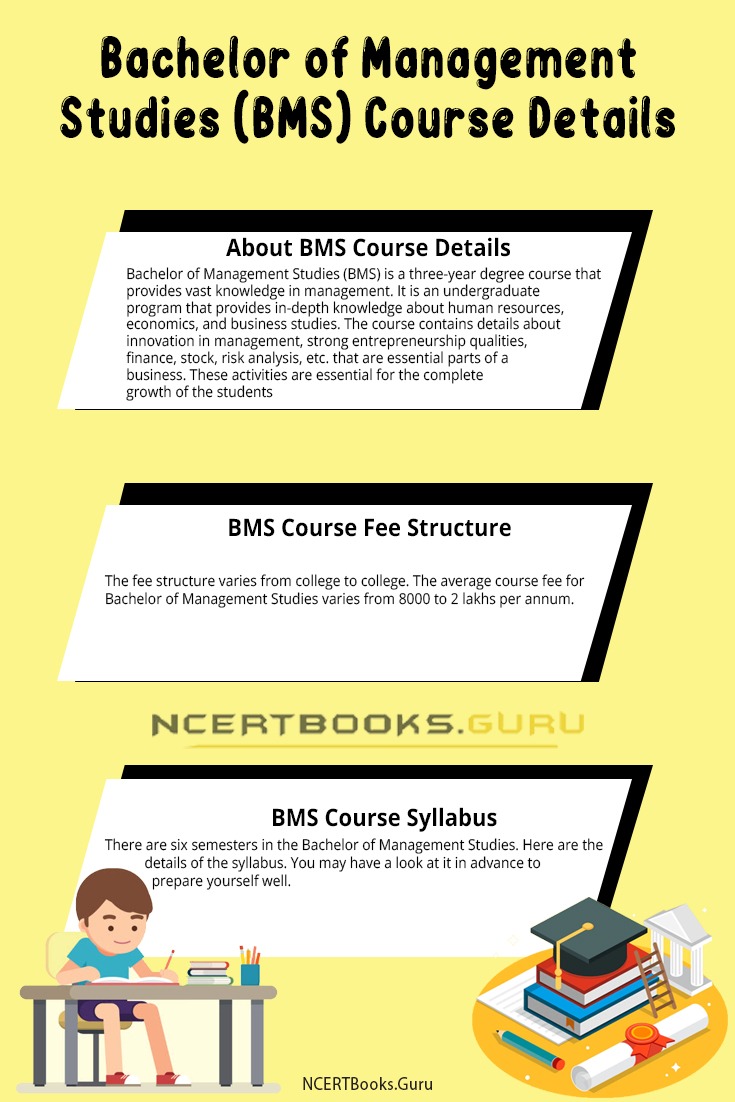
Bachelor of Management Studies (BMS) is a three-year degree course that provides vast knowledge in management. It is an undergraduate program that provides in-depth knowledge about human resources, economics, and business studies. The course contains details about innovation in management, strong entrepreneurship qualities, finance, stock, risk analysis, etc. that are essential parts of a business. There are multiple training sessions and co-curricular activities in this course. These activities are essential for the complete growth of the students.

This course helps the students to get prepared to face difficult challenges in business. This course also helps those students who are interested in starting their journey as entrepreneurs. BMS course helps to enhance business, management, problem-solving, and negotiation skills among the students. It is the perfect undergraduate course for those who have a zeal to solve a business’s critical problems and are team players.

Overview of BMS Course Details

Course  BMS
BMS Full-form Bachelors of Management Studies
Eligibility Criteria 12th passed from any recognized board with a minimum of 45% to 50%
Duration 3 Years
Fee Structure Under 1.5 Lakhs
Course Type Undergraduate Program
BMS Course Salary 3LPA to 12LPA
Admission Process Merit or Entrance Exam based
Examination Type Semester
Top Recruiting Areas Business Firms, Academic Institutions, Marketing and Sales, Banks, Finance and Retailing, Self-Employment, Consultancy, etc.

Subjects in BMS Degree

The contents of this degree are mentioned below. Those interested in this degree course can look at the details mentioned below to get an advance idea on the course.

  • Strategic Management.
  • Managerial Economics.
  • Bank Strategy and Management.
  • Entrepreneurship.
  • Introduction to International Business.
  • Leadership and others.

List of Top Colleges in India Offering BMS Course

Here, we are mentioning some top listed colleges that are offering BMS undergraduate courses. You can choose the best college according to your preference. It is always better to research the college before joining it.

  • Shaheed Sukhdev College of Business Studies, Delhi
  • Shiv Nadar University, Greater Noida
  • Wilson College, Mumbai
  • Indsearch, Pune
  • St Xavier’s College, Kolkata
  • University of Delhi, Delhi
  • Jai Hind College, Mumbai
  • HR College of Commerce and Economics, Mumbai

See More:

BMS Undergraduate Course and Eligibility

One can join this course after completing 10+2 from a recognized board with 45% to 60%. The percentage differs depending on the college. Candidates willing to join this course must have English as a compulsory subject in their high school. The age limit for the general category is 22 years. However, the age limit is 24 years for reserved category.

BMS Course Fee Structure

The fee structure varies from college to college. The average course fee for Bachelor of Management Studies varies from 8000 to 2 lakhs per annum.

BMS Admission Procedure

Candidates can take admission in this course by giving entrance exams such as UGAT. Some colleges take direct admissions based on the candidate’s merit. Suppose you need to fill up the application form of the particular college, either online or offline. After that, you will get a call or email from the concerned authority. Then you should follow their instructions for further procedure.

BMS Course Duration

The duration of this course is three years. Most of the colleges have three years degree course on BMS. You should check the exact duration from the college’s website.

BMS Course Syllabus

There are six semesters in the Bachelor of Management Studies. Here are the details of the BMS Course Subjects. You may have a look at it in advance to prepare yourself well.

Semester I

  • Foundation of Human Skill ( Part 1 )
  • Finance and Cost Accounting
  • Business Law
  • Quantitative Methods for Business ( Part 1 )
  • Effective Communication ( Part 1 )
  • Principles of Management ( Part 1 )
  • Introduction to Computers

Semester II

  • Foundation of Human Skill ( Part 2 )
  • Industrial Law
  • Computer Application in Business
  • Business Environment
  • Managerial Economics ( Part 2 )
  • Production Management
  • Environmental Management

Semester III

  • Management Accounting
  • Managerial Economics ( Part 2 )
  • Marketing Management
  • Materials Management
  • Effective Communication ( Part 2 )
  • Principles of Management ( Part 2 )
  • Management Accounting

Semester IV

  • International Marketing
  • Elements of Direct and Indirect Taxes
  • Export-Import Procedures and Documentation
  • Management of Small Scale Industries
  • Productivity and Quality Management
  • Public Relations Management
  • International Marketing

Semester V

  • Human Resource Management
  • Service Sector Management
  • Financial Management
  • Elements of Logistics Management
  • Management of Co-operatives
  • Rural Marketing
  • Project Work

Semester VI

  • Entrepreneurship
  • Quantitative Method of Business ( Part 2 )
  • Indian Management Thought and Practices
  • Marketing Research
  • Econometrics or International Finance (Elective Paper – 1)
  • Special Study in Finance or Special Study in Marketing (Elective Paper – 2)
  • Project Work

BMS Job Profiles

After completing a Bachelor of Management Studies, you can have a lot of job opportunities. So, you will have a bright career. Some job opportunities are mentioned below :

  • Business Consultant
  • Finance Manager
  • Human Resource Executive
  • Teacher
  • Market Research Analyst
  • Budget Analyst
  • Marketing Manager
  • Project Manager

BMS Course Details

Salary Offered After BMS

The average salary offered after completing BMS is 3LPA to 12LPA, depending on the company and position. However, it also varies depending on the merit and personality of an individual.

FAQ’s on BMS Course Details

Question 1.
What are the popular specializations of Bachelor of Management Studies?

Answer:

The popular specializations for BMS are Entrepreneurship, Catering Science & Hotel Management, Leadership and Innovation, Marketing, and Service Management.

Question 2.
What is the duration of the BMS Course?

Answer:
Most of the colleges offer a three-year degree course on BMS (Bachelor of Management Studies).

Question 3.
Who can pursue this course?

Answer:
Anyone from Science, Arts on Commerce background, after completing class 12 with a minimum of 45% marks can apply for this course. However, the criteria of percentage differ from college to college.

Question 4.
What is the career scope of BMS in India?

Answer:
BMS has a very well career scope in India. Because nowadays, every Indian company wants to hire candidates with a management background for different positions of their organization. You may have an excellent corporate career. You can also pursue higher studies like PGDM, MBA, MMS, and other certificate and diploma courses after completing BMS ( Bachelor of Management Studies ).

Summary

We believe that the information provided above will help many students who have recently completed their school and are looking for a good job oriented course. For any other queries, you may reach out to us via the comment section. Stay connected with us to know more about different courses after 12th in detail.
MA Political Science Course Details | Eligibility, Syllabus, Admission, Fees, Duration, Salary

MA Political Science Course

MA Political Science Course: The MA Political Science Course is the right course if you’re seeking to build a career in the humanities stream. With a great curriculum and highly qualified professors in any institute, this course will make you qualified in one of the most important fields of study in the contemporary world, international relations, alongside Indian polity.

Get to Know More about other types of Course Details in Stream wise, and Category wise.

MA Political Science Course Details

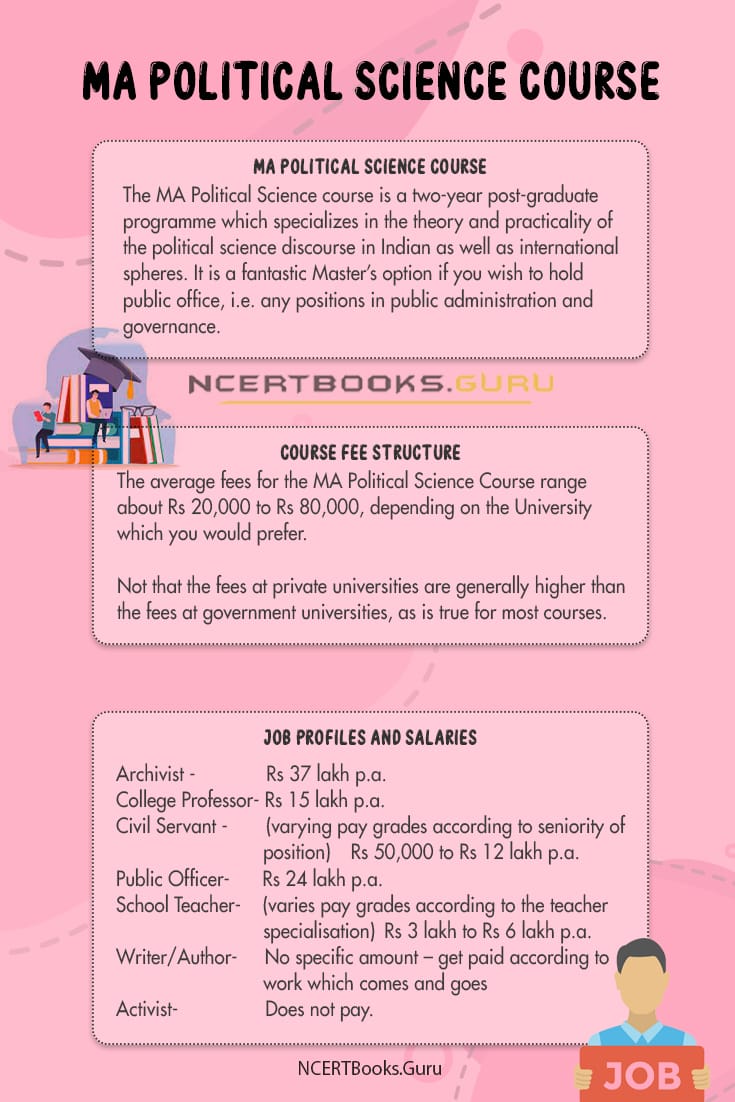
The MA Political Science course is a two-year post-graduate programme which specializes in the theory and practicality of the political science discourse in Indian as well as international spheres. It is a fantastic Master’s option if you wish to hold public office, i.e. any positions in public administration and governance.

To enhance your knowledge about the processes of public policy, public administration, international relations, political theory, and other related spheres, the Master of Political Science course is the apt course for you.

MA Political Science Course Overview

Course name Master of Arts in Political Science
Course duration 2 years
Eligibility 50% minimum marks for BA in the qualifying test, 60% minimum marks for other Bachelor courses in the qualifying test
Syllabus/curriculum Public Administration, International Relations, Comparative Politics,
MA Political Science Course Fees Rs 20,000 to Rs 80,000
Job opportunities Academician, educator, teacher, bureaucrat, public official, etc.
Average salary Rs 50,000 to Rs 37 lakh p.a.
Top colleges JNU, BHU, IGNOU, BU, LPU, OU, etc.

About MA Political Science Course

The MA Political Science course aims to educate all of its students in the various sub-disciplinary facets of the subject of Political Science. This includes Indian and as well as International Contemporary political thought. It strives to show students how to apply their theoretical knowledge of political frameworks to understand and approach the subject is a fruitful manner. Additionally, the Master’s in Political Science course aims to develop a variety of skills in students through textual analyses and varied forms of learning.

MA Political Science Course Eligibility Criteria

The eligibility criteria for the MA Political Science course are both merit-based as well as entrance-test-based.  Bachelor’s degree is a must – while Arts or Humanities Bachelor degrees are preferable, other Bachelors are welcome to apply as well.

The following is the eligibility criteria for the MA Political Science course:

Admission Category Course Requirement Marks Requirement
Entrance Any BA degree (BA Hons/BA Programme/BA Pass/BA Degree) from a recognised university. Minimum 50% marks in the last qualifying examination
Any Bachelor’s degree (BSc, BCom, BTech, etc.) from a recognised university. Minimum 60% marks in the last qualifying examination
Merit BA Hons in Political Science Minimum 60% marks

MA Political Science Admission Process

The admission process for the MA Political Science Course is fairly simple. The first thing to do is to fill up the application form to sign up for the entrance test. The following are some of the entrance tests for MA Political Science according to the top universities under which the course falls. While these universities have entrance exams, they also have respective merit-based systems, as mentioned earlier.

  • Banaras Hindu University Postgraduate Entrance Test (BHU PET)
  • Jawaharlal Nehru University Entrance Exam (JNUEE)
  • Delhi University Entrance Test (DUET)
  • Osmania University Common Entrance Test (OUCET)
  • Sharda University (Online) Admission Test (SUAT)
  • Xavier Aptitude Test (XAT)

Once you have cleared the entrance exam, you will be shortlisted by colleges on the basis of your results. If you do not make the first cut-off list, wait for the next, and so on.

After shortlisting comes the final admission round for admission to the Master of Arts in Political Science course. The final admission round consists of the following three components to further assess the abilities of MA Political Science aspirants:

  • Group discussion (GD)
  • Written ability test (WAT)
  • Personal interview (PI)

MA Political Science Syllabus PDF/Curriculum

The MA Political Science course curriculum consists of about 80 credits spread out over its four semesters. This includes core courses, electives, skill-based compulsory courses as well as open electives. The final assessment consists of the theory exams (70 marks), internal assessments (30 marks) and your dissertation (100 marks), which together hold a culminatory value of 200 marks.

The semester-wise breakdown of the syllabus of the course is as follows:

Semester I – 20 credits

  • Debates in Political Theory (5)
  • Theories of International Relations (5)
  • Politics in India (5)
  • Themes in Indian Political Thought (5)

Semester II – 18 credits

  • Comparative Political Analysis (5)
  • Administrative Theory (5)
  • The third and fourth papers in the second semester of MA Political Science consist of 2 open elective papers of 4 credits each. There are a cumulative 10 open elective papers from which a student can choose.

Semester III

The third semester of MA Political Science consists of 4 elective papers of 5 credits each. These papers can be chosen by students from the 71 elective options available to them under the sub-disciplines of International Relations, Public Administration, Political Theory, Indian Political Thought, Indian Politics and Comparative Politics

Semester IV

  • 4 more electives of 5 credits each.
  • Skill-based compulsory course: Applied Political Science (2)

List of Electives

Ethics and Politics Indian Strategic Thought Key Ideas in Contemporary Critical Theory in India Ambedkar in Contemporary India Gandhi, Autonomy and Discourse
Dalit-Bahujan Thought Contemporary Explorations in Tagore Discourses on Hindu Nationalism Culture and Politics in India Social Conservatism in India
Global Justice and the South Politics and Ethnic Conflicts in J&K Identities and Political Transformation in India Nationalism in Comparative Perspective The Politics of Identity in Comparative Perspective
Themes in Citizenship Democracy and Human Rights in India Religious Nationalism and Political Violence Society, State and Politics: Comparing India and Israel The State in Diverse Political Traditions
Theory and Practice of Democracy Development Process and Politics in India Constitutionalism in Comparative Perspective Politics of South Asia in Comparative Perspective Social Movement and Revolution
Critical Traditions in Political Theory The Modern State in Comparative Perspective Comparative Federalism: Theory and Practice Security Studies The Politics of Violence in South Asia
State Politics in India Indian Polity in State-Society Interactions Elections and Electoral Process in India Public Institutions and Governance Institutions, Development and Poverty
Democracy and Violence: Contestation, Convergence and Discourse Social Exclusion: Theory and Practice Pakistan and the World State and Society in Pakistan Gender in International Relations
Law, Crime and Politics in India Collaborative Governance Transforming Engagements in Public Management Corporate Citizenship and Governance: Theories and Practices Political in Local Governance Environmental Policies & Politics
Politics of Knowledge Marx’s Politics: Labour, Equivalence, Rights Politics and Psychoanalysis Political Theology Debates Black Radical Tradition
Comparative Political Theory Egalitarianism: Theory and Practice Theorizing the Politics of Diversity Interpreting Indian Classical Texts Modern Indian Political Thinkers
Regions and Regionalism India in World Affairs Power Transition and the Dynamics of Foreign Policy in International Relations Conflict Analysis ‘Worlding’ International Relations: Perspectives from the Global South
Islam and International Relations International Relations of South Asia The United States of America in the Transforming Global Order China’s Role in the Contemporary World Citizenship and Borders
North America in Comparative Perspective Contemporary Debates in Indian Federalism Political Parties and Party system in India International Political Economy Key Texts in Political Philosophy
Public Policy

List of Open Electives

Ethics and Governance Understanding the International Political Institutions and Processes in India Gender Studies Security: An Interdisciplinary Discourse
Development Environment Human Rights: Challenges and Concerns Research Methods in Political Science Digital/Social Media and New Public

MA Political Science Course Fee Structure

The average fees for the MA Political Science Course range about Rs 20,000 to Rs 80,000, depending on the University which you would prefer.

Not that the fees at private universities are generally higher than the fees at government universities, as is true for most courses.

The quality of education in India for MA Political Science courses remains impeccable due to the large number of highly qualified Humanities academicians produced in our country. Thus the fee is in accordance with the same.

List of MA Political Science Colleges in India

Please note that most universities in the country offer the MA Political Science course. For your information, the following is a list of the best institutions which offer the Postgraduate Political Science Course:

  • Indira Gandhi National Open Univerity (IGNOU)
  • Jawaharlal Nehru University (JNU)
  • Amity University, Noida
  • Delhi University (DU)
  • St Joseph’s College (Autonomous) (SJC)
  • Bangalore University (BU)
  • Lovely Professional University (LPU)
  • Jadavpur University
  • OP Jindal Global University
  • Banaras Hindu University
  • Osmania University
  • St Xavier’s College
  • Sharda University

Also, Find

MA Political Science Job Opportunities and Salaries of a MA Political Graduate

As a MA Political Science course graduate, there are several appropriate job profiles for you with their salaries listed for you below:

Jobs Average Salary
Archivist Rs 37 lakh p.a.
College Professor Rs 15 lakh p.a.
Civil Servant (varying pay grades according to seniority of position) Rs 50,000 to Rs 12 lakh p.a.
Public Officer Rs 24 lakh p.a.
School Teacher (varies pay grades according to the teacher specialisation) Rs 3 lakh to Rs 6 lakh p.a.
Writer/Author No specific amount – get paid according to work which comes and goes
Activist Does not pay

MA Political Science Course

FAQ’s on MA Political Science Course

Question 1.
What are the eligibility criteria for an MA Political Science course?

Answer:
If you wish to apply for an MA Political Science course, you require to have a Bachelor’s degree from a recognised university. If you have a Bachelor of Arts degree, then the marks requirement is 50% or more for the qualifying exam. If you are the holder of any other Bachelor’s degree other than of Arts, you need to score 60% or more in the qualifying exam.

Question 2.
What is the MA Political Science course duration?

Answer:
MA Political Science courses are two-year post-graduate courses which are spread over four semesters.

Question 3.
What is the average fee for the MA Political Science course?

Answer:
The average fees for the MA Political Course widely range between ₹20,000 and ₹80,000.

Question 4.
Which colleges offer the MA Political Science course?

Answer:
Indira Gandhi National Open University, Jawaharlal Nehru University, Amity University, Delhi University and St Joseph’s College (Autonomous) are some of the institutions which offer Political Science Master’s.

Question 5.
What kind of jobs does an MA in Political Science open up?

Answer:
With an MA in Political Science, you can be a schoolteacher, college professor, archivist, civil servant, public office holder, activist and political writer. The salary ranges between Rs 50,000 and Rs 37 lakh per annum, depending on the job.

Top Web Designing Courses Online | Web Designing Courses Types, After Class 12

Web Designing Courses

Web Designing Courses: Web Designing has gained momentum and popularity as a career in the last few years. During the other times, Web Designing courses remained limited. Only limited institutions offered courses in or related to Web Designing.

The present-day has evolved and holds numerous institutions that provide various formats for Web Designing in India. A few of these can be short-term courses with high salary or long-term courses.

Web Designing courses often come in pairs or bundles with other relevant Computer courses as combos. A few examples are Web designing with visual effects, web designing with animation, web designing with multimedia, web design with graphics, etc.

This article on Web Designing courses will be of help to those students that are interested in pursuing a web designing course. Given below are a few best web designing courses that you can pursue after class 12. This article will provide details regarding the curriculum, admission process, syllabus, and available career opportunities.

What is Web Designing or Web Developing?

Web designing is a process of designing and creating internet portals, or entities, and websites. It encompasses different aspects like graphic design, content production, and webpage layouts.

The modern-day Web designing goes beyond aesthetics and functionality. It is not just limited to websites but has expanded to other mediums such as mobile apps, user interface, and web apps. Web Designing is also not restricted to structure and layout. It also works with technical aspects such as coding, Provides uniques brand identity, works with optimization, performance, and hosting.

Web Designing is a subdivision of Web development, and often Web designing and web development are interchangeable.

Scope of Web Designing

Web designing is a short-term, job-oriented course that provides enormous opportunities for students in the work field.

  • Web designing sees scope in private and public organizations for their website development and online work.
  • With the advent and the rapid growth of the online industry, there holds a high demand for professional web designers. This considerable demand keeps increasing at a fast rate and has created massive opportunities for graduates.
  • Web Designing provides business opportunities, whether big, medium or small, to create a robust online presence.
  • An experienced person in the field of Web designing can work as a freelancer. Many online companies provide projects to individual experienced people. Web designing offers skillful opportunities for self-employment individuals.
  • Web designing has created a platform with numerous projects and jobs. It only needs creativity and talent to make significant and score to achieve ample job opportunities.
  • Web Designing or developing offers work for Multi-National Companies(MNC) type sectors.

Skills Required to Succeed in Web Designing

A good web designer should possess the following skills to achieve great heights.

  • Visual Design skills: These skills come handy with color psychology, grid systems, type hierarchy, typography, web fonts, and color palettes.
  • User Experience: A user experience skill is required to enhance navigation, CTAs, colors, content, etc.
  • Print Designing skills: This skill improves the website’s traffic and helps designers create an offline marketing campaign.
  • Resource: This skill leverages designing tools such as Adobe Illustrator, Photoshop, Adobe Animate, and Adobe After Effects.
  • Communication Skills: This skill helps the designer or developer effectively convey the technical information in clear language.
  • Proactivity and Creativity: This skill helps to create and contribute their ideas and solutions.
  • Time-Management Skills: This skill is essential to present the work on the respective deadlines.
  • Computer knowledge:  A web designer must have strong computer knowledge to navigate throughout.
  • Knowledge about coding languages: A web designer must have experience in coding languages such as CSS, Python, HTML, Java, etc.
  • Learning about relevant software: A web designer or developer must know software such as Adobe Illustrator, Adobe Photoshop, WordPress, Sitebuilder, etc.

Types of Web Designing Courses

In India, web designing courses offer three main formats. They are:

However, among the three formats, as mentioned above, the Bachelor’s Degree courses are highly valued. The Diploma courses follow this, and finally, the certificate courses have the least value.

Web Designing Courses Offered in India

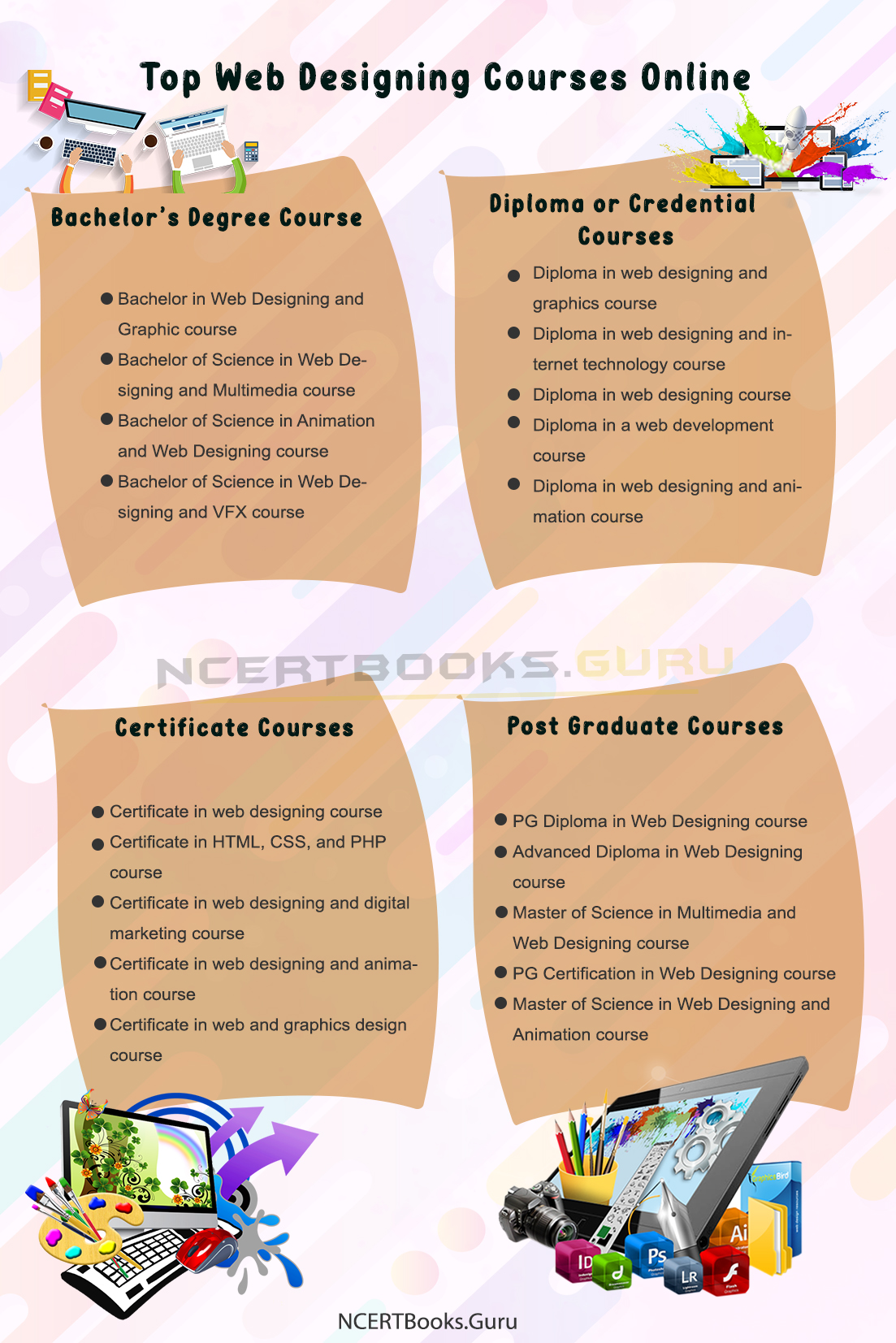
Bachelor’s Degree Course

The following are the Web Designing courses offered in the Bachelor’s Degree:

  1. Bachelor in Web Designing and Graphic course
  2. Bachelor of Science in Web Designing and Multimedia course
  3. Bachelor of Science in Animation and Web Designing course
  4. Bachelor of Science in Web Designing and VFX course

Diploma or Credential Courses

The following are the Web Designing courses offered in Diploma:

  1. Diploma in web designing and graphics course
  2. Diploma in web designing and internet technology course
  3. Diploma in web designing course
  4. Diploma in a web development course
  5. Diploma in web designing and animation course

Certificate Courses

The following are the Web Designing courses offered in Certificate Courses:

  1. Certificate in web designing course
  2. Certificate in HTML, CSS, and PHP course
  3. Certificate in web designing and digital marketing course
  4. Certificate in web designing and animation course
  5. Certificate in web and graphics design course
  6. Certificate in web designing and 2D animation course
  7. Certificate in web designing and internet technology course
  8. Certificate in a web development course

Post Graduate Courses

Apart from the three main entries, here are a few Postgraduate courses that offer web designing courses in India:

  1. PG Diploma in Web Designing course
  2. Advanced Diploma in Web Designing course
  3. Master of Science in Multimedia and Web Designing course
  4. PG Certification in Web Designing course
  5. Master of Science in Web Designing and Animation course

Web Designing Courses Duration

  • The Bachelor’s Degree Course in web Designing requires about three years to complete.
  • The Diploma Course in Web Designing requires about two years to complete.
  • The Advanced Diploma Courses in Web Designing requires about a year to complete.
  • The Certificate Course in Web Designing requires Eighteen months to two years to complete.
  • The Post Graduate Courses in Web Designing requires two years to complete.

Web Designing Course Fees

Web Designing Course Fees structure in India is around INR 5,000 to INR 3,00,000. It many vary from college to college and course level.

Web Designing Courses Eligibility Criteria

  • To complete for any of the courses as mentioned above, the candidate must have completed class 10 and class 12 from a recognized institution and board of Education.
  • The Admission process in particular institutions that are available for the courses in Web Designing is done based on entrance exams such as UCEED, NATA, etc.
  • The Post Graduate degree and diploma courses will be available for those students who have completed their three-years Undergraduate courses in the field of Web Designing.

Also, Read:

Web Designing Courses

Web Designing Course Syllabus

  • Mathematical Structure for Computer Science
  • Basics of Web Designing
  • Web Technologies
  • Multimedia & its Applications
  • Adobe Flash
  • Computer Graphics
  • HTML CSS
  • JavaScript
  • Softwares Animation Techniques
  • Introduction to Web Design & Applications
  • Adobe Dreamweaver
  • Bootstrap
  • Graphic Designing

Web Designing Career Opportunities

An Individual report states that the employment opportunities for Web designing courses have a projected growth rate of 20 percent from 2012-2022. The modern period is driven by the growing demand and popularity of e-commerce and mobile devices.

The average pay for a Web designing course graduate is around INR 268,631 per annum. However, if the graduate posses an additional E-commerce skill, they are associated with high pay for the job. Experience play as a significant influencer in the income section for this job. Any of the Web designing courses provide top position jobs after ten years of experience growth. Also, check best designing courses in India.

Career opportunities for Web Designing course graduates include:

  • Game developer
  • UX researcher
  • UX designer
  • Web Designer
  • Web developer
  • Multimedia Programmer
  • Application Developer
  • Web content Manager
  • Multimedia Specialist
  • SEO Specialist
  • Front-end developer
  • UI designer
  • Motion designer

However, there are specific other jobs that Web Designing courses would also be useful. They include:

  • IT sales professional
  • Database administrator
  • Software Engineer
  • Systems Analyst
  • Artworker
  • Software tester
  • Information systems manager
  • Technical author

FAQ’s Web Designing Courses

Question 1.
Who can apply for Web Designing courses?

Answer:
Those aspirants who have completed their 10+12 from a recognized board with basic internet knowledge to build a website in the World Wide Web,

Question 2.
What are the needed qualification requirements for Web Designing jobs?

Answer:
A graduate requires creative new ideas, adaptable to learn new techniques, excellent communication skills, relevant Diploma in a related field, proficiency in web programming languages such as HTML and CSS, JQuery, and JavaScript, etc.

Question 3.
What are the employment vacancies for graduates from Web designing courses?

Answer:
A fresh graduate has a scope as a Game developer, UX researcher, UX designer, Web Designer, Web developer, Multimedia Programmer, Application Developer, Web content Manager, Multimedia Specialist, etc.

Question 4.
What is the average salary package for graduates from Web Designing courses?

Answer:
The average web designing course salary is around INR 268,631 per annum. However, if the person posses an additional E-commerce skill and has tremendous experience, they are associated with top pay for the job.

Conclusion

We are hoping that the details given here about Web Designing Course Details are helpful for the students who are interested to pursue Web Designing Course Online. Stay tuned to our site to get the latest updates on other courses.

How to become a Cricket Umpire in India | Requirements for Qualification and Exam

How to become a Cricket Umpire in India

How To Become A Cricket Umpire In India: For many Indians, cricket is more than a sport; it is a passion. On an international level, this sport is extensively played in many nations, and the Indian cricket team has captured the hearts of millions. The Indian cricket team’s most ardent supporters are former captain Mahender Singh Dhoni and current captain, Virat Kohli.

Everyone is aware of the captain and other cricket team members, but have you ever considered the other key responsibilities in the game? Umpires are one of the most important jobs, and they are generally filled by people who have a lot of expertise in these sports.

Refer to Course Details to know more about related courses and find details like Admission Process, Eligibility Criteria, etc.

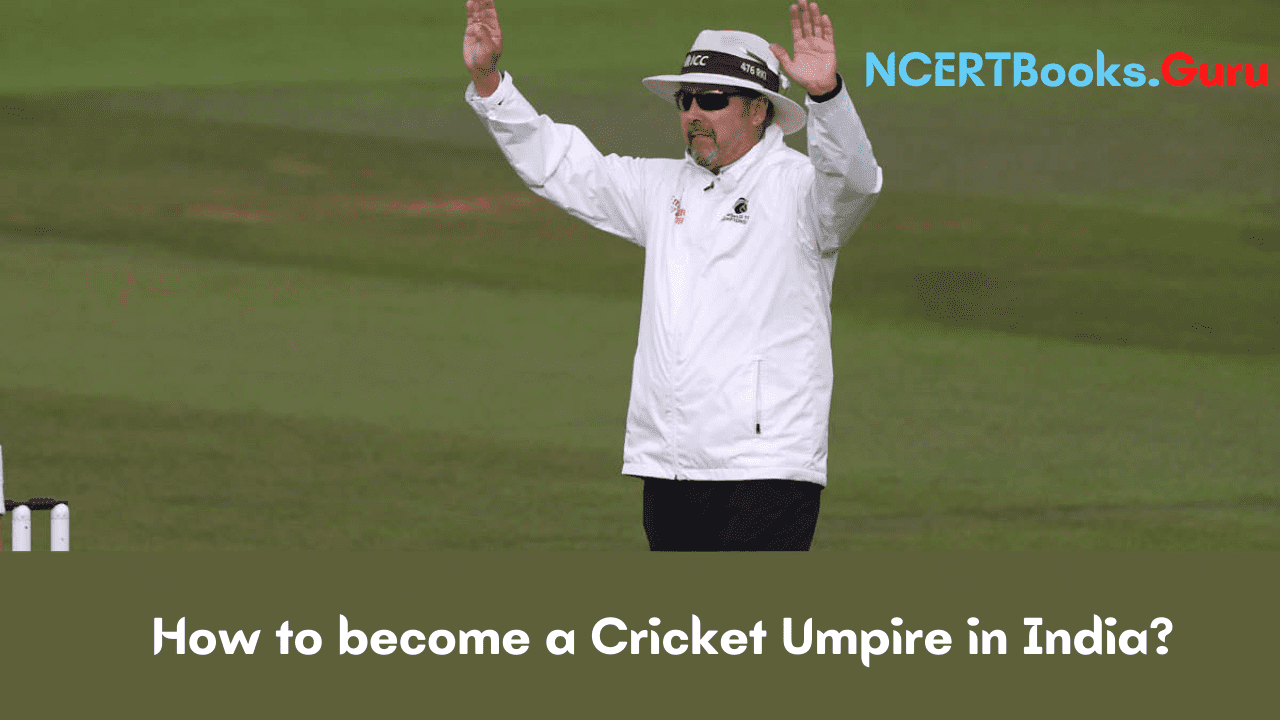
This is a difficult job even though a cricket umpire stands in one spot and looks for no-balls, wide balls, and other things. An umpire generally multitasks and looks for wide balls, no balls, baller feet, LBW, and other things simultaneously.

Requirements for Qualification

Every candidate must meet three fundamental criteria to be considered for the next step in the process. All candidates must go through a series of procedures to be considered, and each step takes time. The following are the minimum qualifying requirements:

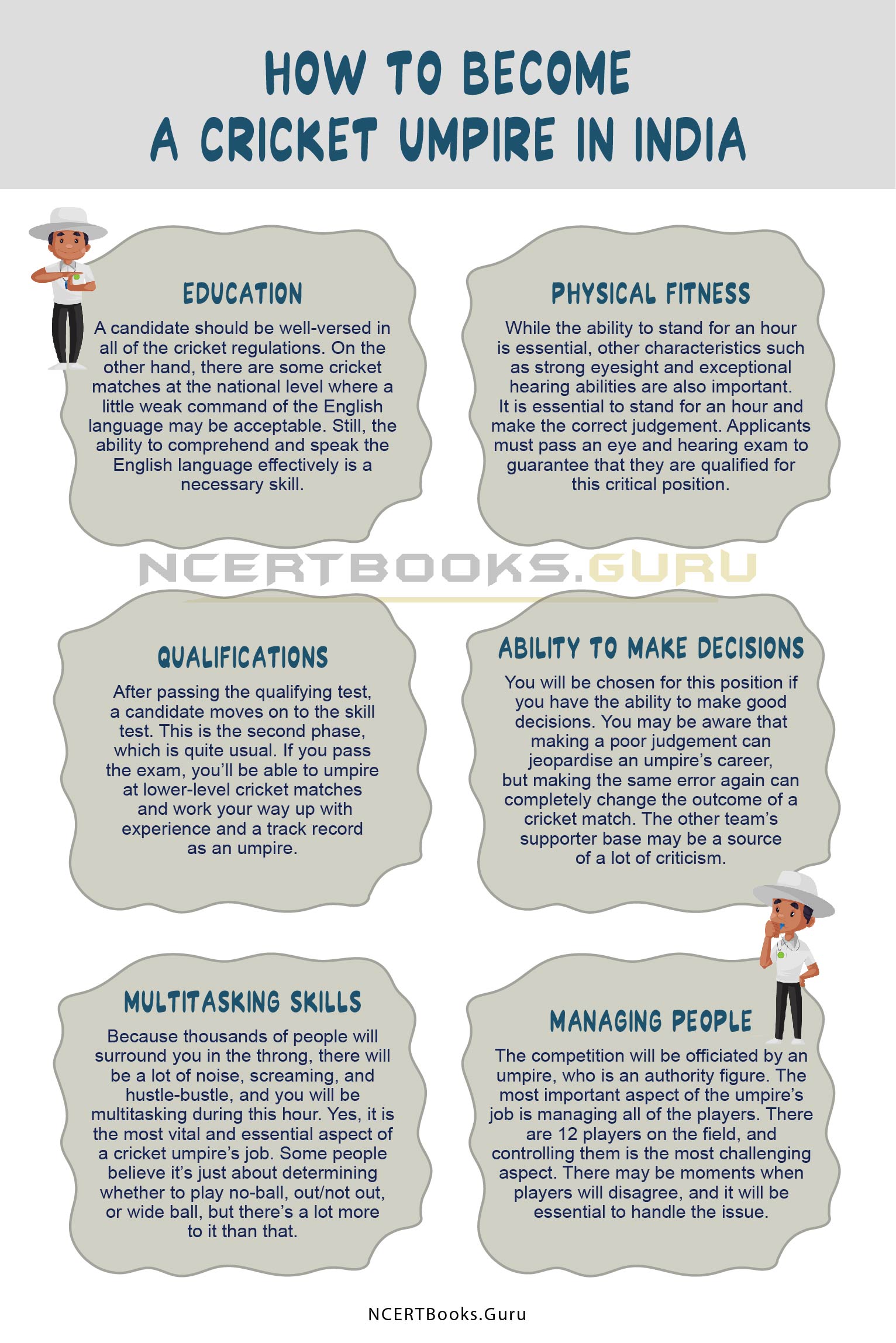
Education

In most cricket sports, all positions are based on abilities. Still, because an umpire is on the field with national and international players, a solid command of the language is required. There are no minimum criteria listed. However, a candidate should be well-versed in all of the cricket regulations. On the other hand, there are some cricket matches at the national level where a little weak command of the English language may be acceptable. Still, the ability to comprehend and speak the English language effectively is a necessary skill.

Physical fitness that is sufficient

As an umpire, you must have a thorough understanding of cricket sports in order to adjudicate a match. You can make the best decision if you have the appropriate information. There are 42 statutes in all, and each candidate must have a deeper understanding of each one. Applicants must pass a theoretical exam, which state sports organizations administer.

While the ability to stand for an hour is essential, other characteristics such as strong eyesight and exceptional hearing abilities are also important. It is essential to stand for an hour and make the correct judgement. When applicants apply for the position of cricket umpire, they must pass an eye and hearing exam to guarantee that they are qualified for this critical position.

The decision to give out or not give out is dependent on the umpire’s analysis. Because the ball moves quickly and focusing on every detail is common, making a mistake is still a risk. In such circumstances, making the wrong judgement might jeopardize a cricket umpire’s career. As a result, making the proper judgment is critical for a long career as a cricket umpire.

Criteria for Qualifications

After passing the qualifying test, a candidate moves on to the skill test. This is the second phase, which is quite usual. If you pass the exam, you’ll be able to umpire at lower-level cricket matches and work your way up with experience and a track record as an umpire. To become a cricket umpire, you must possess the following abilities.

Ability to Make Decisions

A lengthy career as a cricket umpire requires making the correct decisions. However, in order to be chosen, you must possess the same ability. In cricket sports, there are a lot of people rooting for their favorite side, and the audience adds to the excitement. It’s common for umpires to decide on the pressure, and that’s what matters.

You will be chosen for this position if you have the ability to make good decisions. You may be aware that making a poor judgement can jeopardise an umpire’s career, but making the same error again can completely change the outcome of a cricket match. The other team’s supporter base may be a source of a lot of criticism. As a result, making proper decisions is a usual and responsive task.

Making a decision may appear complicated, but doing so in a short period of time is the most difficult challenge. It will also impact your job if you are unable to make a decision in a few seconds (20 to 40 seconds). As a result, an umpire does not have enough time to ponder or seek the third umpire for help. He must make a calculated decision.

At the same time, the umpire can concentrate on reviewing a replay of the same ball, checking for no-balls and other errors, and concluding. However, the entire operation should not take longer than 30 seconds. Now you know how much pressure a cricket umpire has to deal with during a game of cricket.

Multitasking skills

Because thousands of people will surround you in the throng, there will be a lot of noise, screaming, and hustle-bustle, and you will be multitasking during this hour. Yes, it is the most vital and essential aspect of a cricket umpire’s job. Some people believe it’s just about determining whether to play no-ball, out/not out, or wide ball, but there’s a lot more to it than that.

The umpire will first examine the baller’s feet to verify that he does not breach the line, then the ball height. If both conditions are satisfied, the umpire must determine whether the ball made contact with the bat or leg pad. Are you able to see where we’re going? Yes, you can multitask in a matter of seconds

Managing People

The competition will be officiated by an umpire, who is an authority figure. The most important aspect of the umpire’s job is managing all of the players. There are 12 players on the field, and controlling them is the most challenging aspect. There may be moments when players will disagree, and it will be essential to handle the issue.

Cricket is a sport, and no sport can exist without a high level of adrenaline. Conflict is more likely, and dealing with all of the difficulties is part of good people management. Multiple players must be managed at the same time, and this ability is generally taught during the course.

Check More:

Exam for Umpire Certification

To be considered for the position, you must take and pass the umpire credential exam. There are numerous multiple-choice questions, and the curriculum is available on the state board’s official website. Some candidates sit for other state cricket board exams in order to improve their chances of being chosen.

This approach does work, but you will be traveling a lot throughout the cricket season. Being in the same state appears to be a reasonable option. The umpire certificate examination consists of three phases that must be completed in order to pass. After passing all of the exams, you must go to the next phase, which is serving as an umpire in state-level cricket tournaments.

How to become a Cricket Umpire in India

FAQs on How To Become A Cricket Umpire In India?

Question 1.
How can I become a BCCI cricket umpire in India?

Answer:
In the world of cricket, you’re the next great thing. You have the potential to become the future voice of Indian cricket fans. Like Indian cricket fans, you desire to be a member of the International Cricket Council (ICC) and become a member of the International Cricket Council (ICC). Do you wish to work as a cricket umpire for the BCCI in India? This blog post may provide you with step-by-step instructions on how to become a BCCI cricket umpire in India.

Question 2.
What is the pay of a cricket umpire?

Answer:
In the world of cricket, you’re the next great thing. You have the potential to become the future voice of Indian cricket fans. Like Indian cricket fans, you desire to be a member of the International Cricket Council (ICC) and become a member of the International Cricket Council (ICC). Do you wish to work as a cricket umpire for the BCCI in India? This blog post may provide you with step-by-step instructions on how to become a BCCI cricket umpire in India.

Question 3.
What are the steps to becoming a professional cricket umpire?

Answer:
Being a cricket umpire is a fantastic career that allows you to officiate in some of the world’s most prestigious cricket matches. Umpiring equipment is also something that requires some effort to obtain. So, in this post, I’ll attempt to address some frequent umpiring questions and assist aspiring cricket umpires in selecting the appropriate equipment for their forthcoming matches.

Conclusion on How To Become A Cricket Umpire In India?

To become a BCCI cricket umpire, you must complete all of the steps listed above. The road to BCCI is difficult and requires years of expertise. The best thing is that by focusing on quality umpiring and experience, you may quickly achieve this level. If you enjoy cricket and have played it frequently, you may be able to find work as a BCCI umpire with ease.

We have tried include all the necessary informations. Still, if you need any more help or support you can write us on the comment section below. We wish you the best of luck as a cricket umpire.

Post Graduate Diploma in Business Analytics Course Details | Eligibility, Admission, Colleges, Job Prospects, Salary

Post Graduate Diploma in Business Analytics

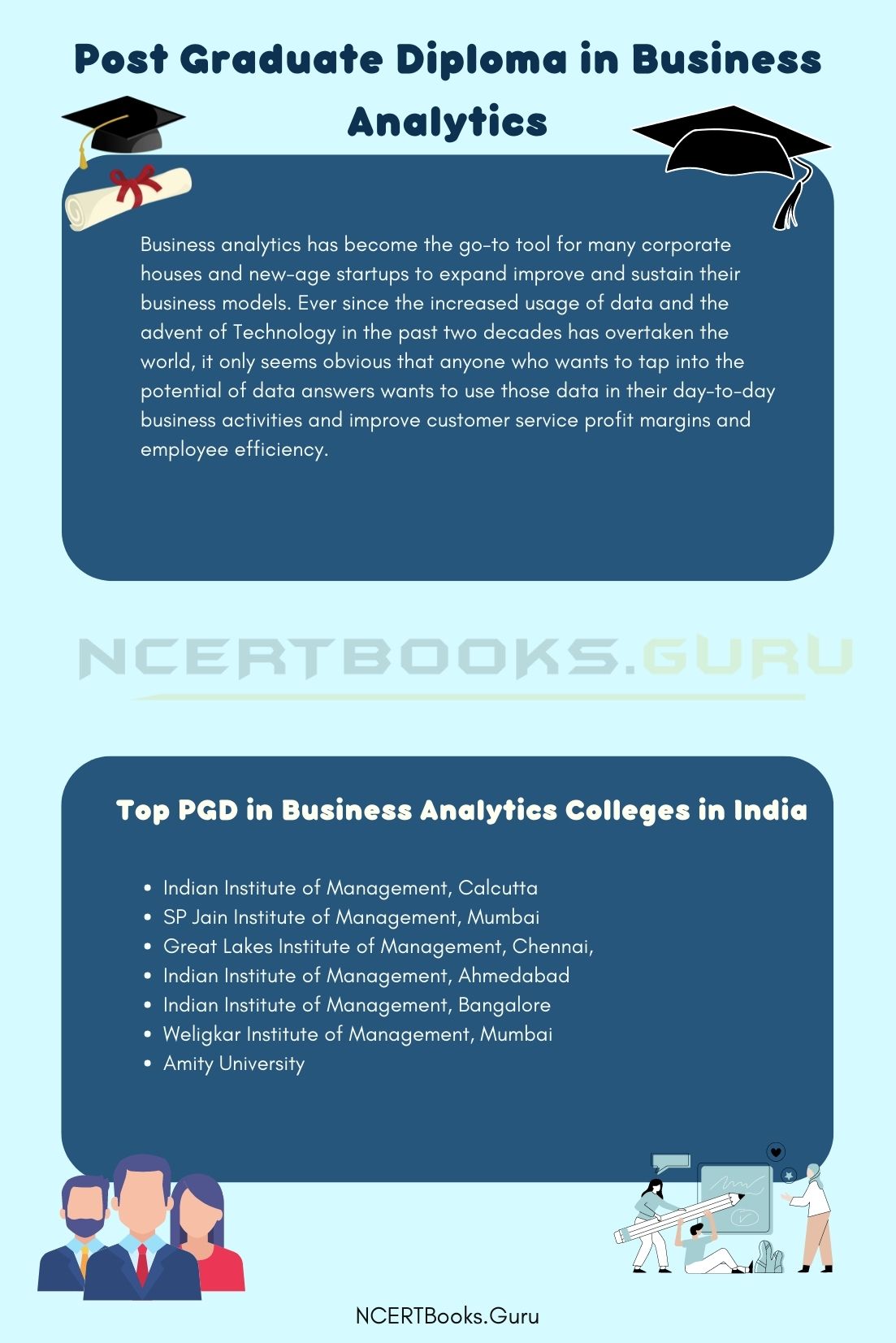
Post Graduate Diploma in Business Analytics Course: Business analytics has become the go-to tool for many corporate houses and new-age startups to expand improve and sustain their business models. Ever since the increased usage of data and the advent of Technology in the past two decades has overtaken the world, it only seems obvious that anyone who wants to tap into the potential of data answers wants to use those data in their day-to-day business activities and improve customer service profit margins and employee efficiency.

With the increased usage and generation of data across the world, it is only obvious that business houses and corporate entities want to use this data to learn more about the market trends customer service, and other elements used for improving their businesses. With this thought process in mind, a brand new area in Business Administration has propped up which is known as business analytics where the team uses raw data generated from the market to refine and filter it as per the business revision and goal to help take the proper business in management information systems.

And hence a postgraduate diploma in business analytics or for that matter any course in the field of business analytics has been termed as the Next Big thing after software engineering and most of the top universities in the world such as the Harvard University or stand for University has predicted that the employability of business analytic managers will be twice or authorized than any other field in any industries across the world. With this in mind without much delay letters dig deep into the nuances of the course of the postgraduate diploma in business analytics.

Get to Know More about other types of Course Details Streamwise, and Category wise.

What is Post Graduate Diploma in Business Analytics?

A Post Graduate Diploma in Management in business analytics course or PGDM in business analytics is a two-year course offered by many b schools and universities across India which is either approved by the All India Council for Technical Education AICTE or the association of Indian universities. Bhojraj diploma in business analytics is an equivalent to a master’s in Business Administration or MBA degree and the below points will help you summarise the overview of a business analytics postgraduate diploma in management:

  • A diploma in management is a 2-year course offered by colleges and universities approved by the All India Council for Technical Education
  • The crux of the syllabus and pedagogy of a postgraduate diploma in management and business analytics is the usage of data-driven insights in business decisions and the application of technology that can be used in different organizational set-ups
  • A PGDM in Business Analytics is one search unit course that is a combination of science engineering mathematics and arts which in today’s world is extremely necessary to take a comprehensive decision in Business organizations
  • PGDM in business analytics as a course is designed to prepare students to become leaders in a new age of startups which is completely data-driven and the business model itself is sustainable
  • Students are thought implementing of monitoring and application of big data strategy in day-to-day business activities.

Now that we have a fundamental overview of a poster diploma in management and business analytics let us understand what the course is about in the subsequence sections of this article on PGDM in business analytics in India. However, before we jump into the course syllabus and pedagogy details of PGDM in business analytics letters understand why one should pursue this course?

Why should you do PGDM in Business Analytics?

A PGDM in business analytics is an attractive course that is an amalgamation of the theories of arts, science, and management. The below points should help aspirants understand why they should pursue their career in the field of PGDM in Business Analytics:

  • Abundant Job Opportunities: PGDM in Business Analytics is in demand across the spectrum of industries, irrespective of whether it’s a manufacturing industry, service industry, agriculture industry, or a government organization. The need for business decision making based on real-time activity data has already done wonders for many new-age companies such as Uber or Amazon and the future is just taking the cue from the present
  • High Return on Investment: The average tuition fee to do a Post Graduate Diploma in Business Analytics in India from any of the top tier B schools in India such as the IIMS, SP Jain’s, etc, will cost approximately Rs. 10 lakhs to Rs. 15 lakhs. Whereas, two years down the lane, after completion of the course, the same student will get placed with a package of Rs. 15 per annum on average. The return on investment in this course will always be more than one and it’s a good investment to make in one’s career.
  • Top Recruiting Companies: some of the base companies in the world such as Google Facebook Amazon run their business decisions based on real-time data and the recruiting companies for postgraduate diplomas in business analytics students will be multinational companies with deep pockets and hands a student will easily get placed in big companies after their graduation. Some of the big companies in India that I have a postgraduate diploma in management and business analytic students are Infosys started a consultancy services IBM Godrej Reliance Tata group Flipkart del Technology etc.
  • Career Stability: since the whole world is moving towards databased business decisions for the next century business analytics will be the center of all the companies towards sustainability and profitability in hands of a business analytics manager will have a stable career stable growth.

PG Diploma in Business Analytics Admission Procedure

The admission procedure for Post Graduate Diploma in Management for Data Analytics is:

  • A student has to give an entrance examination such as CAT, NMAT, XAT, or any other public or private MBA degree entrance tests.
  • Upon clearance of the cut off set by colleges of the aspirant’ desire, students shortlisting will be in colleges for subsequent procedures such as group discussion and personal interview
  • Upon clearing group discussion and personal interview (conducted by particular colleges, under its sole discretion), a candidate might be offered a seat for a diploma in Business Analytics by the college authorities.
  • While the above procedure is the same more or less across the colleges, especially their one and their two colleges, certain their 3 colleges offer direct admission to students and induct them into their course.

Also, Refer

Post Graduate Diploma in Business Analytics(PGDBA) Eligibility Criteria

  • A candidate should have an undergraduate degree in any stream with a minimum aggregate of 50% in the final year of undergraduate.
  • The degree certificate should be from a recognized board in India.
  • A candidate should have cleared his or her MBA entrance examination with the required cut offset by different universities
  • A candidate should have no live backlogs in his or her undergraduate degree

Post Graduate Diploma in Business Analytics Syllabus

  • The course is designed for 2 years with 4 semesters ( 2 semesters for each year)
  • Students have to pass examinations each semester
  • There will be a compulsory industry internships programs that a student should pursue and score well to get the Diploma certificate
  • The entire teaching methodology is a case study based pedagogy

Post Graduate Diploma in Business Analytics 1

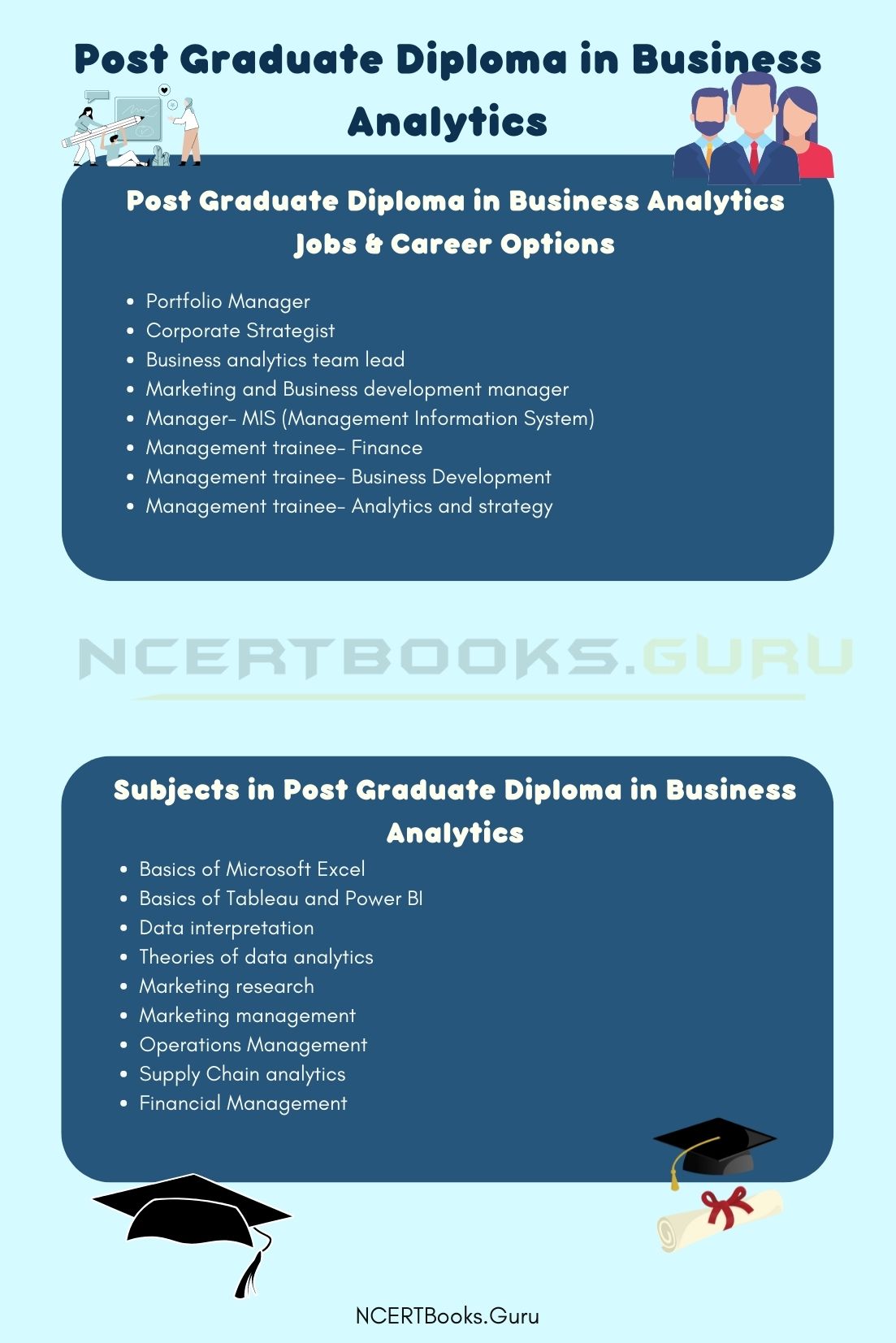
Subjects in Post Graduate Diploma in Business Analytics

  • Basics of Microsoft Excel
  • Basics of Tableau and Power BI
  • Data interpretation
  • Theories of data analytics
  • Marketing research
  • Marketing management
  • Operations Management
  • Supply Chain analytics
  • Financial Management
  • Stochastic modeling
  • Data modeling
  • Communication theories
  • Microeconomics
  • Macroeconomics
  • HRM analytics

Top PGD in Business Analytics Colleges in India

  • Indian Institute of Management, Calcutta
  • SP Jain Institute of Management, Mumbai
  • Great Lakes Institute of Management, Chennai,
  • Indian Institute of Management, Ahmedabad
  • Indian Institute of Management, Bangalore
  • Weligkar Institute of Management, Mumbai
  • Amity University

Post Graduate Diploma in Business Analytics

Top Recruiting Companies for Post Graduate Diploma in Business Analytics

The following industries are the top recruiting ones looking to hire business analytics managers

  • Pharmaceutical Industries such as Aurobindo, Pfizer, Johnson and Johnson, Divis Laboratories, etc.
  • Information Technology industry Infosys, Amazon, TCS, Accenture, etc.
  • Automobile industries such as Hyundai, Honda, Tesla, Toyota, Mercedes Benz, Volkswagen, etc.
  • Online and offline retail Industries such as Amazon Retail, Flipkart, Walmart, Seven Eleven, Target, Ratnadeep, etc.

Post Graduate Diploma in Business Analytics Jobs & Career Options

A student after his or graduation from a post-graduate diploma in business analytics course will end up in the following positions through either on-campus placements or off-campus placements. Check different courses after MBA.

  • Portfolio Manager
  • Corporate Strategist
  • Business analytics team lead
  • Marketing and Business development manager
  • Manager- MIS (Management Information System)
  • Management trainee- Finance
  • Management trainee- Business Development
  • Management trainee- Analytics and strategy
  • Service and product portfolio manager
  • Data consultant
  • Business Analyst

FAQ’s on PGD in Business Analytics

1. What is the average fee to do Post Graduate Diploma in business analytics Online?

The average tuition fee to pursue a Postgraduate Diploma Course in Business Analytics is anywhere between INR 6 lakh or INR 10 lakh at any of the top MBA institutes in the country such as the IIMs.

2. Which is the top B School in India to pursue a Postgraduate Diploma in Business Analytics?

Indian Institute of Management, Calcutta is considered the top college in the country to pursue a PGDM course in. business analytics.

3. What is the average placement pay package for Post Graduate Diploma in Business Analytics?

The average pay package in B schools such as IIMs for a PGDM in Business Analytics varies from Rs. 12 lakh per annum to Rs. 40 lakh per annum. However, the average salary in tier 2 or tier 3 B schools varies from Rs. 6 lakhs per annum to 15 lakhs per annum.

4. What is the difference between PGDM in Business Analytics and regular PGDM?

The main difference between PGDM in Business Analytics course and regular PGDM is the type of subjects thought to students. The course for PGDM in business analytics is designed such that the entire course revolves around data interpretation, data-driven business decisions, and data refining and analysis while the regular PGDM course is mainly for general management theories.

Architecture Courses in India (Degree & Diploma) – Career Options for Architects After 10th & 12th

Architecture Courses

Architecture Courses in India: If you are passionate about Constructing a building, roads, dams, apartments, and designing a restaurant or houses, then here is the best career for you is to become a well-skilled Architect. To become an architect, all you need to choose is the best Architecture courses after completing your 10th or 12th standard. Here, we have provided a list of Degree, Diploma Courses in Architecture After 10th & 12th along with the count of total colleges offers these courses.

Apart from the details of the courses, you can also view more information about Career opportunities, job types, qualities, and skills needed for architects in this article. So, let’s dive into the “Architecture Courses in India – Career options after 10th & 12th” article by using the below links.

Contents In This Article:

About Architecture Course

Architecture course boosts up your creative, innovative skills towards your art talent to become an architect. It mainly focuses on developing the required skills & talents. Architecture is all about the process and product of planning, designing, and constructing buildings or any other structures.

With the help of architecture courses, students will learn about how to construct commercial buildings, airport terminals, highway construction, malls, complexes, and civil construction by applying their innovative ideas and analytical skills. In addition to this, the course teaches the theory part and practice of the designing process and along with the commercial drawing techniques. If you want to learn the full-time course in Architecture then it takes a 2-5 year time period to become an architect.

Most of the colleges & universities offer this Architecture courses for deserved students. All these colleges provide Bachelor’s Degree B.Arch, B.Plan, B.Tech Civil Engineering, Master Degree M.Sc, M.Tech, M.Phil, M.Arch, Ph.D. in Architecture courses for the qualified students in JEE Mains or NATA entrance exams.

Also, there are Major Courses in Architecture like Green Architecture/Sustainable architecture, Landscape Architecture, Museum Architecture, Naval Architecture, and Theatre Architecture, students can opt for gaining more knowledge about Architecture. If you need more info like career prospects for architecture graduates then refer to the upcoming modules on this page.

List of Architecture Courses

Avail Architecture Courses List and master the ones as per your interest. Get to know details like Admission Process, Eligibility Criteria, Course Duration, Fees Structure, Jobs, etc. All you need to do is simply tap on the quick links available and know the entire info. List of Best Courses in Architecture are given as under

Architecture Course Duration

The duration of the Architecture course is 2 to 5 years. Also, it takes a total of seven years to become an expert architect. But for the students who took Degree courses like BA or BSc in Architecture can complete within three years. However, other degrees like planning and building are also generally three-year programs.

Eligibility and Qualification to apply for Architecture Course

  • Candidates who are interested to pursue undergraduate courses such as bachelor’s or diploma should pass the 12th standard examination with 50 % marks in PCM (Science).
  • Also, they should qualify for any of the entrance examinations like AIEEE (All India Engineering Entrance Examination) directed by the Central Board of Secondary Education (CBSE) or the National Aptitude Test in Architecture led by the National Institute of Advanced Studies and Architecture.
  • After graduation, they can also opt for postgraduate courses such as master’s in architecture by attaining at least pass marks in architecture graduation course or equivalent.
  • For obtaining Ph.D. courses, aspirants need to pass a master’s degree with 55%.

UnderGraduate, PostGraduate & Doctoral Degree Courses in Architecture in India

If you are looking for the best architecture courses in India after 12th standard, then here is the detailed list of degree courses in Architecture right from Bachelor of Architecture (B.Arch) UG degree course to Ph.D. in Architecture (Doctorate) Course. One of the best courses for doing UG degree in Architecture is B.Arch.

There are huge top-rated colleges/institutes/universities/b-schools offer this B.Arch Course for the qualified candidates in the entrance exams like JEE Mains or NATA. So, check out the table thoroughly and pick the best Architecture course and get a well-settled job in India. As there is massive scope for Architects in India. 

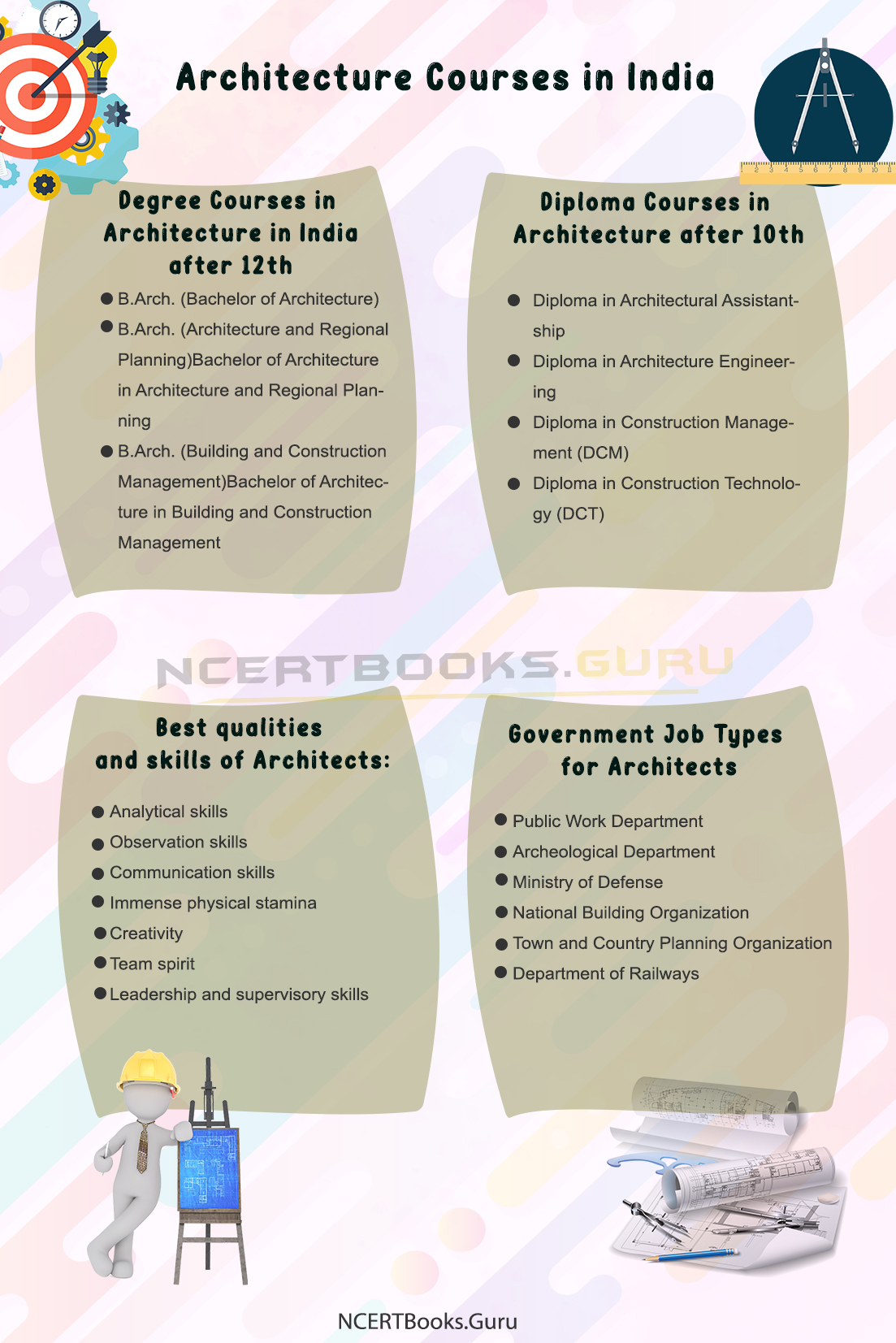
Degree Courses in Architecture in India after 12th

Degree Courses in Architecture Total Colleges
B.Arch. (Bachelor of Architecture)  336
B.Arch. (Architecture and Regional Planning)Bachelor of Architecture in Architecture and Regional Planning  3
B.Arch. (Building and Construction Management)Bachelor of Architecture in Building and Construction Management  3
B.Arch. (Interior Design)Bachelor of Architecture in Interior Design  25
B.Arch. (Landscape Architecture)Bachelor of Architecture in Landscape Architecture  2
B.E. (Construction Technology)Bachelor of Engineering in Construction Technology  7
B.PlanBachelor of Planning  17
B.Sc. (Residential Space Design and Management)Bachelor of Science in Residential Space Design and Management  1
B.Tech. (Urban & Regional Planning)Bachelor of Technology  2
Bachelor of Construction Technology  1
Executive Master of Architecture Advanced Design  1
M.Arch.Master of Architecture  55
M.Arch. (Advanced Design)Master of Architecture in Advanced Design  1
M.Arch. (Architectural and Settlement Conservation)  1
M.Arch. (Architectural Conservation)Master of Architecture in Architectural Conservation  5
M.Arch. (Architectural Design)Master in Architecture in Architectural Design  4
M.Arch. (Building Construction and Management)Master of Architecture in Building Construction and Management  2
M.Arch. (Computer Applications)Master of Architecture in Computer Applications  3
M.Arch. (Construction Management)Master in Architecture in Construction Management  6
M.Arch. (Digital Architecture)Master of Architecture in Digital Architecture  3
M.Arch. (Environmental Architecture)Master in Architecture in Environmental Architecture  4
M.Arch. (Industrial Design)Master of Architecture in Industrial Design  2
M.Arch. (Interior Design)Master of Architecture in Interior Design  3
M.Arch. (Landscape Architecture)Master of Architecture in Landscape Architecture  14
M.Arch. (Theory & Design)Master of Architecture (Theory & Design)  1
M.Arch. (Urban Design)Master of Architecture in Urban Design  12
M.E. (Housing)Master of Engineering in Housing  1
M.E. (Landscape Architecture)Master of Engineering in Landscape Architecture  1
M.E. (Urban Design)Master of Engineering in Urban Design  1
M.Phil. (Architectural and Settlement Conservation)Master of Philosophy in Architectural and Settlement Conservation  1
M.Sc. (Urban and Regional Planning)Master of Science in Urban and Regional Planning  1
M.Tech. (Urban Planning)Master of Technology in Urban Planning  3
Master of Building Engineering and Management  1
Master of Interior Architecture & Design  14
Master of Planning (Environmental Planning)  3
Master of Planning (Housing)  3
Master of Planning (Industrial Area Planning and Management)  1
Master of Planning (Infrastructure)Master of Planning in Infrastructure  2
Master of Planning (Regional Planning)  2
Master of Planning (Rural Planning and Management)Master of Planning in Rural Planning and Management  1
Master of Planning (Transport Planning)Master of Planning in Transport Planning  3
Master of Planning (Urban and Regional Planning)  3
Master of Planning (Urban Planning)Master of Planning in Urban Planning  6
Masters in PlanningMasters in Planning  3
Ph.D. (Architectural Conservation)Doctor of Philosophy in Architectural Conservation  1
Ph.D. (Architecture)Doctor of Philosophy in Architecture  13
Ph.D. (Building Engineering and Management)Doctor of Philosophy in Building Engineering and Management  1
Ph.D. (Environmental Planning)Doctor of Philosophy in Environmental Planning  1
Ph.D. (Housing)Doctor of Philosophy in Housing  2
Ph.D. (Industrial Design)Doctor of Philosophy in Industrial Design  1
Ph.D. (Landscape Architecture)Doctor of Philosophy in Landscape Architecture  1
Ph.D. (Physical Planning)Doctor of Philosophy in Physical Planning  1
Ph.D. (Regional Planning)Doctor of Philosophy in Regional Planning  2
Ph.D. (Transport Planning)  1
Ph.D. (Urban Design)  1
Ph.D. (Urban Planning)  3

Also Read: B.Arch Books

Diploma Courses in Architecture after 10th

Aspirants who want to join architecture courses after completing their 10th standard can take up these mentioned Diploma Courses in Architecture. If you need any assistance like how many colleges offered the particular diploma course, then you must check out this table given below for detailed information about what you are looking for.

Diploma Courses in Architecture Total Colleges
Diploma in Architectural Assistantship  57
Diploma in Architecture Engineering  55
Diploma in Construction Management (DCM)  4
Diploma in Construction Technology (DCT)  4
Foundation Diploma in Architecture and Design (F.D.A.D.)  1
Post Graduate Diploma in Construction Management  2
Post Graduate Diploma in Town – Country Planning  1

Architecture Courses in India

Career Opportunities in Architecture

The scope of architecture is huge in India. Well in the situation where India is developing gradually by developing new companies and firms under the government or private sector. Architects in India have plenty of career opportunities in various architectural firms, universities, consultancy companies, etc. If you compared to the global market, then architecture graduates have attractive jobs in leading international firms such as Atelier Bow-Bow, Leo A Daly, Zaha Hadid, Erick Van Egraat, Dude Architects, etc.

However, Architects also work in nonrelated areas that comprise plumbing, sewerage systems, heating, cooling, ventilation systems, electrical wiring, landscape arrangements, and so on. In some cases, interior architecture and furnishings require to be specified as well. In some firms, the Architect Role would be like Supervising the workers, Fix stipulations for the sites, Tour the sites, Maintain contracts linked to situations, Consider the amount of material, expenditure, and time of completion & many more.

Below are some of the specialized fields in Architecture. Once, have a look at them and know where you can fit as per your skills & expertise:

  • Designing
  • Model making
  • Construction
  • Adjudications
  • Information technology
  • Expert witness
  • Real Estate / Property development
  • Urban and Regional Planning
  • Historic preservation
  • Architectural Journalism
  • Perspectives
  • Production drawing
  • Surveying
  • Contact administration
  • Arbitrators

Best qualities and skills of Architects:

  • Analytical skills
  • Observation skills
  • Communication skills
  • Immense physical stamina
  • Creativity
  • Team spirit
  • Leadership and supervisory skills
  • Organizational skills and flexibility
  • Having keen observation
  • Technical skills
  • Scientific temper
  • Visualization skills
  • Responsibility and accountability
  • Sharp mathematical acumen and dexterity
  • Ability to sketch
  • Good memory along with a high concentration level
  • Up to date with current and social environmental issues

Government Job Types for Architects

We all know there is a better scope for private sectors to hire the architects as they plan for company branches in various parts of India. But nowadays, the government of India also step forward to employ architects on a regular or expert basis to design up their organizations in a high-class level with all needed facilities. To plan accordingly with new technologies, architects are the best. So, some of the leading government organizations who recruit architecture graduates for jobs are provided below:

  • Public Work Department
  • Archeological Department
  • Ministry of Defense
  • National Building Organization
  • Town and Country Planning Organization
  • Department of Railways
  • National Institute of Urban Affairs
  • Post and Telegraphs
  • Public Sector Undertaking
  • Housing and Urban Development Corporations
  • National Building Construction Corporation Ltd.

Also, Check More Articles:

Job Profiles for Architecture Graduates

However, Architect can lead a less stressful life because of the easy work life. There are various job options for graduates in Architecture Courses in India. They can wisely choose their career path with the help of the following job profiles:

  • Manager
  • Architectural Engineer
  • Sales/Business Development Manager
  • Architectural Historian
  • Art Director
  • Architectural Assistant
  • Project Assistant Manager
  • Technical Assistant
  • Architectural Journalist
  • Architecture Designer
  • Building Contractor& Researcher
  • Interior Designer
  • Staff Consultant
  • Landscape Architect
  • Architecture Draftsman
  • Data Analyst

Salary offered for Architects

Candidates who have started their career as a fresher in architecture jobs can earn INR 30-40K per month. Whereas the candidates who gain experience in the field can earn more payment in the range between 1-2 lakh per month. If the candidate passed out from the premier architect colleges/institutes, then they will get high remuneration.

If the candidates are well-deserved and experienced in the architecture field, the private firms pay a massive salary to them. Well, architecture course certified and experienced candidates can also select for international markets like the USA, Canada, Australia, Singapore, Malaysia, and Dubai with huge salary packages.

FAQs on Architecture Courses in India

1. Can I do a diploma in architecture after 10th?

Yes, you can go for an architecture course after your 10th. You can go for Diploma in Architectural Assistantship (3 years). It includes assisting architects with basic building design along with digital drafting and modeling skills.

2. What should I do after 10th to become an Architect?

You can apply for a diploma in Architecture Course right after 10th if you’re interested in drawing or art. Or else, you can opt for the science stream in HSC and prepare for competitive exams such as JEE and NATA, these exams will get admission into good Architecture Colleges in India.

3. How can I become an architect after 12th?

The process to become an Architect after 12th are first you should join degree courses in Architecture like B.Arch Course. For getting admission, you should appear for the NATA exam and score qualifying marks to give admission by the top institutions or B-schools which are offering the B.Arch Course. After completing the course duration apply for the best jobs and become Architect after 12th. Most of the reputed institutions offering B. Arch course will have on-campus placements.

4. Which is better Nata or JEE?

I must admit that the difficulty level of JEE Mains is higher than NATA. The scope of getting admissions to various colleges and institutes is high based on the NATA entrance exam. Based on JEE Mains Paper 2, only NITs and GFTIs institutions give admission in Architecture Courses whereas by NATA you get admission into State Level Colleges, and Private colleges, other than NITs, and IITs.

5. Which course is best for architecture?

Here is the list of 5 Best Architecture Courses & Certification in 2020:

  1. Free Architecture Courses by Universities and Colleges (edX)
  2. Frank Gehry Teaches Design and Architecture (Masterclass)
  3. Making Architecture by IE School of Architecture & Design (Coursera)
  4. Roman Architecture by Yale University (Coursera)
  5. The Architectural Imagination by Harvard University (edX)

6. Is architecture a good career?

Yes, Architecture is one of the best careers in India because Architects’ job satisfaction is considered in terms of upward mobility, stress level, and flexibility. If you are looking for a low-stress level, good work-life balance, and solid prospects to improve, get promoted, and earn higher salary jobs, then Architecture Courses is a good career option.

Conclusion

Analyze the career options available above and select one out of the best Architecture courses where you can excel and contribute to something for the firm or individual. If you have any other suggestions feel free to advise us by commenting below so that we can add to the list & help others to choose their interested Course in Architecture and become an Architect with a huge package of job options.

Share this article with your friends who are interested in the Architecture course and support them with the best possibilities like this. Moreover, you can discover more information about Best Courses & Career Options in India after completion of the 10th & 12th standards by visiting our site Ncertbooks.guru. So, Bookmark it by pressing CTRL+D.