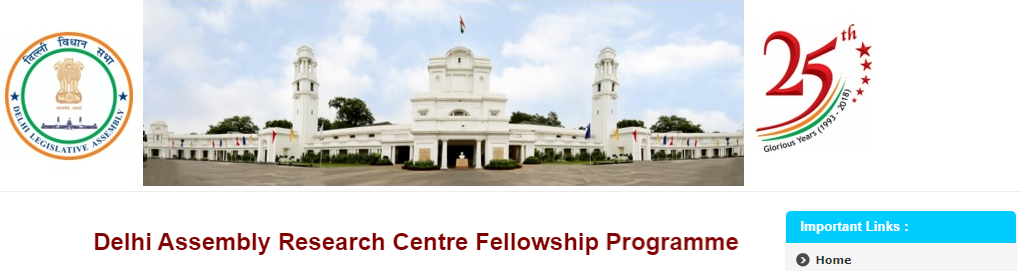
DARC Fellowship 2023-2024: The DARC Fellowship Programme (Delhi Assembly Research Centre) is an initiative of the Legislative Assembly of the National Territory of Delhi. The primary goal of this fellowship is to provide bright and talented individuals the opportunity to work with various legislators and Delhi Assembly Secretariat.
Graduate, Post Graduate Students and Research Fellows can also find more Fellowship Articles to explore various fellowships across India to know the funding opportunities.
Under the DARC Fellowship, selected fellows will be involved in crucial phases of legislation, committees and other related responsibilities. Candidates will also receive a monthly stipend between INR 1,00,000 to INR 60,000. The total tenure of the program is two years, with the first three months being probation. DARC Fellowship selection process involves screening the application and then shortlisting candidates for the interview. Those who clear the interview will be offered a Fellowship/Assistant Fellowship. Read on to find more about Delhi Government Fellowship 2023.
DARC Fellowship Dates
Events
Dates
Application Window Begins from
March 2023 (Tentative)
Last Date to submit an application
March 2023
Announcement of First Shortlist
June 2023 (Tentative)
Final Interviews
To be announced
Announcement of Final list
July (Tentative)
The final date for candidates to select the offer
To be announced
DARC Fellowship Eligibility Criteria
Interested candidates must ensure that they fulfill the following criteria to ensure eligibility:
DARC Fellowship Age Limit: Candidates must be between 21 and 35 years of age as on the date of application.
Educational Qualifications for Fellows
P.hD with a one-year full-time experience (or)
Working professionals such as chartered accountants, company secretaries or architects have a minimum of 2 years experience (post-registration with their respective professional bodies) (or)
Post Graduation with at least 60% marks or equivalent and minimum full-time work experience of 2 years. (or)
Graduates with at least 60% marks and minimum full-time work experience of 4 years.
Educational Qualification for Associate Fellows
Post Graduation with at least 60% marks or equivalent. (Or)
Working professionals such as chartered accountants, company secretaries or architects that are registered with their respective professional bodies. (Or)
Graduates with at least 60% marks and minimum full-time work experience of 1 year.
Educational Qualification for Associate Fellows (Media)
Post Graduation or Diploma in Journalism or Mass Communication with at least 60% marks or equivalent. (Or)
Graduation in Journalism or Mass Communication with at least 60% marks or equivalent and full-time work experience of 1 year.
DARC Fellowship Benefits
Selected Fellows and Associate Fellows will be presented with an opportunity to be a part of the Delhi Assembly Research Centre (DARC).
Also, Fellows and Associate Fellows will be involved in crucial phases of legislation, committees and other related tasks.
Selected Fellows will receive a consolidated monthly stipend of INR 100,000. Assistant Fellows will receive a monthly stipend of INR 60,000.
DARC Fellowship Application Process
DARC Fellowship apply to follow the following steps:
Interested candidates are required to visit the official site at http://www.darc.dtu.ac.in/ and select register.
Post-registration, you will be provided the login credential, which must be saved for future reference.
Fill in the application form with the relevant details.
Upload the prescribed documents.
Submit the application form.
DARC Selection Process
Stage 1 – Screening/Shortlisting of Online Application: The first round is shortlisting of candidates will be done on the basis of academic performance, professional qualifications, the credibility of the institution, motivation for the FPM and their response to personal statement ( in the form of an essay) total year and relevance of work experience.
Shortlisted candidates will be called for interview.
Stage 2 – Personal Interview: The final round will consist of a face to face interview with a panel comprising experts from academia and civil society and officers. Candidates will be interviewed either in person in Delhi (preferred) or through video conferencing.
FAQ’s On DARC Fellowship
Question 1. What is the official website to access the DARC Fellowship application form?
Answer: Candidates can visit the official DARC website at http://www.darc.dtu.ac.in/ and select register to initiate the application process.
Question 2. What is the stipend amount given to the Fellows?
Answer: Selected Fellows will receive a consolidated monthly stipend of INR 100,000 and Assistant Fellows will receive a monthly stipend of INR 60,000.
Question 3. What is DARC Fellowship?
Answer: DARC Fellowship (Delhi Assembly Research Centre) is an initiative of the Legislative Assembly of the National Territory of Delhi.
A company’s highest-ranking executive is the Chief Executive Officer (CEO). Although the role of the CEO varies depending on the company, the CEO’s main responsibilities will include setting the company’s overall direction and managing its operations and resources.
Basically, the CEO is a person who is primarily in charge of the company, and his or her decisions can have a major impact on its way. The position carries a lot of power and even more responsibility, and it usually comes with a lot of money. Because of this, many people would wish to become CEO in India and if you are among them, then this article is for you. This article discussed how to become a CEO in India, educational qualifications, salary, and job opportunities. Read on to find more.
The eligibility criteria and educational qualifications to become a CEO in India are given below:
A candidate aspiring to become a CEO in India will have to clear his or her bachelor’s degree in business or economics.
After completing Bachelors’s degree, he/she should complete a Master of Business Administration (MBA) or similar post-graduate qualification.
How to become a CEO in India?
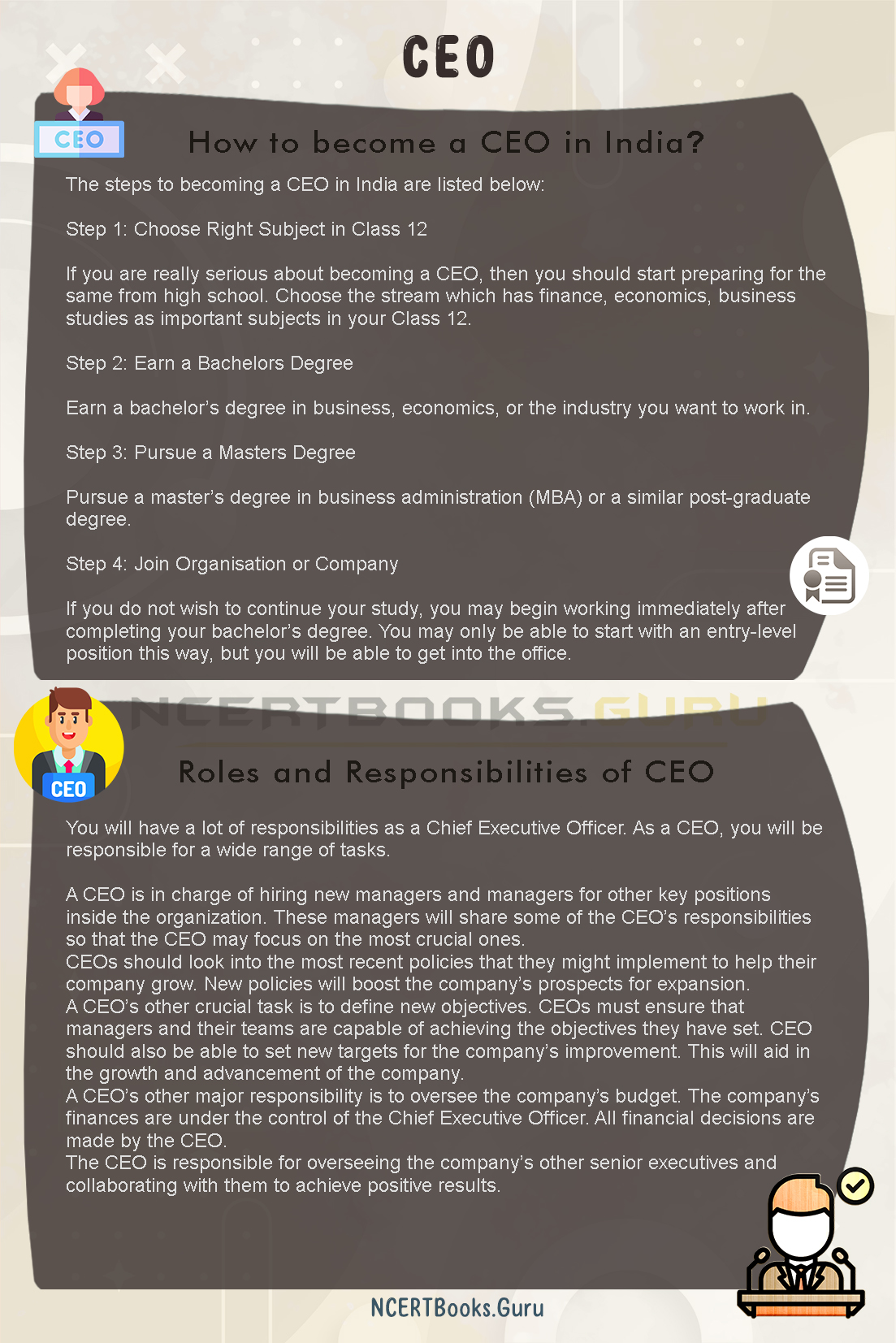
The steps to becoming a CEO in India are listed below:
Step 1: Choose Right Subject in Class 12
If you are really serious about becoming a CEO, then you should start preparing for the same from high school. Choose the stream which has finance, economics, business studies as important subjects in your Class 12.
Step 2: Earn a Bachelors Degree
Earn a bachelor’s degree in business, economics, or the industry you want to work in. For that, you should now take your entrance exam and enroll in college, where you will complete your bachelor’s degree. A bachelor’s degree in management courses, such as Bachelor of Business Administration or Bachelor of Business Management should be completed.
Step 3: Pursue a Masters Degree
Pursue a master’s degree in business administration (MBA) or a similar post-graduate degree. This means that after finishing your bachelor’s degree, you should enroll in the best management college. The names of the colleges or universities where you earned your degree may also be important. You should pursue a master’s degree in marketing, accounting, business administration, or business analytics.
Step 4: Join Organisation or Company
If you do not wish to continue your study, you may begin working immediately after completing your bachelor’s degree. You may only be able to start with an entry-level position this way, but you will be able to get into the office.
Work your way up through a firm or gain substantial leadership experience across a variety of industries. Demonstrate your ability to lead and manage a business or a business unit within a large organization at the senior management and executive levels. In small and medium businesses, you can become a CEO with as little as 10-15 years of experience, however, in larger businesses, you will need 20-25 years of industry expertise.
We have created a rundown of different course details such as eligibility, admission, job profiles, salary offered, etc.
Roles and Responsibilities of CEO in India
You will have a lot of responsibilities as a Chief Executive Officer. As a CEO, you will be responsible for a wide range of tasks.
A CEO is in charge of hiring new managers and managers for other key positions inside the organization. These managers will share some of the CEO’s responsibilities so that the CEO may focus on the most crucial ones.
CEOs should look into the most recent policies that they might implement to help their company grow. New policies will boost the company’s prospects for expansion.
A CEO’s other crucial task is to define new objectives. CEOs must ensure that managers and their teams are capable of achieving the objectives they have set. CEO should also be able to set new targets for the company’s improvement. This will aid in the growth and advancement of the company.
A CEO’s other major responsibility is to oversee the company’s budget. The company’s finances are under the control of the Chief Executive Officer. All financial decisions are made by the CEO.
The CEO is responsible for overseeing the company’s other senior executives and collaborating with them to achieve positive results.
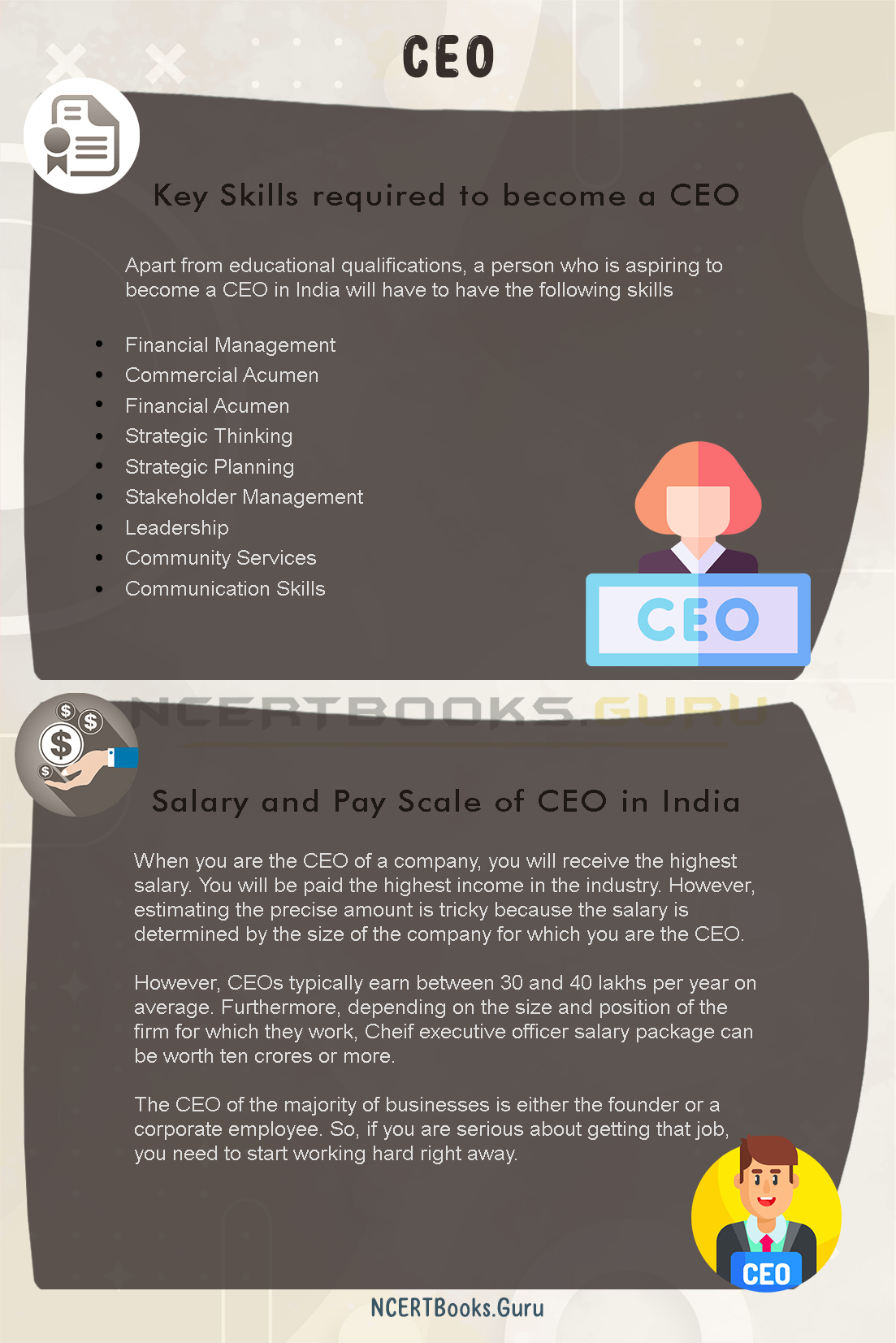
Key Skills required to become a CEO in India
Apart from educational qualifications, a person who is aspiring to become a CEO in India will have to have the following skills
When you are the CEO of a company, you will receive the highest salary. You will be paid the highest income in the industry. However, estimating the precise amount is tricky because the salary is determined by the size of the company for which you are the CEO.
However, CEOs typically earn between 30 and 40 lakhs per year on average. Furthermore, depending on the size and position of the firm for which they work, Cheif executive officer salary package can be worth ten crores or more.
The CEO of the majority of businesses is either the founder or a corporate employee. So, if you are serious about getting that job, you need to start working hard right away.
FAQs on How to become a CEO in India
1. How to become a CEO after the 12th?
Becoming a CEO requires a great level of education, years of experience, and the capacity to lead a business overall. Becoming a CEO directly after the 12th is only achievable if your family has a business and you are going to grasp the position with that effect. However, we recommend you to follow the hierarchy mentioned on this page to become a CEO in India after Class 12.
2. What is a CEO Salary in India?
In India, the average annual salary for a CEO is Rs. 24,00,000.
3. How to become a CEO of a Company in India?
To become the CEO in an organization or company, one needs to get a bachelor’s degree, relevant experience, and abilities, as well as demonstrate their value to the company.
Arts Courses after 10th: You must have heard that your career opportunities would be better if you had chosen commerce or science. But now in the 21st century, the arts are gaining importance. There are numerous courses which you can pursue in the art domain and build a good career for your better future.
If you are also one of those who are searching for the Best Arts Courses after the 10th then you are at the right place. Here, in the below article we are providing you detailed information about the eligibility, top courses list, duration, fees, job profile, career scope, and a lot more related to art courses.
Arts is one of the traditional streams which is still a popular choice among the students. The art courses consist of humanities, visual arts, performing arts, literary arts, language courses, history, law, geography, political science, and a lot more. Due to these various options, students can choose the best suitable course for them.
Even the arts include various subjects which help the students in preparing for the highest honor exam such as civil services. In arts, the courses after 10th are job oriented which helps the students to build a better future.
Outline for Arts Courses after 10th
The highlights for the after 10th arts courses will help you to get an idea about the details included in the article.
Courses offered
Certificate
Diploma
Admission Criteria
Merit or Entrance Based
Education Criteria
Must have cleared class 10th with minimum 50% marks from recognized board
Average Fees
Rs 20,000 to Rs 10,00,000
Average Salary
Rs 2,00,000 to Rs 5,00,000
List of Courses after 10th Standard
After the completion of class 10th, you may look for various career options. You can pursue a Diploma and various kinds of certificate courses such as fine arts, Hindi, spoken English, Functional English, and a lot more. You may find detailed information about the top courses after 10th in arts.
Course
Duration
Course Type
Fee structure
Certificate Course in Functional English
6 months
Must have cleared class 10th
Rs 3,200 to Rs 8,500
Certificate Course in Spoken English
6 months to 1 year
Rs 10,100 to Rs 45,500
Certificate in Hindi
1 year
Rs 1,500 to Rs 2.5 Lacs
Diploma in Fine Arts
1 year
Rs 10,200 to Rs 15,500
Fine Arts Courses after 10th
After the completion of class 10th, you can build your career in fine arts after choosing fine arts courses. These courses can be pursued in the domain of Graphic Design, Sculpture, etc. There are various diploma and certificate courses related to fine arts which you may pursue.
Here, below the table, you may find the detailed list of fine arts courses along with the fee structure.
Course Name
Duration
Average Fees
Certificate Course in Drawing and Animation
8 months
Rs 20,000
Certificate Course in Fine Arts
3 months
Rs 55,000
Certificate in Crafting Creative Communications (CCC)
1 year
Rs 8,50,000
Certificate in Performing and Visual Arts
1 year
Rs 7,000
Certificate in Plate Making and Offset Printing
1 year
Rs 3,450
Certificate in Visual Arts: Applied Arts (CVAA)
1 year
Rs 3,600
Certificate in Visual Arts: Sculpture (CVAS)
1 year
Rs 4,000
Arts Courses after 10th Without Maths
Some students find maths a difficult subject. For them the are numerous courses designed without maths. You may pursue the certificate and diploma courses in these respective fields.
The arts stream offers numerous short-term courses which can easily be completed in the time of 3 months to 1 year. These courses are beneficial in both senses if you are willing to run your own business or want to work with the top companies. You are expected to pay a minimal amount for the completion of the courses.
Below the table, students may find the detailed list of top short-term courses after 10th in arts.
Courses
Fee
Course Duration
Admission Procedure
Beautician and hairdressing courses
Rs. 4,000 to Rs.20,000
3 months to 1-year
Direct admission
Diploma in Food Technology
25,000 to 50,000 per year
3 years
Entrance Test
Direct admission
Event Management
Rs. 20,000 to Rs. 1,00,000
6 months to 1 year
Merit-based
Graphic Design
Rs. 10,000 to Rs. 50,000
6 months to 8 months
Merit-based or
Direct admission
Social Media Marketing
Rs. 35,000 to Rs. 45,000
6 months to 12 months
Direct admission
Arts Diploma Courses after 10th
The diploma is a quote popular choice among the students when it comes to studying a degree course after the 10th. If you are willing to pursue the art courses in diploma after 10th then you may have numerous options. These Diploma courses offer you lucrative career opportunities and a sound salary structure.
Also, the students have the option can choose diploma courses in various subjects such as language, management, design, beauty, and a lot more. You may also find the top colleges which are offering diploma courses. From the below list students can identify some of the top arts diploma courses after the 10th in detail.
Courses
Duration
Diploma in 3D Animation
1 year
Diploma in Audio Video Editing
6 months – 1 year
Diploma in Beauty Culture and Hair Dressing
1 -2 years
Diploma in Communication Design
1 – 3 years
Diploma in Digital Marketing
3 months – 1 year
Diploma in Drawing
1-year
Diploma in Education Technology
1 year
Diploma in Event Management
1 year
Diploma in Fashion Designing
1 -2 years
Diploma in Fine Arts
1 year
Diploma in Fire Safety
1 year
Diploma in Foreign Language
1 year
Diploma in Hotel Management
3 years
Diploma in Interior Design
1 year
Diploma in Journalism
1 – 2 year
Diploma in Kitchen and Catering
1 year
Diploma in Multimedia and Animation
1 year
Diploma in Painting
1 year
Diploma in Performing Arts
1 year
Diploma in Photography
1 year
Diploma in Physical Education
1 – 2 year
Diploma in Printing and Publishing
1 – 2 year
Diploma in Radio Jockey
1 year
Diploma in Script Writing
1 – 2 year
Diploma in Travel and Tourism
1-year
Diploma in Video Shooting
6 months – 1 year
Arts Courses After 10th Subjects
Arts courses are termed one of the easiest degrees. But it’s not true there are various practical and difficult subjects which you may find difficult. Here, in the below list the most popular subjects offered in the art degree are defined. You may choose the best suitable subject for you.
Psychology
History
Sociology
Mathematics
Home science
English
Physical education
Hindi
Geography
Political science
Computer science
Public administration
Fine arts
Economics
Music
Top Institutes for Arts Courses after 10th Class in India
For the courses, after the 10th you may find a huge list of colleges all over India. But choosing the best colleges according to education, training, and provided skills is a big task. So, here we are providing you with a detailed list of top colleges for arts courses after the 10th in India.
VLCC Institute of Beauty and Nutrition
Digital Academy India
ADMEC Multimedia Institute
Atharva School of Business, Mumbai
Walchand College of Engineering, Sangli
Lovely Professional University, Phagwara
India Institute of Technology, Chennai
Gujarat Technological University, Ahmedabad
Government Polytechnic Lucknow
Indira Gandhi National Open University, New Delhi
University of Delhi, New Delhi
Techno India University, Kolkata
Government Polytechnic, Nagpur
Government Polytechnic, Mumbai
King George’s Medical University, Lucknow
Amity University, Chennai
Government Polytechnic, Pune
Swarnim Startup and Innovation University, Gandhinagar
The Delhi Skill and Entrepreneurship University
the University of Mumbai, Mumbai
Jamia Millia Islamia ( JMI ) University, New Delhi
Rai University, Ahmedabad
The Maharaja Sayajirao University of Baroda
Savitribai Phule Pune University, Pune
Career Scope and Job Opportunities After 10th Arts Courses
You can easily build your career after the completion of arts stream courses based on your class 10th marks. There are various options as you can run your own business or after the completion of a diploma degree, you may look for job options in various companies. Due to unlimited options, students can make the equilibrium choice.
There are various job options available for you after the completion of courses. A few of these career opportunities which are available around the world are listed below.
Salary Structure in Arts Stream Courses after 10th
In the beginning, the salary offered ranges between Rs 2 to Rs 5 lakhs. But with the experience and knowledge, you will see a surge in the salary structure.
Job
Average Salary (per annum)
Fashion Designer
Rs 3 Lakhs
Photographer
Rs 3.3 Lakhs
Filmmaker
Rs 5 Lakhs
Beautician
Rs 3.5 lakhs
Content Writer
Rs 2 Lakhs to Rs 4 Lakhs
Social Worker
Rs 2.9 Lakhs to Rs 4 Lakhs
FAQs on Arts and Humanities Courses after 10th
1. Is the Arts course good to pursue after 10th?
Arts is one of the best career options which students can pursue after 10th. There is a never-ending list of courses in the arts stream which you can pursue. It will be a good choice for the students.
2. What are the skills required for the Arts courses after 10th?
Skills are very important for any job. So, some of the important skills for art students are Critical Thinking and Problem-Solving Skills, Communication Skills, Creative and Innovative Skills, Leadership Skills, Organisation Skills, Adaptability Skills, Time Management, Teamwork and Collaboration Skills, Learning Skills, and a lot more.
3. Which is the best subject to choose after 10th in Arts?
There is a wide range of subjects available in which you may pursue a specialization. Thus, some of the popular courses are music, languages, painting, sociology, journalism, communication, economics, and a lot more.
4. Is there any entrance exam to get admission into the art courses after the 10th?
In the diploma and certificate courses, the admission can be done based on a merit-based list or the colleges take up the direct admission criteria.
Summing Up
After the 10th standard, you may see a varied range of specializations along with Arts courses after 10th, that you can choose from. If you are still confused about your career opportunities and confused about other course details then you may contact our expert team of Ncertbooks.guru. We will try to solve all your queries asap.
Aviation Courses Kerala: Aviation courses are in great demand these days. Are you also one of those who is surfing for aviation courses in Kerala? Then you are at the right place. Kerala is one of the chosen places by the students to study aviation because there are around more than 25 colleges for aviation courses.
Here in this below article, you will find the detailed list of best aviation courses in Kerala, eligibility criteria, duration, top colleges, career scope, salary structure, job profile, fees, and a lot more.
Right from the diploma or certificate degree in aviation you can study the master’s level courses from the top colleges in Kerala. The aviation courses are related to the airlines, operation of airlines, aircraft manufacturers, and a lot more related to the aerospace industry. The course offers a lucrative career scope to the students.
Aviation courses include interesting subjects and training in their curriculum. The salary offered after the completion of the courses for beginners is quite sound. In Kerala due to amazing colleges and its offered curriculum is recommendable which is the big reason students prefer to study aviation courses in Kerala.
Aviation Courses Kerala: Overview
The Highlights of the Aviation Courses in Kerala are described here:
Courses Available
Certificate
Diploma
Undergraduate
Postgraduate
Duration
Few Weeks to 2 Years
Admission
Merit-Based or entrance-based
Eligibility Criteria
Must be cleared 12th from a recognized board
Average Course Fee
Rs 20,000 to Rs 4,00,000
Beginners Salary
Rs 2 to 10 LPA
Job Profiles
Commercial Pilot
Ground Services Staff
Air Hostess/ Cabin Crew
Airport Manager
Cargo Department Manager
Flight Attendant, etc.
Aviation Courses in Kerala Duration
The duration of the Aviation courses varies according to their profiles. As you can complete the certificate courses from a few weeks to 6 months, diploma courses can be completed in 6 to 12 months. Whereas the bachelor’s degree takes 3 to 4 years the completion and the master’s takes 2 years to get the authentic degree.
Aviation Courses Qualification
The qualification criteria are one of the most important factors while getting admission into the top colleges. It also depends on the guidelines issued by the colleges. To be eligible for the program you need to clear class 12th with a minimum of 50% marks from the recognized institution.
Aviation Courses Admission Process
The admission process for the aviation courses in Kerala is not the same for all colleges. Some amidst students based on the entrance exam or some admit based on the merit-based list. You need to visit the official websites of the selected colleges to which you want to take the admission. Then apply for the courses and wait for your name on the final list. You can apply to the admissions through online and offline modes.
Aviation Diploma Courses in Kerala
The diploma courses can be completed in a short time. Those students who are not able to study for long-duration bachelor’s degrees can pursue diploma degrees. These are job-oriented courses that are highly recommendable by students who want to get a quick job in a short time. The diploma courses can be pursued in both diploma and PG diploma domains. These courses are available in various specializations related to the aviation industry. Few diploma courses by the Colleges in Kerala are.
Diploma in Airport Ground Handling
Diploma in International Airline & Travel Management
Diploma in Airport Management
Diploma in Air Fare & Ticketing Management
Diploma in Aviation, Tourism, and Hotel Management
Diploma in Air Cargo Practices & Documentation
Diploma in Domestic Airline & Travel Management
Diploma in Air Cargo Management
Diploma in Aviation Hospitality
Post Graduate course with Diploma degree in Aviation & Tourism Management
Diploma in Flight Services Management and Cabin Crew
Certificate Aviation Courses in Kerala
The certificate courses can be pursued at both online and offline levels. For those students who are working and want to get a degree that will help them for the betterment of the future, certificate courses are the best option. You may find the top certificate courses here below.
Certificate course for Professionals related to Airport Management and Customer Care
PG Certificate Course related to Aviation, Hospitality, Travel & Customer Service
Certificate course for professionals in Ground Staff and Hospitality
Certificate course for professionals related to Ground Staff Service
Certificate course for Professional Cabin Crew
PG Certificate Course related to Aviation & Hospitality Services
PG course with a certificate in Airport Ground Services
After the completion of class 12th students look for a bachelor’s degree in aviation. Bachelor’s in aviation offers quite high career opportunities as you will study every topic in detail.
The companies hire students who have completed a bachelor’s degree in aviation. These bachelor’s courses will provide students an opportunity to get training or work as an intern with various top companies. Some of the top bachelor’s degrees in aviation in top colleges of Kerala are defined here.
Bachelor of Aeronautical Engineering
Bachelor of Science in Aviation Maintenance Management
MCC (Multi-Crew Cooperation) Course
BSc Aviation
BBA Aviation
Postgraduate Aviation Courses in Kerala
After the completion of the bachelor’s degree if you still want to gain more knowledge about aviation subjects then a master’s is the best option for the students. You may pursue MBA and MSc degree at PG domain in aviation.
Rajiv Gandhi Academy for Aviation Technology is one of the best government colleges in Kerala which offers several courses in the Aviation field. After the completion of class 12th, you are eligible to apply for admission to these top courses.
The institute provides training to the students while teaching the aviation courses. With the collaboration of top airlines, students get to know real-life experiences in the aviation domain. The top courses offered by the government institute are
It is an undergraduate degree that can be completed in 3 years. During these courses, students will get to know about the airport, business, airlines, and every aspect related to the aviation industry. The course can be completed in around Rs 40,000 to Rs 4 lakhs per annum
Aviation Courses in Kerala Subjects
The course curriculum varies for all the colleges. It also varies according to the degrees as you will study the detailed topics in bachelor’s degree as compared to the certificate and diploma. Some of the core subjects which you might find in the aviation courses are.
Introduction to Aircraft
Fuel Economy
Crew Member Coordination and Communication
Cargo Management & Handling
Personality Development & Soft skills
Aviation safety and security management
Airline operations and scheduling
Aviation medicine & first aid
Airline route planning
Aircrew survival over the sea and land
Airport Functioning
CRM & human factors
Air traffic control and management
Flight safety
Future air navigation systems
Introduction to the Airline Industry
Top Aviation Colleges in Kerala
There are numerous colleges available for various types of degrees in aviation in Kerala. You may find various private and government colleges in the state. Here, is the list of top colleges along with their fee structure available here.
Top Colleges
Average Aviation Courses Kerala Fees
Akbar Academy, Trivandrum
Rs 70,000
Guiders Education, Cochin
Rs 1 lakhs
IIKM Business school, Calicut
Rs 90,000
Indian School of Business Management and Administration
Rs 14,900
Kerala Institute of Tourism and Travel studies
Rs 64,900
Nucleus college of arts and science
Rs 80,000
Regional Institute of Aviation
Rs 3.85 lakhs
Travancore Business Academy, Kollam
Rs 18,000
Vidya Bharathi Group of Institutions
Rs 2.98 lakhs
Career Scope After Aviation Courses
The career scope is high in the aviation industry if you are willing to work in flexible working hours as the aviation industry works 24 hours for 7 days. There are opportunities to work with national and international airlines. You can easily get an opportunity to work with both private and government industries and deals in aviation.
There are various tasks available for the students which require specific skills and knowledge. As aviation is in huge demand these days it creates amazing career opportunities for the students.
Job Profile wise Salary for the Aviation Students
The minimum salary that freshers earn after the completion of aviation courses is Rs 2,00,000 to Rs 10,00,000 per annum. There are various high-profile jobs for the aviation students such as air traffic controller, avionics manager, airfield operations specialist, air freight manager, and a lot more. In the below list get to know about the detailed job profile wise salary.
Job Profile
Average Salary
Aircraft Maintenance Engineer
INR 7.38 lakhs
Airline Customer Service Agent
INR 3.5 lakhs
Airline Ticketing Agent
INR 4.1 lakhs
Airport Manager
INR 6.06 lakhs
Airport Operations Manager
INR 6 lakhs
Cargo Department Manager
INR 18 lakhs
Flight Test Engineer
INR 11.6 lakhs
FAQs on Aviation Courses in Kerala
1. Which are the top companies that recruit after completion of aviation courses from Kerala?
Various companies hire students to form the aviation domains. Some of these top companies are Lemon Tree, Jet Airways, Airport Authority of India, Air India Charters Limited, Air heritage, Make my trip, Spice Jet, Air Costa, and a lot more.
2. Do Aviation students need specific skills?
The key skills that the students need to pursue while studying aviation courses are writing skills, management skills, technical skills, critical thinking skills, communication skills, organization skills, and more.
3. What is the specialization available in the aviation domain in Kerala Colleges?
The aviation colleges in Kerala offer various specializations. But the work was chosen y the students are Cabin Crew/ Airhostess, Aircraft Maintenance Engineering, Flying/ Pilot Training, Terminal Operations and Management, Cargo Management, etc.
4. Does the aviation industry offer good scope in India for graduates?
India is a developing country where the growth and development of airlines are increasing day by day. In a few years, it is expected that the aviation industry will see a surge. Thus, the career opportunities in India are also very high, also India has a leading aviation industry as it stands in 3rd position in several airports and flights.
Summing Up
Aviation courses develop a sense of job skills among the students, it makes them job-ready. After the completion of a specific degree in aviation, you can easily get a high-profile job with a sound salary, This makes aviation is most preferable career option among the youth these days.
Students who are willing to take help to get the admission in Aviation courses Kerala you may ask your doubts in the below comment section. Our team of Ncertbooks. guru will help you in the best possible manner. You can also get other course details on our page.
Applied Science Courses. The growth ladder of one’s professional career calls for acquiring leadership and management skills at the workplace so as to meet the expectation of highly skilled employees who can be shifted to the above roles. This is why careers in Applied Science are popular these days.
If you are someone who wants to build a career in science and is looking for a rather new career opportunity, then this article on Best Courses in Applied Science is for you. In this article, we have covered Applied Science Courses, their eligibility criteria, top colleges for applied Science courses, course fees, career options, and salary. This article will provide you with a guide to the Applied Science Courses. So let’s begin.
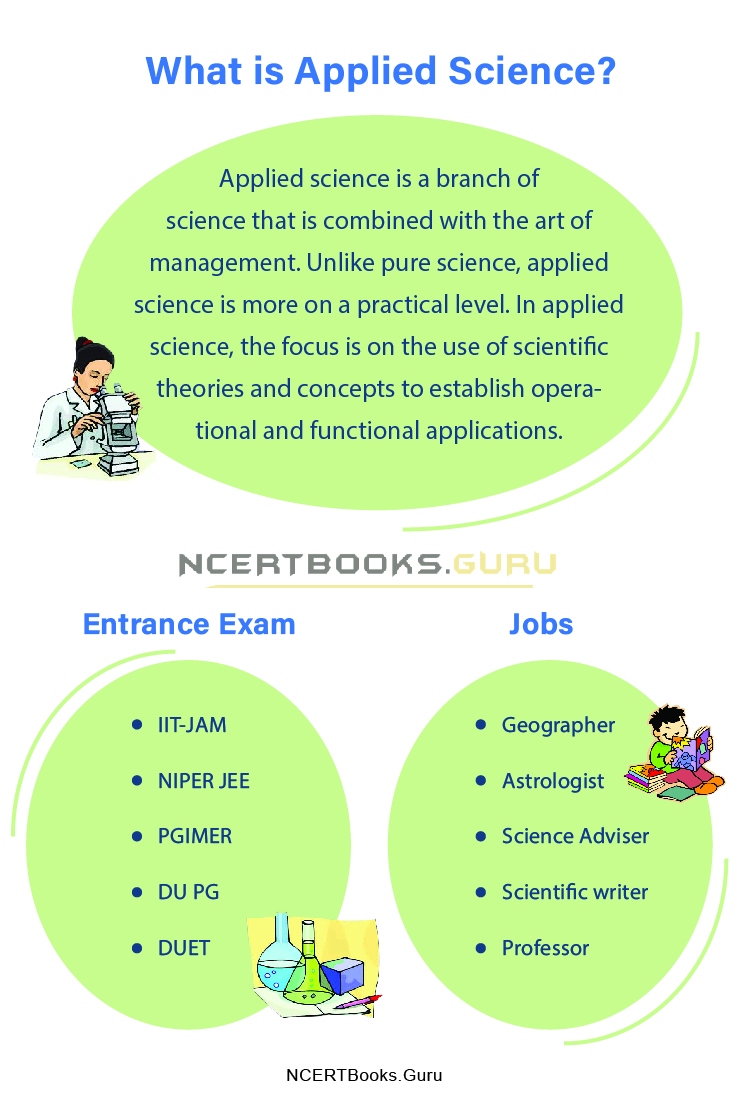
Applied science is a branch of science that is combined with the art of management. Unlike pure science, applied science is more on a practical level. In applied science, the focus is on the use of scientific theories and concepts to establish operational and functional applications.
Apart from the study of basic theories and concepts of science, applied science involves studies of various concepts of social science such as management, innovation, vitality framework, etc.
List of Applied Science Courses in India
In general, the applied science courses are offered at two levels i.e. undergraduate applied science courses and postgraduate applied science courses. At the UG level, the course is B.Sc in applied Science and at the PG level, the course is an M.Sc in applied Science.
Here the details of B.Sc and M.Sc in Applied Science are covered. Have a look.
B.Sc Applied Science Courses Duration, Eligibility, and Fees
The full-time B.Sc in Applied Science is of 2 years duration. In most universities, it is divided into semesters and therefore 6 semesters in total.
As far as Eligibility criteria is concerned The students must pass 10+2 with English and Mathematics as compulsory subjects from a recognized board. The student should get a minimum of 50% of marks in the 10+2 examination. It is also mandatory for the candidate to clear the cut-offs for the colleges conducting entrance examinations.
The average B.Sc in Applied Science fee lies between ₹20k to ₹5 lacs. The fee varies from college to college and also some relaxation in fees is given to certain categories of students as per the policy of the college
The working areas in B.Sc applied science are as follows:
The duration of a full-time M.Sc in Applied Science is 2 years. Whereas the eligibility criteria require the candidate to have completed B.Sc from any recognized university with a minimum of 50% Marks.
Apart from this, it is also mandatory that the candidate must have Physics, Botany, Electronics, Zoology, Biochemistry, Chemistry, Microbiology, and Biotechnology as compulsory subjects at the graduation level.
The Average fee for M.Sc in Applied Science ranges from ₹5k to ₹5 lacs. But the fee tends to vary from college to college. For example, the fee for M.Sc in applied Science from Fergusson College, Pune is ₹12,000 and that from Miranda House is ₹15,000.
The working areas in M.Sc in Applied Science include:
M.Sc in Applied Physics
M.Sc. Biophysics
M.Sc. Biology
M.Sc. Earth Science
M.Sc. Tech. in Information Systems
M.Sc. Tech. in Applied Geology
M.Sc. Tech. in Environmental Science & Technology
Integrated M.Sc. in Applied Geology
Integrated M.Sc. in Biotechnology
Integrated M.Sc. in Cell and Molecular Biology
10 Best Applied Sciences Types
The list of 10 top types of applied sciences is here for your reference:
Computer science
Aerospace engineering
Molecular biology
Agricultural engineering
Mathematics
Architectural engineering
Statistics
Biomedical engineering
Civil engineering
Mechanical engineering
Entrance Exam for Applied Science Courses in India
The national level entrance exams for the admission in UG and PG courses in Applied Science are given below:
IIT-JAM (Joint Admission Test)
NIPER JEE (Joint Entrance Exam)
PGIMER Chandigarh
DU PG Admission test
DUET
Applied Science Courses in Canada
In Canada, Applied science courses are considered equivalent to engineering courses. Chanda offers a variety of Applied Science courses that you can choose from.
The list of Applied Science courses in Canada is given below:
Bachelor of Applied Science Engineering: Environmental Management
Bachelor of Applied Science: AgriBusiness
Applied Science BASc
Bachelor of Applied Science: Industrial System Engineering
Bachelor of Applied Science: Ecosystem Management.
Bachelor of Applied Science: Material Engineering
Other Online & Short Term Applied Science Courses List
The other online certificate and short term courses available in Applied Science are:
Level 2 Diploma in Applied Science
Level 3 Extended Diploma in Applied Science
Science: Pure and Applied; Health Science
BTEC National Extended Diploma in Applied Science
Principles of Static Equipment Programme-Applied Physics
Applied Physics for data science and Machine learning
Astrophysics: Exploring exoplanets
Earth Economics
Top Applied Science Colleges in India
The top colleges for applied science courses available in India are:
The University of Delhi – DU, Delhi
Barkatullah University – BU, Bhopal
Indian Institute of Engineering Science and Technology, Howrah
Nizam College, Hyderabad
BITS Mesra, Ranchi
Loyola College, Chennai
Christ University, Bangalore
Madras Christian College, Chennai
The Oxford College of Science, Bangalore
Ramjas College, Delhi
Fergusson College, Pune
Hans Raj College, New Delhi
Miranda House College
Recruiters for Applied Science Courses
The list of recruiters for Applied Science courses are as follows:
Bharat Petroleum,
Fortes Holdings,
IIIT,
Institute of Nuclear Medicine and Allied Sciences,
Indian Institute of Patent Physics Research Laboratory,
Nuclear Science Centre New Delhi,
Bhabha Atomic Research Centre (BARC)
List of Applied Science Jobs
The various job profiles available after completing Applied Science courses are:
Laboratory Technician,
Research Specialist,
Geographer,
Astrologist,
Electronic Engineer,
Science Adviser,
Biology Researcher,
Plant Biochemist,
Teacher & Lecturer
Scientific writer
Professor
Applied Science Salary in India
The average salary after applied science courses varies between ₹2.5lacs- ₹5 lacs. But the salary varies according to the role. The average salary of a professor lies between ₹4.5 lacs to 6.5 lacs per annum and that of a Geographer lies between 4 lakh per annum to 12 lacs per annum.
In a nutshell, Applied science is the subject that applies the knowledge of scientific concepts to real-world scenarios. The working area of Applied Science ranges from biology to engineering. Applied science is generally used to solve dynamic real-life problems by applying static scientific theories and principles.
2. What is the B.Sc Applied Science syllabus?
In B.Sc Applied Science, you study a wide variety of subjects covering the 6 semesters of the programme. Some of the subjects include in BSc applied science are as follows:
human physiology.
microbiology.
genetics and genetic engineering.
astronomy and medical physics
3. Is Applied Science a good career option?
A degree in applied science is considered a high professional in many countries. In India, this is a relatively new discipline that is rather not so popular. But overall, it is a good career option with ample opportunity to grow.
4. Which online platforms provide online courses in Applied Science?
The list of top 5 online platforms providing Applied science courses are:
ADL online courses
classcentral.com
acs.edu.au
appliedscience.unl.edu
distancelearningportal.com
Final Words
The article given above is all about Applied Science courses. It makes you aware of what Applied science courses are available to you along with the other important things you should consider before choosing the course. We hope this article was helpful to you. If you have any doubts still left, comment below. For more course details articles like this, stay tuned to our site @ncertbooks.guru.
Law is a career stream that students undergo at UG, PG, or Doctorate Level to get into the Legal Profession. Law is a Profession that brings a lot of career prospects for students to conquer and explore. Students can pursue various specializations in law depending on their interests. We have curated the Law Courses Admission Process, Eligibility Criteria, Entrance Exams, Fee Structure, Career Options, Top Universities that offer Law Education, etc.
List of Law Courses
Below are some of the Law Courses available. To know each course fee, eligibility criteria, admission process just tap on the quick links available. Before joining the course check for the needed information and clear your concerns.
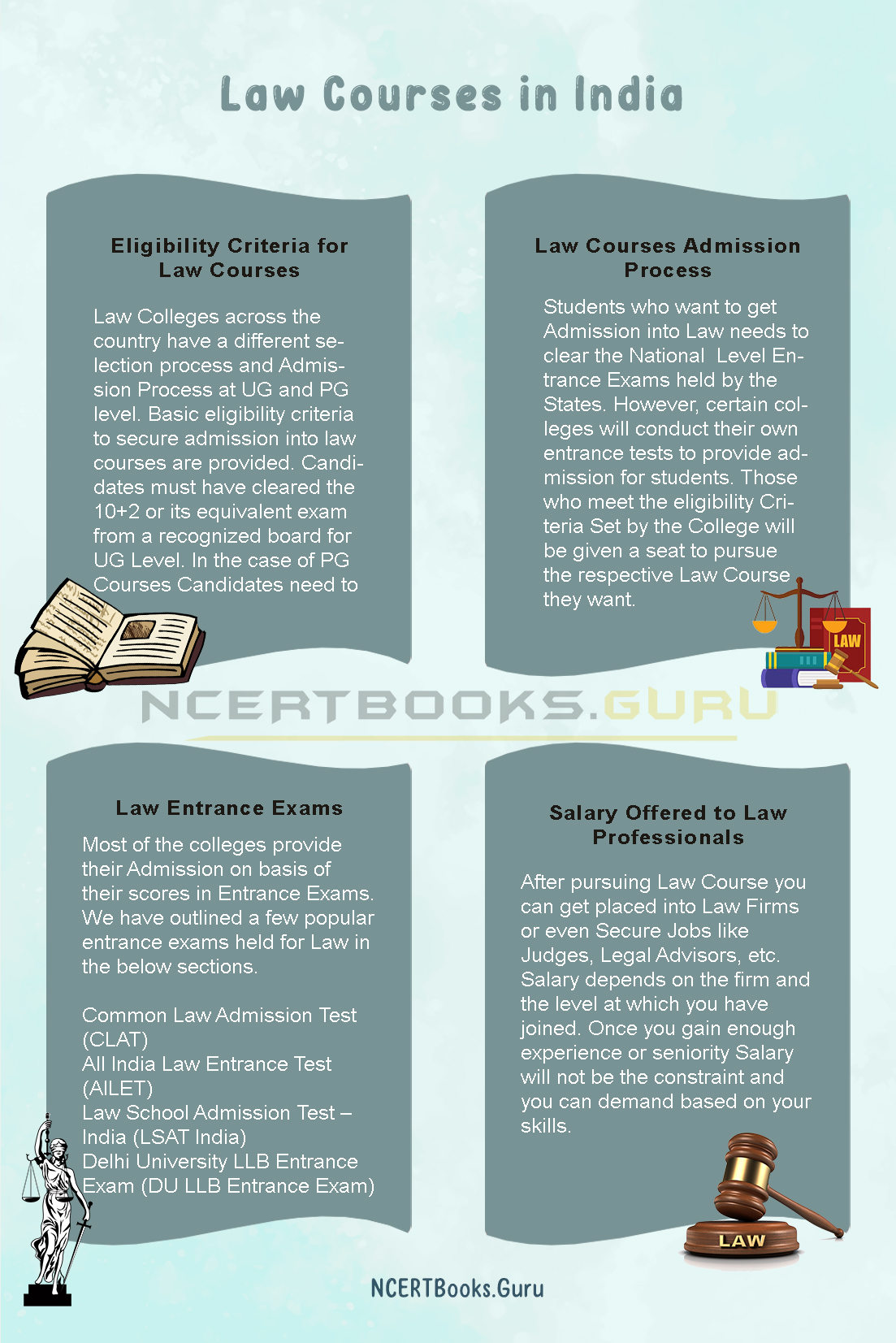
Law Colleges across the country have a different selection process and Admission Process at UG and PG level. Basic eligibility criteria to secure admission into law courses are provided. Candidates must have cleared the 10+2 or its equivalent exam from a recognized board for UG Level. In the case of PG Courses Candidates need to complete Graduation from a recognized board.
Law Courses Admission Process
Students who want to get Admission into Law needs to clear the National Level Entrance Exams held by the States. However, certain colleges will conduct their own entrance tests to provide admission for students. Those who meet the eligibility Criteria Set by the College will be given a seat to pursue the respective Law Course they want.
Law Entrance Exams
Most of the colleges provide their Admission on basis of their scores in Entrance Exams. We have outlined a few popular entrance exams held for Law in the below sections.
Common Law Admission Test (CLAT)
All India Law Entrance Test (AILET)
Law School Admission Test – India (LSAT India)
Delhi University LLB Entrance Exam (DU LLB Entrance Exam)
Top Universities that Offer Law Education
The West Bengal National University of Juridical Sciences, Kolkata
Rajiv Gandhi National University of Law, Patiala
Damodaram Sanjivayya National Law University, Visakhapatnam
National University of Study and Research in Law, Ranchi
National Law University, Jodhpur, Jodhpur
Gujarat National Law University, Gandhinagar
Ram Manohar Lohia National Law University, Lucknow
Chanakya National Law University, Patna
National Law University Odisha
National Law University, Delhi, New Delhi
National Law School and Judicial Academy, Assam, Guwahati
Tamil Nadu National Law School, Srirangam
Hidayatullah National Law University, Raipur
National University of Advanced Legal Studies, Kochi
Maharashtra National Law School, Nagpur
Not just these universities there are plenty of institutes out there Online that provide Law Education.
Law Course Duration
Course Duration for each Specialization will vary and you can check out them individually by tapping on the links available. They may range from 1 year to 5 years as well. Some of the People will complete the course, even more, earlier through distance learning.
Law Course Fees
Course Fee for Law varies from institute to institute and course to course. Each College sets its own fee structure depending on the infrastructure, placement offers it provides. So check for the info on the college website and confirm before you join.
Law courses in India have various specializations and we have outlined popular specializations in which students can make their career. They are as under
Civil Law
Criminal Law
Cyber Law
Business Law
Corporate Law
Tax Law
Constitutional Law
Labour & Employment Law
Real Estate Law
Competition Law
Media Law
Banking Law
Intellectual Property Law
Environmental Law
International Law
Mergers and Acquisition Law
Job Options after Law Courses
Students will have Several Opportunities after completing the Law Courses. After pursuing the course students can get into both public and private sectors. Some of the Job Roles for Law Students are given below
Notary
Law Reporter
Government Lawyer
Legal Advisor
Judges
Law Firms
MNCs
Business House
Legal Consultancies
News Channels
Judiciary
Sales tax and Excise Departments
Salary Offered to Law Professionals
After pursuing Law Course you can get placed into Law Firms or even Secure Jobs like Judges, Legal Advisors, etc. Salary depends on the firm and the level at which you have joined. Once you gain enough experience or seniority Salary will not be the constraint and you can demand based on your skills.
FAQs on Law Courses
1. What are the Various Specializations in Law?
The Popular Law Specializations are listed in the following fashion
Civil Law
Criminal Law
Cyber Law
Business Law
Corporate Law
Tax Law
Constitutional Law
Labour & Employment Law
Real Estate Law
Competition Law
Media Law
Banking Law
Intellectual Property Law
Environmental Law
International Law
Mergers and Acquisition Law
2. What is the Eligibility Criteria required to get into Law?
Candidates must have cleared the 10+2 or its equivalent exam from a recognized board for UG Level. In the case of PG Courses Candidates need to complete Graduation from a recognized board.
3. Which is the most popular Law Course available?
The Most Popular Law Course available is Bachelor of Legislative Law(LLB).
4. Is Choosing Law a Good Career Option?
Yes, Choosing Law is a Good Career Option and there are thousands of law firms in which you can seek jobs after finishing the Law Course.
Final Words
Hope the knowledge shared regarding the Law Courses has enlightened you in some or the other way. To know more about Various Course Details refer to our site. Stay connected to avail latest updates on several courses information in no time.