Biomedical Engineering Courses | Fee Structure, Salary, Courses and Scope in India

Biomedical Engineering Courses

Biomedical Engineering Courses Online: There is an end number of decisions that you need to take in order to launch your career. The first one is the selection of the right field that suits your interest. For students your age there are so many options to choose from and one such exciting field is of biomedical engineering. With the growing demand in the healthcare sector and less job saturation, biomedical engineering is the best course in the modern-day.

The biomedical engineering courses in India are an amalgamation of two principles (engineering and medical science) making it one exclusive elite course. A biomedical engineer has a huge part to play in stabilizing the healthcare system. The student aims at a holistic study of mathematics, science, biology and medicine.

This article has been curated for someone like you, who is seeking guidance regarding the biomedical engineering courses after 12th. You get to learn about the courses, edibility, jobs, etc. everything under one roof that is related to the stream of a biomedical engineer. So let’s get into it.

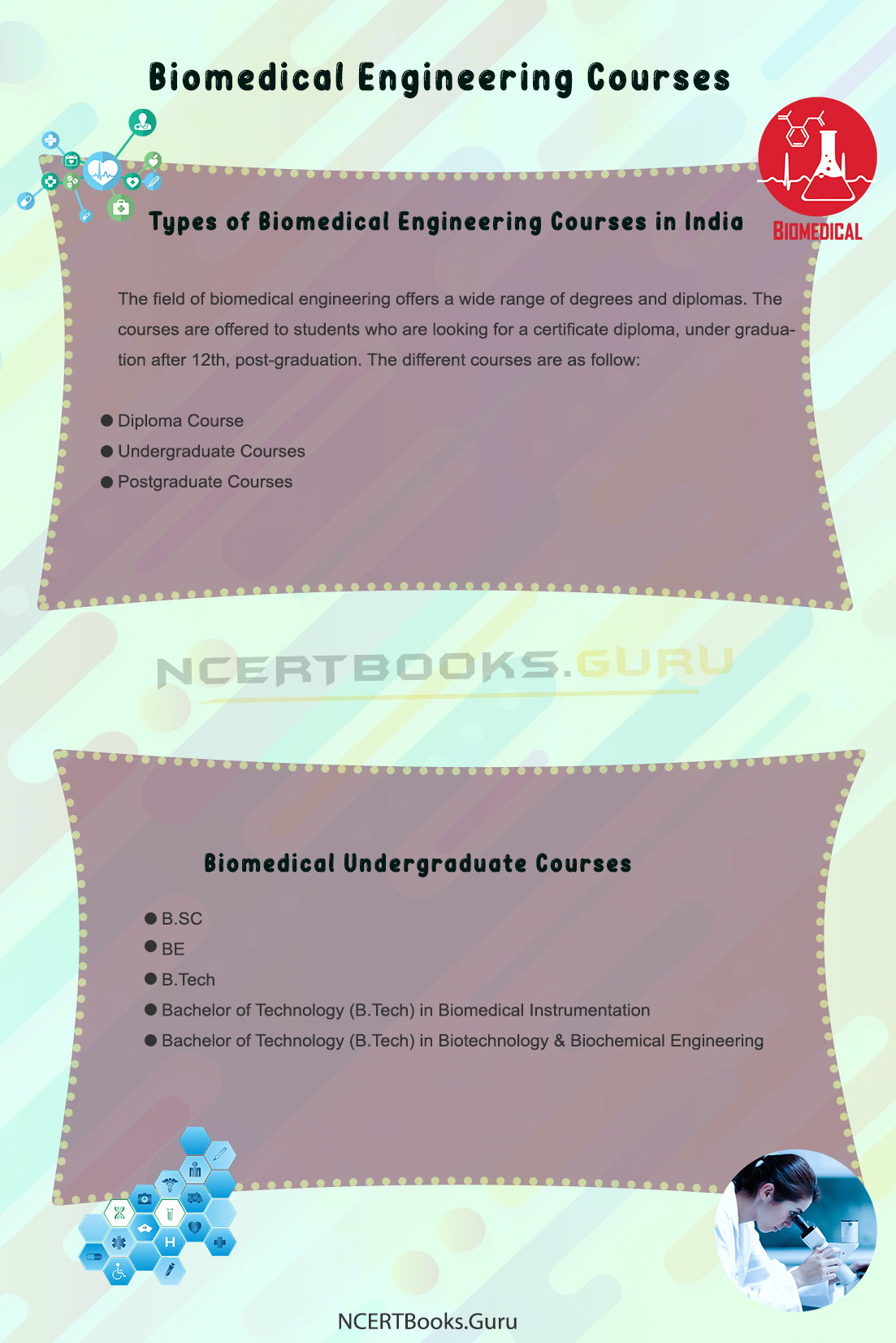
Types of Biomedical Engineering Courses in India

The field of biomedical engineering offers a wide range of degrees and diplomas. The courses are offered to students who are looking for a certificate diploma, under graduation after 12th, post-graduation. The different courses are as follow:

  • Diploma Course
  • Undergraduate Courses
  • Postgraduate Courses

Biomedical Engineering Diploma Course

Diploma in biomedical engineering is a full-fledged 3 years’ program. This program is generally picked up by students after finishing their 10th board. Diploma helps the student to prepare for further studies in this very field of biomedical engineering.

  • Eligibility: Students are eligible for a diploma course soon after they finish their 10th board or 12th. The student must be thorough with science and mathematics. To add, the entrance is entirely merit-based. The student has to go through a qualifying exam to make it to the merit list.
  • Course Structure: The 3-year program is divided into 6 semesters. A student who takes up this course is trained in various Biomedical Engineering subjects. These subjects are medical sensors, medical imaging, chemistry, application of electrical and electronics engineering in medical technology and instrumentation. The Biomedical Engineering Courses fees range between 3,00,000 – 7,00,000 INR for the entire course.
  •  Scope/ Job Opportunities/ Salary: Anyone with a biomedical engineering diploma has a lot of job opportunities. The job is entirely based on the student’s performance academically. The starting salary could be anything between 10,000-30,000 per month in case of a private job. Some of the job profiles are that of a research associate, service engineer, biomedical engineer, etc.

Also, read:

Biomedical Undergraduate Courses

A four-year course is curated for students seeking a degree in the field of biomedical engineering. By pursuing this degree, you become someone who has a lot to offer in the sphere of healthcare. All you have to have is ardent interest and creativity to aid the research, technology and sciences. Under this program, you have the below-mentioned degrees to choose from.

The degrees under the 4-year under graduation program are as follows:

  • B.SC
  • BE
  • B.Tech
  • Bachelor of Technology (B.Tech) in Biomedical Instrumentation
  • Bachelor of Technology (B.Tech) in Biotechnology & Biochemical Engineering

Eligibility: Students who are done with their 12th (science stream) or have finished their diploma in biomedical engineering are eligible for this course. You have to prove your eligibility by attempting various entrance exams for the same. Since it is a niche engineering course you have to sit for the same relevant competitive exams to get into the best Biomedical Engineering colleges.

Course Structure: The program is divided into 8 semesters. Each semester has some common biomedical engineering subjects, to begin with, the student is trained in basic engineering subjects. The study of biology along with other engineering subjects makes the course very unique. A student is guided throughout with the help of workshops, seminars and other educative means. Check B.Tech Biomedical Engineering Reference Books.

Scope/ Job Opportunities/ Salary: A person who has completed the 4-year program is ready to acquire one of the reputed profiles such as Biomedical engineer, equipment design engineer, lab administrator, etc. Pharmaceutical, healthcare equipment manufacturing companies, pathology labs, rehabilitation centers, hospitals, etc. is the apt place for anyone with this degree. The starting Biomedical Engineering salary is 4,00,000-7,00,000 INR per annum. One can also seek jobs abroad to attract better pay and give an international service.

Biomedical Engineering Postgraduate Courses

To have deeper knowledge in the field of biomedical engineering go for post-graduation. This is a 2 years short program. The level of the studies you have previously done is deepened. Know different Bio medical Science Courses.

PG courses for biomedical engineering offered in India are:

  • M.Tech
  • M. Sc
  • MS
  • ME
  • Master of Engineering (ME) in Biochemical Engineering & Biotechnology
  • Master of Technology (M.Tech) in Bio-Medical Signal Processing & Instrumentation
  • Master of Technology (M.Tech) in Biomedical Instrumentation

Eligibility: You need to be an engineering graduate in the field of biomedical or any other field which is closely related to the former. To get admission in a reputed college you need to have good marks in GATE. MBBS holders can also opt for post-graduation in biomedical engineering. It is both a merit and entrance based course.

Course Structure: On this level, the student is taught a similar amalgamation of two major principles of engineering and biology. Along with this, the students are also prepared with lifesaving tactics like writing, communication and observation. The fee structure is 1-4 lacs for the entire program.

Scope/ Job Opportunities/ Salary: Obtaining this degree opens up a lot of doors for the student’s career-wise. Postgraduates in biomedical engineering are hired by giant healthcare companies. The person can choose from various job profiles, like product specialist, patent analyst, biochemical engineer, etc. The starting salary ranges from 4,00,000 – 18,00,000 INR per annum.

Fee Structure of Biomedical Engineering Courses

The fees of all these courses approximately range between 2,00,000- 7,00,000 INR. To get the best of the fair fees always look forward to clearing the state or national level entrance test.
Biomedical Engineering Courses

Biomedical Engineering Courses – Industry Domains/ Career Opportunities

The majority of the services are needed by the companies which are tech giants dealing with healthcare equipment, software, biochemical research, etc. A person also paves his/ her way to big research centers, hospitals, labs, etc. Graduates in this field get to serve humanity in the broadest way possible.

FAQ’s on Biomedical Engineering Course Details

Question 1.
How many marks do I need in my 12th board to pursue a degree in biomedical engineering?

Answer:
You need to have an aggregate of at least 50% marks in your 12th grade from a reputed board.

Question 2.
Do I need biology to pursue biomedical engineering?

Answer:
Yes, a student must have physics, chemistry, biology and mathematics as core subjects to pursue this degree.

Question 3.
What kind of work does a biomedical engineer have to deal with?

Answer:
It is purely a niche engineering job with a bent towards research. A biomedical engineer is in demand at all the leading multi-specialty hospitals, healthcare companies, etc.
BPT Course Details – Admission, Eligibility, Fees, Duration, Scope, Jobs & Salary

BPT Course Details

BPT Course Details: Candidates willing to pursue a career in the Bachelor of Physiotherapy Course can make use of the information listed below. Get to know related details like Eligibility, Course Duration, Fee Structure, BPT Full Form, Colleges, etc. Apart from this clear all your queries related to Physiotherapy by going through them further. Have a glance at the list of topics to be covered as a part of the BPT Syllabus.

What is BPT?

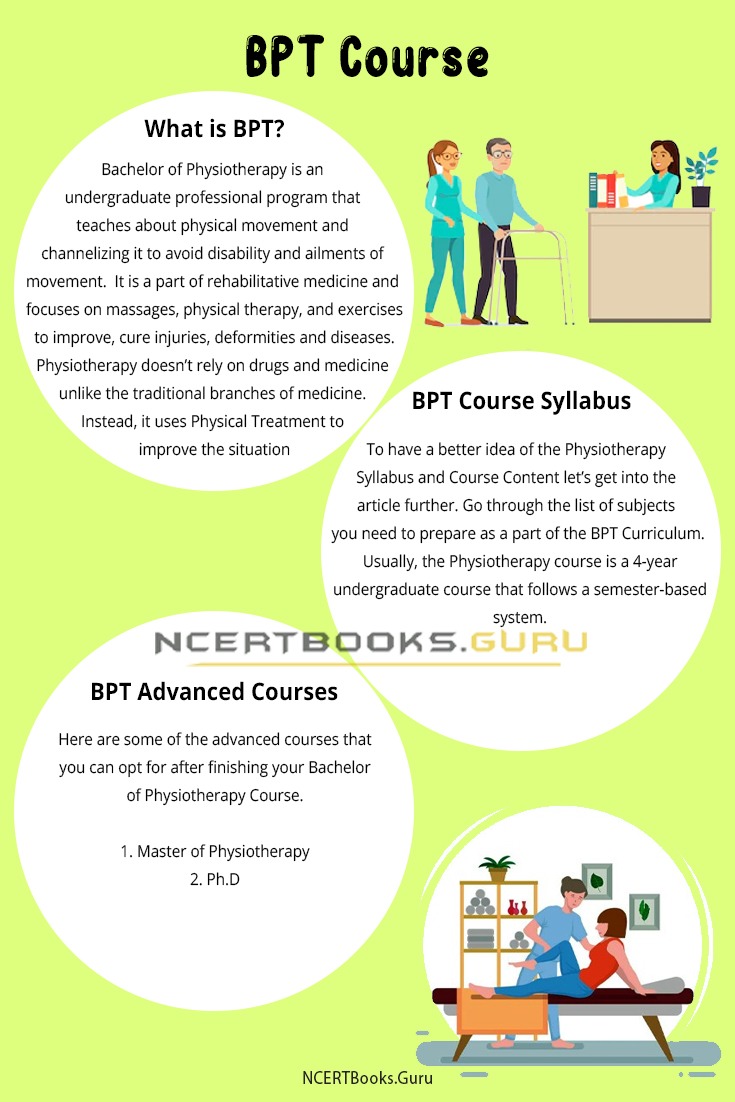
Bachelor of Physiotherapy is an undergraduate professional program that teaches about physical movement and channelizing it to avoid disability and ailments of movement.  It is a part of rehabilitative medicine and focuses on massages, physical therapy, and exercises to improve, cure injuries, deformities and diseases. Physiotherapy doesn’t rely on drugs and medicine unlike the traditional branches of medicine. Instead, it uses Physical Treatment to improve the situation.

Physiotherapy Course Details

Course   BPT
BPT Full form Bachelor of Physiotherapy
Eligibility 10+2 or equivalent
Duration Four and a half years
Fee Offered  1 – 5 LPA
Course Type Regular mode
Starting BPT salary offered 2.95 – 5 LPA
Advance Courses Master of Physiotherapy
Employment opportunities Physiotherapist, Rehabilitation Specialist, Consultant, Sports physiotherapist

BPT Course Syllabus

To have a better idea of the Physiotherapy Syllabus and Course Content let’s get into the article further. Go through the list of BPT Subjects you need to prepare as a part of the Curriculum. Usually, the Physiotherapy course is a 4-year undergraduate course that follows a semester-based system. Check out the BPT Books that are useful for students to score good marks.

You will have a total of 8 semesters during the entire course 2 each year. BPT is a paramedical course and students have to study the Syllabus similar to that in MBBS. Candidates will have few practical subjects as a part of their Curriculum and they are also provided in the later modules.

Semester I

  • English
  • Physiology
  • Biochemistry
  • Basic Nursing
  • Anatomy

Semester II

  • Psychology
  • Orientation to Physiotherapy
  • Biomechanics
  • Sociology
  • Integrated Seminars

First year Practical Subjects

  • Orientation to Physiotherapy
  • Physics and chemistry

Semester III

  • Pharmacology
  • Pathology
  • First Aid & CPR
  • Microbiology
  • Constitution of India

Semester IV

  • Introduction to Treatment
  • Research Methodology & Biostatics
  • Electrotherapy
  • Exercise Therapy
  • Clinical Observation Posting

Second Year Practical Subjects

  • Basic Nursing, First Aid & CPR
  • Introduction to Treatment
  • Clinical Observation Posting

Semester V

  • General Medicine
  • General Surgery

Semester VI

  • Supervised Rotatory Clinical Training
  • Orthopedics and Sports Physiotherapy

Third Year Practical Subjects

  • Physiotherapy in Dentistry
  • Evidence-Based Physiotherapy Practice

Semester VII

  • Neurology and neurosurgery
  • Community medicine
  • Neuro- Physiology
  • Community-based Rehabilitation

Semester VIII

  • Supervised Rotatory clinical training
  • Evidence-based physiotherapy and practice
  • Ethics, Administration and Supervision
  • Project

Must See: B.Com Course Details

BPT Advanced Courses

Here are some of the advanced courses that you can opt for after finishing your Bachelor of Physiotherapy Course.

  • Master of Physiotherapy
  • Ph.D

Colleges list offering BPT Course

Below is the list of some of the top colleges that provide a Physiotherapy Course. You can pick from any of them and join the BPT Course. They are as under

  • Prakash Institute of Physiotherapy Rehabilitation and Allied Medical Sciences
  • Punjabi University
  • Pt. J.N.M. Medical College
  • Pt. Deen Dayal Upadhyaya Institute for Physically Handicapped, New Delhi
  • Rajiv Gandhi University of Health Sciences
  • RajaRajeswari College of Physiotherapy
  • S.D.D.Institute of Physiotherapy and Rehabilitation

Physiotherapy Entrance Exams

We have listed some of the top entrance examinations held for the BPT course. They are along the lines

  • CET (Common Entrance Test)
  • JIPMER All India Entrance Exam
  • Guru Govind Indraprastha University Physiotherapy Entrance Exam

BPT Admission Process

Candidates need to secure minimum aggregate in their 10+2. However, some colleges will have minimum criteria that students need to meet. Candidates will be given admission in colleges based on their performance in the college-specific entrance test.

Physiotherapy Course Eligibility Criteria

Candidates can pursue BPT Course after completing 12th in Science Stream from a Recognised Education Board. However, Candidates should pursue Science Stream with Physics, Chemistry, and Biology as their mainstream. Some colleges conduct their own entrance test and require minimum qualifying marks to give admission. Interested students can also pursue a Diploma in Physiotherapy Courses to become physiotherapists.

Get to know about more types of Course Details organized streamwise and category wise.

BPT Course Fee Structure

Usually, the Bachelor of Physiotherapy Courses Fee varies based on the college. Some Colleges charge less whereas some charge more. On Average Physiotherapy, the Course ranges from 1 – 5 Lakhs Per Annum.

BPT Course Duration

BPT is a 4 Year Undergraduate Course that revolves around revolves around the treatment of patients facing the issue of injury and pain caused by stress, accidents, stroke to name a few. It also includes a 6-month clinical internship involving the science of physical movement trained at preventing disability and disease.

Also, Read:

Career Opportunities after BPT Course

Once you finish the BPT Course you will have a plethora of opportunities to go with. Some of them are listed below

  • Osteopath
  • Lecturer
  • Assistant Physiotherapist
  • Physiotherapist
  • Customer Care Assistant
  • Consultant

BPT Course Details

Salary Offered to BPT Candidates

Physiotherapists have been in demand for a very long time. However, with the growing demand for sports activities, demand for Physiotherapists are also rising alongside. Not just in the sports sector, they can find ample career opportunities in the Private Sector. The Average Salary for a BPT Candidate is 2.95 LPA. However, it varies from firm to firm, and based on the skillset and work experience you gain thereafter.

FAQs on BPT Course?

1.  What is BPT Course?

BPT is a 4 Year Undergraduate Course that revolves around revolves around the treatment of patients facing the issue of injury and pain caused by stress, accidents, stroke to name a few.

2. Is Physiotherapy a Good Career Choice?

Yes, it is a good career option considering the aspects of Physiotherapy which have improved and people consider Physiotherapist a much-needed professional in the medical fraternity.

3. How many subjects are there in Physiotherapy?

Topics covered in Physiotherapy include Human Anatomy, physiology, pharmacology, pathology, psychology, biomechanics, medical and surgical conditions,  rehabilitation, disability prevention, and other subjects.

4. What is the Salary of BPT?

Candidate’s salary may vary from 2.95 – 5.5 LPA based on the skillset and experience of the individual.

5. Is there Scope in BPT?

There is a wide scope for Physiotherapy in the future. You can go with specializations in the fields of geriatrics, cardiorespiratory, geriatrics, orthopedics & neurology.

Conclusion

We believe the information shared above regarding BPT Course Details is true to our knowledge. If you still have any queries feel free to drop us a comment and let us know. We will help you out as soon as possible with the best possible solution to your query.

List of M.Sc Courses after B.Sc Agriculture | Eligibility Criteria, Fee Structure, Job Profile and Salary

List of M.Sc Courses after B.Sc Agriculture

List of M.Sc Courses after B.Sc Agriculture: M.Sc course is a post-graduation course. It is a two-year course that is spread over four semesters. There are many top colleges and universities across the country that offer the M.Sc course. It is a course that deals mainly with agriculture and the scientific processes that are involved in the field of agriculture.

The article is going to give you all the necessary details that are required to know about the M.Sc Agriculture courses. After reading this article, you will have all the necessary information about the course, admission procedure, fees, syllabus, colleges, and job profiles. All this information is essential because it gives you an idea about what the course is and what you will learn in this course.

M.Sc Courses after B.Sc Agriculture Course Details

The M.Sc Courses is a two-year post-graduation program. It is a course that is offered in many colleges and universities across the country. There are four semesters in the M.Sc course. The eligibility criteria to apply and enroll for the course are easy and straightforward to understand.

It is a course that deals with agriculture and all its elements. The program is for students who have a keen interest and want an in-depth knowledge of agriculture and how science can give it the potential to benefit everyone. There is a lot of potential and job opportunities for candidates who want to work in the agriculture sector. For candidates who study this course, there are many public as well as private-sector jobs available.

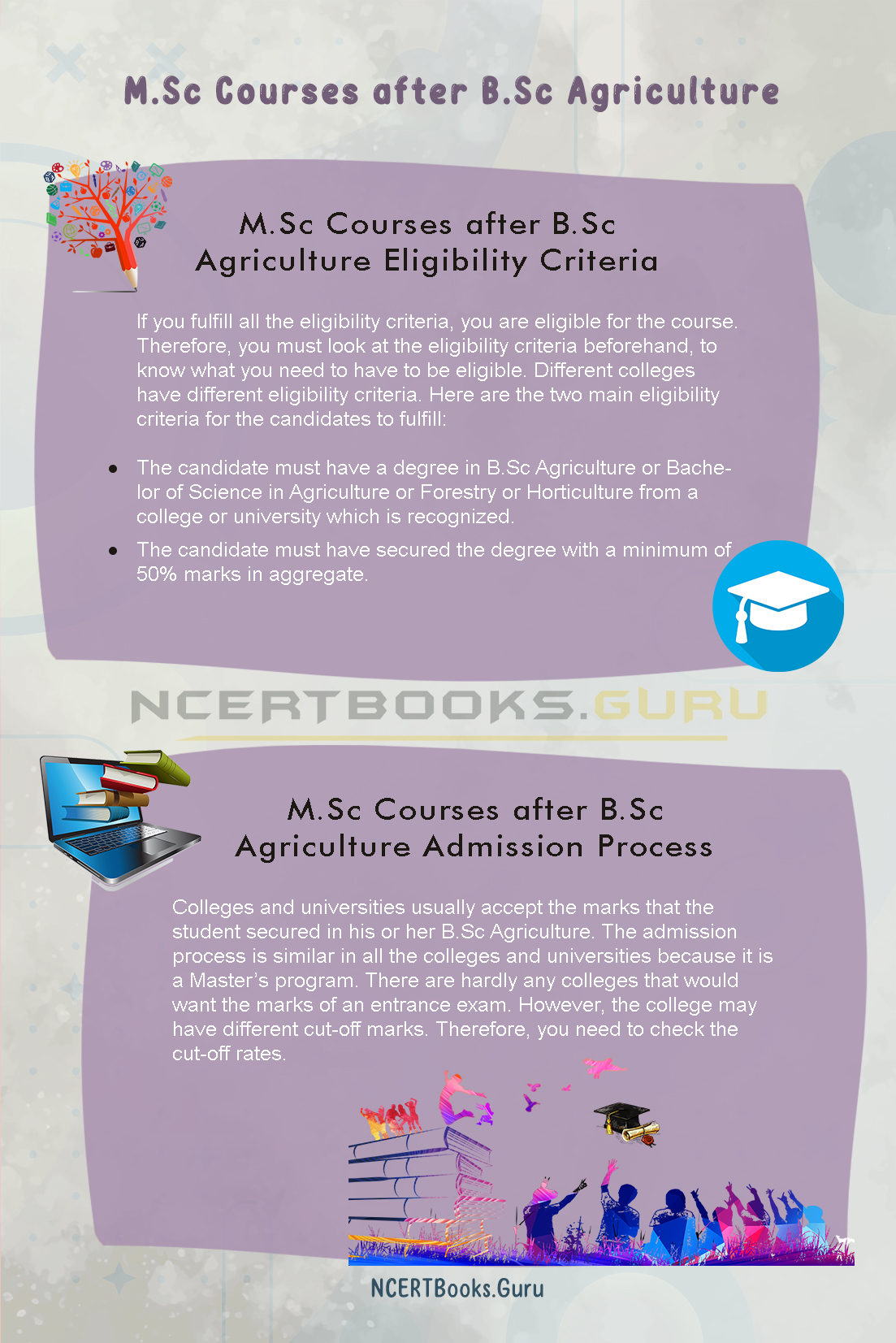
M.Sc Courses after B.Sc Agriculture Eligibility Criteria

If you fulfill all the eligibility criteria, you are eligible for the course. Therefore, you must look at the eligibility criteria beforehand, to know what you need to have to be eligible. Different colleges have different eligibility criteria. Here are the two main eligibility criteria for the candidates to fulfill:

  • The candidate must have a degree in B.Sc Agriculture or Bachelor of Science in Agriculture or Forestry or Horticulture from a college or university which is recognized.
  • The candidate must have secured the degree with a minimum of 50% marks in aggregate.

M.Sc Courses after B.Sc Agriculture Admission Process

Colleges and universities usually accept the marks that the student secured in his or her B.Sc Agriculture. The admission process is similar in all the colleges and universities because it is a Master’s program. There are hardly any colleges that would want the marks of an entrance exam. However, the college may have different cut-off marks. Therefore, you need to check the cut-off rates.

M.Sc Courses after B.Sc Agriculture 1

List of M.Sc Courses after B.Sc Agriculture

M.Sc Agriculture

The first course that candidates can opt for is the M.Sc Agriculture course. It’s a program that’s going to advance your learning in the same field after B.Sc Agriculture. The candidates will start learning the practical part of the course and do research work. Many colleges across the country offer the M.Sc Agriculture course. Here’s a list of the colleges and universities that offer the M.Sc Agriculture course:

  • Uttaranchal University, Dehradun
  • Dr.K.N.Modi University, Tonk
  • University of Technology, Jaipur
  • CT University, Ludhiana

M.Sc Horticulture

If you have an interest in fruits, vegetables, and all other gifts of nature, a horticulture course is perfect for you. You will get the perfect opportunity to learn the processes of cultivation and methodologies. You can pursue a career as a horticulturist, floriculturist, and any other career-related to this field. Here are some of the colleges and universities where you can apply for the course:

  • Apex University, Jaipur
  • Shyam Institute of Engineering & Technology, Dausa
  • Shobhit University, Meerut.
  • LNCT University, Bhopal.

M.Sc Dairy Science 

It is another course that you can choose to do after you finish your B.Sc Agriculture. It’s a great course where you will learn about research and understanding of the milk production and production process. Here are some of the colleges where you can pursue M.Sc Dairy Science :

  • Shyam University, Dausa
  • Sri Parasakthi College for Women, Tirunelveli
  • College of Agriculture, Pune

M.Sc Fisheries

If your interest lies in fishes and the fishing industry, this is the best course for you. M.Sc Fisheries is a course where candidates will learn various aspects like processing, culturing, and many other processes. Here are some of the colleges where you can pursue the M.Sc Fisheries course

  • The Neotia University, Kolkata
  • Centurion University of Technology and Management, Bhubaneshwar
  • Utkal University, Bhubaneswar

M.Sc Forestry

The last course that you can apply and enroll in the M.Sc Forestry course. It’s a course for those who have a keen interest in forestry and wildlife. M.Sc Forestry is the perfect course for you if you want to take care of the wildlife and learn how to protect wildlife. Here are some of the colleges where you can pursue M.Sc Forestry.

  • Dolphin PG Institute of Biochemical & Natural Sciences, Dehradun
  • Alpine Group of Institutes, Dehradun
  • College of Forestry, Ratnagiri

Get to Know More about other types of Course Details Streamwise, and Category wise.

M.Sc Courses Syllabus

The syllabus is a factor that will differ from college to college. Different courses have different syllabus. You need to check the website of the college that you apply and enroll in for the proper details about the syllabus. It’s one of the factors that you need to read before you apply for any course. After reading the syllabus, you will get an idea about what kind, of course, you are going to be studying for two years. However, here are some of the basic subjects that you will have in any of the M.Sc courses:

  • Agriculture Botany
  • Agronomy
  • Agriculture of Economics
  • Dairy Science
  • Extension Education
  • Agriculture Entomology
  • Animal Husbandry
  • Soil Science
  • Agriculture Chemistry
  • Plant Pathology
  • Agriculture Botany

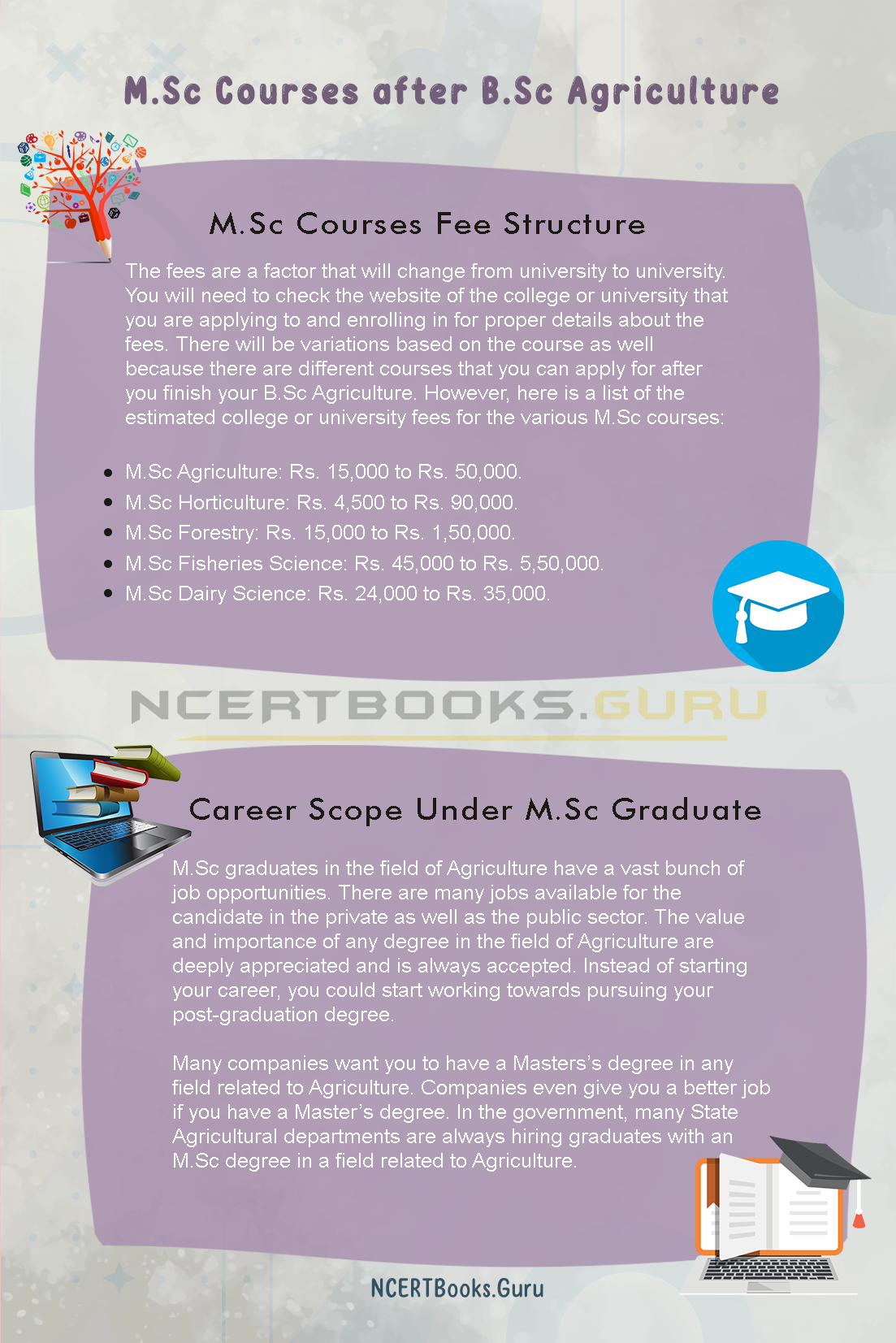
M.Sc Courses Fee Structure

The fees are a factor that will change from university to university. You will need to check the website of the college or university that you are applying to and enrolling in for proper details about the fees. There will be variations based on the course as well because there are different courses that you can apply for after you finish your B.Sc Agriculture. However, here is a list of the estimated college or university fees for the various M.Sc courses:

  • M.Sc Agriculture: Rs. 15,000 to Rs. 50,000.
  • M.Sc Horticulture: Rs. 4,500 to Rs. 90,000.
  • M.Sc Forestry: Rs. 15,000 to Rs. 1,50,000.
  • M.Sc Fisheries Science: Rs. 45,000 to Rs. 5,50,000.
  • M.Sc Dairy Science: Rs. 24,000 to Rs. 35,000.

Also, Read:

Career Scope Under M.Sc Graduate

M.Sc graduates in the field of Agriculture have a vast bunch of job opportunities. There are many jobs available for the candidate in the private as well as the public sector. The value and importance of any degree in the field of Agriculture are deeply appreciated and is always accepted. Instead of starting your career, you could start working towards pursuing your post-graduation degree.

Many companies want you to have a Masters’s degree in any field related to Agriculture. Companies even give you a better job if you have a Master’s degree. In the government, many State Agricultural departments are always hiring graduates with an M.Sc degree in a field related to Agriculture.

M.Sc Courses after B.Sc Agriculture 2

Top Profiles for M.Sc Graduate

Choosing a career path is a significant decision that you need to make after you complete your M.Sc. It would help if you chose a job that you will perform your best at and fulfill all your duties. It’s essential to choose which sector you want to join- the private sector or the public sector. Here are some of your job profiles after you finish the M.Sc courses

  • Corporate Sales Manager
  • Research Scientist
  • Lecturer or Professor
  • Field Officer
  • Breeder
  • Foreman
  • Horticulturist
  • Horticultural Education Supervisor
  • Fisheries Manager
  • Fisheries Officer
  • Agronomist
  • Farm Manager

Salary of an M.Sc Graduate

Salary is a factor that changes from candidate to candidate. It depends on the size of the company and job position. On the side of the candidate, it depends on factors like educational qualifications, skill sets, work experience and many other factors. However, the general pay ranges from Rs. 3,00,000 to Rs. 6,50,000 per year.

FAQ’s on List of M.Sc Courses after B.Sc Agriculture

Question 1.
What is the duration of the M.Sc courses after you finish your B.Sc Agriculture course?

Answer:
The duration of the M.Sc courses after the B.Sc Agriculture course is two years, and it’s spread over four semesters.

Question 2.
Which are some of the eligibility criteria that students need to fulfill to be eligible for the M.Sc courses?

Answer:
The candidates need to fulfill to be M.Sc agriculture eligibility criteria:

  • Candidates need to have finished their B—Sc Agriculture from a college or university which is under a recognized board.
  • Candidates need to have secured a minimum aggregate of 50% in their BSc Agriculture course.

Question 3.
What are the courses that candidates can do after they complete BSc Agriculture?

Answer:
Candidates can do the following courses after they finish their B.Sc Agriculture course:

  • M.Sc Agriculture
  • M.Sc Horticulture
  • M.Sc Forestry
  • M.Sc Fisheries Science
  • M.Sc Dairy Science

Question 4.
What is the fee structure for the M.Sc Courses?

Answer:
The fee structure of the M.Sc courses varies from one college or university. It varies based on the course too. There’s a different fee structure for different courses. You need to check the website of the college for the proper details about the fee structure from the college website. However, here is the approximate fee range for the different courses:

  • M.Sc Agriculture- Rs. 15,000 to Rs. 50,000.
  • M.Sc Horticulture- Rs. 4,500 to Rs. 90,000.
  • M.Sc Forestry- Rs. 15,000 to Rs. 1,50,000.
  • M.Sc Fisheries Science- Rs. 45,000 to Rs. 5,50,000.
  • M.Sc Dairy Science- Rs. 24,000 to Rs. 35,000.

Question 5.
What is the salary of the candidates who pursue an M.Sc after B.Sc Agriculture?

Answer:
The salary varies from person to person depending on the job position and the company. It also depends on the candidate’s skill set, educational qualification, work experience, and many other factors. The starting salary for many jobs in the field of Agriculture starts at Rs. 3,00,000 to Rs. 6,00,000.

MBBS Course Details – Eligibility, Course Fee, Duration, Admission, Career Options, Salary

MBBS Course Details

MBBS Course Details: You might have heard of many people telling you about starting your career in a field that is all about saving lives and improving healthcare. But, still, you might not be sure about it. To clear all your ambiguities we have come up with this article that covers everything about MBBS Course Details. Have info on MBSS Full Form, Admission Process, Entrance Exams, Career and Employment Opportunities, etc.

About MBBS?

MBBS itself stands for Bachelor of Medicine and Bachelor of Surgery. It is an undergraduate program that falls under Medicine allowing you to pursue your career in Doctor’s Field. MBBS Course is encapsulated with both theoretical and practical knowledge for 4 and a half years and a one-year internship.

This academic degree includes subjects of both Medicine and Surgery. Though the name suggests 2 degrees it is a single degree in real. Course enlightens students on Medicine study and Surgical Methodology which can split into 2 different streams based on the Master’s Degree they are willing to join.

MBBS Course Details

Course MBBS
MBBS Full form Bachelor of Medicine and Bachelor of Surgery
Eligibility (10+2)
Duration 5.5 years
Fee Offered 70,000 – 21 Lakhs Per Annum
Course Type Regular mode
Starting salary offered 3.6 Lakhs Per Annum
Advance Courses MD, MS, Diploma
Similar Course MBA, Law, PGDMLE, MMST, M.Tech
Employment opportunities Junior Doctor, Doctor, General Physician, etc.

MBBS Course Syllabus

Students who are pursuing or wish to pursue MBBS Course can refer to the following Syllabus of the MBBS Course. MBBS Syllabus mentioned below is most common for the majority of the colleges and may differ slightly from college to college. Refer to the Latest MBBS Course Syllabus by going through the below section and get to know the topics to prepare in advance. Preparation becomes easy by making use of the Bachelor of Medicine and Bachelor of Science Study Material & Notes over here.

S.No. MBBS Subjects of Study
1 General Medicine
2 Pediatrics
3 General Surgery
4 Psychiatry
5 Radiology
6 Skin & STD
7 Ear Nose And Throat
8 Tuberculosis & Chest Diseases
9 Ophthalmology
10 Orthopedics
11 Obstetrics and Gynaecology including Family Welfare Planning
12 Casualty
13 Dentistry
14 Community Medicine

Eligibility Criteria & Requirements for MBBS

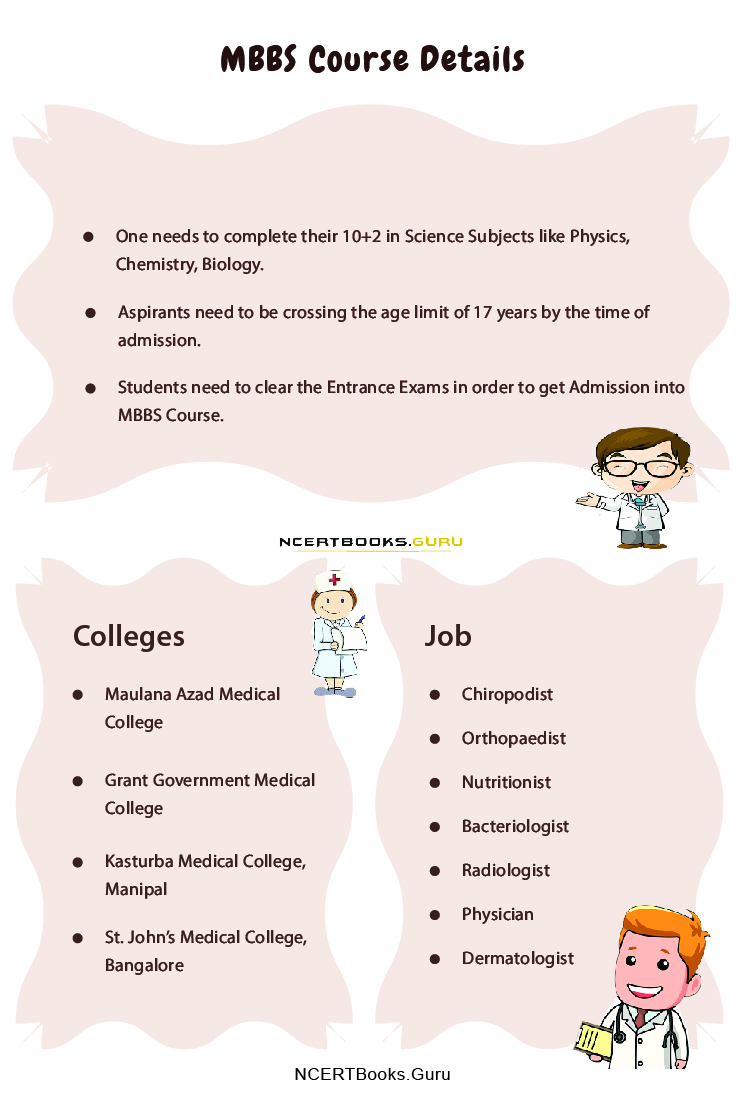
  • One needs to complete their 10+2 in Science Subjects like Physics, Chemistry, Biology.
  • Aspirants need to be crossing the age limit of 17 years by the time of admission.
  • Students need to clear the Entrance Exams in order to get Admission into MBBS Course.

MBBS Course Admission

Admission to MBBS Course will be based on the Entrance Exam held at National/Stage/ College Level. Most of the colleges provide admission into colleges based on the marks in NEET UG Exam. For Other government-aided universities like JIPMER, Students need to score max. marks in the entrance exam conducted by exam/ university.

MBBS Course Duration

MBBS is a five and half year course including one year of rotating internship. Usually, the academic course is a four and had year holding 9 semesters all together. Medical Council of India Formulates and Handles the Course Structure and it is the only accredited body of medical course in India.

Many students take up this after completing the higher secondary no matter how tough it seems to be. Huge Selection of Students who have a bent for Science Opt for this MBBS Course.

MBBS Course Fee Structure

Course Fee varies from institute to institute based on their standards. Fee Structure varies based on Government and Private Colleges. Average MBBS Course Fee lies somewhere in between 70,000 -21 Lakhs Per Annum.

List of Colleges Offering MBBS

We listed some of the top colleges that provide MBBS Course and you can pick from them. Choose the college from the below-mentioned list and join the MBBS Course. They are as under

  • Maulana Azad Medical College
  • Grant Government Medical College
  • Jawaharlal Institute Of Post Graduate Medical Education & Research (JIPMER), Puducherry
  • Seth GS Medical College
  • Kasturba Medical College, Manipal
  • All India Institute of Medical Sciences (AIIMS), New Delhi
  • Christian Medical College, Vellore
  • St. John’s Medical College, Bangalore
  • Faculty Of Medical Sciences (King George’s Medical University)
  • Armed Forces Medical College, Pune

MBBS Course Details

MBBS Specialization Courses

Candidates can go with the following Specializations after completing their MBBS Degree. Career Specializations for MBBS Course are as under

  • Ophthalmology
  • Pharmacology
  • Medicine
  • Dermatology and Sexually Transmitted Diseases
  • Pediatrics
  • Human Physiology Including Bio-Physics
  • Radiotherapy
  • Microbiology
  • Orthopedics
  • Human Anatomy
  • Biochemistry
  • Physiology
  • Psychiatry
  • Introduction to Humanities & Community Medicine
  • Otorhinolaryngology
  • Orthopedics
  • Obstetrics & Gynaecology
  • Surgery
  • Forensic Medicine including Toxicology
  • Pathology

MBBS Entrance Exams

There will be Entrance Exams at National Level and University to give admission to Candidates. Aspirants need to be thorough with their 10+2 Syllabus as most of the questions will be based on Physics, Chemistry, Biology. Certain Exams include questions on Aptitude, English, and Personality.

National Level Entrance Exams

  • Armed Forces Medical College Admission [AFMC MBBS Admission]
  • National Eligibility cum Entrance Test Undergraduate [NEET UG]
  • All India Institute of Medical Sciences MBBS Entrance Examination [AIIMS MBBS]

University Level Entrance Exams

  • Amrita Medical Entrance Exam [Amrita MBBS]
  • Annamalai University All India Medical Entrance Exam [AU AIMEE]
  • Aligarh Muslim University Medical Admissions [AMU MBBS]
  • Jawaharlal Institute of Postgraduate Medical Education & Research [JIPMER]
  • St. John’s Medical Entrance Test [St John’s MBBS]
  • Indraprastha University MBBS/BDS Admissions [IPU MBBS]
  • CMC Vellore MBBS/BDS Admissions [CMC Vellore MBBS]
  • Delhi University MBBS/BDS Admissions [DU MBBS]

Do Refer:

MBBS Career Options

MBBS itself is a Medical Degree that enables you to practice Medicine. With the commercialization of the medical profession, there are plenty of opportunities for Medical Graduates. Students can look forward to the following options after pursuing their Graduation Course. They are as under

  • Nursing Homes
  • Medical Colleges
  • Laboratories
  • Biomedical Companies
  • Hospitals
  • Health Centres

Job Opportunities after MBBS

Employment is extensive and secure when it comes to MBBS. Students will have an abundant scope both in private and public sectors. You can even have a wide range of opportunities to go with for MBBS Course. Candidates after pursuing their MBBS Degree can join in any of the fields. They are as such

  • Chiropodist
  • Orthopaedist
  • Medical Reviewer
  • Nutritionist
  • Anesthesiologist
  • N.T Specialist
  • Bacteriologist
  • Enterologist
  • Hospital Administrator
  • Radiologist
  • Physician
  • Dermatologist
  • Doctors
  • Psychiatrist
  • Neurologist
  • Cardiologist
  • Pathologist
  • Gynaecologist
  • Medical Admitting Officer
  • Anaesthetist/ Anaesthesiologist
  • Physician
  • Medical Professor or Lecturer
  • Chief Medical Officer
  • Gastroenterologist
  • Clinical Research Field
  • General Surgeon
  • Scientist
  • Researcher
  • Junior doctors
  • Obstetrician
  • Junior Surgeons
  • Medical Analyst

Candidates who want to become dentist must pursue MDS Course.

Required Skillset for MBBS

Ability to work in a critical and dynamic environment Patience and perseverance
Approachable and empathetic skills Medical writing skills
Sharp memory and prompt approach Counseling and caring skills
Communication interpersonal skills Desire for knowledge and learning new research
Scientific research and development skills Professional commitments and medical ethics

MBBS Salary

Average Salary for an MBBS Degree Graduate is around 3.6 Lakhs Per Annum. However, this can vary from hospital to hospital, diligence, and experience gained from an individual.

FAQs on MBBS Course Details

1. What is the MBBS Course?

Bachelor of Medicine and Bachelor of Surgery is an undergraduate degree. This course enlightens on Medicine study and Surgical Methodology.

2. What is the average salary of an MBBS doctor in India?

Average Salary for an MBBS Degree Graduate is around 3.6 Lakhs Per Annum. However, this can vary from hospital to hospital, diligence, and experience gained from an individual.

3. Can we join MBBS without NEET?

MBBS Admission is not possible without NEET either in India or Abroad. To Pursue MBBS in India, Candidates must qualify NEEET.

4. Can I get direct admission in MBBS?

Eligibility for Direct Admission in MBBS is that candidates must have passed their 12th, PUC, or Senior Secondary Exam.

5. What is the total fees of MBBS?

Average MBBS Course Fee lies somewhere between 70,000 – 21 Lakhs Per Annum. However, this varies from institute to institute and also whether the college is a government college or a Private one.

6. What is best after MBBS?

MD/ MS/Diploma is the most commonly chosen path that most people follow after completing MBBS in their medical career.

Conclusion

We believe the knowledge shed as a part of MBBS Course Details has been essential in clarifying all your concerns. For any other information needed to guide you feel free to drop us a comment and our expert team will guide you. Bookmark our site for more info like Various Medical Course Details, Books, Syllabus and Study Materials that pave your way in exam preparation.

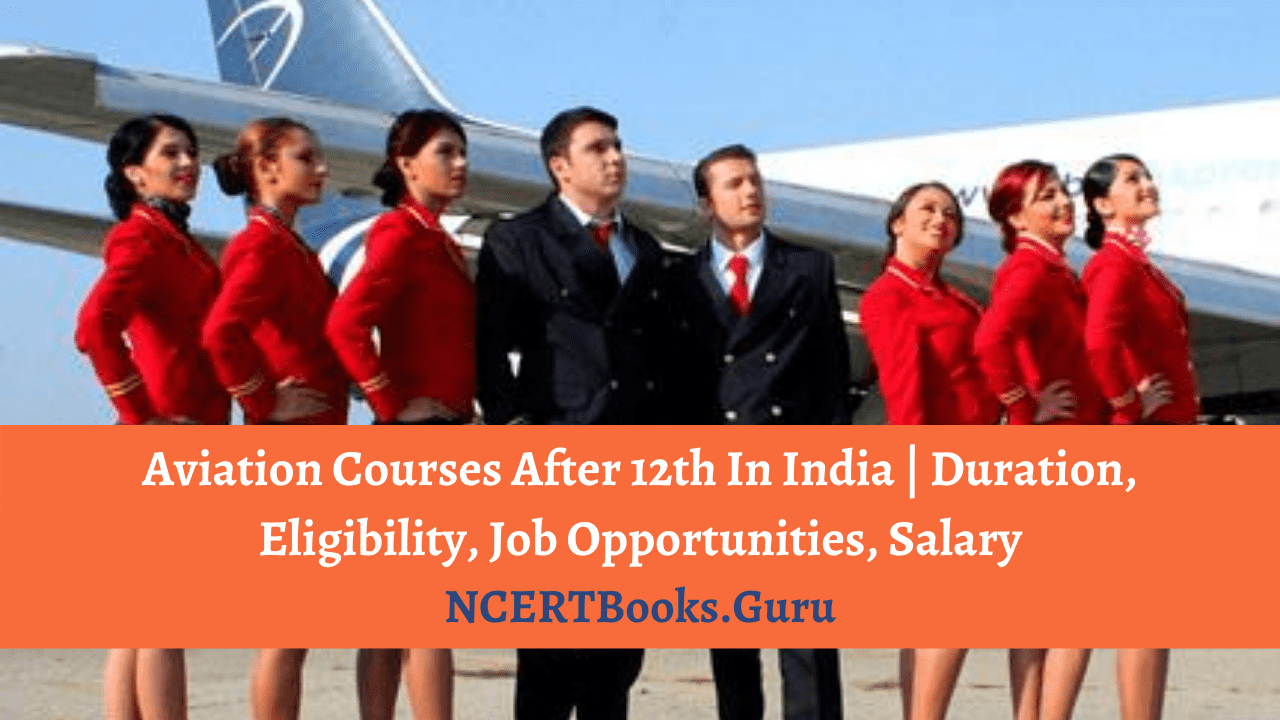
Aviation Courses After 12th In India | Duration, Eligibility, Job Opportunities, Salary

Aviation Courses

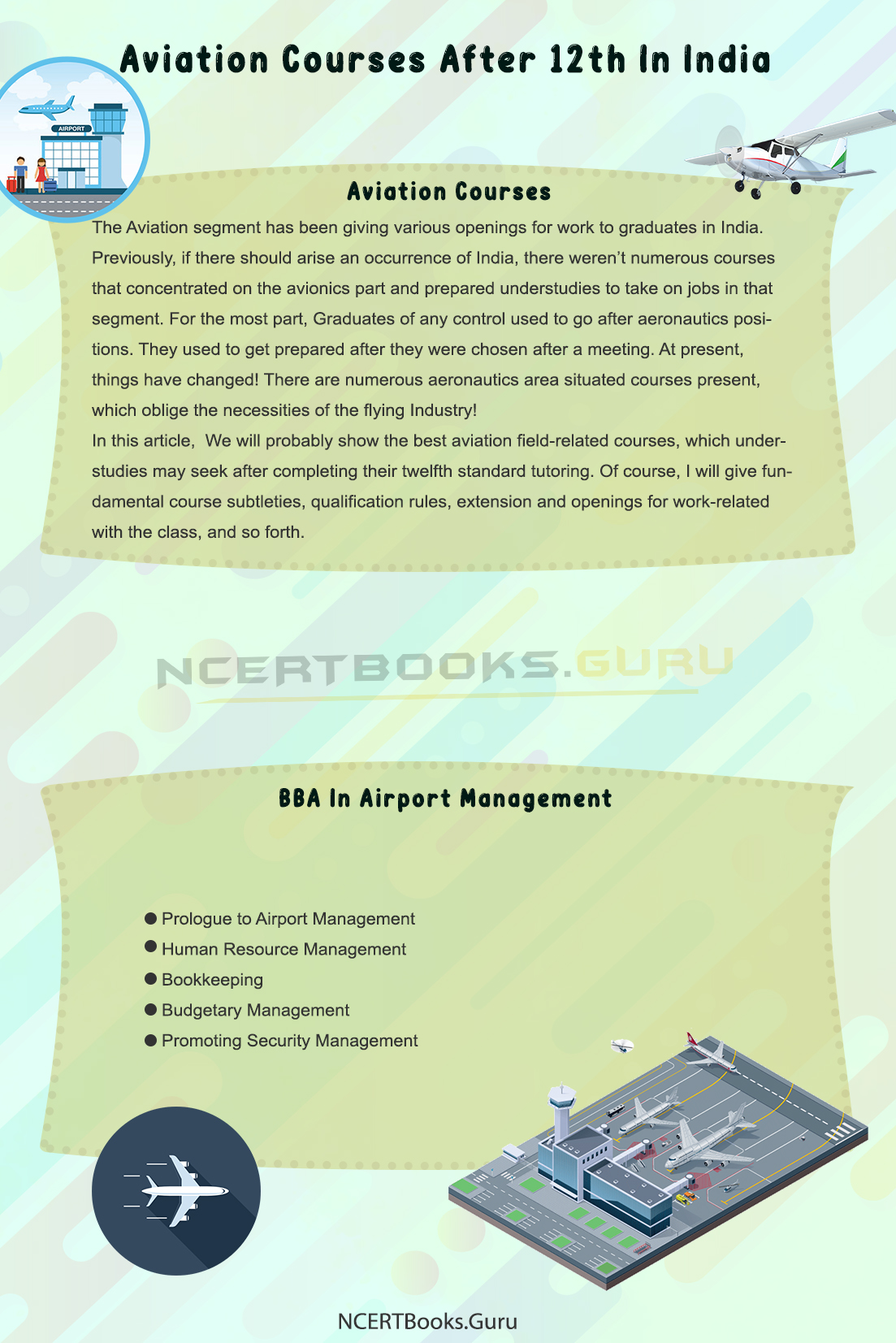
Aviation Courses: The Aviation segment has been giving various openings for work to graduates in India. Previously, if there should arise an occurrence of India, there weren’t numerous courses that concentrated on the avionics part and prepared understudies to take on jobs in that segment. For the most part, Graduates of any control used to go after aeronautics positions. They used to get prepared after they were chosen after a meeting. At present, things have changed! There are numerous aeronautics area situated courses present, which oblige the necessities of the flying Industry!

In this article,  We will probably show the best aviation field-related courses, which understudies may seek after completing their twelfth standard tutoring. Of course, I will give fundamental course subtleties, qualification rules, extension and openings for work-related with the class, and so forth.

Note that vocation possibilities and the chance of getting a lucrative occupation in the Aviation part rely a great deal upon the nature of the Institute from which you seek after the course. Indeed, type obviously and inclination of the competitor likewise assumes a tremendous job. Ensure that you look into well about an Institute/College, before taking confirmation in it.

The primary thing you should check is whether the Institute you are intrigued is endorsed and perceived by the suitable specialists or not! Before choosing a specific course, ensure that you have the inclination and capacity to flourish in the job related to that course. For instance, not every person can turn into a Commercial Pilot! If you don’t incline to turn into a Pilot, it is smarter to pick another Aviation course!

Work Oriented Aviation Courses To Opt After 12th

Have a glance at the Best Aviation Courses after 12th. Each of their eligibility, job opportunities, and salary offered, etc. are provided in detail. Get to know them in advance and decide on which one to opt after your 12th.

BBA In Airport Management

In other B.B.A. courses, the study focuses on various disciplines to let the students learn and get specialized in certain subjects. However, in this course, one is made to learn how to do various jobs in airports. One can further study M.B.A. after doing B.B.A. in airport management.

B.B.A. in Airport Management trains understudies to take on Managerial and Administrative posts in an Airport. The course material includes subjects like

  • Prologue to Airport Management
  • Human Resource Management
  • Bookkeeping
  • Budgetary Management
  • Promoting Security Management

Eligibility: Any student who has passed the 12th standard in any stream from any board is eligible for this course. However, the minimum percentage is different in different institutes, but 50 percent remains in many.

Job And Salary: After graduating from B.B.A. Airport Management, one can opt for jobs at various domestic and international airports. The average salary ranges from 3- 6 lakhs per annum. One can be designated as a staff manager, airport manager, security officer, etc.

Diploma In Airport Management

This is a Diploma course that endures one year and spotlights exclusively on the zone of Airport Management. While it makes a superior showing in managing the specialized subtleties, when contrasted with the B.B.A. program, I should likewise concede that this Diploma Degree doesn’t have as much incentive as the B.B.A. program does. A decent method to take care of this issue is by going for a Post Graduate Diploma in Airport Management in the wake of completing any Graduation course! Some of the essential subjects in this course are cargo and staff management, security management, etc.

Aviation Courses Qualification: Any student from any stream who has passed class 12th can apply for this diploma course. The duration of the course is just one year.

Job and Salary: After doing a diploma in airport management, one can opt for jobs in domestic and international airports. The annual salary is 2- 5 lakhs. Some designations after this course can be cargo management, airport management, etc.

Commercial Pilot Training

Among the numerous employments that the Aviation segment gives, this one must be the most captivating just as compensating one! Be that as it may, Commercial Pilot preparing is exorbitant! Then again, when completed, this course will guarantee that you land a well remunerating activity!

Eligibility: Here, the eligibility criteria are a bit different. The students who have passed 12th with physics, chemistry, and mathematics can opt for this course. Also, the minimum percentage required is 45- 50 percent in the 12th. In addition to this, students need to clear a written test as well as an interview.

Job and Salary: One may directly become a pilot for any airline after this degree. Also, one can choose to become a chartered pilot. You can also opt for a flying instructor after this degree. Annual income ranges somewhere between 10- 12 lakhs.

Eligible candidates, who have completed the Commercial Pilot Training Course can check How to become a Commercial Pilot in India? Check other Pilot Courses in India to get better job opportunities easily.

Diploma In Ground Staff And Cabin Crew Training

The course is generally six months or one year long and aims at giving you opportunities to become air hostess, Steward, in flights. Subjects taught in this course include communication skills, first aid procedures, customer service, etc.

Eligibility: Male or female who has passed class 12th in any stream from any board can apply for this course.

Job and Salary: After this course, one can become air hostess or Steward in domestic or international flights with an annual income of 4- 6 lakhs.

Diploma In Aviation Hospitality

Hospitality is something that is required in every job you do. Thus the aviation sector also requires professionals in hospitality.

Some subjects which are taught over here are communication skills, foreign languages, front operation management, etc.

Eligibility: Students from any stream with any subjects from any board who have passed class 12th can opt for this.

Aviation Courses Job Opportunities and Salary: Cabin crew, ground staff, and computer operators are the jobs one can opt for after this degree in domestic as well as international airports. Salary ranges from 4- 6 lakhs per year.

Aeronautical Engineering

This is a technical, engineering course of 4 years. The job will require you to take proper care of the aircraft and its safety.

Eligibility: Only students from the science stream can apply for this course. Mathematics is compulsory. In addition to this, they must clear various national and international level entrance tests to get admission in different colleges.

Job and Salary: The graduates can be hired by private and governmental airlines to work as design engineers, safety engineers, developmental and chief engineers, etc.

B.Sc Aviation

Sc. in Aviation is three years in length Undergraduate Degree program. This course covers themes, for example, Air Regulations, Navigation, Meteorology, Aircraft and Engine, Air Traffic Control, Aviation Security, Flight Safety, and Crew Management. In the wake of seeking after this course, fruitful up-and-comers may take up employments, for example, Air Traffic Controller, Ground tasks staff, Cargo the executive team, Ticketing staff, and so on. One may likewise go for P.G. courses identified with the Aviation segment, for example, M.B.A. (applicable), M.Sc. Aeronautics Safety, P.G. Diploma courses (pertinent), and so on. Whenever intrigued, fruitful competitors may likewise go for C.P.L. preparing!

Eligibility: Students from the science stream with physics and mathematics who have passed 12th from any recognized board are eligible for this course.

Job and Salary: The job opportunities after this course are diverse. One can opt for jobs like air traffic control or management at airports. Salary ranges from 2- 4 lakhs depending upon your profile and location.

Diploma In Airfare And Ticketing Management

This course will suit the individuals who need to take up a ground obligation work. It is a Diploma declaration course. The course span could be anyplace between a half year to 1 year. This course is accessible in low maintenance just as full-time positions.

The course covers points, for example, Airline codes, tagging wording, Electronic tagging, Passport and Visas, Foreign Exchange, Airfares, and tagging programming. In the wake of seeking after this course, one will have the option to secure a position in the tagging division.

Eligibility: Students from any stream with any subjects from any board who have passed class 12th can opt for this.

Job and Salary: Graduates can get a job quickly on domestic and international airports to work as ticket manager, boarding pass operator. The salary ranges from 2- 3 lakhs per annum.

Students can also check Aviation and Navy Courses which are similar to Aviation Course Details.

See More:

A.M.E. (Aircraft Maintenance Engineering)

A.M.E. is three years in length specialized instructional class. Scholarly program is 2½ years long. After the academic program, understudies likewise need to experience a half year-long entry-level position program. On effectively finishing academic programs and temporary positions, one will be granted A.M.E. permit by the DGCA.

Eligibility: Students from the science stream with physics and mathematics who have passed 12th from any recognized board are eligible for this course.

Job And Salary: The graduates can get hired by various private and governmental firms as aircraft parts manufacturers. The salary ranges from 3- 5 lakhs per annum.

Aviation Courses After 12th In India

FAQ’s on Aviation Courses

Question 1.
If someone wants to pursue the aviation sector as a career opportunity, which college he or she should opt for?

Answer:
Grand Forks’ The University of North Dakota is the best.

Question 2.
Is becoming a pilot a tough job to opt for?

Answer:
If you are passionate about it, yes, it is easy, but if you are not, then it is the hardest.

Question 3.
For how many hours one has to work if he or she is a pilot?

Answer:
A pilot has to fly for 60 hours per week.

Question 4.
What subject qualification does the course require?

Answer:
Subjects that one covers under the course include Meteorology, Air Navigation, Air regulation, Air Law, etc.

BDS Course Details – Admission, Eligibility, Duration, Fee Structure, Entrance Exams, Jobs

BDS Course Details

BDS Course Details: One of the most desirable careers most of you wish to opt after MBBS is BDS. You can avail the complete info regarding the Bachelor of Dental Surgery from this page. Have an insight into information like BDS Full Form, Eligibility, Admission, BDS Course Duration and Fee Structure, Syllabus, Scope, and Salary Offered. Clarify all your ambiguities regarding the Under Graduate Professional Course by going through the entire article.

What is BDS?

Bachelor of Dental Surgery abbreviated as BDS is one of the most sought after courses after MBBS. Usually, BDS enables an aspirant to pursue their career as a Dentist. Students will be taught about dental problems, dentures, and surgery.

Aspirants will be educated in the fields of dental treatment, including dental anatomy and oral histology, community dentistry, oral pathology, dental materials, surgical procedures, oral medicine & radiology, Pedodontics, etc.

BDS Course Details

Course BDS
BDS Full form Bachelor of Dental Surgery
Eligibility & Requirement 10+2 or equivalent
BDS Course Duration 4 years
Fee Offered  50,000 to 4 LPA
Course Type Regular mode
Starting BDS Course salary offered 3 LPA
Advance Courses M.Sc. in Primary Dental Care, M.Sc. in Paediatric Dentistry, M.Sc. in Restorative and Artistic Dentistry
Similar Course MBA
Employment opportunities Dentist, Surgeon, Dental health consultant

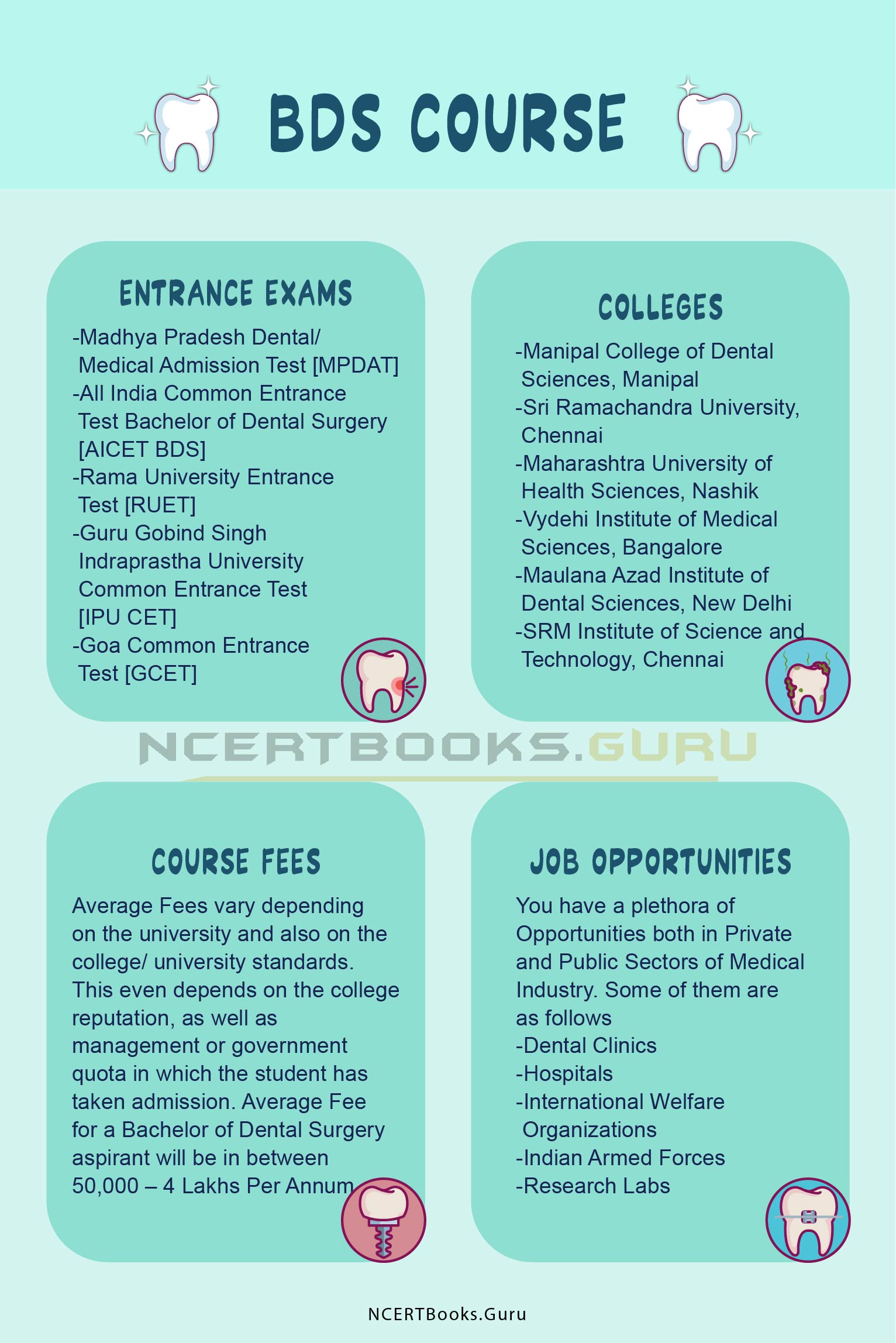
BDS Course Fees

Average Fees vary depending on the university and also on the BDS college/ university standards. This even depends on the college reputation, as well as management or government quota in which the student has taken admission. Average Fee for a Bachelor of Dental Surgery aspirant will be in between 50,000 – 4 Lakhs Per Annum.

BDS Course Duration

BDS is an undergraduate degree for 5 Years that trains students to enter the noble profession of Dental Surgery and Science. You can pursue the course either through Full Time or Part Time. Usually, the Bachelor of Dental Surgery Course follows a Semester Based System.

Eligibility Criteria for BDS

The BDS Course Eligibility to gain admission is that the students need to clear their 10+2 with English, Physics, Maths, Chemistry as their main subjects with a minimum percentage. Aspirants can even gain admission through National Competitive Exam called NEET.

Apart from the central government-administered examinations, State Governments even conduct state level exams. Do Check the List of Dental Courses.

Bachelor of Dental Surgery Admission

You need to appear for an All India Entrance Level Examination if you want to get admission into a Government College. Based on the marks scored in the Exam, 10+2 candidates will be allotted admission into reputed universities. Students need to appear for the counseling process by the concerned authorities and seats will be allotted based on the merit list as well as the seats available. Interested aspirants can also see other Medical Courses in India.

BDS Subjects

Course Subjects pursued as a part of the Bachelor of Dental Surgery Curriculum are prevailing here. A Minor variation can be observed in the subjects followed in certain colleges or universities. However, most of them remain the same.

  • Oral Pathology
  • Public Health Dentistry
  • Oral Microbiology
  • Nutrition
  • Pediatric & Preventive Dentistry
  • General Human Anatomy
  • Microbiology
  • Periodontology
  • Orthodontics & Dentofacial Orthopaedics
  • Oral And Maxillofacial Surgery
  • Embryology
  • Oral Medicine And Radiology
  • General Human Physiology
  • Dietetics
  • Crown and Bridge
  • General Pathology
  • Dental Materials
  • Histology
  • General Surgery
  • Biochemistry
  • Dental Therapeutics
  • General and Dental Pharmacology
  • Preclinical Conservative Dentistry
  • Oral Histology
  • Embryology
  • Conservative Dentistry And Endodontics
  • Preclinical Prosthodontics
  • Dental Anatomy
  • General Medicine
  • Orthodontics and Dentofacial Orthopaedics

Bachelor of Dental Surgery Entrance Exams

There are plenty of Entrance Exams available to get admission into the Bachelor of Dental Surgery Course. Some of the Entrance Exams conducted by the respective colleges or universities are provided in this article. They are in the following fashion

  • Madhya Pradesh Dental/Medical Admission Test [MPDAT]
  • All India Common Entrance Test Bachelor of Dental Surgery [AICET BDS]
  • Rama University Entrance Test [RUET]
  • Guru Gobind Singh Indraprastha University Common Entrance Test [IPU CET]
  • National Eligibility cum Entrance Test [NEET]
  • Goa Common Entrance Test [GCET]
  • Jawaharlal Institute of Post Graduate Medical Education and Research [JIPMER]
  • Siksha O Anusandhan University Admission Test [SAAT]

BDS Course Syllabus

Course Syllabus followed as per the Bachelor of Dental Surgery Curriculum is mentioned here. Minor deviations can be observed in the curriculum in some of the colleges or universities. However, the core of the syllabus remains the same throughout the nation. Refer to the subjects you need to study in advance and make your preparation effective.

First Year Subjects

  • Nutrition and Diabetics
  • Dental Materials
  • Oral Histology
  • Preclinical Prosthodontics and Crown & Bridge
  • General Human Anatomy
  • Dental Embryology
  • Human Physiology
  • Preclinical Conservative Dentistry
  • Dental Anatomy
  • Biochemistry

Second Year Subjects

  • General Pathology and Microbiology
  • Preclinical Conservative Dentistry
  • Oral Pathology and Microbiology
  • Dental Pharmacology and Therapeutics
  • Preclinical Orthodontics
  • Preclinical Prosthodontics and Crown & Bridge
  • Dental Materials
  • General Pharmacology

Third Year Subjects

  • Prosthodontics and Crown & Bridge
  • Oral and Maxillofacial Surgery
  • Conservative Dentistry and Endodontics
  • Orthodontics and Dentofacial Orthopaedics
  • Public Health Dentistry
  • Periodontology
  • General Surgery
  • Oral Pathology and Microbiology
  • Pediatric and Preventive Dentistry
  • Oral Medicine and Radiology
  • General Medicine

Fourth Year Subjects

  • Oral Medicine and Radiology
  • Public Health Dentistry
  • Conservative Dentistry and Endodontics
  • Oral and Maxillofacial Surgery
  • Prosthodontics and Crown & Bridge
  • Pediatric and Preventive Dentistry
  • Orthodontics and Dentofacial Orthopaedics
  • Periodontology

Must See:

List of BDS Colleges in India

There are plenty of Colleges available across the country that offer BDS Course but we have compiled a few of them that are renowned. Top Bachelor of Dental Surgery Colleges are in the following fashion

  • Manipal College of Dental Sciences, Manipal
  • Sri Ramachandra University, Chennai
  • Maharashtra University of Health Sciences, Nashik
  • Vydehi Institute of Medical Sciences, Bangalore
  • Maulana Azad Institute of Dental Sciences, New Delhi
  • SRM Institute of Science and Technology, Chennai
  • SDM College of Dental Sciences and Hospital Sattur, Dharwad
  • Gujarat University, Ahmedabad
  • KIIT University, Bhubaneswar
  • Government Dental College & Research Institute, Bengaluru
  • Amrita College of Dentistry, Kerala
  • Faculty of Dental Science, King George’s Medical University, Lucknow
  • Dental College, Thiruvananthapuram
  • Govt. Dental College & Hospital, Andhra Pradesh

BDS Job Opportunities

An enormous scope of employment is available for candidates who are done with the BDS Course. You have a plethora of Opportunities both in Private and Public Sectors of Medical Industry. Some of them are as follows

  • Dental Clinics
  • Hospitals
  • International Welfare Organizations
  • Indian Armed Forces
  • Research Labs

BDS Career Options

Employment Opportunities that come with the Bachelor of Dental Surgery Course are in the below fashion. You can choose any of the Job Profiles after finishing your BDS Course.

  • Oral Pathologist
  • Dentist
  • Dental Surgeon
  • Dental health Consultant
  • Lecturer
  • Medical Writer

Advance Courses after BDS

Candidates usually after finishing their Internship in BDS Course will opt for higher studies. Some of the advanced courses that you can do after Bachelor of Dental Surgery are in the following fashion

BDS Course Details

Wages/ Salary Offered to BDS Graduate

Average Course Salary for a Bachelor of Dental Surgery Graduate is around 3 Lakhs Per Annum. However, this varies based on the sector of Employment the aspirant is working, diligence, skillset, and experience gained by the individual in the respective field.

FAQs on BDS Course

1. What is the BDS Course?

BDS abbreviated as a Bachelor of Dental Surgery is an undergraduate course done in the field of dentistry.

2. What is the Fee of BDS?

Average Fee for Bachelor of Dental Surgery Student lies in between 50,000 – 4 LPA. However, this varies from college to college and their standards.

3. Does BDS require NEET?

NEET is mandatory for candidates willing to join BDS Course. Candidates need to qualify the National Eligibility cum Entrance Test to get admission.

4. What is the Salary after BDS?

BDS Course Salary is around 3 Lakhs Per Annum. This varies based on the individual’s skill set and the talent gained during the workforce.

5. Is BDS Course Tough?

Bachelor of Dental Surgery is perhaps one of the toughest courses to pursue and is a 5 Year Programme of which 1 year is Internship.

Summary

Hoping, the information shared as far as our knowledge is concerned regarding BDS Course Details has been useful in Clarifying your concerns. For any other information or queries related to this drop us a comment via the comment section and we will help you out at the earliest. Keep in touch with our site for more updates on this.