Diploma in Stenography – Eligibility, Admission, Fees, Syllabus, Career, Scope, Salary

Diploma in Stenography

A diploma in Stenography is a unique course designed to train students in the field of copywriting, typing, transcribing, compiling, and organization of documents in a corporate and non-corporate entity. Stenography means shorthand writing which directly means writing or typing articles at a much faster pace than regular writers and typists.

In this particular Stenography Diploma Course Details, students will be equipped with the knowledge of fast handwriting in different languages of their choice, English being the compulsory shorthand writing language. While a diploma in Stenography or for that matter any course (bachelor’s or master’s) in Stenography is not that mainstream in India, the job market is huge and the demand for quality stenographers is at an all-time high across the industries.

For those of you who have little idea about Stenography and its academic courses, this article should be of great help to equip one with the required knowledge for a diploma in Stenography to make an informed career decision.

What does a Stenographer do?

The below points should suffice the basic job description of a Stenographer:

  • Stenographers help in publishing different government documents and reports on a quarterly or yearly basis
  • He or she copywrites and proof checks different documents in the organization
  • Confidential minutes of the meeting are taken down by a shorthand writer and republished to the relevant participants of the meeting
  • He or she always is responsible to transcribe vocal words into the written format
  • Stenographers also help is captioning speeches or live events for a different target audience such as the deaf or the elderly
  • They track and maintain confidentiality documents within and outside an organization

Diploma in Stenography Course Structure

  • A diploma in Stenography is a 2-year course done after the 10th or 12th standard
  • The course is divided into 4 semesters, with 2 semesters in each year
  • A diploma in Stenography also entails group projects, individual assignments, and industry internship programs other than the regular subjects thought to students over the course of 2 years

Eligibility Criteria for a Diploma in Stenography

  • The student should have a pass certificate from their 10th or 12th standard
  • Should be able to provide the identity of proof
  • Should have cleared the required cut off marks in the entrance tests, set by the university that a student is applying for
  • If there are any personality tests or group discussion rounds set by the colleges, students will have the clear the same and score the required marks to get admission to the college of their choice.

Diploma in Stenography Admission Procedure

  • Many colleges offer direct admission to students after their 10th or 12th graduation
  • One needs to apply using an online application form for the colleges that he or she desires. The application can also be in the offline form
  • One needs to have all the documents ready to get admission into a diploma in the Stenography course. Documents required are 10th and 12th standard pass certificates from a recognized board in India, transfer certificates, domicile certificates, migration certificates, proof of identity, provisional certificates, etc.

Diploma in Stenography Fees

  • The Diploma in Stenography Course Fees varies from college to college but on an average, the basic tuition fee should be around Rs. 1 lakh for the entire course
  • Other than education fees, on average, an extra Rs. 50000 could be spent on co-curricular and extracurricular activities.
  • The fee in government colleges will be much cheaper, varying between Rs. 20000 to Rs. 50000 for the entire course.

See More:

Diploma in Stenography Subjects List

The following are the subjects thought for a diploma in Stenography in most of the colleges in India:

  • Shorthand writing
  • Copywriting
  • Content writing
  • Compulsory language writing
  • Library and extracurricular activities
  • Communication skills (written and vocal)
  • Internal project
  • Viva voce
  • Final year project
  • Industry training
  • Internships
  • Corporate training
  • Government training

Diploma Stenography Career Options

Below are some of the top recruiting industries for a graduate or diploma in Stenography. Stenographer vacancies can be seen mostly in governmental organizations and a few private entities whose business models demand the usage of the skills of a stenographer.

  • Courts in India (Supreme Court, High courts in different states, civil courts, district courts, etc.)
  • Central Secretariats
  • State government agencies
  • Indian Railways
  • Indian Army headquarters
  • Indian Navy headquarters
  • DRDO: Defence Research and Development Organisation
  • Election Commission of India
  • Public Banks such as the State Bank of India (SBI), Punjab National Bank (PNB), etc.
  • Local municipal corporations and related wings

Employment Opportunities for a Graduate in Diploma in Stenography

After completion of a diploma course in Stenography, one might get a job in the sectors of the meeting with the following positions:

  • Management trainee
  • Shorthand writer
  • Copywriter
  • Personal assistant
  • Assistant Manager: Content strategy
  • Lead stenographer
  • Executive: Stenography

Skills need to become a Stenographer

The different skills required to become a stenographer are:

  1. He or she has to be passionate about the written languages
  2. He or she has to have a good command of the language
  3. He or she has to be good at organizational skills and keeping things on track
  4. He or she has to be good at handling documents and organizing them in a proper and predictable pattern

FAQs on Diploma in Stenography

1. What is the average fee for a diploma in Stenography?

The average fee to complete the course of diploma in Stenography is not more than Rs. 1 lakh.

2. Which is the best college to pursue a Diploma in Stenography?

Rajhans Commercial College is considered the best college in India to pursue a diploma in Stenography

3. What is the average salary for a graduate with a Diploma in Stenography?

The average salary at the beginning of a career that a student with a diploma in Stenography gets ranges between Rs. 3 lakhs per annum to Rs. 6 lakhs per annum.

4. Is Stenography a career worth pursuing?

The answer to this question depends on the individual aspirant’s passion, interest, and social and financial situation that he or she is in. However, if one is passionate about the field, then a diploma in Stenography is worth it.

Conclusion

In conclusion, we would like to tell the aspirant that, although Stenography as a career choice might not be the first to be at the top of your head, especially in comparison with the likes of engineering or medical, a diploma in Stenography has plenty of advantages that an aspirant should look into.

The return on investment for this course is very high and the cost of education is highly affordable. As a reason for this, people from any financial background will be able to pursue this course.

While there are plenty of pros that we have already mentioned in this particular article on a diploma in Stenography, there are a few downsides as well, such as the job market is not much expanding ever since the advent of technology and artificial Intelligence. Also, the pay package for stenographers in India is not at par with their counterparts in USA or UK. Check out our article on Best Courses other than Engineering and Medicine.

How to Become a Forest Officer in India – Duties, Eligibility, Courses, Entrance Exams, Career Prospects, Salary

How to Become a Forest Officer in India

Do you have a dream to protect our nature? If yes, then you have a chance to protect the environment by working in the Indian forest services. The job in Indian forestry is a central government job. This is quite different from other kinds of jobs because it does not depend upon the time. You have to work 24 hours to safeguard the forest. There is a lot of demand for forest services in India.

The Indian Forest Officers are responsible to protect and manage forests. You may have doubts that how to become a forest officer in India. In this article, the aspirants can get the forest officer course details of educational qualifications, age limit, selection process, roles and responsibilities, pay scale, etc from here.

What does a Forest Officer do? | Job Role of an IFO

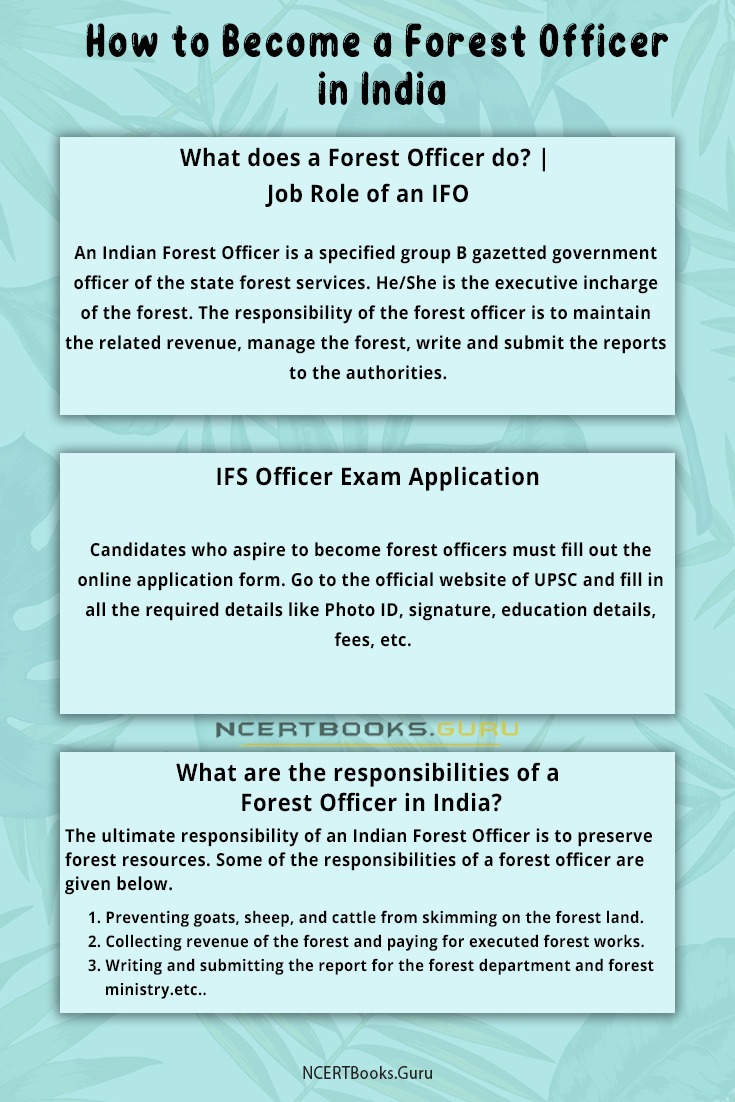
An Indian Forest Officer is a specified group B gazetted government officer of the state forest services. He/She is the executive incharge of the forest. The responsibility of the forest officer is to maintain the related revenue, manage the forest, write and submit the reports to the authorities.

What are the responsibilities of a Forest Officer in India?

The ultimate responsibility of an Indian Forest Officer is to preserve forest resources. Some of the responsibilities of a forest officer are given below.

  • Preventing goats, sheep, and cattle from skimming on the forest land.
  • Collecting revenue of the forest and paying for executed forest works.
  • Writing and submitting the report for the forest department and forest ministry.
  • The forest officer’s responsibility is to conduct surveys frequently of soil, topography, flora, fauna, etc.
  • Their duty is to seize illegal exploitation of forest resources.
  • Checking the telephone and electricity lines setups.
  • Planting trees in the forests to expand the forest.
  • Assigning tasks to the subordinates and managing their work.
  • Providing medical aid to the injured animals and birds.
  • Preventing hunters from killing the animals.

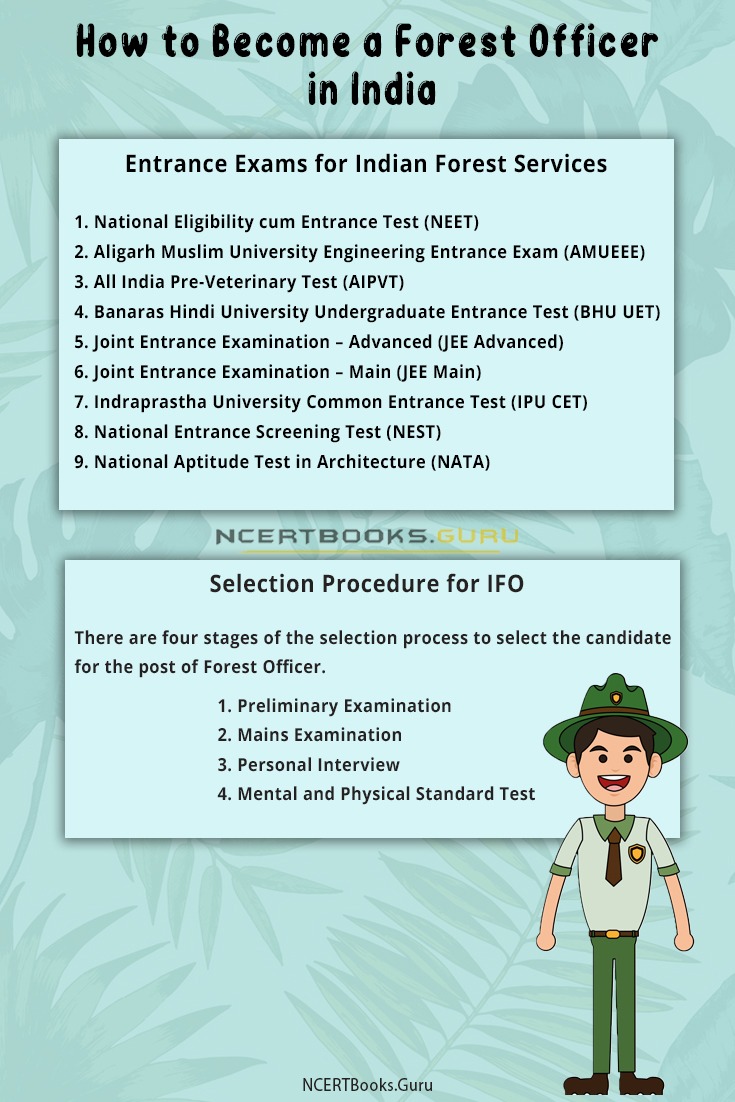
Entrance Exams for Indian Forest Services

  • National Eligibility cum Entrance Test (NEET)
  • Aligarh Muslim University Engineering Entrance Exam (AMUEEE)
  • All India Pre-Veterinary Test (AIPVT)
  • Banaras Hindi University Undergraduate Entrance Test (BHU UET)
  • Joint Entrance Examination – Advanced (JEE Advanced)
  • Joint Entrance Examination – Main (JEE Main)
  • Indraprastha University Common Entrance Test (IPU CET)
  • National Entrance Screening Test (NEST)
  • National Aptitude Test in Architecture (NATA)

See More:

IFS Officer Exam Application

Candidates who aspire to become forest officers must fill out the online application form. Go to the official website of UPSC and fill in all the required details like Photo ID, signature, education details, fees, etc.

how to become forest office in india 2

How to Become a Forest Officer in India?

The aspirants must follow some steps to become an Indian Forest Officer. They are as follows,

  • To Apply for the IFO post: First, the candidate must fill the application form along with the information brochure of the Indian Forest Services Exam from any post office. Fill the application form and send it to the given postal address.
  • Preliminary Exam: The aspirants have to take the prelims exam in the month of May or June. The exam consists of two papers
    Paper-I – General Studies (150 marks)
    Paper-II – Optional subjects (300 marks)
    Following are the optional subjects who have to study in the paper-II.

    • Agriculture
    • Botany
    • Zoology
    • Public Administration
    • Indian History
    • Political Science
    • Mechanical Engineering
    • Electrical Engineering
    • Civil Engineering
    • Economics
    • Philosophy
    • Statistics
    • Mathematics
    • Geography
    • Psychology
    • Commerce
    • Sociology
    • Geology
    • Animal Husbandry and veterinary science
    • Chemistry
    • Law
    • Physics
  • Mains Exam – The aspirants who have scored the cut off marks in the exams will be shortlisted for the mains exam. The mains exam paper is descriptive type. The pattern of the mains exam is shown below.
    Objective Marks
    Essay type of Indian Language Qualifying paper 300
    English 300
     General Essay type 200
    General Studies Papers 300
     Optional subject 300
  • The candidates who have scored top in the main exam will be called for a personal interview. You may have the physical standard test before or after the personal interview. Aspirants who have performed well in the interview will be selected for the post of Indian Forest Officer.

Eligibility to Become Indian Forest Officer (IFO) – Educational Qualification, Age Limits, Nationality

The candidates who wish to join the Forest Officer in India must fulfill the below eligibility criteria.

  • Educational Qualification – Candidates must have completed a bachelor’s degree in any medical, science, or engineering field from any admitted university. After that, you have to qualify in the prelims exam and mains exam to get selected for the IFS (Indian Forest Services).
  • Nationality – The applicant of this forest officer post must be an Indian citizen. If the government permits the candidates from Nepal, Bhutan, Tibetan can also apply for this IFO job. And also the candidates from the Indian-origin migrants from Pakistan, Sri Lanka, Myanmar, Vietnam, and East-African Countries are eligible to apply for the forest officer job.
  • Age Limit – The minimum age for the applicant is 21 years and the maximum age is 32 years. The extension of five years for SC/ST, ex-servicemen, and Jammu & Kashmir residents. The extension of three years for OBC and 10 years for physically handicapped candidates.
  • Physical and Mental standards – Physical fitness and mental fitness are also important to get qualified for the post of Forest Officer. After qualifying in the written exam and interview the candidate will undergo some medical examination. If you are medically fit you will be qualified for the forest officer.

Selection Procedure for IFO

There are four stages of the selection process to select the candidate for the post of Forest Officer.

  • Preliminary Examination
  • Mains Examination
  • Personal Interview
  • Mental and Physical Standard Test

how to become forest officer in india 1

Indian Forest Officer Salary

The approximate salary for a forest officer in India is Rs. 3,71,000 per year. Based on your rank and performance you will get more salary. As it is a central government job you will be having more benefits.

Frequently Asked Questions to become an IFO

1. What is the qualification of the forest officer?

A bachelor’s degree in any subject like science, botany, mathematics, physics, geology.

2. Is the IFOs exam tough?

Both Indian Forest Officer and IAS exams are very tough to crack the post.

3. How many IFOs are selected every year?

On average 35 candidates will be selected for the post of Indian Forest Officer every year.

Summary

We believe that the details prevailed in the above article on “How to become a forest officer in India” are helpful for you. Please post your doubts in the form of comments in the below comment section. Bookmark our site to get the latest updates regarding the Indian Forestry jobs.

All About Best Courses after Diploma in Mechanical Engineering | Eligibility, Admission Process, Fees, Job Options, Salary

Course after Diploma in Mechanical Engineering

Short term Course after Diploma in Mechanical Engineering: After completing a diploma in mechanical engineering, students can go for higher education depending upon their skills, their career plans, etc. Students can switch their field from technical to non-technical by choosing courses from the fields of arts, commerce, etc. A variety of certification courses and degrees are available for students who have a diploma in mechanical engineering degree. They can opt for courses ranging from six months to two years or more.

Mechanical engineering is a core engineering branch and one of the most popular among all engineering branches. It incorporates engineering physics and mathematical principles with material science concepts. This branch of engineering involves the design, production, and operation of machinery. Students who complete their diploma in mechanical engineering might now want to move on to higher courses.

Let’s look at all the details about different courses that students can go for after getting their diploma degree in mechanical engineering. We will look at the things such as course details, eligibility criteria, the application process, fee structure, salary, job options, etc. So let’s get started!

All About Course after Diploma in Mechanical Engineering

Once you’re done with the mechanical engineering diploma course, students can opt for higher education either in technical or even in non-technical fields. Students can go for a B-Tech degree, self-employment, short term professional courses depending upon the time period they want to dedicate for the course, the goals they have for their career, the stream they want to choose for higher education. The certification courses can value from a time duration of six months to up to two years or more.

Details About Courses After Mechanical Engineering Diploma

B-Tech Courses after Diploma in Mechanical Engineering: students can go for a bachelor of technology graduation course after completing their diploma in mechanical engineering. Many colleges offer lateral entry for students who have a diploma degree. This means that you can directly get admission in the second year of engineering if you hold a diploma degree.

Non-technical graduation courses: If the particular student does not want to continue in the technical field for higher education, they can switch to non-technical courses such as those in the field of arts, science, commerce. There are various courses available in these fields for students to take up this will be an entire shift of background but if the student prefers non-technical background, they must go for these courses.

AMIE: AMIE is a distance course for B-Tech. This is fit for students who have a job after completing their diploma but they still want to go for a B-Tech degree. This might be hard to manage but if the student wishes to keep their job along with their education, they must go for this process.

Short-term Professional courses: students can opt for various courses which will help them grow in their careers by providing them with proper certification. Students can go for certification courses of six months, one year, or two years depending upon the course and the time they want to dedicate to the course. Following are the top courses for students who have completed their diploma in mechanical engineering:

  • CNC Training
  • CAD/CAM Training
  • Unigraphics
  • AutoCAD 2D & 3D
  • ADCNC
  • Diploma in Tool Design
  • Piping Design Training
  • RADIOSS Training
  • Diploma in Mechatronics and Robotics
  • Fire and Safety Course
  • Hypermesh Training
  • Boiler Operator Training
  • PG Safety

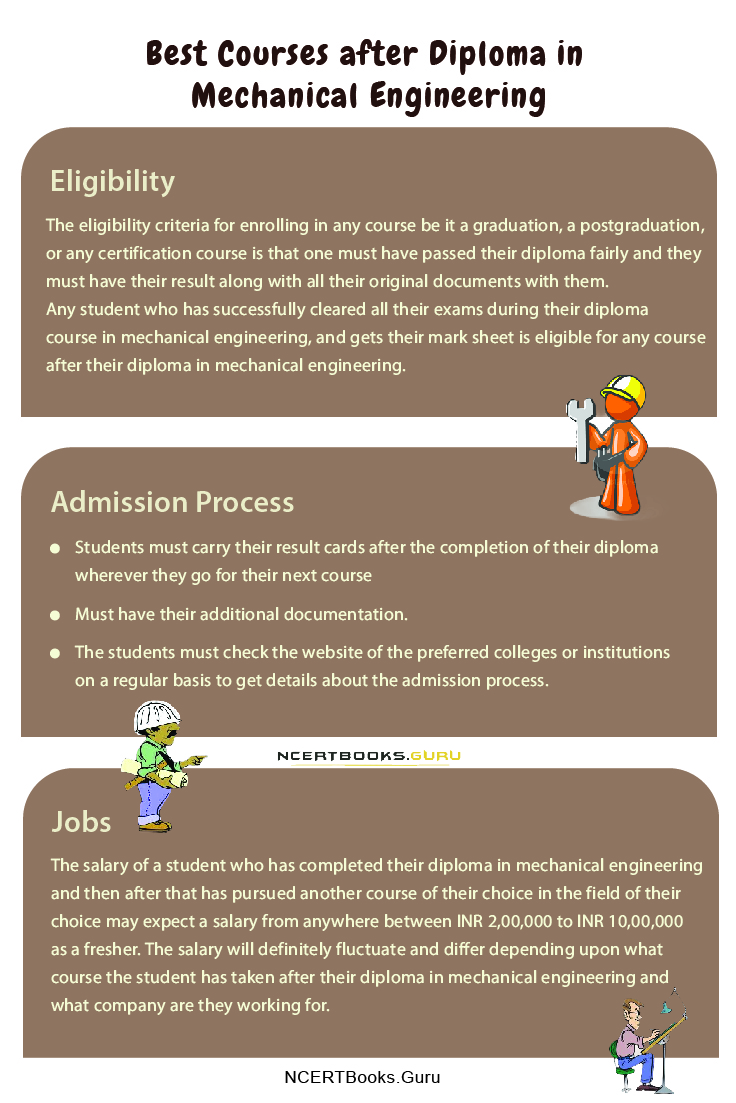
Eligibility Criteria for Course After Diploma in Mechanical Engineering

The eligibility criteria for enrolling in any Course after Diploma in Mechanical Engineering is 10th class from a recognised board.

Any student who has successfully cleared all their exams during their diploma course in mechanical engineering, and gets their mark sheet is eligible for any course after their diploma in mechanical engineering.

Must Check:

Admission Process After Diploma in Mechanical Engineering in Courses

The admission process for course after a diploma in mechanical engineering is very simple.

  • Students must carry their result cards after the completion of their diploma wherever they go for their next course.
  • Must have their additional documentation.
  • The students can apply for different courses either in online or an offline format as mentioned by the college, university, or institution where the student wants to take admission.
  • The students must check the website of the preferred colleges or institutions on a regular basis to get details about the admission process.

Fee Structure for Certified Diploma Mechanical Course

The fee of the courses completely depends upon the course type and the institution from which the student is completing the course. One can get certification courses for a few thousand up to getting graduation degrees for lakhs of rupees. The fee can go anywhere between INR 5,000 to INR 10,00,000.

High Salary Jobs After Diploma in Mechanical Engineering

For people who do not want to pursue courses further, the best option would be either to take up a job or go for self-employment. Let’s look at both of these things in detail:

Job opportunities: after completing a diploma in mechanical engineering, there are a lot of job options available for students in the private as well as government sector and even apprenticeship. Let’s look at the top companies that provide employment to mechanical engineering diploma holders in the private as well as government sectors:

Private Sector:

  • TATA Group
  • Thermax
  • Ashok Leyland
  • Godrej Group
  • Larson and Toubro
  • General Motors
  • Kirloskar Group
  • Maruti Suzuki
  • Mahindra Group

Government Sector:

  • Railways
  • SAIL
  • DRDO
  • SSC JE
  • State Level JE Exams
  • DMRC
  • ISRO
  • NTRO
  • NTPC
  • Power Grid
  • Coal India
  • IOCL

Self-employment: the perfect option for people who want to be their own boss is to go for self-employment. If you cannot find your dream job why not just create it? Now, this might sound easy, but always remember that this is not at all an easy task. Having a diploma in mechanical engineering, you might have gained a lot of skills on various difficult steps. You can use those skills to build your own company in this field.

Being an entrepreneur requires passion, determination, and risk-taking capacity. You will definitely need monetary investment and a good business idea. Always remember that you won’t become a millionaire overnight, you will have to invest and keep on working hard in order to make your business successful.

So, if you do not want to go for a job or other course after your diploma in mechanical engineering, you can definitely opt for self-employment by building your own company or business.

Courses after Diploma in Mechanical Engineering

Jobs After Diploma in Mechanical Engineering Salary Details

The salary of a student who has completed their diploma in mechanical engineering and then after that has pursued another course of their choice in the field of their choice may expect a salary from anywhere between INR 2,00,000 to INR 10,00,000 as a fresher.

The salary will definitely fluctuate and differ depending upon what course the student has taken after their diploma in mechanical engineering and what company are they working for. The exact salary cannot be told unless we do not know the course of the student after a diploma in mechanical engineering.

FAQ’s on Courses after Diploma in Mechanical Engineering in Abroad & India

1. What courses can I do after a diploma in mechanical engineering?

You can do a variety of courses after completing your diploma in mechanical engineering such as:

  • B-Tech
  • Short-term Professional Courses
  • AMIE
  • Certification Courses, etc

2. Can I switch to a non-technical field after I have done a diploma in mechanical engineering?

Yes, you can definitely switch from the technical field that you currently have your degree from to a non-technical field such as arts, commerce. You can do so by taking up a course which is from these fields after you have your diploma degree in mechanical engineering.

3. Is it mandatory to do a course after completing a diploma in mechanical engineering?

No, it is not a compulsion to do other courses after completing a diploma in mechanical engineering. You can definitely skip other courses and go for the other options after your diploma in mechanical engineering such as:

  • Self-employment
  • Jobs in government and private sector
  • Apprenticeship, etc

Conclusion

We hope that this course after diploma in mechanical engineering article was able to provide you with information regarding the course options that you have after the completion of mechanical engineering course in diploma. All the best to you and we hope that you make an informed decision for yourself. For more, visit ncertbooks.guru & get full clarity on a career path and course details.

How to Become a Chief Financial Officer in India | Eligibility Criteria, Educational Qualifications, Career Path, Job Profiles, Skillset

How to Become a Chief Financial Officer in India

The position of a chief financial officer in India is an important one. A CFO takes up the responsibility of planning, implementing, and managing all the activities related to finance in the organization and he or she is responsible for all fiscal decisions. Tracking cash, analyzing the company’s financial strength, and proposing corrective actions are also some of the responsibilities of a CFO in India.

Currently, there are many new startups and businesses coming up. Therefore, there is a growing demand for a chief financial officer in India. It is a great time to aim for the companies whose revenues are increasing as CFOs are associated with 19% greater cost efficiencies.

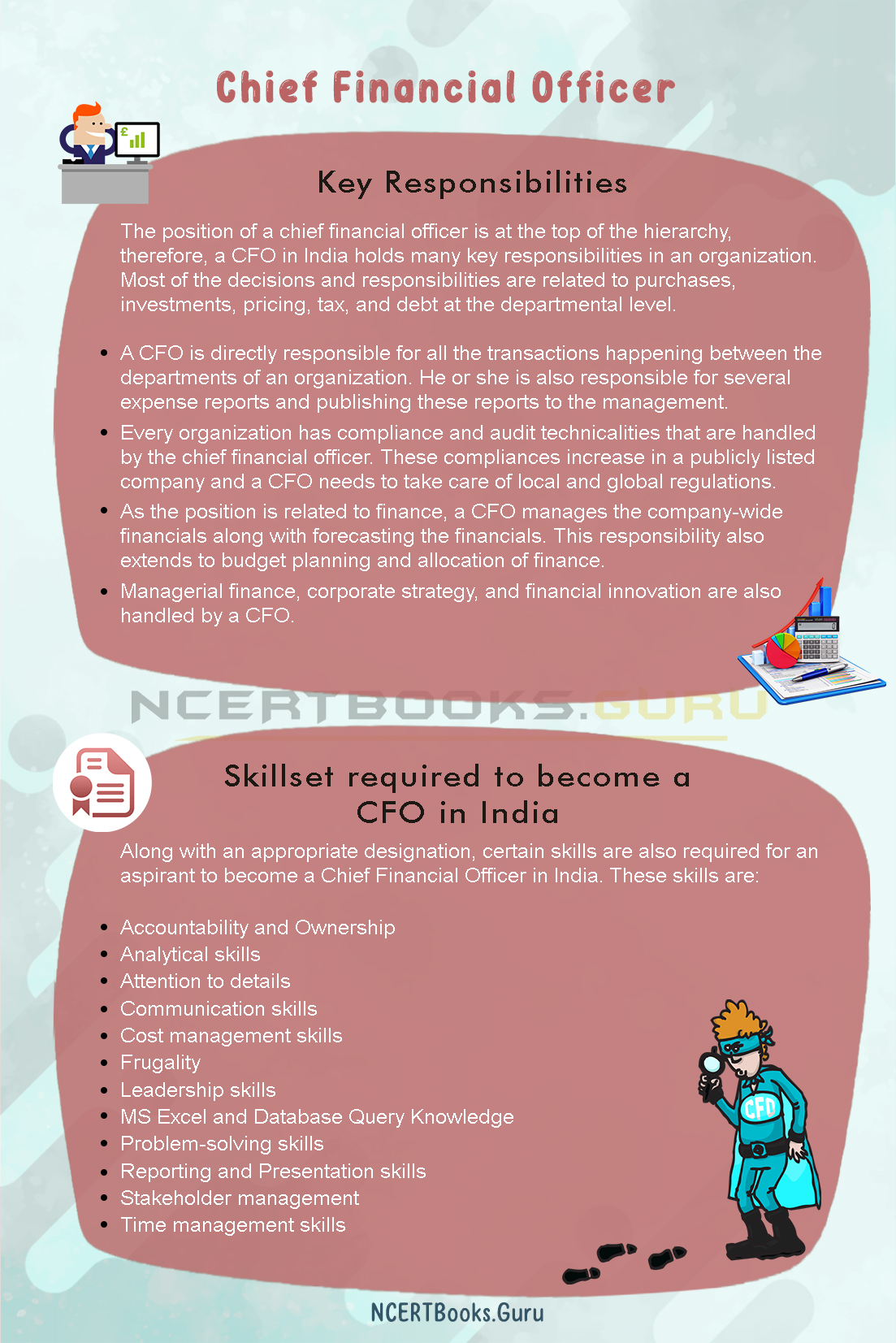
Key Responsibilities of a Chief Financial Officer

The position of a chief financial officer is at the top of the hierarchy, therefore, a CFO in India holds many key responsibilities in an organization. Most of the decisions and responsibilities are related to purchases, investments, pricing, tax, and debt at the departmental level.

  • A CFO is directly responsible for all the transactions happening between the departments of an organization. He or she is also responsible for several expense reports and publishing these reports to the management.
  • Every organization has compliance and audit technicalities that are handled by the chief financial officer. These compliances increase in a publicly listed company and a CFO needs to take care of local and global regulations.
  • As the position is related to finance, a CFO manages the company-wide financials along with forecasting the financials. This responsibility also extends to budget planning and allocation of finance.
  • Managerial finance, corporate strategy, and financial innovation are also handled by a CFO.

How to Become a Chief Financial Officer in India?

To hold the position of chief financial officer, a student needs to get acquainted with accounts and finance first. There are certain steps one needs to follow to go in the direction of becoming a CFO.

  • Many colleges in India provide a course for Accounting, finance, and economics. To get admission into such colleges requires good scores in class 10th and 12th. Therefore, a candidate needs to first focus on their school examination or take the several entrance examinations required for colleges.
  • If a student is serious about a career in finance, he or she may take up commerce in class 12th and further study B.Com or BBA in their undergraduate study.
  • A student with a commerce background is usually given a preference when it comes to higher courses, however, a commerce background isn’t always necessary.
  • There are several colleges in India that conduct their admission on the basis of entrance examinations. So, a student wishing to study in those colleges needs to prepare the syllabus for the entrance test well to get admission in bachelor’s or master’s degree.
  • Proper research is necessary before delving into a field of study. To become a CFO in India, a student needs to select a college that provides proper opportunities for on-field research and work exposure through internships. A good college can open up several avenues.

Eligibility Criteria to become a CFO in India

If someone is wondering how to become a chief financial officer in India, the process is quite simple. However, to actually reach the position requires a lot of dedication and merit. It is always better to set on the path as early as class 12th.

School Level Preparation

  • To become a CFO in India, the preparation needs to start early. A student needs to score a minimum of 50 percent aggregate in any discipline of arts, commerce, or science during class 12th or equivalent.
  • Many colleges conduct entrance examinations for admission so students need to prepare the syllabus accordingly.

Undergraduate Preparation

  • It is not necessary to take admission in a finance-related discipline to become a CFO in India. A student needs to fulfill the criteria of admission for the college to secure a seat.
  • The minimum duration of an undergraduate degree in India is 3 years and an undergraduate degree is paramount.

Postgraduate Preparation

  • A candidate needs a master’s degree to become a CFO.
  • The master’s degree should be held for a finance-related discipline as a chief financial officer needs to have in-depth knowledge related to accountancy, business management, and finance.

Do Refer:

Educational Qualifications to become a Chief Financial Officer in India

If a student wishes to become a CFO, there are certain educational qualifications and exams he or she needs to qualify in order to reach the goal. Do note that the position of a CFO is on the top of the pyramid and one needs to work towards the top.

Bachelor’s Degree: A right bachelor’s degree can offer accurate insight into the financial world. Therefore, a student needs to opt for degrees like BBA, BBM, or B.Com. A bachelor’s degree is the first step towards working in the financial domain and becoming a CFO in India one day.

Masters of Business Administration (Finance): A master’s degree with a specialization in finance is required to gain in-depth knowledge regarding finance. An elite institute can open doors for a student into the corporate world and help him or her to climb up the ladder.

Dual specializations in MBA, like Finance and Operations, will also help a candidate develop confidence and exposure. There are also MBA programs designed for working professionals in India.

Chartered Accountant: Chartered Accountant is a professional course that teaches a student about taxation and accounting standards. Becoming a chartered accountant improves one’s chances of becoming a chief financial officer as he or she would have gained knowledge and skills about various Accounting practices.

Chartered Financial Analyst: CFA or Chartered Financial Analyst is also a course almost similar to that of a Chartered Accountant. CFA is more focused on the investment aspect of the business by assessing cash flows and financial domains. Becoming a CFA opens up avenues for becoming a CFO.

Financial Risk Manager: FRM is also a similar course to Chartered Accountant and Chartered Financial Analyst. A financial risk manager deals with Financial risk and takes strong decisions regarding the risks at a company. The syllabus includes fundamentals related to minimizing risks and maximizing profits.

Short-term Training Programs: If a candidate is already working in a finance-related field, he or she may want to upskill themselves through various online organizations and courses. There is a myriad of short-term training programs like compliance management, import, and export manager, Financial risk management, operations management, and financial analysis to help a person become a CFO.

Career Path of Chief Financial Officer in India

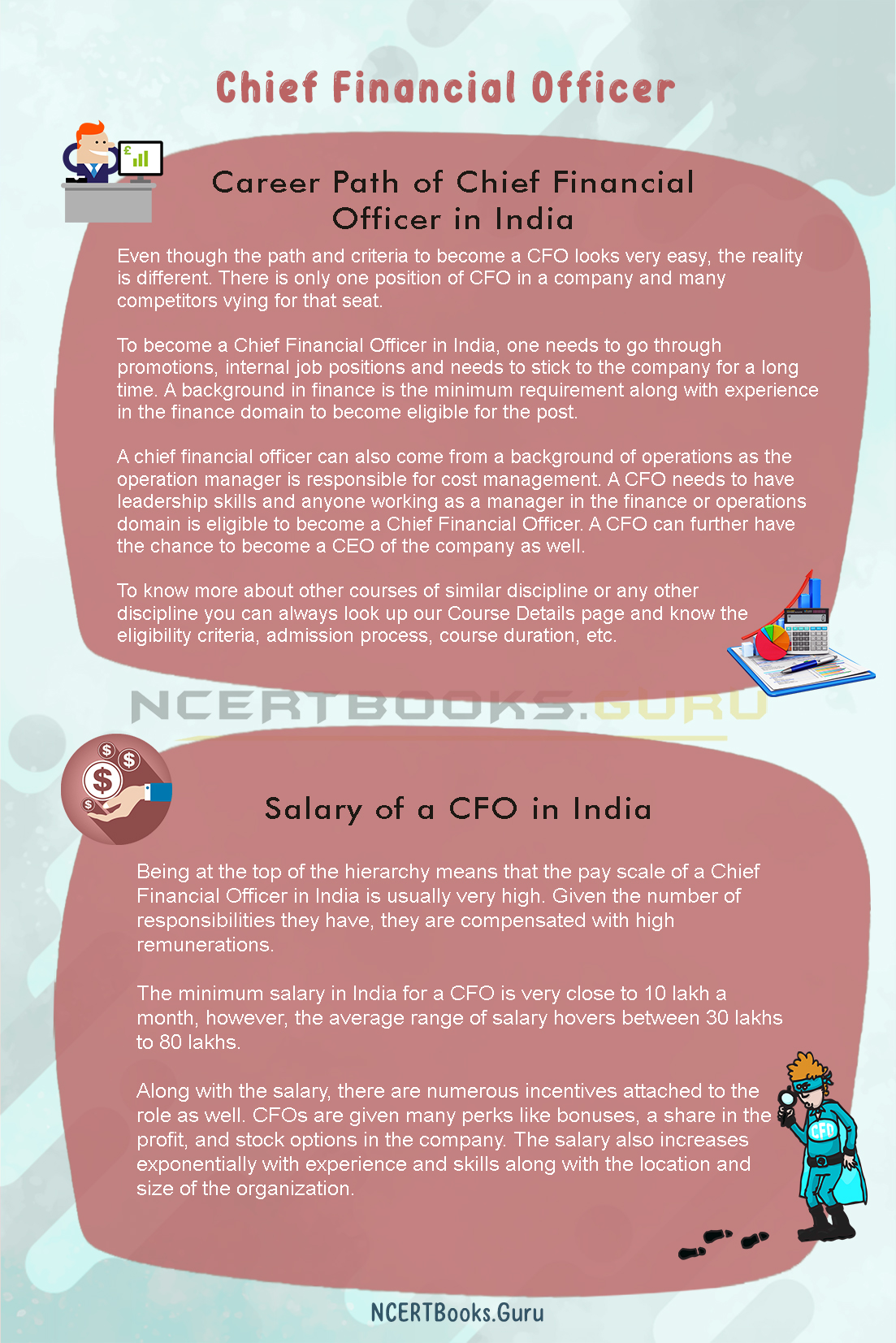
Even though the path and criteria to become a CFO looks very easy, the reality is different. There is only one position of CFO in a company and many competitors vying for that seat.

To become a Chief Financial Officer in India, one needs to go through promotions, internal job positions and needs to stick to the company for a long time. A background in finance is the minimum requirement along with experience in the finance domain to become eligible for the post.

A chief financial officer can also come from a background of operations as the operation manager is responsible for cost management. A CFO needs to have leadership skills and anyone working as a manager in the finance or operations domain is eligible to become a Chief Financial Officer. A CFO can further have the chance to become a CEO of the company as well.

To know more about other courses of similar discipline or any other discipline you can always look up our Course Details page and know the eligibility criteria, admission process, course duration, etc.

Job Profiles for Chief Financial Officer

To become a chief financial officer in India, a candidate needs to enter into the company with one of the designations mentioned below to increase their chances of becoming a CFO.

  • Business Manager
  • Director of Administration
  • Director of Finance
  • Director of Operations
  • Director of WorkForce Management
  • Financial Manager
  • General Manager
  • Operations Manager

Skillset required to become a CFO in India

Along with an appropriate designation, certain skills are also required for an aspirant to become a Chief Financial Officer in India. These skills are:

  • Accountability and Ownership
  • Analytical skills
  • Attention to details
  • Communication skills
  • Cost management skills
  • Frugality
  • Leadership skills
  • MS Excel and Database Query Knowledge
  • Problem-solving skills
  • Reporting and Presentation skills
  • Stakeholder management
  • Time management skills

Chief Financial Officer 1

Types of CFOs

It is not enough to know how to become a chief financial officer in India but a candidate also needs to know the type of CFOs in various companies.

The Financier
A CFO specializing in the field of finance oversees structuring financial tools, planning, and working of internal corporate work. A financier CFO also manages investor relations and understands the legal aspects of financing.

The Economist
An economist CFO is a vital addition to a company as an economist can significantly boost business growth. This is due to their excellence in articulating complex financial models, understanding unit economics, and having a good grasp of various business activities.

The Operator
An operator CFO is intertwined in the art of corporate dynamics along with project monitoring, financial modeling, and budget building. An operator CFO is always more involved hands-on with various operations across the company.

Salary of a CFO in India

Being at the top of the hierarchy means that the pay scale of a Chief Financial Officer in India is usually very high. Given the number of responsibilities they have, they are compensated with high remunerations.

The minimum salary in India for a CFO is very close to 10 lakh a month, however, the average range of salary hovers between 30 lakhs to 80 lakhs.

Along with the salary, there are numerous incentives attached to the role as well. CFOs are given many perks like bonuses, a share in the profit, and stock options in the company. The salary also increases exponentially with experience and skills along with the location and size of the organization.

Chief Financial Officer 2

Conclusion

As the position of a Chief Financial Officer in India is at the top of the pyramid, an aspiring student needs to set realistic expectations. It takes a minimum of 10 to 12 years of dedicated efforts to become a CFO in an organization. In addition to efforts, loyalty towards the company is also paramount to reach the topmost role in the organization.

NIOS Medical Courses List | NIOS Diploma Medical Course Admission, Career Options, Colleges

NIOS Medical Courses List

NIOS Medical Courses List: NIOS provides you ample opportunity to attain senior secondary and degree courses easily. If you are not willing to study regularly the NIOS is waiting for you. The main focus is that the exam is conducted in various languages so accordingly, you can choose the medium.

Medical courses can also be pursued from NIOS. The vocational courses will provide you with detailed practical knowledge about the subjects. However, there is a proper process to get into NIOS.

In this below article you can read the complete details on NIOS Medical Courses List, career scope, fees, and more about NIOS. So, let’s get started.

Get to Know More about other types of Course Details Streamwise, and Category wise.

About NIOS Medical Courses in India

Medical courses have become an important part of the world. Thus, for your benefit, NIOS is offering a lot of short-term and long-term medical courses that too at a minimal cost. After the completion of these courses, the various doors of opportunities are waiting.

The content you will study is easy and understandable. Right from the beginning to the advanced level courses are offered by NIOS in medical science. Studying medical courses from open learning in yoga, homoeopathy, ayurvedic, and other domains is just offered by NIOS and it is an amazing chance to grab it.

Detailed NIOS Medical Courses List 2022

The NIOS Courses by Vocational Education Department (Health and Paramedical) provide ample courses in the medical field. You can have a look at the detailed list of health and paramedical vocational courses offered by NIOS on this page. You can get the code for the specific courses related to medical science which will help you to identify the actual course.

6 Months Certificate Course

  • Yoga (614)

1 Year Certificate Course

  • Care of the Elderly (445-448)
  • Homeopathic Dispensing (718-719)
  • Ayurvedic Therapy (721-722)
  • Yoga Teachers Training Program

2 Year Diploma Course

  • Diploma in Medical Imaging Technology (471-473)
  • Diploma in Radiography
  • Diploma in Medical Laboratory Technology (474-477)

Senior Secondary Courses at 1-year Stand Alone Certificate Course

  • Ayurveda Assistant (665)
  • Panchakarma Assistant (666)
  • Yoga Assistant (667)

NIOS Medical Certificate Courses: Eligibility

The eligibility for the diploma and other certificate courses is not the same. The minimum eligibility for the courses is class 8th. But to have complete details on the latest eligibility criteria for the NIOS Medical Courses is as follows:

6 Months Certificate Course

The 6-month certificate course can be pursued after class 8th. This is a great opportunity for you if you want to build your career in yoga since childhood.

1 Year Certificate Course

Only for the Ayurvedic Therapy are you required to pass class 12th with science and for the yoga trainer course class 12th is mandatory. But for other courses clearing class 10th is fair enough.

2 Year Diploma Course

For NIOS Diploma courses you must clear class 12th. However, it is also necessary to study biology in class 10+2. For the Medical Laboratory Technology course, you must attain a minimum aggregate of 40$ in class 12th as biology is the main subject.

Senior Secondary Course For 1-year Stand Alone Certificate Course

This course requires you to just clear class 10 with the required good marks.

NIOS Medical Courses Fees

NIOS does not charge a high amount of fees from the students, You can easily get a vocational course degree by just paying a minimal amount. If you are worried about the fee structure of Medical Certificate Courses offered by NIOS then you are at the right place. Read the below table to know the complete fee structure.

  • 1-year Stand Alone Certificate Course (Senior Secondary Course) can be pursued after just paying Rs 3000.
  • 6 Months Certificate Course can be completed in Rs 1000
  • The 1-year certification course varies from Rs 6000 – to Rs 18000. The fees structure will be as follows:
  1. Ayurvedic Therapy- Rs.15,000
  2. Care of the Elderly- Rs.6,000
  3. Yoga Teachers Training Program- Rs.10,000
  4. Homeopathic Dispensing- Rs.18,000
  • The 2 years Diploma course can be completed within a fees structure of Rs 14,000 – Rs 45,000.

NIOS Medical Courses Online Admission in India

You can easily take admission at NIOS through the online mode of application. The application fees charged are different according to the category. But with the help of the following points, you can easily pursue a degree in NIOS medical Courses.

  • First, open the official website portal
  • Now, register for the course and submit all the required documents.
  • Be careful while choosing the state and submitting your application.
  • At last pay the required fees.

Documents Required

While taking admission at the National Institute of Open Schooling you must be well aware of these documents. As they must be prepared in advance so that you will not face any difficulty at the time of admission.

  • Copy of all mark lists & valid certificates.
  • ID Proof & Address Proof
  • Photo
  • Fill application form

Top Colleges In India Offering NIOS Medical Courses

There are numerous colleges available all over India that accept NIOS degree Courses. You can apply to most of the courses, but there are a few courses for which you are not eligible. With the vast range of opportunities by the colleges, here in the below table, we are providing you with an amazing college list.

  • Gauhati University
  • Patna University
  • Indira Gandhi National Open University (IGNOU)
  • University of Delhi
  • Goa University
  • North Gujarat University
  • Sardar Patel University
  • Haryana Agricultural University
  • Kurukshetra University
  • Ranchi University

There are a few eligibility criteria that you need to clear to get admission into the colleges. However, there are a lot more than the above mentioned.

Also, Refer

Career Opportunities After National Institute of Open Schooling (NIOS) Medical Courses in India

The NIOS’s students’ future is similar to that of those who study in the regular school. After the completion of medical courses, you can either continue to study further or can work in these domains. However, you can work in both government and private sectors.

  • Yoga Teacher
  • Homeopathy assistant
  • Lab assistant
  • Therapist
  • Work in dispensary

Salary for Certified Candidates in NIOS Online Medical Courses

The salary structure completely depends on the job profile which you have chosen for your future. The average salary after the medical diploma is Rs 10,000 to Rs 40,000.

Top Companies Hire NIOS Medical Holders

Some top companies which hire candidates after NIOS courses are:

  • AIIMS
  • Apollo Hospitals
  • Cipla
  • Zydus Cadila
  • Torrent Pharmaceuticals
  • Dr. Reddy’s Laboratories Ltd.

FAQ’s on NIOS Paramedical Courses List 2022

1. Is NIOS a good career option?

Yes, the door for various colleges and courses is opened after pursuing the vocational course after NIOS Medical Courses. You can easily get admission to further courses related to your bachelor’s after studying at NIOS.

2. Can I pursue MBBS after studying at NIOS? 

For MBBS and BDS exams, proper education in class 12th with biology, Physics, and Chemistry as the main subjects is required. You must have attained a regular degree in class 12th. Thus, by getting awarded by NIOS there is no chance yet that you can get admission to MBBS.

3. Does the NIOS degree offer me good jobs? 

Yes, the degree is recognized by almost all universities and educational institutes. You can easily rely on the NIOS degree for better career opportunities.

4. What are the medical courses list offered by NIOS? 

There are various NIOS medical course lists. But the main structure includes.

  • 1–year Stand Alone Certificate Course (Course Senior Secondary Level)
  • 6 Months Certificate Course
  • 1-year certification course
  • The 2 years Diploma course

To get the detailed NIOS Medical Course List, you can refer to the above article.

Final Words

To save your time and complete vocational courses in a short duration of time you can easily pursue NIOS courses. In addition, the NIOS Medical courses list create amazing opportunities for a better future. If you want to know more about the medical courses you can visit our official website Ncertbooks.guru. Also, you may ask your queries in the comment section below.

Architecture Courses After 10th: About, Eligibility, Admission, Syllabus, Entrance Examinations, Top Colleges, Fee Structure, Work Profiles, Recruitment, Salary In India

Architecture Courses After 10th

Architecture Courses After 10th: Intrigued by the beautiful monuments all across the globe? Love designing creative structures? Well, if designing and creating wonderful architecture is your dream going for architectural courses right after class 10th can be just the right decision for your career.

Let’s find out what architectural courses are available for students after class 10th, the eligibility criteria for the courses, admission process, syllabus, top colleges, fee structure, entrance examinations, work options, recruitment areas, top recruiting companies, and salary. So let’s begin!

List of Courses in Architecture Field for Class 10 Pass-outs?

Undergraduate programs for architecture allow admission to students after they have completed their class 12th at the recognized Board of Education after scoring a minimum of 50% marks. Also, there are diploma-level courses and integrated courses that offer admission to students right after they have completed their class 10th.

Let’s look at some of the most popular architecture courses after class 10th and their eligibility criteria:

  • Diploma in Architectural Assistantship: The diploma in architectural assistantship is a diploma-level program that has a duration of 3 years. the entire duration of the course is divided into semesters and there are a total of 6 semesters throughout the course duration. The minimum eligibility criteria for the scores is that the students must have science math and English as their compulsory subjects in class 10 in order to take admission to the scores. The marks of the students must be at least 50% in their board examination.
  • Diploma in Architectural Assistantship – BTech Civil Engineering: The diploma in an architectural assistantship and BTech civil engineering program is a dual program. In this course, there is a diploma course and a degree program combined into one. Due to the dual nature of the program, the duration of this program is 6 years. Students can enroll in the scores right after their class 10th. The entire program is divided into semesters and there are 12 semesters in total throughout the duration of 6 years. Students must have mathematics, science, and English as their compulsory subjects in class 10 in order to be eligible for the course admission since this is the minimum eligibility criteria.
  • Diploma in Architectural Assistantship – Bachelor of Design: This course combines a diploma course and a degree course. Since this is a dual program, the duration of this course is 6 years. Each year is divided into 2 semesters making the course a total of 12 semester-long courses. The eligibility criteria for the course are also similar to the other courses which are passing the class 10th from a recognized Board of Education with a minimum of 50% Marks and having mathematics science, and English as compulsory subjects.

Other Architecture Diploma Courses after 10th

Course Duration Eligibility
Diploma in Architecture 3 Years After Class 10th
Diploma in Construction Management 1 Year After Class 10th
Foundation Diploma in Architecture and Design 2 Years After Class 10th
Diploma in Construction Technology 3 Years After Class 10th

Admission Process in Architecture Courses

The admission process to architecture courses after class 10th is quite simple. The admissions can be done either on the basis of merit or on the basis of entrance examinations. Let’s look at each of these processes in detail.

For merit-based admission following are the steps to be taken:

  • The admission process is done via both online and offline modes. The application form for a college can be done in an online mode by submitting the application form along with the necessary documents in a scanned format. Foreign offline mode of submission of application visiting the college campus is important along with all the original documents whose photocopy is to be submitted along with the application form.
  • The overall percentage of the student in the board examination of class 10th is the deciding factor whether the student will get admission to their desired college or not. The higher the marks the higher the chances of a student getting into a great college.
  • After the verification of documents and looking at the merit of the student in the class 10th examination a list is prepared in which the names of selected candidates are mentioned. The candidates who have cleared the cut-off criteria are hence eligible for admission to the course.
  • After this, the student will have to reserve a seat in the college by paying around the amount of fee that differs from college to college. After completing the final process of fee payment, the student will be considered the registered student for that course and they can start the classes according to the timetable of the college.

For entrance exam based admission following are the steps to be taken:

  • For entrance exam-based admission the very first step is registering for the entrance examination that the students want to take. For this, the student will have to visit the website of the body that conducts the examination and fill out the application form. There are certain details such as phone number email ID etc that need to be filled in at the time of submission of the application form.
  • This submission should be done very properly because only if all the details are proper, the admit card is released. As soon as the admit card is released, the student will have to download it and get a printout of it because without the admit card entry will not be allowed into the examination hall for taking the entrance test.
  • After taking the test the student will have to wait for the result announcement. If the student has cleared the test their name will be announced and they will have to come in for the counseling process in order to get their desired college.
  • The colleges look at the marks of the student obtained in the entrance examination for selecting the students for various courses. After the students are selected in a particular college for a particular course, they will then have to submit the fee in order to confirm their seat in that course. After this last step, the students will be considered the student of that college and they can start the classes according to the timetable of their course.

Entrance Exams for Admission to Architectural Courses after Class 10th

Following are the top entrance examinations for admission to architectural courses that the students can take in order to get admitted to their desired top college:

  • DELHI CET
  • AP POLYCET
  • TS POLYCET

Architecture Course Syllabus After Class 10

The exact syllabus of an architecture course completely depends upon the particular course and also the college to which the student is admitted. However, the subjects of study are common. Following is a list of the major subjects of study in all architectural courses that are taught to students in order to instill in them the necessary skills required to become a skilled architectural professional:

  • Architectural drawing
  • Architecture design new life building construction
  • Building science and services
  • Theory of structures
  • Building management
  • Computer and software lab
  • History of architecture
  • Building management
  • Architectural appreciation
  • Theory of settlement planning
  • Workshop practice
  • Training
  • Thesis
  • Design applications

Colleges for Diploma in Architecture after 10th

There are many popular institutes for architectural courses that provide good quality education for students and instill in them the skills that are required by good professionals. Following other top colleges that the students desire to get admitted to in order to pursue their architectural dream:

  • Aryabhatta Polytechnic
  • Cochin Technical College
  • Academy of Architecture
  • ACN College of Polytechnic
  • AMIE Institute
  • APS Polytechnic
  • Devgarh Institute of Technology
  • Government Polytechnic
  • Gautam girls Polytechnic

What is the Fee for an Architecture Course in Diploma?

The fee for an architecture course after class 10 can be somewhere between INR 8000 per annum to INR 50,000 per annum. The exactly completely depends upon the course that the student has enrolled in and also the colleges that the student has been admitted to. The certification courses or diploma courses have a lesson free as compared to the dual courses.

Job Profiles for Architectural Courses Holders after Class 10

Completing education in architecture opens up a door of opportunities for the students who are keenly interested in the field. There are multiple job roles that are suitable for skilled professionals as the industry is constantly looking for good architects and related professionals to bring in their skill set and knowledge to create wonders. Following are the top set of job profiles for architecture professionals:

  • Assistant manager
  • Building designer
  • Assistant architect
  • Layout designer
  • Interior designer
  • Teacher
  • Automotive designer
  • Project engineer
  • Construction site assistant supervisor
  • Assistant field inspector
  • Quality control engineer
  • Assistant project manager

Do Refer:

Top Recruiting Companies & Areas for Architects after 10th Class

List of top most common hiring industries that consider architects after their 10th is as follows:

Top recruiting areas for architecture students:

  • Construction companies
  • Airports
  • Housing industry
  • Educational institutes
  • Civil engineering department
  • Railways
  • Interior designing companies
  • Engineering transportation
  • Roadway engineering
  • Site design
  • Land development

Top recruiting companies for architecture students:

  • Housing board
  • Christopher Charles Benninger
  • L&T
  • NHAI
  • Emaar Properties
  • Unicorn development constructions
  • Ralls constructing
  • Shapoorji and pallonji
  • Falkon

Salary for Architects in India

The average salary of a fresher working in the architecture field is somewhere between INR 2,00,000 per annum to INR 4,00,000 per annum. Experience is of utmost importance in this field and as one gains experience via projects and different work experiences, the salary automatically keeps on increasing as the value of that candidate increases.

FAQs on How to Become Architect in India After 10th

1. Will I be able to enroll in any undergraduate program in architecture after class 10th?

No, Most undergraduate programs allow students to enroll in their courses if they have completed their class 12th from a recognized Board of Education with a minimum of 50% marks. However, there are some courses that are available for students right after they have completed their class 10 such as diploma courses and integrated programs that are related to architecture.

2. What are the subjects of study in architectural courses?

The basic subjects of study in architectural courses are:

  • Design
  • Sketching
  • Communication skills
  • Creative thinking skills
  • Physics
  • Mathematics
  • Project work

3. Is architecture a good career option in India?

If you have a zeal for creative work that can be seen in front of your eyes and forms of buildings Holcomb library other wonderful structures and want to be known for its architecture is definitely a good career option for you. In a country like India which is seeing a rapid increase in industrial infrastructure development, becoming an architect might really be beneficial for you both in terms of experience and money.

Conclusion

The above article contains all the information about architectural courses after class 10 right from the description of available courses to the future scope of the courses. We hope that you found what you were looking for. Do let us know your thoughts about this write-up and give your suggestions in the comments below. Stay connected to us for more such content on NCERTBooks.Guru. All the best and we hope that you make all the right choices.