Diploma Hotel Management Course in India & Abroad Info: Duration, Syllabus, Eligibility, Admission Process, Entrance Exams, Fee Structure, Job Options, Top Recruiters, Salary

Diploma Hotel Management Course

Diploma Hotel Management Course: Thinking about building your career in the hotel management industry? Doing a Diploma Hotel Management Course might just be the right choice for you. The hotel management industry is one of the most rapidly growing sectors all over the globe that provide a variety of job opportunities.

In this article, we will provide you with all the information about the Diploma in Hotel Management Course. The course details like Diploma in hotel management duration, syllabus, registration process, eligibility criteria, fee structure, future prospects, pros and cons, salary, etc.

Also, a list of top recruiters that hire students who pursue diploma hotel management courses in India and Abroad is provided for your knowledge. So, let’s get started!

About Diploma Hotel Management Course

Doing a diploma hotel management course is one of the best ways of entering the lavish world of hospitality and hotel management. The hotel management industry is growing at a very fast pace, with various job opportunities emerging from within the sectors. A diploma hotel management course is a 3-year diploma level hotel management course which is divided into six semesters. It focuses on the management of various sectors such as accounts, advertising, front office, bakery, administration, housekeeping, food management, catering, and upkeep. A diploma hotel management course will groom you as you step into the vast world of hotel management.

Should you do a Diploma in Hotel Management Course?

Who should do a diploma hotel management course? A person who is keen to understand how the world of hotel management and the related fields work and wants to build a career in this industry should do a diploma hotel management course. This course will help you develop various professional skills required to enter and sustain in this industry.

Throughout the diploma hotel/hospitality management course, you will have to work with the various sectors of hotel management and hospitality which will help you understand the internal working and structure of the rapidly growing and evergreen hotel management industry deeply.

Do Check: 

Diploma in Hotel /Hospitality Management – Course Details

A diploma in hotel management course duration is a 3-year diploma level hotel management course which has been divided into six semesters.

There are various sectors in which a diploma hotel management course focuses in order to train the students and provide them knowledge:

  • Hotel administration
  • Accounts
  • Housekeeping
  • Front office
  • Advertising
  • Catering
  • Bakery
  • Food and beverage management
  • Upkeep

Diploma in Hospitality Management Syllabus

A diploma hotel management course is divided into six semesters and the syllabus of the entire course is distributed throughout these semesters. Let’s look at the semester wise distribution of the syllabus of a diploma hotel management course:

1st Semester  2nd Semester 3rd Semester 4th Semester 5th Semester 6th Semester
Front office operation Accommodation operation Quality food production Quantity food production Front office management Advanced food production
Basic food and beverage service Basic food and beverage service Food and beverage management Beverage operations practical Advance beverage services Research methodology
Nutrition food science Health and hygiene Principles of management Front office operation practical Advanced food production Applications of computer
Basic food production Basic food production Beverage operations Accommodation operation practical 2 Interdisciplinary Applications of computer practical
Accommodation practical 1 Basic food production practical 1 Hotel maintenance Hotel maintenance practical Hotel financial management Marketing and sales management
Language 1 Language 1 Principles of accounting Industrial exposure training Facility planning Project
Language 2 Language 2 Environmental studies _ Hotel law _

Advantages of doing online diploma hotel management courses

There are various advantages of doing a diploma hotel management course for your career, skill set, and professional growth. Let’s look at the pros of doing a diploma hotel management course below:

  • Knowledge of the hotel management industry
  • Vast career options
  • Practical skill development
  • Various internship options during the course
  • Soft skill development
  • Increase in salary

Disadvantages of doing a Diploma Courses in Hotel Management

Just like there are always two sides to a story, there are disadvantages as well of doing a diploma hotel management course. Let’s take a look at some of its disadvantages before you make up your mind to enrol in a diploma hotel management course:

  • Working hours can be extremely long
  • You have to be flexible
  • A disciplined life is of utmost importance
  • The industry is sensitive to economic ups and downs
  • A lot of patience and soft skills are required

Eligibility Criteria for Diploma Hotel Management Course in India and Abroad

Whether you want to pursue a diploma hotel management course in India or abroad, there are some eligibility criteria that you must fulfill to get admitted in specific courses. Let’s look at the eligibility criteria for a diploma hotel management course in India and abroad:

In India 

  • Education of 10 + 2 with any stream with 45 to 50% minimum marks
  • Some universities will demand a good score in hotel management entrance exams like AIMA UGAT, BVP CET, AIHMCT WAT, etc

Abroad

  • Education of 10 + 2 with any stream
  • A good score in English language proficiency exams like TOEFL, IELTS, etc
  • A letter of recommendation and the statement of purpose

Diploma Hotel Management Course in India 1

Diploma Course in Hotel Management Admission Process | How to apply for Diploma in Hotel Management Course?

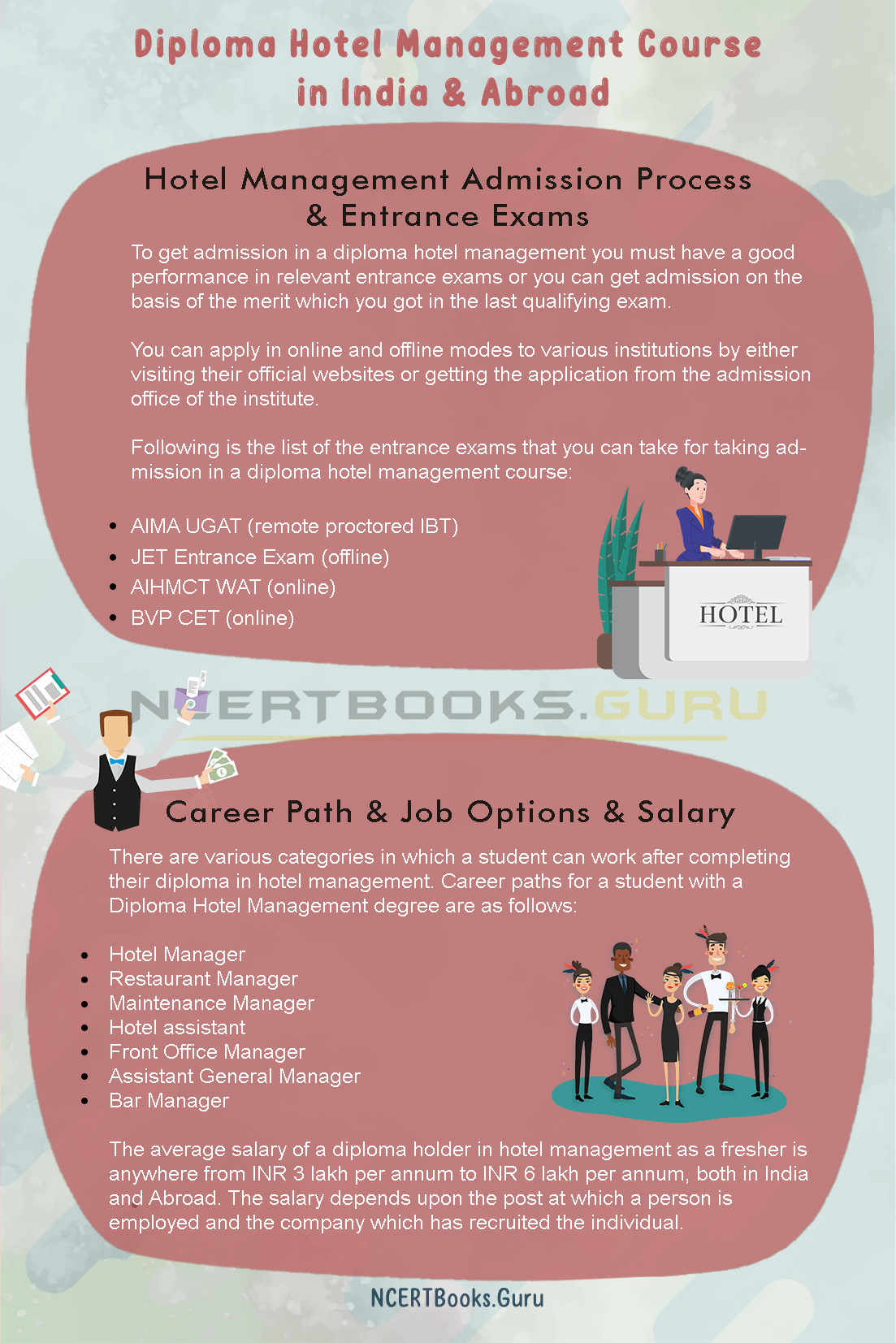
To get admission in a diploma hotel management you must have a good performance in relevant entrance exams or you can get admission on the basis of the merit which you got in the last qualifying exam.

You can apply in online and offline modes to various institutions by either visiting their official websites or getting the application from the admission office of the institute.

Entrance Exams for Diploma in Hotel Management Course

Following is the list of the entrance exams that you can take for taking admission in a diploma hotel management course:

  • AIMA UGAT (remote proctored IBT)
  • JET Entrance Exam (offline)
  • AIHMCT WAT (online)
  • BVP CET (online)

Diploma in hotel management courses fees

The average fee for a diploma hotel management course begins from INR 14,000 and goes up to INR 2,00,000. The fee depends upon the college that you want to take admission. There are different fee structures and submission criteria for different colleges. Also, you can get to know about 1-year diploma in hotel management fees from here.

List of Top Colleges for Diploma Hotel Management Course in India and Abroad 2022

Whether you want to do a diploma hotel management course from India or abroad, there are various institutes and universities which will provide you with top-quality education. Let’s look at the top Colleges and Universities that provide diploma courses in hotel management in India and abroad:

In India

  • Institute of Hotel Management Catering Technology and Applied Nutrition
  • Indian Institute of Hospitality and Management
  • Shree Devi College of Hotel Management
  • Indian School of Business Management and Administration
  • Amrapali Institute of Hotel Management
  • Vels University
  • Garden City University
  • YMCA Delhi

Abroad

  • Victoria University
  • Sheffield Hallam University
  • Ecole Hôtelière de Lausanne (EHL)
  • Torrents University
  • Royal Roads University
  • Glion Institute of Higher Education, Glion & Bulle
  • Cornell University
  • Hotel school The Hague
  • Les Roches International School of Hotel Management

Career Path & Job Options for Diploma Hotel/Hospitality Management Students

There are various categories in which a student can work after completing their diploma in hotel management. Career paths for a student with a Diploma Hotel Management degree are as follows:

  • Hotel Manager
  • Restaurant Manager
  • Maintenance Manager
  • Hotel assistant
  • Front Office Manager
  • Assistant General Manager
  • Bar Manager

Diploma Hotel Management Course in India 2

Top Recruiters That Hire Students of Diploma Hotel Management Degree in India and Abroad

There is a high demand for a workforce in the hospitality industry. The top companies that recruit hotel management students in India and Abroad are:

In India

  • ITC
  • Taj Group
  • Hilton Group
  • The Leela Palaces
  • Oberoi Group
  • OYO rooms
  • Sarovar Hotels and Resorts
  • Lemon Tree Hotels
  • Indian Hotels Company Limited

In Abroad

  • Four Seasons Hotel, London
  • Hilton, Edinburgh
  • Taj, Maldives
  • Sheraton Hotels, Niagara Falls
  • Hyatt, Australia
  • Jackson Hotel, Ireland
  • Pendley Manor, Hertfordshire
  • Nino Dsaman, Kuwait
  • Crossing The Bar, San Francisco

Diploma in Hotel Management Salary

The average salary of a diploma holder in hotel management as a fresher is anywhere from INR 3 lakh per annum to INR 6 lakh per annum, both in India and Abroad. The salary depends upon the post at which a person is employed and the company which has recruited the individual.

FAQs on Diploma Hotel Management Course

1. What is a hotel management diploma?

A diploma hotel management course is a 3-year diploma level hotel management course providing practical and theoretical knowledge to students about hotel management.

2. Is a diploma in hotel management valuable? 

Yes, a diploma degree in hotel management can get you a good job with decent pay. Also, it will help you enter the vast world of hotel management and hospitality.

3. What is the salary after a diploma in a hotel management course?

A fresher can get a salary anywhere from INR 3 lakh per annum to INR 6 lakh per annum depending on their post and company.

Conclusion

We hope that this article was able to provide you with the complete information about the Diploma Hotel Management Course like syllabus, eligibility criteria, admission process, entrance exams, fee structure, future job options, top recruiters, and average salary in India & Abroad.

We hope you got what you were looking for and will now be able to make an informed decision regarding your career. Do visit our portal ncertbooks.guru for the latest technology courses or career articles.
Bachelor of Foreign Trade (BFT) Courses | Duration, Eligibility Criteria, Admission Process, Job Prospects and Salary

Bachelor of Foreign Trade (BFT) Courses

Bachelor of Foreign Trade (BFT) Courses: Bachelors of Foreign trade or BFT is an undergraduate course in Foreign Trade Management. Globalisation has radically changed the business outline in India. Foreign trade in India has remarkably grown, consistently bringing more and more MNCs to set up markets. There is a burgeoning need for workers experienced in international trade.

A career in foreign trade has, therefore, become a profitable option proposing global job possibilities for those pursuing the courses in international business. The Bachelor of Foreign Trade courses will benefit students who are involved in Economic activities like commerce, industry, trade, management, and other fields related to it and also have a strong aptitude for business, excellent interaction skills, capability to influence others and knowledge of foreign languages.

Get to Know More about other types of Course Details in Stream wise, and Category wise.

A Brief on Bachelor of Foreign Trade (BFT) Courses

Foreign Trade is also known as International Trade, is the interchange of capital, goods and services across international borders and territories. The course offers an overall view and helps to develop a solid base and understand the circumstances concerning the global marketplace. Students can get exceptional knowledge about the movement of goods, services and capital over International territories and borders. The courses are both in Government and Private Institutions in the country that offers the BFT programme in both regular mode and distance mode. BFT is a broad field and consists of the following features –

  • Imports
  • International Business Laws
  • Exports
  • Foreign Trade Regulations
  • Trade Policies

Bachelor of Foreign Trade (BFT) Courses Highlights

  • Name of the Course: Bachelor of Foreign Trade
  • BFT Full Form: Bachelor of Foreign Trade
  • Duration: The Duration of the BFT course is three years consisting of six semesters.
  • Eligibility Criteria: The BFT eligibility criteria state that the candidates must qualify 10+2 from a recognised Board
  • Fee Structure: The generic fee structure for the course starts from Rs 4000 to Rs 30,000.
  • Salary: The average starting salary for the course is from Rs 3 to 8 lakhs per annum.
  • Career Opportunities: Some career opportunities after completion of the BFT Courses are Investments Analyst, Corporate Analyst, Business Analyst, Tax Advisor Accountant, Market Analyst and many more.

Bachelor of Foreign Trade (BFT) Courses Eligibility Criteria

Students must meet the eligibility criteria to apply for Bachelor of Foreign Trade. The BFT eligibility criteria state that the candidates must qualify 10+2 from a recognised Board.

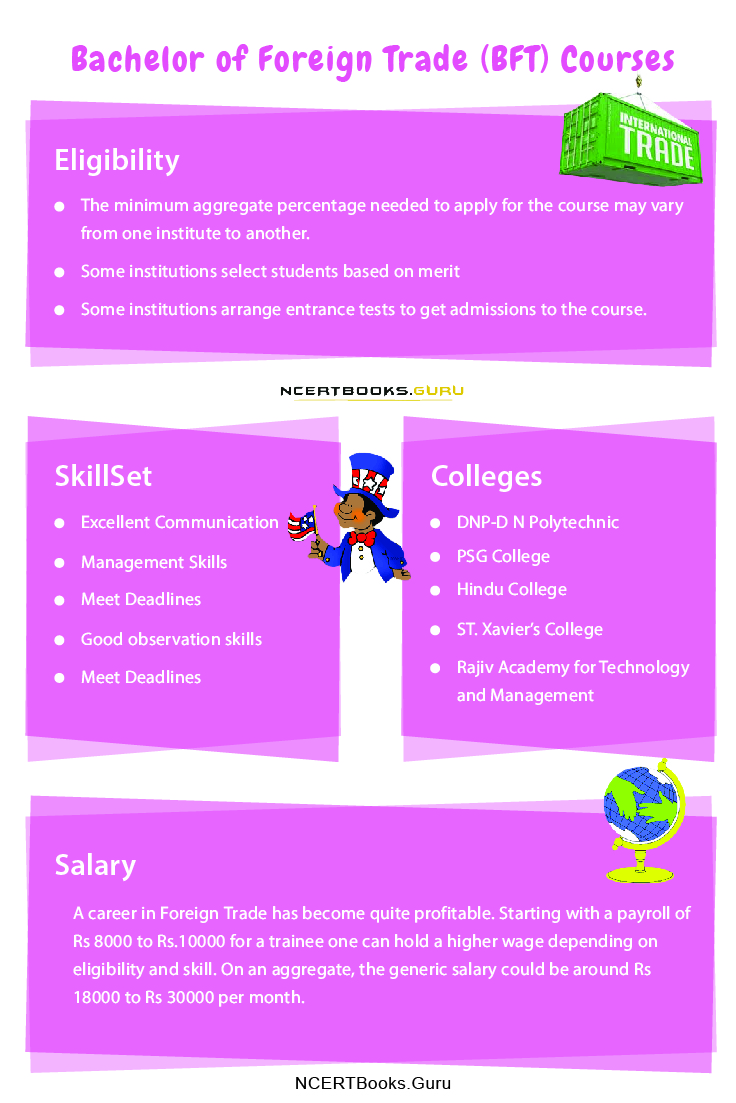
  • The minimum aggregate percentage needed to apply for the course may vary from one institute to another.
  • Some institutions select students based on merit
  • Some institutions arrange entrance tests to get admissions to the course.

SkillSet Required for Bachelor of Foreign Trade (BFT) Courses

  • Excellent Communication
  • Management Skills
  • Capability to handle stress
  • Meet Deadlines
  • Have sight for detail
  • Good visual imagination
  • Good observation skills
  • Have Persuasiveness

Benefits of BFT Courses

  • BFT courses offer job possibilities in different areas like commerce, banking, trade, accounts, and many more.
  • It encourages students to seize a professional qualification in foreign trade and affords a solid foundation in the field of international business
  • One can work in the exportation market to increase overseas sales.
  • One can work as a marketing executive who plans strategies based on marketing research.

More Related Articles

Bachelor of Foreign Trade (BFT) Courses Admission Process

  • Visit the official website of the colleges or institutions and select the BFT course.
  • Fill and submit the application forms.
  • Applicants should pay the application fee and submit all the required documents.
  • The selection method for Bachelors of Foreign Trade BFT Courses may vary from one institution to another.
  • Some institutions rely on the merit-based admission process for admitting students into the Bachelor of Foreign Trade course.
  • Most institutions arrange entrance exams along with the interview process to apply for the course.
  • Some institutes manage a donation-based admission process.

Bachelor of Foreign Trade Syllabus

The BFT program has six semesters. Every semester there are two elective papers and the third paper is a practical paper. The syllabus may vary from one institute to another. Here is a list of some subjects in each semester:

First Year

Semester I

  • India’s Foreign Trade I
  • Basics of International Trade I
  • Basics of International Trade II
  • Practical

Semester II

  • India’s Foreign Trade II
  • Elements of Export Marketing I
  • Practicals

Second Year

Semester III

  • Elements of Export Marketing II
  • Exports Finance and Procedure I
  • Exports Finance and Procedure II
  • Export Logistics I
  • Practicals

Semester IV

  • Export Documentation and Procedure I
  • Export Logistics II
  • Practicals

Third Year

Semester V

  • Export Documentation and Procedure II
  • Practicals

Semester VI

  • Export Documentation and Procedure
  • Practicals

List of Colleges Offering Bachelor of Foreign Trade (BFT) Courses

There are many Government and private Institutions for the Bachelor of Foreign Trade courses. Some of the BFT Course colleges are given below:

  • DBSAP-Dr Baba Saheb Ambedkar Polytechnic
  • DNP-D N Polytechnic
  • I.K. Gujral Punjab Technical University
  • PSG College
  • Rajiv Academy for Technology and Management
  • Dr Babasaheb Ambedkar Marathwada University
  • Hindu College
  • ST. Xavier’s College

Bachelor of Foreign Trade (BFT) Courses Fee Structure

The fee structure for the course may vary from one institute to another. The generic fee structure for the course starts from Rs 4000 to Rs 30,000. The fees for private colleges may be higher than the fees in the government colleges.

Job Prospects Under BFT Course

After the completion of the course, the BFT students will find a plethora of job opportunities in different areas. Some of the employment areas are given below

  • Directorate General of Foreign Trade
  • Marine Insurance Companies
  • State Trading Corporations
  • Banks & Financial Institutions
  • Shipping Companies or Corporations
  • Export Houses
  • International Finance
  • Merchandiser
  • Transportation Corporations
  • Dry Ports, Ports
  • Custom Clearing Houses

Bachelor of Foreign Trade (BFT) Courses

Some of the job types the student might hold after the completion of the course are

  • Market Analyst
  • Accountant, Tax Advisor
  • Budget Analyst
  • Marketing Manager
  • Money Manager
  • Investment Banker
  • Investments Analyst
  • Financial Analyst
  • Business Analyst
  • Corporate Analyst
  • Investment Banker
  • Equity Research Analyst
  • Operations Manager
  • Revenue Agent
  • Personal Finance Consultant

BFT Salary in India

A career in Foreign Trade has become quite profitable. Starting with a payroll of Rs 8000 to Rs.10000 for a trainee one can hold a higher wage depending on eligibility and skill. On an aggregate, the generic Bachelor of Foreign Trade salary could be around Rs 18000 to Rs 30000 per month. If the candidate is in any government post, the payment will be as per the grade and payscale.

FAQ’s on Bachelor of Foreign Trade (BFT) Courses

Question 1.
How does the BFT course help?

Answer:
The BFT course helps to learn a great understanding of the movement of services, goods and capital across International territories and borders.

Question 2.
What are the skillsets to pursue a Bachelor of Foreign Trade course?

Answer:
The skill sets required are to have excellent interaction and management skills along with the capability to manage stress and to reach deadlines to pursue a career in foreign trade.

Question 3.
What are the eligibility criteria for the course?

Answer:
The BFT eligibility criteria state that the candidates must qualify 10+2 from a recognised Board.

Question 4.
What is the mode of education for the BFT course?

Answer:
The mode of education for the Bachelor of Foreign Trade course is both regular and part-time.

How to become a Computer Programmer in India | Courses, Fees, Colleges, Eligibility, Career Prospects, Jobs, Salary

How to become a Computer Programmer in India

Nowadays computer programmers are the builders of the computing world. There is a lot of scope for the students in the software field. There is a huge demand for computer Programmers. The candidates must have to pursue the course related to IT, Maths, Computer Science. A Computer Programming job is all about writing the code using certain computer languages.

Do you want to build your career as a computer programmer? If we are right then this article will be very helpful for all the aspirants. There is no need to write any entrance exams to get selected as computer programmers. Know how to become a computer programmer in India from this page. All you need to do is to just scroll this page to get the information like what are eligibilities, responsibilities, course details like duration, fees and online programming course and so on from here.

Computer Programmer

A computer programmer is also known as a coder. A computer programmer can be employed to suggest the software developers, analysts, computer scientists. Programmers use computer languages such as C, C++, Python, Java, Machine Learning, etc. The job roles and responsibilities of a computer programmer are discussed in the coming sections.

Responsibilities of a Computer Programmer

A computer programmer is the one who writes and executes the codes. There is no need to be scared to write the programs if you learn the basic programming languages like C, C++, Python, JavaScript, Machine learning, etc. It is better to learn the python language as it is becoming a popular programming language for data science. The duties and responsibilities of the computer programmers are enlisted below.

  • Write programs in computer languages like C, C++, Java, Python, etc.
  • Test and compile the code and fix the bugs if there are any errors.
  • Create and test code in IDE

Eligibility to become a Computer Programmer | Eligibility Criteria

In order to apply for a computer programmer post, the candidates must accomplish the eligibility criteria that is mentioned by the organizations.

Educational Requirements

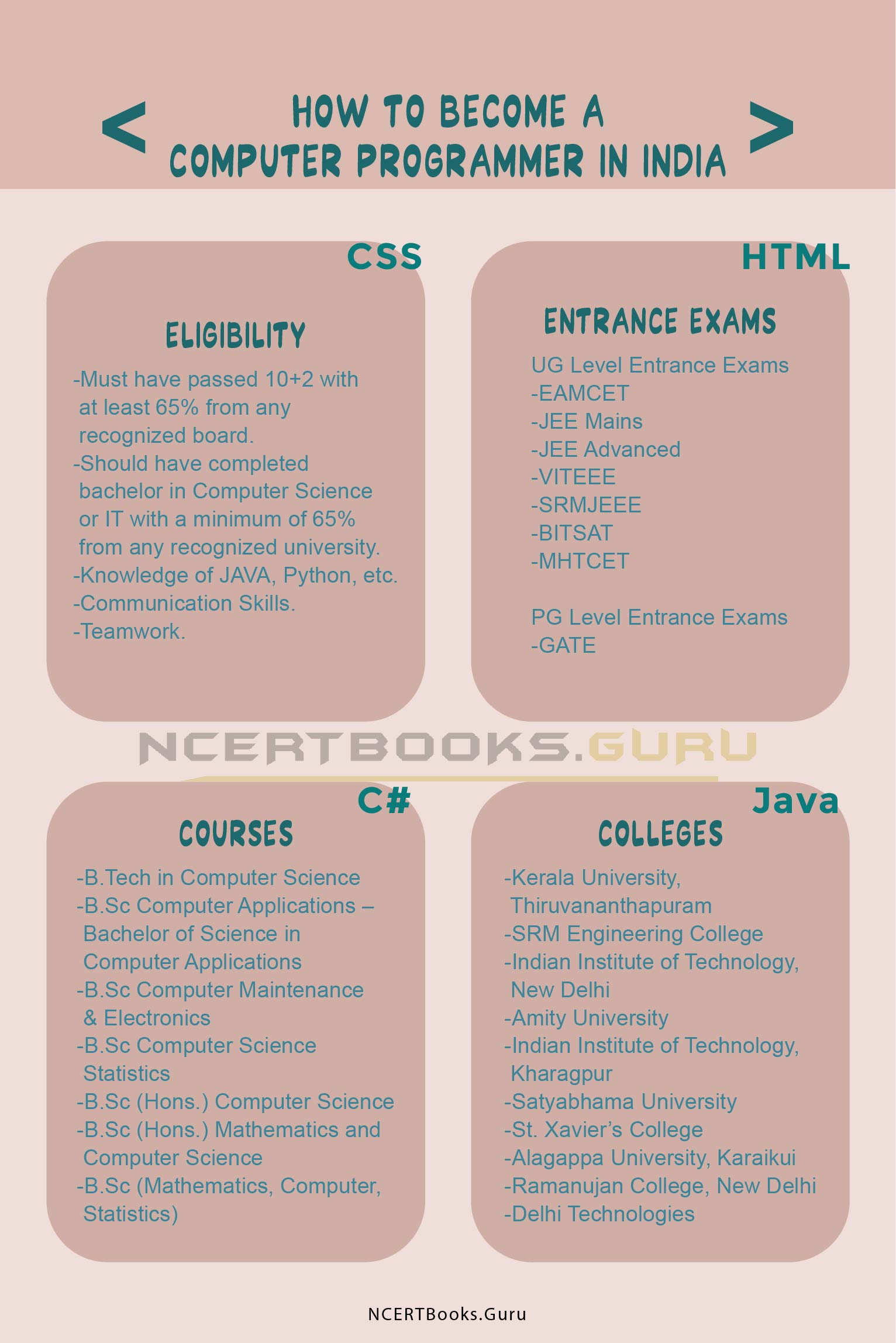
  • Must have passed 10+2 with at least 65% from any recognized board.
  • Should have completed bachelor in Computer Science or IT with a minimum of 65% from any recognized university/institution.
  • Knowledge of programming languages like JAVA, Python, etc.
  • Should have certificate course on any of the programming language.
  • Communication Skills
  • Teamwork
  • Should have completed an internship in the programming field.

Age Limitations: There are age limitations to applying for the post of computer programmer. The minimum age to apply for the computer programmer job is 20 years.

Entrance Exams to become a Computer Programmer

In order to join the bachelor’s candidates must apply for the entrance exams like EAMCET, JEE mains, JEE Advanced, etc. If you score good marks in the entrance exams then you will be eligible to apply for the colleges that offer computer science courses.

UG Level Entrance Exams

  • EAMCET
  • JEE Mains
  • JEE Advanced
  • VITEEE
  • SRMJEEE
  • BITSAT
  • MHTCET

PG Level Entrance Exams

  • GATE

See More:

Courses for becoming a Computer Programmer

UG Courses

  • B.Tech in Computer Science
  • B.Sc Computer Applications – Bachelor of Science in Computer Applications
  • B.Sc Computer Maintenance & Electronics
  • B.Sc Computer Science Statistics
  • B.Sc (Hons.) Computer Science
  • B.Sc (Hons.) Mathematics and Computer Science
  • B.Sc (Mathematics, Computer, Statistics)
  • B.Sc + M.Sc (Bachelors and Masters in Computer Science)

PG Courses

  • M. Tech in Computer Science
  • Master of Technology in Computer and Information Science
  • Master of Philosophy in Computer Science
  • Master of Science in Applied Mathematics with Oceanology and Computer
  • Master of Science in Computer Communication
  • Master of Science Honours in Computer Science
  • Master of Science in Computer Science
  • M.Sc (Operation Research & Computer Applications)
  • Master of Science in Statistics and Computer Applications
  • Master of Science and Technology in Industrial Mathematics with Computer

Diploma Courses

  • Post Graduate Diploma in Applied Computer Science
  • Diploma in Advanced Computing (DAC)
  • Post Graduate Diploma in Computer Hardware
  • Advanced Diploma in Software Development
  • Post Graduate Diploma in Computer Aided Interior Space

Doctorate Course

  • Doctor of Philosophy in Computer Science
  • Doctor of Philosophy in Computer Science and Applications

Computer Programmer Course Duration

The duration and fee structure of all the bachelor, master, and Ph.D. courses are given in the below table.

Name of the course Duration Fee Structure per annum
Diploma 1 year Differs from college to college
Bachelor’s 3 years Rs. 10,000 to 1 lakh
Master’s 2 years Rs. 30,000 to 1 lakh
Doctorate 3 years Rs. 1 lakh to 2 lakhs

B.Sc Computer Science Syllabus for a Computer Programmer

Here is the list of the subjects in B.Sc Computer Science sem-wise to become a computer programmer.

 Sem 1:

  • Introduction to Digital Electronics
  • Basics of Computer Science
  • Environmental Sciences
  • Foundation course in Mathematics
  • Functional English-I

Sem 2:

  • Front Office Management
  • Discrete Mathematics
  • Computer Organization
  • Value and Ethics
  • Fundamental of Open Source Software-LINUX

Sem 3:

  • Object-Oriented Programming using C++
  • Operating Systems concepts
  • Introduction to Data Structures
  • System Analysis and design
  • Technical Writing
  • Analytical Skill Development-I

Sem 4:

  • Database Management Systems
  • Report Writing(Yantra)
  • Analytical Skill Development-II
  • System Programming
  • Numerical Analysis
  • Introduction to Computer Network

Sem 5:

  • Python programming
  • Introduction to Software Engineering
  • Mobile Application Development
  • Personality Development Program
  • Mini Project-I

Sem 6:

  • Introduction to Web Technology
  • Project Work

Top Colleges/Institutions that offer Computer Science Courses in India

  • Kerala University, Thiruvananthapuram
  • SRM Engineering College
  • Indian Institute of Technology, New Delhi
  • Amity University
  • Indian Institute of Technology, Kharagpur
  • Satyabhama University
  • St. Xavier’s College
  • Alagappa University, Karaikui
  • Ramanujan College, New Delhi
  • Delhi Technologies
  • Indian Institute of Technology, Mumbai
  • Indian Institute of Technology, Bombay
  • National Institute of Technology, Calicut
  • College of Computer Science and Information Technology
  • National Institute of Technology, Calicut
  • Vellore Institute of Technology
  • Sri Ramakrishna Engineering College
  • National Institute of Technology, Durgapur
  • Bharati Vidyapeeth Deemed University
  • Indian Institute of Technology, Roorkee
  • Jadavpur University, Kolkata
  • Christ University
  • D.Y. Patil College of Engineering
  • Vishwakarma Institute of Technology
  • Indian Institute of Technology, Varanasi
  • Banaras Hindu University

Online Programming Courses with Duration to become a Computer Programmer

Course Name Duration
Code Yourself! An Introduction to Programming by Coursera 12 Hours
CS50’s Web Programming with Python and JavaScript by Harvard University 12 weeks
Introduction to Programming with Python and Java Specialization by Coursera 4 months
Java Programming and Software Engineering Fundamentals Specialization by Coursera 4 months
Introduction to Programming in C++ by edX 8 weeks
Advanced Programming in C++ by edX 8 weeks
Introduction to Computer Science and Programming Specialization by Coursera 4 months
Machine Learning: Hands-On Python & R In Data Science by Udemy 44 hours
2021 Complete Python Bootcamp From Zero to Hero in Python by Udemy 22 hours

Computer Programmer Skills

In addition to the educational qualifications, the selection committee will expect some skills from the aspirants.

  • Good Communication Skills
  • Time Management Skills
  • Basic knowledge of programming language
  • Problem Solving Skills
  • Observation
  • Technical writing skills
  • Detail-oriented
  • Troubleshooting skills
  • Patience

How to become a Computer Programmer in India

Computer Programmer Salary in India

The salary for the candidates will be based on their educational qualification, performance and job role, and also the company. Here in the below table, we have provided the salary details as per the job role.

Role of Job Annual Income
Team Leader Rs. 5,80,000 to 20,00,000
Java Developer Rs. 2,00,000 to 10,00,000
.NET Software Developer/Programmer Rs. 1,80,000 to 9,00,000
Lead Software Engineer Rs. 7,00,000 to 20,00,000
Senior Software Engineer Rs. 5,00,000 to 20,00,000
Software Engineer Rs. 2,50,000 to 10,00,000
Software Developer Rs. 2,00,000 to 10,00,000
Associate Software Engineer Rs. 2,20,000 to 10,00,000
Senior Software Developer/Programmer/Developer Rs. 4,00,000 to 20,00,000
Software Developer/Programmer/Developer Rs. 2,30,000 to 10,00,000

Top Companies that hires Computer Programmers

The list of companies that hires computer programmers with good salary are given below.

  • L&T
  • Google
  • Amazon
  • Facebook
  • Cognizant
  • Oracle
  • Deloitte
  • TCS
  • HCL
  • Yahoo
  • Microsoft
  • Infosys
  • Wipro
  • Tech Mahindra
  • Genpact
  • Sun Microsystem
  • IBM
  • Lenovo Group Limited
  • Accenture
  • Kronos
  • Adobe

Pros & Cons of a Computer Programmer

Pros:

  • Job Security
  • Good Salary

Cons:

  • Stress and pressure

Frequently Asked Question on Computer Programmer Job

What are the subjects in Computer Science Engineering?

  • Operating System
  • Design and Analysis of Algorithm
  • Programming Languages
  • Microprocessor
  • Computer Software
  • Database Management System
  • Mobile Communications
  • Cryptography and Network Security
  • Performance Evaluation

How much is a programmer paid in India?

About 4 to 15 lakhs is paid per annum for a computer programmer in India.

What are the highest salary programming jobs in India?

  • Data Science
  • Machine Learning Professionals

Can I become a programmer without a degree?

A programming job is one skill that does not require any college degree.

Final Verdict

Hope the info seen in the above article is helpful for all the candidates who aspire to become computer programmers. Stick to our site if you feel that this article is beneficial for you to become a Computer Programmer in India. Also, the students can get the latest information regarding all the Engineering jobs with complete guidance from our website.

Bachelor of Accounting And Finance (BAF) Course | Eligibility Criteria, Job, Salary, Syllabus

BAF Course

BAF Course: Bachelor of Accounting And Finance (BAF) is a three-year undergraduate course that offers in-depth knowledge about financial accounting and other financial subjects. The University of Mumbai introduced it in the year 2003-2004. It is a three-year self-financed course. This Course has six semesters, two semesters in a year. If you have an interest in accounting and finance-related subjects, then this is the Course for you. Day to day work of a BAF graduate includes preparing a balance sheet, recording the transactions of the company, preparing financial reports for the company.

BAF Course Full Form is Bachelor of Accounting And Finance.

About Bachelor In Accounting And Finance (BAF) Course

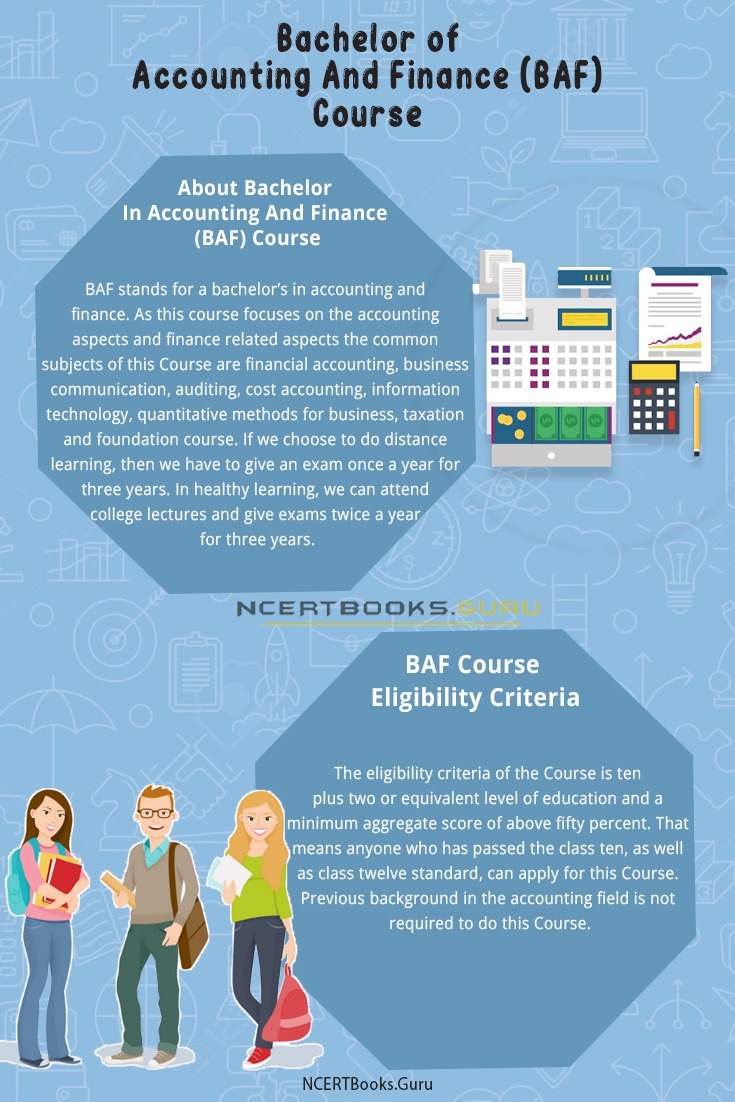
BAF stands for a bachelor’s in accounting and finance. As this course focuses on the accounting aspects and finance related aspects the common subjects of this Course are financial accounting, business communication, auditing, cost accounting, information technology, quantitative methods for business, taxation and foundation course. If we choose to do distance learning, then we have to give an exam once a year for three years. In healthy learning, we can attend college lectures and give exams twice a year for three years.

The Course is for the students who want to build their career in the accounting and financial field. This degree comes under the subdivision of BCom(bachelor of commerce). It is beneficial for the students who want to pursue chartered accountancy (CA) because the majority of the subjects are very similar. It gives exposure to the entire financial markets. It is a highly demanding course these days.

BAF Course Eligibility Criteria

The eligibility criteria of the Course is ten plus two or equivalent level of education and a minimum aggregate score of above fifty percent. That means anyone who has passed the class ten, as well as class twelve standard, can apply for this Course. Previous background in the accounting field is not required to do this Course.

Students of science and arts background till class twelve can also join this Course. There are some colleges and universities which conduct the entrance exams. There is no maximum age limit for doing this Course. Anyone who has passed class 12 can opt for this Course.

Also, Read:

Bachleor of Accounting and Finance( BAF) Course 2

Syllabus of BAF Course

BAF Course Subjects details are listed here.

First Year 

  • Elements of financial accounting 1
  • Financial accounting 2
  • Economics (microeconomics)
  • Commerce (business environment)
  • Information technology (accounting software) 1
  • Foundation course
  • Quantitative methods for business 1
  • Business law 1
  • Auditing 1
  • Business communication 1
  • Business communication 2

Second Year

  • Cost accounting 1
  • Commerce
  • Quantitative methods for business 2
  • Cost accounting 2
  • Auditing 2
  • Foundation course
  • Financial accounting 3
  • Information technology 2
  • Financial accounting 4

Third-year

  • Economics 4
  • Taxation 3
  • Risk management
  • Financial accounting 5
  • Managerial economics
  • Organizational Behavior
  • Auditing 3
  • Cost accounting
  • Foundation course

The syllabus above is for Mumbai university. The syllabus may be different in different universities, but there are some subjects like accounting and costing, which is common in the whole Course irrespective of the universities.

Scope of BAF Course

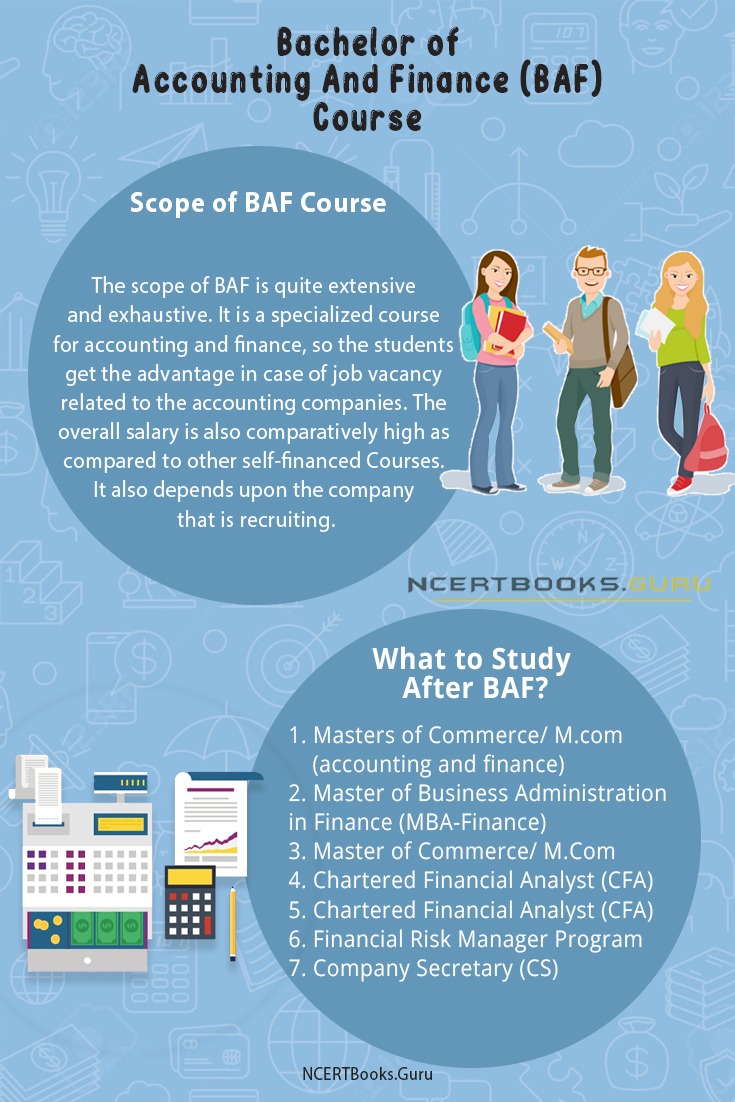
The scope of BAF is quite extensive and exhaustive. It is a specialized course for accounting and finance, so the students get the advantage in case of job vacancy related to the accounting companies. The overall salary is also comparatively high as compared to other self-financed Courses. It also depends upon the company that is recruiting.

For example, if a company is looking for a specialized accountant, then the demand for the BAF graduate students increases. Students can also perceive chartered accountancy, chartered financial Courses, which will help in increasing the overall package of the student. Students can also go for a Masters in Finance(MBA in finance) after completing the BAF course. Having a double degree always helps ahead in the career. One can also perceive a risk management course as a postgraduate course.

Individual colleges in certain cities offer campus placements which turn out to be very helpful to the students. Due to more and more advancements in technology and due to an increase in accounting companies, the demand for accountants and junior accountants is very high. Thus there is a lot of scope in the finance and accounting course.

Get to Know More about other types of Course Details Streamwise, and Category Wise.

Career Options And Job Prospects for BAF Student After The Course

BAF Course Job Opportunities are here. Students who have completed their BAF Course can get the following job options.

  • Financial Consultant
  • Accounting Analyst
  • Marketing Manager
  • Billing Data Analyst
  • Accounts Assistant
  • Finance Analyst

The BAF Course salary package differs as per the Job designations and professional experience. The entry-level salary of a fresher is around three lakh Indian rupees. The following are some fields where BAF graduates are generally employed

  • Financial Analysis
  • Taxation
  • Accountancy
  • Banking
  • Auditing
  • Actuarial Science
  • Financial planning

BAF Course Colleges

  • Mithibai College, Vileparle East, Mumbai
  • Kishinchand Chellaram College, Churchgate, Mumbai
  • H R College of Commerce and Economics, Churchgate, Mumbai
  • Birla Institute Of Liberal Arts And Management Sciences, Kolkata
  • Smt. MMK College of Commerce and Economics, Bandra, Mumbai
  • K P B Hinduja College of Commerce, Charni Road, Mumbai
  • Shaheed Sukhdev College of Business Studies, New Delhi
  • Gayatri Vidya Parishad College For Degree and Post Graduate Courses(GVPCD), Visakhapatnam
  • Marks Classes, Pune
  • Government Autonomous College(GAV), Kalahandi
  • Stella Maris College, Chennai
  • Sri Ram College of Commerce, Delhi

Bachleor of Accounting and Finance( BAF) Course 2

What to Study After BAF?

  • Masters of Commerce/ M.com (accounting and finance): M.com in accounting and finance is a two-year post-graduation course in the domain of accounting and finance along with related aspects. This Course is available in only a handful of countries, particularly in the commonwealth nations. The Course is designed to provide a holistic view and in-depth knowledge of the disciplines of Accounting and Finance and quite literally make them “Masters” of the trade.
  • Master of Business Administration in Finance (MBA-Finance): The courses in an MBA program cover various subjects of business such as accounting, applied statistics, finance, managerial economics, entrepreneurship, marketing, and operations in a manner most relevant to management analysis and strategy. This is one of the most sought-after courses after BAF and can be pursued in both domestic and international universities. An MBA in finance specifically entails the study based on the subject of finance.
  • Master of Commerce/ M.Com: One can also do an M.Com or Master of Commerce degree, which is a postgraduate master’s degree focusing on commerce, management, economics and accounting. Rather than focusing on just the accounts and finance side of the story, this Course focuses on all of the accounting fields. This course is offered only in commonwealth countries. This Course fits the bill of the “jack of all trades.”
  • Chartered Financial Analyst (CFA): The Chartered Financial Analyst Program is a professional certificate course that is offered internationally by the CFA Institute, which is based in America. Anyone who completes the program is awarded the “CFA charter”. A CFA usually deals with the financial aspects of the company and is usually the financial manager of the company.
  • Chartered Accountancy (CA): CA is considered the second-best Course in the whole world. CA exams in India are conducted by ICAI(Institute of Chartered Accountancy of India) and require to pass three exams Foundation, Inter, and CA final. A Graduate degree holder in the field of commerce and accounts can directly give the Inter exam of the CA. After clearing the Inter level of the exam, one has to do an article ship for three years where he/she gets the practical experience. It is one of the most challenging courses in the world—only two to three percent of the students clear all three exams in one go.
  • Financial Risk Manager Program: FRM exams are conducted by the Global Association of Risk Professionals(GARP, USA) and require clearance of two levels. It is not a professional degree like CA and CS; it is a certified course. Two years of experience is required for giving the exams. An FRM certificate holder has career opportunities in risk management, trading, structuring, modeling, etc.
  • Company Secretary (CS): Company Secretary is a professional course offered by ICSI(Institute of Company Secretary of India). This Course can be done after completing BAF or can be done simultaneously. It has three exams Foundation, Executive and professional. It gives an overall view of how a company works. It is more of a theory orientated Course, where all the company laws come into the picture. This course will provide you with the knowledge and understanding of corporate finance and legal affairs practices.

Bachleor of Accounting and Finance( BAF) Course 1

FAQ’s on Bachelor In Accounting And Finance (BAF) Course

Question 1.
What is the duration of the Bachelor In Accounting And Finance (BAF) course?

Answer:
The duration of the Bachelor In Accounting And Finance (BAF) course is six semesters over a period of three years, after class twelve.

Question 2.
What are the career or job options for students after the BAF course?

Answer:
After completing the BAF course students can pursue their career as a Financial Consultant, Accounting Analyst, Marketing Manager, Billing Data Analyst, Accounts Assistant, Finance Analyst, etc.

Question 3.
What is the fee for the Bachelor In Accounting And Finance (BAF) course?

Answer:
The course fee differs from college to college, but on average it is about Rs. 30,000-40,000.

Conclusion

This course gives students the bird’s eye view of how a company works financially and about maintaining the accounts of the companies. BAF is an upcoming course that is soon to hit the primary stream radar. It’s a different area of study which is recommended to the students who are focused on a career in finance and accounting. If the student has a keen interest in accounting and finance-related aspects, then he/she should go for this degree course. There are less theory and more practical knowledge of this undergraduate degree. If some students want to go for chartered accountancy or financial postgraduate Course, then they can opt for this degree. It can be done simultaneously with professional courses like CA, CFA, and CMA.

The average fees of this Course are around thirty thousand Indian rupees annually. The fees for different universities are different. Doing this Course from a good university will benefit the student in their career ahead. One can also get self-employed by stating the business in this field related to the Course.

List of Medical Courses After 10th | Admission Process, Fees, Colleges, Future Scope, Salary

medical courses after 10th

Medical Courses After 10th: Medicine being one of the most popular career choices in our country medical courses see a huge number of admissions right after class 10th. What makes these courses so popular? What can the candidate expect upon enrolling in the course? If you are looking for these answers you are at the right place. This article describes the details of medical courses that the students can pursue after class 10th. Information regarding various subjects such as About the courses, Course Options, Admission process, Fees, Best Colleges, Future Scope, Salary, Top Recruiters in 2022.

Get to Know More about other types of Course Details in Streamwise, and Category wise.

Details of Medical Courses After Class 10

After completing class 10th, students can enrol in paramedical courses that are at the certification and diploma level. The students who want to dig deeper into the field of medicine and build a career in it can use this as a starting point in their career. After completing medical courses after class 10th, students can directly go for jobs.

This will give the students an early start in their career and will give them more time to really dig deeper into the research field of medicine if they want to. Paramedical courses do not require clearing the NEET examination. Upon choosing the right course after class 10th candidates can earn good stipends and expand their work and learning area. Medical courses will provide the students with all the necessary skills that will help them achieve anything that they wish to in the medical field.

List of After class 10 in Medicine Courses

There are multiple certification and diploma courses that are available for students after class 10th. Following is a list of all those paramedical courses that the students can do right after class 10th:

Certification Courses:

  • Certificate in medical laboratory technology
  • Certificate in lab technician
  • Certificate in lab assistant
  • Certificate in physiotherapy
  • Certificate in CT scan technician
  • Certificate in ECG scan technician
  • Certificate in dialysis technician
  • Certificate in home-based healthcare
  • Certificate in a nursing care assistant
  • Certificate in HIV and family education
  • Certificate in dental assistant

Diploma Courses:

  • Diploma in optometry
  • Diploma in orthopedics
  • Diploma in gynecology and obstetrics
  • Diploma in child health
  • Diploma in dermatology, venereology, leprosy
  • Diploma in clinical research
  • Diploma in OT technician
  • Diploma in medical field
  • diploma in rural healthcare
  • Diploma in medical record technology
  • Diploma in a nursing care assistant course

Other Courses:

Admission Process After class 10 in the Medical Field

After completing class 10th students can apply for various medical courses according to their interests. Following is the proper procedure for application to courses after class 10th in the medical field:

  • The admission to these courses is generally done on the basis of the merit of the student that they have obtained in class 10th.
  • After thoroughly checking out the website of the college that the students to get admitted to, the next step to follow is filling out the application form in submitting it along with all the necessary documents in a scanned format.
  • After successful completion of the above procedures, the colleges will contact the selected students via the contact information provided by them at the time of application.
  • After this, the students are required to visit the college in order to pay the admission fee and reserve a seat for the course. After all these processes the student is finally admitted to a medical course after class 10th.

Medical Courses After 10 Fee Structure

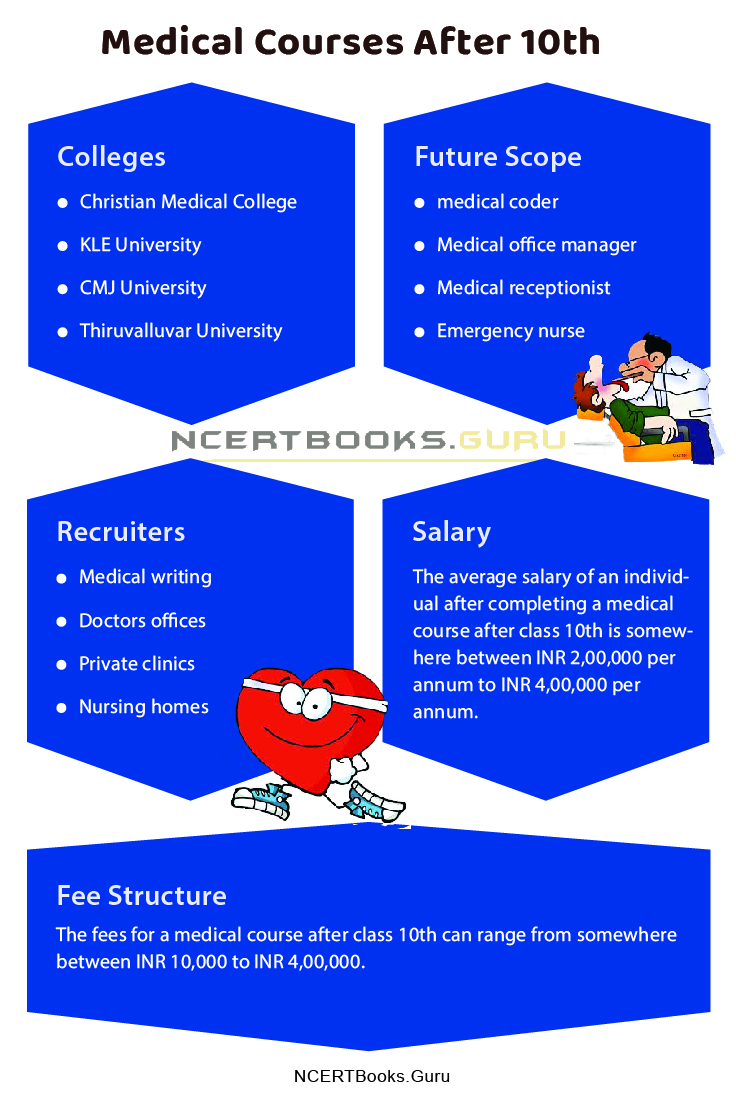
The fees for a medical course after class 10th can range from somewhere between INR 10,000 to INR 4,00,000. The exact fees of the course depend upon the particular course that the student is admitted to and the type of college that the student is enrolled in.

Medical Courses After 10th Top Colleges

There are various institutions all across the country that are famous for their education in medical courses. Following is a list of top colleges for medical courses after class 10th:

  • Christian Medical College
  • King George’s Medical University
  • St Xavier’s College
  • KLE University
  • CMJ University
  • Singhania university
  • Bangalore Medical College and Research Institute
  • Thiruvalluvar University

Future Scope After Medicine Courses After class 10

After completing medical courses after class 10th, the students can either go for research work, higher studies by giving various competitive examinations or, they can also go for a job. Following are the top job profiles for students who have completed medical courses after class 10th:

  • medical coder
  • Emergency nurse
  • Medical office manager
  • Medical receptionist
  • Health information technician
  • Billing and coding technician
  • Community health nurse
  • Infection control nurse

Do Check

Salary of Medical Courses After class 10

The average salary of an individual after completing a medical course after class 10th is somewhere between INR 2,00,000 per annum to INR 4,00,000 per annum. If the student goes on to complete higher degree courses along with their job vacancy a hike in their salary and their salary can go up to INR 10,00,000 per annum.

Top Recruiters and Recruitment Areas for Medical Students

Government and private hospitals are the biggest recruiters of students who have medical degrees after class 10th. Following is a list of top recruitment areas for the students who complete medical courses after class 10th:

  • Medical writing
  • Medical colleges
  • Community health centers
  • Doctors offices
  • Laboratory technician
  • Assistant technician
  • Private clinics
  • NGOs
  • Nursing homes
  • Dialysis technicians
  • Healthcare systems clinics
  • Homoeopathic centers
  • Health care homes

Medical Courses After 10th

FAQ’s on Medical Courses After 10th

1. Can I study your medical lab technician course after class 10th?

Yes, you can definitely study a medical lab technician course after class 10th. You can either go for a certified medical lab technician course or for a diploma medical lab technician course after you have completed your class 10th.

2. Is it worth doing medical courses after class 10?

The worth of a course is decided by the student pursuing the course. If you are interested in going for research work, higher studies, or you looking for a job in the medical field as soon as possible, doing a medical course after class 10th is the right option for you.

3. Can I study radiology after class 10th?

Yes, you can definitely study radiology courses after completing your class 10th. There is a diploma course which is diploma in medical radiography (X-ray and ECG), a certificate in ECG and CT scan technician, and some other related courses that will help you to learn more about radiology.

4. Are medical courses after class 10th easy?

The ease of a course depends upon the interest of the student learning the course. Since the medical courses after class 12th are the starting level of the medical courses, they are comparatively easy as compared to the courses that the students pursue after class 12th. However, they require sheer will, patience, and interest of the students in order to be fruitful to the students.

Conclusion

We hope that your thirst for knowledge regarding medical courses after class 1oth was quenched after reading this complete article. Stay connected with us for getting information about various courses, books, study material, etc. Do let us know what you felt about this article and what would you like to see in the future we would love to get your suggestions and feedback.

How to become a Marine Engineer in India | Eligibility Criteria, Colleges, Scope, Salary

How to become a Marine Engineer in India

How to become a Marine Engineer in India: One of the highly valued and well-paying jobs, the job of a marine engineer is an important one. If you aspire to become a marine engineer, in this article you’ll find everything you need to know about marine engineering and how to become a maritime engineer. Read on to find out about the career path

Refer to Course Details to know more about related courses and find details like Admission Process, Eligibility Criteria, etc.

What is Marine Engineering?

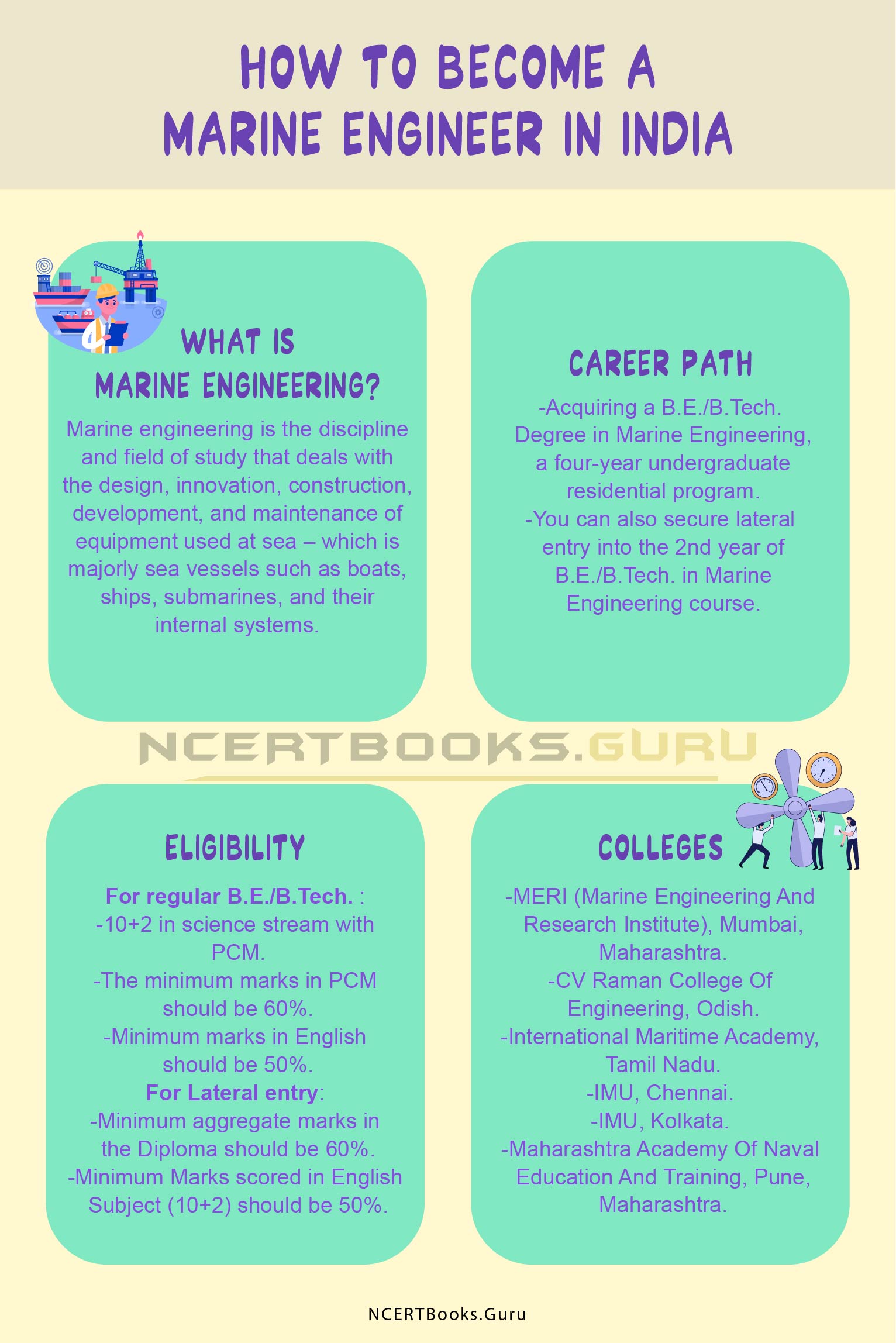
Marine engineering is the discipline and field of study that deals with the design, innovation, construction, development, and maintenance of equipment used at sea – which is majorly sea vessels such as boats, ships, submarines, and their internal systems.

It is a branch of engineering that specializes in the application of engineering sciences such as mechanical engineering, electrical engineering, electronic engineering, and computer sciences to marine vessels and structures and their onboard systems such as power and propulsion mechanics, machinery, piping, fuel system, automation, and control systems.

Who is a Marine Engineer? What do they do?

Marine engineers are professionals who are trained in maritime engineering. Having studied and specialized in the field they are responsible for the operation, maintenance, and repairs of all major mechanical and engineered equipment and systems used in marine vessels.

There are many mechanical systems that together run the marine vessel, such as power and propulsion systems, electricity and power generation, fuel and lubrication systems, even lighting and air conditioning systems. Simply put, a marine engineer takes care of any or all of them.

Career Path of a Marine Engineer – How to Become a Marine Engineer in India?

There are two ways you can become a marine engineer.

  1. The first is by acquiring a B.E./B.Tech. Degree in Marine Engineering, a four-year undergraduate residential program covering all parts of theoretical learning and practical training requisite.
  2. The second and alternative way is by lateral entry. You can also secure lateral entry into the 2nd year of B.E./B.Tech. in Marine Engineering course after completing Diploma in Mechanical or Marine Engineering from a recognized institution.

Do Refer:

Eligibility Criteria To Become A Marine Engineer In India

Educational qualifications 

For regular B.E./B.Tech. in Marine Engineering:

  • 10+2 in science stream with PCM subjects Physics, Chemistry and Mathematics mandatory.
  • The minimum aggregate of marks in PCM should be 60%
  • Minimum marks scored in English Subject should be 50%

For Lateral entry:

Successfully completed Diploma Course in Mechanical or Marine Engineering from a recognized university.

  • Minimum aggregate marks in the Diploma course should be 60%
  • Minimum Marks scored in English Subject (10+2) should be 50%

Age limit 

For regular B.E./B.Tech. in Marine Engineering:

Candidates must be between 17 to 25 years of age.

For Lateral entry:

No lower age limit however there’s an upper age limit. Candidates should not be older than 25 years of age.

Medical standards 

In addition to educational qualifications, there is also a medical standard that one needs to qualify in order to be admitted into the maritime engineering course. Life on a ship miles away from the land has its own challenges, candidates, therefore, need to be physically fit and healthy in order to face the challenges of a seafaring role. Besides, a maritime engineer is required to stay onboard the ship for long periods of time without limited medical facilities on board.

The Medical standards and health criteria are therefore an important factor and given great priority. These include constitution and built, cardiovascular, digestive, skin, genitourinary, respiratory health which may be determined with the help of physical examination and clinical tests. Deformities and disabilities or potential deformities are causes of rejection.

What Does It Take To Be A Marine Engineer?

From what you know by far, you can easily imagine life at sea if you choose to be a marine engineer! Life can be pretty adventurous for you. But before you get aboard your workplace, you need to earn the degree of a maritime engineer.

The course and curriculum itself involve an extensive study of systems and rigorous practical training. Besides the theoretical understanding of everything, there is a much greater emphasis on the practical training know-how, therefore the course of marine engineering is a four-year long full-fledged residential program. In addition to the bachelor’s degree, Marine engineers are also required to earn the Maritime Engineer Certificate of Competency, awarded by the Ministry of Shipping, India, which is provided only after the candidate completes 6 months of sea service.

Top Colleges Offering Marine Engineer Course

  1. MERI (Marine Engineering And Research Institute), Mumbai, Maharashtra
  2. CV Raman College Of Engineering, Odish
  3. International Maritime Academy, Tamil Nadu
  4. IMU, Chennai
  5. IMU, Kolkata
  6. Maharashtra Academy Of Naval Education And Training, Pune, Maharashtra

How to become a Marine Engineer in India