Management Engineering Courses – Eligibility, Exams, Fees, Duration, Syllabus, Scope, Salary

Engineering Management Courses

If you are interested in these management engineering courses? Then this article explains everything about management engineering.  In simple words, the engineering manager will deal with recruiting emergencies, people conflict emergencies, people’s emergencies, project planning emergencies.  For this manager role, you need to develop plenty of new skills you didn’t know even existed. This blog explains the eligibility, salary, job opportunities, fee, and duration of management engineering.

Get to know more about Course Details for any other courses.

Highlights of Management Engineering Courses

Under Graduate Post Graduate
Courses
  • Bachelor of Engineering
  • Bachelor of Technology in Engineering
  • Master of Technology in Engineering Management
  • MS in Engineering Management
  • PG Certificate in Engineering Management
  • PG Diploma in Engineering Management
Duration 4 – 5Years 1-2 Year
Eligibility Criteria 10+2 Examinations as well as any other Entrance Exam Specified by the University of Admission BE/BTech Degree in Engineering

Any Entrance Exam specified by the University of Admission

Fees Rs. 40,000  – Rs. 1,50,000 PA Rs. 1,00,000 -Rs. 4,10,000
Salary Rs. 2,50,000 – Rs. 3,50,000PA Rs. 4,00,000PA – Rs. 6,00,000PA
Jobs Available Plant Engineer, Industrial Engineer, Process Engineer. Senior Lead Analyst, Engineering Project Manager, Cost System Analyst, Construction Management Engineer

What is Management Engineering?

Engineering Management is an extremely qualified job for graduates of engineering. Engineering management has tremendous opportunities for career growth and gives one a much higher pay than a normal engineering graduate would expect. Management engineering deals with essential technical knowledge as well as skills to head a team.

Eligibility in Engineering Management

If you want to join any course in any college there will be some requirements to join. All those requirements for Management Engineering Courses graduate and post-graduate levels are given below.

Graduate-Level:

  • Candidate should complete 10 + 2 from any recognized board of education with a minimum of 50% of aggregate.
  • The candidate should complete 10 +2 in the stream of Science.
  • If you have any entrance exams you should be qualified for them.

Post Graduate Level:

  • The candidate should complete the bachelor’s degree in order to join the master’s degree.
  • And candidate should get a good rank in any entrance exam, especially GATE.
  • Many Colleges give admission to the students they conduct tests, interviews, group discussions.

Entrance Exams for Engineering Management Courses

For admission to an engineering management degree, we need to write entrance exams. These exams are at private, state, and national levels. Some of the common entrance exams are given below.

  • GATE
  • UPSEE
  • AP PGECET

Engineering Management Syllabus

The syllabus that was covered in this engineering management course is given below.

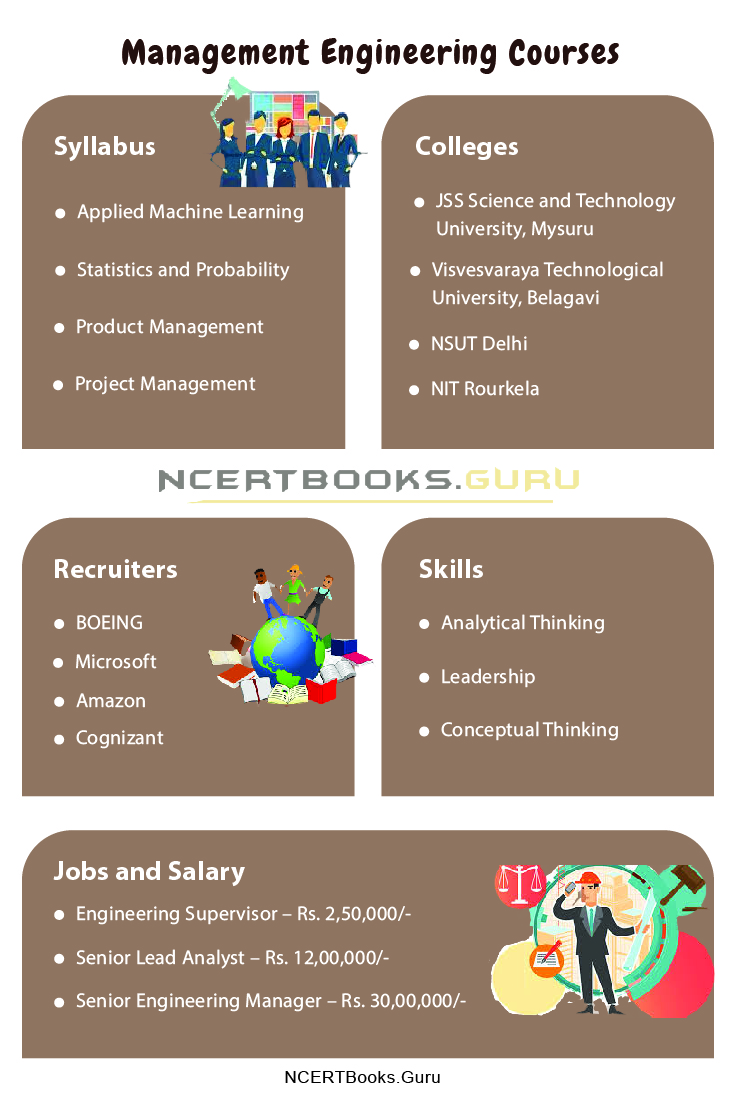
  • Applied Machine Learning
  • Accounting and Financial Management
  • Statistics and Probability
  • Data Analysis /Data Science for Business Intelligence.
  • Product Management
  • Operations Management
  • Project Management
  • Systems Engineering and Architecture
  • Managerial Economics / Economics & Public Policy
  • Manufacturing Management
  • Computer Simulation for Risk

Fees and Duration for Engineering Management in India

This fee structure will be different from college to college. let us look into the duration and the minimum fee and the maximum fee for an engineering management graduate and undergraduate level.

Graduate Level

Fee: 

Government: 2.7 Lakhs

Private: 1 Lakh – 5 Lakhs.

Duration: 4 – 5 Years.

Post Graduate Level

Fee: 

Government: 90000 – 2.31 Lakhs

Private: 1.29 Lakh – 3.56 Lakhs.

Duration: 2 Years

Also, Refer:

Top Engineering Management Colleges

Look into the list of engineering management colleges in India. Below is the list.

  • JSS Science and Technology University, Mysuru
  • Visvesvaraya Technological University, Belagavi
  • NSUT Delhi
  • NIT Rourkela

Engineering Management Jobs and Salary

Compared to other jobs, the job opportunities and salaries for these engineering Management Courses are high. Below we have given some of the job profiles along with the average salary.

  • Engineering Supervisor – Rs. 2,50,000/-
  • Operations Analyst –  Rs. 600000/-
  • Senior Lead Analyst – Rs. 12,00,000/-
  • Engineering Project Manager – Rs. 15,00,000/-
  • Senior Engineering Manager – Rs. 30,00,000/-
Management Engineering Courses

Top Recruiters for Engineering Management Course

Look into some of the top recruiters for engineering management courses that are given below.

  • BOEING
  • Microsoft
  • Flipkart
  • Amazon
  • Oracle Corporation
  • Cisco System
  • Tata Consultancy Services
  • Cognizant
  • Bharat Heavy Electricals Limited
  • Facebook

Skills Required for the Management Engineering

With the right skills and technical knowledge, you can get excellent in this engineering management course. Listed below are the few skills that are essential for progress in this field.

  • Analytical Thinking
  • Technical Knowledge
  • Leadership
  • Conceptual Thinking
  • Leadership Qualities
  • Professionalism

FAQs on Engineering Management Course

1. Is the engineering management course tough?

Yes, being an engineering management course is tough, it requires skills and managerial qualities.

2. Do I need any job experience for an engineering management course?

No. there is no need for any job experience in an engineering management course.

3. Is a MEM better than an MBA?

For an engineer,  MEM will be more apt to his or her job and be more useful. It helps them succeed in the same domain and as a result, it can be a good decision if one is really curious about engineering rather than business and management.

Summing Up

We believe that the information provided above about Management Engineering Courses after 12th is very useful to you as you can get deep knowledge about the course. If you are looking for any help from us, please contact us through the below comment box. We will certainly get back to you with the best possible solutions asap. Bookmark this NCERTBooks.guru website to know more course details and many.
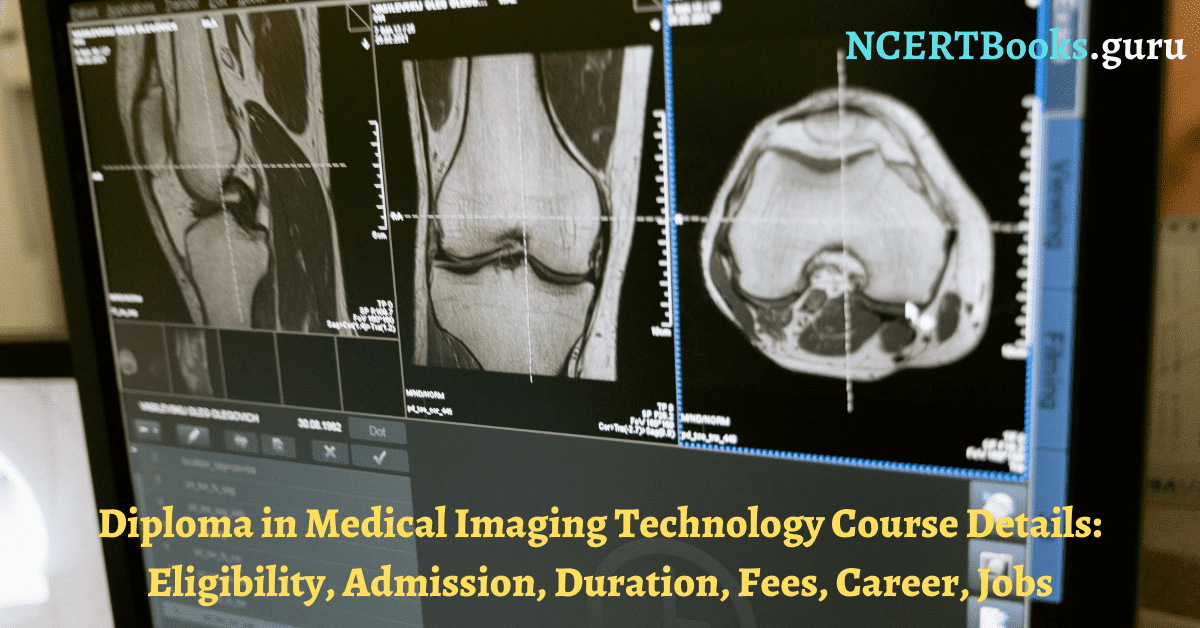
Diploma in Medical Imaging Technology Course Details | Eligibility, Admission, Duration, Fees, Career, Jobs

Diploma in Medical Imaging Technology Course

Diploma in Medical Imaging Technology Course Details: Students who are interested in the medical sector can opt for this course. A diploma in Medical Imaging Technology will teach students about the different elements of traditional physics, patient positioning, X-rays, CT scan, C-arm, film processing and development, and diagnostic nuclear medicine.

What is Diploma in Medical Imaging Technology?

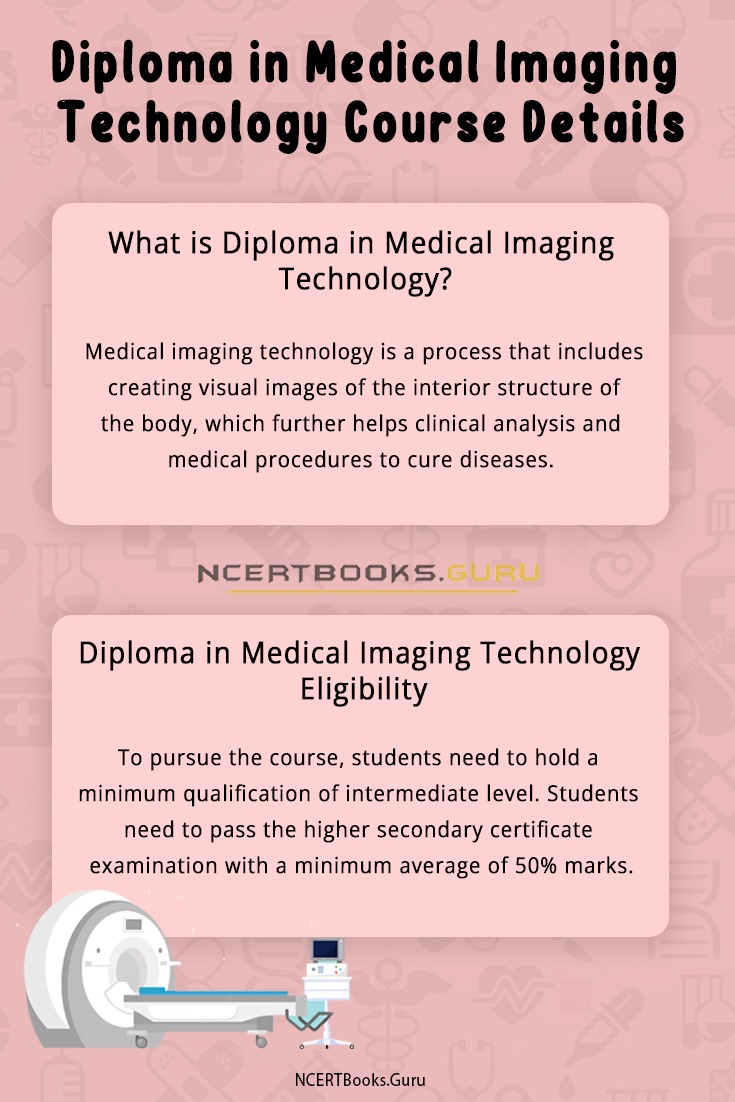
Medical imaging technology is a process that includes creating visual images of the interior structure of the body, which further helps clinical analysis and medical procedures to cure diseases. The course offers a wide spectrum of knowledge and information in health sciences and biophysical, which enables the students to take over theory and practical. Thereby, training them to handle radio imaging equipment and processes. The course is filled with comprehensive learning with demonstrations, lectures, clinical and practical experiences.

Diploma in Medical Imaging Technology Eligibility

To pursue the course, students need to hold a minimum qualification of intermediate level. Students need to pass the higher secondary certificate examination with a minimum average of 50% marks.

Medical Imaging Technology Diploma Entrance Exams

There are two types of examinations for entrance:

  • State-specific Entrance Examinations
  • University-specific Entrance Examinations

The examination has to be attempted in the form of MCQs.

Syllabus

  • Biology
  • Chemistry
  • Physics
  • English Language and Comprehension
  • Quantitative Reasoning

DMIT Course Duration

A diploma in Medical Imaging Technology can be completed in a span of 2 years. The course follows a semester pattern with a total of four semesters to be completed. Each year will have 2 semesters that last for a period of 6 months. Students have to qualify for the examination for each semester to successfully complete the diploma.

Diploma in Medical Imaging Technology Fees

The fees for Diploma Courses in Medical Imaging Technology range between INR 1 lakh- 1.5 lakhs.

Diploma in Medical Imaging Technology Colleges

Some of the popular colleges that offer the DMIT Course in India are listed for your reference. Select the college that better suits you and join to pursue your dream course.

  • Bareilly International University, Bareilly
  • Bhargavi Institute of Management and Technology, Hyderabad
  • Kohinoor College of Paramedical Science, Mumbai
  • Max Skill First, New Delhi
  • Melmaruvathur Adhiparasakthi Institute of Medical Sciences and Research, Kancheepuram
  • Oasis Institute of Health Sciences and Research Center, Pune
  • Sanskriti University, Mathura

Diploma in Medical Imaging Technology Course Syllabus

DMIT Syllabus for all 2 Years is listed below. Know the Diploma in Medical Imaging Technology Subjects you need to cover as a part of your curriculum and prepare based on the weightage. Allot time to the topics of more weightage and prepare accordingly.

Diploma in Medical Imaging Technology Syllabus for 1st Year

Anatomy I

  • Introduction of Bones of the Human Body
  • Surface Markings of the Body
  • Respiratory Organs
  • Circulatory Organs
  • Digestive Organs
  • Joint and Functions

Physiology I

  • Definition of Cell
  • Structure and Functions the Cytoplasmic Organelles
  • Reproduction
  • The Important Physic-Chemical Laws Applied to Physiology
  • Fundamentals of Different Organ Systems

Pathology

  • Introduction of Pathology
  • Immunity & Hypersensitivity
  • Human Blood Group Antigens and Antibodies
  • ABO Blood Group Systems
  • Rh Blood Group System
  • Erythroblastosis Faetalis
  • Growth Disorders and Heoplasia

Generation and Properties of X-Ray

  • Introduction
  • Properties and Production of X-Ray
  • Electric System in X-Ray
  • Basic X-Ray Circuits Transformers Law
  • Types Used in X-Ray Machine
  • X-Ray Tubes
  • Serial Radiography
  • Tomography
  • Iteration of X-Ray and Scatter Radiation
  • Care and Maintenance of X-Ray Equipment

Radiation Hazards & Protection

  • Introduction to Various Hazards
  • Principle and Method of Protection
  • Radiation Risk
  • Biological Effects of Radiation
  • Transport of Radiation Materials
  • Radiation Emergencies

General Radiography

  • Patents and Role of General Radiographer
  • Regional Radiography
  • Upper Limb and Lower Limb
  • Hip and Pelvis
  • Viertebral Column
  • Chest and Adomen
  • Skeletal Survey

Diploma in Medical Imaging Technology Syllabus for 2nd Year

Anatomy II

  • Reproductive Organs
  • Liver and Spleen Pancreas: Gall Bladder
  • Excretory Organs
  • Muscles

Physiology II

  • Introduction of Physiology
  • Formation of Different Type of Blood Cells
  • Mechanism of Blood Clotting
  • Cerebrospinal Fluid
  • Specials Senses

General Radiography

  • Special Procedure and Related Contrast Media
  • Excretory System
  • Oral Cholecystography
  • Hystero Salpingography
  • Angiography
  • Soft Tissue Radiography
  • Forensic Radiography

Mammography and Ultrasound Imaging

  • Mammography
  • Ultrasound
  • Principle of Ultra Sound
  • Types of Ultra Sound
  • Role of Ultrasound in the Delivery Suite

CT Scan

  • Basic Principle of CT Scan
  • Equipment’s Description
  • Conventional CT
  • Computer Tomography
  • Scanning Principle
  • Image Reconstruction
  • Sprial CT

MRI

  • Basic Principle
  • Instrumentation
  • Principles of Magnetic Resonance Imaging
  • Rapin Scan Techniques
  • Spectroscopy
  • Bioeffects and Safety

Also, find:

Job Opportunities after Diploma in Medical Imaging Technology

After successfully completing the program, a student will be able to tackle projects in hospitals, medical labs, healthcare institutions, nursing home diagnostic centers, and research laboratories. The student has to pursue Radiology Courses to work as an Applications specialist for Equipment, Interventional Radiology Specialist, Medical Imaging technologist, Radiology information specialist, etc. Some of the other available jobs are as follows:

  • Medical Imaging Technologist
  • Application Specialist for Equipment
  • Radiology Information Specialist
  • Sonographer
  • Interventional Radiology Specialist
  • Magnetic Resonance Imaging Specialist
  • Teacher/Lecturer
  • Research Associate
  • Medical Case Review Physician
  • Patient Care Coordinator
  • ECMO Technician
  • Ultrasound Technician

Diploma in Medical Imaging Technology Course Details

Diploma in Medical Imaging Technology Salary in India

The salary starts from INR 10,000 to 15,000/-, depending on the experience and post of the candidate. The remuneration can rise up to INR. 2 Lakhs to 10 Lakhs p.a. as per experience.

Learn about different kinds of course details related information all under one destination and make the right career choice whether to go with it or not.

Diploma in Medical Imaging Technology Scope

Candidates who have finished studying the DMIT course can get job options in government as well as private companies. They can also go for higher studies such as graduate courses. Check different Short Term Courses in Medical Field that gives the highest salary.

FAQs on DMIT Course Details

1. What can I do after diploma in imaging technology?

After pursuing a Diploma in Medical Imaging Technology you can become a Radiologist, Radiographer, Ultrasound Technician/ Diagnostic Medical Sonographer, MRI Technician, CT Tech/ CAT Scan Technologist/ CT Scan Technologist.

2. What are the subjects in medical imaging technologies?

Diploma in Medical Imaging Technology Subjects include the following

  • Anatomy
  • Radiation Physics
  • Pathology
  • Radiographic Special Procedures and Patient Care
  • Orthopaedics
  • Radiographic Positioning
  • Microbiology
  • CT Imaging and Contrast Technique

3. What is the course duration of the Diploma in Medical Imaging Technology?

Diploma in Medical Imaging Technology lasts about 2 Years.

Conclusion

After successful completion of the Diploma in Medical Imaging Technology Course, a student can go for paramedical courses or opt for BSc. medical imaging technology. The student can take up a job as listed above or go for higher studies in any related medical field.

B.Sc Cardiac Care Technology Courses | Duration, Eligibility Criteria, Admission Procedure, Employment Prospects

B.Sc Cardiac Care Technology Courses

B.Sc Cardiac Care Technology Courses: If you are a graduate who has completed 10+2 level of graduation in the Science stream with PCB as the core subjects, you have the option to become a Cardiac Care professional or technologist.

The employment task of a cardiac care technician is to perform the required activities in the field that requires less medical training before and during the procedure, and the course programme boosts and trains academic education.

The article on the B.Sc Cardiac Care Technology course programme provides a comprehensive analysis of the course and its successful job-oriented career in the medical arena. The report encompasses topics such as – course details, duration, eligibility, admission, curriculum and employment prospects.

All About B.Sc Cardiac Care Technology Courses

It is an undergraduate level Bachelor’s Degree program that is a part of an allied healthcare training program. The overall course duration for a B.Sc Cardiac Care Technology course programme is three years. This program is ideal for those who want to build a rewarding career in the healthcare sector.

Cardiac Care is a vital part of the healthcare sector and aims to deal with the treatment and care of any ailment regarding cardiopulmonary system-related. The course programme involves procedures and processes such as medicine, diagnosis, patient education, surgery, or rehabilitation.

Cardiac care technologist mainly assists cardiologists during any crucial and sensitive medical procedures. The course programme enables aspirants to monitor vital signs such as heartbeat, pulse rate, and sometimes, are also involved in the education and patient rehabilitation sector.

B.Sc Cardiac Care Technology Course Highlights

Course Name B.Sc Cardiac Care Technology
Course Level Undergraduate-level
Course Duration Three years with six semesters.
Age Limit The lower age limit is 18 years, and there is no applicable upper age limit specification.
B.Sc Cardiac Care Technology Eligibility Criteria Candidates must have cleared 10+2 level board examination in the stream of science from a recognised board of education or equivalent with a minimum of 50 per cent or 55 per cent in the qualified subjects such as Physics, Chemistry and Biology.
Placement Opportunities Academic Institutions, Government and Private Hospitals, Government or Private Clinics, Nursing care Homes or Centres, Mentally disabled Centres, Healthcare Offices, NGOs, Rehabilitation Centres, Emergency Medical Services, and more.
Employment Roles Echocardiographer, Cath Lab Technologist, Cardiovascular Technologist, ICU-intensivist, Dialysis Technician, Consultant Nephrologist, Cardiac Care Technician, Medical Sonographer, Cardiologist, Registered Vascular Specialist, Cardiac Care Technologist, and more.
Average B.Sc Cardiac Care Technology Salary Offered Rs. 40,000 to Rs. 50,000 per month
Advanced Courses M.Sc, MBA and other PG medical and Diploma courses
Similar Courses

B.Sc Nursing

Skillset Required for B.Sc Cardiac Care Technology Courses

Candidates who want to opt for B.Sc Cardiac Care Technology course programme must adopt skills and qualities that enable them to perform better-

  • EKG skills
  • Stress tests
  • Holter skills
  • Cath lab skills
  • Patient care skills
  • Heart rate
  • Stress echocardiograms skills
  • Interventional procedures skills

B.Sc Cardiac Care Technology Course Duration

The course duration for the B.Sc Cardialogy courses is a three-year-long undergraduate course programme that follows the semester system of education. The entire course programme is distributed into six semesters, with each semester lasting for six months.

Get to Know More about other types of Course Details in Streamwise, and Category wise

Eligibility Criteria for B.Sc Cardiac Care Technology Courses

The eligibility conditions are highly subjective and may vary from one institution to another institution. However, the standard eligibility requirements followed by several reputed universities or institutions offering B.Sc Cardiac Care Technology course programme is listed below-

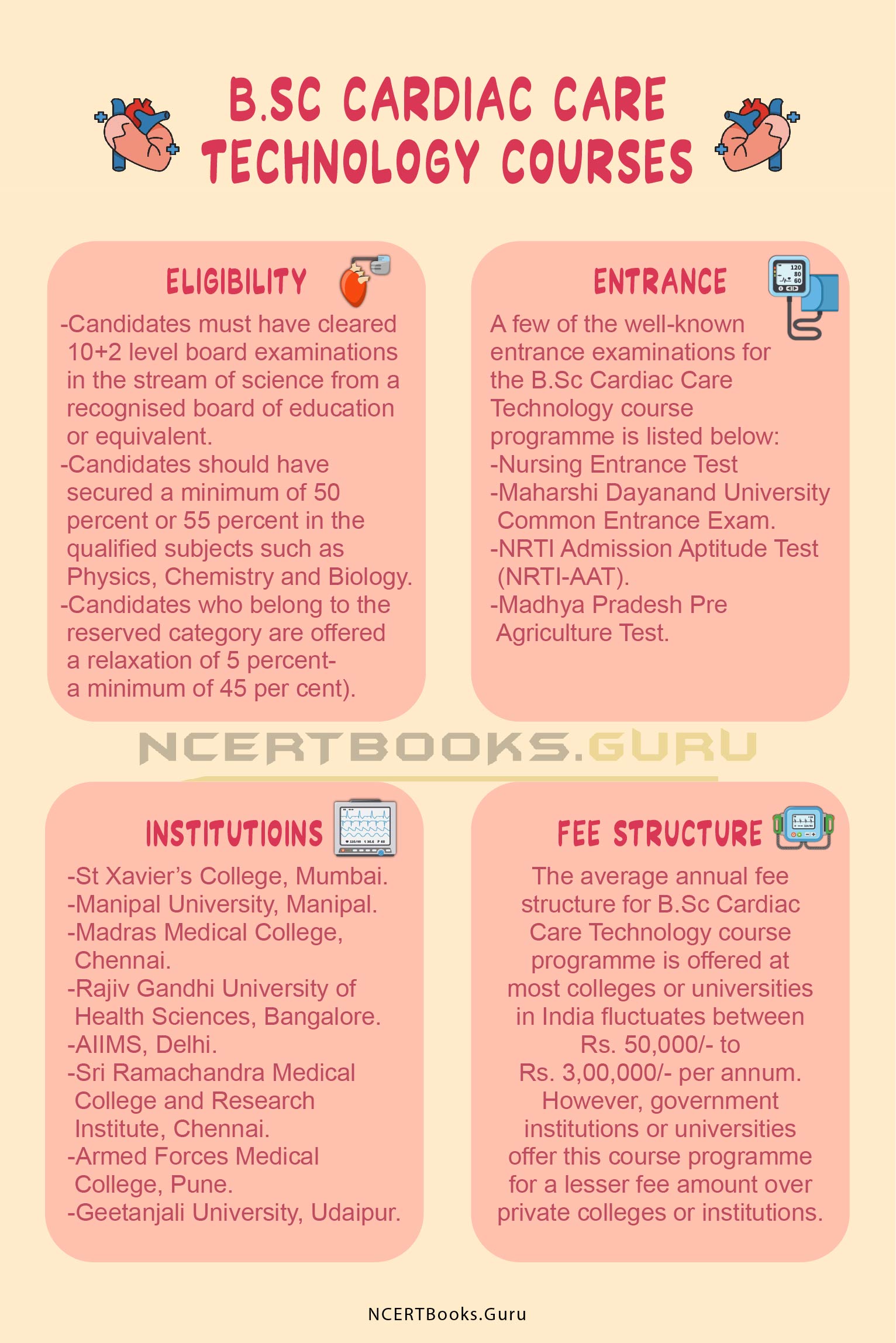
  • Candidates must have cleared 10+2 level board examinations in the stream of science from a recognised board of education or equivalent.
  • Candidates should have secured a minimum of 50 percent or 55 percent in the qualified subjects such as Physics, Chemistry and Biology.
  • Candidates who belong to the reserved category are offered a relaxation of 5 percent- (a minimum of 45 per cent aggregate).

Admission Protocol for B.Sc Cardiac Care Technology Courses

In India, each college follows either a direct method or an entrance-based method of the admission process as per their requirements. The standard admission protocol for BSc Cardiac Care Technology course is conducted either through Direct admissions or the Merit-based admission.

Several institutions or colleges follow the entrance-based admission process, wherein the institutions offer a standard entrance test. Students have to make an application to be eligible for such exams. Students who qualify for the university-level entrance examinations get through the admission for the course programme.

Colleges that conduct the merit-based admission process carry out the selection process either through a personal interview or a group discussion. Most institutions shortlist candidates based on their past academic education, while the personal Interview and the group discussion add on as a bonus.

Read More Articles:

B.Sc Cardiac Care Technology Courses Entrance Examinations

A few of the well-known entrance examinations for the B.Sc Cardiac Care Technology course programme is listed below:

  • Nursing Entrance Test
  • Maharshi Dayanand University Common Entrance Exam
  • NRTI Admission Aptitude Test (NRTI-AAT)
  • Madhya Pradesh Pre Agriculture Test

B.Sc Cardiac Care Technology Course Fee Structure

The average annual B.Sc Cardiac Care Technology fee structure is offered at most colleges or universities in India fluctuates between Rs. 50,000/- to Rs. 3,00,000/- per annum. However, government institutions or universities offer the B.Sc Cardiac Care Technology course programme for a lesser fee amount over private colleges or institutions.

The factors that affect the fee structure include ownership of the institution, management quotas, materials, infrastructure, and reputation of the college in the global market.

B.Sc Cardiac Care Technology Course Curriculum

B.Sc Cardiac Care Technology Syllabus is categorised into six semesters and aims to cover all the essential concepts in the field of medical science.

First Year Second Year Third Year
Pathology Including Blood-Banking, Clinical Pathology and Haematology Introduction Cardiac Care Technology Clinical Cardiac Care Technology
Biochemistry Applied Pharmacology Applied Cardiac Care Technology
Human Anatomy Medicine Relevant Cardiac Care Advanced Cardiac Care Technology
Physiology Applied Pharmacology
Microbiology Applied Pathology
Applied Microbiology

Subject-Wise Breakups

Some of the important subjects present in the B.Sc Cardiac Care Technology course curriculum-

  • Anatomy
  • Applied Cardiac Care Technology
  • Medicine
  • Biochemistry
  • Advanced Cardiac Care Technology
  • Pharmacology
  • Physiology
  • Clinical Cardiac Care Technology
  • Microbiology

Top Institutions Offering B.Sc Cardiac Care Technology Course

B.Sc Cardiac Care Technology course programme is offered in several reputed institutions. Listed below are the top ten institutions along with their location that offers the B.Sc Cardiac Care Technology course in India.

  • St Xavier’s College, Mumbai
  • Manipal University, Manipal
  • Madras Medical College, Chennai
  • Rajiv Gandhi University of Health Sciences, Bangalore
  • AIIMS, Delhi
  • Sri Jayadeva Institute of Cardiovascular Sciences and Research, Mysore
  • Sri Ramachandra Medical College and Research Institute, Chennai
  • Armed Forces Medical College, Pune
  • Geetanjali University, Udaipur
  • Jawaharlal Institute of Postgraduate Medical Education and Research, Puducherry

B.Sc Cardiac Care Technology Courses

Employment Prospects for a B.Sc Cardiac Care Technology Graduate

B.Sc Cardiac Care Technology is a broad course that encompasses an ample variety of employment opportunities for graduates in both government and private sectors. B.Sc Cardiac Care Technology opens the door to a plethora of options with a high pay package from which graduates can choose a suitable profile of their interest and comfort.

Areas of Employment

B.Sc Cardiac Care Technology course graduates from allied areas can choose their domain that interests them or which they can specialise in, such as-

  • Academic Institutions
  • Government and Private Hospitals
  • Government or Private Clinics
  • Nursing care Homes or Centres
  • Mentally disabled Centres
  • Healthcare Offices
  • NGOs
  • Rehabilitation Centres
  • Emergency Medical Services

Job Roles Under Cardiac Care Technology

With adequate experience, graduates from the field of Cardiac Care Technology can advance up to the job profiles in different medical sectors such as-

  • Echocardiographer
  • Cath Lab Technologist
  • Cardiovascular Technologist
  • ICU-intensivist
  • Dialysis Technician
  • Consultant Nephrologist
  • Cardiac Care Technician
  • Medical Sonographer
  • Cardiologist
  • Registered Vascular Specialist
  • Cardiac Care Technologist

Salary and Pay Package for B.Sc Cardiac Care Technology Graduate

The average annual B.Sc Cardiac Care Technology salary can fluctuate anywhere between Rs. 40,000 to Rs. 50,000 per month, initially. However, for those graduates with ample experience, professional skills and aptitude, job location, and profile employer, graduates can earn up to Rs. 80,000 to Rs. 1 Lakh per month.

FAQ’s on Bachelor of B.Sc Cardiac Care Technology Courses

Question 1.
What are the specialisations a B.Sc Cardiac Care Technology graduate can opt for?

Answer:
A B.Sc Cardiac Care Technology graduate can specialise in areas such as invasive cardiology, vascular technology, echocardiography, and non-invasive cardiology to expand their course programme.

Question 2.
How long is the B.Sc Cardiac Care Technology course programme?

Answer:
The course duration for B.Sc Cardiac Care Technology course is a three-year-long undergraduate course programme that follows the semester system of education. The entire course programme is distributed into six semesters, with each semester lasting for six months.

Question 3.
What is the average salary for a B.Sc Cardiac Care Technology graduate?

Answer:
The average annual salary of a B.Sc Cardiac Care Technology graduate can fluctuate anywhere between Rs. 40,000 to Rs. 50,000 per month, initially. However, for those graduates with ample experience, professional skills and aptitude, job location, and profile employer, graduates can earn up to Rs. 80,000 to Rs. 1 Lakh per month.

Question 4.
What are the top five institutions that offer the B.Sc Cardiac Care Technology course programme?

Answer:
The top five institutions that offer the course programme are St Xavier’s College, Mumbai, Manipal University, Manipal, Madras Medical College, Chennai, Rajiv Gandhi University of Health Sciences, Bangalore, and AIIMS, Delhi.

Summary

We hope that the information mentioned above regarding the B.Sc Cardiac Care Technology course details has helped improve your understanding of the subject with in-depth knowledge.

Best Advanced Diploma Courses in Canada After 12th | Tution Fee, Top Colleges, Required Documents

Advance Diploma Course in Canada

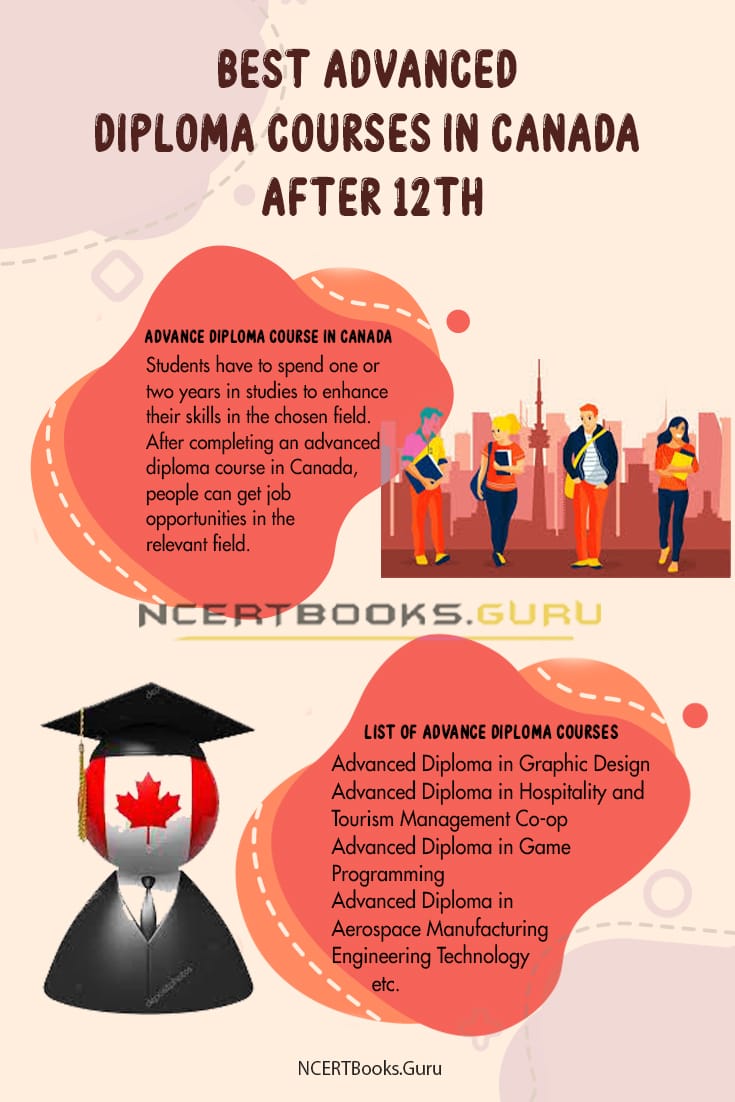
Advance Diploma Course in Canada: Do you want to pursue diploma courses in Canada? If yes, then stay on this page. Here we are providing the complete guide on advanced diploma courses in Canada after 12th class or 10th grade. Students have to spend one or two years in studies to enhance their skills in the chosen field. After completing an advanced diploma course in Canada, people can get job opportunities in the relevant field.

Have a look at the detailed admission procedure, tuition fee, best colleges and universities of advanced diploma courses available in Canada for local and international students.

List of Advance Diploma Courses in Canada

Advanced diploma courses in Canada are short term courses that focus on specialization and primary aim to make students industry-ready. In general, the Canada diploma course duration is 2 to 3 years in a wide range of specializations. Advanced Diploma in Canada after 12th Course has 6 semesters for 3 years of study. The diploma courses in Canada are job oriented containing practicals in the relevant field of study.

Advance diploma course in Canada fees ranges from $10,000 to $15,000 per academic year. But it may vary based on the course, the college you choose. Below mentioned are some advanced diploma courses for students in Canada.

  • Advanced Diploma in Graphic Design
  • Advanced Diploma in Hospitality and Tourism Management Co-op
  • Advanced Diploma in Game Programming
  • Advanced Diploma in Aerospace Manufacturing Engineering Technology
  • Advanced Diploma in Civil Engineering Technology
  • Advanced Diploma in Software Engineering Technology
  • Advanced Diploma in Health Informatics Technology
  • Advanced Diploma in Business Administration
  • Advanced Diploma in Biomedical Engineering Technology
  • Advanced Diploma in Mechanical Engineering Technician – Design
  • Advanced Diploma in Energy Systems Engineering Technology
  • Advanced Diploma in Advertising and Marketing Communication Management
  • Advanced Diploma in Food Science Technology
  • Advanced Diploma in Chemical Laboratory Technology
  • Advanced Diploma in Fashion Design
  • Advanced Diploma in Child and Youth Care
  • Advanced Diploma in Aviation Technology
  • Advanced Diploma in Cyber Security
  • Advanced Diploma in Fine Art
  • Advanced Diploma in Environmental Technology

Benefits of Studying Advance Diploma Course in Canada

Here we are giving the advantages of pursuing advanced diploma courses in Canada for international and local students. These courses are mainly focused on practical aspects of learning along with job-oriented skills.

  • Advance Diploma Courses are of less duration and can be finished in less than 3 years. There are few programs that take more than 4 years to complete all subjects.
  • We also know that diploma courses are job-oriented and enhances practical knowledge rather than focusing on the academic aspects.
  • The short term courses are valid across Canada and considered for different job profiles.
  • The cost of the course is affordable as it starts from $2,000 per year.
  • Canada provides post-graduate work permission (PGWP) to the students who have enrolled in courses of 8 months or more duration.

Best Colleges in Canada for Advanced Diploma

Advance Diploma Course in Canada is offered at public colleges, universities, community colleges, and others. The list of top colleges in Canada for advanced courses is here.

  • Algonquin College
  • Athabasca University
  • Conestoga College
  • Centennial College
  • St. Clair College
  • Seneca College
  • Mohawk College
  • Cambrian College
  • Toronto School of Management
  • Northern Alberta Institute of Technology (NAIT)
  • Canadian College of Technology and Business
  • College of Rockies
  • British Columbia Institute of Technology (BCIT)
  • Southern Alberta Institute of Technology (SAIT)

Canada Diploma Courses Required Documents for International Students

Every individual has to fulfil certain requirements to apply for advanced diploma courses in Canada. The required documents and admission procedure is different for different colleges. But here we are providing the basic documents to apply for diploma courses in Canada for Indian students.

  • Passport: It is mandatory to have a passport that is valid for a minimum of 6 months after the completion of your course.
  • Entrance Exam Qualified Certificate: Candidate must score good marks in any entrance test to get admission to colleges in Canada. You must carry that particular exam qualified document.
  • Birth Certificate and Parental Consent: Candidates who are studying diploma courses in Vocational colleges such as CEGEPs have to submit their birth certificates. Students with age below 18 years have to submit parental consent to study in Canada.
  • Immigration Documents: Students who want to study in Canadian colleges/universities must apply for visas. They can have a temporary visa when the course duration is less than 6 months. Other mandatory documents needed at the time of immigration are temporary residential visa/travel documents and an acceptance letter from DSI in Canada.
  • Official Documents from College: Students have to submit official marks lists from class 10th.
  • English Language Proficiency Test Scores: International students have to submit TOEFL, IELTS scores if they have studied English up to 12th class. English language proficiency is the main requirement for admission. Candidates without the best score in the school level English tests have to submit TOEFL, IELTS scores to prove their language proficiency.
  • Proof of Funds: It is one of the primary requirements to get admission to any best diploma course in Canada. Applicants has to submit a detailed financial statement about their family’s financial status. This information is used by the college to know if he affords the education.

Entrance Exams to Study Advance Diploma Courses in Canada

If you are planning to apply to the university or college of Canada for advanced diploma courses? Then you must know the exams required to apply for the course. The following exams depend on the course you select in diploma and Canadian institution for admission. Some of the Canada entrance exams are listed here:

  • IELTS Exam: It is a direct evaluation of the high quality of English language tests.
  • TOEFL Exam: It is a Test of English as a Foreign Language (TOEFL). Most Canadian colleges ask students to have a minimum score in TOEFL.
  • PTE Exam: Several institutions and colleges in Canada recognise PTE academics. This is the simplest method to get an acceptance letter from a designated Canadian learning institute.
  • Law School Admission Test (LSAT): You can apply for Canadian law school by writing LSAT Canada.
  • Scholastic Assessment Test (SAT): High school diplomats can continue studying and enrol in the Canadian university by qualifying for this test.
  • Medical College Admission Test (MCAT): This exam tests critical, analytical abilities, and ideas of physical, biological sciences.

Advanced Diploma Courses in Canada After 12th

More Related Articles:

Canada Advance Diploma Course Fee

Tuition fees for various fields advance diploma course in Canadian colleges and universities are given here.

College Name Tuition Fee
Algonquin College 8.8 Lakhs
Centennial College 8.0 Lakhs
Durham College 7.4 Lakhs
Fanshawe College 4.18 Lakhs
Fleming College 10 Lakhs
George Brown College 2.73 Lakhs
Humber College 9.48 Lakhs
The Sheridan College 10.5 Lakhs
Sault College 8.86 Lakhs
Mohawk College 9.83 Lakhs
St. Stephens College 5.57 Lakhs
North Island College 8.92 Lakhs
Luther College 11.60 Lakhs
St. Lawrence College 4.76 Lakhs
Niagara College 8.22 Lakhs

You can also pursue 2 years PG Diploma Courses in Canada.

FAQ’s on Advance Diploma Courses in Canada

1. What is Advanced Diploma Canada?

The advanced diploma course is more specialised than the regular diploma course as it includes co-op and internship components. That unique opportunity improves your skills in real-world situations, networks within the industry, building a resume, and so on. The total course duration is for 3 years and it is an undergraduate-level course.

2. Who is eligible for the advanced diploma course in Canada?

To join for advance diploma course in Canada, students should complete a relevant undergraduate diploma or 12th class with a cumulative score of 60%. Few special courses related to business administration or project management may require to have one to two years of work experience.

3. What comes after Advanced Diploma?

Students who have successfully completed undergraduate advanced diploma courses can apply for postgraduate courses like postgraduate diplomas or master’s degrees.

4. Is an advanced diploma equal to a degree?

The advanced diploma course is a program that is studied between a degree program and certification. The diploma is better than certification but it is less worthy than a degree or bachelor’s degree or master’s degree. The major difference between an advanced diploma and PG is degree course duration is 2 years and the advanced diploma course duration is 3 years.

5. How long is advance diploma course in Canada?

Advanced diploma programmes course duration is 3 years.

Final Words

We hope that the information given here about Advance Diploma Course in Canada is useful for the students who want to study in Canada. Stay in touch with our website ncertbooks.guru to know other course details.

Nanny Course in Chandigarh | Eligibility, Career Opportunities, Salary, Fees, Job Options

Nanny Course in Chandigarh

Nanny Course in Chandigarh: If you are interested in taking up courses required to become a nanny, this is the perfect article for you. Given below are all the necessary Nanny Course details that are required for you to become a nanny. You will get the details about the courses, the requirements, the fees, and the institutes where you can apply them.

A nanny is professionally hired to provide care to a child if the parents are unable due to work or any other obligations. Nannies work in the houses of these children to provide the necessary care for the child and perform all the required tasks. They can also take care of children in childcare facilities. Nannies usually take care of children from the age of when they are a few months old. They also take care of children before and after school.

Get to Know More about other types of Course Details in Stream wise, and Category wise.

Nanny Course in Chandigarh Eligibility Criteria

Only one educational qualification required for a candidate to become a nanny is that they should have passed standard 12. Besides that, there are no educational qualifications that are required for a person to become a nanny. However, other qualifications are required for someone to become a nanny. Here are some of the qualifications:

  1. The nannies should take a personal interest in the growth and development of children that are going to be taking care of when they start working.
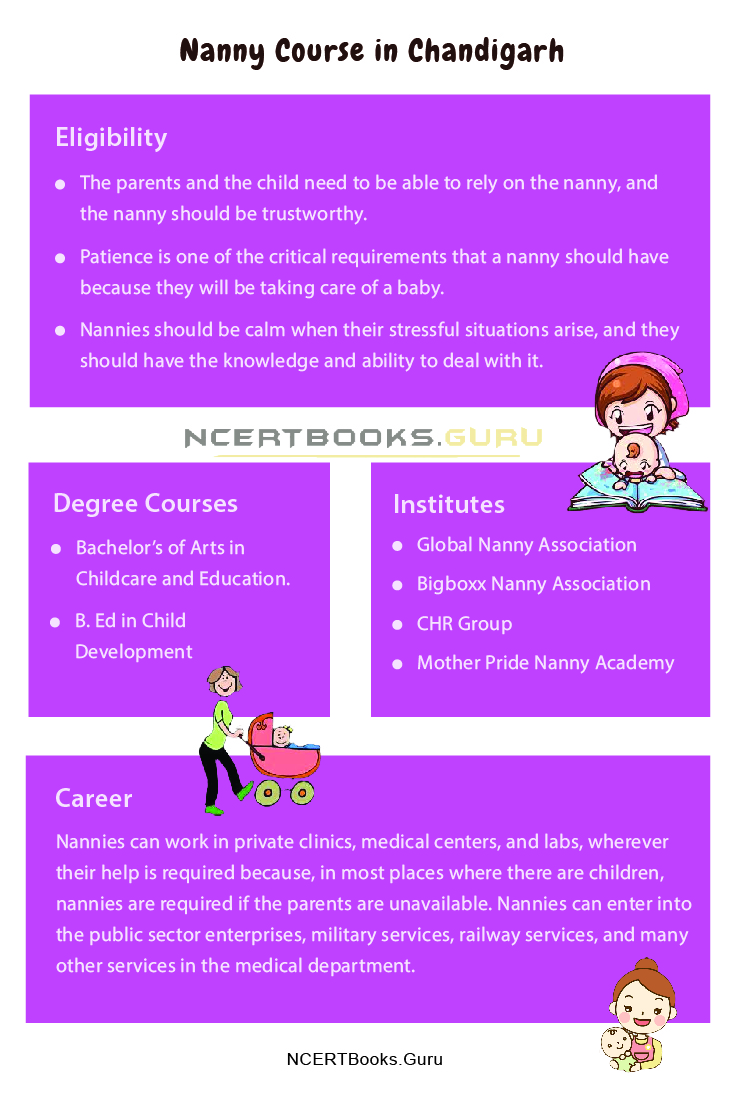
  2. The parents and the child need to be able to rely on the nanny, and the nanny should be trustworthy.
  3. Patience is one of the critical requirements that a nanny should have because they will be taking care of a baby.
  4. Nannies should be calm when their stressful situations arise, and they should have the knowledge and ability to deal with it.
  5. The candidate should have excellent domestic skills and interpersonal abilities too.
  6. Candidates should be flexible and be available for working some extra hours when and if the need arises.
  7. They should be proactive in dealing with all the issues.
  8. Nannies should have the ability to work with the parents because they need to approve of you if you want to work in their house.
  9. The most important qualification is that nannies should love babies and have a loving and caring attitude.

Degree and Certificate Courses for Becoming a Nanny

Many times there are nannies who don’t have many educational qualifications. However, it is recommended to do academic courses in the field to become better qualified. There are diploma courses, certificate courses, and degree courses that you can enroll in for studying to become a nanny. The requirements that you need to apply in these courses may vary from college to college. Look at the website of the college for the proper requirements for applying in this course. You can be enrolling in these courses and start your journey towards becoming a nanny. Here’s a list of the course that you can apply and enrolled in:

Degree Courses for Becoming a Nanny

  • Bachelor’s of Arts in Childcare and Education.
  • B. Ed in Child Development.

Requirements for applying for this course:

The candidates need to have finished 10th and 12th standard with minimum marks.

Certificate Courses and Diploma Courses for Becoming a Nanny

  • Certificate course in Childcare and Development
  • Certificate course in Childcare
  • Diploma in Childcare

Requirements for applying for this course:

The candidates need to have finished 10th or 12th standard with minimum marks.

Institutes in Chandigarh for Becoming a Nanny

Here are the top five institutes that offer courses for you to become a nanny in Chandigarh. Nanny course duration and fees are affordable for any student.

  1. CHP Group Chandigarh- Nanny Institute
  2. National Institute of Nanny Care
  3. Eden Group Institute
  4. Global Nanny Association
  5. Angel Care Giving Institute
  6. Bigboxx Nanny Association
  7. CHR Group
  8. Mother Pride Nanny Academy

Nanny Course Subjects

  • Nutrition
  • Child Care
  • Geriatrics Care
  • Psychology
  • Work Place Abuse Reporting
  • Hazards & Emergencies

Career Prospective for Nannies

There are many career prospects for candidates that want to become nannies. They have good prospects in private households as well as providing their insights to parents. Nannies can help their parents by providing expertise in areas like satisfying children’s needs, including physical, emotional, and mental wellness.

Nannies can work in private clinics, medical centers, and labs, wherever their help is required because, in most places where there are children, nannies are required if the parents are unavailable.

Nannies can enter into the public sector enterprises, military services, railway services, and many other services in the medical department. Their job includes planning and preparing the child’s meals, doing the laundry, providing full clothing care for the child, and organizing activities where the child can play.

Salary of the Nanny

The salary of the nanny depends from one workplace to another. However, the regular average salary of a nanny just starting the job is around Rs. 4000 to Rs. 5000. The nanny’s salary depends on the years of education, expertise, places of work, and skills. If their skills keep improving, the salary of the nannies will increase too. It is one of the factors that vary from one household to another household.

Nanny Course in Chandigarh

FAQ’s on Nanny Course in Chandigarh

Question 1.
What is the role of a nanny?

Answer:
A nanny is a professional who is hired to take care of a child if the parents are busy with their jobs or have other obligations.

Question 2.
Name a few institutes in Chandigarh where nanny courses are offered?

Answer:
A few institutes that offer the nanny course in Chandigarh are CHP Group Chandigarh- Nanny Institute, National Institute of Nanny Care, Eden Group Institute, Global Nanny Association, Angel Care Giving Institute, and Bigboxx Nanny Association

Question 3.
What are a few requirements to be a nanny?

Answer:
There are educational qualifications to become a nanny; however, these qualifications are more important. Here are some of the qualifications a nanny should have to become a nanny:

  • They should take a personal interest in the growth and development of a child.
  • A nanny should be able to stay calm during high-pressure situations and should be able to handle them.
  • A nanny should be trustworthy and dependable.
  • The nanny should have a genuine love and care for children.

Question 4.
What is the salary of a nanny?

Answer:
The nanny’s salary depends on several factors, like years of experience, educational qualifications, and skills. However, the starting salary of the nanny is from Rs. 4000 to Rs.5000. It is the salary for those who are just beginning or entering the field of a nanny.

Easy Courses After 12th Science | Course List, Eligibility, Fees, Duration, Colleges, Career Scope, and More

Easy courses after 12th science

Easy Courses after 12th Science: Science in class 12th is considered one of the toughest choices for students. Even the degree choices after 12th science are PCM or PCB. But some students lose interest in these tough courses, for them also there are various easy courses available.

Easy courses also offer amazing job opportunities for the students. Even the salary offered is quite good. For both biology and math backgrounds students also easy courses after class 12 are available in India. Here in this article, we will guide you about the Easy Courses after 12th Science which is also related to your interest.

About Easy Courses After 12th Science PCM / PCB

The Science stream includes physics, biology, math, and other subjects too. But many of these subjects are not known to students. Most of them just know that they can pursue B.Sc or B.Tech after the completion of class 12th science.

Even the guardians also guide them to become engineers. However, these courses offer amazing career scope but some students are not eager to pursue these degrees. Then the scope for easy courses arises. These courses are not so different from the science field but the pattern and syllabus they follow are quite easy. These easy courses can be completed in a short span of time.

Easy Unique Courses after 12th Science Eligibility Criteria

The eligibility criteria for these short & easy courses after class 12 science vary. Some colleges may ask you to study math in class 12th and some may ask you to study biology. It completely depends on the course you are choosing. But the few important points which you need to keep in mind are:

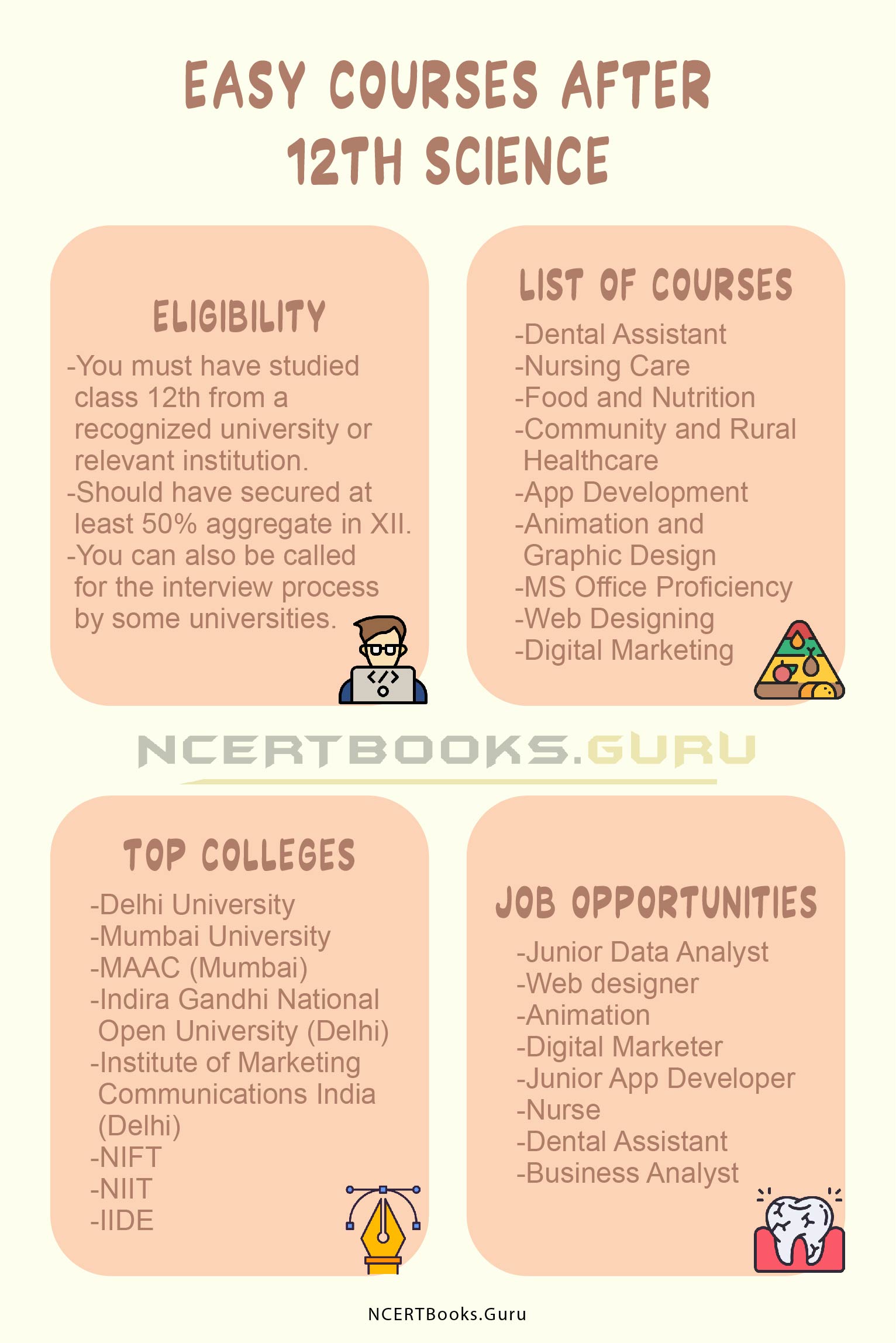
  • You must have studied class 12th from a recognized university or relevant institution.
  • Should have secured at least 50% aggregate in XII.
  • You can also be called for the interview process by some universities.

List of Easy Courses after Class 12th Science

These short-term courses are easy in nature. You can have a never list for easy courses after the 12th. However, it has been advised that you must choose these courses according to your interest as your interests will help you a lot while you will be practicing them in real life.

  • Dental Assistant
  • Nursing Care
  • Food and Nutrition
  • Community and Rural Healthcare
  • App Development
  • Animation and Graphic Design
  • MS Office Proficiency
  • Web Designing
  • Digital Marketing
  • Information Technology
  • VFX and Animation
  • A career in Foreign languages

Job Oriented Best and Easy Courses After 12th Science List

These courses can be completed in a few weeks or hours. But they are extremely useful for your better career. You can pursue these courses after the completion of class 12th. After the compilation of these courses, you will be provided a certificate that helps you to build your resume. These can be known as non-scholastic courses after the 12th.

  • Java Development
  • Big Data and Hadoop
  • Data Visualization
  • Business Analytics
  • Data Mining
  • Machine Learning

Fees Structure for Easy Degree Courses After 12th Science PCMB

The Fees structure is not similar for all the courses. As these courses demand different ways of learning, the fees demanded are based on the types of equipment used by the college. The fee for free courses is described here in the below table:

Dental Assistant Rs 1.5 lacs to Rs 3 lacs
Machine Learning Rs 40,000 to Rs 60,000
Digital Marketing Rs. 36,000
Food and Nutrition Rs. 30,000 – RS. 2 lacs
Data Visualization Rs 36,000 to Rs 60,000
Web Designing Rs 40,000 to Rs 15 lacs

Top Colleges That Offer Easy Courses after 12th Class Science

The colleges for the short-term courses after the 12th are available all over India. Even few websites are offering these courses online. These colleges are:

  • Delhi University
  • Mumbai University
  • MAAC (Mumbai)
  • Indira Gandhi National Open University (Delhi)
  • Institute of Marketing Communications India (Delhi)
  • NIFT
  • NIIT
  • IIDE
  • Tata Institute of Social Sciences (Kolkata)

Career Scope in Easy & Professional Courses after 12th Science

As we have defined, easy courses are available in data science, nursing, food and nutrition, Animation, and more. Thus the companies such as MNCs want their employees to hold degrees in such courses. They are ready to pay a high amount of salary to their employees.

Even after the completion of these courses, you can further your bachelor’s or master’s degree in the relevant domain. You will have a fabricating future and this will help you to stand out among all the employees at the time of recruitment. Not only in India companies abroad also want employees to hold such types of easy courses.

Do Check: Diploma in Data Science Course

Job Opportunities After Easy Courses in Science

various companies are recruiting students in demand for these easy courses for the profile of

  • Junior Data Analyst
  • Web designer
  • Animation
  • Digital Marketer
  • Junior App Developer
  • Nurse
  • Dental Assistant
  • Business Analyst

Easy Courses After 12th Science

Easy Courses After 12th Science with High Salary

The easy courses offer high salaries. But this salary depends on your job profile and the course you had chosen while studying. You are also required to maintain your skills and knowledge to earn high, But on average, you can earn Rs 20,000 to Rs 50K with the help of these easy courses. Later with experience, your salary could get increased.

FAQs on Easy Science Courses after 12th in India

1. Which are the easiest courses after class 12th science? 

You can go for the diploma and certificate courses as they can be completed in a short period and you do not need to study a lot. But in return, they will provide you with a high salary structure. The domains can be Digital Marketing, Web Designing, Hotel Management, Event Management, and more.

2. Are these easy courses after 12th science worthwhile? 

Yes, there are a lot of career opportunities that are waiting for you. These easy courses do not mean that you will not get any proof in return. You can pursue them in a diploma or certificate course domain which companies accept and provide great job profile opportunities.

3. What is the eligibility for these easy courses after 12th Science? 

You need to score at least 50% marks in class 12th. Also, you must have studied physics, chemistry, biology, math, and other relevant science subjects in your class 12th.

4. Do easy courses after the 12th science offer a good salary? 

Yes, the science courses offer a great salary. You can earn around Rs 20,000 to Rs 50K as a fresher after the completion of the degree, However, the salary structure is completely dependent on your skills and knowledge.

Related Articles: Data Science Courses

Conclusion

If you are ready to explore more and face challenges then there are a lot of opportunities that are waiting for you. Thus, with the trendy easy courses after 12th science NcertBooks.Guru is always there for you. We are also accepting suggestions and questions regarding various course details and career options which you may ask in the comment section below.