Top Short Term Courses in Medical Field in India | List of Short Term Medical Courses to Study

Short Term Courses in Medical Field

Short-term medical courses: Hey, are you on a hunt for short-term medical courses? Well, you must feel lucky because there are a plethora of options available for you. The courses fall under two categories. The first category is for aspirants who are new to the medical field and want to pursue a degree in the same. The second category is for those who want to get a master’s or a diploma in the medical field.

Do you need help to know some of the best short-term medical courses? Not to worry. We have added such courses in our article. Search for the program best suited for you.

Why Opt for Short-Term Medical Courses?

Medicine is undoubtedly a broad field of study and research. Until a few years ago, people thought MBBS was the only medical degree they could pursue. But, over the years, medical aspirants started walking on a new path: they started pursuing short-term courses. These short-term courses promise you a better future with job openings or further higher studies. Here is our list of the best short term medical courses:

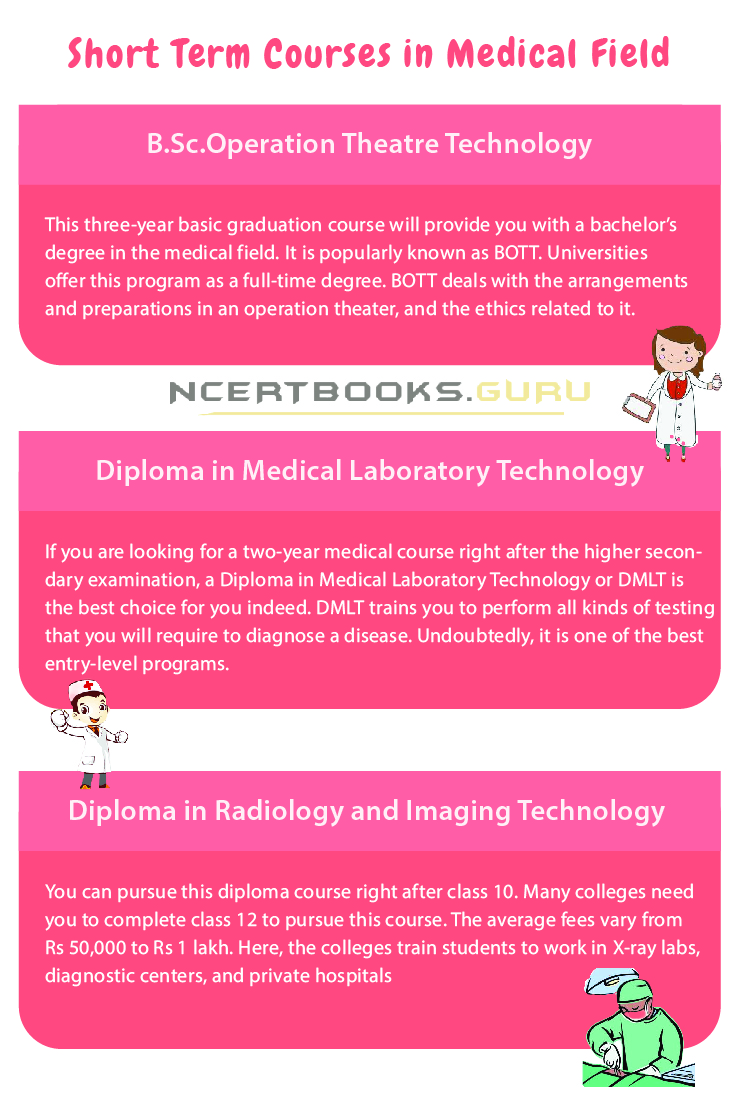
B.Sc.Operation Theatre Technology (BOTT)

This three-year basic graduation course will provide you with a bachelor’s degree in the medical field. It is popularly known as BOTT. Universities offer this program as a full-time degree. BOTT deals with the arrangements and preparations in an operation theater, and the ethics related to it. Students get to know how they should take care of patients before and after surgery. Moreover, they are provided with proper training to assist the doctors and nurses in the OT.

This engaging course promises lots of future scopes. Additionally, it serves as the gateway for a variety of jobs, for instance, OT assistants, OT technologists, Teachers, lecturers, to name a few. Students can also opt for a master’s degree to pursue higher education in this field. The average course fee ranges from Rs 50,000 to Rs 10 Lakhs, depending on the college.

Diploma in Medical Laboratory Technology (DMLT)

If you are looking for a two-year medical course right after the higher secondary examination, a Diploma in Medical Laboratory Technology or DMLT is the best choice for you indeed. Though not all colleges accept students after class 12, many colleges do. Some even offer distance learning for this course.

DMLT trains you to perform all kinds of testing that you will require to diagnose a disease. Undoubtedly, it is one of the best entry-level programs. Students are trained thoroughly in pathology, biochemistry, microbiology. Additionally, they perform hands-on training in the laboratories. Thus, if you are interested in pursuing a career in paramedical science, go for this course without giving it a second thought. The course fee for this fast-growing field ranges from Rs 20,000 to Rs 1 Lakh.

Get a comprehensive list of Course Details all in one place and study various courses information such as eligibility to pursue one, course duration, fees, colleges, etc.

Six Months Medical Certification Courses

The demand for these certification courses is surging. The reason behind this is they allow you to pursue these certification courses right after class 12 while training you to meet the crunch of trained medical professionals in the country. You can complete the courses either online or offline mode. Popular certification courses include Geriatric Care Assistance, Lab Technicians, Phlebotomy Assistance, to name a few.

You need to visit the website of the offering institute and apply there. Subsequently, you will get calls based on the merit list. The average fee ranges from Rs 1100 to Rs 25,000. Thus, if you want to earn early in the medical field, opt for this course. It will be the best fit for you.
Short Term Courses in Medical Field in India

Diploma in Radiology and Imaging Technology (DRIT)

Last but not least, we have a Diploma in Radiology and Imaging Technology (DRIT) in our list. You can pursue this diploma course right after class 10. Many colleges need you to complete class 12 to pursue this course. A diploma in Radiology and Imaging Technology (DRIT) has a course duration of two years. The average fees vary from Rs 50,000 to Rs 1 lakh.

Here, the colleges train students to work in X-ray labs, diagnostic centers, and private hospitals. In this full-time medical course, students get to do hands-on training on practical things, especially basic diagnosis, radiographic equipment, to name a few. Undoubtedly, this course is in high demand.

Read More: Diploma in Medical Imaging Technology Course Details

FAQs on Short Term Medical Field Courses

1. What is the best short-term medical course?

Best short term medical courses include:

  • B.Sc.Operation Theatre Technology (BOTT)
  • Diploma in Medical Laboratory Technology (DMLT)
  • Six-month medical certification courses
  • Diploma in Medical Laboratory Technology (DMLT)

2. What is the shortest medical course?

Certified Phlebotomy Technician (CPT) Training Course takes time of around 11 weeks. Apart from that, there are other certification courses with a maximum duration of six months.

Final Words

Thus, as you can see, there are lots of available options if you want a career in the medical field. You just need to select the best short-term medical course for you. Now that you know about the best courses, bookmark them and decide which one you want to pursue. Happy reading!

How to become a Lieutenant in the Indian Army – Qualification, Exams, Selection Process, Facilities, Salary

How to become a Lieutenant in the Indian Army

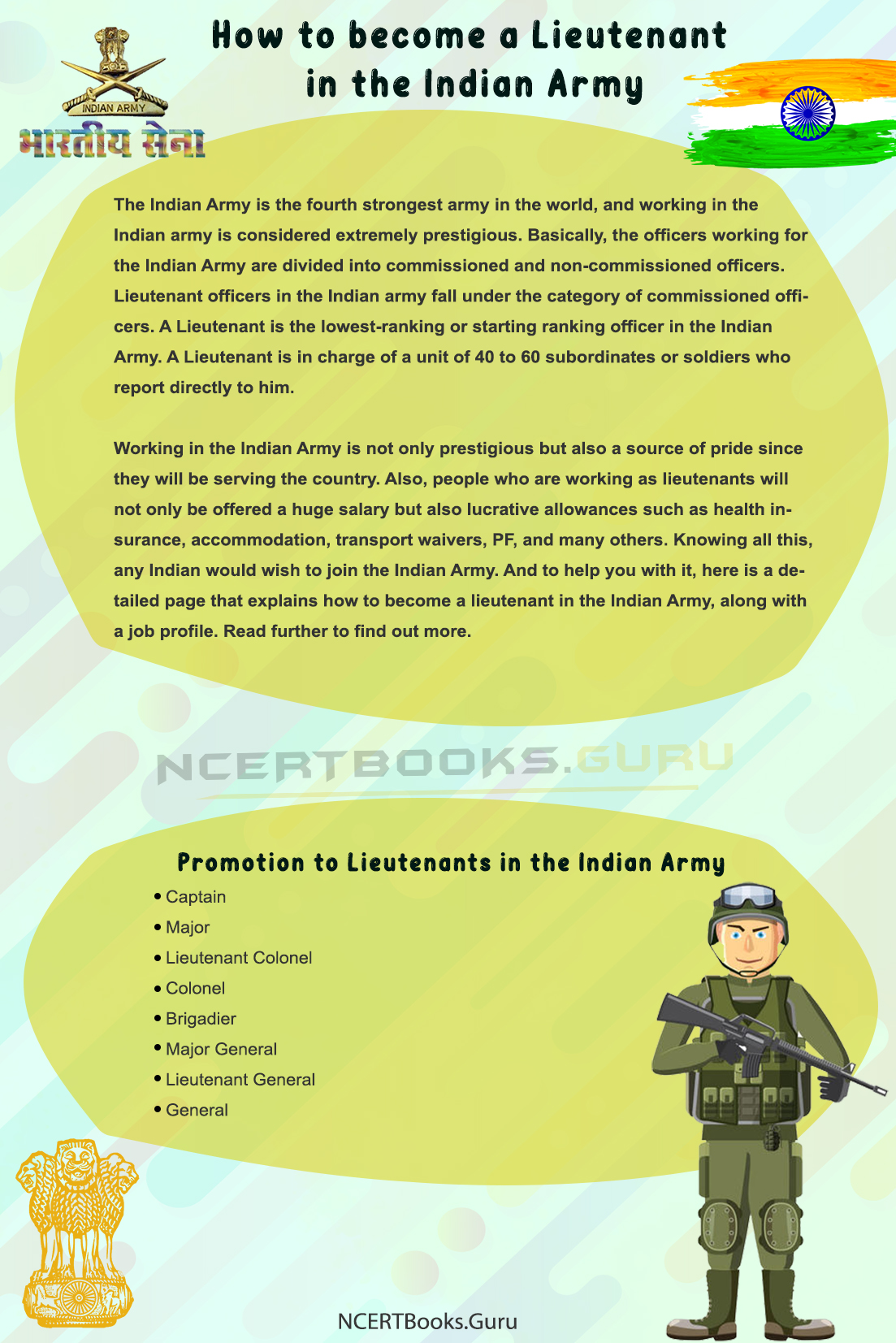
The Indian Army is the fourth strongest army in the world, and working in the Indian army is considered extremely prestigious. Basically, the officers working for the Indian Army are divided into commissioned and non-commissioned officers. Lieutenant officers in the Indian army fall under the category of commissioned officers. A Lieutenant is the lowest-ranking or starting ranking officer in the Indian Army. A Lieutenant is in charge of a unit of 40 to 60 subordinates or soldiers who report directly to him.

Working in the Indian Army is not only prestigious but also a source of pride since they will be serving the country. Also, people who are working as lieutenants will not only be offered a huge salary but also lucrative allowances such as health insurance, accommodation, transport waivers, PF, and many others. Knowing all this, any Indian would wish to join the Indian Army. And to help you with it, here is a detailed page that explains how to become a lieutenant in the Indian Army, along with a job profile. Read further to find out more.

Table of Contents

How to Become a Lieutenant in the Indian Army?

There are multiple ways through which you can join the Indian Army as a Lieutenant. A few methods which you can follow to become a lieutenant in the Indian Army are explained below.

1. Register for the UPSC Exam and Join NDA

One of the easiest ways to become a lieutenant in the Indian Army is to crack the UPSC NDA exam and join the NDA program.

  • The officials of UPSC will release the NDA notification, usually in the months of June and November. Those candidates who wish to join the NDA will have to appear in the entrance exam conducted by the UPSC officials.
  • The NDA entrance exam will consist of two papers: mathematics and a general ability test. Those candidates who clear the written test will have to appear in the Services Selection Board Interview (SSB), where the candidate’s psychological aptitude and general intelligence skills will be evaluated.
  • Those candidates who have cleared both rounds of interviews will be eligible to join the NDA. Along with cracking the entrance exam, candidates will also have to meet the other eligibility criteria, such as age limit, physical and medical requirements.
  • Once you are selected for the NDA, you will undergo a 3-year programme. Candidates go through integrated training for the first two and a half years. The final six months of training are dedicated to the specific service you have chosen. If you join the Indian army, you will get the basic physical, mental, and endurance training that an army officer requires.
  • After three years, you will get a BA or BSc degree and be directed to attend IMA for one year of additional training. After finishing the course, you are given a permanent commission and commissioned as a lieutenant.

2. University Entry Scheme for Engineering Students

If you are an engineering aspirant and want to join the Indian army as a lieutenant, then you can achieve the same through a university entry scheme.

Eligibility Criteria for University Entry Schemes

The eligibility criteria for the university entry scheme to join the Indian army is as follows:

  • Candidates who are in their third year of engineering must be between 18 and 24 years of age. Candidates studying in the fourth year of engineering must be between 19 and 25 years of age.

Selection Process under the University Entry Scheme

There is no written examination under the university entry scheme. The UES recruitment notification is usually released in the month of May every year. Those candidates who filled out the application form will go through the initial screening. Once application screening is done, candidates will be called for an SSB interview.

Candidates who are selected in the SSB interview will be called for a medical examination. Based on the interview and medical examination, the officials will release the merit list. Candidates whose names are present in the merit list will have to undergo a one-year training programme at IMA. Post the completion of training, the aspirants will be permanently commisioned under the rank of lieutenant in the Indian army.

Also, Read:

3. Appear for CDS Exam to Become a Lieutenant

If you have just completed your graduation and have decided to join the Indian Army as a lieutenant, then this path is best for you. You can simply appear for the CDS exam, attend the IMA training, and become a lieutenant.

  • The CDS exam is an offline exam that is conducted by the officials of UPSC. In the CDS exam, only objective types of questions will be asked. The English and elementary mathematics subjects will be tested in the CDS exam.
  • Candidates who clear the CDS exam will be called for an SSB interview.
  • If you are selected in the SSB interview, then you will have to undergo a medical examination. Once you are successful at this step, you will need to attend IMA training.
  • Completing the IMA training will enable you to join the Indian army as a lieutenant.

Note: Apart from the IMA, you can also choose the Officers Training Academy (OTA) exam. The key differences between OTA and IMA are as follows:

If you pass the CDS IMA exam, you will receive 18 months of training in different factors of war, weaponry, and leadership. You are given a permanent commission as a lieutenant after successfully completing IMA training.

If you pass the CDS OTA exam, you will receive 49 weeks of training in many disciplines of war, weapons, and leadership. You will be given a short service commission as a lieutenant after successfully completing the OTA training.

4. Become a Lieutenant by Taking a Technical Graduate Course

Engineering aspirants who wish to join the Indian Army as lieutenants can opt for this method. Usually, the officials will release the notification for the Technical Graduate Course in the month of May or November. The eligibility criteria to become a lieutenant in the Indian army are explained below.

  • The candidate should be an unmarried male.
  • The candidate’s age limit should be between at 20 to 27 years of age.
  • Candidates who are studying in their final year or have completed their degree can also apply for the technical graduate course.

Candidates will be invited to the SSB interview based on the results of the application screening. Candidates cracking the SSB interview will have to meet all the medical requirements in the medical examination.

Candidates who are selected in TGC recruitment will have to undergo 1 year of IMA training and, post the completion of the training, they can join the Indian Army as Lieutenants.

5. Technical Entry Scheme to Join the Indian Army as a Lieutenant

Candidates who have cleared their Class 10+2 or equivalency exam can apply for the Technical Entry Scheme and join the Indian Army as a lieutenant.

Every year, the Indian Army issues notifications for the TES course in May or June and October or November. Male students between the ages of 16.5 and 19.5 who scored 70% or higher in the science stream in their 10+2 exams are eligible to apply for TES. There is no written exam for TES admission, and candidates are chosen solely on the basis of their merit.

Students can undergo a five-day SSB interview and medical test if they pass the initial screening. If candidates pass all of the stages and are chosen, they will be directed to attend the Officers’ Training Academy in Gaya for a year of basic military training.

The College of Military Engineering, Military College of Telecommunication Engineering, or Military College of Electronics and Mechanical Engineering will then select candidates. Candidates who successfully complete the course receive an engineering degree and a permanent commission as a lieutenant.

Salaries of Lieutenants in the Indian Army

A lieutenant’s fixed pay at the IMA during training is Rs. 70,541 per month. A lieutenant’s salary after commission in the Indian army is at Level 10, which is the first level in the Armed Forces’ pay system for officers. A lieutenant’s average salary is Rs. 12,94,951 per year.

Lieutenant’s Allowances in India

Apart from huge salaries, officers who are working in the Indian army as lieutenants will enjoy various allowances. Some of the allowances out of them are listed below:

  1. Dearness Allowances
  2. Travel Allowance
  3. Kit Maintenance Allowances
  4. Hardship Allowance
  5. Flying Allowances for Pilot Soldiers

Promotion to Lieutenants in the Indian Army

The Lieutenants working in the Indian Army will be promoted from time to time in the following order:

  • Captain
  • Major
  • Lieutenant Colonel
  • Colonel
  • Brigadier
  • Major General
  • Lieutenant General
  • General

How to become a Lieutenant in the Indian Army

FAQs on How to Become a Lieutenant in the Indian Army

The frequently asked questions regarding lieutenants in the Indian Army are as follows:

1. How can I become a lieutenant after Class 12th?
To become a lieutenant in the Indian Army after Class 12, candidates can either appear in the NDA exam or the Technical Entry Scheme. The detailed selection procedures by which candidates will be recruited as lieutenants in the Army under these schemes are explained on this page.

2. Can the CDS exam help me become a Lieutenant in the Indian Army?
Yes, candidates can appear in the CDS exam and join the IMA training to become a lieutenant in the Indian army.

3. Can civil engineering candidates become lieutenants in the army?
Yes, civil engineers are eligible to become lieutenants in the Indian army.

We hope this page helped you find everything you needed about how to become a lieutenant in the Indian Army. If you have any queries regarding this page, reach us through the comment box below and we will get back to you as soon as possible.

Distance Education Courses | Fee Structure, Eligibility Criteria, Job Opportunities, Salary

Distance Education Courses

Distance Education Courses: Distance education courses are becoming popular all over the world. However, distance education courses have been helping people access to learning for centuries. Distance education is also referred to as online learning and distance learning. Even there is a scope of distance education in the future. Everyone is getting attracted to this distance education course mode and wish to pursue their higher education along with their career.

Do you want to live in India but study in New York? Do you study engineering and want to specialize in accounts as well? Or do you have responsibilities or work full time but want to value your time at home with a basic degree? In such cases, distance education courses or programs are the best choices for you. Now, in this article, we shall discuss the distance education courses, and it’s advantages.

What is Distance Education?

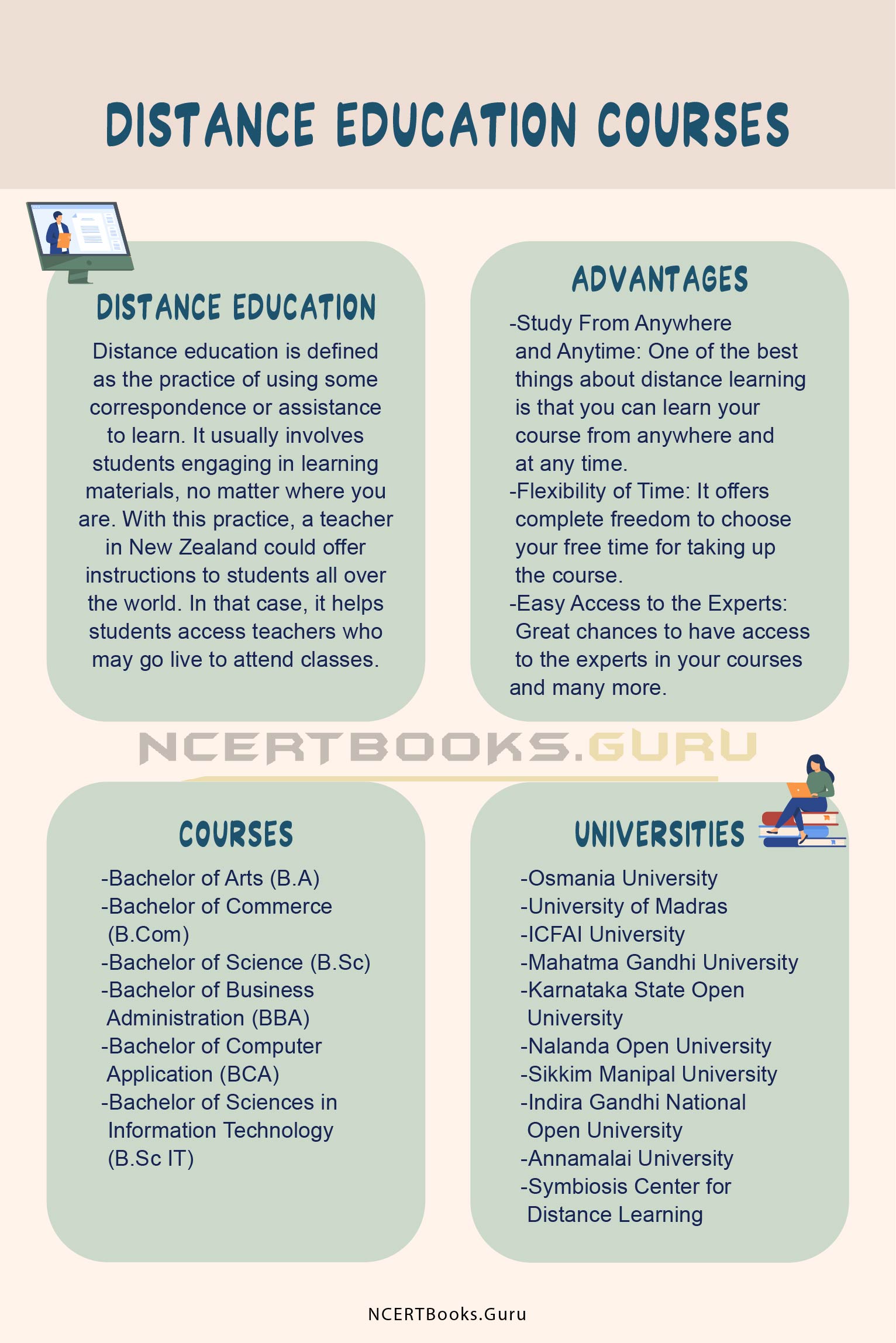
Distance education is defined as the practice of using some correspondence or assistance to learn. It usually involves students engaging in learning materials, no matter where you are. With this practice, a teacher in New Zealand could offer instructions to students all over the world. In that case, it helps students access teachers who may go live to attend classes. Moreover, distance education help students who cannot attend classes because of work or some other responsibilities.

With the help of these distance education programs, you can study any degree-based courses. Some of the best colleges and universities always ensure that their distance learning courses are of the same quality as regular based courses or programs.

Most of the students think that distance education courses are for certificate courses or short-term programs. In fact, that is not true; you may find distance learning courses not only for short term certificate courses but also for Ph.D. degrees or Masters. However, there are some colleges and universities that are known to offer the best education programs under this distance education mode.

Therefore, sometimes, it becomes challenging for the students to make the right decision of the university. In such cases, here are some things that students need to follow in selecting the right university or college to choose the distance education courses.

Must Check: Diploma in Labour Law Distance Education

Things to Remember While Choosing Distance Learning Courses

Course Accreditation

Students should remember that the courses are nationally recognized and accredited. Therefore, it can lead to a certified degree and will be accepted by the organizations in the future. Moreover, it is important to check the accreditation of the college or university when choosing the distance education course.

One of the most important things to remember is that the recognized accreditation agency should accredit the program. It is because that this accreditation agency would have investigated the various subjects that are offered by the university to ensure that they are coordinated in the educational standards.

Study Materials and Digital Learning Environment

The quality of the Digital learning environment and study materials are important to check when it comes to distance education courses. If the students are offered a motivational learning environment along with interactive tasks and videos, then they can improve the chance of success.

Student Support Services

Students need to remember that the quality of personal assistance and support from the lecturers are of utmost importance. It is because that student support services can influence the success or failure of the students. However, students need to consider the following things:

  • Check whether there are personal appointments
  • Know that the institution is offering personal assistance at the time of exam preparation?
  • Check out whether they will clear your doubts immediately or need to wait for several days to get answers?

Course Duration

If you are juggling between study time and work hours, then you know the value of resource time. Most of the courses take around one to two years to complete. In such cases, if you know the course duration in advance, then you will be able to adjust your timings for your work and study.

Advantages of Distance Education Courses

Study From Anywhere and Anytime

One of the best things about distance learning is that you can learn your course from anywhere and at any time. Except in cases where you need to attend a tutorial or an online lecture through videoconferencing. Simply, you will get the freedom to deal with the study materials at any time in distance learning mode.

Flexibility of Time

Distance learning provides the flexibility of time. It offers complete freedom to choose your free time for taking up the course. All you need is a computer with an internet connection to learn. Also, you don’t need to go in person to submit anything or ask doubts.

Easy Access to the Experts

One of the best things about distance learning is that it will offer you the best and great chances to have access to the experts in your courses even if they are from different countries. Also, you can stay connected with them from any part of the globe.

Save Money

One of the other benefits of distance education courses is saving money. The total cost that you incur for distance learning will be less when compared to a regular college or university. Therefore, you can easily afford any course in any university or institution.

Pursue a Job with Studies

You can learn or pursue your college studies while you are working. It is because there is no fixed time for distance learning courses. Also, you can work all day and can study at night or vice-versa.

Distance Education Courses Offered

As there is a gradual increase in the popularity of distance education, many of the educational institutions have started distance learning courses. It starting from certificate level to PG level can be done by the students. Also, courses are offered in the field of management, IT, technology, and many more.

Distance Education UG Courses

  • Bachelor of Arts (B.A)
  • Bachelor of Commerce (B.Com)
  • Bachelor of Science (B.Sc)
  • Bachelor of Business Administration (BBA)
  • Bachelor of Computer Application (BCA)
  • Bachelor of Sciences in Information Technology (B.Sc IT)

Also, Read:

Distance Education PG Courses

  • Master of Arts (M.A)
  • Master of Commerce (M.Com)
  • Master of Science (M.Sc)
  • Bachelor of Education (B.Ed)
  • Master of Business Administration (MBA)
  • Master of Computer Application (MCA)
  • Master in Interior Design
  • Master in Fashion Management & Design (MFM)
  • Master of Journalism and Mass Communication (MJMC)
  • Master of Science in Information Technology (M.Sc IT)

Dual Degree Courses

  • Executive Diploma in Strategic Management & Leadership + MBA
  • Executive Diploma in International Business Management + MBA

PG Diploma Courses

  • PG Diploma in Business Administration
  • PG Diploma in Information Technology
  • PG Diploma in Journalism and Mass Communication
  • PG Diploma in Computer Application

Distance Education Courses

Best Distance Education Universities in India

  • Osmania University
  • University of Madras
  • ICFAI University
  • Mahatma Gandhi University
  • Karnataka State Open University
  • Nalanda Open University
  • Sikkim Manipal University
  • Indira Gandhi National Open University
  • Annamalai University
  • Symbiosis Center for Distance Learning

FAQ’s on Distance Education Courses

Question 1.
Why do distance education courses cost less when compared to regular courses?

Answer:
The reason behind the affordable prices in distance learning courses is that there will no additional costs incurred by the institutions. However, some of the universities offering free tuition online programs while some are charging moderate tuition fees just like regular-based colleges.

Question 2.
Do you think student support services are important that are offered by distance learning providers?

Answer:
Yes, student support services influence the success or failure of a student to an extent. However, there are some services to the students that can offer satisfaction, they are:

  • Personal appointments
  • Prompt reply to the doubts posed by the students
  • Personal assistance to the students in preparation for exams.

Question 3.
Do regular courses and distance learning courses offer the same value?

Answer:
Yes, distance learning education and regular courses are given the same level of recognition and value.

Question 4.
What is the best method of finding the best and affordable distance education course?

Answer:
The best method of finding the best and affordable online course is to research the available education institutions using some global information website. In fact, you can check out some of the reviews of students who have already enrolled in the courses.

How to Join ISRO | Eligibility Criteria, Ways To Get into ISRO and Salary

How to join ISRO

How to Join ISRO?: Do space and planets appear fascinating to you? Do you love learning new things about space, planets, stars, meteors, moon? If researching is your domain and you want to become a scientist, then it is impossible to not have ISRO on the wishlist. If you agree to this, then here are all the details on How to join ISRO.

The Indian Space Research Organisation or ISRO is a national space agency which is situated in Bengaluru. The formation of ISRo was in 1969. The Department of Space manages the ISRO. The Prime Minister of India holds command of ISRO and the executive director of ISRO is the Chairman of ISRO. The aim of ISRO is the development and use of space technology for national development along with the ensuing planetary examination and space science research.

Refer to Course Details to know more about related courses and find details like Admission Process, Eligibility Criteria, etc.

Eligibility Criteria to Join ISRO

If you want to get into ISRO, then you need to qualify for the eligibility criteria. After you successfully score a good score in the 12th standard, you should get into top institutes such as the Indian Institute of Space Science and Technology or the Indian Institute of Technology. But after you get admission into top institutes, you will still have to be consistent in your studies to make a successful entry in ISRO.

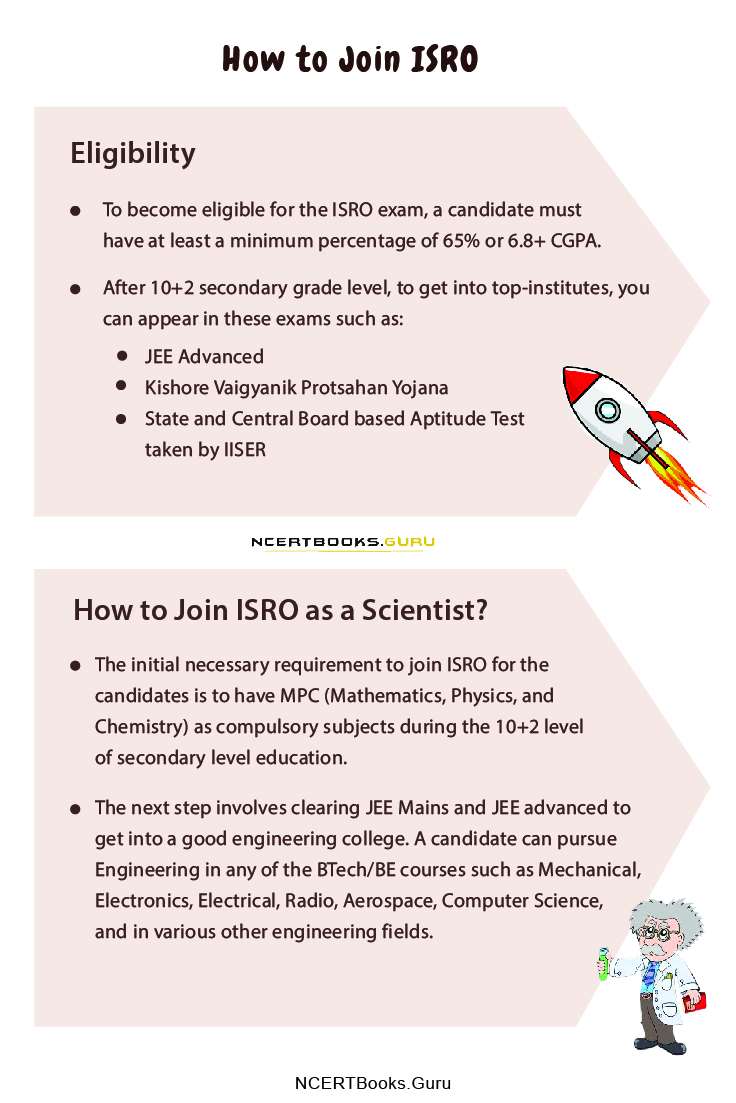
  • To become eligible for the ISRO exam, a candidate must have at least a minimum percentage of 65% or 6.8+ CGPA.
  • After 10+2 secondary grade level, to get into top-institutes, you can appear in these exams such as:
    • JEE Advanced
    • Kishore Vaigyanik Protsahan Yojana
    • State and Central Board based Aptitude Test taken by IISER

Do Refer:

How to Join ISRO 2

How to Join ISRO as a Scientist?

  • The initial necessary requirement to join ISRO for the candidates is to have MPC (Mathematics, Physics, and Chemistry) as compulsory subjects during the 10+2 level of secondary level education. A candidate should be great with aptitude knowledge. It is important for a candidate to have sound knowledge in Mathematics and Physics to understand the conceptual approach.
  • The next step involves clearing JEE Mains and JEE advanced to get into a good engineering college. A candidate can pursue Engineering in any of the BTech/BE courses such as Mechanical, Electronics, Electrical, Radio, Aerospace, Computer Science, and in various other engineering fields. To be eligible for the JEE entrance exam, a candidate should have more than 75% in the 10+2 grade. So, make sure to satisfy the eligibility criteria to get into a good college.

It is always a plus point to get into top ranking and highly reputational government and private institutions such as IITs, NITs, IIST, etc.

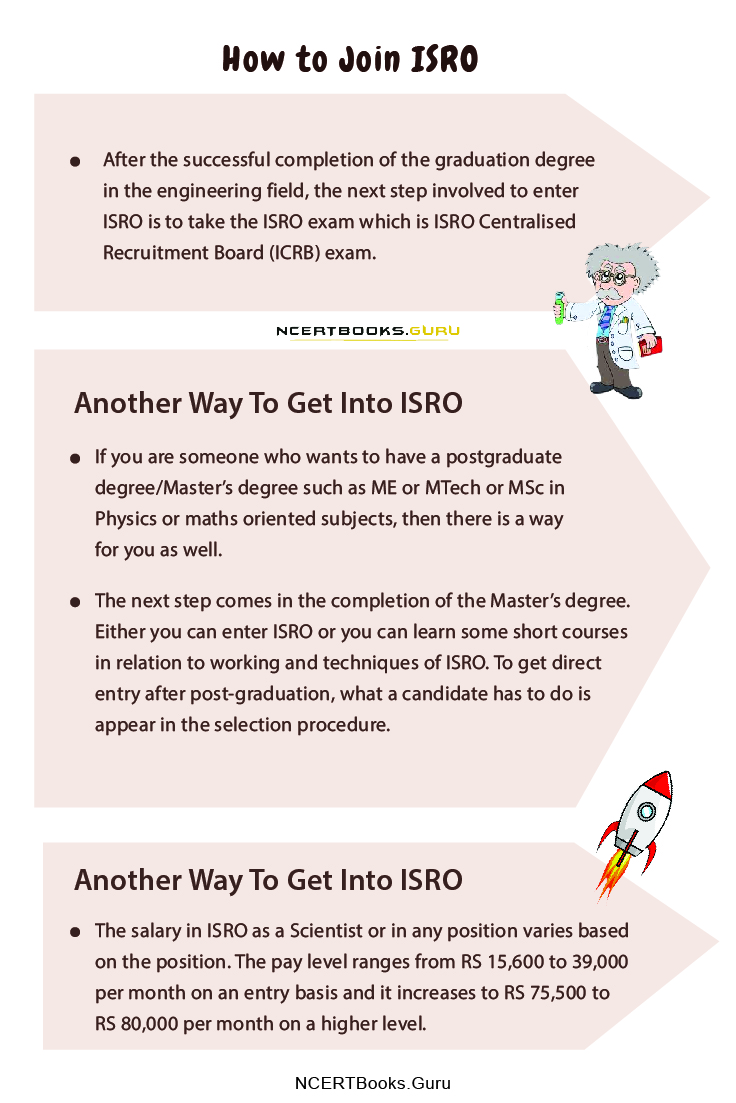
  • After the successful completion of the graduation degree in the engineering field, the next step involved to enter ISRO is to take the ISRO exam which is ISRO Centralised Recruitment Board (ICRB) exam. To appear for this exam, a candidate needs to satisfy some eligibility criteria such as:
    • A candidate should have a BTech/BE degree with Mathematics and Physics as a core subject. The minimum percentage to appear in the ISRO exam is more than 65% or 6.5 CGPA out of 10 scales.
  • After clearing the ISRO exam, the candidates who will be selected have to give the written test and the interview round will be conducted in order to join the agency. If you clear all the rounds, then you can join ISRO as a scientist.

Another Way To Get Into ISRO

  • If you are someone who wants to have a postgraduate degree/Master’s degree such as ME or MTech or MSc in Physics or maths oriented subjects, then there is a way for you as well.
  • The next step comes in the completion of the Master’s degree. Either you can enter ISRO or you can learn some short courses in relation to working and techniques of ISRO. To get direct entry after post-graduation, what a candidate has to do is appear in the selection procedure. The selection process involves a written test and the interview round. After you qualify for the rounds, you can get entry into ISRO as a scientist.

Salary After Joining ISRO

The salary in ISRO as a Scientist or in any position varies based on the position. The pay level ranges from RS 15,600 to 39,000 per month on an entry basis and it increases to RS 75,500 to RS 80,000 per month on a higher level. The basic salary level in ISRO is around RS 15,000 per month. The experience, position, and other factors are the points of determination for salary requirements.

ISRO is among the most reputed organisations in India. With proper planning and educational preparation, one can get into ISRO. All you need is hard work and dedication to enter the organisation. Young minds are all that is the current requirement to excel the challenges and to develop.


How to Join ISRO 1

Mining Engineering Course Details | Admission Process, Eligibility, Duration, Fees, Syllabus, Salary

Mining Engineering Course Details

Mining Engineering Course Details: Are you interested in learning about minerals and extraction? If so, there could be no other better option than choosing a Mining Engineering Course. In the course, candidates will learn about the technologies and techniques for the identification and extraction of the minerals. The term Mining Engineering is the combination of two branches “mining” and “engineering.” Mining is all about getting coal or other minerals from a mine. Engineering is a branch of science that deals with the design, building, and uses of engines.

About Mining Engineering Course Details

Mining Engineering course is available at various levels like Diploma courses, B.E./B.Tech., ME/M.Tech. The course is for those interested in learning the mining of different products. There are rising demands for professional trained Mining Engineers to create high-quality designs. Also, demand is for the processes to maximize efficiency and safety. After the identification of mineral deposits by geologists, mining engineers have the responsibility to decide the place of explosion.

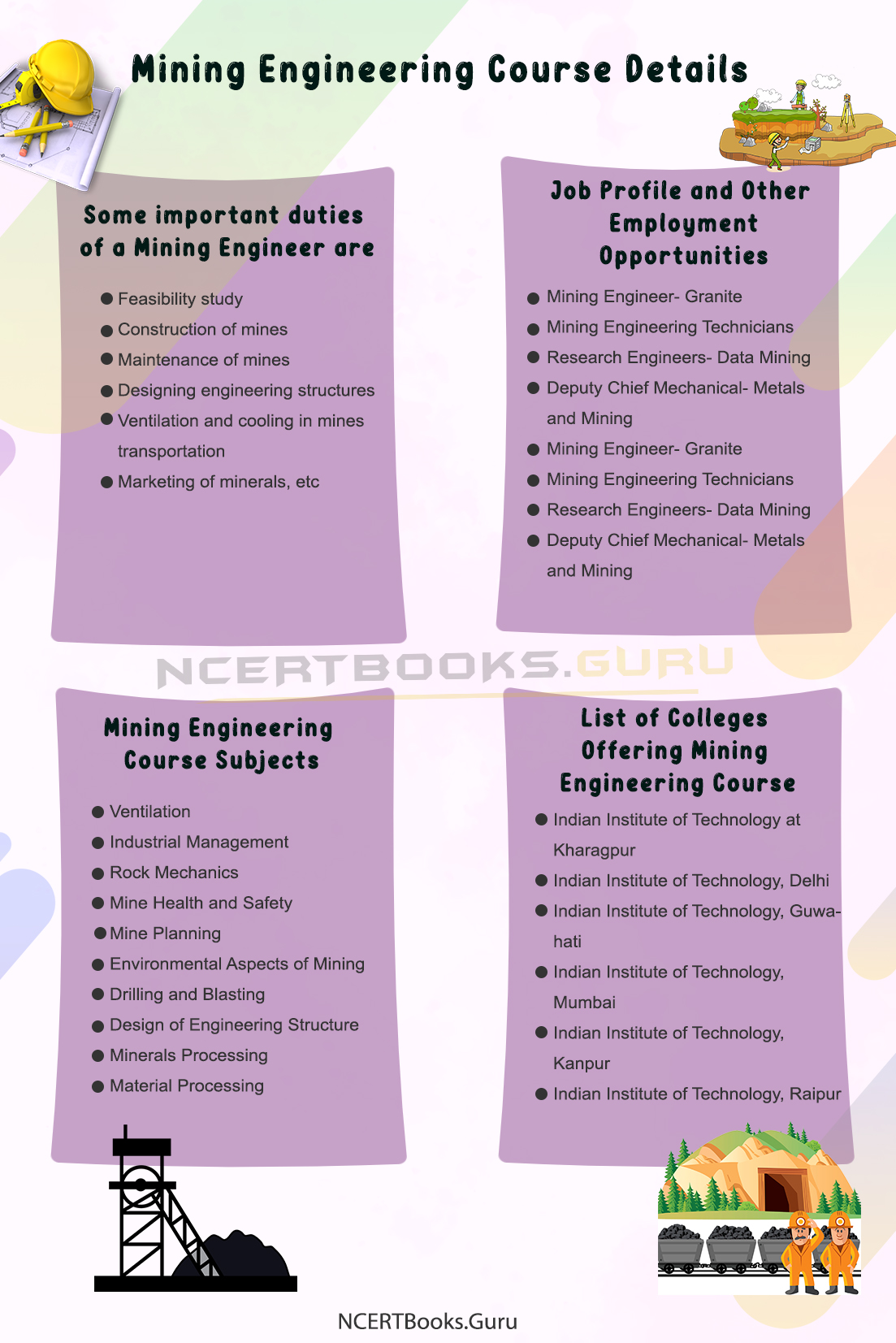
Some important duties of a Mining Engineer are:

  • Feasibility study
  • Construction of mines
  • Maintenance of mines
  • Designing engineering structures
  • Ventilation and cooling in mines transportation
  • Marketing of minerals, etc

Not only this, but they also have to keep the surroundings safe from wastes and pollution. It comes to pass during the process of mineral extraction. Read below to have complete fee details, course duration, salary offered, job opportunities, admission process, and eligibility for Mining Engineering Course.

Overview of Mining Engineering Course Details

Course Mining Engineering
Duration 1-3 years depends upon course type
Eligibility The aspirant must have cleared 10th standard
Fees paid INR 50K-2 lakh
Salary Offered 5-6 Lakhs per annum
Job opportunities Junior Mining Engineer, Assistant Mining Operator, Technical Consultant
Type of Course Certification, Diploma, Undergraduate, Postgraduate course
Admission Procedure Merit/ performance-based
Skills Required Creativity to create unique methods

Subjects and Concept in Mining Engineering Courses

Subjects like electrical and mechanical engineering, engineering drawing, mining safety, mining survey, computer-aided designs, calculus, social science and humanities, economic analysis, soil mechanics, and drafting have studied that help in research and development in the mining field.

Get to Know More about other types of Course Details in Streamwise, and Categorywise.

List of Colleges Offering Mining Engineering Course

  • Indian Institute of Technology at Kharagpur
  • Indian Institute of Technology, Delhi
  • Indian Institute of Technology, Guwahati
  • Indian Institute of Technology, Mumbai
  • Indian Institute of Technology, Kanpur
  • Indian Institute of Technology, Raipur
  • Indian Institute of Technology, Kurukshetra
  • Indian School of Mines, Dhanbad
  • Government Engineering College, Gujarat, etc

Duration of Mining Engineering

Mining Engineering degree is a 4-year course in which the candidate must pass 10+2 with physics, chemistry, maths. Theory subjects are easy to learn with practical experience. The criteria are similar to other engineering courses to take admission and for eligibility.

Mining Engineering Course Fee

The fee for the course depends upon various factors like the type of institute, the popularity/ranking of the institute, merit, and the scholarship earned by the student.

The fee for the government institutes is much lower as compared to any private institutes. And merit-based admissions also have a lower fee. But the average course fee is between 50K-5 lakhs.

Mining Engineering Eligibility Criteria

Eligibility for Mining engineering differs from college to college. However, there are some eligibility criteria that must be fulfilled before applying for admission. These criteria are as given below:

  • The student must have studied science subjects like maths, physics in the 12th, or qualifying exam.
  • The candidate must have 50% aggregate in 12th standard
  • Students who are waiting for the 12th result may also apply.

Mining Engineering Admission Procedure

Admission in Mining Engineering may be based on different factors. It depends on the type of institute a candidate is applying for, given below is the detailed information regarding the admission process:

  • Merit-Based Admission: seats are offered to the student based on his performance in the 12th standard. Many states like Haryana, Tamil Nadu, Maharashtra, and many others offered online counseling.
  • Entrance-Based Admission: some institutes conduct entrance exams for the admission process. The seat is offered if the candidate clears the entrance exam.
  • Direct- Admission: Candidates can get direct admission without any entrance exam in any private institute. The candidate has to visit the respective college for admission.

Mining Engineering Course Subjects

Several subjects are to be studied under the Mining Engineering Course. The theoretical subjects that are includes are given below:

  • Ventilation
  • Industrial Management
  • Rock Mechanics
  • Mine Health and Safety
  • Mine Planning
  • Environmental Aspects of Mining
  • Drilling and Blasting
  • Design of Engineering Structure
  • Minerals Processing
  • Material Processing
  • Ore Reserve Analysis
  • Mine Cost Engineering

Job Profile and Other Employment Opportunities

The candidate may be appointed as:

  • Mining Engineer- Granite
  • Mining Engineering Technicians
  • Research Engineers- Data Mining
  • Deputy Chief Mechanical- Metals and Mining
  • Assistant Mining Engineer
  • Mining Engineer
  • Mine Planner
  • Technical Consultant- Mining Industries

There are numerous career options for the candidate after completing graduation. They are also eligible for teaching if they pursue a master’s degree in mining engineering. In India, candidates have a better scope of profitable job opportunities for candidates.

Given below is a list of top companies where the candidate can apply for:

  • The Indian Bureau of Mines
  • Geological Survey of India
  • IPCL
  • Essel Mining and Industries Ltd.
  • Damodar Valley Corporation
  • Neyveli Lignite Corporation
  • Essel Mining and Industries Ltd.
  • Hindustan Zinc Limited
  • Adani Mining Pvt.Ltd.
  • ArcelorMittal
  • Bharat Forge Limited
  • Cairn Energy

Mining Engineering Course Details

Salary Offered to Mining Engineering Professionals

The candidate who has graduated with Mining Engineering and wants to join any of the job profiles will earn an average salary of 6 to 8 lacs per year. As one will gain experience and learn skills, they will see an increase in their salary. Also, it depends upon the location and the organization you are working for. As compared to other professions, they earn more compensation. In countries like the US, mining engineers earn approximately $90,070.

FAQ’s on Mining Engineering Course Details

Question 1.
What do mining engineers do?

Answer:
The person who makes sure that underground resources like minerals, metals, oil, gas, etc., are extracted safely and bring well-organized plans for possible mining sites.

Question 2.
What is mining?

Answer:
It is the process of extraction of valuable minerals or geological materials from Earth. Mining Process will have a great scope in the coming times. So the demand for engineers is increasing.

Question 3.
What is the process of learning mining?

Answer:
To become a minimal engineer, one needs to gain at least a bachelor’s degree and further pursue a master’s degree in research. It is to ensure you have mastered your field with great knowledge.

Summary

Hopefully, through the knowledge above, you must gain all the detailed information about the Mining Engineering course in India. Topics are covered in brief details include the fee, duration, eligibility, salary, job prospects, and the admission procedure.

Software Testing Course Details | Eligibility, Fee Structure, Duration, Job Profile, Salary

Software Testing Course Details

Software Testing Course Details: Software testing is defined as work to check whether the actual results match the expected outcome and to make sure that the software is problem-free. It requires the execution of a software component or system component to evaluate one or more interest properties. Software testing also helps identify gaps, missing requirements, and errors contrary to the actual requirements. It can be either done using automated tools or manually—some like saying Software testing as a White Box and Black Box Testing.

Why Should One Take Software Testing?

  • It’s challenging: Testing is not that easy there are always puzzles and problems to solve. The work will likely bring something new every day. If you prefer a tedious job where you don’t have to overthink, don’t pursue a software testing career. But if you want work that keeps you on your toes, anyone will tell you that Testing is an amain choice.
  • It’s important: Testers don’t get enough credit for the work they do, but we’d be lost without them. As a tester, you’re advocating the end-user and making sure that they’re ettin a quality product. Without someone to find bugs/problems before software is delivered, many businesses would suffer from poor reputations and unloyal customer bases.
  • It’s creative: You have to be a little innovative when testing. The process isn’t going to be a bed of roses for you; it takes a little detective work. By playing as the end-user, you’re the one who has to be creative when thinking of places. There may be irregularities.
  • It’s data-driven: One of the best things about a software testing career is that it’s just as technical and creative. While most testers need to have a base of developing and coding as a baseline, they’re also analyzing day-to-day data and product trends. Knowing computer sciences is imperative, as you have to be someone who knows the software’s ins and outs and the way it works.
  • You’re always learning: Whether you’re starting to code, automate, or security test, there’s always more to learn in a software testing career. You likely have a very supportive/production team behind you to make sure you have all the resources you need to do the best for the company. Your work will never be at rest, as you’ll be continuously growing and improving my practice.
  • You get to test the limit/Products: You can’t check people’s laptops, but you do get to use software to see where it stops doing its job. Of course, testers don’t break software, but it can be enjoyable to find a bug no one thought existed in software. It takes especially critical/sharp eyes to find these kinds of problems and solve them.
  • It’s in demand: If you want high growth, high paying career, QA is the way to go up. As a software tester, you’ll always be required and will find no lack of leading companies trying their hardest to recruit you. There are many opportunities/chances to grow in your career to reach a managerial level.
  • There are many paths: Each company that uses software requires software testers, which is to say, everyone needs software testers. Testers are valuable in any industry, from healthcare to retail to IT to video games. You can choose whether you want to go into manual Testing profiles, Automated Testing, performance testing, etc.
  • It’s a specialized skill: In spite of the wrong conception, not anyone can test. Most testers begin in a similar field and find themselves being attracted to the role, but it requires deep knowledge of UI/UX design and development patterns and practices, and analytical and communication skills. Not just anyone will find that they have what it takes to be a tester, but those who find it’s their calling are sure to fall in love with it.

Importance of Software Testing

Software Testing is Important because

  • Cost-Effective: It is one of the essential positives of software testing. Testing any IT sample on time helps you to save your money in the long term. In case the bugs caught in the first or second stage of software testing, it costs less to fix.
  • Security: It is the most sensitive and vulnerable benefit of software testing. People are looking for trusted and dependable products. It helps in removing risks earlier.
  • Product quality: It is an essential requirement for any software related product. Testing/QA ensures a quality product is delivered to customers every time.
  • Customer Satisfaction: The main aim of any software related product is to give satisfaction to the customers. UI/UX Testing/QA ensures the best user experience for customers.

Typically Testing is classified into three categories

  • Functional Testing
  • Non-Functional Testing or Performance Testing
  • Maintenance (Regression and Maintenance)

Details about Software Testing Certification Courses

Software testing is a part of the curriculum of Undergraduate engineering courses (BE/BTech) in Information Technology or Computer Science. But, engineering and other graduates can choose for different certifications to get professional knowledge of software testing. Certifications help the testers/candidates to be more efficient and effective in their respective works. One can grow in their career by taking the next levels of software testing and gradually becoming an expert in it. Get to know about Software Engineering Courses After 10th details. Following is the list of such certifications:

  • STQB (International Software Testing Qualifications Board): ISTQB Certification is an internationally accepted software testing certification conducted online by the Member Boards through a testing Exam Provider. An Exam Provider is an org licensed by a Member Board(s) to offer exams locally and internationally, and online testing certification. Candidates who successfully pass the test are given the ISTQB Certified Tester certificate. This website provides all the QA Training material needed to pass the ISTQB Foundation level exam.
  • CAST (Certified Associate in Software Testing): The Certified Associate in Software Testing (CAST) Certification validates a foundation-level understanding of Software Testing techniques and practices. Getting the CAST design indicates a professional level of competence in the principles and practices of Software Testing in the IT profession.
  • CSTE (Certified Software Testing Engineer): The Certified Software Tester (CSTE) certification demonstrates a practitioner-level understanding of software testing principles and practices. Acquiring the designation of Certified Software Tester (CSTE) indicates a professional level of competence in the principles and practices of quality control in the IT profession.
  • Qspiders Software Testing: QSpiders is the world’s ace software testing training organization with an aim to bridge the gap between the demands- supply of the industry and the curriculum of educational institutions.
  • Vskills: Vskills Certification is a professional skill test conducted to ensure that a person is qualified to perform a job. Vskills Certification is proof that the candidate has the requisite skills to do a job.
  • Seed InfotechQA Campus
  • STC

Software Testing Course Eligibility Conditions

Students must have a basic degree or diploma to get eligible for Software Testing Courses Online. And you should have basic knowledge of using computers, computer software, and programming languages.

Software Testing Course Fees and Duration

Software Testing Course Fees in India is ranges from Rs.10,000 to Rs.20,000. The course duration of software testing is 6 months or more or less in several institutions.

Skills Required for Software Testing Courses

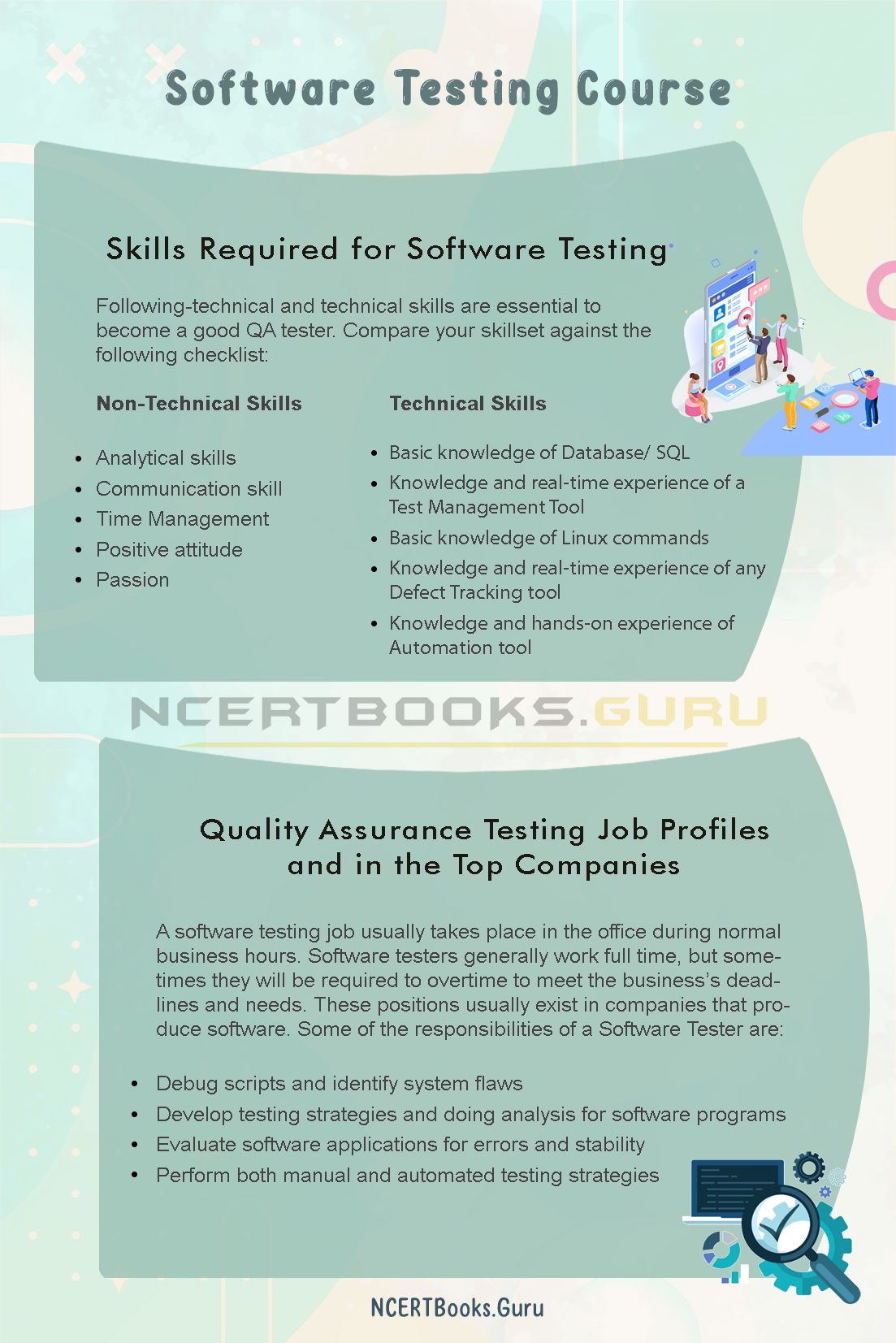
Following-technical and technical skills are essential to become a good QA tester. Compare your skillset against the following checklist:

Non-Technical Skills

  • Analytical skills
  • Communication skill
  • Time Management
  • Positive attitude
  • Passion

Technical Skills

  • Basic knowledge of Database/ SQL
  • Knowledge and real-time experience of a Test Management Tool
  • Basic knowledge of Linux commands
  • Knowledge and real-time experience of any Defect Tracking tool
  • Knowledge and hands-on experience of Automation tool

Software Testing Course Syllabus PDF

A brief intro to software systems and SDLC

  • Quality Assurance versus Quality Control
  • The Cost of Quality
  • How Quality is Defined
  • The Multiple Roles of the Software Tester
  • When Should Testing Occur?
  • Scope of Testing
  • Why Do We Test Software?
  • What is a Defect?
  • Software Quality Factors.
  • Testing Constraints
  • Life Cycle Testing
  • Independent Testing
  • What is the QA Process?
  • Levels of Testing

Testing Techniques

  • Structural versus Functional Technique Categories
  • Verification versus Validation
  • Static versus Dynamic Testing
  • Examples of Specific Testing Techniques

Test Administration

  • Test Planning
  • Customization of the Test Process
  • Budgeting
  • Scheduling

Create the Test Plan

  • Prerequisites to Testing planning
  • Build the Test Plan
  • Understand the Characteristics of the Software Development
  • Write the Test Plan

Test Reporting

  • Prerequisites to Testing planning
  • Build the Test Plan
  • Write the Test Plan
  • Understand the Characteristics of the Software that is getting Developed

Automation Testing Basics

  • Factors for choosing a particular tool
  • An overall view of the major functional testing tools
  • Overall view of Test management and bug tracking tools

Quality Assurance Testing Job Profiles and in the Top Companies

A software testing job usually takes place in the office during normal business hours. Software testers generally work full time, but sometimes they will be required to overtime to meet the business’s deadlines and needs. These positions usually exist in companies that produce software. Some of the responsibilities of a Software Tester are:

  • Debug scripts and identify system flaws
  • Develop testing strategies and doing analysis for software programs
  • Evaluate software applications for errors and stability
  • Perform both manual and automated testing strategies

Software Testing Course 1

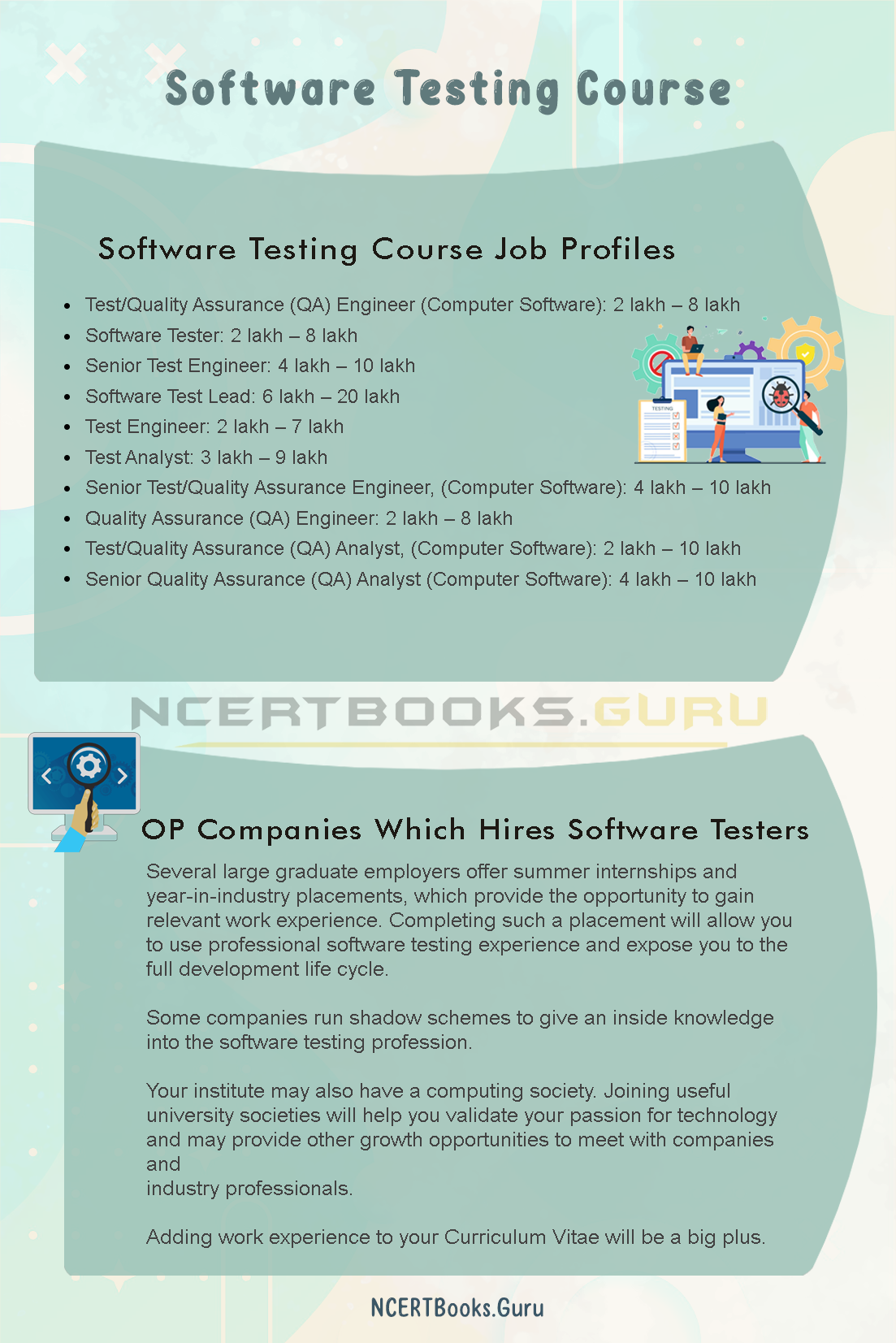
Software Testing Course Job Profiles and Salaries

  • Test/Quality Assurance (QA) Engineer (Computer Software): 2 lakh – 8 lakh
  • Software Tester: 2 lakh – 8 lakh
  • Senior Test Engineer: 4 lakh – 10 lakh
  • Software Test Lead: 6 lakh – 20 lakh
  • Test Engineer: 2 lakh – 7 lakh
  • Test Analyst: 3 lakh – 9 lakh
  • Senior Test/Quality Assurance Engineer, (Computer Software): 4 lakh – 10 lakh
  • Quality Assurance (QA) Engineer: 2 lakh – 8 lakh
  • Test/Quality Assurance (QA) Analyst, (Computer Software): 2 lakh – 10 lakh
  • Senior Quality Assurance (QA) Analyst (Computer Software): 4 lakh – 10 lakh

Also, see related articles:

Software Testing Job Working Hours

Working hours usually follow a normal office day of eight or ten hours, between 8 am and 6 pm. But, due to the type of project, you may be called to work outside these times.

On occasion, this may imply working shifts and weekend work. This will most likely occur during periods/time of software deployment or if a project work happens to be taking place across multiple locations/countries and time zones.

Software Testing Work Experience

Several large graduate employers offer summer internships and year-in-industry placements, which provide the opportunity to gain relevant work experience. Completing such a placement will allow you to use professional software testing experience and expose you to the full development life cycle.

Some companies run shadow schemes to give an inside knowledge into the software testing profession. Your institute may also have a computing society. Joining useful university societies will help you validate your passion for technology and may provide other growth opportunities to meet with companies and industry professionals.

Adding work experience to your Curriculum Vitae will be a big plus.

Top Companies Which Hires Software Testers

  • ScienceSoft
  • QASource
  • Itransition
  • Oxagile
  • SENLA
  • Infosys
  • TCS
  • Hexaware

List of the top companies which are specialized in Software testing services only

  • Mentor
  • Software Testing Company
  • QualiTest Group
  • TestMatick
  • DeviQA
  • QualityLogic
  • TestingXperts
  • ImpactQA
  • Apphawks
  • Aspire Systems

Software Testing Course 2

FAQ’s on Software Testing Course Details

Question 1.
Can I get a Software testing certificate through Vskills?

Answer:
Yes, you can get a degree through Vskills because Vskills Certification is a professional skill exam that is conducted to ensure that a person is qualified or good enough to perform a job. Vskills Certification is proof that the candidate has the requisite skills to do a job.

Question 2.
Is the job gives you a respectable job profile?

Answer:
Yes, companies like Infosys and TCS hire for these jobs. They give a handsome salary and a respectable job.

Question 3.
If I am selected as Software Tester, Can I get into software development profiles?

Answer:
No, that is not the case. You have to et a separate degree in that.

Summary

Every company wants well-tested and used software before submissions. Thus, it becomes the primary responsibility of all the developers to remove all the errors, bugs, and minimize the chances of cyberattacks from the particular program/software before submitting it finally. The below write-up describes the Quality Assurance Testing and its scope in detail.

So, in this ultra-modern world where everything is going online and software-driven and the business is booming, so the companies have to makes sure their programs are running well. So the need for software testers is going to increase many folds. So if you are interested in Computer Science, this is one of the safest and growing jobs in the country. With the right course selection and hard work, one can easily climb the corporate ladder in the field and achieve milestones.