Best Engineering Courses for a Secured Future in India | Top 5 Engineering Courses with High Demand

Best Engineering Courses

Best Engineering Courses: Hey! Are you keen on choosing the right engineering course for you? As Indians, all of us aspire to become an engineer at some point or the other, agree? The only reason behind this is that engineering offers a wide range of career options. It is no wonder engineering is one of the most popular and opted degrees after class 12. Today we will look at the best engineering courses for engineering aspirants. Let’s start!

In India, there are two types of Engineering Courses. They are Bachelor of Engineering (BE) and Bachelor of Technology (BTech). Both of them accept Joint Entrance Examination (JEE) scores for admission. Both are similar to each other with differences in the subjects offered. While B.Tech focuses more on practical implementation. B.E focuses on theoretical knowledge. Nevertheless, that does not make much of a difference today.

No. 1 Courses in Engineering | Top Engineering Courses to Study

Engineering is a four-year undergraduate program for students in India. AICTE is the nodal body that approves engineering courses. Students can opt for an engineering degree across various specializations. Some prominent specializations include:

  • Computer Science Engineering
  • Electronics and Communication Engineering
  • Information Technology
  • Mechanical Engineering
  • Chemical Engineering
  • Electrical Engineering
  • Civil Engineering

Today, we will look at the top five engineering courses that offer bright prospects. After pursuing these courses, they can get into. While the first year of study is common to all, the rest three years are domain-specific. We have filtered out the best engineering courses based on factors like job opportunities, average salaries they receive, and the scope of growth.

Computer Science Engineering (CSE)

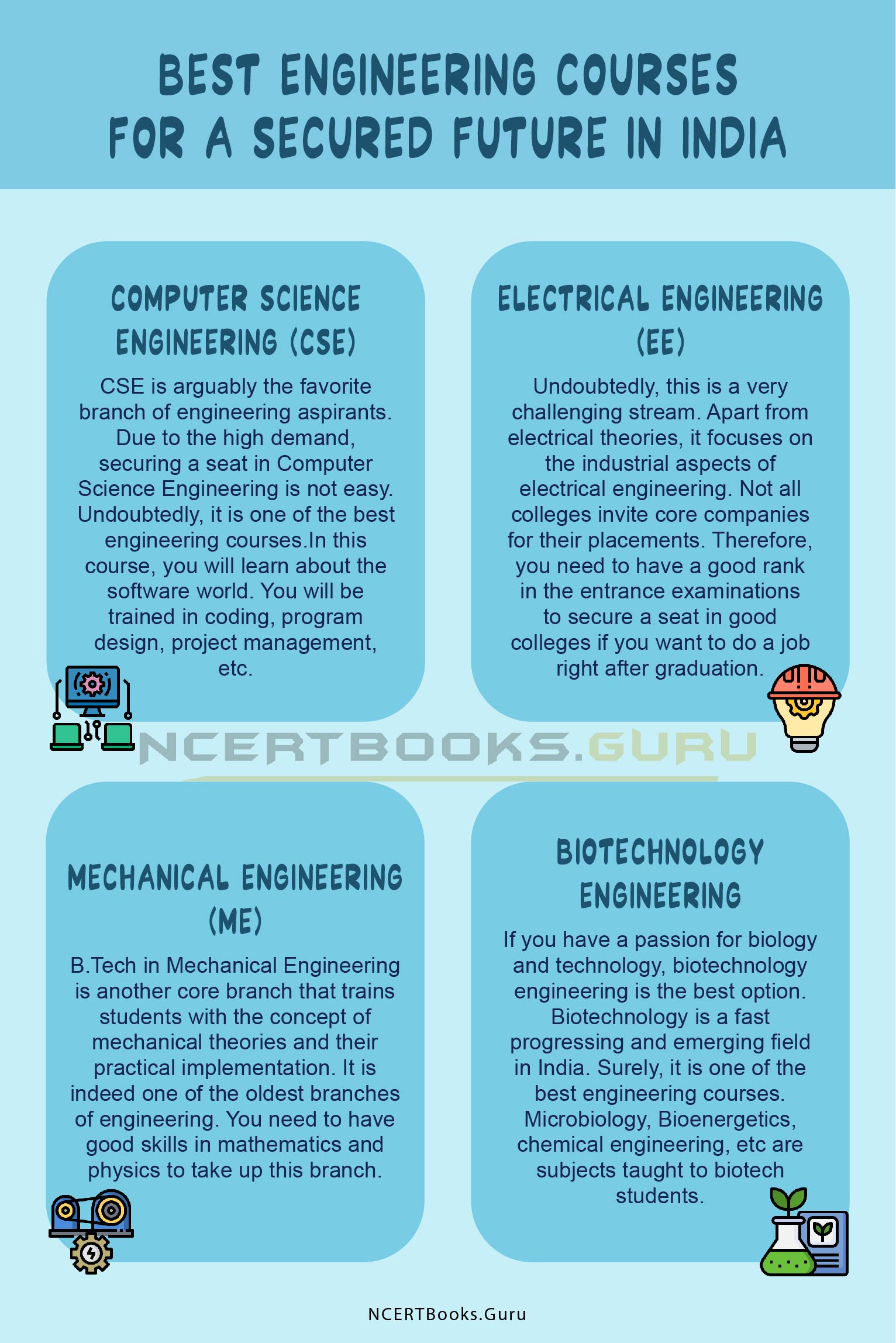
CSE is arguably the favorite branch of engineering aspirants. Due to the high demand, securing a seat in Computer Science Engineering is not easy. Undoubtedly, it is one of the best engineering courses.

In this course, you will learn about the software world. You will be trained in coding, program design, project management, etc. Additionally, you need to have good analytical, creative and problem-solving skills to excel in this field.

This branch promises maximum job opportunities. You can work in many roles, for example, software developer, research analyst, database administrator, web developer, project manager, etc. The most famous companies to hire are Amazon, Google, Microsoft, Cisco, etc. Mass recruiters include Tata Consultancy Services(TCS), Cognizant, Wipro, etc.

Electronics and Communication Engineering (ECE)

ECE is an emerging multi-dimensional stream. It particularly deals with electronics, signals, systems, communication networks, wave progression, etc. ECE is a versatile branch since it blends the concepts of Computer Science and core electrical subjects.

Students get a variety of career options after graduating as an ECE Engineer. They can either enter the software or the core world. ECE graduates can easily find jobs in the private and public sectors. They can also pursue higher education. Motorola, BSNL, etc. are the top-recruiting companies.

Electrical Engineering (EE)

If you don’t have a knack for coding, electrical engineering is the best core option for you. No one can imagine a world without electricity. Thus, electrical engineering is a promising stream for undergraduates.

Undoubtedly, this is a very challenging stream. Apart from electrical theories, it focuses on the industrial aspects of electrical engineering.

Not all colleges invite core companies for their placements. Therefore, you need to have a good rank in the entrance examinations to secure a seat in good colleges if you want to do a job right after graduation. Alternatively, you can sit for exams like GATE to get a PSU job or pursue higher education. Some top-recruiting companies are SIEMENS, Tata Power, Jindal Steel and Power, Larsen and Toubro, etc.

Mechanical Engineering (ME)

B.Tech in Mechanical Engineering is another core branch that trains students with the concept of mechanical theories and their practical implementation. It is indeed one of the oldest branches of engineering.

You need to have good skills in mathematics and physics to take up this branch. After graduating, you can either begin your job or continue pursuing higher education. If you want a core job right after graduation, try to go to the best colleges in India, for example, the IITs, NITs, or the top private universities like BITS, SRM, VIT, etc. Top core recruiting companies are Hindustan Unilever, ITC, ONGC, Tata Steel, NTPC, etc.

Biotechnology Engineering

If you have a passion for biology and technology, biotechnology engineering is the best option. Biotechnology is a fast progressing and emerging field in India. Surely, it is one of the best engineering courses.

Microbiology, Bioenergetics, chemical engineering, etc are subjects taught to biotech students. A biotechnologist finds a job in an array of fields. They include Bio-processing Industries, Public-funded Laboratories, Food processing, etc. Few marquee companies that recruit biotechnology undergraduates are Johnson & Johnson, Stryker, Philips Healthcare, Samsung Healthcare, etc. The demand for biotechnologists is on the rise evidently.

Engineering Courses for a Secured Future in India

FAQs on Top Engineering Courses List to Study

1. Which engineering course is the best?
It depends on your interest. For example, if you have an interest in technology and software, go for Computer Science or Information Technology engineering. Besides that, electronics and communication engineering offer better chances of placement. Thus, if you have an interest in core subjects, go for electrical engineering.

2. What is the easiest engineering course?

Your interest in the subjects of an engineering course determines the level of difficulty for you. For example, if you have a strong foundation in coding, CSE or IT engineering may seem very easy to you.

3. Which engineering course has the best future?

Streams like Computer Science Engineering and Electronics and Communication Engineering are in high demand already. The demand for biotechnology engineers is also rising rapidly.

Conclusion

Depending on your goals, interests, and strength, decide the best option for you. Unquestionably, the above-mentioned courses help students grab a good job and provide numerous opportunities for higher education. Moreover, individual choices determine the career paths of all these courses details. Thereafter, we hope you could choose the best engineering course for you. Happy reading!

Diploma in Dietetics Course Overview – Eligibility, Fees, Career Options, Jobs, Admission Process, and Salary

Dietitian Diploma Course

Dietitian Diploma Course: The requirement and awareness about dieticians have increased in recent days. People are giving preference to look handsome by following healthy diet plans, fitness and there is a huge demand for dieticians and nutritionists in everyone’s life. The branch of science that deals with people eating habits are Nutrition and Dietetics.

The primary goal of a dietician is to ensure a healthy and nourished life. Dietetics focuses on the proper food management in the human body with the correct proportion of proteins, vitamins, and energy. Diploma in Dietetics Course make professionals who expertise in diet planning, nutrition and health development, nutrition management fitness, etc.

Students who are interested in attending Dietetics Diploma Course must have finished the 12th class from a recognised organisation. Eligible candidates can refer to the following sections to get useful course details such as fee, admission procedure, eligibility conditions, required skills, top colleges, career opportunities, job role, salary, and others.

What is Dietitian Diploma Course?

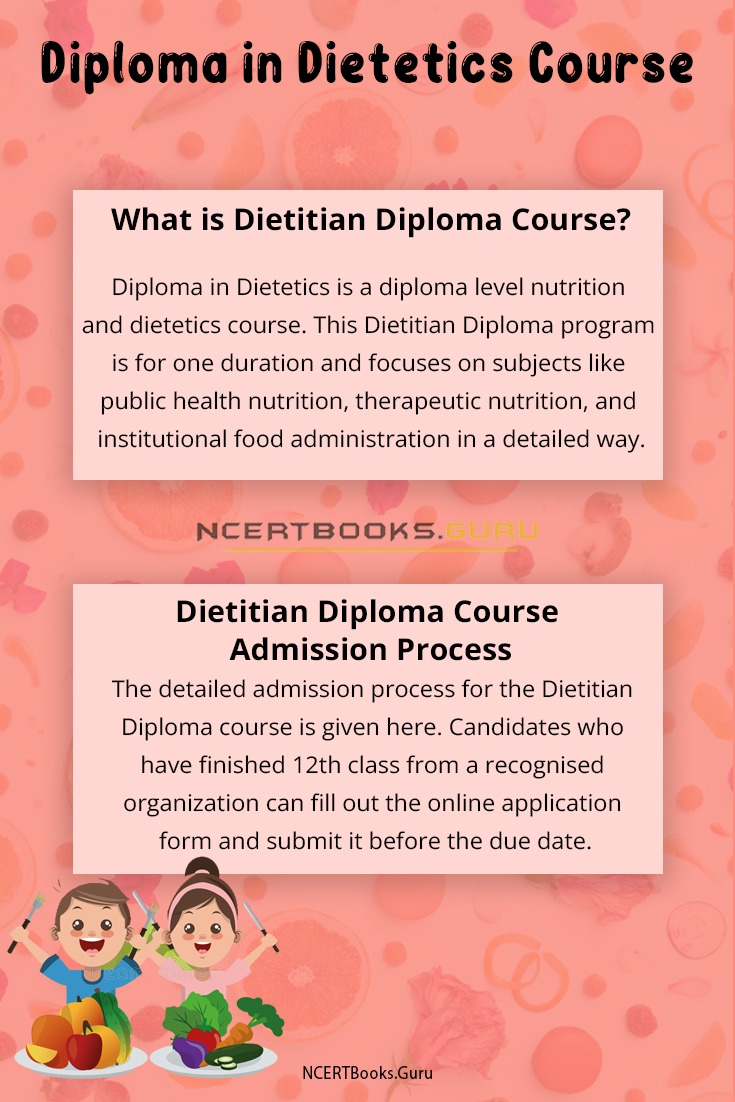
Diploma in Dietetics is a diploma level nutrition and dietetics course. This Dietitian Diploma program is for one duration and focuses on subjects like public health nutrition, therapeutic nutrition, and institutional food administration in a detailed way. Students after completing the 10+2 standard can apply online for Diploma in Dietetics Course and they are shortlisted for admissions by taking a merit list or conducting an entrance exam.

In the dietetics course, students will learn to monitor, plan the diet of patients, athletics in fitness centres, private clinics, sports centres. Dieticians are responsible for advising correct food and food habits by considering patient health, age, lifestyle, allergies. Candidates can pursue PG Diploma in Nutrition and Dietetics Online Course after completing this program.

Dietitian Diploma Course Highlights

The overview of the Dietician Diploma course is listed here.

Level Undergraduate
Name of the course Diploma in Dietetics
Course Duration One Year
Mode Regular
Exam Type Semester
Educational Qualification Passed 10+2
Selection Process Merit Basis/Entrance Exam
Course Fee INR 5,000 to INR 2 Lakhs
Pay Scale INR 2.5 Lakhs to INR 6.5 Lakhs
Job Profiles Clinical Dietitians, Sports Dietician, Pediatric Dietician, Management Dietitians, Community Dietitians, Foodservice Dietitians, Consultant Dietitians, Business Dietitians, Gerontological Dietitians, etc
Employment Sectors Government Hospitals, Private Hospitals, Nursing Homes, Private Clinics, Public Health Facilities, etc

Know about other diploma courses streamwise and category wise on this website.

Diploma in Dietetics Course Eligibility Conditions

To apply for Dietitian Diploma Course, candidates must meet the following eligibility criteria.

  • Candidates must have passed the 10+2 exam from a recognised educational board or its equivalent.
  • As their main subject, candidates must have studied Chemistry, Physics, Biology, and English.
  • At most colleges or universities, the minimum percentage required for admission is 50%.

Dietitian Diploma Course Admission Process

The detailed admission process for the Dietitian Diploma course is given here. Candidates who have finished 12th class from a recognised organization can fill out the online application form and submit it before the due date.

Submitting Online Applications

  • The colleges will announce the applications registration dates on their websites.
  • Eligible candidates can apply online using registration links.
  • Provide the mandatory details in the registration form and click on the submit button.
  • The profile is created with login details.
  • Fill in all the details in the application form.
  • Scan and upload the educational certificates, photograph, signatures, and other documents. Make sure that all the documents must be uploaded in the given format and size.
  • Pay the application fee using a credit card/debit card/net banking/UPI.

Entrance Test/Merit List

  • Applicants are get shortlisted for admission based on their 10+2 marks or by conducting an entrance exam.
  • The qualified students in the entrance exam will be allowed to do further operations of admissions.
  • Qualified candidates must submit the original document at the time of certificate verification.

Admission Procedure

  • Candidates must pay the 1st term college fee to get admission.

Dietitian Diploma Course Fees

The course fee structure for Diploma in Dietetics is given here:

Institution Type Minimum Fee Average Fee Maximum Fee
Government Colleges/Public Colleges INR 5,000/- INR 35,000/- INR 1 Lakh
Private Colleges INR 15,000/- INR 1.5 Lakhs INR 2 Lakhs

More Related Courses:

What are the Skills Required for Dietitian Diploma Course?

Candidates who are interested in working in the field of Health and Nutrition and mainly as a Dietitian should have the following skills that help them to work in the professional field.

  1. Communication Skills: It is the ability to pass the information clearly and similarly the person wanted to convey their message is one of the important skills for Dietitian Diploma Course or in any other field. The importance of communication skills is there in all aspects of life whether in professional or personal life.
  2. Time Management Skills: It is another mandatory skill to become a dietician as a Dietician/Nutritionist should know how to manage professional life and personal life at the same time. Time management skills are helpful for individuals to complete a task within a given time. Good time management abilities allow individuals to complete more work in a shorter time and thus reduce the amount of stress and leads to a successful career.
  3. Team Work: It demonstrates the combined actions of the whole group to achieve a particular task. This skill is demanded by the management teams from the students who are applying for Dietician and Nutritionist Diploma. Teamwork skill is useful in making a good atmosphere among the employees and because of which respect, love, and loyalty grows and makes the employees complete more hard work and be supportive and cooperative.
  4. Interpersonal Skills: It is a way to interact with patients and establish a good relationship with them. Few interpersonal skills are responsibility, empathy, leadership, flexibility, dependability, motivation, patience, active listening.
  5. Interest in Health, Diet, and Fitness: It is an important skill that every candidate must have before applying for a Diploma in Dietetics because if a student doesn’t have this skill then he will lack in providing good knowledge to the patients.

Diploma in Dietetics Colleges

Here provided are the best colleges to study Dietitian Diploma Course. Interested and eligible candidates can visit the colleges/universities’ official websites to know more useful details about them. While you are applying for Diploma in Dietetics Course, check these best colleges to take admission.

Name of the College Location
Pacific University (PU) Udaipur
Prayag Institute of Hotel Management and Catering Technology Prayagraj
St. Joseph’s College for Women (SJCW) Visakhapatnam
Amity University Noida
University of Calcutta Kolkata
Institute of Chemical Technology Mumbai
Pondicherry University Pondicherry
Banasthali University Jaipur
NIMS University Jaipur
Chandigarh University Chandigarh
St. Teresa’s College Kerala
Osmania University College for Women Telangana
Welcome Group Graduate School of Hotel Administration Manipal
Lovely Professional University Jalandhar
Shoolini University Himachal Pradesh
Mount Carmel College Karnataka
RVS College of Arts and Science Tamil Nadu

Dietitian Diploma Course Syllabus

The subjects included in Diploma in Dietitian are given here. Students have to study all these subjects without fail during the course and score qualifying marks.

S. No. Subject Name
1 Community Nutrition (theory)
2 Community Nutrition (practical)
3 Diet Therapy and Applied Nutrition (theory)
4 Diet Therapy and Applied Nutrition (practical)
5 Hygiene and Microbiology
6 Physiology
7 Institutional Food Administration (theory)
8 Institutional Food Administration (practical)
9 Social Welfare
10 Project

Important Books for Diploma in Dietetics Course Subjects

The name of the important books and author names to help the students while studying the Dietitics Diploma Course are listed here.

  • Community nutrition: applying epidemiology to contemporary practice by Gail Frank
  • Applied Nutrition and Diet Therapy for Nurses Hardcover
  • Fundamentals of Foods, Nutrition and Diet Therapy 5th Edition by S.R Mudambi, M.V Rajagopal
  • Institutional Food Management (Old Edition) Paperback – 1 December 2008 by Mohini Sethi (Author)
  • Food Hygiene, Microbiology and HACCP Hardcover – Import, 31 December 1999
    by P.R. Hayes (Author), S.J. Forsythe (Author)

How is Dietitian Diploma Course Beneficial?

The candidates who are in dilemma of can I study Dietitian Diploma Course or not can go through the benefits of the course and make a decision.

  • This course provides the good basics for further higher studies and research in this field like M.Sc, PhD, and M.Phil.
  • They can get jobs in private sector clinics and hospitals and they can also have self-employment.
  • They can also become a psychiatric nurse where they have to deal with patients who are suffering from emotional and psychological distress.
  • Other sectors where they can get employment are private sector organisations like leisure cruise companies and private nursing homes.

Diploma in Dietetics Course Suitability

This course is suitable for the students who want to know all about the skill set in nutrition and food habits, training in health care units like clinics, hospitals and community nutrition in close proximity of doctors, dieticians and clinics. Candidates who have team spirit, alertness of mind, tact, comparison can also opt for this course.

Dietitian Diploma Course Career Score and Job Profile

The employment sectors, job profiles for the candidates who have completed their Dietitian Diploma Course are given here. You can get employed in any of the following employment sectors by communicating with top recruits and getting the best jobs.

Employment Sectors

  • Government hospitals
  • Private hospitals
  • Nursing homes
  • Private clinics
  • Public health facilities

You can get a chance to work in any of the following jobs if you perform well in the interview and finish the course with good marks.

Job Profiles

  • Dietetic assistant
  • Administrative dietitians
  • Business dietitians
  • Gerontological dietitians
  • Foodservice dietitians
  • Consultant dietitians
  • Management dietitians
  • Sports dietician
  • Community dietitians
  • Pediatric Dietician
  • Clinical dietician

Diploma in Dietitians course finished candidates can approach the following recruiting offices to get job easily.

Top Recruiters

  • AIIMS
  • Apollo Hospital
  • Fortis Hospital
  • Taj Group
  • Hyatt Corporation
  • Eli Lily
  • Nestle
  • Dumex
  • Cadbury’s
  • Unilever
  • Novartis

There is a high career score for the students who have a Dietitian Diploma degree. They have a huge demand ad dietician in the beauty sector, sports sector and hospitals. People who want to maintain a diet must take suggestions from a dietician to maintain their health well. Diploma degree-holding candidates can also choose to pursue higher studies to get better employment with the best salaries.
Diploma in Dietetics Course

Dietitian Diploma Salary Details, Career Options

Here are the salary details and some popular job profiles for the people who have successfully finished Dietitian Diploma Course. Program completed students can check Nutrition & Dietetics Courses Details.

1. Pediatrician Dietician:

A pediatric dietician works with children of all ages for treating diabetes or obesity and encourage them to have a healthy and nutritious diet. They also warn children’s parents to develop healthy eating patterns. Have a look at the minimum, average and maximum salaries of paediatrician dieticians in the following sections.

Minimum Salary Average Salary Maximum Salary
Rs.3,00,000/- Rs.4,50,000/- Rs.6,00,000/-

2. Clinical Dietician:

The primary job duty of a clinical dietician is to provide medical nutrition food counselling to the patients. They design specific diet plans that focus on patients’ health needs and food habits and also give guidance on how to lead a healthy life and its importance. Check out the minimum, maximum, and average pay scale of the clinical dietician.

Minimum Salary Average Salary Maximum Salary
Rs.2,50,000/- Rs.3,00,000/- Rs.5,50,000/-

3. Dietician in R&D Department:

A dietician can also focus on the research and development to ensure the consistency and nutritional requirements of various food products. Along with obtaining a medical degree, dieticians may work in laboratories and study the effects of different dietary forms on the body. The starting, average and highest  salary details of a dietician who works in the research and development department are given here:

Minimum Salary Average Salary Maximum Salary
Rs.2,50,000/- Rs.3,50,000/- Rs.6,50,000/-

4. Sports Dietician:

A dietician who is affiliated with various sports clubs and athletic teams is called a sports dietician. The sports dietician prepares diet plans for the sportspersons which helps them to maintain their body weight, muscle and keep their nutritional standards in check. The aim of the sports dietician is to maximise the performance of athletes. The minimum, maximum and average salary details of sports dieticians are along the lines:

Minimum Salary Average Salary Maximum Salary
Rs.2,45,000/- Rs.3,75,000/- Rs.6,50,000/-

FAQ’s on Dietitian Diploma Course

1. Which course is best for dieticians?

The list of top diploma dietitian courses after the 12th class are here:

  • Diploma in Dietetics
  • Diploma in Food Science and Nutrition
  • BSc Nutrition and Dietetics
  • Diploma in Food Technology
  • Diploma in Nutrition and Dietetics
  • Diploma in Nutrition and Health Education
  • Diploma in Nutrition and Food Technology
  • Diploma in Dietetics and Clinical Nuterition

2. Can I become a dietitian with a diploma?

To become a dietician, you must have either completed a post-graduate diploma in nutrition and dietetics or M.Sc in food and nutrition, followed by 6 months internship after graduation.

3. What qualifications do dieticians require?

You have to complete a degree or postgraduate qualification in dietetics or human nutrition. If you already finished a degree with an acceptable level of human physiology and biochemistry, then take a post-graduate course.

4. What are some job profiles after the study of diploma in dietetics course?

Community dietitians, foodservice dietitians, business dietitians, pediatric dietitians, clinical dieticians, sports dieticians, management dieticians, consultant dietitians, administrative dietitians, gerontological dietitians, and dietetic assistant are the job roles after pursuing dietician diploma course.

Final Words

We are hoping that the details provided here about Dietitian Diploma Course highlights are helpful for you. And if you still have doubts about this course you can comment in the below section. And if you need any other course details, you can visit NCERTBooks.guru website.
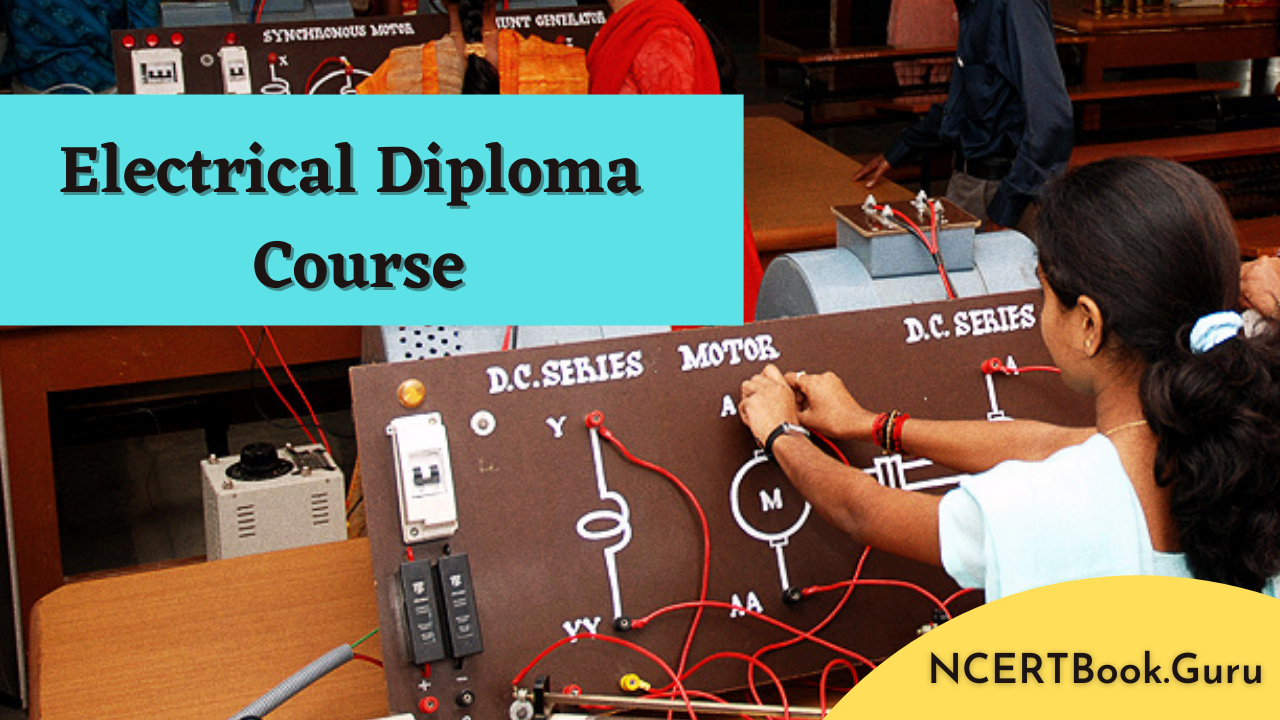
Electrical Diploma Course – Eligibility, Colleges, Salary, Career Options, Fee and Duration

Electrical Diploma Course

Online Electrical Diploma Courses in India: If you are passionate about electronics, electricity then you can choose an electrical diploma course. A diploma in electrical engineering is a skill enabling engineering program that deals with telecommunications, maintenance, installation, control systems, signal processing. Nowadays that electrical engineering not only involves electronics but also computer, communication, and mechanical fields.

In this article, we are going to discuss the complete information about the eligibility criteria, salary, fees, colleges, and many others.

About Electrical Diploma Course

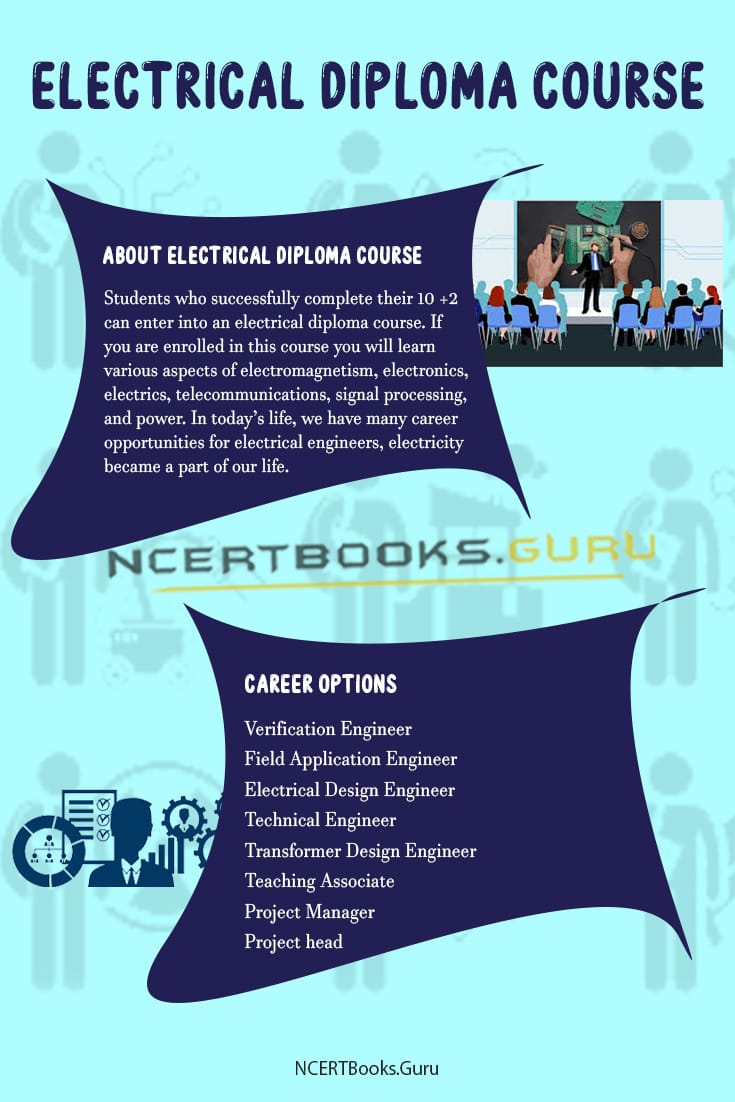
Students who successfully complete their 10 +2 can enter into an electrical diploma course. If you are enrolled in this course you will learn various aspects of electromagnetism, electronics, electrics, telecommunications, signal processing, and power. In today’s life, we have many career opportunities for electrical engineers, electricity became a part of our life. With an electrical diploma course, you can get a job in both private and public organizations. The electrical diploma course mainly focuses on electrical elements and devices.

Electrical Diploma Course Highlights

Course Level Diploma
Duration 3 years
Eligibility 10+2
Minimum Percentage 45%
Examination Type Semester-wise
Admission Process Merit-Based / Entrance Exam Based
Course Fees INR 10,000 to INR 3,00,000.
Entrance Exams Delhi CET, JMI EE, AMU EE, JEXPO
Electrical Diploma Subjects Digital Electronics, Measurements & Instruments, Computer Applications, Transducers, Signal Conditioners, Circuits, Electronic Devices, etc.
Top Colleges KJ Somaiya Polytechnic, Jamia Millia Islamia University, Swami Vivekananda Group of Institutions, Central Polytechnic College, etc.
Average Salary Rs. 120,000 to Rs. 168,000.

Eligibility Criteria for Electrical Diploma Course

If you are interested in a diploma course then you need to fulfill the given set of eligibility criteria that are given below:

  • Candidate must have passed 10th class from a recognized board.
  • The candidate must obtain a minimum of 50% marks in class 10.
  • And in that class 10th, you need to pass in mathematics and science subjects is compulsory.
  • If you have 12th then they are also eligible for the electrical diploma course.
  • The candidate must not have any color blindness problem.
  • Candidates who have reservations must submit their reservation certificates that are issued by the government.

Diploma in Electrical Engineering Admission 2022

Most universities and colleges admit students based on 10th class and 12th class merit but in some universities, they admit students by the entrance exams. We will the below steps that candidates should follow to get admission in the course.

Entrance Exam Based

  • Firstly, you need to register for admission to an electrical diploma course.
  • And appear for the exam on the scheduled exam date.
  • Then you need to secure the cut-off mark in that examination.
  • After that, you need to attend counseling and reserve a seat.
  • Submit the documents on the given date.
  • Pay the admission fee and you can join the course.

Merit-Based 

  • Firstly, you need to get the merit marks in the 10th or 12th that your university needs.
  • Then you need to attend the counseling and reserve a seat.
  • Submit the documents on the given date.
  • Then you need to pay the admission fee and join the course.

Diploma in Electrical Engineering Entrance Exams

Some of the top entrance exams for diploma courses in electrical engineering are:

  • JEXPO
  • Delhi CET
  • JMI EE
  • IUET
  • AMU EE
  • Assam PAT
  • HP PAT
  • BCECE

Diploma in Electrical Engineering Course Duration and Fee Structure

This diploma course is a 3-year course with 6 semesters and this semester will be completed after every 6 months. Through this course, you will get knowledge about each and every piece of electrical equipment that use in our daily life. And this Diploma in Electrical Engineering Course Fees ranging from Rs.10,000 to 50,000 PA these fees are different from university to university. Some of them are given below:

  • St. Peter’s Engineering College – INR 46,500.
  • Quli Qutub Government Polytechnic – INR 11,400.
  • Vishwa Bharati College of Engineering – INR 65,000.
  • Government Polytechnic College – INR 8,000.
  • Turbomachinery Institute of Technology & Sciences – INR 45,000.

Electrical Diploma Syllabus | Diploma in electrical engineering subjects list pdf

Here we are going to discuss the syllabus that you have for your diploma electrical course is:

Semester Diploma in Electrical Engineering Syllabus
 

Semester – I 

  • Electrical wiring lab
  • Basic computer skills lab
  • science lab
  • Mechanical Engineering Courses
  • Elements of Electrical Engineering
  • Applied Sciences
  • Mathematics – I
Semester – II
  • Computer-Aided Engineering Course
  • Electronics Lab – I
  • Electrical and circuit Laboratory
  • English Communication
  • Mathematics – II
  • Electrical Circuit
  • Electronics – I
 

Semester – III

  • Electronics – II
  • Electronic lab -II
  • Electrical Machines – I
  • Electrical & Electronics Measurement
  • Communication and Computer Networks
  • Electrical measurements Lab
Semester – IV
  • Power Electronics Lab
  • Power Electronics
  • C – Programming Lab
  • Electrical Machines Lab
  • Electrical Power Generation
  • Transmission and Distribution
  • Electrical Machines- II
Semester – V
  • Electrical Installation Design Lab
  • Electrical Workshop
  • Embedded System Lab
  • Estimation and Specification
  • Project work Phase -I
  • Switch Gear and Protection
  • Estimation and Specification
Semester – VI
  • Electric Motor Control Lab
  • PLC and HDC Lab
  • Industrial Devices and Control
  • Utilization of Electrical Energy and Management
  • Industrial Visit
  • Project Work Phase – II

Top Colleges for Electrical Diploma Course

Here are some top colleges for electrical diploma courses are given below:

  • Government Polytechnic, Pune
  • Quli Qutub Government Polytechnic
  • Government Polytechnic, Nagpur
  • Government Polytechnic, Mumbai
  • Government Polytechnic, Ahmedabad
  • Aryabhatt Institute of Technology, Delhi.
  • Acharya Polytechnic, Bangalore.
  • Reddy Jana Sangha Polytechnic
  • MN Technical Institute, Bangalore.

Diploma Course in Electrical Engineering

Career Options For Electrical Engineering Diploma Course

Following are the job profiles that we get for the electrical diploma course.

  • Verification Engineer
  • Field Application Engineer
  • Electrical Design Engineer
  • Technical Engineer
  • Transformer Design Engineer
  • Teaching Associate
  • Project Manager
  • Project head
  • Operations Manager
  • Workshop Manager

Also Refer:

Books And Study Materials for 1 year diploma in electrical engineering

Books Author
Basic Electrical and Electronics Engineering B.R. Patil
Foundations of Electrical Engineering Leonard S. Bobrow
Basic Electrical and Electronics Engineering M. S. Sukhija
Electric Machinery and Transformers Bhag S. Guru
Basic Electrical Engineering T.K. Nagsarkar
Basic Electrical Engineering Prasanta Kumar Satpathy
Protection and Switchgear Bhavesh Bhalla

Top Recruiters for Electrical Diploma Course

Look into Some top recruiters who hire for the electrical diploma course.

  • Mentor Graphics – Noida.
  • International Business Machines Corporation
  • BMW Group
  • Shell Oil Company
  • Google
  • Apple
  • Mitsubishi Electric
  • Servomax
  • Fuji Electric
  • Cable Corporation of India Ltd.
  • Tata Motors
  • Jai Balaji Steel

Diploma in Electrical Engineering Salary

For the electrical diploma course salary will be offered for freshers salary starting from Rs. 2 Lakh from 5 Lakh per annum. And there are different for different job profiles and there are differences from office to office. And for experienced candidates, you will get $65000 per annum. We will see some of the profiles along with the salary.

Job Profiles Salary Offered
Electric Designer Engineer INR 1,40,000 to INR 1,95,000
CAD Engineer INR 1,65,000 to INR 2,22,000
Junior Engineer INR 1,42,000 to INR 1,80,000
Technical Trainer INR 1,50,000 to INR 1,92,000

FAQs of Electrical Diploma Course

1. Can I get admission into a diploma course after the 10th?

Yes, you can get admission into a diploma course after the 10th.

2. What are the top specializations of electrical engineering?

Some of the specializations of electrical engineering are Microsystems, Signal and Image Processing, Electrical Engineering are Semiconductors, etc.

3. Is electrical engineering a good career?

At present days, we have a lot of opportunities for electrical engineers for young professionals.

Final Words

Hope that the information which is given above regarding Electrical Diploma Course helped you and you have got some knowledge about this course. Still, if you need any assistance in the electrical diploma course, feel free to reach us via the comment section so that we will answer you as early as possible. Stay tuned to this NCERTBooks.Guru website for more course details.

Jewellery Design Course in India | Online, Fees, Syllabus, Eligibility, Admission, Career Opportunities

Jewellery Design Course

Jewellery Design Course Online Free: Jewellery design is one of the popular creative courses. In India, jewellery has always been a vital asset. India manufactures as well as exports pieces of jewellery to different parts of the world. So, jewellery designing courses can offer you a promising career. It is best suitable for people having a creative mind and zeal for designing.

This article covers essential information about jewellery designing courses like fee details, admission procedure, eligibility criteria, type of courses, list of colleges, course duration, and career prospects.

Get to Know More about other types of Course Details in Stream wise, and Category wise.

About Jewellery Design Course

There are bachelor programme, post-graduate programme and diploma courses for jewellery making. Jewellery designing is a creative professional course that provides knowledge on various aspects of designing a piece of jewellery like cutting, engraving, polishing, and many other things.

This course provides both theoretical and technical knowledge of jewellery designing. Students learn to turn their imaginary visualisation into reality. This course includes information on different kinds of jewels and gems, fabrication techniques, composition, market trends, and wearability. The jewellery industry is a growing sector in India because Indians prefer buying pieces of jewellery either as assets or to adorn themselves. As a result, there will be demand for jewellery designers in the future as well.

Jewellery Design Course Details

Name of the Course Jewellery Design
Course Level Degree/Diploma/Certification
Duration of the Course Undergraduate Degree: 3 years
Post-graduate degree: 2 years
Diploma/Certification: 6 months to 1 year
Jewellery Design Course Eligibility Undergraduate Degree: 10+2 qualified
Post-graduate degree: Bachelor
Diploma/Certification: Either class 10 or 10+2 qualified
Job opportunities Jewellery Designer, Jewellery Merchandiser, Exhibition Manager, Production Manager, Embroidery Maker and Innovator, Illustrator, Planning and Concept Manager, Jewellery Setter, Engraver, and Gem Assorter
Employment Sector Boutiques, Retail Chains, Television and Film Industry, Accessory Designing Houses, Jewellery Designing Firms, Goldsmiths, Gemmologists, and Jewellery Manufacturing Firm
Average Salary Offered Fresher: 8000 to 15000 rupees
Mid-level Professional: 25000 to 40000 rupees
Expert: Upto 1.5 lakh

Skillset Required for Jewellery Design Course

Previously one could have been a good jewellery designer with a creative mind. In modern times, becoming a good jewellery designer requires both a creative mind and technical knowledge as most of the designs are created on the computer. There are some other skills that a good jewellery designer must possess.

  • Detail-oriented
  • Good communication skills
  • Patience
  • Good imagination power
  • Interpersonal skills
  • Knowledge of past and present market trends
  • Hard work and dedication
  • Fair drawing skills
  • Ability to meet deadlines
  • Organisation and time management skills

Jewellery Design Course Duration

Different types of jewellery designing courses are available in India. Bachelor’s degree in jewellery designing is a three years course. To complete the post-graduation programme in jewellery designing, it will take two years. Apart from these two, there are also diploma courses in jewellery designing ranging from six months to one year.

Jewellery Design Course Eligibility Criteria

To complete graduation in jewellery designing, one must complete a minimum class 12 or equivalent (10 + 2) from a recognised university.

To pursue a post-graduation programme in jewellery designing, one must complete graduation in any stream ( Arts / Science / Commerce ) preferably in jewellery designing.

To take admission in diploma in jewellery making, one must complete class 12 or equivalent from a recognised university. Some institutions offer admission to class 10 pass candidates as well.

Some institutions require a minimum of 50 per cent marks in the last examination. However, this criteria is relaxed for candidates from reserved categories.

Jewellery Design Course Admission Procedure

The institutions offer admission in jewellery designing courses either based on merit obtained in the last examination or based on the entrance exam. Some institutions also provide admission based on counselling and personal interview. It is recommended that one should check the official website of a particular college to know about their process of admission.

Entrance-Based Admission Procedure

Most of the institutions prefer taking an entrance exam over and above the academic qualification to know the suitability of the candidate for this particular course. Some of the popular entrance exams for jewellery designing are discussed below:

  • AIEED: It is a combination of GAT and CAT. Candidates can take admission to undergraduate and post-graduate programmes by passing this examination. This exam is specially designed to check the creativity of the students willing to pursue a career in the designing industry.
  • NATA: This course is specifically designed for those willing to pursue a career in architecture. It checks aesthetic quality, creative mind, sense of proportion, drawing skills, and observation power. This exam is the compulsory entrance examination for Architecture.
  • NID: This entrance examination is especially for those willing to make a career in the designing industry. It is an offline course that happens once a year. Seven colleges in India are accepting this entrance examination’s score for providing admission to various designing courses. This entrance exam is the way to get admission in various undergraduate and post-graduate programmes in design.
  • CEED: This is another popular entrance examination for designing courses. This examination is intended explicitly for technical designing courses at the post-graduate level. This examination checks the candidate’s drawing skills, visual imagination, creativity, and logical reasoning.

Merit-based Admission Procedure: Some institutions also offer direct admission based on the merit obtained in the last examination. For an undergraduate programme, the score of class 12 is considered. For post-graduate programmes, the score of graduation is considered. For the diploma courses, class twelve’s score matters. Many institutions prefer a minimum of 50 percent marks in aggregate. However, there is relaxation for the candidates belonging from reserved categories ( SC / ST / OBC ). To get the benefits of the reserved category, one must hold official certificates for the same.

Counselling-based Admission Procedure: Most of the institutions prefer taking a counselling round before confirming admission. Is it the best way to know about the nature and creative mind of a person. Some institutions take admission entirely based on counselling and personal interview while others take counselling along with entrance examinations. One must carry all \the relevant documents while going for counselling. After applying online through the institute’s official website, candidates are informed about the venue, timing and other essential things of counselling sessions either through email or by the call. It is crucial to provide correct contact information while filling up the application form online.

Do Check

Jewellery Design Course Fee Structure

The fee structure of degree/diploma/certification course in jewellery designing varies from two lakhs to eight lacs rupees. The Jewellery Design Course fees structure depends on the location, type of course, and reputation of the college. However, government or government-aided colleges offer jewellery designing courses at a lower price than private institutions.

Jewellery Design Course Syllabus

The syllabus mentioned here may differ from the actual depending on the type of the course and institution. However, the topics mentioned will remain more or less the same.

1st semester 2nd semester 3rd semester
Fundamentals of Design I Fundamentals of Design II Markets and consumer behaviour
Visualisation and Drawing Techniques Colour Techniques Metallurgy
Jewellery illustration I Financial Management and Accounting Introduction to Gemology
Basics of Organisational management History of Art and Culture Theme based designing
Communication Skills Indian & International Jewellery Markets Ornament designing I
Socio-cultural History of Jewellery Jewellery Illustration II Design development
Advertisement & Brand management of Jewellery Basics of computer applications Environment science
Project
4th semester 5th semester 6th semester
Technical Drawing Retail Marketing & Sales promotion Diamond grading and sorting
Design illustration Metal Decoration CAD
CAD Cost Assessment Technique Gemology
Socio-Economic foundation of Jewellery Beading Art Accessory design
Ornament Designing II Traditional Indian Designing Portfolio Development
Layout Methodology Jewellery Design Presentation Project
Project (Textile Crafts of India) Technical Drawing

Top Institutions Offering Jewellery Design Course

There are many institutions all over India offering degree/diploma/certification courses in jewellery designing.

Name of the Institution Location
NIFT Delhi
IIT Multiple locations
National Institute of Design Multiple locations
ARCH Academy of Design Jaipur
Vogue Fashion Institute Bangalore
National Institute of Jewellery Design Ahmedabad
Indian Institute of Jewelry Design Ahmedabad
Amor Design Institute Ahmedabad
India International Trade Center Pune
Exterior Interior Limited Multiple locations

Career Prospects in Jewellery Design Course

Degree/diploma/certification course in jewellery designing offers a promising career in the designing industry. One can work at both national and multinational jewellery brands and earn a handsome salary package. The jewellery industry is growing in India.
Employment Areas

After completing the jewellery designing course, one can find jobs in different sectors. Candidates can also choose to work as a freelance jewellery designer. Some of the industries that hire jewellery designers are listed below :

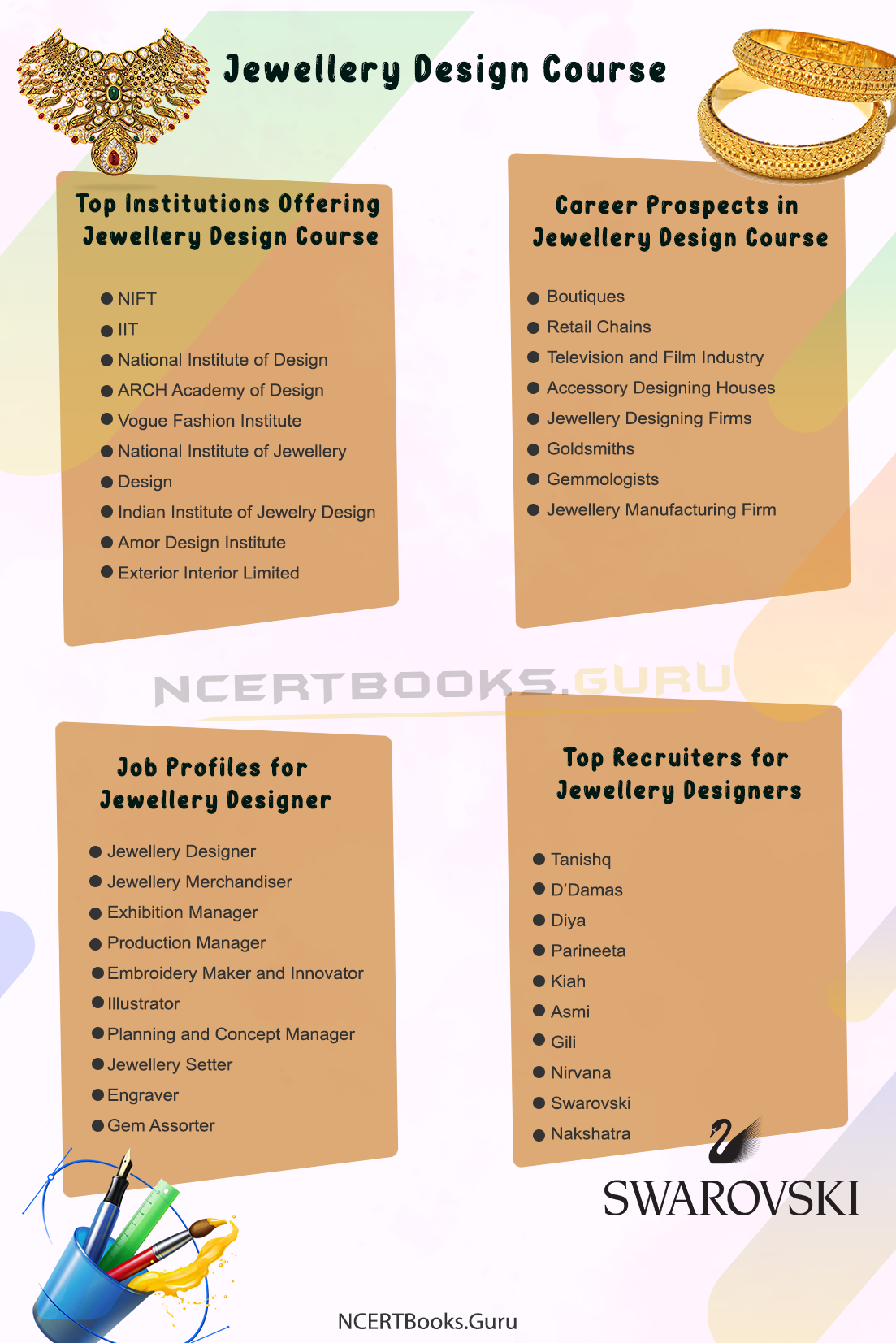
  • Boutiques
  • Retail Chains
  • Television and Film Industry
  • Accessory Designing Houses
  • Jewellery Designing Firms
  • Goldsmiths
  • Gemmologists
  • Jewellery Manufacturing Firm

Jewellery Design Course

Job Profiles for Jewellery Designer

This is a lucrative field that allows you to be creative and design your imagination. One can start working for a particular company and gain experience for a few years. After a few years, s/he can begin his/her own designing house. Some of the job openings for a jewellery designer are listed below:

  • Jewellery Designer
  • Jewellery Merchandiser
  • Exhibition Manager
  • Production Manager
  • Embroidery Maker and Innovator
  • Illustrator
  • Planning and Concept Manager
  • Jewellery Setter
  • Engraver
  • Gem Assorter

Top Recruiters for Jewellery Designers

Multiple national and international organisations recruit jewellery designers. Some of the companies that recruit jewellery designers are listed below :

  • Tanishq
  • D’Damas
  • Diya
  • Parineeta
  • Kiah
  • Asmi
  • Gili
  • Nirvana
  • Swarovski
  • Nakshatra
  • Rivaaz

Salary Prospects of a Professional Jewellery Designer

The salary of a professional jewellery designer depends on the experience and skills of the candidate. It also depends on the location and reputation of a company. A fresher in this field earn somewhere around 8000 to 15000 rupees. A mid-level professional earns between 25000 to 40000 rupees. A jewellery designer can earn more than 1 lakh rupees per month in India with time and experience.

FAQ’s on Jewellery Design Course

Question 1. 
What are the software’s used for jewellery designing?

Answer:
Some of the software that is used for jewellery designing are listed below :

  • Rhinegold
  • Zbrush & Sculptris
  • Matrix
  • Blender
  • 3Design
  • SketchUp
  • TinkerCAD

Question 2. 
Can I pursue a jewellery design course after class 12?

Answer:
Yes, one can pursue either an undergraduate degree programme in jewellery designing or a diploma in jewellery designing after completing class 12. Some institutions prefer a minimum of 50 percent marks in aggregate.

Question 3. 
What is the jewellery designing course duration?

Answer:
Bachelor’s degree in jewellery designing is a three years course. To complete the post-graduation programme in jewellery designing, it will take two years. Apart from these two, there are also diploma courses in jewellery designing ranging from six months to one year.

Question 4. 
How much salary do fresher jewellery designers earn?

Answer:
A fresher jewellery designer earns somewhere around 8000 to 15000 rupees in India. However, the figure gets doubled with a few years of experience.

Question 5.
What is the course fee for jewellery designing course in India?

Answer:
The fee structure for the jewellery designing course ranges from two lakhs to eight lakhs. Diploma courses are available cheaper than this depending on the location and institution.

Question 6.
Is the jewellery industry growing in India?

Answer:
The gems and jewellery industry contributes approx 16 percent to India’s total merchandise exports. The gems and jewellery industry has grown at a CAGR of over 14.8 percent in the last 50 years. India contributes to 29 per cent of global jewellery consumption.

Best Medical Engineering Courses | Subjects, Syllabus, Colleges, Career Options, Scope, Salary

Medical Engineering Courses

Planning a career in medical engineering? If Yes! Then, it is the right place for you to know about all the important topics about medical engineering. Medical Engineering Courses is the technique with organic sciences to improve the quality of healthcare, pharmaceutical, and human life.  In this blog, we have collated all the outstanding information related to the field!

Get to know more about other Courses Details about stream-wise and category-wise.

What is Medical Engineering?

Medical engineering combines engineering skills with medical activities and knowledge of the human body as it operates in various forms. Medical Engineering is different from other engineering branches. A medical engineering degree is simply an application in the field of cell biology and epidemiology. This medical engineering focuses mainly on some medical innovations like surgical robots, pacemakers, artificial organs.

Popular Courses in Medical Engineering

We have many types of courses in medical engineering at different levels of study.  Have a look at them.

Undergraduate Level

  • Bachelor in Medical Engineering(Honours)
  • BSc (Hons) Immersive Systems Design – 3D Modelling
  • Bachelor of Science in Engineering – Humanitarian Engineering
  • Bachelor of Design (Interaction Design)/Bachelor of Engineering (Honours).
  • BEng/ BTech Biomedical Engineering
  • Medical Engineering BEng (Hons).
  • BEng (Hons) Biomedical Engineering with Sandwich Year.

Post Graduate Level

  • Master of Engineering in Bioengineering
  • Medical Engineering MSc
  • Master of Science in Electrical and Computer Engineering (Biomedical Engineering) – Thesis-based
  • Advanced Biomedical Engineering MSc
  • Biomedical Engineering MSc
  • Advanced Biomedical Engineering MSc

Doctorate Level

  • Ph.D. in Biomedical Engineering
  • Ph.D. in Medical Physics and Bioengineering
  • Ph.D. in Biomedical Engineering
  • Ph.D. in Chemical and Biological Engineering

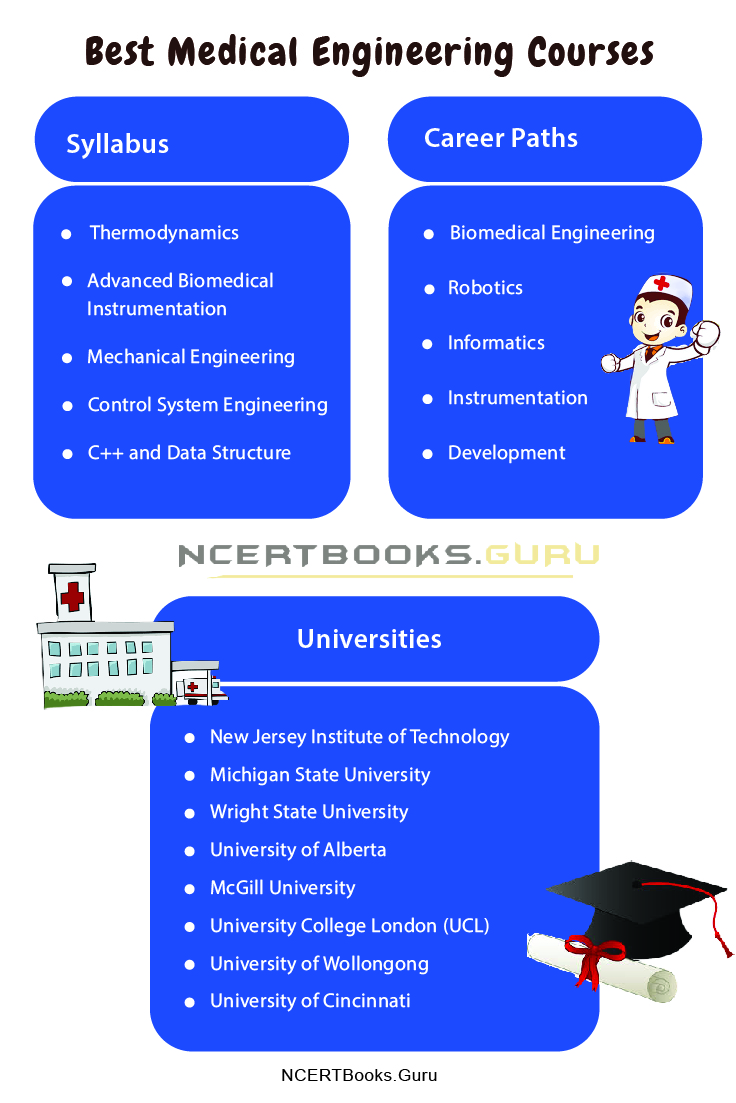
Syllabus for Medical Engineering Courses

Let us know the subjects that are taught during this course of the study. And the important note is the subjects can be varied from university to university.

  • Thermodynamics
  • Advanced Biomedical Instrumentation
  • Dynamics of Biofluids
  • Mechanical Engineering
  • Control System Engineering
  • C++ and Data Structure
  • Dynamics of Biofluids
  • Advanced Mathematics
  • Fundamentals of Civil Engineering
  • Medical Informatics

Also, Refer:

Types of Career Paths in Medical Engineering Courses

This medical engineering course offers a various range of employment pathways and opportunities. Let’s take a look at some of the most prevalent medical engineering career pathways.

  • Biomedical Engineering
  • Clinical engineering
  • Robotics
  • Informatics
  • Instrumentation
  • Managing medical equipment
  • Development

Top Universities for Medical Engineering

Here we can see universities that offer medical engineering in other countries. Given below are some of the top universities for this course.

  • New Jersey Institute of Technology
  • Michigan State University
  • Wright State University
  • University of Alberta
  • McGill University
  • University College London (UCL)
  • University of Wollongong
  • University of Cincinnati
  • Ryerson University
  • Colorado State University

Best Medical Engineering Courses

FAQs on Medical Engineering Courses After 12th

1. Is medical engineering tough?

In general,  getting an engineering degree provides you with more career strength than most other majors, although it finally depends on the individual.  Medical engineering is a vast subject and it is a little tough.

2. What topics are in medical engineering?

Undergraduate programs in medical engineering have topics like calculus, medical imaging systems, and biomechanics.

3. How much course duration do we have in medical engineering?

The course duration we have in medical engineering is 4 years.

Final Words

Hope that the information that is given above about Medical Engineering Courses is useful to you. Still, if you have any doubts about this engineering course you can comment us in the comment section. We will give the answer to your question ASAP.  Bookmark our NCERTBooks.guru site and know about other course details, books, and exams.

Diploma Courses in Ayurveda | Course Duration, Eligibility, Skills, Admission, Top Colleges, Fees, Job Options, Salary, Top Recruiters in 2023

Ayurveda Diploma Course

Ayurveda Diploma Course: Ayurveda has a holistic approach to medicine and life. It does not differentiate between the mind and the body since the Ayurveda is based on the principle that the mind and the body are interconnected. Ayurveda emphasizes promotive and preventive healthcare. An unhealthy lifestyle, bad diet habits, and stress are some of the factors which lead to an imbalance in the mental and physical health of an individual resulting in diseases.

If you are interested in the Ayurvedic field of medicine, taking up a diploma course related to Ayurveda might be the best option for you. Keep reading this article to gain all the knowledge about the course details of the Ayurveda diploma course. Let’s get started!

About Ayurveda Diploma Course

Diploma Ayurveda courses are designed in order to train the candidates in various fields such as Ayurveda pharmacy, maternal care, Ayurveda pharmaceuticals, yoga therapy, etc. The course might have a duration of a few weeks up to two years.

The Diploma in Ayurveda Course duration completely depends upon the particular course requirements. The fee of a diploma course in Ayurveda is somewhere between INR 20,000 to INR 1,50,000 depending upon the college to which the student gets admitted. An individual can expect a salary of somewhere between INR 2,00,000 to INR 4,00,000 as a fresher after completing their diploma in Ayurveda degree.

Types of Ayurveda Diploma Courses | Ayurvedic Courses List

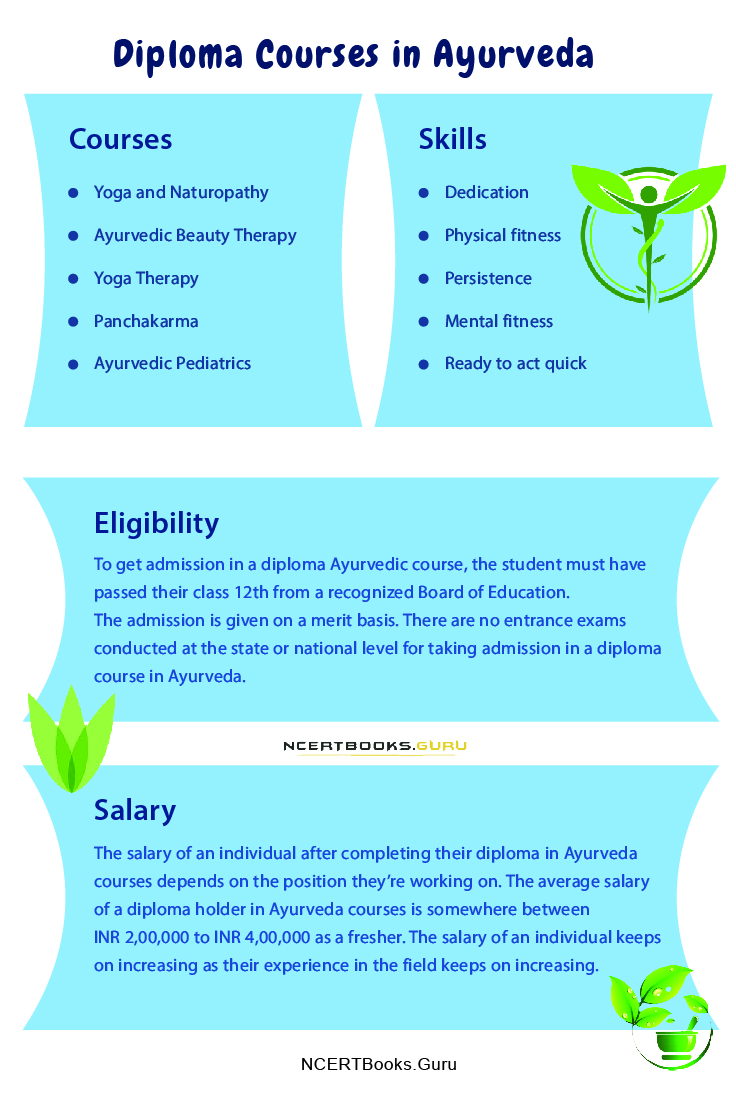
There are various fields under Ayurveda yoga that provide different kinds of specializations. Following is the list of different diploma courses in Ayurveda that one can take up according to their interests:

  • Yoga and Naturopathy
  • Ayurvedic Dietetics
  • Ayurvedic Beauty Therapy
  • Ksharsutra
  • Ayurvedic Lifestyle Management
  • Ayurvedic Cosmetology and Skin Disease
  • Yoga Therapy
  • Ayurvedic Drug Standardization
  • Cultivation of Medicinal Plants
  • Panchakarma
  • Ayurvedic Gynecology
  • Ayurvedic Pediatrics
  • Ayurveda Anesthesiology
  • Management and Administration of Ayurveda Institutions
  • Ayurvedic Nursing
  • Ayurvedic Massage
  • An introductory course in Ayurveda
  • Ayurvedic Cosmetics
  • Ayurvedic Food and Nutrition
  • Nadi Pariksha
  • Ayurvedic Astrology
  • Ayurvedic Pharma
  • Rog Nidan Vidhi
  • Ayurvedic Nursing and Pharmacy
  • Netra Rog Chikitsa
  • Manasik Swasthya
  • Maternal Health Care
  • Physiotherapy and Ayurveda
  • Ayurvedic Compounded Training
  • Meditation Teacher Training
  • Ayurvedic Pharmaceutics
  • Yoga Teacher Training

Skills Required for Doing an Ayurveda Diploma Course

For studying in any field, there are some basic skills required. The skills that the candidates possess help them to learn and comprehend the degree in a much better way. Candidates going for a diploma in Ayurveda must have an appropriate set of skills if they want to excel in this field. Following are the skills required to study an Ayurveda diploma course:

  • Dedication: The students must have full dedication towards the course and must focus on learning.
  • Interest: Students must have a very keen interest in science and medicine.
  • Physical fitness: The students must be physically fit in order to complete the degree.
  • Attention to detail: The students must have the quality of paying attention to detail since Ayurveda is a subject of medicine and details are of utmost importance here.
  • Persistence: Students must be persistent with their work and their zeal to learn.
  • Mental fitness: The student should be mentally fit in order to complete the degree.
  • Ready to act quick: The students must be very agile.
  • Practical knowledge of Ayurvedic medicine: The students must have some idea about the Ayurvedic medicines prior to enrolling in the course, just on the basic level.

Eligibility Criteria for an Ayurveda Diploma Course

To get admission in a diploma Ayurvedic course, the student must have passed their class 12th from a recognized Board of Education. The admission is given on a merit basis. There are no entrance exams conducted at the state or national level for taking admission in a diploma course in Ayurveda.

However, some universities might take their own entrance examinations for admission to the course. The student must have secured at least 50% marks in their 10 + 2 examinations to be eligible for the admission process.

Also Read:

Admission Process in an Ayurveda Diploma Course

  • To take admission in a diploma course in Ayurveda, the candidate must pass the eligibility criteria which is completing their 10 + 2 with a minimum of 50% marks.
  • Candidates must submit all their documents asked by the college along with their application form before the deadline.
  • Students are must check the website of the college they want to apply for on a regular basis to get updates on the application process.
  • Application forms can be submitted online or offline form as per the instructions of the college.
  • The candidates who successfully meet all eligibility criteria and complete all the admission processes properly are selected for other processes and others are disqualified from the admission process.

Top Colleges for Diploma Courses in Ayurveda

There are various top institutes all across the country which provide premium quality education when it comes to the various diploma courses in the field of Ayurveda. With India being one of the biggest producers and consumers of Ayurvedic medicine, this field is extremely popular all across the country. Following is the list of top colleges for diploma courses in Ayurveda:

  • Bharti Vidyapeeth Deemed University College of Ayurveda, Pune
  • State Ayurvedic College and Hospital, Lucknow
  • NIA – National Institute of Ayurveda, Jaipur
  • Government Ayurvedic College and Hospital, Patiala
  • Pt Khushilal Sharma Government Autonomous Ayurveda College and Institute, Bhopal
  • Government Ashtanga Ayurved College, Indoor
  • DSRRAU P-  Doctor Sarvapalli Radhakrishnan Rajasthan Ayurved University, Jodhpur
  • Shree Laxmi Narayan Ayurvedic College, Amritsar
  • Abhilash University, Mandi
  • CMJ University, Shillong
  • YBN University, Ranchi
  • Madhya Pradesh Medical Science University, Jabalpur
  • Shobhit University, Gangoh
  • Janardhan Rai Nagar Rajasthan Vidyapeeth, Udaipur
  • Shree Narayan Prasad Awasthi Government Ayurvedic College, Raipur
  • Golgotia University, Greater Noida
  • RKDF University, Bhopal
  • Shree Satya Sai University of Technology and Medical Sciences, Sehore
  • Tantia University, Shree Ganga Nagar
  • Uttaranchal Unani Medical College and Hospital, Haridwar
  • Government Autonomous Ayurveda College and Hospital, Reva
  • Guru Nanak Ayurvedic Medical College and Hospital, Shri Muktsar Sahib
  • Gondwana University, Gadhchirauli

Fee Structures of Diploma in Ayurveda Courses

The fee of an Ayurvedic diploma course ranges somewhere between INR 20,000 to rupees INR 1,50,000. The fee structure entirely depends upon the College in which one wants to get admission. The government colleges charge much lesser fees in comparison to the private colleges since the government universities are externally funded by the state or central government.

Job Opportunities after Completing a Diploma in Ayurveda

After completing a diploma in Ayurveda, various sectors of the medical field relating to Ayurveda open up for an individual to work in and grab the experience. People are now getting more and more aware of Ayurvedic medicines and the positive effect that they have on the human body and people are shifting to Ayurvedic medicines for a more permanent cure for their illnesses.

This field is growing in India at a very high rate. Following are the job profiles that one can take after completing a diploma course:

  • Pharmacist
  • Professor
  • Ayurveda Specialist
  • Medical Representative
  • Marketing Specialist
  • Quality Control Engineer, and many more

Salary of a Diploma Holder in Ayurveda

The salary of an individual after completing their diploma in Ayurveda courses depends on the position they’re working on. The average salary of a diploma holder in Ayurveda courses is somewhere between NR 2,00,000 to INR 4,00,000 as a fresher. The salary of an individual keeps on increasing as their experience in the field keeps on increasing.

Diploma Courses in Ayurveda

Top Recruiters for Students With an Ayurveda Diploma Degree

Completing a diploma in Ayurveda Courses opens up a lot of doors in the medical field related to Ayurveda. Following are the top recruiters for the students who hold a diploma degree in Ayurveda courses:

  • Patanjali Ayurved Limited
  • The Himalaya Drug Company
  • Dabur
  • Zandu Pharmaceuticals Works Limited
  • Hamdard Laboratories
  • Surya Herbal Limited
  • Vicco Laboratories

FAQ’s on Ayurveda Course in Diploma

1. Can I apply for a diploma Ayurveda course after class 12th?

Yes, you can apply for admission in an Ayurveda diploma course in India after completing your class 12th. The minimum eligibility criteria for enrolling in a diploma course in Ayurveda is that the students must have completed their class 12th from a recognized Board of Education with a minimum of 50% marks.

2. What is the fee of an Ayurveda diploma course?

The average fee of a diploma Ayurveda course is somewhere around INR 50,000. However, the range of the fee of different colleges is from INR 20,000 to INR 1,50,000 per annum. The exact fee depends upon the College in which a student takes admission. The private colleges charge higher than the government colleges since the government colleges are funded by the state or the central government.

3. Is the Ayurveda diploma course a good option?

Yes, if you are someone who is interested in it and wants to build a career in it, doing a diploma course in Ayurveda can be a really good option for you. India is one of the biggest consumers of Ayurvedic medicines and Ayurveda is practiced quite a lot all across the country.

4. What jobs can I get after completing Ayurveda diploma courses?

Following are the job profiles for students who have completed their Ayurveda courses in diploma:

  • Medical Representative
  • Quality Control Engineer
  • Pharmacist
  • Professor
  • Ayurveda Specialist
  • Marketing Specialist, and many more.

Conclusion

We believe that this article was able to provide you with all the information regarding Ayurveda Diploma Courses. We have covered all the points that explain Ayurveda, course details, top colleges for diploma degree in Ayurveda, eligibility criteria, admission process of colleges, fee structure, job options after completing a diploma course in the field of Ayurveda, the skills required to pursue this course, the salary after completing a diploma in Ayurveda as a fresher.

Hoping that this complete guide on Ayurveda diploma courses will be able to help you make an informed decision for yourself. Knowing about all the options available, the processes, and the future scope will help you clear up your mind and focus on the main features.