M.Sc Nursing Course Details | Duration, Eligibility Criteria, Admission Protocol, Employment Prospects

M.Sc Nursing Course Details

M.Sc Nursing Course Details: If you are looking to expand your medical knowledge and academics in nursing, then you can opt to continue a postgraduate degree in Nursing. M.Sc Nursing program enables students to hold responsibilities as consultants, administrators, researchers, nurse specialists, educators, or even as administrators in a spectrum field with professional settings.

Students will also be provided with the on-campus experience of organizing, conducting, and taking part in workshops and conferences with eminent personalities. The report on the M.Sc Nursing course program covers the overall topics like prospectus, course gradations, particulars on qualification, the confirmation process, fee structure, and vocation possibilities.

What is M.Sc Nursing Course?

M.Sc. Nursing is a two-year-long postgraduate level program that aims to cater to all topics encompassing Nursing and Applied Sciences.

M.Sc. Nursing includes theoretical work, practical work, on-field training inclusive of extensive lab coaching. The course program consists of a research thesis in the final semester for the final evaluation along with class assignments, research projects, and end-semester exams.

The demand for nurses is high as doctors need assistance for treating patients. M.Sc Nursing graduates get potential well-paid employment opportunities in Healthcare facilities as Nurse Supervisor, Occupational Health Nurse, Nurse in-charge, Clinical Instructor, etc.

M.Sc. Nursing Highlights

Course Name M. Sc. Nursing
Course Level Postgraduate-level
M.Sc Nursing Full Form Master of Science in Nursing
Course Duration Two years with four semesters.
Age Limit Age limit criteria are not applicable as anyone interested can pursue this course program after graduation.
Eligibility Criteria Minimum educational qualifications in Post Basic B.sc Nursing or B.Sc. Hons Nursing or B.Sc. Nursing with a minimum of 55 percent aggregate for General category and 50 percent aggregate for SC/ST candidates from an institution recognized by the Indian Nursing Council.
Placement Opportunities Nursing Homes, Old-age Homes, Military Hospitals, Private or Government Hospitals, Medicine Industry, Academic or Research Institutions, Medical Colleges and Universities, and more.
Employment Roles Staff Nurse, Ward Nurse, Nursing Supervisor, Paramedic Nurse, Nursing Instructor, Nursing Executive, Nurse assistant, Psychiatric Nursing Tutor, Medical Advisor, and more.
Average M.Sc Nursing Salary Offered Rs. 1 Lakh to Rs. 2 Lakhs per year
Advanced Courses M.Phil Nursing, Ph.D. Nursing
Similar Courses A.N.M. Nursing, G.N.M. Nursing, P.B. B.Sc. Nursing

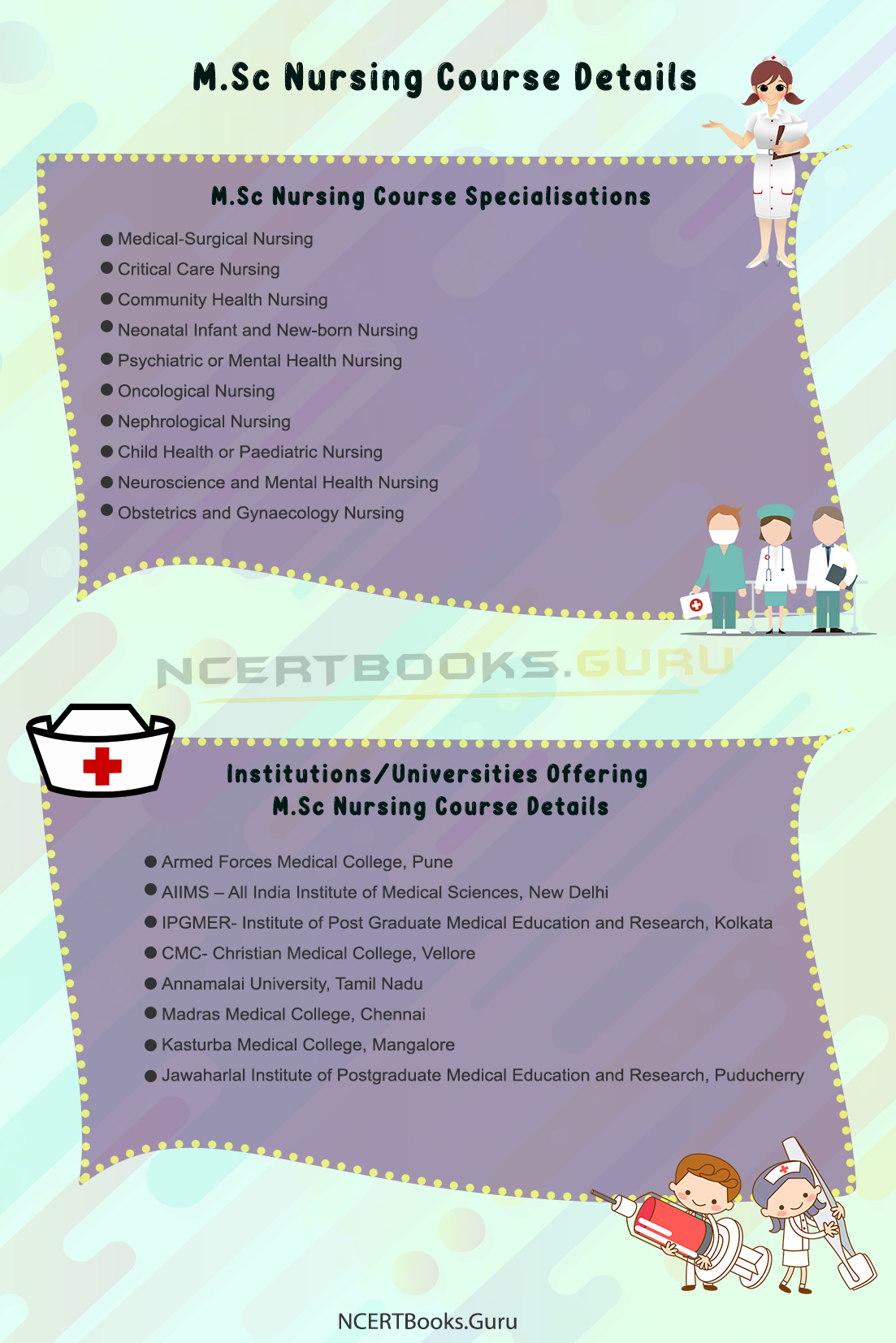
M.Sc Nursing Course Specialisations

M.Sc. Nursing Course offers specifications for candidates to undertake during their two-year medical program. Below is a list of clinical specializations offered for M.Sc. Nursing course program:

  • Medical-Surgical Nursing
  • Critical Care Nursing
  • Community Health Nursing
  • Neonatal Infant and New-born Nursing
  • Psychiatric or Mental Health Nursing
  • Oncological Nursing
  • Nephrological Nursing
  • Child Health or Paediatric Nursing
  • Neuroscience and Mental Health Nursing
  • Obstetrics and Gynaecology Nursing

Get to Know More about other types of Course Details Streamwise, and Category wise.

Skillset Required for M.Sc Nursing Course

Candidates who are opting for the M.Sc Nursing course program must hold the skillsets that enable them to perform better-

  • Good Communication Skills: To interact with co-workers, patients, and doctors.
  • Critical Thinking Skills: To identify the patient’s problems.
  • Detail-oriented Skills: To document medical reports and provide patients with medications.
  • Patience: While taking care of sick and generally anxious or frightened patients.
  • Computer and Technology Skills: Use of informatics and elementary computer knowledge to conduct computer-based operations and operate healthcare software.
  • Adaptability Skills: To keep updated with the new and changing research and medical practices.
  • Time-management Skills: To comply and manage.

M.Sc Nursing Course Duration

M.Sc. Nursing is a two-year-long postgraduate medical academic program distributed into four semesters. Each semester lasts for six months and covers a list of essential subjects aligned with medical science.

M.Sc. Nursing Course Eligibility Criteria

To pursue M.Sc. Nursing Course, candidates must meet the eligibility requirements put forth by the relevant institution and colleges. The eligibility requirements for M.Sc. Nursing is as follows:

  • Candidates must have completed minimum educational qualifications in Post Basic B.sc Nursing or B.Sc. Hons Nursing or B.Sc. Nursing with a minimum of 55 percent aggregate for General category and 50 percent aggregate for SC/ST candidates from an institution recognized by the Indian Nursing Council.
  • Candidates should hold a registration as a midwife or nurse or equivalent from any state’s Nursing Registration Council.
  • Candidates must have a minimum of one-year work experience prior to or after Post Basic B.Sc. Nursing and Basic B.Sc. Nursing.
  • Candidates must be deemed as medically fit individuals.

M.Sc Nursing Course Admission Procedure

The admission protocol for M.Sc. Nursing course program is dependent upon institutions. However, the standard selection procedure is a merit-based admission process and entrance-test based examination protocol.

The conducting body will conduct the determination of the All India Common Entrance Test (AICET) merit list. However, some colleges and institutions conduct a personal interview as an additional selection process.

Selected candidates will undergo the counseling process and must produce the necessary certificates and documents.

M.Sc. Nursing Entrance Examinations

A few renowned M.Sc. Nursing entrance examinations are tabulated below:

Examination Conducting Body Mode of Examination
MET 2020 Manipal Academy of Higher Education Online Mode
ITM NEST NEST University Online Mode and Offline Mode
AIIMS M.Sc. Exam AIIMS Online Mode
DSAT Dayanand Sagar University Online Mode and Offline Mode
WBPGNAT West Bengal University of Health Sciences Online Mode

M.Sc Nursing Course Details

M.Sc Nursing Course Fee Structure

The annual fee structure for an M.Sc Nursing course program varies according to different institutions. However, the annual M.Sc Nursing fee structure in most reputed institutions ranges between Rs. 1.5 Lakhs/- to Rs. 3.5 Lakhs/- per annum.

Candidates applying for admission protocol at governmental universities have a comparatively lesser fee amount to that of private institutions.

M.Sc. Nursing course program is structured based on other factors such as the university’s status, the faculty, infrastructure, and the government and management quotas.

Also, See:

M.Sc. Nursing Course Program Syllabus and Subjects

The theory and practical hours differ according to the institution or colleges. The standard cumulative and approximate hours for M.Sc. Nursing course program is as follows-

M.Sc Nursing Subjects List Theory Hours Practical Hours
Clinical speciality-I 150 650
Nursing Education 150 150
Advanced Nursing Practice 150 150
Nursing Research and Statistics 150 150

Second-Year Schedule

Subject Theory Hours Practical Hours
Clinical speciality-II 150 950
Nursing Research (Dissertation) 300
Nursing Management 150 150

M.Sc. Nursing Course Module-Wise Breakup

Nursing Education

This module comprises thirteen units under study:

  • Teaching-Learning Process
  • Development and Trends in Nursing Education
  • Curriculum development
  • Meaning of Education
  • Accreditation in Nursing Education Programmes
  • Administration of nursing curriculum
  • Instructional Media and A. V. Aids
  • Teacher education for the nursing profession
  • Overview of nursing education programs in India
  • Continuing education in Nursing
  • Administration of nursing curriculum
  • Guidance and counseling
  • Development of standards

Clinical Speciality-I

This module comprises seven units under study:

  • Endocrine System and its problem management.
  • Skin and Sensory Organs and their causes, investigations, pathophysiology, problem management, and clinical features.
  • Gastrointestinal System and its causes, investigations, pathophysiology, problem management, and clinical features.
  • Cardiorespiratory System and its problem management
  • Urogenital System and its causes, investigations, pathophysiology, problem management, and clinical features.
  • Neurological System and the problems of the brain.
  • Muscle- Skeletal System and its causes, investigations, pathophysiology, problem management, and clinical features.

Nursing Research and Statistics

This module comprises ten units under study:

  • Research Approaches
  • Reporting and utilizing results
  • Sampling
  • Research Designs
  • Theoretical Context
  • Measures of variability
  • Use of statistical methods in psychology and education
  • Analysis and interpretation of data
  • Measures of central tendency
  • Organization and presentation of data

Advanced Nursing Practice

This module comprises twelve units under study:

  • Economic and Political Aspects of Health Care Delivery
  • Genetics
  • Nursing as a Profession
  • Trends in Nursing
  • Epidemiology
  • Nursing Process Approach
  • Philosophy and Theories of Nursing
  • Psychological Aspects and Human Relations
  • Bio-Psycho Pathology
  • Basis of Current Nursing Practices
  • Scope of Nursing Practice
  • Computer Applications for Nursing Practice and Patient Care Delivery System

Nursing Management

This module comprises ten units under study:

  • Introduction to management
  • Management information system
  • Legal and ethical issues in the nursing management
  • Roles and functions of the nurse manager in controlling
  • Material management
  • Organizational behavior
  • Roles and duties of the nurse manager in financial management
  • Roles and responsibilities of the nurse manager in planning
  • Roles and functions of the nurse manager in directing
  • The organization of nursing and the health delivery system

Clinical Speciality-II

This module comprises eleven units under study:

  • Management of patients with vascular problems
  • Preventive and Control measures of cardiothoracic and vascular disorder
  • Assessment of normal and abnormal cardiac function
  • Planning and organization of critical care units
  • Review of anatomy and physiology of the cardiovascular system
  • Geriatric nursing
  • Blood and blood-forming organs
  • Advance nursing procedures
  • Immune system compromising conditions
  • Psychosocial issues in cardiothoracic and vascular disorders
  • Clinical features and management of problems of infectious conditions

Institutions/Universities Offering M.Sc Nursing Course Details

The top institutions/ universities that offer M.Sc Nursing course program is as follows:

  • Armed Forces Medical College, Pune
  • AIIMS – All India Institute of Medical Sciences, New Delhi
  • IPGMER- Institute of Post Graduate Medical Education and Research, Kolkata
  • CMC- Christian Medical College, Vellore
  • Annamalai University, Tamil Nadu
  • Madras Medical College, Chennai
  • Kasturba Medical College, Mangalore
  • Jawaharlal Institute of Postgraduate Medical Education and Research, Puducherry
  • Siksha ‘O’ Anusandhan University (SOA), Bhubaneswar
  • Maulana Azad Medical College, New Delhi
  • Government Medical College, Kozhikode
  • Bharati Vidyapeeth Deemed University (BVDU), Pune
  • Manipal University, Mangalore

Employment Prospects of a Nurse

A nurse with a postgraduate degree has a higher chance of employment opportunities in multispeciality hospitals, or governmental and private healthcare units, nursing homes, or any other medical facility. A postgraduate nursing degree offers a broader employment spectrum and provides a higher pay package.

Areas of Employment

M.Sc. Nursing graduates get employment opportunities in medical facilities such as:

  • Nursing Homes
  • Old-age Homes
  • Military Hospitals
  • Private or Government Hospitals
  • Medicine Industry
  • Academic or Research Institutions
  • Medical Colleges and Universities
  • Multispeciality Hospitals
  • Healthcare Centres and Units
  • Medical Content Writing

Job Postings Under M.Sc. Nursing Graduates

M.Sc. Nursing graduates can pursue multiple job profiles depending on the company or institution such as

  • Staff Nurse
  • Ward Nurse
  • Nursing Supervisor
  • Paramedic Nurse
  • Nursing instructor
  • Nursing Executive
  • Nurse assistant
  • Psychiatric Nursing Tutor
  • Medical Advisor
  • Assistant Nursing Superintendent
  • Nursing Tutor
  • Dietitian
  • Anesthetist
  • Nursing In-Charge
  • Occupational Health Nurse
  • Clinical Instructor

Salary and Pay Package of M.Sc Nurse

With the increasing need and demand for healthcare facilities, private nurses, caregivers at hospitals and nursing homes, nurses are an in-demand career, and the placement opportunities in this field are excellent and established. A postgraduate nurse can earn an average pay package of Rs. 1 Lakh to Rs. 2 Lakhs per annum. However, with time and experience, postgraduate nurses get a higher pay package.

FAQ’s on M.Sc. Nursing Course Details

Question 1. 
What is the difference between the Masters in Public Health (MPH) and M.Sc? Nursing?

Answer:
M.Sc. Nursing course program aims to provide care to patients and deal with multiple health problems. At the same time, MPH prepares candidates to promote community awareness about issues that affect health and safety such as infectious diseases, injury, violence prevention, and more.

Question 2. 
What are the various entrance examinations for M.Sc? Nursing?

Answer:
A few of the several entrance examination for M.Sc Nursing course program is MET 2020, ITM NEST, AIIMS M.Sc. Exam, DSAT, and WBPGNAT.

Question 3.
What is the admission procedure for the M.Sc Nursing course program?

Answer:
The admission protocol in several reputed colleges and institutions are conducted through university-level entrance examinations, followed by counseling sessions.

Question 4. 
How is the AIIMS M.Sc. entrance test different from others?

Answer:
The AIIMS MSc entrance examination for Nursing is an online exam conducted for 90 minutes. The test pattern comprises 90 multiple-choice questions that hold one mark each and is devoid of negative marking.

Summary

We hope that the information mentioned above regarding the M.Sc Nursing course details has helped improve your understanding of the subject with in-depth knowledge.
Top Professional Courses in India After 10th, 12th and Degree Courses

List of Professional Courses in India

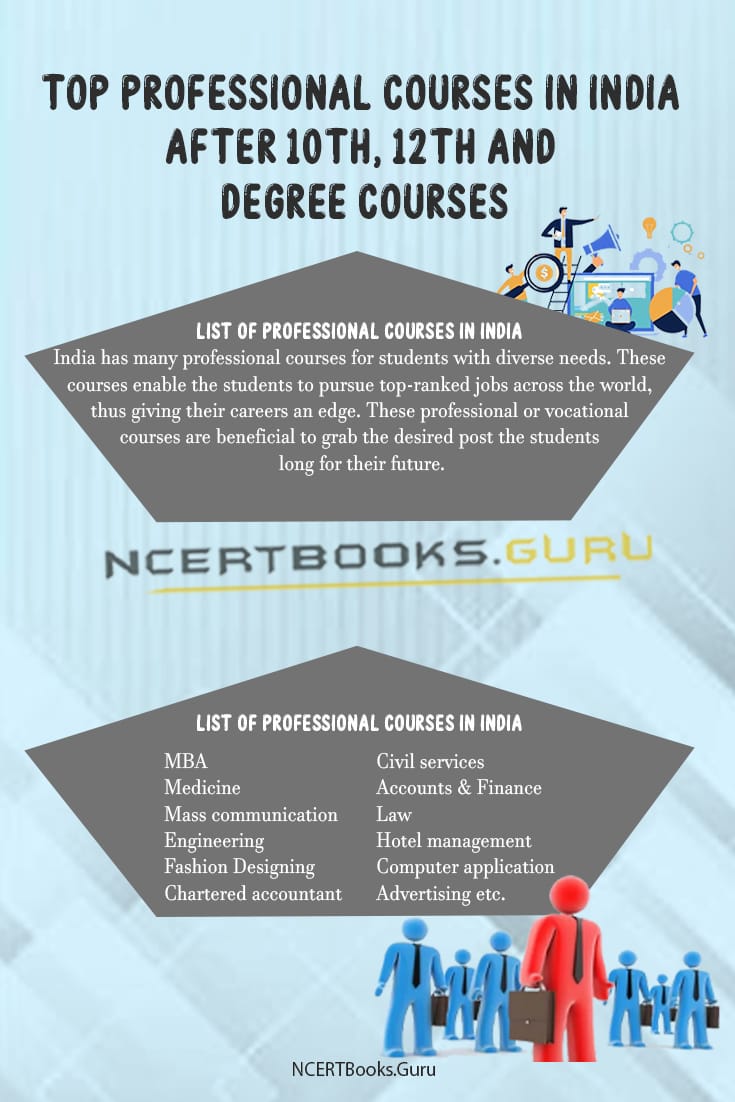
List of Professional Courses in India: India has many professional courses for students with diverse needs. These courses enable the students to pursue top-ranked jobs across the world, thus giving their careers an edge. These professional or vocational courses are beneficial to grab the desired post the students long for their future.

To pursue these professional courses in India, the candidate has to pass an entrance exam in general. There are also other eligibility criteria that a student must undergo in order to be eligible for the admission procedure of the desired professional course in India.

Most of these professional courses can be pursued after successfully passing the 10th and 12th standards in different streams. Here, we are discussing the number of professional courses available in India, how to select a professional course and prepare for it.

Get to Know More about other types of Course Details in Streamwise, and Category wise

How to Choose The Best Professional Course in India?

A student can easily search the web for choosing the best professional course in India as per their interests. The following are the steps to find and select the best professional courses in India for a bright and successful future.

  • List your Interests And Preferences: In order to pursue any course, it is necessary to first understand your interest and passion. There are many professional courses available in India such as engineering to management; the choice solely depends on the interest of the student. One can take the decision on the basis of factors such as family background, subjects preferred, hobbies and desired job.
  • Research on the Basis On Your List: Once you have your list ready, it is extremely important to look for other factors on the internet. These include courses available related to the specific course, colleges in India offering the course, duration, fees, scope and eligibility of the course.
  • Shortlist the Courses: Once your research is done, streamline it to the courses that will suit you the best. For instance, if you are interested in hospitality, your options are event management courses, hotel management courses, wedding planning, travel management, etc. Shortlist the ones you feel will be beneficial to you.
  • Book a Consultation Session: Now that you have a hint of what you want to pursue ahead, talk to an educational consultant to explore your options and how to pursue them. For help in understanding the admission and enrollment procedure, the consultant will advise you to prepare for certain examinations.
  • Start Prepping Up: Once all the above-mentioned procedures are fulfilled, it is time to start preparing yourself for admission. Visit the college websites, track the admission dates and start studying entrance examinations if any.

Professional Courses Admission Procedure

Most of the colleges have their own admission procedure for each student to enrol in a specific professional course. Generally, a student must have passed 10th or 12th standard with a minimum or 45 to 50% to be eligible for the entrance examination. One must visit the college or university website or go through the brochure for a better understanding.

Also, Check

List of Professional Courses in India

There are a vast number of top professional courses in India that can be pursued by different streams. The students with diverse interests and pick the course that they prefer from the list given below.

  • Master of Business Administration
  • Medicine
  • Mass communication
  • Engineering
  • Fashion Designing
  • Chartered accountant
  • Civil services
  • Accounts & Finance
  • Law
  • Hotel management
  • Computer application
  • Professional photography
  • Interior Designing
  • Nursing
  • Baking and confectionery
  • Travel and tourism
  • Animation
  • Advertising
  • Creative writing
  • Digital marketing
  • Web Designing

List of Professional Degree Course in India

Apart from the above mentioned professional courses, one can also pursue a professional degree course. The professional degree courses are longer and tougher than professional diplomas or certifications. However, the scope of job and career are abundant once a student completes the degree course.

  • Management MBA/BBA
  • Engineering B.Tech and B.Arch, M.Tech, ME, BE
  • Arts – psychology, history, sociology
  • Computer Application-BCA/MCA
  • Fine arts – B.F.A
  • Education- B.Ed, M.Ed
  • Designing – Fashion/Interior/Web
  • Mass-communication/Journalism BJMC
  • Pharmacy – B.Pharma, M.Pharma
  • Hospitality – Hotel Management
  • Medical-BDS and MBBS
  • Nursing – B.Sc. M.Sc.
  • Dental- BDS
  • Finance – B.Com/CA/CFA/ CS
  • Architecture – B.Arch

The professional degree, diploma and certificate courses need certain preparation to pass the entrance examination. The scope and job profiles range from government organizations to private organizations. The individual can also become an entrepreneur or freelancer after pursuing these courses.

Professional Courses in India

FAQ’s on List of Professional Courses in India

Question 1.
How to choose a professional course?

Answer:
To select a professional course, a student should list down his or her interests, research about the topics, talk to a consultant and start tracking the college information.

Question 2.
What is the duration of professional courses?

Answer:
Professional diplomas and courses can last from 1 month to up to 6 months of duration with additional industry exposure.

Question 3.
What is the duration of the professional degree course?

Answer:
Professional degree courses last up to 3 to 5 years of duration including industry exposure, internship and placement opportunities.

Question 4.
What are the eligibility criteria for professional courses?

Answer:
A student needs to pass the 10th or 12th standard with a minimum or 40 to 50% to be considered eligible for any professional courses. Other factors vary depending on the college and course.

M.Ed Course | Details, Eligibility Criteria, Scope, Salary, Career Opportunities

M.Ed Course

M.Ed Course: Pursuing a Career in Education will allow you to make significant differences in young minds as teachers, professors, facilitators and instill them with the requisite values, outlook eventually shaping their worldviews. Apart from the morality and contentment associated, Education Industry is rapidly expanding as it is a prerequisite for the development of Human Capital. With Ed-tech and Online Education gaining significant currency lately, a degree in Education leaves one with ample scope and opportunities in various fields of this Industry.

This is why a Career in Education just not provides unparalleled contentment but at the same time is lucrative. In order to pursue a career in this sector, A Masters in Education, also known as M.Ed becomes requisite. And this is what this blog is dedicated to- providing a brief overview of the course and opportunities in M.Ed.

In this article we would be discussing the course structure of M.Ed- essentially what can expect from the course and the pedagogy, the duration of the course, requisite skill sets, the fees required to pursue this course, and industry domains/career option along with their salary structure.

Get to Know More about other types of Course Details in Stream wise, and Category wise.

M.Ed Course Overview

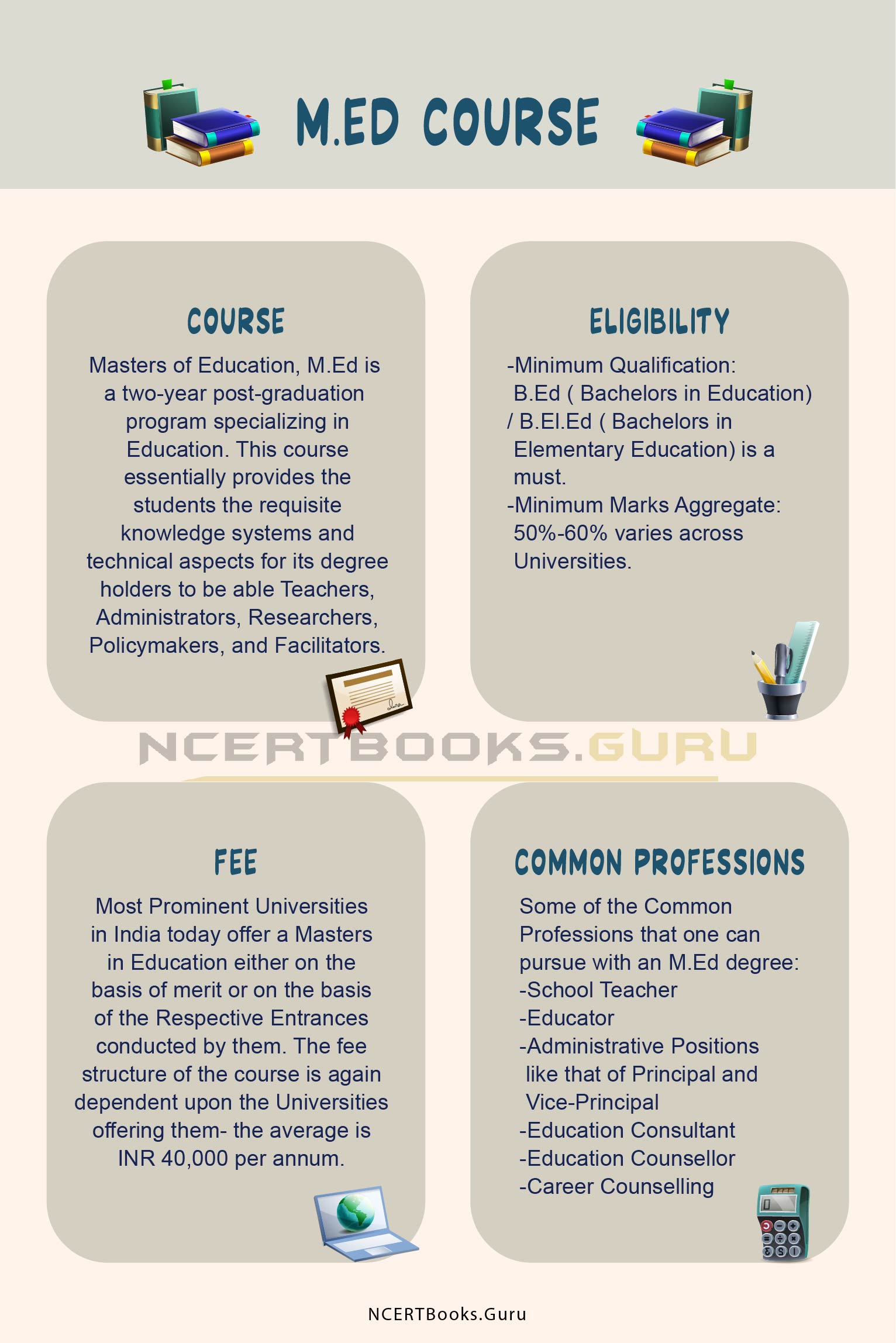
Masters of Education, M.Ed is a two-year post-graduation program specializing in Education. This course essentially provides the students the requisite knowledge systems and technical aspects for its degree holders to be able Teachers, Administrators, Researchers, Policymakers, and Facilitators. Since Education is a pivotal factor in ensuring a country’s development, there have been massive investments both by the Government and Private Groups, resulting in exponential growth and development in this industry, providing a multitude of career openings.

M.Ed Course Eligibility Criteria

Candidates who clear the following criteria are eligible to apply for the MEd Programme.

  • Minimum Qualification: B.Ed ( Bachelors in Education)/ B.El.Ed ( Bachelors in Elementary Education) is a must.
  • Minimum Marks Aggregate: 50%-60% varies across Universities.

M.Ed Course Structure

Essentially being a two-year postgraduate program, students here are made to develop competencies required in the various domains of this Industry- from the technical aspects to the research modules to policymaking. The course structure essentially encompasses knowledge systems and pedagogy required in the field of instruction, curriculum, policymaking, counseling, leadership, and education technology.

M.Ed Course Scope/Salary/Career Opportunities

A degree in Masters in Education enables one to develop all the technical finesse and competencies required to make your mark in the industry. This two-year postgraduate course also comes with specializations— Education Management, Language Management, Environment Education, Education Policy, etc.

As mentioned before, there has been exponential growth in this industry, both by Public and Private Players. Ed-Tech Industry is, in fact, one of the fastest-growing and an industry that holds immense potential. Several Educational Startups as well as Unacademy, Byjus are turning into big giants providing several career opportunities to the area, blooming owing to this growth.

Some of the Common Professions that one can pursue with an M.Ed degree:

  • School Teacher
  • Educator
  • Administrative Positions like that of Principal and Vice-Principal
  • Education Consultant
  • Education Counsellor
  • Career Counselling

The salary structure of an M.Ed degree holder is again variable, depending upon the posts. In most cases, it would range across INR 6 LPA- INR 9 LPA.

Universities Offering M.Ed Course

Most Prominent Universities in India today offer a Masters in Education either on the basis of merit or on the basis of the Respective Entrances conducted by them. The fee structure of the course is again dependent upon the Universities offering them- the average is INR 40,000 per annum.

M.Ed Course

FAQ’s on M.Ed Course

Question 1.
Which are the best colleges offering a Masters in Education?

Answer:
While every major University would have a Masters in Education, some of the prominent names in the country are:

  • Tata Institute of Social Sciences, Mumbai.
  • Christ University, Bangalore
  • Aligarh Muslim University
  • Delhi University
  • Azim Premji University, Bangalore.

Question 2.
How to apply to these Universities?

Answer:
Most of the Universities in Postgraduate Level conduct their respective Entrances. Please visit the website and contact the help desk of the respective Universities to know more about them. You can also connect with our Representative today to know more about the procedures in detail.

Question 3.
What is the scope after doing an M.Ed from these Colleges?

Answer:
As mentioned earlier, the opportunities after obtaining an M.Ed degree from these Reputed Universities are immense. You could further go for higher studies to base a career in Research and Academia or you could work as a Consultant, Career Counsellor, or even as an Administrator, etc. The salary structure ranges from INR 6 LPA- INR9 LPA.

List of Dental Courses in India – Admission, Eligibility, Entrance Exams, Colleges, Fees, Career & Scope

Dental Courses

List of Dental Courses after 12th: Dentistry is a field of study that is all about diagnosis, prevention, and treatment of diseases and conditions of the oral cavity. It has been a popular course after MBBS and many students undergo Dental Courses every year. It has a wide range of opportunities in both the public and private sectors. Learn all about Dental Courses Admission Process, Fee Structure, Eligibility Criteria, Colleges List, Entrance Exams, Salary Offered by referring to the entire article.

List of Dental Courses after 12th

Students willing to pursue their Dental Courses after 12th can have a glance at the below sections. In order to access the course details, you just need to click on the quick links available. Get acquainted with the entire details like Admission Process, Course Duration, Fee Structure, Entrance Exams, Scope, etc.

Eligibility Criteria for Dental Courses

Candidates must have finished their 10+2 from a recognized board with a minimum aggregate in order to pursue an Under Graduation Course. For PG Courses one needs to finish their UG from a recognized board or university. For Doctorate Courses you need to complete PG from a recognized board or university with a minimum aggregate.

Dentistry Courses Admission Procedure

Admission to Dental Courses is provided on the basis of their performance in Entrance Exams. Some of the colleges will provide admission on basis of a merit list in 12th standard.

Dentistry Course Duration

Course Duration for Dental Courses varies depending on the level of study. To help you out we have listed the UG, PG, Diploma, and Certificate Dentistry Courses below. Get an idea by referring below.

  • Certificate: 6 month – 1 year
  • Diploma & PG Diploma: 2 year
  • UG: 5 years
  • PG: 3 years
  • Doctorate: 3 – 6 years

Dental Courses Fee Structure

Fee Structure for Dentistry Courses List varies based on the level of study. Check out the Certificate, Diploma, UG, PG, Doctorate Dental Courses Average Fee Structure. They are as such

  • Certificate: INR 1.5 – 4 lakhs
  • Dental Diploma Courses & PG Diploma: INR 3 – 12 lakhs
  • UG: INR 1 – 6 lakhs
  • PG: INR 10 – 25 lakhs
  • Doctorate: INR 10K – 15 lakhs

Top Dentistry Courses Colleges List

Check out the Dental Colleges List in India provided below and have an idea of which college to join. They are in the following fashion

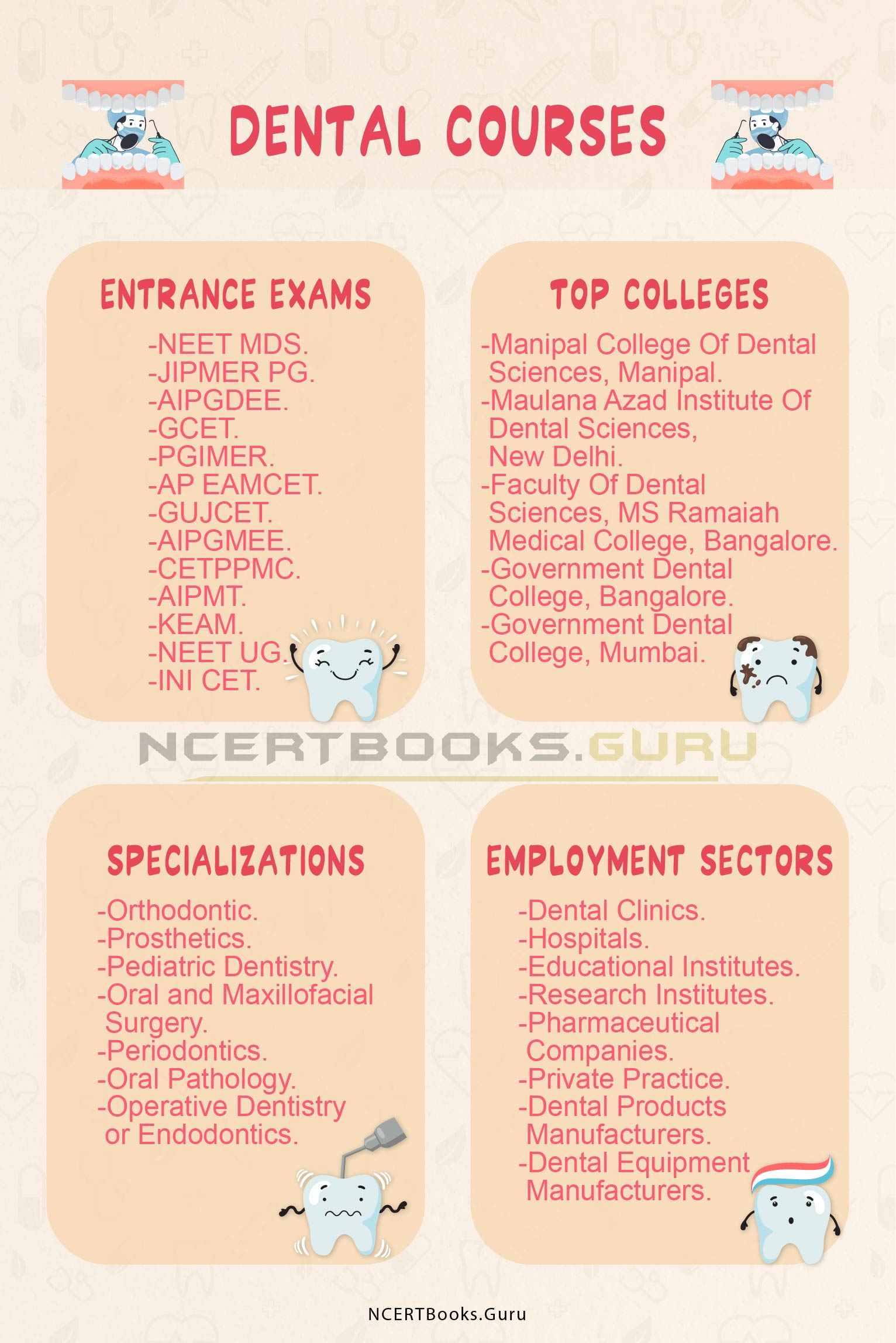
  • Manipal College Of Dental Sciences, Manipal
  • Maulana Azad Institute Of Dental Sciences, New Delhi
  • Faculty Of Dental Sciences, MS Ramaiah Medical College, Bangalore
  • Government Dental College, Bangalore
  • Government Dental College, Mumbai
  • SDM College Of Dental Sciences, Dharwad
  • Faculty Of Dental Sciences, King George’s, Lucknow
  • Manipal College Of Dental Sciences, Mangalore
  • Christian Dental College, Ludhiana
  • Dr. R. Ahmed Dental College, Kolkata

List of Dental Entrance Exams in India

Candidates can get admission into the colleges by clearing the Dental Entrance Exams. We have listed the popular entrance exams held nationally for both UG, PG Courses. They are in the following fashion

  • NEET MDS
  • JIPMER PG
  • AIPGDEE
  • GCET
  • PGIMER
  • AP EAMCET
  • GUJCET
  • AIPGMEE
  • CETPPMC
  • AIPMT
  • KEAM
  • NEET UG
  • INI CET

Specializations in Dental Courses

Students willing to pursue Dental Courses can check out the specializations that you can opt for. They are as such

  • Orthodontic
  • Prosthetics
  • Pediatric Dentistry
  • Oral and Maxillofacial Surgery
  • Periodontics
  • Oral Pathology
  • Operative Dentistry or Endodontics

Read More:

Employment Opportunities for Dental Courses

Students after pursuing the Dentistry Courses can have Employment Opportunities in the following sectors. They are along the lines

  • Dental Clinics
  • Hospitals
  • Educational Institutes
  • Research Institutes
  • Pharmaceutical Companies
  • Private Practice
  • Dental Products Manufacturers
  • Dental Equipment Manufacturers

List of Dental Courses in India

Jobs after Dental Courses

Candidates after finishing Dental Courses can join different job roles as per their specializations. Some of them are given below

  • Consultant
  • Dental Assistant
  • Oral Pathologist
  • Professor
  • Dental Lab Technician/ Ceramist
  • Public Health Specialist
  • Medical Representative/ Sales Representative
  • Private Practitioner
  • General Dentist
  • Dental Surgeon
  • Endodontist
  • Pediatric Dentist
  • Orthodontist
  • Researcher

Average Salary Offered to Dental Professionals

Candidates after finishing their Dental Courses can Earn an Average Salary of 2 – 5 Lakhs. However, the salary mentioned isn’t exact and it depends on the sector and the firm you have joined. Salary will not be the constraint if you have enough experience and you can demand more.

FAQs on Dental Courses

1. What is the Eligibility Criteria for Dental Courses?

UG: Candidates must have finished their 10+2 from a recognized board with a minimum aggregate

PG: Candidates needs to finish their UG from a recognized board or university.

Doctorate: You need to complete PG from a recognized board or university with a minimum aggregate.

2. What are the Job Opportunities for Dental Courses?

Candidates will have the following job opportunities after completing their Dental Course. They are as under

  • Dental Surgeon
  • Endodontist
  • Pediatric Dentist
  • Orthodontist
  • Researcher

3. Is Dentistry hard?

There is no such thing as hard or easy. If you put enough effort in studying dentistry is never tough and you can clear the course with flying colors.

Summary

Hope the knowledge shared regarding the Dental Courses has shed some light on you in clearing your queries. If you need any assistance feel free to reach us and we will revert back to you at the earliest. Bookmark our site for more updates on Course Details in a matter of seconds.

B.Com Taxation Course | Duration, Eligibility Criteria, Admission Procedure, Employment Prospects

B.com Taxation Course

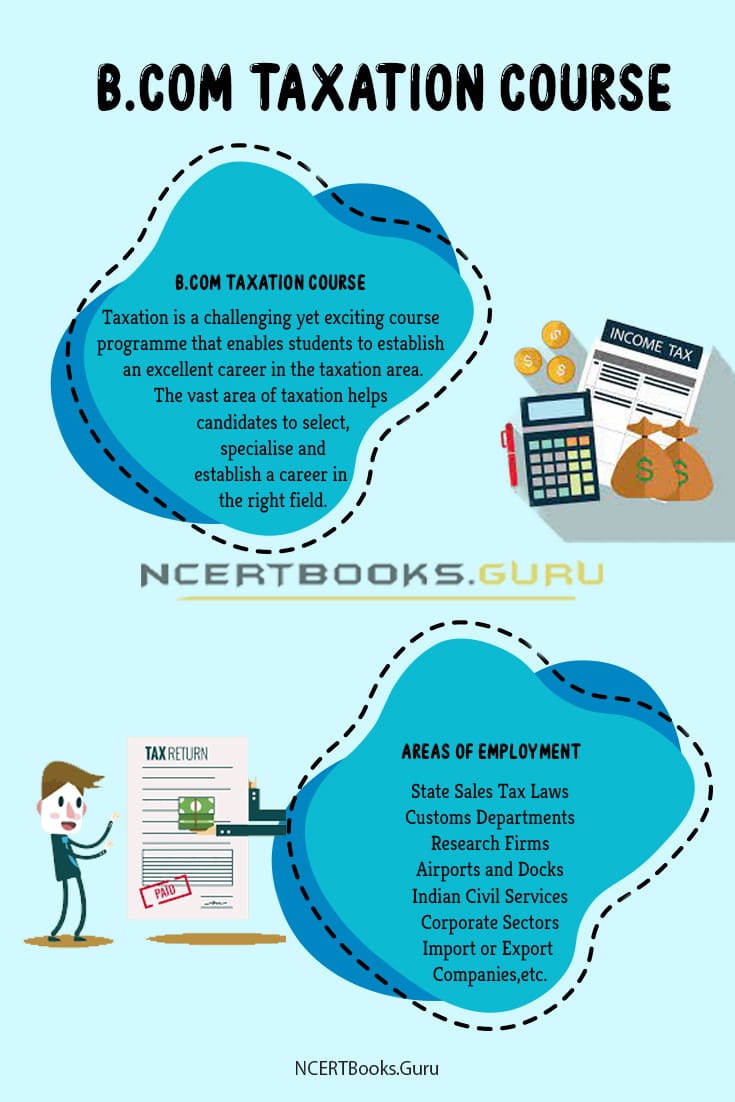
B.Com Taxation Course: Taxation is a challenging yet exciting course programme that enables students to establish an excellent career in the taxation area.

The vast area of taxation helps candidates to select, specialise and establish a career in the right field and also offers a broad scope for aspirants to either opt for higher education and choose a career or opt for government jobs such as government accountants.

The article on the B.Com Taxation course programme provides a comprehensive analysis of the course and its successful job-oriented career in the management arena. The B.Com Taxation report encompasses topics such as – course details, duration, eligibility, admission, curriculum and employment prospects.

Get to Know More about other types of Course Details in Stream wise, and Category wise.

About B.Com Taxation Course

B.Com Taxation is a three-year-long undergraduate programme that prepares and trains students in the field of accounting, financing, and Taxation. The course programme exposes students to the details of indirect taxes like customs tax, wealth tax, and central excise tax and other allied fields like accounting and financing.

The minimum eligibility criterion to pursue the B.Com Taxation course is 10+2 level of graduation from a recognised board or equivalent in the country with a minimum of 50 percent or more from any stream. The course programme offers an overview of the microeconomic theory and financial structure that emphasis on tax evaluation.

B.Com Taxation enables students to develop a successful career and trains them as qualified professionals to work in various organisations, government, banks, offices, and other establishments and sectors of Accounts and Finance bureaus. Graduates are exposed to a broad spectrum of employment opportunities.

B.Com Taxation Course Highlights

Course Name B.com Taxation
Course Level Undergraduate-level
Course Duration Three years with six semesters.
Age Limit The lower age limit is 18 years, and there is no applicable upper age limit specification.
Eligibility Criteria Candidates should have completed the 10+2 level of graduation from a recognised board or equivalent in the country with a minimum of 50 per cent or more from any stream with any one of the subjects like Accountancy, Business Studies, Economics or Mathematics at an intermediate level.
Candidates belonging to the reserved category hold 5 per cent relaxation.
Placement Opportunities State Sales Tax Laws, Customs Departments, Research Firms, Airports and Docks, Indian Civil Services, Corporate Sectors, Import or Export Companies, Excise Departments, Public Accounting Firms, Indian Economic Services, Economic Consulting Offices, Budget Planning, Merchant Banking, and more.
B.Com Taxation Jobs Accounts Assistant, Tax Manager, Cost Accountant, Business Analyst, Corporate Analyst, Risk Analyst, Tax Collector, Employment Tax Specialist, Tax Consultant, Accountant, Tax Examiner, Equity Research Analyst, Tax Attorney Specialist, Revenue Agent, Tax Advisor, and more.
B.Com Taxation Salary Offered Rs. 40,000 to Rs. 60,000 per month
Advanced Courses M.Com. (Taxation)
Similar Courses B.Com. (Hons.) (Taxation)

Skillset Required for B.Com Taxation Course

Candidates who want to opt for B.Com Taxation course programme must adopt skills and qualities that enable them to perform better-

  • Mathematical skills
  • Commercial awareness
  • Working knowledge of M.S Excel
  • Elementary knowledge of taxes
  • Communication skills
  • Problem-solving skills
  • Numeracy skills
  • Attention to details
  • Time management skills

B.Com Taxation Course Duration

The course duration for B.com Taxation course is a three-year-long undergraduate course programme that follows the semester system of education. The entire course programme is distributed into six semesters, with each semester lasting for six months.

B.Com Taxation Course Eligibility

The eligibility conditions are highly subjective and may vary from one institution to another institution. However, the standard eligibility requirements followed by several reputed universities or institutions offering B.Com Taxation course programme is listed below-

  • Candidates should have completed the 10+2 level of graduation from a recognised board or equivalent in the country.
  • Candidates must have secured a minimum of 50 per cent or more from any stream with any one of the subjects like Accountancy, Business Studies, Economics or Mathematics at an intermediate level.
  • Candidates belonging to the reserved category hold 5 per cent relaxation.
  • Candidates belonging to the reserved category must present their reservation certificates issued by the competent authorities.

B.Com Taxation Course Admission Process

The admission protocol for B.com Taxation course is conducted either through Direct admissions or Merit-based admissions.

  • Entrance-Based Admission: Several institutions or colleges follow the entrance-based admission process, wherein the institutions offer a standard entrance test. Students have to make an application to be eligible for such exams. Students who qualify for the university-level entrance examinations get through the admission for the course programme.
  • Merit-Based Admission: Colleges that conduct the merit-based admission process carry out the selection process either through a personal interview or a group discussion. Most institutions shortlist candidates based on their past academic education, while the personal Interview and the group discussion add on as a bonus.

B.Com Taxation Course Entrance Examinations

A few of the well-known entrance examinations for the B.Com Taxation course programme is listed below:

  • Central Universities Common Entrance Test
  • Jammu University Entrance Test
  • Jamia Millia Islamia Entrance Exam
  • Maharshi Dayanand University Common Entrance Exam
  • Indraprastha University Common Entrance Test

Also, Check

B.Com Taxation Course Fee Structure

The average annual fee structure for B.Com in Taxation offered at most colleges or universities in India fluctuates between Rs 5,000/- to Rs 5,00,000/- per annum. However, government institutions or universities provide the B. Com Taxation course programme for a lesser fee amount over private colleges or institutions.

The factors that affect the fee structure include ownership of the institution, management quotas, materials, infrastructure, and reputation of the college in the global market.

B.Com Taxation Subjects List

B. Com Taxation course programme is categorised into six semesters and aims to cover all the essential concepts in the field of Taxation and Business mathematics. Get B.Com Taxation Syllabus, B.Com Taxation Books details in the following sections.

Semester I Semester II
Central and State Sales Tax Procedure and Practice Part I Central and State Sales Tax Procedure and Practice Part II
Business Economics Business Mathematics
Financial Accounting Indian Tax System and Income Tax
Indian Tax System and Income Tax Financial Accounting
Business Mathematics Business Management
Business Management Business Economics
Semester III Semester IV
Direct Tax on Employers Obligation Part  I Corporate Law
Business Statistics Business Statistics
Corporate Law Direct Tax on Procedure and Practice
Direct Tax on Procedure and Practice Corporate Accounting
Corporate Accounting Business Regulatory Framework
Business Regulatory Framework Wealth Tax
Semester V Semester VI
Indirect Tax: Central Excise Duty Indirect Tax: Provisions of Custom Duty
Cost Accounting Cost Accounting
Taxation Law Financial Management
Financial Market Operations Indirect Tax: Procedure and Practice
Accounting for Management Taxation Law
Indirect Tax: Procedure and Practice Auditing

B.Com Taxation Colleges

B.Com Taxation course programme is offered in several reputed institutions. Listed below are the top ten institutions along with their location that offers the B.Com Taxation course in India.

  • Institute of Management,- Christ University, Bangalore
  • St. Andrews College of Arts, Science, and Commerce, Mumbai
  • Shri Ram College of Commerce, New Delhi
  • Loyola College, Chennai
  • Hindu College, Delhi
  • St. Xavier’s College, Mumbai
  • St Joseph’s College of Commerce, Bangalore
  • Symbiosis College of Arts and Commerce, Pune
  • Jamia Millia Islamia, New Delhi
  • Maharshi Dayanand University, New Delhi

B.Com Taxation Course

Employment Prospects for a B.Com Taxation Graduate

B.Com in TaxationTaxation is a broad course that encompasses an ample variety of employment opportunities for graduates in both government and private sectors. B.Com Taxation opens the door to a plethora of options with a high pay package from which graduates can choose a suitable profile of their interest and comfort.

Areas of Employment

B.com Taxation course graduates from allied areas can choose their domain that interests them or which they can specialise in, such as-

  • State Sales Tax Laws
  • Customs Departments
  • Research Firms
  • Airports and Docks
  • Indian Civil Services
  • Corporate Sectors
  • Import or Export Companies
  • Excise Departments
  • Public Accounting Firms
  • Indian Economic Services
  • Economic Consulting Offices
  • Budget Planning
  • Merchant Banking
  • Banking Sectors
  • Treasury and Forex Department

B.Com Taxation Jobs | Best Career Options After B.Com Taxation

With adequate experience, graduates from the field of Taxation. Taxation can advance up to the job profiles such as-

  • A Tax Policy Analyst
  • A Tax Collector
  • A Tax Attorney Specialist
  • An Auditing Clerk
  • A Cost Accountant
  • A Bookkeeping Staff
  • A Personal Finance Consultant
  • A Senior Accountant
  • A Financial Analyst
  • A Tax Manager
  • A Risk Analyst
  • A Budget Analyst
  • An Accountant
  • An Investment Banker
  • A Tax Advisor
  • A Market Analyst
  • An Accounts Assistant
  • A Tax Consultant
  • A Revenue Agent
  • A Tax Assistant
  • A Business Analyst
  • An Equity Research Analyst
  • A Tax Recruiter
  • An Operations Manager
  • A Corporate Analyst
  • A Money Manager
  • A Tax Examiner
  • An Employment Tax Specialist
  • Marketing Manager
  • An Investments Analyst
  • A Securities Analyst

B.Com Taxation Salary

The average annual salary of a B.com Taxation graduate can fluctuate anywhere between Rs. 40,000 to Rs. 60,000 per month, initially. However, those graduates with ample experience and professional skills acquired through the years of working in the field can earn up to Rs. 70,000 to Rs. 1 Lakh per month.

FAQ’s on B.Com Taxation Course

Question 1. 
What is the overall course duration offered for the B.Com Taxation course programme?

Answer:
The course duration for the B.Com Taxation course is a three-year-long undergraduate course programme that follows the semester system of education. The entire course programme is distributed into six semesters, with each semester lasting for six months.

Question 2. 
What are the other specialisations to pursue in B.Com?

Answer:
Some popular specialisations for the B.Com Course programme are commerce, corporate secretaryship, secretarial practice, economics, financial markets, capital, and marketing.

Question 3. 
What are the various skills needed for aspirants interested in Taxation?

Answer:
Candidates who want to opt for the B.Com Taxation course programme must adopt skills and qualities that enable them to perform better like mathematical skills, commercial awareness, working knowledge on M.S excel, an elementary understanding on taxes, communication skills, problem-solving skills, numeracy skills, attention to details, and time management skills

Question 4. 
What are the areas of employment for graduates opting for the B.Com Taxation course programme?

Answer:
A few of the employment areas that offer ample career opportunities in the field of TaxationTaxation are State Sales Tax Laws, Customs Departments, Research Firms, Airports and Docks, Indian Civil Services, Corporate Sectors, Import or Export Companies, Excise Departments, Public Accounting Firms, Indian Economic Services, Economic Consulting Offices, and more

Summary of B.Com Taxation Course

We hope that the information mentioned above regarding the B.com Taxation course details has helped improve your understanding of the subject with in-depth knowledge.
Can I Become Engineer Without Maths? | List of Best Engineering Courses Without Further Maths

Engineering Courses Without Maths

Engineering Courses Without Maths: Students who don’t feel comfortable with complex math problems and complicated equations and formulas in physics can refer to this article for better choices to avail after your intermediate or 12th class. In this article, you will be completely grasping the knowledge about the engineering courses without further maths and physics.

Are you wondering what are engineering courses that don’t require further maths? Check out this page till to an end without any fail and avail all the latest updates on engineering degree without maths.

About Best Engineering Courses without Maths in India

Earlier it was mandatory to have math as the main subject for engineering courses. But now All India Council For Technical Education (AICTE) has made it optional for the students to have math and physics for their bachelors. This was made applicable from the academic year 2021-22. This decision is a bridge for those who did not have math but want to build their career in engineering.

Now, class 12 students can easily choose subjects according to you for their bachelor’s degree. As of now there is no such restriction so you may choose any subject from Maths, Physics, Chemistry, Agriculture Biology according to you.

However, engineering requires a lot of mathematics in its beginning semesters. Despite not studying math in class 12 you must be aware of the basic concepts. As courses in data science, artificial intelligence, and machine learning require math in detail, before making your decision you must think twice.

Do Check:

Can I Study Engineering Without Maths?

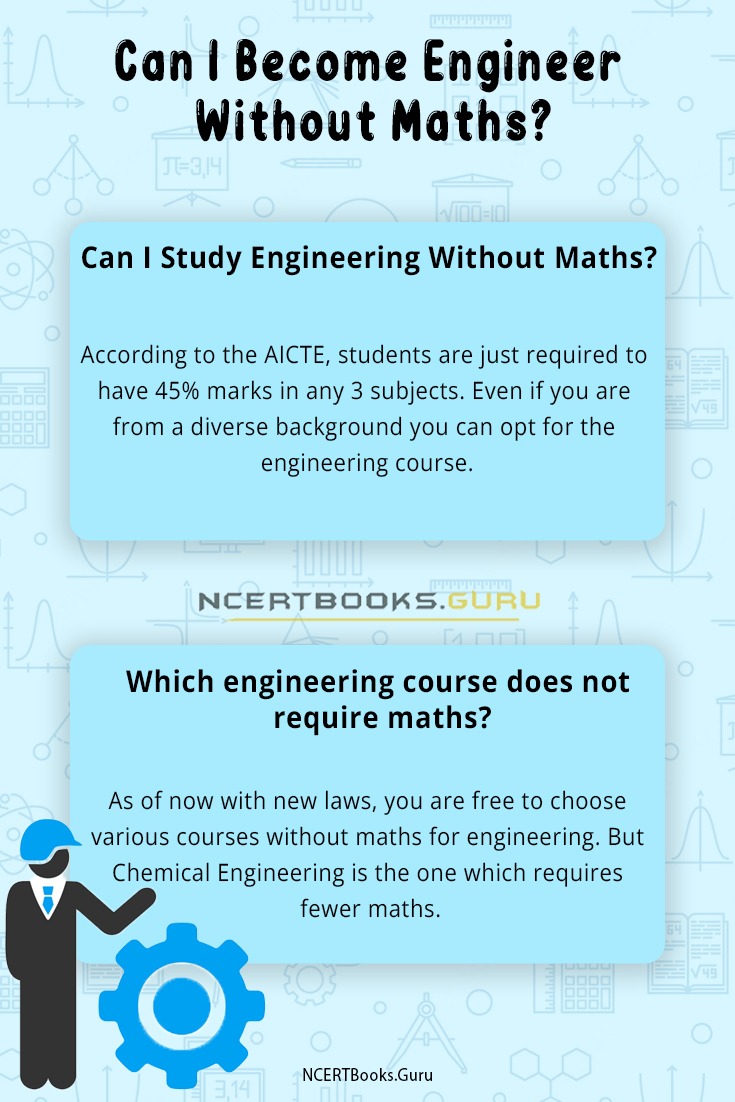
According to the AICTE, students are just required to have 45% marks in any 3 subjects. Even if you are from a diverse background you can opt for the engineering course. This will bring a lot more to the engineering background as different minds will indulge in engineering projects. Despite the course requiring a lot of mathematics but for the weaker students, this is a great opportunity to grab.

Read the complete blog, to get detailed information on the Engineering Courses Without Maths. You can read more about the List of engineering courses, entrance after class 12 for engineering, colleges that offer a bachelor of engineering courses without mathematics, and more.

Eligibility for Engineering Degree without Maths

Getting into one of the best colleges is still a dream for many. Thus, to get into the best college you must have the following:

  • Clear class 12 with 50% marks, however, it still depends from institution to institution.
  • You must have cleared JEE Mains and JEE Advanced for the topmost institutions.
  • There are few other exams for specific institutions such as KIITEE, VITEEE, BITSAT, and more.

List of Engineering Courses After 12th Without Maths

Students can go for the best engineering courses after 12th without further maths are software engineering, computer science engineering, mechanical engineering, electrical and communication engineering. But there are various other fields too after class 12 in engineering which include math subjects a lot more.

Some students are not aware of them. The duration of bachelor’s courses in engineering is 4 years. Here, you can get the complete list for the B.E and B.tech Courses after class 12th without math.

Electrical and Electronics Engineering

Automotive Electronics
Biomedical Instrumentation And Devices
Communication Engineering
Control Engineering
Digital Electronics
Electrical And Electronics Engineering
Electrical Engineering
Electronics & Communication Engineering
Electronics & Instrumentation
Electronics Engineering
Industrial Electronics
Instrumentation Engineering And Technologies
Power Electronics
Sound Engineering
Telecommunication Engineering
VLSI/Embedded Design Engineering

Civil and Construction Engineering

Civil Engineering
Coastal Engineering
Construction Engineering And Technologies
Environmental Engineering
Geotechnical Engineering
Hydraulics Engineering
Infrastructure Engineering
Municipal And Urban Engineering
Structural Engineering (Civil)
Surveying (Civil)
Transportation Engineering
Water Resources Engineering

Automotive Engineering

Automobile Design (Engineering)
Automobile Engineering
Automotive Technologies

Aviation and Space Engineering

Aeronautical Engineering
Aerospace Engineering
Aircraft Maintenance Engineering
Astronautical Engineering
Aviation Technologies
Avionics

Information and Computer Engineering

Animation And Game Design (Engineering)
Artificial Intelligence And Machine Learning
Computer Networks
Computer Networks and Information Security
Computer Science and Engineering
Data Science and Engineering
Information Science and Engineering
Information Technology
Internet of Things
Machine Learning
Mobile Computing and Application Development
Programming And Software Engineering

Agricultural Engineering

Agricultural Biotechnology (Engineering)
Agricultural Engineering
Aquaculture Engineering
Food Engineering
Irrigation Engineering

Materials and Resources Engineering

Materials Science And Engineering
Metallurgical Engineering
Mineral Engineering
Mining Engineering

Chemical Engineering

Cement Technology
Ceramic Engineering And Technologies
Chemical Engineering
Chemical Technologies
Cosmetic Science And Technologies
Dyestuff Technologies
Fibre And Textile Processing Technologies
Leather Technology
Oils, Oleochemicals And Surfactant Technologies
Paints Technologies
Paper And Pulp Technologies
Perfumery And Flavour Technologies
Petrochemical Engineering
Petroleum And Petrochemical Engineering
Petroleum Engineering
Plastic Engineering And Technologies
Polymer Engineering
Rubber Technologies
Surface Coating Technologies
Textile Engineering And Technologies

Pharmaceutical Technologies and Engineering

Pharmaceutical Technology
Pharmaceuticals And Fine Chemicals
Pharmaceutics And Pharmaceutical Engineering

Bioengineering

Biochemical Engineering
Biochemical Engineering And Biotechnology
Bioelectrical Engineering
Bioelectronics Engineering
Bioengineering
Biomechanical Engineering
Biomedical Engineering
Bioprocess Technologies
Biotechnology (Engineering)
Clinical Engineering
Food Biotechnology (Engineering)
Food Processing Technologies
Food Technology
Rehabilitation Technologies
Sugar Processing Technology

Can I Become Engineer Without Maths

Top Colleges Offers Engineering Courses without Mathematics In India

There are numerous colleges that offer B.E and B.Tech in India. But most students prefer to pursue a bachelor’s from government institutions. As getting into IITs and NITs is not an easy task. Here is the list of top private and government colleges for B.E and B.Tech in India.

Indian Institute of Technology, Madras
Indian Institute of Technology Delhi
Indian Institute of Technology Bombay
Indian Institute of Technology Kanpur
Indian Institute of Technology Kharagpur
Indian Institute of Technology Roorkee
Indian Institute of Technology Guwahati
Indian Institute of Technology Hyderabad
National Institute of Technology Tiruchirappalli
Indian Institute of Technology Indore
Indian Institute of Technology (BHU) Varanasi
Indian Institute of Technology (Indian School of Mines)
National Institute of Technology Karnataka
Anna University
Vellore Institute of Technology
National Institute of Technology Rourkela
Jadavpur University
Institute of Chemical Technology
National Institute of Technology Warangal
Amrita School of Engineering
Indian Institute of Engineering Science and Technology

Also See: Management Engineering Courses

FAQs on Types of Engineering Courses Without Maths and Physics

1. Which engineering course does not require maths? 

As of now with new laws, you are free to choose various courses without maths for engineering. But Chemical Engineering is the one which requires fewer maths.

2. Do all engineers need to be advanced with maths? 

It’s not compulsory to be advanced with maths but yes, engineering courses use mathematics in their syllabus. Due to this if you are pursuing engineering you must be aware of maths.

3. I am weak in Maths, can I go for engineering as my career option? 

Engineering requires maths, but if you are weak in the subject even then you can be engineer easily as there are various other subjects.

4. Which is the most preferable engineering course after 12th?

Engineers are required everywhere. But these days computer science engineers are in demand and they are offered a sound salary too.

Conclusion

We have included detailed information on the Engineering Courses Without Maths. If you need to find information on some more Engineering Courses, visit our website Ncertbooks.guru.

Also, if you are still confused about the details related to Btech or BE Engineering Courses without math you can ask your queries in the comment section below. Soon we will get back with the best solutions to your queries. Meanwhile, bookmark our website and dig deep with our other course details and career articles.