How to become a Human Resource (H.R.) Manager in India | Educational Qualifications, Course Duration, Fees, Eligibility, Skills, Career Options, Jobs

How to become a Human Resource (H.R.) Manager in India

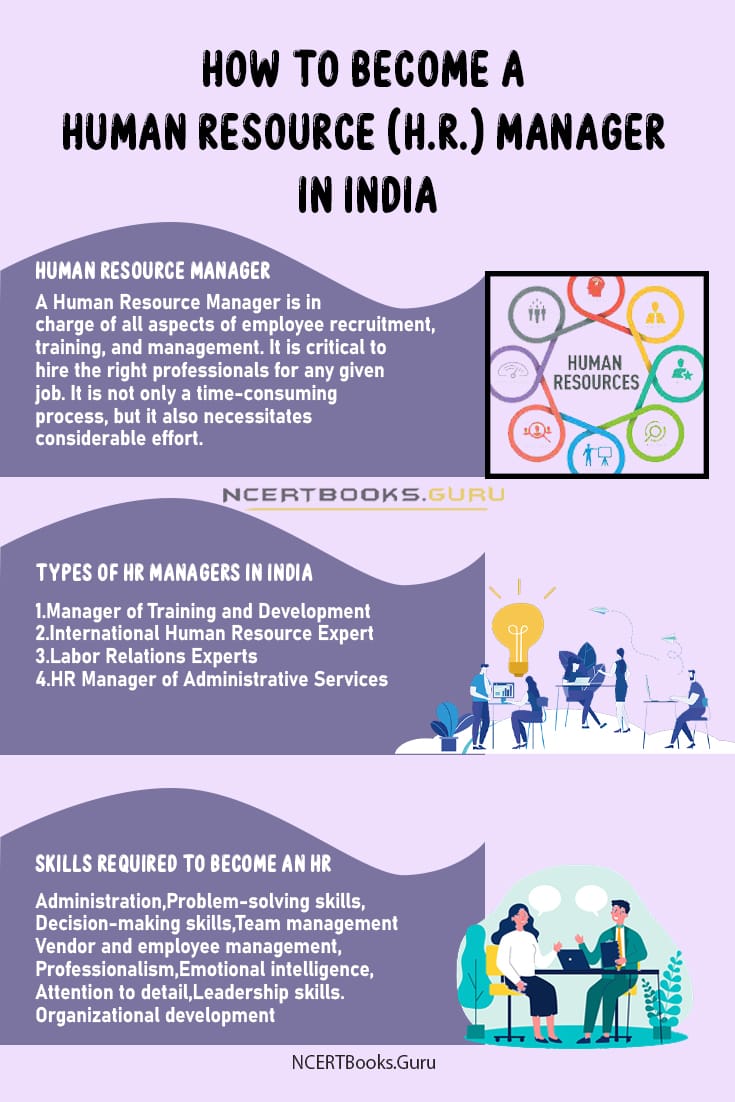
A Human Resource Manager is in charge of all aspects of employee recruitment, training, and management. It is critical to hire the right professionals for any given job. It is not only a time-consuming process, but it also necessitates considerable effort. You will have to spend a lot of money on recruiting and training them. In addition, as your company grows, it requires more new talent. It will be difficult for anyone to select the best talent from such a large talent pool and hire the best ones. This is where the Human Resource Manager comes into the picture.

It is the Human Resource Manager’s responsibility to ensure that new employees understand the company’s agenda, motto, and strategy. That is when the company will be able to profit from the employees it hires and trains. Apart from these, they should handle the company’s administrative duties. On this page let us discuss everything about how to become an HR manager in India, the required qualifications, salary, and many other aspects involved in becoming a Human Resources Manager. Read further to find more.

Table of Contents

Types of HR Managers in India

Below are some of the human resource manager job profiles,

  • Manager of Training and Development

They assist employees in improving their skillsets and careers. The groom and assist the corporation’s employees in developing their overall temperament. They are in charge of increasing the productivity of the organization’s employees and workers. They plan, coordinate, and direct programs to improve the skills and knowledge of an organization’s employees.

  • International Human Resource Expert

The profile of an international human resource professional requires one to travel the world and perform HR tasks on a global scale. They play an important role in the overall operation of the organization, not just the HR department. They are in charge of creating and implementing a unique orientation program for each employee based on where they are being relocated.

  • Labor Relations Experts

Their job is to interpret and administer labor contracts relating to organizational issues such as wages and salaries, healthcare, pensions, and union and management practices. He or she assists in the administration and facilitation of work contracts between unions, employees, and managers in an organization. Drafting proposals, communicating with union leaders and company managers, and dealing with compensation and work environment complaints are some of the common tasks of Labor Relations Specialists.

  • HR Manager of Administrative Services

Their job is to establish, direct, and coordinate auxiliary services for a company, as well as to maintain facilities and supervise activities such as record keeping, mail distribution, and office maintenance. Their primary responsibilities include mail distribution, record keeping, and office upkeep. They also supervise employee work and ensure the organization runs smoothly.

Skills Required to Become an HR Manager

Below are the skills required to become an HR Manager,

  • Administration
  • Problem-solving skills
  • Decision-making skills
  • Team management
  • Vendor and employee management
  • Professionalism
  • Emotional intelligence
  • Attention to detail
  • Leadership skills
  • Organizational development

How to Become an HR Manager in India?

The steps to becoming a Human Resource Manager in India are explained below:

  • Schooling:

After Class 10, students can choose Commerce (with or without math) to begin preparing for undergraduate courses that will help them become HR Managers in India. The section that follows discusses the step-by-step process of becoming an HR Manager after graduating from high school.

  • Graduation:

After completing Class 10+2, one must pass an entrance examination and complete a three-year undergraduate course. In India, the graduation course lasts three years, after which you must complete an internship.

  • Post Graduation:

After completing the UG degree, the candidate can do an internship for a year before continuing his or her education. A PG course will assist students in mastering the skills needed to become successful HR Managers.

Also, Read:

Courses to choose for Human Resource (H.R) Manager in India

After completing the 12th grade, a candidate can pursue a variety of courses at various levels in order to become an HR Manager.

Diploma in Human Resource Management

A Diploma in Human Resource Management is a certificate-level course in human resource management. It is a one-year program that focuses on managerial skills as they relate to the effective management of humans as a resource.

Admission Procedure for the Diploma in Human Resource Management:

Admissions to a diploma in human resource management programs are typically based on a merit-based criterion. Students who have passed their 10+2 or equivalent examinations with a minimum of 50% can apply to various institutes and colleges/institutes.

BBA Human Resource Management

BBA Human Resource Management is a three-year undergraduate program that prepares students to manage the human resources of a company or institution.

Admission Procedure for BBA Human Resource Management:

  • Top colleges for the BBA human resource management course issue application forms and selection is based strictly on merit.
  • Shortlisting and merit list preparation is done on a merit-based basis, after which the candidate is called for a personal interview.
  • For some of the top universities, such as Delhi University, the cut-off for admission to top colleges can be as high as 99 percent.
  • Some colleges also hold entrance exams to admit students to the BBA program.

Entrance Exam for BBA Human Resource Management:

Below are the entrance exams for BBA Human Resource Management,

  • DU JAT (Delhi University Joint Admission Test)
  • IPU CAT (Indraprastha University Common Entrance Test)
  • NPAT (National Test for Programs After Twelfth)
  • SET (Symbiosis Entrance Exam)

How to Register for the Exam?

  • Fill out the application form: When visiting websites, carefully read the instructions to ensure that the form is filled out correctly.
  • Documents needed: The completed registration form is required. Documents such as Aadhaar cards, Pan cards, photographs, identity cards, 10+2 mark sheets, and so on.
  • Submission of final work: After that, double-check all of the information you’ve entered and submit the form.
  • Make your payment: The final step is to pay using a debit/credit card or net banking, if available.
  • Create a confirmation slip: Print the final confirmation page for your records.

Learn about various Course Details of different streams and join a course of your dream.

MBA Human Resource Management

MBA in Human Resource Management is a two-year postgraduate program that focuses on recruitment, management, and providing direction and guidance in organizations. This course provides training and knowledge in managing an organization’s workforce.

Admission Procedure for MBA Human Resource Management:

  • Candidates interested in pursuing an MBA in human resource management must apply to their preferred B-School.
  • It usually consists of entrance exams, group discussions, and personal interviews.
  • They must pass the entrance exam and meet the College/eligibility University’s requirements.

Entrance Exam for MBA Human Resource Management:

Below are the entrance exams for MBA Human Resource Management,

  • CAT (Common Admission Test)
  • XAT (Xavier Aptitude Test)
  • CMAT (Common Management Admission Test)
  • ATMA (AIMS Test for Management Admissions)

How to Register for the Exam?

  • Login to the CAT website.
  • Create a user ID and password after entering important information such as your name, date of birth, email address, and phone number.
  • Log in again with the User ID and password you created earlier to finish the application form.
  • Fill out all of the required information correctly, including personal information, academic information, work experience, photographs, and signatures.
  • Pay the CAT application fees using a debit/credit card or net banking, whichever is more convenient for you.
  • Print the confirmation page for future use.
How to become a Human Resource (H.R.) Manager in India

Career as an HR Manager

A Human Resources Manager is one of the most prestigious jobs in the world. If you are interested in management, this profession is ideal for you because it provides numerous career benefits and opportunities to work in the field of management.

  • High Salary

A human resource manager’s annual salary ranges between 9 and 10 lakh rupees. HR managers’ salaries vary greatly in comparison to other professions all over the world.

  • Positive Impact

In your role as an HR Manager, you will have numerous opportunities to assist others. People will come to you with personal and professional issues, and you will need to act as a mentor, career director, and psychologist to help them solve these issues.

  • Continual Learning

The HR Manager’s Continual Learning Profession allows candidates to learn at all times. Every day, you are given new and unusual tasks from customers that require a wide range of knowledge.

  • Progression in Your Career

An HR Manager’s career has no endpoint; finishing an undergraduate degree is only the beginning. After becoming an HR Manager, they can pursue post-graduate studies to increase their pay packages.

Salary for an HR in India

There is a high demand for qualified and skilled candidates for the position of the human resource manager. Salary in the profession is entirely determined by one’s skills, knowledge, experience, and level of talent. The following are some average salary figures for various aspects of human resource manager job profiles,

Profile Joining Salary
per annum (in INR)
Experience Salary –
Mid-Level per annum
(in INR)
Experienced Salary –
Senior-Level per annum
(in INR)
Training and Development Manager 300000 – 340000 340000 – 540000 900000 – Above
Administrative Services Manager 200000 – 250000 250000 – 350000 500000 – Above
Compensation and Benefits Manager 400000 – 500000 500000 – 700000 NA

FAQs on How to become an HR Manager in India?

1. What are the areas where an HR Manager works?
HR manager works in different platforms –

  • Management of companies and enterprises: 14%
  • Professional, scientific and technical services: 14%
  • Manufacturing: 12%
  • Government: 9%
  • Health care and social assistance: 9%

2. What are the skills required to become an HR Manager?
Some of the basic skills required are Decision-making, Interpersonal, Leadership, Organizational, Speaking, etc.

3. How many years does it take to become an HR Manager?
Becoming a certified human resources manager can take a minimum of five years of education and professional experience.

4. Is an HR Manager a good job?
HR is a rewarding career field for growth. HR specialist even ranked among the Best Business Jobs in America for 2019 by U.S. News & World Report.

5. Why are HR Managers high in demand?
Human resources managers’ employment is projected to grow 6 percent from 2019 to 2029, faster than the average for all occupations. Need for human resource managers increases as new companies form and organizations expand their operations.

6. What is the career growth rate of an HR manager?
The career scope for human resources managers is better than average. According to BLS, the number of employed HR managers will grow 7 percent from 2018 to 2028—faster than the 5% average for all occupations.
Diploma in Civil Engineering After 10th | Eligibility, Admission, Fees, Exams, Scope, Career Prospects, Jobs, Salary

Diploma in Civil Engineering After 10th

The ever-increasing globalization, urbanization, and industrialization, the need for the development of infrastructure not just in the urban areas but in the rural areas of the country have been coming from different areas, both from the corporate sector, the private sector, and the government sector. A man-made sustainable jungle is what everyone wants.

In the past ten years, at least 5% of India’s gross domestic product has been allocated to the improvement of infrastructure in the country. Even global rating agencies including but not limited to the United Nations have ranked countries as developed, developing, underdeveloped, or poorly developed countries based on many factors which also include an important factor of the infrastructure development.

With this kept in mind, we can say without an iota of doubt that the need for quality civil engineers to work not just in the country but beyond the borders is high and the demand for the same will keep increasing for years to come.

In this particular article on a diploma in civil engineering after 10th, we are going to give students a 360-degree holistic overview of what a diploma in civil engineering holds, how will a student’s carrier be set after diploma in civil engineering after 10th standard, and what are the companies, job prospects and salaries that one can expect after diploma in civil engineer after 10th standard.

Students just passing out of the tenth standard will be as gullible as one expected to be and it makes sense. They will be at that juncture of their life where they do not know what to do and they are looking for answers in their future. And it is this turning point in their life that will define their financial and social stability for years to come.

At the end of this article, we hope to provide answers to all your questions that one might have before pursuing a diploma in civil engineering after 10th.

What is Diploma in Civil Engineering?

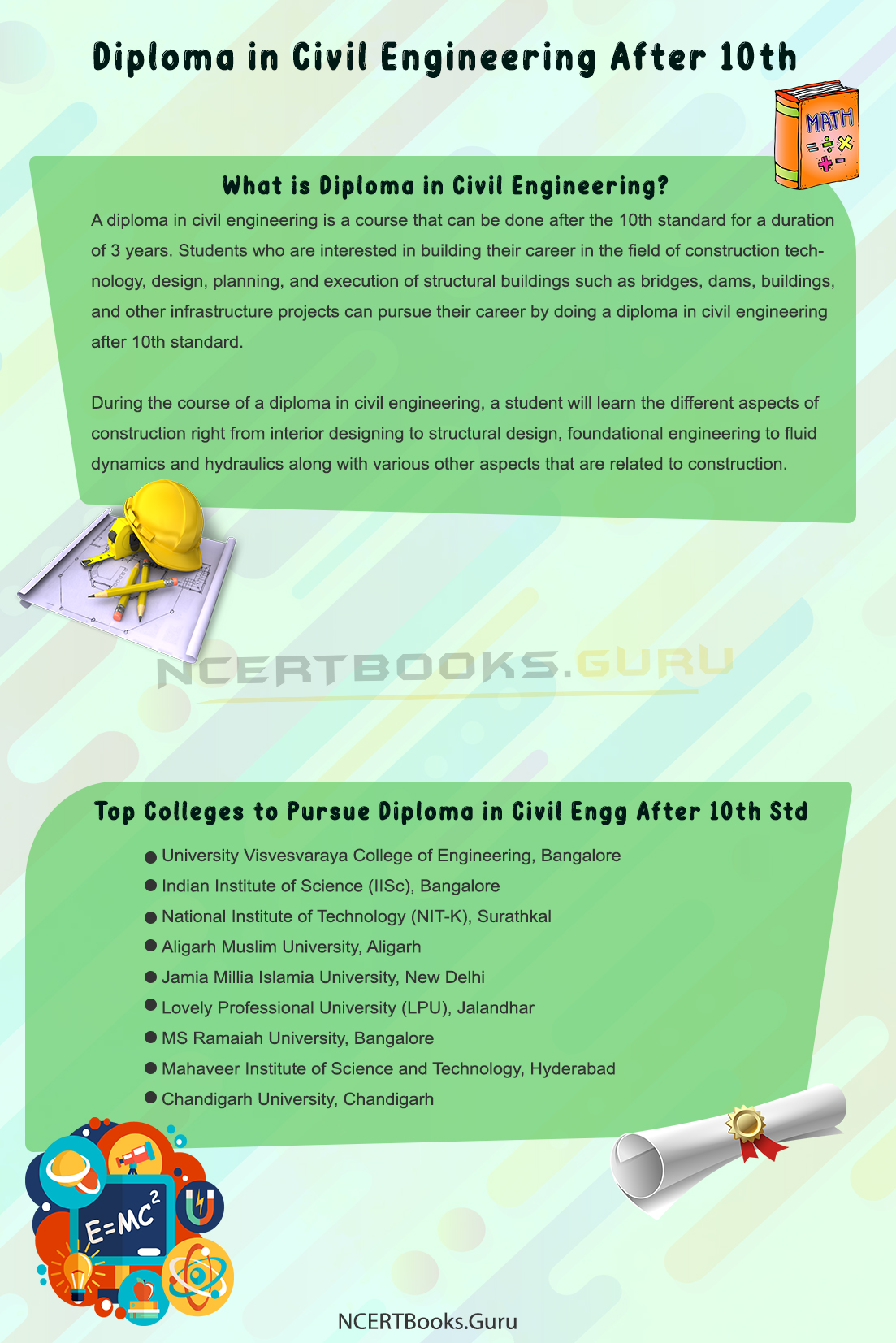
A diploma in civil engineering is a course that can be done after the 10th standard for a duration of 3 years. Students who are interested in building their career in the field of construction technology, design, planning, and execution of structural buildings such as bridges, dams, buildings, and other infrastructure projects can pursue their career by doing a diploma in civil engineering after 10th standard.

During the course of a diploma in civil engineering, a student will learn the different aspects of construction right from interior designing to structural design, foundational engineering to fluid dynamics and hydraulics along with various other aspects that are related to construction.

Diploma in Civil Engineering After 10th Eligibility

The following points will sum up the eligibility criteria for pursuing a diploma course in civil engineering after 10th?

  •  A candidate should have cleared his 10th standard from a recognized board in India such as ICSE, CBSE, or State Board.
  • A candidate should have a minimum of 50% aggregate from a recognized board in India in his or her 10th standard
  • The candidate should compulsorily be a citizen of India or of that particular state to avail of any reservation that might be in place in that particular state.

The above-mentioned criteria are those that are described by recognized boards of India. However, here in this particular article on diploma engineering after 10th standard, we have jotted down a few points that one should consider before pursuing this particular course in civil engineering:

1. A candidate whose mental aptitude and ambition are in the field of construction technology should pursue this course in diploma in civil engineering.

2. Anyone who wants to get into the industry and start working early on in their career should definitely prioritize a diploma in civil engineering after 10th standard over plus 2 (12th standard) and then a 4-year course of engineering (B.E or B.Tech). We say this because a diploma in civil engineering can make a student get into the job market as early as possible as compared to his or her counterpart who does a bachelor’s in engineering.

3. One has to remember that civil engineering is that field that keeps changing with the advent of technology and is a very dynamic arena to be in. The technology that was relevant yesterday might not be relevant at all today. And the designs that are in trend today might be completely redundant and out of trend tomorrow. Hence a student must be at the tip of his or her toe and keep updating themselves with the new technology to keep themselves competitive in this field of Engineering.

Also, Read:

Admission Procedure for pursuing Diploma in Civil Engineering after 10th Standard

The procedure of admission for pursuing a diploma in civil engineering after the 10th standard is as follows:

  • The candidate has to first give any entrance examination either on state-level or central level such as Karnataka CET, Delhi CET for TamilNadu, and clear the exam with the required cut-off.
  • Depending on the ranking and cutoff prescribed by the university of one’s choice of the particular state in that particular area, a candidate might be called for further procedures by certain universities that he or she has applied to
  • Depending on the university admission procedure, a candidate might be called for an interview procedure or he or she might directly be selected based on the score that they have secured in their entrance examination. Certain universities also take into consideration past academic records (Higher secondary scores or 10th standard scores) to assess the suitability of the candidates.
  • Usually, top colleges or top universities such as Delhi University, Alliance University of JNU conduct personal interview tests before a candidate is selected for the course of diploma in civil engineering after the 10th standard.
  • As a rule of thumb, certain universities also take into account the past academic records of the student and other extracurricular achievements before providing them a seat in their prestigious institutions

Diploma in Civil Engineering after 10th Subjects

The syllabus of diploma in civil engineering is more or less similar to the syllabus of bachelors in civil engineering except for the number of subjects which are on the higher side in the course of B.E or BTech degree.

You can find below the course structure and syllabus for a diploma in civil engineering:

  • The course of diploma in Civil Engineering is designed in such a way that in the three years of the duration, a student should have knowledge of both the theoretical aspects and the practical aspects of civil engineering.
  • The course consists of 6 semesters with 2 exams in each semester, totaling 12 exams for the entire course.
  •  At the end of the course, that is in the final year, students will have to go to a compulsory internship program and industrial visits and another such practical-based approach so that they can have a first-hand experience of the construction industry.
  • The course and pedagogy of diploma in civil engineering in most of the public universities added by AICTE is designed in such a way that theoretical knowledge that the student has gained in classrooms is easily applicable on-field during their professional career

The following are the subjects that are most common across all universities in India for a course in diploma in civil engineering

Diploma in Civil Engg after 10th Course Syllabus

  • Hydraulics
  •  Thermal engineering
  • Fluid dynamics
  • Applied mathematics
  • Design of RCC or Design of Reinforced Concrete Structure
  • Construction management
  •  Entrepreneurship and project management
  • Survey
  • Engineering drawing and Computer-Aided Engineering Drawing (CAD)
  • Concrete technology
  • Mechanics of Materials
  • Engineering dynamics
  • Geology engineering
  • Communication and Technology
  • Earthquake engineering
  • Town planning construction and design
  • Building construction and maintenance
  • Foundational and structure engineering
  • Applied physics and applied chemistry
  • Estimation, Costing, and evaluation

The above 20 subjects are the most common ones across the universities irrespective of whether it is a private or public university or its affiliation to education boards. Because the above subjects cover almost all the topics that a student needs to learn to become a civil engineer.

Studying only theoretical subjects is of no value to a student’s life if they cannot implement that in their real life. Hence, in the course of diploma in civil engineering, a student is also put through rigorous laboratory subjects and real-world applications during the three-year period. Below is the list of laboratory subjects for diploma in civil engineering

Laboratory Subjects in Diploma in Civil Engineering

  • Fluid dynamics laboratory
  • Field survey
  • Concrete laboratory
  • Earthquake engineering laboratory
  • Materials laboratory
  • Structures laboratory
  • Electrical and mechanical laboratory
  • Workshop
  • RCC and Highway laboratory
  • Field exposure

Know all kinds of course details related information all in one place and resolve all your doubts if any regarding the course in no time.

Diploma in Civil Engineering after 10th Fees

The fees for a diploma in civil engineering after 10th class might vary from INR 10,000 per year to INR 2 lakh per year depending on whether the university is private, public, deemed, deemed to be, aided, or unaided college.

However, other expenses such as books, extracurricular courses, and co-curricular activities depend on the particular student in a particular university and the particular course structure. Expenses can be highly subjective and are very dynamic in nature.

Top Colleges to Pursue Diploma in Civil Engg After 10th Std

The following is the list of colleges that one should aim for, for pursuing a course in diploma in civil engineering after the completion of their 10th standard. This list has been prepared by keeping in mind factors such as syllabus, pedagogy, faculty, infrastructure, alumni, crowd, and campus placements

  • University Visvesvaraya College of Engineering, Bangalore
  • Indian Institute of Science (IISc), Bangalore
  • National Institute of Technology (NIT-K), Surathkal
  • Aligarh Muslim University, Aligarh
  • Jamia Millia Islamia University, New Delhi
  • Lovely Professional University (LPU), Jalandhar
  • MS Ramaiah University, Bangalore
  • Mahaveer Institute of Science and Technology, Hyderabad
  • Chandigarh University, Chandigarh
  • Walchand College of Engineering

The course, structure, and syllabus at all the above-mentioned top colleges recognized by Indian education boards, are more or less similar. However, the factors mentioned above such as faculty, infrastructure, alumni network, crowd, and campus placements may vary and these are rated highest for the top 10 colleges that we have mentioned above.

Diploma in Civil Engineering After 10th

Top Recruiting Companies for Civil Engineering Diploma Candidates

  • Shapoorji and Paloji Limited
  • Kirloskar construction
  • Larsen and Toubro construction limited
  • Newton engineering and chemicals limited
  • GMR group of constructions
  • Delhi land and finance limited (DLF)
  • Essar group of constructions
  • NBCC
  • Tata Projects
  • IRCON International Limited

Jobs after Diploma in Civil Engineering After 10th

After graduation of a candidate with a diploma in civil engineering, he or she might get a job in the following positions. They are as follows

  • Engineering trainee
  • Construction engineer
  • Senior project engineer
  • Environmental engineer
  • Structural engineer
  • Earthquake engineer
  • Design engineer
  • Interior designer
  • Valuation engineer
  • Geotechnical engineer

Also, the following is the list of top recruiting companies that one can get into after a diploma in civil engineering.

FAQs on Civil Engineering Diploma after 10th

1. What is the starting salary of a graduate with diploma in civil engineering?

Starting salary will vary anywhere between INR 20,000 per month to INR 60 thousand per month depending on the competency of the student and the brand of the college that he or she is passing out from after completing a diploma in civil engineering after 10th standard

2. Which is the top college to pursue a diploma in civil engineering in India?

Any of the top IITs such as IIT Bombay, IIT Delhi, and IIT Madras are good enough to pursue a course in civil engineering.

3. Can I pursue Bachelor’s in Engineering after Diploma in Civil Engineering?

Yes, one can pursue a bachelor’s in civil engineering after completing a diploma in civil engineering through the process of lateral entry. The admission procedure for the same varies from University to University and from affiliated board to affiliated board.

4. What should I do diploma in civil engineering or a bachelor’s in civil engineering?

Diploma in civil engineering and Bachelors in Civil Engineering have their own advantages and disadvantages. A diploma in civil engineering will put you in the market earlier than the ones in Bachelors in civil engineering but many top recruiting companies prefer B.Tech holders over Diploma holders. This is a highly subjective topic and it is difficult to come to a conclusion on which is a better diploma in civil engineering or a bachelor’s in civil engineering.

How to become a Product Manager in India | Course Eligibility, Admission Process, Career Opportunities, Job Profiles, Salary

How to become a Product Manager in India

Product managers play a crucial role in bringing products to the public’s attention. A product manager is a highly organized, technically skilled employee of the organization who also possesses critical-thinking abilities and a desire to work creatively.

So if you are a person who is looking to become a product manager, then this page is for you. This article will explain everything about what is product manager, the educational qualifications required for career opportunities, salary structure, and much more. Read further to find more about the product manager role in India.

Who is a Product Manager?

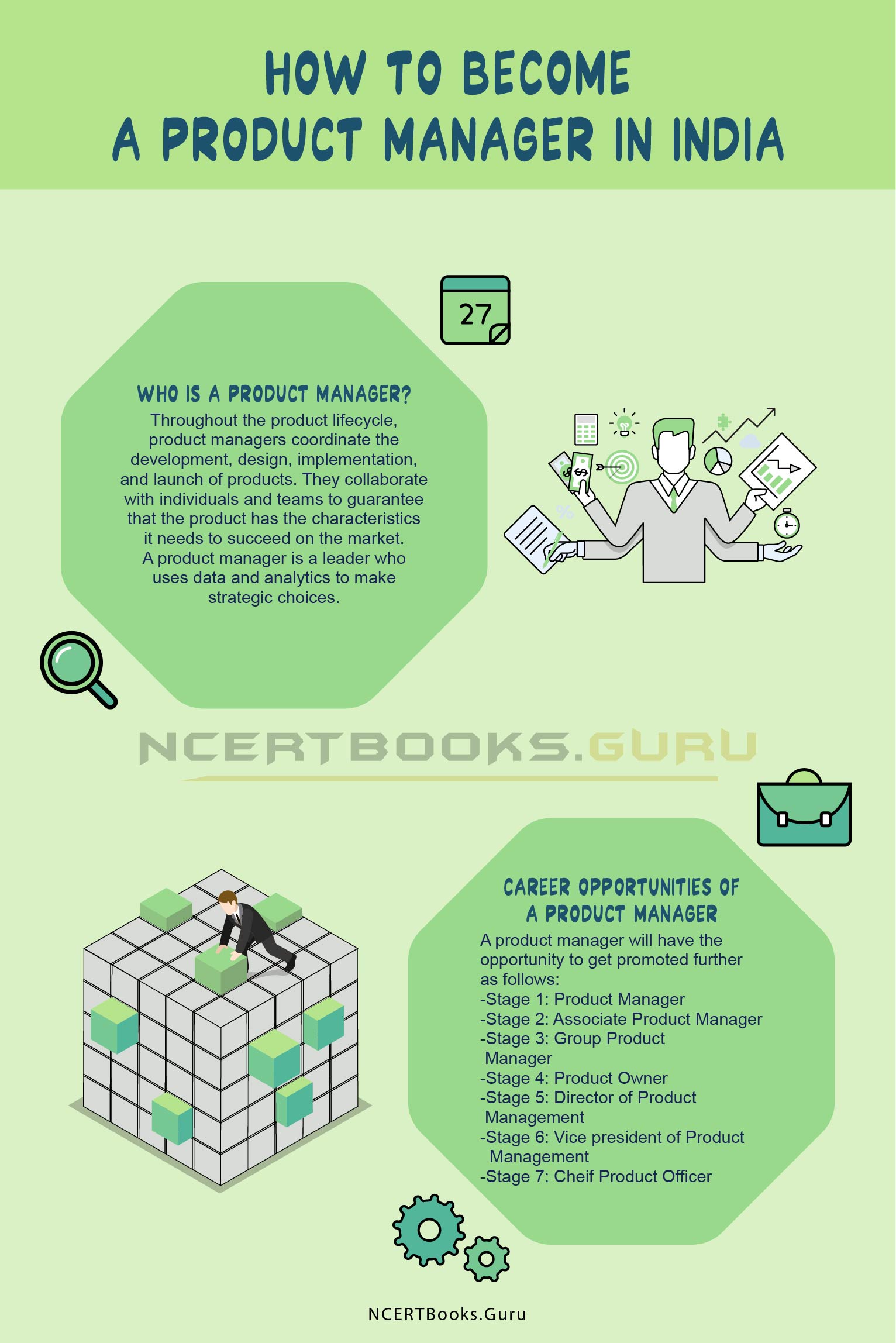
Throughout the product lifecycle, product managers coordinate the development, design, implementation, and launch of products. They collaborate with individuals and teams to guarantee that the product has the characteristics it needs to succeed on the market. A product manager is a leader who uses data and analytics to make strategic choices.

They require knowledge and understanding to make product choices since they are responsible for all aspects of development, including managing procedures such as the product backlog and roadmap, as well as appeasing stakeholders, finding investors, and speaking with potential consumers.

Product managers coordinate efforts throughout a company and with end-users and investors to assess each party’s requirements and roles and assure the completion of a working product.

How to become a Product Manager in India?

To become a product manager in India, you just need to hold a degree and have lots of experience. Apart from holding a degree, you will also need to follow the below steps to become a product manager in India.

Step 1: Choosing a Career Path

To become a product manager, you can choose one of three paths:

Enroll for MBA Programme: An MBA program in product management can help you improve your professional abilities. Aspiring product managers typically attend a school with three to five years of business experience, so they already possess some of the necessary abilities.

Undergoing Training: The Association of International Product Marketing & Management offers project management certification courses. An online course and exam are required for certification. In their education, this program incorporates international best practices in product management.

Learn While Working: In certain circumstances, a candidate may be placed in a junior product management position, learning from more experienced product managers. Product managers learn on the job and gain the abilities they need to advance in the field of product management in this ideal situation. Building a case study, doing market planning, proposing a business strategy, and performing competitive analysis are all abilities that may be learned on the job.

Step 2: Sharpen your Skills

After you have earned degrees and certifications, you will have to sharpen your skills. The skills which are essential for becoming a successful product manager in India are:

Technical Proficiency: Knowing how the product works at the code level, understanding the software development lifecycle techniques, running A/B testing, and working on product analytics are all examples of technical competence.

Empathy: The important soft skills that a product manager must have are empathy and knowing what the user wants and how the user thinks.
Creative and Strategic Thinking: Innovation and creativity are essential in the day-to-day responsibilities of a product manager, whether it’s establishing a plan to bring a product to market or responding to challenges that arise along the route.

Communication and Negotiation Skills: A product manager links various departments and stakeholders within an organisation. The job necessitates effective diplomatic, interpersonal, and communication abilities to guarantee seamless understanding and interaction between the corporate leadership, departments, and stakeholders.

Business Administration Skills: All of the other skills will be useful only if the product manager is well-organized and knows how to lead a team successfully. Organizational abilities are required to guarantee that even the most complicated project stages operate well and that the product is delivered on time and on budget.

Step 3: Apply for Leadership Course

Taking a leadership course is a simple method to enhance your CV while looking for product management jobs. Leadership training is available in a variety of formats. Look for leadership training courses online, go to a local institution or university, or ask around your network. Local chambers of commerce and professional groups are likely to provide a plethora of leadership possibilities.

Step 4: Prepare Resume

You may start preparing yourself on a resume once you have completed your product management education and skill development.

Consider the talents and courses you should include in your new product management resume. Create a compelling goal that explains why you should be recruited as a product manager. The most successful objective statements are those that are specifically customized to the job or organization to which you are applying.

Even if you haven’t worked as a product manager for a long time, you may generalize and emphasize numerous abilities that can be applied to other fields such as marketing or project management. Describe how you collaborated with product managers to achieve a goal and what role you played.

Step 5: Start Applying for Product Manager Roles in India

Now it’s time to apply for Product Manager vacancies announced by the organizations. You can hunt for job opportunities in various applications such as Linkedin, Naukri, and so on. Make sure you are reading the reviews from Glassdoor before appearing for the job interview.

Refer to the different types of course details available on our pages and clear all your ambiguities on whether to opt for a particular course or not.

Product Manager Salary in India

The following is a list of the most common product management job roles in India, along with their average salaries:

  • Product Manager – INR 1,724,129
  • Associate Product Manager – INR 964,617
  • Group Product Manager – INR 1,789,046
  • Product Owner – INR 1,542,224

Promotions and Career Opportunities of Product Manager in India

Within an organization, there are many product management job responsibilities and designations. Based on numerous aspects such as product strategy, offers, seniority level, and customers, each company will define the positions slightly differently. Furthermore, the types and sizes of companies will determine which jobs and titles are available inside the product management hierarchy.

After being a product manager in a company, you will have the opportunity to get promoted further as follows:

  • Stage 1: Product Manager
  • Stage 2: Associate Product Manager
  • Stage 3: Group Product Manager
  • Stage 4: Product Owner
  • Stage 5: Director of Product Management
  • Stage 6: Vice president of Product Management
  • Stage 7: Cheif Product Officer

How to become a Product Manager in India

Refer Similar Articles:

FAQs on How to Become a Product Manager in India

1. How to become a product manager without experience in India?

There is no option to become a product manager without experience. However, in few organizations, if you have undergone leadership training and internships, you can become a product manager.

2. How to become a product manager after the 12th?

To become a product manager after class 12, you will need to earn a degree, sharpen your skills, undergo internships, and then apply for product manager vacancies in organizations.

3. What is the product manager’s salary?

In India, the average annual salary for a Product Manager is Rs. 15,00,000. In India, the highest annual salary for a Product Manager is Rs. 27,00,000.

Food Technology Diploma Course Details | Eligibility Criteria, Colleges, Fees, Career Scope and Salary

Diploma in Food Technology

A Diploma in Food Technology is a Food Technology curriculum at the Diploma level. The food sector is extremely dynamic, and it is continually evolving to satisfy consumer expectations and incorporate technological advancements.

Diploma Food Technologists is tasked with finding innovative approaches in biotech and food manufacturing, as well as comprehending the link between food, nourishment, and wellness, as the global population grows.

The Food Technology Diploma Course equips students with the information and skills needed for quality control and research & innovation in food processing companies. If you are interested in pursuing a career in this field, we are here to show you how to get started with your Diploma in Food Technology journey.

Table of Contents:

About Diploma in Food Technology and Course Duration

Diploma in Food Technology duration ranges between 2 to 3 years depending on the institution curriculum; students can pursue Diploma in food technology as it is one of the favorable courses to choose. Food technology diploma courses are provided in a variety of disciplines, including food samples, quality control, dairy technologies, and food manufacturing.

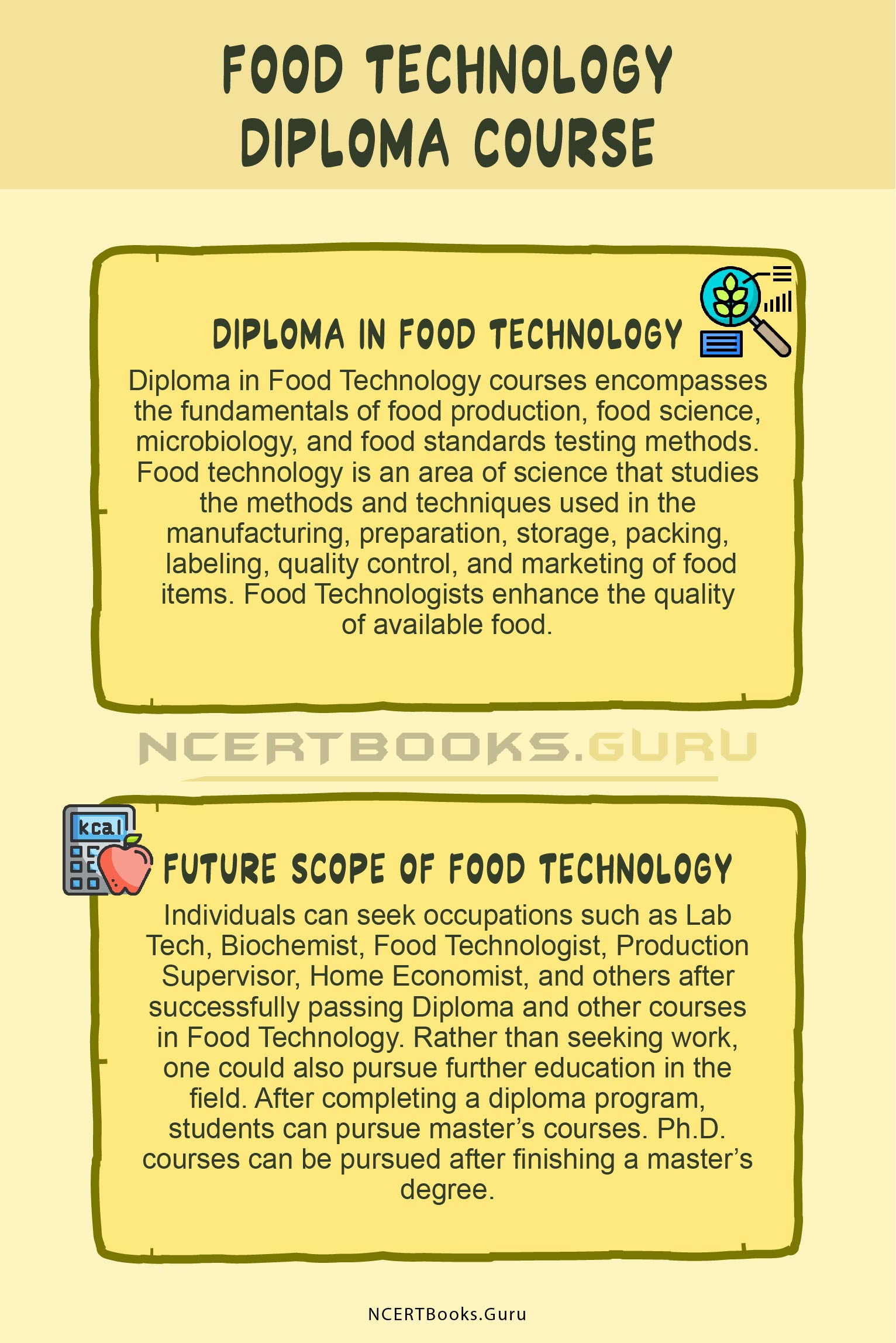
Diploma in Food Technology courses encompasses the fundamentals of food production, food science, microbiology, and food standards testing methods. Food technology is an area of science that studies the methods and techniques used in the manufacturing, preparation, storage, packing, labeling, quality control, and marketing of food items. Food Technologists enhance the quality of available food.

Also Refer:

Skills Required for Diploma Food Technology Course

Skills are the basic requirements that are needed for the successful completion of a given task. It enhances your ability to do work with expertise. Some of the skills that you will need are as follows:

  • Curiosity in food science
  • Interest in diet and health
  • Technical abilities
  • Practical abilities
  • Organizing abilities
  • Issue Resolving
  • Ability to conduct research
  • Skills in observation
  • Taking a scientific approach
  • Time management
  • Consumer market awareness
  • Analytical mind
  • Possess the ability to work with a wide range of details

Diploma in Food Technology Colleges in India with Fees

Colleges and Institutions are difficult to choose as there are a number of colleges that offer the same courses, but to help you choose among them we have listed some of the best colleges with their Type(Private/Public) and their Total Fees which will guide you to choose the best colleges.

Name of the College/University Type Total Fees
Mirmadan Mohanlal Government Polytechnic College,

Nadia

Public INR 1.8 K
UOU – Uttarakhand Open University

Haldwani

Public INR 6.65 K
 

Falakata Polytechnic College

Jalpaiguri

Public INR  1.8 K
Government Polytechnic College, Adampur

Hisar

Public INR 27 K
Government Polytechnic College, Bhiwani

Bhiwani


Public INR 27 K
Himalayan University

Dehradun

Private INR 30 K – 1.38 L
Faculty Centre for Integrated Rural Development and Management, Ramakrishna Mission Vivekananda Educational and Research Institute

Narendrapur, Kolkata

Private INR  35.1 K
Swami Vivekanand University

Sagar


Private INR  59.1 K – 84 K
Galgotias University

Greater Noida

Private INR 1.15 L
AKS University

Madhya Pradesh

Private 1.2 L

Diploma in Food Technology Eligibility Criteria

At both the undergraduate and postgraduate levels, students can pursue a degree, diploma, or doctoral program in food technology.

To undertake the curriculum at the undergraduate level, applicants must have completed Class 12th in the Science stream with courses such as Physics, Chemistry, Biology, Math, and Home Science, as well as meet the university/minimal institution’s qualification marks that range between 50% –  60%.

Admission Procedure for Food Technology Diploma Course

Admission to these programs is based on both merit and entrance examinations. Applicants are chosen for direct enrollment to a diploma-level course based on their performance in the qualifying exam.

Most Common Entrance Exams Conducted for Diploma Food Technology Course

The majority of academic institutions admit applicants to their Food Technology diploma programs based on a written entrance exam. Some universities, on the other hand, offer applicants direct admission based on their performance on the previous qualifying test. Also, many colleges and universities carry out their own entrance tests.

Some of the common exams for the Food Technology diploma course are as follows:

  • JEE Main
  • JEE Advanced
  • GATE Exam
  • UPSEE/AKTU Exam
  • VITEEE Exam
  • IPU CET Exam
  • COMEDK Exam
  • MHT CET Exam
  • JEEP 2020 (Joint Entrance Examination Polytechnic)
  • CFTRI (Central Food Technological Research Institute Entrance Examination)
  • IICPT (Indian Institute of Crop Processing Technology Entrance Examination)

Diploma in Food Technology Subjects (Syllabus)

Although the disciplines and course curricula vary depending on the program and degree, the Diploma in Food technology program covers a wide range of topics such as food processing, preservation, production, labeling, marketing, and quality assurance.

The following are some of the wide range of subjects you may anticipate studying in a Food and Technology Diploma Course.

  • Seafood and Dairy Technology
  • Applied Food Biotechnology
  • Crop Processing Technology
  • Meat and Poultry Processing Technology
  • Food Additives
  • Confectionery Technology
  • Fermented Milk Products
  • Food Analysis
  • Packaging Technology
  • Product Design & Development
  • Food Microbiology
  • Enzyme Technology
  • Food Hygiene and Sanitation
  • Nutrition and Health
  • Food Processing
  • Food Plant Layout & Design
  • Laws and Quality Assurance
  • Unit Operations in Food Processing
  • Food and Vegetable Processing Dairy
  • Plant Engineering

Best Books To Study Diploma Food Technology Course

To begin with your course, the most important things you require are your books, so here are a few lists of the books which will guide you in your journey of a Diploma in Food and Technology.

  • Introduction to Food Toxicology By Takayuki Shibamoto, Leonard Bjeldanes
  • Practical Design, Construction, and Operation of Food Facilities By J. Peter Clark
  • The Produce Contamination Problem by Karl Matthews, Gerald Sapers
  • Microwaves in the Food Processing Industry by Bernard Schweigert, Richard Mudgett, Robert Decareau
  • Starch: Chemistry and Technology by Roy Whistler, James Be Miller,
  • Statistical Methods in Food and Consumer Research by John Hawthorn, George Stewart, Bernard Schweigert
  • Food Preservation Process Design By Dennis Held man
  • The Chemistry and Technology of Pectin by Steve Taylor, Reginald Walter
  • Sensory Evaluation Practices By Herbert Stone, Rebecca Bleibaum,
  • Thermo bacteriology in Food Processing By C. Stumbo

Future Scope of Food Technology Diploma Holders

In India, Food Technology has a lot of opportunities. The Indian food processing industry is one of the world’s largest, with 9 million jobs predicted to be created by 2024.

Individuals can seek occupations such as Lab Tech, Biochemist, Food Technologist, Production Supervisor, Home Economist, and others after successfully passing Diploma and other courses in Food Technology.

Rather than seeking work, one could also pursue further education in the field. After completing a diploma program, students can pursue master’s courses. Ph.D. courses can be pursued after finishing a master’s degree. Candidates with a Ph.D. degree can work as lecturers and professors.

Diploma in Food and Technology Specializations

There are different areas of Specialization in Diploma Food and Technology where students can explore their career opportunities, some of the areas are listed below:

  • Cereals, dairy products,
  • alcoholic beverages,
  • Cereals, dairy products,
  • Vegetables and fruits
  • Processing of oil and oilseeds
  • Meat and fish
  • Sugar

Do Check:

Career Prospects in Diploma in Food Technology in India

After completing a diploma, certificate, UG, PG, or Ph.D. level Food Technology course, you will have a plethora of work prospects in India. Food companies and farms engage food technologists to produce food products all over the country.

Below are some of the job profile that is offered to the aspirants who have completed their course in Food and Technology diploma courses:

  • Food Safety Manufacturing Units
  • Laboratories
  • Processing and Distributing Units
  • Quality Assurance Units
  • Research Units
  • Storage Units
  • Food Business Management
  • Food Marketing

Food Technology Diploma Course Details

Top Recruiters Offer Jobs for Diploma Food Technology Graduates in India

You can start your career as a Food scientist or Food Technologist once you have a degree or diploma in the field or you can work for different research and development firms supervised by the government. Bachelors and diploma holders can find jobs as Food Technologists, Organic Chemists, Biochemists, etc.

Food and beverage Departments, Food Business Administration, Food Advertising, Food Manufacturing, Production Organizations, Food Hygiene Manufacturing Units, Laboratories, and other industries use dairy technologists.

Below is the list of some of the best companies that hire Degree and Diploma holders in Food and Technology:

  • Agro Tech Foods
  • Amul
  • Britannia Industries Ltd
  • Cadbury India Ltd
  • Dabur India Ltd
  • Gits Food Products Pvt Ltd
  • Milkfood
  • MTR Foods limited
  • Nestle India Pvt Ltd
  • Parle Products Pvt Ltd
  • PepsiCo India Holdings
  • Perfetti India Ltd

Diploma in Food Technology Salary per Month in India

Individuals with a diploma and another degree in Food Technology can work in both the government and private industry. A good salary package is available to the Food Technologist in a variety of work descriptions. The salary paid to diploma holders in Food Technology specialists, on the other hand, differs from firm to company and is determined by the type of activity he or she performs.

In India, a beginner can expect to earn between INR 2,00000 and INR 5,20000 per year, while an experienced Food Technology professional can expect to make between INR 5,50,000 and INR 30,00000 per year.  To better understand the salary of a job profile we have listed a few jobs along with their monthly salary:

  1. Lab Technician Average monthly salary = INR 28,730
  2. The average monthly salary for a biochemist =INR 32,800
  3. Food Technologist  Average monthly salary = INR 34,610
  4. The average monthly salary for a Production Manager = INR 63,075
  5. Home Economist Average monthly salary = INR 45,565

FAQs Related to Diploma in Food and Technology Courses

1. What purpose does food technology serve?

Food technology, in simple words, is the implementation of food science to the manufacturing, packaging, storage, marketing, quality control, and use of food items. Technology, Analytic Chemistry, Biotech, Quality Assurance, Food and Wellness, and Food Safety Practices are all part of this interdisciplinary discipline.

2. What work opportunities exist for diploma food technologists?

You will be engaged by food enterprises and farms to process food products around the country after completing a diploma certificate course in food technology in Food Technology. Graduates of Food Technology programs are typically hired by food companies and farms that prepare food products.

3. What are diary technologists’ primary duties?

A Food Technologist is someone who works with raw resources to turn them into food. Developing procedures and equipment to manufacture recipes on a big scale, maintaining that strict hygiene food safety regulations are fulfilled, producing new product concepts and ideas, etc are a few of the frequent work tasks of food technology specialists.

4. Can I take a diploma food technology course online?

It all relies on what you’re looking for. If you are a working professional trying to improve your skills, online courses are a good option. If you want to work in the sector of food technology, though, offline classes will be advantageous because they will increase networking, communication, and a variety of other abilities.

Conclusion

Food Technology is the science that is applied to improve the quality of food and make it healthier and more beneficial for us to consume. Food is one of the basic requirements of our lives, we can’t survive without food. So, the job opportunity in Food Technology is a never-ending process.

A Diploma in Food Technology will make you a trained and skilled technologist who knows the importance of food and how to improve the quality of food that will be beneficial for the individual as well as for the industry.

So if you have the interest and the passion to be a successful Food Technologist this is the field for you. Make use of the details provided in this article and give life to your dreams and make them a reality. For more career updates and other course details, visit our comprehensive website @ ncertbooks.guru

Diploma in Horticulture – Course Details, Fee, Admission Procedure, Eligibility, Career Scope & Syllabus

Diploma in Horticulture

Diploma in Horticulture: Are you fond of plants production? If yes, then you can choose a horticulture course after the 10th standard. Here we have given the complete guide on horticulture diploma course details in India. As we know that India is an Agrarian country, therefore the scope of job opportunities in the horticulture field is on a large scale.

It is important to understand that horticulture gives more returns than field crops. Horticultural crops are essential as it has high nutrition and vitamins. The crops are sustainable for small and marginal farmers. Horticulture is a specific field of agriculture that has plantation and management of plants and so on. It shows that horticulture is more than farming, the crop gives a huge number of fruits and vegetables.

On this page, we are giving the complete details about Diploma in Horticulture course. Know what are the skills required to get admission, eligibility conditions, top colleges, course fee, job profiles, salary, etc. Check more useful details about other types of Course Details category wise and streamwise.

What is Diploma in Horticulture Course?

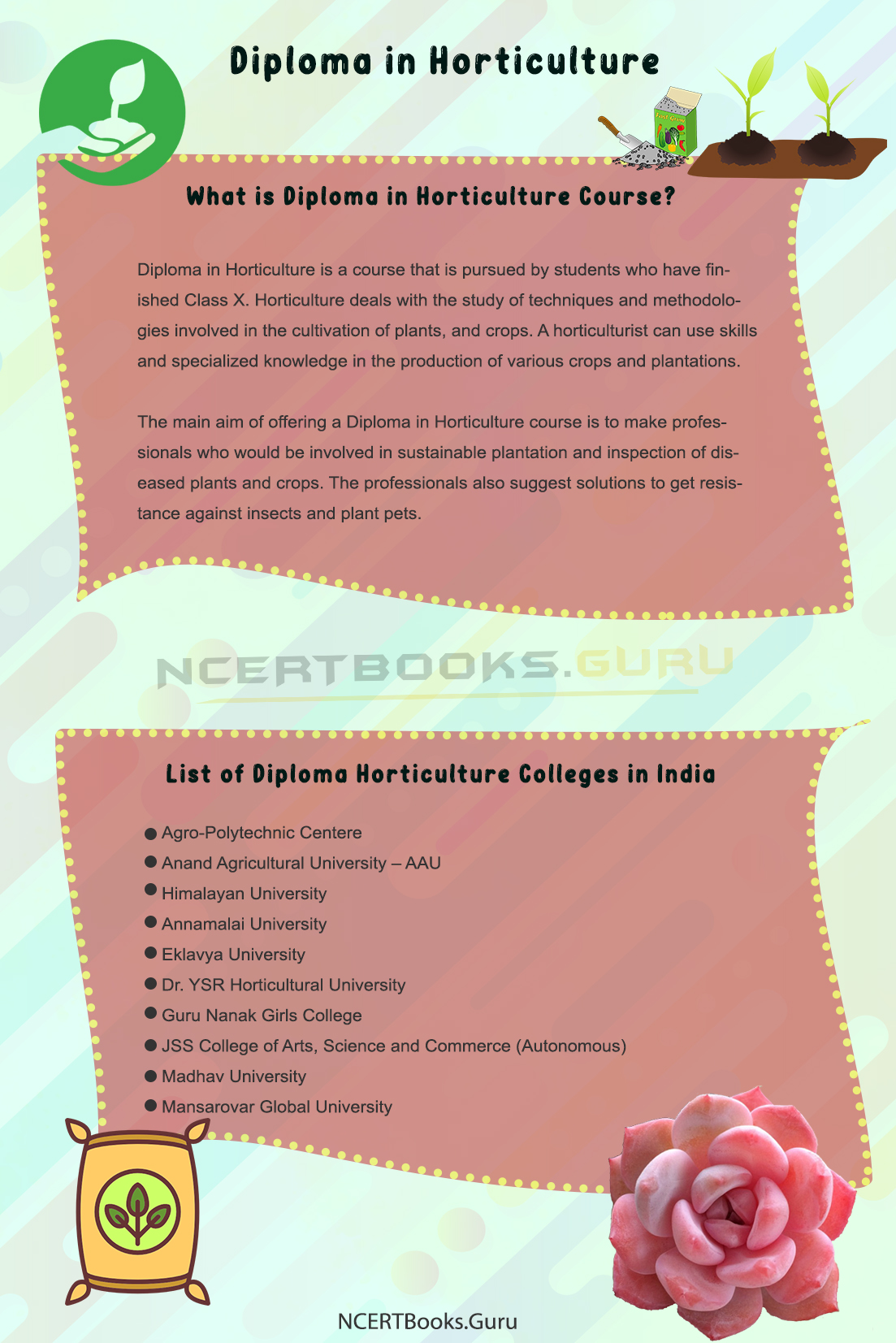
Diploma in Horticulture is a course that is pursued by students who have finished Class X. Horticulture deals with the study of techniques and methodologies involved in the cultivation of plants, and crops. A horticulturist can use skills and specialized knowledge in the production of various crops and plantations.

The main aim of offering a Diploma in Horticulture course is to make professionals who would be involved in sustainable plantation and inspection of diseased plants and crops. The professionals also suggest solutions to get resistance against insects and plant pets.

Details of Diploma Course in Horticulture

Horticulture Diploma course may have an average duration of two years. This course is equivalent to the graduate degree in agriculture dealing with the study of plantation, crops, and flower farming. To apply for admission, candidates must have passed class 10th with a minimum of 35% marks. The students who are interested in pomology, gardening, and farming can choose this course.

Candidates can apply for Diploma Horticulture colleges/universities via online. It teaches about flowers, cultivation, gardening, trees, and different insects and worms that affect the plants. The average course fee is Rs. 15,000/- and it prepares students to handle their jobs as professionals. Candidates can get a salary from 2 lakhs to 4 lakhs on average.

Why Study Diploma in Horticulture?

Diploma in Horticulture is an undergraduate diploma course with a short duration from one year to two years at different universities. The advantages of the horticulture diploma course are mentioned below:

  • Students who have successfully completed this diploma course can easily jump into different career opportunities in horticulture.
  • The demand for horticulturists has caught the momentum as the government has been taking more steps to control the rising pollution level in the cities.
  • In India, major people don’t have knowledge on how to increase the production of crops by following scientific horticulture methods. So, there are lots of opportunities in India to fulfil the needs of horticulturists.
  • Candidates having a horticulture diploma certificate are given a special reservation during the B.Sc course admission.

Diploma in Horticulture Overview

Course Name Diploma in Horticulture
Course Duration 2 years
Eligibility Conditions Class X
Selection Process Merit List
Course Fee Rs. 20,000 to 80,000
Job Roles Horticulturist, Floriculturist, Pest controller, Pomologist, Marketing professional, Sales executives
Basic Salary Rs. 2 lakhs to 8 lakhs

Diploma in Horticulture Course Eligibility Details

The minimum eligibility conditions to get admission in diploma in horticulture is given below:

  • Candidate must have passed Class X board examination with at least 35%.
  • In a few states, preference in admission is given to the wards of farmers. A certain amount of seats is reserved in that category.
  • Candidates must be between the age of 15 years to 22 years.
  • Candidates below the minimum age can also apply for the course after submitting an age relaxation certificate.

Horticulture Diploma Course Admission Procedure

Various colleges/universities have different criteria for taking admissions into the Diploma Horticulture course. Eligible candidates can get admission based on merit, entrance exam performance and direct admission. Look at them below.

Merit Basis Admission:

  • To join the horticulture diploma course on a merit basis the colleges will announce the cut-off marks.
  • Eligible candidates can apply online for the colleges.
  • Colleges will announce the specific date for the certificate verification.
  • Document verification includes mark sheets, passport size photos, provisional certificates and any reservation related documents.

Direct Admission:

  • Few colleges consider the overall academic performance of the colleges.
  • So, all eligible candidates can apply online for the universities/colleges.
  • The selected applicants have to submit documents at the time of certificate verification.

Entrance Exam Based Admission:

  • Students have to register for the entrance examinations.
  • Fill out the online applications released by the universities.
  • Pay the examination fee.
  • The examination board will release the admit cards.
  • After completing the exam, the board will announce the results.
  • The qualified candidates should go through a document verification process.

Documents Needed for Horticulture Diploma Admission

Below mentioned is the list of documents that must be produced at the time of certificate verification to get admission for a diploma in horticulture course in colleges.

  • Proof of Date of Birth.
  • Mark sheets of 10th grade.
  • Transfer Certificate.
  • Character Certificate.
  • School leaving Certificate.
  • Residential Certificate.
  • Caste Certificate (Optional).
  • Migration Certificate.
  • Farming Family Certificate (Optional)

List of Diploma Horticulture Colleges in India

  • Agro-Polytechnic Centere
  • Anand Agricultural University – AAU
  • Himalayan University
  • Annamalai University
  • Eklavya University
  • Dr. YSR Horticultural University
  • Guru Nanak Girls College
  • JSS College of Arts, Science and Commerce (Autonomous)
  • Madhav University
  • Mansarovar Global University
  • Smt. Narayanamma Horticulture Polytechnic
  • Nanasaheb Yashvantrao Narayanrao Chavan Arts, Science and Commerce College
  • RIMT University
  • Thanthai Roever Institute of Agriculture and Rural Development – TRIARD
  • Navsari Agricultural University
  • Sher-e-Kashmir University of Agricultural Sciences and Technology of Jammu
  • Sri Konda Laxman Telangana State Horticultural University
  • Tamil Nadu Agricultural University – TNAU
  • Yashwantrao Chavan Maharashtra Open University
  • Singhania University
  • The Glocal University
  • Vanavarayar Institute of Agriculture

Also, Check:

Horticulture Diploma Course Fee

The fee details we are giving is just for reference. It might differ from college to college and we are offering the maximum and minimum course fee details for private as well as government institutions.

  • Minimum Fee: INR 6,000
  • Maximum Fee: INR 51,667
  • Average Fee: INR 30,000 – INR 75,000

Diploma in Horticulture

Diploma in Horticulture Syllabus

The subject wise syllabus for the horticulture diploma course is given here. Students who choose horticulture course in diploma should pass all these subjects to finish their course.

Semester I:

  • Basics in Horticulture
  • Communication Skills
  • Farm Machinery
  • Livestock Management and Poultry Production
  • Soil and Fertility Management
  • Plant propagation practices
  • Fundamentals of Agronomy
  • Physical Education

Semester II:

  • Irrigation
  • Weed management
  • Fruit crops Production Technology
  • Ornamental gardening and Landscaping
  • Silvi Horticulture
  • Medicinal and Aromatic crops production technology
  • Dry Land Horticulture
  • Agroforestry

Semester III:

  • Spice crops
  • Crop Diseases and its management
  • Flower crops Production Technology
  • Commercial Agriculture
  • Crop Pests Management
  • Vegetable crops Production Technology

Semester IV:

  • Production Technology
  • Protected cultivation
  • Plantation crops Production Technology
  • Farm Management and Marketing
  • Seed production Technology of Horticultural crops
  • Post Harvest Handling
  • Practical training

Diploma in Horticulture Course Books

Students have to get all kinds of knowledge about the Horticulture practices. The books and study materials of the Diploma in Horticulture course that helps to achieve goals are given here.

The Fundamentals of Horticulture Chris Bird
Handbook of Horticulture K.L. Chadha
Control of Crop Diseases W.R. Carlile
Seed Storage of Horticulture Crops S.D. Doijode
Introductory Horticulture H. Edward Reiley, Carroll L. Shry, JR.

Horticulture Diploma Career Options and Job Profile

After completing a Diploma in Horticulture 2 years course, candidates can choose to work in different sectors like agriculture, pharmaceutical industry, perfumes, cosmetics production industry. Interested candidates can also set up their businesses.

Planting crops like vegetables, fruits, and flowers using horticultural techniques is the best business opportunity for the candidates. They can also research and develop agriculture landscape management in future.

Companies that are hiring horticulturists are Green Decor, government organizations, IFFCO, real estate, and Sun Valley Landscaping. The govt is majorly focusing on urban gardens where they can use horticulture skills. The diploma horticulture completed candidates can make their career in the following fields with the good salary packages.

Horticulturist Use scientific knowledge to propagate and cultivate the plants. Share knowledge with farmers and professionals in the field. INR 2 lacs
Horticultural Technician Work with urban parks or recreation centres, golf courses, nurseries, greenhouses. Also, employed by lawn service, gardening and landscape services. INR 1.5 – 2.5 lacs
Tree Expert A tree expert is a member of the larger field of grounds maintenance. A tree expert has the job responsibility of pruning and trimming trees. INR 2.25 – 3.5 lacs

Diploma Horticulture Future Scope

The horticulture field is growing rapidly as it is explaining about plants and their management.

  • Today, everything we are eating is not pure, and people are searching for organic foods. So, horticulturists have huge demand, not only in India but also in other countries. People love organic food, vegetables, and fruits that are grown with organic farming techniques.
  • Pollution has become the major issue in urban areas due to the smoke released by vehicles, industries. The only way to control it is by growing more and more plants in these areas. The government should develop parks/gardens to fulfil these projects, so they have o hire horticulturists.
  • Floriculture, pomology is fields of horticulture where candidates can find job opportunities.

FAQ’s on Diploma in Horticulture

1. How can students pursue the Diploma in Horticulture through distance?

The students who want to pursue a diploma horticulture through distance must have to complete the required credit points. For practical knowledge, they have to go for field research.

2. Which course is best in Horticulture?

If you are interested in studying the techniques of cultivating fruits, vegetables, flowers, and tea, then Diploma in Horticulture after 10th is the best course. This course is equivalent to agriculture in terms of career aspects.

3. What can we do after a diploma in horticulture?

After completing diploma horticulture, students can apply for pomologist, sales executive, floriculturist, horticulturist, pet controller, marketing professional jobs or do a business by growing organic food. In addition to this, you can also apply for technical officers in agricultural universities.

Diploma in Mechanical Engineering Course | Duration, Fees, Eligibility, Career, Colleges, Salary

Diploma Mechanical Course

Diploma Mechanical Course: Mechanical Engineering is the skill that is used to create a wide range of products, from automobiles to airplanes to microwaves. It allows you to carry out a variety of daily tasks with convenience, as it introduces useful technology to our current civilization. It is the most essential branch of engineering since most of the innovations we use daily might not be possible without the Diploma Mechanical Course.

Do you want to know the intricacies of this course? This website provides you with top-notch information regarding the diploma in mechanical Engineering courses and many others. Read through to know more and do not forget to check other course details!

What is a Diploma Mechanical Course?

Diploma Mechanical Course is the branch that is considered as one of the most important in the field of engineering. It is the field in engineering that has led to the innovation and development of several technologies that have made the life of people easier and simpler.

The analysis of mechanical components and equipment is the core of a Diploma Mechanical Course. Students will have the skills and competence to manage, maintain, and develop automobile engines, motor or boats, and airplanes upon passing the program. Students will gain knowledge about industrial machinery, thermodynamics, kinematic, etc. in this course.

Diploma in Mechanical Course Details

Students can pursue a three years Diploma Mechanical Course after 10th. It is a 3 years polytechnic course that focus on designing, construction, and maintenance or repair of mechanical apparatus utilizing a basic understanding of mechanics

The majority of the courses in the Diploma Mechanical Course are Arithmetic, Classical Mechanics, Mathematics-I, Engineering Graphics, Production Technology, Computer Programming Lab, etc. are subjects in Mechanical Engineering. Students pursuing a Diploma Mechanical Course have job opportunities in almost every private and public sector of various renowned companies.

Also Check:

Eligibility Criteria for 1 year diploma in mechanical engineering

Eligibility Criteria specify traits that all applicants must have in common. The eligibility criteria required for a Mechanical Engineer are listed below:

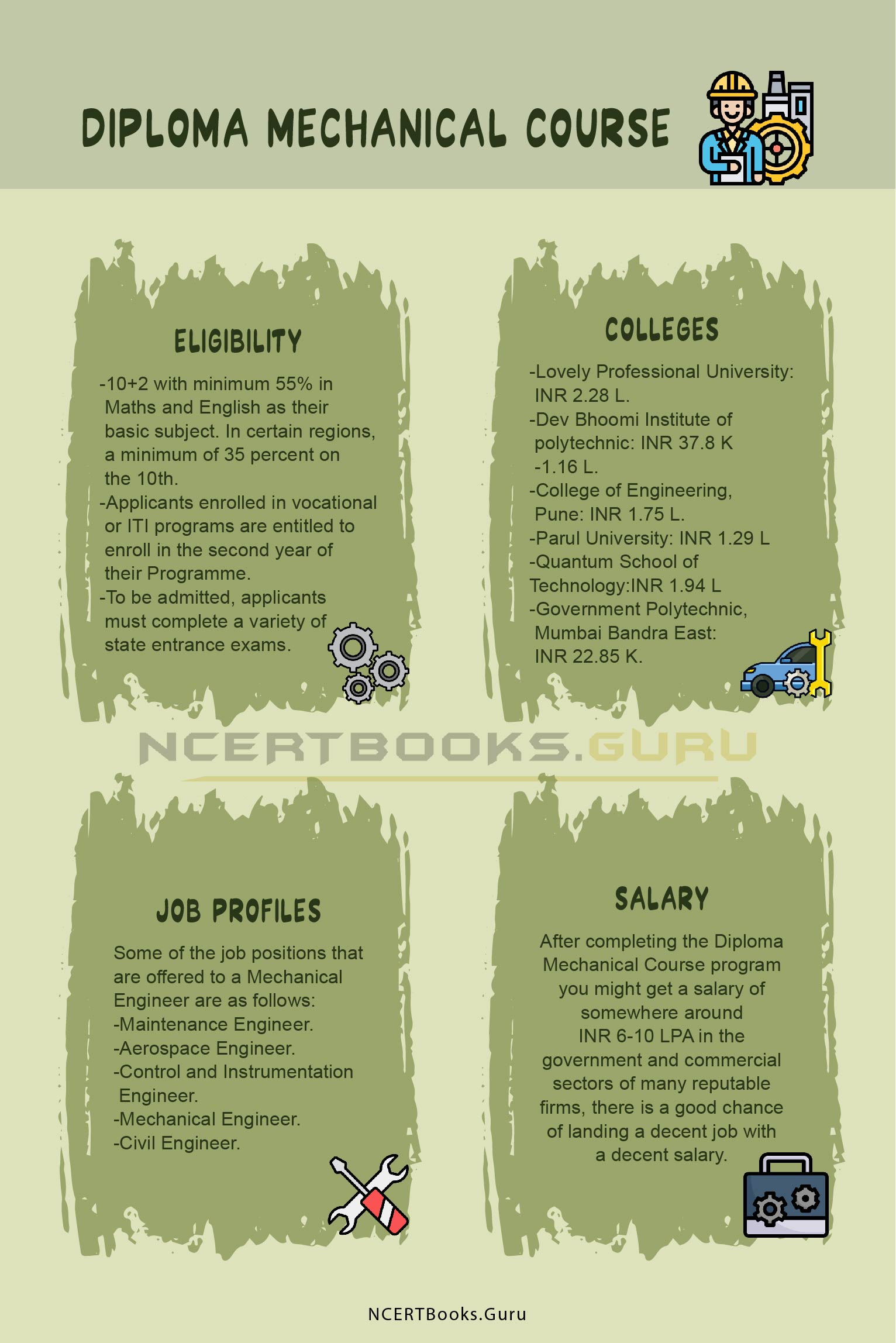
  • Applicants must have completed their tenth grade with a minimum of 55 percent in Maths and English as their basic subjects. Although, in certain regions, a minimum of 35 percent on the 10th or comparable exam is necessary.
  • Applicants enrolled in vocational or ITI programs are entitled to enroll in the second year of their Programme.
  • To be admitted, applicants must complete a variety of state entrance exams.

With this eligibility you can also pursue Diploma in Computer Science Courses.

Skill Set Required for Diploma Mechanical Course Aspirants

Mechanical engineering is an everlasting technology field that makes engineering a strong and popular discipline all around the world. To become a successful and prominent Mechanical Engineer, a student should cultivate the following skills:

  • Issues- Resolving
  • Creativity
  • Clear communication abilities
  • Ability to lead
  • Mathematics

Admission Procedure for Polytechnique Mechanical Engineering Course in India

Applicants can opt for a public or private institution to pursue the Diploma Mechanical Course course. If you take the course at a public university or college it will help you advance in your job because they have a superior track record and reduced entrance fees.

  • The Engineering Diploma Admission Exam is held in all the provinces in India.
  • In a private institution admission depends on your 10th-grade marks, however, many private colleges set their own admissions exam.

Once you have cleared the admission or entrance exam, all you have to do is follow the admission guideline for Diploma Mechanical Engineering Course, the guidelines are as follows:

  • Once you have selected the college or institution to join, visit their website and submit the application form along with all the required details.
  • The College’s Admission department will short-list the applicant’s and a counseling session will be held for them.
  • Once you are shortlisted it’s a must that you should be available on the date of the counseling session.

List of Diploma in mechanical engineering colleges Offline and Online with Diploma Mechanical Course Fees

There are many Government and Private colleges or universities that provide courses for Mechanical Engineering. You can opt for the one you like according to your preference. However, to make your work easy we have a list of some colleges which include both private and public universities along with their fee structure.

Name of College Public/ Private Total Fees
Lovely Professional University Private INR 2.28 L
Dev Bhoomi Institute of polytechnic Private INR 37.8 K – 1.16 L
College of Engineering, Pune Shivaji Nagar, Pune Public INR 1.75 L
Veermata Jijabai Technological Institute – VJTI Mumbai Public INR 22.85 K – 23.36 K
SPSU – Sir Padampat Singhania University Private INR 5.23 L
Government Polytechnic, Mumbai Bandra East Public INR 22.85 K
Parul University Private INR 1.29 L
Teerthanker Mahaveer University Moradabad Private INR 1.13 L – 1.97 L
Ganga Institute of Technology and Management Private INR 1.01 L
Quantum School of Technology Private INR 1.94 L

Diploma in mechanical engineering syllabus pdf

The following are the disciplines covered in the Diploma Mechanical Course Programme

Mechanical diploma subjects 1st year

S/N Subjects/Courses
1 Communication Skills in English
2 Basic workShop -I
3 Engineering Graphics-I
4 Basic Computer Skills Lab
5 Engineering Mathematics-I
6 WorkShop Technology

Second Semester

S/N Subjects/Courses
1 Applied Science Lab
2 Engineering Graphics-II
3 Basic Electrical & Electronics Engineering
4 Applied science
5 Engineering Mathematics-I
6 Basic Electrical & Electronics Lab

Third Semester

S/N Subjects/Courses
1 Machine shop-I
2 Basic workshop practice-II
3 Mechanical Testing & Quality control Lab
4 Mechanical Measurements & Metrology
5 Manufacturing Technology-I
6 Fluid Mechanics & Machinery
7 Engineering Mechanics & Strength of Materials

Fourth Semester

S/N Subjects/Courses
1 Parametric Solid Modeling Lab
2 Machine Shop-II
3 Fluid Power Lab
4 Fluid Power Engineering
5 Manufacturing Technology-II
6 Thermal Engineering-I
7 Theory of Machines

Fifth Semester

S/N Subjects/Courses
1 Project Work and Industrial visit
2 CASP
3 C-Programming and MAT lab
4 Mechatronics lab
5 Mechatronics
6 Design of machine elements
7 Thermal Engineering-II
8 Basic Management Skills and Indian Constitution

Sixth Semester

S/N Subjects/Courses
1 CNC and Casting Simulation lab
2 Thermal Engineering lab
3 Elective:

Metal Casting Science and Engineering

  • Refrigeration and Air-conditioning
  • Power plant engineering
  • Non-conventional Energy resources
4 Computer integrated manufacturing
5 Automobile Engineering
6 Estimating and costing
7 Project work

Career Options after Completion Diploma in Mechanical Engineering

The list of future opportunities that are offered for the candidates of diploma mechanical engineering course is discussed here for a better choice:

  1. Aerospace sector: This sector has seen a lot of advancements and breakthroughs over the years. The demand for highly trained Mechanical engineers with immense knowledge is increasing all the time in this sector.
  2. Auto Manufacturing: As one of the quickest expanding industries, it has created countless career opportunities. A Mechanical Engineer is highly in demand in this sector.
  3. Chemical industry: Mechanical engineers are in demand in this field as they provide technical assistance, responsible for the improvements and efficiency of the tools, etc.
  4. Railway Industry: Overhead line networks require guidelines to be created, layouts to be examined, and technical questions to be solved, all of which fall under the domain of Mechanical Engineers.

Students who wants to study higher studies can check Courses After Diploma in Mechanical Engineering to select the best course.

Diploma Mechanical Course

Job Profiles Under Diploma Courses in Mechanical

A Mechanical Engineer knows how to design and construct a machine, their skills have made them highly demandable in most companies and industries. Some of the job positions that are offered to a Mechanical Engineer are as follows:

  • Maintenance Engineer
  • Aerospace Engineer
  • Control and Instrumentation Engineer
  • Mechanical Engineer
  • Civil Engineer

Expected Salary in Diploma Mechanical Engineering Course

After completing the Diploma Mechanical Course program you might get a salary of somewhere around INR 6 – 10 LPA in the government and commercial sectors of many reputable firms, there is a good chance of landing a decent job with a decent salary. You can also be an entrepreneur and start a manufacturing or repairing business.

FAQs on List of courses after diploma in mechanical engineering

1. What digital programs are available to Mechanical Engineering grads once they complete their diploma?

Following a diploma in engineering, there are a variety of online courses offered that can help you get additional skills in addition to engineering. Industrial Sketching, Drafting, Advanced MS Excel, etc are some of the short-term courses that are available.

2. Is A Diploma Mechanical Course a good choice?

A Diploma Mechanical Course is an excellent choice. Having stated that, students must have a keen interest in Mechanical Engineering.

3. In a Mechanical Engineering diploma, how many subjects are there?

There are 6 semesters in Mechanical Diploma and each semester has six to eight subjects.

Final Words

If you have a passion for learning and the curiosity of an individual thus makes you a great Mechanical Engineer, if you’re a person of this kind then it’s time for you to explore the world of engineering and showcase your inner potential. You can also visit other links on our website @ncertbooks.guru to get your academic queries solved on diploma mechanical course & others! Do not forget to go through them!