Bhagat Phool Singh Mahila Vishwavidyalaya Courses & Syllabus | BPSMV Courses List

Bhagat Phool Singh Mahila Vishwavidyalaya Courses

Bhagat Phool Singh Mahila Vishwavidyalaya Courses & Syllabus 2022: Check out Bhagat Phool Singh Mahila Vishwavidyalaya Courses & Syllabus 2021. Candidates can check the necessary details about Bhagat Phool Singh Mahila Vishwavidyalaya courses and syllabus 2021. Here we have given courses and also syllabus for various programs (भगत फूल सिंह महिला विश्व विद्यालय पाठ्यक्रम) and other important details. Here we also gave semester-wise Subjects which helps the candidate in providing information. Also, check various academic programs offered by Bhagat Phool Singh Mahila Vishwavidyalaya.

The Institute invites applications from candidates who have completed or are likely to complete the required courses this academic year. Download the Bhagat Phool Singh Mahila Vishwavidyalaya Courses & Syllabus 2021 PDF is also available here.

Bhagat Phool Singh Women University has approximately 7,000 students. It provides education from UG level through to doctorate, with many courses being of a vocational nature. Candidates who get qualified in the Haryana state exam will have a chance of getting a seat at this university. For some courses, the University itself conducts the entrance test. Candidates who get qualified on a merit base will be given a seat at this university.

About Bhagat Phool Singh Mahila Vishwavidyalaya

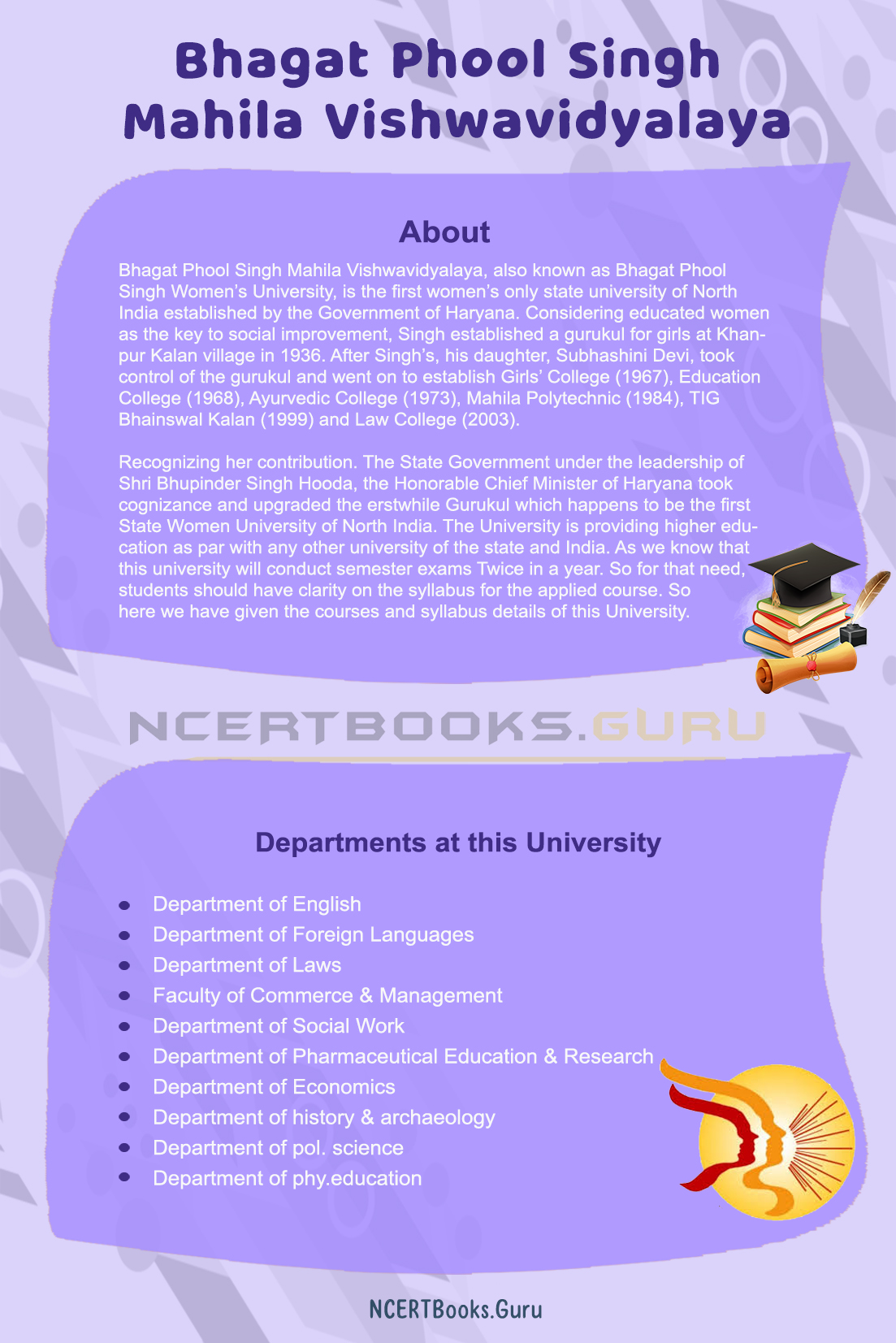
Bhagat Phool Singh Mahila Vishwavidyalaya, also known as Bhagat Phool Singh Women’s University, is the first women’s only state university of North India established by the Government of Haryana. Considering educated women as the key to social improvement, Singh established a gurukul for girls at Khanpur Kalan village in 1936. After Singh’s, his daughter, Subhashini Devi, took control of the gurukul and went on to establish Girls’ College (1967), Education College (1968), Ayurvedic College (1973), Mahila Polytechnic (1984), TIG Bhainswal Kalan (1999) and Law College (2003).

Recognizing her contribution. The State Government under the leadership of Shri Bhupinder Singh Hooda, the Honorable Chief Minister of Haryana took cognizance and upgraded the erstwhile Gurukul which happens to be the first State Women University of North India. The University is providing higher education as par with any other university of the state and India. As we know that this university will conduct semester exams Twice in a year. So for that need, students should have clarity on the syllabus for the applied course. So here we have given the courses and syllabus details of this University.

Overview of Bhagat Phool Singh Mahila Vishwavidyalaya Courses

Here we have given the UG, PG Courses and Departments of this university

University Bhagat Phool Singh Mahila Vishwavidyalaya
Location  Haryana
Offered Courses undergraduate, postgraduate, and Ph.D.
Website Click here
Application Notification Admissions open

Bhagat Phool Singh Mahila Vishwavidyalaya Courses Offered

Departments at this University

  • Department of English
  • Department of Foreign Languages
  • Department of Laws
  • Faculty of Commerce & Management
  • Department of Social Work
  • Department of Pharmaceutical Education & Research
  • Department of Economics
  • Department of history & archaeology
  • Department of pol. science
  • Department of phy.education

Undergraduate Courses

  • B.B.A.
  • B.A.
  • B.Sc (Medical)
  • B.SC (Computer Science)
  • B.Sc (Non-Medical)
  • B.Sc (Home Science)
  • B.Tech Computer Sciences & Engineering
  • B.Tech Information Technology
  • B.Tech Fashion Technology
  • M.Tech. Fashion Technology- Functional Garments
  • M.Tech. ICT
  • Library and Information Science
  • Office Management & Computer Applications
  • B.A.M.S.
  • Pharmacy
  • Electronics and Communication Engineering
  • Medical Laboratory Technicians
  • Computer Engineering
  • Information Technology
  • Fashion Technology
  • Architecture Engineering
  • B.Ed. ( Bachelor of Education)
  • D.Ed. (Diploma in- Education )
  • B.Tech Electronics Communication & Engineering
  • Post Graduate Diploma in Human Rights & Duties
  • B.A.LL.B
  • B.B.A.LL.B
  • B.Pharmacy
  • B.Pharmacy (Lateral entry)
  • B.Com(Honours)
  • BHM (Bachelor of Hotel Management)

Post Graduate Courses

  • M.B.A. (Lateral Entry)
  • M.Sc. (Mathematics)
  • M.A. Social Work
  • L.L.M.
  • Post Graduate Diploma in Cyber Laws & Ethics
  • Post Graduate Diploma in Insurance Laws
  • M.Ed.
  • M.Sc. in Home Science (Food & Nutrition)
  • Ph.D. (English)
  • M.A. (English)
  • M.A. English (Integrated)
  • Ph.D.
  • Ph.D. in Law
  • M.A. in Economics (Hons.) Integrated
  • M.A. in Economics
  • Ph.D. in Economics
  • Ph. D (CSE, FT & ECE)
  • MBA (Tech.) (B.Tech. in ECE + MBA)
  • M.Tech. Network Security
  • M.Phil (Education)
  • M.A. (Education)
  • Ph.D. Social Work
  • Ph.D. in Food & Nutrition
  • Ph.D. in Management
  • Ph.D. in Commerce
  • M.H.M. (Masters in Hotel Management)
  • M.B.A.
  • M.Com

Bhagat Phool Singh Mahila Vishwavidyalaya Courses – Click Here

Bhagat Phool Singh Mahila Vishwavidyalaya Syllabus

Bhagat Phool Singh Mahila Vishwavidyalaya Courses & Syllabus: Here we have given the syllabus for the academic year 2017-18. Candidates who want to score good marks in their final exams can refer to this article and gain information. A student can score good marks if he knows the exact syllabus of the exam he/she is writing.

Bhagat Phool Singh Mahila Vishwavidyalaya Exam Syllabus 2021

Syllabus from the session 2017-18

Bhagat Phool Singh Mahila Vishwavidyalaya Courses & Syllabus – Click Here

BPSMV Previous Syllabus

Candidates studying at this university should know the syllabus of the particular course. So here we have mentioned the syllabus of courses for the academic years 2014-2018. As we know that the exam syllabus remains the same as the last year. So here we have given the syllabus for this academic year.

BPSMV Syllabus 2017-18 – Click Here

BPSMV 2017 Syllabus – Click Here

BPSMV 2016 Syllabus – Click Here

BPSMV 2015 Syllabus – Click Here

BPSMV 2014 Syllabus – Click Here
Bhagat Phool Singh Mahila Vishwavidyalaya Courses & Syllabus

Read More:

FAQs on Bhagat Phool Singh Mahila Vishwavidyalaya Courses

1. What are the Courses Offered by Bhagat Phool Singh Mahila Vishwavidyalaya?

BPSMV offers various courses like B.A, B.Sc, B.Pharmacy, M.A, M.Phil, M.Ed, L.L.M, and many more.

2. Where do I get the Syllabus for BPSMV Courses of various disciplines?

You can get Syllabus for BPSMV Courses of various disciplines on our page.

3. Which website Offers the Bhagat Phool Singh Mahila Vishwavidyalaya Courses & Syllabus in detail?

NCERTBooks.Guru is a trusted and reliable website that offers BPSMV Courses & Syllabus in detail.

Conclusion

We have provided Bhagat Phool Singh Mahila Vishwavidyalaya Courses & Syllabus 2021 in this article. Students are requested to share this article with their friends. Students who want to know more details about this article about those associated with the Official Website for Bhagat Phool Singh Mahila Vishwavidyalaya can refer to our web page to know more information. If you have any queries about this article can leave a review in the below report box for clarifying your doubts.

Medical Courses Other than MBBS | Best Alternative Courses for Medical Students Other than MBBS

Medical Courses other than MBBS

Hey medical aspirant! Medicine is arguably one of the most popular courses opted for by students after class 12. Medicine and MBBS have become synonymous. But, if you are looking for medical courses other than MBBS, you no longer need to worry. There are lots of alternative courses in the medical field. If you pursue those courses, lots of future options open up. You can aim for higher education or seek jobs based on your degree.

Career Options in Medical Field other than MBBS

The medical field is not only limited to doctors. It includes everything from diagnosis to other activities of the pharmaceutical and healthcare units. A medical degree serves as the gateway to many opportunities in the healthcare sector. From doctors to physiotherapists, from nursing to pharmacy, the list is endless. Here is a list of some medical courses you can pursue depending on your interests.

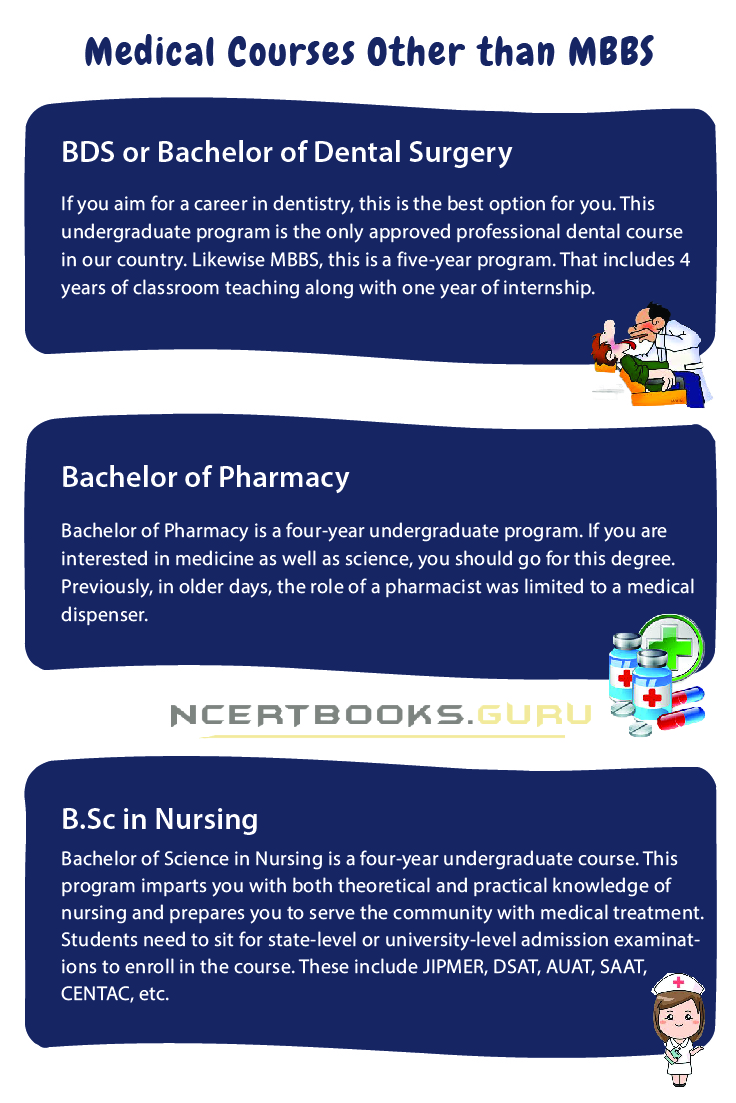
BDS or Bachelor of Dental Surgery

If you aim for a career in dentistry, this is the best option for you. This undergraduate program is the only approved professional dental course in our country. Moreover, the Dental Council of India (DCI) regulates the degree. You need to clear the National Eligibility cum Entrance Exam ( NEET )to get a seat in one of the dental colleges in India. Approximately, there are more than 300 such government and private colleges in India with almost 26,000 seats.

Likewise MBBS, this is a five-year program. That includes 4 years of classroom teaching along with one year of internship. The course covers subjects like Dental Histology, Oral Pathology, Public Health Dentistry, to name a few. BDS opens up lots of career options which include employment as well as higher education.

Bachelor of Pharmacy

Bachelor of Pharmacy is a four-year undergraduate program. If you are interested in medicine as well as science, you should go for this degree. Previously, in older days, the role of a pharmacist was limited to a medical dispenser. Contrary to that, nowadays it has undergone a sea change to become a medical counselor, researcher, medical management expert, etc.

The course deals with the various methods of drug preparation as well as medication dispensing. You can pursue this course by appearing for examinations like NEET, GPAT, BITSAT. B. Pharmacy helps you to build a career as a scientific writer, medical representative, medical scripter. You can also do government jobs and build a flexible yet stable career.

B.Sc in Nursing

Bachelor of Science in Nursing is a four-year undergraduate course. This program imparts you with both theoretical and practical knowledge of nursing and prepares you to serve the community with medical treatment. Students need to sit for state-level or university-level admission examinations to enroll in the course. These include JIPMER, DSAT, AUAT, SAAT, CENTAC, etc.

The rapidly growing nursing industry provides an array of employment options in government and private hospitals, nursing homes, research institutes, etc as a nurse, nursing tutor, nursing assistant, nursing manager, to name a few. Candidates can also go for a master’s degree in the same.

Bachelor of Homeopathic Medicine and Surgery

This undergraduate program is streamlined to train the students with knowledge of homeopathic medicine. The course duration is 5.5 years which includes 4.5 years of classroom training and 1 year of internship. You can get admission to  BHMS  through various entrance examinations like NEET. Besides that, various colleges conduct their entry-level exams.

If you want to promote good health through homeopathy, this is the only option available for you. Moreover, you can pursue higher education after BHMS like PG Diploma in Homeopathic Medicine and Surgery, MD (Hom) Allopathy, etc. You can also work as a homeopathic doctor, lecturer, or consultant in healthcare units.

Bachelor of Physiotherapy

Bachelor of Physiotherapy is a four-year professional undergraduate program. It also includes a mandatory internship of 6 months. The course trains students with the science of physical movements which helps to eliminate the disease through exercise and other modalities. Some of the entrance exams conducted are CET, JIPMER, and Guru Govind Indraprastha University Physiotherapy entrance exam.

This course opens up various job roles like private physiotherapists, assistant physiotherapists, therapy managers. Moreover, they can complete a master’s course. The evergreen demand for physiotherapists will continue to cater to the needs of patients, especially old age people.

Get a comprehensive list of Course Details all in one place and study various courses information such as eligibility to pursue one, course duration, fees, colleges, etc.

Medical Courses Other than MBBS

FAQs on Popular Medical Courses other than MBBS

1. Which course is good other than MBBS?

If you want to enter the medical field, there are lots of other options than MBBS. They include BS, B Pharm, BSc Nursing, and many more.

2. Can I become a doctor other than MBBS?

Yes, you can become a doctor of AYUSH (Ayurveda, Unani, Siddha, and Homeopathy). Now, the government regularizes these courses.

3. Is BHMS equal to MBBS?

Yes, in both cases, the doctor works as a registered medical practitioner. BHMS courses are becoming popular nowadays.

How to Join Territorial Army in India? | Roles and Eligibility Criteria To Join Territorial Army in India

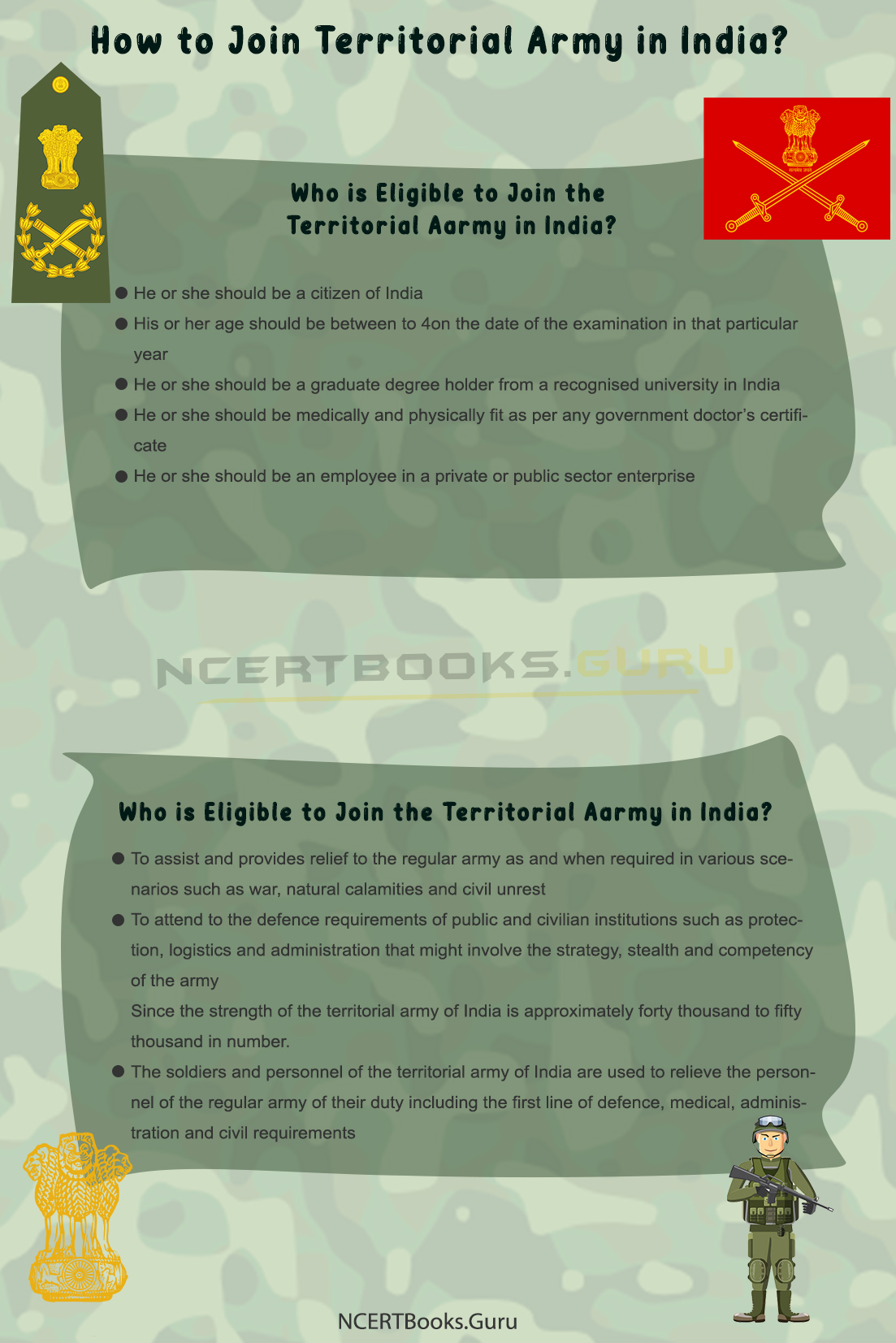
How to Join Territorial Army in India?: It is a dream come true for any law-abiding citizen to serve for the nation in uniform. Men and women in uniforms always have unique respect in society that no other professionals can demand. The fact that a civilian can have a chance to serve for the nation in the army is enough to motivate him or her to pursue a part-time career in the territorial army. A sense of fulfilment that people get in servicing the nation in defence forces is enough to fill the vacancies in such units.

Refer to Course Details to know more about related courses and find details like Admission Process, Eligibility Criteria, etc.

Before addressing the nuances involved process of joining the Territorial Army in India, let us address a few questions such as:

What is the Territorial Army of India?

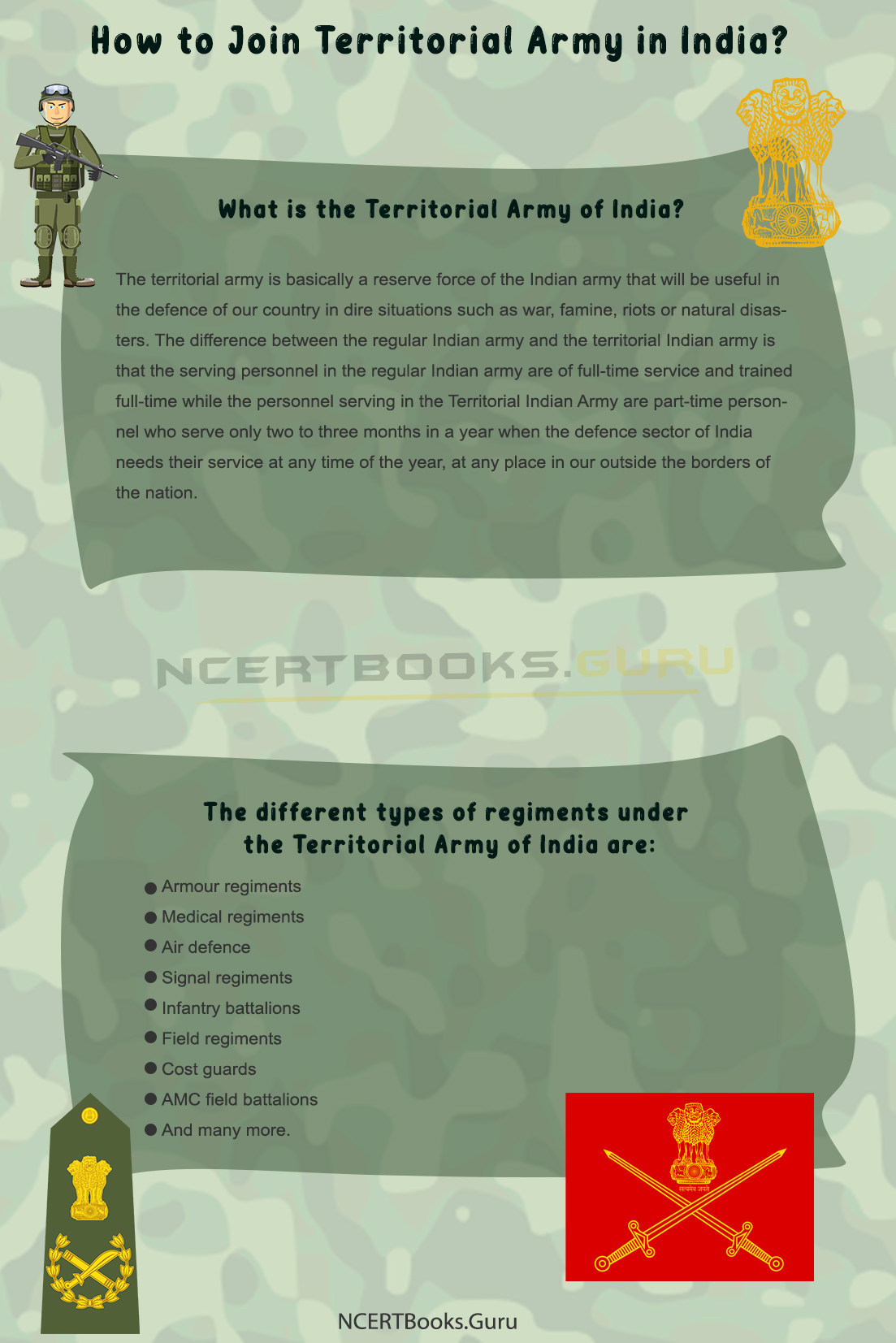
The territorial army is basically a reserve force of the Indian army that will be useful in the defence of our country in dire situations such as war, famine, riots or natural disasters. The difference between the regular Indian army and the territorial Indian army is that the serving personnel in the regular Indian army are of full-time service and trained full-time while the personnel serving in the Territorial Indian Army are part-time personnel who serve only two to three months in a year when the defence sector of India needs their service at any time of the year, at any place in our outside the borders of the nation.

This army is often called by the phrase part-time commitment, full-time honour. The territorial Indian army was originally started by the British in the early part of the 19th century. This concept of the army was of utmost need during the 1st and d world Wars when the British needed extra troops to fight in the war. Back then the territorial army of India was a part of IDF ( Indian Defence Force). At that point in time (before the independence of India), British nationals who were permanent residents in India were compulsorily obliged to serve in the territorial army of India.

The modern territorial Indian army started in 19under C Rajagopalachari, the first governor-general of India.

The different types of regiments under the Territorial Army of India are:

  1. Armour regiments
  2. Medical regiments
  3. Air defence
  4. Signal regiments
  5. Infantry battalions
  6. Field regiments
  7. Cost guards
  8. AMC field battalions
  9. And many more.

How to Join Territorial Army in India 1

What is the Role of the Territorial Army in India?

The following 5 points will significantly sum up the role of the territorial army of India and help students and aspirants get an idea of life after joining the Territorial Army of India:

  1. To assist and provides relief to the regular army as and when required in various scenarios such as war, natural calamities and civil unrest
  2. To attend to the defence requirements of public and civilian institutions such as protection, logistics and administration that might involve the strategy, stealth and competency of the army
    Since the strength of the territorial army of India is approximately forty thousand to fifty thousand in number.
  3. The soldiers and personnel of the territorial army of India are used to relieve the personnel of the regular army of their duty including the first line of defence, medical, administration and civil requirements
  4. Territorial army also helps in assisting protection and security to important institutes of the country such as Nuclear Power plants, natural mineral reserves, constitutional bodies such as RBI, supreme court and High court etc.
  5. One of the most important purposes of the territorial army also includes the sense of inclusiveness that it provides to the civilians in the defence of the country.

Below are the steps that an aspirant can follow to join the territorial army in India:

  1. Registration and application to give territorial army exam
  2. Written exam and interview
  3. SSB
  4. Medical board for final selection

While the above four steps are for civilians, ex-servicemen can also get into the Indian Territorial army by giving only the interview stage of the recruitment process.

The examination will be of objective type for a span of two hours.

Who is Eligible to Join the Territorial Aarmy in India?

The list of criteria to enter and be a part of the Indian territorial army is as follows:

  1. He or she should be a citizen of India
  2. His or her age should be between to 4on the date of the examination in that particular year
  3. He or she should be a graduate degree holder from a recognised university in India
  4. He or she should be medically and physically fit as per any government doctor’s certificate
  5. He or she should be an employee in a private or public sector enterprise
  6. He or she who is already serving in the army, navy, airforce, police or any constitutionally valid institutions are not eligible to apply for the Indian territorial army.

One can say with conviction that it will be a life of fulfilment to serve in the territorial army of India. The pride and satisfaction one will get in serving the nation and fighting the evil forces is something that can’t be measured and will not be found in any other services across the country, be it in the public or private sphere. There are plenty of celebrities, Bollywood stars, sportsmen, sportswomen, and other important personalities in the public domain.

How to Join Territorial Army in India 2

Institute Of Rural Management Anand Courses & Syllabus 2022 | IRMA Courses

Institute Of Rural Management Anand Courses

Check out Institute of Rural Management Anand Courses & Syllabus 2022. Candidates can check the necessary details about IRMA courses and syllabus 2022. Here we have given courses and also syllabus for various programs and other important details (इंस्टिट्यूट ऑफ रुरल मैनेजमैंट आनंद कोर्सेस). Here we also gave semester-wise Subjects which helps the candidate in providing information. Also, check various academic programs offered by the Institute of Rural Management Anand. The Institute invites applications from candidates who have completed or are likely to complete the required courses this academic year.

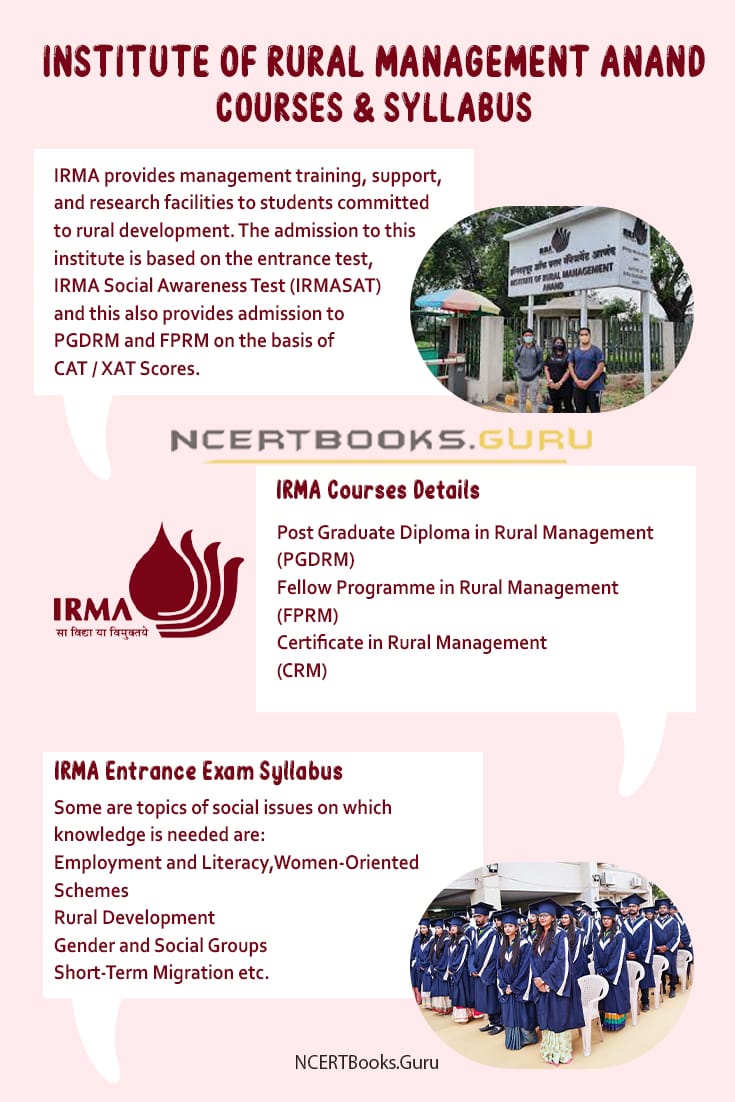
IRMA provides management training, support, and research facilities to students committed to rural development. The admission to this institute is based on the entrance test, IRMA Social Awareness Test (IRMASAT) and this also provides admission to PGDRM and FPRM on the basis of CAT / XAT Scores. So the interested candidates can apply online. This institute takes students only on a merit basis.

Institute of Rural Management Anand Courses & Syllabus 2021

University Institute of Rural Management Anand
Page Information & Location Institute of Rural Management Anand Courses & Syllabus, Gujarat
Offered Courses PGDRM, FPRM, CRM
Official site Click Here
Application Notification Admissions open

IRMA Programs details

IRMA was established in 1979 at Anand, Gujarat with the support of the Swiss Agency for Development Cooperation (SDC). The rationale behind its installation had to do with providing management education, training, research, and consultancy support to co-operatives and rural development organizations in India. This is an autonomous institution located in Anand in Gujarat. Here we have provided the syllabus of various courses present at this institute. Interested candidates can refer to our site for more details.

IRMA Courses details

This institute is the best institute in India this offers the best quality of education. Here we have given courses offered by this institution

Post Graduate Diploma in Rural Management (PGDRM)

IRMA’s PGDRM integrates the two streams and equips talented men and women with both development perspectives and business acumen. The PGDRM is recognized as equivalent to a Master’s degree in Rural Management by the Association of Indian Universities (AIU) and approved by the All India Council for Technical Education (AICTE). This course is offered for 2 academic years and the exam will be conducted on a semester basis. We have also given the syllabus for this course.

Fellow Programme in Rural Management (FPRM)

This is for aspirants and professionals seeking careers in research, teaching, and specialized knowledge-based positions in institutions of higher learning, research, and development organizations. FPRM is a doctoral-level program approved by the All India Council for Technical Education (AICTE). This course is offered for 3 academic years and the exam will be conducted on a semester basis. The external exam, results will be declared after the month of exams. We have also given the syllabus for this course.

Certificate in Rural Management (CRM)

IRMA’s designated organizations can sponsor their employees (executives and officers) for a Certificate in Rural Management (CRM) or Post Graduate Diploma in Rural Management (PRM). The sponsored applicants can complete the program in two years, or they can opt for a Certificate in Rural Management (CRM) at the end of the first year. This course is offered for 6 months and the exam will be conducted on a semester basis. We have also given the syllabus for this course.

Institute of Rural Management Anand Courses – Click Here

IRMA Entrance Exam Syllabus

Institute of Rural Management Anand Courses & Syllabus: There is no pre-defined syllabus for the IRMA entrance exam. The candidates need to knowledge and understanding of social issues. Here are some of the topics of which some questions were asked.

  • Employment and Literacy
  • Women-Oriented Schemes
  • Rural Development
  • Gender and Social Groups
  • Short-Term Migration
  • Social and Economic Development
  • Human Development
  • Indian Economy
  • IRDP Schemes
  • Educational Initiatives of the Government
  • Poverty alleviation and development programs
  • Millennium development goals
  • Internal security issues
  • Human Rights
  • Sex Ratio
  • Agriculture
  • Environmental Issues
  • Health Issues
  • Education
  • Rural and Urban Population
  • Corporate Social Responsibility

Also, Check:

IRMA 20221 Syllabus (Institute of Rural Management Anand Courses & Syllabus)

Candidates studying this university should know the syllabus of the particular course. So here we have mentioned the syllabus of courses for the academic year 2014-2017. As we know that the exam syllabus remains the same as the last year. So here we have given the syllabus for this academic year.

IRMA Syllabus 2017-18 – Click Here

IRMA Syllabus 2017

PGDRM  Syllabus 2017 – Click Here

FPRM Syllabus 2017 – Click Here

CRM Syllabus 2017 – Click Here

IRMA Syllabus 2016 – Click Here

IRMA Syllabus 2015 – Click Here

IRMA Syllabus 2014- Click Here

Institute Of Rural Management Anand Courses & Syllabus

FAQs on IRMA Courses

1. Where can I find Year Wise IRMA Course Syllabus?

You can find Year Wise IRMA Course Syllabus on our page.

2. How to download IRMA Course Syllabus PDF?

All you need to do is simply tap on the quick links available for IRMA Course and use them as a reference.

3. What are the Courses Offered at IRMA?

Courses Offered at IRMA are Post Graduate Diploma in Rural Management (PGDRM), Fellow Programme in Rural Management (FPRM), Certificate in Rural Management (CRM).

Summary

We have provided the Institute of Rural Management Anand Courses & Syllabus 2021 in this article. Students are requested to share this article with their friends. Students who want to know more details about this article those associated with the Official Website for Institute of Rural Management Anand or our web page to know more information. Students who have any queries about this article can leave a review in the below report box for clarifying your doubts.
Paramedical Diploma Courses After 10th | Eligibility, Subjects, Exams, Colleges, Career, Scope, Fees

Paramedical Diploma Course

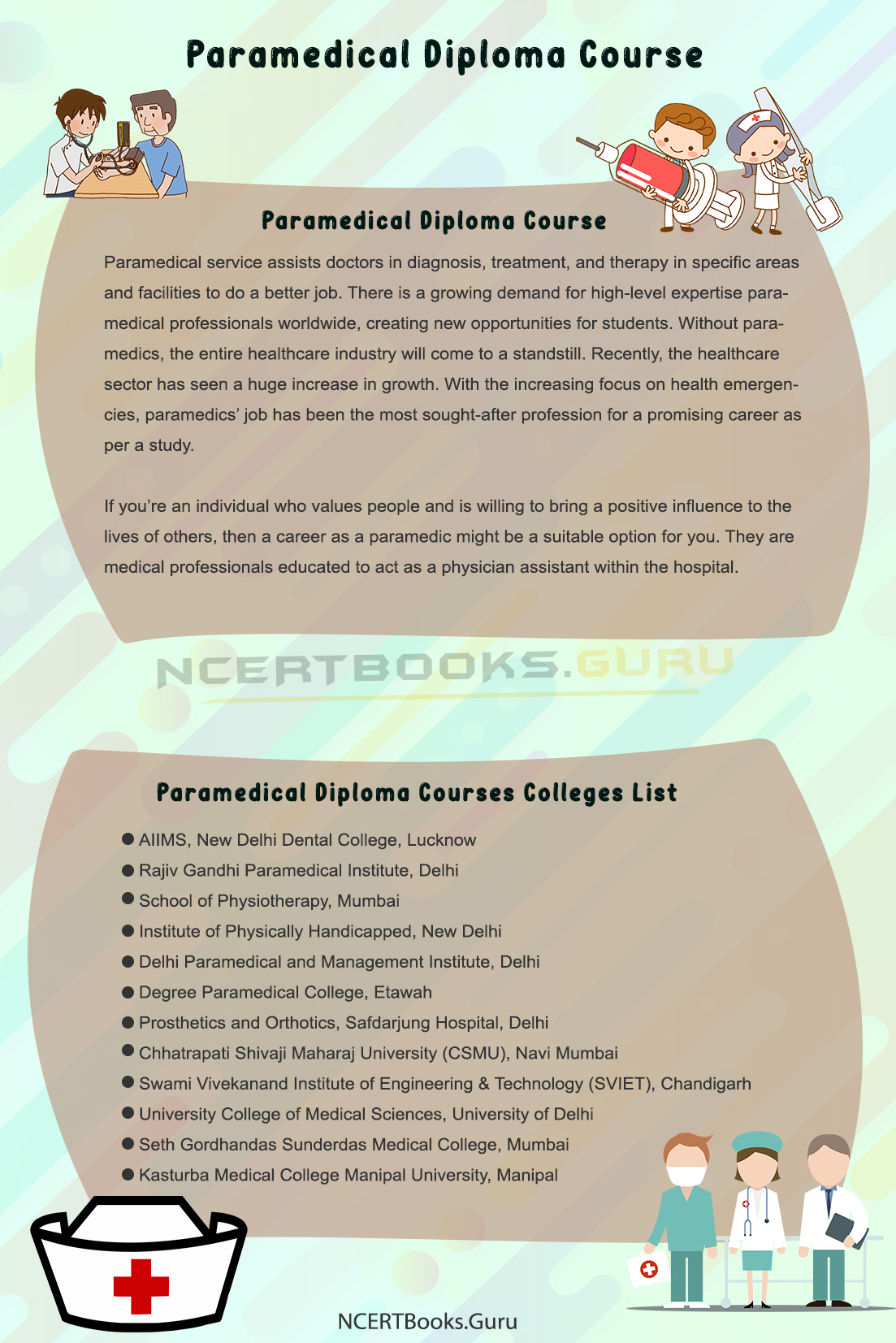
Paramedical Diploma Courses List: Paramedical service assists doctors in diagnosis, treatment, and therapy in specific areas and facilities to do a better job. There is a growing demand for high-level expertise paramedical professionals worldwide, creating new opportunities for students. Without paramedics, the entire healthcare industry will come to a standstill. Recently, the healthcare sector has seen a huge increase in growth. With the increasing focus on health emergencies, paramedics’ job has been the most sought-after profession for a promising career as per a study.

If you’re an individual who values people and is willing to bring a positive influence to the lives of others, then a career as a paramedic might be a suitable option for you. They are medical professionals educated to act as a physician assistant within the hospital. Their job is to support doctors throughout the medical checks and treatments to guarantee effective medical therapy. They are accountable for providing initial medical treatment to patients in emergencies. Paramedics can also be referred to EMS as Emergency Medical Services Professionals.

Pursuing Paramedical Diploma Course after the 12th standard is the most effective for those looking to pursue a career in the medical field with less time and at a low cost. Through this program, students gain the expertise to master the art of medical surgery, assist and diagnostics, etc.

Diploma in Paramedical Course Eligibility

Students who wish to pursue a career in paramedical fields must satisfy the following requirements for eligibility.

  • You must have completed 12th in the science stream and biology from a recognized board with a minimum of 50 percent marks.
  • There isn’t a minimum requirement for diploma courses for the percentage, as each college has its criteria concerning the percentage.
  • Some colleges may even grant admission by the percentages obtained from board exams.
  • Most colleges conduct their own entrance tests or allow admission based on the national or state-level examination scores.
  • The applicants must be 17 or over.
  • Candidates could also be required to take NEET UG.

Paramedical Diploma Courses Admission

Candidates interested in Paramedical Diploma Courses are supposed to check the following admission process. It is as under

  • Candidates need to visit the official portal of the college/Institute they wish to apply to and fill in the application form and pay fees accordingly. However, certain colleges will only allow offline applications for which your presence is mandatory.
  • Keep track of the Admission Opening Dates of the Universities/Colleges you are targeting.
  • Most of the colleges select candidates depending upon the scores in entrance exams or on a merit basis. After this, you need to attend the counseling process and qualified candidates will get seats allotted to them.

Entrance Exams for Paramedical Diploma Courses

Following is the comprehensive list of entrance exams held for Paramedical Courses. Candidates need to appear for any of these Entrance Exams to get into their Paramedical Course.

  • AIIMS
  • NEET PG
  • MHT CET
  • NILD CET / SVNIRTAR CET/ NIEPMD CET-
  • JCECE

Find all kinds of course details on our page and decide whether your favorite ones are bright for your future or not.

Paramedical Diploma Course Duration

For students who want to do Paramedical courses after the 12th the duration will be 2 years to 3 years as per Course.

  • Bachelor Paramedical Courses 4 – 3 years
  • Diploma Paramedical Courses 3 to 2 years
  • Certificate Paramedical Courses 1 year

Specializations in Paramedical Diploma Course

Here is the list of specializations one can opt for in the Diploma Paramedical Course. They are as follows

  • Emergency medical technician
  • General duty assistant
  • Diploma in Medical laboratory technician
  • Patient care management
  • Operations theatre assistant
  • Radiology and imaging technician
  • Occupational Therapist
  • Audiologist and Speech Therapist

Paramedical Diploma Courses Colleges List

Find below the list of top colleges to pursue Paramedical Courses:

  • AIIMS, New Delhi Dental College, Lucknow
  • Rajiv Gandhi Paramedical Institute, Delhi
  • School of Physiotherapy, Mumbai
  • Institute of Physically Handicapped, New Delhi
  • Delhi Paramedical and Management Institute, Delhi
  • Degree Paramedical College, Etawah
  • Prosthetics and Orthotics, Safdarjung Hospital, Delhi
  • Chhatrapati Shivaji Maharaj University (CSMU), Navi Mumbai
  • Swami Vivekanand Institute of Engineering & Technology (SVIET), Chandigarh
  • University College of Medical Sciences, University of Delhi
  • Seth Gordhandas Sunderdas Medical College, Mumbai
  • Kasturba Medical College Manipal University, Manipal
  • Sri Ramachandra University, Chennai
  • St. Xavier’s College, Mumbai
  • Madras Medical College, Mumbai
  • Osmania University, Hyderabad
  • Amity University Manesar, Gurgaon
  • Christian Medical College, Ludhiana
  • Symbiosis International University

Paramedical Diploma Course

Paramedical Courses Fees

The fees of the course depend upon the college or university you choose to pursue the diploma course. Generally giving an estimate the course fees initiates from 75,000 INR varying upon the facilities and position of the institution you choose.

Scope of Paramedical Courses

There are various paramedical programs, including diploma, certificate, and undergraduate levels. Students who have finished 12th grade by an approved school are qualified to apply. The scores of entrance exams determine the admission to certain of these classes, and students must pass examinations like JIPMER, NEET-UG, and the MAT CET.

The certificate and diploma courses generally take between one and two years to complete. UG courses can take 1.5 to four years. There are a variety of paramedical programs provided by Indian universities. Some of these courses include Diploma of OT Technician, Certificate of Nutrition and Childcare, Certificate in HIV and Family Education, Diploma in Rural Health Care, Diploma in Optometry, Diploma of Occupational Therapy, Diploma for X-ray Technology, etc.

Popular Paramedical Jobs

  • Medical Laboratory Technician/Technologist
  • Physiotherapist
  • Occupational Therapist
  • Rehabilitation Worker
  • Audiologist and Speech Therapist
  • Radiographers
  • Nurse
  • Radiologist
  • Critical Care Paramedic
  • Medical Assistant
  • Advanced Life Support Paramedic

Salary After Paramedical Courses

Paramedical Diploma Job Profile Paramedical Course Salary
Medical Assistant Rs 2,98,000
Advanced Life Support Paramedic Rs 1,76,000 to Rs 3,62,000
Nurse Rs 2,00,000
Critical Care Paramedic Rs. 3,35,000
Physiotherapist Rs 5,00,000
Occupational Therapist Rs 3,00,000
Radiologist Rs 7,00,000

Do Check:

FAQs on Diploma in Paramedical Courses

1. Who comes under Paramedical Staff?

Paramedical Staff includes nurses, technicians, therapists, and other ancillary personnel involved in medical care.

2. Are Paramedics doctors?

Paramedics are not doctors. They are specialized medical professionals who specialize in Emergency Treatment. The name itself suggests they are “next to doctors”.

3. How long do you study for Diploma Paramedic Course?

Diploma in Paramedic Course lasts about 2-3 Years based on the college or institute.

Conclusion

Students looking to pursue an impressive profession in the medical field must keep in mind that the medical courses they choose are all practical to help the traditional student’s growth. The paramedical training courses offer great potential in the rapidly expanding medical profession.

Specialized courses benefit from focusing on a specific subject that the students choose. The employment opportunities in this area are highly sought-after, and students will have a good profile after the end of the course. The student’s primary goal could lead them to a higher level to admire their professional career.

CFP Course Details | Duration, Eligibility, Course Types, Fee Structure, Jobs, Salary

CFP Course Details

CFP Course Details: For those individuals seeking a career in the financial service sector, CFP provides open doors of opportunities and a definite edge over other candidates. CFP is an internationally leading certification that encompasses over 1,70,000 certificate holders in the field of Financial Planning.

CFP holds a graciously excellent career opportunity for those individuals who fit in the norms of education, examination, experience, and ethics. CFP graduates are much revered by professionals, industry, and even consumers.

Below is the recorded structure course for aspirants to pursue after twelfth or after graduation. This report covers the overall topics like prospectus, course gradations, particulars on qualification, the confirmation process, fee structure, and vocation possibilities.

All About Certified Financial Planner (CFP) Course

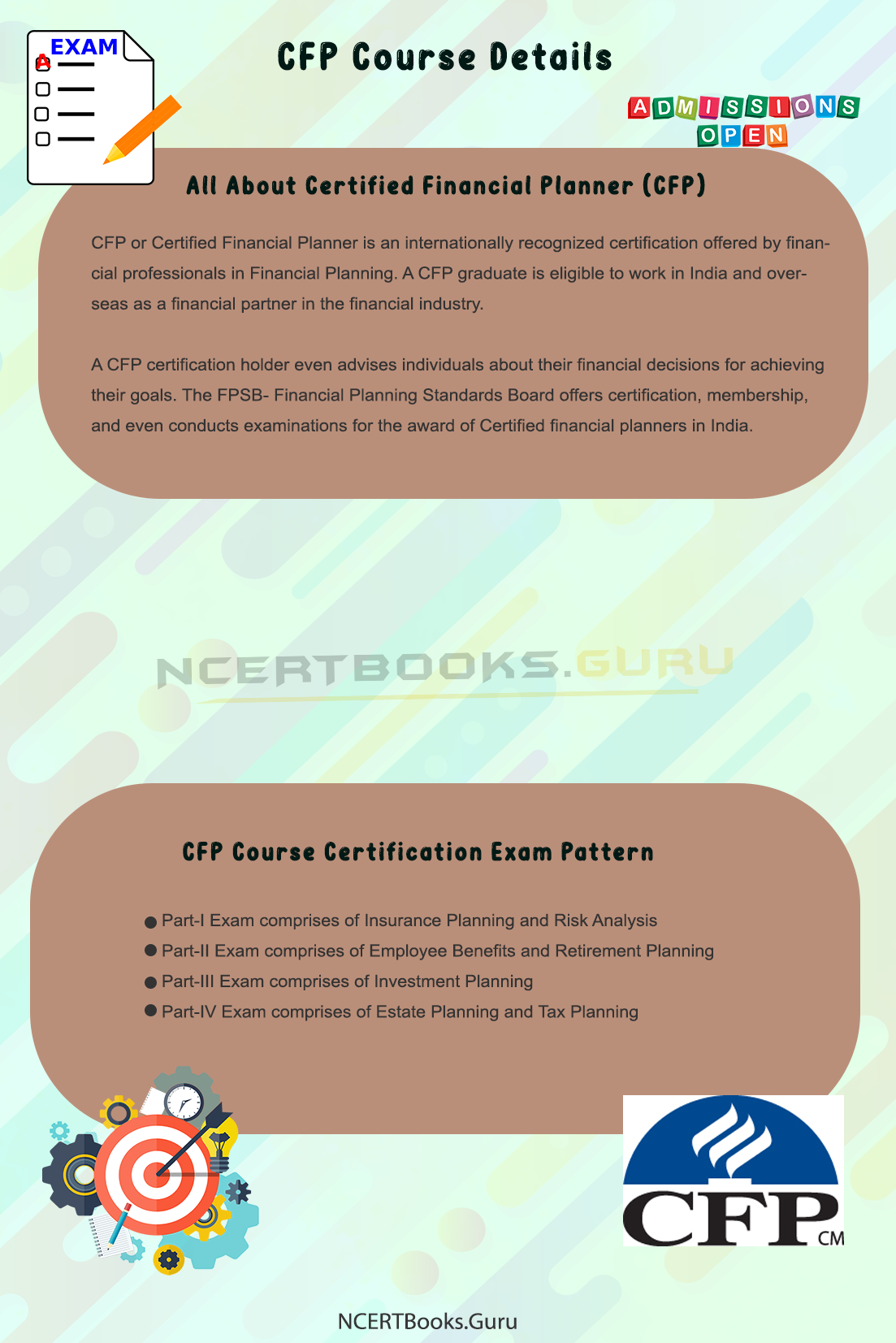
CFP or Certified Financial Planner is an internationally recognized certification offered by financial professionals in Financial Planning. A CFP graduate is eligible to work in India and overseas as a financial partner in the financial industry.

A CFP certification holder even advises individuals about their financial decisions for achieving their goals. The FPSB- Financial Planning Standards Board offers certification, membership, and even conducts examinations for the award of Certified financial planners in India.

The FPSB examines its multiple study and examination centers across India. CFP has gained worldwide recognition for its qualification.

Overview of CFP Course Details

Course  CFP
Full form Certified Financial Planner
Eligibility 10+2 or Bachelors degree
Duration six months to two years
Fee Offered  $595 for application
Course Type Certification
Starting salary offered ₹3.5 Lakhs per annum
Similar Course CFA Course
Employment opportunities Portfolio Managers, Tax Planners, Insurance Advisors, Risk Analysts, Debt Management Specialist, Financial Advisors, Retirement Planning Advisors, and Mutual Fund Advisors

CFP Course Certification Exam Pattern

Certification CFP Certification holds tow modes of exams for contaminates- the Regular Pathway and the Challenge Status Pathway.

Regular Pathway

Candidates need to qualify the five CFP examinations consisting of 6 modules to acquire the CFP Certification. The Regular Pathway comprises four-part examinations, which the candidate must qualify through training support and self-study from any of FPSB’s approved Educational Institutions.

  1. Part-I Exam comprises of Insurance Planning and Risk Analysis
  2. Part-II Exam comprises of Employee Benefits and Retirement Planning
  3. Part-III Exam comprises of Investment Planning
  4. Part-IV Exam comprises of Estate Planning and Tax Planning

Theses four-part examinations are conducted on the NSE Academy Certification in the Financial Market platform and are facilitated by the National Stock Exchange. The examinations are conducted through NSE’s centers and other networking sites throughout India.

Challenge Status Pathway

To get past the Challenge Status Pathway, Candidates must secure a minimum aggregate in the Advanced Financial Planning to acquire a CFP certification. Candidates who possess higher qualifications like LLB, Ph.D., CA, CS, etc. are eligible to register for CFP Certification through the Challenge Status Pathway Portal.

CFP Course Duration

The overall duration for the CMA course option is flexible, which indicates that the total time taken to complete the CFP program depends on the aspirant’s level of dedication and focus. The entire CFP Certification course duration fluctuates between 6 months to two years based on the candidate’s potential.

CFP Certification and Eligibility

To acquire CFP certification, candidates must meet the minimum eligibility criteria laid down by the FPSB. The eligibility criteria are different for the two modes of the CFP Certification Examination.

Regular Pathway Eligibility

Aspiring candidates must secure a minimum aggregate in Matriculation or SSC or 10th standard. Candidates who have secured a minimum aggregate in Class 12 and those currently enrolled in Bachelor’s degree of any discipline are eligible to register for CFP Certification through the Regular Pathway.

However, at the time of Certified Financial Planner Certification, candidates must have secured a minimum aggregate in HSC or 12th standard.

Challenge Status Pathway Eligibility

To deem eligible for Challenge Status Pathway, candidates should have completed CA or Intermediate level, CFA, ICWA, CS, CAIIB, LLB, Ph.D., MPhil, PG, Actuary, FFSI and FLMI from LOMA, Associate or Fellowship of Life Insurance, Civil Service Examinations by UPSC.

In this mode of examination, candidates must clear only the Advanced Financial Planning, which is the fifth exam to be qualified and earn the CFP Certification.

See More:

Fee Structure for CFP Certification

The approximate Fee Structure for CFP Certification applicable for both Regular Pathway Candidates and Challenge Status Pathway Candidates is given below:

  • Registration Fees with FPSB India- Rs. 16, 385 per annum
  • Exam paper- I-IV Fee Payment-  Rs. 4,130 per exam per attempt
  • Exam paper-V Fee Payment-  Rs. 8,260 per attempt
  • CFPCM Certification Fee Payment- Rs. 7,080 per annum, but is renewed annually

CFP Course Exam Curriculum

The CFP Curriculum comprises of FPSB’s financial planning program. This exam program comprises of topics that cover all the aspects of Certified Financial Planner. It is inclusive of fundamentals and real-life skills required to tackle in the real world.

Module Exam Curriculum
Introduction to Financial Planning Financial Planning Process that includes client interactions, time value of money applications, etc.
Education planning, and other general principles
Insurance Planning and Risk Analysis Introduction to the strategies and applications of Risk Analysis
Insurance Concepts, Insurance Policies, Environment of an Insurance Advisor,
Retirement Planning and Employee Benefits Introduction to Retirement Planning, Retirement Benefits, Retirement Planning, and Strategies, etc.
Reform proposals, Pension Sector Planning, and other related sectors.
Components of Investment Planning A fundamental concept to Investment Planning,  Regulation od the process, Investment vehicles, Client Application, and other related sections
Tax Planning & Estate Planning Tax Planning Considerations, Tax Computations, etc.
Planning of Estates
Introduction to Advanced Financial Planning This section of the portion includes determining and gathering client data along with their goals and expectations and other related sections.

CFP Course Details

Institutes Offering CFP Course

Below given are a few top institutes for Certified Financial Planner (CFP) Certification course:

Top Government Institutions

  • Indian School of Business Management and Administration, Hyderabad
  • Indian School of Business Management and Administration, Patna
  • Indian School of Business Management and Administration, Delhi

Top Private Institutions

  • IMS ProSchool Pune, Pune
  • ICICIdirect Centre for Financial Learning (ICFL), Kolkata
  • ICOFP Delhi- International College of Financial Planning, Delhi
  • ICOFP Mumbai – International College of Financial Planning, Mumbai

CFP Course Career Prospects

Financial Planning has become the need of the day among the middle-class sector of the income group as there is an increasing rate of people shifting from traditional assets to asset classes. This shift has increased the demand for Financial Planners across the globe.

CFP Course Job Opportunities

A Certified Financial Planner holds high demand in the follows areas of expertise:

  • Private Banking sector
  • Investment Consultancy Firms
  • Wealth Management Companies
  • Insurance Companies
  • Mutual Funds

CFP Course Job Profiles

A fully-qualified CFP Certification Holder is eligible to hold the following professional roles:

  • Portfolio Managers
  • Tax Planners
  • Insurance Advisors
  • Risk Analysts
  • Debt Management Specialist
  • Financial Advisors
  • Retirement Planning Advisors
  • Mutual Fund Advisors

Earnings of CFP Certificate Holder

In India, the average earning of a Certified Financial Planner is ₹3.5 Lakhs yearly.CFP holds a high demand that provides an additional sum of average ₹50,000 as a bonus, an average of ₹75,000 in the form of commission, and an average of ₹22,000 in profit sharing.

Also, Check Courses After 12th, Courses After 10th on this website.

FAQ’s on CFP Course Details

Question 1.
What are the advantages of a Certified Financial Planner?

Answer:
Certified Financial Planner is the most recognized in the field that increases employment rate at Mutual Funds, Wealth Banks, etc. This Certification course improves career progression and boosts advisory services.

Question 2.
What is the duration of the CFP Certification Course?

Answer:
The overall duration for the CMA course option is flexible, which indicates that the total time taken to complete the CFP program depends on the aspirant’s level of dedication and focus. The entire CFP Certification course duration fluctuates between 6 months to two years based on the candidate’s potential.

Question 3.
How can you differentiate between CFA and CFP?

Answer:
A CFA graduate often works on the investment analysis with corporate clients, while a CFP graduate builds a financial plan with individual investors.

Summary 

We hope that the information mentioned above regarding CFP Course Details has helped improve your understanding of the subject with in-depth knowledge.