Printable Blank India Outline Map for UPSC Preparation | How to Study India Outline Map for UPSC IAS Exam?

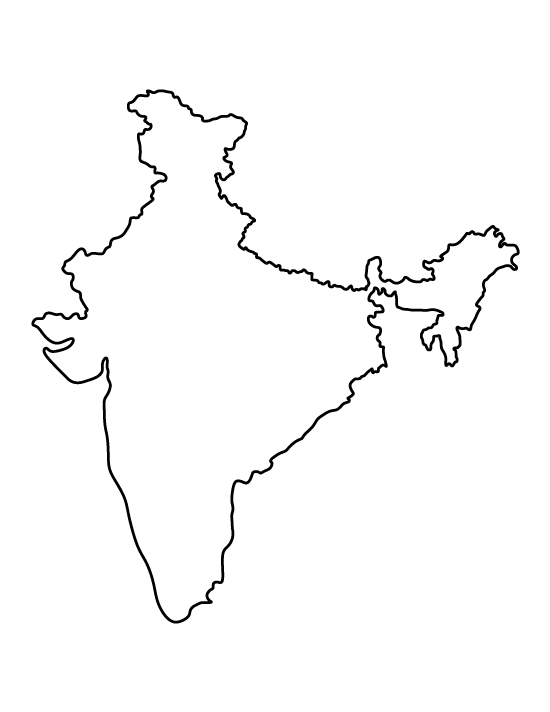
India is the second-largest country in Asia and shares its boundaries with Countries like Burma, Bangladesh, China, Bhutan, Pakistan, and Nepal. It is a Republic made of 28 States and 8 Union Territories. An Outline Map of India will help identify the boundaries of states in the country. It can be a perfect guide for students of geography to know various states in the country.

This article will shed some light on how to integrate maps into your learning strategy and tackle questions related to Geography. UPSC will never ask questions directly and checks your ability to interconnect topics. Understand the Importance of Maps to Score better grades in your UPSC Civil Service Examination. Maps play a crucial role in UPSC Prelims, Mains Exam. One needs to know How many States are there and where they are located.

Download Printable India Outline Map

If you are one of those who are getting started with the India Map Outline Drawing then Blank Map Outline can be a great source in learning it. Blank Map of India can be useful to guide you in drawing the Whole India Map. Outline Maps of India are available in both offline and online versions. The offline version is a printable one that you can use during your Educational Purposes. Check out the accuracy of your Geographical Knowledge by practicing from the Printable Outline India Map.India Map Outline

Do Read More Articles on

How to Study Maps for UPSC IAS?

Keep the below pointers in mind and complete one after the one. This, way you can get a grip on the India Map and its locations by which you can answer any difficult question asked in the UPSC Exam.

Neighbours: Firstly, learn about India’s Neighbouring Countries. List out different states that share the boundaries of India’s Neighboring Countries. Study thoroughly about oceanic regions and Islands, etc.

Lines: Get to know about Important Lattitude and Longitude Lines. Keep a note of states that passes through the Indian Standard Meridian.

States: You need to be in a position to draw the political map of India by hand. Be aware of the Important Cities of the country and point them on the Map. Identify the west/east/south/north extents of states and union territories. Make a note of new states carved out in the existing territory of India.

Rivers and Lakes: Find Origin, Sources, Tributaries, and Flow Routes of Rivers in India. Point out Lakes on Political Map and identify the states that share them.

Mountains/Glaciers: Note down the important peaks of mountains and draw mountain ranges on a political map. Study about different glaciers and various rivers originating from these glaciers. Learn a comparative approach to draw Western and Easter Ghats Mapping.

Natural Vegetation: Study about Great Diversity in Indian Natural Vegetation. Learn the Spacial Distribution of types of forests across India.

Wrapping Up

We believe the knowledge shared regarding the India Outline Map has shed some light on you. If you need any help do leave us your queries via the comment section so that we can revert back to you with possible help. Bookmark our site to know UPSC Exam Preparation related Stuff in no time.

NCERT Solutions for Class 6 Sanskrit Chapter 8 सूक्तिस्तबकः

NCERT Solutions for Class 6 Sanskrit Ruchira Chapter 8 सूक्तिस्तबकः

अभ्यासः

पाठ का सम्पूर्ण सरलार्थ-

1. अस्माकं विद्यालयः ……………………. विकासः भवति। (पृष्ठ-57)
हिन्दी सरलार्थ-
हमारा विद्यालय गाँव के पास है। सुबह छात्र मेरे गाँव से विद्यालय आते हैं। दूसरे गाँवों से भी छात्र यहाँ पढ़ने के लिए .. आते हैं। विद्यालय की प्रार्थना सभा बहुत सुन्दर है। प्रार्थना सभा के बाद बालक और बालिकाएँ अपनी-अपनी कक्षा में जाते हैं। वे अध्यापकों से अनेक विषय पढ़ते हैं। विद्यालय के पुस्तकालय से छात्र पुस्तकें लाते हैं। वहाँ वे समाचार-पत्र भी पढ़ते हैं। पुस्तकें पढ़ने से ज्ञान का विकास होता है।

2. विद्यालयस्य पुरतः ………………….. अतिसुखदं भवति। (पृष्ठ-57)
हिन्दी सरलार्थ-
विद्यालय के सामने एक बगीचा है। बगीचे की शोभा बहुत सुन्दर है। यहाँ अनेक प्रकार के फूल हैं। उनके ऊपर भँवरे गूंजते हैं। वे फूलों का रस पीते हैं। वहाँ पक्षियों का चहचहाना बहुत सुखद होता है।

3. विद्यालयस्य ……………………. ततः सुखम्॥ (पृष्ठ-58)
हिन्दी सरलार्थविद्यालय का खेल का मैदान बहुत बड़ा है। यहाँ छात्र न केवल खेल के कालांश में अपितु छुट्टी के बाद भी खेलते हैं। खेल के अध्यापक से वे खेल में निपुणता प्राप्त करते हैं। हमारे विद्यालय में पढ़ने से और खेलने से छात्रों का शारीरिक और मानसिक विकास होता है।

विद्या से और विनम्रता से युक्त स्वस्थ छात्र ही समाज और देश की सेवा करते हैं। और कहा गया है-

विद्या विनम्रता देती है, विनम्रता से (मनुष्य) योग्यता को प्राप्त करता है। योग्यता से धन प्राप्त करता है, धन से धर्म और उससे सुख प्राप्त करता है।

पाठ्य-पुस्तक के प्रश्न-अभ्यास

प्रश्न: 1.
उच्चारणं कुरुत-
मोदकात् – मोदकाभ्याम् – मोदकेभ्यः
मालायाः – मालाभ्याम् – मालाभ्यः
चित्रात् – चित्राभ्याम् – चित्रेभ्यः
शुकस्य – शुकयोः – शुकानाम्
लतायाः – लतयोः – लतानाम्
चित्रस्य – चित्रयोः – चित्राणाम्
उत्तर:
विद्यार्थी स्वयं उच्चारण करें।

प्रश्नः 2.
रेखाङ्कितानि पदानि बहुवचने परिवर्तयत-
यथा-
छात्राः ग्रामात् आगच्छन्ति।
छात्राः ग्रामेभ्यः आगच्छन्ति।
(क) जनाः आपणातु क्रीडनकानि क्रीणन्ति।
जनाः ………… क्रीडनकानि क्रीणन्ति।

(ख) बालकाः पुस्तकालयात् पुस्तकानि आनयन्ति।
बालकाः …………… पुस्तकानि आनयन्ति।

(ग) पत्रिकायाः चित्राणि पश्यत।
…………” चित्राणि पश्यत।

(घ) शाखायाः पत्राणि आनय।
……………. पत्राणि आनय।

(ङ) लतायाः पुष्पाणि चिनुत।
……………. पुष्पाणि चिनुत।

(च) वृक्षात् पत्राणि पतन्ति।
…………….. पत्राणि पतन्ति।
उत्तर:
(क) आपणेभ्यः
(ख) पुस्तकालयेभ्यः
(ग) पत्रिकाभ्यः
(घ) शाखाभ्यः
(ङ) लताभ्यः
(च) वृक्षेभ्यः

प्रश्नः 3.
रेखाङ्कितानि पदानि एकवचने परिवर्तयत-
यथा- वनानां दृश्यम्
वनस्य दृश्यम्
(क) उद्यानानां शोभा।
………….” शोभा।

(ख) चित्राणां वर्णः।
…………. वर्णः।

(ग) बालिकानाम् आभूषणम्।
………….. आभूषणम्।

(घ) कोकिलानां स्वरः।
……………. स्वरः।

(ङ) सिंहानां निद्रा।
……… निद्रा।

(च) मेघानां गर्जनम्।
…………… गर्जनम्।
उत्तर:
(क) उद्यानस्य
(ख) चित्रस्य
(ग) बालिकायाः
(घ) कोकिलस्य
(ङ) सिंहस्य
(च) मेघस्य

प्रश्नः 4.
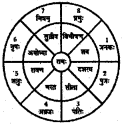
अधोलिखितं चित्रं पश्यत। उदाहरणानुसारेण कोष्ठकगतैः शब्दैः वाक्यानि रचयत-
NCERT Solutions for Class 6 Sanskrit Chapter 8 सूक्तिस्तबकः 1
यथा-
(क) रामः (लव) लवस्य जनकः।
(ख) रामः (दशरथ) ………… पुत्रः।
(ग) रामः ……………………………..
(घ) …………………………………….
(ङ) ……………………………………
(च) ……………………………………
(छ) ……………………………………
(ज) ……………………………………
उत्तर:
(क) रामः लवस्य जनकः।
(ख) रामः दशरथस्य पुत्रः
(ग) रामः सीतायाः पतिः।
(घ) रामः भरतस्य अग्रजः
(ङ) रामः रावणस्य शत्रुः।
(च) रामः अयोध्यायाः नृपः।
(छ) रामः सुग्रीवस्य मित्रम्
(ज) रामः विभीषणस्य प्रभुः।

प्रश्नः 5.
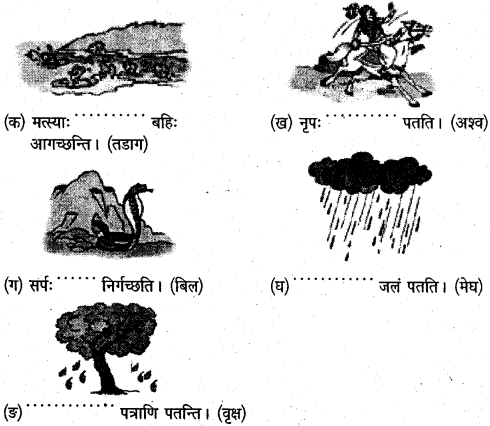
चित्राणि दृष्ट्वा कोष्ठकगतशब्देषु उचितां विभक्तिं प्रयुज्य वाक्यानि पूरयत-
NCERT Solutions for Class 6 Sanskrit Chapter 8 सूक्तिस्तबकः 2
उत्तर:
(क) मत्स्याः तडागात् बहिः आगच्छन्ति।
(ख) नृपः अश्वात् पतति।
(ग) सर्पः बिलात् निर्गच्छति।
(घ) मेघेभ्यः जलं पतति।
(ङ) वृक्षात् पत्राणि पतन्ति।

प्रश्नः 6.
उपयुक्तशब्दं चित्वा रिक्तस्थानानि पूरयत-
(क) बालकाः …………. गृहम् आगच्छन्ति। (विद्यालयात विद्यालयेन)
(ख) श्यामः ………….. दुग्धम् आनयति। (गृहेण/गृहात्)
(ग) नदी ……….. प्रभवति। (पर्वतात्/पर्वतेन)
(घ) माता’…………. जलम् आनयति। (कूपेन/कूपात्)
(ङ) नरेशः ……………. वस्तूनि क्रीणाति (आपणेन्/आपणात्)
उत्तर:
(क) विद्यालयात्
(ख) गृहात्
(ग) पर्वतात्
(घ) कूपात्
(ङ) आपणात्

प्रश्नः 7.
गोपालः किं किं वस्तु कुतः आनयति इति लिखत-
पुस्तकालयात् ग्रामात् मालाकारात् कोषात् आपणात्
(क) ………….. फलानि आनयति।।
(ख) ………….. पुस्तकानि आनयति।
(ग) ………….. धनम् आनयति।
(घ) ………….. दुग्धम् आनयति।
(ङ) ………….. पुष्पाणि आनयति।
उत्तर:
(क) आपणात्
(ख) पुस्तकालयात्
(ग) कोषात्
(घ) ग्रामात्
(छ) मालाकारात्

NCERT Solutions for Class 6 Sanskrit

Free Samples of Bank Statement Letter Format | How To Write Bank Statement Letter?

bank statement letter format and sample

Format and Samples of Bank Statement Letter: Usually, A bank statement letter is written to the bank manager, requesting to provide a bank statement to self. Actually, a bank statement is a report of all the financial transactions made by a person or a business entity. Therefore, a bank statement is considered an essential document.

Bank holders usually get their bank statements on a monthly basis at most of the banks. In a bank statement, you will find to know the list of all transactions from withdrawals to deposits in various forms (cash, cheque, net banking, etc). As the world is mostly running via digital transactions, everyone is using bank applications to check their bank account & statements more conveniently by accessing the internet.

Still, at some times that we require a hardcopy of our bank statement for particular reasons like previous salary bank statements, Govt exams fee bank statements, etc. The only way to get the bank statements is to write a bank statement letter for the bank manager.

Format for Bank Statement Letter Writing

Are you waiting to have a glance at your bank transactions on your bank passbook? Then, write a letter for a Bank statement and give it to your bank manager for processing it further. The Format of the Bank Statement Letter is tabulated below:

To,

Receiver’s Name

Receiver’s Address

Date

Sender’s Name

Sender’s Address

Subject Line:

Dear Sir/ Madam,

[————————–letter body———————————]

[————————–letter body———————————]

[————————–letter body———————————]

Yours Sincerely

[Sign]

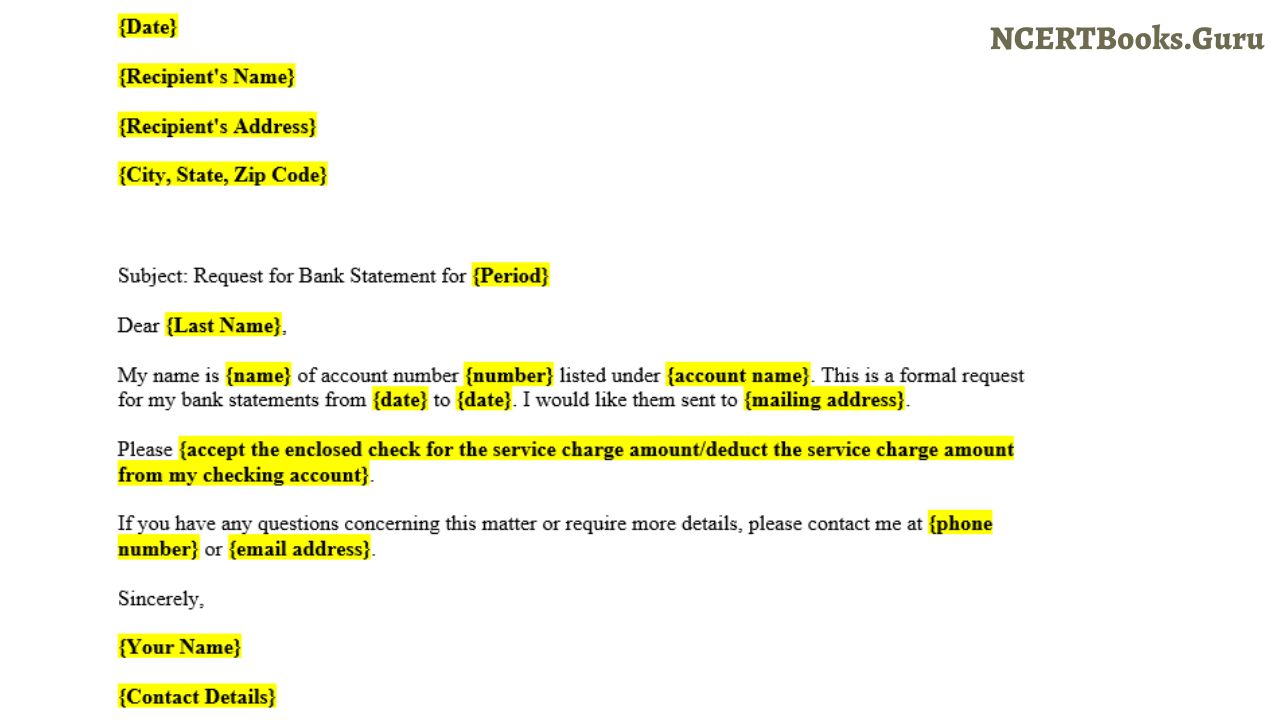
Issue of Bank Statement Letter Template in Image

word template for bank statement letter

Bank Statement Letter Samples

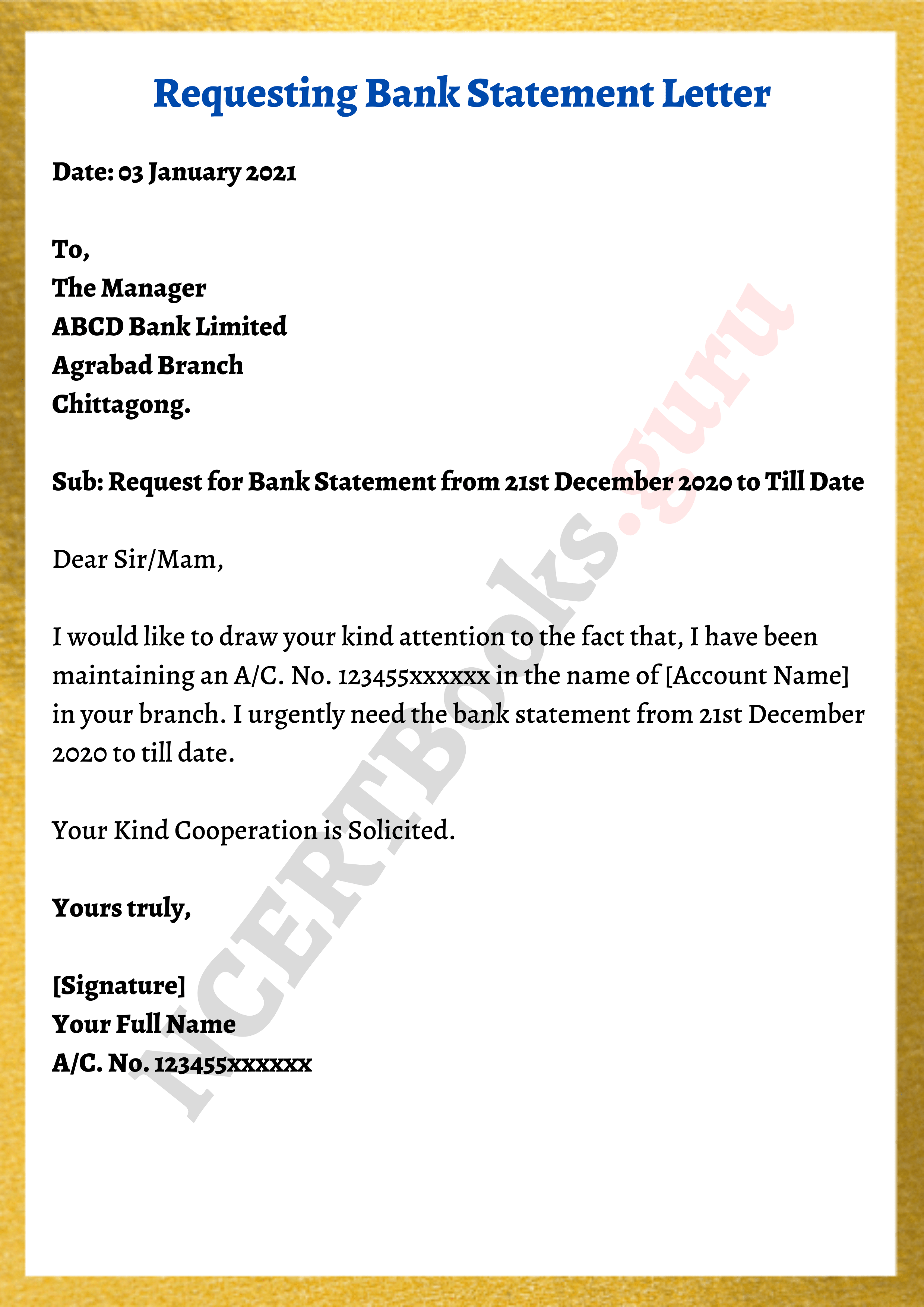
The following image makes you understand how to write a bank statement letter to your bank manager. So, check out this sample for a bank statement letter & make use of it whenever you require.

Sample for Requesting Bank Statement Letter

bank statement letter samples

FAQs on Bank Statement Letter Writing

1. How can I write a Bank Statement Letter?

Tips to Write a Bank Statement Letter is given here:

  • Add receiver’s and senders’ addresses at first.
  • Write succinctly why you need a bank statement in a letter.
  • Provide essential data and supporting details to make it clearer.
  • Ensure you write in a Formal way with simple & understandable words.
  • Be accurate and factual.
  • Proofread and edit before submitting.

2. Where can I find Bank Statement Letter Samples in PDF Format?

You can find Bank Statement Letters Samples in PDF Format on NCERTBooks.Guru for free of cost.

3. How do I request a bank statement?

If you want to request a bank statement then address the bank statement letter by filling in all the necessary details and give it to your bank manager where your account exists.

NCERT Solutions for Class 8 Social Science History Chapter 11 The Making of the National Movement 1870s – 1947

The Making of the National Movement 1870s – 1947 Class 8 Questions and Answers History Chapter 11

History Class 8 Chapter 11 NCERT Textbook Questions and Answers

Question 1.
Imagine that you are involved in the Indian national movement. Based on your readings of this chapter, briefly discuss your preferred methods of struggle and your vision of a free India.
Answer:
I would prefer to be a member of the revolutionaries mainly Bhagat Singh and his group. Whatever they did was right and I would also do what they did. I am not a person to suffer the injustice of the British. After all we (Indian) too are human beings. We should always be ready to fight for our motherland.

Question 2.
Why were people dissatisfied with British rule in the 1870s. and 1880’s?
Answer:
People were dissatisfied with British rule in the 1870s and 1880s due to the following reasons :
1. The British passed the Arms Act in 1878 which disallowed Indians from possessing arms.
2. In the same year they passed the Vernacular Press Act. This Act snatched the freedom of speech and expression. It allowed the government to confiscate the assets of newspapers including their printing presses if the newspapers published anything that was critical of the government.
3. In 1883, the Ilbert Bill was introduced. The bill provided for the trial of British or European persons by Indian and sought equality between British and Indian Judges in the country. But the white opposition forced the government to withdraw the bill.

Question 3.
Who did the Indian National Congress wish to speak for?
Ans. The Indian National Congress did not wish to talk only on behalf of professional groups, zamindars to industrialists hue also for peasants, artisans, women and for all people of the country. It also raised a number of economic issues, social issues, and political issues.

Question 4.
What economic impact did the First World War have on India?
Answer:
The First World War led to a huge rise in the defence expenditure of the Government of India. The government in turn increased taxes on individual incomes and business profits.

Increased military expenditure and the demands for war supplies led to the sharp rise in prices which badly affected the common mass. They found it difficult to fulfil even their essential needs.

But the business groups earned huge profits from the war. The war created a demand for industrial goods like jute bags, cloth, rails and caused a decline of Import’s from other countries into India. As a result Indian industries expanded during the war.

Question 5.
What did the Muslim League resolution of 1940 ask for?
Answer:
In 1940 the Muslim League had moved a resolution demanding “Independent states” for Muslims in the north-western and eastern areas of the country. The resolution did not mention partition or Pakistan.

Question 6.
Who were the Moderates? How did they propose to struggle against British rule?
Answer:
The Moderates were against extreme actions. They had deep faith in the good intention of the government. They were of the opinion that slowly and steadily they would make the British go to their own land.

The moderate leaders developed public awareness about the unjust nature of British rule. They published news papers, wrote articles and showed how British rule was leading to the economic ruin of the country. They criticised British rule in their speeches and sent representatives to different parts of the country to mobilise public opinion. They believed that the British had respect for the ideals of freedom and justice and therefore, they would definitely accept all the just demands of the people of India. Their main task was to acknowledge the British government with these demands.

Question 7.
How was the politics of the Radicals within the Congress different from that of the Moderates?
Answer:
The radicals criticised the moderates for their “politics of prayers” and emphasised the importance of self-reliance and constructive work. They argued that people must rely on their own strength not on the “good” intentions of the government; people must fight for swaraj. Tilak raised the slogan “ Freedom is my birth right and I shall have it!”

Question 8.
Discuss the various forms that Non-cooperation Movement took in different parts of India. How did the people understand Gandhiji?
Answer:
The Non-cooperation movement spread for and wide. It took various forms in different parts of the country:

  1. In Kheda, Gujarat, Patidar peasants were worried about the high land revenue demand of the British. Hence they organised non-violent campaigns against it.
  2.  In coastal Andhra and interior Tamil Nadu, liquor shops were picketed.
  3. In the Guntur district of Andhra Pradesh, Tribals and poor peasants started several forest satyagrahas, sometimes sending their cattle into forests without paying grazing tax. They were very much fed up with the restrictions imposed on them by the British regarding the use of forest resources. They wanted the abolition of the forest regulations.
  4. In Sind, now in Pakistan, Muslim trades and peasants were very enthusiastic about the Khilafat call. In Bengal too, the khilafat Non-cooperation alliance gave enormous communal unity and strength to the national movement.
  5. In Punjab, the Akali agitation of the Sikhs sought to drive out corrupt mahants, supported by the British from the gurudwaras. This movement got closely identified with Non-cooperation movement.
  6. In Assam, tea garden labourers left with the British owned plantations and become the followers of Gandhiji.
    People viewed Gandhiji as a messiah as some one who could help them overcome their misery and poverty.

Question 9.
Why did Gandhiji choose to break the salt law?
Answer:
Gandhiji declared that he would lead a march to break the salt law. According to this law, the state had a monopoly on the manufacture and sale of salt. Mahatma Gandhi along with other nationalists reasoned that it was sinful to tax salt since it is such an essential item of our food. The salt march related the general desire of freedom to a specific grievance shored by every body, and thus did not divide the rich and the poor.

Gandhiji and his followers marched for over 240 miles from Sabarmati to the coastal town of Dandi where they broke the government law by gathering natural salt found on the seashore and bailing sea water to produce salt.

Question 10.
Discuss those developments of the 1937—47 period that led to the creation of Pakistan.
Answer:
From the late 1930, the Muslim League began viewing the Muslims as a separate- nation from the Hindus. This nation might have developed because of the history of tension between some Hindu and Muslim groups in the 1920s and 1930s The provincial elections of 1937 also might have convinced the League. The Muslims were a minority and they would always have to play fiddle frilled in any democratic structure. Meanwhile, the rejected the Legue’s desire to form a joint Congress- League government in the united provinces in 1937. This annoyed the League.

In 1940, the league finally moved a resolution demanding ‘Independent states’ for Muslim in the north-western and eastern areas of the country. The resolution
did not mention partition or Pakistan.

In 1945, the British opened negotiations between the Congress, the league and themselves for the independence of India. The talks could not succeed because the League saw itself as the sole spokesperson of India Muslims. The Congress proved this claim baseless because several Muslims still supported it.

In the provincial elections in 1946 the League got grand success in the seats reserved for Muslims. Hence it persisted its demand for Pakistan. In march 1946, the cabinet mission came to Delhi to examine this demand and to suggest a suitable political framework for a free India. This mission suggested that India should remain united and constitute itself as confederation a loose with some autonomy for Muslim-majority areas. Neither the Congress nor the Muslim League agreed to it. The failure of the cabinet mission made partition inevitable. Ultimately in 1947 partition took with the birth of a new country, i.e, Pakistan.

Question 11.
Find out how the national movement was organised in your city, district area or state. Who participated in it and who led it? What did the movement in your area achieve?
Answer:
(Students to do it as per their area)
Organization of National Movement in our city:
Hints:

  • Visit of Gandhiji.
  • Formation of Action Committees.
  • Meetings and awareness of different events at the national level.
  • Prabhat Pheries and Rallies.
  • Protest march to district headquarters.
  • Mass arrests.
  • Hanging of the freedom fighters.
  • Award after getting independence.

Question 12.
Find out more about the life and work of any two participants or leaders of the national movement and write a short essay about them. You may choose a person not mentioned in this chapter.
Answer:
(a) Rajendra Prasad:
The political career of Dr. Rajendra Prasad started as a social worker. In 1918, he came into contact with Gandhiji during the Champaran satyagraha. He took active part in this movement. He was also sent to jail, by the Britishers, a number of times. He was one of the most uncontroversial figure in the Indian politics. When India became independent, he was elected the first President of India.

(b) Jaiprakash Narayan :
From 1934, Jaiprakash Narayan dedicated his life for the welfare of the country. First he became the secretary of the socialist party, and then in 1946 when Jawaharalal Nehru offered him the membership of the congress working committee, he rejected the offer. However, later he joined the congress committee with Ram Manohar Lohia. But both of them left it soon. After some years, Jaiprakash Narayana became the General secretary of the socialist party. He is known for his active, selfless service for the country.

Activities

Activity 1
From the beginning the Congress sought to speak for and in the name of, all the Indian people. Why did it choose to do so?
Answer:
From the very beginning congress considered itself the nucleus of a future parliament for our country and thus, thought for all the entire nation and the entire population.

Activity 2
What problem regarding the early congress does this comment highlight?
In Pursuit of gold : This is what a Moderate leader, Dinshaw Wacha, wrote to Naoroji in 1887 :
Pherozeshah is nowdays too busy with his personal work ………….. . They are already rich enough ………….. Mr. Telang too remains busy. I wonder how if all remain busy in the pursuit of gold can the progress of the country be advanced?
Answer:
Dineshaw Wacha wrote to Naoroji that if all the congress members thought of them selves what will happen to the country? And how the country will advance if there will be no unity among the congress.

Activity 3
Find out which countries fought the First world war.
Answer:
Germany, Poland, France, Russia, British, etc.

Activity 4
Find out about the Jalianwala Bagh massacre. What atrocities were committed there? How were they committed?
Answer:
The people of Punjab had been very angry and excited over many issues. When the government ordered the arrest of Dr. Satyapal and Dr. Saifuddin Kitchleu, the people in order to protect against their leaders arrest assembled on 13 April, 1919 at Amirtsar in the Jallianwala Bagh. This Bagh was enclosed on three sides by buildings and had only one exist, which was narrow. General Dyer surrounded the Bagh with troops, closed the only exit and ordered his troops to fire upon the innocent people. Many people were killed and wounded.

Activity 5
(a) Read Source 4.
According to this report, how did people view Mahatma Gandhi? Why do you think they felt that he was oppossed to zamindars but not to the government? Why do you think they were in favour of Gandhiji?

(b) “It was he who got bedakhli stopped in paragraph”
The following is an extract from a CID report on the kisan movement in Allahabad distract, January 1921:

The currency which Mr. Gandhis name has acquired even in the remotest villages is astonishing. No one seems to know quite who or what he is, but it is an accepted fact that what he says is so, and what he orders must be done. He is a Mahatma or sadhu, a Pundit, a Brahmin who lives at Allahabad, even a devta ………. the real power of his name is to be traced back to the idea that it was he who got bedakhli (illegal eviction) stopped in Pratapgarh ……. as being antagonistic to Government, but only to the zamindars ………… We are for Gandhiji and the Sarkar.
Answer:
(a) People viewed Gandhiji as a Mahatma or Pandit; or sadha or a Brahmin who lives in Allahabad.
(b) The people thought that he opposed to zamindars by not to government because zamindars were in direct contain with the farmers and not the British. Gandhiji had stopped the illegal evicting of the zamindar in Pratap- garh because he favoured the common people and not the zamindars.

NCERT Solutions for Class 8 Social Science

Middle School GK Questions & Answers for Class 7 Maths Science, General Awareness

GK Questions for class 7 kids in english

GK Questions for Class 7: Parents and educators who are shaping future “genius persons” with facts and concepts of maths and science is somewhat difficult yet even greater. To help you out from the toughest situation at sometimes we have shared the top and best collection of GK Questions for Class 7 Students. This guide covers class 7 General knowledge questions and answers in English for easy grasping and enhancing the level of academic and general knowledge on the world, India, current affairs, etc.

Check out the links provided here and directly jump into the particular section of GK quiz questions & answers for class 7 and make your memory fill with necessary information about the education life or general life. Moreover, this list of top General Knowledge questions in English for 7th class includes maths & science subject related questions to improve more subject knowledge as well as to score high in various competitive examinations.

This Article Contains:

Also, Check out our main page of General Knowledge for grabbing various topics, questions, etc. related to GK.

General Awareness & Current Affairs GK Questions & Answers

Updating yourself with the facts which you were not aware of before from class to class is very important for kids in school life. The memory power at early ages for kids is so powerful. Make them learn and aware of everything happening around them to think smarter & become intelligent. The List of GA & Current Affairs GK Questions with Answers in English covers all about the world, India, history, technology, etc. so class 7 students should consider it as a quick activity while studies.

1. What is the Smallest Ocean?

Answer: Arctic Ocean

2. Who has the authority to declare a “Global Emergency”?

Answer: World Health Organisation (WHO)

3. Who is the new chairman of the Central Board of Secondary Education (CBSE)?

Answer: Rajesh Kumar Chaturvedi

4. Which country has won the 18th Men’s Asian Junior Team Squash championship 2017?

Answer: India

5. Which state government of India has launched the PEHAL programme for raising education standards?

Answer: Himachal Pradesh

6. Name the Currency used in Singapore?

Answer: Singapore Dollar

7. Who has the authority to issue currency in India?

Answer: Reserve Bank of India (RBI)

8. What is the name of India’s longest Highway having a length of 4,112 km?

Answer: NH44

9. In which year World War II (WW2) started?

Answer: 1939

10. What is the capital city of Australia?

Answer: Vienna

11. How deep is the ocean in Antarctica?

Answer: 7,236 m (23,740 ft)

12. What is the capital city of France?

Answer: Paris

13. Char Minar is located in which city?

Answer: Hyderabad

14. The grasslands of North America are known as?

Answer: Prairies

15. Who was the first Indian woman who wins the Nobel Prize?

Answer: Mother Teresa

Do Refer: GK Questions for Class 1

Class 7 Science & Technology General Knowledge Quiz Questions

Science is a hub of mixed things that prefaces your kid to the engaging world of plants, animals, and the environment around them. Studying & grasping general science becomes easier when it is interesting. So, to make it more intriguing, we have given the GK quiz questions of science topics for class 7 kids here below. Go through the list of science general knowledge questions and answers in English and build more passion towards nature.

1. What are animals, which eat both plants and animals, called?

Answer: Omnivores

2. Yeast is a type of what?

Answer: Fungus

3. What type of energy eventually depletes?

Answer: Non-renewable energy

4. Which is the strongest sense in a dog?

Answer: Smell

5. What disease is caused by vitamin B deficiency?

Answer: Beriberi

6. What is a healthy blood pressure limit?

Answer: 120/80 mmHg

7. What is the main source of energy made through photosynthesis for plants?

Answer: Glucose

8. Cataract is the disease of What?

Answer: Eye

9. What does the 26 atomic number denote?

Answer: Iron (Fe)

10. What is the main cause of Goitre?

Answer: Iron Deficiency

Must See: GK Questions for Class 2

Mathematics GK Questions with Answers for Class 7 Kids in English

GK Questions for the 7th Class Maths are given below along with answers. So, try to learn and memorize them throughout your life for better scores in academics or else in upcoming competitive exams after high school education. The main slogan to keep in your mind is ‘Learn it, Revise it’. Hence, the list of math General knowledge quiz question answers class 7 is here.

1. What is the name of India’s longest Highway having a length of 4,112 km?

Answer: 4

2. What is the square root of 1296?

Answer: 36

3. What should be subtracted from 19700 so that it becomes a perfect cube root?

Answer: 17

4. 3:50 times of 8 is equal to?

Answer: 400

5. 9 raised to the power 0 is equal to:

Answer: 1

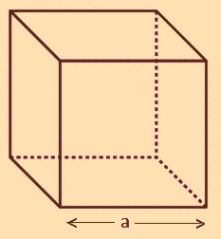
6. a is the side of a cube, then the volume of the cube is:

cube figure

Answer: 6a²

7. Is a triangle a two-dimensional or three-dimensional shape?

Answer: A two-dimensional shape

8. How many sides does a Hendecagon have?

Answer: 11

9. The polygons whose all the sides are equal are called

Answer: Equilateral Polygons

10. What are the types of polygons?

Answer: Regular Polygon, Irregular Polygon, Convex Polygon, and Concave polygon

Some more related Articles:

Final Words

We have given the list of top-best GK questions for class 7 with answers in English for better general awareness about the world, India, sports, history, polity, etc. Also, we covered some of the GK Questions from Class 7 Maths and Science to excel in academics and practice for various competitive exams.

Answering General Knowledge questions for Grade 7 will definitely aid you to obtain more knowledge and more confidence. However, our site Ncertbooks.guru covered all GK Questions for Kids in one place to help the students practice more and clear various competitive exams.

Sick Leave Letter Format & Samples for School, College, and Office | Tips & Key Points to Write a Sick Leave Application

sick leave application format samples and tips

Sick Leave Application: A sick leave letter is a formal document where an employee or student can request to take a leave of absence from work because of Illness/Sick. It permits you to inform the dates and details of your absence in the application or letter writing so everyone like a Boss, HR Department, Teacher, or Principal understands why and for how long you’ll be taking the leave.

If you are writing a sick leave letter as an employee, then the letter will also work as proof in your HR file for the future. A medical certificate from a certified doctor or medical practitioner may also be needed if you take a long period of time due to sickness. In some situations, a formal written letter is needed to submit like in colleges, or schools.

Are you looking for efficient ways to draft an application for sick leave? Then, referring to this article is the best option for you. So, check it out and note down the key points to be remembered and a few formats & samples to draft a perfect sick leave letter. Moreover, you can also access various Letter Writing Topics relating to both formal and informal categories and learn how to draft various letter writings from our site Ncertbooks.Guru.

Sick Leave Application Format for Office/School/College

Sending or Emailing a leave application is the formal and professional way for requesting a sick leave from work for one or a few days. For addressing a perfect sick leave application here we have given various sick leave letter formats for employee, student & parent.

Below format that helps an employee to apply for leave directly through the company portal. For employee’s comfort to write the sick leave application for Illness and Sickness, we are providing the format of the application for sick leave.

Employee Related Sick Leave Letter Format

Subject: Application Sick Leave Application for office for required days

Dear Mr/Mrs (name of recipient),

I am writing this application to inform you that I am suffering from severe viral disease and therefore, I want sick leave from work. I got this infection last night and I will not be capable to come to the office for at least [number of days]. As advised by my doctor, I should take a rest and recover appropriately before continuing work. The report from the doctor is also attached for your reference.

Kindly grant me a leave for [number of days] days. I will be available on the phone in case of any emergency cases. Please reach me as per your comfort. For important matters, I have notified [Name of the colleague] to take care of them to assure that all deadlines are met.

I believe you will understand and grant me leave for the mentioned period. I am waiting for your approval.

Thanks for the consideration.

Yours Sincerely,
(Name).

Application for Sick Leave Format To Class Teacher

To,
The Class Teacher,
Name of the school,
Address.

Date: XX-XX-XXXX.

Subject: Application for Sick leave.

Sir/Mam,

Most respectfully, I beg to state that I am not in a condition to come to the school since I am suffering from a fever. I have been prescribed by our family doctor o take proper rest for at least [number of days] days. Hence, kindly grant me leave from (start date) to (end-date). I shall be really grateful to you.

Thanking you,

Yours obediently,
Your Name,
Class and section,
Roll No.

Sick Leave Letter Format To School Principal

Look at the format of the sick leave application to the principal from below. This will aid you to draft the sick leave letter for the requisite purpose on your own:

To,
The Principal,
(School Name),
(Address).

Subject: Sick Leave Application to School Principal.

Dear (Sir/madam),

With due regard, I want to notify you that my child (name of the student) is a student of class (class name), of your school. Due to some wellness issues, my boy/girl is hospitalized and is recommended to be in a doctor’s monitoring for two days. My family members are taking care of him/her in hospital, right now and we are not in a state to send him/her to school.

Hence, I beg you to please understand our position and grant my child leave for (mention number of days) from (start date) to (end-date). I am inserting a medical document from the doctor for your reference. I ensure you that he/she will attend the school daily going forward.

Thanking you,

Yours sincerely,
(Name of the Parent),
(Signature).

Key Points for Writing Application for Sick Leave

  • Greeting or addressing to the concerned person
  • Subject line
  • Reason for leave
  • Number of leaves required
  • Details of your work compensation
  • Contact information
  • Name and Signature

Download Samples of Sick Leave Application for Various Scenarios

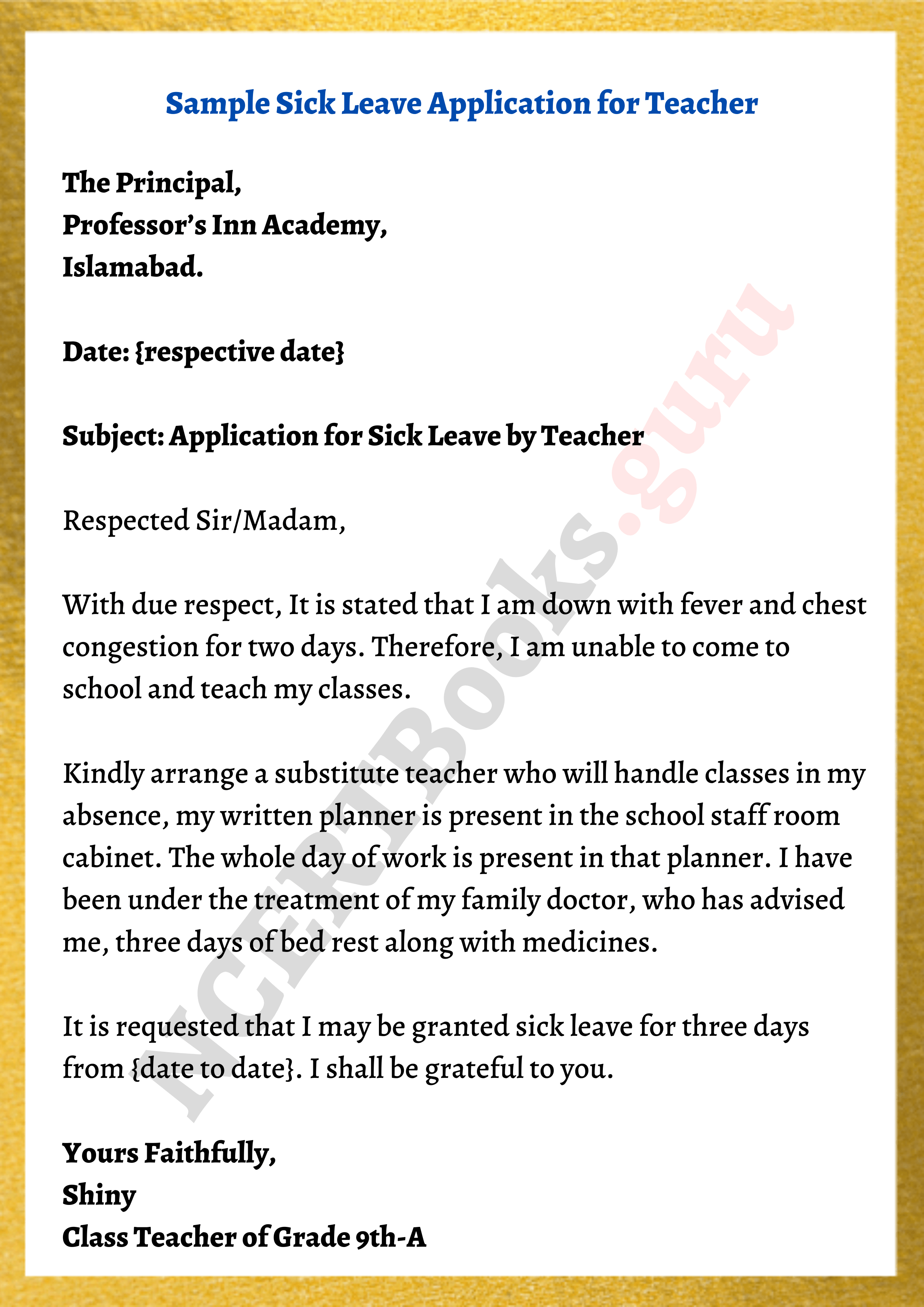
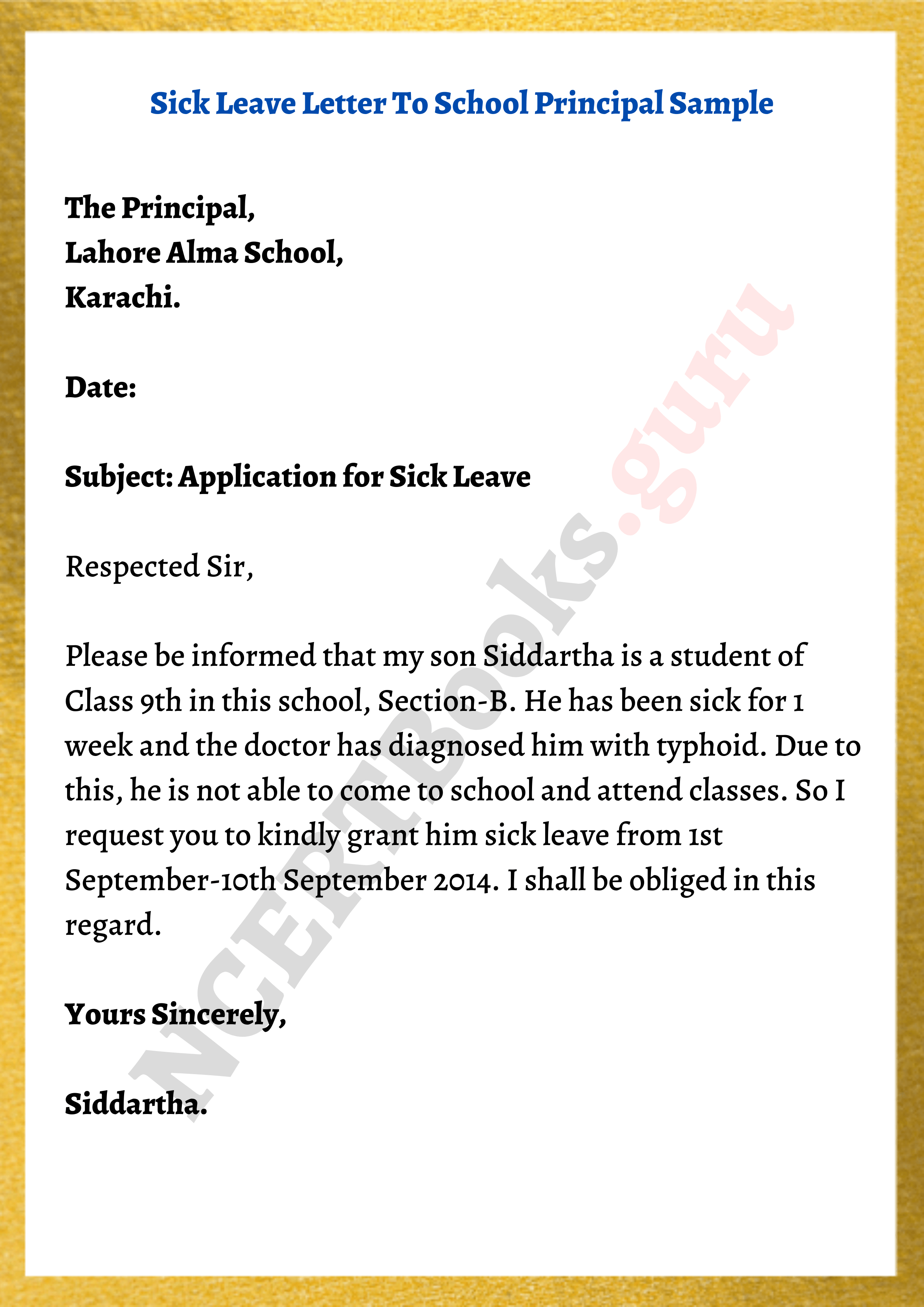
Also, on this page, we have even included some commonly used Sick Leave Letter Samples in images form that you can download for free of cost. Check out these samples of sick leave applications & write your own sick leave letter. By referring to these sick leave application samples you can get an idea of what and what not to include in the letter. They are as such

Sick Leave Letter by an Employee – Sample 1

sick leave letter sample for employees

Sample 2 – Sick Leave Application for Teacher

Sick leave letter sample for teacher

Sick Leave Letter To School Principal by Students – Sample 3

sick leave application sample to principal

FAQs on Sick Leave Application Writing

1. How to write a sick leave letter for school/office/college?

The primary steps that included in writing a sick leave letter are as follows:

  • Right Format of the Letter
  • Date
  • Recipient’s address
  • Greeting
  • The body
  • An expression of gratitude
  • A complimentary close
  • Signature
  • Any supporting documentation

2. What are the Types of Sick Leave Application School/College?

Here are a few sick leave application types. They are as such:

  • Medical Leave Application
  • Leave Application for Fever
  • Application To Principal for Sick Leave

3. What are Crucial Tips To Write Leave Application for Sick?

Some of the important tips that should be followed by the employee or students while drafting the application for sick leave are as mentioned below. Look at the points and remember all the time:

  1. Draft the leave application in a polite manner that represents the request for leave and sounds real.
  2. State the purpose specifically for which you are requesting to leave.
  3. The base of the application must be maintained.
  4. Sick Leave letter should be concise and to the point.
  5. Cross-check with grammar mistakes or punctuation.
  6. The application should mention the relationship between the child and the sender of the letter.