100 Top General Knowledge Questions for Kids between 4 to 12 | Get Simple GK Quiz Questions with Answers, True or False Questions for All Age Groups.

GK Questions for Kids

GK Questions for Kids: Having a basic general knowledge at an early age changes your kid’s level of thinking and intelligence. GK is the most important part of education, it helps children to gain more knowledge about academics and general awareness. Also, it aids in creating social awareness, possessing knowledge of social and general aspects support your little one with their mental development, civil abilities, and civic senses.

General Knowledge Questions and Answers for kids cover facts on various topics from science to history, from the constitution to civics, and many others. These GK Questions for Kids are for all age groups between 4 to 12 and high school students as well as graduates. Also, you can find an elaborative explanation for a few of the General Knowledge topics on our site that helps you to revise and memorize the answers to all questions.

This Article Includes:

Also Check: 

General Knowledge Quiz Questions for Age between 4-7 Years Kids

The kids who are in this age group from 4 to 7 are very interested in learning the things in their surroundings. The only way to make them acquire general knowledge is by engaging with fun learning activities. The best way to engage the kids is with the GK questions and answers. Here, we have added some simple GK Questions for children to explore and expand their General Knowledge level along with the academic level of knowledge.

1. How many days are there in a normal year?

Answer: 365 (not a leap year)

2. How many letters are there in the English alphabet?

Answer: 26

3. What is a baby frog known as?

Answer: Tadpole

4. How many colors are there in a rainbow?

Answer: 7

5. We breathe with our—?

Answer: Nose & Mouth

6. How many consonants are there in the English alphabet?

Answer: 21

7. Which month of the year has the least number of days?

Answer: February

8. Which day comes after Saturday?

Answer: Sunday

9. How many days are there in a Leap year?

Answer: 366

10. What do you call the person who brings a letter to your home from the post office?

Answer: Postman

11. Which are the vowels in the English alphabet series?

Answer: A, E, I, O, U

12. How many hours do we have in a day?

Answer: 24 hours

13. How many continents are there in the world?

Answer: 7 continents

14. What is 4+5?

Answer: 9

15. Which is the largest planet in our Solar system?

Answer: Jupiter

GK Question Answers for Kids between Age 8-10 Years

If your kids turn 8-10 years then they start discovering new things occurring around them and raises a lot of questions to parents, grandparents, educators to get answers and they will also relate them to their education. At this age group studying things about general awareness can improve their knowledge about society and the world. They show some interest in knowing & acquiring general knowledge from books and the internet too. Here is the list of GK Questions for Kids of age group 8 to 10.

16. Which animal is known as the ‘Ship of the Desert?’

Answer: Camel

17. What type of gas do plants release?

Answer: Oxygen

18. Who was the first prime minister of India?

Answer: Pandit Jawaharlal Nehru

19. Which animal is called King of Jungle?

Answer: Lion

20. Which color symbolizes peace?

Answer: White

21. Which is the tallest mountain in the world?

Answer: Mount Everest

22. Which planet is nearest to the Earth?

Answer: Mercury

23. Who is India’s first lady Prime Minister?

Answer: Indira Gandhi

24. Which is the World’s longest River?

Answer: Nile

25. How many years are there in one Millenium?

Answer: 1,000 years

26. How many primary colors are there?

Answer: Three (red, yellow, blue)

27. Which is the largest animal in the world?

Answer: Blue whale

28. What is the top color in a rainbow?

Answer: Red

29. Which place is known as the roof of the world?

Answer: Tibet

30. Which is the smallest continent?

Answer: Australia

Classes 4, 5, 6 or Age between 10 – 12 Years GK Questions with Answers in English

Kids at this age can relate some of the education topics to real-life things. Also, this age group is the best to understand & learn many things. So, we have jotted down General knowledge questions for children from academics, general topics, current affairs, history, etc. This list of GK Questions for Classes 4 to 6 can be tough compare with the above lists.

31. Which is the thickest jungle in the world?

Answer: The Amazon rainforest

32. What type of bird lays the largest eggs?

Answer: Ostrich

33. Which country is called the land of the rising sun?

Answer: Japan

34. Which is the fastest animal on the land?

Answer: Cheetah

35. Which planet is known as the Red Planet?

Answer: Mars

36. Which is the most sensitive organ in our body?

Answer: Skin

37. Trout, carp and, barracuda are names of what?

Answer: Fish

38. Which is the world’s largest flower?

Answer: Rafflesia

39. How many zeros are there in one hundred thousand?

Answer: Five

40. How many months of the year have 31 days?

Answer: 7 (January, March, May, July, August, October, and December)

41. Who was the first man to walk on the moon?

Answer: Neil Armstrong

42. Which Saint’s Day is celebrated on 14th February?

Answer: Saint Valentine

43. The largest ‘Democracy’ in the world?

Answer: India

44. Which is the largest country in the world?

Answer: Russia (By area)

45. Which is the largest ocean in the world?

Answer: Pacific Ocean

Basic General Knowledge Quiz – Multiple Choice Questions and Answers

One of the easiest formats to answer the GK Questions asked in various competitive exams is Multiple Choice Questions. It is pretty simple to answer than the basic questions and answers format in GK Quizzes. So, here we have shared some of the General knowledge multiple choice questions with answers in English.

46. What is the most popular sport throughout the world?

A. Soccer
B. Cricket
C. Volleyball
D. Football

Answer: Soccer

47. How many cards are there in a complete pack of cards?

A. 20
B. 32
C. 40
D. 52

Answer: 52

48. What is the place where books are kept called?

A. Zoo
B. Library
C. Garden
D. Museum

Answer: Library

49. How many planets are there in our solar system?

A. 7
B. 8
C. 9
D. 5

Answer: 8

50. How many digits are there in Mathematics?

A. Hundred
B. Thousand
C. Billion
D. Infinite

Ans: Infinite

51. What is the 15th letter of the English alphabet?

A. F
B. I
C. M
D. O

Answer: O

52. Which was the occupation or job of the following famous people: Leonardo da Vinci, Pablo Picasso, Vincent Van Gogh?

A. Musician
B. Painter
C. Carpenter
D. Dancers

Answer: Painter

53. Which of the following birds is known for its intelligence?
A. Owl
B. Kingfisher
C. Sparrow
D. Crow

Answer: Owl

54. Which one is not amongst the Seven Wonders of the World?
A. Mecca Madina
B. Statue of Liberty
C. Taj Mahal
D. The Great Wall of China

Answer: Mecca Madina

55. Can you name the country from where Parmesan cheese comes?

A. India
B. China
C. Italy
D. France

Answer: Italy

True or False GK Questions for Kids

Most of the students confused to decide what is right and what is wrong when a statement is given in an exam about current affairs or general things. To break that confused state in every kid, we have given the facts here in the form of True or false GK Quiz Questions for Children. So, check it out and understand the facts happening in the world.

56. There are 31 days in May.

Answer: True

57. Half of 250 is 75.

Answer: False

58. Plants absorb Carbon dioxide.

Answer: True

59. 8 o’clock in the evening is written as 8 pm.

Answer: True

60. An ostrich’s eye is bigger than its brain.

Answer: True

61. William Shakespeare is a scientist.

Answers: False (He is a dramatist)

62. Humans have four hearts.

Answer: False

63. There are over 330 different dog breeds in the world.

Answer: True

64. Electrons are larger than molecules.

Answer: False

65. Watermelons are originally from Australia.

Answer: False (originally from West Africa)

66. Dodo is an endangered bird.

Answers: False (Dodo is an extinct bird)

67. There are 11 players in a cricket team.

Answers: True

68. Bubble gum contains rubber.

Answer: True

69. Adult dogs and adult humans have the same number of teeth.

Answer: False

70. The deadliest earthquake of 2017 took place in Iran and Iraq.

Answer: True

Sports General Knowledge Questions & Answers in English

Being active in all situations keeps your mind fresh and improves your memory power. So it is very important to do physical activities like indoor or outdoor games. Students will have full of memories of playing sports in schools along with hectic classroom sessions.

GK Questions about the world and India national sports is also one of the essential topics for kids to learn and gain knowledge. Therefore, below we have listed out some of the General Knowledge Questions and Answers for kids about sports games.

71. What is the national game of the USA?

Answer: Baseball

72. Who is Sachin Tendulkar?

Answer: A Cricketer

73. When is the national sports day of India observed?

Answer: August 22

74. Total Olympic medals won by India in 2012

Answer: Six

75. In which year Olympic Games were canceled because of World War I?

Answer: 1916

76. Which is the National sport of Canada?

Answer: Lacrosse/Ice hockey

77. How many players in one team of Kho Kho?

Ans- Nine

78. Commonwealth Games are held in every _ years

Answer: 4 years

79. How many players are there in the Basket Ball team?

Answer: 5

80. In which sports, the term HAT-TRICK is used?

Answer: Cricket

GK Quiz Games For Children

Quiz Games is the funniest way to learn about various concepts along with playing. The below provided GK Quiz Game is Odd One Out, here your kids will observe the group of words. In the given group of words, one is not related to the rest of the words. So, kids have to identify the one which is an odd word in the group and answer it.

81. Medicine, Injection, Ointment, Laptop

Answer: Laptop

82. Hammer, Blacksmith, Carpenter, Cobbler

Answer: Hammer

83. Cabbage, Potato, Capsicum, Tomato

Answer: Potato

84. Knife, Poison, Gun, Books

Answer: Books

85. Earrings, Necklace, Wood, Bracelet

Answer: Wood

86. Theater, Ticket, Movie, School

Answer: School

87. Paper, Poster, Book, Rug

Answer: Rug

88. Carrot, Mango, Banana, Apple

Answer: Carrot

89. Ball, Bat, Stump, Hockey stick

Answer: Hockey stick

90. Television, History, Science, Math

Answer: Television

General Knowledge Question and Answers for Kids

91. Which is the hardest substance available on earth?

Answer: Diamond

92. Who discovered what gravity is?

Answer: Sir Isaac Newton

93. How many bones do an adult human have?

Answer: 206 bones

94. Which number is known as the Ramanujan number?

Answer: 1729

95. Who is known as the father of Mathematics?

Answer: Archimedes

96. Which planet is known as the ‘Dwarf Planet’?

Answer: Pluto

97. What makes up (approx.) 80% of our brain’s volume?

Answer: Water

98. Which language is used by the computer to process data?

Answer: Binary language

99. Which continent is known as the ‘Dark’ continent?

Answer: Africa

100. Which is the largest animal on land?

Answer: African Elephant

Summary

If you have been in thought of having general knowledge is enough for your life then you are wrong as it has vast concepts about various things which you’ve to treasure more. So, always update your general knowledge from time to time by using the provided lists of GK Questions for Kids and improve your knowledge to the next level. Also, make your kids learn & practice more GK Quizzes for better intelligence and think smarter.

Also, we’re welcome to add a new list of General Knowledge Questions and Answers from your suggestions so make it happen for other students’ benefits. If you want to show some love to this article, then please share it with your friends and family & expand the knowledge.

Letter of Undertaking Format, Template & Samples | Guidelines for Writing Undertaking Letter

Undertaking letter format and samples

Undertaking Letter: Undertaking letters are utilized in various other situations in a formal way. Most of the time, it is used from a business perspective, to achieve some deeds or work for a business and in return, getting paid for it. Furthermore, a letter of undertaking is normally brief and clear – unambiguously describing the sender’s intent. For instance, if one party wants to fulfill some work for a business and get paid for it, the individual would arise a letter of undertaking to the business declaring their intentions.

Here, we have curated the LOU Format, Templates, and Samples for your reference along with some tips, guidelines, and steps on how to write an Undertaking Letter. Also, Use our distinct Letter Writing Topics relating to Formal and Informal Sections and get familiar with several writing styles.

How to Write a Letter of Undertaking?

Remember the following steps while writing a Letter of Undertaking and prepare an effective letter.

  1. LOUs are brief and straightforward, clearly outlining the sender’s intentions.
  2. Both individuals need to grant on terms else the letter is irrelevant. It is hence important that if you’re requesting the letter, not for foolish demands, and if sending one to ensure the recipient is expecting it.
  3. Since it is a form of agreement it is common to sign the letter in good faith.

Tips for Writing Undertaking Letter

As it is a formal type of letter writing one should follow certain tips while writing the letter of undertaking. The writing tips of Undertaking Letter are as follows:

  • Add the exact terms of conditions and any other relevant information
  • Make sure that the letter is written in a formal tone by avoiding informal greetings.
  • The matter should be unambiguous and short.
  • Seek to prevent technical jargons that may hamper the clarity of the terms.
  • Assure that the letter is signed in good faith.
  • Proofread the letter carefully before sending or emailing it in.

Undertaking Declaration Letter By Employer Template | Format of Undertaking letter

I ______________________________________________________ sign this undertaking on
behalf of ___________________________________________________________________
Physical Address _________________________________________________________
_________________________________________________________
Postal Address _____________________________  (Code)_______
Telephone: (Office) __________________________  (Mobile) _______________________
Telefax: __________________________
Email: _________________________________________________________

Candidate’s Name: _________________________________________________________
Candidate’s ID No. ________________________________
Candidate’s Employment Commencement date: __________________________

I hereby certify that the above candidate is currently employed in my
firm/organisation/department on a full-time basis and will be afforded full opportunity –
supervised by a Registered Professional Quantity Surveyor member of my staff or by me, or
mentored by a contracted external PrQS, to gain the appropriate practical experience in
preparation for admission to the prescribed Assessment of Professional Competence as
detailed in the Registration Policy as amended in the Government Gazette from time to time.

I declare that I have read the “Employer’s Responsibility” as set out below and I confirm that
the above candidate will be given experience in the indicated Areas of Skills Categories listed
in the Council’s logbook appended.

___________________________________                                     _________________
Signature of Employer/Head of Department                                                 Date

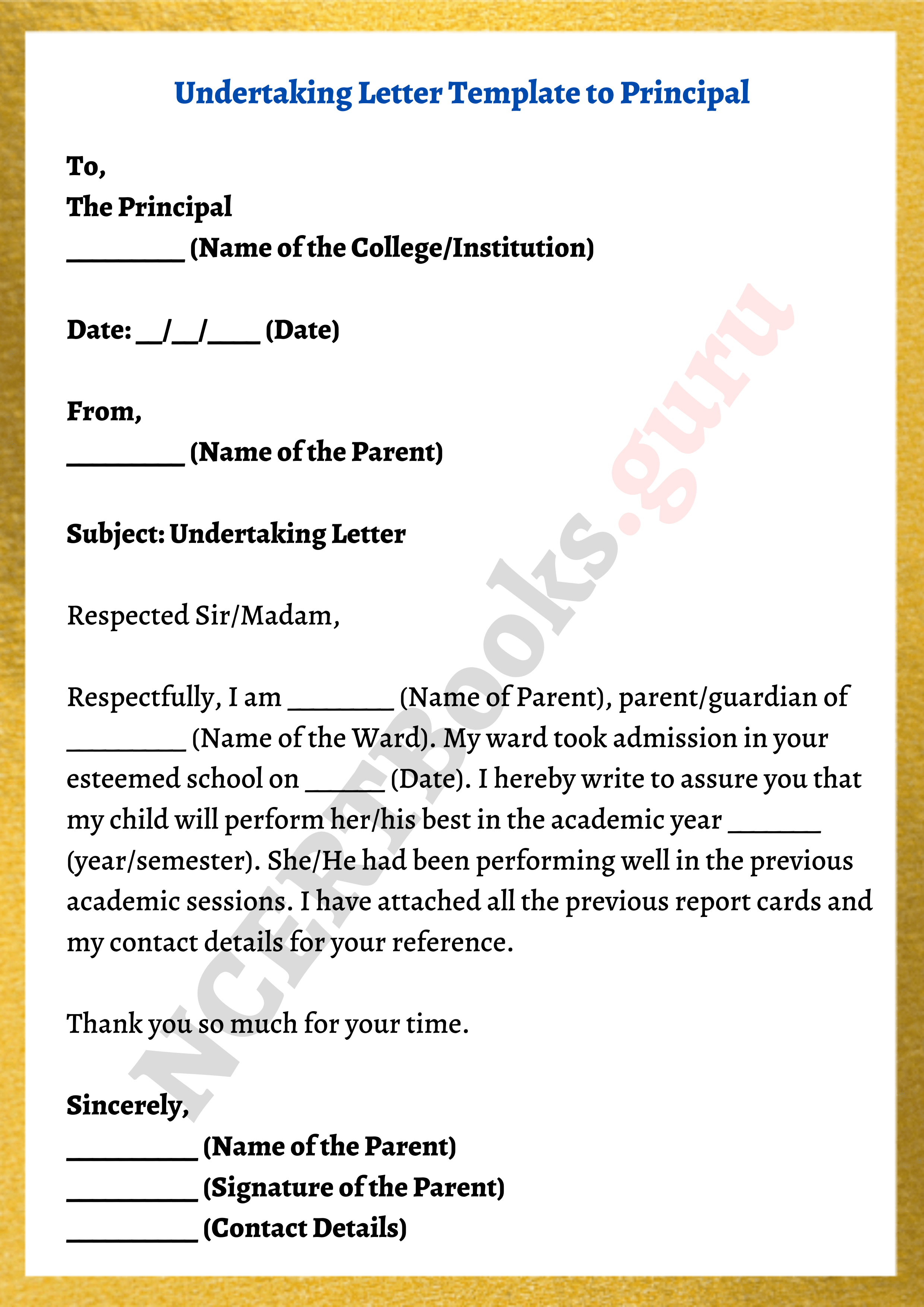
Template of Undertaking Letter by Parents for Student in School

To,
The Principal
_________ (Name of the College/Institution)

Date: __/__/____ (Date)

From,
_________ (Name of the Parent)

Subject: Undertaking Letter

Respected Sir/Madam,

Respectfully, I am ________ (Name of Parent), parent/guardian of _________ (Name of the Ward). My ward took admission in your esteemed school on ______ (Date). I hereby write to assure you that my child will perform her/his best in the academic year _______ (year/semester). She/He had been performing well in the previous academic sessions. I have attached all the previous report cards and my contact details for your reference.

Thank you so much for your time.

Sincerely,
__________ (Name of the Parent)
__________ (Signature of the Parent)
__________ (Contact Details)

template for letter of undertaking

Undertaking Declaration Letter Samples

Get the undertaking letter samples and examples for various scenarios and understand how to draft the letter of undertaking declaration on your own. Just refer to the images given here and download those Undertaking Letter examples images for reference.

After having a glance at these samples of undertaking letters you will surely learn what to include and what not to include. So, go through this section and check out the different examples of undertaking declaration letters.

Sample 1 – Undertaking Letter for an IT Job

Undertaking letter for an it job sample

Letter of Undertaking to State Bank of India

undertaking letter to state bank of india

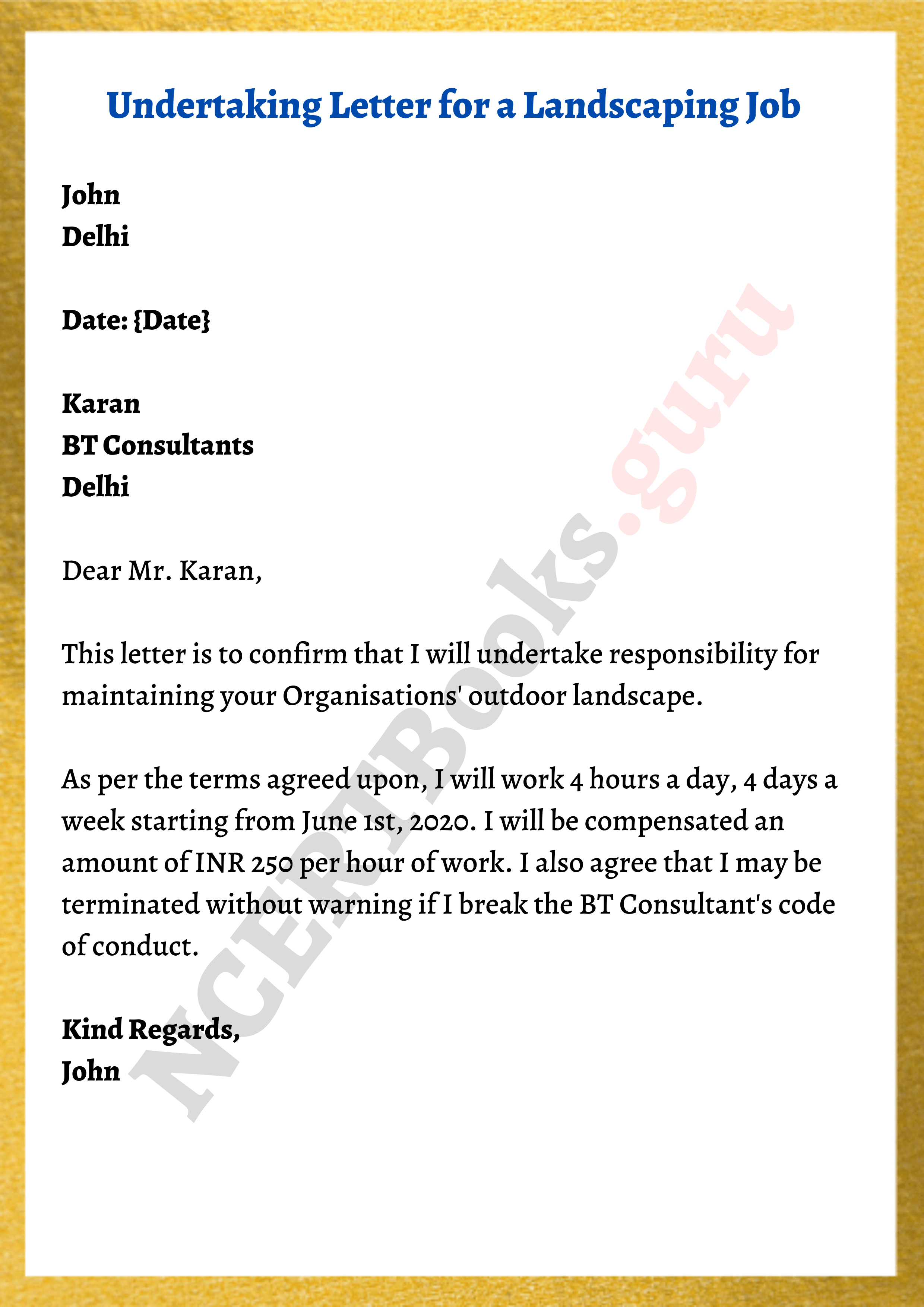
Undertaking Letter for a Landscaping Job

landspacing job sample letter of undertaking

FAQs on Undertaking Letter Writing

1. What is mean by the undertaking letter?

Undertaking Letter is a surety by one party to another party that they will fulfill the commitment that had been earlier agreed on, but not written into a contract. Also, a letter of undertaking is obvious in real estate and other transactions where one party wants to reduce potential losses.

2. Who can give an undertaking?

Undertakings are provided on behalf of the firm and not a self. You only need to give an undertaking if you are duly authorised by your firm to do so. In case you are so authorised, you must assure that you comply with any procedures your firm has in connection to undertakings.

3. What should include in an undertaking letter in school?

A letter of undertaking is a kind of formal letter, it should include the date, your address, school address, salutation, and heading. Also, it must hold an introduction which should explain clearly if the letter is written by a lawyer or by the person in need.

NCERT Solutions for Class 7 Social Science Civics Chapter 8 Markets Around Us

Markets Around Us Class 7 Questions and Answers Civics Chapter 8

Class 7 Civics Chapter 8 NCERT Textbook Questions and Answers

Question 1.
Why do people go to a weekly market? Give three reasons.
Answer:
People go to a weekly market because of the following reasons:

  1. Many things in weekly markets are available at cheaper rates.
  2. Most things that we need are available at one place.
  3. Since weekly markets have a large number of shops selling the same goods, then, things can be available at a cheaper rate.

Question 2.
Who are the sellers in a weekly market? Why don’t we find big business persons in these markets?
Answer:
The sellers in a weekly market are local people who do not have permanent shops. These small traders set up shops for the day and then close them in the evening. Then they may set up at a different place the next day.

We do not find big businessmen in these markets, because they have permanent shops in a shopping complex or mall.

Question 3.
Why are things cheap in the weekly market?
Answer:
Things are cheap in the weekly market because of the following reasons :

  1. The shops are temporary, i.e., not permanent. The shopkeepers do not have to pay rent, electricity, fees to the government, etc.
  2. The shopkeepers do not have to pay wages to their workers.
  3. Most of the things that are sold by the shopkeepers are stored at home.
  4. Most of them are helped by, their family members and, hence do not need to hire workers.

Question 4.
Explain with an example how people bargain in the market. Can you think of a situation where the bargain would be unfair?
Answer:
Weekly markets have a large number of shops selling the same goods which means there is a competition among them. If some trader were to charge a high price, for example, apples, people would move to another shop where the apples may be available more cheaply or the buyer may bargain and bring the price down.

The bargain would be unfair if the seller is selling his goods at a reasonable (cheaper) price.

Question 5.
Why did Sujata carry a notebook? Do you think this system is useful? Can there be problems?
Answer:
Sujata carried a notebook because she was buying goods on credit. It is useful as long as both buyer and seller and fair. The buyer should pay the seller the amount of the exact time without any hindrance.

Yes, this system can create problems when the buyer does not pay his dues; or the seller has forgotten to write any article sold to the buyer, etc.

Question 6.
What are the different kinds of shops that you find in your neighbourhood? What do you purchase from them?
Answer:
We find all types of shops in our neighbourhood, such as groceries, clothes, chemists, daily needs shop, fair price, vegetable and fruit shops, etc.

Normally, we purchase all the items needed from them.

Question 7.
Why are goods sold in permanent shops costlier than those sold in the weekly markets or by road side hawkers?
Answer:
Goods sold in permanent shops are costlier because these shops, incur a lot of expenditure” they have to pay rent, electricity, fees to the government, and, they also have to pay wages to their workers. More over these shops sell branched or packed goods.

Question 8.
Why do you think the guard wanted to stop Kavita and Sujata from entering the shop? What would you say if someone stops you from entering a shop in a market?
Answer:
Kavita and Sujata were wandering on the 3rd floor. The guard wanted to stop them for entering the shop because he thought that they did not have the money to buy clothes. There were just going inside to look at the clothes being sold at the shop.

If someone stops me from entering a shop in a market, I would pull his hat and remind him that everyone is free to go to any place he/she likes. It is not necessary that in whichever shop we enter, we have to buy something.

Question 9.
Why do people not bargain in shops located in malls whereas they bargain in weekly markets?
Answer:
People do not bargain in the shop located in the malls whereas they bargain in weekly market because branded goods available in the mall are expensive, durable, and often promoted by advertising, claiming of better quality as compared to non branded goods. Fewer people afford to buy but dono’t bargain in terms of quality and brand.

Question 10.
How do you think your neighbourhood shop gets its goods? Find out and explain with some examples.
Answer:
Our neighbourhood shop gets its goods through agents or wholesaler For example A vegetable wholesale trader will not buy a few kilos of vegetables, but will buy a large lot of 25 to 100 kilos.

There will be then sold to other traders. It is through this the retailer get the goods and finally reaches to our neighbourhood shop.

Question 11.
Why is a wholesale trader necessary?
Answer:
Goods are produced in factories, on farms, and in homes. However, we don’t buy directly from the factory or from the farm. The goods from factories, or farms etc. are purchased by the wholesaler and sold to the retailer.

From the retailer we buy goods. Thus, a wholesale trader is necessary.

Question 12.
In what ways is a hawker different from shop-owner?
Answer:
Hawker is a person who sells his product or goods by moving on the streets while a shop-owner is a person who sells his goods at a fixed place. A hawker can sell different goods like vegetables, clothes, shoes, etc., while shop owner sell the some things or goods. For e.g. in a book shop you can get only books, stationery etc., not vegetables, ice-cream, sweets etc.

Question 13.
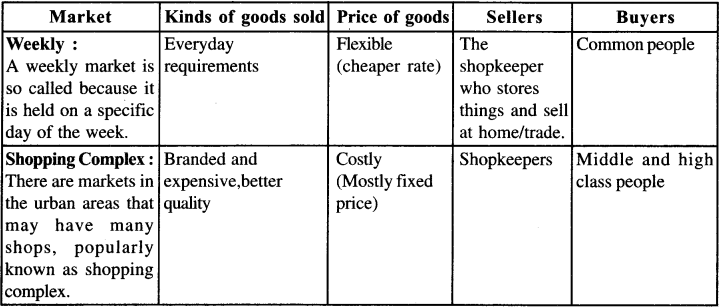
Compare and Contrast weekly market and a shopping complex on the following :
NCERT Solutions for Class 7 Social Science Civics Chapter 8 Markets Around Us 1
Answer:
NCERT Solutions for Class 7 Social Science Civics Chapter 8 Markets Around Us 2

Question 14.
Explain how a chain of markets is formed. What purpose does it serve?
Answer:
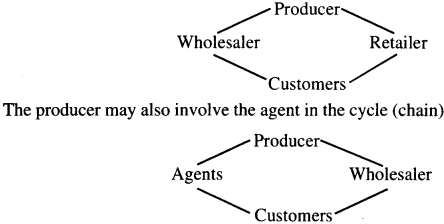
A series of markets that are connected like a link in a chain because products pass from one market to another is known as chain of market. The people in between the producer and the final consumers are the traders, middlemen agent, etc.

(a) The producer supplies goods to retailer who sell them to customers. Producer : Retailer : Customers producer: Wholesaler: Customer. The goods can be sold with the help of retailer and wholesaler in the following chain process :

NCERT Solutions for Class 7 Social Science Civics Chapter 8 Markets Around Us 3

It is through this links (chain) of the trader the goods reaches far away places. The purpose of this chain markets is to make the easiest availability of all the goods at far away place immediately.

Question 15.
All persons have equal right to visit any shop in a market place. Do you think this is true of shops with expensive products? Explain with example.
Answer:
Yes, all persons have equal rights to visit any shop in a market place. It is also true of shops with expensive products.

Example:
Kavita and Sujata are two friends. They went to Anzal Mall, a five floor shopping complex. They were enjoying themselves, then they decided to go to a branded ready made shop which was situated on 3rd floor. Security guard wanted to stop them, but he could not, they looked at some costly dresses, but none was less than 2500 Rs. Sujata whispered to Kavita, let us try on another shop. I’ll take you another shop which has good quality readymade clothes at very reasonable prices.

Question 16.
‘Buying and selling can take place without going to a market place’. Explain this with the help of examples.
Answer:
Yes, Buying and selling can take place without going to a market place. We can place order for variety of things through phone and these days through internet, and the goods are delivered at our homes.
Example :

In clinic and nursing homes we have noticed that sales representatives waiting for doctors. Such persons are also engaged in selling of goods. Thus buying and selling take . place in different ways, not necessarily through shops in the market.

Another example can be given of a Pizza Hut. The favourite Pizzahuts have toll free mobile and land-line numbers. We can place our order through phone call. Their home delivery service will drop the pizza at our doorstep within a short time. These shops run 24 hrs daily.

NCERT Solutions for Class 7 Social Science

NCERT Solutions for Class 7 Social Science History Chapter 8 Devotional Paths to the Divine

Devotional Paths to the Divine Class 7 Questions and Answers History Chapter 8

Class 7 History Chapter 8 NCERT Textbook Questions and Answers

Question 1.
Match the foilowing-

The Buddha Namghar
Shankaradeva Worship of Vishnu
Nizamuddin Auliya Quertioned social differences
Nayanars Sufi saint
Alvars Worship of Shiva

Answer:

The Buddha Quertioned social differences
Shankaradeva Namghar
Nizamuddin Auliya Sufi saint
Nayanars Worship of Shiva
Alvars Worship of Vishnu

Question 2.
Fill in the blanks-
1. Shankara was an advocate of ……………..
2. Ramanuja was influenced by the …………….
3. ………….., …………… and ………………. were advocates of Virashaivism.
4. ……………. was an important centre of Bhakti tradition in Maharashtra.
Answer:
1. Advaita
2. Alvars
3. Basavana, Allama Prabhu, Akkamadevi
4. Pantharpur.

Question 3.
Describe the beliefs and practices of the Nathpanthis, Siddhas and Yogis.
Answer:
A number of religions groups that emerged during this period criticised the ritual and other aspects of conventional religion and the social order, using simple, logical arguments. Among these were the nathpanthis, Siddhacharas And Yogis.

Beliefs and practices of the Nathpanthis, Siddhas and Yogis-

  • They advocated renunciation of the world.
  • According to them, the path to salvation lay in meditation on the formers. Ultimate Reality and the realisation of oneness with it.
  • To achieve the above they advocated intense training of the mind and body like yogasanas, breathing exercises and meditation.
  • For their beliefs and practices, these groups became particularly popular among ‘low’ castes.

Question 4.
What were the major ideas expressed by Kabir ? How did he express there?
Answer:

  1. Kabir’s teachings were based on a complete, indeed vehement; rejection of the major religions traditions.
  2. Kabir’s teaching openly ridiculed all form of external worship of both Brahmanical Hinduism and Islam the pre-eminence of the priestly classes and the caste system.
  3. The language of his poetry was a form of spoken Hindi widely understood by ordinary people.
  4. Kabir believed in a formless supreme God and preached that the only path to salvation was through bhakti or devotion.

Question 5.
What were the major beliefs and practices of the sufis?
Answer:
Major beliefs and practices of the sufis-

  1. Sufis were Muslim Mystics. They rejected outward religionsity and emphasised love and devotion to God and compassion towards all fellow human beings.
  2. The Sufis often rejected the elaborate rituals and codes of behaviour demanded by Muslim religions scholars.
  3. They sought union with God much as a lover seeks his beloved with a disregard for the world.
  4. Like the saint poets, the sufis too, composed poems expressing their feelings, and a rich literature in prose, inducting anecdotes and fables, developed around them.
  5. The sufis also believed that the heart can be trained to look at the world in a different way. They developed elaborate methods of training using Zikr (Chanting of a name or sacred formula), contemplation, same (singing), raqs (dancing), discussion of parables, breath control, etc. under the guidance of a master or pir.

Question 6.
Why do you think many teachers, rejected prevalent religions beliefs and practices?
Answer:
Many teachers rejected prevalent religions beliefs and practices because they were irrational, unlogical and very difficult to understand. For example, Kabir and Guru Nanak rejected all orthodox religions and their beliefs and practices. Many teachers did not favour casteism; the feeling of up or down or low or high castes. They favoured humanism.

Some teachers like Tulsidas and Surdas accepted beliefs and practises but wanted to make these accessible to all though the languages of the common people.

Question 7.
What were the major teachings of Baba Guru Nanak?
Answer:
Major teachings of Baba Guru Nanak-

  1. Guru Nanak emphasized the importance of the worship of one God. He insisted that caste, creed or gender was irrelevant for attaining liberation. His idea of liberation was not that of a state of inert bliss but rather the pursuit of active life with a strong sense of social commitment.
  2. He himself used the terms nam, dan and isnan for the essence of his teachings which actually meant right worship, welfare of others and purity of conduct.
  3. His teachings are now remembered as nam-japna, kirt-karma and vand-chhakha, which also underline the importance of right belief and worship, honest living, and helping others.

Question 8.
For either the Virashaivas or the sants of Maharashtra, discuss their attitude towards caste.
Answer:
The Virashaivars or the saint of Maharashtra had a very progressive humanistic attitude, they opposed casteism or inequality based on any ground. From the thirteen to seventeen centuries Maharashtra saw a great number of saint poets.

The most important among them were Janeshwar, Namdev, Eknath and Tukaram as well women like Sakhu bai and the family of Chokhamela. They belonged to the “untouchable” Mohar Caste.

There was a Gujarati Saint Narsi Mehtra. He was a famous Vaishnava. He said, “They (men and women) are vaishnavas who understand the pain of others.

All saints (male as well female) stressed Bhakti particularly on the vithala (a form of Vishnu). They participated in the temple of Pantherpur. They favoured the nation of a personal god residing in the hearts of all people.

These saints, poets, rejected castism and all types of ritualism. They did not favour disparity and differences based on birth.

Question 9.
Why do you think ordinary people preserved the memory of Mirabai?
Answer:

  1. Mirabai was a Rajput princes married into the royal family of Mewar in the sixteenth century. Mirabai became a disciple of Ravidas, a saint from a caste untouchablef. She was devoted to Krishna and composed inumerable bhajans expressing her intense devotion.
  2. Her songs also openly challenged the norms of the “upper” caste and became popular with the masses in Rajasthan and Gujarat.

Question 10.
Find out whether in your neighborhood these are any dargahs, gurudwaras or temples associated with saints of the bhakti tradition in your neighborhood. Visit any one of these and describe what you see and hear?
Answer:
Yes, these are many dargahs, gurudwaras or temples associated with saints of bhakti tradition in our neighbourhood.

I have visited all these religious places from time to time along with my mother or father or elder brother.

I have seen that people go there with devotion and they ofter prayer and hear preaching of religious people with great devotion.

Question 11.
For any of the Saint-poets where compositions have been included in this chapter, find out more about their works, noting down other poems. Find out whether these are sung, how they are sung, and what the poets wrote about?
Answer:
We have read about many bhakti saint and sufi saint in this chapter. I have heard about Kabir, Baba Guru Nanak, Mirabai, Goswami Tulsidas and Surdas. Their religious works poems, bhajans are read out and sung at religious place and by bhakt singers and poets. I have heard devotional song on radio and Television. I have also read certain books related . with the above saint poets.

Question 12.
There are several saint-poets whose names have been mentioned but their works have not been included in the chapter. Finds out more about sung and what their compositions were about.
Answer:

  1. All Marathi saint such as Janeshwar, Namdev, Eknath and Tukaram had written and sung in Marathi.
  2. Narsi Mehta had written and sung in Gujarati.
  3. Tulsidas had written in Awdhi (Hindi).
  4. Surdas had written in Brij Bhasha (Hindi).
  5. Mirabai had written in Rajasthani (Hindi).
  6. Kabir had written in composit language taking words from Hindi, Urdu, Punjabi and other languages of India. His language is called Khichri Bhasha.
  7. Guru Nanak Dev had written and sung in Hindi and Punjabi.
  8. They were not in a favour of converting Hindus to Islam.

NCERT Solutions for Class 7 Social Science

Free Internship Letter Format, Samples to Download | How to write a Cover Letter for Internship?

Have you seen a perfect internship in the field of your study? Are you ready to apply and feeling the pressure as a great cover letter of Internship can provide you with ample opportunities? It’s Important to Structure your Internship Letter in the Right Format. Showcase the skills you have learned in your Class or through extracurricular activities and make yourself a great candidate for the Internship.

While you are applying for an Internship you need to submit the Internship Cover Letter as a part of your application. Your Internship Letter should include the details regarding the Specific Internship and also Examples of your Work, Extra-Curricular Activities. Refer to the further modules and have an Idea on Internship Letter Format, Tips on How to Write An Internship Letter in the coming modules. We even attached Internship Cover Letter Samples for your reference so that you can have ideas or write one on your own.

Check out Various Letter Writing Topics covered under both formal and informal categories and learn to write different letter writing styles.

Internship Cover Letter Writing Tips

Let’s dive deep into the article and know How to Structure a Cover Letter for an Internship. They are along the lines

Internship Letter Format

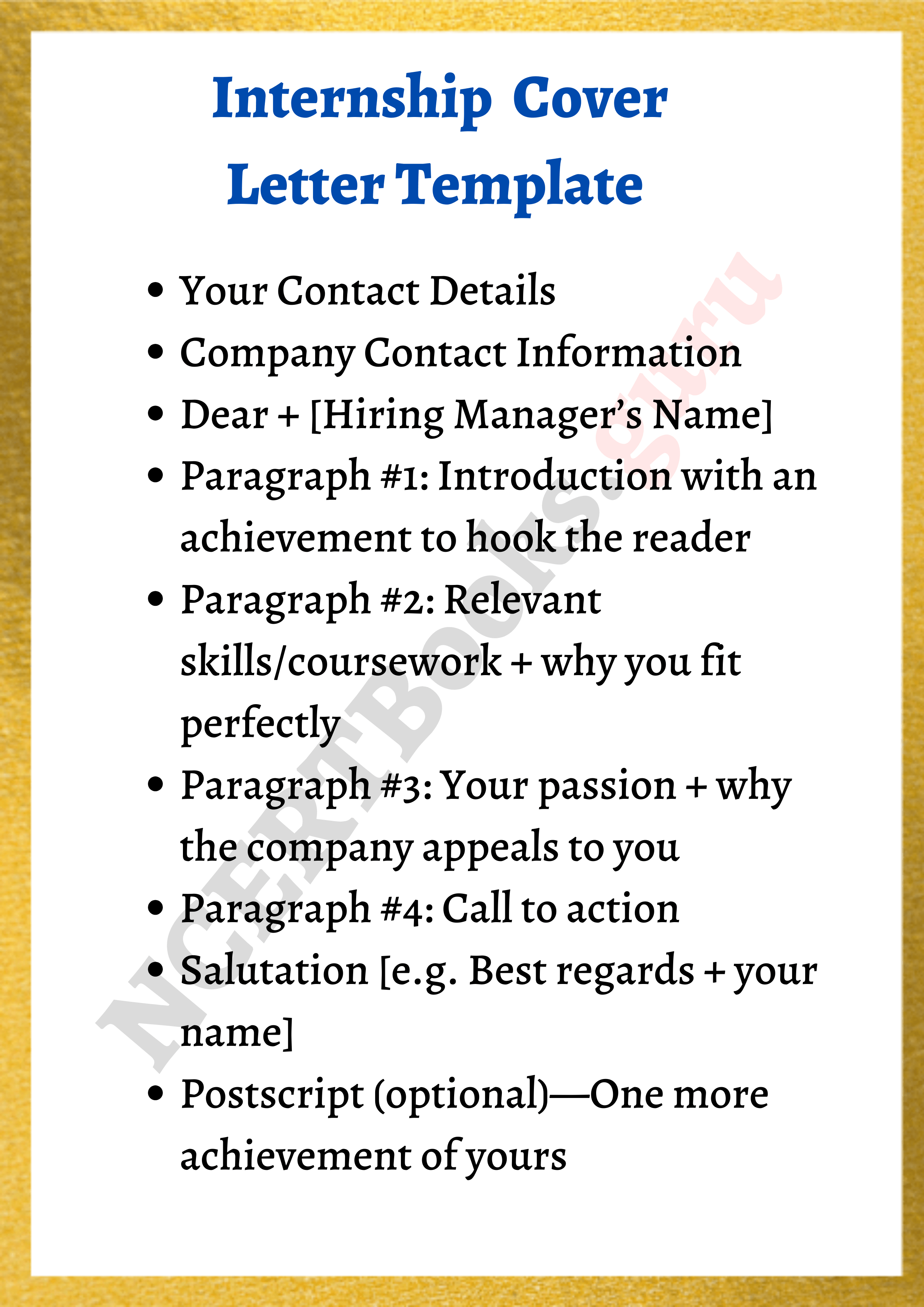
Internship Letter Template

Use the Internship Letter Template available below and draft a cover letter on your own. Using this create a Sample Internship Letter on your own.

Internship Cover Letter Template

Cover Letter Samples for Internship

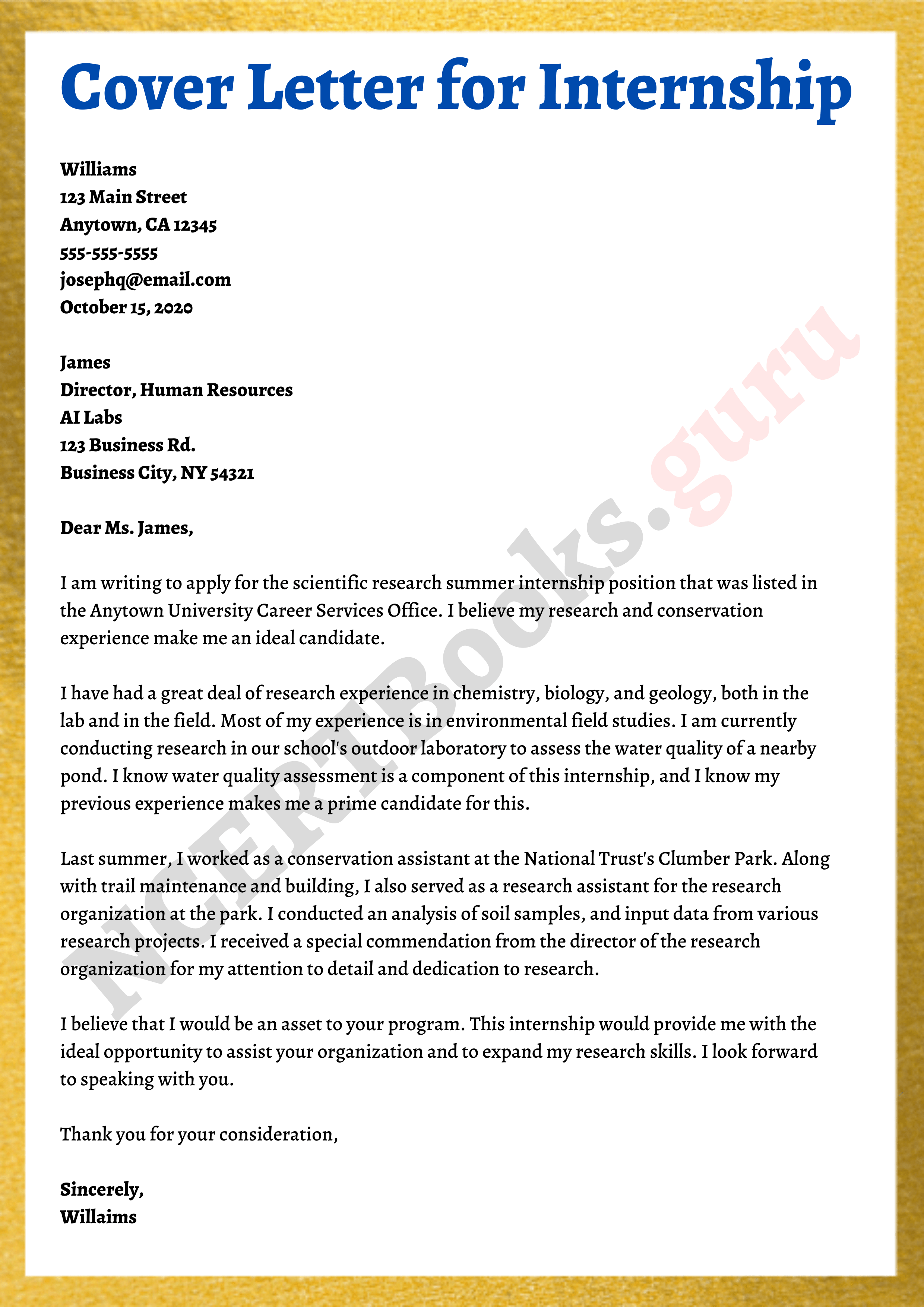
Are you searching rigorously across the web for Internship Cover Letter Samples? Then, you can halt your search as we will provide you with the necessary information that you might find helpful. Refer to the below Cover Letter of Internship for further guidance. Use the below-attached Internship Letter Samples and draft a Strong Internship Cover Letters on your own.

Internship Cover Letter Example

Internship Cover Letter

Sample Request Letter for Internship

Cover Letter for Internship

FAQs on Internship Letter

1. What is an Internship Letter?

If you are applying for an Internship you need to submit a cover letter having the details regarding the Specific Internship and also Examples of your Work, Extra-Curricular Activities.

2. How to write a Cover Letter for an Internship? 

Go through the below modules and write a strong Internship Letter.

  • Point out the particular position you’re applying for.
  • Include the right keywords.
  • List your relevant education and coursework.
  • Add relevant skills and abilities.
  • Describe why you’re the perfect match for the internship role.
  • Explain what the company will gain by hiring you.
  • Proofread your cover letter.

3. Where do I get a Cover Letter of Internship Samples & Writing Tips?

You can get a Cover Letter of Internship Samples & Writing Tips free of cost on our page.

NCERT Solutions for Class 8 Social Science Geography Chapter 2 Land, Soil, Water, Natural Vegetation and Wildlife Resources

Land, Soil, Water, Natural Vegetation and Wildlife Resources Class 8 Questions and Answers Geography Chapter 2

Geography Class 8 Chapter 2 NCERT Textbook Questions and Answers

Question 1.
Observe the land, type of soil and water availability in the region you live. Discuss in your class, how it has influenced the lifestyle of people there.
Answer:
Hints :
Land, type of soil and water availability influence the life style of the people living there because generally human activities are influenced by environment. For remaining take the help of your class teacher.

Question 2.
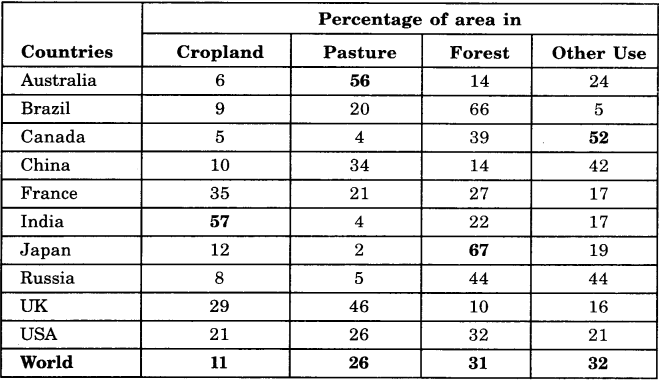
Table 2.1 : Land use in selected countries
NCERT Solutions for Class 8 Social Science Geography Chapter 2 Land, Soil, Water, Natural Vegetation and Wildlife Resources 1
Study the above table and answer the following :
(i) Name the countries having the highest percentage of land under cropland, forest, pasture and other uses.
(ii) How would you relate the land use patterns of these countries with the probable economic activities?
Answer:
(i) The countries with the highest use of land under cropland, forest, pasture and other crops are as follows :
Cropland : India (57%)
Forest : Japan (67%)
Pasture : Australia (56%)
Other uses : Canada (52%)

(ii) The land use pattern of these areas affects the economic activities of these countries in the sense that people and their demands are ever growing, however, the availability of land is limited. In the same way the quality of land is also different from one place to another. The common man is encroaching land for housing and industrialisation purposes. In rural areas land is expanded to increase agricultural needs. This also affects the social culture.

Question 3.
Activity : In India soils could be alluvial, black, red, laterite desertic and mountain soil. Collect a handful of different types of soil and observe. How are they different?
Answer:

  • Alluvial soil : It is very fertile and good for crops. It is generally found along the belt of rivers.
  • Black soil : It is black in colour. It is fertile and good for cotton crops.
  • Red soil : It is red in colour and rich in iron. It is porous in nature.
  • Laterite soil : It is less fertile with low content of nitrogen, phosphate and calcium.
  • Desertic soil : Mostly sandy and alkaline in nature.
  • Mountain soil : Mostly thin and infertile.

Question 4.
Answer the following questions.
(i) Which are two main climatic factors responsible for soil formation?
(ii) Write any two reasons for land degradation today.
(iii) Why is land considered an important resource?
(iv) Name any two steps that government has taken to conserve plants and animals.
(v) Suggest three ways to conserve water.
Answer:
(i) The two main climatic factors responsible for soil formation are temperature and rainfall. Rainfall contributes in breaking the rocks by applying pressure. Temperature fluctuations between hot and cold also form cracks in the rocks.

(ii) Reasons for land degradation are :

  • Destruction of forest cover.
  • Ever growing demand of the growing population.

(iii) Land is considered an important resource because it provides surface for agriculture, living, forestry, industries, construction, etc. Most of the activities take place on land.

(iv) Steps taken by the government to conserve plants and animals are :

  • Establishment of natural parks and wildlife sanctuaries in different parts of the country.
  • Conservation of important species of plants and animals.

(v) Three ways to conserve water are :

  • By rain water harvesting : By this method rain water can be collected and used at the time of scarcity.
  • Drip irrigation to be practised in dry regions.
  • Proper irrigation system so that water is not lost at the time of irrigation.

Question 5.
Tick the correct answer.
(i) Which one of the following is NOT a factor of soil formation?
(a) time
(b) soil texture
(c) organic matter
Answer:
(b) soil texture

(ii) Which one of the following methods is most appropriate to check soil erosion on steep slopes?
(a) shelter belts
(b) mulching
(c) terrace cultivation
Answer:
(c) terrace cultivation

(iii) Which one of the following is NOT in favour of the conservation of nature?
(a) switch off the bulb when not in use
(b) close the tap immediately after using
(c) dispose playbacks after shopping
Answer:
(c) dispose playbacks after shopping

Question 6.
Match the following :

(i) Land use (a) prevent soil erosion
(ii) Humus (b) land suitable for agriculture
(iii) Rock dams (c) productive use of land
(iv) Arable land (d) organic matter deposited on top soil
(e) contour ploughing

Answer:

(i) Land use (c) productive use of land
(ii) Humus (d) organic matter deposited on top soil
(iii) Rock dams (a) prevent soil erosion
(iv) Arable land (b) land suitable for agriculture

Question 7.
State whether the given statement is true or false.
If true, write the reasons.
(i) Ganga-Brahmaputra plain of India is an overpopulated region.
(ii) Water availability per person in India is declining.
(iii) Rows of trees planted in the coastal areas to check the wind movement is called intercropping.
(iv) Human interference and changes of climate can maintain the ecosystem.
Answer:
(i) True
(ii) True
(iii) False
(iv) True.

Question 8.
Activity
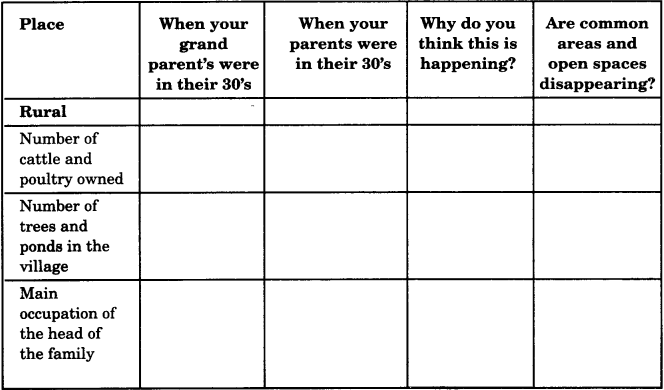
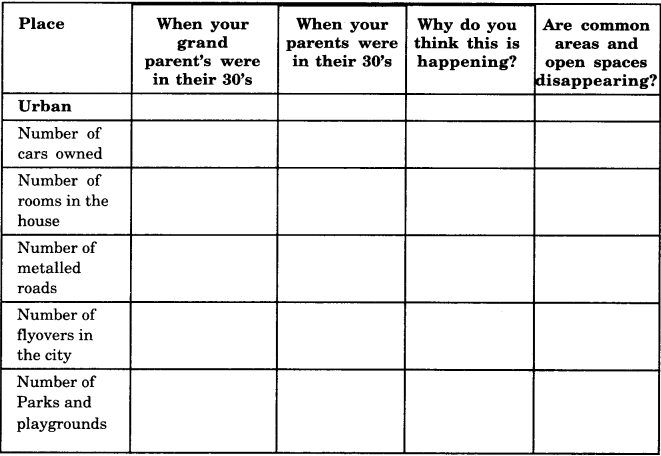
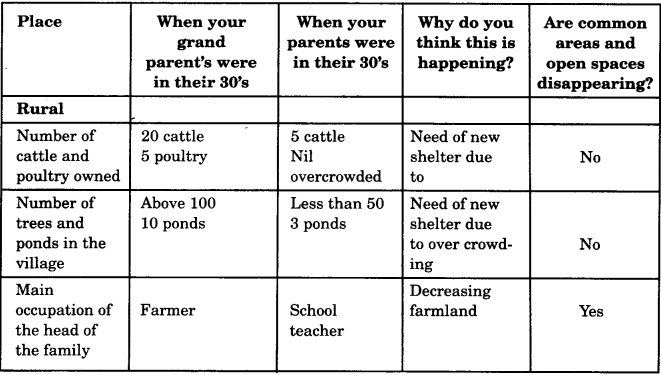
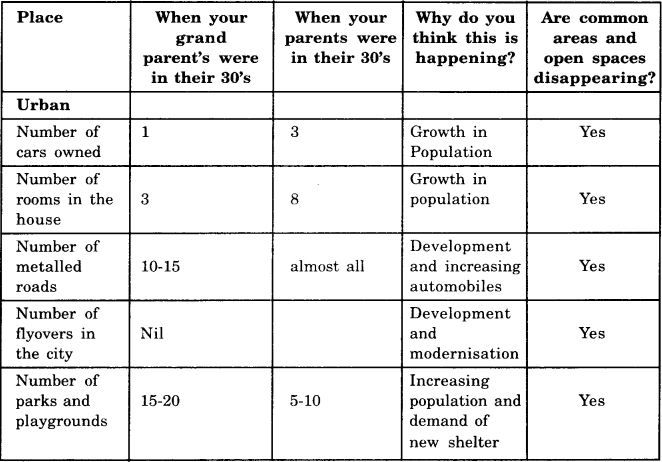
Discuss some more reasons which are responsible for changes of land use pattern. Has your place undergone any change in the land use pattern in recent years?
Find out from your parents and elderly people. You can conduct an interview by asking the following questions.
NCERT Solutions for Class 8 Social Science Geography Chapter 2 Land, Soil, Water, Natural Vegetation and Wildlife Resources 2
NCERT Solutions for Class 8 Social Science Geography Chapter 2 Land, Soil, Water, Natural Vegetation and Wildlife Resources 3
Answer:
NCERT Solutions for Class 8 Social Science Geography Chapter 2 Land, Soil, Water, Natural Vegetation and Wildlife Resources 4
NCERT Solutions for Class 8 Social Science Geography Chapter 2 Land, Soil, Water, Natural Vegetation and Wildlife Resources 5

NCERT Solutions for Class 8 Social Science