Free Quotation Format Letter, Samples | How to Write a Quotation Letter?

Quotation Format Letter

Quotations are Important to any Business and so is the format. You can come across Quotation Formats Online but then you have to make your own. Keeping this in mind, we have come up with Quotation Letter Format, Different Samples of Quotation Letters, Tips on How to Write a Quotation Letter in the coming sections.

Usually, Quotation Letters allow individuals, companies, and organizations to seek information regarding the Price of Goods and Services offered by certain businesses. In fact, they are Formal Business Style Letters and are meant to transmit important information to an organization or company. This act of sending Quotation Letters can cut down the amount of time and efforts buyers put in to know about the Price of Goods or Services by asking one by one.

Access Letter Writing Topics for both Formal and Informal Topics and know how to write various letters on your own.

Tips for writing Quotation Format Letter

There are numerous types of Quotation Format Letters depending on their purpose. If you are planning to write a Quotation Letter make sure to follow the simple and easy steps listed and create one on your own as per your requirement.

  • Write down it more of a formal letter and express your gratitude and appreciation towards them for their interest in your organization.
  • Make sure to include the Supplier Name, Address on the Left side, and also the date on which the Letter of Quotation is written. Next to that mention the Customer Name and Address.
  • Remember to include a Salutation at the starting and sign it at the end of the letter.
  • Make a note of Relevant Details such as Materials Price, Payment Mode, Terms and Conditions of Delivery if any, etc.
  • Explain to the Customer what’s so unique about Goods and Services and why they should choose you.
  • Also, mention how your materials can add value to their business.
  • Remember to write it short and crystal clear.
  • Also, mention your contact details so that they can communicate with you further.
  • Use Professional Language and Write it in Business Format Style.

Quotation Letter Samples to Download

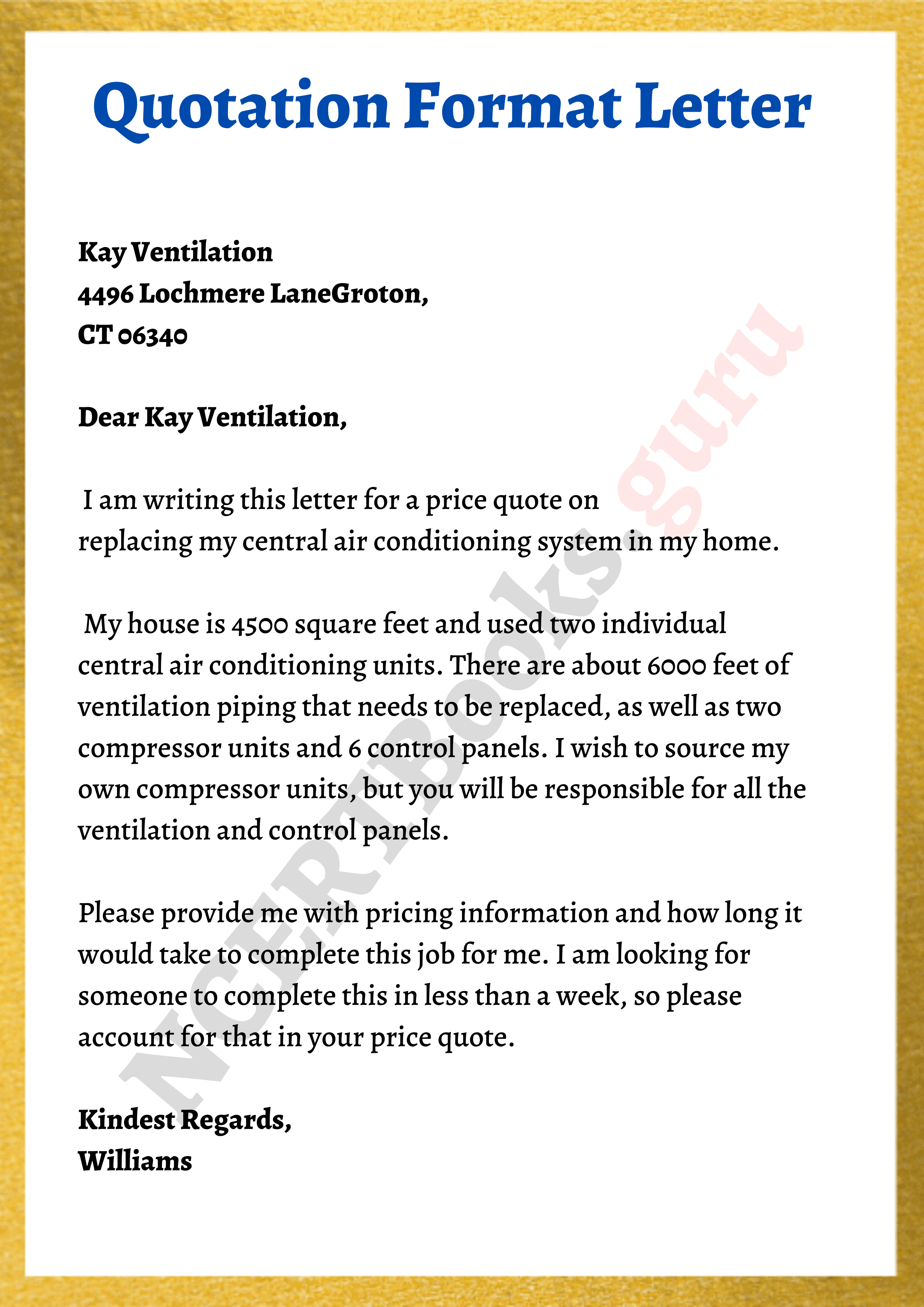
Sample Quotation Format Letter

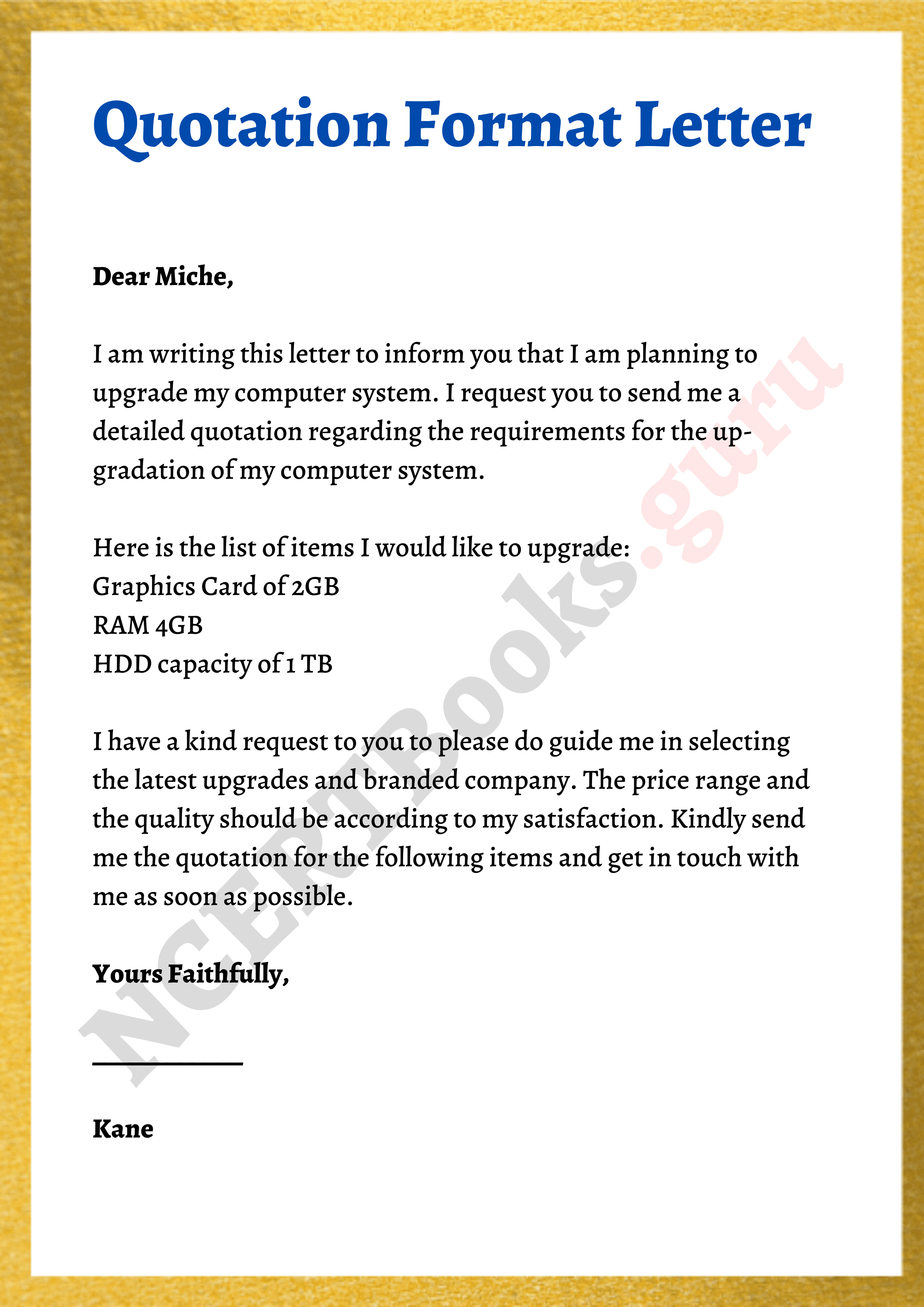
Quotation Format Letter Samples

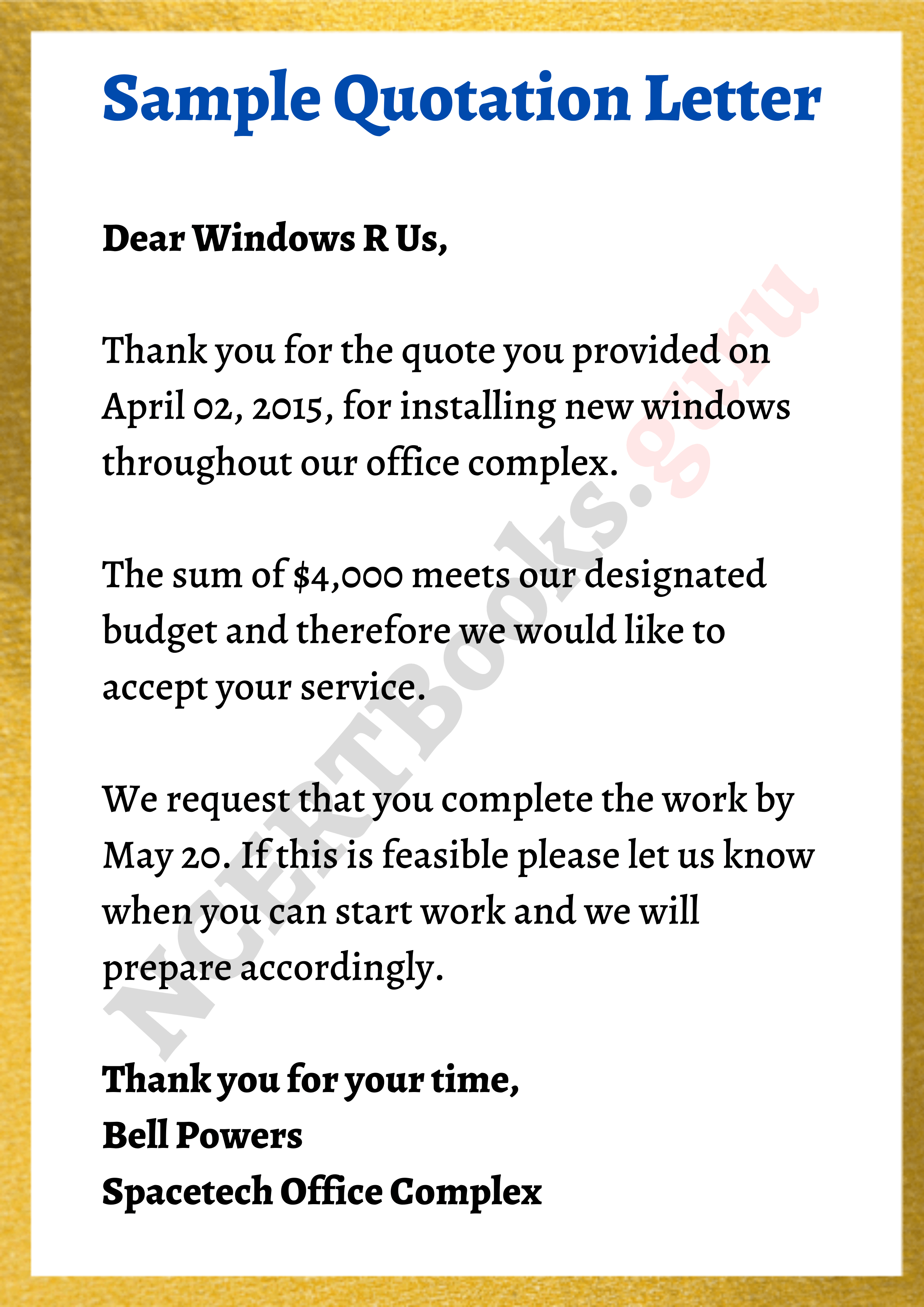
Sample Quotation Letter

Quotation Acceptance Letter

Quotation Acceptance Letter

FAQs on Quotation Format Letter

1. What is a formal letter of quotation?

Quotation Format Letters are Formal Business Style Letters and are meant to transmit important information to an organization or company.

2. Where do I get Sample Quotation Letters for free?

You can get Sample Quotation Letters for free of cost on NCERTBooks.guru a trusted portal.

3. How do you end a Quotation Letter?

To End a Quotation Letter, use a closing statement and clarify the purpose of your letter and later sign at the end.

Complaint Letter Format | How to Write a Letter of Complaint? | Few Sample Complaint Letters Images

Complaint letter format and samples

Format, Samples, Tips for Complaint Letter: Have you filled any complaint letter previously? Do you see writing a letter of complaint towards unfair things like unsatisfied with government works, roads, disaffected orders, public & services, etc.? If yes, then you would know that these complaint letters are usually formal in nature. Hence, proper action will be taken by the concerned department for the complaint raised by you. So, every citizen of the country had a right to raise the complaint against the problems happening to them and get a productive result.

For more information about Complaint Letter, you have to check out this page thoroughly without leaving any of the modules. Here, students can find the samples of complaint letters, 10th class complaint letter marking scheme, Format of the complaint letter, Topics to raise the complaints. Also, Go ahead and refer to the mentioned mistakes to avoid while writing a complaint letter and address your concerns fairly and quickly by the authorized members.

What is the Complaint Letter?

A Complaint Letter is a subtype of formal letters concerned with addressing the problems, issues, mistakes done with you during an online purchase or public transport or government issues, etc. Type of issues that can be addressed via complaint letters are wrong-doing, offense, grievance, resentment arising out of a product, service, etc.

If you are troubling with any one of these problems then raise your complaint about unfair things and seek a productive outcome by sending or emailing the complaint letter. Raising complaints against unfair issues comes under every citizen’s duty, so filing a Complaint is absolutely right.

When you speak and take a stand on the unfair things then your fight will inspire so many troubled consumers, influences the concerned authorities to take proper action, and makes the defaulters more liable, responsible, and responsive. Complaint Letter can be of the following types-

  • Professional Complaint letter: It is the type of complaint letter that is written towards an organization relating to issues that are affecting the entire employees of the organization.
  • Personal Complaint letter: The type of complaint letter you compose on your own individual level pertaining to your individual grievances is considered as a personal complaint letter.

Complaint Letter Format

A complaint letter can be written formally in nature. The format of the complaint letter is provided here for helping you guys to write any of your problems/dispute/mistakes/misbehavior or any kind of complaint to the authorized person & get the work done from their end. So, check out the format of the complaint letter from here & score well in your exams or solve your issues easily.

Sender’s Address

Date:

Receiver’s Address

Subject: (Mention the reason for complaint)

Salutations (Dear/Mr./Ms.)

Body of the letter:

  • Introduction
  • Main Reason to write the letter
  • Conclusion

Closing of Letter (Yours sincerely/faithfully)

Signature

Marking Scheme for Class 10 Complaint Letter

Students who are looking for the Complaint Letter Class 10 Marking Scheme can refer to this table. Here, we have mentioned the detailed marking scheme of the 10th Std Complaint Letter Writing. Verify it thoroughly and learn the techniques to score full marks in writing the complaint letter in 10th class examinations.

FORMAT (Sender’s address, date, Receiver’s address, subject/heading, salutation, complimentary close) 1 mark
CONTENT 4 marks
ACCURACY 1.5 marks
FLUENCY 1.5 marks

What are the Topics for Complaint Letter Writing?

People who are searching for various topics on writing a complaint letter can check this module. Here, we have listed out some of the major letter writing topics on Complaints for your assistance.

  • Poor Condition of Roads and Canals
  • Rash driving of the DTC drivers.
  • Incomplete or defective order
  • Abnormal delay in sending the consignment
  • Defective packing of goods
  • The goods arrive in a damaged condition
  • Receiving of different orders
  • Quantity of goods is not what was ordered
  • Goods are delivered at the wrong address
  • Misbehaviour of staff or salesman
  • The mistake in preparing the invoice
  • Mistakes in a bill or reminders for payment after the bill has been paid, etc
  • Work undertaken is done unsatisfactorily
  • Wrong-doing in public.
  • Poor treatment of street dogs, etc.

A Few Samples of Complaint Letters on Various Topics | Image Download

You have seen some of the major reasons for raising a complaint letter from the above module. Here, you will see some of the Complaint Letter Writing Samples on the basis of various cases. Hence, you will get clarity in writing the complaint letter.

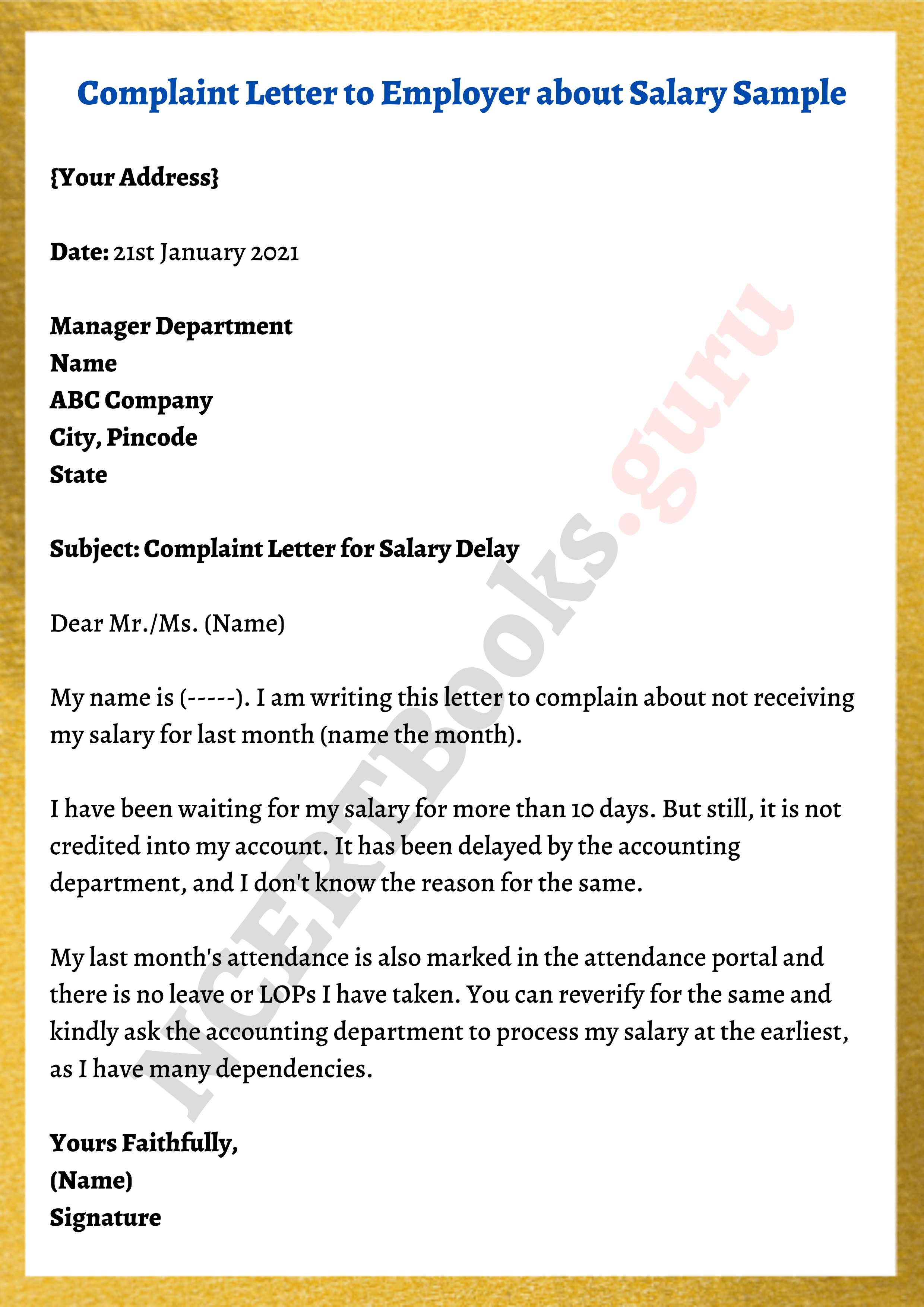
Complaint Letter to Employer about Salary Sample

complaint letter sample about salary

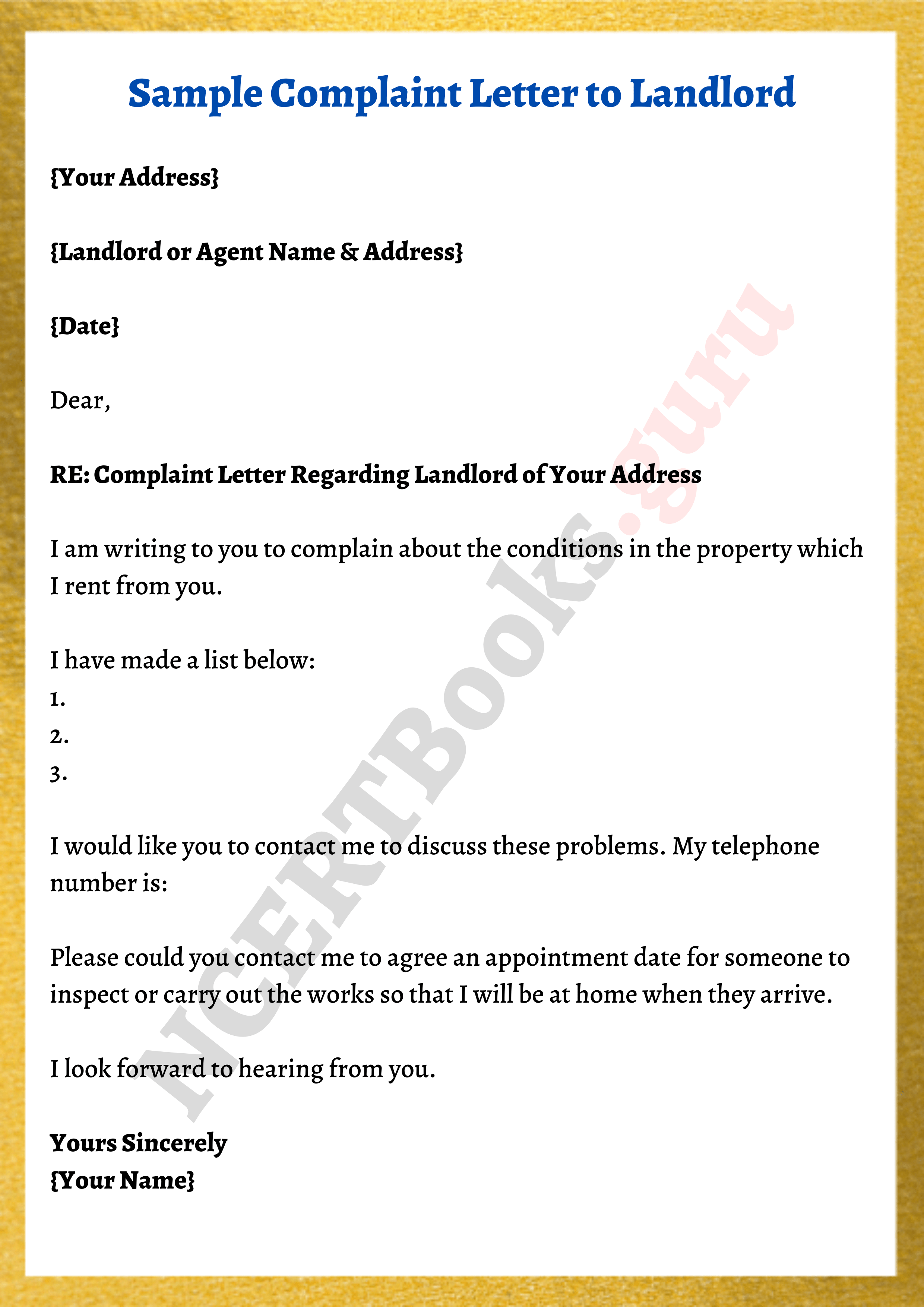
Sample Complaint Letter To Landlord

complaint letter to landlord

Complaint Letter Tips & Tricks

Here are the tips to be followed while writing a perfect compliant letter and receive proper & fair things within less time. They are as follows:

  • Read a lot of letters to get an idea.
  • The presentation is very important.
  • Ensure that you introduce yourself properly.
  • The purpose of writing should be loud and clear.
  • Do not deviate from the topic and write to-the-point.
  • Try to be formal and avoid writing offensive and disrespectful words.
  • Make sure you adhere to the format as it carries marks.
  • Leave an adequate number of lines between paragraphs to make it look clean.
  • Make sure you double-check for grammatical accuracy and spellings. They carry marks.

Some Mistakes to Avoid While Writing a Letter of Complaint

If you want to process/consider your complaint letter quickly then these are some of the major mistakes that you should avoid while composing your complaint letter.

  • Don’t be vague or leave out details.
  • Not to make unreasonable demands.
  • Don’t assume the reader is responsible.
  • Shouldn’t write words that are angry, sarcastic, or threatening.
  • Don’t leave out proof.
  • Don’t forget to include copies of all relevant documents.
  • No at all leave out your name and contact information.
  • Don’t just stamp it and mail it—send it by certified mail.
  • Don’t have grammar mistakes or typos.

FAQs on Complaint Letter Writing

1. What is the layout of the complaint letter?

Adhere to the following three-step sequence for knowing the complaint letter layout:

Step 1: Simply state the facts of your case/causes for your complaint.

Step 2: Outline/discuss why you are so troubled/upset.

Step 3: In some cases, it can be relevant to set out your ideas on a remedy/or others; Well in some other situations, it is best to leave the solution in the hands of the perpetrator.

2. People need to Write A letter of complaint formally or informally?

A complaint letter writing falls into the formal letters category. So, people should check the compliant letter format above and compose it in a formal way to consider your problem quickly.

3. How to close the Complaint letter?

After completion of your body text regarding your complaint, you should always close your letter with a closing salutation. To close the complaint letter, you need to write the closing salutation such as “Yours sincerely” or “Sincerely” and to leave sufficient space (usually three lines) for your signature.

Who is regarded as the Father of Biology? | List of Difference Branches of Biology & their Fathers

guide on father of biology

Guys who are preparing for the competitive exams should aware of general knowledge questions about the world, India, current affairs, static GK, and subjects from primary to high school. Is biology a branch of Science or not? Do you know the answer to Who is the Father of Biology? Knowing the correct answers to such types of questions is very important for students. So, refer to this ultimate guide on the father of biology and gather the complete details. Aristotle is the father of biology and it is divided into various branches. Also, you can find the list of different branches of biology and their fathers’ names. Let’s dive into this article without any fail.

Also Check:

Who is the Father of Biology?

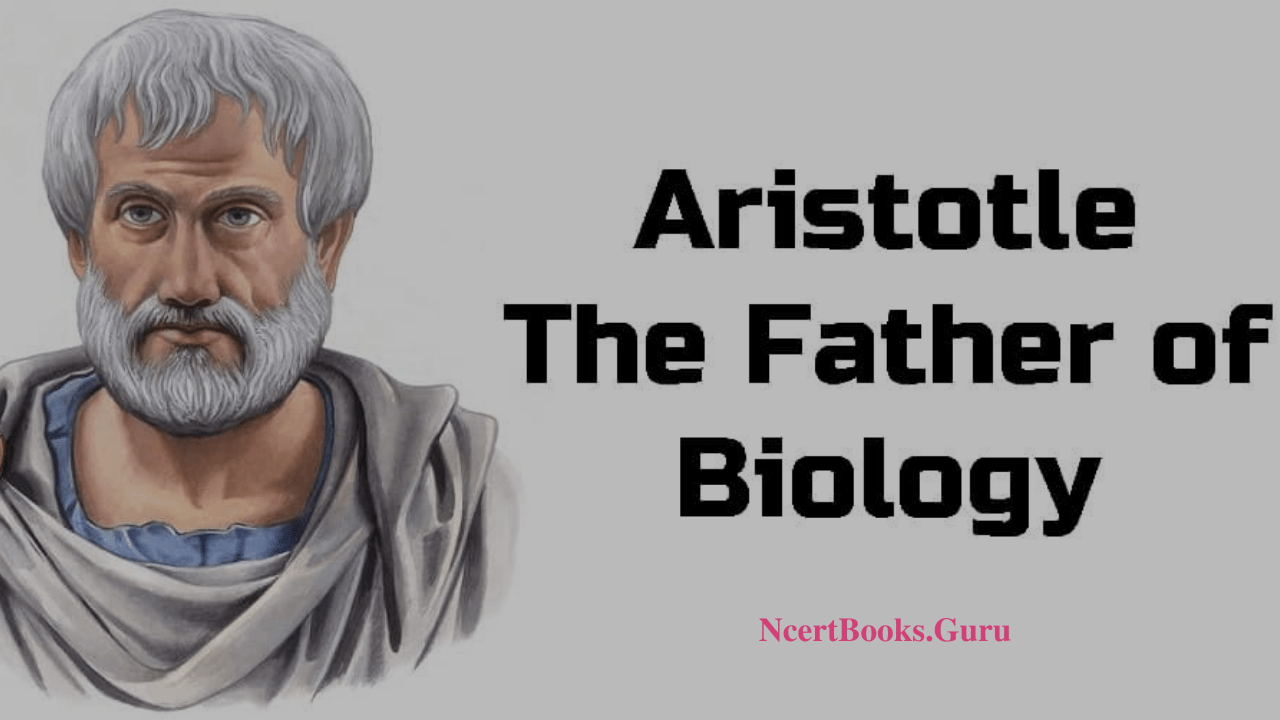
Aristotle is regarded as the “Father of Biology”. The birth of Aristotle was in 384 BC. In the 4th century BC the Greek philosopher Aristotle traveled to Lesvos, an island in the Aegean teeming, then as now, with wildlife. His passion for what he discovered there, and his meticulous research of it, resulted in the birth of new science i.e., Biology. One of the three major subjects of natural science is Biology. Basically, biology is the study of life, living things such as animals, plants, fungi, microorganisms, etc., and the evolution of life.

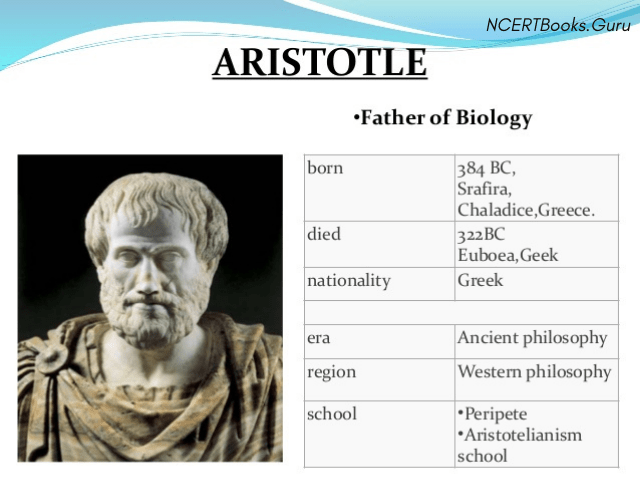
He was considered as the ‘Father of Biology’, due to the extensive study of the natural world and also studied its origins using scientific insights and systematic observations rather than connecting it to divine interference. However, Aristotle was the first to reveal the relationship between animals and establish a system of classification. Check out the below image and memorize Aristotle’s biography. 

About Aristotle

List of Other Fathers of Biology Branches

Biology is the study of living beings for improved understanding or prediction of natural or other phenomena. It is classified into different branches such as Botony, Zoology, etc. The Father of Biology is Aristotle and the fathers of different branches of Biology are presented here in the below table. ‘Who is the father of Botany or Zoology?’ or such other questions have been asked in various Govt or other Competitive exams. So, have a glance at the below table and remember the names of fathers for different branches of biology.

Subject Father
Father of Botany Theophrastus
Father of Zoology Aristotle
Father of Biology Aristotle
Father of Modern Botany Linnaeus
Father of Endochrinology Thomas Addison
Father of Immunology Edward Jenner
Father of Agronomy Peter De-cresenji
Father of Genetics GJ Mendel
Father of Modern Genetics TH Morgan
Father of Cytology Robert Hooke
Father of Palynology Erdtman
Father of Mycology Micheli
Father of Plant Physiology Stephan Hales
Father of Gene Therapy Anderson
Father of Polygenic Inheritance Kolreuter
Father of Surgery and Plastic Surgery Susruta
Father of Anatomy Herophilus
Father of Ethology Konard Lorentz
Father of Cloning Ian Willmut
Father of Chemotherapy Paul Ehrlich
Father of Bryology Johann Hedwig
Father of Mutation Hugo De Vries
Father of Genetic Engineering Paul Berg
Father of Ayurveda Charka
Father of Taxonomy Carolus Linnaeus
Father of Embryology Aristotle
Father of Blood Circulation William Harvey
Father of Medicine Hippocrates
Father of Blood Groups Karl Landsteiner
Father of Palaentology Leonardo da Vinci
Father of DNA Finger Printing Garrod
Father of Gerontology Korenchevsk
Father of Bacteriology Robert Koch
Father of Antibiotics Alexander Fleming
Father of Pathology Rudolph Virchow
Father of Virology WM Stanley
Father of Epidemiology John Snow
Father of Endocrinology Thomas Addison
Father of Homeopathy Hahnemann

FAQs on Father of Modern Biology or Father of Botany

1. Who is the Father of Science?

Galileo Galilei is the father of science.

2. Who is the father of Physics, Chemistry, and Biology?

The father of physics is Isaac Newton, the father of chemistry is Antoine Lavoisier, and the father of biology is Aristotle.

3. Who is considered the Father of Zoology?

The father of Zoology is also Aristotle.

4. Who is known as the Father of Botany?

The father of botany is Theophrastus.

What Does SSC Stand For? | Quick Facts, SSC Full Form Kya Hai, How it Works? and Exams Conducted by SSC

SSC Full form

SSC Full Form: Need a deep-down explanation about SSC exams? Then, you have stepped onto the right page. Here, at NcertBooks.Guru website, expertise team researched and gathered the necessary information about SSC Full Form. Students from secondary education will surely hear about the SSC exams from the adults or seniors or teachers. To provide the proper information and make you understand what is SSC? we have explained the content in this article, utilize these below quick links, and directly learn the information that you are looking for.

What is SSC Full Form & How it Works?

The full form of SSC is the Staff Selection Commission, an organization responsible for leading the hiring process for various posts under the Government of India in various ministries and departments. The other name for SSC is Subordinate Service Commission called formally and present it is termed as the Staff Selection Commission. SSC Organization comes under the Department of Personnel and Training (DoPT) ruled by a Chairman, two Members, and a Secretary-cum-Controller of Examinations.

At present, the Chairman of SSC is Braj Raj Sharma. Also, know that according to the proposals given by the commission, the functions of the Staff Selection Commission were redefined by The Government of India through the Ministry of Personnel, Public Grievances and the fresh structure and functions of Staff Selection Commission (SSC full form) came into effect from 1 June 1999.

Quick Facts For SSC

  • The Headquarters of Staff Selection Commission is located in New Delhi.
  • The Official Website of SSC is ssc.nic.in
  • SSC Chairman is Braj Raj Sharma from May 24, 2020.
  • Regional offices- Allahabad, Mumbai, Kolkata, Guwahati, Chennai, Bangalore
Region Names State Names SSC Zonal Websites
MP Sub-Region Madhya Pradesh (MP), and Chhattisgarh www.sscmpr.org
Western Region Maharashtra, Gujarat, and Goa www.sscwr.net
North Western Sub-Region J&K, Haryana, Punjab, and Himachal Pradesh (HP) www.sscnwr.org
Central Region Uttar Pradesh (UP) and Bihar www.ssc-cr.org
KKR Region Karnatka Kerala Region www.ssckkr.kar.nic.in
Eastern Region West Bengal (WB), Orrisa, Sikkim, A&N Island, and Jharkhand www.sscer.org
Southern Region Andhra Pradesh (AP), Puducherry, and Tamilnadu www.sscsr.gov.in
North Region Delhi, Rajasthan, and Uttarakhand www.sscnr.net.in
North Eastern Region Assam, Arunachal Pradesh, Meghalaya, Manipur, Tripura, Mizoram, and Nagaland www.sscner.org.in

Educational Qualification for SSC Exams

All candidates require to have minimum qualifications to appear for the SSC exams. The minimum qualification for all SSC Posts is from 10th passed to graduate. Detailed education requirements for all posts of SSC like CGL, CPO, GD, etc. are discussed in the below sections. So, check it out & apply for the eligible posts.

SSC Full Form in Hindi

  • Hindi Me SSC Full Form Kya Hai – कर्मचारी चयन आयोग
  • SSC Ka Full Form – Staff Selection Commission
  • SSC फुल फॉर्म – कर्मचारी चयन आयोग

Do Refer: NSA Full Form in Hindi

Exams Conducted by Staff Selection Commission(SSC)

Staff Selection Commission is mainly involved in leading competitive examinations to hire candidates for various posts in different departments and organizations. All deciding announcements were to be taken by the organization with due permission from DoPT as it operates as a subordinate office of DoPT. Thus, SSC conducts the following Competitive Exams:

  • SSC Combined Graduate Level Examination (SSC CGL)
  • Staff Selection Commission Combined Higher Secondary Level Exam (SSC CHSL)
  • SSC CPO
  • SSC Junior Engineer
  • Junior Hindi Translator
  • SSC GD Constable
  • SSC MTS (Multitasking Staff)
  • Selection Post
  • Stenographer Grade C & D

A few of the crucial exams are discussed here along with their full forms, facts, eligibility, etc.

SSC Exam Name Full Form
Full form of CGL Combined Graduate Level Exam
Full form of CHSL Combined Higher Secondary Level Exam
Full form of SSC CPO Central Police Organization
Full form of SSC MTS Multi-Tasking Staff
Full form of SSC JE Junior Engineer
Full form of SSC GD General Duty

1. What is SSC CGL & its Full Form?

The SSC CGL Full Form is the Staff Selection Commission – Combined Graduate Level Exam and it was conducted by the SSC organization to hire staff into several posts in various departments, ministries, and organizations under the Indian Government. To apply for SSC CGL Exam, aspirants need to meet the eligibility criteria provided by the officials of SSC.

The selection process for the Staff Selection Commission – CGL posts is in four stages. The first two stages (level 1 and level 2) are held online while the third stage is a descriptive exam and the last level is a skill test. If any candidate cracks all these four tiers of the SSC CGL Exam, he/she will be hired for different Group B and Group C posts. Here we have listed some of the SSC CGL Group B posts for the sake of better understanding to aspirants.

  • Assistant Audit Officer
  • Assistant Accounts Officer
  • Divisional Accountant
  • Assistant Section Officer
  • Assistant/ Superintendent
  • Inspector of Income Tax
  • Inspector, (Central Excise)
  • Assistant Enforcement Officer
  • Inspector (Preventive Officer)
  • Inspector (Examiner)
  • Sub Inspector
  • Inspector Posts
  • Inspector
  • Sub Inspector
  • Junior Statistical Officer

2. What is SSC CHSL Full Form?

The full form of SSC CHSL is the Staff Selection Commission- Combined Higher Secondary Level Exam. The CHSL Examination was conducted by SSC to recruit aspirants for several departments, ministries, and many other government posts. Under SSC CHSL Exam, qualified candidates get the choice to pick the post in Lower Division Clerk (LDC)/ Junior Secretariat Assistant (JSA) post, Postal Assistant (PA)/ Sorting Assistant (SA) post, Data Entry Operator (DEO), and Data Entry Operator, Grade A.

Also Check: SSC CHSL Books 2020 

3. What does SSC CPO Stand for?

The abbreviation of CPO is the Central Police Organization Exam. SSC conducts the CPO Examination for the hiring of Sub-Inspector (SI) in Delhi Police, Central Armed Police Forces (CAPFs), and Assistant Sub-Inspector (ASI) in CISF. Interested candidates should check for the minimum requirements in the official notification of Staff Selection Commission CPO and apply online for the posts.

4. What is the Full form of SSC MTS?

SSC MTS abbreviation is Staff Selection Commission- Multi-Tasking Staff Exam. MTS is a very important post & a demanding job for everyone. SSC held the MTS exam for recruiting candidates to offer various central government jobs. To apply for the MTS exam, candidates only require a 10th pass certificate, and also hired aspirants will get paid with a decent salary package.

5. What is the full form of SSC JE?

The abbreviation of SSC JE is Staff Selection Commission – Junior Engineer Exam. Candidates who studied engineering courses can apply for the SSC JE Exam. It is all in all an engineering-based examination where aspirants are recruited for Junior Engineer (Civil, Mechanical, Electrical, and Quantity Surveying & Contracts) for different ministries/ Departments/ Organizations in the Government of India. Staff Selection Commission- Junior Engineer Recruitment is done for the below-given departments:

  • Central Water Organization
  • Central Water Commission
  • Military Engineer Services
  • Central Public Works Department
  • Department of Posts
  • Farakka Barrage Project
  • Border Road Organization
  • Central Water and Power Research Station
  • Directorate of Quality Assurance
  • National Technical Research Organization

6. SSC GD – What is SSC GD?

The full form of GD is General Duty and this exam gonna be conducted by SSC every year. The hiring for SSC GD posts is made according to the Memorandum of Understanding (MoU) together approved by the SSC and Ministry of Home Affairs. SSC lead General Duty exam annually to engage eligible candidates for the posts of Constable (General Duty) in Border Security Force (BSF), Secretariat Security Force (SSF), Central Industrial Security Force (CISF), National Investigation Agency (NIA), Indo Tibetan Border Police (ITBP), Sashastra Seema Bal (SSB), Central Reserve Police Force (CRPF) and Rifleman (General Duty) in Assam Rifles.

FAQs on SSC Full Form

1. What is the meaning of an SSC job?

Staff Selection is the meaning of SSC job. Also, formerly called Subordinate Services Commission or Staff Selection Commission (SSC) is an organization under the Government of India to hire workers for different posts in the several Ministries and Departments of the Government of India and in Subordinate Offices.

2. Is SSC Posts come under both state and central government of India?

Yes, candidates who apply for SSC posts can opt for both state and central government jobs in India.

3. What is the qualification for SSC Exams?

The minimum educational qualification for some of these SSC exams is undergraduate (12th board ). But, most of these exams have the qualification requirement for graduation.

NCERT Solutions for Class 12 Physics Chapter 9 Ray Optics and Optical Instruments PDF

NCERT Solutions for Class 12 Physics Chapter 9

NCERT Solutions for Class 12 Physics Chapter 9 Ray Optics and Optical Instruments PDF Free Download links are available here. Candidates of class 12 CBSE board can rely on these NCERT Physics Ch 9 Solutions while preparing for the examinations. These detailed explanations of questions and solutions are very important for both board and entrance exams.

NCERT Solutions of Class 12 Physics offer comprehensive answers to the questions under Chapter 9 Ray Optics and Optical Instruments covered topics and subtopics. Many of the online learning platforms are available on the web to offer NCERT Solutions for all the chapters of Class 12 Physics but the best site is NCERTBooks.Guru. So Download NCERT Questions & Answers of 12th Physics Ch 9 PDF from here and access them anywhere.

Class 12 Physics NCERT Solutions Chapter 9 Ray Optics and Optical Instruments

In chapter 9, students will completely study the phenomena of reflection, refraction, total internal reflection, and dispersion of light, etc. with the help of ray diagrams. Also, from the Ray Optics and Optical Instruments chapter Students can build a strong foundation in ray optics and various instruments related to it.

NCERTBooks.Guru provides NCERT Exercise Questions and S0lutions to aid students understand the chapter in a better way and solve the numerical and theoretical questions based on the concept of Ray Optics and Optical Instruments effortlessly.

Class 12
Subject Physics
Book Physics
Chapter Number 9
Chapter Name Ray Optics and Optical Instruments

NCERT Solved Exercise Questions & Answers for Class 12 Physics Ch 9

Class 12 Physics NCERT Solutions Ray Optics and Optical Instruments play a major role in scoring more marks in the final exams. Candidates of different central and state boards like UP, Uttarakhand, Bihar, BIE, CBSE can follow the NCERT Solutions for Class 12 Physics Ch 9 as these are prepared based on NCERT textbooks. For the sake of your convenience, we have curated the NCERT Solutions for 12th Class Physics Chapter 9 Ray Optics and Optical Instruments in Hindi & English Mediums.

Question 1.
A small candle 2.5 cm in size is placed 27 cm in front of a concave mirror of radius of curvature 36 cm. At what distance from the mirror should a screen be placed in order to receive a sharp image ? Describe the nature and size of the image. If the candle is moved closer to the mirror, how would the screen have to be moved ?
Answer:
Here, h = 2.5 cm, u = – 27 cm, R = – 36 cm.
NCERT Solutions for Class 12 physics Chapter 9
Nature of image : Real, inverted and magnified. When the position of the object (i.e. candle) is moved closer to the concave mirror, the distance of the image moves away from the screen till the distance of the candle from the concave mirror is less than 18 cm. Hence, the screen has to be moved away from the concave mirror. When the distance of the candle is less than 18 cm from the concave mirror, a virtual and magnified image of the candle is formed behind the mirror. This image is not obtained on the screen.

Question 2.
A 4.5 cm needle is placed 12 cm away from a convex mirror of focal length 15 cm. Give the location of the image and magnification. Describe what happens as the needle is moved farther from the mirror.
Answer:
Here, h1 = 4.5 cm, μ = – 12 cm, f= 15 cm
vedantu class 12 physics Chapter 9.1
Thus, the image is virtual, erect and diminished. As we move the needle away from the mirror, the image goes on decreasing in size and moves towards the principal focus on the other side.

Question 3.
A tank is filled with water to a height of 12.5 cm. The apparent depth of the needle lying at the bottom of the tank is measured by a microscope to be 9.4 cm. What is the refractive index of water ? If water is replaced by a liquid of refractive index 1.63 up to the same height, by what distance would the microscope have to be moved to focus on the needle again ? (C.B.S.E. 2009 )
Answer:
NCERT Solutions for Class 12 physics Chapter 9.2

Question 4.
The following figures (a) and (b) show refraction of an incident ray in air at 60° with the normal to glass-air and water-air interface, respectively. Predict the angle of refraction of an incident ray in water at 45° with the normal to a water-glass interface [Fig. (c)]
NCERT Solutions for Class 12 physics Chapter 9.3
Answer:
NCERT Solutions for Class 12 physics Chapter 9.4
Question 5.
A small bulb is placed at the bottom of a tank containing water to a depth of 80 cm. What is the area of the surface of water through which light from the bulb can emerge out ? Refractive index of water is 1.33 (consider the bulb to be a point source).
Answer:
vedantu class 12 physics Chapter 9.5
The light rays from the bulb B, which fall on the surface of water at an angle equal to critical angle (θC), grazes on the surface of water and the rays of light which fall on the surface of water at an angle greater than θC are totally internally reflected back into the water. The rays of light images emerges out of water through a circular patch of radius r.
NCERT Solutions for Class 12 physics Chapter 9.6

Question 6.

A prism is made of glass of unknown refractive index. A parallel beam of light is incident on a face of the prism. By rotating the prism, the angle of minimum deviation is measured to be 40°. What is the refractive index of the material of the prism ? If the prism is placed in water (refractive index 1.33), predict the new angle of minimum deviation of a parallel beam of light. The refracting angle of the prism is 60°.
Answer:
NCERT Solutions for Class 12 physics Chapter 9.7
NCERT Solutions for Class 12 physics Chapter 9.8

Question 7.
Double-convex lenses are to be manufactured from a glass of refractive index 1.55, with both faces of the same radius of curvature. What is the radius of curvature required if the focal length is to be 20 cm ?
Answer:
Here, n = 1.55, R1 = R and R2 = – R, f= 20 cm Using lens maker formula, we get
NCERT Solutions for Class 12 physics Chapter 9.9
Question 8.
A beam of light converges to a point P. A lens is placed in the path of the convergent beam 12 cm from P. At what point does the beam converge if the lens is (a) a convex lens of focal length 20 cm, (b) a concave lens of focal length 16 cm ?
Answer:
(a) When a convex lens is placed in the path of light converging at P, the beam converges at Pt. Thus, point P acts as virtual object for the convex lens.
Now, u = 12 cm, f= 20 cm.
vedantu class 12 physics Chapter 9.10
NCERT Solutions for Class 12 physics Chapter 9.11

Question 9.
An object of size 3.0 cm is placed 14 cm in front of a concave lens of focal length 21 cm. Describe the image produced by the lens. What happens if the object is moved farther from the lens ?
Answer:
NCERT Solutions for Class 12 physics Chapter 9.12
Thus, the image is virtual, erect, diminished and is formed on the same side of the lens at a distance of 8-4 cm from the lens. If the object is moved away from the lens, the image moves towards the principal focus and goes on decreasing in size.

Question 10.
What is the focal length of a convex lens of focal length 30 cm in contact with a concave lens of focal 
length 20 cm ? Is the system a converging or a diverging lens ? Ignore thickness of the lenses.
Answer:
Here, f1 = 30 cm and f2 = -20 cm
For the combination of two thin lenses, the focal length of the combination is given by
NCERT Solutions for Class 12 physics Chapter 9.13
Since the focal length of the system of lens is negative, therefore, the combination behaves as a diverging lens.

Question 11.
A compound microscope consists of an objective lens of focal length 2-0 cm and an eye-piece of focal length 6.25 cm separated by a distance of 15 cm. How far from the objective should an object be placed in order to obtain the final image at
(a) the least distance of distinct   vision (25 cm), (b) infinity ? What is the magnifying power of the microscope in each case ? (C.B.S.E. 2008)
Answer:
Here, fn =2.0 cm, f = 6.25 cm,
Distance between object lens and eye piece = 15 cm (a) For the formation of image at the least distance of distinct vision,
vedantu class 12 physics Chapter 9.14
NCERT Solutions for Class 12 physics Chapter 9.15

Question 12.
A person with a normal near point (25 cm) using a compound microscope with objective of focal length 
8.0 mm and an eye-piece of focal length 2.5 cm can bring an object placed 9.0 mm from the objective in sharp focus. What is the separation between the two lenses ? How much is the magnifying power of the microscope?
Answer:
NCERT Solutions for Class 12 physics Chapter 9.16
vedantu class 12 physics Chapter 9.17

Question 13.
A small telescope has an objective lens of focal length 144 cm and an eye-piece of focal length 6.0 cm. What is the magnifying power of the telescope ? What is the separation between the objective and eye-piece ?
Answer:
Here, focal length of objective lens, f0 = 144 cm Focal

NCERT Solutions for Class 12 physics Chapter 9.18

Question 14.
(a) A giant refracting telescope at an observatory has an objective lens of focal length 15m. If an eye-piece of focal length 1.0 cm is used, what is the angular magnification of the telescope ?
(b) If this telescope is used to view the moon, what is the diameter of the image of the moon formed by the objective lens ? The diameter of the moon is 3.48 x 10⁶m and the radius of lunar orbit is 3.8 x 10⁸m. (C.B.S.E. 2008, 2011)
Answer:

NCERT Solutions for Class 12 physics Chapter 9.19

Question 15.
Use the mirror equation to deduce that
(a) an object placed between f and 2f of a concave mirror produces a real image beyond 2f.
(b) a convex mirror always produces a virtual image independent of the location of the object.
(c) the virtual image produced by a convex mirror is always diminished in size and is located between the focus and the pole.
(d) an object placed between the pole and focus of a concave mirror produces a virtual and enlarged image. (C.B.S.E. 2011)
Answer:
NCERT Solutions for Class 12 physics Chapter 9.20
vedantu class 12 physics Chapter 9.21
NCERT Solutions for Class 12 physics Chapter 9.22

Question 16.
A small pin fixed on the table top is viewed from above from a distance of 50 cm. By what distance would the pin appear to be raised if it is viewed from the same point through a 15 cm thick glass slab held parallel to the table ?
Refractive index of glass = 1.5. Does the answer depend upon the location of the slab ?
Answer:
Here, t = 15 cm, n = 1.5
The lateral displacement
NCERT Solutions for Class 12 physics Chapter 9.23
For small angles of incidence, the answer does not depend upon the location of the slab.

Question 17.
(a) Following figure shows a cross-section of a ‘light pipe’ made of glass fibre of refractive index 1.68. The outer covering of the pipe is made of material of refractive index 1.44. What is the range of the angles of incident rays with the axes of the pipe for which the total internal reflection inside the pipe take place as shown in the figure ?
(b) What is the answer if there is no outer covering of pipe ?
NCERT Solutions for Class 12 physics Chapter 9.24
Answer:
NCERT Solutions for Class 12 physics Chapter 9.25
vedantu class 12 physics Chapter 9.26
Therefore all incident rays in the range 0 to 90°suffer total internal refletion.

Question 18.

Answer the following questions :
(a) You have learned that plane and convex mirrors produce virtual images of objects. Can they produce real images under some circumstances ? Explain.
(b) A virtual image, we always say, cannot be caught on a screen. Yet when we ‘see’ a virtual image, we are obviously bringing it on to the ‘screen’ (i.e., the retina) of our eye. Is there a contradiction ?
(c) A diver under water, looks obliquely at a fisherman standing on the bank of a lake, would the fisherman look taller or shorter to the diver than what he actually is ?
(d) Does the apparent depth of a tank of water change if viewed obliquely ? If so, does the apparent depth increase or decreases
(e) The refractive index of diamond is much greater than that of ordinary glass. Is this fact of some use to a diamond cutter ?
Answer:
(a) Yes. They can produce real images if the object is a virtual object as shown in figure.
NCERT Solutions for Class 12 physics Chapter 9.27
(b) here is no contradiction in this case. The virtual image of the object acts as an object for the convex lens of our eye and the lens of our eye make a real image of this object on the ratina.
(c) Let AB be the fisherman standing on the bank of the lake. The rays of light from the head of the fisherman bends towards the normal on refraction at the interface separating water and air. The refracted rays appear to come from point B’ instead of point B for the fish. Thus, for a diver the height of the fisherman is AB’ which is greater than his actual height AB.
NCERT Solutions for Class 12 physics Chapter 9.28
(d) The apparent depth of a pond of water decreases when viewed obliquely. This is due to the refraction of light from the surface of water.
NCERT Solutions for Class 12 physics Chapter 9.29
Question 19.
The image of a small electric bulb fixed on the wall of a room is to be obtained on the opposite wall 3 m away by means of a large convex lens. What is the maximum possible focal length of the lens required for the purpose ?
Answer:
The minimum distance between a real object and its real image formed by a convex lens of focal length/is given by
L = 4f
vedantu class 12 physics Chapter 9.30

Question 20.
A screen is placed 90 cm from an object. The image of the object on the screen is formed by a convex lens at two different locations separated by 20 cm. Determine the focal length of the lens.
Answer:
Let O be the position of object and I is the position of image when lens is at L1 and then
at L2
NCERT Solutions for Class 12 physics Chapter 9.31

Question 21.
(a) Determine the effective focal length of the combination of the two lenses in the question 910 if they are placed 8.0 cm apart with their principal axes coincident. Does the answer depend on which side a beam of parallel light is incident ? Is the notion of effective focal length of this system useful at all ?
(b) An object 1.5 cm in size is placed on the side of the convex lens in the above arrangements. The distance between the object and the convex lens is 40 cm. Determine the magnification produced by the two-lens system, and the size of the image.
Answer:
NCERT Solutions for Class 12 physics Chapter 9.32 NCERT Solutions for Class 12 physics Chapter 9.33

vedantu class 12 physics Chapter 9.34

Question 22.
At what angle should a ray of light be incident on the face of a prism of refracting angle 60° so that it just suffers total internal reflection at the other face ? The refractive index of the material of the prism is 1.524.
Answer:
Let the ray of light be incident on the face AB at angle i so that it is totally internally reflected at face AC.
NCERT Solutions for Class 12 physics Chapter 9.35

Question 23.
You are given prism made of crown glass and flint glass with a wide variety of angles. Suggest a combination of prisms which will 
(a) deviate a pencil of white light without much dispersion (b) disperse (and displace) a pencil of white light without much deviation.
Answer:
(a) 
Angular dispersion produced by two prisms i.e. crown glass and flint glass should be zero in this case
NCERT Solutions for Class 12 physics Chapter 9.36
NCERT Solutions for Class 12 physics Chapter 9.37
In the combination of prisms, flint glass prism of greater angle may be tried but in any case still this angle will be smaller than the angle of the crown glass prism in opposite order as shown in figure.

Question 24.
For a normal eye, the far point is at infinity and the near point of distinct vision is about 2.5 cm in front of the eye. The cornea of the eye provides a converging power of about 40 dioptres, and the least converging power of the eye lens behind the cornea is about 20 dioptres. From this rough data estimate the range of accommodation {i.e., the range of converging power of the eye-lens) of a normal eye.
Answer:
When the object is placed at infinity, the eye makes use of the least converging power, Therefore, total converging power of cornea and the eye lens = 40 + 20 = 60 dioptre.
vedantu class 12 physics Chapter 9.38

Question 25.

Does short-sightedness (myopia) or long-sightedness (hypermetropia) imply necessarily that the eye has partially lost its ability of accommodation ? If not, what might cause these defects of vision ?
Answer:
No. Myopia may arise due to the elongation of the eye ball and hypermetropia may arise due to the decrease in the size of the eye ball even when the eye has the normal ability of accommodation. There is another defect in the eye called presbyopia similar to hypermetropia. However, the causes of presbyopia and hypermetropia are different. Presbyopia arises in elderly persons and is corrected by using a bi-focal lens.

Question 26.
A myopic person has been using spectacles of power – 1.0 dioptres for distant vision. During old age he also needs to use separate reading glass of power 
+2 dioptres. Explain what may have happened.
Answer:
For -1.0 dioptre, the far point for eyes is 1 m 
i.e. 100 cm. The near point is 25 cm. The objects lying at infinity are brought at 100 cm from his eyes using the concave lens and the objects lying in between 25 cm and 100 cm are brought to focus using the ability of accommodation of the eye lens. In the old age, this ability of accommodation is reduced and the near point reaches 50 cm from his eyes.
NCERT Solutions for Class 12 physics Chapter 9.39


Question 27.

A person looking at a mesh of crossed wires is able to see the vertical wires more distinctly than the horizontal wires. What is this defect due to ? How is such a defect of vision corrected ?
Answer:
This is due to the defect of lenses called astigmatism. The defect arises because of the fact that curvature of the eye-lens and the cornea is not same in different planes. This defect is removed by using cylindrical lens with vertical axis.

Question 28.
A man with normal near point (25 cm) reads a book with small print using a magnifing glass : a thin convex lens of focal length 5 cm.
(a) What is the closest and the farthest distance at which he can read the book when viewing through the magnifying glass ?
(b) What is the maximum and minimum angular magnification (magnifying power) possible using the above simple microscope ?
Answer:
(a) To see the object at a closest distance, the image of object should be formed at the least distance of distinct vision.
NCERT Solutions for Class 12 physics Chapter 9.40
NCERT Solutions for Class 12 physics Chapter 9.41
Question 29.
A card sheet divided into squares each of size 1 mmis being viewed at a distance of 9 cm through a magnifying glass (a converging lens of focal length 10 cm) held close to eye.
(a) What is the magnification (image size/object size) produced by the lens ? How much is the area of each square in the virtual object ?
(b) What is the angular magnification (magnifying powers) of the lens ?
(c) Is the magnification in
(1) equal to magnifying power in
(2) ? Explain.
Answer:
vedantu class 12 physics Chapter 9.42
(c) Clearly magnification and power magnification are not equal to each other unless the image is located near the least distance of distinct vision, e. v = D.

Question 30.
(a) At what distance should the lens be held from the figure in the above exercise in order to view the squares distinctly with maximum possible magnifying power ?
(b) What is the magnification (image size/object size) in this case ?
(c) Is the magnification equal to magnifying power in this case ? Explain.
Answer:
(a) The magnifying power is maximum if the image is formed at the least distance of distinct point from the eye, i.e., if υ = -25 cm ; Also, f = 10 cm
NCERT Solutions for Class 12 physics Chapter 9.43
=> the linear magnification and magnifying power is equal in this case.

Question 31.
What should be the distance between the object in the previous exercise and the magnifying glass if the virtual image of each square in the figure is to have an area 6.25 mm2 ? Would you be able to see the squares distinctly with your eyes very close to the magnifier ?
Answer:
NCERT Solutions for Class 12 physics Chapter 9.44

Question 32.

Answer the following questions :
(а) 
 The angle subtended at the eye by an object is equal to the angle subtended at the eye by the virutal image produced by a magnifying glass. In what sense then does a magnifying glass provide angular magnification?
(b) In viewing through a magnifying glass, one usually positions one’s eyes very close to the lens. Does angular magnification change if the eye is moved back ?
(c) Magnifying power of a simple microscope is inversely proportional to the focal length of the lens. What then stops us from using a convex lens of smaller and smaller focal length and achieving greater and greater magnifying power ?
(d) Why must both the objective and the eye-piece of a compound microscope have short focal lengths ?
(e) When viewing through a compound microscope, our eyes should be positioned not on the eye-piece but a short distance away from it for best viewing. Why ? How much should be that short distance between the eye and eye-piece ?
Answer:
(a) When magnifying glass is not used, object to be seen clearly is to be placed at 25 cm. However, while using magnifying glass, object can be placed closer to eye than at 25 cm. The closer object has large angular size than the same object placed at 25 cm. It is in this sense that magnifying glass provides angular magnification.
(b) Yes. The angular magnification decreases slightly because angle subtended at eye is somewhat less than the angle subtended at the lens.
(c) The aberrations like spherical and chromatic aberrations start croping up if the convex lens of smaller and smaller focal length is made.
(d) Angular magnification of eye piece is given by (1+D/fe)  and angular magnification of objective is approximately given by υ/f0. Clearly for better magnification focal length of eye piece fe and focal length of objective fe should be small.
(e) If we position our eye very close to the eyepiece, the whole light will not fall on our eye and the field of view will decrease. So we place our eye a short distance away from the eye-piece to collect the large amount of light refracted through the eyepiece to increase the field of view.

Question 33.
An angular magnification (magnifying power) of 30 X is desired using an objective of focal length 1.25 cm and eye piece of focal length 5 cm. How will you set up the compound microscope ?
Answer:
For the image formed at the least distance of distinct vision, the magnifying power is given by
NCERT Solutions for Class 12 physics Chapter 9.45
NCERT Solutions for Class 12 physics Chapter 9.46

Question 34.

A small telescope has an objective lens of focal length 140 cm and an eye piece of focal length 5.0 cm. What is the magnifying power of the telescope for viewing distant objects when
(a) the telescope is in normal adjustment (i.e.,when the final image is formed at infinity) ?
(b) the final image is formed at the least distance of distinct vision (25 cm) ?
Answer:
NCERT Solutions for Class 12 physics Chapter 9.47
Question 35.
For the telescope described in the last exercise, in 9.34
(a) what is the separation between the objective lens and the eye-piece ?
(b) If this telescope is used to view a 100 m tall tower 3 km away, what is the height of image of the tower formed by objective lens ?
(c) What is the height of final image of the tower if it is formed at 25 cm ?
Answer:
(a) Since the final image is formed at infinity, the distance between the object lens and the eye-piece is f0 + fe = 140 + 5 = 145 cm
vedantu class 12 physics Chapter 9.48

Question 36.

A cassegrain telescope uses two mirrors as shown in figure. Such a telescope is built with mirrors 20 mm apart. If the radius of curvature of large mirror is 220 mm and the small mirror is 140 mm, where will be the final image of an object at infinity be ?
NCERT Solutions for Class 12 physics Chapter 9.49
Answer:

NCERT Solutions for Class 12 physics Chapter 9.50

Question 37.
The adjoining figure shows an equiconvex lens (of refractive index 1.50) in contact with a liquid layer on top of a plane mirror. A small needle with its tip on the principal axis is moved along the axis until its inverted image is found at the position of the needle. The distance of the needle from the lens is measured to be 45.0 cm. The liquid is removed and the experiment is repeated. The new distance is measured to be 30.0 cm. What is the refractive index of liquid ?
NCERT Solutions for Class 12 physics Chapter 9.51
Answer:
In the presence of the liquid, the distance of the needle from the lens is equal to the focal length f of the combination of the convex lens and the piano concave lens formed by the liquid below it i.e. f = 45 cm. Also n = 1.5
In the absence of the liquid, the distance of the needle and the lens is equal to the focal length of the convex lens only i.e. f = 30 cm
.’.  If f2 is the focal length of plane concave lens formed
vedantu class 12 physics Chapter 9.52

Check out the Exercise Wise NCERT Solutions for Class 12 Physics Ch 9 and grasp every logic beneath each topic. You can access the 12th Physics NCERT Exercise Questions and Solutions for ch 9 Ray Optics and Optical Instruments via direct links provided here. Brainstorm and Mindmap preparation related stuff other than NCERT Solutions like Important Questions, Exemplar Problems, Notes, Study Material, etc. from here.

Final Words

The data shared here about NCERT Solutions for Class 12 Physics Chapter 9 has been helpful to you to clear all your doubts. In case you’re left with additional doubts please let us know via the below comment section & we will solve it soon. Meanwhile, Bookmark our site NCERTBooks.guru & get more updates on NCERT Solutions of 12th Physics Ch 9 Ray Optics and Optical Instruments.

NCERT Solutions for Class 6 Sanskrit Chapter 15 मातुलचन्द्र

NCERT Solutions for Class 6 Sanskrit Ruchira Chapter 15 मातुलचन्द्र

अभ्यासः

पाठ का सम्पूर्ण सरलार्थ-

चन्दामामा कहाँ से आते हो?
चन्दामामा कहाँ जाओगे?

बहुत दूर तक फैला हुआ नीला आकाश है
कहीं भी अवकाश दिखाई नहीं देता है।
चन्दामामा कैसे जाओगे?
चन्दामामा कहाँ से आते हो?

हे! मेरे घर क्यों नहीं आते हो?
मामा! स्नेह क्यों नहीं बिखेरते हो?
चन्दामामा! कब जाओगे?
चन्दामामा! कहाँ से आते हो?

तुम्हारी फैली हुई सफेद चाँदनी
तारों से सुशोभित सफेद वस्त्र।
हे चन्दामामा! क्या मुझे दोगे?
चन्दामामा! कहाँ से आते हो?

जल्दी आओ, मुझे गीत सुनाओ।
प्यारे मामा! मेरा प्यार बढ़ाओ।
क्या नहीं आओगे चन्दामामा?
कहाँ से आते हो चन्दामामा?

पाठ्य-पुस्तक के प्रश्न-अभ्यास

प्रश्नः 1.
बालगीतं साभिनयं सस्वरं गायत।

प्रश्नः 2.
पद्यांशान् योजयत
(क) मातुल! किरसि – सितपरिधानम्
(ख) तारकखचितं – श्रावय गीतिम्
(ग) त्वरितमेहि मां – चन्द्रिकावितानम्
(घ) अतिशयविस्तृत – कथं न स्नेहम्
(ङ) धवलं तव – नीलाकाशः
उत्तर:
(क) कथं न स्नेहम्
(ख) सितपरिधानम्
(ग) श्रावय गीतिम्
(घ) नीलाकाशः
(ङ) चन्द्रिकावितानम्

प्रश्नः 3.
पद्यांशेषु रिक्तस्थानानि पूरयत
(क) प्रिय मातुल! …………. प्रीतिम्।
(ख) कथं प्रयास्यसि ………….।
(ग) ……………. क्वचिदवकाशः।
(घ) ……………… दास्यसि मातुलचन्द्र!।
(ङ) कथमायासि न …………. गेहम् ।
उत्तर:
(क) वर्धय मे
(ख) मातुलचन्द्र
(ग) नैव दृश्यते
(घ) मह्यम्
(ङ) भी! मम

प्रश्नः 4.
प्रश्नानाम् उत्तराणि लिखत
(क) अस्मिन् पाठे कः मातुलः?
(ख) नीलाकाशः कीदृशः अस्ति?
(ग) मातुलचन्द्रः किं न किरसि?
(घ) किं श्रावयितुं शिशुः चन्द्रं कथयति?
(ङ) चन्द्रस्य सितपरिधानं कथम् अस्ति?
उत्तर:
(क) अस्मिन् पाठे चन्द्रः मातुलः अस्ति।
(ख) नीलाकाशः अतिविस्तृतः अस्ति।
(ग) मातुलचन्द्रः स्नेहम् न किरसि।
(घ) गीतं श्रावयितुं शिशुः चन्द्रं कथयति।
(ङ) चन्द्रस्य सितपरिधानं तारकखचितम् अस्ति।

प्रश्नः 5.
उदाहरणानुसारं निम्नलिखितपदानि सम्बोधने परिवर्तयत-
यथा-
चन्द्रः – चन्द्र!
(क) शिष्यः – ……….
(ख) गोपालः – ……….
उत्तर:
(क) शिष्य!
(ख) गोपाल!

यथा- बालिका – बालिके!
(क) प्रियंवदा – ……….
(ख) लता – ……….
उत्तर:
(क) प्रियंवदे!
(ख) लते!

यथा- फलम्- फल!
(क) मित्रम् – ……….
(ख) पुस्तकम् – ……….
उत्तर:
(क) मित्र!
(ख) पुस्तक!

यथा- रविः – रवे!
(क) मुनिः- ……….
(ख) कविः – ……….
उत्तर:
(क) मुने!
(ख) कवे!

यथा- साधुः – साधो!
(क) भानुः – ……….
(ख) पशुः – ……….
उत्तर:
(क) भानो!
(ख) पशो!

यथा- नदी – नदि!
(क) देवी – ……….
(ख) मानिनि – ……….
उत्तर:
क) देवि!
(ख) मानिनि!

प्रश्नः 6.
मञ्जूषातः उपयुक्तानाम् अव्ययपदानां प्रयोगेण रिक्तस्थानानि पूरयत-
कुतः कदा कुत्र कथम् किम्।
(क) जगन्नाथपुरी ……… अस्ति?
(ख) त्वं ……………. गमिष्यसि?
(ग) गङ्गानदी …………. वहति?
(घ) तव स्वास्थ्यं……….. अस्ति?
(ङ) वर्षाकाले मयूराः ……………… कर्वन्ति?
उत्तर:
(क) कुत्र
(ख) कदा
(ग) कुतः
(घ) कथम्
(ङ) किम्

प्रश्नः 7.
तत्समशब्दान् लिखत-
मामा, मोर, तारा, कोयल, कबूतर
उत्तर:
मामा – मातुल
मोर – मयूर
तारा – तारक
कोयल – कोकिल
कबूतर – कपोत

NCERT Solutions for Class 6 Sanskrit