Diploma in Apparel Designing Course Details | Eligibility, Duration, Colleges, Fees, Syllabus, Career Scope and Salary

Diploma in Apparel Design

Diploma in Apparel Design: As part of the Apparel Design program, students are exposed to a specialized and artistic way of monitoring and producing garments and clothes in the fashion business.  It is the course where they have to be creative and think of new ideas and concepts.

This apparel design and construction diploma courses covers all the minor details related to the manufacturing and designing of clothes such as fashion art and drawings, fabric production, garment design and pattern, various sorts of knitting, computerized aided stitching, patterns, and predicting for apparel, conceptual design, etc.

What is Apparel Designing?

Apparel designing is one of the best courses to pursue as the one who is specialized in this field have a plethora of opportunities lying ahead of them. Various sectors require the skills and expertise of an Apparel designer such as Customized Fashion, Athletic Wear, Workout Gear, Operational Clothing (clothing specifically designed for a specific profession), and so on.

And if you are planning to pursue a Diploma in Apparel Design then you have landed on the right page, in this article, we will discuss all the detailed information regarding a diploma in apparel design and fabrication technology that will help you to get a comprehensive idea of this course.

About Diploma in Apparel Design and Course Duration

The duration of a Diploma in Apparel Designing can vary from 1 to 3 years which completely depends on the institution and the course structure. This course is based on the revised curriculum of fashion trends and designing, guiding students towards various lucrative careers in the field of apparel fashion designing. It entails creativity, technicality, and innovative ideas for the Fashion industry.

Know More About Fashion Designing Course Details

Apparel designers conceptualize and develop clothes and accessories. An apparel designer’s primary responsibility is to keep track of changing or trending fashion items and forecast future trends. An apparel designer is also in charge of creating innovative illustrations, selecting appropriate trends and fabrics, and overseeing production. They need acknowledgment from the client, vendors, or art directors before moving forward with the notion.

Basic Skills Required for Apparel Designing Diploma Courses

Apparel Designing is a task that requires innovation and creativity, apart from these there are several other skills that are required to master the course of Diploma in Fashion and Apparel Design, such as:

  • Understanding of color, hue, and tone.
  • Good communication skills
  • Quick to pick up new information
  • Basic tech skills, such as utilizing a computer-aided design tool, designing, and operating machinery.
  • Deep understanding of fashion trends, markets, and demands of the clients.
  • Attention to detail
  • Fashion industry awareness is essential.
  • Persuasiveness
  • Graphic design, drawing, and outlining designs
  • Patience in the face of long hours of meticulous work
  • Vibrant consistency and adaptation

Top Government and Private Colleges for Diploma in Apparel Designing with Fees

Various colleges provide a short-term Diploma in Apparel Designing, we have listed some of the best institutions along with their Type (Private/Government), Fee structure so that it will be easy for you to choose the best institution.

Name of the Institution Private/ Public Total Fees
 

Government Women’s Polytechnic College, Location: Bangalore

Public ·         INR 3,990


Government Polytechnic College For Women,

Location: Hassan

Public ·         INR  12,810


Periyar University

Location: Salem

Public ·         INR  7,220

·


SAGE University, Indore

Indore

Private ·         INR 30,000


ATDC – Apparel Training And Design Center

Location: Jaipur

Private ·         INR 52,000


Apparel Training and Design Centre

Location: Gurgaon

Private ·         INR 45,000


Acharya Polytechnic

Location: Hessarghatta Road, Bangalore


Private ·         INR  40,215


Diploma in Fashion Technology and Apparel Designing Eligibility

Applicants who have finished their 10+2 from recognized boards are eligible to enroll in the Diploma course for apparel designing. Applicants from any stream can join this course you only need to have design and fashion skills. Additionally, if you have an elevated degree in fashion and its technique, you can enroll in the course.

See More:

Admission Procedure for Diploma Courses in Apparel Designing in India

There are certain procedures that a candidate must follow in order to get admission to the Diploma in Apparel Designing program. You can refer to the steps below for the admission procedure.

  1. Students can apply to the college/institution website and fill in the required details, students are selected on a merit basis and the marks are obtained in class 10th standard.
  2. Students can also visit their desired colleges directly with the required documents for admission.
Diploma in Apparel Designing Course Details

Diploma in Fashion and Apparel Design Syllabus

This detailed diploma in fashion & apparel design program enables learners to understand, develop their skills, and comprehend the basics of apparel design. Fiber theory, basic knowledge of design and classification, underlying principles of apparel design, and basic drawings are all included in the apparel designing course to provide a firm foundation in drawings and designing.

Project work, internship programs, industrial training, and other aspects of the apparel and fashion design curriculum help learners gain technical skills that they can pertain to as soon as they start working. Below you can find the list of subjects that are covered in this course:

  • Apparel Production
  • Textile Testing
  • Apparel Computer-Aided Design
  • Fashion Business Management
  • Apparel Quality Assurance
  • Portfolio Presentation
  • Non-woven & Technical Textiles
  • Apparel Export Documentation
  • Shop Floor Management
  • Fibre & Yarn Science
  • Basics of Pattern Making & Sewing
  • Elements of Fashion & Design
  • Fabric Analysis
  • Basics of Garment Construction
  • Fashion Art & Design
  • Pattern Making & Clothing Construction
  • Wet Processing
  • Traditional Textile Art
  • Historic Costumes
  • Entrepreneurship Development
  • Fashion Accessories
  • Garment Surface Ornamentation
  • Project & Viva Voce

Area of Specialization in Fashion & Apparel Design Courses in Diploma

Apart from Diploma in Apparel Designing, there are several other areas in Fashion & apparel Designing where you can pursue a Diploma Course; some of those areas are listed below.

  • Diploma in Fashion Photography
  • Diploma in Retail Merchandising
  • Diploma in Leather Design
  • Diploma in Textile Design
  • Diploma in Visual Merchandising
  • Diploma in Jewelry Design

Future Scope for Diploma Apparel Design Courses in India

The majority of people nowadays are intrigued by fashion. People enjoy purchasing fashionable clothing and other fashion items which they can flaunt. As a result, the fashion industry is growing in importance. Numerous young people are becoming interested in the industry to the point where they want to make a career out of it. Skilled candidates have a lot of options.

Once you have completed your Diploma in Apparel Designing you can work as Assistant Fashion Designer, Associate Stylist, Junior Textile Designer, etc. If you want to upgrade your skill to a higher level you can also go for degree courses, below we have listed some of the bright scopes that this course can provide you.

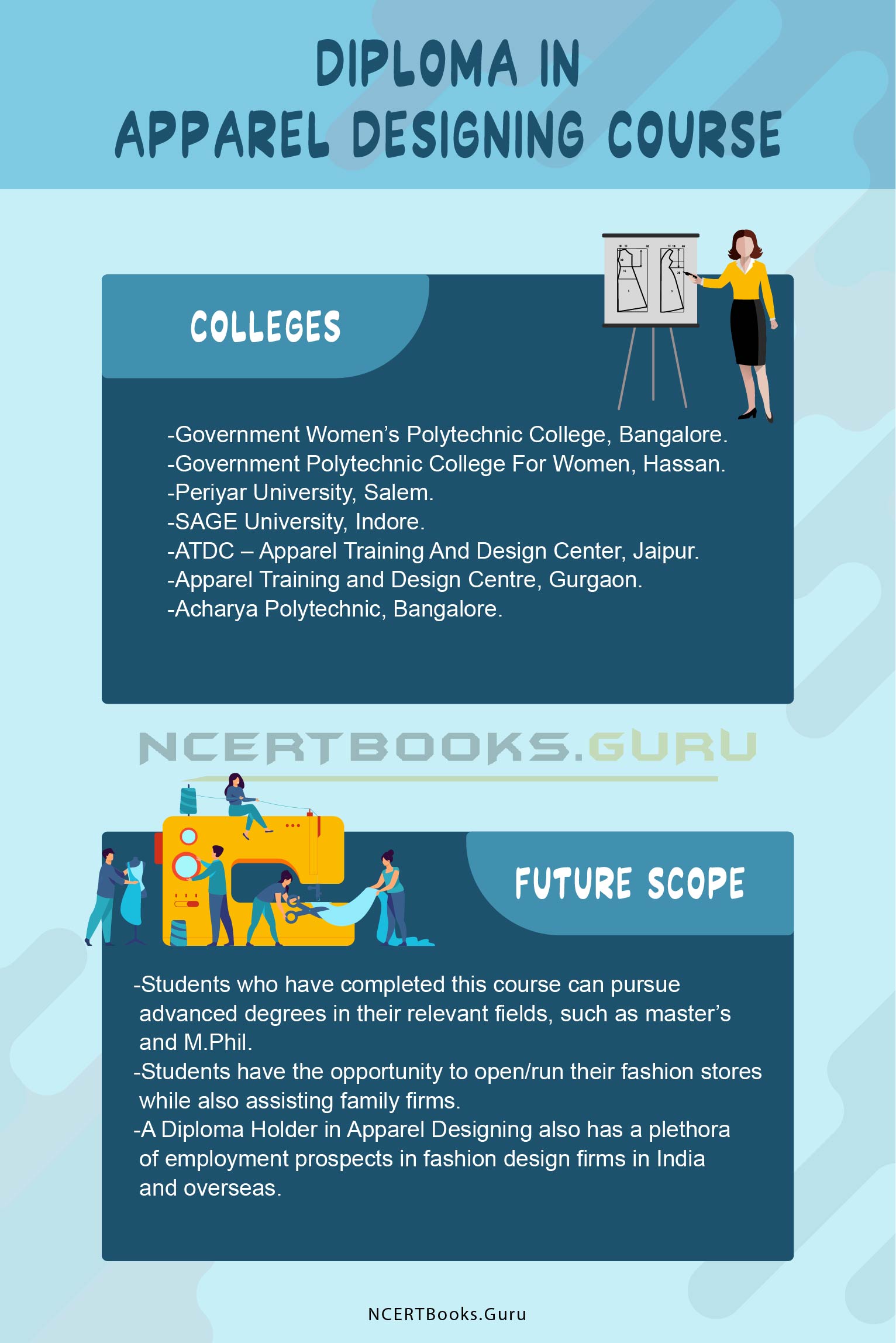
  • Students who have completed this course can pursue advanced degrees in their relevant fields, such as master’s and M.Phil.
  • Students have the opportunity to open/run their fashion stores while also assisting family firms.
  • A Diploma Holder in Apparel Designing also has a plethora of employment prospects in fashion design firms in India and overseas.

Job Opportunities for Apparel Designers After Diploma Programs

Apparel fashion designers are responsible for creating and sustaining an apparel brand. Apparel designers develop, highlight, and forms pattern design concepts, as well as predict the average cost of production and retain their affiliated company’s clothing lines.

Predicting fashion trends is similar to predicting climate conditions. Because the fashion business is dynamic and new patterns are established every day, fashion forecasters are required to study and analyze the global fashion industry. All these are the basic duties of an Apparel Designer now the various jobs that are offered to a Diploma holder in Apparel Designing are as follows:

  • Fashion Assistant
  • Fashion Instructor
  • Retail Fashion Designer
  • Fashion Stylist
  • Product Development Assistant
  • Fashion Designer & Merchandiser
  • Fashion Coordinator
  • Designer
  • Fashion Designer

Different Employment Areas for Diploma in Apparel Design Course in India

There are various areas of employment where a Diploma in Apparel Designing can apply for a job; these sectors provide amazing pay and career options after taking up the best designing courses in India. Some of the employment sectors are listed below:

  • Institutions of Textile Design
  • Organizations that manufacture and export garments
  • Apparel Design Companies
  • Governmental Organizations
  • Universities and Colleges

Diploma in Apparel Design and Merchandising Salary

The average salary for a fresher after earning a Diploma in Apparel Designing is between INR 2,00,000 and INR 6,00,000. However, it completely depends on one’s qualifications and the skills one possesses. In the fashion industry, experience trumps education, so if you are skillful and talented there is no limit to your income as the growth and development of this industry are increasing at a much faster rate.

Do Check: 

FAQs Related to Diploma Apparel Design Courses Online

1. Is there a distinction between fashion and apparel design?

Fashion design encompasses the creation of garments, jewelry, footwear, and other items. They create designs based on market trends and forecasts. Fabric, material, color, and design are all things they deal with. Apparel design, on the other hand, is the process of creating cloth from the ground up. They are regarded as a more technical individual. Textile printing, embroidery, and conceptual design are among their skills.

2. Is pursuing an apparel design diploma a good idea?

The fashion business is flourishing as the trend for fashionable clothing rises. Demand for talented and innovative designers is growing at the same time.  This is a good course for you if you have an interest in fashion and would like to grasp the fundamentals of fashion design, and want to be a popular apparel designer. It can assist you in showcasing your fashion skill and expertise.

3. Is it possible to get a job with an Apparel Design Diploma Certification?

A professional life in fashion or apparel design can be challenging due to the competitive nature of the fashion industry. Achieving an advanced diploma or degree in apparel design from a reputable institution, on the other hand, can open up opportunities for you in almost every position in the specialized industry.

To work in the fashion industry, you do not need a diploma or a degree. The important things that contribute to a potential job opportunity are your competence, innovation, the types of tasks you do, and your experience.

5. What is the goal of clothing design?

An apparel designer’s goal is to develop visually appealing clothes by contingently altering design features centered on design fundamentals.

Conclusion

A Diploma in Apparel Design is the course that fills you with all the skills and expertise that are required to be a good Apparel Designer. Being an apparel designer you have to predict the upcoming fashion trends and come up with fresh and innovative ideas.

Hence, your ability to be creative and innovative plays an important role in making your career successful as an apparel designer. The job of an apparel designer after diploma courses in apparel design is not only to make wearable and stylish cloth but to make a masterpiece out of a simple piece of cloth.

So if you have the passion and zeal for fashion and apparel designing, go for it and create your “Master Piece.” For more career updates and other course details, visit our comprehensive website @ ncertbooksguru.com
Textile Designing Courses | Eligibility, Duration, Fee, Syllabus, Admission Procedure, Jobs, and Salary

Textile Designing Courses

Textile Designing Courses: Textile designing is the way to create artistic designs through fabric and clothes. Textile designers have a lot of tools to make their imagination into reality. All the brands offer unique designed outfits to the customers. Textile designing is everywhere, starting with the clothes you wear to the wallpaper. These are fabrics, yarns, and fibers. Here, you will get information on the details of the textile designing course. The duration, eligibility criteria, prerequisite, admission procedure and fee structure of the textile designing course are discussed here. You will also get to know which Indian institutions offer a textile designing course and how is the job market for textile designers in India.

Get to Know More about other types of Course Details in Stream wise, and Category wise.

About Textile Designing Courses

Textile Designing is the process of weaving yarn and fiber creatively to form a decorative and flexible cloth or fiber. It is either printed or adorned. There are three parts of textile designing like woven, printed, and mixed media. It was there from ancient times, but nowadays, it has become an industry. Carpet, towel, clothing, etc. are produced by textile designing. Textile designers make trends in the fashion industry by creating a unique collection of clothes. Textile designers possess both creative and technical skills. Artistic skill is required to produce a great design, whereas technical expertise is mandatory to build it properly. Textile designers should possess basic knowledge of computers as well. Nowadays, most of the designs are created on the computer. Textile designers sometimes use the same design in different colors. Textile Designers can understand the trend and create designs within a challenging environment and deadline.

Textile Designing Courses Subjects, Concepts

CAD – Print Textile Chemical Processing Woven Design Project
Textile Design Techniques Woven Structures Surface Techniques
CAD – Dobby, Carpet and, Jacquard Visual Merchandising Graduation Project
Fashion Studies Fabric Styling World Textiles
Traditional Indian Textiles Advanced Woven Structures Craft Research and Documentation
Entrepreneurship management Fabric Studies Industry Internship
Print Design Project Pattern Making & Construction Non-Loom Techniques
Textile Science Fabric Quality Assurance Sustainable Design
Professional Ethics & Responsibilities Fashion Marketing & Merchandising Advanced Design Project

List of Colleges Offering Textile Designing Courses

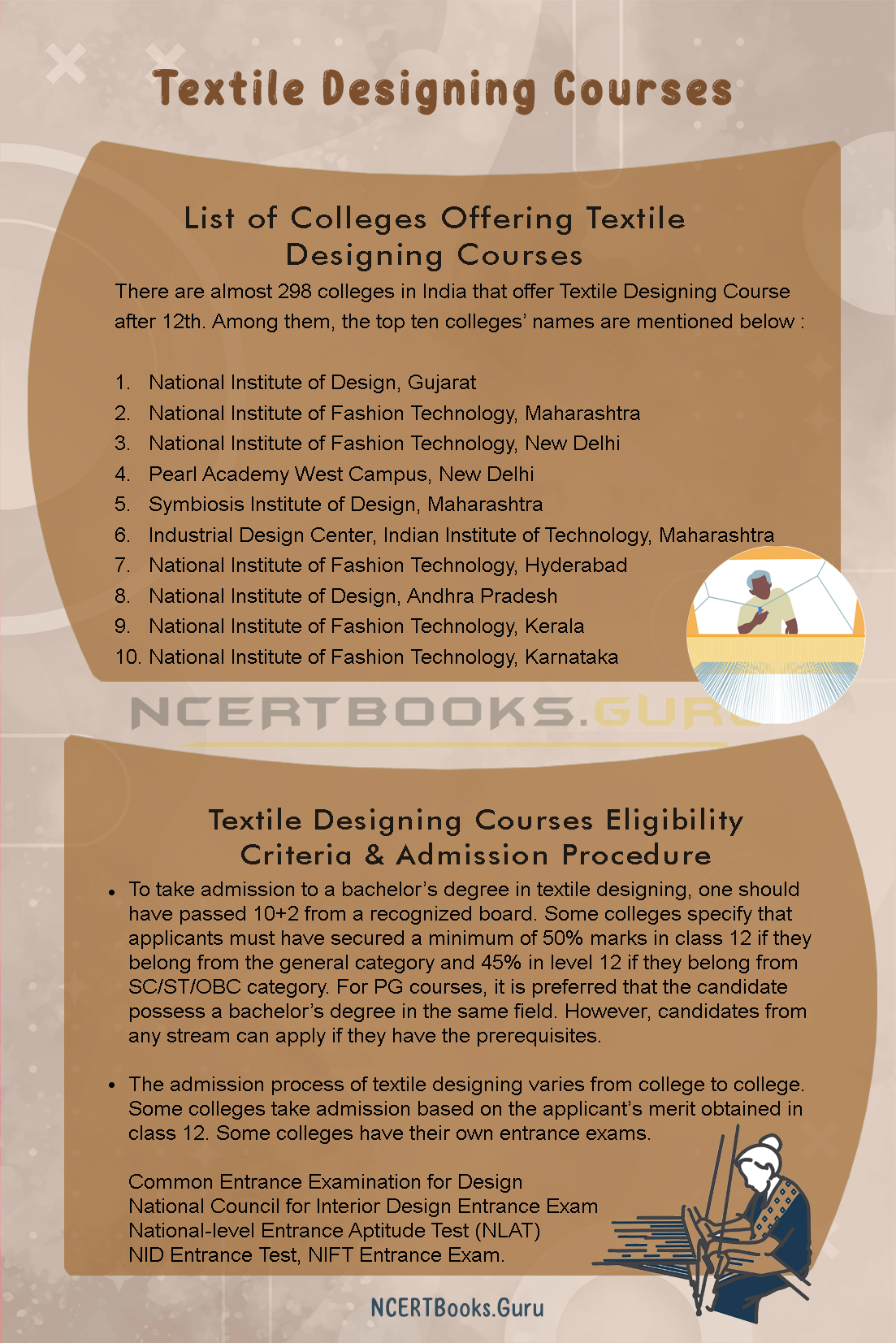
There are almost 298 colleges in India that offer Textile Designing Course after 12th. Among them, the top ten colleges’ names are mentioned below :

  1. National Institute of Design, Gujarat
  2. National Institute of Fashion Technology, Maharashtra
  3. National Institute of Fashion Technology, New Delhi
  4. Pearl Academy West Campus, New Delhi
  5. Symbiosis Institute of Design, Maharashtra
  6. Industrial Design Center, Indian Institute of Technology, Maharashtra
  7. National Institute of Fashion Technology, Hyderabad
  8. National Institute of Design, Andhra Pradesh
  9. National Institute of Fashion Technology, Kerala
  10. National Institute of Fashion Technology, Karnataka

Textile Designing Courses Prerequisite

To pursue this course, one should have a creative mind and basic knowledge of weaves and fabrics. One must have the artistic taste and experience of colors, shades, etc. Excellent communication is another requirement to be a good textile designer. The person should have an innovative mind and skills to draw different designs. The person should be aware of current fashion trends, goal-oriented, and have an eye for detail. S/he should have excellent observation skills and understand the customer lifestyle.

Textile Designing Courses Eligibility Criteria

To take admission to a bachelor’s degree in textile designing, one should have passed 10+2 from a recognized board. Some colleges specify that applicants must have secured a minimum of 50% marks in class 12 if they belong from the general category and 45% in level 12 if they belong from SC/ST/OBC category. For PG courses, it is preferred that the candidate possess a bachelor’s degree in the same field. However, candidates from any stream can apply if they have the prerequisites.

Textile Designing Courses 1

Textile Designing Courses Fees Structure

The course fee of textile designing varies from 60000 to 12 lacs rupees. The course fee depends on the location, program type, quality of the instructors, and the college’s reputation. Government and government-aided colleges charge lesser than private institutions.

Textile Designing Courses Admission Procedure

The admission process of textile designing varies from college to college. Some colleges take admission based on the applicant’s merit obtained in class 12. Some colleges have their own entrance exams. Some of the accessible entrance exams for the textile designing course are given below:

  • Common Entrance Examination for Design
  • National Council for Interior Design Entrance Exam
  • National-level Entrance Aptitude Test (NLAT)
  • NID Entrance Test, NIFT Entrance Exam.

Textile Designing Course Duration

Bachelor’s degree in textile designing is of three academic years. A Master’s degree in textile designing is of two academic years. But there are diploma programs in textile designing as well. These diploma programs are for one year.

Textile Designing Courses Syllabus

The syllabus varies from college to college. However, a standard curriculum is mentioned here so that you can have a rough idea on the syllabus before taking admission in the course.

Textile Design Course Curriculum for UG Courses

Course Syllabus
BDes Textile Design Applied Art on Textiles
Basics of Computer Science Application
Colour Mixing
Communication and Graphic Design
Computer-Aided Design (CAD) & Weave Design
Design, Art and Basic Design
Design Elements and Principles
Dueing Embroidery
Exhibition Design
Fine Arts- Drawing Sculpture and Painting
Foundation Programme in Design
Graphic Software And Its Usage For Image Creation
History Of Art
Marketing And Merchandising
Print Design
Printing & Finishing
Principles Of Resource Management
Professional Management
Properties Of Materials
Quality Analysis & Assurance
Surface Development Techniques
Textiles And Clothing
Textile Design And Applied Arts
Textile Dyeing And Pattern Making
Bachelors in Textile Design Elements of Design
Geometry
Visualisation Representation
Overview of Fashion
Material Studies
Computer Application
Field Study
Integrated Term Project
Design Methodology
Fashion Studies
Surface Techniques
Textile Science
Introduction to Weaving Skills & Knitting Skills
Appreciation of Traditional Textiles
Computer-Aided Design for Print
Digital Imaging & Editing Techniques
Textile Design Development Project
Dyeing
Printing and Finishing
Quality Analysis & Assurance
CAD and Weave Design
Print Design
Styling for Apparel & Home Furnishings
Woven Design Project
Dobby & Jacquard Design
Marketing & Merchandising
BA Textile Design Weaving
Dyeing & Printing
Weaving/ Dyeing & Printing
Weaving/ Printing
BA (Hons) Textile Design Principles of Design and Fashion
Fashion Model Drawing
Communication Skills & Personality Development
Introduction to Textiles
Pattern Making
Instruction Techniques
Technical Drawing
Construction Techniques
Fashion Illustration
Machinery & Equipments
Surface Ornamentation
Computer Application
Fashion Studies- Woven
History of Design
Principles of Management
Graphic Design
Computer-Aided Design
Colour Theory
Fundamentals of Fashion Marketing & Merchandising
Fashion Studies – Knit
Traditional Textiles & Embroidery of India
Dyeing and Printing
Textile Garment Quality Analysis and Assurance
Yarn Craft
Fashion Forecasting
Design Management

Textile Design Course Curriculum for PG Courses

Textile Theory Fiber Theory
Yarn Process Textile Texture
Textile chemistry Weaves process
Loom’s process Textile science (printing & dying)
Introduction to finishing advance weaving process Finishing process articles on printing industrial visit
Market Dynamics Knitting Industrial Visits
Project on woven & knitting fabrics Advance Diploma in Textile Design – 2 year

Study Material of Textile Designing Courses

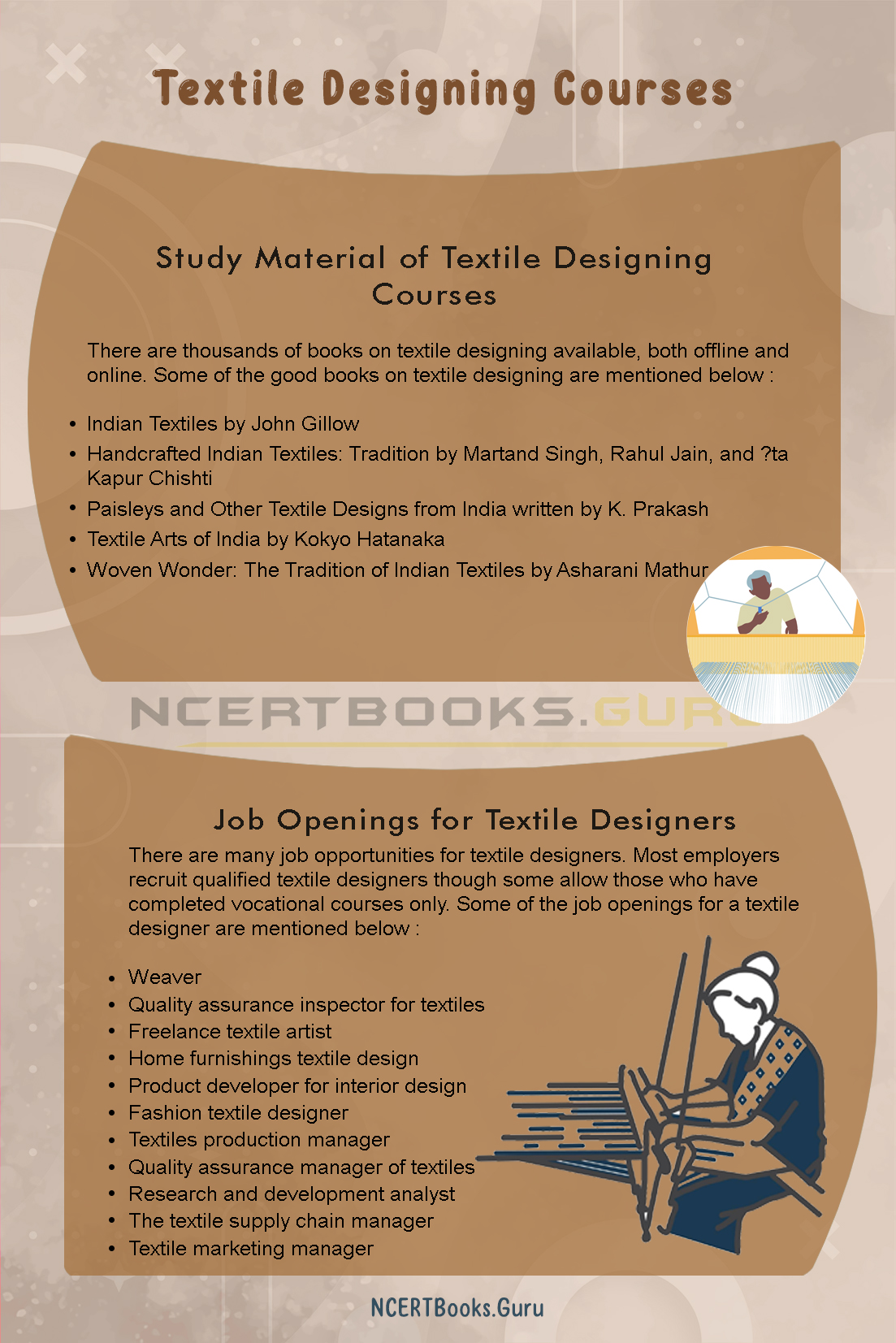
There are thousands of books on textile designing available, both offline and online. Some of the good books on textile designing are mentioned below :

  • Indian Textiles by John Gillow
  • Handcrafted Indian Textiles: Tradition by Martand Singh, Rahul Jain, and ?ta Kapur Chishti
  • Paisleys and Other Textile Designs from India written by K. Prakash
  • Textile Arts of India by Kokyo Hatanaka
  • Woven Wonder: The Tradition of Indian Textiles by Asharani Mathur

Do Check the Textile Engineering Course details.

Job Openings for Textile Designers

There are many job opportunities for textile designers. Most employers recruit qualified textile designers though some allow those who have completed vocational courses only. Some of the job openings for a textile designer are mentioned below :

  • Weaver
  • Quality assurance inspector for textiles
  • Freelance textile artist
  • Home furnishings textile design
  • Product developer for interior design
  • Fashion textile designer
  • Textiles production manager
  • Quality assurance manager of textiles
  • Research and development analyst
  • The textile supply chain manager
  • Textile marketing manager

Textile Designing Courses 2

Also, Refer

Top Recruiters of Textile Designers

After completing the textile designing course in India, one can get the chance to work with reputed fashion brands like Bombay Dyeing, Welspun, etc. Some of the top recruiters of textile designers are mentioned below :

Arvind Mills Triburg Jagdish Stores Alps Industries Pvt. Ltd.
Rupayan (Jaipur) Bombay Dyeing Donear Industries Ltd. Aditya Birla Home Décor
Crew BOS Nahar Industries The Shop Future Group
Welspun India Shades of India Himmatsingka Seide Fabindia
Indian Terrain Bharat Silks AVH Exports Jayshree Textiles
Shingora International Pvt. Ltd. Globe Enterprises Rateria Exports Manish Arora
Mahajan Overseas Portico Grasim Industries Ltd. Masaba Gupta
Mura Collective Madura Fashion & Lifestyle Mafatlal Industries Ltd. Mangalam Arts
NSL Textiles OBT Carpets Pantaloons Raymond’s India Limited
Ratan Textiles Reliance Brands Limited Sabyasachi Couture Shahi Exports
Shades of India Siyaram Silk Mills Synergy Lifestyles Pvt. Ltd. Trident Industry
Textrade International Vardhman Mills Ltd. W (TCNS Clothing Pvt. Ltd.)

Salary Offered to Textile Designers in India

The entry-level salary of a textile designer is between 3 to 5 lacs per annum. Those who have completed a master’s degree in textile designing and have relevant experience can earn up to 20 lacs per annum in India. Textile designers can receive a handsome package doing freelancing as well.

FAQ’s on Textile Designing Course

Question 1.
Which states in India are famous for textile designing?

Answer :
Maharashtra, Gujarat, Tamil Nadu, Uttar Pradesh, Karnataka, Madhya Pradesh, Rajasthan, and West Bengal are famous for this industry.

Question 2.
What is CAD in textile designing?

Answer:
CAD means computer-aided design. Nowadays, designers design using some computer software.

Question 3.
How is the market of textile designing?

Answer :
This industry has almost 4.5 crore workers, including 35.22 lacs handloom workers in India. The domestic textile and apparel market was at an estimated US$ 100 billion in FY19. The production of raw cotton in India has reached 36.04 million bales in the financial year 2020.

Question 4.
Is textile designing the right career choice?

Answer :
This is a competitive field. One must possess good theoretical knowledge as well as practical skills to get success in this field.

Summary of Textile Designing Courses

Textile Designing course online is best suitable for those who have a creative mind and zeal for innovation. If you have a passion for creating fashion trends, textile designing can be a good career option for you. If you have any other queries on the textile designing course, please tell us in the comments section.

Master of Law LLM Course Details | Duration, Eligibility Criteria, Duration, Fee Structure

Master of Law LLM Course Details

Master of Law LLM Course Details: Master of law or LLM course is an undergraduate degree of two years for the students who are interested in the law field. The course curriculum is divided into four semesters in these two years. Students with an undergraduate degree in law or a professional law degree can get inducted into this course. This course will take the students deeper into the law field and make them understand the different complex aspects of the law.

The students have to choose a specialization in this course to pursue their careers in that particular specialization field. There is a wide range of specialization available in the law field, such as- Civil Law, Tax Law, Criminal Law, Corporate Law, Commercial Law, Labor Law, Real Estate Law, and many others.

Get to Know More about other types of Course Details in Stream wise, and Category wise

Students are required to gain in-depth knowledge and develop appropriate skills in the chosen specialization field. This course educates the students with practical knowledge that will develop their research and analyzing skills.

Importance of Master of Law LLM Courses in India

The Master of Law or LLM course will develop a student’s skills and knowledge, turning them into an efficient law professional. The course uses practical methods of teaching to give professional learning experience to the students. Job availability in the law field is very scarce, so to get a job in the law sector, students are required to have unique skills to catch the eye of recruiters.

There are many specialization fields in LLM for students to choose from. Specializations, like international business law, can increase the student’s opportunity to get a job abroad and continue a successful career. Similarly, there are many specializations which can give the students a successful career.

The pay scale in the law sector is very high, and a student with a master’s degree in law can get hired in big law firms with a good salary.

Students with a master’s degree in law can stand out among many students seeking jobs and can attract recruiters to hire them.

Skillset Required for Master of Law LLM Course

LLM is a complex course because the law is one of the toughest fields to pursue a career. Students are required to work hard and give all of their efforts into this course so to complete it successfully. In doing so, students required some skills that will help them to complete the course with ease and not much pressure. The required skills will help the student to understand different subjects of this course and gain in-depth knowledge in this field. These skills are the same for various Law Courses in India. Some of the required skills for this course are:

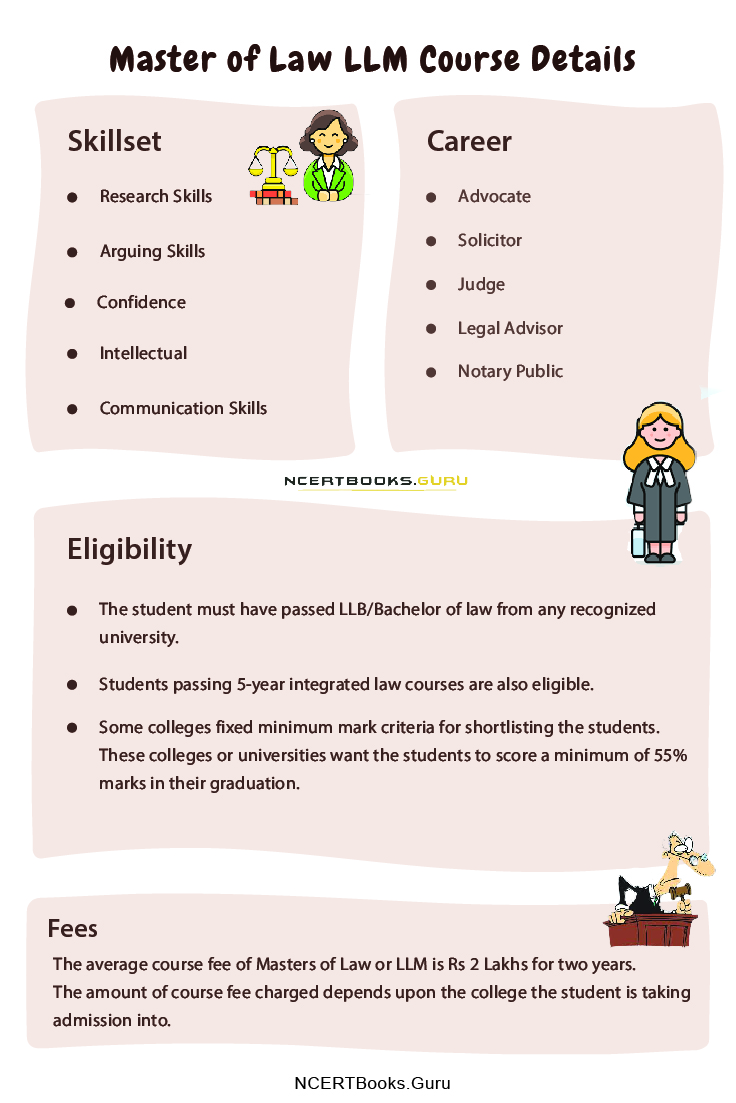
  • Research Skills: The student must have appropriate research skills in order to gain knowledge in this course. In the law field, professionals are required to do a lot of research before coming to any conclusion. The research is done in some cases, should be appropriate and authentic.
  • Arguing Skills: This is the most important skill, a law professional should possess for being successful in his/her career. Professional with good arguing skills can put up his point in any circumstance and will not be suppressed by any other person’s decision.
  • Confidence: Students for becoming an efficient law professional are required to be confident in everything he/she is doing. Students lacking confidence in their work can get suppressed by anybody in the world, which is not a good quality in the law sector.
  • Intellectual: The students are required to be intelligent so that they can study and interpret human behaviour and come into conclusions basing upon those behaviours.
  • Communication Skills: The student should be a good communicator so that he/she can communicate information properly to the listener without causing any trouble for them.
  • Presentation Skills: The student must possess the skills to pitch and present his/her idea in front of others in such a way that the presentation will make the listeners believe the student’s idea or opinion.

Master of Law LLM Course Duration in India

The Master of law or LLM course is a two-year postgraduate course with the main objective of improving the skills and knowledge of the students in the field of law. The students are educated in a practical based learning system in these two years.

This two-year course is divided into four semesters. In these four semesters, the students will gain basic knowledge as well as advanced knowledge in different aspects of the law.

Master of Law LLM Course Eligibility Criteria

Students are required to qualify some eligibility criteria to get admission into this course. This is the process different colleges use to shortlist the students. Colleges reject the application of students who don’t fulfil the eligibility criteria for this course. The eligibility criteria for this course is as follows:

  • The student must have passed LLB Course/Bachelor of law from any recognized university.
  • Students passing 5-year integrated law courses are also eligible.
  • Some colleges fixed minimum mark criteria for shortlisting the students. These colleges or universities want the students to score a minimum of 55% marks in their graduation.

Master of Law LLM Course Fees Structure

The average course fee of Masters of Law or LLM is Rs 2 Lakhs for two years. The amount of course fee charged depends upon the college the student is taking admission into. Top law colleges charge more as compared to ordinary colleges.

The course fee doesn’t include other expenditures that the student has to incur in these two years. Some of these expenses are hostel fees, mess fees, library fees, the fee charged for different college seminars and functions.

Master of Law LLM Course Syllabus

LLM Business Law Subjects

  • Insurance Law
  • Business Law
  • Law and Social Transformation in India
  • Legal Education and Research Methodology
  • Law Relating to Regulatory Authorities
  • Legal Regulation of Economic Enterprises
  • Commercial Arbitration
  • Environmental Law
  • Alternate Dispute Resolution & Securities Law
  • Judicial Process
  • Law of Industrial and Intellectual Property
  • Indian Constitutional Law: The New Challenges
  • International Trade Law

LLM (Constitutional Law)

  • National Security, Public Order and Rule of Law
  • Law and Social Transformation in India
  • Research Methodology
  • Administrative Law
  • Mass Media Law
  • Constitutionalism: Pluralism & Federalism
  • Administrative Process and Judicial Control
  • Human Rights
  • Dissertation
  • Indian Constitutional Law- The New Challenges
  • Judicial Process

LLM (Criminal Law)

  • Research Methodology
  • Life and Fire Insurance
  • Judicial Process
  • Banking Law
  • Consumer Law
  • Corporate Law
  • Theories of Law
  • Legislative Process
  • Legal Concepts
  • Law of Intellectual Property
  • Competition Law
  • Corporate Jurisprudence

LLM (Family Law)

  • Family Law III – Nuclear and Extended Family Rights
  • Family Law V – Family Property and Succession
  • Comparative Public Law
  • Foreign Business Language
  • Foreign Business Language
  • Family Law IV – Penal Laws on Family Affairs
  • Family Law I – System Scope Sources and Schools
  • Law and Justice in Globalizing World
  • Legal English and Research Methodology
  • Family Law VI – Family Disputes Resolution
  • Family Law II – Marriage and Matrimonial Remedies

LLM (Human Rights)

  • International Obligation
  • Concept & Classification of Rights
  • International Humanitarian Law
  • Human Rights and International & Regional Perspectives: Implementation Mechanism
  • Human Rights & Criminal Justice
  • Concept of Human Rights
  • Refugee Law
  • Human Duties, Responsibilities & its Effectuation
  • Dissertation Research
  • People’s Rights to Self-determination
  • Constitutional Governance of Human Rights in India
  • Jurisprudence & Human Rights: Lego Philosophical perspectives
  • Dialectics of Human Rights
  • Concept of Human Duties
  • Emerging Concept of Human Rights

LLM International Trade Law

  • Law and Practice in International Banking and Commercial Payments
  • Charter Parties: Law and Practice
  • e-Commerce
  • International Litigation and Arbitration
  • World Trade Law
  • Introduction International Trade Law
  • Marine Insurance

Also, Refer

Master of Law LLM Career Options

Job opportunities in the law sector are low as compared to the other sectors, but the pay scale in this sector is much higher than the other sectors. Being hired in a reputed law firm can get the students to earn huge fortunes and to prosper in their careers. There are many career options available in the law sector where a law professional can get hired in. Some of these career options are:

  • Advocate: A student with this degree can be a professional advocate. Advocates are hired by individuals or companies to fight their cases. Advocates are required to research efficiently and present proper facts in front of the court to prove his claim. There are also other responsibilities of an advocate, such as scrutinizing and drafting contracts.
  • Solicitor: Students need to specialize in a particular area such as tax, litigation, family or property to become a solicitor. Companies hire solicitors to get his/her advice in their legal matters. With the help of the solicitor, companies can avoid getting into legal issues.
  • Judge: A student can get selected as a judge. A judge is required to ensure that the legal rights of both the parties fighting a case are not hampered. A judge listens to the arguments of the advocates and comes to a conclusion based on these arguments.
  • Legal Advisor: Legal advisors is one of the most popular job profiles in the field of law. Governments and different private companies hire a legal advisor in order to prevent their organizations from getting into any legal complications.
  • Notary Public: In order to get hired in this post, job seekers are required to have some job experience. The Central Government or State Government makes the recruitment for this post. The responsibility of this job profile is to handle and maintain the legal matters of the government.

Master of Law LLM Course Details

Master of Law LLM Course Salary

Law is one of the highest-paid sectors. Getting a job in the field of law is difficult, but the pay scale is much more than the other sectors. The average salary in the law sector is Rs 10 Lakhs for freshers Experienced professionals are paid more than the amount as mentioned earlier.

The expected salary of some of the job profiles are:

Job Profile Annual Average LLM Salary
Advocate Rs 10 Lakhs
Solicitor Rs 8 lakhs
Judge Rs 15 Lakhs
Legal Advisor Rs 8 Lakhs
Notary Public Rs 36 Lakhs

Master of Law LLM Course Admission Process

Admissions into this course are done through the entrance exams. Some of the popular entrance exams in India are CLAT and LSAT. Universities also conduct their own entrance exams for shortlisting the students. Some of the university-based entrance exams are IPU, CET, DUET, etc.

Some of the top colleges of India are:

  • National Law University, Bengaluru
  • National Law University, New Delhi
  • Nalsar University of Law, Hyderabad
  • Indian Institute of Technology, Kharagpur

FAQ’s on Master of Law LLM Course Details

Question 1.
How can I pursue LLM in India?

Answer:
Students need to have a graduation degree in the law sector and should have a minimum of 55% in his/her graduation to get qualified for admission into this course. Students need to appear for an entrance exam to finally get selected and pursue the course in a university or college.

Question 2.
Is it worth doing LLM in India?

Answer:
This course is a master’s course in law and offers a lot of job opportunities for students. As Law sector is one of the highest-paid sectors, students after completing their postgraduate degree can get hired in top law firms with highly paid salaries. Therefore, in recent days LLM in India has become a good choice for the students.

Bachelor of Unani Medicine & Surgery (B.U.M.S.) Course | Admission, Eligibility, Fee Structure, Syllabus, Job Profiles, Salary

Bachelor of Unani Medicine & Surgery B.U.M.S. Course

Bachelor of Unani Medicine & Surgery (B.U.M.S.) Course: Bachelor of Unani Medicine and Surgery is one of the most growing and enthusiastic courses that has come to light very recently. For all participants who are seeking to pursue this course, this article will give an insight into the eligibility, syllabus, scope, and salary of this course. For further details on the admission and application process of this course, this article has been written with the precision of keeping in mind the best needs of the students.

B.U.M.S Full form is Bachelor of Unani Medicine & Surgery.

About Bachelor of Unani Medicine & Surgery (B.U.M.S.) Course

One of the significant fields of science and medicine has come to light very recently offering the participants a better chance to differentiate and have better specifications in this field. The Bachelor of Unani Medicine and Surgery is a 5.5-year course in the field of medicine. All participants are required to have a 10+2 for this course. This course is also subjugated to entrance test and interviews depending on the colleges. This is an Undergraduate degree programme, including a year of internship which is compulsory for all students.

Bachelor of Unani Medicine & Surgery Course Highlights

  • The Bachelor of Unani Medicine and Surgery is an Undergraduate program that is 5.5 years in duration, including a year of Internship compulsory for all students.
  • All applicants are required to have a relevant 10+2 in education in the field of science. The minimum percent marks required varies between 50 – 55 depending on the college. Some colleges also include an age limit as their eligibility criteria; the minimum age of all students are required to be 17 and over.
  • The BUMS admission process depends on Entrance Test and Interviews and Counseling, which are conducted on clearing the entrance tests. The criteria may be different for different colleges.
  • The course fees for the Bachelor of Unani Medicine and Surgery course varies from Rs. 50000 to 6.3 lacs depending on the college which the applicant chooses to study.
  • The average starting BUMS Course salary of the participants on completion of this course varies between 2 lacs to 10 lacs per annum depending on the recruiting company.
  • Different job positions for recruitment in this course include Consultant, Lecturer, Scientist, Private Practitioner, Medical Assistant, Public Health Specialist, and many more.
  • Top enlisting organizations in this field incorporate Unani Medical Colleges, Unani Charitable Institutions, Unani Clinic, Unani Medicine Stores, Unani Consultancies, Unani Medicine System Education Training Institutes, Life Science Industries, Healthcare Communities, Unani Private Hospitals, Unani Care, Unani Dispensaries, and some more.

What is Unani?

Unani is the arrangement of elective meds. This is like the Ayurveda in terms of the four components and as mainstream as the Ayurveda. The clinical highlights as the sign, side effects, research facility highlights and mijaz are imperative to analyze any infection. Some of them include Skin inflammation, Vitiligo, Rheumatoid, Leucoderma, Joint pain, Psoriasis, Bronchial Asthma, Jaundice, Filariasis, Intense and continuous sicknesses.

In this master course the understudies are instructed about Regimental treatment, Venesection, Cupping, Diaphoresis, Diuresis, Turkish shower, Massage, Cauterization, Purging, Emesis, Exercise, Leeching, Pharmacotherapy, Dietotherapy, Surgery Jarahat, etc.

The unhitched male of Unani Medicine and Surgery, similar to all elective clinical student programs that fall into the AYUSH order – Ayurveda, Yoga and Naturopathy, Unani, Siddha, and Homeopathy, is checked by the Central Council of Indian Medicine.

List of Colleges offering Bachelor of Unani Medicine and Surgery

Some of the most reputed colleges offer the Bachelor of Unani Medicine and Surgery course for their participants. The top colleges for pursuing this course have been ranked below in terms of education, faculty, and job prospects. They are as follows :

  • Bachelor of Unani Medicine and Surgery in Delhi NCR.
  • Bachelor of Unani Medicine and Surgery in Maharashtra.
  • Bachelor of Unani Medicine and Surgery in Chennai.
  • Bachelor of Unani Medicine and Surgery in Uttar Pradesh.
  • Bachelor of Unani Medicine and Surgery in Telangana.
Name of College Fees  City
Luqman Unani Medical College and Hospital Rs. 1.5 Lacs Bijapur
Tippu Sultan Shaheed Educational Trust Unani Medical College Rs. 66417 Gulbarga
HMS Unani Medicine College Sadashiv Nagar Rs. 6 Lacs Tumkur
National Institute of Medical Sciences Rs. 5 Lacs New Delhi
Glocal University Rs. 5 Lacs Saharanpur
Eram Unani Medical College and Hospital Rs. 7 Lacs Lucknow
ZVM Unani Medical College and Hospital Rs. 4-5 Lacs Pune
Aligarh Muslim University Rs. 30000 Aligarh
Zulfequar Haidar Unani Medical College and Hospital Rs. 5 Lacs Bihar
University of Delhi Rs. 4 Lacs Delhi
Government Unani Medical College Rs. 50000 New Delhi
Government Ayurveda College Rs. 4 Lacs Thiruvananthapuram
Government Autonomous Unani Medical College and Hospital Rs. 1 Lac Bhopal

Bachelor of Unani Medicine & Surgery (B.U.M.S.) Course Syllabus/Curriculum

B.U.M.S Course Subjects details are available here.

First Year 

  • History of Unani System.
  • Anatomy.
  • Physiology.
  • Yoga.
  • Pathology.
  • Bedside Clinic.

Second Year

  • Dissertation 1.
  • Toxicology.
  • Medical Ethics.
  • Advanced Yoga.
  • Social Medicine and Preventive.
  • Medical Jurisprudence.

Third and Fourth Years

  • Dissertation 2.
  • Regimental Therapy.
  • Gynecology, Pediatric.
  • Advanced Principles of Unani Medicine.
  • ENT.
  • Surgery.
  • Dissertation 3.

Fifth Year

  • Internships.

Bachelor of Unani Medicine & Surgery (B.U.M.S.) Course Eligibility Criteria

The essential qualification measures for seeking after Bachelor of Unani Medicine and Surgery (BUMS) course is a successful score in Higher Secondary Examination or 10+2 in Science stream with subjects, for example, Physics, Chemistry, and Biology with at least 50 percent from a perceived school or college.

The understudies who have examined Urdu in class XII or having capability in the Urdu language will be given inclination in affirmation.

Bachelor of Unani Medicine & Surgery (B.U.M.S.) Course Application Process

Some presumed institutions offer affirmation through the national and state level placement test. Understudies can show up in KEAM (state-level test), CPAT, CPMEE or NEET for confirmation in the BUMS course. The applicant ought to be at least of 17 years old.

A few foundations offer confirmation through the state and national level selection test.

At the hour of affirmation, the applicant ought to have a minimum age of at least 17 years.

The Bachelor of Unani Medicine and Surgery can likewise be sought after through the online mode training framework.

B.U.M.S Course Fee Details

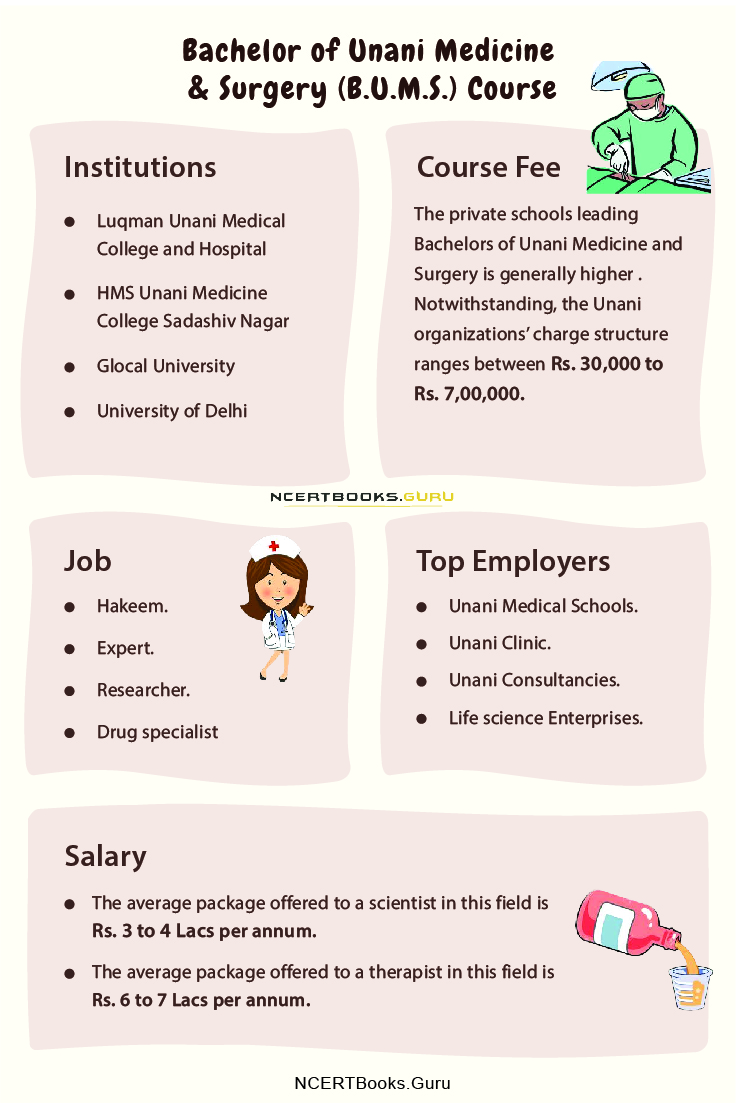
The private schools leading Bachelors of Unani Medicine and Surgery is generally higher Undoubtedly, government universities’ charge is lesser than private foundations. Notwithstanding, the Unani organizations’ charge structure ranges between Rs. 30,000 to Rs. 7,00,000. The expense structure additionally relies upon the program that the participant enrolls into.

Get to Know More about other types of Course Details Streamwise, and Category wise

Bachelor of Unani Medicine & Surgery Course Job Profiles

Numerous associations and exploration organizations are working in the assembling and examination field abroad are requiring an expert in Bachelor of Unani Medicine and Surgery. Unani is known as the fourth crowded drug framework after Allopathy, Ayurveda, and Homeopathy. The activity profiles in the wake of finishing the BUMS program are the following:

  • Hakeem.
  • Expert.
  • Instructor.
  • Researcher.
  • Advisor.
  • Private practice.
  • Drug specialist.
  • Clinical right hand.
  • General wellbeing pro.
  • Spa chief.

Also, Read:

Salary Offered to Bachelor of Unani Medicine and Surgery Professionals

Applicants can land the position in Unani universities as an educator, speaker, and instructor or as an analyst. This brings forth a substitute treatment. A portion of the mainstream proficient roads open to such alumni is recorded underneath with the comparing pay rates offered for the individual positions.

  • The average package offered to a scientist in this field is Rs. 3 to 4 Lacs per annum.
  • The average package offered to a therapist in this field is Rs. 6 to 7 Lacs per annum.
  • The average package offered to a Pharmacist in this field is Rs. 4 to 5 Lacs per annum.

Top Employers for Bachelor of Unani Medicine and Surgery

The top employers for this field include the following places :

  • Unani Medical Schools.
  • Unani Charitable Establishments.
  • Unani Clinic.
  • Unani Medication Store.
  • Unani and Ayurvedic Research Establishments.
  • Unani Consultancies.
  • Unani Medication Framework Instruction Training Foundations.
  • Life science Enterprises.
  • Medicinal Services Network.
  • Unani Pharmaceutical Enterprises like Hamdard.
  • Unani Government Emergency Clinics.
  • Unani Private Emergency Clinic.
  • Nursing Homes in Unani Care.
  • Unani Dispensaries.

Bachelor of Unani Medicine & Surgery (B.U.M.S.) Course

FAQ’s on Bachelor of Unani Medicine and Surgery

Question 1.
What are the top colleges offering Bachelor of Unani Medicine and Surgery Courses?

Answer:
Listed here are some of the top schools offering Bachelor of Unani Medicine and Surgery Medical courses: Jawaharlal Institute of Postgraduate Medical Education and Research (Puducherry), Osmania Medical College (Hyderabad), Armed Forces Medical College (Pune), Sri Ramachandra Medical College, and Research Institute (Chennai), Lady Hardinge Medical College (New Delhi). You can investigate these schools on our site to check on the off chance that they offer Bachelor of Unani Medicine and Surgery ((B.U.M.S.)) or not.

Question 2.
What is the average fee for the Bachelor of Unani Medicine and Surgery course?

Answer:
The average fee that is required for an applicant of the Bachelor of Unani Medicine and Surgery course is Rs. 3 Lacs. The costs depend on the colleges ranging from Rs. 30000 to Rs. 7 Lacs.

Question 3.
What is the duration of the course for Bachelor of Unani Medicine and Surgery?

Answer:
The Bachelor of Unani Medicine and Surgery is a five and a half year course which also includes a full year of internship, compulsory for all students.

Question 4.
What are the most popular specializations related to Bachelor of Unani Medicine and Surgery?

Answer:
A portion of the popular specializations for Bachelor of Unani Medicine and Surgery are Unani Medicine and Surgery, Medical Sciences, General Medicine.

Question 5.
What is the Bachelor of Unani Medicine and Surgery offering to the applicants?

Answer:
Graduates with this degree have the opportunity in the ventures like Unani Medical Colleges, Unani Charitable Institutions, Unani Clinic, Unani Medicine Store, Unani and Ayurvedic Research Institutes, Unani Consultancies, Unani Medicine System Education Training Institutes, etc. The average pay for graduates Bachelor of Unani Medicine and Surgery is around Rs. 2 to10 Lacs; however, this can be higher based on understanding and different elements.

How to become PGT Teacher in India | Educational Qualification, Necessary Skills, Salary, Steps to Become a PGT Teacher

How to become PGT Teacher in India

How to Become PGT Teacher in India?: Teachers are the source of inspiration for the future of the nation. From childhood, many kids have dreamt of becoming a teacher. Are you someone who loves to spread knowledge? Then, being a teacher is the right profession for you. To know about how to become PGT Teacher in India, read the complete article.

PGT or Post Graduation Teachers are teachers that teach senior secondary or higher secondary students. PGT teachers are also famous as senior secondary school teachers. It is a high-level position. The roles and responsibilities of a PGT teacher are the same as that of a school teacher. The Post-graduation teachers work under the principle of teaching. They teach students according to the curriculum and instructions of the institution they are teaching in. To become a PGT teacher, you should have in-depth knowledge of the subjects. The primary duty of a teacher is to prepare and guide students to secure better marks in examinations. The role of a teacher is not limited to teaching only. They are the source of light in the life of the students.

Refer to Course Details to know more about related courses and find details like Admission Process, Eligibility Criteria, etc.

Educational Qualification to become a PGT Teacher

To become a PGT teacher, you need to qualify some criteria and should have specific academic qualifications. Some of the academic qualifications are as follows:

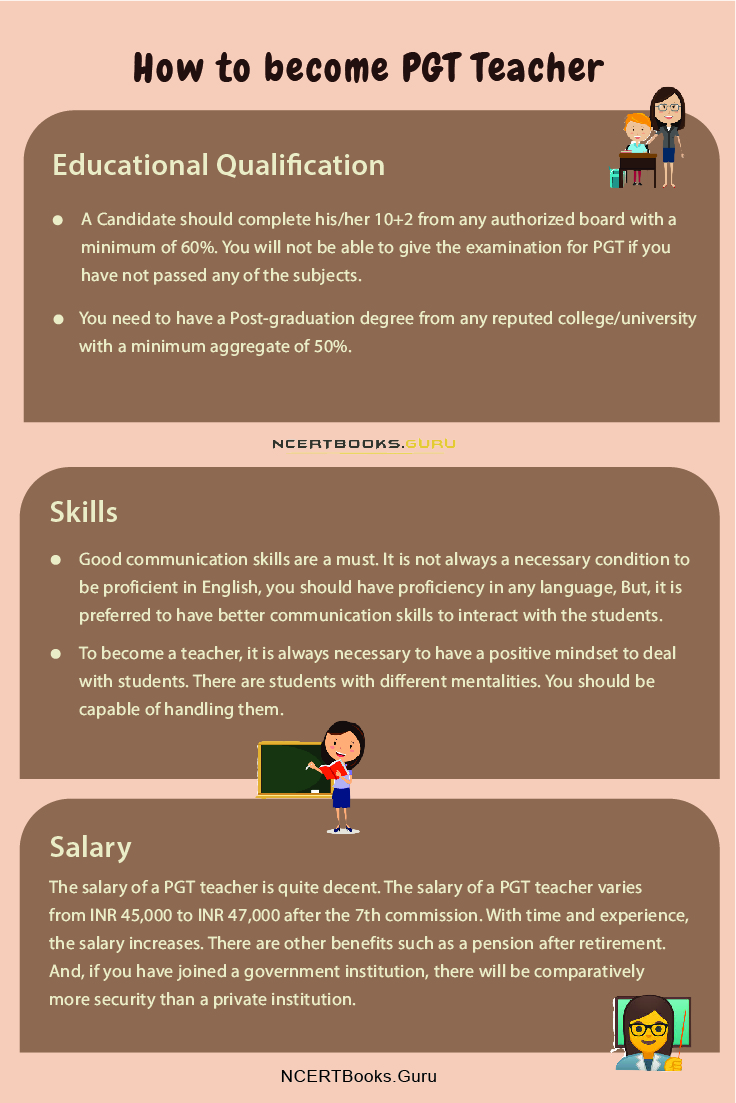
  •  A Candidate should complete his/her 10+2 from any authorized board with a minimum of 60%. You will not be able to give the examination for PGT if you have not passed any of the subjects.
  •  A Candidate must have a graduation degree with a minimum of 55%.
  • You need to have a Post-graduation degree from any reputed college/university with a minimum aggregate of 50%.
  •  If you have some additional knowledge of any subject or if you have any additional skills that are relevant for teaching such as coding, writing, etc. It will help you in getting into PGT.

Necessary Skills to become a PGT Teacher in India

After passing the necessary criteria/educational qualification to become a PGT teacher in India, you need to have some necessary skills to move further in pursuing to become a PGT teacher. There are some required skills such as:

  • Good communication skills are a must. It is not always a necessary condition to be proficient in English, you should have proficiency in any language, But, it is preferred to have better communication skills to interact with the students.
  • To become a teacher, it is always necessary to have a positive mindset to deal with students. There are students with different mentalities. You should be capable of handling them.
  • A person should have great interpersonal skills.
  • Apart from communication skills, you should have good listening skills to be able to solve the problems of students. You should also have a problem-solving approach to tackle the issues.
  • To enter into the educational industry, you need to have a helpful attitude to help students.

Read More:

Salary of a PGT Teacher

The salary of a PGT teacher is quite decent. The salary of a PGT teacher varies from INR 45,000 to INR 47,000 after the 7th commission. With time and experience, the salary increases. There are other benefits such as a pension after retirement. And, if you have joined a government institution, there will be comparatively more security than a private institution.

How to become PGT Teacher in India

Steps to Become a PGT Teacher

To become a PGT teacher, one must follow certain steps such as:

  • You must have to have an educational degree from any reputed organization. To become a PGT, it is mandatory to have an honours degree.
  • If you want to be in a better position and want to open new avenues for yourself, then you should have a post-graduation degree from any reputed university in the same subject/stream.
  • To simplify entry into this field, it is always a recommendation to complete a B.Ed degree from any reputed university. It acts as a benefit to get a better opportunity.
  • After completing B.Ed or any Bachelor’s degree, you should go for M.Phil and other degrees with the same value. To broaden the scope, you can opt for a PhD.
  • Many institutions lookout for teachers with experience, then if you have experience of teaching. It eases the processes of entering into PGT.
  • After completing the post-graduation degree, you have to clear examinations held by Higher Secondary Boards. Once you will qualify for the examination, you can apply for the PGT post in any institution.

In the end, it can be concluded that after qualifying for the educational qualification and passing the examination test, you will be able to become a PGT teacher. You will open ways to a secure and successful future.

FRM Course Details | Check Eligibility, Fee Structure, Carrer Opportunities, FRM Certification Holder Earnings

FRM Course Details

FRM Course Details: If you are desired to challenge yourself by solving financial risks then becoming a certified FRM holder is the correct career option. From this page, you can gain complete knowledge about FRM Full Form, Course eligibility, Fee structure, FRM Course Certification, Exam Pattern, and Career opportunities for FRM Certificate Holder. Moreover, you can have an idea of FRM certified holder job designations and Earnings of FRM certification professionals through this article.

What is FRM?

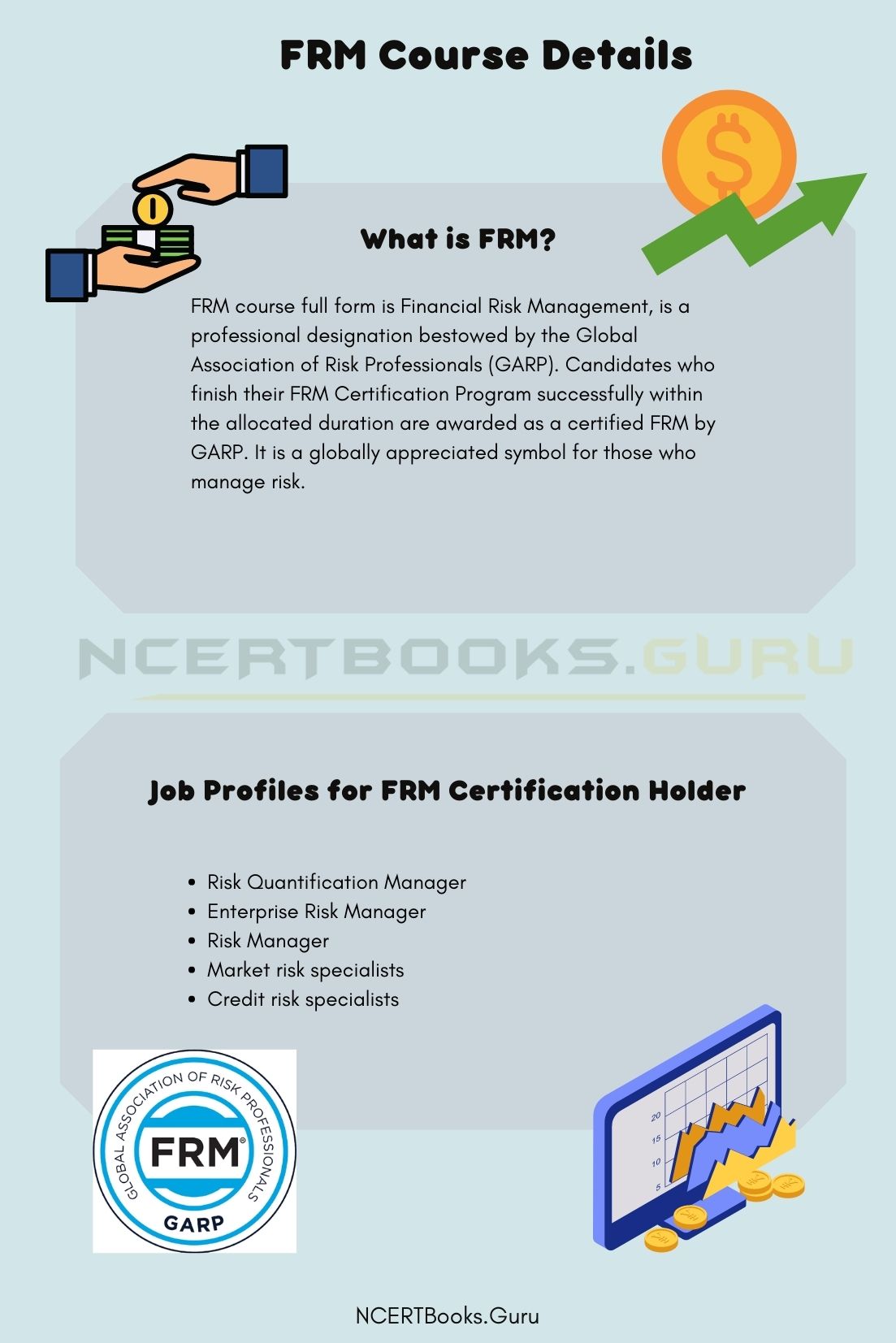
FRM course full form is Financial Risk Management, is a professional designation bestowed by the Global Association of Risk Professionals (GARP). Candidates who finish their FRM Certification Program successfully within the allocated duration are awarded as a certified FRM by GARP. It is a globally appreciated symbol for those who manage risk.

After seeing the rapid changes in the finance industry all over the world there is a requirement for experts who manage risk, money, and investment to earn worldwide standardized modern knowledge, and also FRM strives to fill that gap. However, the FRM exam is a practice-oriented examination offered in two parts; questions are meant to relate theory to practical, real-world, problems. View more info about FRM Course details in the below modules.

FRM Course Details

Course  FRM
Full form Financial Risk Management
FRM Course Eligibility Minimum graduation
Duration Exams will be conducted twice in a year
Fee Offered for exam  $350
Course Type Certified Exam
Starting salary offered  INR 900,000
Advance Courses Advance Certificate in Financial Accounting, Advance Certificate in Financial Statement Analysis
Employment opportunities Market Risk Manager, Regulatory Risk Manager, Commercial Risk Manager

FRM Certification & Eligibility Criteria

The certification exam for financial risk management is held twice in a year by the council. Candidates will be certificated based on qualification through merit scores in the exam. Interested aspirants can appear for the FRM Certification Exam in May and November. Anyone can take this exam as there are no educational or professional requirements to appear for the FRM Exam.

FRM Course Duration

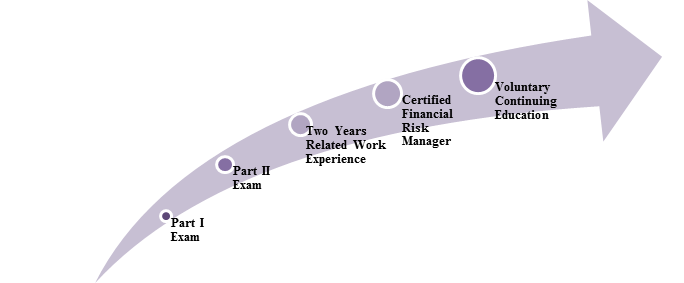
Based on the aspirant’s focus and dedication, it takes a minimum of 1 year to finish both the exams of the FRM course. Candidates can give the exams of FRM Part I and Part II in May and November. Also, there is FRM exam validity for 5 years from the date of registration. That means the aspirant should clear both the exams and get 2 years of experience, and acquire the certificate within these 5 years. However, to become a Certified Financial Risk Manager, aspirants must meet with the following outline of the program:

FRM-Certification-Requirements

Financial Risk Management (FRM) Course Certification

Candidates who meet with the requirements of the FRM Exam can be eligible for the certification. Aspirants should follow the three main steps for becoming a certified FRM. The following steps are the only way to complete the certification of FRM. So, follow them:

  1. One should pass the FRM Exam Part I.
  2. After that, candidates have to pass FRM Exam Part II within 4 years after passing the Part I FRM Exam.
  3. They need to show 2 years of professional full-time financial risk management work experience.

If you need more clarity on this, you can check the above-displayed image of the FRM Course Program Outline. Check out the below modules and get to know more about FRM Part I Exam and FRM Part II Exam details.

FRM Part I Exam Pattern & Syllabus

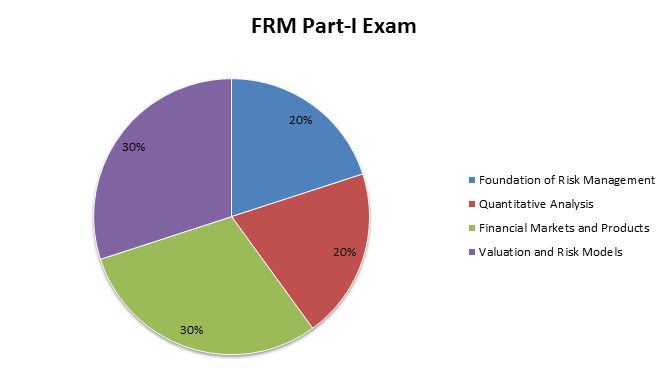
One of the first steps that you should fulfill to become a Certified Financial Risk Manager is clearing the FRM Part I Exam. Aspirants should know about the exam pattern and concepts & theories involved under risk management and what should be included to a risk manager’s daily work. Every year, the exam of FRM Part I will be conducted in May and November months. So, candidates need to concentrate on the required Part I important tools and concepts to clear the exam. There are 100 MCQs to be solved within 4 Hours. The below diagram portrays the subjects that the aspirants are expected to prepare for the level I exam with their respective weightage.

FRM PART I EXAM SYLLABUS

FRM Part II Exam Pattern & Syllabus

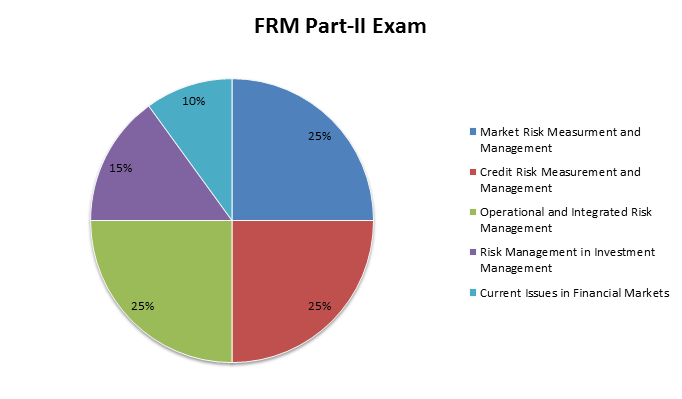
And the second step candidates should follow after qualifying the part 1 exam of FRM is the Financial Risk Manager Exam Part II. They have to clear this FRM part 2 exam also to become a certified FRM. The FRM Exam Part II centers on the practical application of risk management tools involved in Part I to particular areas of risk management like credit risk, market risk, and operational risk. Aspirants can take this exam in May and November every year. You will be seen 80 multiple choice questions to attempt within 4 Hours of exam duration. The below diagram narrates the subjects with their respective weightage, which are supposed to prepare by the candidates for the level II FRM Exam.

FRM Part II Exam Pattern

Fee Structure for FRM Certification

The estimated Financial risk management certification Free Structure is mentioned below. Make use of the below points and know the application and examination fee structure for 2 papers by verifying further. To have a prior idea on the FRM Certification Fees, we have provided the fee structure here:

Part I

  • Early Registration: $825
  • Standard Registration: $950
  • Late Registration: $1125

Part II

  • Early Registration: $350
  • Standard Registration: $475
  • Late Registration: $650

As there is no fee for the exam of FRM Certification. Candidates have to pay the fee for registration and that would be taken in the amount of Exam as mentioned above. You can only register for the exam in an online mode. Candidates can expect the registration process on the dates of continuity months.

FRM Career Options – Industries Employing Certified FRM’s

The certification course of a financial risk manager is an ultimate designation that aids you with specialized knowledge and skills in the field of financial risk management. It offers varied career options in Risk Management, Trading, Structuring, Modeling, etc. You can also check Different Courses After MBA or Management Engineering Courses to pursue or get steps on How to become an Entrepreneur in India. After completion of your FRM Course, you can start your career in the following fields:

  • Banks
  • Risk and technology vendors
  • Asset management firms
  • Hedge funds
  • Credit agencies
  • Corporations (including non-financial corporations)
  • Consulting firms
  • Insurance firms
  • Central banks
  • Investment banks
  • Government/regulatory agencies

Job Profiles for FRM Certification Holder

In this present situation, every industry requires FRMs, as they consider FRMs has extensive knowledge and high professional standards to manage risk, investment, and money. FRM certificate holders can get jobs in various firms and industries and they will be worked in some of the main Job profiles involved in the firms like listed below:

  • Risk Quantification Manager
  • Enterprise Risk Manager
  • Risk Manager
  • Market risk specialists
  • Credit risk specialists

FRM Course Details

FRM Certificate Holder Salary Details

Candidates who hold FRM Certificate can earn the average salary in India is INR 900,000. The salary for FRM professional and experienced candidates can earn a bigger amount compared with the salary amount of a fresher. Also, the earnings may vary based on the skillset and diligence and experience gained by the individual in the workforce.

More related articles:

FAQs on Financial Risk Management (FRM) Certification

1. What is the mode of examination for both Part I and Part II FRM Exam?

Both FRM Part I and II exams would be manual via paper and pencil.

2. When can one appear for the exam?

Financial Risk Management Certification Part I & Part II exams are available on the 3rd Saturday of May & November each year.

3. How much work experience required before applying for the FRM Exam?

However, there are no educational or professional prerequisites to apply for the Financial Risk Manager Exam. But, to become a Certified FRM, individuals must have professional experience of two years in risk-related full-time professional experience positions including portfolio management, risk consulting, and other fields.

4. What are my career opportunities after becoming a Certified FRM?

There are various career prospects available as it is the most prominent designations in the risk management industry. FRM certified holders job options can be like Chief Risk Officer, Senior Risk Analyst, Head of Operational Risk, and Director, Investment Risk Management, etc.

5. What is the Salary of FRM in India?

FRM Certified holders can get an average salary in India is INR 90,000 also it depends on the firm and the industry they are working in and also the experience the candidate hold.

6. Which is the best reference book for the FRM Examination?

Some of the best FRM Reference Books are listed below:

  • 2017 FRM (part 1) Curriculum (GARP) Books + Free Question Bank
  • 2017 FRM (part 2) Curriculum (GARP) Books + Free Question Bank

Summary

Hope, the information shared as a part of the FRM Course Details has lit up you a bit. For any other information needed feel free to drop us your suggestions via comment box and we will help you resolve them at the soonest possible. Keep in touch with us to know more about different course details, study materials, notes, and books you need as a part of preparation.