Paramedical Diploma Courses After 10th | Eligibility, Subjects, Exams, Colleges, Career, Scope, Fees

Paramedical Diploma Course

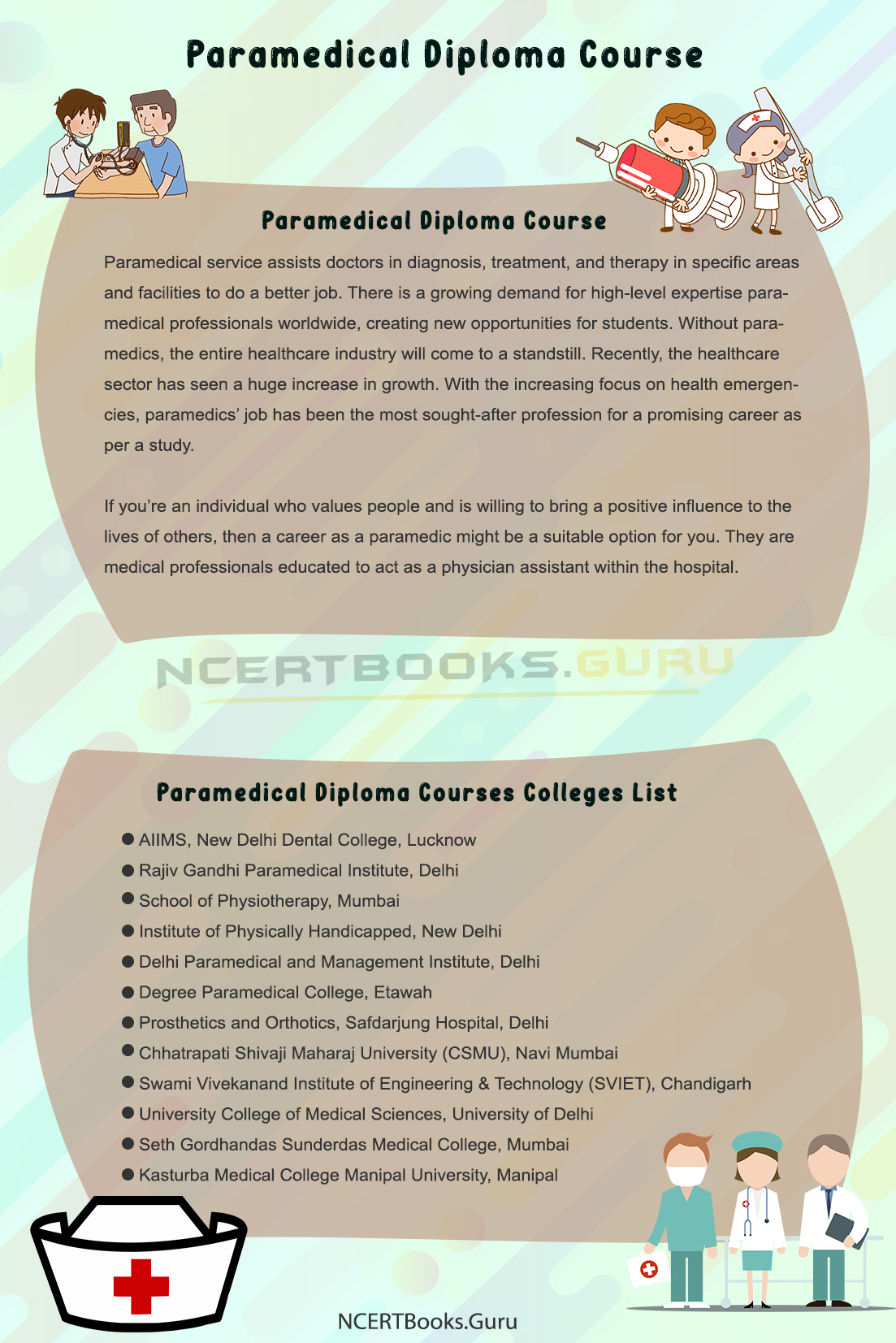
Paramedical Diploma Courses List: Paramedical service assists doctors in diagnosis, treatment, and therapy in specific areas and facilities to do a better job. There is a growing demand for high-level expertise paramedical professionals worldwide, creating new opportunities for students. Without paramedics, the entire healthcare industry will come to a standstill. Recently, the healthcare sector has seen a huge increase in growth. With the increasing focus on health emergencies, paramedics’ job has been the most sought-after profession for a promising career as per a study.

If you’re an individual who values people and is willing to bring a positive influence to the lives of others, then a career as a paramedic might be a suitable option for you. They are medical professionals educated to act as a physician assistant within the hospital. Their job is to support doctors throughout the medical checks and treatments to guarantee effective medical therapy. They are accountable for providing initial medical treatment to patients in emergencies. Paramedics can also be referred to EMS as Emergency Medical Services Professionals.

Pursuing Paramedical Diploma Course after the 12th standard is the most effective for those looking to pursue a career in the medical field with less time and at a low cost. Through this program, students gain the expertise to master the art of medical surgery, assist and diagnostics, etc.

Diploma in Paramedical Course Eligibility

Students who wish to pursue a career in paramedical fields must satisfy the following requirements for eligibility.

  • You must have completed 12th in the science stream and biology from a recognized board with a minimum of 50 percent marks.
  • There isn’t a minimum requirement for diploma courses for the percentage, as each college has its criteria concerning the percentage.
  • Some colleges may even grant admission by the percentages obtained from board exams.
  • Most colleges conduct their own entrance tests or allow admission based on the national or state-level examination scores.
  • The applicants must be 17 or over.
  • Candidates could also be required to take NEET UG.

Paramedical Diploma Courses Admission

Candidates interested in Paramedical Diploma Courses are supposed to check the following admission process. It is as under

  • Candidates need to visit the official portal of the college/Institute they wish to apply to and fill in the application form and pay fees accordingly. However, certain colleges will only allow offline applications for which your presence is mandatory.
  • Keep track of the Admission Opening Dates of the Universities/Colleges you are targeting.
  • Most of the colleges select candidates depending upon the scores in entrance exams or on a merit basis. After this, you need to attend the counseling process and qualified candidates will get seats allotted to them.

Entrance Exams for Paramedical Diploma Courses

Following is the comprehensive list of entrance exams held for Paramedical Courses. Candidates need to appear for any of these Entrance Exams to get into their Paramedical Course.

  • AIIMS
  • NEET PG
  • MHT CET
  • NILD CET / SVNIRTAR CET/ NIEPMD CET-
  • JCECE

Find all kinds of course details on our page and decide whether your favorite ones are bright for your future or not.

Paramedical Diploma Course Duration

For students who want to do Paramedical courses after the 12th the duration will be 2 years to 3 years as per Course.

  • Bachelor Paramedical Courses 4 – 3 years
  • Diploma Paramedical Courses 3 to 2 years
  • Certificate Paramedical Courses 1 year

Specializations in Paramedical Diploma Course

Here is the list of specializations one can opt for in the Diploma Paramedical Course. They are as follows

  • Emergency medical technician
  • General duty assistant
  • Diploma in Medical laboratory technician
  • Patient care management
  • Operations theatre assistant
  • Radiology and imaging technician
  • Occupational Therapist
  • Audiologist and Speech Therapist

Paramedical Diploma Courses Colleges List

Find below the list of top colleges to pursue Paramedical Courses:

  • AIIMS, New Delhi Dental College, Lucknow
  • Rajiv Gandhi Paramedical Institute, Delhi
  • School of Physiotherapy, Mumbai
  • Institute of Physically Handicapped, New Delhi
  • Delhi Paramedical and Management Institute, Delhi
  • Degree Paramedical College, Etawah
  • Prosthetics and Orthotics, Safdarjung Hospital, Delhi
  • Chhatrapati Shivaji Maharaj University (CSMU), Navi Mumbai
  • Swami Vivekanand Institute of Engineering & Technology (SVIET), Chandigarh
  • University College of Medical Sciences, University of Delhi
  • Seth Gordhandas Sunderdas Medical College, Mumbai
  • Kasturba Medical College Manipal University, Manipal
  • Sri Ramachandra University, Chennai
  • St. Xavier’s College, Mumbai
  • Madras Medical College, Mumbai
  • Osmania University, Hyderabad
  • Amity University Manesar, Gurgaon
  • Christian Medical College, Ludhiana
  • Symbiosis International University

Paramedical Diploma Course

Paramedical Courses Fees

The fees of the course depend upon the college or university you choose to pursue the diploma course. Generally giving an estimate the course fees initiates from 75,000 INR varying upon the facilities and position of the institution you choose.

Scope of Paramedical Courses

There are various paramedical programs, including diploma, certificate, and undergraduate levels. Students who have finished 12th grade by an approved school are qualified to apply. The scores of entrance exams determine the admission to certain of these classes, and students must pass examinations like JIPMER, NEET-UG, and the MAT CET.

The certificate and diploma courses generally take between one and two years to complete. UG courses can take 1.5 to four years. There are a variety of paramedical programs provided by Indian universities. Some of these courses include Diploma of OT Technician, Certificate of Nutrition and Childcare, Certificate in HIV and Family Education, Diploma in Rural Health Care, Diploma in Optometry, Diploma of Occupational Therapy, Diploma for X-ray Technology, etc.

Popular Paramedical Jobs

  • Medical Laboratory Technician/Technologist
  • Physiotherapist
  • Occupational Therapist
  • Rehabilitation Worker
  • Audiologist and Speech Therapist
  • Radiographers
  • Nurse
  • Radiologist
  • Critical Care Paramedic
  • Medical Assistant
  • Advanced Life Support Paramedic

Salary After Paramedical Courses

Paramedical Diploma Job Profile Paramedical Course Salary
Medical Assistant Rs 2,98,000
Advanced Life Support Paramedic Rs 1,76,000 to Rs 3,62,000
Nurse Rs 2,00,000
Critical Care Paramedic Rs. 3,35,000
Physiotherapist Rs 5,00,000
Occupational Therapist Rs 3,00,000
Radiologist Rs 7,00,000

Do Check:

FAQs on Diploma in Paramedical Courses

1. Who comes under Paramedical Staff?

Paramedical Staff includes nurses, technicians, therapists, and other ancillary personnel involved in medical care.

2. Are Paramedics doctors?

Paramedics are not doctors. They are specialized medical professionals who specialize in Emergency Treatment. The name itself suggests they are “next to doctors”.

3. How long do you study for Diploma Paramedic Course?

Diploma in Paramedic Course lasts about 2-3 Years based on the college or institute.

Conclusion

Students looking to pursue an impressive profession in the medical field must keep in mind that the medical courses they choose are all practical to help the traditional student’s growth. The paramedical training courses offer great potential in the rapidly expanding medical profession.

Specialized courses benefit from focusing on a specific subject that the students choose. The employment opportunities in this area are highly sought-after, and students will have a good profile after the end of the course. The student’s primary goal could lead them to a higher level to admire their professional career.

International Women’s Day Speech for Students and Children in English

International Women’s Day Speech: Globally, on March 8, we celebrate International Women’s Day to commemorate women’s contributions in different fields. This celebration gives attention to the accomplishments of those women who excelled in their areas. Indeed, after that, women have made a significant contribution to the welfare of society and country.

Also, women’s day takes on significant importance, and every year becomes a tradition. Also, this occurrence is a symbol of gratitude, affection, love, and compassion for women, both in our lives and in society. I am also glad the day for women now celebrated by schools and colleges. In the minds of the young generation, this instigates respect and care for women since childhood.

Long and Short Speeches on International Women’s Day for Students and Kids in English

The following are brief and lengthy 100-150 words and 500 words of International Women’s Day speeches. When required, students can refer to this speech on International Women’s Day, and grace the occasion with their words.
Speech on International Women's Day

Long Speech on International Women’s Day 500 Words in English

International Women’s Day Speech is usually given to classes 7, 8, 9, and 10.

Good morning to one and all. Today is an auspicious occasion where we get a chance to acknowledge the importance of women and the hard work they put in every aspect of their lives, but are seldom recognized or accepted.

First and foremost, it is a chance to realize how much change has been achieved, let us not forget that women now have opportunities that our mothers and grandmothers could only dream of and we have to celebrate that, and it is a significant time to do so.

However, it is also a chance to see how much more progress we have to make until we live in a world where equality of gender is something that we consider to be a reality. Until there can be as many mediocre women in the same positions as men, until it is not the case that women, as we do today, often have to work twice as hard to be considered half as good as our male counterparts. It is a society in which male dominance often dictates, a community in which the care offered to women regularly, the standards that they are considered to be, contributes to a very different reality for women than fact for men. Furthermore, today is a day when I think it is necessary to reeducate ourselves, not only as humans but to inspire our male allies to teach themselves to the fight for real gender equality.

Modern women no longer depend on men. In any way, she is strong and self-confident, and she is capable of doing something equal to men. We should also respect each of them, not because of gender, but because of their own identity.

We must agree that both women and men contribute equally to the development of the home and community. Women are not just “child-bearers,” women have their own identity, let us not forget it. Moreover, each woman is amazing, regardless of where she works, home or office We must respect and recognize the achievements of women in their life and to contribute happiness to the lives of other women and those around them.

We are living in that phase of history where women’s voices are being recognized and heard only because of the tireless emancipatory efforts of Feminist and Humanitarian activists throughout past decades. We owe a lot to them, especially the first and second-wave feminists, because of whom, women have rights today which they did not have a few generations back.

Nevertheless, I speak of my dream, and that can extend to all of us, that the future in which I want girls to grow up as a woman is an environment in which the gender wage gap is shackled to history, where the structural inadequate-representation of women is a distant memory, and where the deep-seated misogyny which, let us be frank, persists in our culture, and where you do not have to go too far into the dark domains of social media, is a thing of the past.

Short Speech on International Women’s Day 150 Words in English

International Women’s Day Speech is usually given to classes 1, 2, 3, 4, 5, and 6.

Perfect morning to everyone present here. Today is an auspicious occasion where we get a chance to acknowledge the importance of women and the hard work they put in every aspect of their lives, but are seldom recognized or accepted.

First and foremost, it is a chance to realize how much change has been achieved, let us not forget that women now have opportunities that our mothers and grandmothers could only dream of and we have to celebrate that, and it is a significant time to do so. However, it is also a chance to see how much more progress we have to make until we live in a world where equality of gender is something that we consider to be a reality. Until there can be as many mediocre women in the same positions as men, until it is not the case that women, as we do today, often have to work twice as hard to be considered half as good as our male counterparts.

It is a society in which male dominance often dictates, a community in which the care offered to women regularly, the standards that they are considered to be, contributes to a very different reality for women than fact for men. Moreover, today is a day when I think it is necessary to reeducate ourselves, not only as humans but to inspire our male allies to teach themselves to the fight for real gender equality.

International Women’s Day Speech

10 Lines on International Women’s Day Speech in English

  1. Each year on March 8, we celebrate International Women’s Day to commemorate women’s extraordinary contribution to our culture.
  2. The initiative seeks to promote women’s rights and gender equality around the world.
  3. The International Women’s Day furthermore marks a remarkable achievement for women in several areas like science, academics, and technology.
  4. It ensures fair chances for women in education, industry, politics, the media, etc.
  5. In 1909, the United States initiated the International Women’s Day movement.
  6. The day commemorates the role of women around the world in safeguarding the rights of women and promoting gender equality.
  7. The World Women’s Day is celebrated every year, with a message that highlights women’s rights in society.
  8. An equal world is an enabled world became the focus of International Women’s Day 2020.
  9. IWD 2020 reflects on equity for men and women and how it works to advance the growth of the human planet.
  10. Many global activities are being planned for the event, such as workshops, panel meetings, lectures, exhibitions and concerts.

FAQ’s on International Women’s Day Speech

Question 1.
When was the first official “International Women’s Day”?

Answer:
The United Nations began to commemorate the day in 1977.

Question 2.
What is is this day commemorated?

Answer:
Globally, on March 8, we celebrate International Women’s Day to commemorate women’s contributions in different fields. This celebration gives attention to the accomplishments of those women who excelled in their areas. Indeed, after that, women have made a significant contribution to the welfare of society and country.

Question 3.
What is the significance of this day?

Answer:
Following a Women’s Day organized by the Socialist Party of America on February 28, 1909, in New York, German delegates Clara Zetkin, Käte Duncker, and others suggested that a special Women’s Day should be held annually at the 1910 international Socialist Women’s Conference. After the election of women in Soviet Russia in 1917, March 8 was a national holiday there. The communist countries mainly celebrated this day, and later, by the feminist movement. The United Nations officially recognized the day as “International Women’s Day” in 1977.

Question 4.
What is the aim of this day?

Answer:
The aim of International Women’s day is not to celebrate women once a year, but it is a reminder that men and women are equal, and women have an identity of their own and that they have the freedom to choose for themselves, and not according to societal norms.

CFP Course Details | Duration, Eligibility, Course Types, Fee Structure, Jobs, Salary

CFP Course Details

CFP Course Details: For those individuals seeking a career in the financial service sector, CFP provides open doors of opportunities and a definite edge over other candidates. CFP is an internationally leading certification that encompasses over 1,70,000 certificate holders in the field of Financial Planning.

CFP holds a graciously excellent career opportunity for those individuals who fit in the norms of education, examination, experience, and ethics. CFP graduates are much revered by professionals, industry, and even consumers.

Below is the recorded structure course for aspirants to pursue after twelfth or after graduation. This report covers the overall topics like prospectus, course gradations, particulars on qualification, the confirmation process, fee structure, and vocation possibilities.

All About Certified Financial Planner (CFP) Course

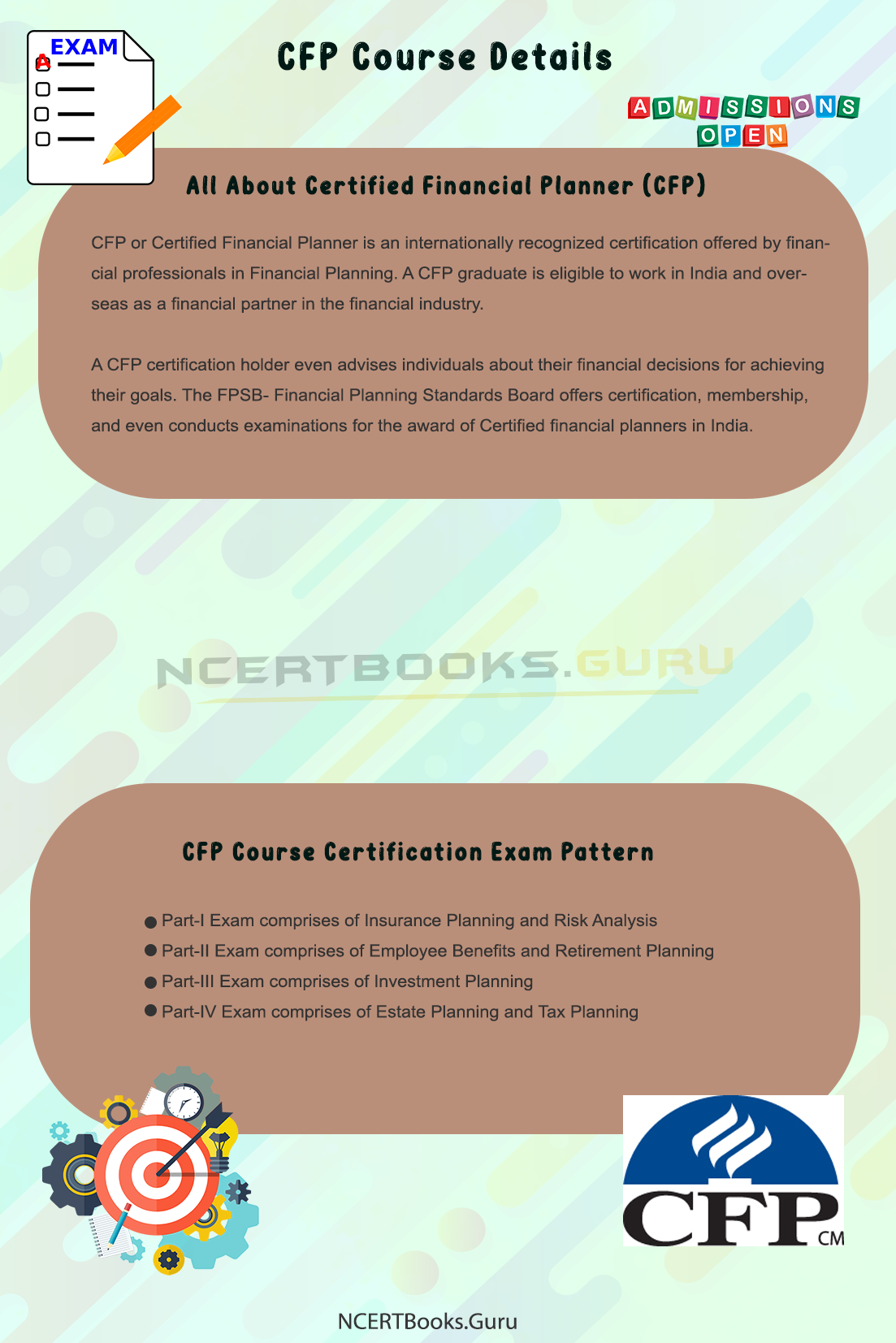
CFP or Certified Financial Planner is an internationally recognized certification offered by financial professionals in Financial Planning. A CFP graduate is eligible to work in India and overseas as a financial partner in the financial industry.

A CFP certification holder even advises individuals about their financial decisions for achieving their goals. The FPSB- Financial Planning Standards Board offers certification, membership, and even conducts examinations for the award of Certified financial planners in India.

The FPSB examines its multiple study and examination centers across India. CFP has gained worldwide recognition for its qualification.

Overview of CFP Course Details

Course  CFP
Full form Certified Financial Planner
Eligibility 10+2 or Bachelors degree
Duration six months to two years
Fee Offered  $595 for application
Course Type Certification
Starting salary offered ₹3.5 Lakhs per annum
Similar Course CFA Course
Employment opportunities Portfolio Managers, Tax Planners, Insurance Advisors, Risk Analysts, Debt Management Specialist, Financial Advisors, Retirement Planning Advisors, and Mutual Fund Advisors

CFP Course Certification Exam Pattern

Certification CFP Certification holds tow modes of exams for contaminates- the Regular Pathway and the Challenge Status Pathway.

Regular Pathway

Candidates need to qualify the five CFP examinations consisting of 6 modules to acquire the CFP Certification. The Regular Pathway comprises four-part examinations, which the candidate must qualify through training support and self-study from any of FPSB’s approved Educational Institutions.

  1. Part-I Exam comprises of Insurance Planning and Risk Analysis
  2. Part-II Exam comprises of Employee Benefits and Retirement Planning
  3. Part-III Exam comprises of Investment Planning
  4. Part-IV Exam comprises of Estate Planning and Tax Planning

Theses four-part examinations are conducted on the NSE Academy Certification in the Financial Market platform and are facilitated by the National Stock Exchange. The examinations are conducted through NSE’s centers and other networking sites throughout India.

Challenge Status Pathway

To get past the Challenge Status Pathway, Candidates must secure a minimum aggregate in the Advanced Financial Planning to acquire a CFP certification. Candidates who possess higher qualifications like LLB, Ph.D., CA, CS, etc. are eligible to register for CFP Certification through the Challenge Status Pathway Portal.

CFP Course Duration

The overall duration for the CMA course option is flexible, which indicates that the total time taken to complete the CFP program depends on the aspirant’s level of dedication and focus. The entire CFP Certification course duration fluctuates between 6 months to two years based on the candidate’s potential.

CFP Certification and Eligibility

To acquire CFP certification, candidates must meet the minimum eligibility criteria laid down by the FPSB. The eligibility criteria are different for the two modes of the CFP Certification Examination.

Regular Pathway Eligibility

Aspiring candidates must secure a minimum aggregate in Matriculation or SSC or 10th standard. Candidates who have secured a minimum aggregate in Class 12 and those currently enrolled in Bachelor’s degree of any discipline are eligible to register for CFP Certification through the Regular Pathway.

However, at the time of Certified Financial Planner Certification, candidates must have secured a minimum aggregate in HSC or 12th standard.

Challenge Status Pathway Eligibility

To deem eligible for Challenge Status Pathway, candidates should have completed CA or Intermediate level, CFA, ICWA, CS, CAIIB, LLB, Ph.D., MPhil, PG, Actuary, FFSI and FLMI from LOMA, Associate or Fellowship of Life Insurance, Civil Service Examinations by UPSC.

In this mode of examination, candidates must clear only the Advanced Financial Planning, which is the fifth exam to be qualified and earn the CFP Certification.

See More:

Fee Structure for CFP Certification

The approximate Fee Structure for CFP Certification applicable for both Regular Pathway Candidates and Challenge Status Pathway Candidates is given below:

  • Registration Fees with FPSB India- Rs. 16, 385 per annum
  • Exam paper- I-IV Fee Payment-  Rs. 4,130 per exam per attempt
  • Exam paper-V Fee Payment-  Rs. 8,260 per attempt
  • CFPCM Certification Fee Payment- Rs. 7,080 per annum, but is renewed annually

CFP Course Exam Curriculum

The CFP Curriculum comprises of FPSB’s financial planning program. This exam program comprises of topics that cover all the aspects of Certified Financial Planner. It is inclusive of fundamentals and real-life skills required to tackle in the real world.

Module Exam Curriculum
Introduction to Financial Planning Financial Planning Process that includes client interactions, time value of money applications, etc.
Education planning, and other general principles
Insurance Planning and Risk Analysis Introduction to the strategies and applications of Risk Analysis
Insurance Concepts, Insurance Policies, Environment of an Insurance Advisor,
Retirement Planning and Employee Benefits Introduction to Retirement Planning, Retirement Benefits, Retirement Planning, and Strategies, etc.
Reform proposals, Pension Sector Planning, and other related sectors.
Components of Investment Planning A fundamental concept to Investment Planning,  Regulation od the process, Investment vehicles, Client Application, and other related sections
Tax Planning & Estate Planning Tax Planning Considerations, Tax Computations, etc.
Planning of Estates
Introduction to Advanced Financial Planning This section of the portion includes determining and gathering client data along with their goals and expectations and other related sections.

CFP Course Details

Institutes Offering CFP Course

Below given are a few top institutes for Certified Financial Planner (CFP) Certification course:

Top Government Institutions

  • Indian School of Business Management and Administration, Hyderabad
  • Indian School of Business Management and Administration, Patna
  • Indian School of Business Management and Administration, Delhi

Top Private Institutions

  • IMS ProSchool Pune, Pune
  • ICICIdirect Centre for Financial Learning (ICFL), Kolkata
  • ICOFP Delhi- International College of Financial Planning, Delhi
  • ICOFP Mumbai – International College of Financial Planning, Mumbai

CFP Course Career Prospects

Financial Planning has become the need of the day among the middle-class sector of the income group as there is an increasing rate of people shifting from traditional assets to asset classes. This shift has increased the demand for Financial Planners across the globe.

CFP Course Job Opportunities

A Certified Financial Planner holds high demand in the follows areas of expertise:

  • Private Banking sector
  • Investment Consultancy Firms
  • Wealth Management Companies
  • Insurance Companies
  • Mutual Funds

CFP Course Job Profiles

A fully-qualified CFP Certification Holder is eligible to hold the following professional roles:

  • Portfolio Managers
  • Tax Planners
  • Insurance Advisors
  • Risk Analysts
  • Debt Management Specialist
  • Financial Advisors
  • Retirement Planning Advisors
  • Mutual Fund Advisors

Earnings of CFP Certificate Holder

In India, the average earning of a Certified Financial Planner is ₹3.5 Lakhs yearly.CFP holds a high demand that provides an additional sum of average ₹50,000 as a bonus, an average of ₹75,000 in the form of commission, and an average of ₹22,000 in profit sharing.

Also, Check Courses After 12th, Courses After 10th on this website.

FAQ’s on CFP Course Details

Question 1.
What are the advantages of a Certified Financial Planner?

Answer:
Certified Financial Planner is the most recognized in the field that increases employment rate at Mutual Funds, Wealth Banks, etc. This Certification course improves career progression and boosts advisory services.

Question 2.
What is the duration of the CFP Certification Course?

Answer:
The overall duration for the CMA course option is flexible, which indicates that the total time taken to complete the CFP program depends on the aspirant’s level of dedication and focus. The entire CFP Certification course duration fluctuates between 6 months to two years based on the candidate’s potential.

Question 3.
How can you differentiate between CFA and CFP?

Answer:
A CFA graduate often works on the investment analysis with corporate clients, while a CFP graduate builds a financial plan with individual investors.

Summary 

We hope that the information mentioned above regarding CFP Course Details has helped improve your understanding of the subject with in-depth knowledge.

MSW Course Details | Duration, Eligibility, Fee Structure, Syllabus and Subjects

MSW Course Details

MSW Course Details: The MSW Course Full Form is a Master of Social Work. It is a master’s degree in social work. It is a two-year professional degree, consisting of macro and micro aspects of social work practices in terms of the community, hospitals, schools, and other fields of social service work.

The two-year postgraduate degree in MSW has a lot of scope in the field of social work. In the medical area, the opportunities for jobs are much higher. Candidates can work as healthcare social workers, therapists, or social workers on mental health.

Check more about other types of Course Details Streamwise, and Category wise.

A Brief on Masters In Social Work (MSW) Course

Social work is related to serving people and communities and groups to improve their individual and collective well-being. It takes the help of sociology, psychology, Social Science, political science, public health, community development, law, and economics to solve individual and community levels.

Social work is essential and has its roots in society’s attempts at large to deal with the problem of poverty and inequality. Social work is ravelled with the idea of charity work, in broader terms. The concept of charity goes back to early times, and the tradition of providing for the needy has roots in all the world religions.

  • The number of weak, needy, and disadvantaged people in India is growing day by day. Because of factors such as education, alcoholism, drug abuse, poverty, racism, unemployment, health, people are suffering daily all over the globe.
  • The MSW course provides a start to social personalities involved in people’s lives connected with the kind of social injustice, either indirectly or directly.
  • MSW is the only course that provides required training to work in different sections of society regarding social work, social service, and social justice.

Skillset Required for MSW Course

Applicants who want to pursue the MSW course need to have excellent communication skills. Some additional key skills that an aspirant should hold on to when thinking of pursuing the course are listed below:

  • Empathy
  • Good listener
  • Emotional intelligence
  • Critical thinking
  • Tolerance
  • Social perceptiveness
  • Persuasion
  • Integrity
  • Ability to set boundaries
  • Self-awareness
  • Ability to coordinate

MSW (Master of Social Work) Course Eligibility Criteria

The eligibility required is the following:

  • Bachelor of Social Work (BSW) from any recognized college with a minimum of 50% marks.
  • Science/Management/Humanities/Social Science/ and other qualifications are also eligible for the MSW course if the student has obtained a minimum of 50%.
  • Students waiting for their Bachelor’s degree results can also apply for the program with the scores they have.

Master Of Social Work (MSW) Course Details

  • MSW Full form- Master of social work
  • Course Level- Postgraduate
  • Duration- 2 years
  • Examination Type- Semester Type
  • MSW Course Qualification- Graduation in any Stream
  • MSW Course Admission Process- Merit-Based + Written Test, followed by Personal Interview or Group Discussion.
  • Average Fees-INR 1-2 Lakhs
  • Job Positions – Social Worker, Public Welfare Managers, Consultants, Project Coordinator, Professor, Training Coordinator, etc.
  • Average Salary- INR 3-5 LPA
  • Job Sectors- Government Dept., NGOs, Global Counselling Centre, Health Industry, Human Rights Agencies, etc.

Also, Refer

MSW Entrance Exams

Colleges select students based on the written test or assessment test scores, followed by a Personal Interview.

Some of the tests are

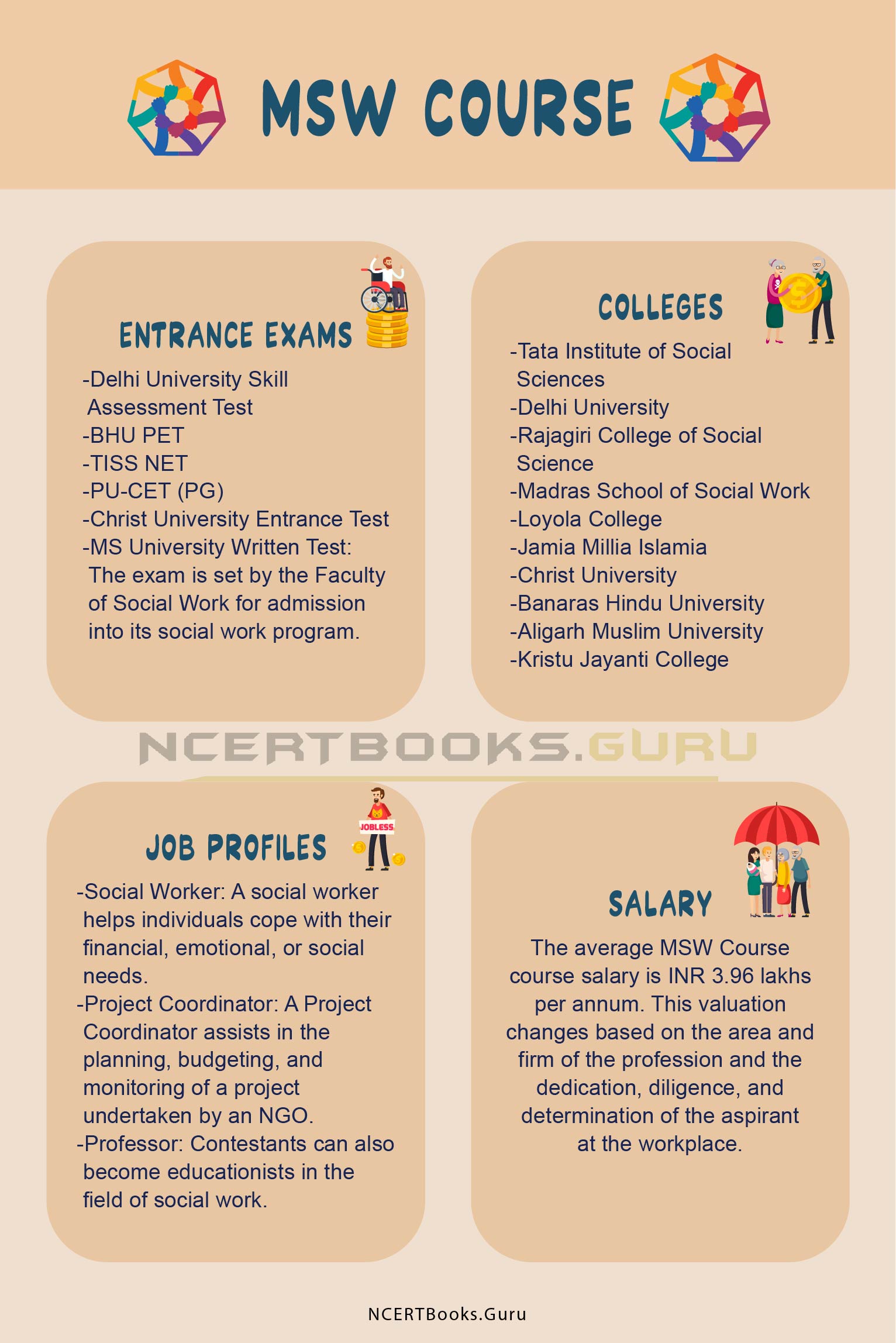
  • Delhi University Skill Assessment Test
  • BHU PET
  • TISS NET
  • PU-CET (PG)
  • Christ University Entrance Test
  • MS University Written Test: The exam is set by the Faculty of Social Work for admission into its social work program.

List of Top Colleges in India Offering MSW Course

Here, we are mentioning some top listed colleges that are offering MSW undergraduate courses. You can choose the best college according to your preference. It is always better to research the college before joining it.

  1. Tata Institute of Social Sciences
  2. Delhi University
  3. Rajagiri College of Social Science
  4. Madras School of Social Work
  5. Loyola College
  6. Jamia Millia Islamia
  7. Christ University
  8. Banaras Hindu University
  9. Aligarh Muslim University
  10. Kristu Jayanti College
  11. Stella Maris College
  12. Central University of Rajasthan

MSW Course Fees Structure

The fee structure varies from college to college. The average course fee for the Masters of Social Work varies from 8000 to 2 lakhs per annum.

Masters in Social Work Distance Course Eligibility

The Eligibility Criteria for Masters in social work Distance Education is that the Student must have completed the graduation degree from a regionally certified university. Candidates from any stream Commerce, Humanities, or Science are qualified to pursue MSW as a course at the post-graduation level.

MSW Course Syllabus

MSW Subjects for Semester 1, 2,3, and 4

  • Social Work Profession
  • Social Group Work
  • Social Case Work
  • Community Organization
  • Concurrent Field Work including Social Work Camp
  • Concurrent Field Work including Study Tour
  • Analysis of Indian Society
  • Social Policy, Planning & Development
  • Dynamics of Human Behaviour
  • Social Work with Rural, Urban and Tribal Community
  • Study of Indian Economics
  • Social Work Approaches for Social Development
  • Study of Indian Constitution Social Work and Social Justice
  • Social Work Research and Statistics
  • Social Work Administration
  • Personal & Professional Growth
  • Field Work including Case Studies
  • Block Placement
  • Women & Child Development
  • Labour Welfare & Legislation
  • Criminology & Correctional Administration
  • Human Resource Management
  • Introduction to Disaster Management
  • Medical & Psychiatric Social Work
  • Communication and Counselling

MSW Course Subjects

The subjects introduced in the curriculum of the MSW course are enlisted below. Some minor variations may occur in the curricula of colleges, institutes, and universities across the nation.

  • Social Work Profession
  • Social Group Work
  • Social Case Work
  • Community Organization
  • Concurrent Field Work including Social Work Camp
  • Concurrent Field Work including Study Tour
  • Analysis of Indian Society
  • Social Policy, Planning & Development
  • Dynamics of Human Behaviour
  • Social Work with Rural, Urban and Tribal Community
  • Study of Indian Economics
  • Social Work Approaches for Social Development
  • Study of Indian Constitution
  • Social Work and Social Justice
  • Social Work Research and Statistics
  • Social Work Administration
  • Concurrent Field Work including Summer Placement
  • Concurrent Field Work with Case Studies
  • Dissertation
  • Block Placement
  • Women & Child Development
  • Labour Welfare & Legislation
  • Criminology & Correctional Administration
  • Human Resource Management
  • Introduction to Disaster Management
  • Medical & Psychiatric Social Work
  • Communication and Counselling
  • Personal & Professional Growth

MSW Course Specializations

  1. Community Social Work
  2. Child, Family, and School Social Work
  3. Mental Health and Substance Abuse Social Work
  4. Social Work with Military Members and Veterans
  5. Social Work Administration
  6. Domestic Violence Counseling
  7. ElderCare

MSW Course Job Profiles

After completing the MSW course, students can pursue higher studies in social work or opt to get a job in the field of social work after completing their MSW course. Some job profiles that applicants can join after completing their MSW course are listed below:

  • Social Worker: A social worker helps individuals cope with their financial, emotional, or social needs.
  • Project Coordinator: A Project Coordinator assists in the planning, budgeting, and monitoring of a project undertaken by an NGO.
  • Professor: Contestants can also become educationists in the field of social work.

Some reputed organizations that work for the socio-economic support and the welfare of the disadvantaged, orphans, and people with disabilities are:

  • CINI
  • CRY
  • Department of Rural Development
  • HelpAge India
  • UNESCO
  • UNICEF
  • Internationally recognized NGO’s

Salary Offered After MSW Course

The average MSW Course course salary is INR 3.96 lakhs per annum. This valuation changes based on the area and firm of the profession and the dedication, diligence, and determination of the aspirant at the workplace.

MSW Course Details

FAQ’s on MSW Course Details

Question 1.
What is the use of the MSW Course?

Answer:
Social work is essential and has its roots in society’s attempts at large to deal with the problem of poverty and inequality. Social work is ravelled with the idea of charity work, in broader terms.

Question 2.
What is the Eligibility Criteria for MSW?

Answer:
The Eligibility criteria for MSW are

  • Bachelor of Social Work (BSW) from any recognized college with a minimum of 50% marks.
  • Science/Management/Humanities/Social Science/ and other qualifications are also eligible for the MSW course if the student has obtained a minimum of 50%.

Question 3.
What is the job Profile after we pursue MSW?

Answer:
After completing the MSW course, students can pursue higher studies in social work or opt to get a job in the field of social work after completing their MSW course.

How to Become a Real Estate Agent in India? | Eligibility, Salary, Job, Qualifications

How to Become a Real Estate Agent in India?: The real estate market is easily one of the most illustrious businesses in India. It is ever-so-booming, versatile, and highly forgivable, especially in a country like India, where there is perpetual high demand. Real estate prices are soaring as we speak, and there is no better time than now to hop into the business.

Refer to Course Details to know more about related courses and find details like Admission Process, Eligibility Criteria, etc.

What Do Real Estate Agents Do?

More often than not, property owners are not able to find buyers or get a good price for their property. This is where real estate agents come into the picture. They list your property for you, set up viewings for prospective buyers, quote a price, and do all the paperwork that comes with a sale. To put it simply, real estate agents help you sell your property, in exchange for a commission.

Confused about whether being a real estate agent is your calling? Well, here are a few skills that every real estate agent must have:

  • Must be up-to-date with the market trends and keep track of price fluctuations.
  • People with good interpersonal skills make for successful real estate agents.
  • Ability to synthesize and be creative.
  • Must be an excellent negotiator.

How to Become a Real Estate Agent in India?

To become a property agent in India, it is paramount to obtain a license by registering under the Real Estate (Regulation and Development) Act, 2016. The act makes it mandatory for all property agents to register with concerned state-level real estate authorities.

The agents are then issued RERA Registration Number/License, which is valid for 5 years. The licensing fee varies from state to state and usually lies somewhere between INR 5,000 – INR 2,00,000 for individuals and companies.

For registration, the applicants need to submit a duly filled form issued by the state authorities along with a copy of the following documents:

  1. Income Tax Returns for the last 3 years
  2. Address Proof
  3. Copy of PAN Card
  4. Other particulars of the applicant

The license/certificate of registration is usually issued within 30 days of application.

Other than the license, real estate agents in India must also apply for Professional Tax Registration. PTR is a tax imposed by state governments for carrying out professional activities in their jurisdiction. This registration needs to be renewed every year.

Top Courses for Real Estate Management in India

There are no minimum qualifications required to become a real estate agent in India. There is no mandatory course or field of study for this profession, and anyone can enter the business.

However, if you’re looking to hone your craft and be well prepared before entering the market, here are the top courses that you can do to become a good real estate agent in India.

Course Fee
Bachelor of Business Administration INR 20,000 – INR 10,00,000
BBA in Real Estate and Urban Infrastructure INR 35,000 – INR 12,00,000
MBA in Real Estate Management INR 50,000 – INR 20,00,000
Masters of Business Administration INR 10,000 – INR 25,00,000

Career Prospects for a Real Estate Agent in India

Being a real estate agent is not an easy job. It is highly technical and requires a good knowledge of business principles and sales albumen. No doubt, it is a very interesting job with a number of career prospects. Some profiles where Real Estate agents normally work include:

  • Real Estate Manager
  • Consultant
  • Agent
  • Commercial Broker
  • Loan and mortgage specialist, etc.

A registered real estate broker can start his independent practice, work in collaborations with a business, or be hired by a real estate company. Some real estate agents also have a franchise agreement with regional or national level companies. The opportunities in this profession are endless. The two most common ways how real estate agents start out in India are:

  1. By joining a company that deals with the sale and purchase of Real Estate.
  2. By opening your own Real Estate company after registering yourself.

According to the latest statistics, more than 50% of the real estate agents in India work independently, and about 32% of brokers work with real estate companies. Some top recruiters in Indian include DLF Ltd., NBCC India Ltd., Godrej Properties Ltd., Indiabulls Real Estate Ltd., etc.

Real Estate Agent Annual Salary
Entry Level INR 4-5 Lakhs
Mid Level INR 6 Lakhs
Senior Level INR 10-12 Lakhs

There are several pros to becoming a real estate agent in India. It is a highly lucrative job and pays really well throughout the career span. You do not have to follow a set 9-5 job schedule and work at your convenience. In addition to this, there is unlimited scope for growth in this profession. The money that you earn will be directly proportional to your efforts. So, the harder you work, the more your earn! Simple.

Very few professions guarantee this flexibility and scope of growth. Thus, if you haven’t already, you must consider becoming a real estate agent in India.

How to Become a Physiotherapist in India | Types, Eligibility, Skills, Career Path, Salary | Steps For Becoming A Physiotherapist in India

How to Become a Physiotherapist in India

How to Become a Physiotherapist in India: Physiotherapy is becoming a vital medical profession in India and achieving that designation might seem over one’s head but with the correct pathway, it’s attainable. Knowing more about Physiotherapy Courses and Types of Physiotherapists in India will help you in choosing the right career path.

In this article below, a synopsis of how to become a physiotherapist after 12th, 10th in India is stated along with the best Physiotherapy Colleges in India, eligibility criteria, career aspects, best books, top companies, and more.

Table of Contents

What is Physiotherapy?

Physiotherapy is derived from the term ‘Physical Therapy’ that assists patients in reinstating their health through Physical Interventions, Exercises, Diagnosis, and Physical Examinations. Physiotherapy is prescribed to the convalescent after any kind of major or minor physical injury accompanied by medications and other treatments.

Physical Therapy or Physiotherapy is a form of therapy that cures any physical disability or abnormal functional abilities through a set of physical exercises. PTs are recognized for laying out a well-structured therapy plan for the patients alongside other treatments if required. Therapists restore the entire movement capability of an individual and provide manual therapy accompanied by electrophysical modalities too.

Types of Physiotherapists in India

Similar to MBBS, the candidates get to choose Physiotherapy Specialization to mold a career. In India, there are numerous types of Physiotherapists, and listed below are a few famed ones:

Orthopedic Physiotherapists: 

Orthopedic Physiotherapists are known for rehabilitating deformities in Bones, Muscles, or Ligaments. Any injury associated with the Skeletal System, especially the extremities and the spine can be cured by Orthopedic Physiotherapists.

Cardio-Respiratory Physiotherapists:

After the pandemic, these physiotherapists are to be called for. Cardio-Respiratory Physiotherapists cure any impairment related to the Heart, Lungs, or respiratory System. After recovering from Covid-19, Cardio-Respiratory Physiotherapists assists patients in gaining back their normal respiration system.

Pediatric Physiotherapists:

Kids Physiotherapists are proficient in dealing with infants to teens. Pediatric Physiotherapists are recognized for curing the child’s posture, gross motor function, strength, flexibility, etc.

Sports Physiotherapists:

This specialization of physiotherapy deals with the athletes or sportsmen who get injured during the match. Athletes often hire their Physiotherapists to keep joint-muscle flexibility in check.

Neuro Physiotherapists:

These physiotherapists can treat all brain-related disabilities such as Stroke, Parkinson’s, Brain Injuries, Concussions, Alzheimer’s, etc. Neuro Physiotherapists primarily deal with mental trauma or similar neuro-related disorders.

How to Become a Physiotherapist in India?

Attaining the physiotherapist designation could be burdensome but is equally practicable if is overseen by correct guidance. To become a physiotherapist in India after Class 12th, one must focus on clearing the entrance exams such as NEET, CET, Private University exams, etc. Mentioned below are a few steps that would aid you in becoming a physiotherapist in India:

  1. Clear Class 12th: The candidates who aspire to become physiotherapists need to clear Class 12 Examinations (Science) with the subject combination- Physics, Chemistry, and Biology. The candidates must secure at least 50% of the aggregate in all three subjects in Class 12th.
  2. Appear for Entrance Exams: There are various entrance examinations to become a physiotherapist after Class XII but the most popular yet tough ones are NEET and CET. Universities do conduct their private entrance tests.
  3. Check College, Cut-off, and Eligibility: After appearing for the entrance examinations, candidates must make sure to achieve the minimum marks required for admission to a decent physiotherapy college. The average expected NEET score is 300-400 out of 720.
  4. Enroll for B.Sc. in Physiotherapy: As per your score, find relevant and recognized physiotherapy colleges that offer physiotherapy. The candidates can also enroll themselves for occupational therapy if they are not eligible for the Physiotherapy Course offered by the University or the College.

Also Check: 

Role of Physiotherapists

Achieving a BPT degree could be tough but it molds candidates for the roles that the physiotherapy career demands. Listed below are a few roles that physiotherapists have to bring about:

  • Physical Examination

It’s imperative to examine and assess the patient’s case as well as their previous medical history to provide them with the correct treatment. This initial step comprises examining the patient’s flexibility, movement patterns, strength, and current overall physical condition.

  • Treatment

Curating a treatment is subjective and differs for every patient. The treatment must be feasible for the patient, engaging as well as result-driven. Generally, Physiotherapy treatments are in conjunction with other medical treatments as well. So, analyzing the entire medical history is a compulsion.

  • Planning the Treatment

The treatment penned down must be executable by the patient and the sufferer must be able to carry out the exercises smoothly. Deriving a herculean exercise is not the aim but to recommend the most efficient ones is.

  • Home Visits and Assistance

In most cases, patients are not in a frame to visit clinics, and hence the physiotherapists must be prepared for the home visits too. In a few cases, patients do require physical assistance in the treatment thus, the therapist must be prepared for that too.

When it comes to medical fields, patient education is a must. Miscommunication or lack of communication can lead to health issues and hence communication is of the utmost importance in the physiotherapy career.

Best Physiotherapy Colleges in India and Fees Structure

Candidates must aim to choose the best physiotherapy colleges available. To do so, they must tick all the criteria boxes bestowed by the college. Stated below are a few of the best physiotherapy colleges in India along with their Fees Structures.

Top Colleges Fees Structure (Per Annum)
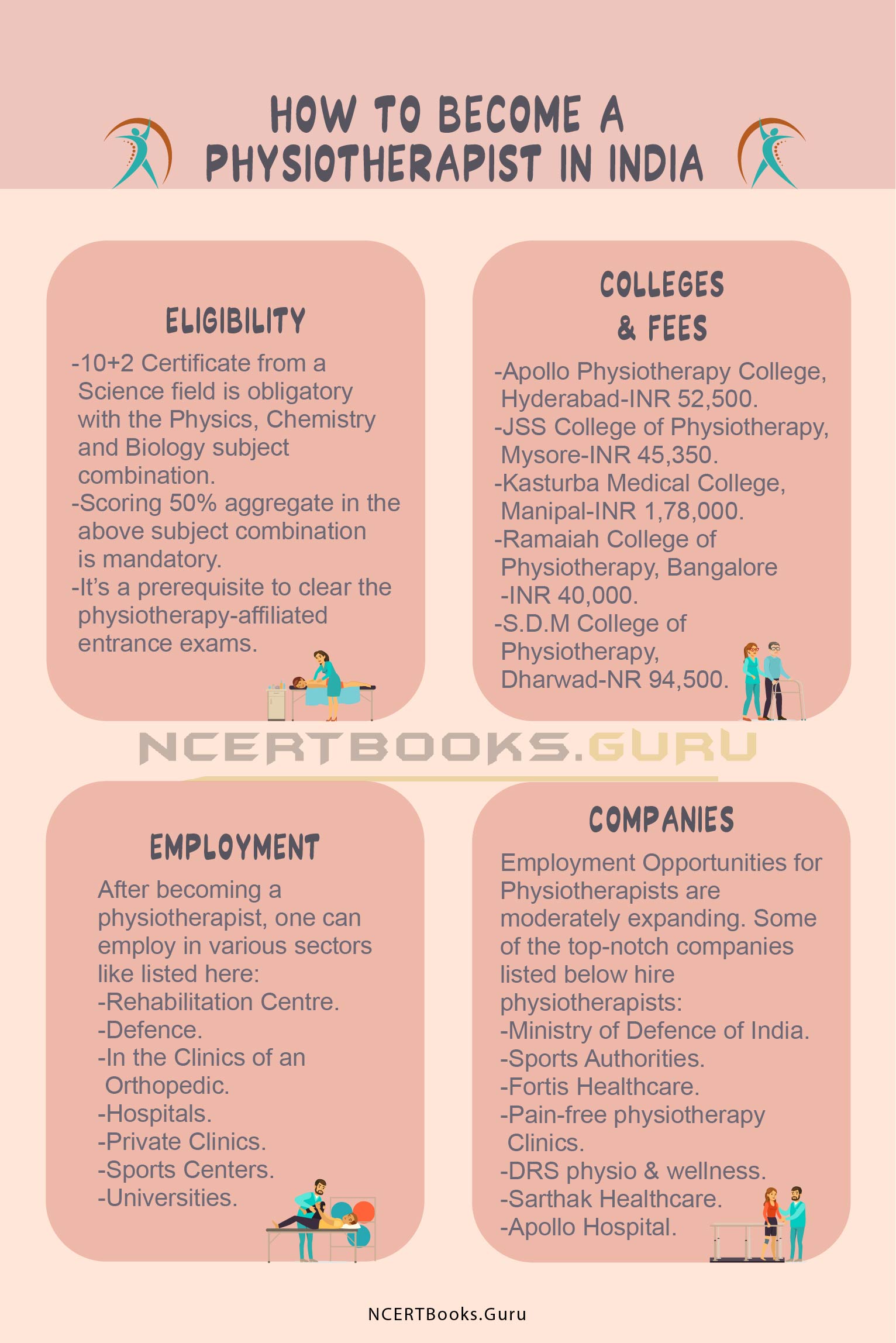
Apollo Physiotherapy College, Hyderabad INR 52,500
JSS College of Physiotherapy, Mysore INR 45,350
Kasturba Medical College, Manipal INR 1,78,000
Ramaiah College of Physiotherapy, Bangalore INR 40,000
S.D.M College of Physiotherapy, Dharwad INR 94,500

Eligibility Criteria

Similar to any other field, even aspiring Physiotherapists need to fulfill a certain set of criteria listed below:

  • 10+2 Certificate from a Science field is obligatory with the Physics, Chemistry and Biology subject combination.
  • Scoring 50% aggregate in the above subject combination is mandatory.
  • It’s a prerequisite to clear the physiotherapy-affiliated entrance exams.

Candidates would not be eligible to appear for the entrance examinations if they fail to achieve 50% aggregate in their Class 12 examinations.

How to Become a Physiotherapist in India

Best Books to Become Professional Physiotherapists in India

There are countless books available for the Physiotherapist Entrance. However, the basic NEET generic preparation Books such as Arihant, Human Anatomy are obligatory to refer. Here are a few book recommendations to clear the BPT Physiotherapy entrance exam:

  • Orthopedic Physical Assessment- David J Magee
  • Therapeutic Exercise- Carol Kisner
  • The Principles of Exercise Therapy- Deena Gardiner
  • Manual Therapy Approaches In Neuro-Physiotherapy- Ganvir Suvarna
  • Manual of Mulligan Concept (Revised Edition)- Deepak Kumar
  • Manipulative Physiotherapy Assessment, Treatment and Improvisation- Biswas Amrit
  • Essentials of Orthopedics for Physiotherapists- Ebnezar

The candidates must focus on referring to a minimum yet the most efficient book. Practicing MCQs is the key to clearing any and every entrance exam.

Employment Opportunities for Physiotherapists

The scope as a physiotherapist is going well in recent times and also there are numerous employment opportunities for the candidates. After becoming a physiotherapist, you can employ in various sectors like listed here:

  • Rehabilitation Centre
  • Defence
  • In the Clinics of an Orthopedic
  • Hospitals
  • Private Clinics
  • Sports Centers
  • Universities

Physiotherapy Career in India

After becoming a Physiotherapist, the candidates can either go for masters or get employed in Hospitals, Firms, or other private institutes that are equipped with physiotherapy affiliated apparatus. Home visits are a requisite part of the Physiotherapy career as patients often are incapable of visiting the hospitals or the clinic.

Candidates can establish their clinic but it requires a great deal of monetary investment. Most of the candidates go for a master’s degree or intern with pharma-related companies.

Top Companies that hire Physiotherapists

Employment Opportunities for Physiotherapists are moderately expanding. Some of the top-notch companies listed below hire physiotherapists:

  • Ministry of Defence of India
  • Sports Authorities
  • Fortis Healthcare
  • Pain-free physiotherapy Clinics
  • DRS physio & wellness
  • Sarthak Healthcare
  • Apollo Hospital

Various other high-ranked and foremost hospitals hire physiotherapists. Besides, Physiotherapists can invest in their clinics as well.

Salary of Physiotherapist in India

Pay-scale for the physiotherapist is decent in India. Experience is directly proportional to the salary offered. Salary differs depending on the institution the therapist is working with. The Average Salary of a Physiotherapist in India is 3,60,000 INR per annum. It can hike up to 8,00,000 INR per year with the increasing experience. Some hospitals offer up to 10,00,000 INR packages for candidates who have adequate experience in Physiotherapy.

FAQs on How Can I Become Physiotherapist in India

1. Is it a prerequisite to choosing a Physics, Chemistry, and Biology subject combination to become a physiotherapist in India?

Yes, it is a prerequisite to choose Physics, Chemistry, and Biology subject combination to become a physiotherapist in India

2. Which is the most popular physiotherapy entrance exam?

National Eligibility Entrance Test (NEET) is the most popular physiotherapy entrance exam

3. Is it mandatory to score 50% aggregate in Class XII to become a Physiotherapist in India?

Yes, it is mandatory to score 50% aggregate in Class XII to appear for the Physiotherapy Entrance Exams.

Conclusion on How to Become a Physiotherapist in India

These guidelines would highly be of assistance to you in becoming a physiotherapist. This is a sought-after career pathway that can open various options for aspiring physiotherapists. Apart from this article, for more course details and additional helpful information about How to Become a Physiotherapist in India, bookmark or visit our site @Ncertbooks.guru