Education Courses in India – Admission, Eligibility, Entrance Exams, Colleges List, Specializations

Education Courses

Free Online Education Courses are for those who are willing to enhance their professional credentials in the field of Education. Build Knowledge and Skills by studying Education Courses across the Institutes of the country. These Courses often specialize in a particular discipline related to secondary education, foreign language teaching, etc. To learn complete info regarding the Education Courses such as Course Duration, Eligibility Criteria, Colleges, Career Prospects, and Salary Offered, etc. continue reading the entire article.

Best Courses in Education | List of Education Courses

Go through the below modules to know about the details like Admission, Eligibility Criteria, Course Duration, Fees Structure, etc. You can access the Education Courses of your choice through the direct links available. Tap on the links below and avail the entire info and chose the course as per your choice.

Admission Procedure for Education Courses

Admission Procedure for Education Courses will be done on the merit basis of their respective degree or through scores in entrance exams held. However, certain colleges will provide admission to candidates on basis of the entrance exams held individually.

Eligibility Criteria for Education Courses

Candidates who want to pursue their Education Courses need to complete their 10+2 with a minimum pass percentage. For PG Courses you need to complete UG with a minimum aggregate from a recognized board or university.

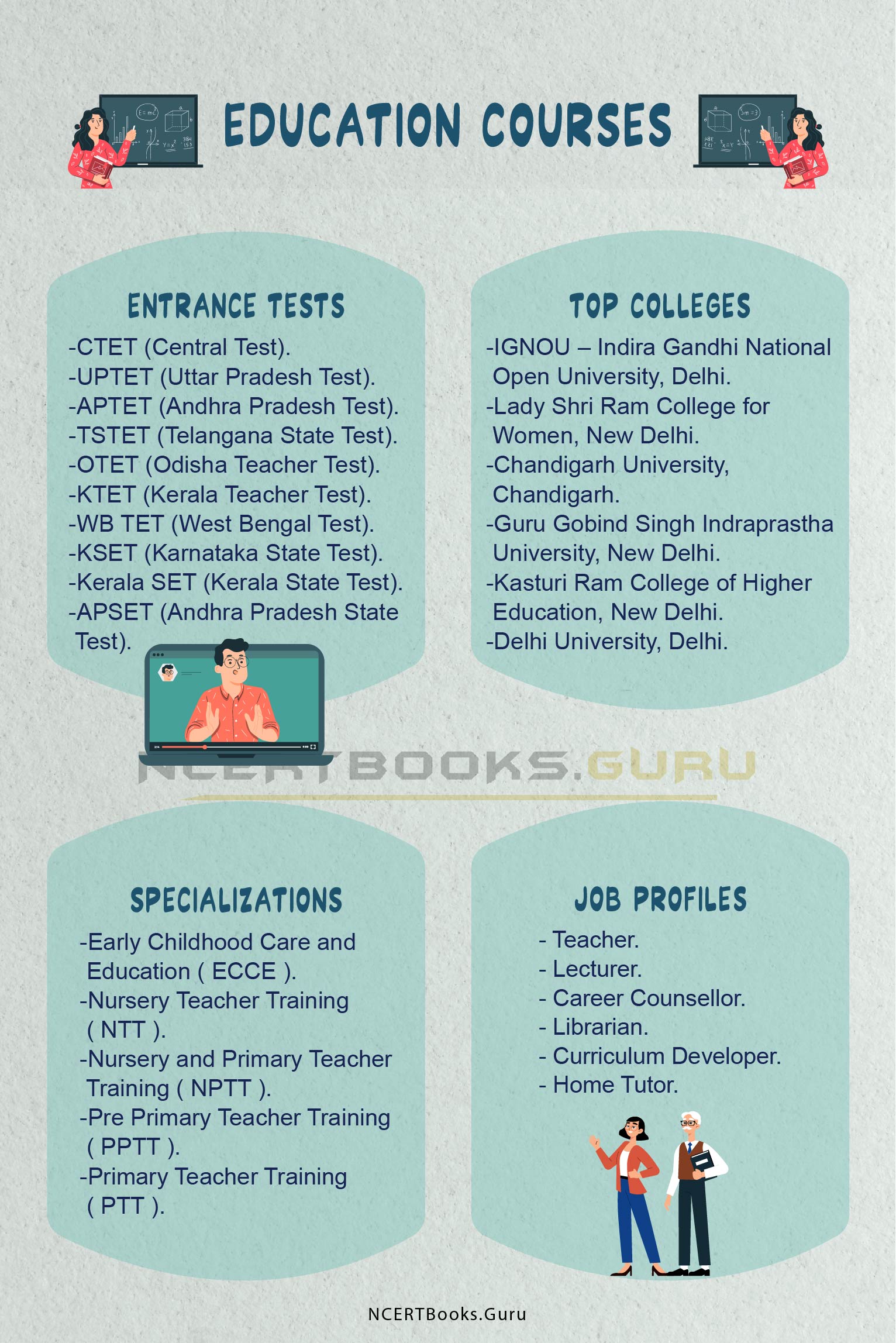
Entrance Tests for Education Courses

Candidates willing to get Admission into Colleges for pursuing their Education Courses need to get good scores in Entrance Exams. Below are the Entrance Exams held at different levels of study. They are along the lines

  • CTET (Central Teacher Eligibility Test)
  • UPTET (Uttar Pradesh Teacher Eligibility Test)
  • APTET (Andhra Pradesh Teacher Eligibility Test)
  • TSTET (Telangana State Teacher Eligibility Test)
  • OTET (Odisha Teacher Eligibility Test)
  • KTET (Kerala Teacher Eligibility Test)
  • WB TET (West Bengal Teacher Eligibility Test)
  • KSET (Karnataka State Eligibility Test)
  • Kerala SET (Kerala State Eligibility Test)
  • APSET (Andhra Pradesh State Eligibility Test)

Top Education Colleges in India

If you are looking for the best colleges in India for your Education Courses you can check out the following list prepared by experts. Select from the top most colleges and join the one that suits you and pursue the course accordingly.

  • IGNOU – Indira Gandhi National Open University, Delhi
  • Lady Shri Ram College for Women, New Delhi
  • Chandigarh University, Chandigarh
  • Guru Gobind Singh Indraprastha University, New Delhi
  • Kasturi Ram College of Higher Education, New Delhi
  • Delhi University, Delhi
  • Maharshi Dayanand University, Rohtak
  • Calicut University, Calicut
  • Mahatma Gandhi University, Kottayam
  • Lovely Professional University, Jalandhar
  • Amity University, Lucknow

Education Specializations in India

Following are the Education Specializations available for Education. You can join any of the following specializations depending on your subject of interest. They are as follows

  • Early Childhood Care and Education ( ECCE )
  • Nursery Teacher Training ( NTT )
  • Nursery and Primary Teacher Training ( NPTT )
  • Pre Primary Teacher Training ( PPTT )
  • Primary Teacher Training ( PTT )

Must Read:

Required Skillset for Teaching/Education Courses

Apart from the regular Education Qualification one needs to have the following additional skills to successfully pursue their Education. They are as follows

  • Confidence
  • Patience
  • Discipline
  • Leadership skills
  • Classroom management skills
  • Team player
  • Organization skills
  • Time management skills
  • Interpersonal skills
  • Mentoring/counseling skills
  • Planning skills
  • Communication skills
  • Innovative
  • Hardworking

Job Profiles after Education Courses

After completing the Education Courses students can get into colleges, schools coaching centers, research centers, educational consultancies, and many more. They are plenty of opportunities in both the public and private sectors. They are as follows

  • Teacher
  • Lecturer
  • Career Counsellor
  • Librarian
  • Curriculum Developer
  • Home Tutor

Education Courses in India

FAQs on Education Courses Online

1. Is there any website that offers the List of Education Courses?

NCERTBooks.Guru is a trusted portal that offers the List of Education Courses organized efficiently.

2. What is the Eligibility Criteria for Education Courses?

Candidates who want to pursue their Education Courses need to complete their 10+2 with a minimum pass percentage. For PG Courses you need to complete UG with a minimum aggregate from a recognized board or university.

3. What are the Specializations in Education Courses?

Have a look at the Education Specializations and choose the one accordingly. They are as below

  • Early Childhood Care and Education ( ECCE )
  • Nursery Teacher Training ( NTT )
  • Nursery and Primary Teacher Training ( NPTT )
  • Pre Primary Teacher Training ( PPTT )
  • Primary Teacher Training ( PTT )

Final Words

We as a team believe that the information shared on Education Courses has helped you be on the right track and clarify your concerns. For more related info on Course Details stay in touch with our site and avail latest updates in a matter of seconds.

B.Sc Agriculture Course Details | Admission, Fee, Eligibility, Application Date, Course Duration, Job Opportunities, Earnings Offered to Employees

B.Sc Agriculture Course Details 2020

B.Sc Agriculture Course Details: Are you a science student who loves to improve the agricultural world? Are you looking for the courses which will apt for your dream? Then, here is one of the finest solutions for you, i.e., B.Sc Agriculture course. B.Sc Agriculture course is an undergraduate degree that educates you totally about modern agriculture. If you want to know complete details of B.Sc Agriculture Course, then look at the below modules. Here, you can check out the info like what is B.Sc Agriculture, admission process, eligibility criteria, fee structure, important dates, course duration, career options, job types, salary, etc.

Contents covered in this article about B.Sc Agriculture Course:

About Bachelor of Science (B.Sc) Agriculture – Course Details

B.Sc Agriculture stands for Bachelor of Science in Agriculture. It is a four-year course that actually covers up the entire parameters of scientific research and implementations of the same in the agricultural and industrial fields. The government of India considered this B.Sc Agriculture course as a professional degree. Candidates should meet the requirements for admission in agriculture courses offered by universities/institutes. The eligibility criteria for the Bachelor of Science in Agriculture course is 50-60% (depends on the institute) in 10+2 with Physics, Chemistry, and Biology subjects as mandatory.

The candidates can opt for the higher education of the same course with more detailed and scientific research which will be very valuable. They can opt for Masters of Science [M.Sc] in Agriculture to gain more knowledge and experience in the field of Agriculture and industry. The B.Sc Agriculture jobs are in the field of the banking sector as Agriculture Specialist Officer, Post of Field Assistant in pesticides and fertilizer cooperation, spices board in Krishi Vigyan Kendra, etc. Also, refer to more information about BSC Agriculture from the below sections.

Also, Refer to the related articles,

B.Sc Agriculture Course Details

Out of many institutes, there are a few like 42 State Agricultural Universities (SAUs), 1 Central Agricultural University (CAU), 5 Deemed Universities (DUs), and 4 general Central Universities who offer B.Sc Agriculture in India. Every year, these universities give admission at UG level in 11 disciplines and over 15,000 candidates get registered for the course specialization. In the below table, we have mentioned some of the important B.Sc course details in the Agriculture field.

Course  B.Sc Agriculture 
B.Sc Agriculture Full form

Bachelor of Science in Agriculture

B.Sc Agriculture Eligibility 10+2 or equivalent
Duration 3 years
B.Sc Agriculture Fees Starts with Rs 5000
Course Type Regular mode / Distance mode
Starting salary offered Avg salary of 2 to 4 lakhs per annum
Entrance based on KEAM, EAMCET

Admission Process to Bachelor of Science in Agriculture

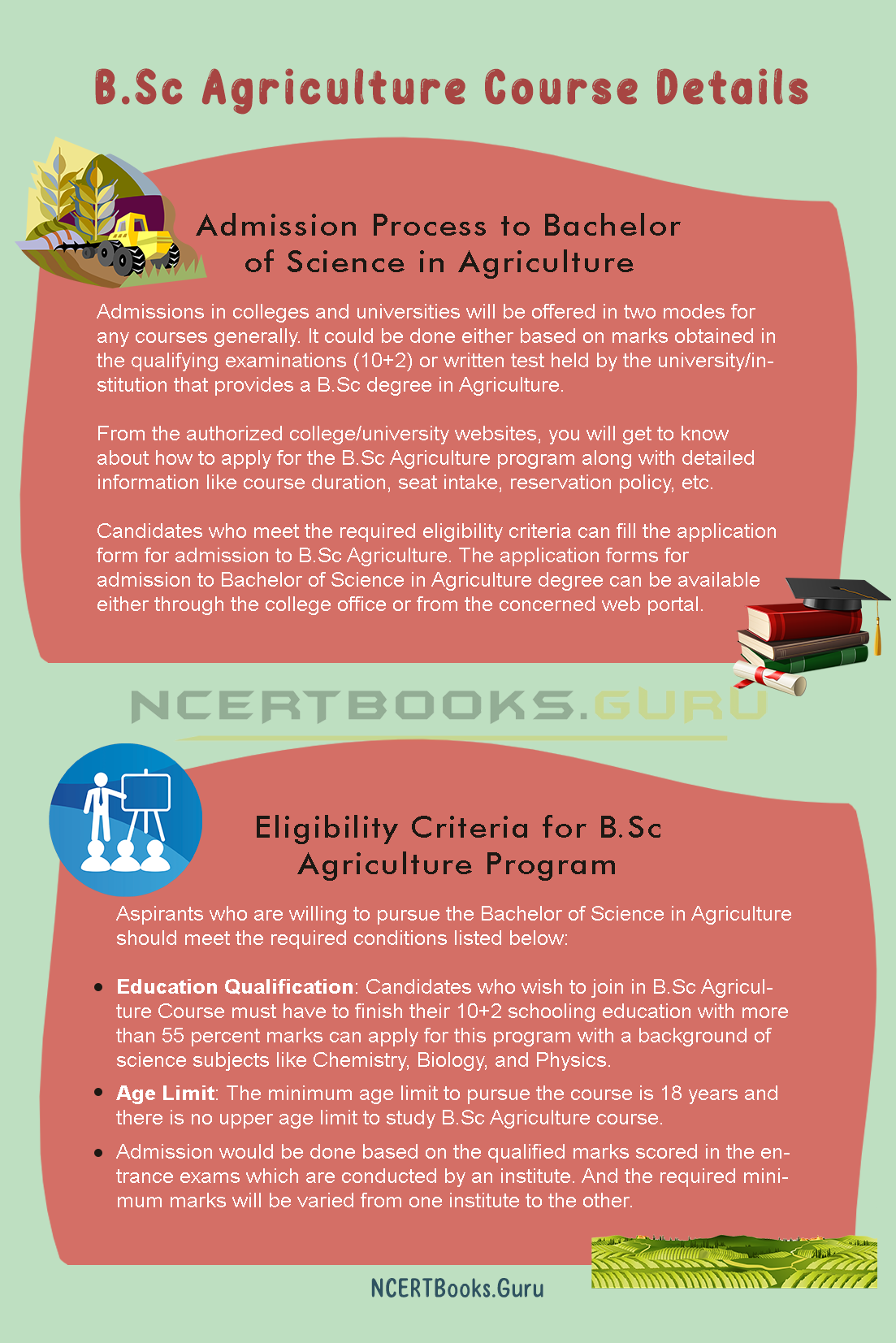
Admissions in colleges and universities will be offered in two modes for any courses generally. It could be done either based on marks obtained in the qualifying examinations (10+2) or written test held by the university/institution that provides a B.Sc degree in Agriculture.

From the authorized college/university websites, you will get to know about how to apply for the B.Sc Agriculture program along with detailed information like course duration, seat intake, reservation policy, etc.

Candidates who meet the required eligibility criteria can fill the application form for admission to B.Sc Agriculture. The application forms for admission to Bachelor of Science in Agriculture degree can be available either through the college office or from the concerned web portal.


A list of few B.Sc. Agriculture entrance exams conducted for admission to the course mentioned below:

  • EAMCET– Conducted for admissions in Agriculture colleges and universities in Andhra Pradesh
  • KEAM– Conducted for agricultural colleges in Kerala
  • PAU Entrance Exam– Conducted by Punjab Agricultural University for admissions in Agricultural programs.
  • IGKV CET– This entrance exam will be held by Indira Gandhi Krishi Vishwavidyalaya for offering admissions to qualified candidates in the Agriculture courses.
  • ICAR Entrance Exam (ICAR-AIEEA)– It is an agriculture entrance exam implemented by an Indian Council of Agricultural Research (ICAR) for admission to 15% seats in Agriculture Universities in Bachelor Degree programs and 100% seats in ICAR Deemed to be Universities and NDRI, Karnal.

B.Sc. Agriculture Important Dates

Candidates can also check the list of B.Sc. Agricultural Entrance examination 2020 in India and Important Dates from the below table and start your exam preparation accordingly:

Entrance Examination Application Start Date

Date of Examination

ICAR Entrance Exam (ICAR-AIEEA) Updated Soon Update Soon
TS EAMCET 6th April 2022 14th, 15th July 2022
MP PAT Updated Soon Releases Soon
JCECE Releases Soon Updated Soon
AP EAMCET 11th April 2022 11th, 12th July 2022
IGKV/ IGAU Updated Soon Releases Soon
PAU CET Available Soon Releases Soon
BCECE Updated Soon Updated Soon

Eligibility Criteria for B.Sc Agriculture Program

Aspirants who are willing to pursue the Bachelor of Science in Agriculture should meet the required conditions listed below:

  • Education Qualification: Candidates who wish to join in B.Sc Agriculture Course must have to finish their 10+2 schooling education with more than 55 percent marks can apply for this program with a background of science subjects like Chemistry, Biology, and Physics.
  • Age Limit: The minimum age limit to pursue the course is 18 years and there is no upper age limit to study B.Sc Agriculture course.
  • Admission would be done based on the qualified marks scored in the entrance exams which are conducted by an institute. And the required minimum marks will be varied from one institute to the other.

Note: The eligibility criteria for B.Sc Agriculture may vary from university to university in terms of subject combinations and it also differs for the reserved categories.
B.Sc Agriculture Course Details 1

Fee Structure for B.Sc Agriculture

Approximately the B.Sc. Agriculture Science program fees range from INR 20000 to INR 30, 000 for 4 years in government-funded institutes. The total fee for the course will be Rs. 35,000 per year on the basis of the college.

University name Location of university Annual fee
Bharti Vidyapeeth University Pune 95K
Jawaharlal Nehru Krishi Vishwa Vidyalaya Jabalpur 16.7K
Mewar University Chittorgarh 88K
Punjab Agricultural University Ludhiana 67.5K
Sivaji University Kolhapur 77K
Sardar Vallabhai Patel University of Agriculture and Technology Meerut 50K
Tamil Nadu Agricultural University Coimbatore 36.9K

B.Sc Agriculture Course Duration

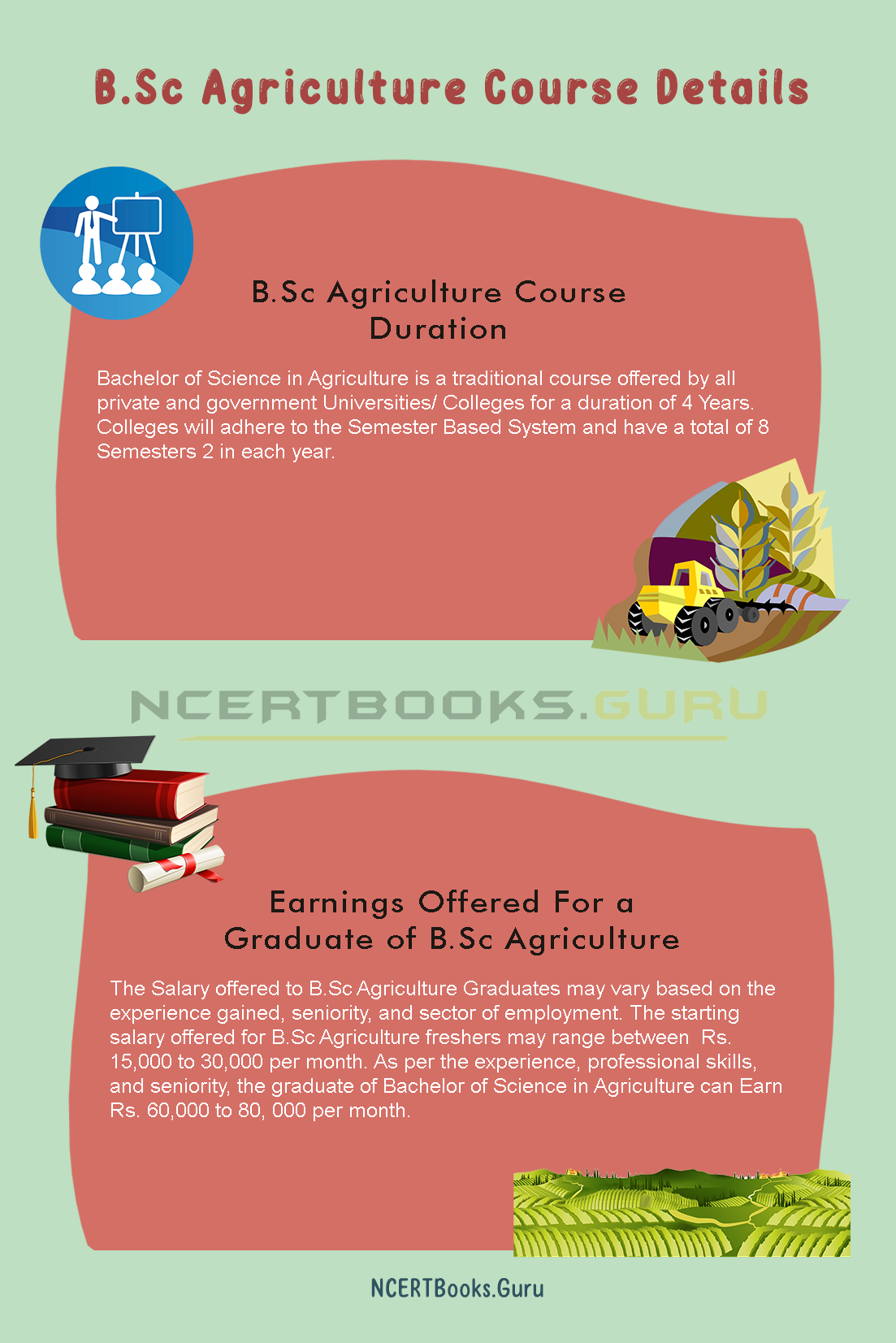
Bachelor of Science in Agriculture is a traditional course offered by all private and government Universities/ Colleges for a duration of 4 Years. Colleges will adhere to the Semester Based System and have a total of 8 Semesters 2 in each year.

Syllabus for B.Sc Agriculture Program

Bachelor of Science in Agriculture Syllabus will support you to understand the subjects and its concepts along with the Indian Legal System. Candidates who wish to join this course should follow the syllabus of Bsc agriculture and start their exam preparation. B.Sc Agriculture Syllabus mentioned here can be followed by any universities or institutes students. Go through the detailed Bachelor of Science Agriculture Syllabus listed below and have a deep understanding of the concepts. Check out the topics you need to cover in the whole 8 Semesters and be prepared for the exams in advance.

  • Agricultural Engineering
  • Agricultural Economics
  • Agronomy
  • Genetics and Plant Breeding
  • Horticulture
  • Soil Science
  • Plant Pathology
  • Basic Sciences
  • Entomology
  • Animal Husbandry
  • Extension education
  • Humanities
  • Food Technology

Check the detailed info from the link given here, B.Sc Agriculture Scope, Subjects, Syllabus 2020

B.Sc Agriculture Subjects

The subjects pursued in the Bachelor of Science [B.Sc] in Agriculture Courses after 12th are listed below:

  • Fundamentals of Information Technology
  • Introduction to Computer Applications
  • Plant Biochemistry
  • Principles of Plant Biotechnology
  • Principles of Environmental Sciences
  • Production Economics and Farm Management
  • Applied Mathematics
  • Crop Pests and their Management
  • Principles of Analytical Chemistry
  • Educational Psychology
  • Sericulture
  • Water Management
  • Agricultural Marketing, Trade, and Prices
  • Irrigation
  • Breeding of Field and Horticulture Crops

Popular Colleges List Offering B.Sc Agriculture Program

Here is some popular universities and private B.Sc Agriculture Colleges list and you can pick from the below list based on your requirements. They are as follows:

  1. University of Agricultural Sciences, Bangalore
  2. Tamil Nadu Agricultural University, Coimbatore
  3. Forest Research Institute, Dehradun
  4. Punjab Agricultural University, Ludhiana
  5. National Dairy Research Institute, Karnal
  6. Chaudhary Charan Singh Haryana Agricultural University, Hisar
  7. Indian Agricultural Research Institute (IARI), New Delhi
  8. Govind Ballabh Pant University of Agriculture and Technology, Pantnagar

Career Prospects For B.Sc Agriculture Graduates

Once you complete your Bachelor of Science in Agriculture course from the best institutes then, you will have huge options to go with. Here we have provided a few career options for B.Sc. Agriculture graduated in both private and government sectors & firms. They are as follows:

  • Agriculture Marketing
  • Indian Agricultural Research Institute
  • National Seeds Corporation Limited
  • Rice Breeder
  • Seed Technologist
  • State Farms Corporation of India
  • Indian Council of Agricultural Research
  • Business Development Executive
  • Marketing Executive
  • Council of Scientific and Industrial Research
  • Micro-finance institutions
  • Agriculturists
  • The financial sector with a focus on agriculture

Course completed individuals can also go for highest studies such as List of M.SC Courses after B.SC Agriculture.

B.Sc Agriculture Job Profiles

There are various types of job opportunities available to graduates of B.Sc Agriculture course are

  • Agriculture Officer
  • Associate Manager
  • Agricultural Lecturer
  • Marketing Executive
  • Project Manager
  • Actuarial Analyst
  • Sales Officer
  • Subject Matter Specialist
  • Management Executive
  • Agriculture Portfolio Manager
  • Primary Production Manager
  • Farming Consultant/Agronomist
  • Program Manager
  • Research/Fundamental Analyst

Earnings Offered For a Graduate of B.Sc Agriculture

The Salary offered to B.Sc Agriculture Graduates may vary based on the experience gained, seniority, and sector of employment. The starting salary offered for B.Sc Agriculture freshers may range between  Rs. 15,000 to 30,000 per month. As per the experience, professional skills, and seniority, the graduate of Bachelor of Science in Agriculture can Earn Rs. 60,000 to 80, 000 per month. Students can pursue different Agriculture Science and Technology Courses to get placed in the best companies with the highest salaries.
B.Sc Agriculture Course Details 2

FAQs on (Bachelor of Science in Agriculture) B.Sc Agriculture Course Details

1. What is the eligibility of a BSc in Agriculture?

The basic eligibility is 50-60% in Class XII (Science stream) and the age limit to take admission in the Agriculture B.Sc course is above 18 years. There is no upper age limit required to pursue the course.

2. How can I get admission in B.Sc Agriculture?

Candidates can get admission to B.Sc Agriculture in 2 modes, one is by securing the highest marks in the Qualifying examination (direct Admission) and the other is scoring more than qualifying marks in the entrance test which is undertaken by the college/university. For the admission, the Universities grant merit-based admission to the B.Sc. Agriculture program.

3. What is the salary for B.Sc Agriculture Graduate?

The Salary Scale for B.Sc Agriculture Course is mentioned here in this article. But for the sake of quick read, the average salary offered to Bachelor of Science [B.Sc] Agriculture course graduates are given here. It ranges from INR 5 lakhs to 9 lakhs.

Summary

Hope you have got enough idea on B.Sc Agriculture Course Details and info like Fee Structure, Duration, Eligibility & Requirements, Colleges List, Job Options, etc. If you need any assistance regarding the same, drop a comment in the below comment box and we’ll help you out at the earliest. Visit our site frequently and get more updates on course details, syllabus, books, exams, and many more.

How to Join NIA in India | Roles, Eligibility Criteria, Salary and Allowances

How to Join NIA in India

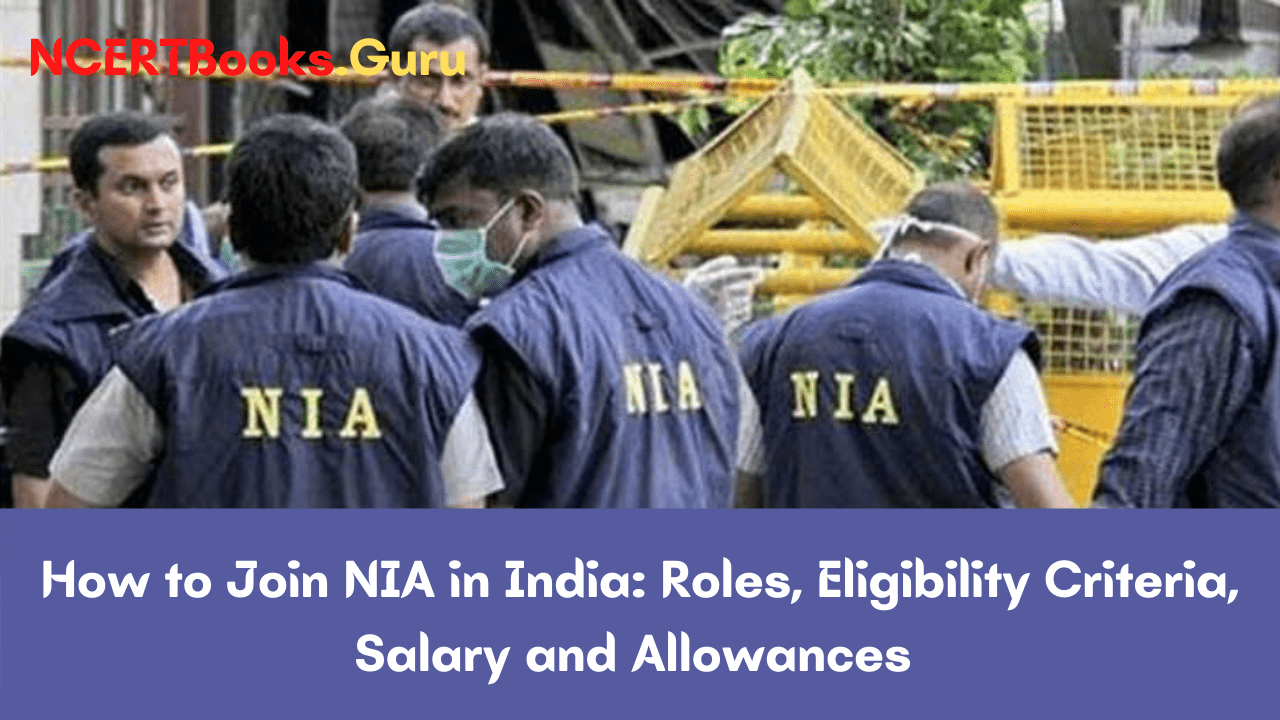
How to Join NIA in India: Are you someone who loves to interrogate various issues? Do you also want to join the most powerful agency in India? If yes, then the National Investigation Agency is all for you. NIA is among the most powerful investigation agency of India that counter-terrorism and maintains peace and integrity in the country. They enjoy numerous benefits in comparison to various other agencies. If you want to know more information on how to join NIA in India, then read out the complete article.

The National Investigation Agency (NIA) is India’s counter-terrorism agency that aims to handle all the investigations of terror-oriented crimes across different states without any special permission from the state’s assistance decree from the Ministry of Home Affairs. The major reason behind the formation of the National Investigation Agency is the failure of intelligence and the inability to track the interference of anti-elements during the 26/11 Mumbai terror attack. The headquarters of the National Investigation Agency is in New Delhi.

Refer to Course Details to know more about related courses and find details like Admission Process, Eligibility Criteria, etc.

Role of National Investigation Agency

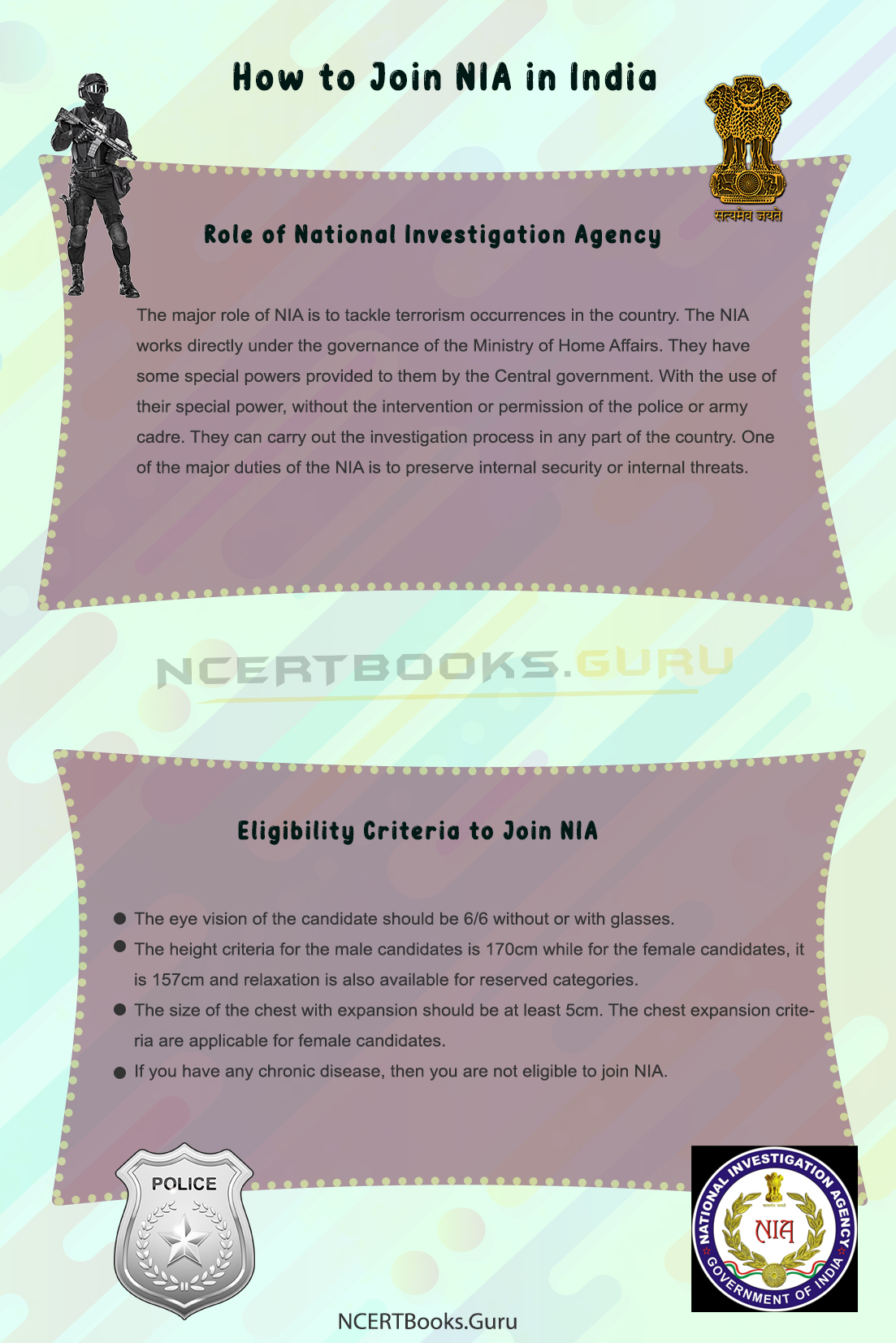
The major role of NIA is to tackle terrorism occurrences in the country. The NIA works directly under the governance of the Ministry of Home Affairs. They have some special powers provided to them by the Central government. With the use of their special power, without the intervention or permission of the police or army cadre. They can carry out the investigation process in any part of the country. One of the major duties of the NIA is to preserve internal security or internal threats.

Recently, according to the new amendment in the NIA act. The National Investigation Officers can now investigate even in the outer parts of the country as well. They share the same power as that of a police officer when it comes to taking action. After the investigation part, the case is presented in the NIA court. NIA is the most powerful agency and they are the ones who develop the list of the most wanted people or gangs in the country and target them one by one.

Eligibility Criteria to Join NIA

If you are willing to join the National Investigation Agency, then it is compulsory for every candidate to have a bachelor’s degree from any authorized institute or University. The maximum age criteria to join NIA is not more than 30 years old. Candidates belonging to various castes such as OBC (Other Backward Class), SC (Scheduled Caste), or Scheduled Tribes (ST).

The role in NIA is quite challenging when it comes to physical ability during the fieldwork. A candidate must have to fulfil some physical requirements to enter the service such as:

  • The eye vision of the candidate should be 6/6 without or with glasses.
  • The height criteria for the male candidates is 170cm while for the female candidates, it is 157cm and relaxation is also available for reserved categories.
  • The size of the chest with expansion should be at least 5cm. The chest expansion criteria are applicable for female candidates.
  • If you have any chronic disease, then you are not eligible to join NIA.

See More:

How to Join NIA in India?

If you want to become an Officer in the NIA, then there are no direct ways through which you can join. You can only enter by applying for the Sub-Inspector in the NIA. To attain the position of sub-inspector in the NIA, one has to clear the SSC-CGL (Combined Graduate Level Examination) which is an examination that occurs once a year. The body which conducts the exam is the Staff Selection Commission. The final selection depends on the result of the examination.

Salary and Allowance in NIA

The government pays salaries on the basis of categorization. In terms of categorization, the employees of NIA come under grade A which is the highest categorization.

The salary of the NIA officers varies from Rs 47,000/- to Rs 85,000/- on a monthly basis and the range of salary varies from the area of posting. Apart from salary, they get various allowances such as:

  • Lifetime Pension
  • Travel Allowances
  • Dearness Allowances
  • Ration
  • Free stay at the Government quarter

There are various other allowances but these are the most common allowances given to government employees.

After appearing for the internal exam for promotion, the chances of salary increment increase.

If you have a passion to investigate and fighting against all the terror and removing the anti-social elements, then you should go ahead with NIA. NIA is a great platform for you to achieve your goal. Prepare well for the SSC-CGL exam and then after you satisfy the eligibility criteria, then you can become a part of NIA! Go ahead!

How to Join NIA in India

10 Lines on My Best Friend for Students and Children in English

10 Lines on My Best Friend

10 Lines on My Best Friend: We interact with many people in our daily life, out of which only a few of them manage to impress and influence us. These few people then turn out to be our friends. Some become the close ones out of our friends, and the rarest ones who have some unique traits that fascinate us and leave a mark on our hearts become our best friends. The qualities of the best friends are rarest and thus highly impressive and appreciating.

We often come across the globally famous saying at many places, i.e., “a friend in need is a friend indeed.” This means that a real and true friend is the one who is there for you always, even in most difficult situations. People often surround us when we are having a great time and cheering up, but the best friends are the ones who are even there in our worst times. On the other hand, fake friends often ignore us whenever we need them or have some difficult time.

The best friend is the one who always helps us to come out of any troublesome and worse situation and even helps us with all what he/she can do to make things better for us. Everyone has a best friend, who is the one in a million people for each of us!

People love spending time with their best friend and going out with them. The best friend of any person has exceptional traits and exceptional love for his/her friend, making him/her the best one among all the friends. A best friend will never let you down and will never let you feel alone. He/she will be there for you always, just like your shadow.

Enhance your vocabulary and writing skills with 10 Lines Essays available. Spark up the creativity in you and access various Topics on 10 Lines all in one place.

Set 1 – 10 lines on My Best Friend for kids

This set of ten lines on My Best Friend is perfect for the kids of classes 1st to 5th:

  1. Finding a good friend is a challenging task in the World. They are very rarely available around.
  2. “A friend in need is a friend indeed” is a globally popular phrase referring to the traits of a good friend.
  3. A best friend is the one who is the shining star of your eyes, and you value him/her more than any other friend.
  4. People have many friends, but the number of close friends is lower, and that of best friends is rarer.
  5. Experts also believe that without a best friend, life gets more challenging and feels incomplete.
  6. We trust our best friend the most and believe that they will never let us down.
  7. A best friend is more than just a best friend; he/she is almost like a family.
  8. A best friend will never let you fall into any habit that might destroy you or your family.
  9. A best friend is an exceptional person with impressive qualities. Best friends of some people even understand that something is not good with their friend by just looking into their eyes.
  10. A best friend is a person who can make fun of you at your face but will always stand by your side behind your back.

10 lines on My Best Friend for kids

Set 2 – 10 Lines on My Best Friend for School Children

This set of top ten lines is perfect for the children of classes 6th to 8th:

  1. You and your best friend will surely share fantastic chemistry. This is because your best friend can read your mind by just looking at your eyes.
  2. We share the best time when we are around our best friend. We laugh together, play together, party together, and do a lot of stuff, without leaving each other.
  3. A best friend always provides the best piece of advice, which is beneficial for you. They always give the right opinion about anything, rather than trying to sound good to you.
  4. No matter how upset you are, if you ever talk to your best friend you will end up laughing.
  5. If you are ever suffering from anything or having a bad time, your best friend will be the real sympathizer to you and never leak your secrets.
  6. A best friend will always motivate you and be happier if you achieve success in your life.
  7. Your best friend will always be behind you, just like a shadow, no matter what the situation is.
  8. A best friend is the only person whom you can blindly trust and share every sorrow and happiness.
  9. Every year, people celebrate 30th July as International Day of Friendship, for celebrating the best friendship moments and experience.
  10. As the bond between two friends gets more profound, it gives rise to the best friendship.

Set 3 – 10 Lines on My Best Friend for Higher Class Students

This is the set of ten best lines on my best friend for the students of classes 9th to 12th:

  1. A best friend is like a sibling to you, who always stands by your side in happiness and sadness.
  2. When you are with your best friend, you do not need to worry about making any wrong decisions, because they will never let you do so.
  3. A best friend is a well-wisher of ours, who is happy with our success, and motivates us during any failures to influence us to work harder.
  4. A best friend will always help you with everything, including the studies, life issues, sports, or any other thing.
  5. You can always trust your best friend in any situation and can share every secret with them.
  6. A best friend never misleads you or pushes you towards any bad influences or habits.
  7. A best friend is the person who will always motivate you to put more effort and will boost your morale whenever you feel low.
  8. A best friend will stay by your side throughout your life. They will never leave you, just like your shadow.
  9. A best friend will always put on efforts to see you happy and smiling, no matter their mood.
  10. A best friend will always understand what is going in your mind, even when you are silent.

10 Lines on My Best Friend for Higher Class Students

Frequently Asked Questions on My Best Friend

Question 1.
Write the qualities that one can find in a true best friend.

Answer:
The qualities of a true best friend are as follows:

  • A true and a best friend will indeed accept you as who you are and respect your personality and traits.
  • A best friend will always take some time out for you.
  • A real best friend will always share the right opinion with you, no matter if it makes you happy or sad.
  • A best friend will always support you in achieving success.
  • A best friend will never try to mislead you or push you towards any bad habits.

Question 2.
Explain the three types of friendship, according to Aristotle.

Answer:
Aristotle stated that there exist three kinds of friendships, which are as follows:

  1. Friendship of Utility – It exists between two people who are useful to each other in one way or another.
  2. Friendship of pleasure – This type of friendship exists between two people who enjoy each other’s company.
  3. Friendship of the good – This friendship is based on mutual admiration and respect. It takes longer to build such
  4. friendships than the previous two kinds. This is the most potent and enduring type of friendship.

Question 3. 
What do you mean by the term ‘bestie’?

Answer:
The word ‘bestie’ refers to a best friend or a close friend. A bestie is a friend who you love a lot and with whom you love to spend more time. In other words, ‘bestie’ is the other word for referring to a best friend.

Question 4.
Explain the levels of friendship.

Answer:
There are different stages which lead to the development of the stage of friendship, which is as follows:

  1. Strangers – This is the stage when the two concerned people do not know each other.
  2. Acquaintance – At this stage, the two people are known to each other, but haven’t had many talks yet.
  3. Casual Friend – At this level, the two concerned people know some details of each other.
  4. Close Friend – This is the stage where the two friends start understanding each other and each other’s emotions and feelings.
  5. Intimate Friend – This is the stage in which the two people are the best friends and connect to each other’s soul.

Medical Courses Other than MBBS | Best Alternative Courses for Medical Students Other than MBBS

Medical Courses other than MBBS

Hey medical aspirant! Medicine is arguably one of the most popular courses opted for by students after class 12. Medicine and MBBS have become synonymous. But, if you are looking for medical courses other than MBBS, you no longer need to worry. There are lots of alternative courses in the medical field. If you pursue those courses, lots of future options open up. You can aim for higher education or seek jobs based on your degree.

Career Options in Medical Field other than MBBS

The medical field is not only limited to doctors. It includes everything from diagnosis to other activities of the pharmaceutical and healthcare units. A medical degree serves as the gateway to many opportunities in the healthcare sector. From doctors to physiotherapists, from nursing to pharmacy, the list is endless. Here is a list of some medical courses you can pursue depending on your interests.

BDS or Bachelor of Dental Surgery

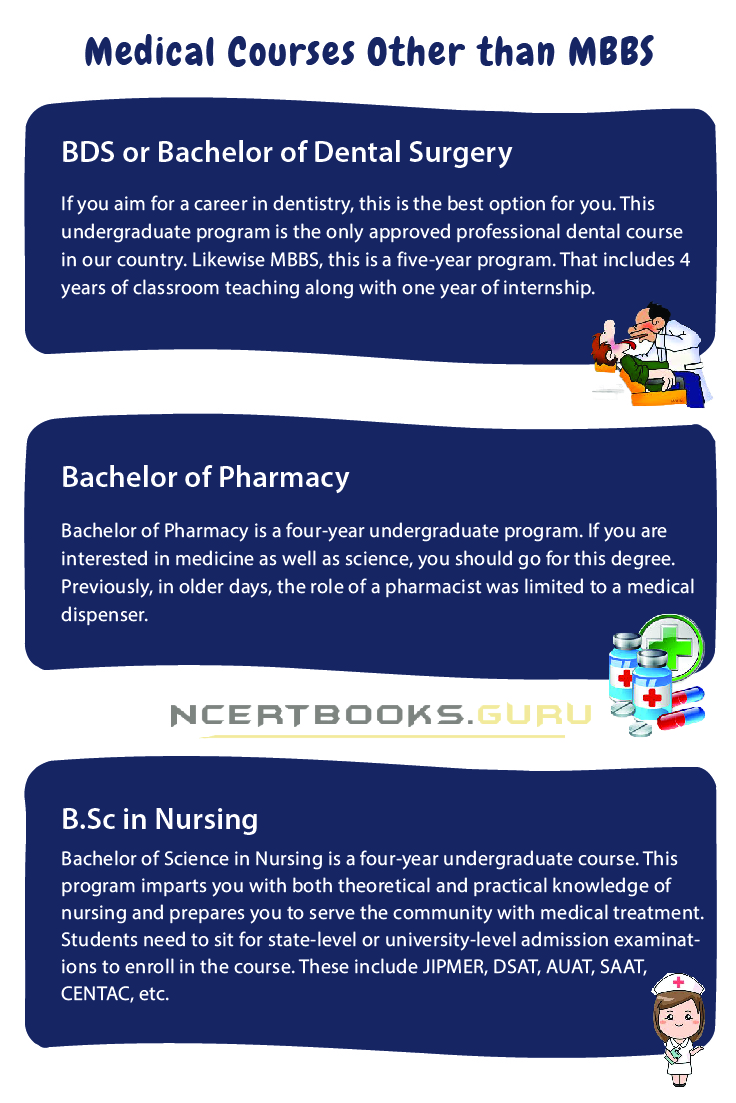
If you aim for a career in dentistry, this is the best option for you. This undergraduate program is the only approved professional dental course in our country. Moreover, the Dental Council of India (DCI) regulates the degree. You need to clear the National Eligibility cum Entrance Exam ( NEET )to get a seat in one of the dental colleges in India. Approximately, there are more than 300 such government and private colleges in India with almost 26,000 seats.

Likewise MBBS, this is a five-year program. That includes 4 years of classroom teaching along with one year of internship. The course covers subjects like Dental Histology, Oral Pathology, Public Health Dentistry, to name a few. BDS opens up lots of career options which include employment as well as higher education.

Bachelor of Pharmacy

Bachelor of Pharmacy is a four-year undergraduate program. If you are interested in medicine as well as science, you should go for this degree. Previously, in older days, the role of a pharmacist was limited to a medical dispenser. Contrary to that, nowadays it has undergone a sea change to become a medical counselor, researcher, medical management expert, etc.

The course deals with the various methods of drug preparation as well as medication dispensing. You can pursue this course by appearing for examinations like NEET, GPAT, BITSAT. B. Pharmacy helps you to build a career as a scientific writer, medical representative, medical scripter. You can also do government jobs and build a flexible yet stable career.

B.Sc in Nursing

Bachelor of Science in Nursing is a four-year undergraduate course. This program imparts you with both theoretical and practical knowledge of nursing and prepares you to serve the community with medical treatment. Students need to sit for state-level or university-level admission examinations to enroll in the course. These include JIPMER, DSAT, AUAT, SAAT, CENTAC, etc.

The rapidly growing nursing industry provides an array of employment options in government and private hospitals, nursing homes, research institutes, etc as a nurse, nursing tutor, nursing assistant, nursing manager, to name a few. Candidates can also go for a master’s degree in the same.

Bachelor of Homeopathic Medicine and Surgery

This undergraduate program is streamlined to train the students with knowledge of homeopathic medicine. The course duration is 5.5 years which includes 4.5 years of classroom training and 1 year of internship. You can get admission to  BHMS  through various entrance examinations like NEET. Besides that, various colleges conduct their entry-level exams.

If you want to promote good health through homeopathy, this is the only option available for you. Moreover, you can pursue higher education after BHMS like PG Diploma in Homeopathic Medicine and Surgery, MD (Hom) Allopathy, etc. You can also work as a homeopathic doctor, lecturer, or consultant in healthcare units.

Bachelor of Physiotherapy

Bachelor of Physiotherapy is a four-year professional undergraduate program. It also includes a mandatory internship of 6 months. The course trains students with the science of physical movements which helps to eliminate the disease through exercise and other modalities. Some of the entrance exams conducted are CET, JIPMER, and Guru Govind Indraprastha University Physiotherapy entrance exam.

This course opens up various job roles like private physiotherapists, assistant physiotherapists, therapy managers. Moreover, they can complete a master’s course. The evergreen demand for physiotherapists will continue to cater to the needs of patients, especially old age people.

Get a comprehensive list of Course Details all in one place and study various courses information such as eligibility to pursue one, course duration, fees, colleges, etc.

Medical Courses Other than MBBS

FAQs on Popular Medical Courses other than MBBS

1. Which course is good other than MBBS?

If you want to enter the medical field, there are lots of other options than MBBS. They include BS, B Pharm, BSc Nursing, and many more.

2. Can I become a doctor other than MBBS?

Yes, you can become a doctor of AYUSH (Ayurveda, Unani, Siddha, and Homeopathy). Now, the government regularizes these courses.

3. Is BHMS equal to MBBS?

Yes, in both cases, the doctor works as a registered medical practitioner. BHMS courses are becoming popular nowadays.

How to Join Territorial Army in India? | Roles and Eligibility Criteria To Join Territorial Army in India

How to Join Territorial Army in India?: It is a dream come true for any law-abiding citizen to serve for the nation in uniform. Men and women in uniforms always have unique respect in society that no other professionals can demand. The fact that a civilian can have a chance to serve for the nation in the army is enough to motivate him or her to pursue a part-time career in the territorial army. A sense of fulfilment that people get in servicing the nation in defence forces is enough to fill the vacancies in such units.

Refer to Course Details to know more about related courses and find details like Admission Process, Eligibility Criteria, etc.

Before addressing the nuances involved process of joining the Territorial Army in India, let us address a few questions such as:

What is the Territorial Army of India?

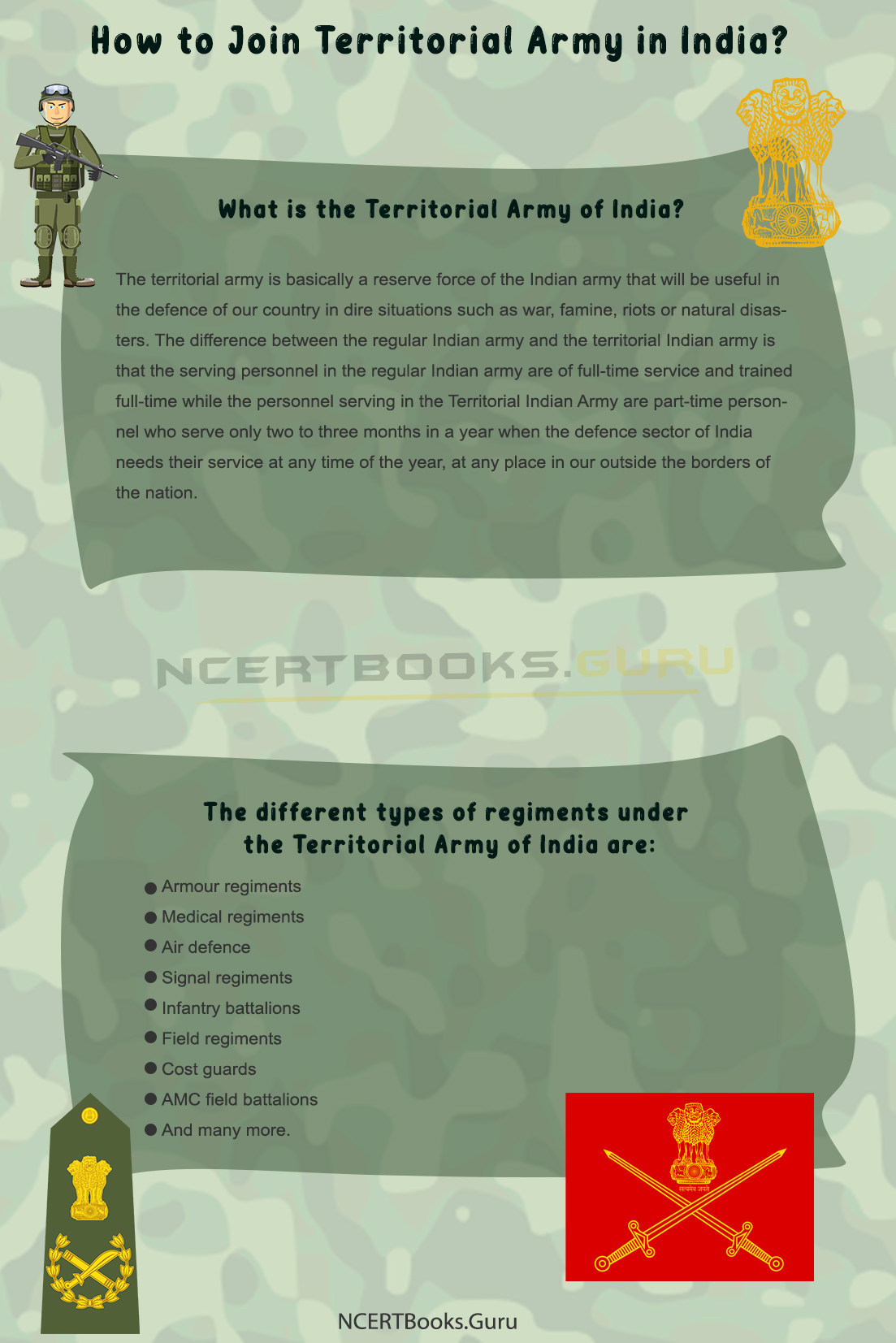
The territorial army is basically a reserve force of the Indian army that will be useful in the defence of our country in dire situations such as war, famine, riots or natural disasters. The difference between the regular Indian army and the territorial Indian army is that the serving personnel in the regular Indian army are of full-time service and trained full-time while the personnel serving in the Territorial Indian Army are part-time personnel who serve only two to three months in a year when the defence sector of India needs their service at any time of the year, at any place in our outside the borders of the nation.

This army is often called by the phrase part-time commitment, full-time honour. The territorial Indian army was originally started by the British in the early part of the 19th century. This concept of the army was of utmost need during the 1st and d world Wars when the British needed extra troops to fight in the war. Back then the territorial army of India was a part of IDF ( Indian Defence Force). At that point in time (before the independence of India), British nationals who were permanent residents in India were compulsorily obliged to serve in the territorial army of India.

The modern territorial Indian army started in 19under C Rajagopalachari, the first governor-general of India.

The different types of regiments under the Territorial Army of India are:

  1. Armour regiments
  2. Medical regiments
  3. Air defence
  4. Signal regiments
  5. Infantry battalions
  6. Field regiments
  7. Cost guards
  8. AMC field battalions
  9. And many more.

How to Join Territorial Army in India 1

What is the Role of the Territorial Army in India?

The following 5 points will significantly sum up the role of the territorial army of India and help students and aspirants get an idea of life after joining the Territorial Army of India:

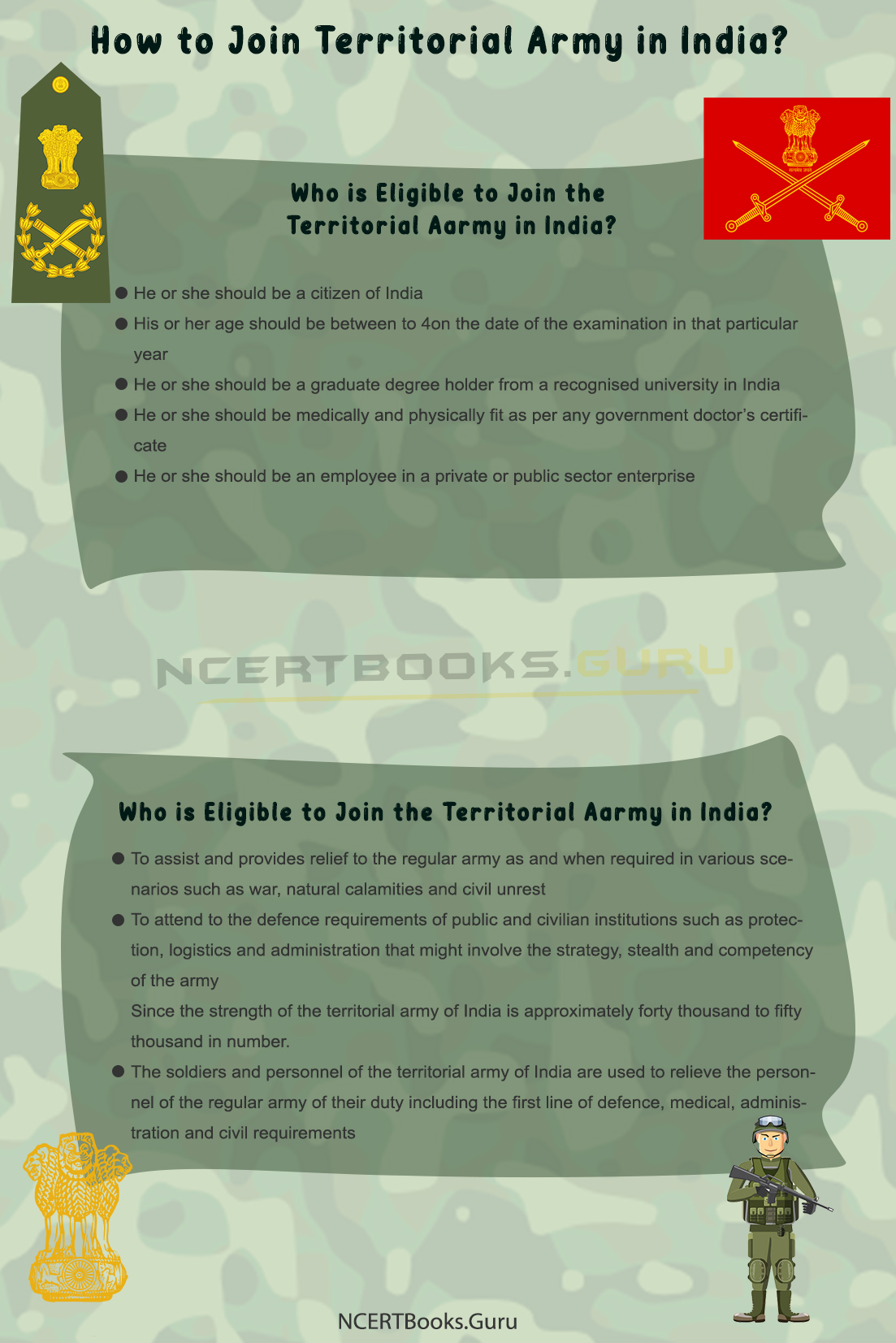
  1. To assist and provides relief to the regular army as and when required in various scenarios such as war, natural calamities and civil unrest
  2. To attend to the defence requirements of public and civilian institutions such as protection, logistics and administration that might involve the strategy, stealth and competency of the army
    Since the strength of the territorial army of India is approximately forty thousand to fifty thousand in number.
  3. The soldiers and personnel of the territorial army of India are used to relieve the personnel of the regular army of their duty including the first line of defence, medical, administration and civil requirements
  4. Territorial army also helps in assisting protection and security to important institutes of the country such as Nuclear Power plants, natural mineral reserves, constitutional bodies such as RBI, supreme court and High court etc.
  5. One of the most important purposes of the territorial army also includes the sense of inclusiveness that it provides to the civilians in the defence of the country.

Below are the steps that an aspirant can follow to join the territorial army in India:

  1. Registration and application to give territorial army exam
  2. Written exam and interview
  3. SSB
  4. Medical board for final selection

While the above four steps are for civilians, ex-servicemen can also get into the Indian Territorial army by giving only the interview stage of the recruitment process.

The examination will be of objective type for a span of two hours.

Who is Eligible to Join the Territorial Aarmy in India?

The list of criteria to enter and be a part of the Indian territorial army is as follows:

  1. He or she should be a citizen of India
  2. His or her age should be between to 4on the date of the examination in that particular year
  3. He or she should be a graduate degree holder from a recognised university in India
  4. He or she should be medically and physically fit as per any government doctor’s certificate
  5. He or she should be an employee in a private or public sector enterprise
  6. He or she who is already serving in the army, navy, airforce, police or any constitutionally valid institutions are not eligible to apply for the Indian territorial army.

One can say with conviction that it will be a life of fulfilment to serve in the territorial army of India. The pride and satisfaction one will get in serving the nation and fighting the evil forces is something that can’t be measured and will not be found in any other services across the country, be it in the public or private sphere. There are plenty of celebrities, Bollywood stars, sportsmen, sportswomen, and other important personalities in the public domain.

How to Join Territorial Army in India 2