How to Become An Archaeologist in India | Eligibility, Courses, Job Profiles, Salary

How to Become An Archaeologist in India

How to become An Archaeologist in India?: The person who will study Archaeology is called an archaeologist. An archeologist studies the civilizations and cultures of human. It talks about the study of the human past and presents through the left-over remains. It is nothing but the study of dishes, tools, bones, and clothes which are left-over. All these left-overs are collected, observed, and studied to collect interesting information to conduct research. The research is conducted using the available data, artifacts, and biofacts available in the environment.

Archaeology has many branches like the study of lithics-stone tools, ancient plants-paleoethnobotany, animals-zooarchaeology, human remains-bioarchaeology, fossil sciences, and more. These branches explain that Archaeology is much more than digging the earth using tools. So, if you are someone who is looking to become an archaeologist in India, read further:

Refer to Course Details to know more about related courses and find details like Admission Process, Eligibility Criteria, etc.

In India, most of archaeologist works in the Archaeological Survey of India (ASI). An ASI diploma is a must to work in this area in India.

Eligibility Criteria To Become an Archaeologist in India

Before moving further, let us see the eligibility criteria for becoming an Archaeologist:

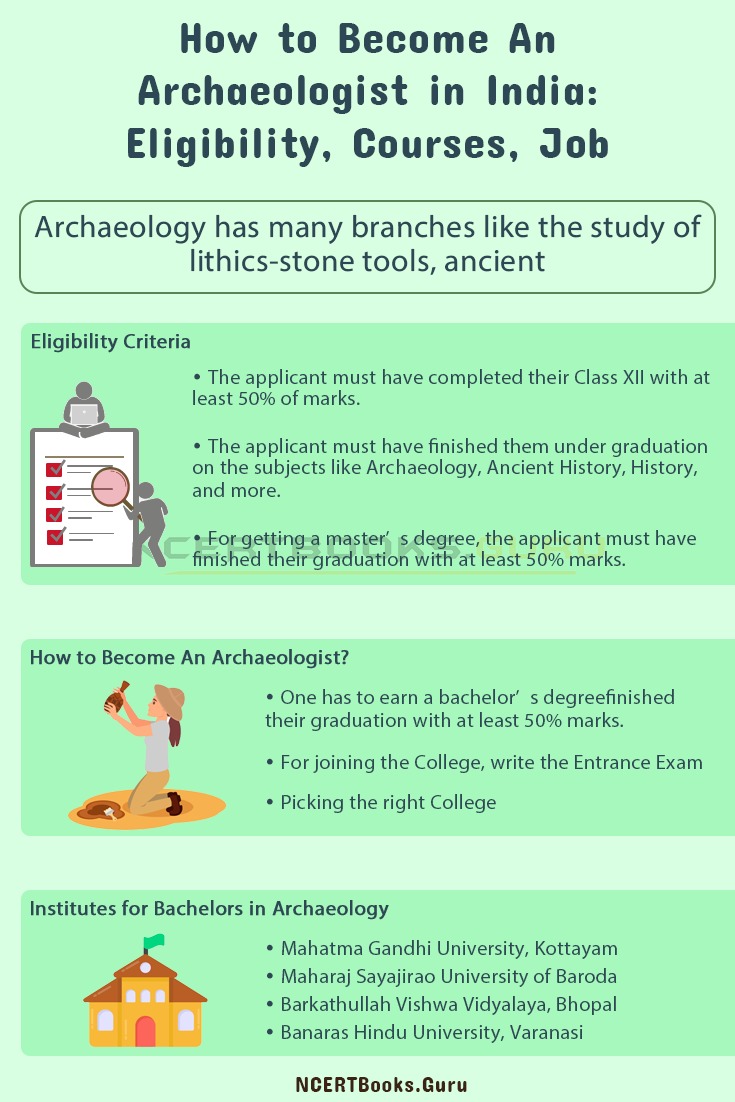
  • The applicant must have completed their Class XII with at least 50% of marks.
  • The applicant must have finished them under graduation on the subjects like Archaeology, Ancient History, History, and more.
  • For getting a master’s degree, the applicant must have finished their graduation with at least 50% marks.

How to Become An Archaeologist in India?

For becoming an archaeologist in India, one has to fulfill the below educational requirements and have to follow the below steps:

One has to earn a bachelor’s degree: To become an archaeologist, one has to have completed the undergraduate program and earn a bachelor’s degree in cultural heritage, ancient history, archaeology, history or geography or anthropology, or other related fields. One has to enroll himself in a B.A. Archaeology program. Joining in B.A. must take place after the completion of higher secondary education. If the student is looking to become a Marine Archaeologist, he should have an Engineering degree. This educational background will be an additional benefit to you, as you will regularly make assessments of the archaeological remains and actively participate in the excavation projects.

For joining the College, write the Entrance Exam: Admissions for the BA Archaeology are mostly based on the merits. But many top colleges regularly conduct entrance exams for taking admission. IPU CET, BHU PET, and AUCET are the state entrance exams that also include personal interviews.

But if you are looking for admission in MA, colleges will conduct personal interviews where thesis and research works from BA degree are an additional advantage.

Picking the right College: This is highly important as the student must have good field experience to become an archaeologist. When you apply for the College, choose where the on-field experience is the highest and how good the College offers work exposure via internships.

For working as an archaeologist, one must have either a bachelor’s or master’s degree. So, let us see some colleges in India which offer these courses.

Do Read:

Institutes for Bachelors in Archaeology

  • Mahatma Gandhi University, Kottayam
  • Maharaj Sayajirao University of Baroda
  • Barkathullah Vishwa Vidyalaya, Bhopal
  • Banaras Hindu University, Varanasi

The Banaras Hindu University, Varanasi, is one of the top Archaeology schools in India.

Institutes for Masters in Archaeology

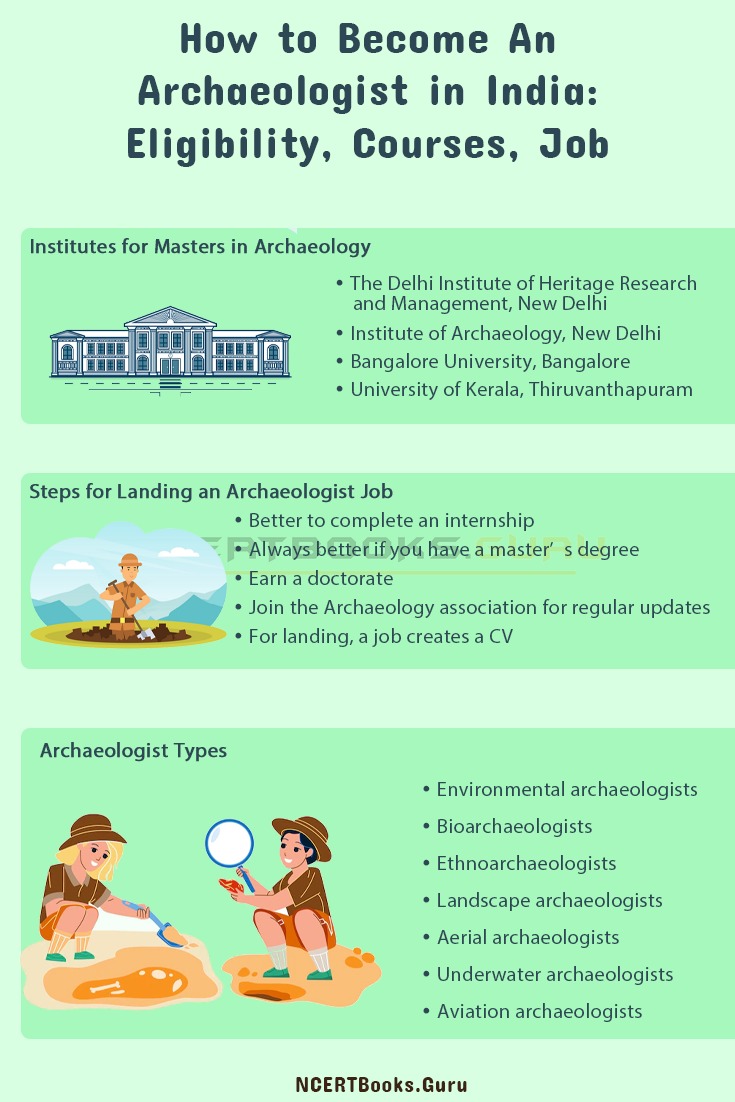
  • The Delhi Institute of Heritage Research and Management, New Delhi
  • Institute of Archaeology, New Delhi
  • Bangalore University, Bangalore
  • University of Kerala, Thiruvanthapuram
How to Become An Archaeologist in India 1

Steps for Landing an Archaeologist Job

Once you get a degree in the field of Archaeology, you have to remember and follow the below steps for landing a job:

Better to complete an internship

Completing a fellowship or an Internship will give you the better field experience, which is the prime requirement of archaeological jobs. You can do these internships at government agencies, archaeological organizations, and museums. When you do the internship, you can even estimate how well you are at the job and making the right career choice.

Always better if you have a master’s degree

Though a bachelor’s degree will land you with entry-level jobs, when you do a master’s course and earn a degree, you will have a better understanding of the field, which will better your skill levels. PG Diploma, Diploma, M.Phil., and M.A. in Archaeology are the master’s degrees one can pursue.

Earn a doctorate

Earning a doctorate will let you work as an Archaeology professor and help you take up higher-level projects. Completing the doctorate will take three years, and additionally, you will have to do field research for seven months on a specific topic.

Join the Archaeology association for regular updates

Joining these associations will help you stay in touch with people of similar likes and help you know the latest updates of the news that are archeology-related.

For landing, a job creates a CV

A CV holding the information related to your experience, skills, and education will help impress the employer. Focus on the field experience in the field of your choice when you write the CV.

Which jobs do you land into?

Laboratory technician, heritage consultant, excavation technician, preservation officer, cultural resource specialist, collections manager, and associate archaeologist are the most common entry-level jobs you may land into.

Archaeologist Types

Now that we know how to become an archaeologist, let us see the Archaeologist types:

Environmental archaeologists

They study the interrelationship between the natural environment and an ancient group of people. They talk about the natural habitat that the ancient people lived in. They regularly examine the crops, animals, and plants present in the period they are researching. Their study also involves laboratory experiments.

Bioarchaeologists

Bioarchaeologists are professionals who study the skeletal remains at archaeological sites. These study the skeletal remains at the site. This study includes the study of genetics, ancient diseases, and human remains.

Ethnoarchaeologists

These people talk about the ethnographic investigation of living communities that were present previously. This will help in gaining past knowledge. They have to study the site and culture and compare it with the present people living today in the same site.

Landscape archaeologists

It is the study of landscapes and their artificial and natural changes. The archaeologist will examine for understanding any link between habitats and human behavior.

Aerial archaeologists

Making use of photography and aerial surveys, the archaeologists will try to spot new dig sites. This doesn’t deal with excavations.

Underwater archaeologists

Also known as maritime and marine archaeologists, they study the remains underwater, such as shipwrecks, cities, and more. They dive deep into the water and use tools for the search.

Aviation archaeologists

They discover and study the remains of abandoned airbuses, runways, aircraft, or anything dealing with aviation history. Using the information, they will gather information and explain the events and past behavior that were the reason for aircraft crashes.

What are the Skills the one Studying Archaeology Should Have?

An archaeologist must be capable of studying the things used by individuals in the past. They have to excavate and find proofs and observe those proofs to get outcomes. He has to have food knowledge on Topography and History.

The skills required are:

  • Good Research Skill
  • Teamwork Skills
  • Good Eye to detect and find In-Depth Details
  • Communication and Writing Skills

What are the different Responsibilities and roles of an Archaeologist?

  • They have to be capable of studying the documents to find historical pieces of evidence.
  • They must study excavated structures and objects and identify the date and other details to interpret their significance.
  • They have to preserve and restore the human past and the ancient civilization.
  • They have to survey, research and assess the sites of the historical cultures and societies.
  • They have to recommend methods to conserve and interpret any findings and write and publish the reports of what is found on the recording site.
  • Collect materials, metals, bones, and stones, place them in the bags, and mark them.
  • Capable of teaching Archaeology at universities and colleges.
How to Become An Archaeologist in India 2

Can an Archaeologist land a Government job in India?

Yes, there is scope to land a government job as an archaeologist. Some of the places are:

  • Cultural galleries.
  • National Museum
  • Archaeological Survey of India
  • Indian Council of Historical Research
  • National Heritage Agencies
  • Colleges and Universities

What is the Basic Salary of an Archaeologist in India?

There is a huge demand for Archaeologists these days as there are fewer numbers in the market. This demand has resulted in very good pay packages to the Archaeologists. A fresher can get a salary of 30,000 every month, and an experienced professional can get a salary between five to nine lakhs per annum.

Parting Words

If you are someone who achieves self-satisfaction after discovering some part of history or the culture that has been hidden for years, then this is the best career option for you. Along with interest, you should have enough patience and work hard to find results. It is the best profession for you if you love to unravel mysteries. Also, unraveling or discovering something new will bring a great reputation in the field of Archaeology.

Marine Engineering Courses After 12th | Eligibility, Fees, Duration, Skills, Career Scope, Salary

Marine Engineering Courses After 12th

Marine Engineering Courses After 12th: Are you excited to work around the ocean and is that your dream job? Then, marine engineering is the best course that you can do. This marine engineering course can be done once after completion of your mechanical engineering graduation. The course deals with the design, operation, construction, and maintenance of the ship functions that contain steering, cargo handling, anchoring, heating, air conditioning,  ventilation, etc. In this blog, we are going to learn more about the marine engineering course and all the details like eligibility, courses, fees, salary, career, and many more.

Eligibility Criteria of Marine Engineering Courses

If you are willing to study this course you need to meet the particular criteria before applying for the course. Here are the eligibility criteria you can know the requirement of marine engineering.

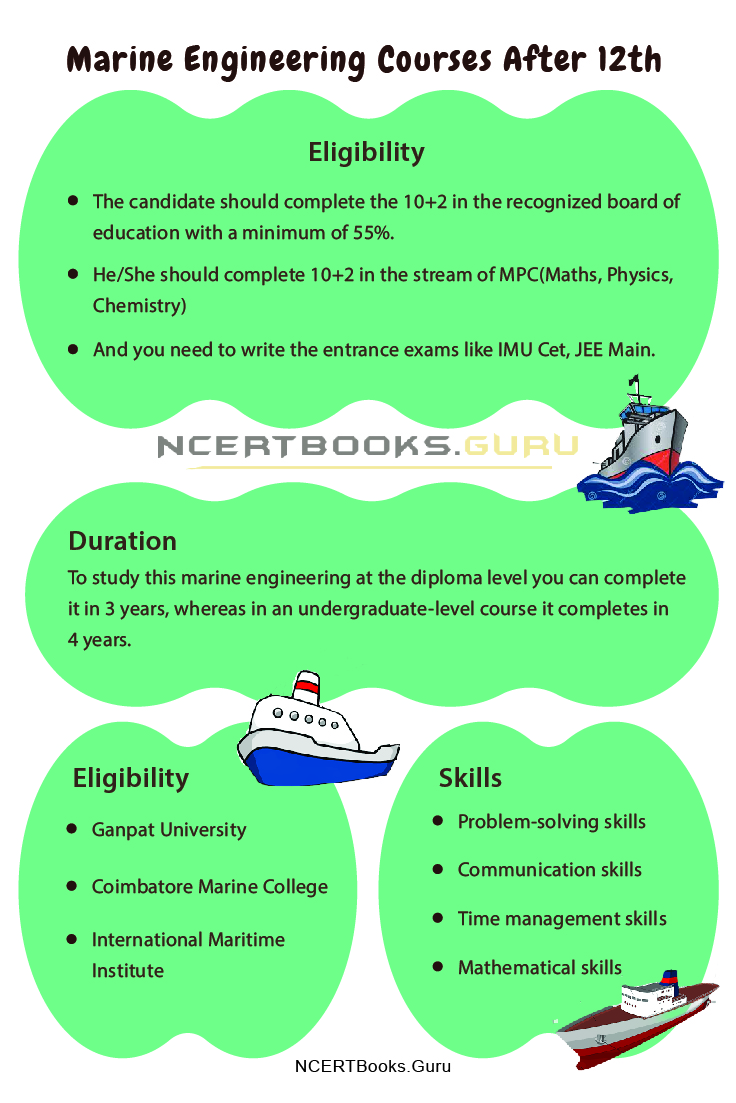
  • The candidate should complete the 10+2 in the recognized board of education with a minimum of 55%.
  • He/She should complete 10+2 in the stream of MPC(Maths, Physics, Chemistry).
  • And the age should be between 17 – 25 years.
  • The candidate should have a minimum of 50% marks in the English language.
  • And you need to write the entrance exams like IMU Cet, JEE Main.

Marine Engineering Course Fees

In marine engineering, as we have different levels of education, there are different fees for different levels of education. And another essential thing is fees will be varied from college to college. we will look into it one by one.

Diploma Course:

The average fee structure for this diploma in marine engineering can be INR 50,000 to INR 3,00,000. This is not the actual amount it depends on the college you choose.

Graduate Level:

The average fee for public colleges can be between INR 50,000 and INR 10,00,000.  Whereas, private colleges can be between INR 50,000 and INR 10,00,000.

Marine Engineering Course Duration

To study this marine engineering at the diploma level you can complete it in 3 years, whereas in an undergraduate-level course it completes in 4 years.

Entrance Exam for Marine Engineering After 12th

To get admission from any college in the marine engineering course you need to write the entrance examinations for the UG and PG levels.

UG Level Entrance Examination

In this level entrance examination, you will have the syllabus on maths, physics, chemistry. Given below is the list of entrance examination.

  • JEE Main
  • JEE Advanced
  • HIMT Entrance exam
  • IMU Cet
  • AP EAMCET

PG Level Entrance Examination

To study PG in colleges you need to write the entrance examination that is given below.

  • GATE

Marine Engineering Subjects

In this Marine Engineering course what is the syllabus will be covered in the colleges has given below.

  • Technical Management
  • Electronics Navigation Systems
  • Marine Control and Automation
  • Advanced Marine Engineering
  • Mathematics
  • Ship Design
  • Systems Engineering
  • Offshore Engineering
  • Human Resource Management
  • Safety Management
  • Environment Science and Management
  • Information Technology and Security
  • Communication Skills

Marine Engineering Colleges in India

In India, many colleges offer marine engineering courses that are given below. Look into the list.

  • Ganpat University
  • Marine Engineering and Research Institute, Kolkata
  • Coimbatore Marine Engineering College
  • Coimbatore Marine College (CMC)
  • V.Raman College of Engineering, Bhubaneswar
  • International Maritime Institute (IMI) Noida
  • GKM Institute of Marine Sciences and Technology
  • National Institute of Technology, Karnataka
  • Maharashtra Academy of Naval Education and Training, Pune
  • Academy of Maritime Education & Training (AMET University)
  • Institute of Technology and Marine Engineering

Books & Study Materials for Marine Engineering Courses 2022

Here we are providing some of the books and study materials to study marine engineering courses.

  1. General Engineering Knowledge – H.D McGeorge.
  2. Ship Construction – David J.Eyres.
  3. Introduction to Marine Engineering – D.A. Taylor.
  4. Marine Boilers – G.T.H Flanagan.
  5. Marine Auxiliary Machinery – H.D McGeorge.
  6. Practical Marine Electrical Knowledge – Dennis T.Hall.

Skills Required for Marine Engineering

Here are some of the skills required for the marine engineering course.

  • Problem-solving skills
  • Efficient planner
  • Communication skills
  • Time management skills
  • Computer-aided design and manufacturing skills
  • Proven negotiating skills
  • Mathematical skills

Marine Engineering Courses After 12th

Top Recruiting Companies for Marine Engineer

Given below is the list of companies that give marine engineer jobs.

  • Indian Navy
  • GE Shipping Co. Limited
  • TMC Shipping Pvt. Ltd.
  • Fleet Management Limited
  • Martinek
  • Shipping Corporation of India
  • Design and Engineering Pvt. Ltd.
  • Carnival Cruise Line
  • ITT Shipping Pvt Ltd

Must Read:

Career Scope in Marine Engineering After 12th Science

In Marine Engineering you have plenty of opportunities. Depending on the specializations you have done you will be getting the job in that field. Many of them think that the marine engineer’s job is just the construction and maintenance of ships. But it is not at all true. You can extend the marine engineer’s job upto the project management and control responsibilities.

There are many jobs outside for marine engineers in the public sector as well as in the private sector. As we have given there are plenty of job profiles with the highest paying salaries we have in marine engineering. You can job not only in India but also we have opportunities abroad too.

Job Profiles and Salaries for Marine Engineering Courses After 12th in India

Following are the job profiles that many offers once after completing the marine engineering courses after the 12th.

Job Profiles Avg Salaries
Navy personnel 25K- 46K
Chief Security Officer 126- 212K
Marine Equipment Designer 58K- 95K
Onshore Marine Coordinator 34K- 47K
Maintenance Engineer 58K- 95K
Trainee Marine 30K- 45K
Engineering Managers 58K- 95K
Submarine Designer 32K- 50K
Chief Engineer 50k- 106k
Design Engineer 55K- 78K

FAQs on Marine Engineering Courses After 12th

1.  Is marine engineers’ jobs are tough?

Marine engineers’ job is to work in an engine room with four-hour shifts and it is quite a challenging job.

2. What is the GME exam?

GME (Graduate Marine Engineering) is a one-year diploma course after the 12th. If you are interested in joining the merchant navy sector. you can join this course.

3. How long is B.tech in Marine Engineering?

B.tech in Marine Engineering takes 4 years to complete course.

4. What are the minimum marks you need to get for marine engineering?

To join marine engineering in colleges you need to get the minimum cut-off mark is 160.

Summary

The information which we have given above about marine engineering courses after 12th is useful. And in this marine engineering, we have many job opportunities with the highest salary. Suppose you get a government job you no need to look back. Look into the details carefully that are given about the marine engineering course. Still, if you have any doubts about the course you can ping us in the comment section. we will definitely respond to your messages and provide you with the answers. All the best for the future.

IGU Meerpur Courses And Syllabus 2022 – UG, PG, M.Phil, Ph.D. Courses

IGU Meerpur Courses

IGU Meerpur Courses: Check out Indira Gandhi University Meerpur Courses and Syllabus 2022. Candidates can check the necessary details about Indira Gandhi University Meerpur courses and syllabus 2022. Here we have given courses and also syllabus for various programs and other important details. Here we also gave semester wise Subjects (IGU मीरापुर पाठ्यक्रम और पाठ्यक्रम) which helps the candidate in providing information. Also, check various academic programs offered by Indira Gandhi University Meerpur.

The Institute invites applicants to Indira Gandhi University Meerpur campus who have completed the required courses this academic year. In the previous article, we have given details of Indira Gandhi University Meerpur Fees structure, Important dates, Results, and Admit card. So candidates who want to gain information on the Indira Gandhi University Meerpur can refer to our site.

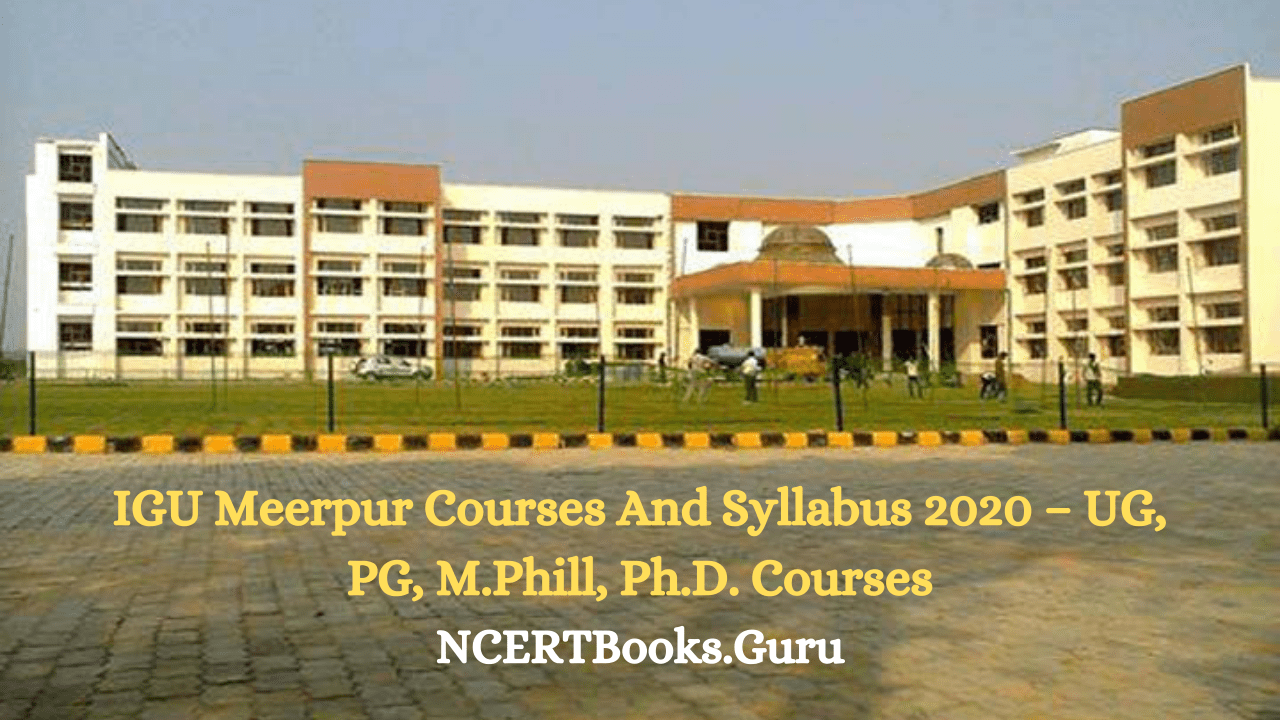
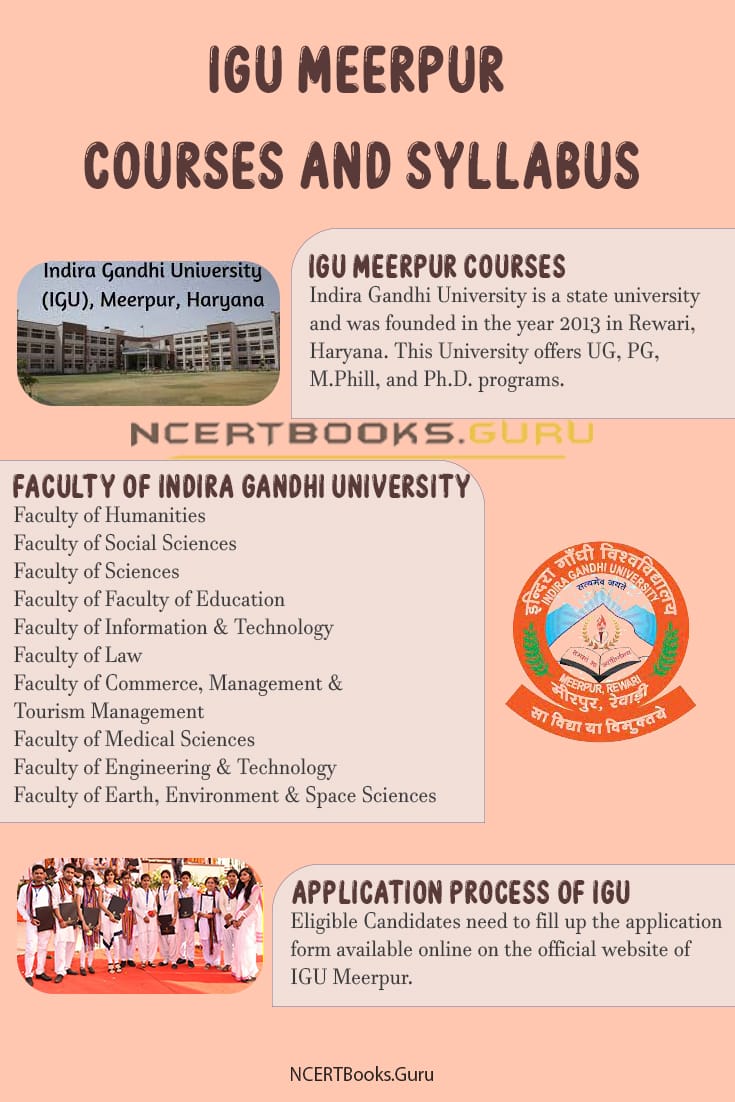
Indira Gandhi University is a state university and was founded in the year 2013 in Rewari, Haryana. This University offers UG, PG, M.Phill, and Ph.D. programs. Admissions of this university will be opened in the month of February. This university provides seats on the basis of merit. Candidates who want to get the seat at this university should get qualified in the entrance test conducted by the university. Candidates should also meet the minimum eligibility criteria of this university.

IGU Meerpur Courses and Syllabus

University / Institution Indira Gandhi University Meerpur
Location Haryana
Offered Courses UG, PG, M.Phill, Ph.D.
Website Click here
Admissions Notification Click Here

About Indira Gandhi University Meerpur

The Indira Gandhi University Meerpur, Rewari was established through an ordinance promulgated by the Governor of Haryana on Sept. 07, 2013. It started its functioning from Sept.13, 2013. The university has been determined to develop the all-round personality of students by making them not just outstanding professionals but also good individuals with ingrained human values and commitment to expanding the frontiers of knowledge for the advancement of society.

This university further for the purpose of imparting education in Arts, Science, Information Technology, Computer Education, Commerce, Humanities, Management and to achieve excellence in these and connected fields of the learned professions, the university tends to promote study and research for the further advancement of learning in education.

The university began its way as the Post Graduate Regional Centre of Maharishi Dayanand University, established in 1988. The vision of the university is where all are engaged in creating learning opportunities for themselves and others to encourage development, growth, and productivity to keep pace with the global trends and compete with the best-known Universities of the world.

Indira Gandhi University Meerpur Courses

Indira Gandhi University offers many courses like UG, PG, M.Phill, Ph.d. Here we have given the programs offered by this university

Faculty of Indira Gandhi University

  • Faculty of Humanities
  • Faculty of Social Sciences
  • Faculty of Sciences
  • Faculty of Faculty of Education
  • Faculty of Information & Technology
  • Faculty of Law
  • Faculty of Commerce, Management & Tourism Management
  • Faculty of Medical Sciences
  • Faculty of Engineering & Technology
  • Faculty of Earth, Environment & Space Sciences

Undergraduate courses

B.Tech

  • Civil Engineering
  • Mechanical Engineering

LLB

BSc

  • Hospitality and Hotel Administration
  • Physics (Hons.)
  • Chemistry (Hons.)
  • Mathematics (Hons.)
  • Biotechnology (Hons.)
  • Zoology (Hons.)

B.Com (Honors) 

BBA

BCA

B.Ed.

Postgraduate Courses

MA

  • English
  • Hindi
  • Sanskrit
  • History
  • Economics
  • Geography
  • Public Administration
  • Yoga
  • Journalism and Mass Communication
  • Geography
  • Political Science
  • Sociology
  • Education

MSc

  • Mathematics
  • Physics
  • Chemistry
  • Botany
  • Zoology
  • Geography

MCA

M.Tech

  • Computer Science and Engineering
  • Civil Engineering
  • Mechanical Engineering
  • Printing Technology

MBA

  • Regular
  • Travel and Tourism Management

M.Ed.

MSW

M.Phil.

  • English
  • History
  • Economics

Doctorate  Programmes

Ph.D

  • English
  • History
  • Economics
  • Physics
  • Computer Application
  • Commerce
  • Geography

Indira Gandhi University Meerpur Courses Official Site – Click Here

Do, Check:

IGU Meerpur Admission Process

Eligible students can apply for IGU Meerpur UG, PG, M.Phil and PhD courses online or offline.

  • Visit the official website of Indira Gandhi University Meerpur.
  • Go to the Announcements/Notification section.
  • Click on the notification and download it.
  • Fill out the application form and pay the application fee before the last date.
  • Save the login credentials for future use.
  • Attend the entrance exam with the admit card.

IGU Meerpur Fees

Course Name Fees Course Name Course Fees
M.A.English 5090 LLB 7090
M.A. History 5090 B.Tech 51290
M.A. Economics 5090 B.H.M.C.T. 41290
M.A. Hindi 5090 M.Sc. Zoology 10090
M.Sc-Mathematics 10090 M.Sc. Botany 10090
M.Sc. Math with CS 20090 M.A. Pol. Science 5090
M.Sc. Geography 10090 M.sc. Bio-technology 11250
M. Sc. Physics 10090 Master of Social Work 11250
M. Sc. Chemistry 10090 M.Sc. Psychology 11250
M. Com 8090 MCA 21290
M.Com Hons 8090 B. Pharma 31290
M.Sc. Yoga 10090

Indira Gandhi University Meerpur Syllabus

Candidates who want to score good marks in their final exams can refer to this article and gain information. A student can score good marks if he knows the exact syllabus of the exam he/she is writing.

Indira Gandhi University Meerpur Exam Syllabus 2019 – Click Here

Indira Gandhi University Meerpur Recent Syllabus – Click Here

IGU Meerpur courses and syllabus

Indira Gandhi University Meerpur Previous Syllabus

Indira Gandhi University Meerpur Courses and Syllabus: Candidates studying this university should know the syllabus of the particular course. So here we have mentioned the syllabus of courses for the academic year 2022. As we know that the exam syllabus remains the same as the last year. So here we have given the syllabus for this academic year 2017-18. Here we have given the previous syllabus of all courses of this university.

Indira Gandhi University Meerpur Syllabus 2017-18 – Click Here

Indira Gandhi University Meerpur 2017 Syllabus – Click Here

Indira Gandhi University Meerpur 2016 Syllabus – Click Here

Indira Gandhi University Meerpur 2015 Syllabus – Click Here

Indira Gandhi University Meerpur 2014 Syllabus – Click Here

FAQ’s on IGU Meerpur Courses

1. What is the duration of courses offered at IGU Meerpur?

The duration of each course at IGU Meerpur differs and you can check out the above-mentioned article to know the details.

2. What is the application process of IGU Meerpur?

Eligible Candidates need to fill up the application form available online on the official website of IGU Meerpur.

3. In which streams Indira Gandhi University Meerpur Offers its Courses?

Indira Gandhi University Meerpur Offers Courses in various disciplines of UG and PG Programmes.

Wrapping Up

We have provided IGU Meerpur Courses and Syllabus 2022 in this article. Students are requested to share this article with their friends. Students who want to know more details about this article about those associated with the Official Website for Indira Gandhi University Meerpur can refer to our web page to know more information.

Interested candidates can also refer to our previous articles of the Indira Gandhi University Meerpur and know course details about Admissions, the Fee structure, Important dates, Timetable of this university. Students who have any queries about this article can leave a review in the below report box for clarifying your doubts.

Travel and Tourism Courses | Duration, Eligibility, Fee Structure, Jobs, Salary

Travel and Tourism Courses

Travel and Tourism Courses After 12th: The travel and tourism industry is currently undergoing immense growth. It is the largest service industry in India. It provides heritage, cultural, business, medical and sports tourism. The primary purpose of this area is to promote tourism, maintain the competitiveness of India as a tourist destination, and develop and grow existing tourism outcomes to ensure employment generation and economic growth.

Students have countless career possibilities in this fast-growing industry of travel and tourism. Candidates looking to continue their career in the travel and tourism industry can choose to work for travel agencies, tour operations, immigration, government tourism departments, and customs services, airlines, hotels, and the list continue. As per various studies, the industry is suspected of creating over 45 million jobs in India by 2025.

A Brief on Travel and Tourism Course

Travel and Tourism program captivates students from all over the globe, providing them with the highest quality educational and practical learning. It is created such that classroom training is augmented with on-the-job industrial exposure so as to hone the skills and techniques learned sufficiently. The Government is providing much interest in the tourism sector. Travel and Tourism management experts manage the comfort, travel modes, tour program and overall stay of such tourists in India.

Aspirants can pursue a degree, diploma, or certificate course in travel and tourism at graduation or post-graduation level. Applicants can also seek a Ph.D. in their chosen subject of travel and tourism to grow their career in the area of research.

Travel and Tourism Course Highlights

  • Name of the Course: Travel and Tourism course
  • Duration: The duration of the course depends upon the level of the program such as graduate level, postgraduate level, certificate, or diploma level courses.
  • Application Process: Applicants who have completed their 10+2 and Graduation or Diploma from any recognized University such as State Government/ DEC/ UGC/ AIU/ AICTE/) in any discipline and have proficiency in English ( spoken and written both are mandatory) are eligible to apply for the course.
  • Application Fee: The entire fee structure may vary from one institute to another. The generic Travel and Tourism Courses fees for the courses start from Rs 50,000 to 4 lakhs.
  • Career Opportunities: Some career opportunities after completion of the travel and tourism courses online are accounting, Sales, Public relations, Ground staff or In-flight staff, Traffic Assistance, Reservation and Counter Staff, and many more.

Travel and Tourism Course Eligibility Criteria

Most of the institutes in India offer undergraduate or postgraduate level degree, diploma, certificate, distance learning, and online courses in different areas of travel and tourism. Given below are general travel and tourism eligibility criteria for UG as well as PG courses. The eligibility criteria for the course may vary from one institute to another.

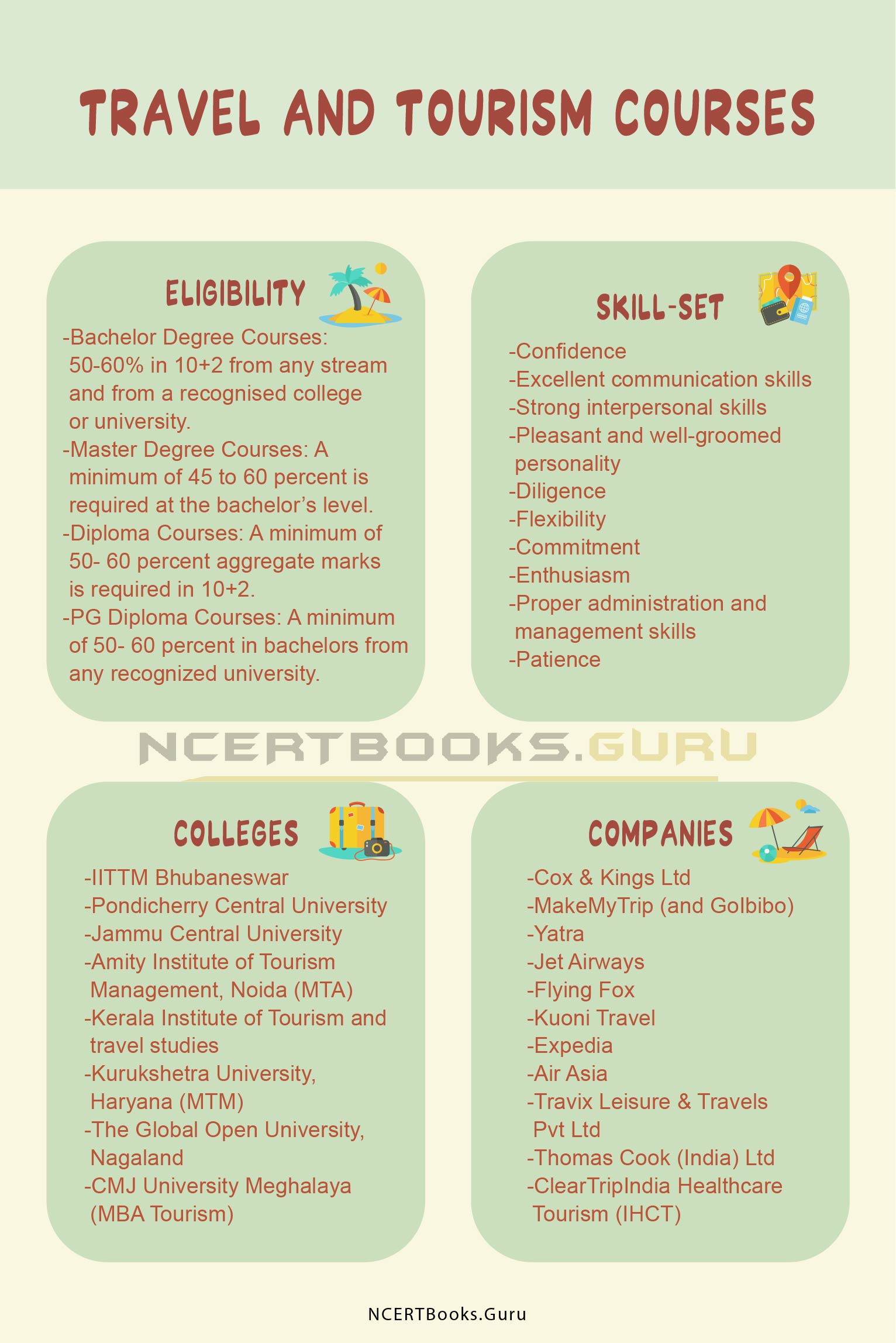
  • Bachelor Degree Courses: A qualified degree in 10+2 in any stream and from a recognised college or university. A minimum of 50 – 60 percent is required to join the course.
  • Master Degree Courses: A minimum of 45 to 60 percent is required at the bachelor’s level. Preferences for applicants who have knowledge in any of the foreign languages can usually opt for the course.
  • Diploma Courses: A minimum of 50- 60 percent aggregate marks is required in 10+2.
  • PG Diploma Courses: A minimum of 50- 60 percent in bachelors from any recognized university.
  • Certificate Courses: Candidates with a minimum of 45 – 50 percent marks from a recognized board can apply for the course.

Get to Know More about other types of Course Details in Streamwise, and Category wise

Required Skill-set for Travel & Tourism Courses

Professionals working in the business of travel and tourism are involved with rendering quality services to people who are away from home on a holiday or business. Candidates seeming to pursue a career in the tourism industry need to love traveling along with the desire to learn new things. Some of the skills that applicants should have to create a successful career in the travel and tourism industry are:

  • Confidence
  • Excellent communication skills
  • Strong interpersonal skills
  • Pleasant and well-groomed personality
  • Diligence
  • Flexibility
  • Commitment
  • Enthusiasm
  • Proper administration and management skills
  • Patience
  • Excellent research and planning skills
  • Problem-solving skills
  • Organization skills
  • Time management skills
  • Strong networking skills
  • Teamwork
  • Hardworking
  • Leadership skills

Travel and Tourism Courses Syllabus/Curriculum

The curriculum of the travel and tourism course depends on what the candidate is pursuing – degree, diploma, or certificate. To get a summary of the program here are some of the courses you can study.

Certificate Course in Travel & Tourism

  • Tourism Management – Principles and Practices
  • Airlines, Tours, Travel Agency and Travel Management
  • Marketing in Service Industry – Airlines, Tours & Hotel, Travel
  • Airlines – Reservations and Ticketing with fare Constructions
  • Hospitality Oriented – Language studies

BA (H) Hotel Management, Travel and Tourism

  • Fundamentals of Travel and Tourism
  • Concepts of Hospitality and Tourism
  • Tourism Resources and Attractions in India
  • Perceptions of International Travel and Tourism
  • International Tourism: Concepts and Principles-I
  • International Tourism Geography and Ecology
  • International Tourism: Concepts and Principles-II
  • Tourism Geography and Ecology of India
  • General Aspects of Hotel Management
  • History, Traveling, and Tourism in India
  • Tourism Marketing Management
  • Modes of Transportation System
  • Concepts of Air Fare Structure and CRS (Computerised Reservation System)
  • Marketing Management Services
  • Heritage and Cultural Tourism in India
  • Concept of Food and Beverage

B.Com Tourism and Travel Management

  • Tourism Business
  • Financial Accounting-I
  • Business Management
  • Business Economics-I
  • English-I
  • Second Language-I
  • Holistic Development-I
  • Indian Tourism Product and Geography
  • Fundamentals in Hotel Management
  • Financial Accounting-II
  • Human Resources Management
  • Business Environment
  • English-II
  • Second Language-II
  • Holistic Development-II
  • Tourism Marketing
  • Study Tour Report
  • Corporate Accounting
  • Indian Financial System
  • Principles and Practice of Insurance
  • Business Communication
  • Second Language-III
  • Indian Constitution

MBA in Tourism and Travel

  • Principles of Management
  • Financial Accounting
  • Fundamentals Of Communication & Interview Preparation
  • Human Resource Management
  • Mastering The Interview & Networking Skills
  • Introduction to travel and tourism
  • Tourism Marketing
  • Travel Agency Management
  • Geography of Travel
  • International Tourism
  • Internet Marketing
  • Tour operations management
  • Customer-Centric Organisation
  • Relationship Marketing

PG Diploma in Travel and Tourism

  • Historical, Cultural, and Architectural Background of India
  • Tourism Operations and Products
  • Travel Formalities and Tourist Facilities
  • Tourism Marketing

MA in Travel and Tourism

  • Historical Background of India
  • Tourism Recreation
  • Tourist Indian Destination
  • Religious and Cultural Background of India
  • Tourism Transport System
  • Tour Operations and Formalities
  • Travel Formalities/Domestic Travel and Facilities
  • Architectural History of India
  • Tourism Planning
  • International Tourist Destination
  • Tourism Marketing/Tourism industry in India
  • Art, Iconography, and Craft
  • Research Methodology
  • IATA and its functions
  • Tourism Management/Tourism Management and Operations

Ph.D. in Travel and Tourism

  • Contemporary issues in Tourism Management
  • Tourism Research Methodology and Statistics
  • Tourism Policy and Planning
  • Thesis Planning and Seminar
  • Tourism Marketing and Promotion
  • Tourism research Thesis

Master of Philosophy (MPhil) in Tourism

  • Conceptual Framework of Tourism
  • Research Methodology
  • Advanced Research Techniques
  • Dissertation

Scope of Travel and Tourism Course

The Travel and Tourism industry is one such industry that even though it is relatively new to the others but is growing and is also expected to do well in the coming years as well. There are many industries that are direct contributors to the industry and hence, at the end of the day, create greater job opportunities for those that would want to be a part of the industry. Restaurants, hotels, retailing, transportation, travel agencies, tourist attractions, leisure, recreation and sport, and cultural industries are a number of contributors to the industry.

Also, See:

Travel and Tourism Course Career Options

There is a lot of scope in the travel and tourism sector both in public and private. These are some of the profiles one can look into:

  • Tourism Department: There are jobs as counter and reservation staff, marketing staff. There is also the provision of Information assistants at the Tourism departments office where applicants are chosen through competitive examinations held by the Staff Selection Commission. One can work as a Guide which is listed under the tourism department. The Ministry of Tourism identifies three types of guides; regional, state and local.
  • Airlines: One can opt between becoming a ground staff or in-flight staff. You can also have the option of becoming Traffic Assistance, Reservation, and Counter Staff.
  • Hotels: It a service industry that serves the essential requirement of food and accommodation. One can choose from Operations, Front Office, Housekeeping, Food and Beverages, Accounting, Sales, Public relations and Security, etc.
  • Tour operators: They help to arrange conducted tours to different tourist spots and handle the travel and accommodation of the tourists.
  • Travel Agents: Travel agents appraise the requirements of tourists and people in business and help them make the best possible travel arrangements. Many resorts or travel groups use travel agents to promote their tour packages to travelers.

List of Top Recruiting Companies for Travel and Tourism

Some of the top Recruiting Companies are

  • Cox & Kings Ltd
  • MakeMyTrip (and GoIbibo)
  • Yatra
  • Jet Airways
  • Flying Fox
  • Kuoni Travel
  • Expedia
  • Air Asia
  • Travix Leisure & Travels Pvt Ltd
  • Thomas Cook (India) Ltd
  • ClearTripIndia Healthcare Tourism (IHCT)
  • SOTC India
  • East India Travel Co
  • Club Mahindra Holidays
  • TravelGuru
  • American Express Global Business Travels

Travel and Tourism Course


Top Travel and Tourism Courses Colleges

  • IITTM Bhubaneswar
  • Pondicherry Central University
  • Jammu Central University
  • Amity Institute of Tourism Management, Noida (MTA)
  • Kerala Institute of Tourism and travel studies
  • Kurukshetra University, Haryana (MTM)
  • The Global Open University, Nagaland
  • CMJ University Meghalaya (MBA Tourism)
  • CV Raman University Chhattisgarh
  • IITTM Gwalior

FAQ’s on Travel and Tourism Course

Question 1.
What is the importance of the Travel and Tourism course?

Answer:
A Travel and Tourism course will teach students about business management, marketing fundamentals, human resources, cross-cultural awareness, and much more. The information and experiences gained through the program are essential and helpful for a variety of careers.

Question 2.
What are the fees structure for the Travel and Tourism Courses in India?

Answer:
The fee structure for the course may vary from one institute to another. The generic fees for the courses start from Rs 50,000 to 4 lakhs.

Question 3.
Name some of the colleges for Travel and Tourism Courses in India?

Answer:
Some of the top institutes for the courses are:

  • Pondicherry Central University
  • Jammu Central University
  • Amity Institute of Tourism Management, Noida (MTA)
  • Kerala Institute of Tourism and travel studies
  • Kurukshetra University, Haryana (MTM)

ACJ College Courses & Syllabus 2022 | Download Asian College of Journalism Courses Syllabus

ACJ College Courses

Check out the ACJ College Courses & Syllabus 2022. Candidates who have got the admission in ACJ College Courses & Syllabus are searching for the ACJ College Courses & Syllabus details 2021. (एसीजे कॉलेज पाठ्यक्रम और पाठ्यक्रम विवरण). So, in this article, I am going to give detailed information about the ACJ College Courses & Syllabus. Here you can also check the Syllabus for all the courses semester wise. The details of various academic programs offered by ACJ College are also mentioned in this article.

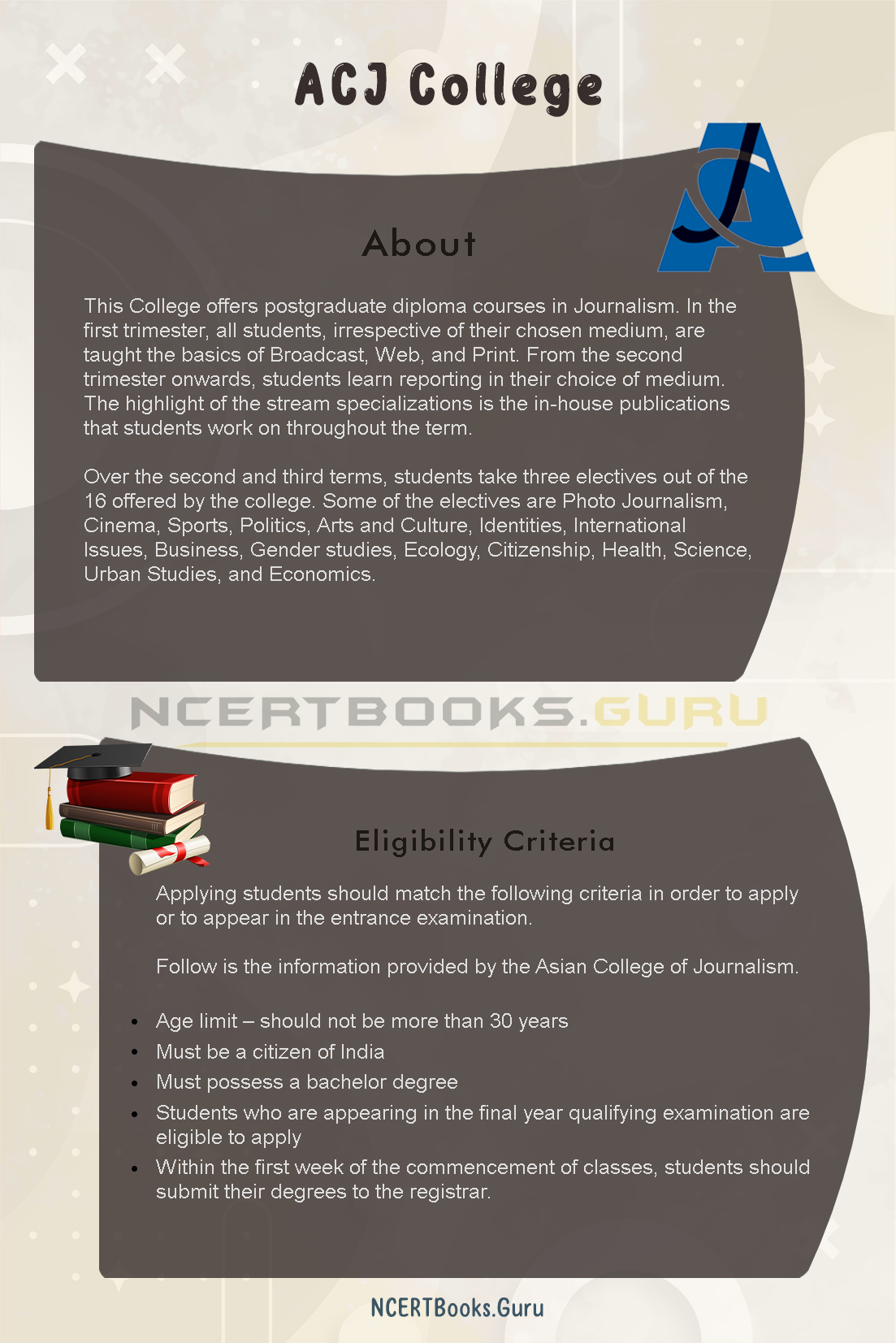
This College offers postgraduate diploma courses in Journalism. In the first trimester, all students, irrespective of their chosen medium, are taught the basics of Broadcast, Web, and Print. From the second trimester onwards, students learn reporting in their choice of medium. The highlight of the stream specializations is the in-house publications that students work on throughout the term.

Over the second and third terms, students take three electives out of the 16 offered by the college. Some of the electives are Photo Journalism, Cinema, Sports, Politics, Arts and Culture, Identities, International Issues, Business, Gender studies, Ecology, Citizenship, Health, Science, Urban Studies, and Economics.

ACJ College Courses & Syllabus 2022

College Asian College of Journalism(ACJ)
Location Chennai, India
Offered Courses Journalism Courses
Website www.asianmedia.org.in
ACJ Courses and Syllabus Available Now

ACJ Course Details

ACJ College offers PG Diploma courses in Journalism. Here is the list of courses provided by the college. Just have a glance at these courses.

  • PG Diploma in Journalism (Print)
  • PG Diploma in Journalism (New Media)
  • PG Diploma in Journalism (Television)
  • PG Diploma in Journalism (Radio)

Core Courses offered by the College

  • Reporting, Writing, and Editing
  • Integrated Journalism
  • Quantitative methods
  • Key issues in business Journalism
  • Bloomberg training
  • Principles of economics
  • Understanding Companies
  • The history of corporate India
  • Finance and financial markets
  • Data Visualisation
  • Long-form Writing
  • Investigative Reporting
  • Personal finance
  • Understanding and reporting the contours of the new economy: less cash and share economy.

ACJ College Syllabus

Here is the Syllabus for all courses offered by the College. Here are the files provided, you can just download the PDF files by the links available by clicking on them. These Syllabus PDF will also be available on the official website of the ACJ College. Candidates who want to prepare for the exams must first know the Syllabus.

ACJ 2022 Exam Dates

The exam date for the entrance exam is not yet declared. We will update the exam date as soon as AAFT releases the official date of the exam. Candidates should check the eligibility criteria before applying for the same. Candidates should fill the application form before the last date of the application ends.

Events Important Dates (Tentatively)
Last date to submit the application form Available Soon
Date of examination Release Soon
Personal interview Update Soon
Declaration of result Available Soon

ACJ 2022 Eligibility Criteria

Applying students should match the following criteria in order to apply or to appear in the entrance examination.

Follow is the information provided by the Asian College of Journalism.

  • Age limit – should not be more than 30 years
  • Must be a citizen of India
  • Must possess a bachelor degree
  • Students who are appearing in the final year qualifying examination are eligible to apply
  • Within the first week of the commencement of classes, students should submit their degrees to the registrar.

Also, Read:

ACJ 2022 Exam Pattern

Session Subject Name Duration of exam Marks
Morning English 2hours 100
Afternoon General knowledge 1:30min 100

ACJ College Courses & Syllabus

FAQ’s on ACJ College Courses

1. Where do I get the Syllabus for all courses offered by ACJ College?

You can get the Syllabus for all courses offered by the ACJ College on our page.

2. How to download ACJ College Courses Syllabus PDF?

You can download the ACJ College Syllabus PDF through the direct links available. Tap on the links and use them as a reference during your preparation.

3. What are the courses offered by ACJ College?

ACJ College offers Courses in Journalism of various specializations. You can check out the courses and their specializations by referring above.

Conclusion

We have provided ACJ College Courses & Syllabus 2021 in this article. Students are requested to share this article with their friends. Students who want to know more details about the ACJ Courses & Syllabus can visit the Official website or keep visiting our website for updates.

LLM Course | Eligibility Criteria, Fees Structure, Syllabus & Jobs

LLM Course

LLM Course: The Masters of Law course is otherwise known as the LLM course. It is a two-year law course offered in many colleges across the country. If you are interested in pursuing a course in the Masters of Law, the information given below is going to be helpful for you. It is going to given details about the course, fee structure, admission procedure, eligibility criteria, and job opportunities.

Get to Know More about other types of Course Details in Stream wise, and Category wise

LLM Course Details

The Masters of Law is a two-year post-graduation law course. The two-year course is divided into four semesters, two each year. It is one of the courses that is offered is many colleges across the country. You can apply and enroll into any of these universities and colleges to pursue a course in Masters of Law.

In the Masters of Law course or LLM course, candidates will learn about specific fields of law through research and theory covered in each semester. Candidates have the freedom to choose a specialisation and pursue that specialisation for the two years of college.

If the candidates fulfill the eligibility criteria that are required, then they can apply and enroll in any of the top colleges and universities that offer the LLM course. There are abundant job opportunities available for candidates who complete this course. Graduates of Maters of Law have job opportunities in the public as well as the private sector.

Skillset Required for Pursuing an LLM Course

There is a certain set of skills that you need to acquire to pursue a post-graduation course like Masters of Law. The more skills you acquire, the more passionate you will grow about the course that you are studying. Here are some of the skills you need to have to pursue an LLM course or be a lawyer:

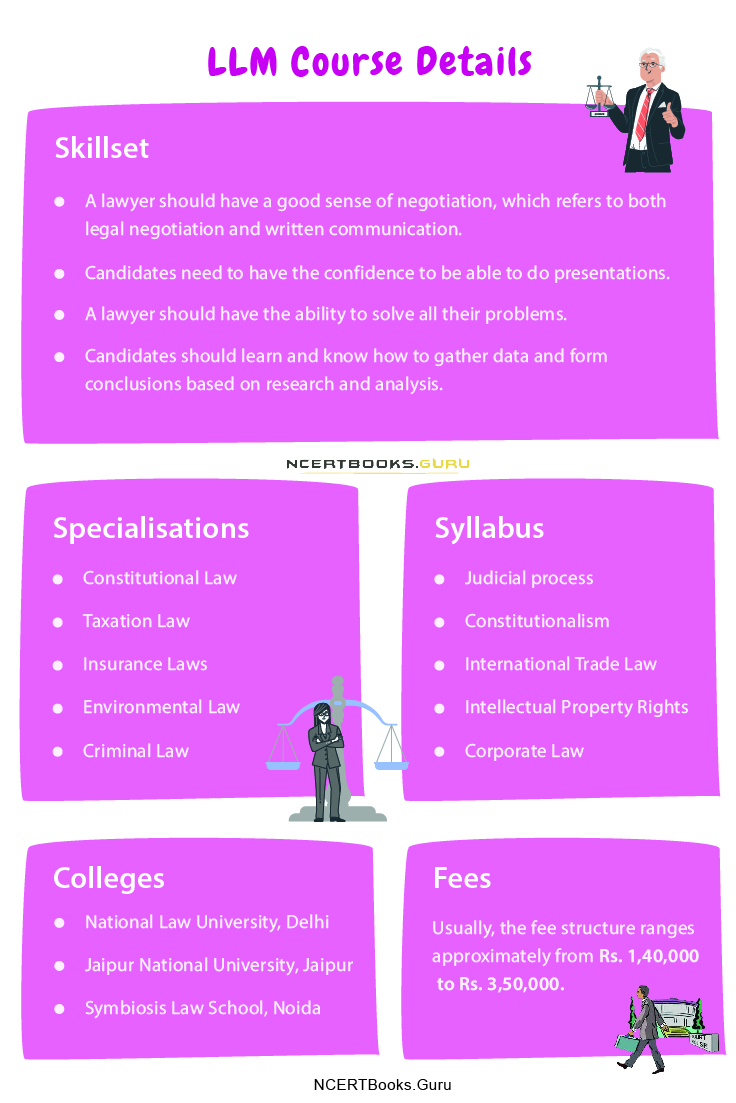
  • A lawyer should have a good sense of negotiation, which refers to both legal negotiation and written communication.
  • Candidates should learn and know how to gather data and form conclusions based on research and analysis.
  • Candidates need to have the confidence to be able to do presentations.
  • A lawyer should have the ability to solve all their problems.
  • Candidates need to have the ability to work under pressure.
  • A lawyer should be hard-working and efficient.
  • The candidate needs to be objective in his approach towards cases.

LLM Course Specialisations

In the Masters of Law course, you have the opportunity to choose a specialisation. You can choose the specialisation which interests you. Here are some of the specialisation options that you can choose from:

  • Constitutional Law
  • International Trade and Business Law
  • Taxation Law
  • Insurance Laws
  • Family Law
  • Corporate Law and Governance
  • Environmental Law
  • Criminal Law
  • Human Rights
  • Intellectual Property Law
  • Jurisprudence

LLM Course Eligibility Criteria

There are certain eligibility criteria that a candidate needs to fulfill to be eligible for a Masters of Law course. Different colleges and universities have different criteria, so you will have to check the website of the college that you apply and enrol in. Here are some of the eligibility criteria that you will need to fulfill:

  • Candidates can apply for an LLM course only if they have finished a graduation course in law, like Bachelor of Law or a five-year LLM course.
  • They need to have finished the graduation course from a recognised university or college
  • The candidate needs to have secured a minimum score of 55% in his or her graduation course.

LLM Course Admission Procedure

Candidates that are interested in pursuing a course in Masters of Law or LLM course can apply after they finish their Bachelor of Law course. Before candidates apply for the course, they need to write the Common Law Admission Test or CLAT. All the colleges across India accept the results of the Common Law Admission Test or CLAT. Many colleges have the entrance exams that the candidates will have to register and appear for them. Candidates must appear for these entrance exams to join the LLM course.

The entrance exams are multiple-choice questions that will be divided into sections. The syllabus of the examination is usually based on the legal knowledge of the candidates.

LLM Course

LLM Course Syllabus

Syllabus of the Masters of Law (LLM) is a factor that is similar in all the colleges and universities. Get to know about the syllabus of the Masters of Law course. There may be a slight variation, but the core subjects are the same in all the institutes. Given below is a list of some of the subjects that you will teach in class:

  • Law and Social Transformation in India
  • Judicial process
  • Legal Research and Methodology
  • Alternative Dispute Resolution
  • Constitutionalism
  • Human Rights and Humanitarian Law
  • International Trade Law
  • Intellectual Property Rights
  • Corporate Law

List of Colleges Offering LLM Course

There are many colleges across the country which offer the Masters in Law course. Some of the best colleges in the country that offer the LLM course is given below. Choose a college that is best suitable for you and apply in that college. Here is a list of some of the colleges in the country which has this course:

  • National Law School of India University, Bangalore
  • National Law University, Delhi
  • NALSAR University of Law, Hyderabad
  • National Law Institute University, Bhopal
  • Jaipur National University, Jaipur
  • National University of Juridical Sciences, Kolkata
  • Symbiosis Law School, Noida

LLM Course Fee Structure

Fees are one of the factors which vary from institute to institute. You will have to check the website of the college that you apply and enrol in for proper details about the fee structure. Usually, the fee structure ranges approximately from Rs. 1,40,000 to Rs. 3,50,000.

Job Description and Career Prospects of LLM Course

Law is one of the fields where there are jobs available in the private and public sectors. It is a profession that has a lot of opportunities for different kinds, and you will pursue a career in any of these different sectors. Opportunity is abundant in the field of law.

The Central government and state government release a list of posts that are available for lawyers and LLM graduates. Candidates are hired through entrance exams for the different government department which are hiring.

There are various job opportunities for lawyers in the private sector too. All companies have a legal department for which they need passionate and intellectual lawyers. They regularly hire lawyers and graduates of Masters of Law to take care of the legal duties and provide legal counsel.

There’s another option that lawyers have, and they can start their practice. If a lawyer thinks that he or she has the skills and resources, they can start their practice.

Job Opportunities for Lawyers

Here are some of the job opportunities that lawyers have:

  • Advocate
  • Magistrate
  • Judge
  • Trustee
  • Oath Commissioner
  • Notary
  • Legal Associate
  • Legal Consultant
  • Legal Document Reviewer
  • Professor
  • Fraud Investigator

Top Recruiters of LLM Course

There are many legal firms where they provide job opportunities to graduates of Masters of Law. Here are some of the top legal firms in the country:

  • L&L Partners
  • Khaitan & Co.
  • Shardul Amarchand Mangaldas & Co.
  • Cyril Amarchand & Mangaldas

LLM Course Salary

Salary is a factor that varies from one company to another. There are various reasons for the variation, like educational qualifications, skill set, experience and many more variations. The salary of a graduate of Masters of Law mainly depends on the job profile that they hold. Usually, the starting ranging of salary for candidates who finish Masters of Law is approximately around Rs. 2,50,000 to Rs. 4,00,000 per year. The salary increases as the candidate’s experience and skillset increases. The salary of legal consultants and legal advisers starts at Rs.4,00,000 to 7,00,000 per year. The salary of a private practitioner who is a lawyer for the supreme court earns up to Rs. 1 crore per year.

FAQ’s on LLM Course

Question 1.
What is the LLM Course?

Answer:
Masters of Law is a law course otherwise known as LLM. It is a two-year postgraduate course that candidates can pursue after completing their Bachelor of Law.

Question 2.
What are the eligibility criteria to apply for this course?

Answer:
The eligibility criteria for pursuing a Masters of Law course are simple. Candidates need to have a Bachelor’s of Law degree with a minimum percentage of 55.

Question 3.
Which are some of the specialisations in the LLM Course?

Answer:
In a Masters of Law, degree candidates have the opportunity to pursue specialisations. Here are some of the specialisations:

  • Constitutional Law
  • International Trade and Business Law
  • Taxation Law
  • Insurance Law
  • Family Law

Question 4.
Which are some of the colleges and universities that offer this course?

Answer:
There are many colleges and universities across the country that offer the LLM course. Here are some of the top colleges that offer this:

  • National Law School of India University, Bangalore
  • National Law University, Delhi
  • NALSAR University of Law, Hyderabad
  • National Law Institute University, Bhopal
  • Jaipur National University, Jaipur

Question 5.
What are some of the job profiles that a graduate of Masters of Law can pursue?

Answer:
Various job opportunities are available for a graduate of Masters of Law. Here are some of the job profiles:

  • Advocate
  • Magistrate
  • Judge
  • Trustee
  • Oath Commissioner
  • Notary
  • Legal Associate
  • Legal Consultant