2 Years Post Graduate Diploma in Canada | Top Colleges, Course Fee, Benefits of Studying

2 Years Post Graduate Diploma in Canada

The “abroad dream” or “the foreign dream” is one that has been inculcated to students in India for many years now and it has become more impressive now than ever before due to increased globalization and sensationalization of western education and way of life. Every year thousands are in fact lacs of students dream of doing their masters in countries like the United States of America Canada European and Asia Pacific countries. However, not many students are guided well regarding their career aptitude and the kind of future that they want to set themselves for in these foreign lands.

In this particular article on 2 Year PG diploma in Canada, we are going to give a fundamental idea for aspirants on what their life would be in Canada during their academic career as well as after their graduation in the course of diploma. At the end of this article on 2-year diploma postgraduate course in Canada, a student will be able to get answers to the following questions:

1. What is a postgraduate diploma?
2. What are the different two-year PG diploma courses in Canada?
3. Is Canada a good country to pursue a master’s in?

In the process of answering the above three fundamental questions that every aspirant will have before applying for foreign universities, we aim to provide a 360-degree overview of life in Canada during education and after so that students can make an informed choice about their career and life.

What is Post Graduate Diploma?

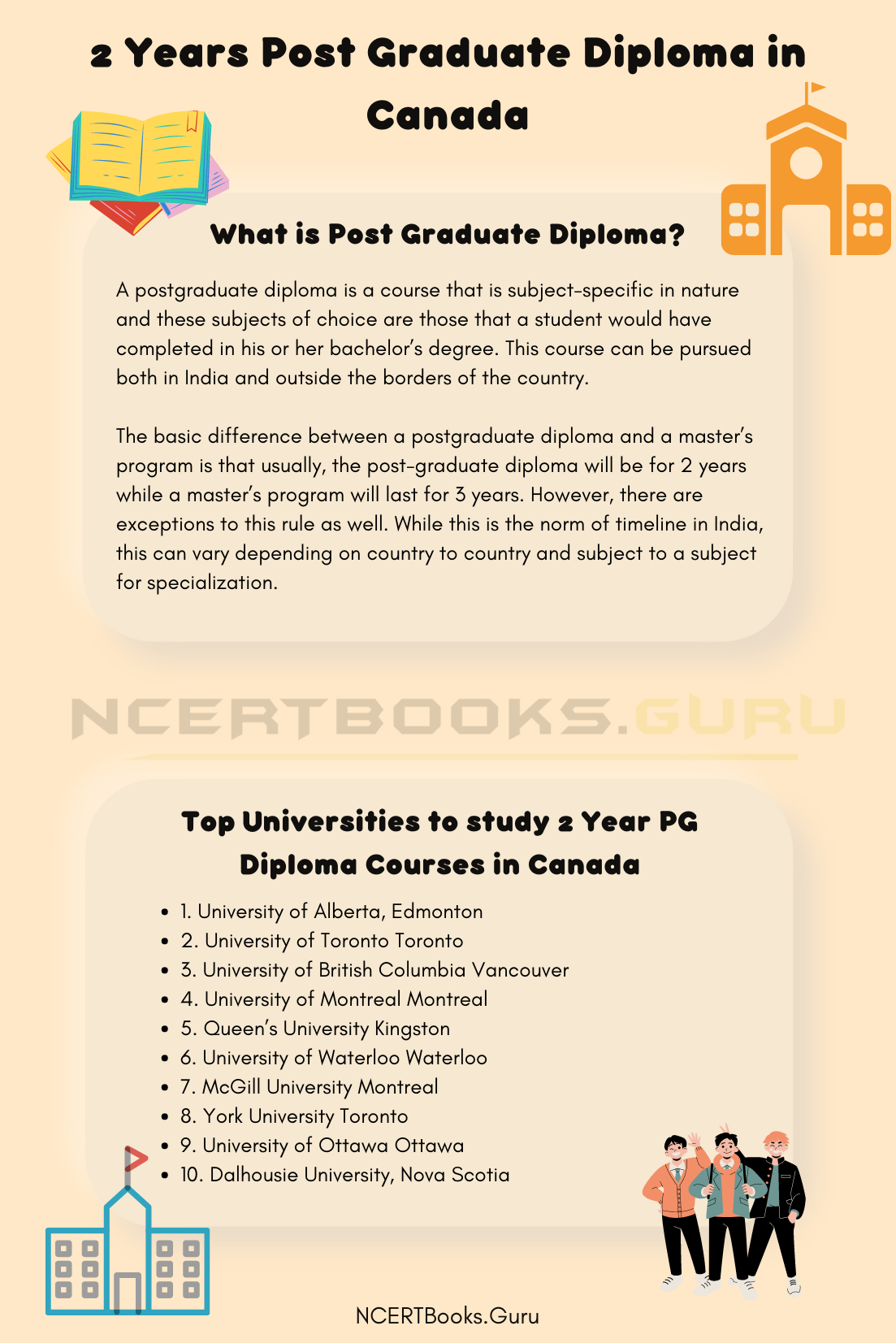
A postgraduate diploma is a course that is subject-specific in nature and these subjects of choice are those that a student would have completed in his or her bachelor’s degree. This course can be pursued both in India and outside the borders of the country.

The basic difference between a postgraduate diploma and a master’s program is that usually, the post-graduate diploma will be for 2 years while a master’s program will last for 3 years. However, there are exceptions to this rule as well. While this is the norm of timeline in India, this can vary depending on country to country and subject to a subject for specialization.

Usually, students pursue graduation in diploma for better career opportunities, lucrative jobs and to gain more subject-specific knowledge. While in bachelor’s degree students will be studying general subjects, in postgraduate diploma courses, the students will be studying in-depth of their subject of specialization.

Get complete details about various course details all under one place and clarify all your queries like course duration, fees, admission process, etc.

List of 2 Year PG Diploma Courses in Canada

There are plenty of courses in postgraduate diplomas in Canada that an Indian student can pursue after their 10th or 12th standard. In this particular section of 2 year PG diploma course in Canada we are going to provide 5 such courses depending on the following priorities that most students aspiring to study in Canada will have:

Benefits of doing Postgraduate Diploma Courses in Canada

1. Job opportunities
2. University rankings
3. Syllabus and pedagogy
4. Faculty
5. Alumni
6. Placements
7. Infrastructure
8. Job satisfaction
9. Crowd
10. Future job market trends

Based on the above factors you can find below a few of the most lucrative postgraduate diploma courses in Canada that a student should definitely keep in their bag to have a stable career, both financially and socially.

Postgraduate Diploma in Management or Business Administration

Now that the world is becoming smaller and smaller due to increasing globalization and ever-expanding industrialization and private sector space, the need for good leadership to manage companies and run profitable businesses is at its peak in the 21st century. With regards to this, the lookout for quality business administrators by companies across industries is why a post-graduate diploma in business administration holds a unique value in the recruiters’ book. If a student is looking for steady financial growth as well as job satisfaction, then he or she should pursue a course of diploma in business administration or management in Canada.

Business Analytics and Data Analysis

As they say, data is the new oil. With the advent of the smartphone and the increased usage of smart AI-driven devices by people across the world, millions of bytes of data are generated every minute. And without an iota of doubt, this generated data is useful for businesses to take calculated business decisions towards the aim of profitability and sustainability.

A course of postgraduate diploma in data analytics will provide students enough knowledge on how to use raw data and convert it into scalable business decisions which in turn makes him or her extremely valuable for business houses across the world.

It is no doubt that every company is going digital and is adapting to the new age of artificial intelligence and machine learning and the need for quality data analysts has been increasing across the sector. Given the contribution of GDP percentage by service sector manufacturing sector, agriculture sector or even governmental sectors, in India, the importance of data analysis for economic growth is high.

Health Care and Pharmaceutical Sciences

USA and Canada are two of the most lucrative markets around the globe in terms of the healthcare and pharmaceutical industries. The sole reason for this is the healthcare sector benefits (government aided) that their respective governments offer.

There are plenty of pharmaceutical companies in Canada that are looking for competent people for their quality assurance, quality control, business development, production planning, inventory control, scientific researcher, research analyst, and scientists to develop complex molecules and drugs which might be life-saving. As a result of which, a PG diploma course in Canada in healthcare and pharmaceutical sciences is extremely lucrative and can provide a wonderful career for the student.

Advertising and Brand Management

Advertising and branding have changed their course manifold as compared to the ones in the late 19th century. Advertising is not just posters, flashy videography, or punchlines and taglines or slogans. It’s about story building and narrative efforts built around the product or service. The advent of social media platforms and the ever-increasing usage of smartphones have changed in totality, the way that advertising and branding have been done in today’s world.

Right from targeted advertisements to social media marketing, branded content all across the mediums has become the norm and it is the creative strategies that will survive in this already overcrowded market. As a result of which, content creation has become the core part of advertising and brand management and companies are continuously looking out for talents that can provide the proper strategy to make them stand out from the crowd.

If you believe that you are a creative person who understands the market and knows how to deliver great customer value on the product or services in question, then a course diploma in marketing management, advertising, and brand management is a perfect one for you to have a bright career ahead.

Financial Management

Canada has one of the biggest stock markets and regulated funds around the world. Stock investments, dividend decisions, and financial decisions are extremely important to manage the financial portfolios and there are plenty of large investment banks located in Canada that are looking out for talents who can manage their finances and take proper business decisions.

A 2 year postgraduate diploma course in financial management will provide a gateway for students to get into the world of finance in a highly developed country like Canada and become financial leaders and banking leaders of the world in years to come.

While we have mentioned only five courses that we think are lucrative to a student, one has to make a thorough analysis and come to a conclusion depending on his or her competency, aptitude level, and personal desires and ambitions.

Do Refer:

Is Postgraduate Diploma in Canada Worth it?

There are plenty of reasons for one to pursue a postgraduate diploma in Canada and the following are a few of the reasons that we found that we feel that Canada is a perfect country to pursue a master at:

1. Globally recognized universities
2. Large job market
3. Friendly government policies for education
4. Highly skilled talent pool in areas of specialization
5. One of the most attractive climatic conditions
6. Indian diaspora present in Canada
7. Good work-life balance
8. The most highly developed countries in North America
9. Large industries and the banking sector present in the
10. Geographically and ethnically one of the most beautiful places to live in

Below we have listed some of the top universities in Canada to pursue a 2 year post graduate diploma:

Top Universities to study 2 Year PG Diploma Courses in Canada

1. University of Alberta, Edmonton
2. University of Toronto Toronto
3. University of British Columbia Vancouver
4. University of Montreal Montreal
5. Queen’s University Kingston
6. University of Waterloo Waterloo
7. McGill University Montreal
8. York University Toronto
9. University of Ottawa Ottawa
10. Dalhousie University, Nova Scotia
2 Years Post Graduate Diploma in Canada

FAQs on 2 year Post Graduate Diploma in Canada

1. How much does it cost to do 2 year PG in Canada?

2 year PG Diploma Courses in Canada Fee varies anywhere between 15 lacs to Rupees 50 lacs depending on the university ranking, geographical location, and course structure

2. Can you do a part time job in Canada during the Diploma course?

Yes, you can do a part-time job in the industry of your choice and earn money while pursuing a 2 year Post Graduate Diploma in any field in Canada

3. Which is better 2 year PG Diploma in, USD or Canada?

It depends on the type of course and the financial condition of an aspirant. If you can ready to cough up hefty amounts on fees and living expenses, the USA would make a great choice since it has plenty of the world’s top-rated universities. However, if you want quality as well as affordable education, then Canada it is.

4. Which exams to give to pursue 2 year PG in Canada?

A candidate has to compulsorily give IELTS exam to pursue his or her education in Canada, in addition to other optional exams such as GRE or GMAT, as described by the university that one is applying to.
Cyber Security Course Details | SkillSet, Eligibility Criteria, Career Prospects, Duration

Cyber Security Course Details

Cyber Security Course Details: India battles a 37 percent increase in cyberattacks such as unpatched software, malware, hacking, phishing, identity theft, hijacking files, and many more. To ensure the system’s integrity and confidentiality of sensitive information, Cybersecurity courses introduce the basics of the field.

This article provides you the list of Cyber Security courses as a reference for school or college work. Below are the course program’s recorded structure for aspirants to pursue after twelfth or after graduation. This report covers the overall topics like prospectus, course gradations, particulars on qualification, the confirmation process, fee structure, and vocation possibilities.

Get to Know More about other types of Course Details in Stream wise, and Category wise

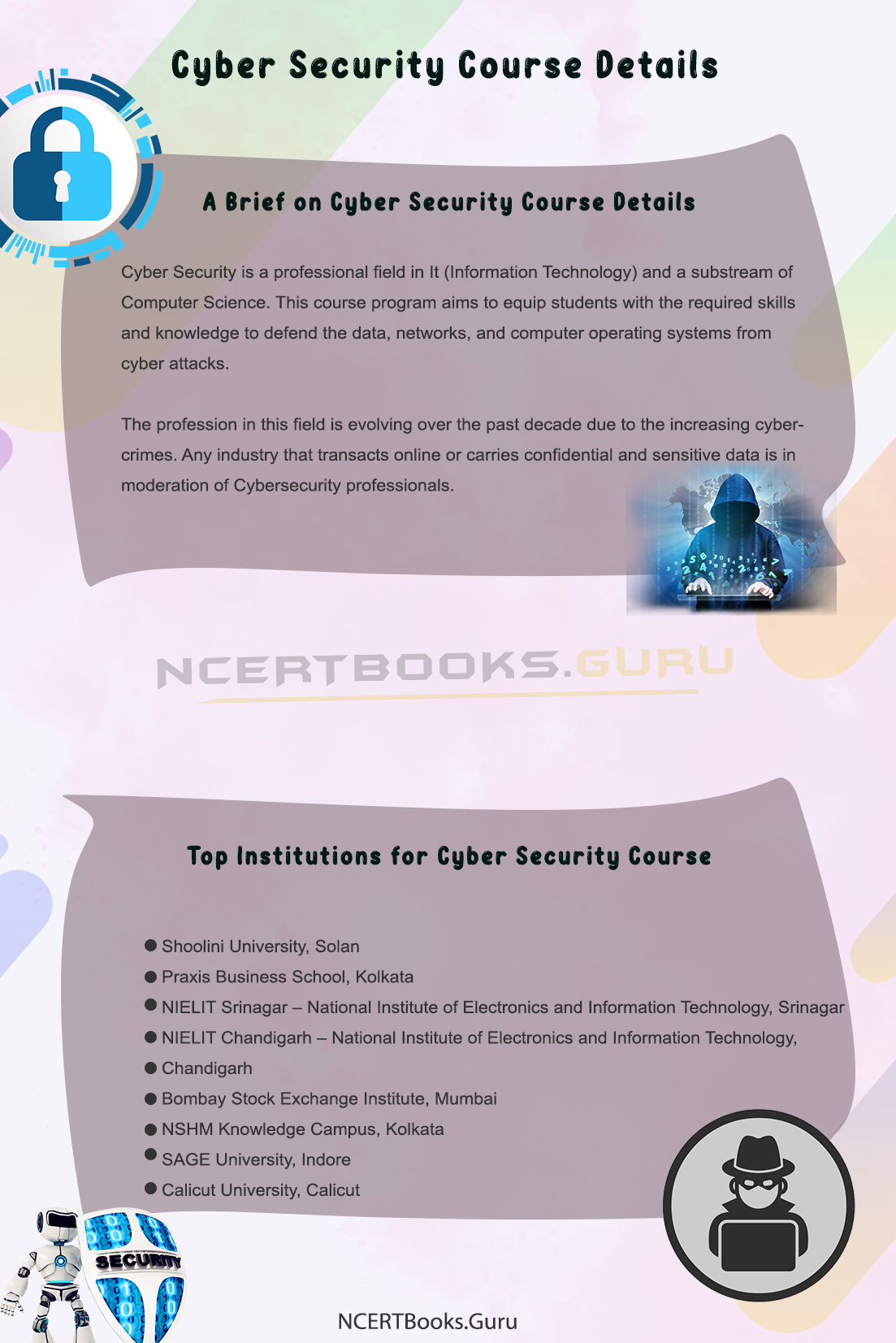
A Brief on Cyber Security Course Details

Cyber Security is a professional field in It (Information Technology) and a substream of Computer Science. This course program aims to equip students with the required skills and knowledge to defend the data, networks, and computer operating systems from cyber attacks.

The profession in this field is evolving over the past decade due to the increasing cybercrimes. Any industry that transacts online or carries confidential and sensitive data is in moderation of Cybersecurity professionals.

Cybersecurity courses are prevalent through Degree programs, training, and certification in information technology, information security, and cybersecurity. This course program offers bachelor’s, masters and even certificate level with practices and processes for network protection and data from unauthorized attacks.

Through these different programs, students learn to detect the vulnerabilities of a system, identify security issues, ward off attacks, protect the information, track down the individual who hacked data, and manage emergencies.

Cyberspace is a platform that safeguards data from delinquents and os accessed by anyone from any corner of the globe. Because cybersecurity is necessary, homeland security and various other sectors have incorporated cyberspace as a part of their program. Thus, the scope of cybersecurity is equally yet varied with a different focus across the globe

Some of the essential topics covered in cybersecurity classes include:

  • Information management
  • Computer systems
  • Risk management
  • Cyber law and ethics
  • Technical report writing
  • Investigation techniques

Skillset Required for Cyber Security Courses after 12th

With the evolution of technology, Cybersecurity professionals need to stay updated with the latest advancements to cushion against world cyber threats. Here are the following cybersecurity skills that make you an in-demand expert in the field:

  • Cloud Security
  • Security Analysis
  • Black-Hat thinker
  • Programming
  • Mitigation and Risk Analysis
  • Intrusion Detection
  • Reversing and Malware Analysis

Cyber Security Course Details

Candidates are offered with multiple options prospecting their career in Cyber Security. Candidates can opt Degree course programs, Diploma Course programs, Certification course programs, both at UG and PG level.

Cyber Security course programs can be pursued as a full-time course or part-time course or even online. A majority of the Cyber Security course programs are offered as full-time course programs by private and government institutions. However, certification courses are more relevant to prospective students.

Degree Cyber Security Course Program

Students can pursue B. Tech or B. Sc Degree in Cyber Security and Computer Science (CS) after the completion of their higher secondary education.

B. Tech degree course programs in Cyber Security/ Computer Sciences are conducted for four years, and B. Sc in Cyber Security/ Computer Sciences is a three-year-long course duration.

Diploma Cyber Security Course Program

Students are eligible to pursue Diploma courses in Cyber Security programs at both Undergrad and Postgrad levels.

The course duration for both Undergrad and Postgrad Diploma course programs fluctuates between 10 months to 1 year-long duration.

Cyber Security Certification Course Programs

Certification course programs in Cyber Security/Computer Sciences are short-term course programs majorly offered online and some offline.

The entire Computer Sciences/ Cyber Security course duration for can fluctuate between three to six months long.

Accessible Cyber Security Course Program

Here are a few popular Cybersecurity Degree and Certificate courses available in India for interested students:

Degree Course Programs

  • B.Tech or M.Tech in Computer Science Engineering with Cyber Security
  • B.Tech or M.Tech in Computer Science Engineering with Forensics and Cyber Security
  • B.Tech or M.Tech in Computer Science Engineering with Cyber Security and Networking
  • B.Tech or M.Tech in Computer Science Engineering with Quick Heal and Cyber Security
  • B.Tech or M.Tech in Computer Science Engineering with Certified Cyber Security Investigator
  • B.E in Information Technology with IBM
  • B.Sc in Cyber Security
  • B.Sc in Information Cyber Security and Technology Management
  • BCA Hons. In Cyber Security
  • BCA with Microsoft Cloud Computing and Cyber Security

Certification Course Programs

  • Certified Ethical Hacker course
  • Certificate in Information Security course
  • Certified Risk and Information System Control course
  • ISACA Certified Information Security Management course program
  • ISACA Certified Information Security Auditor course program
  • ISC Certified Information Systems Security Professional course program
  • Cisco Certified Network Professional
  • Cisco Certified Information Security Expert

Cyber Security Specialisation Programs

In India, several cybersecurity courses offer various specialization programs. Given below is a list of Cyber Security Specialisation course programs for interested candidates to choose when willing to take up a course in Cyber Security.

Degree Specialisation Courses

  • Information Security with IBM
  • Information Technology Management and Cyber Security
  • Computer Science with Cyber Expert Investigator
  • Computer Science with Cyber Security and Quick Heal program
  • Computer Science with Networking and Cyber Security
  • Computer Science with Cyber Security and Forensics program

Certification Specialisation Cyber Security Courses

  • Security Professional
  • Information System Auditor
  • Information Systems Security Professional
  • Information Security Management
  • Certified Systems Engineering
  • Cyber Expert and Investigator

Cyber Security Course Eligibility Criteria

The eligibility factor varies from across the institutions in India. Each institution holds a different selection process and eligibility factor based on the available course level and type. To pursue a Cyber Security course program at Undergrad and postgrad levels, candidates must meet the essential eligibility criteria.

  • Eligibility Criteria for Undergrad Cyber Security Courses: To clear the admission process for any of the undergraduate degree programs in Cyber Security, candidates should have completed higher secondary education (10+2) in the stream of science with a minimum aggregate from a recognized board or equivalent.
  • Eligibility Criteria for Postgrad Cyber Security Courses: To be able to clear the admission process in the master’s program, candidates should complete their graduation in Cyber Security with a minimum of 50 percent aggregate in the qualifying examination from a recognized university or institution.

Cyber Security Course Fees

Cyber Security Course Fees structure for different colleges ranges from INR 1,30,000 to 2,00,000.

Entrance Examinations Under Cyber Security Course

Most institutions in India offering Cyber Security courses have a uniques selection process and admission criteria based on the type and levels of courses being offered.

The admission process to the degree courses in Cyber Security is through national level examinations. However, some reputed institutions take admission ob the basis of entrance levels exams such as CET, IIT-JEE, etc.

Some institutions conduct in-house entrance examinations for admission to the diploma courses. Those candidates applying for cybersecurity certifications have no entrance examination of any sort.

Cyber Security Course Curriculum

The course curriculum for Cyber Security varies based on the level and type of courses. However, the generic course curriculum for Cyber Security courses are as follows:

  • An Introduction to Cyber Security
  • Measuring Cyber Security
  • Security Investment and Management
  • Market Failures and Policies
  • Policy Interventions to Correct Market Failures
  • Case Study: Cooperation and information sharing
  • The Human Factor

Top Institutions for Cyber Security Course

  • Shoolini University, Solan
  • Praxis Business School, Kolkata
  • NIELIT Srinagar – National Institute of Electronics and Information Technology, Srinagar
  • NIELIT Chandigarh – National Institute of Electronics and Information Technology, Chandigarh
  • Bombay Stock Exchange Institute, Mumbai
  • NSHM Knowledge Campus, Kolkata
  • SAGE University, Indore
  • Calicut University, Calicut
  • Karunya Institute of Technology and Sciences, Tamil Nadu
  • Apeejay Institute of Management and Engineering Technical Campus, Jalandhar

Cyber Security Course Details

Career Prospects of Cyber Security

After the completion of Cybersecurity course programs, graduates can work as Cybersecurity professionals, or information security analysts with a broad spectrum of responsibilities. A graduate’s primary job in this field is to safeguard an organization’s files and network, create security plans, monitor activity, and install firewalls.

Graduates can look forward to work in the following job profiles:

  • Cryptographer
  • Vulnerability Accessor
  • Forensic Expert
  • Security Software Developer
  • Penetration Testes
  • Chief Information Security Officer
  • Security Engineer
  • Security Architect
  • Security Manager
  • Security Auditor
  • Security Code Auditor
  • Security Consultant
  • Security Administrator

Top Recruiters Under Cyber Security

Graduates from Cybersecurity courses get recruited incorporates and MNCs such as:

  • Banks
  • Apple
  • Patient First
  • Lockheed Martin
  • General Motors
  • Capital One
  • Cisco
  • Intel
  • Northrop Grumman
  • Boeing

Salary Prospects of Cyber Security Course Holders

The average salary for a cybersecurity a fresh graduate is around INR 7 lakhs per annum. However, with time and experience, the pay package increases. Experienced resources are in more demand, drawing salaries in the range of INR 20 lakhs to INR 24 lakhs per annum.

FAQ’s on Cyber Security Course Details

Question 1.
What scope do the Cybersecurity courses offered in India?

Answer:
India has turned into a breeding ground for Cyber Security experts. In India, the scope of Cyber Security has turned to a more competitive platform. The average salary for a cybersecurity a fresh graduate is around INR 7 lakhs per annum. However, with time and experience, the pay package increases. Experienced resources are in more demand, drawing salaries in the range of INR 20 lakhs to INR 24 lakhs per annum.

Question 2.
What are the different course categories offered For Cybersecurity courses?

Answer:
Candidates are offered with multiple options prospecting their career in Cyber Security. Candidates can opt Degree course programs, Diploma Course programs, Certification course programs, both at UG and PG level.

Question 3.
What is the eligibility factor for a candidate to apply for Cybersecurity courses?

Answer:
The eligibility criteria differ for course type and level. However, the standard criteria to be met by applicants are:

  • For undergraduate degree programs in Cyber Security, candidates should have completed higher secondary education (10+2) in the stream of science with a minimum aggregate from a recognized board or equivalent.
  • For the master’s program, candidates should complete their graduation in Cyber Security with a minimum of 50 percent aggregate in the qualifying examination from a recognized university or institution.

Summary of Cyber Security Course Details

We hope that the information mentioned above regardingCyber Security Course Details has helped improve your understanding of the subject with in-depth knowledge.

About Distance Engineering Courses | Tips and Tricks, Eligibility, Entrance Exams, Admission, Top Institutions, Fee Structure, Job Opportunities, Salary, Top Recruiters in 2022

Distance Engineering Courses

Distance Engineering Courses approved by AICTE: Distance learning is a form of education where technology is used for the interaction between students and teachers. This method is extremely helpful for those students who are not able to attend universities or schools due to problems. With technological advancement, distance learning has become extremely popular in the education system.

Engineering Courses are one of those courses that are available for students to learn in distance learning or correspondence mode. Keep reading the following article to know more about distance learning engineering courses and the types of courses available together with all the details that you will ever need about them. So let’s get started!

What are Distance Engineering Courses?

A distance engineering course or a corresponding engineering course is a 4-year-long course that teaches the students various engineering disciplines according to the stream chosen by the students. This course operates in a distance mode and is extremely suitable for people who are either working professionals or cannot attend universities due to some issues.

There are multiple streams in which people can pursue distance learning education in engineering and multiple career opportunities are open after completing this course. If the students are dedicated enough and choose to develop their skills over time distance learning engineering is nothing less than a regular engineering course.

The demand for skilled engineers has been rising in recent times and the industry awaits students who can provide feasible solutions to real-life problems in various disciplines. Top companies hire engineers who are highly skilled, one can have a very glorious career in terms of salary and longevity if they are dedicated enough in the engineering department.

List of Best Distance Engineering Courses in India

Following are the top engineering branches that are available in th distance learning mode to complete your engineering dream via distance mode:

Tips for Making the Most Out of Your Long Distance Engineering Courses

There is a lot of difference between the traditional style of learning where students and teachers have a one-on-one interaction in the classroom and the remote form of learning where technology is your only way to connect with your teachers and your fellow students. You could really use some tips and tricks to make the most out of your distance learning program first of following are some tips that might be useful for you:

  • Participate in active communication with teachers and classmates
  • Have a fixed routine
  • Practice meditation and increase your focus
  • Do not start your school in your pajamas
  • Make sure you prepared your meals
  • Create a learning environment
  • Keep all your distractions away
  • Get used to your devices on which give study
  • Remember to take short breaks
  • Do some extracurricular activities which do not involve technology or gadgets
  • Be kind to yourself

Eligibility for Distance Engineering Courses for Diploma Holders

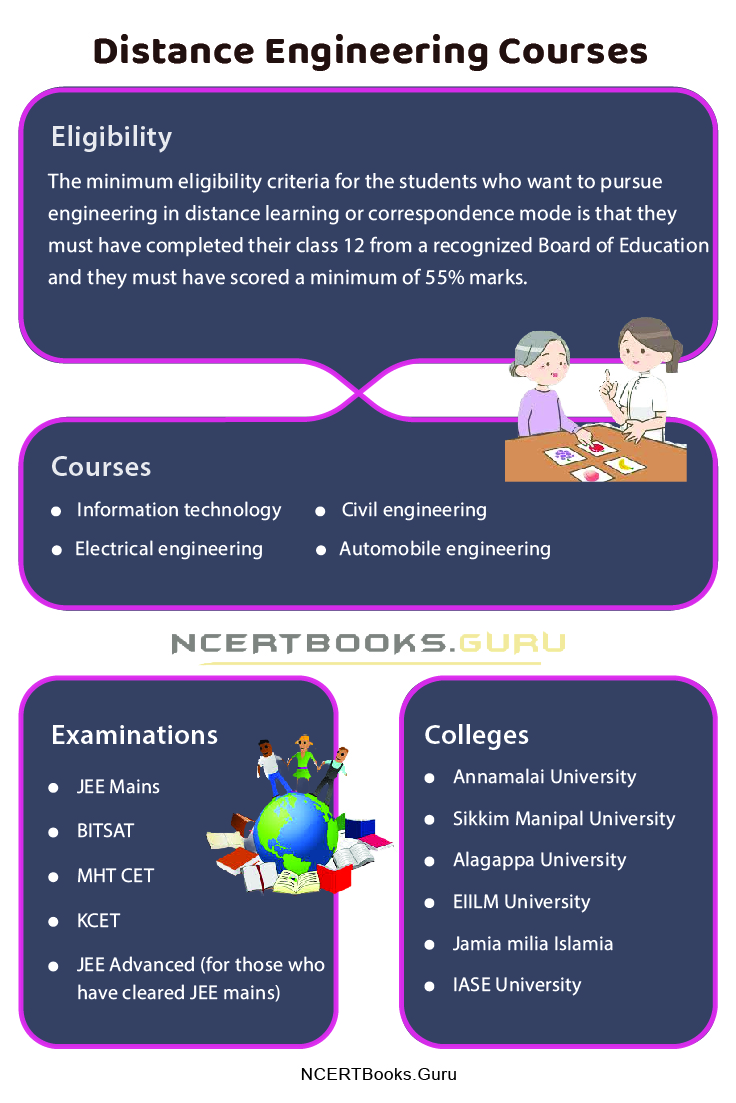
The minimum eligibility criteria for the students who want to pursue engineering in distance learning or correspondence mode is that they must have completed their class 12 from a recognized Board of Education and they must have scored a minimum of 55% marks.

The marks for the 3 main subjects physics, chemistry, and maths must be above 50%. The students who have completed their diploma in engineering can also apply for distance learning or correspondence engineering courses.

How to Apply for Distance Learning Engineering Courses?

  • If the candidate has met all the eligibility criteria for a distance education engineering course, they can now go through the application process to get admitted to their dream college.
  • The students can visit the website of the college that they want to get admitted to and fill out the application form with all their details and necessary documents uploaded in a scanned manner.
  • Candidates can also visit the College in offline mode and fill out the application form physically.
  • The selection of students for these courses is done on the basis of merit and entrance examinations both.
  • If the student wants to get admitted via entrance examinations, the students can register for the examination download the admit card once it is available sit for the test wait for the result and then reach out to the college if they see their name in the selected student’s list.
  • After that, the students will have to go to the college and submit an installment of the fee to reserve a seat in that course.
  • Once you have completed all these formalities, submit the necessary documents, and the fee. Then, the student will finally be selected for the course and they can start preparing for beginning the course.

Entrance Examinations for Admission to Distance Education Engineering Courses

Following is the list of top entrance examinations that are popular among students who want to get admitted to engineering courses be it regular courses or distance learning courses:

  • JEE Mains
  • BITSAT
  • MHT CET
  • KCET
  • JEE Advanced (for those who have cleared JEE mains)

Do Refer: Distance Education Courses

AICTE Approved Distance Education Engineering Colleges in India

There are many universities all across the country that provide distance learning courses. Completing a distance learning engineering course from a good university is as beneficial as doing a regular engineering course if the student is dedicated enough. Top institutions that offer engineering distance learning courses are:

  • Indira Gandhi National Open University
  • Annamalai University
  • Rajasthan Vidyapeeth University
  • Sikkim Manipal University
  • Yashwantrao Chavan Maharashtra Open University
  • Alagappa University
  • Birla Institute of Technology and Science
  • Chaudhary Devi Lal University
  • EIILM University
  • Jamia milia Islamia
  • Lovely Professional University
  • IASE University
  • Manipal University
  • Periyar University
  • Mumbai University
  • Madurai Kamaraj University
  • Symbiosis University
  • St Peter’s University
  • Uttaranchal Open University, and many more.

Fee Structure of Engineering Distance Learning Programs

The fee for distance learning engineering programs can be somewhere between INR 50,000 per annum to INR 10,00,000 per annum. The exact fee completely depends upon the type of college that the student is admitted to stop the fee of government colleges for engineering courses is much lower than that of private colleges for the same course.

Career Opportunities after Completing Distance Learning Engineering Course in India

Completing an engineering course in correspondence mode opens up a lot of opportunities for the candidates many leading companies from different industries hire candidates that have attained the engineering degree and every specialization has great job opportunities stop following are the top job profiles according to various specializations:

Job options after completing BTech in mechanical engineering:

  • Design engineer
  • Researcher
  • Mechanical engineer
  • Process development technologist

Job options after completing BTech in architectural engineering:

  • Technical architect
  • Building inspector
  • Construction manager

Career options after completing Distance BTech Computer Science and Engineering Course:

  • Developer
  • Engineering support specialist
  • Professor
  • Technical writer
  • Computer networks engineer
  • Software engineer
  • Researcher

Job options after completing BTech in information technology:

  • Database manager
  • Web developer
  • Lecturer
  • Information technology engineer

Job options after completing BTech in Distance industrial engineering learning program:

  • Process engineer
  • Quality engineer
  • Industrial manager

Career options after completing distance electronics and communication engineering:

  • test technician
  • First-line technician
  • Electronics technician
  • Field technician

Job Roles after completing BTech distance aerospace engineering:

  • Aerospace engineer
  • Design engineer
  • Aerospace designer checker
  • Manufacturing engineer

Also See: Diploma in Labour Law Distance Education IGNOU Course Details

Top Recruiters for Distance Education Engineers in India

There is a high demand for highly-skilled engineers in different fields all across the globe. Following are the top recruiting companies for different types of engineers:

Software Engineers:

  • Google
  • Goldman Sachs
  • Defence Research and development organization
  • Adobe
  • Microsoft
  • Tata Consultancy Services
  • Cognizant technology solutions
  • Accenture
  • Wipro
  • Capgemini
  • Oracle
  • HCL technologies
  • Hexaware technologies

Mechanical Engineers:

  • Bharat heavy electricals limited
  • Godrej group
  • Thermax
  • Simon’s
  • Ashok Leyland
  • Larsen and toubro
  • Kirloskar brothers
  • Tata group
  • Indian Oil Corporation
  • Mahindra and Mahindra
  • Tata Motors
  • General Motors
  • Coal India
  • NTPC
  • Hindustan Petroleum
  • Aerotech

Electronics Engineers:

  • Hindustan aeronautics limited
  • Steel Authority of India
  • Gas authority India limited
  • Oil and natural gas corporation
  • Bharat heavy electricals limited
  • Uttar Pradesh power corporation limited
  • Defense research and development organization
  • Hindustan Petroleum corporation limited

Civil Engineers:

  • DLF
  • Hindustan construction company
  • LNT
  • Tata projects
  • Sobha developers limited
  • Shapoorji pallonji and company
  • Unitech
  • Sadbhav engineering
  • Skyline builders
  • Metro tunneling group
  • Nagarjuna construction company

Electrical Engineers:

  • Lockheed Martin
  • The Boeing company
  • General Electric
  • ABB limited
  • Bharat heavy electricals limited
  • Apple
  • Tata power
  • Bharat electronics limited
  • Intel
  • Texas Instruments
  • Aditya Birla group
  • IBM
  • Immersion
  • Rockwell Automation

Distance Engineering Courses

Salary of Distance Learning Engineering Graduates

The average salary that a candidate can expect after completing their engineering courses and working as a professional in different fields is somewhere around INR 2,00,000 per annum to INR 10,00,000 per annum. The salary in this field sees a lot of fluctuation since there is a lot of demand for the workforce and there are various different types of students that start working in the engineering field.

Where some students might get a salary of less than 4,00,000 per annum, other sets of students may get a starting salary of about 20,00,000 per annum or more students who work in the IT industry and bag big companies like Google, etc even get salary package worth crores.

FAQs on IGNOU Distance Engineering Courses

1. Can I do distance learning engineering courses after completing class 12th?

Yes, you can definitely pursue distance learning or correspondence engineering courses after completing your class 12. The minimum eligibility criteria for enrolling in a correspondence program for engineering courses is that you must have completed your class 12 from a recognized Board of Education and scored a minimum of 55% marks. You must also have physics, chemistry, and mathematics as your compulsory subjects in class 12th and must have scored at least 50% marks in all 3 of them.

2. What is the fee for distance learning engineering courses?

The fee for distance learning engineering courses can be somewhere between INR 50,000 per annum to INR 10,00,000 per annum or more. The exactly depends upon the college that the student is admitted to. Government colleges charge much lesser fees compared to private colleges for the same course.

3. Will I be able to get the same opportunities if I pursue engineering in distance mode? 

Yes, in today’s world skills are the most important thing. As long as you are skilled and you have a degree in engineering in any mode regular or distance, you will be getting great career opportunities. You must be able to grab those opportunities and make the most of them in order to be successful in your career. Pursuing a course in distance mode doesn’t make you any less of a student than pursuing the course in a regular mode.

Conclusion

We hope that you were able to find all the information regarding the distance engineering courses approved by AICTE that you were looking for. The above article contains details about the distance learning engineering course right from tips to job opportunities after completing the distance education engineering course.

We hope that you make an informed decision for yourself. Do let us know what you felt about this article and stay connected to us for further updates on course details. All the best!

Art Teacher Diploma (A.T.D) Course Details | Eligibility, Syllabus, Fee, Best Colleges, Admission Process, Career

Art Teacher Diploma Course Details

Art Teacher Diploma Course Details: Do you want to become an art teacher in primary and secondary schools? If yes, then you can check the A.T.D course overview before applying for it. There is a huge demand for art teachers in both government and private schools in India. Every year, a lot of jobs are created related to art in the teaching field.  So, the art teacher is a good job to choose.

Art teachers have to prepare, arrange art materials and art equipment in the classroom for the students. They need to deliver lectures to students about art techniques, art history, and so on. You can check the useful information about the art teacher diploma course online like eligibility, syllabus, overview, admission process, top colleges, and career scope in the below-mentioned sections of this page.

What is Art Teacher Diploma?

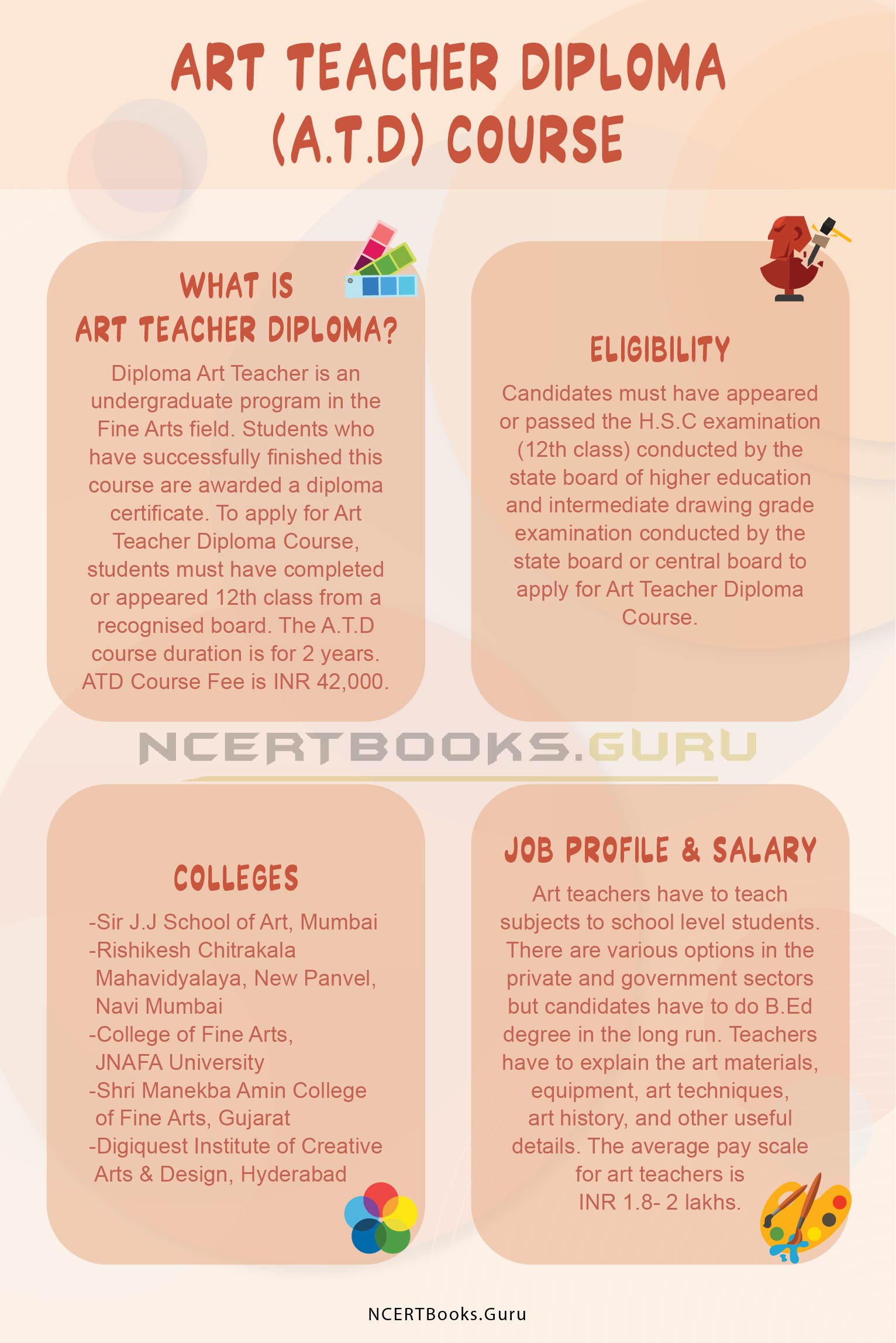
Diploma Art Teacher is an undergraduate program in the Fine Arts field. Students who have successfully finished this course are awarded a diploma certificate. To apply for Art Teacher Diploma Course, students must have completed or appeared 12th class from a recognised board. The A.T.D course duration is for 2 years. ATD Course FEe is INR 42,000.

The diploma in art education course is mainly designed to meet the requirements of art teachers so as to equip them for art teaching in collegiate institutions including higher art institutions. The course gives them knowledge on art skills, teaching skills, drawing skills, and many more. Art Teacher Diploma Course details completed individuals can get art teacher jobs in primary and secondary schools with the best salary.

Art Teacher Diploma Course Details – Overview

Parameter Details
Course Name Art Teacher Diploma
Course Level Diploma
Course Duration 2 Years
Stream Fine Arts
Eligibility Details H.S.C or Intermediate
Admission Procedure Merit List
Art Teacher Diploma Course Course Fees INR 42,000
Job Art Teacher
Pay Scale Rs 21,230 to Rs 63,010/-

Art Teacher Diploma Course Details – Eligibility Conditions

Candidates must have appeared or passed the H.S.C examination (12th class) conducted by the state board of higher education and intermediate drawing grade examination conducted by the state board or central board to apply for Art Teacher Diploma Course. Also, check other courses after 12th class details.

A.T.D Course Admission Process

Students should follow the below provided instructions to complete the admission process for Art Teacher Diploma Course Details. Candidates are given admission to the college based on the merit list.

  • 12th grade passed students can choose any one college to apply for an art teacher in diploma.
  • Go to the official website of the college.
  • Download the application form.
  • Enter personal details, educational qualifications, and other required details in the application.
  • Pay the application fee via the draft.
  • Send the application form, required documents to the college address before the due date.

Do Check:

Diploma in Art Teacher Course Fees

Year A.T.D Course Admission Fee A.T.D Course Fee Total Fee
Ist Year 200 20,820 INR 21,020/-
2nd Year 200 20,840 INR 21,040/-

Best Art Teacher Diploma Course Colleges

The list of top diploma in art teacher course details colleges is provided here.

  • Sir J.J School of Art, Mumbai
  • Rishikesh Chitrakala Mahavidyalaya, New Panvel, Navi Mumbai
  • College of Fine Arts, JNAFA University
  • Shri Manekba Amin College of Fine Arts, Gujarat
  • Digiquest Institute of Creative Arts & Design, Hyderabad

Art Teacher Diploma (A.T.D) Course Details

Art Teacher Diploma Syllabus

Here we are giving the names of all subjects included in the A.T.D diploma course. Candidates should score qualifying marks in all these subjects to get the diploma certificate.

A.T.D First Year Subjects

  • Fundamentals of Art
  • Projection Drawing-Perspective
  • Theory of Education and Child Art.
  • Art Expression -(Dance, Drama & Music)
  • History of Art (Indian) Part-I
  • Object Drawing (Manmade / Natural)
  • Drawing -Memory / Imaginative
  • Work Experience: A – Clay, B – Paper & Cardboard work
  • 2D Design & Print Making
  • Colour-Theory & Practical
  • Drawing & Painting
    • Memory & Imagination
    • Object Drawing (Manmade & Nature)
    • Perspective Drawing
    • Outdoor Study (Sketching & Landscape)
    • Blackboard Drawing & Calligraphy
  • Design
    • 2D & 3D Design
  • Theory & Practical
  • Work-Experience
  • Clay Work
  • Paper & Cardboard Work
  • Language Teaching Methodology
  • Class Work
  • Project
  • Micro Teaching

A.T.D Second Year Subjects

Practical Drawing

  • Human, Natural or Manmade Objects
  • Memory/Imaginary Drawing
  • Perspective
  • Still Life: Creative/Realistic
  • 2-D Design: Composition & Print Making
  • Work Experience:
    • Doll Making & Toys
    • Screen Printing

Technical

  • Art Expression (Teaching Methods)
  • Art (Drawing-sculpture, Dance-Drama & Music) integrated teaching
  • History of Art (Indian) Part-ll
  • Theory of Education Part-ll
  • BlackBoard Drawing/Writing
  • Project Work: Based on any Art Form (Drawing, Sculpture, Architecture, Folk Art, Indian Art) with following Points
    • Place – Period
    • Artistic Importance
    • Remarks

Diploma Art Teacher Course Career Scope, Job Profile and Salary

Diploma in fine arts degree holders has plenty of options to choose from in terms of their career. One can choose areas like teaching, archaeology, etc in terms of their career. The best and most of the individuals choose to teach options in secondary, primary schools, and colleges.

Art teachers have to teach subjects to school level students. There are various options in the private and government sectors but candidates have to do B.Ed degree in the long run. Teachers have to explain the art materials, equipment, art techniques, art history, and other useful details. The average pay scale for art teachers is INR 1.8- 2 lakhs.

FAQ’s on A.T.D (Art Teacher Diploma) Course

1. How to become an art teacher?

Candidates must possess the following three basic requirements to become an art teacher.

  • A regular Art Teacher Diploma Course Details for the duration of 2 years from a recognised private/government college which is approved from UGC.
  • A diploma course for the duration of 6 months in arts from a reputed college.
  • Art appreciation certification programme from a government college for 6 months.

2. What is diploma art teaching?

The art education diploma is designed to meet the needs of art teachers so that they can teach techniques to college students including higher art institutions. Teachers should have knowledge on equipment of art, designing and drawing methods.

3. What is the eligibility for A.T.D Course?

The eligibility conditions for Art Teacher Diploma Course Details is to pass the H.S.C examination from a recognised board.

4. What skills does an art teacher need?

The skills every art teacher needs are given here:

  • Love kids
  • Love art
  • Passionate about the profession
  • Dedication
  • Energetic
  • Creativity, and so on.

5. What is the A.T.D (Art Teacher Diploma) Course Duration?

The course duration of the art teacher diploma is 2 years.

Conclusion

We thought that the data given here regarding Art Teacher Diploma Course Details si helpful for the candidates who want to become an art teacher. You can ask your doubts about the course using the comment section. Stay tuned to our website www.ncertbooks.guru to get the latest updates on other art teacher courses.

Diploma in Ophthalmology Course Details | Eligibility, Fees, Colleges, Admission, Job Opportunities, Salary

Diploma in Ophthalmology

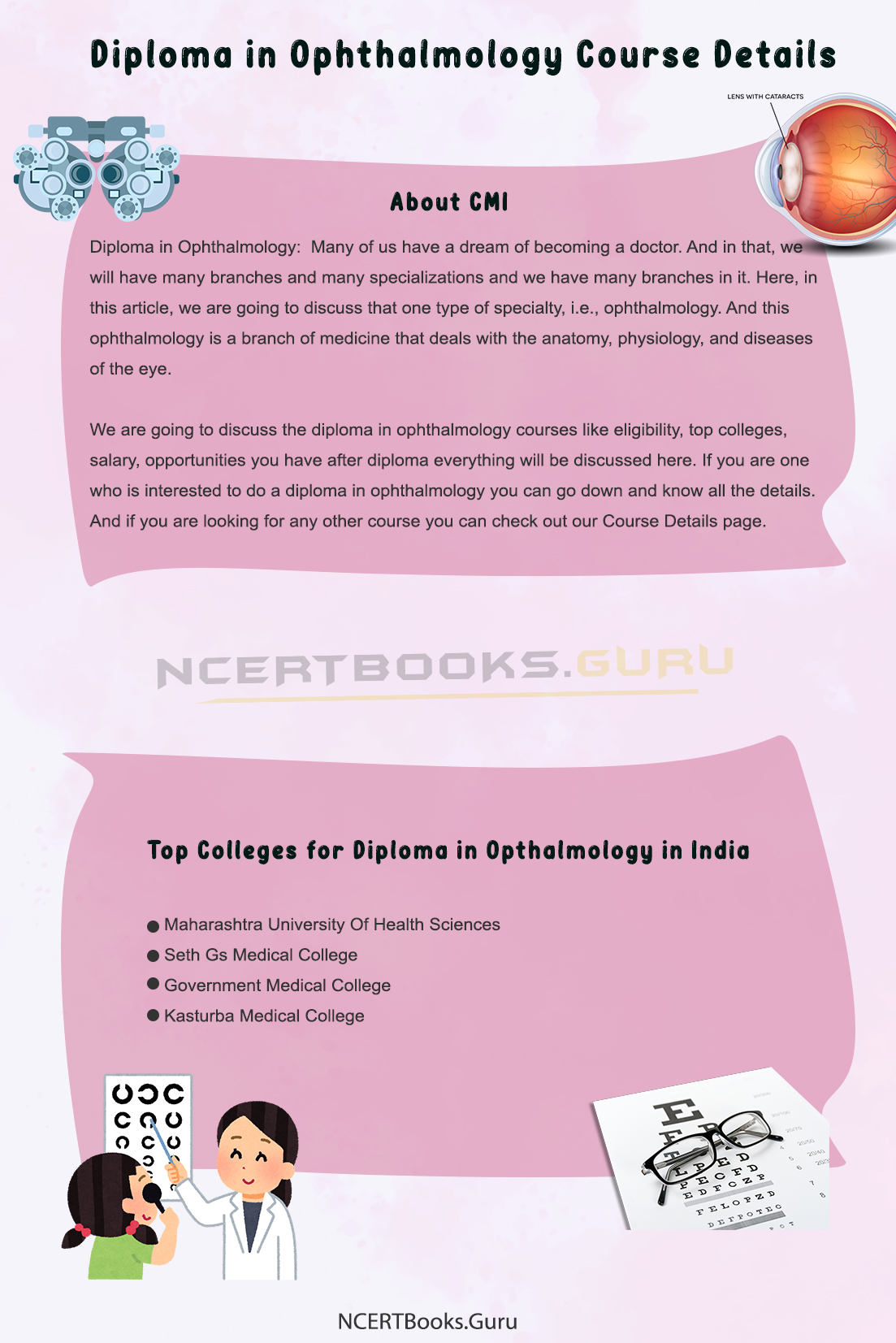
Diploma in Ophthalmology:  Many of us have a dream of becoming a doctor. And in that, we will have many branches and many specializations and we have many branches in it. Here, in this article, we are going to discuss that one type of specialty, i.e., ophthalmology. And this ophthalmology is a branch of medicine that deals with the anatomy, physiology, and diseases of the eye.

We are going to discuss the diploma in ophthalmology courses like eligibility, top colleges, salary, opportunities you have after diploma everything will be discussed here. If you are one who is interested to do a diploma in ophthalmology you can go down and know all the details. And if you are looking for any other course you can check out our Course Details page.

Highlights of Diploma in Ophthalmology

Here we will discuss some highlights that are all the details about this course and also what we are going to cover in this course.

Course Name Diploma in Ophthalmology
Course level Graduation
Course duration 2-3 Years
Course Fees Up to 5 lacs
Eligibility criteria 10+2
Admission Process Entrance exam
Examination Type Semester wise
Salary Upto 20 lacs per annum
Top Recruiting Companies Indian Nursing Council, State Nursing Councils, Metro Hospital, Max hospital, Indian Red Cross Society, AIIMS, Fortis Hospital, Kailash Hospital, Orphanage, etc.
Job Positions Associate Professor, Super Specialty Consultant, Sales Executive, Product Manager, Area Sales Manager, Zonal Sales Manager, Consultant, ophthalmology, OT Technician, etc.

Eligibility Criteria For Diploma Ophthalmology Course

Let us look into the eligibility criteria that you need for this diploma course.

  • Candidate must be completed 10 + 2 in any recognized board of education with a minimum 50 % percentage, in any stream.

Admission Process for Diploma Course in Ophthalmology

To get admission to any college or university we have different steps to follow.  And these admission processes may vary from college to college. The admission process will be done by the entrance exams in some colleges and in some other colleges, there will be a merit-based admission.

  • Firstly, colleges or universities release an application form online. And you need to register in that application form to join.
  • Then, if you are eligible for any of those you can fill out the application form as per the given instructions.
  • And then, you need to provide your contact details for verification.
  • Then, you need to submit the asked documents in the given format.
  • And you need to pay the fee through online payment modes.
  • Submit the application form.
  • Next, if it is merit-based it is ok, otherwise, you should write the entrance examination and get the cut-off mark.

Diploma in Ophthalmology Syllabus

We are going to provide the syllabus according to many universities and colleges.

Sr. No. Subjects of Study
A Applied Basic Sciences in Ophthalmology
1 Anatomy and Physiology
a) Anatomy of the eye and ocular adnexa
b) Embryology of the eye and adnexa.
c)Binocular vision and its development
d) The visual pathways
e) Physiology of vision, color vision, accommodation
f) Physiology of aqueous humor and its circulation and maintenance of Intraocular Pressure.
g) Maintenance of intraocular pressure
h) The Neurology of vision (Visual pathway, papillary pathways, and reaction) dark Adaptation.
i) Optics – elementary Physiological optics, optics of radioscopy and other dark Room procedures and ophthalmic types of equipment.
j) Anatomy and Physiology of motor mechanism
k) Blood aqueous barrier.
l) Tear circulation
m) Maintenance of corneal transparency.
2 Pathology and Microbiology
a) Pathology of ocular and adnexal lesions (Inflammatory, neoplastic, lens specification, etc)
b) Virus – Herpes Zoster, Simplex, adenovirus, trachoma, etc.
c) Microbiology of common organism affecting the eye – Bacteria Staph. Strepto – pneumococci, gonococci diphtheria, Morax axenfield bacillus, AFB, Lepra bacilli, Pseudomonas, etc.
d) Parasites, protozoa, and fungi causing coular lesion e.g., toxoplasma amoebiasis, toxocariasis, Treponema, cysticercus, hydatid, microfilaria aspergillus, Penicillium, candida, etc.
3 Biochemistry
a) Vitamin A and its metabolism
b) Aqueous composition
c) Glucose Metabolism
d) Biochemical aspects of cataract (Senile and diabetic)
e) Tear film and its composition.
f) Thyroid function tests
4 Pharmacology
Pharmacology of drugs used in Ophthalmology–
a) Autonomic drugs – Sympathomimetic, Sympatholytics, cholinergic, anticholinergic agents, etc.
b) Anti-inflammatory agent – steroid and non-steroidal agents
c) Antibiotics and chemotherapeutic agents used in ophthalmology
d) Local anesthetics
e) Antivirals and antifungals used in ophthalmology
f) Dyes used in ophthalmology – fluorescein, rose Bengal, etc.
g) Tear Substitutes
h) Drugs used to reduce intra ocular pressure (systemic and topical agents)
i) Anti-mitotic agents and immunosuppressive
j) Ocular penetration of systemically administered drugs and topical agents.
5 Optics
B Clinical Ophthalmology including Refraction

Entrance Exams for Ophthalmology Diploma Course

For getting admission in any college, and if that college gives admission on the basis of entrance exam. you need to prepare for entrance exams and you need to get the cut-off marks. This is different from college to college.

  • NEET
  • AJEE
  • MNS Entrance Exam

Benefits of Studying Diploma Opthalmology

Here, we will look into the benefits of studying this ophthalmology are given below:

  • Students take up research work with organizations such as ICMR.
  • After the study of the ophthalmology course, you have better opportunities available in private hospitals, clinics, missionary hospitals, NGOs, charitable hospitals.
  • You can also begin your career in the research or teaching area if you have done any specialization.

Recommended Books for Opthalmology Course

Here are some of the books that are recommended to study ophthalmology. You need to add all these books to their books shelf.  some of the reference books are given below.

  • Textbook of Ophthalmology for Paramedical Courses, S. B. Gupta, ‎S. Agarwal.
  • Textbook of Ophthalmology, HV Nema, ‎Nitin Nema.
  • Ophthalmic Assistant, PK Mukherjee.
  • Ophthalmology: A textbook for diploma students, Patrick Dacre Trevor-Roper.

Diploma in Opthalmology Fees

The fee structure can be different from college to college. And for this diploma study, we have both private and government colleges. The average course fee for private colleges will be Rs.15,000 to Rs.1.5 Lakhs. And the average course fee for government colleges is Rs.5,000  to Rs.35,000.

Top Colleges for Diploma in Opthalmology in India

Many colleges are offering this course in India. Here we have both government and private colleges. Some of the colleges are listed below:

  • Maharashtra University Of Health Sciences
  • Seth Gs Medical College
  • Government Medical College
  • Kasturba Medical College

Diploma in Ophthalmology Course Details

Employment Areas after Diploma

We will look into the employment areas that have after diploma. Some of these employment areas are given below.

  • Government Hospitals
  • Medical Continent Writing
  • Colleges & Universities
  • Defense Services
  • Nursing Homes

Also, Refer:

Career Options with the Salary After Opthalmology Diploma Course

Here we are going to discuss the career options with the salary after completion of this course.

Job Profile Average Salary
Super Specialty Consultant 3 – 4 Lakhs Per Annum
OT Technician 9 – 10 Lakhs Per Annum
Consultant Ophthalmology 1.5-3 Lakhs Per Annum
Associate Professor 1.5 – 4 Lakhs Per Annum
Area Sales Manager 10 – 11 Lakhs per Annum
Product Manager, Zonal Sales Manager 5 – 6 Lakhs per Annum

FAQs of Diploma in Ophthalmology After 12th

1. Is studying for a diploma in ophthalmology from a private college good?

Yes, it is beneficial to study diploma courses from private colleges is beneficial. There are great placements and opportunities we have when we have studied in private colleges.

2. What are the opportunities we have after a diploma in ophthalmology?

If you study diploma in ophthalmology we have many opportunities like a supervisor in ophthalmic glass, ophthalmic technician, refraction assistant, and many.

3. Is an optometrist a doctor?

No, An optometrist is not a doctor, but someone who is licensed to practice optometry.

Conclusion

Hope that the complete information that was given above is very useful. And still, if you have any doubts about the course details you can just comment us in the comment section by signing up. And stay tuned to the NCERTBooks.guru for more course details. And after this course, there are many best opportunities that build your career.

10 Lines on Save Environment for Students and Children in English

10 Lines on Save Environment

10 Lines on Save Environment: The environment is the total of all the biotic and abiotic factors like air, water, soil, atmosphere, rocks, trees, etc., that make up the surrounding or niche of a living organism. We need to save the environment by using the latest technologies, and old-fashioned habits have decreased their quality.

Enhance your vocabulary and writing skills with 10 Lines Essays available. Spark up the creativity in you and access various Topics on 10 Lines all in one place.

Set 1 – 10 Lines on Save Environment for kids

Set 1 is helpful for students of Classes 1, 2, 3, 4 and 5.

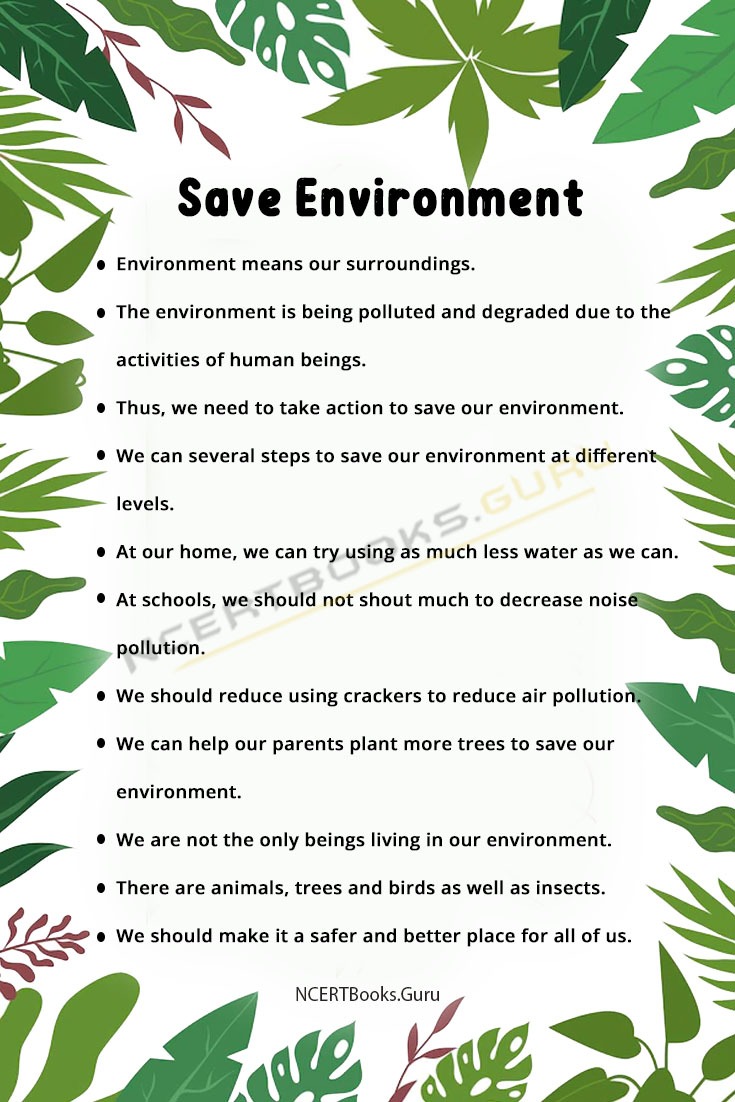
  1. Environment means our surroundings.
  2. The environment is being polluted and degraded due to the activities of human beings.
  3. Thus, we need to take action to save our environment.
  4. We can several steps to save our environment at different levels.
  5. At our home, we can try using as much less water as we can.
  6. At schools, we should not shout much to decrease noise pollution.
  7. We should reduce using crackers to reduce air pollution.
  8. We can help our parents plant more trees to save our environment.
  9. We are not the only beings living in our environment. There are animals, trees and birds as well as insects.
  10. We should make it a safer and better place for all of us.

10 Lines on Save Environment 1

Set 2 – 10 Lines on Save Environment for School Children

Set 2 is helpful for students of Classes 6, 7 and 8.

  1. The environment can be defined as the niche of every living organism that includes the biotic and abiotic components.
  2. We, as human beings, are responsible for the quality deterioration of our environment by our activities.
  3. Several types of pollutions harm our environment like – air pollution, water pollution, noise pollution, soil pollution, etc.
  4. Air pollution is the decrease in the quality of air around us. It can be decreased by checking our vehicles’ exhausts, building higher chimneys, preferring public transport when possible, decreasing fossil fuels and crackers’ burning, etc.
  5. Water pollution is the pollution of water bodies by the contamination caused by sewages released to water bodies, throwing of debris and garbage of water bodies, natural siltation, idols’ immersion, discharging effluents from industries, etc.
  6. Noise pollution is the cumulative effect of shrill and high pitched noises in the atmosphere. The effects of this type of pollution cause harm to ground insects who become unstable due to screeching of horns, shrill and too high pitched noise disturb dogs, automobile sounds and construction sounds can be harmful to heart patients, students concentrating on their studies, etc.
  7. The main cause of soil pollution is fertilizers and pesticides, throwing of non – decomposable debris on to soil, etc.
  8. The environment is home to every living organism, and any pollution invariably decreases some individual’s survival chances.
  9. The need of the hour is to be cautious of our footprints and save the environment.
  10. We, as humans, must take up this duty as the foremost.

Set 3 – 10 Lines on Save Environment for Higher Class Students

Set 3 is helpful for students of Classes 9, 10, 11, 12 and Competitive Exams.

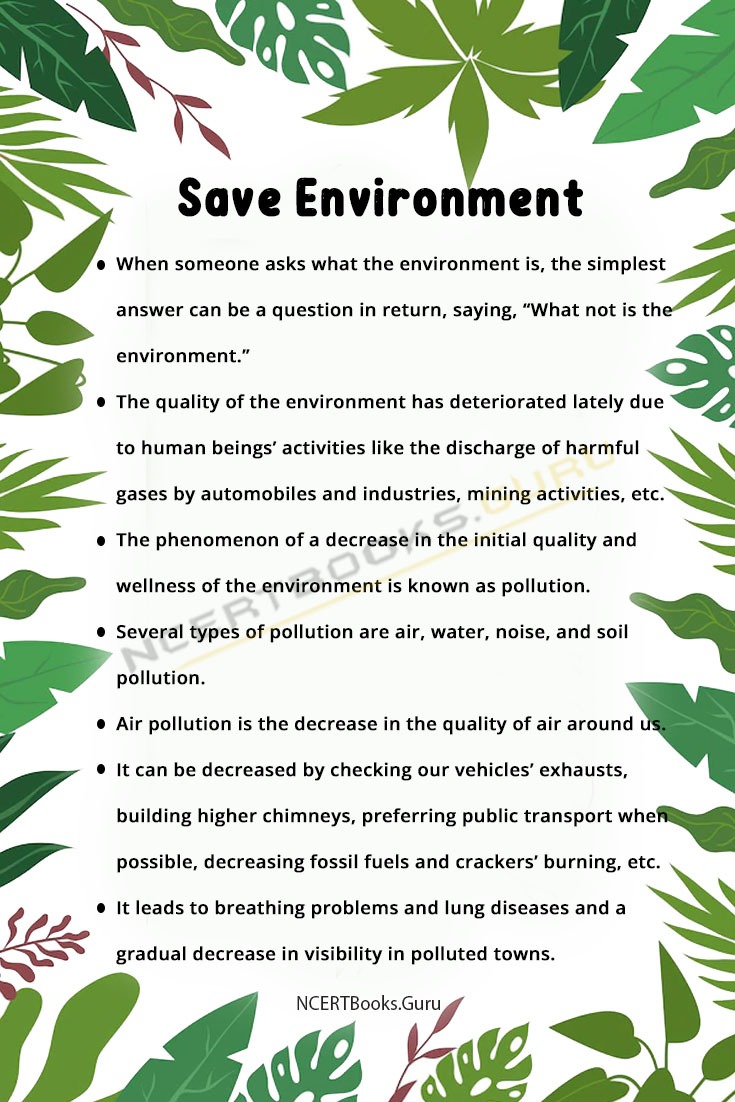
  1. When someone asks what the environment is, the simplest answer can be a question in return, saying, “What not is the environment.”
  2. The quality of the environment has deteriorated lately due to human beings’ activities like the discharge of harmful gases by automobiles and industries, mining activities, etc.
  3. The phenomenon of a decrease in the initial quality and wellness of the environment is known as pollution. Several types of pollution are air, water, noise, and soil pollution.
  4. Air pollution is the decrease in the quality of air around us. It can be decreased by checking our vehicles’ exhausts, building higher chimneys, preferring public transport when possible, decreasing fossil fuels and crackers’ burning, etc. It leads to breathing problems and lung diseases and a gradual decrease in visibility in polluted towns.
  5. Water pollution is the pollution of water bodies by the contamination caused by sewages released to water bodies, throwing of debris and garbage of water bodies, natural siltation, idols’ immersion, discharging effluents from industries, etc. By effectively treating sewage and discharges before sending them into water bodies and judicious use in household chores and day to day life, water pollution can be checked.
  6. Soil pollution is the most harmful type of pollution as it degrades the soil, the very base of life where creatures bountifully reside, and food grows. The main cause of soil pollution is fertilizers and pesticides, throwing of non – decomposable debris on to soil, etc. This can be checked by shifting to organic agriculture and reducing plastic wares use.
  7. Noise pollution is the cumulative effect of shrill and high pitched noises in the atmosphere. The effects of this type of pollution cause harm to ground insects who become unstable due to screeching of horns, shrill and too high pitched noise disturb dogs, automobile sounds and construction sounds can be harmful to heart patients, students concentrating on their studies, etc.
  8. Global warming is the outcome of environmental degradation, which is the eventual rise in the earth’s temperature due to air pollution. It causes the melting of glaciers and the subsequent consequences.
  9. Environment degradation, global warming, water footprint, and carbon footprint are the prime cause of concern in environmentalists’ minds today.
  10. Rome was not built in a day. So we can start today by judicious use of all resources and thus save the environment.

10 Lines on Save Environment 2

Frequently Asked Questions on Save Environment

Question 1.
What is the environment?

Answer:
The environment is the amalgam of biotic and abiotic factors that make up the surrounding or niche of a living organism.

Question 2.
What are the causes of air pollution?

Answer:
The causes of air pollution are as follows:

  1. use of mining practices
  2. burning of fossil fuels
  3. Exhaustive use of personal automobiles
  4. use of aerosols, etc.