Nutritionist Diploma Course Duration, Advantages, Eligibility, Admission, Syllabus, Colleges, Best Books, Fee, Job Options, Salary in India

Nutritionist Diploma Course

Nutritionist Diploma Course: By definition, a nutritionist is a person who advises other people on matters of nutrition and food and their impacts on their health. Some people specialize in certain areas such as sports nutrition public health, or animal nutrition among all other areas. In many countries, a person can claim to be a nutritionist without even any education training or professional license.

People often confuse nutritionists with dieticians. Dietitians are professionals who have a university degree professional license and certification for professional practice. They are experts in identifying and treating disease-related malnutrition and in conducting medical nutrition therapy.

Keep reading the following article to know more about a nutritionist diploma course. The advantages of a diploma course in nutrition, the eligibility criteria, admission process, syllabus, top colleges, best books, fees, job options after completing a diploma nutritionist course, salary as a nutritionist in India. The article contains all this information under different headings. So let’s begin!

About Nutritionist Diploma Course

Nutrition is a field in medical science that aims on helping individuals keep themselves fit and healthy. There are various programs in this field that are offered at graduate as well as postgraduate levels. These programs cover various subjects such as human physiology and nutrients that are required by the body to remain fit and healthy and work in a proper condition.

Food technology and biochemistry are also very important parts of the programs. A diploma course to become a nutritionist enables the individuals to create a diet plan and help other people as well as the members of the organization to follow a proper diet to keep themselves healthy.

There are various opportunities in this field to work in the government in the private sector as well. The course duration of a diploma course to become a nutritionist can be somewhere between one year to three years. In the current situation, a career in the nutrition industry is one of the most in-demand career choices since the world needs knowledgeable people to guide them in the health department.

Advantages of a Diploma Course in Nutrition

There are multiple advantages to doing a diploma course in nutrition. Following are some of the advantages that the students get if they pass their diploma in nutrition:

  • Serving society by advising people with a healthy lifestyle and hygienic food is always necessary. By completing or diploma course in nutrition people can work as skilled professionals to fulfill their duty towards their society and humankind.
  • Today in this fast-paced world, everyone is so busy that they do not have time to think about their diet. In such cases, nutrition advisors are of utmost importance so that they can provide people with useful insights on how to manage their diet and nutrition in order to live a healthy life.
  • If we talk about the research field, it is quite obvious that the development of new techniques is in process and there is a demand for the development of techniques of food intake that guarantee high nutritional values and people who are interested in this field can definitely provide their contribution in the research work.
  • Candidates who have completed the diploma in nutrition can open their own diet clinics to help people plan their diet and stay healthy.

Diploma in Nutrition and Dietetics Eligibility

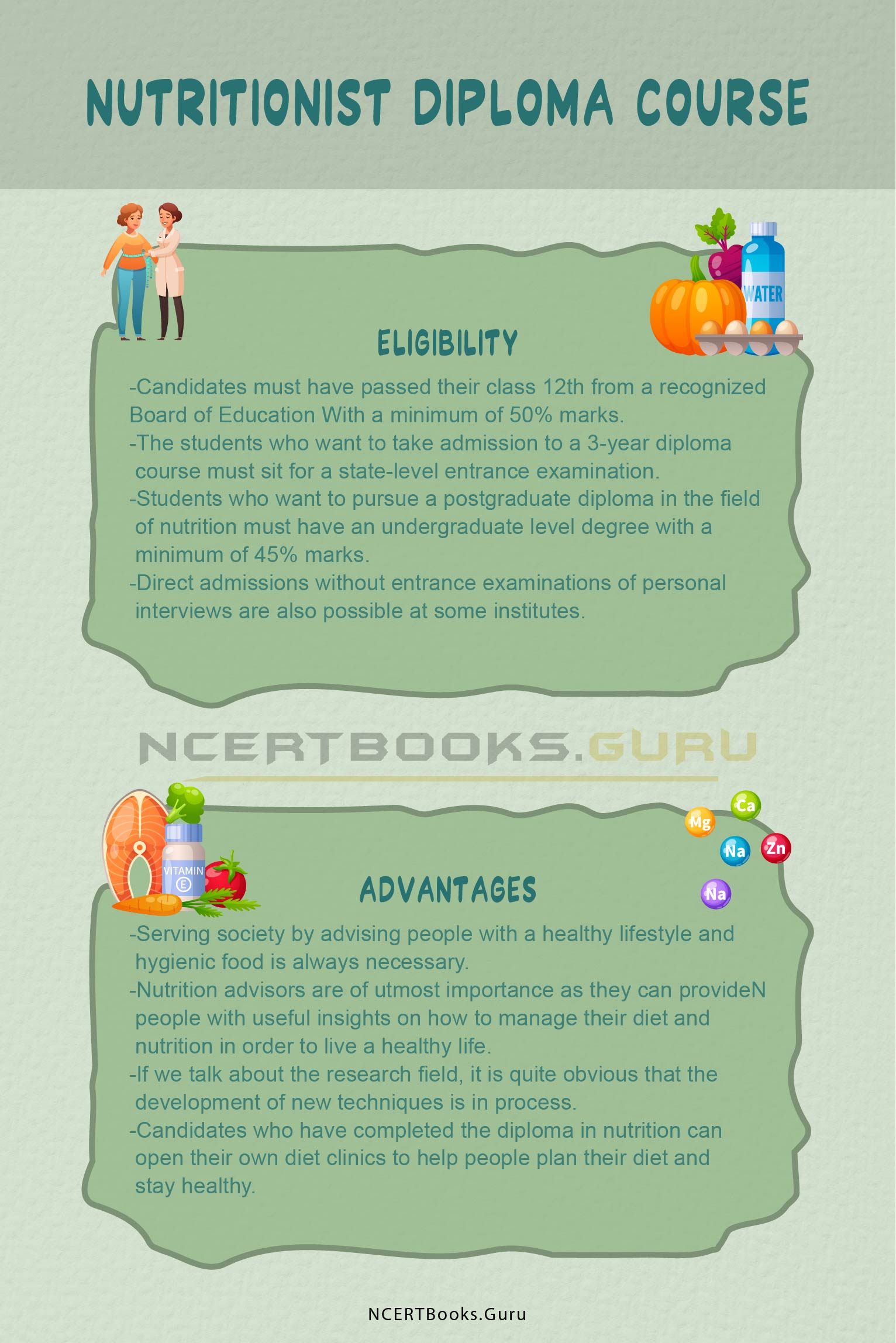
Following are the eligibility criteria for applying for the diploma in Nutrition & Dietetics Course 2022:

  • The candidates that want to apply for an undergraduate diploma degree must have passed their class 12th from a recognized Board of Education With a minimum of 50% marks.
  • The students who want to take admission to a 3-year diploma course must sit for a state-level entrance examination since admission toward 3-year diploma courses on the basis of the results of the state-level entrance examination.
  • Students who want to pursue a postgraduate diploma in the field of nutrition must have an undergraduate level degree with a minimum of 45% marks.
  • Direct admissions without entrance examinations of personal interviews are also possible at some institutes however most institutes do conduct a separate entrance exam for admission to a diploma course for becoming a nutritionist.

Admission Process for Nutritionist Diploma Course

The admission to her nutritionist diploma course is done either on the basis of merit or on the basis of entrance examination results. Following are all the details of both kinds of admission process:

Entrance examination based admission:

  • Colleges release applications days before the examination dates on their official websites and the registration process can be done just by filling out the right information on their forms.
  • The candidates must fill up their genuine details and must have the required documents to prove them.
  • At the time of the registration process, documents need to be submitted via scanning so that it gives the exact details of the candidates.
  • The students must submit an application fee that will be submitted through modern digital payment modes.
  • After the registration process, the candidates must download their admit card which will help them to get entry into the examination hall for the entrance exam.
  • The students can prepare for the entrance examination using well-known editors’ reference books or they can also practice the previous year’s question papers.
  • After 3 to 4 weeks of the examination results get declared. The qualified candidates can go forward with the admission process.
  • After the candidates get selected, the counseling process starts. In the counseling process, priority is given to the students who have higher marks in the examination. During the counseling, the candidates can select their stream and the college.

Direct admission:

  • For direct admission, students need to register themselves as new applicant to the college that they want to get admitted to.
  • The students must submit their application form along with the documents in a scanned format. The students must provide all the details correctly and must submit all documents in the correct manner.
  • Students must submit the application fee which is a must for the registration process. The students must keep checking the official website of the college that they want to get admitted to for further admission details.
  • The students can also submit the application form in an offline mode by visiting the admission cell of the college they want to get admitted. Candidates should carry their original documents to submit at the time of submitting the application form also, they must be ready to pay the admission fee.

Do Check: 

Nutritionist Diploma Course Syllabus

There are multiple subjects that are taught throughout the duration of the diploma course for becoming a nutritionist. Following are the most popular subjects that are taught you know diploma course for nutrition:

  • Human Physiology
  • Food and service management
  • Food microbiology
  • Chemistry
  • Biochemistry
  • Post-harvest technology
  • Family meal management
  • Food preservation
  • Food quality control
  • Dietetics
  • Fundamental computer concepts and windows
  • Food science
  • Community nutrition
  • Quality food services and physical facilities
  • Principles of nutrition
  • Environmental studies

Diploma in Nutrition Colleges in India

There are various institutes all across the country that provide top-quality education in diploma courses related to nutrition. Following is a list of the best colleges for nutritionist diploma courses:

  • AIIMS Delhi, Delhi
  • CMC Vellore, Vellore
  • Maulana Azad Medical College, Delhi
  • Armed forces Medical College, Pune
  • St Xavier’s College, Mumbai
  • Jawaharlal Institute of Postgraduate Medical Education and Research, Puducherry
  • Sri Devaraj URS Academy of Higher Education and Research, Kolar
  • Madras Medical College, Chennai
  • Guru Gobind Singh Indraprastha University, New Delhi
  • Sri Ramachandra Medical College and Research Institute, Chennai

Best Books for Nutritionist Course in Diploma

Following are the top books that a student must refer to while they are doing their diploma course in nutrition:

  • Public health nutrition – Judith L. Buttriss, ‎Ailsa A. Welch, ‎John M. Kearney
  • Food science -B. Srilakshmi
  • Food nutrition and health – Goyal Shashi & Gupta Pooja
  • Introduction to nutrition and health research – Eunsook T. Koh, ‎Willis L. Owen

See More: Diploma in Nutrition and Health Education

Certified Nutritionist Diploma Course Fee

The fee for a diploma in a nutrition course can rain somewhere between INR 5,000 to INR 2,00,000 per annum. The fee depends upon the college that the student is admitted. Course fee in private colleges is much higher than that of government colleges which is the case in almost all the courses.

Job Profiles After Diploma Course in Nutrition & Dietetics

With the increase in urbanization and medical problems amongst working individuals, the need for proper nutrition is increasing at a rapid rate. Dietitians and nutritionists are getting a lot of importance among the urban crowd as the young generation of the country are releasing the importance of a healthy diet and values of being fit poster hence the private nutritionists are earning a lot of money in tier one and Tier 2 cities.

Hospitals are also hiring professionals to consult with their patience a number of corporate companies hire nutritionists in order to keep their employees healthy and active following are the job profiles that are the most popular for nutritionists:

  • Sports nutritionist
  • Therapeutic dietician
  • Researcher
  • Consultant
  • Food show host
  • Administrative nutritionist
  • Nutrition trainer
  • Nutritional sales executive

Nutritionist Diploma Course

Diploma Nutritionist Holders Salary Details

The salary of a person working in the health care and nutrition department can be somewhere around INR 1,50,000 to INR 11,00,000 per annum. Following are the most popular job profiles along with their average salaries in INR:

  • Food scientist – INR 4,00,000 to INR 6,00,000 per annum
  • Professor – INR 9,00,000 to INR 10,00,000 per annum
  • Nutrition specialist – INR 1,50,000 to INR 5,00,000 per annum
  • Dietitian – INR 3,00,00 to INR 4,00,000 per annum
  • Weight loss or gain advisor – INR 1,00,00 to INR 4,00,000 per annum
  • Process development officer – INR INR 6,00,000 to INR 11,00,000 per annum

FAQs on Diploma in nutrition and dietetics after 10th

1. What is the difference between a nutritionist and a dietician?

The difference between a nutritionist and a dietitian is that a nutritionist mainly focuses on suggesting meal plans as per their nutritional values. The dietician on the other hand focuses on the health of the patient and plans accordingly. hey look at the patient’s health, the requirements of the patient’s body, and then suggest a healthy meal for them.

2. Can I pursue a diploma in nutrition course after class 10th?

No, you cannot pursue a diploma in nutrition after class 10th. The minimum eligibility criteria for enrolling in a diploma course for nutrition is that the student must have passed their class 12th from a recognized Board of Education with a minimum of 50% marks.

3. What are the career options after a diploma in nutrition?

A diploma in nutrition opens up multiple career options for the candidates. They can work in various private clinics, government and private hospitals, they can work as a teacher, health centers, research labs, food manufacturing industries, etc.

Conclusion

The above article contains all the information regarding the diploma in a nutrition course. All the important details are covered in separate paragraphs for a clear understanding of the nutritionist diploma course. We hope that you make an informed decision for yourself. All the best! If you need more assistance on this nutrition diploma course or any other course details do share with us via the comment section below.
Import Export Diploma Course Details | Eligibility, Admission Process, Colleges, Entrance Exams, Career Options, Jobs, Salary

Import Export Diploma Course

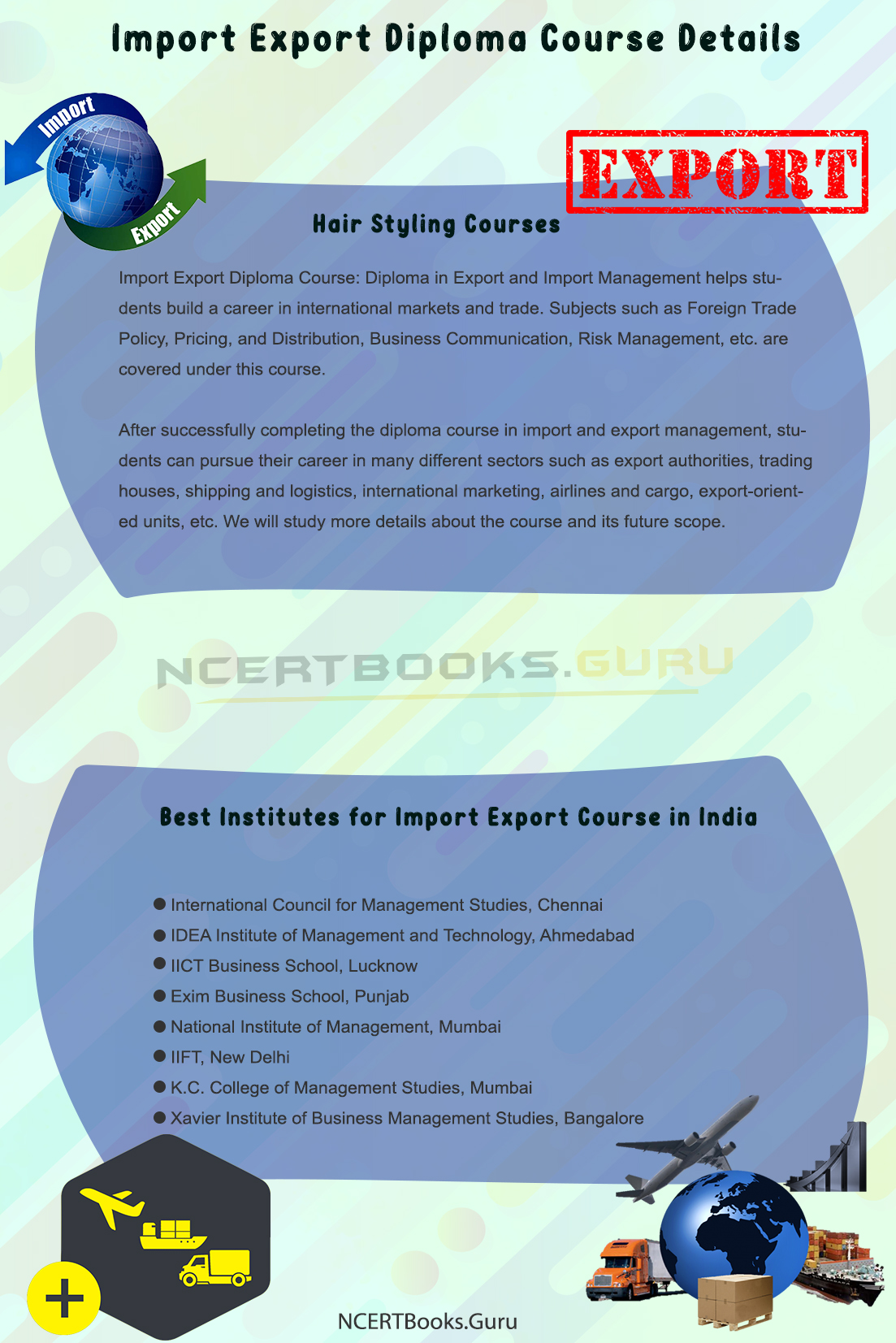
Import Export Diploma Course Online: Diploma in Export and Import Management helps students build a career in international markets and trade. Subjects such as Foreign Trade Policy, Pricing, and Distribution, Business Communication, Risk Management, etc. are covered under this course.

After successfully completing the diploma course in import and export management, students can pursue their career in many different sectors such as export authorities, trading houses, shipping and logistics, international marketing, airlines and cargo, export-oriented units, etc. We will study more details about the course and its future scope.

Diploma in Import Export Course Eligibility Criteria

Candidates who want to pursue the import-export diploma course must pass 10+2 examinations with a minimum of 50%. Candidates under the reservation category need at least 45% to fulfill the eligibility criteria for the course.

Diploma in Export and Import Management Admission Process

Admission in this course is based on the performance in class 12th examinations. In the case of merit-based selection, marks obtained by the student in the exams are the parameter for admission. Below are the steps that should be taken into account for admission into the course:

  • Registration
  • Filling up of application form
  • Scan and upload documents
  • Application fee
  • Admission

Import Export Diploma Course Fees

The Diploma in Export Import Course Fee ranges from INR 5000 to INR 30,000. However, this can vary depending on the college or institute you have opted for.

Diploma in Import Export Entrance Exams

The few colleges in India that offer this course conduct an entrance exam for admission. The examination lasts for 2 to 3 hours during which the students are expected to answer objective-type questions.

Below are a few tips to prepare for the entrance examination:

  • Go through the syllabus
  • Revise important topics
  • Solve previous year’s question papers
  • Give online mock test

Required Skills for studying Diploma in Import Export Management

To pursue the course and build a successful career in the field, the candidate must have the skills as listed below:

  • Management Skills
  • Analytical Ability
  • Logical Thinking
  • Communication Skills
  • Knowledge about international business
  • General awareness about the business sector
  • Leadership qualities

Import Export Diploma Course Structure & Syllabus

The diploma lasts one year and is divided into two semesters. The semesters last for 6 months each. During the course, the students are expected to work on many assignments, presentations, and projects. For successful completion of the course, the students have to qualify for each semester examination.

Semester I

  • International Business Environment
  • Insurance and Inspection in foreign trade
  • International Supply Chain Management
  • Procedures and Practices in EXIM management
  • Projects

Semester II

  • Risk Management in Import-Export Business
  • Export-Import Regulations
  • EXIM Policy Framework
  • Export-Import promotional schemes in India
  • Banking Transactions

Refer More:

Best Institutes for Import Export Course in India

Below is the list of top colleges in India to pursue a diploma in export import courses after 12th. Select the college that meets your expectations and study your favorite course.

  • International Council for Management Studies, Chennai
  • IDEA Institute of Management and Technology, Ahmedabad
  • IICT Business School, Lucknow
  • Exim Business School, Punjab
  • National Institute of Management, Mumbai
  • IIFT, New Delhi
  • K.C. College of Management Studies, Mumbai
  • Xavier Institute of Business Management Studies, Bangalore
  • Indian School of Business Management and Administration, New Delhi

Import Export Diploma Course Details

Top Companies that hire Candidates Pursuing Import Export Course

After completion of the course, opportunities from the following companies can be expected:

  • Indian Oil
  • Tata Steel
  • Sun Pharma Industries
  • Tata Motors
  • Vardhaman Textiles
  • Reliance Industries
  • Rajesh Exports
  • International Lace Trade Center
  • Bajaj International Private Limited
  • ITC
  • Bharat Petroleum
  • Sun Pharma

Job Opportunities after completing Import/Export Courses

Completion of the course will allow the candidates to secure a job in export processing zones, export promotion councils, export-oriented units, trading houses, export departments, development authorities and commodity boards, and marine insurance companies.

To know more about several course details check our page covering entire information such as Eligibility, Admission, Fee, Course Structure, etc.

Import/Export Diploma Salary in India

Job profiles such as Export Sales Manager, Import Manager, International supplies Logistic Manager, Export Manager and offered to the candidate. Diploma in Import Export Course Salary ranges from INR 4 lakhs- 6 lakhs p.a.

FAQs on Diploma in Import Export Course

1. What is Import Export Diploma?

Diploma in Import Export is a foundation course of 1-2 years in international trade and market.

2. Is Import Export a Good Career?

No matter the scale of the company you choose Import Export is a great career and can help you land good jobs in the marketplace.

3. What are the best Institutes that offer Import Export Diploma Courses?

  • International Council for Management Studies, Chennai
  • Xavier Institute of Business Management Studies, Bangalore
  • National Institute of Management, Mumbai
  • IDEA Institute of Management and Technology, Ahmedabad
  • IICT Business School, Lucknow
  • Exim Business School, Punjab
  • K.C. College of Management Studies, Mumbai
  • Indian School of Business Management and Administration, New Delhi
  • IIFT, New Delhi

Conclusion

The rapid growth in the import and export sector has attracted many students to this field. It is a great option if you want to pursue business with a specialization. It also gives you access to the international market. After successful completion of the course, the candidate can pursue a job profile as listed above. He or she can also opt for a full-time MBA course in import-export management, international business, or trading. A degree in Post Graduate Diploma in Export and Import Management is also an opportunity for those with a good academic record or work experience.

10 Lines on Kalpana Chawla for Students and Children in English

10 Lines on Kalpana Chawla

10 Lines on Kalpana Chawla: Kalpana Chawla is a woman who made the country proud all over the world. She was the first spacewoman of India. Through hard work and patience, she achieved her dreams.

Kalpana Chawla is a great role model. Through her story, you learn that nothing is impossible, and you can achieve all your dreams through real dedication to your work. She had a great interest in science, and she studied aeronautical engineering.

One of her ambition throughout her life was to go to space which she achieved. With the help and encouragement of her family, she completed her dreams of going to space. Below, there are three sets of 10 lines on Kalpana Chawla, which will be handy and practical for students looking to write essays and assignment.

Enhance your vocabulary and writing skills with 10 Lines Essays available. Spark up the creativity in you and access various Topics on 10 Lines all in one place.

Set 1 – 10 Lines on Kalpana Chawla for kids

The following set of lines on Kalpana Chawla will be useful for students and children in classes 1, 2, 3, 4, and 5.

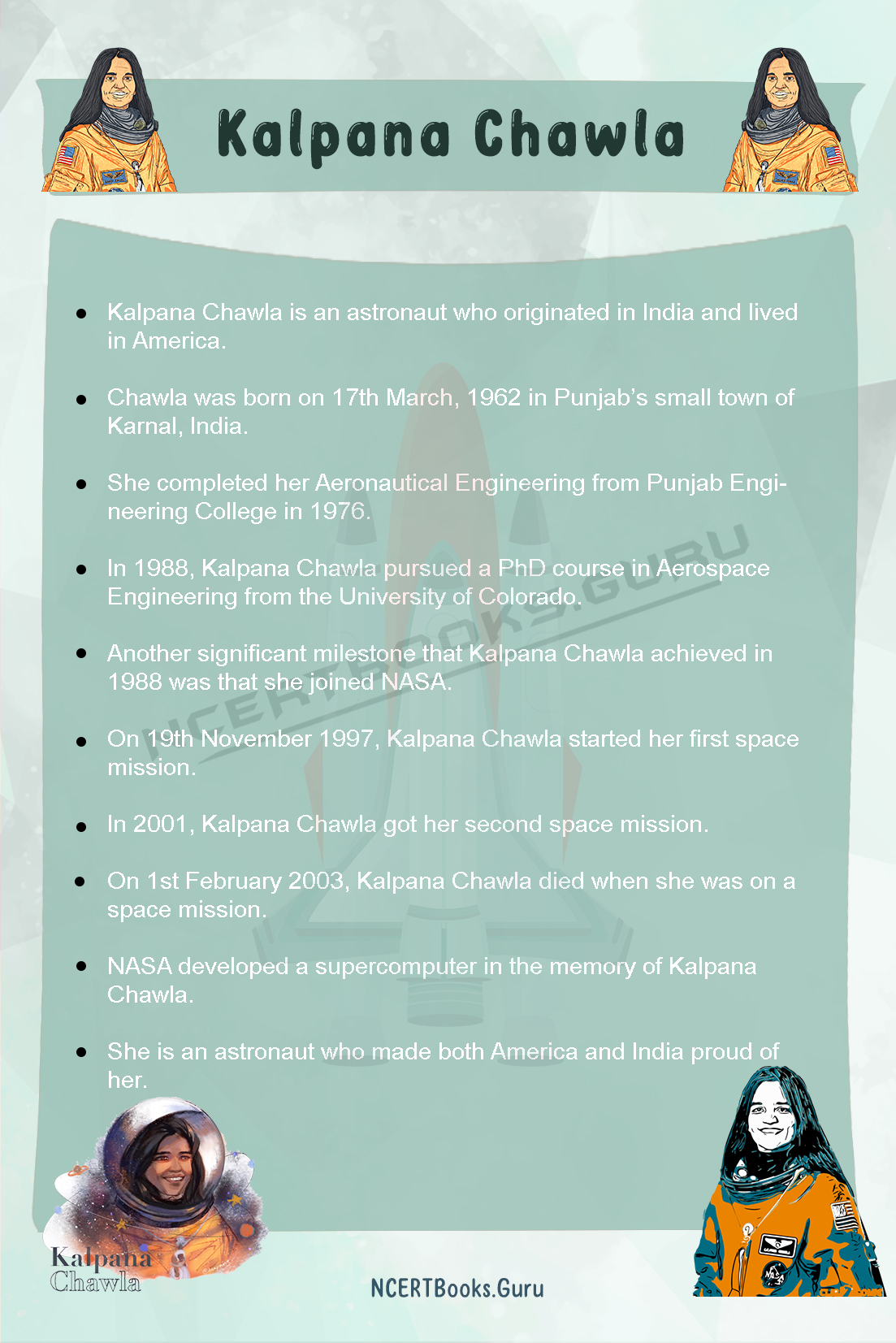
  1. Kalpana Chawla is an astronaut who originated in India and lived in America.
  2. Chawla was born on 17th March 1962 in Punjab’s small town of Karnal, India.
  3. She completed her Aeronautical Engineering at Punjab Engineering College in 1976.
  4. In 1988, Kalpana Chawla pursued a Ph.D. course in Aerospace Engineering from the University of Colorado.
  5. Another significant milestone that Kalpana Chawla achieved in 1988 was that she joined NASA.
  6. On 19th November 1997, Kalpana Chawla started her first space mission.
  7. In 2001, Kalpana Chawla got her second space mission.
  8. On 1st February 2003, Kalpana Chawla died when she was on a space mission.
  9. NASA developed a supercomputer in the memory of Kalpana Chawla.
  10. She is an astronaut who made both America and India proud of her.

10 Lines on Kalpana Chawla 1

Set 2 – 10 Lines on Kalpana Chawla for School Children

The following 10 lines on Kalpana Chawla will be useful for students in classes 6, 7, 8, and 9.

  1. Even though Kalpana Chawla was born in India, she held citizenship of the United States of America.
  2. Since her childhood, Kalpana Chawla had the same dream of having a career in aerospace engineering.
  3. The first space mission that Kalpana Chawla received on 19th November 1997 was called ‘Space Shuttle Columbia’.
  4. On her second mission, which was in 2007, Kalpana Chawla was a member of 7 crews on the flight called ‘STS-07’.
  5. In the year 1983, Kalpana Chawla married a flight instructor, John Pierre Harrison.
  6. Kalpana Chawla spent thirty-one days, fourteen hours and fifty- four minutes in space.
  7. In the United States of America, there is a street named after Kalpana Chawla.
  8. In the year 1983, the University of Colorado started an award called the Kalpana Chawla award.
  9. The Columbia disaster that took Kalpana Chawla’s life in 2003 became a very famous incident worldwide.
  10. In the second space mission, the space shuttle broke into the Earth’s atmosphere when returning from the mission.

Set 3 – 10 Lines on Kalpana Chawla for Higher Class Students

The following 10 lines on Kalpana Chawla will be useful for students in classes 10, 11, and 12.

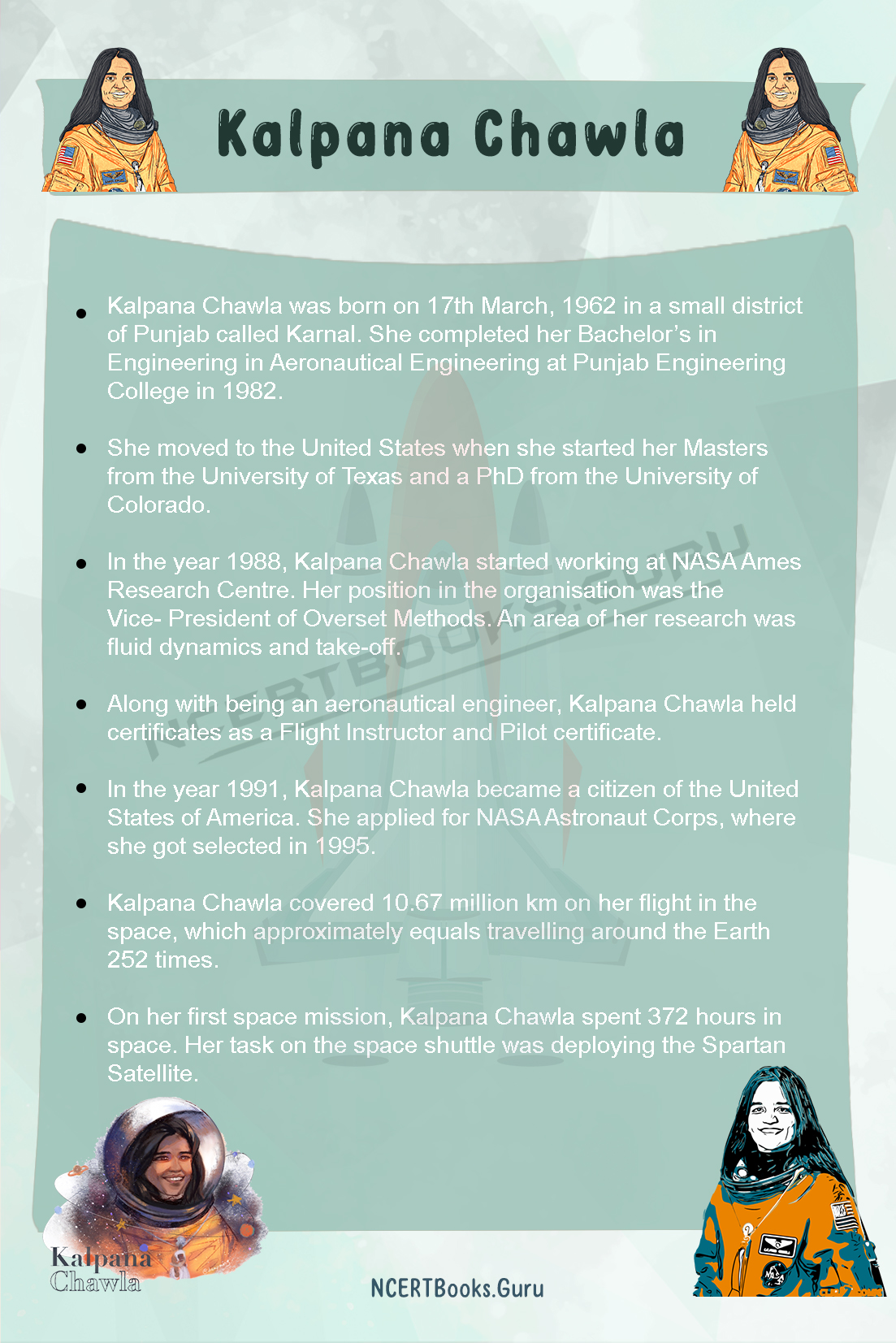
  1. Kalpana Chawla was born on 17th March, 1962 in a small district of Punjab called Karnal. She completed her Bachelor’s in Engineering in Aeronautical Engineering at Punjab Engineering College in 1982.
  2. She moved to the United States when she started her Masters from the University of Texas and a PhD from the University of Colorado.
  3. In the year 1988, Kalpana Chawla started working at NASA Ames Research Centre. Her position in the organisation was the Vice- President of Overset Methods. An area of her research was fluid dynamics and take-off.
  4. Along with being an aeronautical engineer, Kalpana Chawla held certificates as a Flight Instructor and Pilot certificate.
  5. In the year 1991, Kalpana Chawla became a citizen of the United States of America. She applied for NASA Astronaut Corps, where she got selected in 1995.
  6. Kalpana Chawla covered 10.67 million km on her flight in space, which approximately equals travelling around the Earth 252 times.
  7. Chawla’s first space mission was on 19th November 1997 in a space shuttle called ‘Space Shuttle Columbia’. She was a part of a six-member crew aboard on the space shuttle.
  8. On her first space mission, Kalpana Chawla spent 372 hours in space. Her task on the space shuttle was deploying the Spartan Satellite.
  9. After returning to Earth, she continued her technical duties in the space station, which received appreciation from her peers.
  10. She returned to space in 2003 when she conducted a few experiments on studying Earth and space science. While re-entering the Earth’s atmosphere on 1st February 2003, the space shuttle disintegrated with all the seven members lost.

10 Lines on Kalpana Chawla 2

Frequently Asked Questions on Kalpana Chawla

Question 1.
Who was Kalpana Chawla?

Answer:
Kalpana Chawla was an astronaut, the first woman from an Indian Origin. She was a part of two space missions in the years 1997 and 2003, respectively. Kalpana Chawla spent thirty-one days, fourteen hours and fifty- four minutes in space. The space mission that she was a part of was called ‘Space Shuttle Columbia’ and ‘STS-07’.

Question 2.
How did Kalpana Chawla die?

Answer:
Kalpana Chawla died in when she was returning from her second space mission. When STS-07 was re-entering Earth, it caught on fire killing all the seven crew members, including Kalpana Chawla. The tragic incident occurred on 1st February, 2003. It became a famous incident known all over the world.

Question 3.
What are some of the achievements of Kalpana Chawla?

Answer:
Kalpana Chawla had many achievements. She was the first woman who went to space who originated in India. Besides that, she was aware Congressional Space Medal of Honour, NASA Space Flight Medal and Distinguished Service Medal. An asteroid, a hill peak on Mars, and a series of Indian satellites are named after Kalpana Chawla.

Question 4.
How many space missions was Kalpana Chawla a part?

Answer:
Kalpana Chawla was a part of two space missions. The first space mission was the ‘Space Shuttle Columbia’ in the year 1997 and the second space mission in 2003. She spent thirty-one days, fourteen hours and fifty-minutes in space. She lost her life while returning from her second space mission.

10 Lines on Sun for Students and Children in English

10 Lines on Sun

10 Lines on Sun: Sun is the centre of the solar system. It is the nearest planet to the Earth. The Sun is composed of gases that are mainly Hydrogen and Helium. Sun is an essential source of all energy. Every living being acquired their strength from the Sun. It is the source of both light and heat, and without this life on Earth would not be possible. Without sunlight, no photosynthesis will occur and will not get any food. It is also the reason for the rainfall, climate change, and ultimately it is the source of all energy. The Sun’s section is divided into two parts, the Photosphere and atmosphere.

Enhance your vocabulary and writing skills with 10 Lines Essays available. Spark up the creativity in you and access various Topics on 10 Lines all in one place.

Set 1 – 10 Lines on Sun for kids

Set 1 is helpful for the student of class 1,2,3,4 and 5

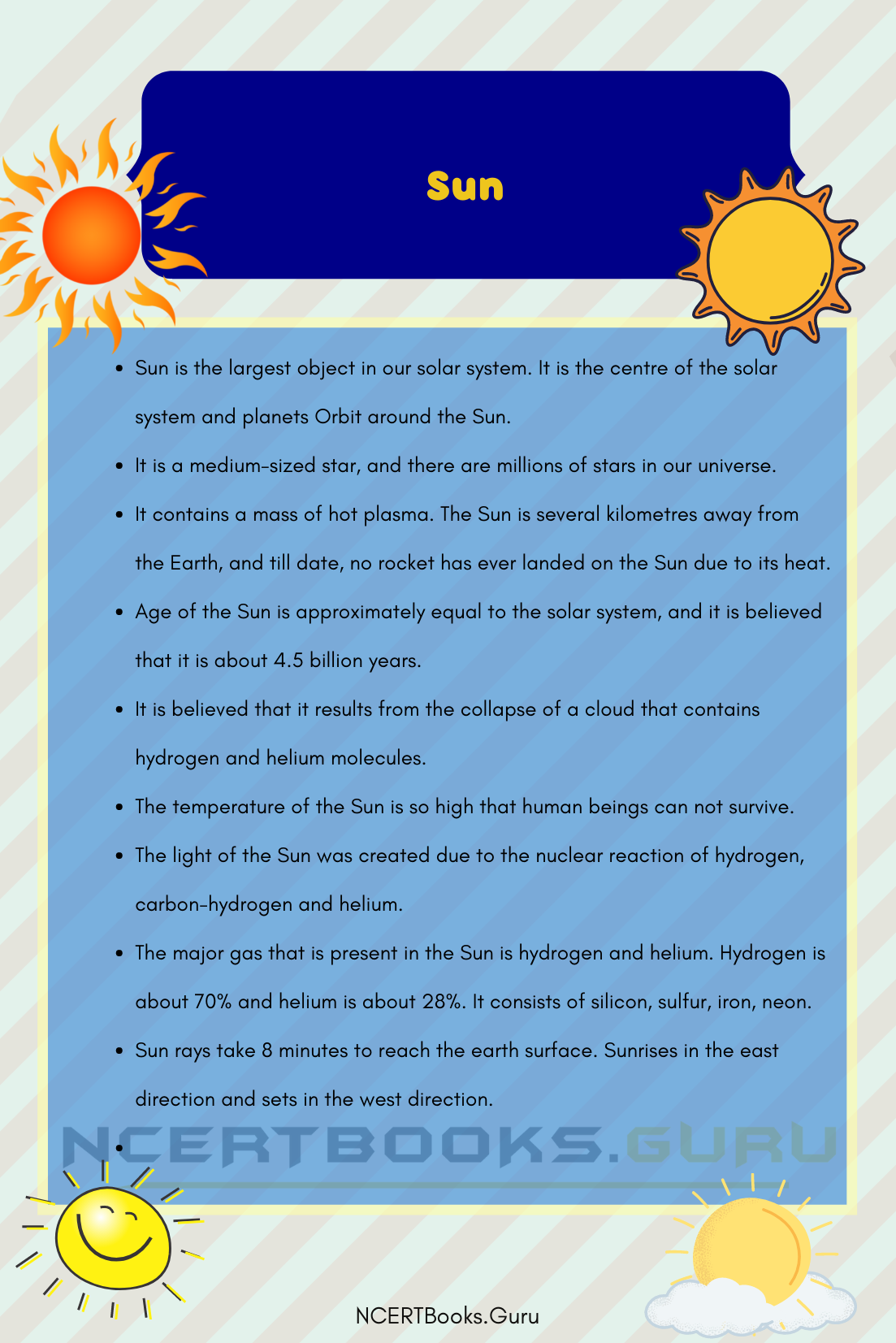
  1. Sun is the largest object in our solar system. It is the centre of the solar system and planets Orbit around the Sun.
  2. It is a medium-sized star, and there are millions of stars in our universe.
  3. It contains a mass of hot plasma. The Sun is several kilometres away from the Earth, and till date, no rocket has ever landed on the Sun due to its heat.
  4. Age of the Sun is approximately equal to the solar system, and it is believed that it is about 4.5 billion years.
  5. It is believed that it results from the collapse of a cloud that contains hydrogen and helium molecules.
  6. The temperature of the Sun is so high that human beings can not survive.
  7. The temperature on the surface is 10000-degree Fahrenheit and in the core is 27 core degrees Fahrenheit, but it is 90000 million miles away from us, so its temperature does not bother us.
  8. The light of the Sun was created due to the nuclear reaction of hydrogen, carbon-hydrogen and helium.
  9. The major gas that is present in the Sun is hydrogen and helium. Hydrogen is about 70% and helium is about 28%. It consists of silicon, sulfur, iron, neon.
  10. Sun rays take 8 minutes to reach the earth surface. Sunrises in the east direction and sets in the west direction.

10 Lines on Sun

Set 2 – 10 Lines on Sun for School Children

Set 2 is useful for students of class 6,7 and 8

  1. Sun is the centre of the solar system, and it is a yellow dwarf star that gives light. It provides infrared energy, ultraviolet light and radio waves.
  2. The solar wind is so present in the Sun. Sun’s mass is 330 thousand times higher than the mass of the Earth. The Sun consists of 99.86% of the solar system’s total mass, and it is Brighter Than 85% star in the Milky Way galaxy.
  3. Nuclear Fusion is carried out on its surface that is the conversion of hydrogen to helium.
  4. Dark area present in the Sun is known as sunspot where the temperature is less than other parts, and the magnetic field is so strong.
  5. The surface of the Sun is visible to us, known as the Photosphere.
  6. The atmosphere of the Sun consists of a Five-layer. Chromophore, transition zone Corona. Are hotter than Photosphere.
  7. Chromosphere Is the first layer which is visible only during the solar eclipse. The moon covers most of the Sun during this time and blocks the brightest light. The transition zone lies between chromosphere and corona.
  8. Corona is the outer part of the Sun. A thin sphere is present in the outer atmosphere of the Sun.
  9. Sun shines due to the conversion of hydrogen to helium.
  10. Sun is 1000 times brighter than the moon. The magnitude measures brightness and its magnitude is -26.74 and so that it looks very bright. We can’t see the Sun with the naked eye, but we can see the moon.

Set 3 – 10 Lines on Sun for Higher Class Students

Set 3 is helpful for students of class 9,10,11,12 and competitive exams.

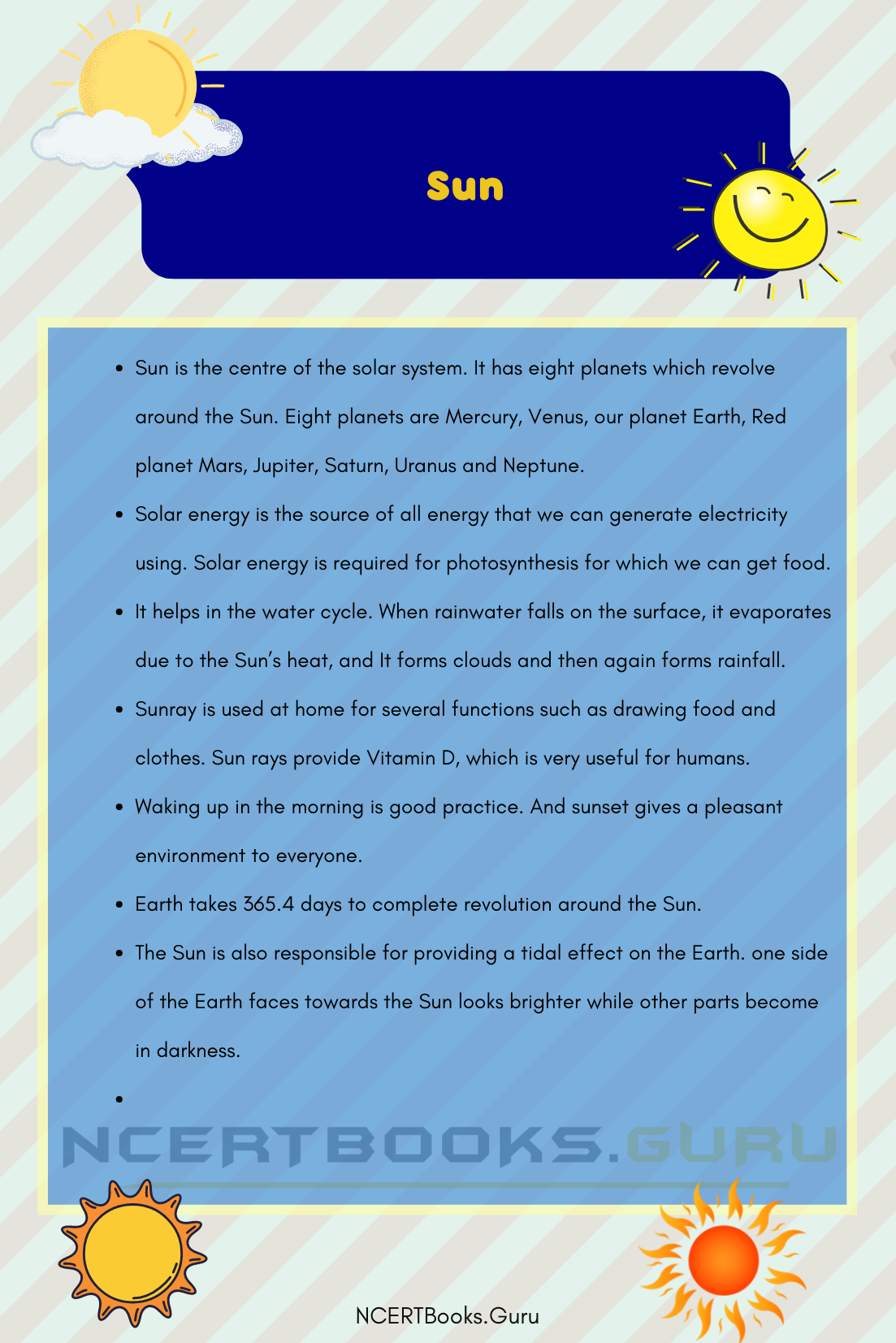
  1. Sun is the centre of the solar system. It has eight planets which revolve around the Sun. Eight planets are Mercury, Venus, our planet Earth, Red planet Mars, Jupiter, Saturn, Uranus and Neptune.
  2. Planets are composed of iron and silicate. Mercury is the hottest and smallest planet and closest to the Sun, and it has a density less than water that is 0.7 gram/cc.
  3. Venus is the second planet, and it is closer to the Earth, and it is known as the evening and morning star its temperature is highest among all planets. Mars is known as Red Planet as its surface is reddish.
  4. Jupiter is the largest planet in the solar system, and twice is the size of another planet. The planet is known as a ring planet, and Uranus Neptune is known as a dark planet as there is so much distance from the Sun.
  5. Solar energy is the source of all energy that we can generate electricity using. Solar energy is required for photosynthesis for which we can get food.
  6. It helps in the water cycle. When rainwater falls on the surface, it evaporates due to the Sun’s heat, and It forms clouds and then again forms rainfall.
  7. Sunray is used at home for several functions such as drawing food and clothes. Sun rays provide Vitamin D, which is very useful for humans.
  8. Waking up in the morning is good practice. And sunset gives a pleasant environment to everyone.
  9. Earth takes 365.4 days to complete the revolution around the Sun.
  10. The Sun is also responsible for providing a tidal effect on the Earth. one side of the Earth facing towards the Sun looks brighter while other parts become in darkness.

10 Lines on Sun 2

Frequently Asked Questions on Sun

Question 1.
Which star closest to the Earth?

Answer:
Sun is the star which is closest to the Earth.

Question 2.
What is the centre of the solar system?

Answer:
The sun is the center of the solar system.

Question 3.
Which reaction takes place inside the Sun

Answer:
Nuclear Fusion is taking place inside the Sun.

Question 4.
The Sun is composed of which gas?

Answer:
Sun is composed mainly of hydrogen and helium.

Question 5.
Which part of the Sun is visible to the human

Answer:
The Photosphere is visible to humans.

Question 6.
Which part visible during the eclipse

Answer:
Corona is visible during eclipse time.

Question 7.
How much time does the sunray take to reach the Earth’s surface?

Answer:
It takes 8 Minute to reach the Earth’s surface.

Master of Science (M.Sc) Courses | Duration, Eligibility Criteria, Admission Process, Syllabus, Career Prospects

Master of Science Courses

Master of Science Courses: If you have graduated and now looking to pursue or pursuing Post Graduation in Science, and are facing a lot of queries related to Top M.Sc courses, this article, presents you a brief about the Master of Science Courses, such as Course Details, Admission process, Course duration, Eligibility criterion, Top Institutions, and Vocation possibilities.

What is an M.Sc Course?

M.Sc is a two-year-long postgraduate course that offers advanced knowledge in specialized Science. The postgraduate course program offers crucial and technical aspects regarding industrial work ethics and applications of Science.

Master of Science is a research-based postgraduate program that concentrates on a particular area and topic and offers an in-depth and comprehensive theoretical and practical knowledge base to students.

Some popular specializations in the field of M.Sc are Biological Science, Chemistry, Physics, Economics, Atmospheric Science, Clinical Psychology, Zoology, Environmental Science, Botany, Meteorology, Information Technology, Geology, Mathematics, Electronics, Biotechnology, and Organisational Leadership.

Overview of M.Sc Course Details

Course Name M. Sc.
M.Sc full form Master of Sciences
Course Level Postgraduate-level
M.Sc Course Duration Two years with four semesters.
Age Limit Age limit criteria are not applicable as anyone interested can pursue this course program after graduation.
Eligibility Criteria 10+2 level of graduation secured from a recognized board with a minimum of 55 percent aggregate.
Placement Opportunities Government Sector,  Private Sector, Research, Teaching, ISRO, BHEL, Railways, BAARC, and more.
Employment Roles Scientist, Lab Technician, Professor, Statistician, Assistant Professor, Field Officer, Junior Software Engineer, and more.
Average Salary Offered Rs. 8 Lakhs per annum
Advanced Courses P.hD and M.Phil
Similar Courses MBA, MCA, M.Com, MA, MSC.MBA

Types of M.Sc Courses in India

M.Sc course is divided into three major types-

  1. M.Sc: A core full-time postgraduate program, which is a research-based degree.
  2. Part-time M.Sc: A part-time postgraduate program that spaces out the same academic content over fewer hours per week for working professionals.
  3. M.Sc Online: A short online program using e-learning technology can be viewed from campus to the office or home.

Get to Know More about other types of Course Details Streamwise, and Category wise.

M.Sc Course Specializations

M.Sc offers a plethora of specializations in the field of Science and its applications at an advanced level. Through the M.Sc degree, you can specialize in various areas, and a few of the specializations are as follows-

Top M.Sc Courses Course Duration Course Specialization
M.Sc. in Advertising Management  and Public Relations Two Years Advertising, Marketing, Public Relations, and Communication.
M.Sc. in Agroforestry Two Years Agricultural and Forestry technologies to create more profitable, diverse, healthy, and productive land-use systems.
M.Sc. in Agronomy Two Years Principles of Crop Nutrition, Crop Production, Herbicides, and Crop Production,  Physiology of Drought, Physiological Aspect of Crop Yield, and Physiology of Crop Plants.
M.Sc. in Anthropology Two Years Prehistoric Archaeology, Social, Political, and Economic Anthropology.
M.Sc. in Aquaculture Two Years Fish Nutrition, Aquatic Toxicology, Fish diseases, Biodiversity, Immunology, and Endocrinology
M.Sc. in Architecture Two Years Contemporary Architecture, Computer Applications in Architecture and Planning, Urban Design, and  Advanced Landscape Design.
M.Sc. in Astrophysics Two Years Space Physics, Applied Mathematics, Quantum Mechanics, Positional Astronomy, and Plasma Physics.
M.Sc. in Biochemistry Two Years Genetic Engineering, Immunology, Enzymes, Proteins, Biochemical, Molecular Biology, and Biophysical Techniques
M.Sc. in Biodiversity and Conservation Two Years Environmental Law, Species Conservation, Biodiversity Management, and Ecological Field Techniques
M.Sc. in Bioinformatics Two Years Computational Mathematics, Information Technology, Molecular Biology, Bioinformatics, and Statistics.
M.Sc. in Biological Sciences Two Years Biochemistry,  Ecology, Biophysics, Cell Biology, Evolutionary Biology, Neuroscience, Genetics, and Neurobiology.
M.Sc. in Botany Two Years Algae and Fungi, Chemical Properties, Reproduction, Plants, Growth, Taxonomic Groups, Development, Evolutionary Relationships among, and Diseases, Structure.
M.Sc. in Chemistry Two Years Organic Chemistry, Analytical Chemistry, and Inorganic Chemistry.
M.Sc. in Clinical Psychology Two Years Adult Mental Health, Geriatrics and Health Psychology, Child Mental Health, Emotional Disturbances, Learning Disabilities, Emotional Disturbances, and Substance Abuse.
M.Sc. in Dairy Engineering Two Years Dairy Sciences and the Study of Dairy Products using the concepts of Engineering.
M.Sc. in Economics Two Years Economics, Applied Economics, and Econometrics.
M.Sc. in Electronics Two Years Semiconductor electronics, DSP, Material Science, IC Technology, Digital, and Analog Electronics.
M.Sc. in Environmental Science Two Years Geo-Environment and  Meteorology, Solid Waste Management, Environment Chemistry and Toxicology, and Environmental Technology.
M.Sc. in Geology Two Years Mineralogy, Optics, Hydrogeology, Crystallography, Environmental Geology, Metamorphic Petrology, Stratigraphy, and Palaeontology.
M.Sc. in Human Development Two Years Early Childhood Care and Education, Parenting in Early Childhood, Child, and Human Rights.
M.Sc. in Information Technology Two Years Advanced JAVA Programming Language, Software Engineering and Management, Interactive Computer Graphics, Algorithm Design, and Analysis.
M.SC in Computer Science Two Years
M.Sc. in Mass Communication and Journalism Two Years Media Appreciation and Research, Media Policy and Technology, and Applied Communication.
M.Sc. in Mathematics Two Years Probability Theory, Algebraic Geometry, Theoretical Computer Science, Global Analysis, and Number Theory.
M.Sc. in Microbiology Two Years Bioinstrumentation, Molecular Immunology,  Food, and Dairy Microbiology, and  Microbial Physiology.
M.Sc. in Molecular Biology Two Years Bioinstrumentation, Molecular Immunology, Food, and Dairy Microbiology, and Microbial Physiology.
M.Sc. in Molecular Biology Two Years Biostatistics, Physical, Biochemistry, Applied Molecular Biology, and Biochemical Techniques
M.Sc. in Neuroscience Two Years Biochemistry, Neuron Organization, Cell Biology, Genetics, and Molecular Biology.
M.Sc. in Optometry Two Years Orthotics, Behavioural Optometry, and Paediatric Optometry.
M.Sc. in Physics Two Years Nuclear Physics, Cosmology, Geophysics, Condensed Matter Physics, and Astrophysics.
M.Sc. in Psychology Two Years Neuro-Psychology, Psychometrics, and Cognitive Psychology.
M.Sc. in Statistics Two Years Finance, Social Sciences, and Econometrics.
M.Sc. in Tourism Two Years Tourism Business, Tourism Marketing, Computer Applications in Tourism, Tour Packaging Management, and Airlines Ticketing.
M.Sc. in Zoology Two Years Parasites and Immunity, Ecological theories and applications, Endocrinology, Comparative Animal Physiology, and Neuroscience.

Skillset Required for Master of Science Courses

Candidates opting for the M.Sc course programs must hold the following skillsets-

  • Research skills
  • Determination
  • Problem-solving skills
  • Observational skills
  • Attention to detail and accuracy
  • Ability to work in a team
  • Patience
  • Scientific skills
  • Determination
  • Analytical skills

Master of Science (M.Sc) Courses

Master of Science Courses Duration

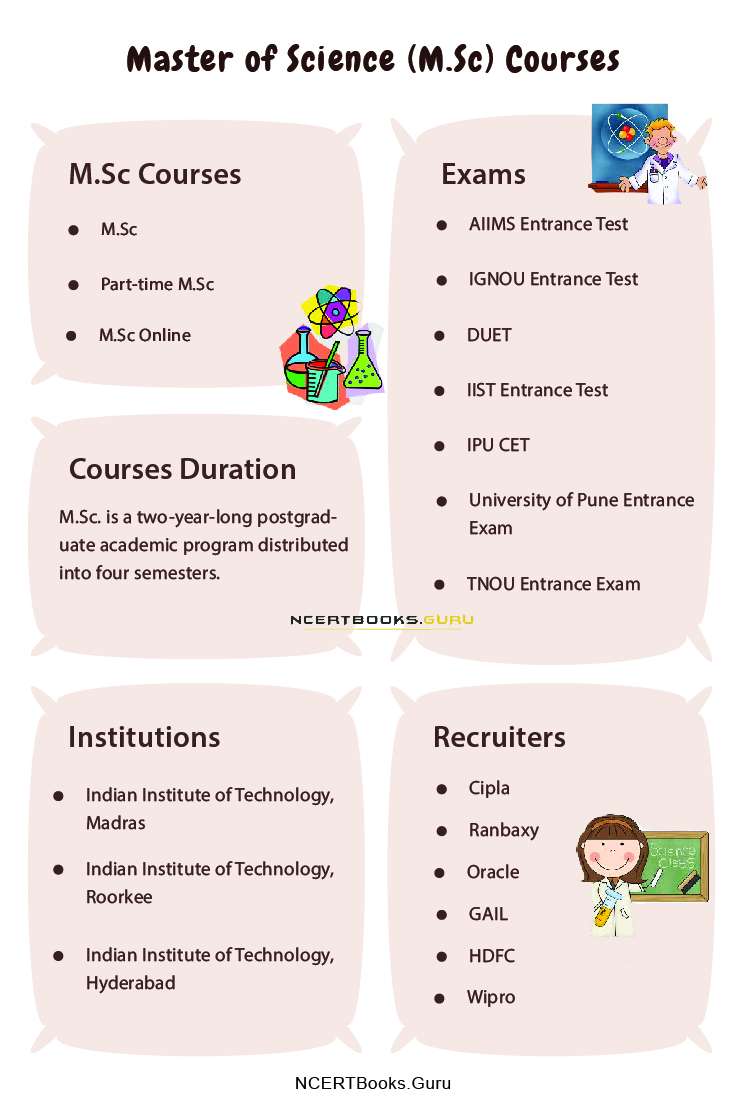
M.Sc. is a two-year-long postgraduate academic program distributed into four semesters. Each semester lasts for six months and covers a list of essential subjects about specialized science subjects.

Master of Science Courses Eligibility Criteria

To pursue any of the specialized courses that fall under the M.Sc program, candidates must have completed their 10+2 level of graduation from a recognized board with a minimum of 55 percent aggregate. However, the minimum total varies from one institution to another.

Master of Science Courses Admission Procedure

An admission procedure is granted for candidates who meet the eligibility criteria for M.Sc course programs. Some universities and institutions provide admissions without an entrance test, based on Personal Interview and academic performance.

Most colleges and universities conduct entrance tests for candidates, and the candidates who clear the admission test will only be given admission for M.Sc course programs.

Entrance Exams for M.Sc

Most university-based entrance examination for M.Sc course programs are-

  • AIIMS Entrance Test
  • IGNOU Entrance Test
  • Osmania University Entrance Exam
  • DUET
  • IIT JAM
  • The Wildlife Institute of India Entrance Exam
  • IIST Entrance Test
  • IPU CET
  • University of Pune Entrance Exam
  • Banaras Hindu University Entrance Exam
  • Indian School of Mines Entrance Exam
  • TNOU Entrance Exam

Master of Science Courses Fee Structure

The fee structure for the Master of Science course programs ranges from Rs. 20,000/- to Rs. 3 Lakhs per annum. Candidates seeking admissions at governmental universities have a lesser fee amount to that of private institutions.

M.Sc course fees structure may vary as per the university’s prestige, infrastructure, and the faculty and the government and management quotas.

Master of Science Course Program Syllabus and Subjects

The course curriculum for M.Sc course programs, namely Chemistry, Mathematics, Physics, and Biology, are tabulated below.

Preparation for M.Sc course programs becomes easy when you prepare prior, enhance accuracy, and problem-solving skills with a better grip on the subjects.

Each M.Sc course program focuses on specific topics and aims to develop a comprehensive and in-depth knowledge base.

The syllabus mentioned below is similar to those followed by the Major colleges in India.

Chemistry

  • Stereochemistry and Reaction Mechanism
  • Physical Chemistry Experiments Lab
  • Spectroscopic Methods in Chemistry
  • Analytical Chemistry
  • Instrumental Methods of Analysis Lab
  • Inorganic Chains, Rings, and Clusters
  • Solid State Chemistry and Materials Science
  • Group theory and Quantum Chemistry
  • Inorganic Quantitative Analysis Lab
  • Thermodynamics and Equilibria
  • Qualitative Analysis Lab
  • Synthetic Strategies and Pericyclic Reactions
  • Inorganic Semimicro

Mathematics

  • Topology and Functional Analysis
  • Analytical Mechanics
  • Advanced Functional Analysis
  • Real Analysis
  • Mathematical Statistics
  • Differential Geometry
  • Theory of Optimization
  • Rings and Modules
  • Theory of Approximation and Splines
  • Solid Mechanics
  • Algebra
  • Electromagnetic Theory
  • Methods of Mathematical Physics
  • Operations Research
  • Group Theory
  • Special Theory of Relativity
  • Numerical Analysis
  • Fluid Mechanics
  • Complex Analysis
  • Number Theory
  • Mechanics
  • Computer Applications

Physics

  • Mechanics of Deformable Elastic Solids
  • Modern Optics
  • Mathematical Physics
  • Electronics
  • Electromagnetic Theory
  • Physics of Semiconductor Devices
  • Quantum and Statistical Physics
  • Crystal Physics
  • Mechanics

Biology

  • Methods in Applied Sciences
  • Genes and Genomics
  • Recombinant DNA Technology
  • Research Methodology and IPR
  • Metabolism and Metabolomics
  • Cell Biology
  • Biostatistics and Bioinformatics
  • Proteins and Proteomics

Master of Science Course Program Subjects

Chemistry

Semester I Semester II
Group theory and Quantum Chemistry Spectroscopic Methods in Chemistry
Inorganic Semimicro Thermodynamics and Equilibria
Inorganic Chains, Rings, and Clusters Elective – I
Instrumental Methods of Analysis Lab Qualitative Analysis Lab
Stereochemistry and Reaction Mechanism Synthetic Strategies and Pericyclic Reactions
Physical Chemistry Experiments Lab Solid State Chemistry and Materials Science
Analytical Chemistry Inorganic Quantitative Analysis Lab
Semester III Semester IV
Spectroscopic Identification of Molecules Industrial Catalysis
Bioorganic, Heterocyclic, and Photochemistry Polymer Science
Organic Qualitative Analysis Lab Elective – IV
Coordination Chemistry Surface Science and Coating Technology
Chemistry of Biomolecules Bioanalytical Chemistry
Elective – II Electives
Bioinorganic and Organometallic Chemistry Medicinal Chemistry
Organic Quantitative Analysis Lab Nano-Chemistry and Technology
Elective – III Project
Electrochemistry and Kinetics Green Chemistry

Mathematics

First Year Syllabus Second Year Syllabus
Numerical Analysis Analytical Mechanics
Group Theory Electromagnetic Theory
Complex Analysis Theory of Optimisation
Mathematical Statistics Number Theory
Computer Applications Theory of Approximation and Splines
Methods of Mathematical Physics Special Theory of Relativity
Mechanics Operations Research
Differential Geometry Rings and Modules
Algebra Advanced Functional Analysis
Topology and Functional Analysis Solid Mechanics
Real Analysis Fluid Mechanics

Physics

First Year Syllabus Second Year Syllabus
Electromagnetic Theory I Electronics I
Laboratory Modern Optics
Mathematical Physics Mechanics II Quantum and Statistical
Mechanics of Deformable Elastic Solids Laboratory
Mechanics I- Quantum and Statistical Electromagnetic Theory II and Crystal Physics
Physics of Semiconductor Devices

Biology

Semester I Semester II
Cell Biology Methods in Applied Sciences
Genes and Genomics Metabolism and Metabolomics
Biostatistics and Bioinformatics Research Methodology and IPR
Proteins and Proteomics Recombinant DNA Technology
Semester III Semester IV
Research Project Clinical Immunology
Introduction to Pharmacology
Molecular Oncology and Molecular Medicine
Recent Advances in Biology

Have a look at the best M.SC books which are helpful during the Master of Science Course.

Top Institutions Offering Master of Science Courses

A few of the top institutions offering M.Sc course programs are as follows:

  • Indian Institute of Technology, Madras
  • Indian Institute of Technology, Roorkee
  • National Institute of Technology, Karnataka
  • Indian Institute of Technology, Guwahati
  • Indian Institute of Technology, Bombay
  • All India Institute of Medical Sciences
  • National Institute of Technology, Rourkela
  • Indian Institute of Technology, Hyderabad
  • Indian Institute of Technology, Kanpur

Also, See:

Master of Science Courses Employment Prospects

M.Sc course programs open doors to a plethora of employment opportunities in both the public and private sectors. Candidates interested in research can opt for doctorate and research programs at various universities and institutions.

M.Sc degree graduates can get employed in various fields like defense, education, public sector, aerospace industries and automotive, technology, healthcare, energy, materials, computing, and information technology.

After the completion of M.Sc course programs, candidates can also pursue higher studies such as M.Phils or Ph.D. courses.

M.Sc in Physics candidates with a good percentage can apply for employment opportunities at NASA.

M.Sc course programs offer multiple employment opportunities in India but also overseas.

Employment Areas

Upon the completion of M.Sc, graduates find placements in both non-traditional and traditional areas of employment such as-

  • Research
  • ONGC
  • Government Sector
  • BAARC
  • Teaching
  • NTPC
  • Banks
  • BHEL
  • Railways
  • ISRO
  • Private Sector
  • HPCL

Job Holdings

M.Sc graduates can pursue multiple job profiles depending on the company or institution such as-

  • Professor
  • Lab Technician
  • Researcher and accountant
  • Field Officer
  • Quantitative Developer
  • Research Assistant
  • Manager
  • Statistician
  • Scientist
  • Junior Software Engineer
  • Assistant Professor

Top Recruiters for Master of Science Graduates

Multiple institutions and companies recruit M.Sc graduates from the field of specialized science.

  • Cipla
  • HCL
  • Ranbaxy
  • Oracle
  • GAIL
  • Infosys
  • HDFC
  • GlaxoSmithKline
  • ICICI
  • ONGC
  • Wipro

Salary and Pay Package of Master of Science Courses

An M.Sc degree graduate fresh in the field earns an average pay package of Rs.25,000 to Rs. 35,000 per month (Rs. 7.95 Lakhs per annum). However, the salary package differs for companies in both private and governmental sectors.

Salaries also depend upon several factors: the company size, location,  working field, sector, qualification, and experience.

FAQ’s on Master of Science Courses

Question 1.
What is the scope of M.Sc course programs?

Answer:
Job Oriented M.Sc courses are high in-demand, and any candidate can gain a respectable job in this area upon completion with good grades. Candidates can also opt for various specializations in the M.Sc program. Each M.Sc discipline holds excellent opportunities in the field of Medicine, Petrochemical, Chemical, and Polymer industries.

Question 2.
What are a few reference books and study materials for M.Sc course programs?

Answer:
Reference materials for M.Sc course programs are Inorganic Chemistry by Shriver and Atkins, Zoology – A Complete Guide by Dr. Anita Sehgal, Classical Mechanics by H.Goldstein, Narosa, A Manual of Botany by Bahadur, R Acharik, and Principle of Mathematical Analysis by Walter Rudin.

Question 3.
What are the eligibility requirements to meet for M.Sc course programs?

Answer:
To pursue any of the specialized courses that fall under the M.Sc program, candidates must have completed their 10+2 level of graduation from a recognized board with a minimum of 55 percent aggregate. However, the minimum total varies from one institution to another.

Question 4.
Name a few entrance examinations for M.Sc course programs?

Answer:
Most university-based entrance examination for M.Sc course programs are- AIIMS Entrance Test, IGNOU Entrance Test, Osmania University Entrance Exam, DUET, IIT JAM, The Wildlife Institute of India Entrance Exam, IIST Entrance Test, IPU CET, University of Pune Entrance Exam, and more.

Madras University Courses for UG, PG | Admissions, Placements, Fees, Eligibility, Colleges

madras university courses

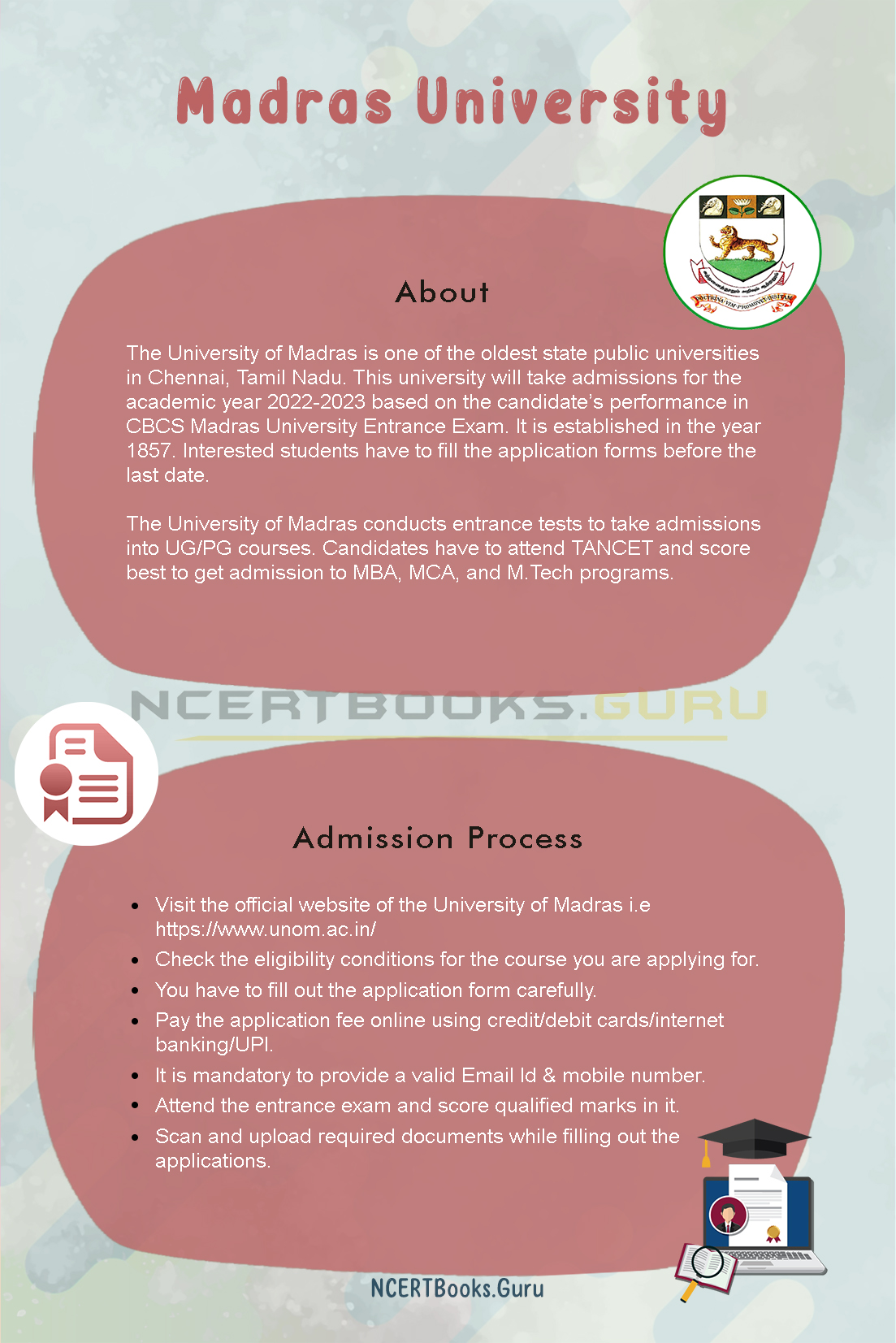
Madras University Courses: The University of Madras is one of the oldest state public universities in Chennai, Tamil Nadu. This university will take admissions for the academic year 2022-2023 based on the candidate’s performance in CBCS Madras University Entrance Exam. It is established in the year 1857. Interested students have to fill the application forms before the last date.

The University of Madras conducts entrance tests to take admissions into UG/PG courses. Candidates have to attend TANCET and score best to get admission to MBA, MCA, and M.Tech programs. In this article, we are giving information regarding the admission process, important dates, UG, PG courses list, eligibility conditions, fees structure, and placements.

University of Madras Courses Overview

Name of the University University of Madras
Location Chennai, Tamil Nadu
Admission Process Entrance Exams
Telephone Numbers 2539 9422, 2539 9746
Courses UG, PG Courses
Official Website https://www.unom.ac.in/

Why Madras University?

Madras University is ranked 28th among the top universities in India by NIRF 2021. It is recognized by the UGC as a “potential for excellence” in the country. The university offers UG, PG, Diploma, Research, and Certificate programs. It has seven branches in Chetpet, Mariana, Chepauk, Guindy, Maduravoyal, and Taramani.

The University of Madras offers more than 230 courses in 87 departments. It also has 121 affiliated colleges, and 53 approved research centres. The departments are sciences, management, humanities, social sciences, and medicine. This university also provides distance education through IDE (Institute of Distance Education).

University of Madras Courses

Madras University provides the best knowledge with research. The university provides various courses in multiple disciplines. It offers courses in 87 departments. Here are the list of disciplines:

  • Philosophy
  • Polymer Science
  • Ramanujan Institute for Advanced Study in Mathematics
  • Center for Water Resource Management
  • Criminology
  • Politics and Public Administration-IDE
  • Centre for Advanced Study in Botany
  • Marina Library
  • Telugu
  • Center for Infrastructural Management Studies
  • Agro Economic Research Centre
  • Biochemistry
  • Theoretical Physics
  • National Centre for Nanosciences and Nanotechnology
  • Library & Information Science
  • Network Systems and Information Technology
  • Psychology-IDE
  • Zoology
  • Energy
  • Central Instrumentation and Service Laboratory
  • Centre for Endangered Languages
  • Microbiology
  • Rajiv Gandhi Chair in Contemporary Studies
  • Hindi
  • Centre for Environmental Sciences
  • Tamil Language
  • National Centre for Ultrafast Process
  • Vaishnavism
  • Counselling Psychology
  • Centre for Natural Hazards and Disaster Studies
  • Centre for Research on Dravidian Movement
  • Anatomy
  • Tamil-IDE
  • Commerce
  • Jainology
  • English
  • Geography
  • UGC – Centre for South and Southeast Asian Studies
  • Endocrinology
  • Social Work
  • Centre for Ocean and Coastal Studies
  • Women’s Studies
  • Material Science
  • Taramani Library
  • Christian Studies
  • Tamil Literature
  • Biotechnology
  • Guindy Library
  • Medical Biochemistry
  • Commerce-IDE
  • Arabic, Persian and Urdu
  • Indian History
  • Adult and Continuing Education
  • Library
  • Centre for Cyber Forensics and Information Security
    Saiva Siddhanta
  • Anna Centre for Public Affairs
  • Physical Chemistry
  • Management Studies
  • Politics and Public Administration
  • Inorganic Chemistry
  • Education
  • Physiology
  • Analytical Chemistry
  • Pharmacology and Environmental Toxicology
  • Management Studies-IDE
  • Computer Science
  • Dr. Ambedkar Centre for Economic Studies
  • Defence and Strategic Studies
  • Computer Science-IDE
  • Psychology
  • Genetics
  • Ancient History and Archaeology
  • Centre for Population Studies
  • Chepauk Library
  • Nuclear Physics
  • Center for Thirukkural Research
  • Anthropology
  • Journalism and Communication
  • JBAS Center for Islamic Studies
  • Bio-informatics
  • Statistics
  • Economics
  • Applied Geology
  • Sangapalagai for Tamil Development
  • Physical Education and Sports
  • Crystallography and Biophysics
  • Kannada
  • Pathology
  • Legal Studies
  • Organic Chemistry
  • Geology
  • Sanskrit
  • Sociology
  • French
  • Econometrics
  • Malayalam
  • Indian Music

Madras University Master Degree Courses & Eligibility Conditions

Every candidate who wish to apply for Madras University Courses of Master Degree must fulfil the eligibility criteria mentioned here.

Madras University Course Master Degree University of Madras Eligibility
M.A. Ancient History and Archaeology Passed any Bachelor’s Degree Examination
M.A. Historical Studies Bachelor’s degree in any subject
M.A. Anthropology
M.A. Sociology Undergraduate Degree
M.A. Women’s Studies Bachelor’s degree in any subject
M.A. Lifelong Learning
M.A. Human Resource Management
M.Sc. Criminology and Criminal Justice Science Any Bachelor’s degree holder
M.Sc. Cyber Forensics & Information Security Degree in Computer Science/ IT/ Computer Applications/ any relevant degree
B.Sc in Mathematics or B.E/B.Tech
M.Ed B.Ed or B.T
M.S.W. Social Work Any Bachelor’s degree holder
M.A. Defence and Strategic Studies B.A./B.Sc./B.Com
M.A. Political Science B.A Political Science
M.A. Public Administration B.A Public Administration
M.A. International Relations B.A Political Science/History
M.A. Development Administration Any Bachelor’s degree holder
M.A. Public Policy
M.A. Economics B.A. Economics/B.Com./ B.A. Corporate Secretaryship/ BBA / B.Sc. Mathematics / B.Sc. Statistics
Masters of Journalism- Online Media Any Bachelor’s degree holder
M.A. English B.A. English or B.A. & B.Sc. with Part-II English
M.Com. International Business & Finance B.Com
M.Lib.I.Sc. Library and Information Science Bachelor’s degree
MBA
M. Sc. Statistics B.Sc. Statistics or B.Sc. Mathematics with Statistics as subject
M.Tech. Geoinformatics M.A./M.Sc. Degree
M. Sc. Biomedical Genetics In the field of Life Sciences
In Medicines/Dental Veterinary and agriculture.

Madras University Diploma Courses List & Eligibility

Students after finishing 12th class can apply for diploma courses in Madras University. Check the below sections to know the detailed eligibility criteria for all diploma courses.

Diploma Course Name Course Eligibility
Diploma in Telugu Must have passed certificate course
Diploma in Italian 12th class & certificate course in Italian
Diploma in Hindi +2 with Hindi or +2 with certificate course in Hindi
Diploma in Cybercrime and information security Graduation
Jaina Temple Management +2 exam
Learning Disabilities (LD) Graduation from any UG or PG discipline
Diploma in Saiva Siddhanta Certificate course in Saiva Siddhanta or Bachelor’s degree
Business Research Analytics Degree
Internal Audit

University of Madras Courses, Eligibility – PG Diploma

Post graduate courses in Madras University eligibility conditions are along the lines:

PG Diploma Course Name Course Eligibility
Technical Writing Graduate with good command on English
Ethics and Human Resource Management Bachelor’s degree
P.G. Diploma in Periya Puranam Studies Diploma Course in Siva Sidhanta or Bachelor degree
Linguistics Graduate
P.G. Diploma in Counselling and Psychotherapy Bachelor’s degree
Immunotechnology Master’s degree
Banking and Finance Degree
P.G. Diploma in Archaeology Master’s degree
PG Diploma in Yoga Theory, Practice and Therapy Graduate

Certificate Madras University Courses and Eligibility

Avail the Madras University Certificate Courses and eligibility details from this page.

Certificate Course Name Course Eligibility
Certificate in Italian (SS) 12th class
Certificate in French (SS)
Certificate in Arabic Graduate
Certificate in Urdu
Certificate in Kannada
Certificate in Hindi +2
Certificate in Hospitality Management
Certificate in Pre-Primary Education
Certificate in Buddhist Studies
Certificate in Juvenile Justice and
Juvenile Psychology
Bachelor’s degree

Madras University Course Admission Process 2022

Interested and eligible aspirants have to apply online for MU courses. Below mentioned are the guidelines on how to apply for the University of Madras.

  • Visit the official website of the University of Madras i.e https://www.unom.ac.in/
  • Check the eligibility conditions for the course you are applying for.
  • You have to fill out the application form carefully.
  • Pay the application fee online using credit/debit cards/internet banking/UPI.
  • It is mandatory to provide a valid Email Id & mobile number.
  • Attend the entrance exam and score qualified marks in it.
  • Scan and upload required documents while filling out the applications.

Madras University Courses 1

Required Documents

  • Community Certificate
  • Mark sheet & Certificates of 10+2, Graduation, Post Graduation
  • Certificate of proof for the differently-abled /Sports/ NCC / Ex.Servicemen
  • Transfer Certificate and Conduct Certificate

More Related Articles

Affiliated Madras University Colleges

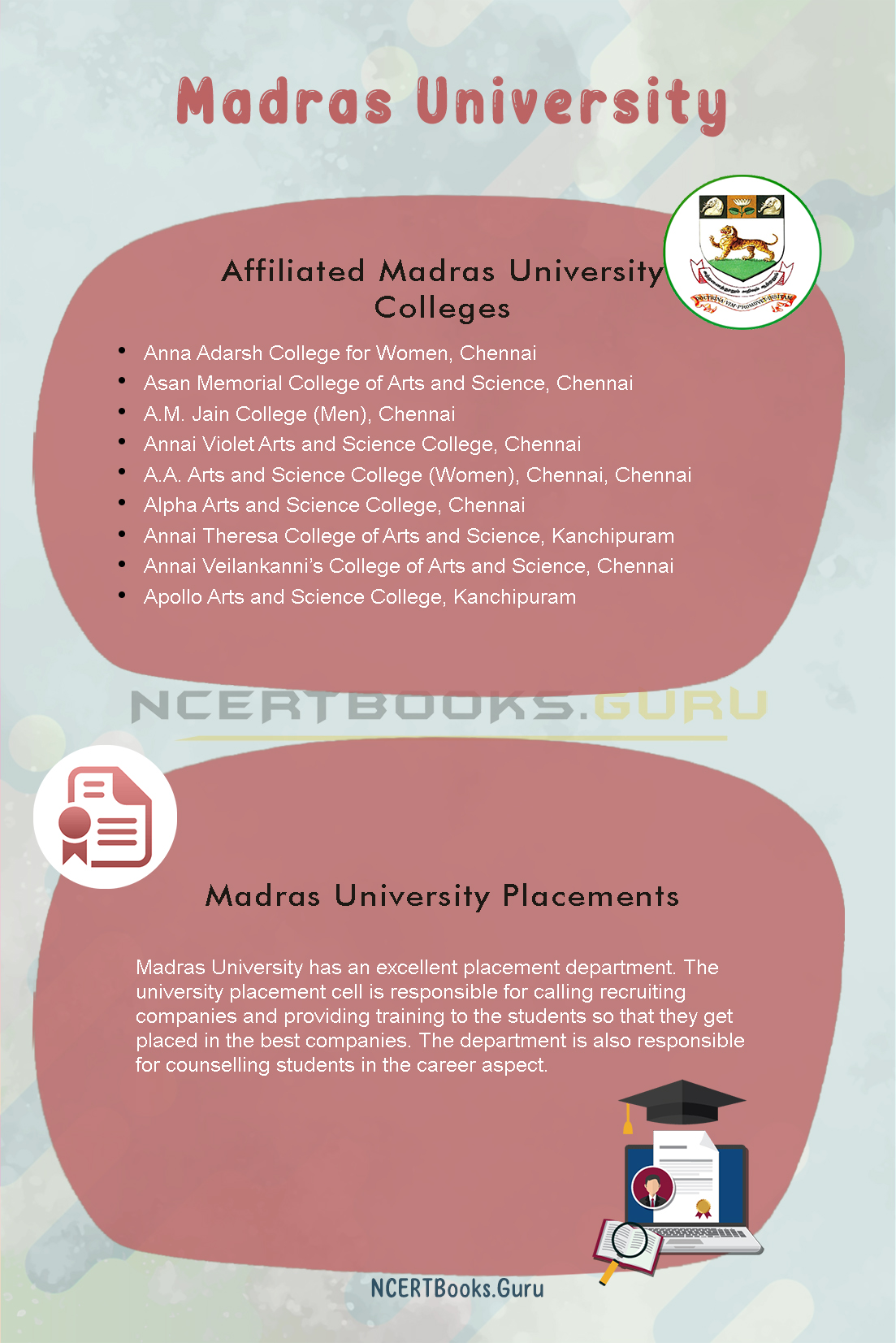
Here is the list of private MU affiliated colleges:

  • Anna Adarsh College for Women, Chennai
  • Asan Memorial College of Arts and Science, Chennai
  • A.M. Jain College (Men), Chennai
  • Annai Violet Arts and Science College, Chennai
  • A.A. Arts and Science College (Women), Chennai, Chennai
  • Alpha Arts and Science College, Chennai
  • Annai Theresa College of Arts and Science, Kanchipuram
  • Annai Veilankanni’s College of Arts and Science, Chennai
  • Apollo Arts and Science College, Kanchipuram

Madras University Courses and Fees

The course fees structure for different MU courses i.e diploma, PG, UG, Master’s, Certificate is provided here:

MU Courses List Madras University Fees
MA INR 5,305 (1st Year Fees)
M.Com INR 5,305 (1st Year Fees)
M.Sc INR 7,425 (1st Year Fees)
MBA in Madras University INR 25,380 (1st Year Fees)
MCA INR 22,580 (1st Year Fees)
M.Tech INR 27,055 (1st Year Fees)
M.Ed INR 8,305 (1st Year Fees)
M.Phil INR 5,060 (1st Year Fees)
Ph.D INR 0,970 (1st Year Fees)

Madras University Placements

Madras University has an excellent placement department. The university placement cell is responsible for calling recruiting companies and providing training to the students so that they get placed in the best companies. The department is also responsible for counselling students in the career aspect.

Madras University Courses 2

FAQ’s on University of Madras Courses

1. How many courses are there in Madras University?

A total of 165 courses are available in the University of Madras.

2. What is the fees of the university of madras?

The Madras University Courses Fees range from Rs.6,500 to Rs.18,850 per year.

3. What are Madras University UG Courses?

The list of MU UG Courses are B.A, B.Sc, BMM, B.Com, and B.C.A in different disciplines.

4. Does Madras University have an entrance exam?

Admissions to Madras University PG Courses such as MBA, MSc, MA, and PhD are based on the entrance exam conducted by the university.

Conclusion

We are hoping that the information included here regarding Madras University Courses is helpful for the people who are willing to pursue UG/PG/Diploma/Certificate courses. Get to know about other University Courses details at our page.