Tamil Nadu Open University, (TNOU) Courses & Fees | Admissions, Eligibility, and Colleges

Tamil Nadu Open University Courses

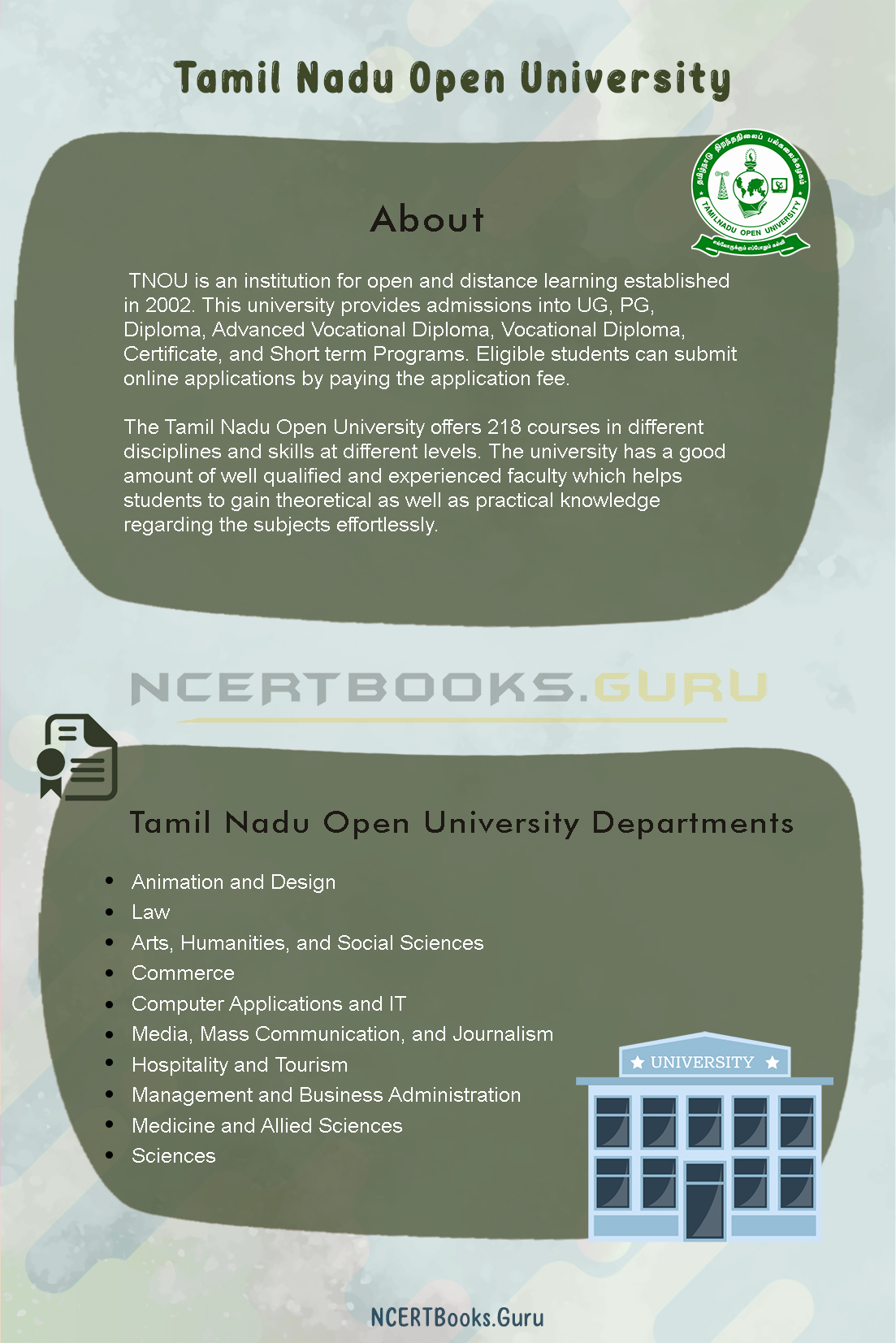
Tamil Nadu Open University Courses: TNOU is an institution for open and distance learning established in 2002. This university provides admissions into UG, PG, Diploma, Advanced Vocational Diploma, Vocational Diploma, Certificate, and Short term Programs. Eligible students can submit online applications by paying the application fee.

The Tamil Nadu Open University offers 218 courses in different disciplines and skills at different levels. The university has a good amount of well qualified and experienced faculty which helps students to gain theoretical as well as practical knowledge regarding the subjects effortlessly.

Here you can check the information such as TNOU Courses and Fees Structure, Eligibility Conditions, Admission Process, Department Names, Affiliated Colleges, and many more.

Tamilnadu Open University Courses Highlights

Name of the University Tamil Nadu Open University
Offered Courses UG, PG, Diploma, Advanced Vocational Diploma, Vocational Diploma, Certificate, and Short term Programs
Mode of Application Online
Admission Criteria  Merit List
Location Chennai
Official Website https://tnou.ac.in/

Tamil Nadu Open University Departments

TNOU offers distance education courses in the following listed streams. Students can select any UG/PG/Diploma/Certificate course related to these departments.

  • Animation and Design
  • Law
  • Arts, Humanities, and Social Sciences
  • Commerce
  • Computer Applications and IT
  • Media, Mass Communication, and Journalism
  • Hospitality and Tourism
  • Management and Business Administration
  • Medicine and Allied Sciences
  • Sciences

Tamil Nadu Open University Courses 1

Tamil Nadu Open University Courses and Fees, Eligibility

Here we are giving the list of postgraduate and undergraduate courses names, their fees structure, and eligibility conditions. Get a detailed semester wise fees amount for every course.

Course Name Course Eligibility 1st Year Fees 2nd Year Fees
UG Courses
B.A Tamil 12th Pass or Equivalent or 12th from NIOS or 3Years Diploma by DOTE. Rs.2500 Rs.2,175
B.A English Rs.3500 Rs.3,300
B.A History Rs.3500 Rs.3,300
B.A Political Science Rs.3500 Rs.3,300
B.A Human Rights Rs.3000 Rs.2,800
B.Com Rs.3500 Rs.3,300
B.B.A Rs.4,750 Rs.4,550
B.Com Computer Applications Rs.4,400 Rs.4,200
B.SC Mathematics Rs.5500 Rs.5,300
B.B.A Marketing Management Rs.4250 Rs.4050
B.Sc Chemistry Rs.6500 Rs.6,300
B.Sc Physics Rs.6500 Rs.6,300
B.Sc Zoology Rs.6500 Rs.6,300
B.Sc Botany Rs.6500 Rs.6,300
B.Sc Geography Rs.6500 Rs.6,300
B.Sc Computer Science Rs.9500 Rs.9,300
Bachelor of Social Work Rs.3500 Rs.3,200
B.C.A 10th Pass and Diploma from Polytechnic College Rs.9500 Rs.9,300
B.A Sociology 12th Pass or Equivalent or 12th from NIOS or 3Years Diploma by DOTE. Rs.3500 Rs.3,300
B.Sc Multimedia Rs.6500 Rs.6,300
PG Courses
M.A Tamil Bachelor’s Degree Rs.3,800 Rs.3,150
M.A English 12th + Bachelor’s degree  Rs.4,300  Rs.4,100
M.A History  Rs.4,300  Rs.4,100
M.A Political Science Rs.4,300  Rs.4,100
M.Com Graduate in Commerce/ Business Administration Rs.5,000  Rs.4,800
M.B.A  12th+Bachelor’s degree  Rs.12,500  Rs.12,300
M.SC Mathematics  B.Sc in Mathematics  Rs.5,500  Rs.5,300
M.Sc Chemistry B.Sc General Chemistry/Bio Chemistry/Industrial Chemistry Rs.10,500  Rs.10,300
M.Sc Physics  B.Sc in Physics/any B.SC Degree with applied physics  Rs.10,500  Rs.10,300
M.Sc Zoology  B.Sc Zoology/Micro biology/ Biotechnology degree/ Bio Chemistry/Animal Science  Rs.10,500  Rs.10,300
M.Sc Botany  B.Sc Botany/Micro biology/ Biotechnology degree/ Bio Chemistry  Rs.10,500 Rs.10,300
M.Sc Counselling and Pyschotherapy  12th + Bachelor’s Degree from any frecognised university  Rs.12,500  Rs.12,500
Master of Social Work  –  Rs.6,500  Rs.6,300
M.L.I.Sc  Bachelor of Library Science/Bachelor of Library and Information Science Rs.5,500  Rs.5,300
M.A Sociology 12th + Bachelor’s Degree Rs.4,300  Rs.4,100
MCA Any Bachelor’s Degree Rs.12,500 Rs.12,300
M.Sc Computer Science BSc (CS)/ BCA/BSC(CT)/BSC information Systems Rs.12,500 Rs.12,300
M.SC Apparel and Fashion Design Bachelor’s Degree in Apparel & Fashion Design  Rs.10,500  Rs.10,300

TNOU Courses and Eligibility, Fees Structure

Diploma, Certificate and Vocational Courses list in Tamil Nadu Open University, courses eligibility, and fees structure is available here:

Course Name Eligibility Fees
Diploma Programmes of Tamil Nadu Open University Courses after 10th
Diploma in Archaeology and Epigraphy 10th Pass 4,000
Diploma in Tourism and Tour Operations Management 3,500
Diploma in Lab Technician 12th Pass 6,500
Advanced Vocational Diploma Courses
Advanced Vocational Diploma in General Duty Assistant 10th Pass 15,200
Advanced Vocational Diploma in General Duty Assistant 7,700
Vocational Diploma Courses
Vocational Diploma in Refrigeration and Air Conditioning Technician 10th Pass 4,700
Vocational Diploma in Office Automation
Vocational Diploma in Vehicle Mechanic
Vocational Diploma in Fashion Design and Garments Making

Tamil Nadu Open University Courses Admission Process 2022

Tamil Nadu Open University (TNOU) is the first open university in Tamil Nadu. Students who are applying for UG, PG, Diploma, and PG Diploma courses can apply online from the official website. Check the below-listed steps to get the complete TNOU Admission Procedure.

Compulsory for Online Applications

  • Credit Card/Debit Card/Internet Banking
  • Scanned copy of the applicant’s recently taken the colour photo
  • Scanned copy of the applicant’s signature
  • JPEG File of Highest Qualification Certificate (10th /+2/Degree/Diploma/ )
  • Valid e-mail id
  • A Mobile Number
  • For submitting the application for Admission of New Students, connect to the internet and visit
  • Tamil Nadu Open University website namely www.tnou.ac.in
  • Community Certificate for those students who wish to avail Scholarship

How to Apply for TNOU Courses?

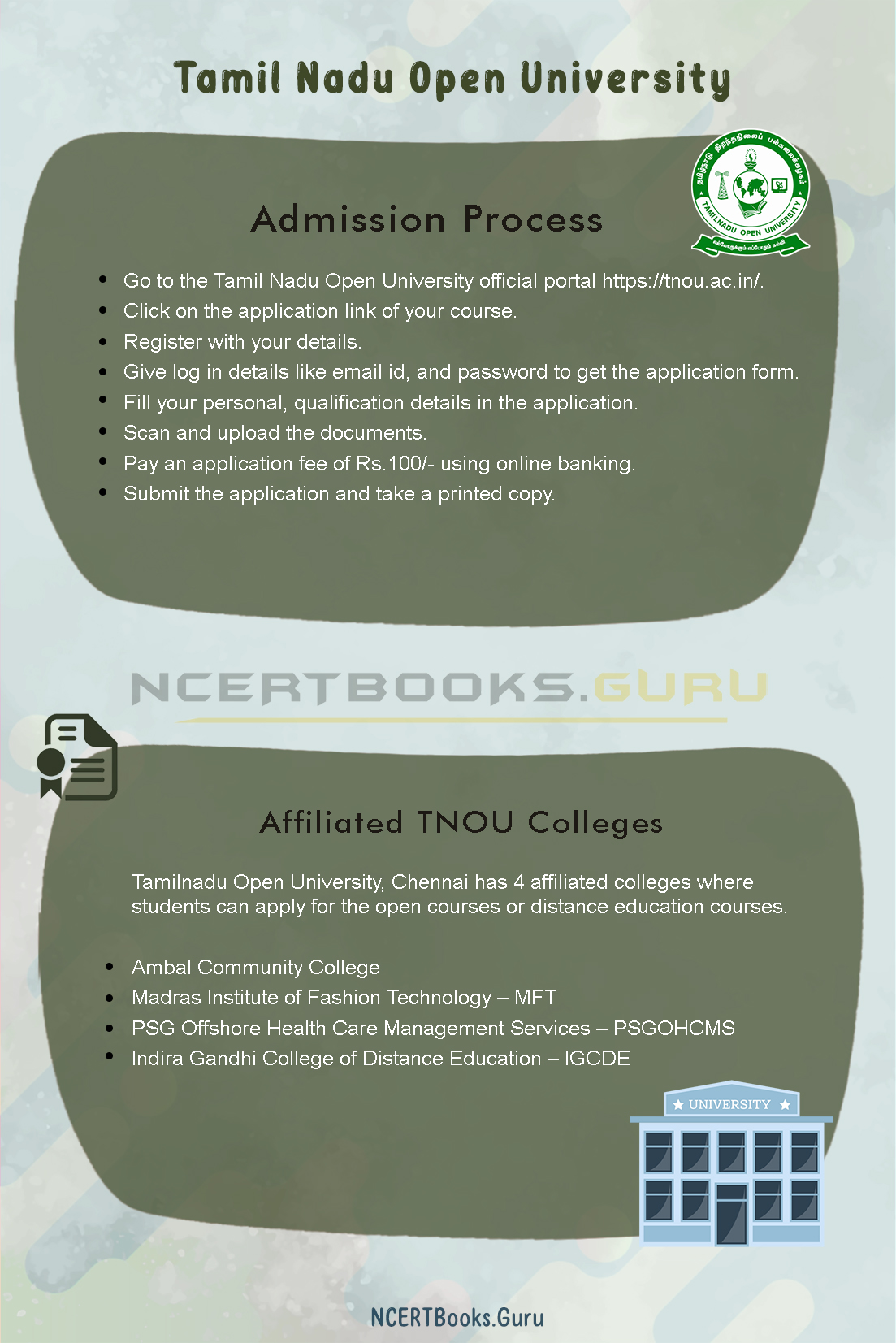
  • Go to the Tamil Nadu Open University official portal https://tnou.ac.in/.
  • Click on the application link of your course.
  • Register with your details.
  • Give log in details like email id, and password to get the application form.
  • Fill your personal, qualification details in the application.
  • Scan and upload the documents.
  • Pay an application fee of Rs.100/- using online banking.
  • Submit the application and take a printed copy.

TNOU Admission Important Dates

Application dates of TNOU UG, PG, and Ph.D Courses are along the lines:

Event Date
Application Starting Date 10th July 2022
Admission End Date 20th August 2022
Exam Date 28th July 2022
Merit List 10th August 2022
Counselling 30th August 2022
Application Starting Date for Ph.D Program 25th July 2022
Ph.D Program Admission End Date 5th September 2022
Ph.D Program Entrance Exam Date 30th August 2022
Test Result of Ph.D Course 10th September 2022
Ph.D Program Merit List 18th September 2022
Ph.D Course Personal Interview 25th September 2022
Counselling for Ph.D Course 30th September 2022

Affiliated TNOU Colleges

Tamilnadu Open University, Chennai has 4 affiliated colleges where students can apply for the open courses or distance education courses.

  • Ambal Community College
  • Madras Institute of Fashion Technology – MFT
  • PSG Offshore Health Care Management Services – PSGOHCMS
  • Indira Gandhi College of Distance Education – IGCDE
Tamil Nadu Open University Courses 2

Also, Refer

Tamilnadu Open University Courses Duration

Duration for different TNOU diploma, undergraduate, postgraduate, certificate, and Ph.D courses are along the lines:

Courses Duration
BA (History) 3 Years
BA (Public Administration) 3 Years
BA (Sociology) 3 Years
BA (Tamil) 3 Years
BA (Travel and Tourism Management) 3 Years
BA (English) 3 Years
B.Ed. 1 Year
B.S.W. 3 Years
B.Sc. (Hospitality and Catering Technology) 3 Years
BBA (Computer Applications) 3 Years
BBA (Marketing) 3 Years
B.Sc (Hospitality and Hotel Administration) 3 Years
BA (Business Economics) 3 Years
B.Com. 3 Years
B.Com. (Accounting and Finance) 3 Years
B.Com. (Corporate Secretaryship) 3 Years
MA (History) 2 Years
Post Graduate Diploma in Counselling Psychology 1 Year
Post Graduate Diploma in Public Relations 1 Year
M.Sc. (Mathematics) 2 Years
M.Sc. (Psychology) 2 Years
Post Graduate Diploma in Environment & Sustainable Development 2 Years
Post Graduate Program in Software Enterprise Management 2 Years
M.Com. 2 Years
M.C.A. 2 Years
P.G. Diploma in Information Security (PGDIS) 1 Year
Post Graduate Diploma in Intellectual Property Rights 1 Year
PG Diploma in Disaster Management 2 Years
Certificate in English Language Teaching to Adults (CELTA)
4 Weeks
Certificate in NGO Management
6 Months
Certificate in Teaching of Primary School Mathematics (CTPM)
6 Months
Diploma in Health Assistant (DHA) 1 Year
Diploma in Bakery and Confectionery
18 Months
Certificate Course in Computer Application
6 Months
Diploma in Beautician 1 Year
Diploma in Catering Assistant (DCA) 1 Year
Diploma in House Electrician (DHE) 1 Year
Diploma in Mobile Phone Servicing (DMPS) 1 Year
Diploma in Plumbing Technician (DPT) 1 Year
Diploma in Refrigeration & Air-Conditioning 1 Year
Diploma in Food & Beverage Service
6 Months
Diploma in Multimedia (DMM) 1 Year
Diploma in Hardware Maintenance 2 Years

TNOU Scholarships

Interested students can apply for scholarships in the prescribed form to be obtained from the office with the supporting documentation. Eligible candidates can get scholarships directly from the university to pursue their open degree or PG degree.

FAQ’s on Tamil Nadu Open University Distance Education Courses

1. How can I join Open University in Tamil Nadu?

To join TNOU, you must have completed 12th or graduated from a recognised university. Eligible students can apply online for PG, UG, and Diploma courses through the website.

2. What are the courses offered by TNOU?

TNOU offers 3 years of UG in BA, BSc, BCom, BBA, and BCA. University offers 2 years of master’s programmes in MA, MBA, MCom, MSc, diploma and PG diploma courses in various specialisations.

3. Which open university is best in Tamil Nadu?

Tamil Nadu Open University is one of the best university for distance education.

4. Is TNOU degree valid for govt jobs?

Yes, Open University degrees like IGNOU, YCMOU, and TNOU are valid for government jobs and further studies.

Final Words

We are thinking that the data mentioned here about Tamil Nadu Open University Courses and Fees are helpful for the students who want to join distance education courses. Check our site to know full TNOU Course Details and other information.

Pega Course Online | Duration, Fee, Eligibility, Admission, Syllabus, Scope and Salary

Pega Course

Pega Course Free: With the digital world growing in bits and bytes in a blink of an eye, there has been an immense increase and scope in digital courses. Students can find ample employment opportunities after pursuing digital and web-based courses. App development courses top the chart today. The best part? Not all application development courses require you to be good at coding. Pega is one such course that has become widely popular.

Today, not many are aware of diverse web and app development courses. Pega is one such course that not all are abreast of. Its exponential growth in the market has increased the demand for developers using Pega to create business process software. For the unenlightened one, Pega is a business process management tool. MNC companies that deal with the development of Customer Relationship Management and Business Process Management software, generally prefer those who have done a certification course in Pega.

Get to Know More about other types of Course Details in Stream wise, and Category wise

If you want to be a Pega architect, you must undergo a Pega certification course and brush up your skills. Here are Pega course details and all the other relevant details such as fee structure, admission process and all that you want to get enlightened about.

About Pega Course Details

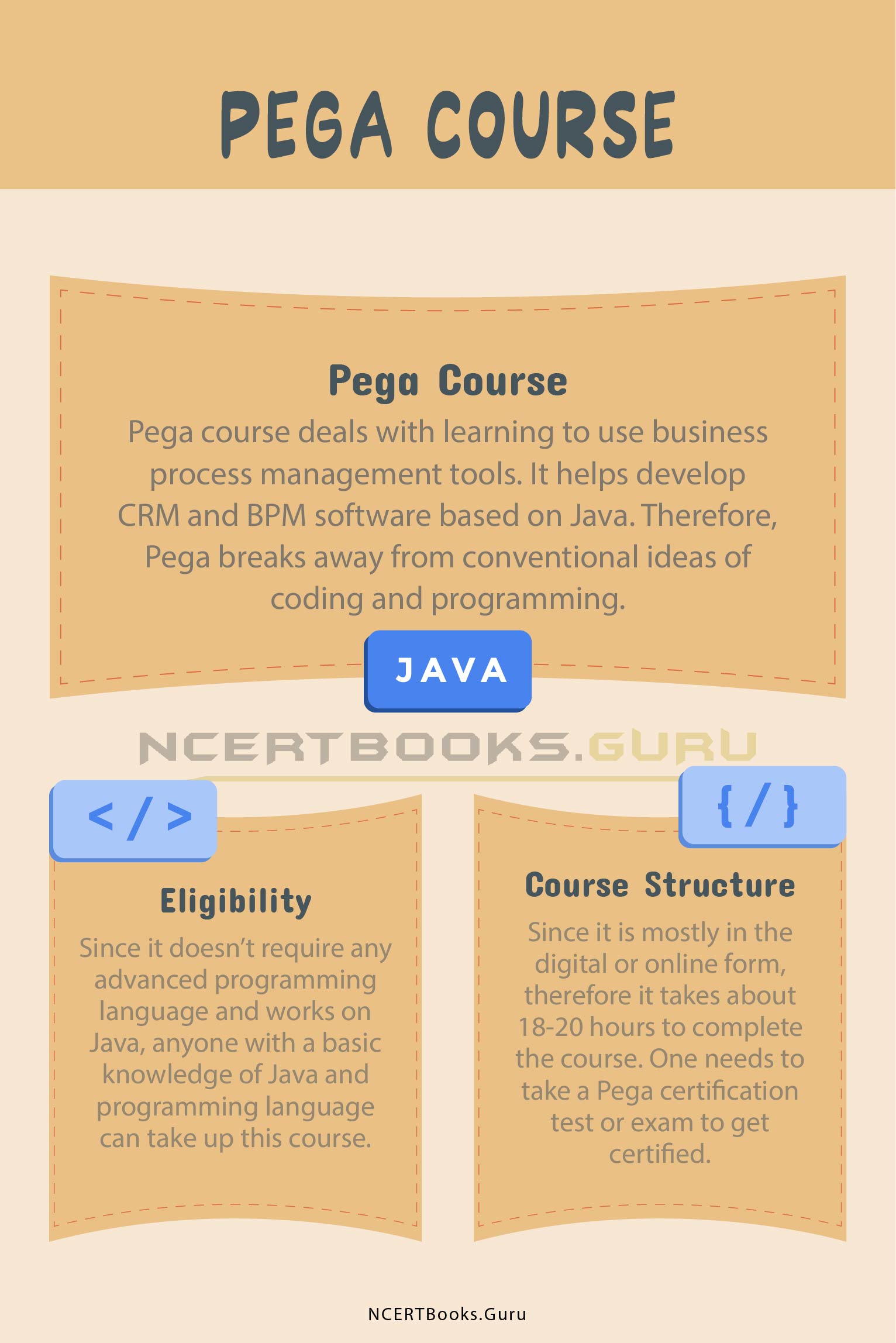
Pega course for beginners deals with learning to use business process management tools. It helps develop CRM and BPM software based on Java. Therefore, Pega breaks away from conventional ideas of coding and programming. A candidate must undergo a business process certification course or technical certification course to become a certified Pega developer.

Pega Course Eligibility Criteria

All the technical and non-technical candidates can learn Pega. Since it doesn’t require any advanced programming language and works on Java, anyone with a basic knowledge of Java and programming language can take up this course.

Pega Course Structure

There are certification courses for learning pega. Since it is mostly in the digital or online form, therefore it takes about 18-20 hours to complete the course. One needs to take a Pega certification test or exam to get certified. Students with technical or non-technical backgrounds can learn Pega after graduation in computer science or Information technology. The course brushes one’s skills from data modeling to application designing.

Pega Course Details

Pega Course Admission Process

As discussed above, any graduate who has graduated from information technology or computer science can get admitted for the course that spans for 18-20 hours. One must also possess a basic knowledge about java to get admitted for the training. The course takes place both offline and online. Offline courses may be costlier than in online training programs.

Pega Course Fees Structure

Different online academies charge different fees for Pega certificate courses. The course fee ranges from INR 15,000 to 25,000 online. Whole institutes offering offline courses can be costlier and can charge up to INR 35,000.

Pega Course Syllabus

The subjects and study materials of Pega course online are listed here.

  • BPM Overview, Project Implementation, Class Structures
  • User Interface
  • Data modelling
    Declarative rules
  • Decision Rules
  • PRPC Database Concepts
  • Case Management
  • Integration with external systems
  • Activities
  • Rule Management & Security
  • Performance, PRPC Guardrails & Topics revision

Also, Check

Pega Course Job Opportunities And Scope

Almost all the industries from healthcare and finance to information and technology to telecom, demand for professionals who are certified in Pega. It is an emerging tool in the market. A certified Pega professional can bag lucrative opportunities in MNCs as Pega Marketing Support Specialist, Pega Decisioning Architect, Pega PRPC, etc.

With an increase in information and technology and an aim of the industry to promote automation for smooth business, Pega professionals are in great demand, therefore learning Pega will always be one’s evergreen skill.

Pega Course Salary

Once you get certified in the Pega course and have hands-on experience in this course, you get a handsome amount in your pocket. However, much depends upon the company profile as well, it’s size, repute and employee size. In India, the salary of a Pega professional may start at 3 lakh per annum while well-reputed companies may offer 9 lakh per annum. MNCs can pay as much as 14 US dollars per annum.

One may work as a Pega Developer and may be responsible for design and develop enterprise-level Pega applications, one may also be recruited as a Pega Architect and may be responsible for a variety of tasks including running end-to-end delivery of Pega PRPC based solutions/projects from a technical perspective. Other job profiles may include Pega decisioning architect or Pega marketing support specialist.

FAQ’s on Pega Courses in India

Question 1.
Are there online courses for Pega?

Answer:
Various academies are offering online certificate courses for Pega.

Question 2.
What is the difficulty level for learning Pega?

Answer:
If you are from a non-technical background and do not have a basic knowledge of Java it can take time to learn otherwise it is pretty easy.

Question 3.
What is the Pega course duration?

Answer:
It can take 18 to 20 hours to complete your online certificates course of Pega.

How to become an IT Manager in India | Courses, Eligibility, Admission Process, Entrance Exams, Colleges, Career, Payscale,

How to become an IT Manager in India

Are you dreaming to become an IT manager in India and preparing for it? The demand for the information technology sector is increasing day by day. This will be the best time to choose the IT field as your career so that you will get the best pay scale. Start learning the computer basics, programming languages, and software and networking from the high school level itself.

Communication and management skills are very important to become an information technology manager. Nothing is impossible if you have an interest in it. The benefit of an IT Manager is salary and job security. Given below is all about how to become an IT Manager in India. Scroll down this page to know what are the courses to finish, roles and responsibilities, skills required, types of IT managers, eligibility, and the salary package.

What does an IT Manager Do?

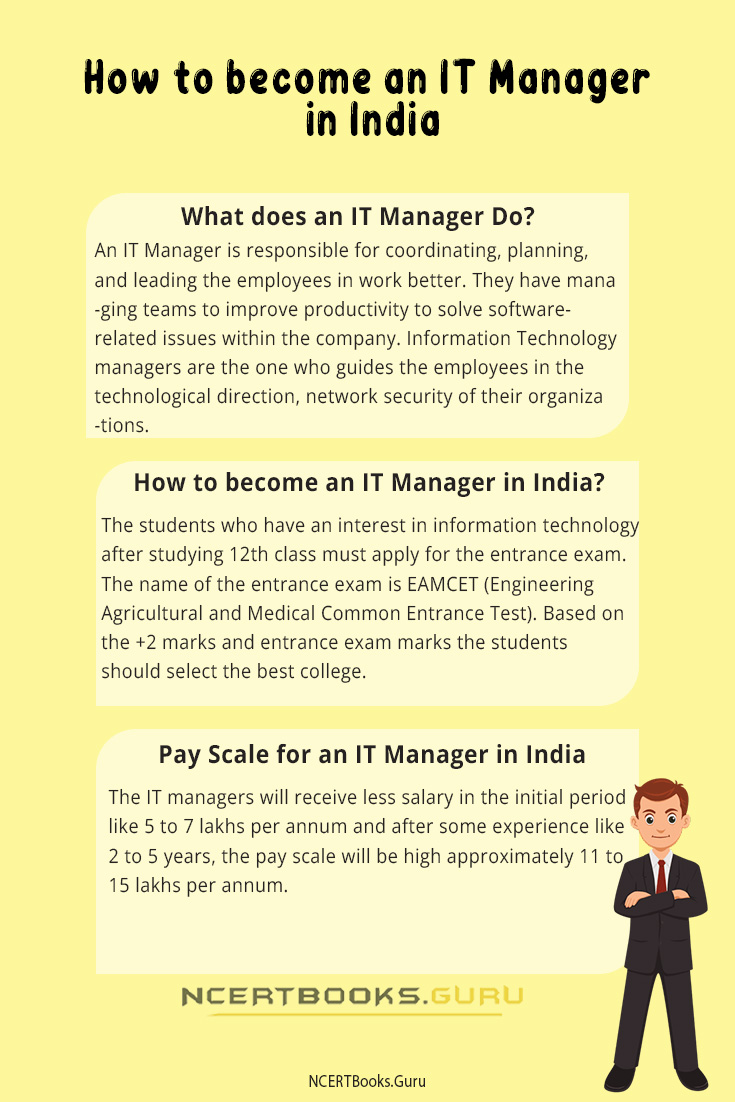
An IT Manager is responsible for coordinating, planning, and leading the employees in work better. They have managing teams to improve productivity to solve software-related issues within the company. Information Technology managers are the one who guides the employees in the technological direction, network security of their organizations. But the main preference will only incorporate planning and directing the department’s needs and also managing a budget with vendors and communicating with clients.

What are the responsibilities of an IT (Information Technology) Manager?

The responsibilities of IT managers are shown below,

  • They are responsible for the financial and other aspects of the project.
  • An IT manager is responsible for documentation and delivering the project to the clients.
  • You have the power of decision-making in the project.
  • They are responsible for data analysis, analyzing the budget, bandwidth computations, and trend analysis.

IT Course Details

Name of the Course Information Technology
Bachelors Degree Duration 4 years
PG Duration 2 years
Admission for UG EAMCET, JEE Mains
Admission for PG Entrance test + GD + PI
The entrance exam for PG CAT, XAT, NMAT, CMAT, MAT
Course Fee 10 to 15 lakhs

How to become an IT Manager in India?

The students who have an interest in information technology after studying 12th class must apply for the entrance exam. The name of the entrance exam is EAMCET (Engineering Agricultural and Medical Common Entrance Test). Based on the +2 marks and entrance exam marks the students should select the best college. And completing the 4 years graduation course means a bachelor’s degree in Information Technology.

After completing the course with a good percentage, the aspirants will get an opportunity to apply for the IT Manager post. To become an IT manager we have to study post-graduation after a bachelor’s degree. In this, you can prepare for a management-based role. This role will make it easy to make the best career. Having an MBA degree in Finance, IT, or Operations will be the best decision. The admissions for MBA are via competitive exams like CAT, GMAT, and other private exams.

In addition to this, the aspirants must show some personal interest in it like learning to assemble and disassembling a computer, internships in any organization to improve networking skills.

Check out various Course Details of different categories and select the one that best suits you and join accordingly.

Skills required to become an Information Technology Manager

We have enlisted the skill that is required by the aspirant to become an IT Manager in India. They are as follows,

  • IT management skills.
  • Technical skills
  • Budgeting & Forecast
  • Problem Solving Skills
  • Time Management & Scheduling
  • Team Work
  • Knowledge of Software Development Lifecycle
  • Conflict Management
  • Project Management
  • Communication Skills
  • Great listening abilities
  • Decision-making skills
  • People Management

What to study to become an IT Manager in India? | Course Details

Students who wish to become an Information Technology Manager in India must choose the course they are applying for. The courses have a different syllabus.
1. Bachelors Degree Course on IT: Students can join the bachelor’s course after completing 12th. The duration of the bachelor’s degree in the Information Technology course is 4 years.
2. Diploma course: The duration of the diploma course related to information technology is 3 years.
3. PG Degree Course: Students can join the PG Degree course after completing the under graduation. You need to write the entrance exam like PGECET to join the post-graduation course. The duration of the PG course in the IT field is 2 years.
4. PG Diploma Course: The duration of the PG Diploma course in Information technology is 2 years.
5. Certificate Course: You can pursue the certification courses like CSM, PMP to become an IT Manager in India.

See More:

Types of IT Manager

The different types of IT managers in different sectors are explained here.
1. IT financial manager: To become an IT financial manager the candidate must have completed a bachelor of degree in the relevant field. They Develop relationships with external shareholders and organizations to assess their technology, support, and security needs, Provide client appraisals and pitches IT equipment and service packages during meetings or presentations.
2. IT service manager: For this IT service manager job the requirement is a bachelor of degree in the relevant field, an important course in IT and computer science. Their role is to provide Client appraisals, service packages during meetings.
3. IT asset and configuration manager: For this, the requirement is a bachelor of degree in the relevant field. This role will ensure that IT management exercises control of IT configuration items.
4. Senior information technology manager: The Senior IT Manager is in charge of accurate and timely technology resource management and advice and consultancy services to managers and staff. The Senior Human Resource Consultant will take a lead role to develop the human resource policy and undertake human resource projects.

Admission Process for MBA Information Technology

The candidates after completing the undergraduate in Information technology can go for further education like MBA. There are four steps for joining MBA in India.

  1. Register and Apply for the MBA entrance exam
  2. Attend the MBA entrance exam.
  3. Shortlist the procedure
  4. Final admission process

MBA IT Syllabus:

  • Bio Design Data
  • Big data and data mining
  • IT entrepreneurship
  • Supply chain management
  • New energy technology

Top MBA IT College in India with Fees

Name of the college Fee Structure
ICFAI Business School 7,00,000
IIM, Lucknow 11,65,000
IIM, Ahmedabad 12,00,000
IIM, Bangalore 12,00,000
GIBS Business School 6,15,000
IIM, Calcutta 11,60,000
Faculty of Management Studies, Delhi University 10,480
Amity University 6,80,000
University of Delhi 96,000
BITS school of management 25,00,000
JMI 24,000
NMIMS Bangalore 9,00,000

Eligibility Criteria to become an Information Technology Manager in India

To apply for the IT Manager job the students must satisfy the eligibility criteria given by the organizations.

  • You must have completed +2 with above 65% from any recognized board. If your percentage is less than 60% then you are not eligible for this job.
  • You need to complete your under graduation in the relevant course with at least 65% and no backlogs.
  • You need to have a degree in management i.e., MBA.
  • Good communication skills and technical skills.

Pay Scale for an IT Manager in India

The IT managers will receive less salary in the initial period like 5 to 7 lakhs per annum and after some experience like 2 to 5 years, the pay scale will be high approximately 11 to 15 lakhs per annum. When it comes to the government sector the pay scale will be around more than 5 lakhs and when it comes to the private sector the salary will be around 6 to 15 lakhs per annum based on your performance.

The salary depends on your dedication and the ideas you give to improve the organization. In the below table we will provide the estimated salary details for different specializations.

Specialization in Information technology Estimated Pay scale per annum
Financial 10,00,000
Service Manager 9,00,000
Asset and Configuration Manager 8,00,000

How to become an IT Manager in India

Pros & Cons of an IT Manager in India

Pros:

  • Growth will be high
  • The employee who works as an IT manager will get a good salary.
  • Business-oriented

Cons:

  • Long working hours
  • Stressful

FAQs on How to Become IT Manager in India

1. What qualifications do I need to become an IT manager in India?

Aspirants must have completed Bachelor’s degree in Information Technology with at least 65% from any recognized university.

2. How much do IT managers make in India?

The average salary of the IT manager is 10 to 15 lakhs.

3. How can I become IT Manager, after 12th in India?

The first thing is that the candidates must have passed 10+2 with an aggregate of 60%. After that, you have to join a UG course in degree or bachelor’s (B.Sc/BA).

Final Verdict

Our aim is to provide the best guidelines for the students who wish to fulfill their dreams. The information provided in this article “how to become an IT Manager in India” is as per the expert knowledge. Keep in touch with us to get the latest information on the courses, eligibilities, admissions, salary, job profiles, and so on.

Diploma in Elementary Education (D.El.Ed) | Duration, Eligibility Criteria, Admission Process, Syllabus, Career Prospects

Diploma in Elementary Education

Diploma in Elementary Education: Diploma in Elementary Education is a professional teacher training program that prepares and enables course participants to work as primary or upper primary school teachers in various parts of the country.

In this article, viewers will be provided with a brief about the Diploma in Elementary Education course program, such as Course Details, Admission process, Course duration, Eligibility criterion, Top Institutions, and Vocation possibilities.

Get to Know More about other types of Course Details in Stream wise, and Category wise

About D.El.Ed. Course Program

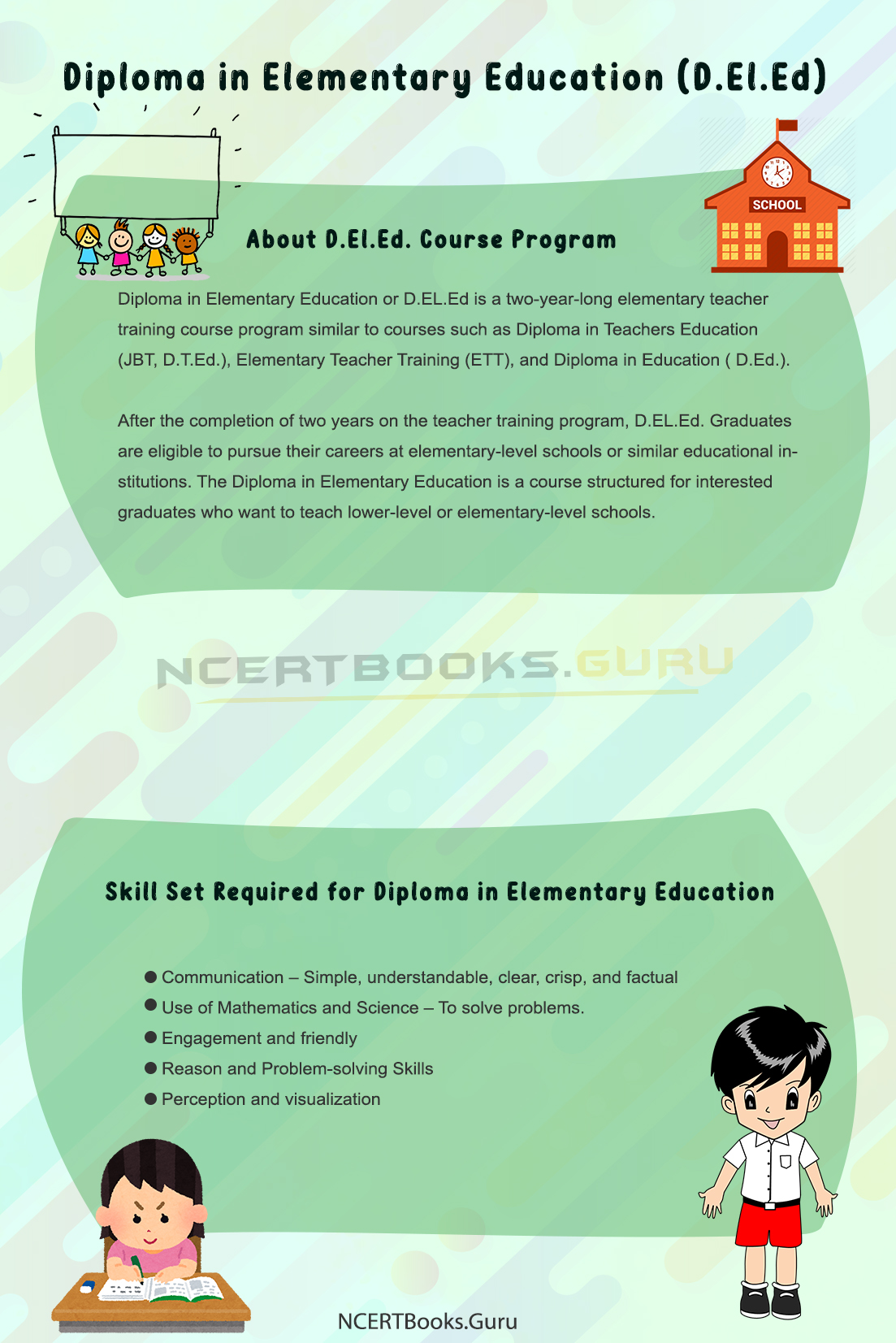
Diploma in Elementary Education or D.EL.Ed is a two-year-long elementary teacher training course program similar to courses such as Diploma in Teachers Education (JBT, D.T.Ed.), Elementary Teacher Training (ETT), and Diploma in Education ( D.Ed.).

After the completion of two years on the teacher training program, D.EL.Ed. Graduates are eligible to pursue their careers at elementary-level schools or similar educational institutions. The Diploma in Elementary Education is a course structured for interested graduates who want to teach lower-level or elementary-level schools.

Diploma in Elementary Education Course Details

Course Diploma in Elementary Education
Course Level Diploma-level
Course Duration Diploma in Elementary Education[D.El.Ed] is conducted for two years.
Age Limit The lower age limit is 17 years, and the upper age limit is 35 years old.
Eligibility Criteria The minimum qualification required for a Diploma in Elementary Education is 10+2 passed from any stream from a recognized board with a minimum aggregate of 50 percent.
Placement Opportunities Government Schools, Nursery, Private schools, Coaching or Private tuition centers, and Day-care centers.
Employment Roles Primary teacher, Assistant-Teacher, Student Counsellor, Tutor, and many more
Average Salary Offered Rs. 2 Lakhs to 5 Lakhs per annum
Similar Courses B.Ed, (D.Ed.),  BA (Education), (ETT), and JBT, D.T.Ed.

Skill Set Required for Diploma in Elementary Education

Candidates must hold certain skill sets that determine their role as an Elementary School Teacher. Skills, as mentioned-below, are a must to be adapted to become an Elementary School Teacher.

  • Communication – Simple, understandable, clear, crisp, and factual
  • Use of Mathematics and Science – To solve problems.
  • Engagement and friendly
  • Reason and Problem-solving Skills
  • Perception and visualization

Diploma in Elementary Education (D.El.Ed)

Diploma in Elementary Education Course Duration

The Diploma in Elementary Education is a 2-year long academic program.

Diploma in Elementary Education Eligibility Criteria

The Diploma’s eligibility criterion in the Elementary Education course program is almost the same for all Indian states. However, certain states or institutions have specific requirements that candidates must check before applying for the course program.

  • Candidates belonging to the general category must have finished 10+2 levels of graduation from a recognized board of education with a minimum aggregate of 50 percent marks or more.
  • Candidates belonging to reserved categories such as the ST, SC, and OBC should have completed 10+2 graduation from a recognized board of education with a minimum of 45 percent.
  • Candidates are required to provide reservation certificates along with other required documents.
  • The lower age limit applicable for D.El.Ed course is 17 years of age, whereas the upper age limit can fluctuate within 34 to 35 years.
  • Candidates should have a minimum of two years in teaching experience at the time of seeking admission.
  • Untrained permanent teachers must hold a primary and elementary teaching experience (standard I to VIII) from any recognized schools.
  • Untrained teachers working at government primary or upper primary institutions can apply for the Diploma in Elementary Education course program (D.El.Ed).

Diploma in Elementary Education Admission Process

The Admission Process for Diploma in Elementary Education course program differs from one institution to another from the respective states. Certain institutions hold the Entrance-based admissions, while some institutions conduct the Merit-based admissions.

A few states such as Assam, Bihar, Chhattisgarh, and Odisha conduct entrance examinations for the Diploma in Elementary Education course program. In contrast, Uttar Pradesh and West Bengal do not conduct Diploma entrance examinations in the Elementary Education course program.

Entrance-Based Admission Process: The Entrance-based admission process conducts objective-type Multiple-choice questions based on subjects studied at school. The entrance examination is based on components such as General Knowledge, Teaching Abilities, English, Mathematics and Numerical Abilities, and Language Test.

A few Diploma in Elementary Education Entrance Examinations are tabulated below:

Entrance Examination Conducting Body
AP DEECET 2020 Andhra Pradesh School of Education Department
Bihar D.El.Ed JET 2020 Bihar School Examination Board
SCERT Odisha Entrance Exam 2020 Directorate of Teacher Education and SCERT, Government of Odisha
Uttarakhand D.El.Ed 2020 Uttarakhand Board of School Education, Uttarakhand (UBSE)
SCERT Assam D.El.Ed PET State Council of Educational Research and Training, Assam (SCERT, Assam)

Merit-Based Admission Process: Merit-based Admission process occurs in cases of reputed institutes. Through this admission procedure, deserving candidates are selected through entrance examinations, based on the board examination or graduation performance, or selection process.

A few Diploma in Elementary Education Merit-based Entrance Examinations are tabulated below:

Entrance Examination Conducting Body
UP BTC D.El.Ed 2020 Uttar Pradesh Parishak Niyamak Pradhikari, Allahabad
WB D.El.Ed 2020 West Bengal Board of Primary Education

Based on the type of admission process, candidates opting for Diploma in Elementary Education will be selected. The qualifying candidates will have to pay the admission fee, submit and complete document verification, and secure their seats for admission to diploma in elementary education course.

Diploma in Elementary Education Fee Structure

The course fee for Diploma in Elementary Education differs based on various factors such as the type of the college (government or private), the student’s merit, and the student’s scholarship.

Those candidates seeking admissions through scholarship criteria, the fee structure comprises more of the scholarship and less fee than those getting through the direct admission process.

The average fee structure for Diploma in Elementary Education course program varies between Rs. 5000/- per annum to Rs. 2 Lakhs per annum.

The Application fee for the various state-level Diploma in Elementary Education course programs fluctuates between Rs. 250/- to Rs. 600/-.

Diploma in Elementary Education Course Program Syllabus

The structured syllabus for the Diploma in Elementary Education (D.El.Ed) is a holistic mixture that imparts teaching skills, educational technology and techniques, and subject-wise in-depth knowledge.

The course curriculum for the Diploma in Elementary Education (D.El.Ed) course program gives a basic idea about the course structure and blueprint, as shown below:

Year I Year II
Contemporary society Cognition and Sociocultural context
English Language Teaching Leadership
Child Development and Learning Fine Arts Education
Work and education Environmental Science Teaching
Mathematics Teaching School health and education
Education and Society Teacher identity and school culture
Self-Understanding Diversity
Internship Internship

Top Institutions Offering Diploma in Elementary Education

Private Institutions offering a Diploma in Elementary Education (D.El.Ed) course program tend to charge a higher fee structure as the candidates are selected directly via the merit system.  Whereas, government institutions depend on Diploma in Elementary Education (D.El.Ed) course entrance examinations for selection and admission and have comparably lower fee structure.

However, the Diploma in Elementary Education (D.El.Ed) course degree from private and government institutions must be approved by the NCTE.

A few of the top institutions offering Diploma in Elementary Education (D.El.Ed) courses along with the city, fee structure, and accreditation of each of the institutions are as follows:

Institution/University Location Accreditation Annual Fee Structure
Jamia Millia Islamia University New Delhi UGC, AICTE, and NAAC-A Rs. 6900/- per annum
Amity University Noida NCTE, UGC, COA, AIU, BCI, and AICTE Rs. 60,000/- per annum
Maulana Azad National Urdu University Hyderabad UGC and NAAC-A Rs. 5,700/- per annum
Pacific University Udaipur AIU and UGC Rs. 50,000/- per annum
Dr. D Y Patil Vidya Pratishthan Society Pune NCTE, UGC, AICTE, and NBA Rs. 13,340/- per annum
Dayalbagh Educational Institute Agra MHRD, UGC, and NAAC-A Rs. 5,950/- per annum
Bombay Teachers’ Training College (BTTC) Mumbai NAAC-A and NCTE Rs. 17,310/- per annum
Integral University Lucknow MCI, UGC, NAAC, and PCI Rs. 50,000/- per annum
Green Valley College of Education Bhopal NAAC-A and NCTE Rs. 35,000/- per annum
Mewar University Chittorgarh NCTE, BCI, UGC, PCI, and AICTE Rs. 53,000/- per annum

Career Prospects Under D.El.Ed Course

The Diploma in Elementary Education (D.El.Ed) course program strives to teach, develop, and enhance India’s elementary teachers’ workforce. The course program enables candidates to develop skills and qualify as an elementary education teacher every year.

Employment Areas

Upon completion of the Diploma in Elementary Education course, candidates may find employment as elementary teachers at reputed educational institutes. Candidates may find work at institutions imparting elementary level education, such as

  • Private Institutions
  • Government Institutions
  • Day-care Centres
  • Coaching or Private Tuition Classes
  • Nursery

Job Profile

Diploma in Elementary Education (D.El.Ed) course program may don professionals roles such as

  • Teacher
  • Tutor
  • Student Counselor
  • Assistant Teacher
  • Content Reviewer
  • Education Developer
  • Content Writer
  • Article Writer
  • Librarian

Candidates can even self-start centers like tuition classes and private coaching centers in front of elementary teachers. Candidates may also choose to work at NGOs educating children in rural areas and those in need.

Career Prospects Under Diploma in Elementary Education

The average pay package a beginner graduate of the Diploma in Elementary Education (D.El.Ed) course program holds is Rs. 4 Lakhs per annum. However, an individual’s pay package depends on qualities such as diligence, dedication, performance, and experience in the workplace.

The average pay package for a primary teacher is Rs. 2.37 Lakhs per annum, while that for a government primary school teacher is Rs. 4.2 Lakhs per annum.

Graduates who get employed as Career counselors earn a minimum of Rs. 2.41 Lakhs per annum. Graduates taking the job post as a content writer earn an average of Rs. 2.43 Lakhs per annum, while for Content Reviewers, the average salary is Rs. 5.2 Lakhs per annum, respectively.

FAQ’s on Diploma in Elementary Education

Question 1.
What are the skillsets required for the Diploma in Elementary Education course program?

Answer:
The skill sets required to pursue the Diploma in Elementary Education are the reason and problem-solving skills, communication skills, perception and visualization skills, use of mathematics and science, working with people, and managing people, time, things, and oneself.

Question 2.
How long is the course duration for a Diploma in Elementary Education course program?

Answer:
The Diploma in Elementary Education is a 2-year long academic program.

Question 3.
What is the Fee structure for the course program?

Answer:
The course fee for Diploma in Elementary Education differs based on various factors such as the type of the college, the student’s merit, and the student’s scholarship. The average fee structure for Diploma in Elementary Education course program varies between Rs. 5000/- per annum to Rs. 2 Lakhs per annum.

Question 4.
What are the possible career prospects of a Diploma in Elementary Education course program?

Answer:
Diploma in Elementary Education course program enables candidates to develop skills and qualify as an elementary education teacher every year. Candidates may find work at institutions imparting elementary level education like Private Institutions, Day-care Centres, Coaching or Private Tuition Classes, Government Institutions, and Nursery.

Diploma in Nursing Course After 10th | Courses List, Colleges, Eligibility, Admission Process, Career Opportunities, Salary

Diploma in Nursing Course After 10th

Are you willing to get a Diploma in Nursing Course After 10th? If yes, then you have landed up at the right place! After the Covid pandemic, India has become a place with a well-established healthcare industry. In the future, we definitely see scope for doctors and nurses to excel in their field.

In today’s time, one can easily pursue a career in nursing just after their 10th standard. Students are eligible to pursue certificate courses and diplomas after qualifying 10th examination.

In India, various nursing colleges provide diploma in different departments. These courses may range from two weeks-two years, depending upon the one you choose. There are various nursing programmes recognized and approved by the Indian Nursing Council, which students can enroll.

But the only qualification for Indian Nursing Council courses is that your qualification should be 10+2. But you need not worry, we are here with some of the best diploma courses in nursing after 10th.

Why do People Pursue Nursing Courses After 10th in Diploma?

One of the most important reasons people choose nursing is the desire to make a difference in people’s lives. Anyone who has spent time in a hospital understands the importance of nurses in making patients feel at ease and safe. Nurses assist individuals in a variety of ways.

If you are pursuing diploma in nursing course after 10th in India, you can even pursue nursing in different countries just by qualifying for different examinations as per standards. Various colleges provide you with online nursing programmes, which can help you work on different tasks at a single time. Another reason why people pursue nursing is that it has job satisfaction and it makes people happy.

LIST OF DIPLOMA NURSING COURSES AFTER 10TH

  • Diploma In Ayurvedic Nursing
  • Diploma In Nursing Care Assistant
  • Rural Healthcare Diploma Course
  • Certificate In Home-based healthcare

Diploma In Ayurvedic Nursing

This is a diploma course of 1.5-2 years, which is pursued by many students all around India. It is recognized for its rich historical and cultural significance. The course is all about Ayurvedic medicines and their benefits over allopathic ones. The job of an Ayurvedic nurse is taking notes, analyzing records, and checking signs whereas the allopathic nurse can participate in operation theatres. Apart from this, Ayurveda is basically about natural oils and herbs.

Also Check: How to Become an Ayurvedic Doctor in India

College

  1. Institute of Ayurvedic science, Lucknow: Diploma in Ayurvedic nursing (30 months)
  2. Tantia University, Sri Ganganagar: Diploma in Ayurvedic nursing in pharmacy (30 months)

Diploma In Nursing Care Assistant

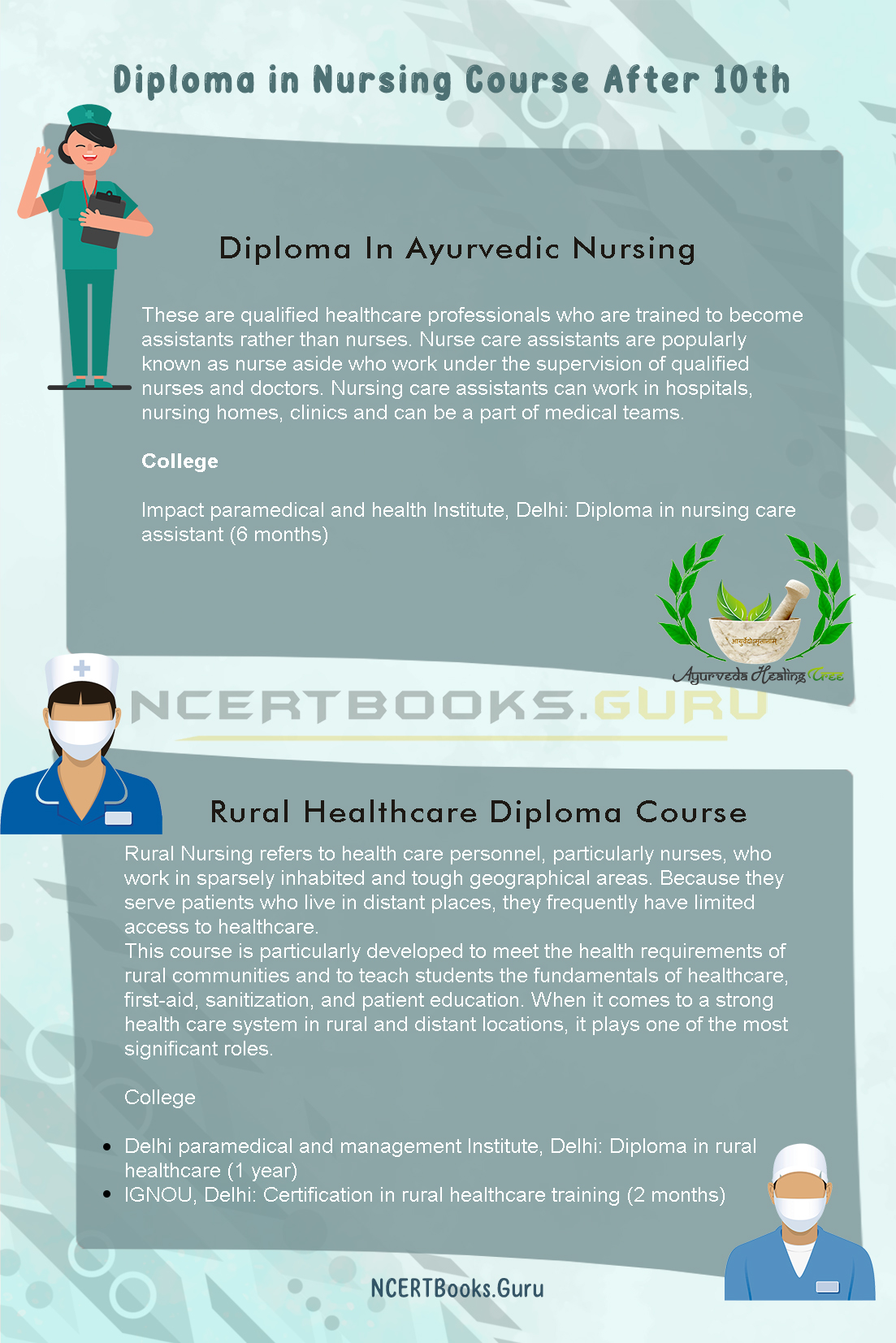
These are qualified healthcare professionals who are trained to become assistants rather than nurses. Nurse care assistants are popularly known as nurse aside who work under the supervision of qualified nurses and doctors. Nursing care assistants can work in hospitals, nursing homes, clinics and can be a part of medical teams.

College

  1. Impact paramedical and health Institute, Delhi: Diploma in nursing care assistant (6 months)

Rural Healthcare Diploma Course

Rural Nursing refers to health care personnel, particularly nurses, who work in sparsely inhabited and tough geographical areas. Because they serve patients who live in distant places, they frequently have limited access to healthcare.

This course is particularly developed to meet the health requirements of rural communities and to teach students the fundamentals of healthcare, first-aid, sanitization, and patient education. When it comes to a strong health care system in rural and distant locations, it plays one of the most significant roles.

College

  1. Delhi paramedical and management Institute, Delhi: Diploma in rural healthcare (1 year)
  2. IGNOU, Delhi: Certification in rural healthcare training (2 months)

Diploma in Nursing Course After 10th 1

Certificate In Home-based healthcare

Home-based care refers to a range of health services delivered in the patient’s home or place of residence, including hospital-level or acute care, primary care, skilled nursing, and therapy services. The hospital-at-home concept replaces hospitalization with intense, hospital-level care at the patient’s home for certain patients.

College

  1. IGNOU, Delhi: Certification in home-based healthcare (6 months)

Do Refer: 

Admission Procedure To Join Diploma Courses in Nursing

So, now when you are aware of these courses you might be wondering the procedure to get admission into these colleges for diploma. Most of these colleges provide courses based on merit. Every college has a unique process of enrolling students after 12th standard.

To enroll in nursing diploma course after 1oth students have to pass various tests and screenings based on aptitude. Moreover, the screening includes written tests, interviews, and group discussions. After all of this, the college will shortlist students who are eligible to enroll in the course.

Diploma Courses in Nursing Eligibility Criteria

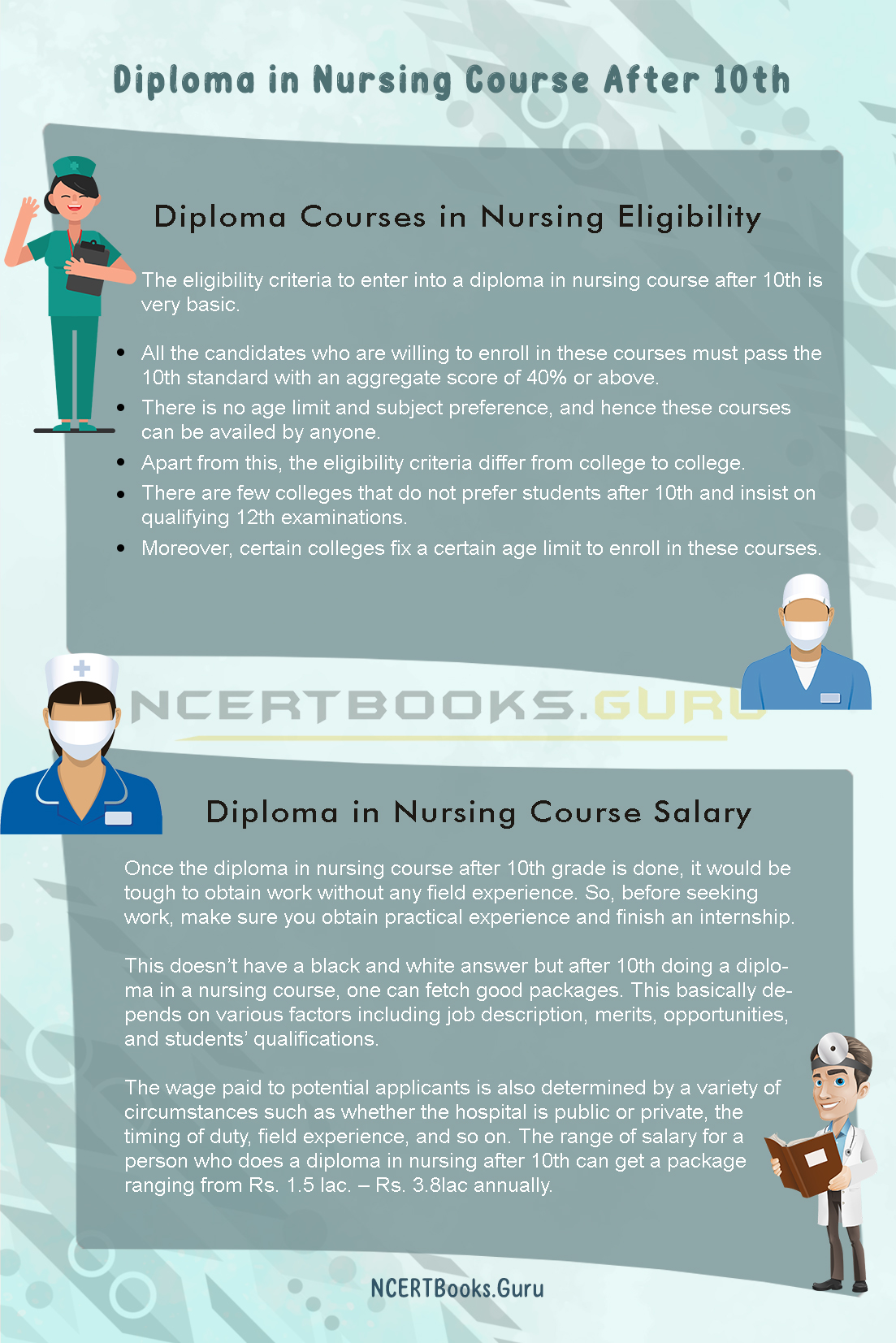
The eligibility criteria to enter into a diploma in nursing course after 10th is very basic.

  • All the candidates who are willing to enroll in these courses must pass the 10th standard with an aggregate score of 40% or above.
  • There is no age limit and subject preference, and hence these courses can be availed by anyone.
  • Apart from this, the eligibility criteria differ from college to college.
  • There are few colleges that do not prefer students after 10th and insist on qualifying 12th examinations.
  • Moreover, certain colleges fix a certain age limit to enroll in these courses.

Diploma in Nursing Course Salary After 10th

Once the diploma in nursing course after 10th grade is done, it would be tough to obtain work without any field experience. So, before seeking work, make sure you obtain practical experience and finish an internship.

This doesn’t have a black and white answer but after 10th doing a diploma in a nursing course, one can fetch good packages. This basically depends on various factors including job description, merits, opportunities, and students’ qualifications.

The wage paid to potential applicants is also determined by a variety of circumstances such as whether the hospital is public or private, the timing of duty, field experience, and so on. The range of salary for a person who does a diploma in nursing after 10th can get a package ranging from Rs. 1.5 lac. – Rs. 3.8lac annually.

Job Profiles Average Salary
Nursing in-charge INR 3.5 LPA
Emergency Nurses INR 4.2 LPA
Nursing Assistant INR 3 LPA
Aanganwadi Workers INR 2.8 LPA
Infection Control Nurses INR 2.5 LPA

Diploma in Nursing Course After 10th 2

Different Types of Career Options in Diploma Nursing After 10th

There are various other career options but the only recommendation is that you need to complete 12th and then apply for courses and jobs. Once you have completed High school you have various job alternatives. But before high school, you can also get good job opportunities like below:

  • Advanced Practice Nurse
  • Staff Nurse
  • Nursing Teachers
  • Nurse Manager
  • Researcher

You can gain experience by working in Clinics, both public and private, Hospitals (public and private), Health Care in the Community, Psychiatric facilities/hospitals, Nursing Homes and Aged Care Facilities, and Rehabilitation facilities.

You can also pursue higher studies like B.SC Nursing Course, M.Sc Nursing Course and others to become Nurse.

FAQs on What is Diploma in Nursing Education?

1. Can I do a diploma in nursing course after 10th?

Yes, you can do a diploma in nursing after 10th. These diploma courses are offered by different colleges and range from two months-three years. After pursuing these diploma courses, you can even gain experience by working in hospitals, clinics, rehab centres, and other places.

2. What is the duration of diploma in nursing course after 10th?

The duration for diploma courses in nursing after 10th starts from two months and ranges till three years. Apart from this, if you are willing to do a certificate course then you might find courses for 1-2 months also.

3. How much average salary can I get after doing a diploma nursing course?

Initially, as a beginner, you can get a salary from around Rs.20,000 – Rs.95,000. The salary also depends upon various factors including the college you have done your diploma course from, the merits, and the job description.

4. Can I do paramedical nursing courses after 10th?

Paramedical courses after tenth grade include certificate and diploma level paramedical courses that may be taken immediately after tenth grade because they do not require advanced level knowledge of biology and sciences.

5. Which is the best diploma in nursing course after 10th?

If the individual has a science background and has taken Biology as a subject, the GNM diploma is the greatest place to start. Graduates of the GNM programme have the option of pursuing a BSc Nursing or a BSc (Post-Basic) Nursing degree.

Conclusion

So here we are towards the end of this article. We hope that you were able to understand the procedure and requirements to do a Diploma in Nursing Course after 10th. More than ever in these days of the worldwide pandemic breakout, the nursing profession is in high demand.

Students following the tenth grade will benefit from early admission into nursing to obtain more on-the-job experience and advance their career possibilities. Stay in touch with our website Ncertbooks.guru and find more course details from any field and build your career path without hassle.

Unique Courses after 12th Science | Course List, Top Colleges, Scope, and More 

Unique Courses after 12th Science: After studying class 12th there are few only options that students know. But the scope after 12th science is quite more. There are several unique courses available after 12th science in India that you can pursue.

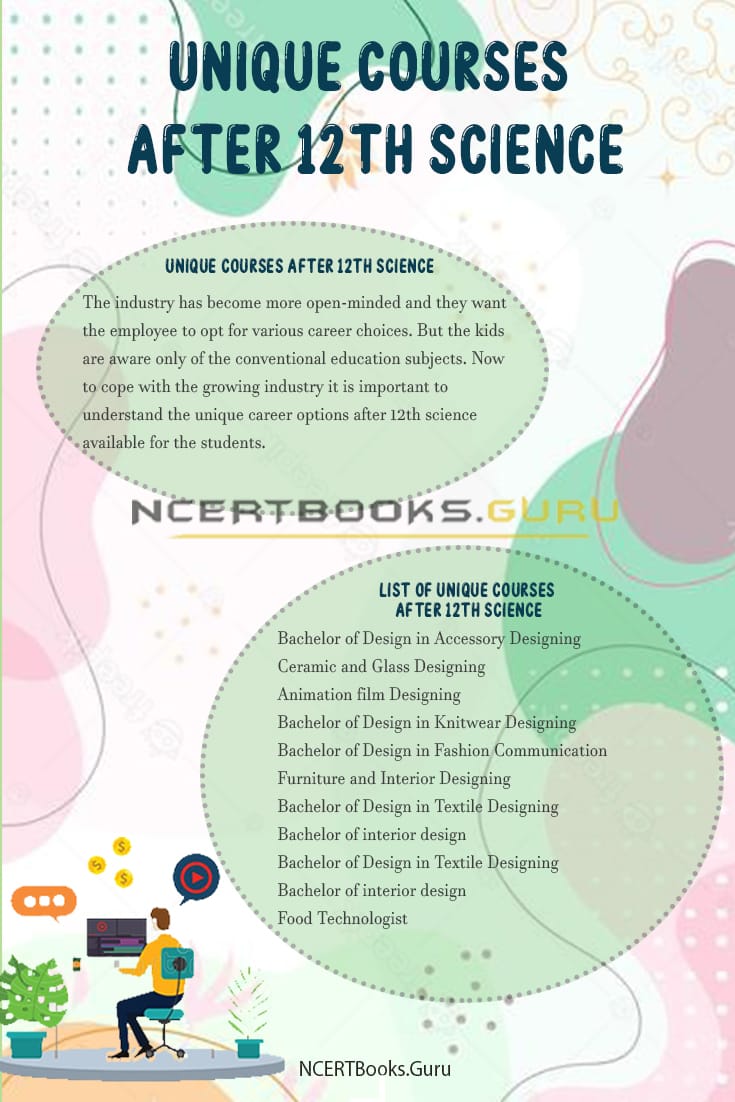
The industry has become more open-minded and they want the employee to opt for various career choices. But the kids are aware only of the conventional education subjects. Now to cope with the growing industry it is important to understand the unique career options after 12th science available for the students.

Here, in this article, we are providing you the Complete course details of Unique Courses after 12th Science. You can read here and choose the best career option for yourself.

Unique Courses After 12th in India Science

Unique courses are not common. But when you get to know about them you will surely get a big surprise regarding your degree after the 12th PCB and PCM. However, the duration of these courses varies according to their degree level and it also depends on the colleges.

B.Sc and B.Tech are one of the most common courses but there are a few more. These unique courses offer amazing job opportunities with high salary structures to students in India as well as abroad.

List of Unique Courses After 12th Science

Here, are the detailed courses that can be pursued after class 12th science. The subject of science means you need to study maths, biology, physics, chemistry, home science, and other science-related subjects to be eligible for these courses.

  • Bachelor of Design in Accessory Designing
  • Ceramic and Glass Designing
  • Animation film Designing
  • Bachelor of Design in Knitwear Designing
  • Bachelor of Design in Fashion Communication
  • Furniture and Interior Designing
  • Bachelor of Design in Textile Designing
  • Bachelor of interior design
  • Food Technologist
  • Bachelor of Design in Fashion Designing
  • Bachelor of Design in Leather Designing
  • Blockchain Solutions Architect/ Blockchain Engineer
  • Nutritionist/ Dietician
  • Data Scientist
  • Siddha Practitioner
  • Product Designing

Now, you have an idea about the unique courses. We will provide you with a detailed description of these courses below.

Rare Courses after 12th Science Biology

The unique courses after 12th class science biology are described here with the fees structure, eligibility criteria, salary scope, and more:

Siddha Practitioner

The course has a duration of 5.5 years. Thus, to be a Siddha Practitioner you must hold a bachelor’s degree in this same domain. In this course, you will get to know more about the elements of the universe which are earth, fire, air, water, and sky.

The course fees vary according to the colleges but you can complete it in around Rs 11.5 lakhs. The degree provides a great scope in various sectors and you can earn a salary of around Rs 4 to 8 lakhs.

Nutritionist/ Dietician

Being a nutritionist is a great career opportunity. To be eligible for this practice you need to pursue a degree in B.Sc in Nutrition and Dietetics or can B.Sc in Home science, these are the two common fields but other relevant courses are also accepted.

The B.Sc degree can be completed in just 3 years and a minimal amount of money. It takes around Rs 50K – 2.5 LPA. But the salary structure after the degree is amazing. You can earn Rs 4 to Rs 8 LPA.

Doctor of Pharmacy 

This degree is commonly known as Pharma D.You can complete it in 6 years wherein 5 years you will study about the course and in 1 year you will practice as an intern. The eligibility for this course is that you must have studied biology and mathematics in your class 12th.

Unique & Best Courses after 12th Science PCM

PCM refers to physics, chemistry, and math, thus if you have all these subjects in your class 12th then you can go for all these unique courses. However, the eligibility criteria, fee structure, and details respective to all these mentioned courses have been defined below:

Food Technologist

Being a Food Technologist you need to hold a B.Sc degree in Food Science or B.Tech in Food Engineering. The B.Sc degree is for 3 years and B.Tech can be completed in 4 years. Food Technologists are required everywhere in the government and private sectors. Thus, you can earn a high amount such as Rs 5 to Rs 8 LPA after the completion of your degree.

Data Scientist

To become a data scientist you need to hold at least a B.Sc degree in computer science or you can also pursue a degree in data science artificial intelligence, or the relevant field degree. Data scientists are in high demand as companies need them for statistical and mathematical functions. The salary paid to data scientists is around Rs 6 to Rs 8 LPA.

Also Refer: Best Science Courses in India after 12th

Blockchain Solutions Architect/ Blockchain Engineer

Blockchain Solutions Architect/Blockchain Engineer is considered among the best unique courses after class 12th science. To practice these courses in a real sense you need to hold B.Sc or B.Tech in Computer Science, after that higher studies in Data Science, Machine Learning, or any other relevant field is necessary.

Thus, the degree can be pursued within a range of Rs 30,000 to Rs 5,00,000. The B.Sc and B.Tech degree is of 3 years and 4 years time period. You can even earn higher packages after the completion of this course which can be around Rs 7-8 LPA.

Statistician

Statisticians are the people who work in the data-related field in the company. Their main role is to apply their statistical tools and mathematical methods to solve real-life issues. You can become a statistician after holding a B.Sc degree in statistics or a degree in stats in other relevant domains. You can complete the degree in time of 3 to 5 years within a fee range of Rs 40k to Rs 5 LPA.

Unique Courses after 12th Science in Designing

After the completion of class 12th science if you have a keen interest in designing then there are amazing courses available for you. B.Sc in designing is offered by the National Institute of Fashion Technology which is popularly known as NIFT.

The Bachelor of Design in Fashion Designing degree can be completed in just 4 years. You can pursue this degree for just Rs 60,000 to Rs 2,00,000. Here are the few unique courses defined for designing.

  • Bachelor of Design in Accessory Designing
  • Ceramic and Glass Designing
  • Animation Film Designing
  • Bachelor of Design in Knitwear Designing
  • Bachelor of Design in Fashion Communication
  • Bachelor of Design in Textile Designing
  • Bachelor of interior design
  • Furniture and Interior Designing

Unique Management Courses After 12th Science

If you have maths in class 12th, you can also pursue these management courses:

  • Bachelor of Business Economics
  • Bachelor of Business Studies
  • Bachelor of Management Studies
  • Integrated B.B.A. + M.B.A.
  • Bachelor of Hotel Management
  • Diploma in Retail Management
  • Bachelor of International Business and Finance

Colleges for Unique Courses after 12th Science

Just the list of unique courses is never-ending, the colleges which are offering these courses are also a lot in number throughout India. You can see the below list for the few colleges:

  • IIT Kharagpur
  • ICT- Mumbai
  • SRM University
  • Kerala University of Health Sciences
  • RVS Siddha Medical College- Coimbatore
  • Lady Irwin College- DU
  • Mount Carmel College- Bangalore
  • Chandigarh University

Related Articles: NCERT Solutions Class 12 Biology Free PDF Download

Unique career options after 12th science

There is a good scope after the completion of unique courses in science after the 12th. Some companies are eagerly waiting for you. You can earn even high salaries for the high profile jobs. The companies can recruit you for the following posts:

  • Dietician
  • Engineer in the Blockchain field
  • Interior designer
  • Textile designer
  • Data Scientist
  • Food Technologist

But if you are not willing to do a job then you can easily pursue a master’s degree or other relevant fields courses.

Unique Courses after 12th Science

Recruitment Options After Unique Courses in Science

The top recruiting firms for all courses are different. Some of these courses after the recruiters are:

  • Lenskart
  • Fiat Chrysler Automobiles (FCA)
  • Ernst & Young (EY)
  • Aditya Birla Group
  • IBM India

FAQs on Unique Courses after 12th Science

1. Are these Unique courses after 12th science offers great career scope? 

Ans. Yes, these Unique courses after 12th science offer great career scope in India. There are great companies and even MNCs waiting for the students who had completed their degrees in designing, statistics, data science, nutrition, and more.

2. What is the eligibility for Unique courses after 12th science? 

Ans. The eligibility for these unique courses is different. The science courses like Food Technologist, Siddha Practitioner, dietician, and more require you to pursue biology in class 12th. For a few courses, you must have studied physics, and maths, in class 12th such as Blockchain Architect, statistician, and more.

3. What are the best Unique courses after 12th science in India? 

Ans. The unique courses in science after 12th are Siddha Practitioner, Blockchain Engineer, Food Technologist, Data Scientist, Bachelor of Design in Accessory Designing, Ceramic and Glass Designing, Animation film Designing, Bachelor of Design in Textile Designing, Furniture, and Interior Designing, and many more.

In Conclusion

Unique Courses After 12th is a better career choice. Due to the lesser-known availability among the people the demand for those who did their degree in these courses is high. Thus, you can easily pursue your dream career in this field. However, NcertBooks.Guru is always there to help you, and you can ask your doubts in the comment section.