Electrical Engineering Courses – Eligibility, Admission, Career, Scope, Salary, Jobs

Electrical Engineering Courses

Electrical Engineering Courses: Electricity runs the whole world. No wonder electrical engineering is one of the most pursued engineering courses in India. Today, electrical engineering is not only limited to electricity. It blends the concepts of electricity with computer applications, electronics, and mechanics.

Imagining a world without electricity is impossible. Opportunities have surged rapidly for qualified and skilled electrical engineers. In India, the average starting salary of a B.Tech Electrical Engineer is Rs 4 lakh per annum.

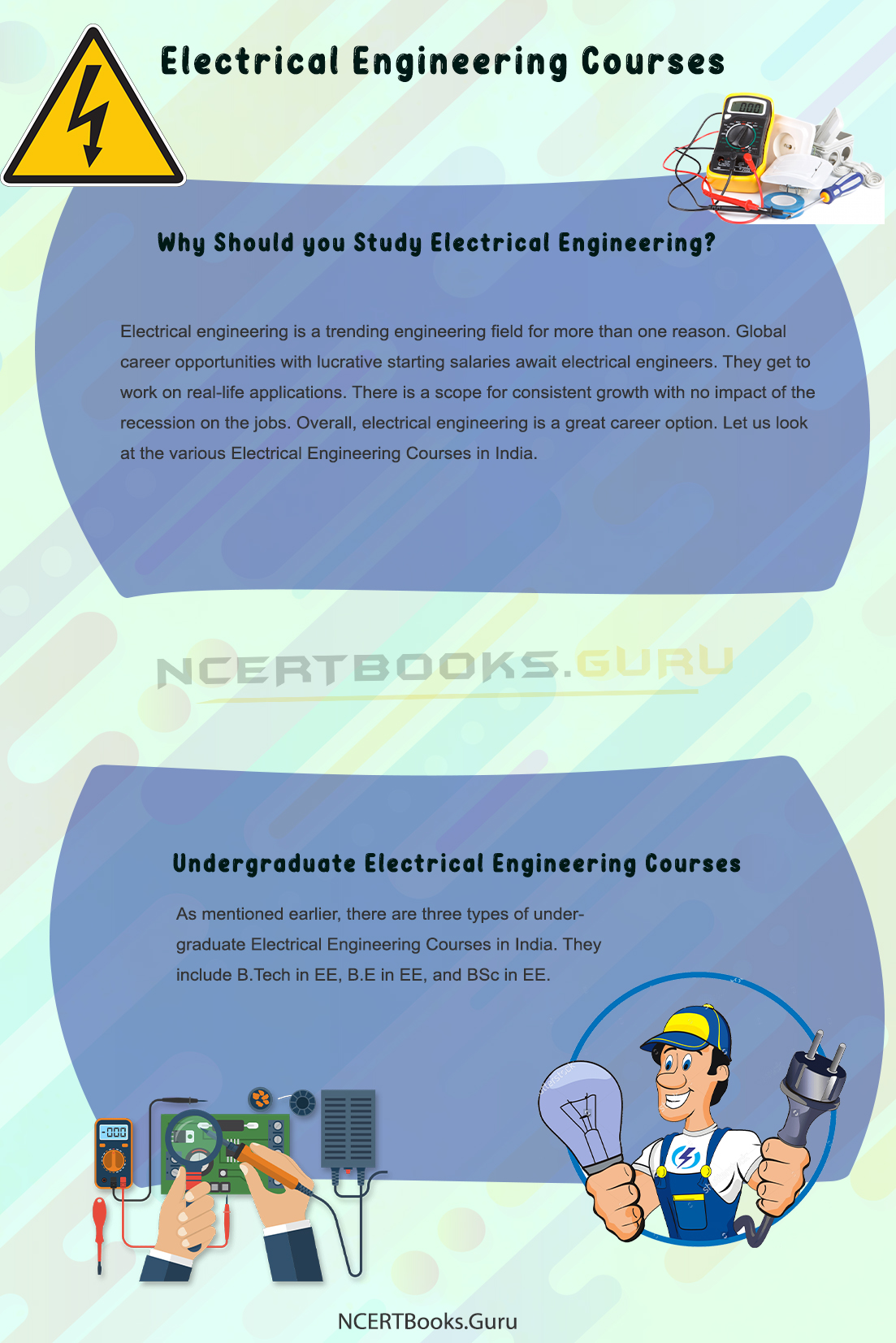
Why Should you Study Electrical Engineering?

Electrical engineering is a trending engineering field for more than one reason. Global career opportunities with lucrative starting salaries await electrical engineers. They get to work on real-life applications. There is a scope for consistent growth with no impact of the recession on the jobs. Overall, electrical engineering is a great career option. Let us look at the various Electrical Engineering Courses in India.

Types of Electrical Engineering Courses in India

In India, there are three types of electrical engineering courses. They are

  • Diploma Electrical Engineering Courses
  • Undergraduate Electrical Engineering Courses
  • Postgraduate Electrical Engineering Courses

Diploma in Electrical Engineering Courses

Diploma in Electrical Engineering Courses Eligibility

For diploma level, you can join the course right after class 10 or class 12. In the latter case, you must have passed the class 12 examination from a recognized institute with a minimum aggregate of 50%.

Diploma in Electrical Engineering Course Admission

The entry to the diploma course is done either by merit list or an entrance exam. The merit list is prepared based on the class 12th examination. Some colleges also conduct entrance examinations. Students need to qualify in those examinations to get admission to the various colleges. Top electrical engineering entrance examinations include Delhi CET, JEECUP, JEXPO, etc.

Diploma in Electrical Engineering Course Careers

A diploma in electrical engineering course provides wide career prospects. After completion of the course, students can go for higher studies. There are various certificate courses that students can take after the diploma like a Certificate course in Power Electronics, a Certificate course in VLSI systems, etc.

Alternatively, students can grab job roles like electrical design engineer, field engineer, technical trainer, etc that promise handsome salaries.

Undergraduate Electrical Engineering Courses

As mentioned earlier, there are three types of undergraduate Electrical Engineering Courses in India. They include B.Tech in EE, B.E in EE, and BSc in EE.

B.Tech and BE in Electrical Engineering Course Eligibility

These are four-year undergraduate courses. Candidates should complete their twelfth board examinations from a recognized institute with a minimum aggregate of 50% with PCM as their main subjects. Lateral entry students should have completed their course in a relevant field.

B.Tech/BE in Electrical Engineering Course Admission

Various national-level and state-level entrance examinations are conducted throughout India for admission to various engineering colleges. Common engineering entrance examinations include JEE Mains and Advanced, BITSAT, VITEEE, WBJEE, etc. The top colleges are the IITs, NITs, VIT, DTU, and SRM University.

B.Tech/BE in Electrical Engineering Course Careers

B.Tech and B.E Electrical engineers get prestigious jobs in various government and private jobs. They can also pursue higher education like an M.Tech. Few popular sectors for graduates include power generation, energy, oil, petroleum, etc. To get jobs in government offices, candidates should clear exams like IES and GATE.

The latter is also a compulsory exam for entrance to postgraduate courses in electrical engineering in most engineering colleges. Popular job profiles include Electrical Engineer, Product Engineer, and Electrical Testing Engineer, to name a few. The average salary of B.Tech or B.E graduates ranges from Rs 3.6 lakh-Rs 6 lakhs per annum.

Find various course details belonging to different streams all organized efficiently under one roof and decide which course to pursue based on the scope.

Postgraduate Electrical Engineering Courses

Postgraduate Electrical Engineering Courses (M.Tech) Eligibility

This full-time is a 2-year course that imparts advanced knowledge of electrical engineering. It requires a bachelor’s degree like B.Tech/B.E or equivalent with a valid GATE score to get admission to Indian engineering colleges.

Postgraduate Electrical engineering courses (M.Tech) Admission

Top MTech Colleges in India are IISc Bangalore, IIT Bombay, and IIT Madras, to name a few. To get admission to most colleges, candidates must qualify in the GATE (Graduate Aptitude Test in Engineering) exam with a good rank.

Postgraduate Electrical Engineering Courses (M.Tech) Career

M.Tech graduates are offered premium jobs in the government sector like BHEL, HAL, DRDO, Indian Armed Forces, etc. They are given roles of site engineers and officer-level posts. Those who want to make a future in research should opt for a Ph.D. degree.
Electrical Engineering Courses

FAQs on Electrical Engineering Courses

1. How many years is electrical engineering?

A B.Tech or a B.E course duration is 4 years, divided into 8 semesters. A diploma course takes 3 years.

2. Is electrical engineering a good career?

Electrical engineering is one of the few core degrees which promises a bright future for qualified and skilled electrical engineers.

3. How can I do MTech in electrical engineering?

You need to clear the GATE examination since most of the colleges accept the GATE score to pursue an MTech course in India.

Conclusion

Thus, as you can see, electrical engineering is a degree worth it. We hope we could help you decide on the best electrical engineering course for you.

Full-Form of IPS, SSC, UPSC, IAS, ACP, PSC | Duration, Eligibility Criteria, Admission Process, Curriculum, Job Prospects

Full Form of IPS, SSC, UPSC, IAS, ACP, PSC

Full-Form of IPS, SSC, UPSC, IAS, ACP, PSC: One of the most desired jobs in India is SSC, IFS, IAS, IPS, PCS, UPSC. Almost every student desires to join one of these services mentioned above as they are incredibly decent jobs in India. They pay a handsome payroll and the perks to be young and brilliant candidates who aspire to assist the nation. Here we will mention some details which will help you to know the Indian Services. Through these articles, the reader will learn about the higher post in India, which represents our nation.

SSC is the method of staff selection, UPSC is a government body which manages the civil services exams, IPS is related to police service, ACP is a classification in the police station, PSC is a government body which administers exams to hire state-level government officers. These labels and services are prestigious and perform a crucial role in the governance of the largest democracy in the world.

Get to Know More about other types of Course Details in Stream wise, and Category wise.

Full-Form of IPS, SSC, UPSC, IAS, ACP, PSC Course Highlight

  • The full form of SSC, IFS, IAS, IPS, PCS, UPSC
  • Responsibilities
  • Skills required for the course
  • Syllabus of the course
  • Entrance Examinations for admissions
  • Fee Structure of the course
  • Career options after completing the course
  • Expected salary

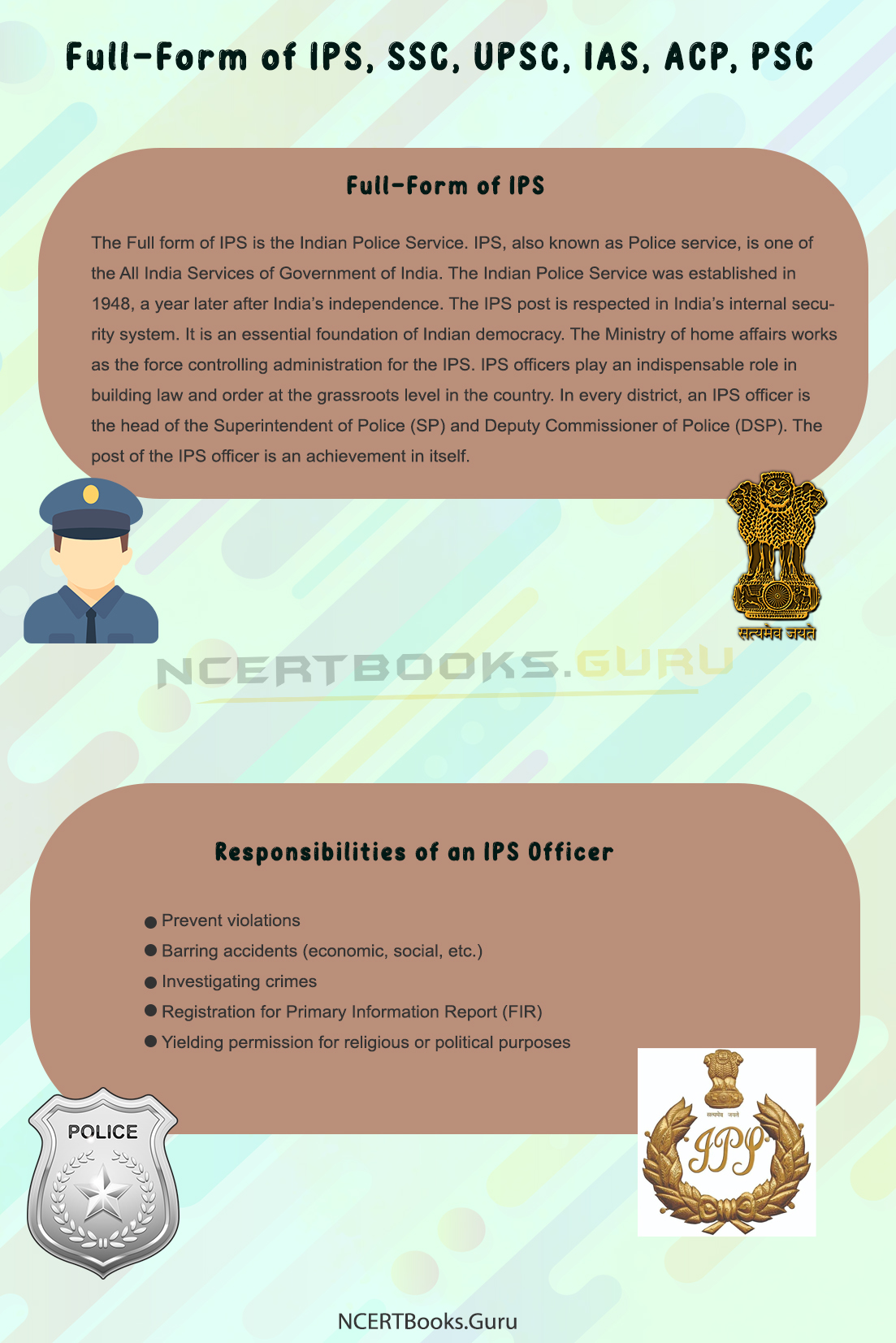
Full-Form of IPS

The Full form of IPS is the Indian Police Service. IPS, also known as Police service, is one of the All India Services of Government of India. The Indian Police Service was established in 1948, a year later after India’s independence. The IPS post is respected in India’s internal security system. It is an essential foundation of Indian democracy. The Ministry of home affairs works as the force controlling administration for the IPS. IPS officers play an indispensable role in building law and order at the grassroots level in the country. In every district, an IPS officer is the head of the Superintendent of Police (SP) and Deputy Commissioner of Police (DSP). The post of the IPS officer is an achievement in itself.

Responsibilities of an IPS Officer 

  • Prevent violations
  • Barring accidents (economic, social, etc.)
  • Investigating crimes
  • Registration for Primary Information Report (FIR)
  • Yielding permission for religious or political purposes.

Full-Form of IPS, SSC, UPSC, IAS, ACP, PSC 1

Eligibility Criteria

  • Applicants from India, Bhutan and Nepal can give the IPS exam.
  • Graduation in any relevant course
  • Candidate age should be between 21-30 years. Reserved category candidates get a five-year privilege.

Physical Ability

  • Male candidates should be 165 centimeters, and female candidates should be 150 cm.
  • SC / OBC male candidates of 160 cm and female candidates 145 cm can also apply.
  • The male chest should be 84 centimeters, and females should have 79 cm.
  • A healthy vision with a power of 6/6 or 6/9 is needed. The optics of weak eyes should be 6/12 or 6/9.

Exams for IPS

There are three stages for the IPS exam.

  • Preliminary (Prelims)
  • Main exam
  • Interview.

Preliminary Exams (Prelims)

In the initial exam there are two sets of paper :

  • Paper I: This paper is of 200 marks and covers Indian History, National and International Current Affairs, Indian National Movement, Geography of India and the World, Political System, Panchayati Raj, Public, Economic and Social Development, Indian Monarchy and Governance, Environmental Ecology, Biodiversity, Climate Change and General Science. The time limit for completing this paper is 2 hours.
  • Paper-II: This paper also consists of 200 marks asks questions related to comprehension, logical reasoning, interpersonal skills, and analytical ability, decision making and problem-solving and data interpretation (charts, graphs, tables). The time limit for the paper is also 2 hours.

Main Examination: The main exam of civil services consists of written tests. The test consists of 9 papers in total, in which Set A and B are for qualifying, and the other seven papers are for merit.

Interview: Applicants are called for a personal interview round after the main exam. This interview is for 45 minutes.

Job and Salary

Designation Salary Grade Pay
Director-General of Police 80,000
Special Commissioner of Police Rs 37,400 12,000
Inspector-General of Police 37,400 – 67,000 10,000
Deputy Inspector General of Police 37,400 – 67,000 8,900
Senior Superintendent of Police 15,600 – 39,100 8,700
Additional Deputy Commissioner of Police 15,600 – 39,000 6,600
Superintendent of Police or Deputy Commissioner 15,600 – 39,000 7,600
Deputy Superintendent of Police/ Assistant Commissioner of Police 15,600 – 39,100 5,400

Full-Form of SSC

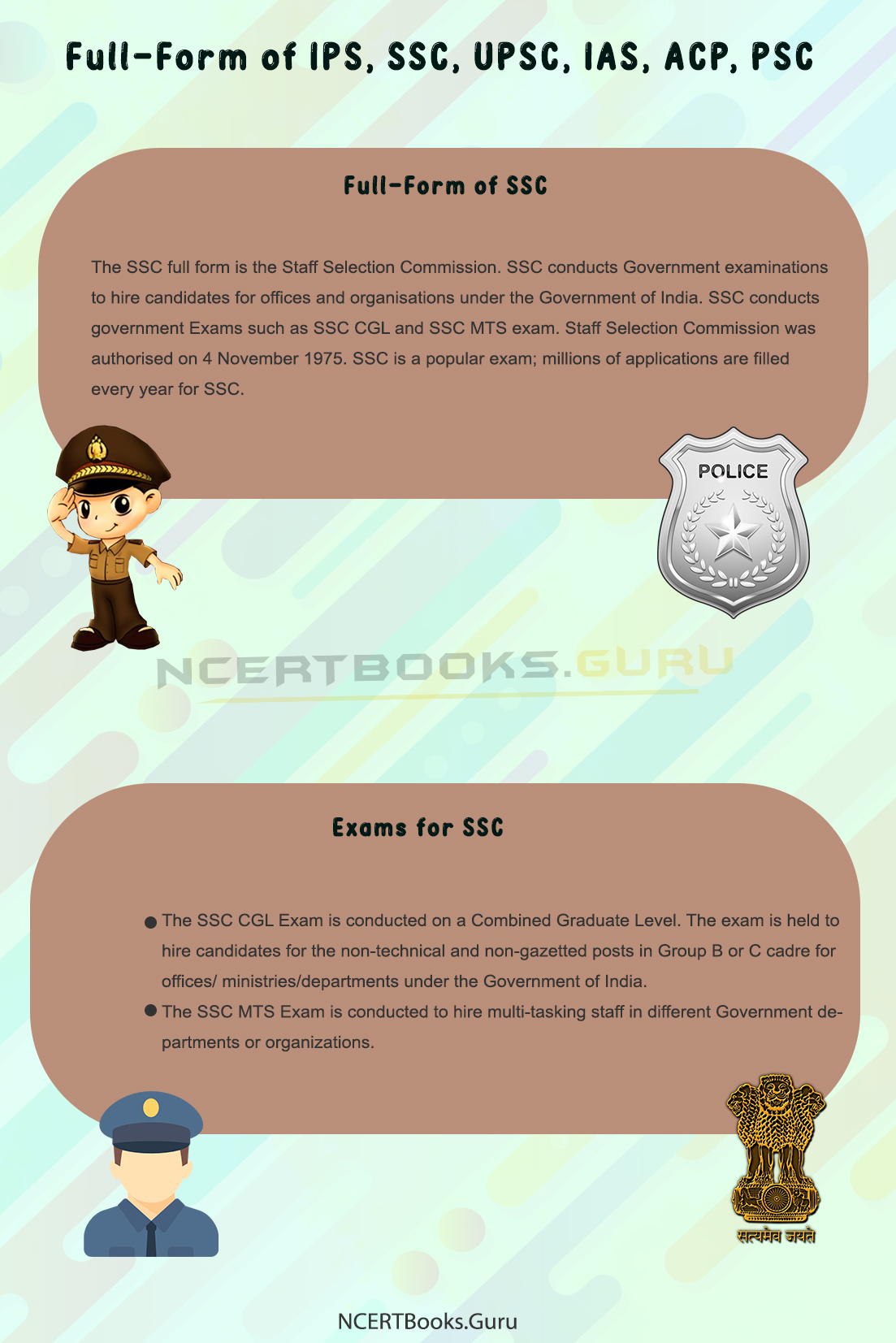
The SSC full form is the Staff Selection Commission. SSC conducts Government examinations to hire candidates for offices and organisations under the Government of India. SSC conducts government Exams such as SSC CGL and SSC MTS exam. Staff Selection Commission was authorised on 4 November 1975. SSC is a popular exam; millions of applications are filled every year for SSC.

Eligibility

  • Graduation in any relevant course
  • The applicant’s age must be between 18 and 32 years. The candidate’s age may vary according to the post.
  • Class 10 or 12 students can also apply.

Physical Ability

  • The chest requirement is 81 cm, with the least expansion of 5 cm for the male candidates. 5cm of relaxation is given to the Gorkhas, Garhwali, Assamese, and the Scheduled Tribes Candidates.
  • The weight of the female candidates should be 48 kg, and a relaxation of 2 kgs for Garhwali, Assamese, Gorkhas and the Scheduled Tribes candidates.
  • The male applicant should cover 1600 meters in 15 minutes, and the female candidate should cover 1000 meters in 15 minutes.
  • The height of the male should be 165 cm, and for the female candidate, it should be 150 cm. The Hill and Tribal candidates have a relaxation up to 5 cms.

Exams for SSC

  • The SSC CGL Exam is conducted on a Combined Graduate Level. The exam is held to hire candidates for the non-technical and non-gazetted posts in Group B or C cadre for offices/ ministries/departments under the Government of India.
  • The SSC MTS Exam is conducted to hire multi-tasking staff in different Government departments or organizations.

Full-Form of IPS, SSC, UPSC, IAS, ACP, PSC 2

Jobs 

  • Assistants
  • Customs Examiner
  • Multi-tasking Staff
  • Junior Clerks
  • Income Tax Inspectors
  • Sub-Inspectors in Narcotics and more.

Full form of UPSC

The full form of UPSC is Union Public Service Commission. It is India’s top-level central government agency that administers many exams to hire officers and staff into various jobs of the central government.

The Public Service Commission (PSC) was renamed as Union Public Service Commission after independence in 1950 and extended its rights. Its primary purpose is to select first and second class officers or civil servants. Apart from IAS or IPS, many other Grade A and B officers are hired through UPSC.

Eligibility 

  • Graduation in any relevant course
  • The candidate should be between 18 and 32 years. The candidate’s age may vary according to the post.

Exams for UPSC 

The UPSC exam pattern is outlined to examine the academic expertise of the candidates as well as the ability of the applicant to present themself orderly and coherently.

The UPSC Exam is conducted in two stages

  • Preliminary
  • Main Examinations

Preliminary Exam

The prelims exam consists of two objective type question papers of 200 marks each. The question papers are set in both Hindi and English.

Main Examination

The UPSC main examination consists of 2025 marks. Candidates who qualify the Prelims exams are allowed to give the main exam.

Some of the examinations conducted by UPSC are :

  • Engineering Services Examination (ESE)
  • Combined Defense Service Exam (CDSE)
  • Civil Service Examination (CSE)
  • National Defense Examination (NDA)
  • Indian Forest Service (IFS)

UPSC Civil Services Examination (CSE)

Eligibility Criteria – Graduation in any relevant course

  • ESE (Engineering Services Examination): The ESE examination is conducted for the roads, manufacturing, railway and power.
  • Combined Defense Services Examination (CDSE): The CDSE is conducted for Indian Military Academy, Indian Air Force Academy and Indian Naval Academy officers. It is conducted twice a year. Only unmarried students can apply for the examination and should have a graduation degree.
  • National Defense Academy Examination (NDA): The NDA exam is conducted twice a year. The student must pass the 10+2 exam, and only unmarried can apply for the exam.
  • Indian Forest Services Exam (IFSE): Graduation in any relevant course

Full-Form of IAS

The IAS exam was founded in 1858 by the name of the Imperial Civil Service. Later the exam name was changed to Indian Administrative Service. The Full form of IAS is Indian Administrative Service. After passing the IAS exam, the applicant can work under the Union Government or State Government.

Eligibility

  • Applicants from India, Bhutan and Nepal can give the IAS exam.
  • Tibetan refugee who arrived in India before 1st January 1962, can also apply
  • candidate need to be between 21 to 32 years
  • Graduate degree from a recognised institution
  • Six attempts are only allowed to clear the exam.

Exams for IAS Exam

The exam pattern is planned to examine the academic expertise of the candidates.

  • The IAS preliminary exam consists of 2 papers of 200 marks each.
  • The main exam consists of 2025 marks. Candidates who qualify the Prelims exams are allowed to give the main exam.

Jobs 

Position in the State Government or Central government Grade Pay Scale
Cabinet Secretary of India Cabinet Secretary Grade Rs 90,000
Chief development officer Senior time scale Rs15,600-Rs 39,100+ 6600 grade pay
Chief secretary of states Apex Scale Rs 80,000
Sub-divisional magistrate in a sub-division of a district (entry) Junior time scale Rs 15,600-Rs 39,100 + Rs 5400 grade pay

Full-Form of ACP

The full form of ACP  is the Assistant Commissioner of Police. ACP is one of the putative posts of Indian Police Services. The position is given to the Assistant Superintendent of Police (Asst.SP) or Deputy Superintendent of Police (DSP) officer. One can become an ACP by serving in the police department for 15 -20 years or by getting directly by giving the UPSC exam and seizing a good rank.

Duties of an ACP 

  • The ACP performs the activities and tasks consigned by the Commissioner of Police.
  • He or she has to manage and guide the officers under their authority and maintain the discipline of the department and pay regular visits to the police stations.

Full-Form of PSC

The full form of PSC is the Public Service Commission. It is a central administration that is liable for managing the recruitment examinations for jobs under different categories. Public Service Commission was organised under Article 315 to 323 of the Constitution of India.

The PSC was installed in 1935 at the provincial level by the Government of India Act. It is known as the State Public Service Commission. The State Public Service Commission is an autonomous constitutional body. It is specified in Part-14 of the Constitution between Articles 315 to 323, its independence, work, and powers, etc.

PSC Eligibility 

  • The candidate should have a Graduate Degree or a Post Graduate or Diploma in a related discipline.
  • The age of the candidate should be between 18 to 33 years.
  • The selection process consists of three stages such as Preliminary Examination, Main Examination, and Personal Interview.

PSC Exams

There are three stages for the PSC exam.

  • Preliminary (Prelims)
  • Main exam
  • Interview.

Some of the Public Service Commissions in India are

  • Union Public Service Commission
  • Andhra Pradesh Public Service Commission
  • Arunachal Pradesh Public Service Commission
  • Assam Public Service Commission
  • Bihar Public Service Commission
  • Chhattisgarh Public Service Commission
  • Goa Public Service Commission
  • Gujarat Public Service Commission
  • Haryana Public Service Commission
  • Karnataka Public Service Commission
  • Kerala Public Service Commission
  • Madhya Pradesh Public Service Commission
  • Maharashtra Public Service Commission
  • Manipur Public Service Commission
  • Meghalaya Public Service Commission
  • Mizoram Public Service Commission
  • Nagaland Public Service Commission
  • Telangana State Public Service Commission

FAQ’s on Full Form of IPS, SSC, UPSC, IAS, ACP, PSC

Question 1.
What is the Eligibility criteria for SSC, IFS, IAS, IPS, PCS, UPSC?

Answer:
The eligibility criteria for SSC, IFS, IAS, IPS, PCS, UPSC are almost the same. The candidate needs a graduation degree in any relevant course. He or she should be between 18 and 32 years. The candidate’s age may vary according to the post.

Question 2.
Why are the IPS and  IAS jobs important?

Answer:
The IPS and the IAS officers play an indispensable role in building law and order at the grassroots level in the country.

Question 3.
What is the exam pattern for SSC, IFS, IAS, IPS, PCS, UPSC jobs?

Answer:
The exam pattern for SSC, IFS, IAS, IPS, PCS, UPSC jobs are outlined to examine the academic expertise of the candidates as well as the ability of the applicant to present themself orderly and coherently. The Exams are conducted in two stages :

  • Preliminary
  • Main Examinations

How To Become a R.J. (Radio Jockey) in India | Course Details, Career Prospectus, Job Profile and Salary

How To Become a RJ in India

How to Become a R.J. in India: R.J. or Radio Jockey is a promising yet challenging career for music lovers. An R.J. holds spontaneous, friendly, euphonious, and charming personalities with a strong command over the language. Radio Jockey is all about voice and words on-air with a signature style.

In 1999, experiments regarding the production of interactive shows on the radio over the traditional ones were created. Early Indian Radio personalities were commonly referred to as ‘radio announcers’; however, with the evolution of time, a successful Radio Jockey is an equal match to a celebrity. Today, India sees the emergence of dozens of R.J. career prospects.

A Brief on Radio Jockey (R.J.)

A Radio Jockey hosts talk shows on the radio. R.J. entertains, provides information, and guides the listeners through a radio program. The primary role of a Radio Jockey is to communicate with the listeners via calls, online chat, or email, through engaging content.

R.J.s should have the knack to present new ideas, concepts, and should have a euphonious personality. He/she should have control over the communication powers, language skills, and avoid inhibitions.

Skillset Required for R.J in India

Radio Jockey require vital skills sets that bridge the formal education. A few required skillsets as an R.J. are:

  • Should hold a euphonious voice
  • Should have an accurate diction
  • Always make use of precise punctuation
  • Should have power over language and fluency
  • Should be creative in ideas and concepts
  • Should possess a great sense of humor
  • Must hold control of voice pitches

Types of R.J. Courses

  1. Diploma in Radio Programming and Broadcast Management (DRPM)
  2. Diploma in Radio Production and Radio Jockeying (D.R.J.)
  3. Post Graduation Diploma in Radio and Broadcast Management (PGDM)
  4. Certificate Course in Radio Jockeying (C.R.J.)
  5. Certificate Course in Radio Production Programme
  6. Certificate Course in Announcing, Broadcasting, Comparing and Dubbing

Diploma in Radio Programming and Broadcast Management (DRPM)

This is the Diploma level of course study. To deem eligible, candidates should have secured a minimum aggregate in their class 12 examination in any discipline from any authorized and recognized Institution or equivalent. The course duration for Diploma in Radio Programming and Broadcast Management is one year.

Diploma in Radio Production and Radio Jockeying (D.R.J.)

This is the Diploma level of course study. To deem eligible, candidates should have secured a minimum aggregate in their class 12 examination in any discipline from any authorized and recognized Institution or equivalent. The course duration for Diploma in Radio Production and Radio Jockeying is one year.

Post Graduation Diploma in Radio and Broadcast Management (PGDM)

This is the Diploma/P.G. level of course study. To deem eligible, candidates should have secured a minimum aggregate in their class 12 examination and Bachelor’s Degree in any discipline from any authorized and recognized Institution or equivalent. The course duration for Post Graduation Diploma in Radio and Broadcast Management is two years.

Certificate Course in Radio Jockeying (C.R.J.)

This is a certification course study. To deem eligible, candidates should have secured a minimum aggregate in their class 12 examination in any discipline from any authorized and recognized Institution or equivalent. The course duration for Certificate Course in Radio Jockeying is six months.

Certificate Course in Radio Production Programme

This is a certification course study. To deem eligible, candidates should have secured a minimum aggregate in their class 12 examination in any discipline from any authorized and recognized Institution or equivalent. The course duration for Certificate Course in Radio Production Programme is six months.

Certificate Course in Announcing, Broadcasting, Comparing and Dubbing

This is a certification course study. To deem eligible, candidates should have secured a minimum aggregate in their class 12 examination in any discipline from any authorized and recognized Institution or equivalent. The course duration for Certificate Course in Announcing, Broadcasting, Comparing, and Dubbing is six months.

Eligibility Criteria of a R.J in India

To enroll in any institution for any of the Radio Jockey courses mentioned above, candidates must meet the eligibility criteria:

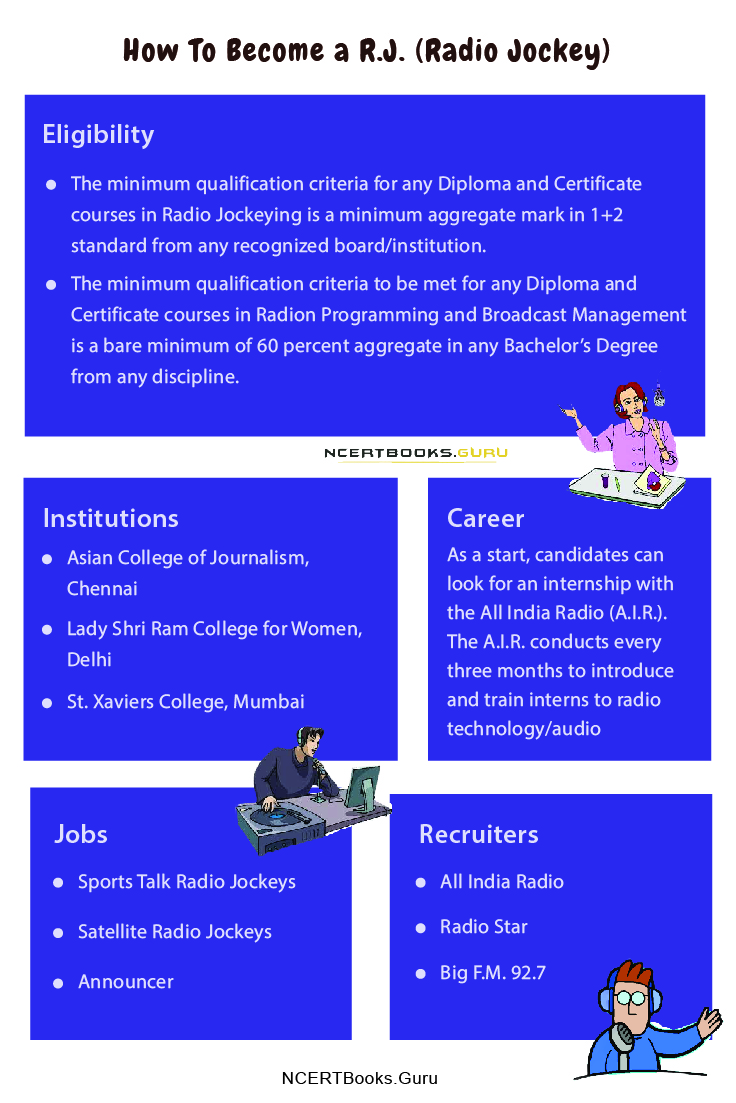
  • The minimum qualification criteria for any Diploma and Certificate courses in Radio Jockeying is a minimum aggregate mark in 1+2 standard from any recognized board/institution.
  • The minimum qualification criteria to be met for any Diploma and Certificate courses in Radion Programming and Broadcast Management is a bare minimum of 60 percent aggregate in any Bachelor’s Degree from any discipline.

Note: However, candidates must present all original documents, certificates, and mark sheets at the time of admission.

Radio Jockey Admission Process

The Admission process for Radio Jockey courses varies from one institution to another. However, there are two primary pathways- The Direct Admission and The Entrance Exam Admission. Certain institutions follow the Direct Admission procedure, whereas a few others conduct Entrance Examinations as an entry mode for Admissions.

Direct Entry Admissions: Several institutions and universities in India follow the Direct Admission Entry Admissions. Through the Direct Admission Process, candidates are selected based on their aggregate marks secured in the intermediate examination. To complete the Admission Process, candidates have to apply for the University or College.

Entrance Exam Entry Admissions: The Entrance Examination Entry Admission Process is the second selection pathway for Radio Jockey Courses. In this Admission pathway, candidates are selected based on the minimum aggregate secured in the Entrance Examinations conducted by the Institution.

To complete the Admission process, candidates must follow the below-mentioned process:

  • Candidates must apply to any university/ college that provides Radio Jockey courses.
  • Followed by this, the Institution will offer the candidates with an Entrance Examination schedule.
  • Following the Entrance Exams results, the Institution or college will release the cut-off or merit list with the eligible candidates’ names.
  • Candidates qualified through the merit lists are eligible to get enrolled for Radio Jockey courses.

Radio Jockey Entrance Examinations

The Entrance Examinations for any of the Radio Jockey Courses are facilitated and conducted by the Encompass Institute of Radio Management. However, certain institutions or universities conduct their screening tests and voice tests in the case of Certification courses such as:

  • X.I.C. Online Entrance Test
  • IIMC Entrance Exam for Post-Graduation Diploma (P.D.G.) in Radio & T.V. Journalism
  • A.J.K. Mass Communication Entrance Test

Radio Jockey Course Curriculum

Whether Radio Jockey Certificate, Diplome, Undergrad, or Postgrad, the course curriculum holds common at all Institutions and Universities. The course curriculum for Radio Jockey Courses are as follows:

  • Non-Commercial Educational Radio and Commercial Educational Radio
  • Console Training
  • Voice Technique
  • Console System and Radio Broadcast
  • Music Programming
  • Live Break Training
  • Transmission System- H.D. Radio

Top Radio Jockey Institutions

Certain Media and Mass Communication Institutions offer Radio Jockey Courses as a part of their course curriculum.

  • Asian College of Journalism, Chennai
  • Xavier Institute of Communications, Mumbai
  • Lady Shri Ram College for Women, Delhi
  • Indian Institution of Mass Communication, Delhi
  • Indian Institution of Journalism and New Media, Bangalore
  • St. Xaviers College, Mumbai
  • Symbiosis Institute of Media and Communication, Pune
  • Manorama School of Communication, Kottayam
  • Madras Christian College, Chennai
  • Christ University, Bangalore

Career Prospects for RJ in India

As a start, candidates can look for an internship with the All India Radio (A.I.R.). The A.I.R. conducts every three months to introduce and train interns to radio technology/audio.

Employment Opportunities for RJ in India

Radio Jockeys have an enormous career scope in government sectors as well as private sectors Aspirants are recruited based on their skill and abilities such as accurate pronunciation, command over the language and vocabulary, clear diction, and voice modulation. However, here are a few organization based career prospects:

Government Sector: Radio Jockeys can get employed in Government- firms like A.I.R., state-wise radio stations, and other radio stations. In Government sectors, radio Jockeys experience several benefits and opportunities and are provided with a high pay package. They are insured with benefits such as perquisites, retirement plans like superannuation fund, gratuity, pension, etc., and allowances with stable job security that remain absent in most to all private sectors.

Private Sector: The private sector provides many opportunities for aspirants in companies like Big FM, Radio Mirchi, Times FM, Radio Mid-Day, Radio Star, and many other independent Radio stations. Radio Jockeys working in the private sector experience a competitive environment, get an excellent pay package, incentives, etc.  The working environment in a government sector lacks a competitive front like those in the private sector as the government sector is established with permanent fulfill business objectives.

Job Profiles of R.J. in India

Apart from textbook methods, qualifications, and eligibility criteria. An R.J. acquires specific skills and traits. After meeting the required skills and qualifications. An R.J. is applicable for several positions and roles that match their personality, attributes, and skills. An R.J. career is diversifying in nature and here are a few Job profiles, that a qualified R.J. can take up:

  • Sports Talk Radio Jockeys
  • FM/AM Radio Jockeys
  • Satellite Radio Jockeys
  • Talk Radio Jockeys
  • Announcer
  • On-Air Personalities
  • News Reader
  • Music Director
  • Station Manager
  • Production Director

Also, See:

Top Recruiters of R.J. in India

The most popular F.M. Agencies or Radio Stations in the country for Radio Jockeys are as follows:

  • All India Radio
  • Times FM
  • Radio Mid-day
  • Radio Star
  • Radio Wani
  • Big F.M. 92.7
  • Radio Mirchi 98.3
  • Radio Mango 91.9
  • Club FM 94.3
  • Red FM 93.5
  • 104 Fever FM
  • Other independent radio stations

How To Become a R.J. (Radio Jockey) in India

Pay Scale Package of R.J. in India

Due to an increasing rate of private radio waves in the area, there appears to be a high demand rate for Radio Jockeys. A fresher in the field earns around Rs 7,000/- and Rs 15,000/- per month, depending on the recruited company.

The pay scale for an R.J. increases with time and experience, and an individual can earn Rs. 2,500 – Rs. 3,000 per show. An experienced R.J. earns up to Rs 1.5 lakhs to Rs. 2 lakhs per month, depending on the company and the show.

Besides the earning of the contracted money, R.J.S. can also add to their payscale through Advertising Ads. Voice-over roles for Radio ads and Television ads can be an added payscale advantage as n R.J.

FAQ’s on How to Become a R.J. in India

Question 1.
What is the skill set required as an R.J.?

Answer:
Aspiring candidates must hold the following skillset: should hold a euphonious voice and an accurate diction, should make use of precise punctuation and must have control of voice pitches. They should have power over language and fluency, be creative in concepts and ideas, and possess a great sense of humor.

Question 2.
What are the career prospects of R.J.s in India?

Answer:
Radio Jockeys have an enormous career scope in government sectors as well as private sectors. R.J.s can work as announcers music directors, producers, talk show jockeys, sports talk show jockeys, etc. with a payscale fluctuating between INR 10,000 to INR 2.5 Lakhs per month with time and experience.

Question 3.
What are the cons of being an R.J.?

Answer:
At times playing the role of a Radio Jockey can require consistent hard work and evolves into a very stressful and demanding profession. The starting pay scale for a fresher is very low and bleak. As a fresher, you have to host shows leading to weird working hours.

Summary

We hope that the information mentioned above regarding How to Become an R.J. in India has helped improve your understanding of the subject with in-depth knowledge.

Best Courses to Study for Jobs | List of Top 6 Best Courses to Study for Future 2022

Best Courses to Study for Jobs

Best Courses to Study for Jobs: Millions of students across the country stand at crossroads upon completing their higher secondary education. There are several courses available for students to establish an excellent and lucrative career.

Before selecting any course, you must consider a few facts, such as career prospects of a course, personal interest, etc. Due to recession and other economic factors, there is an alarming rate of unemployment and an abrupt fall in the number of good jobs. Therefore, it becomes necessary for an individual to put a lot of thought process to choose a course that lays a good career after graduation.

If you are battling between the vast, confusing courses laid out before you, this article will direct your path with a list of top 11 courses to apply after higher secondary Education or 12th standard.

Get to Know More about other types of Course Details in Stream wise, and Category wise.

Courses to Pursue After Higher Secondary School

List of Top 6 Best Courses to Study for Jobs

  1. Food Processing and Technology Engineering
  2. App Making Courses
  3. Bio-Medical Engineering
  4. Mechatronics Engineering/ M.Sc in Mechatronics
  5. Fire and Safety Technology Engineering
  6. Petroleum Engineering

Petroleum Engineering

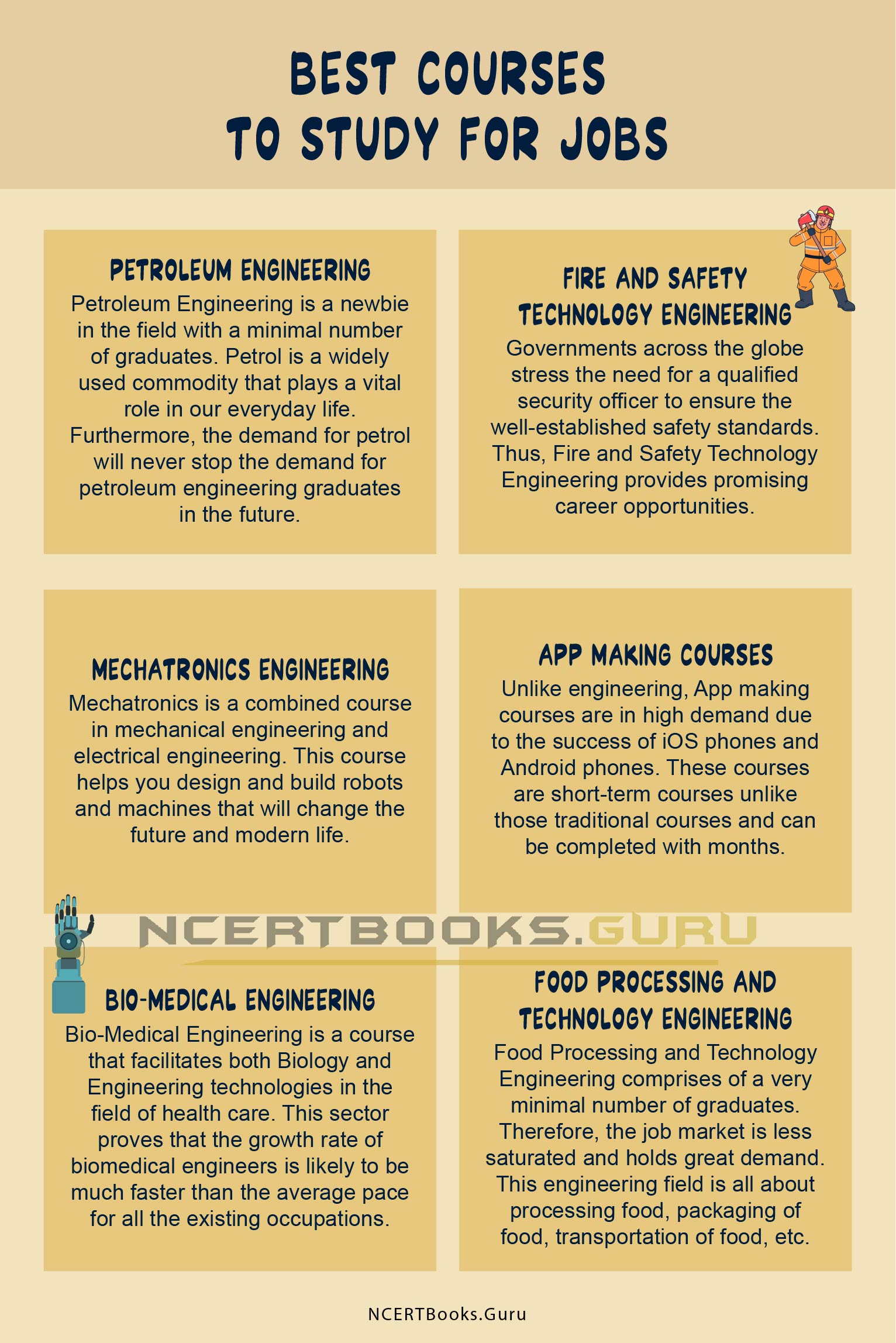
Petroleum Engineering is a newbie in the field with a minimal number of graduates. Petrol is a widely used commodity that plays a vital role in our everyday life. Furthermore, the demand for petrol will never stop the demand for petroleum engineering graduates in the future.

Course Duration

To hold the job as a petroleum engineer, you must complete a Bachelor’s Degree in Petroleum Engineering. Candidates with a degree in Chemical Engineering or Mechanical Engineering course can also be an addition in this field.

  • Bachelor’s Courses – Four Years: Courses under B.E/B.Tech for this field- B.E/B.Tech in Petroleum Engineering, Applied Petroleum Engineering, Petroleum Reservoir, and Production Engineering, Petroleum Refinery Engineering, and Petrochemical Engineering
  • Master’s Courses – Two Years: Courses under M.E/M.Tech for this field- M.E/ M.Tech in Petroleum Exploration, Petroleum Refining and Petrochemical Engineering, and Petroleum Refinery Engineering
  • Dual Degree – Five Years: You can also pursue a Dual Degree – M.Tech + B.Tech in Petroleum Engineering for five years.

Eligibility Criteria

To deem eligible for Bachelor’s in Petroleum Engineering, candidates must have completed class 12 with a minimum aggregate in Science stream from any recognized board or university.

To deem eligible for a Master’s in Petroleum Engineering, candidates must have completed a Bachelor’s Degree in the relevant field from any recognized board or university.

Career Prospects

A Degree in Petroleum Engineering opens career paths that hold a high demand across the globe with a high payscale package. Graduates can be employed as Chief Petroleum Engineer, Production Engineer, or Drilling Engineer at companies like CPCL, HPCL, BPCL, etc. In India, the average pay scale for petroleum engineering is Rs 6,99,027 per year. In the U.S., the average salary is $104000 annually.

Do Check

Fire and Safety Technology Engineering

Fire and Safety Technology Engineering is a course that deals with safety measures and technologies that are used in various manufacturing units and industries. Governments across the globe stress the need for a qualified security officer to ensure the well-established safety standards. Thus, Fire and Safety Courses provide promising career opportunities.

Course Duration

To hold the job in this field, you can take up either a Bachelor’s Degree or a Diploma course.

  • B. Tech in Fire and Safety Technology Engineering – Four Years
  • Diploma in Fire and Safety Management – One or Two Years – The course duration for a full-time diploma program fluctuates between a year or two.

Eligibility Criteria

Candidates enrolling for B.Tech should have completed their Higher Secondary Education with Physics and Mathematics as their core subjects and Chemistry/Biology/Biotechnology/Computer as the optional subject. Candidates must have secured a minimum of 50 percent aggregate from any recognized University or Board.

Candidates enrolling for Diplomashould have completed 10+2 examinations in any discipline with a minimum aggregate from a recognized board or university.

Career Prospects

Safety and Fire Technology engineering graduates have excellent career opportunities, especially in middle eastern countries. In the government sectors, they are provided jobs in Defense Forces, Railways, Airport Authority of India, Electricity Boards, etc. The average payscale fluctuates around Rs 3 Lakhs to Rs 4 Lakhs per annum.

Mechatronics Engineering/ M.Sc in Mechatronics

Mechatronics is a combined course in mechanical engineering and electrical engineering. This course helps you design and build robots and machines that will change the future and modern life.

Course Duration

To pursue this course, you can either choose Mechatronics Engineering or MSc in Mechatronics

  • MSc Mechatronics (Advanced Mechanical Engineering Science) – 1 Year
  • B.E. Mechatronics Engineering – 4 Years

Eligibility Criteria

Candidates enrolling for M.Sc Mechatronics should have completed their Bachelor’s Degree with a minimum aggregate from any recognized institutions.

Candidates enrolling for Mechatronics Engineering should have completed 10+2 examinations with Science as their mainstream with a minimum aggregate from a recognized board or university.

Career Prospects

Since this course is a combination of two different fields, career opportunities are vast globally. Graduates can ger employed as Automation Engineers, Robotic Engineers, Data Scientist, Instrumentation Engineer, etc. The average pay package for a Mechatronics graduate is Rs. 68,000 per month. In the USA, the average pay scale is $99,040 per year.

Bio-Medical Engineering

Bio-Medical Engineering is a course that facilitates both Biology and Engineering technologies in the field of health care. This sector proves that the growth rate of biomedical engineers is likely to be much faster than the average pace for all the existing occupations.

Course Duration

  • Biomedical Engineering eligibility for B.Tech/BE – 4 Years
  • Biomedical Engineering eligibility for M.Tech – 2 Years

Eligibility Criteria

For admission to pursue undergraduate degree programs in Biomedical Engineering, candidates should have completed their 10+2 Education in science stream from a recognized board or institution.

For admission in a Master’s program, candidates should have completed their undergraduate in Biomedical Engineering or hold a Bachelor’s in Biotechnology branch with a minimum aggregate from any recognized university/institution.

Candidates who have completed their MBBS degree can also pursue a Post-graduation course in Biomedical Engineering.

Career Prospects

Graduates are given a plethora of opportunities in the BioMedical line. The rapid advancement of technology in biomedical engineering is a continual change in the factors of various job profiles in the field. Candidates can either become a scientist or continue further with research.

Graduates can get employed as Installation Engineer, Bio-Medical Engineer, Instrumental Engineer, Researcher, and Maintainance Engineer. Top-notch companies like Johnson & Johnson, Siemens Healthcare, Medtronic, Maquet, GE Health care, etc. recruit are on a spree for Bio-medical graduates.

The average salary for the BioMedical graduate is Rs 4 Lakhs per annum. However, with time and experience, the pay scale increases along with skills.

App Making Courses

Unlike engineering, App making courses are in high demand due to the success of iOS phones and Android phones. These courses are short-term courses with high salaries unlike those traditional courses and can be completed with months.

App Making Programs courses are divided into Certification Programmes, Informal Training Programmes, Bachelor’s Degree Program, Diploma Program, P.G. Diploma Program, P.G. Certificate Program, and Master’s Degree Program.

Course Duration

  • B.Voc Networking and Mobile Applications – 3 Years
  • M.Voc networking and Mobile Applications – 3 Years

However, other courses are short-term such as Certification and Diploma courses that fluctuate between three to six months, depending on the individual’s capacity and the institution.

Eligibility Criteria

To deem eligible for B.Voc, Certificate, or Diploma courses, candidates should have completed and should have obtained a bare minimum aggregate in their 10+2 examinations. The eligibility criteria differ from an institution to another.

To deem eligible for M.Voc Master’s course or P.G. Diploma, the minimum educational qualification criteria required is the completion of 10+2 standard with a minimum aggregate and a Bachelor’s Degree course or B.Voc. Course from any recognized institution.

Career Prospects

Upon the completion of App making courses, individuals can start your own business or work under big corporates. The demand for this course never runs out, thus making this field highly lucrative.

The average salary for App Making Courses fluctuates between Rs 4 Lakhs to Rs 10 Lakhs per annum. However, with time and experience, the pay scale increases along with skills. Also, check the steps on How to Become App Developer in India?

Food Processing and Technology Engineering

Food Processing and Technology Engineering comprises of a very minimal number of graduates. Therefore, the job market is less saturated and holds great demand. This engineering field is all about processing food, packaging of food, transportation of food, etc.

Course Duration

  • B.E./B.Tech. Food Processing And Technology Course – 4 Years
  • M.Tech. Food Processing And Technology – 2 Years

Eligibility Criteria

To deem eligible, candidates should have passed class 12 from Science stream with Physics, Chemistry and Mathematics are their core subjects from any recognized board or institution.

The minimum eligibility criterion to hold for M.Tech graduates that you should have completed B. E./B. Tech. in the relevant field from any recognized institution with a minimum aggregate of 45 – 50 percent.

Career Prospects

The career prospects hold high demand. Graduates are either hired by MNCs related to food and beverages or hold great posts in the government sector.

Within that Government sector, graduates are given job profiles like Food Inspector, Quality Assurance Officers, etc. In the private sector, graduates are hired by Private Food Production firms, plants, storage and preservation firms, etc. with an enormous scope.

The average salary for Food Processing and Technology Engineering fluctuates between Rs 2.5 to Rs 4 Lakh Rupees per year.

Courses to Study for Jobs

FAQ’s on Best Courses to Study for Jobs

Question 1.
What are the best courses to study to avail of good jobs?

Answer:
There are a plethora of courses to study. However, certain courses hold high demand. Courses such as Petroleum Engineering, Mechatronic Engineering, App making courses, Bio-medical Engineering, Fire and Safety Technology Engineering, and Food Process and Technology Engineering hold high demand.

Question 2.
What scope do Bio-medical engineering graduates hold?

Answer:
Bio-Medical Engineering holds a vast scope. Interested individuals can hold jobs as sales engineers, application engineers, hospital engineers, and work at Hospitals, healthcare, and R & D companies. The average salary for the BioMedical graduate is Rs 4 Lakhs per annum. However, with time and experience, the pay scale increases along with skills.

Question 3.
What is the career scope after the completion of App Making Courses?

Answer:
Upon the completion of App making courses, individuals can start your own business or work under big corporates. The demand for this course never runs out, thus making this field highly lucrative.

The average salary for App Making Courses fluctuates between Rs 4 Lakhs to Rs 10 Lakhs per annum. However, with time and experience, the pay scale increases along with skills.

Summary of Best Courses to Study for Jobs

We hope that the information mentioned above regarding the best Courses to Study for Jobs has helped improve your understanding of the subject with in-depth knowledge.

Medical Courses Without NEET | Eligibility, Top Colleges, Duration, Career Scope, Salary, and More

Medical Courses Without NEET

Medical Courses Without NEET: Medical Courses are one of the best degrees for the students after class 12th. As we all know studying biology in class 12th is already a difficult job, and with that students are also required to study for the NEET entrance exam to be eligible for admission to MBBS and other healthcare degrees.

But now there are several courses available in India that biology students can pursue medicine even without the NEET exam. BPT, B Pharma, B Nursing, etc. are a few courses that can be pursued without NEET. Thus, these courses are offered by the top colleges in India.

Here, in this article, we will assist you to choose the high salary career options in medical without NEET along with the best career path. The article will help you a lot regarding eligibility, colleges, fees, career scope, salary, and more.

List of Medical Courses After 12th Without NEET

The competition for medical courses is increasing rapidly and the students are not able to get to their dream colleges. This all makes them leave their career for medical sciences. But now, they can also pursue their degree in medical courses.

Here, you can find the table which shows you the top courses offered without NEET along with the course duration.

Courses  Duration 
B.Pharma 4 years
B.Sc Agricultural Science 4 years
B.Sc Animal Husbandry and Dairying 3-4 years
B.Sc Cardiovascular Technology 4 years
B.Sc Cyber Forensics 3-4 years
B.Sc Fisheries 3 years
B.Sc in Biotechnology 3 years
B.Sc in Cardiovascular Technology 3 years
B.Sc in Genetics 3 years
B.Sc in Microbiology 3 years
B.Sc in Nutrition 3 years
B.Sc Nursing 4 years
B.Tech in Biomedical 4 years
Bachelor of Occupational Therapy 4 years
Bachelor of Naturopathy and Yogic Sciences 4.5 years

List of Other Important Courses in Medical Without NEET

There is a never-ending list of medical courses without NEET in India. The Bachelor of Science domain offers a lot of healthcare sector courses. You can look at the list provided below:

  • B.Sc Blood Transfusion Technology
  • B.Sc Nutrition and Dietetics
  • B.Sc Fisheries
  • B.Sc Cardiac Technology
  • B.Sc Audiology
  • B.Sc Nursing
  • Bachelor of Veterinary Science (BVSc)
  • B.Sc Blood Banking Technology
  • B.Sc Medical Imaging Technology
  • B.Sc Intensive Care Technology
  • Bachelor in Prosthetics and Orthotics
  • B.Sc Radiology and Imaging Technology
  • B.Sc Psychology
  • B.Sc Biomedical Science
  • B.Sc Orthopedic Technology
  • B.Sc Anesthesia Technology
  • B.Sc Paramedical Technology
  • B.Sc Dialysis Technology
  • B.Sc Cyber Forensics
  • B.Sc Endoscopy and Gastrointestinal Imaging Technologies
  • B.Sc MLT
  • B.Sc Physician Assistant

Eligibility For Medical Courses Without NEET After 12th

As the name suggests medical courses so it is already clear that you must have studied biology in class 12th. But the eligibility varies according to the different available colleges. The important thing which you need to keep in mind is that you must have cleared class XII with at least a 50% grade.

Medical Courses List Without NEET Fee Structure

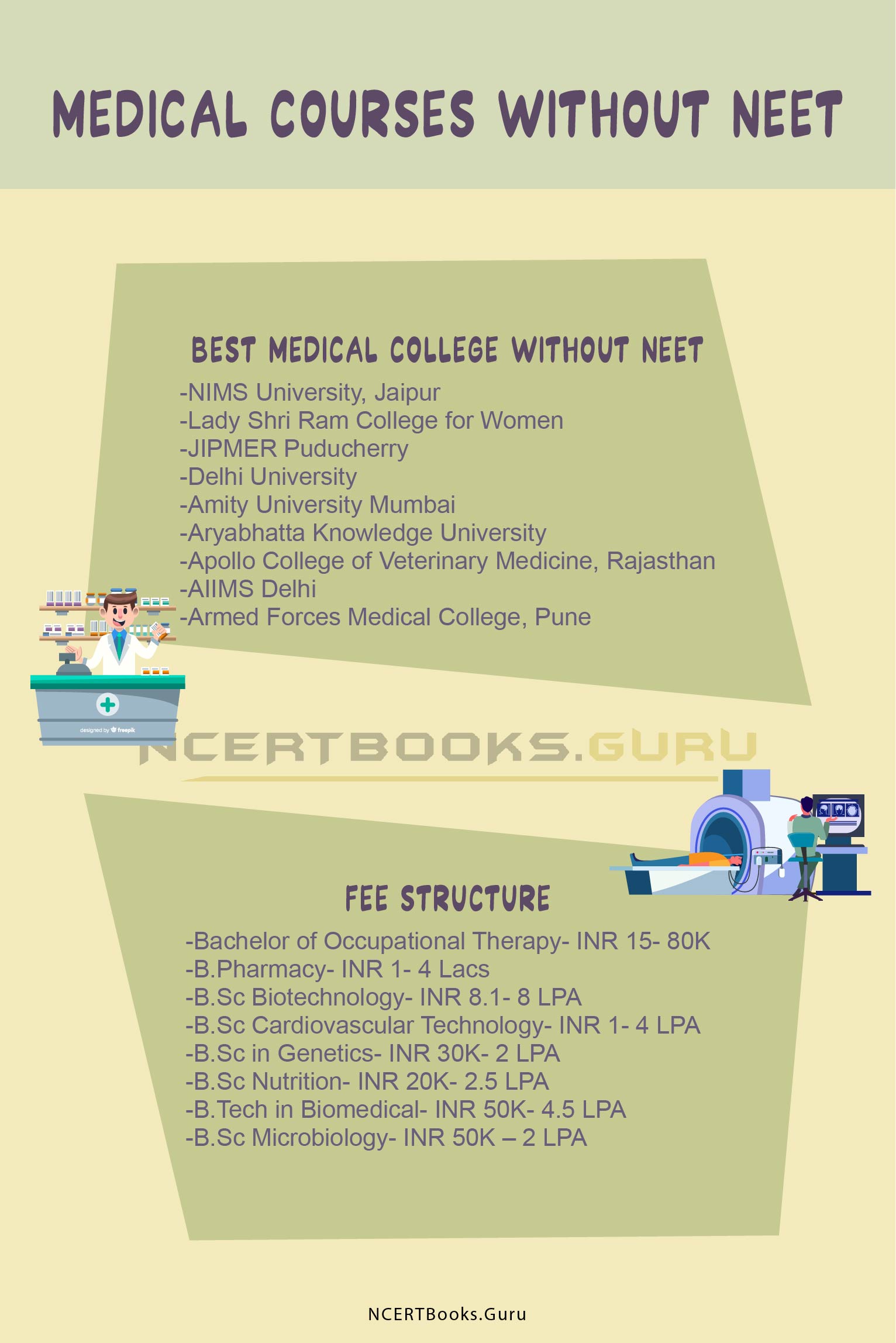
The fees structure for all the colleges varies according to the facilities provided. But the average fees structure could be seen for the following courses without NEET.

Bachelor of Occupational Therapy INR 15- 80K
B.Pharmacy INR 1- 4 Lacs
B.Sc Biotechnology INR 8.1- 8 LPA
B.Sc Cardiovascular Technology INR 1- 4 LPA
B.Sc in Genetics INR 30K- 2 LPA
B.Sc Nutrition INR 20K- 2.5 LPA
B.Tech in Biomedical INR 50K- 4.5 LPA
B.Sc Microbiology INR 50K – 2 LPA

Must Read:

Medical Courses Without NEET

Best Medical College without NEET in India

The top best colleges which are available all over India and offer Medical Courses without NEET are:

  • NIMS University, Jaipur
  • Lady Shri Ram College for Women
  • JIPMER Puducherry
  • Delhi University
  • Amity University Mumbai
  • Aryabhatta Knowledge University
  • Apollo College of Veterinary Medicine, Rajasthan
  • AIIMS Delhi
  • Armed Forces Medical College, Pune
  • Christian Medical College, Ludhiana
  • University of Technology, Jaipur
  • Manipal School of Allied Health Sciences
  • Kerala Veterinary and Animal Sciences University (KVASU)
  • Tamil Nadu Veterinary and Animal Sciences University
  • Indira Gandhi National Open University Delhi

High Salary Career Options in Medical without NEET

After the completion of medical courses without NEET, the career scope related to the salary structure and education is a lot more. You have various opportunities to work with the practitioners and doctors that too independently.

Also, these courses are offered at the bachelor’s and after that can pursue master’s and other higher-level degree courses. You can find a few job profiles which are offered without NEET entrance Exams.

Job Profiles

The top job profiles after the completion of a B.Sc degree and other medical courses without NEET are

  • Pharmacist
  • Nutritionist
  • Food Technologist
  • Nurse
  • Biotechnologist
  • Occupational Therapist
  • Proof-reader
  • Writer
  • Psychologist
  • Child Counseling
  • Researcher
  • Screenwriter
  • Drug Safety Associate
  • Medical Sonographer
  • Geneticists
  • Bacteriologist
  • Naturopathy Doctors

Related Articles: Diploma in Medical Field Course Details

Salary Offered After Medical-Based Courses Without NEET

You have ample opportunities to work. But when it comes to salary structure the students are worried if they will be able to get sound salaries. The answer to this question is yes. The top companies are hiring students who pursue degrees in the healthcare domain.

The average salary which has been offered to the students is around Rs 2 lakh to Rs 30 Lakhs. Find the post wise salary structure:

Job Role Average Salary p.a.
Nurse 3 Lakhs to 8 Lakhs
Biotechnologist 5 Lakhs to 9 Lakhs
Nutritionist 5 Lakhs
Agronomist 2 Lakhs to 3 Lakhs
Forensic Scientist 6 Lakhs
Fisheries Scientist 5 Lakhs to 10 Lakhs
Cardiac Technician 4 Lakhs to 20 Lakhs
Biomedical Engineer 6 Lakhs
Pharmacist 2 Lakhs to 5 Lakhs
Occupational Therapist 4 Lakhs
Naturopathy Doctor 3 Lakhs to 5 Lakhs

FAQs on Medical Related Courses Without NEET in India

1. What are the top medical courses without NEET?

Ans. There are numerous courses that can be pursued without NEET. Some are B.Sc Nursing, Bachelor of Veterinary Science (BVSc), B.Sc Blood Banking Technology, B.Sc Medical Imaging Technology, B.Sc Intensive Care Technology, etc. Get complete details by referring to the above article.

2. What are the high salary career options in medical other than MBBS without NEET? 

Ans. Nursing, Biotechnology, Paramedical Courses, Clinical Research, Toxicology, Occupational Therapist, Genetics, Nutrition and Dietetics, Public Health, Pharmacy, Food Technology, and others are the few courses that offer high salary after the completion of a degree.

3. Can I pursue MBBS without NEET? 

In India, it is not possible to get admission into the MBBS without the NEET entrance exam result. The score of NEET may vary according to the colleges as some offer admission with high neet scores and some may offer with low scores too.

4. What is the average salary offered after medical courses without NEET? 

Ans. The average salary offered after medical courses without NEET is around Rs 2 lakhs to Rs 5 lakhs per annum. The salary structure is completely dependent on the job profile and the skills.

Conclusion

As with the detailed information on the Medical Courses without NEET in the above article, we hope that now you are aware of a few courses. But choosing the best college and finding information about its admission process is not a piece of cake. Thus, the counselors at NCERTBooks.Guru is here to help you in all possible manner. You can provide your doubts in the below comment section.

Bachelor of Banking & Insurance (BBI) Course | Fee Structure, Duration, Eligibility, Syllabus, and Salary

Bachelor of Banking & Insurance BBI Course

Bachelor of Banking & Insurance (BBI) Course: Are you confused about making the right career choice? And Yes! The confusion is natural when there are thousands of courses available to choose from. Finding a stream to take, subject with interest, and a satisfying course to select is challenging. And to go about finding a perfect job option is all based upon the early first step. Before choosing the ideal career option, one must know his interest, soft skills, and aptitude with personality type. If your interest falls in the field of finance, banking, accounting, insurance law, insurance regulation, then go for the Bachelor of Banking and Insurance BBI course.

The course covers class presentations, projects, tests, class participation, and attendance. Also, it covers the performance of students in classroom discussions, debates, and role play.

Get to Know More about other types of Course Details in Streamwise, and Category wise.

About Bachelor of Banking & Insurance (BBI) Course

BBI is a three-year course that comes in the undergraduate course division into six-semester systems. It is to make sure that students will learn and theory and could apply that knowledge to the real world. The course not only covers the subject related to banking but also expands the knowledge about communication skills. Also, it covers the field of commerce. The course trains students such that candidates prefer to handle the technologies used in the field of banking and insurance. It updates students with each formed market reform, banking policies, rules, and regulations.

Highlights of Bachelor of Banking & Insurance BBI Course

Name of the course BBI
BBI Course Full-Form Bachelor of Banking and Insurance
Duration 3- years
Type of course Undergraduate
Eligibility Passed in 10 +2
Fee Paid Rs 14,000- 5,00,000/-
BBI Course Job Opportunities Bank Manager, Finance Officer, Insurance Manager, Consultant, Treasurer, Risk manager, KPO Executive, Credit and cash managers.
BBI Course Salary offered Rs 1,20,000/- to Rs 5,00,000/-

Subject and Concepts of Bachelor of Banking and Insurance (BBI) Course

BBI course is all about preparing the candidates to explore different opportunities. These options are added to banking due to globalization, privatization, and liberalization. The basic skill set that students need to have under the course includes:

  • Build the confidence of candidates and make them self employed.
  • Benefit industries by providing them with a trained person for the banking and insurance department
  • Training is given by industrial visits, summer placements, practical approach, using modern technology for teaching students.
  • Soft skills training.
  • Motivational and personality development
  • Stress management workshop.
  • Talent mapping, counselling sessions

Bachelor of Banking & Insurance BBI Admission Process

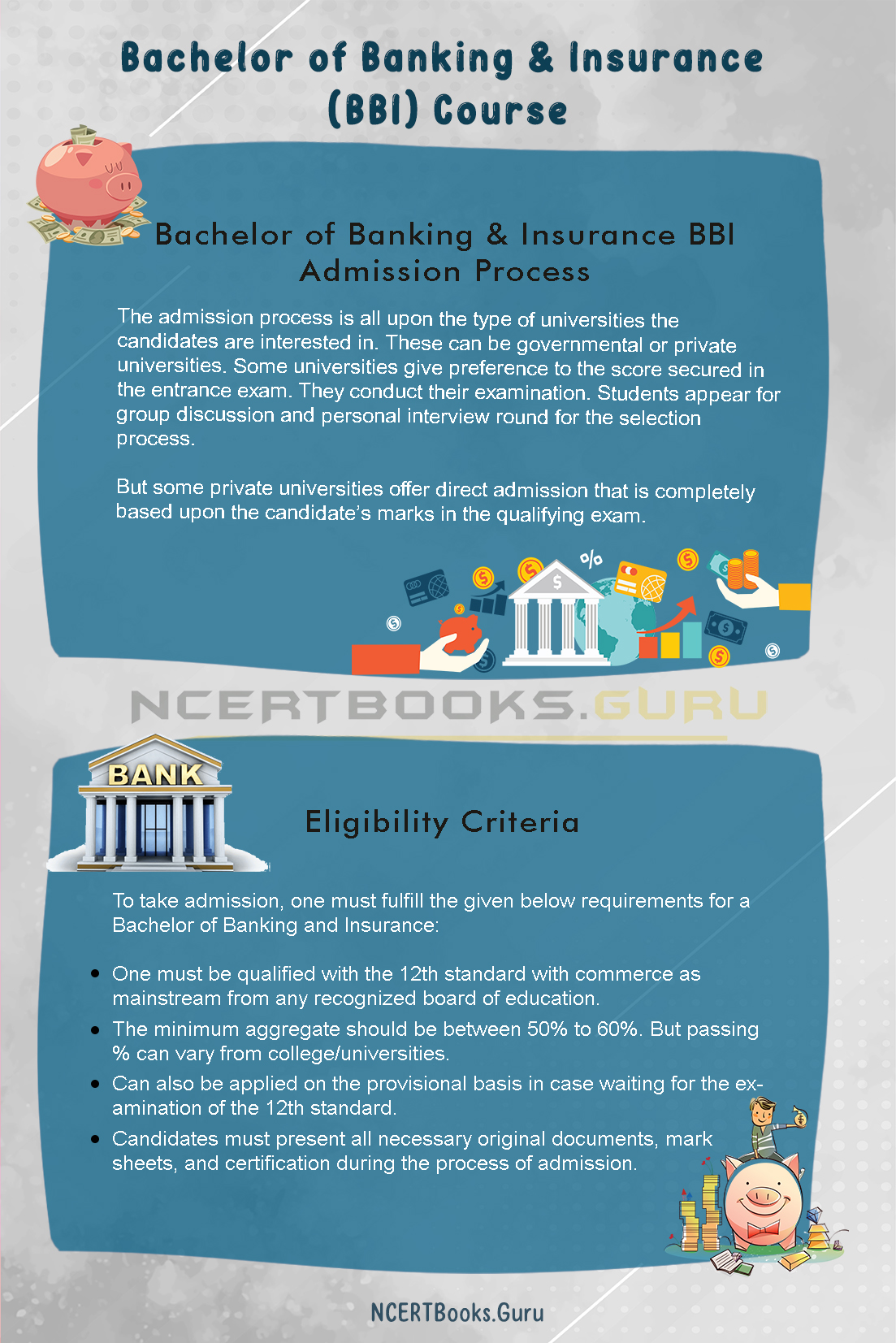
The admission process is all upon the type of universities the candidates are interested in. These can be governmental or private universities. Some universities give preference to the score secured in the entrance exam. They conduct their examination. Students appear for group discussion and personal interview round for the selection process.

But some private universities offer direct admission that is completely based upon the candidate’s marks in the qualifying exam.

Given below is the list of some BBI Entrance Exams

  • Chandigarh University Entrance Exam
  • St. Paul’s College (SPC) Ulhasnagar
  • D.K. College, Buxar
  • B.N.N. College (BNNC), Thane
  • Naree Monjee College of Commerce and Economics Entrance Exam
  • Mumbai University Entrance Test and more than 50 colleges in Mumbai offer the course.

BBI Course Duration

Being an aspirant in the BBI course after completing the 12th standard, then the interested candidate has to spend three years in an undergraduate course. The candidate may pursue masters and other further studies in the future.

Bachelor of Banking & Insurance (BBI) Course Eligibility Criteria

To take admission, one must fulfill the given below requirements for a Bachelor of Banking and Insurance:

  • One must be qualified with the 12th standard with commerce as mainstream from any recognized board of education.
  • The minimum aggregate should be between 50% to 60%. But passing % can vary from college/universities.
  • Can also be applied on the provisional basis in case waiting for the examination of the 12th standard.
  • Candidates must present all necessary original documents, mark sheets, and certification during the process of admission.

Bachelor of Banking & Insurance (BBI) Course

BBI Course Syllabus

Normally the syllabus structure for BBI varies from one college to another. But the basic topic that is covered under the BBI course as mentioned:

First Year

Principles of Management Micro Economics 1 Effective Communication 1 & 2
Management of Financial Services Financial Accounting Macro Economics 1
Effective Communication 1 Effective Communication 2 Quantitative Methods 1
Business Law Introduction to Computer Systems Principles of Banking & Insurance

Second Year

Financial Management 1 Universal Banking Management Accounting
Customer Relationship Financial Market Entrepreneurship Management
Taxation of Financial
Services
Cost accounting,
Insurance and Banking
Financial Reporting and Analysis

Third Year

Central Banking Auditing International Business
International Banking Portfolio Management Business Ethics
Banking Project Strategic Management Turnaround Management

BBI Course Fee Structure

The entire average fee for the BBI course depends upon the institute chosen by the candidate. If you are interested in pursuing this course, then the average annual fee in India ranges from Rs 14,000 to 10,00,000/- in the three years for the course.

Do Check

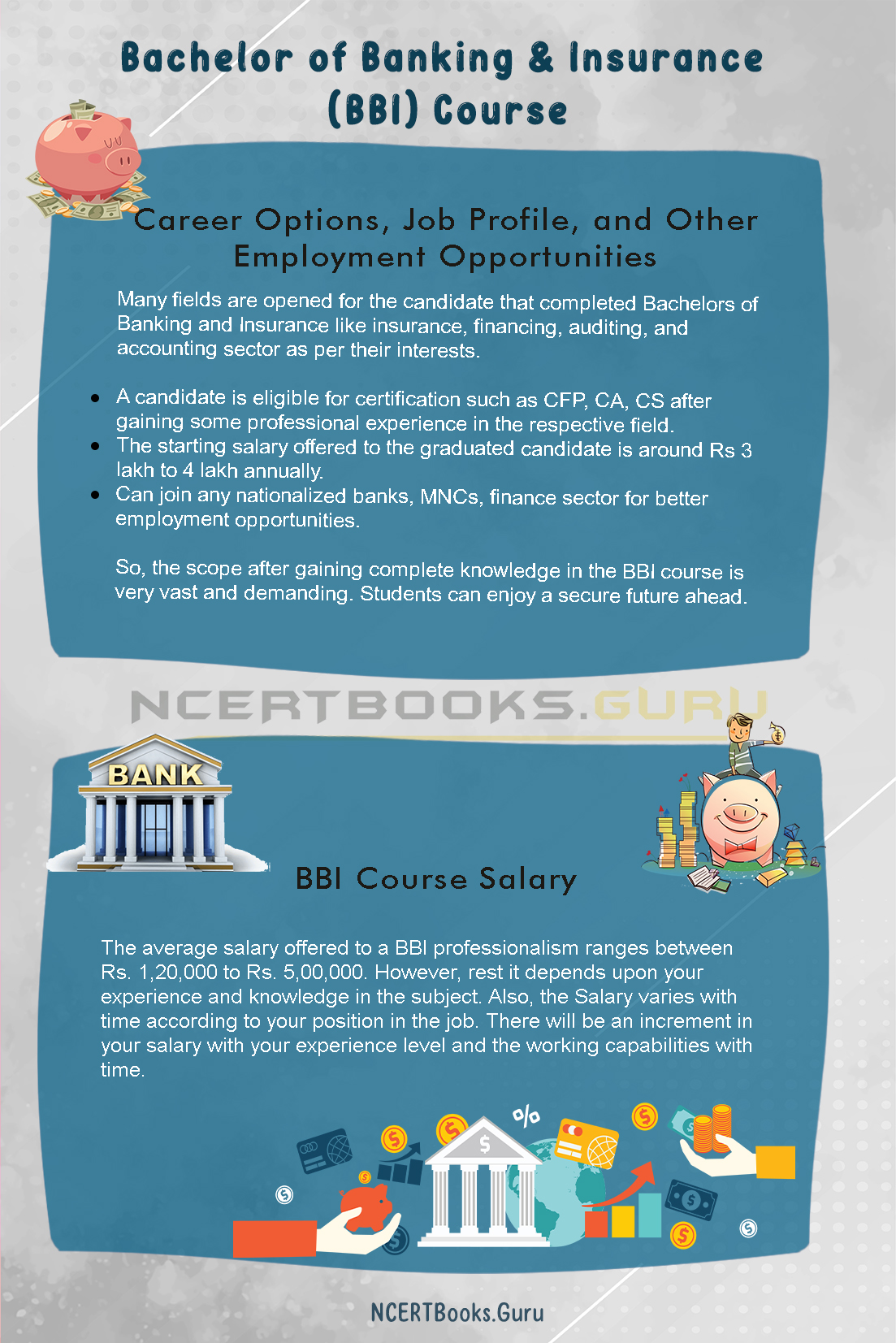
Career Options, Job Profile, and Other Employment Opportunities

Many fields are opened for the candidate that completed Bachelors of Banking and Insurance like insurance, financing, auditing, and accounting sector as per their interests.

  • A candidate is eligible for certification such as CFP, CA, CS after gaining some professional experience in the respective field.
  • The starting salary offered to the graduated candidate is around Rs 3 lakh to 4 lakh annually.
  • Can join any nationalized banks, MNCs, finance sector for better employment opportunities.

So, the scope after gaining complete knowledge in the BBI course is very vast and demanding. Students can enjoy a secure future ahead.

BBI Course Salary

The average salary offered to a BBI professionalism ranges between Rs. 1,20,000 to Rs. 5,00,000. However, rest it depends upon your experience and knowledge in the subject. Also, the Salary varies with time according to your position in the job. There will be an increment in your salary with your experience level and the working capabilities with time.

Bachelor of Banking & Insurance (BBI) Course 2

FAQ’s on Bachelor of Banking & Insurance (BBI) Course

Question 1.
Is there any entrance exam for the BBI course?

Answer:
Some universities have entrance exams like Delhi University Arts, Delhi University Science. You need to clear and meet their eligibility criteria.

Question 2.
Top colleges for offering Bachelor of Banking and Insurance (BBI) in India?

Answer:
The list of top college is given below: St. Xaviers College (Mumbai), Ethiraj college for women (Chennai), St. Andrew College of Arts Science and Commerce(Mumbai), Lady Shri Ram College for Women (Delhi), Indraprastha College for Women (New Delhi), etc.

Question 3.
How much time does it take to complete the degree?

Answer:
Bachelor of Banking and Insurance Course After 12th is a three-year course. Hence, students can efficiently spend their time on it. They have a good option available with them for excess time to master in the course.

Question 4.
Number of the total subject in BBI?

Answer:
There is a maximum of 38 subjects. Hence it would help if you mastered them for a secure future. Also, the total subjects might change according to the university and college you get admitted to.

Question 5.
Is BBI tough or easy to study?

Answer:
Nothing is difficult if pursued by interest. It depends upon your learning capabilities. All subjects are easy in them if you better understand their concepts.

Question 6.
What is the total fee for the Bachelor of Banking and Insurance (BBI) course?

Answer:
In India, the average fee for a Bachelor of Banking and Insurance (BBI) course is 14,000 per year.

Question 7.
What are the benefits of the Bachelor of Banking and Insurance (BBI) course?

Answer:
After getting into the Bachelor of Banking and Insurance (BBI) course, the candidate gets specialization for banking and insurance, CAD & CAM, tourism management.

Question 8.
What is the various training provided under the Bachelor of Banking and Insurance (BBI) course?

Answer:
This course provides training in the field of finance, banking, accounting, insurance, insurance regulation and others.

Summary of Bachelor of Banking & Insurance BBI Course

Hopefully, you must have gained the entire information that is necessary for you to know for BBI Course. We have compiled the entire data required for you in career opportunities, Salary, duration, eligibility, syllabus to cover, and much more.