NCERT Solutions for Class 7 Social Science Civics Chapter 5 Women Change The World

Women Change The World Class 7 Questions and Answers Civics Chapter 5

Class 7 Civics Chapter 5 NCERT Textbook Questions and Answers

Question 1.
If you were Xavier, what subject would you choose and why?
Answer:
I would choose the subject I liked. A person can learn only that subject, that he/she is interested in. You cannot force anyone to take a particular subject in which he/she is not intererted in.

Question 2.
In your experience, what are some of the other pressures that boys experience?
Answer:
There are many pressures that boys experiece. Some of these are :

  • Parents allow their boys not to go out with certain friends.
  • They do not allow boys to keep mobile phones.
  • They do not allow boys to see late night movies or go to picture late night.

Question 3.
What percentage of children leave school at the elementary level?
Answer:
52%

Question 4.
At which level of education do you see the highest percentage of children leaving?
Answer:
Secondary level.

Question 5.
Why do you think that the percentage of Adivasi girls and boys leaving school is higher than that of any other group?
Answer:
There are several reasons why Adivasi girls and boys leave school. In many parts of India, especially in rural and poor areas, there may not be proper schools nor teachers who teach on a regular basis. If a school is not close to people’s homes, and there is no transport like buses or vans, parents may not be willing to send their girls to school. Many families are too poor and unable to bear the cost of educating all their children. Many children also leave school because they are discriminated against by their teacher and classmates.

Question 6.
How do you think stereotypes, about what women can or cannot do, affect women’s right to equality?
Answer:
Many people feel that outside the home, women are good at only certain jobs. For example, many people believe that women make better nurses because they are more patient and gentle. Similarly, it is believed that science requires a technical mind and girls and women are not capable of dealing with technical things.

Because so many people believe in these stereotypes, many girls do not get the same support that boys do to study and train to become doctors and engineers. In most families once girls finish school, they are encouraged by their families to see marriage as their main aim in life. For these reasons, women are denied their right to equality.

Question 7.
List one reason why learning the alphabet was so important to women like Rashsundari Devi, Ramabai and Rokeya.
Answer:
Learning the alphabet are so important to women like Rashundari Devi, Ramabai and Rokeya because they could share their ideology with the society their writing. It gave them the power not only to dream and write, but also to do more to help other girls go to school and to build their own dreams. Also, through their own writing, they also gave the world an opportunity to read about women’s lives in those days.

Question 8.
“Poor girls drop out of school because they are not interested in getting an education.” Re-read the last paragraph on page 62 (TB) and explain why this statement is not true.
Answer:
The above statement is not true because of the following reasons :

  • In many parts of the country, especially in rural and poor areas, there may not even be proper schools nor teachers who teach on a regular basis.
  • If a school is not close to people’s homes, and there is no transport like buses or vans, parents may not be willing to send their girls to school.
  • Many families may be too poor and unable to bear the cost of educating at their children.

Question 9.
Can you describe two methods of struggle that the women’s movement used to raise issues? If you had to organise a struggle against stereotypes, about what women can or cannot do, what method would you employ from the ones that you have read about? Why would you choose this particular method?
Answer:
The two methods of struggles that the women’s movement used to raise issues are as follows:
1. Raising awareness :
An important part of the women’s movement work is to raise public awareness on women’s rights issues. Their message has been spread through street plays, songs and public meetings.

2. Protesting :
The women’s movement raises its voice when violations against women take place or for example, when a law or a policy acts against their interests. Public rallies and demonstrations are a very powerful way of drawing attention to injustices.

I would protest against the stereotypes. I would explain to them that men and women are equal. Women also have, the same rights as men. They also have the same right as men regarding education, job opportunities. They are free to join any profession of their choice.

NCERT Solutions for Class 7 Social Science

Free PDF Download of NCERT Science Solutions for Class 8 All Chapters

NCERT Solutions for class 8 Science PDF Download

NCERT is completely responsible for designing and publishing school books for CBSE students for all classes. Here we have curated the list of chapter-wise NCERT Solutions for Class 8 Science PDF as per the latest and updated 2021-22 CBSE Syllabus and Exam Pattern.

Kids who find learning the physics and biology concepts difficult at class 8 can go through this NCERT 8th Class Science Textbook Solutions PDF. Also, it provides extra guidance to students while preparation so gain proper knowledge about the subject and score well in the exams.

Chapter Wise CBSE NCERT Solutions for Class 8 Science Free PDF Download

All the solutions are prepared according to the latest syllabus prescribed by CBSE and strictly follow CCE marking scheme. So, you can trust this handy NCERT Solutions 8th Class Science Book and start your preparation for the exams.

The guidance that can provide after subject teacher classes is surely NCERT Solutions Class 8 Science book. Hence, download the free pdf NCERT class 8 science solutions for all chapters by clicking the link available here and experience a new approach to learn the subject.

MCQ Questions for Class 8 Science with Answers

Kids who want to prepare effectively for their term 1 board exams should practice more and more with MCQs for class 8 science. By using these Chapterwise Class 8 Science MCQ Questions with Answers, you can examine your preparation standards and then you can concentrate on the weak areas before exams. Get a good grip on all the concepts of physics and biology with multiple choice questions and answers of 8th class and score well in the exams.

  1. Crop Production and Management Class 8 MCQ Questions
  2. Microorganisms: Friend and Foe Class 8 MCQ Questions
  3. Synthetic Fibres and Plastics Class 8 MCQ Questions
  4. Materials: Metals and Non-Metals Class 8 MCQ Questions
  5. Coal and Petroleum Class 8 MCQ Questions
  6. Combustion and Flame Class 8 MCQ Questions
  7. Conservation of Plants and Animals Class 8 MCQ Questions
  8. Cell Structure and Functions Class 8 MCQ Questions
  9. Reproduction in Animals Class 8 MCQ Questions
  10. Reaching the Age of Adolescence Class 8 MCQ
  11. Force and Pressure Class 8 MCQ
  12. Friction Class 8 MCQ
  13. Sound Class 8 MCQ Questions
  14. Chemical Effects of Electric Current Class 8 MCQ Questions
  15. Some Natural Phenomena Class 8 MCQ Questions
  16. Light Class 8 MCQ Questions
  17. Stars and the Solar System Class 8 MCQ Questions
  18. Pollution of Air and Water Class 8 MCQ Questions

NCERT Solutions for class 8 Science PDF Download

NCERT Class 8 Science Solutions Chapter Brief

Science and Maths are two important subjects that can make you face any kind of situation in a real-life. Also, with a great grip on fundamental concepts of science, it can be very easy to understand the advanced concepts in higher studies. In the updated CBSE Syllabus of Class 8 Science, there are 18 chapters present in the NCERT science textbook. All the solutions are given chapter-wise with proper elaborations and techniques to solve them.

CBSE NCERT Solutions for Class 8 Science Chapter 1 Crop Production and Management

Chapter 1 Crop Production covers all important concepts that help students to understand fertilizing, agriculture, etc. Simply go with the quick links available above and learn what are the types of Agricultural Practices, Basic Practices of Crop Production, Irrigation, Preparation of Soil, Sowing, Harvesting and Storage of Crops, Adding Manure and Fertilisers, Protection from Weeds.

CBSE NCERT Solutions for Class 8 Science Chapter 2 Microorganisms: Friend and Foe

In this chapter, students will get to learn how microbes play a vital role in our lives with different examples. Moreover, it explains the definition of microorganisms and then its major concepts like food preservation, places where microorganisms live, microorganisms and us, nitrogen fixation harmful microorganisms, and nitrogen cycle.

The following are the types of microorganisms involved in NCERT class 8 science solutions chapter 2:

  • Bacteria
  • Fungi
  • Protozoa
  • Algae
  • Viruses.

NCERT Solutions for Class 8 Science Chapter 3 Synthetic Fibres and Plastics

This Chapter describes the synthetic fibres and its’ type (rayon, nylon, polyester, and acrylic). Along with such concepts, you will also find some more important concepts like Classification of synthetic fibers, characteristics of synthetic fibers, plastics, plastic as materials of choice, etc. Moreover, Class 8 Students will be familiar with the good qualities of plastic that are light in weight, strong and durable, cheap in cost, and a poor conductor of heat and electricity.

CBSE NCERT Solutions for Class 8 Science Chapter 4 Materials: Metals and Non-Metals

NCERT Solutions Class 8 Science Chapter 4 deals with the metals and non-metals concepts solutions for all the questions covered in the NCERT Textbooks. By learning this chapter, students will definitely learn the classification of components into metals and non-metals based on their properties. Along with this, you can also understand the concepts of Chemical Properties of Metals and Non-Metals, Uses of Metals and Non-Metals.

CBSE NCERT Solutions for Class 8 Science Chapter 5 Coal and Petroleum

Have you ever wondered how coal was formed? what are fossil fuels? how to classify the natural resources? and How natural gas form? If yes, then chapter 5 NCERT Solutions for class 8 science is the answer to all clear all your doubts. Coal and petroleum handle the two most essential fuels ever found by humankind. After revising this chapter, students understand that natural resources are limited so we should use them wisely.

NCERT Solutions for Class 8 Science Chapter 6 Combustion and Flame

In the 6th chapter of Combustion and Flame, the major concepts that are explained are the chemical process of burning and the different types of flames. Moreover, there is a possibility to understand the negative points of combustion. Also, you will learn about various sorts of fuels are utilized for a different purpose at home, in industry and for running autos.

CBSE NCERT Solutions for Class 8 Science Chapter 7 Conservation of Plants and Animals

NCERT CBSE Class 8 Science Solutions for Chapter 7 aid students to study all about conserving plants and animals. The Conservation of Plants and Animals chapter completely provides detailed information about the topics like Biodiversity, Biosphere reserve, Deforestation, Desertification, Ecosystem, etc.

CBSE NCERT Solutions for Class 8 Science Chapter 8 Cell Structure and Functions

Very curious to learn in and out of the major unit of life-cell then this chapter will deal elaborately. It teaches the kids about the process of the cell, its inclination, properties, and composition. Students will further understand the first observer of cells along with the number of cells differing from organism to organism.

NCERT Solutions for Class 8 Science Chapter 9 Reproduction in Animals

The concepts that are described in chapter 9 Reproduction in Animals will make you learn thoroughly about sexual reproduction where students will get familiar with the male reproductive organs, female reproductive organs, fertilization, development of the embryo, viviparous and oviparous animals. In short, it explains the modes and methods of reproduction in creatures.

CBSE NCERT Solutions for Class 8 Science Chapter 10 Reaching the Age of Adolescence

Class 8 Chapter 10 basically starts with the explanation of Adolescence and Puberty and the study of the human conceptive organs and the role of hormones in the development of an individual. Furthermore, it deals with the explanation of the topics of secondary sexual characters, sex determination, the role of hormones in initiating reproductive function, the role of hormones in completing the life history of insects and frogs, reproductive phase of life in humans, other hormones except for sex hormones, reproductive health.

CBSE NCERT Solutions for Class 8 Science Chapter 11 Force and Pressure

In this lesson ‘Force and Pressure’ NCERT 8th Science Solutions, students will come to know about the topics such as Force and types of force like contact force, electrostatic force, magnetic force, and many more.

NCERT Solutions for Class 8 Science Chapter 12 Friction

The chapter Friction deals with the concepts like Force of Friction, Factors affecting Friction, Friction: A Necessary Evil, Increasing and Reducing Friction, Wheels Reduce Friction, Fluid Friction.

CBSE NCERT Solutions for Class 8 Science Chapter 13 Sound

One of the important chapters that one should learn is SOUNDS. It acts a major role in all human lives by assisting us to communicate with each other. All the questions and solutions from concepts like how sound produces, how it travels, how we hear a sound, why some sounds are louder are explained perfectly in the NCERT Solutions of class 8 science chapter 13 sound.

CBSE NCERT Solutions for Class 8 Science Chapter 14 Chemical Effects of Electric Current

Here, it elaborates the concepts of “chemical effects of electric current” and electroplating. Basically, the chapter includes How Liquids Conduct Electricity, Chemical Effects of Electric Current, Electroplating Definition, and Process.

NCERT Solutions for Class 8 Science Chapter 15 Some Natural Phenomena

In this chapter, kids will come to discover the concepts such as lightning, Types of Charges and Their Interaction, Charging by Rubbing, Transfer of Charge, The Story of Lightning, Lightning Safety, and Earthquakes.

CBSE NCERT Solutions for Class 8 Science Chapter 16 Light

The chapter of Light covered in NCERT Solutions class 8 science deals with the key properties, impacts, and utilization of light and its subordinates. Moreover, this chapter will let us know the details about regular reflection, diffused reflection, laws of reflection, etc.

CBSE NCERT Solutions for Class 8 Science Chapter 17 Stars and the Solar System

In the Stars and the Solar System chapter, students will fully learn the concepts like Space, planets, comets, constellations, and the solar system. Basically, you will find the answers to the questions covered in chapter 17 of NCERT solutions for class 8 science.

NCERT Solutions for Class 8 Science Chapter 18 Pollution of Air and Water

The Pollution of Air and water chapter completely talks about the harmful changes that are taking place in our surroundings due to air and water pollution and its effect on human lives. It starts with some of the significant topics like Air pollution, how does air get polluted, further, the concept of the greenhouse effect and methods to reduce air pollution are explained in a simple language for easy understanding to students.

CBSE Class 8 Science Chapterwise NCERT Solutions will aid students as an authentic homework guide and the foundation for the annual board exam and competitive exam preparation like NEET and JEE. Designed NCERT 8th Class Solutions for Science chapters are error-free and easily lucid. Moreover, it helps kids to enhance basic concepts of the subject.

FAQs on CBSE Class 8 Science NCERT Solutions Chapter 1 to 18 PDF Download

1. How many chapters are explained in the Textbook Solutions of NCERT Science Class 8 PDF?

There are 18 chapters present in the NCERT Solutions for class 8 science is explained in a detailed way to help students understand the subject concepts.

2. Why NCERT Class 8 Science Solutions are important?

NCERT Solutions study resource is the best guide to learn and revise the complete syllabus of the class 8 science. However, NCERT Class 8 Science Solutions PDF helps students understand the concepts easily and solve all their doubts about the subject.

3. What are the benefits of utilizing NCERT Solutions for Class 8 Science?

The benefits of NCERT Solutions for Class 8 Science are as follows:

  • Students find detailed answers for both chapter-wise and exercise-wise questions available in the NCERT textbooks.
  • Kids will learn all the solutions in a simple language as they are designed by the subject teachers after ample research.
  • Diagrams and problems related concepts solutions are given neatly for improving the visual learning skills of students.
  • As per the updated 2021-22 CBSE syllabus and exam pattern only subject experts framed these chapterwise NCERT Solutions for class 8 science.
  • Also, you will find complete chapters brief on our page along with the pdf links of class 8 science NCERT Textbook solutions.

Final Thoughts

Learn all your primary, middle, and high school subjects in a fun learning & engaging way with NCERTBooks.Guru. So, be a part of this largest and the single-stop solution for all your textbook solutions, and Download your copy of NCERT Solutions for Class 8 Science PDF NOW! Also, stay connected with us and get the latest updates on NCERT Books, NCERT Solutions of all classes, MCQs with Answers, etc.

NCERT Solutions for Class 7 Sanskrit Chapter 4 हास्यबालकविसम्मेलनम्

We have given detailed NCERT Solutions for Class 7 Sanskrit Ruchira Chapter 4 हास्यबालकविसम्मेलनम् Questions and Answers will cover all exercises given at the end of the chapter.

NCERT Solutions for Class 7 Sanskrit Ruchira Chapter 4 हास्यबालकविसम्मेलनम्

अभ्यास के प्ररनौं के उत्तर

प्रश्न 1.
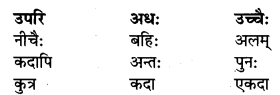
उच्चारणं कुरुतउपरि
NCERT Solutions for Class 7 Sanskrit Chapter 4 हास्यबालकविसम्मेलनम् 1
उत्तर
छात्रा: एतेषां शब्दानाम् उच्चारणं स्वयमेव कुर्वन्तु।

प्रश्न 2.
मञ्जूषातः अव्ययपदानि चित्वा वाक्यानि पूरयत|
अलम, अन्तः, बहिः, अधः, उपरि ।
(क) वृक्षस्य …………….. खगाः वसन्ति।
(ख) …………….. विवादेन।।
(ग) वर्षाकाले गृहात् …………….. मा गच्छ।
(घ) मञ्चस्य ………. श्रोतारः उपविष्टाः सन्ति।
(ङ) छायाः चलच्चित्रगृहस्य …….. प्रविशन्ति।
उत्तर
(क) वृक्षस्य उपरि खगाः वसन्ति।
(ख) अलं विवादेन।
(ग) वर्षाकाले गृहात बहिःमा गच्छ।
(घ) मञ्चस्य अधः श्रोतारः उपविष्टाः सन्ति।
(ङ) छायाः चलच्चित्रगृहस्य अन्तः प्रविशन्ति।

प्रश्न 3.
अशुद्धं पदं चिनुत
(क) गमन्ति, यच्छन्ति, पृच्छन्ति, धावन्ति।
(ख) रामेण, गृहेण, सर्पेण, गजेणा।
(ग) लतया, सुप्रिया, रमया, निशया।
(घ) लते, रमे, माते, प्रिये।
(ङ) लिखति, गर्जति, फलति, सेवति।
उत्तर
(क) गमन्ति
(ख) गजेण
(ग) सुप्रिया
(घ) माते
(ङ) सेवति।

प्रश्न 4.
मञ्जूषातः समानार्थक पदानि चित्वा लिखत
प्रसन्नतायाः, चिकित्सकम्, लब्ध्वा, कुटिलः, दक्षाः
प्राप्य …………
कुशलाः ……….
हर्षस्य …………
वक्र: …………
वैद्यम् …………
उत्तर
प्राप्य – लब्ध्वा
कुशलाः – दक्षाः
हर्षस्य – प्रसन्नतायाः
वक्र: – कुटिलः
वैधम् – चिकित्सकम्

प्रश्न 5.
अधोलिखितानां प्रश्नानाम् उत्तराणि एकपदेन लिखत
(क) मञ्चे कति बालकाः उपविष्टाः सन्ति?
उत्तर
चत्वारः

(ख) के कोलाहलं कुर्वन्ति ?
उत्तर
श्रोतारः

(ग) गजाधरः कम् उद्दिश्य काव्यं प्रस्तौति ?
उत्तर
आधुनिक वैद्यम

(घ) तुन्दिलः कस्य उपरि हस्तम् आवर्तयति?
उत्तर
तुन्दस्य

(ङ) लोके पुनः पुनः कानि भवन्ति ?
उत्तर
शरीराणि

(च) दशमः ग्रहः कः?
उत्तरम्
जामाता

प्रश्न 6.
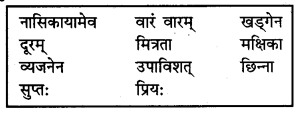
मञ्जूषातः पदानि चित्वा कथायाः पूर्ति कुरुत
NCERT Solutions for Class 7 Sanskrit Chapter 4 हास्यबालकविसम्मेलनम् 2
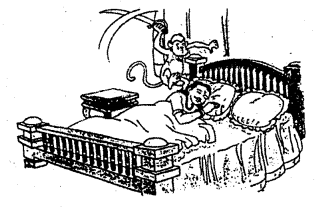
प्रियः पुरा एकस्य नृपस्य एकः ………………. वानरः आसीत्। एकदा नृपः ………………. आसीत्। वानरः ………… तम् अवीजयत्। तदैव एका ………………. नृपस्य नासिकायाम् ……………….। यद्यपि वानरः ………………. व्यजनेन तां निवारयति स्म तथापि सा पुनः पुनः नृपस्य ……………. उपविशति स्म। अन्ते सः मक्षिकां हन्तुं ………………. प्रहारम् अकरोत्। मक्षिका तु उड्डीय ………………. गता, किन्तु खड्गप्रहारेण नृपस्य नासिका ………………. अभवत्। अतएवोच्यते-“मुर्खजनैः सह ………………. नोचिता।”
NCERT Solutions for Class 7 Sanskrit Chapter 4 हास्यबालकविसम्मेलनम् 3
उत्तर
पुरा एकस्य नृपस्य एकः प्रियः वानरः आसीत्। एकदा नृपः सुप्तः आसीत्। वानरः व्यजनेन तम् अवीजयत्। तदैव एका मक्षिका नृपस्य नासिकायाम् उपाविशत्। यद्यपि वानरः वारंवारं व्यजनेन तां निवारयति। स्म तथापि सा पुनः पुनः नृपस्य नासिकायामेव उपविशति स्म। अन्ते सः मक्षिका हन्तुं खड्गेन प्रहारम् अकरोत्। मक्षिका तु उड्डीय दूरं गता, किन्तु खड्गप्रहारेण नृपस्य नासिका छिन्ना अभवत् । अतएवोच्यते-“मूर्खजनैः सह मित्रता नोचिता।”

प्रश्न 7.
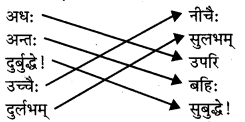
विलोमपदानि योजयत
NCERT Solutions for Class 7 Sanskrit Chapter 4 हास्यबालकविसम्मेलनम् 4
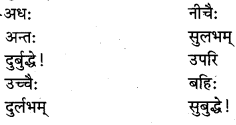
उत्तर
NCERT Solutions for Class 7 Sanskrit Chapter 4 हास्यबालकविसम्मेलनम् 5
ध्यातव्यम्
अस्मिन् पाठे अधः, अन्तः, बहिः, नीचैः, पुनः इत्यादीनि अव्ययपदानि सन्ति। एषां त्रिषु लिङ्गेषु, त्रिषु वचनेषु सर्वासु विभक्तिषु च एकमेव रूपं भवति, विकारो न जायते।
उक्तञ्च
सदृशं त्रिषु लिङ्गेषु सर्वासु च विभक्तिषु।
वचनेषु च सर्वेषु यन्न व्येति तदव्ययम्॥
(पुंल्लिंग, स्त्रीलिंग तथा नपुंसकलिंग-इन तीनों लिंगों, सभी विभक्तियों और तीनों वचनों में जिन शब्दों का एक ही रूप रहता है, उसे ‘अव्यय’ शब्द कहते हैं। इन अव्यय शब्दों में कभी कोई रूप परिवर्तन नहीं होता।)

बहुविकल्पी प्रश्न

(i) मञ्चे कति बालकाः उपविष्टाः सन्ति ?
(A) त्रयः
(B) चत्वारः
(C) पञ्च
(D) सप्त।
उत्तर
(B) चत्वारः

(ii) के कोलाहलं कुर्वन्ति ?
(A) श्रोतारः
(B) वक्तारः
(C) दर्शकाः
(D) क्रीडकाः।
उत्तर
(A) श्रोतारः

(iii) गजाधरः कम् उद्दिश्य काव्यं प्रस्तौति ?
(A) वेदम्
(B) वैधम्
(C) वैद्यम्
(D) वेद्यम्।
उत्तर
(C) वैद्यम्

(iv) तुन्दिलः कस्य उपरि हस्तम् आवर्तयति ?
(A) शुण्डस्य
(B) मुखस्य
(C) पादस्य
(D) तुन्दस्य।
उत्तर
(D) तुन्दस्य।

(v) लोके पुनः पुनः कानि भवन्ति ?
(A) अन्नानि
(B) शरीराणि
(C) धनानि
(D) गृहाणि।
उत्तर
(B) शरीराणि

(vi) दशमः ग्रहः कः ?
(A) सूर्यः
(B) यमः
(C) ज्ञाता
(D) जामाता।
उत्तर
(D) जामाता।

(vii) प्राणान् कः हरति ?
(A) यमः
(B) वधिक:
(C) हन्ता
(D) धनिकः।
उत्तर
(A) यमः

(vii) चितां प्रज्वलितां दृष्ट्वा कः विस्मयम् आगताः ?
(A) वैद्यः
(B) वेद्यः
(C) वेदः
(D) वैधः।
उत्तर
(A) वैद्यः

(ix) लोके दुर्लभं किमस्ति ?
(A) अन्नम्
(B) परान्नम्
(C) स्वादु-अन्नम्
(D) मधुरान्नम्।
उत्तर
(B) परान्नम्

(x) सर्वे बालकाः बहिः निष्क्रम्य कुत्र गच्छन्ति ?
(A) वने
(B) मन्दिरे
(C) मार्गे
(D) गृहे।
उत्तर
(D) गृहे।

Class 7 Sanskrit Chapter 4 हास्यबालकविसम्मेलनम् Summary Translation in Hindi

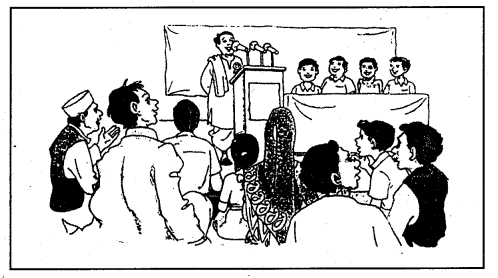
1. (विविध-वेशभूषाधारिणः चत्वारः बालकवयः मञ्चस्य उपरि उपविष्टाः सन्ति। अधः श्रोतारः हास्यकविताश्रवणाय
उत्सुकाः सन्ति कोलाहलं कुर्वन्ति च)
NCERT Solutions for Class 7 Sanskrit Chapter 4 हास्यबालकविसम्मेलनम् 6
सञ्चालकः – अलं कोलाहलेन। अद्य परं हर्षस्य
अवसरः यत् अस्मिन् कविसम्मेलने
काव्यहन्तार: कालयापकाश्च भारतस्य
हास्यकविधुरन्धरा: समागताः सन्ति। एहि,
करतलध्वनिना वयम् एतेषां स्वागतं
कुर्मः।

शब्दार्थाः-
उपरि = ऊपर।
अधः = नीचे।
अलम् = मत करो।
अद्य = आज।
हर्षस्य अवसरः = खुशी का मौका।
काव्यहन्तारः = कविता की हत्या करने वाले, कविता बिगाड़ने वाले।
काल यापकाः = समय बिताने वाले।
हास्यकविधुरन्धराः = हास्यकवियों के शिरोमणि/नेता।
करतलध्वनिना = तालियाँ बजाकर।
कोलाहलम् = शोर।

सरलार्थः-(अनेक प्रकार की वेशभूषा धारण करने वाले चार बालकवि मञ्च के ऊपर बैठे हुए हैं। नीचे श्रोता लोग हास्यकविता सुनने के लिए उत्सुक हैं तथा शोर मचा रहे हैं।)
सञ्चालक-शोर मत कीजिए। आज बड़ी खुशी का मौका है कि इस कवि सम्मेलन में कविता के हत्यारे और समय गंवाने वाले भारत के हास्यकवियों के शिरोमणि कवि लोग आए हुए हैं। आओ, ताली बजाकर हम इनका स्वागत करते हैं।

2. गजाधरः – सर्वेभ्योऽरसिकेभ्यो नमो नमः। प्रथम
तावद् अहम् आधुनिक वैद्यम् उद्दिश्य
स्वकीय काव्यं श्रावयामि
वैद्यराज! नमस्तुभ्यं यमराजसहोदर!
यमस्तु हरति प्राणान् वैद्यः प्राणान्
धनानि च॥
(सर्वे उच्चैः हसन्ति)

शब्दार्था:-
अरसिकेभ्यः = कविता की हँसी उड़ाने वालों को, कविता में रुचि नहीं रखने वालों को।
नमो नमः = बारबार प्रणाम।
उद्दिश्य = उद्देश्य बनाकर, विषय बनाकर।
स्वकीयम् = अपना।
यमराजसहोदर = हे यमराज के सगे भाई!
तुभ्यम् = तुम्हें, तेरे लिए।

सरलार्थः –
गजाधरः- कविता की हँसी उड़ाने वाले सभी लोगों को मेरा बार-बार प्रणाम। अच्छा तो मैं सबसे पहले आधुनिक वैद्य को विषय बनाकर अपनी कविता सुनाता हूँ हे वैद्यराज! हे यमराज के सगे भाई। तुम्हें मेरा प्रणाम है। यमराज तो प्राण ही हरता है परन्तु वैद्यराज तों प्राण भी हर लेता है और धन भी हर लेता है।

3. कालान्तकः –
अरे! वैद्यस्तु सर्वत्र परन्तु न त
मादृशाः कुशलाः
जनसंख्यानिवारणे। ममापि
काव्यम् इदं शृण्वन्तु भवन्त: –
चितां प्रज्ज्वलितां दृष्ट्वा वैद्यो
विस्मयमागतः।
नाहं गतो न मे भ्राता कस्येदं हस्तलाघवम्॥
(सर्वे पुनः हसन्ति)

शब्दार्था:-
मादृशाः = मेरे समान
जनसंख्या-निवारणे = जनसंख्या कम करने में।
शृण्वन्तु = सुनिए।
चिताम् = चिता को।
प्रज्ज्वलिताम् = जली हुई।
विस्मयम् = आश्चर्य।
हस्तलाघवम् = हाथ की चतुराई।

सरलार्थः- अरे ! वैद्य तो सभी जगह मिल जाते हैं, परन्तु मेरे समान जनसंख्या कम करने में कुशल कोई नहीं है। मेरी भी इस कविता को आप लोग सुनिए गया। न तो (इस मरने वाले के पास) मैं गया था और न ही मेरा भाई, फिर यह किसके हाथ की चतुराई है?

4. तुन्दः –
(तुन्दस्य उपरि हस्तम् आवर्तयन्)
तुन्दिलोऽहं भोः। ममापि इदं काव्यं
श्रूयताम् जीवने धार्यतां च
परान्नं प्राप्य दुर्बुद्धे! मा शरि दयां कुरु।
परान्नं दुर्लभं लोके शरीराणि पुनः पुनः॥
(सर्वे पुनः अट्टहासं कुर्वन्ति)

शब्दार्था:-
तुन्दस्य = तोंद के, मोटे पेट के।
आवर्तयन् = घुमाते हुए।
तुन्दिलः = पेटू, तोंदु, जिसका पेट कभी नहीं भरता।
धार्यताम् = धारण कीजिए।
परान्नम् = पराये अन्न को।
प्राप्य = प्राप्त करके।
दुर्लभम् = कठिनता से प्राप्त होने वाला, दुर्लभ।
अट्टहासम् = ज़ोर की हँसी को।

सरलार्थ:
तुन्द- (तोंद के ऊपर हाथ घुमाते हुए) अरे! मैं पेटू हूँ। | मेरी भी इस कविता को सुनिए और जीवन में धारण कीजिए हे दुर्बुद्धि ! पराये अन्न को पाकर शरीर पर दया मत कीजिए (अर्थात् मुफ्त का भोजन खाने को मिले तो शरीर की परवाह मत करो, खाए जाओ, खाए जाओ)। क्योंकि इस संसार में पराया अन्न मिलना बड़ा कठिन है, शरीर तो बारबार मिलते ही रहते हैं। (भारतीय दर्शन के अनुसार मरने के बाद मनुष्य फिर नये शरीर में जन्म ले लेता है।)

5. धुन्धः – अरे! भवन्तः जानन्ति एव यद्
आधुनिकाः वैज्ञानिकाः प्लूटो-ग्रहं न
स्वीकुर्वन्ति तेषां मते अष्ट एव ग्रहाः,
किन्तु मन्मतेन दशग्रहाः सन्ति।

तुन्दः – अयि! कविधुरन्धर! कस्तावत् दशमो
ग्रहः? अस्माभिः कदापि न श्रुतम्।
तस्य च कः प्रभावः?

धुन्धः – सावधानमनसा शृण्वन्तु भवन्तः
दशमग्रहस्य वैशिष्ट्यम्
सदा वकः सदा कूरः सदा
मानधनापहः।
कन्याराशिस्थितो नित्यं जामाता दशमो ग्रहः॥

शब्दार्था:-
मन्मतेन = मेरे मत के अनुसार ।
स्वीकुर्वन्ति = स्वीकार करते हैं।
कवि-धुरन्धर = हे कवि-शिरोमणि।
दशमः = दसवाँ ।
वैशिष्ट्यम् = विशेषता को।
वक्रः = टेढा।
क्रूरः = क्रूर, निर्दय, दयाहीन।
मानधनापहः = सम्मान तथा धन का अपहरण करने वाला।
कन्याराशिस्थितः = बेटी के जीवन में रहने वाला।
जामाता = जमाई, दामाद।

सरलार्थ:
धुन्ध – अरे! आप तो जानते ही हैं कि आधुनिक
वैज्ञानिक ‘प्लुटो’ नामक ग्रह को स्वीकार नहीं करते हैं,
किन्तु मेरे मत के अनुसार दस ग्रह होते हैं।

तुन्द – अरे! कविशिरोमणि! यह दसवाँ ग्रह
कौन-सा है? हमने तो कभी नहीं सुना।
और उसका प्रभाव क्या है?

धुन्ध – सावधान मन से आप लोग दसवें ग्रह
की विशेषता को सुनिएसदा टेढा व्यवहार करने वाला,
क्रूर स्वभाव वाला, सम्मान तथा धन को हरने वाला,
‘दामाद’ नामक दसवाँ ग्रह होता है;
जो सदा ही बेटी के जीवन में स्थित रहता है।

6. (काव्यपाठश्रवणेन उत्प्रेरितः एकः बालकोऽपि
आशुकवितां रचयति सहासं श्रावयति च)
बालकः-श्रूयताम, श्रूयतां भोः। ममापि काव्यम्
गजाधरं यमं नौमि तुन्दिलं चान्नलोलुपम्।
दशमं च ग्रहं धुन्धं कालान्तकं तथैव च॥
(काव्यं श्रावयित्वा ‘हा हा हा’ इति कृत्वा हसति।
अन्ये चाऽपि हसन्ति बहिः निष्क्रम्य सर्वे गृहं च गच्छन्ति।)

शब्दार्थ-
उत्प्रेरितः = प्रेरित होकर।
आशुकविताम् = तात्कालिक कविता को।
सहासम् = हँसीपूर्वक।
यमम् = यमराज को।
नौमि = प्रणाम करता हूँ।
अन्नलोलुपम् = अन्न के लोभी को।
निष्क्रम्य = निकल कर।

सरलार्थः- काव्य पाठ सुनने से प्रेरित होकर एक बालक भी आशकविता रचता है और हँसी के साथ सुनाता है।)

बालक- सुनिए, अजी सुनिए ! मेरी भी कविता है यमराज गजाधर को मैं प्रणाम करता हूँ, अन्न के लोभी तुन्दिल को भी (मैं प्रणाम करता हूँ)। दसवें ग्रह धुन्ध तथा कालान्तक कवि को भी मैं उसी प्रकार प्रणाम करता हूँ। (कविता सुनाकर ‘हा हा हा’ करके हँसता है और दूसरे लोग भी हँसते हैं, और बाहर निकलकर सभी घर चले जाते हैं।)

NCERT Solutions for Class 10 Social Science History Chapter 5 The Age of Industrialisation

NCERT Solutions for Class 10 Social Science History Chapter 5 The Age of Industrialisation

Text Book Questions

Question 1.
Explain the following:
(a) Women workers in Britain attacked the Spinning Jenny.
(b) In the seventeenth century, merchants from towns in Europe began employing peasants and artisans within the villages.
(c) The port of Surat declined by end of the eighteenth”century.
(d) The East India Company appointed gomasthas to supervise weavers in India.
Answer:
(a) Women workers in Britain attacked the Spinning Jenny because, with its introduction, they lost their jobs. These earlier survived on hand spinning.

(b) The merchants from towns in Europe, during the 17th century began employing peasants and artisans within the villages because they would remain in villages while they would work (weave, spin etc.) for the merchants.

(c) The port of Surat declined by the end of the eighteenth century because the European companies had gained a variety of concessions relating to trade and transit (ports etc.) In the last years of the 17th century the gross value of trade through Surat was ₹ 16 million; by 1740, it slumped to ₹ 3 million.

(d) The East India company appointed gomasthas to supervise weavers in India because they were paid by the company and were company’s servants, hence loyal and faithful.

Question 2.
Write True or False against each statement.
(a) At the end of the nineteenth century, 80 per cent of the total workforce in Europe was employed in the technologically advanced industrial sector.
(b) The international market for fine textiles was dominated by India till the eighteenth century.
(c) The American Civil War resulted in the reduction of cotton exports from India,
(d) The introduction of the fly shuttle enabled handloom workers to improve their productivity.
Answer:
(a) False,
(b) True,
(c) False,
(d) True.

Question 3.
Explain what is meant by proto-industrialisation.
Answer:
Proto-industrialisation is the phase of industrialisation ‘when there is a large-scale industrial production, not based on factories.

Discuss

Question 1.
Why did some industrialists in the nineteenth Europe prefer hand labour over machine?
Answer:
During the 19th century Europe, especially in England, the industrialists preferred hand labour over machine. The reason was that there was no shortage of human labour. Poor peasants and vagrants moved to the cities in large numbers in search of jobs, waiting for work.

When there is plenty of labour, wages are low. So industrialists had no problem of labour shortage or high wage costs. They did not want to introduce machines that got rid of human labour and required large capital investment.

Question 2.
How did the East India Company procure regular supplies of cotton and silk textiles from Indian weavers?
Answer:
Following the establishment of political control, the East India Company could assert mono poly right to trade. It proceeded to develop a system of management and control that could end competition, control costs, and ensure regular supplies of cotton and silk goods. This it did through a series of steps.

First; The Company tried to eliminate the existing traders and brokers connected with the cloth trade, and establish a more direct control over the weaver. It appointed a paid servant called the gomastha to supervise weavers, collect supplies, and examine the quality of cloth.

Second: It prevented Company weavers from dealing with other buyers. One way of doing this was through the system of advances. Once an order was placed, the weavers were given loans to purchase the raw materials for their production. Those who took loans had to hand over the cloth they produced to the gomastna. They could not take it to any other trader.

As loans flowed in and the demand for fine textiles expanded, weavers eagerly took the advances, hoping to earn more. Many weavers had small plots of land which they had earlier cultivated along with weaving, and the produce from this supplied their family needs. Now they had to lease out the land and devote all their time to weaving.

Question 3.
Imagine that you have been asked to write an article for an encyclopaedia on Britain and the history of cotton. Write your piece using information from the entire chapter.
Answer:
Britain, following the introduction of industrialisation, became soon the workshops of the world. Cotton was the leading sector in the first phase of industrialisation. Britain captured the idea and made inventions in machine, leading to textile/cloth production. Britain was during the 17th century, a buyer of the Indian textiles, but soon, within a century, she become the producer of textile cloth by turning India into a source of a raw-cotton and later made India as the market of its cotton products.

Question 4.
Why did the industrial production increase during the First World War?
Answer:
The World War I created a dramatically new situation. With British mills busy with war production to meet the needs of the army. Manchester imports into India declined. Suddenly, Indian mills had a vast home market to supply. As the war prolonged, Indian factories were called upon to supply war needs: jute bags, cloth for army uniforms, tents and leather boots, horse and mule, saddles and a host of other items. New factories were set up and old ones ran multiple shifts. Many new workers were employed. Over the war years, industrial production boomed.

Project Work
Select any one industry in your region and find out its history. How has the technology changed? Where do the workers come from? How are the products advertised and marketed? Try and talk to the employers and some workers to get their views about the industry’s history.
Answer:
Students to do this, with the help of their teacher.

These Solutions are part of NCERT Solutions for Class 10 Social Science. Here we have given NCERT Solutions for Class 10 Social Science History Chapter 5 The Age of Industrialisation.

NCERT Solutions for Class 6 Sanskrit Ruchira Bhag 1 | Class 6th Sanskrit Solution

NCERT Solutions for Class 6 Sanskrit Ruchira Bhag 1: Students can easily access the NCERT Solutions for Class 6 Sanskrit New Book Ruchira Bhag 1 रुचिरा भाग 1 Text Book Questions and Answers are designed as per the latest CBSE curriculum and guidelines.

NCERT Solutions of Class 6th Sanskrit रुचिरा भाग 1 | Sanskrit Class 6 NCERT Solutions

Sanskrit Solution Class 6 | NCERT Solutions for Class 6 Sanskrit Ruchira Pdf Free Download

NCERT Solutions for Class 9 Social Science Geography Chapter 1 India-Size and Location

NCERT Solutions for Class 9 Social Science Geography Chapter 1 India-Size and Location

Textbook Exercises

Question 1.
Choose the right answer from the four alternatives given below:

(i) The Tropic of Cancer does not pass through:
(a) Rajasthan
(b) Orissa
(c) Chhattisgarh
(d) Tripura
Answer:
(b) Orissa

(ii) The easternmost-longitude of India is:
(a) 97° 25′ E
(b)68°7’E
(c) 37° & E
(d) 82° 32’E.
Answer:
(a) 97° 25′ E

(iii) Uttaranchal, Uttar Pradesh, Bihar, West Bengal and Sikkim have common frontiers with:
(a) China
(b) Bhutan
(c) Nepal
(d) Myanmar
Answer:
(c) Nepal

(iv) If you intend to visit the island Kavaratti during your summer vacations, which one of the following Union Territory of India you will be going to:
(a) Pondicherry
(b) Lakshadweep
(c) Andaman and Nicobar
(d) Diu and Daman.
Answer:
(c) Andaman and Nicobar

(v) My friend hails from a country which does not share land boundary with India. Identify thf country *
(a) Bhutan
(b) Tajikistan
(c) Myanmar
(d) Nepal
Answer:
(c) Myanmar

Question 2.
Answer the following question brifly.

(i) Name the group of islands lying in the Arabian sea?
Answer:
(i) Lakshdweep

(ii) Name the countries which are larger than India?
Answer:
(ii) Russia, China, Canada, USA, Brazil, Australia.

(iii) Which island group of India lies to its south-east
Answer:
(iii) Andaman-Nicobar Islands

(iv) Which island countries are our southern neighbours.
Answer:
(iv) Sri Lanka, Maldives.

Question 3.
The sun rises two hours earlier in Arunachal Pradesh as compared to Gujarat- in the West, but the watches show the same time. How does this happen?
Answer:
The two hours difference between Gujarat and Arunachal Pradesh is because of the two hours time lag. Though the sun rises two hours earlier in Aruncahcal Pradesh than in Gujarat as also in Jaisalmar, yet the standard time remains the same in whole of the country.

Question 4.
The central location of India at the head of the Indian ocean is considered to be a great significance. Why?
Answer:
India’s location at the head of the Indian ocean is itself of great significance. This is evident from the following:

  1. Because of this location India was able to establish close cultural and commercial contacts with other .countries.
  2. Due to this location, countries of East Africa, West Asia, East Asia, South and South-West Asia could be reached easily through sea routes.
  3. India’s eminent position in the Indian Ocean realm justifies naming an ocean after it.
  4. Because of this location, India is able to maintain direct trade relations not only with the neighbouring countries but also with all the countries of the world.
  5. Due to this position India gets a very vast and open market very near to it.

Map Skills

Question 1.
Identify the following with the help of map reading:
(i) The Island groups of India lying in the Arabian Sea and the Bay of Bengal.
(ii) The countries constituting Indian Subcontinent.
(iii) The States through which the Tropic of Cancer passes.
(iv) The northernmost latitude in degrees.
(v) The southernmost latitude of the Indian mainland in degrees.
(vi) The eastern and the western most latitude in degrees.
(viii) The place situated on the three seas.
(ix) The strait separating Sri Lanka from India.
(x) The Union Territories of India.
Answer:
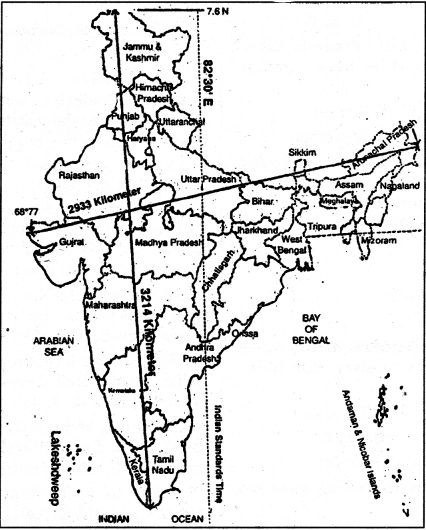
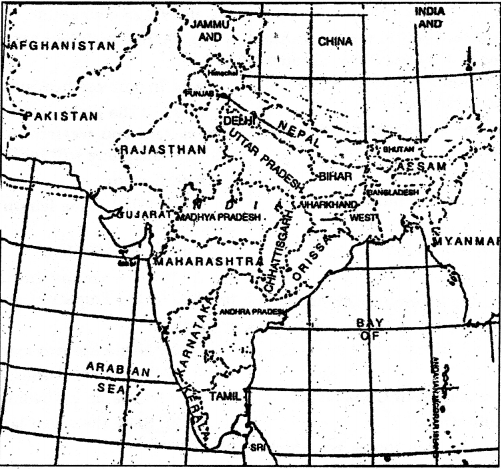
See the following two maps (i) and (ii) of India below :
Map (i)
NCERT Solutions for Class 9 Social Science Geography Chapter 1 India-Size and Location 1
Map (ii)
NCERT Solutions for Class 9 Social Science Geography Chapter 1 India-Size and Location 2
Answer:
Hints:
(i) Lakshdweep islands in the Arabian sea and the Andaman and Nicobar Islands in the Bay of Bengal.
(ii) Pakistan, Nepal, Bangladesh, Bhutan, Sri Lanka, Maldives, Myanmar.
(iii) Gujarat, Rajasthan, Madhya Pradesh, Chhatisgarh, Jharkhand, West Bengal, Tripura, Mizoram.
(iv) Indian union (Indira Point) and tne Mariland (Kanyakumari).
(v) 37%’N.
(vi) 8°4′ N.
(vii) 68° 7 E and 97° 25’E,
(viii) Nepal, Bhutan.
(ix) Kanyakumari.
(x) The Palk Strait.
(xi) Delhi, Chandigarh, Pondicherry, Lakeshdweep, Daman and Diu, Dadra and Nagar Haveli, Andaman and Nicobar Islands.

These Solutions are part of NCERT Solutions for Class 9 Social Science. Here we have given NCERT Solutions for Class 9 Social Science Geography Chapter 1 India-Size and Location.