CCNA Course Details | Duration, Eligibility, Fee Structure, Career Options, Syllabus, and Salary

CCNA Course Details

CCNA Course Details: CCNA is a popular certification course by CISCO. CISCO is the most popular company in manufacturing and selling networking equipment globally. They conduct an exam named that consists of one hundred twenty questions. If you pass the exam, you can become CCNA certified. It is an Information Technology Certification Course. This course certifies your skills in network fundamentals, network access, IP connectivity, IP services, security fundamentals, automation, and programmability. This course is an associate-level course developed for network engineers. If you want to become a CCNA endorsed network engineer, you can check the course details here. The duration, admission process, job opportunities, salary details, eligibility criteria, etc. of the CCNA Course are discussed here.

Get to Know More about other types of Course Details in Stream wise, and Category wise

What is A CCNA Course?

CCNA is one of the most popular courses on networking in the world. It is provided by a leading network equipment vendor company, CISCO. This course provides theoretical knowledge and practical training on networking to make the candidates ready for the real world. There are many training institutions that provide this course while maintaining quality training and learning method. The certification remains valid for three years. You need to renew it before three years to keep it updated. CCNA passed candidates can make connections with remote sites using an extensive area network (WAN), moderate essential system security threats, comprehend basic systems administration concepts, and terminology. This course can be perfect for those interested in entering the networking field as it clearly explains the basic concepts of networking. The course is available in nine different forms which are listed below :

  1. CCNA Routing and Switching
  2. CCNA Cyber Ops
  3. CCNA Wireless
  4. CCNA Cloud
  5. CCNA Data Center
  6. CCNA Security
  7. CCNA Collaboration
  8. CCNA Industrial
  9. CCNA Service Provider

CCNA Course Details Overview

Course CCNA
CCNA Full form CISCO Certified Network Associate
Duration 3 Months to 1 Year
Fee Structure 150 USD to 350 USD
Course Type Certification
Starting salary offered 4.5 Lacs to 8 Lacs Per Annum
Employment opportunities
  1. Network Administrator
  2. Network Engineer
  3. Network and Support Technician
  4. System Engineer
  5. Field Engineer
  6. Network Designer
  7. Network Planner
  8. Network Implementer
  9. Network Optimizer
  10. Network Support Executive etc.

CCNA Course Eligibility Criteria

This is an associate-level networking course provided by CISCO. So there is no requirement of previous networking skills. Anyone can do this course without previous networking background. Though it is best suitable for candidates with a minimum of one-year prior experience in networking. Anyone within 13 to 17 years of age can do this course with parental consent. Candidates of 18 years of age or above can apply for this course without parental consent. Candidates from a non-networking background may practice more to use tools such as GNS3 and Packet Tracer.

CCNA Course Fee Structure

One first needs to complete training on a particular type. The certification cost varies from 150 USD to 300 USD, except for the CCNA Routing and Switching, which costs 325 USD. You can choose to apply for this course through a partner training institution of CISCO, either online or offline.

CCNA Certification Course Duration

Different training centres provide a different time frame for a particular course of CCNA. However, it depends on your hard work and skills. You can give the exam after 30 days or one month or six months. You need to get a minimum of 810 to 850 marks out of 1000 marks. The certification is valid for three years. So, you need to give the exam again after three years to validate the certification.

CCNA Certification Course Admission Procedure

Pearson Vue is the global training partner of CISCO for the CCNA Course. One must have to be a minimum of 13 years old to apply for this certification course. To take admission, one must visit the official website of Pearson Vue and follow the guidelines. For applying offline, one has to visit the Pearson Vue training centre. They provide study materials that will help you to prepare yourself. You may give the examination at your convenience.

Subjects, Concepts in CCNA Certification Course

It is one of the famous courses on networking. It was first started in 1998. It provides vast knowledge of different networking technologies. Some of the common topics of this course are listed below :

  1. OSI models
  2. IP addressing
  3. WLAN and VLAN
  4. Network security and management (ACL included)
  5. Routers/routing protocols ( EIGRP, OSPF, and RIP)
  6. IP Routing
  7. Network Device Security
  8. Troubleshooting

Syllabus of CCNA Certification Course

CCNA Course Syllabus details are provided here.

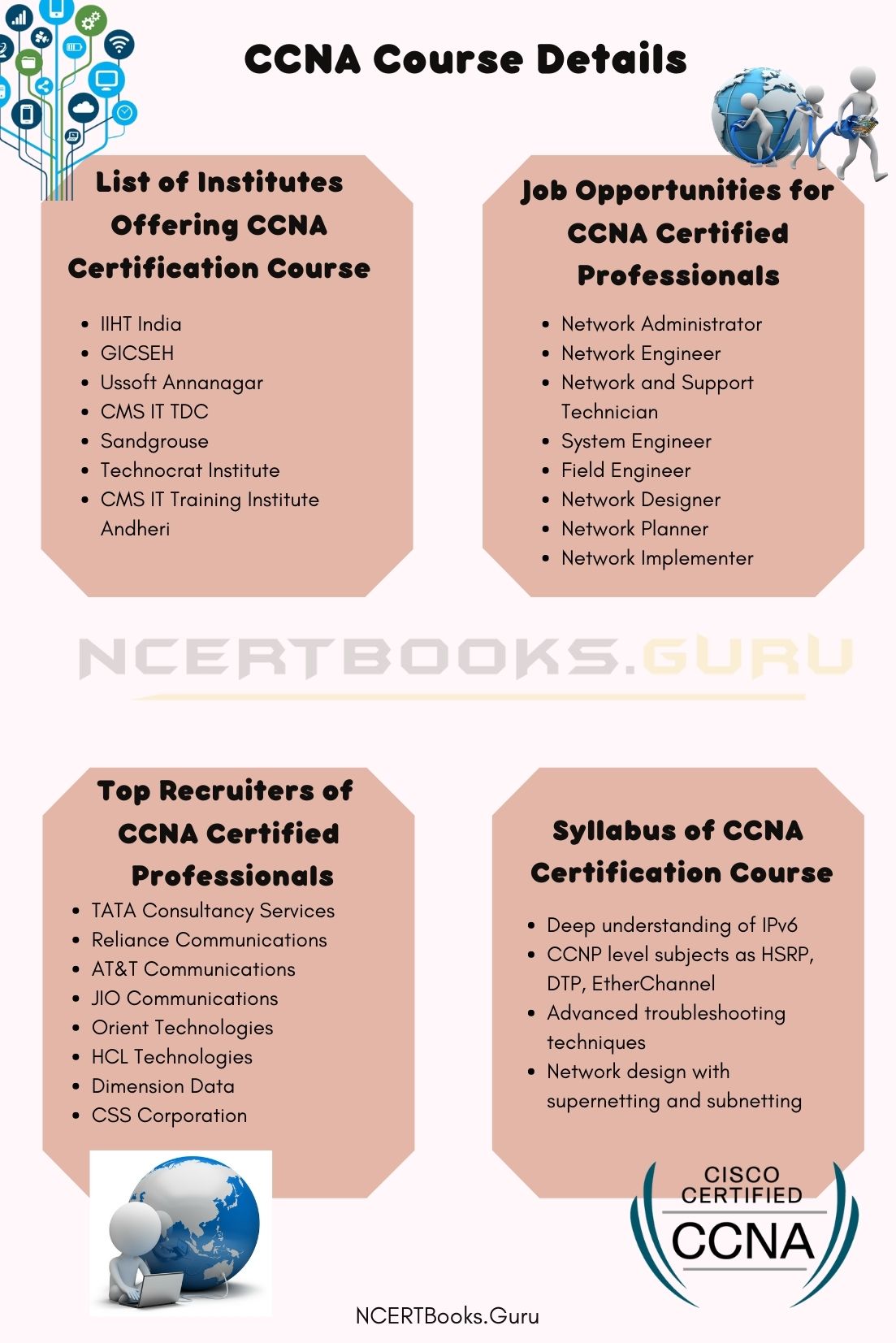
  • The ICND1 offers topics such as IP routing technologies, IP services (NAT, ACLS, DHCP), network device security, IPv6, LAN switching technologies, etc.
  • The ICND2 offers topics such as IP routing technologies, IP services (FHRP, Syslog, SNMP v2 and v3), LAN switching technologies, and WAN technologies.
  • The CCNA combined exam contains all the topics in ICND1 and ICND2. It also covers topics on installation, operation, and troubleshoot.

Some new changes in the current CCNA exam are listed below :

  • Deep understanding of IPv6
  • CCNP level subjects as HSRP, DTP, EtherChannel
  • Advanced troubleshooting techniques
  • Network design with supernetting and subnetting

Also, Refer

List of Institutes Offering CCNA Certification Course

Many training institutions in India offer CCNA Certification Course, both online and offline. Some of the institutes that offer CCNA Courses are listed below :

  1. IIHT India
  2. GICSEH
  3. Ussoft Annanagar
  4. CMS IT TDC
  5. Sandgrouse
  6. Technocrat Institute
  7. CMS IT Training Institute Andheri
  8. Procognition Technologies Pvt Ltd
  9. Siliconuniv
  10. Reliable Network Technologies

Job Opportunities for CCNA Certified Professionals

CCNA Course gives an in-depth knowledge of various networking technologies. So, one can get a wide range of job opportunities after completing the CCNA Certification Course. Some of them are given below :

  1. Network Administrator
  2. Network Engineer
  3. Network and Support Technician
  4. System Engineer
  5. Field Engineer
  6. Network Designer
  7. Network Planner
  8. Network Implementer
  9. Network Optimizer
  10. Network Support Executive
  11. Security Specialist
  12. Security Administrator
  13. Support Engineer
  14. Video Technician
  15. Video Media Operator
  16. Project Manager

CCNA Course Details

Salary Offered to CCNA Certified Professionals

CCNA certified professionals get hands-on experience in various networking technology. All the training partners of CISCO for the CCNA Course maintains proper training and provide useful knowledge. So, these people become ready for the job, and employers prefer them to hire. CCNA certified professionals in India earns between 4.5 lacs to 8 lacs per annum.

Top Recruiters of CCNA Certified Professionals

Some of the top companies in India that hire CCNA certified candidates are listed below :

  1. TATA Consultancy Services
  2. Reliance Communications
  3. AT&T Communications
  4. JIO Communications
  5. Orient Technologies
  6. HCL Technologies
  7. Dimension Data
  8. CSS Corporation
  9. Tech Mahindra
  10. Cisco Systems
  11. Bharti Airtel
  12. Vodafone
  13. Accenture
  14. Erricson
  15. Orange
  16. Wipro

FAQ’s on CCNA Course Details

Question 1.
Is CCNA Course is right for a career?

Answer:
Yes, this is a job focussed course. This course validates your networking skills. There are different topics available in this course. You can choose the topic of your choice to get in-depth knowledge of that particular topic, which will make you ready for the job.

Question 2.
How long the CCNA Certification is valid?

Answer:
The CCNA Certification is valid for three years. One has to give the exam again after three years to keep the certification validated. However, one must score a minimum of 810 marks out of 1000 marks to pass the exam.

Question 3.
Can someone do self-study to pass this exam?

Answer:
Yes, you can do self-study. But you need to apply for this course through any training institution to get the study materials and give the exam.

Question 4.
Who is eligible for the CCNA Course?

Answer:
Anyone within 13 to 17 years of age can do this course with parental consent. Candidates of 18 years of age or above can apply for this course without parental consent. However, it is best suitable for people from networking background.

Summary of CCNA Course Details

If you’re interested in entering the network technology field, CCNA can be the perfect course for you. This course provides in-depth knowledge and practical skills in various networking technologies. CCNA certified professionals get a wide range of job opportunities in India. Hopefully, this article will give you some ideas on the CCNA Certification Course details before you take admission. If you have any other questions regarding CCNA Course Details, please drop your queries in the comments section.
Computer Courses List that you should Know About: Duration, Fees, Colleges, Scope, Career Opportunities, Salary

Computer Courses

Computer Courses: Students must be cautious while choosing a career. With limited career opportunities, unemployment and competition among young people have increased. Information Technology (IT) is a tremendous growing sector that has gained momentum over the last few years. In today’s world, it is a must to hold some knowledge about computer-related information.

India has gained an overwhelming pace in the field of Information Technology. The IT sector has created maximum job opportunities in the area of computer applications. A student need not master computer application through engineering, Graduation, or Post Graduation. A student can get a job opportunity with a credential or short-term or certificate courses in computer applications.

India makes effective use of the internet and computers, and the opportunities are growing at an increasing rate each year. Computer application courses play a vital role and focus on skill development and job orientation. In this article, I will introduce you to some of the best computer course details that provide adequate career opportunities. You can read through the material and select the classes that fall under your interest.

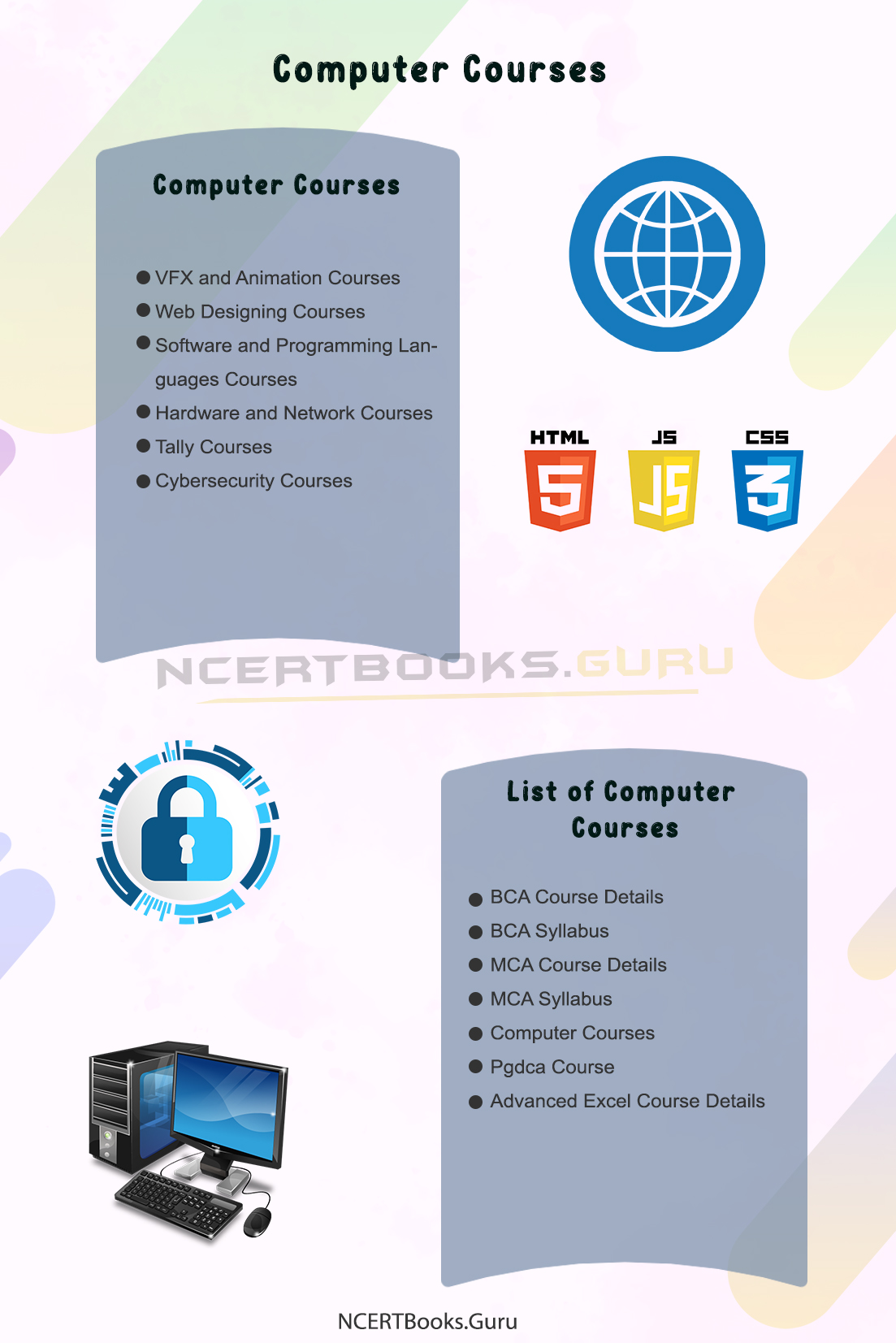
List of Computer Courses

Here are a few computer courses that will aid your growth in the IT sector.

VFX and Animation Courses

A course pursued in VFX and Animation enhances your skill in 3D innovation, illustrations, and visual effects. This field has expanded massively and has led to a change in many industries.

  • Benefits: While VFX benefits skills in Special effects for TV, Films, Digital media, Ads, TV programs, games, etc., Animation holds importance in rotoscope, character animation, modeling, and digital sculpting.
  • Fee: The Fee structure for this course depends on the type of animation and VFX section you chose and the duration of the course. The Fee structure for each varies from one institution to another. However, the Fee can range between INR 1 lakhs to 20 lakhs.
  • Institutions: Several private institutions offer extensive courses in VFX and Animation. However, the best of all is the Arena Multimedia.
  • Career Opportunities: VFX and Animation provides various opportunities that offer an excellent salary package. The possibilities for VFX and Animation students are Character animators, Motion-graphic artists, Match-moving artists, roto-artists, Texture artists, Pre-vis artists, 3D Modellers, compositors, Storyboard artists, Lighting artists, and Rigging artists.

Web Designing Courses

Web Designing course opens door of opportunities for independent individuals. This course manages multiple components required for keeping and building a webpage. It offers the learning of helpful coding dialects such as JavaScript, PHP, HTML, etc.

  • Benefits: Web Designing holds multiple benefits such as Fast-pact low-cost Mobile development, High-conversion rates, Fast webpages, Low maintenance needs, Low bounce rates, Higher mobile traffic, Improved SEO, Improved Online and Offline experiences, and Easier Analytical Reporting.
  • Fee: The Fee structure for Web Designing depends on the duration of the course. The fee structure for Web Designing varies from one institute to another. However, the Fee Structure is about INR 50,000 to 15 Lakhs.
  • Institution: Numerous private institutes offers courses in Web Designing. The notable institute, among others, is the Arena group of institutes.
  • Career Opportunities: Web Designings holds numerous career opportunities. The starting salary offers for Web Designers after the successful completion of the course is around 2 to 6 Lakhs per annum. A student of Web Designing gets opportunities as a Multimedia specialist, Seo specialist, Applications developer, UX designer, Web designer and developer, Web Content manager, etc.

Software and Programming Languages Courses

Software and Programming languages help an individual to develop programs. To better oneself, one must know programming languages such as Java C++, Python, etc. This is an excellent course that seeks great demand in the IT sector.

  • Benefits: This course provides simple editing and the creation of text editors. It adds interactive and dynamics to the webpages. It offers better and faster programming or coding sections and helps in better performance of complex tasks.
  • Fee: The Fee Structure for Software and Programming Languages depend on the language chosen and the duration of the level of the course. However, the fee structure ranges from INR 2000 to 50,000.
  • Institutions: The Best Institution for software and language programming courses in India is NIIT. They provide various programming languages and offer multiple short and long-term courses. They have numerous centers in different parts of the country and have excellent placement opportunities.
  • Career Opportunities: Software and Language Programming offers vast career opportunities. The starting salary for this course is around 15,000 to 1 lakh per month, anywhere.

This course offers careers as Software engineers for electronic product manufacturing companies or computer systems design firms. It also provides opportunities in application development offices, software publishing firms.

Hardware and Network Courses

Most Hardware and Network-based computer courses get a lot of publicity through Ads in TV and Newspapers, as a reassurance for a reliable job career. As promised in their Ads, these courses from a validated institution guarantee job opportunities.

  • Benefits: Hardware and Networking provide fast-pacing technology in the field of computer application. Numerous industries offer different techniques that increase and improve their products through low-cost maintenance, which is achieved through this course.
  • Fee: The Hardware and Networking courses offer a Fee structure that depends on the duration of the course. However, the Fee structure ranges between INR 30,000 to 1.2 lakhs.
  • Institutions: The most notable institution for hardware and Networking course is Jenkins. This institution offers an array of long and short-term courses and has an excellent placement record.
  • Career Opportunities: In India, a fresher from this course is offered a salary package of 3 or 3.5 lacs per annum. A graduate from this course gets an opportunity in Information Technology (IT) sector, call centers, software companies, system design companies, or even in banks, hospitals, schools, organizations, etc.

Tally Courses

A tally course is a book-programming software that provides effective utilization of count. Tally holds trust by the Government and other multiple companies to move and store budgets.

  • Benefits: Tally holds many benefits such as smart budget maintenance, remote and global access to data, support of multiple languages, Data security and reliability, simple tax return fillings, audit tool, and easy payroll.
  • Fee: The Fee structure for Tally depends on the duration of the course. However, the Fee structure ranges between INR 3,000 to 8,000.
  • Institutions: Tally software holds grave importance to master any latest software versions. Many private institutions offer Tally courses, but the most recommended is from NIIT. They offer credential courses in Finance and Marketing and Have been updated with the latest Tally. ERP 9 software.
  • Career Opportunities: The starting salary offered for any Tally-related courses is around 1.4 to 2 lakhs per annum. After you pursue any course in Tally, you become eligible to work as Audit Executive, Admin Executive, Account Executive or Manager, Senior Accountant, and Financial Analyst.

See More:

Cybersecurity Courses

The present-day activities provide online or web assignments such as shopping, covering tabs, banking, etc. As it holds enormous advantages, it also leads to security breaches and dangers on the internet. The present world sees multiplying digital violations.

  • Benefits: Cybersecurity courses have a high demand and have unlimited potential for growth. It has a positive impact and boosts the daily advancements in technology. It helps in the learning of new methods and skills to aids to outwit cybercriminals.
  • Fee: The Fee structure for Cybersec depending on the type of cybersecurity-related work and the duration of the course. However, the Fee structure ranges between INR 30,000 to 80,000.
  • Career Opportunities: The starting salary for a graduate from any Cybersecurity course is offered around 10 to 15 lakhs per annum. This course provides job opportunities as a Cybersecurity analyst, Chief Information Security Officer (CISO), Network Engineer, and Cyber Security Manager.

These are a few courses that you must pursue to get a secure job opportunity. Information Technology has revolutionized the world and has changed our way of living. Through this article, make use of the opportunity to progress in life.

Computer Courses

FAQ’s On Computer Courses 

Question 1.
What is the scope of Animation and VFX?

Answer:
While Animation holds importance in rotoscope, character animation, modeling, and digital sculpting, VFX benefits skills in Special effects for TV, Films, Digital media, Ads, TV programs, games, etc.

Question 2.
What is the salary package for computer course graduates?

Answer:
The average salary package for computer course graduates ranges between INR 30,000 to INR 3,00,000.

Question 3.
Which is the best institution to study cybersecurity courses?

Answer:
Hindustan Institute of Technology and Science, Chennai, is one of the top universities to pursue Cybersecurity courses in India.

Question 4.
What are the career opportunities for Computer course graduates?

Answer:
A few well-paid career opportunities are Application analyst, Application developer, Cybersecurity analyst, Data analyst, Database administrator, Forensic computer analyst, Game designer, Games developer, etc.

Bartender Course | Duration, Eligibility, Fee Structure, Job Profile, and Salary

Bartender Course

Bartender Course: With the unconventional rise in the ‘pub culture’ across India, bartending has grown and gained popularity as the right field for employment. Graduates opting for this field require innate knowledge and skills that enable graduates to entitle to multiple responsibilities. Graduates opting for this course programme must hold basic knowledge on how to deal with cleanliness in the bar to getting stocks, keeping an eye on replenished products, tracking sales summary and training the team about the new offers.

The article on Bartender courses provides a comprehensive analysis of the study and its successful job-oriented career in the bartending arena. The report encompasses topics that cover detailed descriptions of the Course Details, duration, eligibility criteria, admission, curriculum and employment prospects.

All About Bartender Course

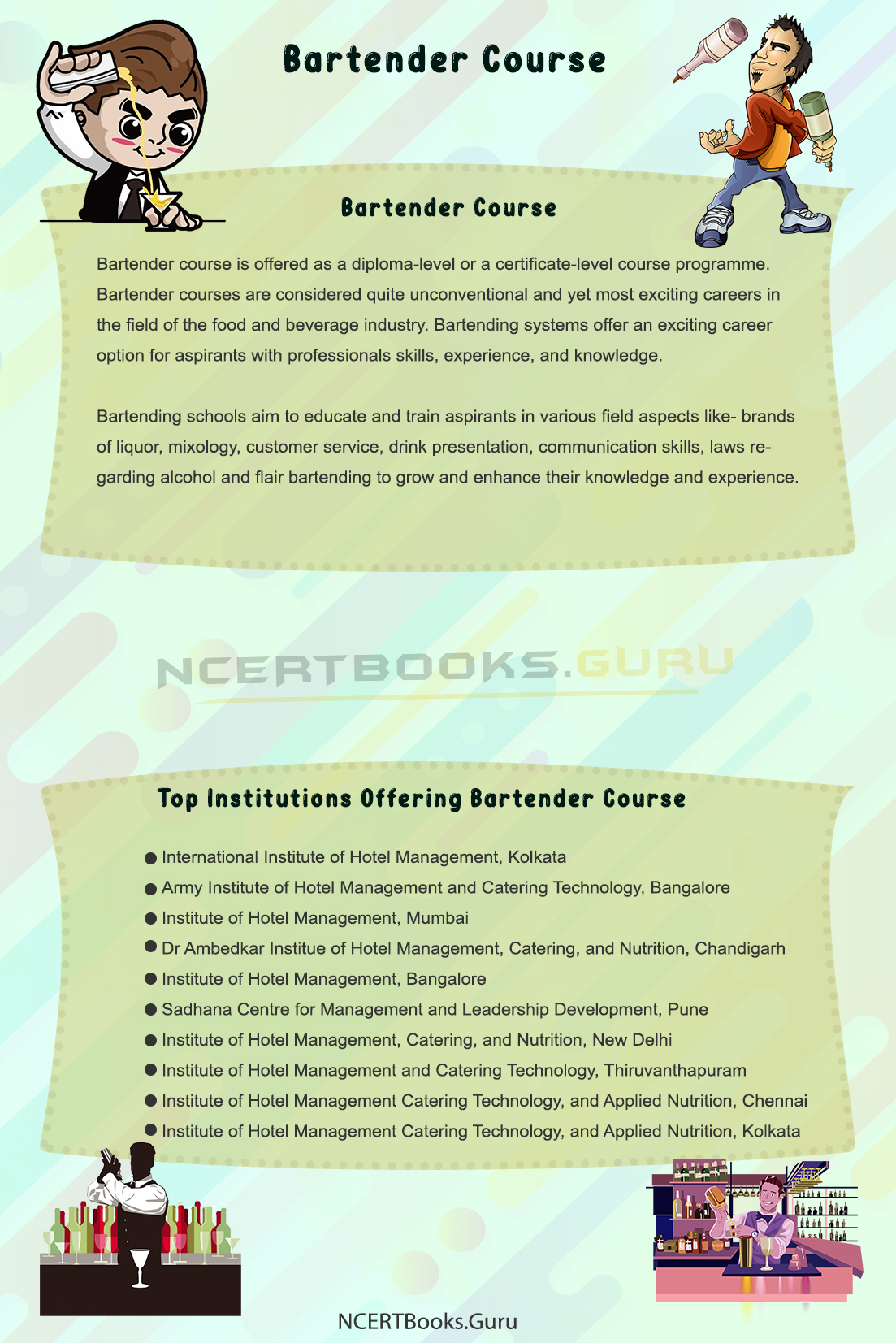
Bartender course is offered as a diploma-level or a certificate-level course programme. Bartender courses are considered quite unconventional and yet most exciting careers in the field of the food and beverage industry. Bartending systems offer an exciting career option for aspirants with professionals skills, experience, and knowledge.

Bartending schools aim to educate and train aspirants in various field aspects like- brands of liquor, mixology, customer service, drink presentation, communication skills, laws regarding alcohol and flair bartending to grow and enhance their knowledge and experience.

Bartender training programmes and course programmes are categorised based on the curriculum and content into three standard types – beginner’s bartending course, intermediate bartending level course, and pro bartending course. Bartender course programmes provide classroom lectures and hands-on practical training. The course offers stable and well-paid jobs.

Bartender Course Highlights

Course Bartender Course
Course Level Diploma-level, Certificate-level
Course Duration Bartender Course is conducted for a period of one month to six months.
Age Limit The bartender course programme offers no age limit, and any interested aspirant can apply for the course programme.
Eligibility Criteria The minimum eligibility criteria required for Bartender Diploma and certification courses is 10+2 level of graduation in any stream from a recognised board or equivalent.
Placement Opportunities Restaurants and other eating places, Resorts, Drinking places that offer alcoholic beverages, Civic and social organisations, Traveler accommodation, Pubs and nightclubs, Amusement, gambling, and recreation industries
Employment Roles Bar Managers, Restaurant General Manager, Assistant Manager, and many more.
Average Salary Offered Rs. 3 Lakhs to 4 Lakhs per annum

Types of Bartender Course

Name of the Course Course level Course Duration
Molecular Mixology Course Advance Training or Workshop Two to Four Days
Certification Course in Blair Flair Certificate Course 6 weeks
Exclusive Bartending Course Certificate Course Three Months
Certification Course in Wines and Spirits Certificate Course Three Months
Advance Bartending Course Certificate Course Four Months
Craftsmanship Course in Bartending Certificate Course Six Months
Basic Flair Bartending Level I Diploma Course One Month
Professional Bartending Course Diploma Course Three Months
Combo Course – Mixology and Flair Bartending Diploma Course Three Months

Skillset Required for Bartender Courses

Candidates who apply for any level of the Bartender course programme must adopt skills that enable them to perform better-

  • An outgoing personality
  • Tact and diplomacy for dealing with difficult situations
  • Responsibility
  • Physical fitness and stamina
  • Customer-service skills
  • Communication skills
  • Flexibility
  • A good memory
  • Decision-making skills
  • Reliability
  • The ability to work well in a team
  • A smart appearance
  • Calmness under pressure
  • Numeracy

Bartender Course Duration

The course duration for bartender course programmes fluctuates between one month to six months depending on the course-level and the institutions offering them.

Bartender Eligibility Criteria

To pursue any of the Bartender course-level programmes, candidates must meet the minimum eligibility conditions put forth by the conducting body.

The minimum eligibility criteria required for Bartender Diploma and certification courses is 10+2 level of graduation in any stream from a recognised board or equivalent.

Bartender Admission Procedure

The admission process for Bartender course programmes is done through a direct procedure based on the grades obtained by the students in the qualifying examination. The majority of the universities and colleges post a cutoff list based on the qualifying examination for admission.

See More: Best Courses To Study For Jobs

Bartender Course Fee Structure

The fee structure for bartender course programmes depends on factors such as course level, the duration and the course curriculum, and the institutions. The approximate average fees for bartender courses range between Rs. 40,000 to Rs. 1,50,000 per annum.

Bartender Courses Curriculum

The course curriculum for Bartender course programmes differs from one institution to another. However, the popular subjects encompassed for this course programme are listed below.

Popular Subjects

The popular subjects understudy for the Bartender course programme as follows-

  • Roles and tasks of a bartender
  • Classical mocktail recipes
  • Bar preparation procedures
  • Customer service
  • Basic principles of bartending
  • Raw materials and products
  • Practicals – alcohol drinks recognition and labels
  • Labour and tasks
  • Operation procedures
  • Art of mixology
  • Social skills, bar appearance, customer welcoming, and personal hygiene
  • Preparing to bartend
  • Practical and training
  • Art of cocktails
  • The operations of the bar

Top Institutions Offering Bartender Course

Top institutions that offer Bartender course programmes are as follows:

  • International Institute of Hotel Management, Kolkata
  • Army Institute of Hotel Management and Catering Technology, Bangalore
  • Institute of Hotel Management, Mumbai
  • Dr Ambedkar Institue of Hotel Management, Catering, and Nutrition, Chandigarh
  • Institute of Hotel Management, Bangalore
  • Sadhana Centre for Management and Leadership Development, Pune
  • Institute of Hotel Management, Catering, and Nutrition, New Delhi
  • Institute of Hotel Management and Catering Technology, Thiruvanthapuram
  • Institute of Hotel Management Catering Technology, and Applied Nutrition, Chennai
  • Institute of Hotel Management Catering Technology, and Applied Nutrition, Kolkata

Check out similar article Hotel Management Courses In India After 12Th to make a career in it.

Employment Prospects for a Bartender

With the slow rise and popularity in the pub culture, the club culture, and the slow growth in the number of resorts, hotels, and nightclubs, graduates are exposed to a plethora of job opportunities since the last couple of years. Bartending as a career has paved the way both as a part-time job and a full-time job.

The employment opportunities demand the need for trained bartenders. Bartenders with a minimum level of graduation, professional experience, excellent skills and qualities bag better employment opportunities. Graduates from this field have a wide variety of job areas to choose from nightclubs to bars to hotels to fine dining restaurants. Graduates can choose as per the interest of their choice.

With professional experience and time, graduates who are trained and qualified from good institutions have a high chance of better employment. These graduates can manage any client and their respective needs. Graduates who are excellent and professional at their job are often tipped for their service.

Areas of Employment

Bartenders or graduates from allied areas can choose their field that interests them or which they can specialise in, such as-

  • Restaurants and other eating places
  • Resorts
  • Drinking places that offer alcoholic beverages
  • Civic and social organisations
  • Traveller accommodation
  • Pubs and nightclubs
  • Amusement, gambling, and recreation industries

Bartender Course

Job Profiles for a Bartender

With adequate experience, the bartender can advance up to the job profiles such as-

  • Bar Managers
  • Restaurant General Manager
  • Assistant Manager

Salary and Pay Package for Bartenders

The average earnings of a bartender vary greatly depending upon the job profile and the area of employment. The annual salary package for a bartender with enough to sufficient work experience fluctuates between Rs. 3 Lakhs to Rs. 4 Lakhs per annum. With knowledge and professional skills, the pay package might increase up to Rs. 5 to Rs. 6 Lakhs per annum.

Read Similar:

FAQ’s on Bartender Courses

Question 1. 
Does the bartender course hold any eligibility conditions?

Answer: Yes, the minimum eligibility criteria required for Bartender Diploma and certification courses is 10+2 level of graduation in any stream from a recognised board or equivalent.

Question 2. 
What is the total course duration for the Bartender course programme?

Answer: Bartending courses is a 0.4-year course programme. The course period fluctuates between one month to six months depending upon the institution and the course level.

Question 3.
What is the annual fee structure to opt for a bartender course programme?

Answer: The fee structure for bartender course programmes depends on factors such as course level, the duration and the course curriculum, and the institutions. The approximate average fees for bartender courses range between Rs. 40,000 to Rs. 1,50,000 per annum.

Question 4. 
What is the average pay package for graduates in this field?

Answer: The average earnings of a bartender vary greatly. The annual salary package for a bartender with enough to sufficient work experience fluctuates between Rs. 3 Lakhs to Rs. 4 Lakhs per annum. With knowledge and professional skills, the pay package might increase up to Rs. 5 to Rs. 6 Lakhs per annum.

Summary

We hope that the information mentioned above regarding Bartender course details has helped improve your understanding of the subject with in-depth knowledge. You can even refer to Diploma Hotel Management Course as it is a similar kind of course.

MS-CIT Course Details | Duration, Fee, Eligibility, Syllabus, Job Profile and Salary

MS-CIT Course Details

MS-CIT Course Details: Candidates interested in learning theory and practical knowledge about information technology in MS-CIT can check for course-related information. MKCL initiated an MS-CIT IT course program for students interested in learning IT concepts. More than seven million people have become IT literate in today’s time through this comprehensive learning program. The course aims to make the complicated concepts of information technology easier to understand. You will get to know about the MS-CIT Course duration, fee structure, syllabus, admission procedure, jobs, and many more.

A Brief About MS-CIT Course Details

MS-CIT Course refers to an IT Literacy course initiated by Maharashtra Knowledge Corporation Ltd (MKCL) in 2001. In the 21st century, most of the data is created digitally, accumulated, presented, accessed, archived, and even managed digitally.  MS-CIT helps it to circulate it through IT Literacy, Alertness, Functionality, and Applicability among people. The candidates qualifying MS-CIT Course can strengthen confidence levels that enable them to get placed effectively in the 21st century. Various e-Learning sessions help students to understand the particulars of this field and master this subject.

MS-CIT Course Details

Course MS-CIT
MS-CIT Course Full-Form Maharashtra State Certificate in Information Technology
Eligibility No
Duration 2-3 months
Fee paid INR 4500 for MMRDA region and INR 4000 for non-MMRDA region
Course type Information Technology (IT) Literacy course
Starting salary offered INR 30,000 to INR 60,000
Employment opportunities IT analyst, teaching, banking, Maintenance Engineer, and so on

Subjects, Concepts in MS-CIT Course

MS-CIT course concepts focus on:

  • Microsoft Windows 7 operating system
  • Use of the Internet for Daily Chores
  • MS-Word 2013
  • Introduction to Basic Hardware and Networking Concepts
  • Ms. Excel 2013
  • MS PowerPoint 2013
  • MS Outlook
  • Using Applications like Notepad, WordPad, Sticky Notes, Windows Games
  • ERA Theory

Institute’s List Offering MS-CIT Course

Several computer centers and institutes are offering MS-CIT courses. The interested candidates can apply to any center to pursue the course.

MS-CIT Course Eligibility Criteria

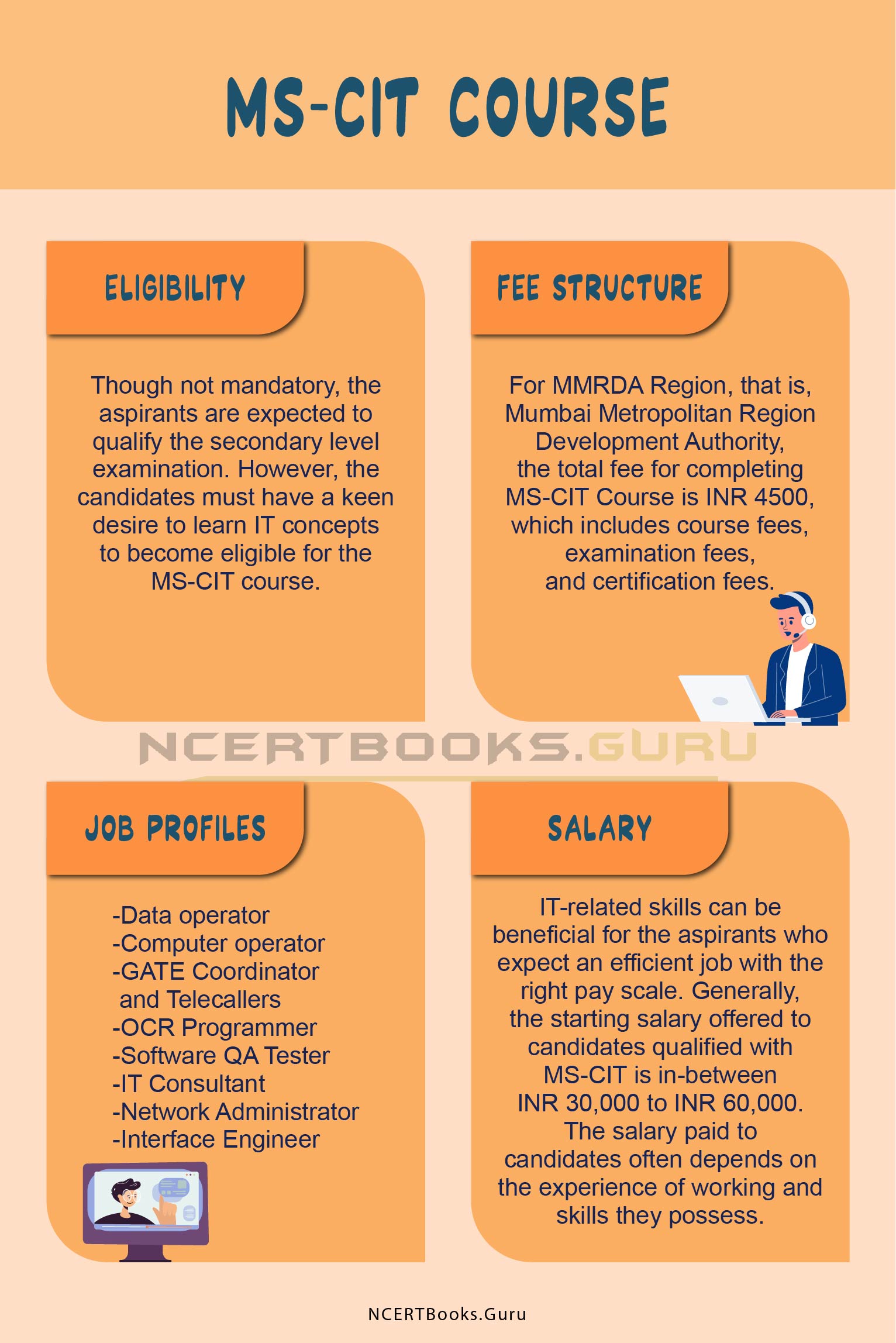
Though not mandatory, the aspirants are expected to qualify the secondary level examination. However, the candidates must have a keen desire to learn IT concepts to become eligible for the MS-CIT course. Apart from it, there is no requirement, and any candidate interested in exploring the IT sector, opportunities, and seeking a career in this field can apply for MS-CIT.

MS-CIT Course Fee Structure

For MMRDA Region, that is, Mumbai Metropolitan Region Development Authority, the total fee for completing MS-CIT Course is INR 4500, which includes course fees, examination fees, and certification fees. If any aspirant wants to pay the fee in two installments, then in the first installment, they have to pay INR 2350, and in the second installment, they have to pay INR 2350. It means candidates paying the fee in two installments have to pay INR 4700.

For the rest of the MMRDA region, the candidates need to pay INR 4000 for a single installment. However, candidates preferring to pay fees in two installments have to pay INR 2100 per installment, meaning the total fee to be paid INR 4200.

Do Check:

MS-CIT Course Admission Procedure

There is no entrance to get an entry for the MS-CIT course. The candidates should go to the MS-CIT ALC (Authorized Learning Centre) to fill an application form. They are required to provide a Xerox copy of their sign and photograph for ID proof. Once they fill the form, the coordinator handling all MS-CIT procedures can check all the details filled and will get you informed.

MS-CIT Course Duration

The aspirants can expect the course duration for MS-CIT for about 2-3 months. Generally, the procedure follows:

e-learning of classroom content (theory) 50 hours (1 hour per day)
e-learning of lab content (practical) 50 hours (1 hour per day)
Self-study, book reading, revision, and practicing 44 hours

MS-CIT Course Syllabus

Computer Basics Overview of computers, uses, understanding input, processes, and output
Operating System (Windows 7) Overview of OS, general operations, applying themes, file and folder management, windows media player, and many more
21st Century Life Skills Candidates can acknowledge how to use Google PlayStore,  net banking, protection from cyberbullying, the importance of passwords, and so on
21st Century Citizenship Skills Candidates can acknowledge how to download Aadhar Card, verify, update, DigiLocker, Voter ID Card, register FIR online, check weather status, and so on
21st Century Study Skills Candidates can use Google, Wikipedia, YouTube, and many other platforms to search the study topics, improve vocabulary, and many more
21st Century Job Skills Candidates can acknowledge how to make a creative bookmark, draft a notice, design a webpage, build a professional profile, create a letterhead, design a BROCHURE, and so on
Word Processing Basic operations, formatting documents, inserting headers and footers, applying page setup, creating and editing pdfs, and so on
Spreadsheet Organizing and formatting worksheets, data analysis, creating Pivot tables, using advanced functions, data validation, and so on
MS Outlook Creating a new email account in MS Outlook, scheduling meetings, including the signature in the outgoing message, and many more

To study the MS-CIT Course Subjects, it is better to go through MS-CIT Course Books PDF.

MS-CIT Course Job Profiles

Once aspirants complete the MS-CIT course, they will become eligible to apply for numerous jobs in the IT sector. They can work in different roles as:

  • Data operator
  • Computer operator
  • GATE Coordinator and Telecallers
  • OCR Programmer
  • Software QA Tester
  • IT Consultant
  • Network Administrator
  • Interface Engineer

Moreover, candidates can also find good jobs in banking, teaching, banking, data analytics, and many more. To get a chance to work in this field, you can also pursue other Computer Courses.

Salary offered to MS-CIT Professional

With the increasing time, the IT sector is experiencing enormous growth. Hence, IT-related skills can be beneficial for the aspirants who expect an efficient job with the right pay scale. Generally, the starting salary offered to candidates qualified with MS-CIT is in-between INR 30,000 to INR 60,000. The salary paid to candidates often depends on the experience of working and skills they possess.

MS-CIT Course Details

FAQs on MS-CIT Course

Question 1.
What is the objective of studying MS-CIT?

Answer:
MS-CIT is based on Information Technology concepts. It helps interested candidates learn the necessary IT concepts, store, archive, and manage information digitally.

Question 2.
How much time is required for the MS-CIT course?

Answer:
Generally, the course duration is 2 hours for MS-CIT. It includes a one-hour theory lecture and one-hour for the practical lecture.

Question 3.
How much does the MS-CIT Course cost?

Answer:
For the Maharashtra region, the MS-CIT course costs INR 4500, and for the rest, the cost is INR 4700.

Question 4.
What are the career opportunities after completing MS-CIT?

Answer:
Upon successful completion of the MS-CIT course, the candidates can make a career in IT Consultant, banking, financing, and other government jobs.

Summary of MS-CIT Course Details

We hope that the MS-CIT Course Details information shared is useful to you. Still, if any candidate has doubt, they can write it in the comment section. We will try our best to answer all your questions, delightfully and as soon as possible.

How to Become a Ship Captain in India – Education Requirements, Course, Colleges, Salary

How to become a Ship Captain in India

Do you want to know how to become a ship captain in India After 12th? If your answer is yes, then what are you waiting for, You are on the right page to get complete guidance on how to become a ship captain in merchant navy. We know that most of the people will have a dream to work for the nation like military and navy. But it is not an easy task you need to work hard and choose the right career path to fulfill your dreams.

Students have to appear in the entrance examinations conducted by the Indian Maritime University to complete the required courses to become the captain of the ship. After completing all the necessary courses candidates can apply for merchant navy jobs. Get the information on how to become a captain of a ship in Indian Navy like course details, eligibility, age limit, and ship captain salary in India from here.

Responsibilities of a Ship Captain

The commanding officer of a ship is called ship captain. He/she play a crucial role in the merchant navy. He is responsible for exporting and importing the activities, management of goods and services in rivers, lakes, seas, and other coastal areas. They are responsible for harmless and systematic ship operations.

Eligibility Criteria to Become a Ship Captain – Educational Requirements, Age Limit & Nationality

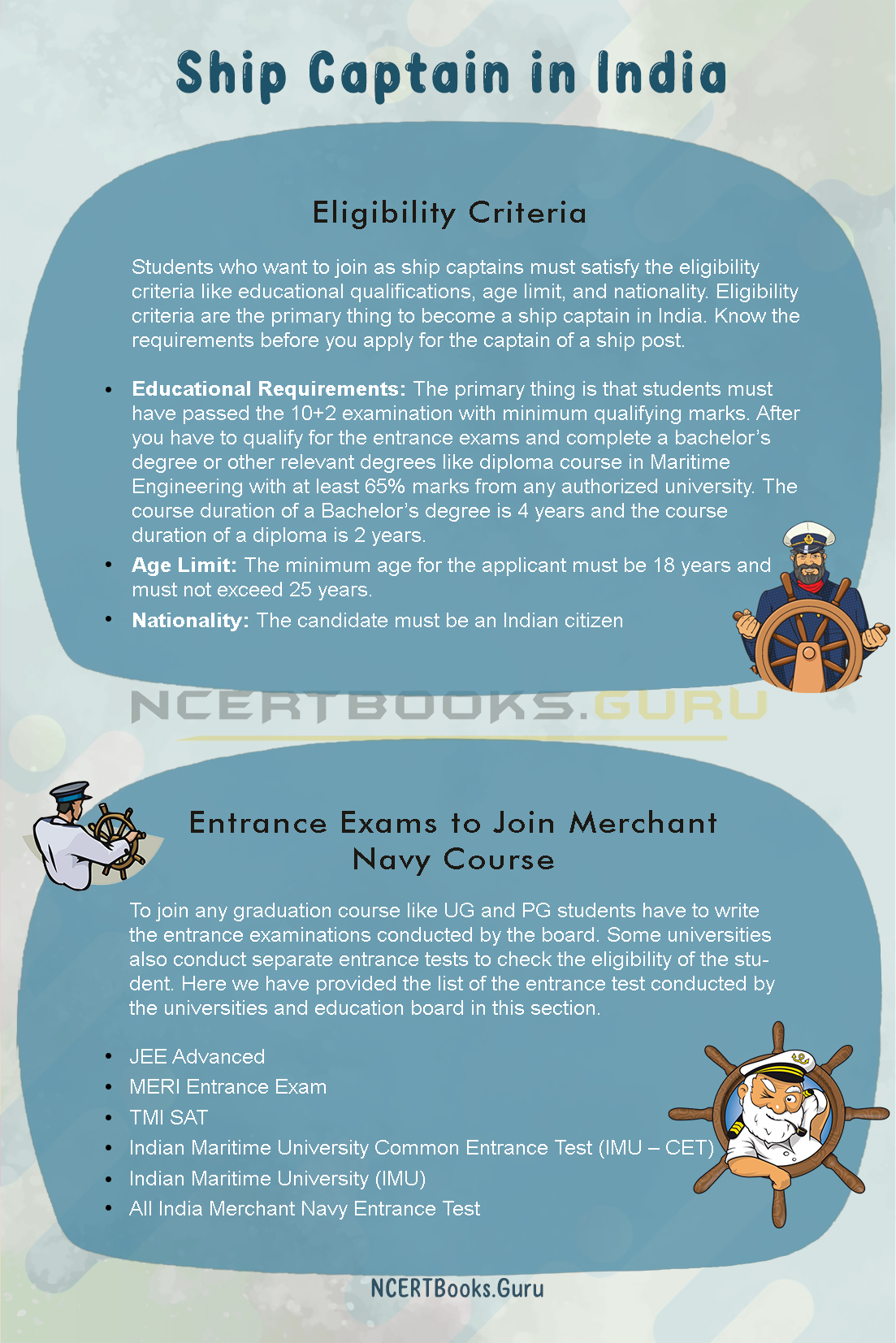
Students who want to join as ship captains must satisfy the eligibility criteria like educational qualifications, age limit, and nationality. Eligibility criteria are the primary thing to become a ship captain in India. Know the requirements before you apply for the captain of a ship post.

  • Educational Requirements: The primary thing is that students must have passed the 10+2 examination with minimum qualifying marks. After you have to qualify for the entrance exams and complete a bachelor’s degree or other relevant degrees like diploma course in Maritime Engineering with at least 65% marks from any authorized university. The course duration of a Bachelor’s degree is 4 years and the course duration of a diploma is 2 years.
  • Age Limit: The minimum age for the applicant must be 18 years and must not exceed 25 years.
  • Nationality: The candidate must be an Indian citizen

Entrance Exams to Join Merchant Navy Course

To join any graduation course like UG and PG students have to write the entrance examinations conducted by the board. Some universities also conduct separate entrance tests to check the eligibility of the student. Here we have provided the list of the entrance test conducted by the universities and education board in this section.

  • JEE Advanced
  • MERI Entrance Exam
  • TMI SAT
  • Indian Maritime University Common Entrance Test (IMU – CET)
  • Indian Maritime University (IMU)
  • All India Merchant Navy Entrance Test

Subjects to prepare to get qualified in the entrance exams for Merchant Navy are mathematics, chemistry, physics, English, General Aptitude, General Knowledge, Merchant Navy Subjects like Naval Architecture, Environmental Science, Marine Auxiliary, Marine Electrical Technology, etc.

How to Become a Ship Captain in India 1

Do Refer:

Which Courses are opted to become a Ship Captain in India?

Students who are interested to become a ship captain must have studied any of the below Bachelor’s degrees in:

  • Marine Transportation
  • Marine Engineering Systems
  • Marine Engineering
  • Shipyard Management
  • Maritime operations and technology
  • Logistics and intermodal transportation

Top Colleges that offer Merchant Navy Training and Course

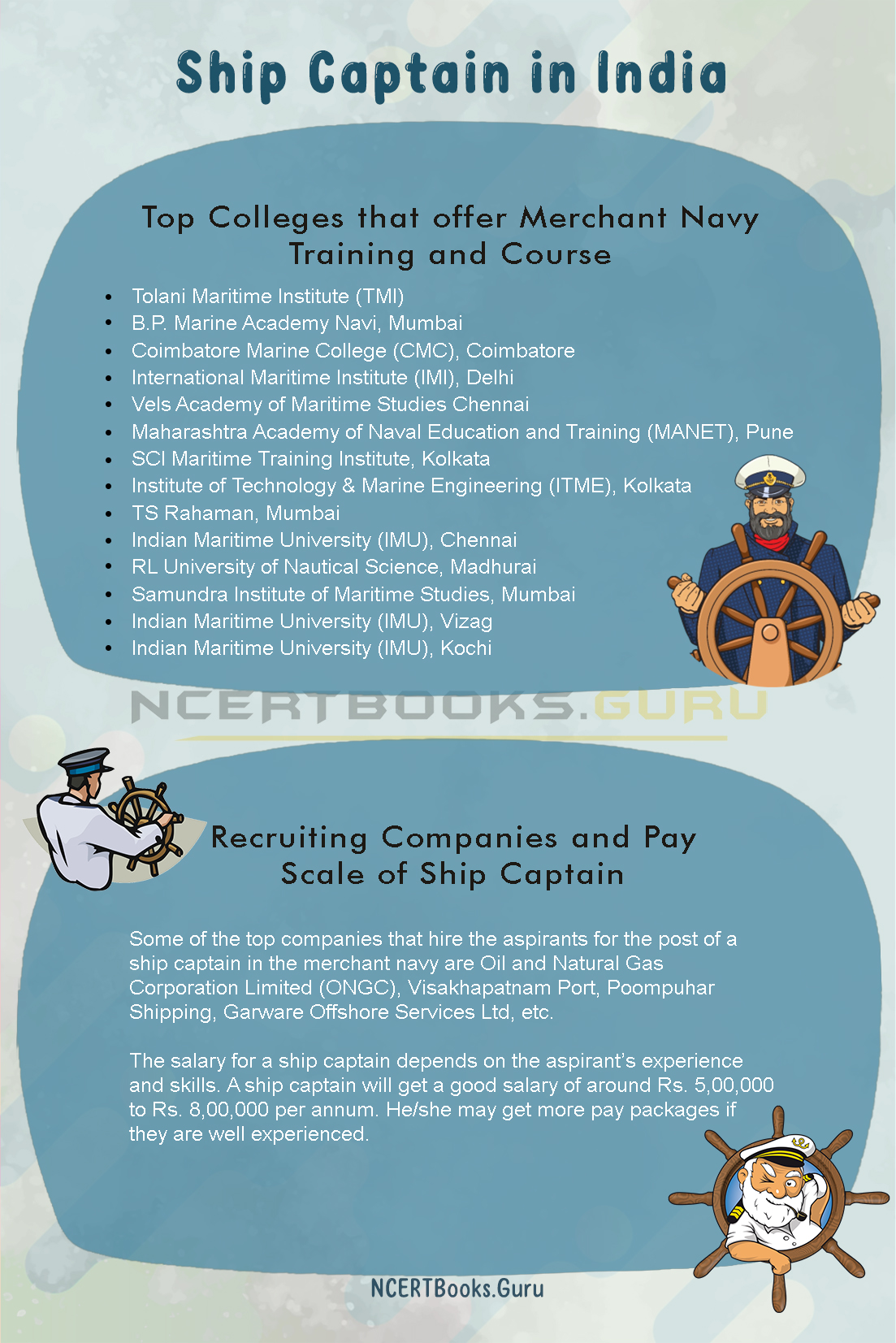
Top colleges that offer navy courses to become captain of a ship are given below. Select the college based on your rank in the entrance exam and location.

  • Tolani Maritime Institute (TMI)
  • B.P. Marine Academy Navi, Mumbai
  • Coimbatore Marine College (CMC), Coimbatore
  • International Maritime Institute (IMI), Delhi
  • Vels Academy of Maritime Studies Chennai
  • Maharashtra Academy of Naval Education and Training (MANET), Pune
  • SCI Maritime Training Institute, Kolkata
  • Institute of Technology & Marine Engineering (ITME), Kolkata
  • TS Rahaman, Mumbai
  • Indian Maritime University (IMU), Chennai
  • RL University of Nautical Science, Madhurai
  • Samundra Institute of Maritime Studies, Mumbai
  • Indian Maritime University (IMU), Vizag
  • Indian Maritime University (IMU), Kochi
  • Chennai School of Ship Management
  • Amer Maritime Training Academy, Kanpur
  • Centre for Maritime Education & Training, Lucknow
  • Hindustan Institute of Maritime Training Pre-Sea Training Center, Chennai

Steps to Become Ship Captain in India | How to Become a Captain of a ship in India?

It is not easy to become the captain of the ship in India in the merchant navy, you need to work hard after completing the 10th standard by selecting the right course. We have provided the steps to become a ship captain in India.
Step 1: First you have to join the merchant marine academy to get promoted to captain.
Step 2: Knowledge of water transport, license, and experience.
Step 3: Qualifying the entrance exams and completing the bachelor’s degree with 4 years duration in maritime engineering, passing drug tests, and medical examination.
Step 4: Apply for the ship captain post and complete the selection procedure to get selected for the post of captain of the ship.

Recruiting Companies for Ship Captain in India

Some of the top companies that hire the aspirants for the post of a ship captain in the merchant navy are Oil and Natural Gas Corporation Limited (ONGC), Visakhapatnam Port, Poompuhar Shipping, Garware Offshore Services Ltd, etc.

How to Become a Ship Captain in India 2

Pay Scale of Ship Captain | Salary for Ship Captain in India

The salary for a ship captain depends on the aspirant’s experience and skills. A ship captain will get a good salary of around Rs. 5,00,000 to Rs. 8,00,000 per annum. He/she may get more pay packages if they are well experienced.

FAQs on How to Become a Ship Captain in India

How long does it take to become a ship captain?

To become the captain of a ship in India candidates must have the captain’s license from the federal maritime authority. It takes around 10 years to get the license from the authority.

What should I study to become a ship captain?

Students who wish to become a ship captain must study bachelor’s degree in maritime engineering.

Do I need a degree to be a captain?

Depending up on the position the candidates should have a bachelor’s degree from a merchant marine academy.

Final Verdict

Students after completing all the academic qualifications can apply for the ship captain in India. Know more about how to become a ship captain in India from this article. We hope all the guidelines presented here are beneficial for you. Keep in touch with our site ncertbooks.guru to get the latest updates on all Aviation and Navy jobs.

How to Become a DJ (Disc Jockey) in India | Course Details, Duration, Fee Structure, Eligibility Criteria

How to Become a DJ in India

How to Become a D.J. in India: If you are passionate about music and mixing tracks and are grinding your head, wondering how to move forward with your passion? Disco Jockey is a viable career option worth pursuing.

An offbeat career makes a sound like an added choice a few years back. However, it is now gaining popularity in the present contemporary world. Creating upbeat music requires an upscale in the levels of creativity, artistry, and skills. Those who carefully mentor their creativity and skills possess the quality of Sound producers and D.J.s.

To make your mark in the highly competitive music industry, make sure you turn your spark and passion into a successful career. Those individuals passionate about music and Deejaying, the below-mentioned report on the domain, will be highly beneficial.

Who is a D.J.?

D.J. or Disco Jockey refers to the person who professionally plays pre-recorded discs or music at clubs or parties. The pre-recorded music is usually drawn from an extensive collection of music that fits the theme of the event.

A DJ can also take up the role of a sound producer. The combined role of D.J. and sound producer involves creativity.

The role of D.J. is a bit complex than its definition. A DJ is often misunderstood and can be easily replaced by a music playlist. However, there are certain accomplishments that a D.J. can take over a piece of canned music.

Types of DJ’s

  • CLUB DJs: Club D.J.s work during the night at clubs and similar venues, providing the music for the crowds to dance and have fun. A Club D.J. maintains the dance floor through the performance of long blends known as transitions between songs to keep people moving.
  • Resident DJs: A permanent D.J. performing at a particular venue is known as ‘Resident D.J..’ HE/she ramps up the energy up and down and maintains a constant balance between a busy bar and an active dance floor.
  • Mobile DJs: This category is often the entrepreneurial type D.J.s that perform at corporate events, weddings, or even offer a memorable prom party. They keep track of all their work and are solely responsible for the setup and teardown of the equipment, managing the crowd, planning the show, or even making announcements. A Mobile D.J. takes easy steps using the microphone and, at times, even investing in a piece of sound equipment.
  • Radio DJs: This is the origin of D.J. across the globe. Radio D.J.s job varies from host celebrity gossip, answer requests, share news, to play music on air. They make small in-between announcements of weather during the songs, to full-on music accusations. Through radio D.J.s art lives in podcast format.
  • Turntablists/ Performance DJs: People often attend an event to see a D.J. because of their reputation, skill, and creative artistry behind the decks. A turntablist’s work displays raw dexterity, clever transitions, and impressive tricks that draw the audience’s attention.

Skillset and Attributes Required for a DJ

  • Should have an ear to music
  • Be familiar with equalization, cueing, Beat-matching and juggling, and audio mixing.
  • He/she should possess the qualities of an outgoing personality.
  • Candidates should possess the ability to mix with people and learn their mood of preference.
  • Should possess excellent interpersonal skills to assist networking.
  • He/she should be well-versed with music in vogue- They should be familiar with the hit songs and convert them into a trendy mix.
  • Technical ability
  • A sense of timing that plays the right track at the right time
  • The ability to manage business accounts.
  • Candidates should possess a creative talent for mixing music.
  • Candidates must have enough stamina and energy to motivate people.

Eligibility Criteria for DJ in India

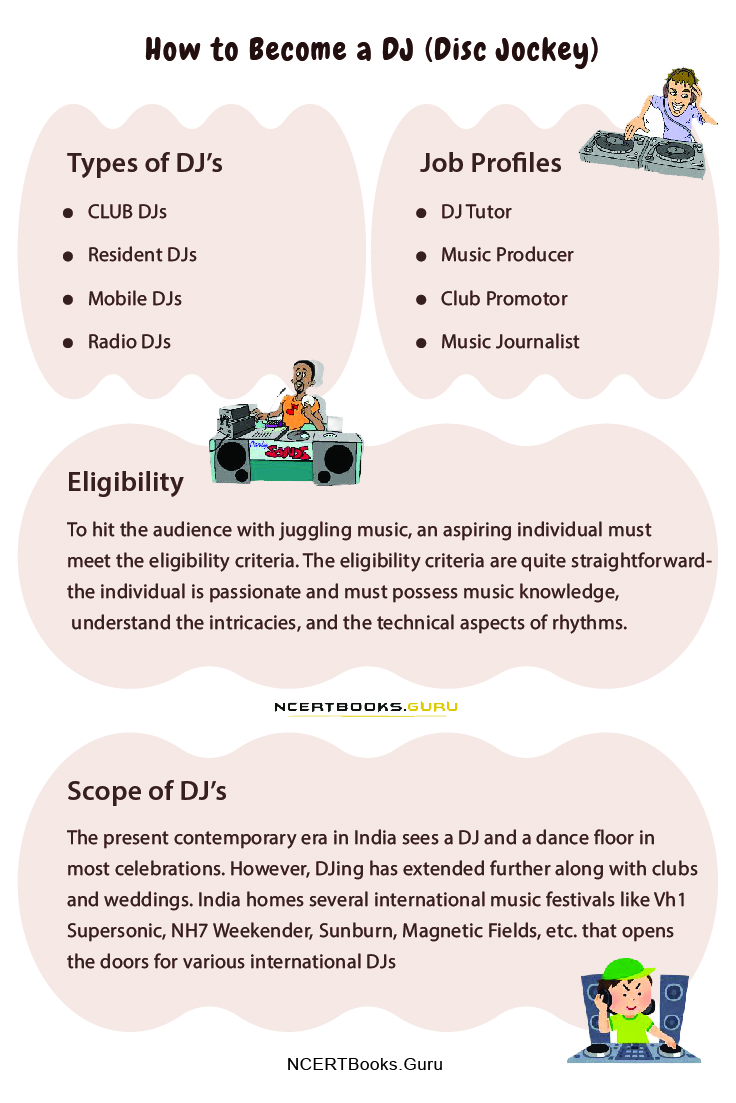
To hit the audience with juggling music, an aspiring individual must meet the eligibility criteria. The eligibility criteria are quite straightforward- the individual is passionate and must possess music knowledge, understand the intricacies, and the technical aspects of rhythms.

A few places draw a line. The eligible candidate must hold a Bachelor’s Degree, while some accept based on the timeline of experience. Internships play a vital role; those who have learned the ropes by adding practical experience as interns in F.M. Radio channels are slightly preferred. A Bachelor’s Degree in Journalism or Communications is an added advantage.

Skillset Courses alongside DJ Courses

To become a Disco Jockey, there are no full-time courses or programs with defined syllabus and curriculum. There are no universities or colleges that enhance the skillset or provides D.J. development or training.

However, certain training centers and private institutions cater to the needed skill set, training, and development across the globe. In India, DJ training and development centers have sprung up in Bangalore, Mumbai, Hyderabad, Chennai, Delhi(N.C.R.), and Kolkata that offer short duration courses in D.J. training and development and other related skillsets.

A few skills set courses that are given training alongside are

  • D.J. Training and Development course
  • Pro D.J.
  • Audio Engineering course
  • Digital Live DJ’ing course

Institutes That Offer D.J. Courses

Institutes that offer D.J. Courses are as follows

  1. I Love Music Academy, Gurgaon
  2. Electronic Academy, Delhi
  3. Jazzy Joe, Delhi
  4. Skratchlab DJ Academy, Chennai
  5. Global D.J. Music Production & D.J. Training Academy, Mumbai
  6. Spin Gurus, New Delhi

I Love Music Academy, Gurgaon

This institute offers Music Production, Audio Engineering, D.J., and Electronic DJ Performances Courses.

Course Duration and Fee Structure: This institution offers the “Pro D.J.” course for three months as a part-time course. The course “D.J. Producer” provides a course duration of nine months as a part-time course.

Electronic Academy, Delhi

This is an institution set up by DJ N.Y.K. – Nikhil Sahni. The institutions offer D.J. courses, Music Production Courses, Podcast production courses, and Visual Performance Courses.

Course Duration and Fee Structure: The Serato D.J. course offered by the institution is for INR 30,000 for two months. The pioneer C.D.J. course is for INR 65,000 for a duration of two to three months.

Jazzy Joe, Delhi

This is one of the oldest institutions set up in 1997 in Delhi. The institution offers Basic Mobile D.J., Professional Club D.J., Sunday Professional Course, and Turntablist Vinyl Course.

Course Duration and Fee Structure: The professional D.J. Courses cost INR 6000 for 100 hours. The Basic Mobile D.J. course costs INR 30,000 for 60 hours, split between 6 days and a field trip. The Sunday Professional Course costs INR 36,00 for eight Sundays inclusive of a field trip. The Tutntabilist Vinyl Course costs INR36,000 for 60 hours for six days.

Skratchlab DJ Academy, Chennai

This institution was developed by D.J. Kave, twice D.M.C. World DJ championship Indian representative. He was also the official D.J. for A R Rahman, Blaaze & Hardkaur.

The institution offers advanced Professional DJ Courses 2.0, D.J. Crash Courses, Home D.J. Tuition, Online D.J. Course, Rockstar D.J. 2020, and Electronic Music producer offered for D.J.s Course.

Course Duration and Fee structure: Advanced Professional DJ Courses 2.0 is for a duration of 32 sessions, with a session for an hour for a fee of 70,000. The D.J. Crash Course offers 16 sessions for INR 35,000. The Home D.J. Tuition is an hour session that costs INR 40,000.

The Online D.J. Course offers ten sessions for INR 20,000. The Rockstar D.J. 2020 offers ten sessions for INR 30,000. The Electronic Music producer offered for D.J.s Course offers 16 sessions for INR 55,000.

Global D.J. Music Production & D.J. Training Academy, Mumbai

This is a well-established institution since 2009. The institution offers several adaptive music courses, mainly D.J. Training Courses, Digital D.J. Courses, and Music Business Development.

Course Duration and Fee Structure: The course duration ranges from a month to three months, depending on individual talents and learning capacity. The Fee structure fluctuates between INR 8,500 to INR 10,000 depending on the courses.

Spin Gurus, New Delhi

Spin Gurus marked its foundation in 2005 by Super Dang as India’s first professional D.J. & Music Production Academy. The institution offers both campuses as well as online courses.

Course Duration and Fee structure: The Complete D.J. Course is for two months, and the fee structure is INR 59,000. The Serato Video D.J. Course is for a month with a fee structure of INR 39,999. The Ableton Live D.J. Course if for a month with a fee structure of INR 39,999. The Online D.J. Course is for a month with a fee structure of INR 29,999.

Career Prospects of DJ in India

Most DJs work as freelancers based on contracts or are self-employed artists. However, depending on the field of experience and credentials, a DJ earns between INR 30,000 to INR 70,000 per night. Several DJs are fully employed in hospital industries and broadcast and earn INR 3 lakh to INR 8 lakh per annum, depending on the experience and popularity.

Job Profiles of DJ in India

Based on experience and popularity, a DJ can hold the following Job Profiles:

  • DJ Tutor
  • Music Producer
  • Club Promotor
  • Music Journalist

See More:

Scope of DJ’s in India

The present contemporary era in India sees a DJ and a dance floor in most celebrations. However, DJing has extended further along with clubs and weddings.

India homes several international music festivals like Vh1 Supersonic, NH7 Weekender, Sunburn, Magnetic Fields, etc. that opens the doors for various international DJs

Therefore, DJing has a vital scope in Indian and offers a platform for aspiring DJs to take the road less traveled with passion and brave heart.

How to Become a DJ (Disc Jockey) in India

FAQ’s on How to Become a DJ in India

Question 1.
What is the skill set required for the DJ?

Answer:
Aspiring candidates must hold the following skillset: technical ability, A sense of timing that plays the right track at the right time, The ability to manage business accounts, creative talent for mixing music, and should possess enough stamina and energy to motivate people.

Question 2.
What are the career prospects of DJs in India?

Answer:
Most DJs work as freelancers based on contracts or are self-employed artists. However, depending on the field of experience and credentials, a DJ earns between INR 30,000 to INR 70,000 per night. Several DJs are fully employed in hospital industries and broadcast and earn INR 3 lakh to INR 8 lakh per annum, depending on the experience and popularity.

Question 3.
How is a D.J different from a Sound Producer?

Answer:
The primary difference holds with the audience – A D.J tailors the needs of the audience while a sound producer performs original music in front of the audience. Also, a DJ works with pre-recorded music, while a sound producer creates his music.

Summary

We hope that the information mentioned above regarding How to Become a DJ in India has helped improve your understanding of the subject with in-depth knowledge.