NCERT Solutions for Class 7 Social Science Geography Chapter 1 Environment

Environment Class 7 Questions and Answers Geography Chapter 1

Class 7 Geography Chapter 1 NCERT Textbook Questions and Answers

Question 1.
Answer the following questions :
(i) What is an ecosystem?
Answer:
An ecosystem is a system formed by the interaction of all living organisms with each other and with the physical and chemical factors of the environment in which they live, all linked by transfer of energy and material.

(ii) What do you mean by natural environment?
Answer:
The combination of physical environment like mountains, rocks, oceans, etc., and biological environment such as that of trees, animals and anything made by nature is termed as natural environment.

Land, water, air, plants and animals comprise of the natural environment.

(iii) Which are the major components of the environment?
Answer:
The major components of the environment are the biotic and the abiotic elements and creations of human beings.

  • Biotic is the world of living organisms, e.g. plants and animals.
  • Abiotic is the world of non-living elements, e.g. land, water, etc.
  • Human activities include buildings, roads, bridges, parks, etc.

(iv) Give four examples of human made environment.
Answer:
Examples of human made environment are“

  1. Buildings
  2. Roads
  3. Bridges
  4. Parks, etc.

(v) What is lithosphere?
Answer:
Lithosphere is the solid crust or the hard top layer of the earth. It is made up of rocks and minerals and covered by a thin layer of soil. It is an irregular surface with various land forms such as mountains, plateaus, plains, valleys, etc.

(vi) Which are the two major components of biotic environment?
Answer:
The two major components of biotic environment are plants and animals.

(vii) What is biosphere?
Answer:
Biosphere is a narrow zone of the earth where land, water and air interact with each other to support life. Both plant and animal kingdoms together comprise of the biosphere.

Question 2.
Tick the correct answer :
(i) Which is not a natural ecosystem?
(a) Desert
(b) Aquarium
(c) Forest
Answer:
(b) Aquarium.

(ii) Which is not a component of human environment.
(a) Land
(b) Religion
(c) Community
Answer:
(a) Land

(iii) Which is a human made environment?
(a) Mountain
(b) Sea
(c) Road
Answer:
(c) Road

(iv) Which is a threat to environment?
(a) Growing plants
(b) Growing population
(c) Growing Crops
Answer:
(b) Growing population

Question 3.
Match the following—

(i) Biosphere (a) blanket of air which surrounds the earth
(ii) Atmosphere (b) domain of water
(iii) Hydrosphere (c) Our surroundings
(iv) Environment (d) Narrow zone where land, water and air interact

Answer:

(i) Biosphere (d) Narrow zone where land, water and air interact
(ii) Atmosphere (a) blanket of air which surrounds the earth
(iii) Hydrosphere (b) domain of water
(iv) Environment (c) Our surroundings

Question 4.
Give reasons-
(i) Man modifies his environment.
Answer:
Human beings interact with environment and modify it according to their needs. Early humans adapted themselves to the natural surroundings. They led a simple life and fulfilled their requirements from the nature around them. With time needs grew and became more varied. Humans learn new ways to use and change environment. They learn to grow crops, domesticate animals and lead a settled life. With more passage of time more modification was made in the environment by man to suite his needs.

(ii) Plants and animals depend on each other.
Answer:
Both plant and animal kingdoms together make the biosphere or the living world. All plants, animals and human beings depend on their immediate surroundings. Often they are also interdependent on each other. This relation between the organisms and their surroundings form an ecosystem. Plants provide animals food, on the other hand, animals provide carbon dioxide to plants to make food. Thus, both are depended on each other.

Question 5.
Activity-
Imagine an ideal environment where you would love to live. Draw the picture of your ideal environment.
Answer:

An Ideal Environment

  1. Optimum population.
  2. An adequate number of plants (forests) and animals (wildlife).
  3. Pollution-free -Air
    • Water
    • Land.
  4. Adequate health and sanitation services.
  5. Amicable and comfortable surroundings.
  6. No strife, stress, and strains.
  7. Peaceful living.
  8. Adequate government care.

For drawing a picture of the ideal environment, take help from your subject and drawing teacher.
NCERT Solutions for Class 7 Social Science

NCERT Solutions Class 12 Maths PDF Free Download | Class 12 Mathematics NCERT Solutions

NCERT Solution for Class 12 Maths PDF

NCERT Solutions for Class 12 Maths will give a strong foundation for all the concepts in the CBSE Class 12 Maths Syllabus. Class 12 Maths NCERT Solutions existing will help you to be prepared for the board and other competitive exams. NCERT Solutions for 12th Class Maths prepared by subject experts will ensure a smooth learning experience all throughout.

Apart from the Class 12 Mathematics NCERT Book Solutions, we will also offer other preparation material such as NCERT Books for Class 12 Maths, Exemplar Solutions, Sample Papers prescribed by the CBSE Board. Step by Step Solutions used for explaining all the questions makes it easy for you to grasp the concepts underlying effectively.

Download Free NCERT Books for class 1st to 12th & NCERT Hindi Books PDF Download

NCERT Solutions Class 12 Maths PDF Free Download

Chapterwise NCERT Solutions Class 12 Maths available makes the concepts of class 12 maths concrete and helps you score better grades in exams. 12th Class Maths NCERT Solutions can be a great aid to be well versed with the fundamentals. Download the easily accessible CBSE Class 12th NCERT Maths Solutions of all chapters through the quick links available and prepare anytime.

Class 12 Maths NCERT Solutions PDF Download

Get sound knowledge and a deeper understanding of all the concepts covered in the NCERT Maths Books for Class 12. Grasp the concepts better and faster taking the help of the 12th Std Mathematics NCERT Book Solutions. NCERT Solutions Class 12 Maths can be the ultimate guide to resolve all your doubts in no time. We have curated all the important maths formulas that are needed to enhance your problem-solving skills and thus the ability to tackle difficult questions too.

Overview of NCERT Solutions Class 12th Maths Chapterwise

Students can have an overview of the topics present in the 13 chapters of the NCERT Books for Class 12 Maths. They are listed for your reference

Class 12 Maths Chapter 1 Relations and Functions

This chapter deals with the notions related to functions and relations. Apart from these topics like range, domain, and co-domain are discussed. You were also introduced to the real-valued functions and their respective graphs. There are a total of 4 exercises that will be solved in this Mathematics Chapters.

Class 12 Maths Chapter 2 Inverse Trigonometric Functions

This chapter includes 2 exercises that deal with topics like restrictions on ranges and domain of trigonometric functions. You will learn about the visibility of inverses and their behavior using a graphical representation. Along with these concepts, Some Elementary Properties are discussed.

Class 12 Maths Chapter 3 Matrix

Matrices are one of the basic concepts in the Mathematics Branch. When compared to all other methods matrices simplify our work and the chapter deals with the fundamentals of the matrix.

Class 12 Maths Chapter 4 Determinants

Here, you will be studying determinants up to three real entries. The six exercises in this chapter will provide you enough opportunities for practice. You will learn various properties of cofactors, determinants and their applications in this chapter. Furthermore, you will know the properties to find the are of minors, triangle, adjoint, and the inverse of a square matrix, topics related to consistency and inconsistency of the system.

Class 12 Maths Chapter 5 Continuity and Differentiability

This chapter helps you understand important concepts related to continuity, differentiability, and relations between both. It even explains the differentiation of inverse trigonometric functions.  There are a total of 8 practice exercises which you can solve to understand the concepts better.

Class 12 Chapter 6 Application of Derivatives

You will learn how to find out derivatives of implicit functions, exponential functions, composite functions, logarithmic functions, and inverse trigonometric functions. In addition to these, you will know about the application of derivatives in various fields like science, engineering, and others. Topics like finding the intervals of various increasing and decreasing functions are also mentioned here.

Class 12 Maths Chapter 7 Integrals

Integral calculus helps in finding the area and define the problem of the region beyond the graph. There are a total of 11 exercises in this chapter 7. In these exercises, you will learn all the topics and the questions related to them.

Class 12 Maths Chapter 8 Application of Integrals

You will be able to learn applications for integers. Furthermore, you will find the area given under curves, areas of lines, and arcs of circles,  parabolas, and ellipses. There are 2 exercises in this mathematics chapter and you need to find the area bounded by the curves mentioned above.

Class 12 Maths Chapter 9 Differential Equations

You will study some basic concepts related to differential equations,  finding the particular and general solutions of differential equations, formation of differential equations different methods to solve a question based on first order. There are a total of 6 exercises in this chapter for your practice.

Class 12 Maths Chapter 10 Vector Algebra

When the quantities include only one value or magnitude than they are called scalars. Whereas if the quantity has multiple directions and magnitude than they are called vectors. Get to know basic concepts of vectors, different operations in vectors along with the algebraic and geometric properties.

Class 12 Maths Chapter 11 Three-dimensional Geometry

Chapter 11 will help you study of different directions of ratios and cosines. Also, learn about the different ratios of a line joining two points and about the equations of planes and lines in ice in different conditions. Furthermore, get to know the angles between two different lines, two planes, a line and a plane, distance from a point to a plane, and shortest distance between 2 skew lines.

Class 12 Maths Chapter 12 Linear Programming

You will get to know about problems in linear programming and their solutions through the graphical method. There are two exercises in the entire chapter. There are several methods to solve these types of problems.

Class 12 Maths Chapter 13 Probability

This chapter will take you through fundamental concepts of conditional probability for an event where another event has already occurred. In addition topics like the independence of events, Bayes’ theorem, and multiplication rule of probability. There are a total of 5 exercises in this chapter and you will get to learn important concepts for random variables and it’s a probability distribution.

Download Complete NCERT Solutions from Class 6th to 12th

FAQs on NCERT Solutions Class 12 Maths PDF

1. Do I have to practice all the questions in the Class 12 Maths NCERT Solutions?

Yes, you need to practice all the questions in the Class 12 Maths NCERT Solutions as it develops a robust foundation for all the math concepts and helps you gain confidence while attempting the exam.

2. Where do I find Chapterwise NCERT Solutions of Class 12 Mathematics?

You can find Chapterwise NCERT Solutions of Class 12 Mathematics on NCERTBooks.guru

3. How many chapters are there in Class 12th Maths NCERT Solutions?

There are a total of 13 Chapters in the Class 12th Maths NCERT Solutions.


Updated 2021-22 CBSE Class 10 English Literature Reader NCERT Solutions Book PDF Download

NCERT Solutions for Class 10 English Literature Reader PDF Download

Are you facing issues while browsing chapter-wise NCERT Solutions for class 10 English literature reader book? Don’t get tensed as we are here with the complete list of Class 10 English NCERT Textbook Solutions in PDF so you can prepare any of the concepts in no time. Also, by availing the experts prepared CBSE Class 10 NCERT English Solutions PDF you can clarify all your doubts in few seconds.

Our experts created these NCERT Solutions for Class 10 English as per the CBSE Curriculum for Academic Year 2021-22. Hence, you will have a stronger foundation of the subject and handle answering different types of questions easily. Assess your preparation by practicing the updated 2021-22 MCQ Questions for Class 10 English with Answers and improve your subject skills.

Chapter-wise NCERT Solutions for Class 10 English Literature Reader PDF Download

The list of chapterwise NCERT Solutions for Class 10 English Literature Reader PDF is up to date and they are part of NCERT Solutions for Class 10 English. So, we advise students to download the NCERT Textbook Solutions Book of class 10 English literature reader in PDF Format and try to answer the questions so effectively in the final exams. All chapters from Fiction, Poetry, and Drama are covered in these CBSE Class 10 English Literature NCERT Book Solutions PDF just tap on the respective link and ace up your preparation to enhance your english grammar skills.

NCERT Solutions for Class 10 Communicative English

NCERT Solutions for Class 10 English Literature Reader

Fiction

Poetry

Drama

NCERT Solutions for Class 10 English Literature Reader PDF Download

Advantages of availing CBSE NCERT Class 10 English Literature Reader Textbook Solutions 2021-22

Students can view so many advantages of accessing class 10 English NCERT Solutions book but we have curated some of them for your reference:

  • NCERT Solutions provided here are free to download at any time and anywhere.
  • Experience in-house subject experts designed these solutions books for students in a simple language so they can easily understand the concepts.
  • All solutions are explained in a concise and to-the-point so it helps students learn faster.
  • Our experts prepared NCERT textbook solutions & other study materials as per the latest and updated CBSE new pattern and follow the prescribed guidelines of NCERT.
  • All Chapters in CBSE Class 10 English literature reader syllabus are covered in this NCERT Solutions Book so download them for free and start your preparation with ease.

FAQs on Class 10 English Literature Reader NCERT Book Solutions PDF

1. Where can I find the Chapterwise NCERT Solutions of Class 10 English Literature Reader for free?

You can find the Chapterwise NCERT Class 10 English Literature Reader Solutions for free on our page.

2. How can I download the 10th Class English Literature Reader NCERT Solutions PDF?

You can download the 10th Class English Literature Reader NCERT Solutions PDF by just hitting on the quick links available on our NCERTBooks.Guru website.

3. Does preparing with CBSE Class 10 NCERT Solutions English Literature Book help me to get good marks in exams?

Yes, preparing from CBSE Class 10 English Literature Reader NCERT Solutions Book assists all students to score good grades in exams and also improve English grammar skills.

Conclusion

We believe the data given on our page is genuine and true according to my knowledge. For more details and other assistance kindly reach us via the comment section below. Also, stay connected with our site to avail latest updates on NCERT Textbooks PDF, Classwise NCERT Solutions of different subjects, Previous Question Papers all in one place.

All Chapters NCERT Solutions of Class 11 Financial Accounting Free PDF Download

NCERT Solutions for Class 11 Financial Accounting Free PDF Download

In the commerce stream, the financial accounting subject plays an important role. Students who opt for the commerce course should have a good grip on the accountancy topics to score well in the board exams. CBSE NCERT Solutions for class 11 financial accounting chapterwise pdf links are provided here for easy access and free download.

All the Solutions of NCERT 11th Accountancy are prepared by the subject experts as per the new syllabus and guidelines of CBSE. Without any hesitation kids, parents, and teachers can use these chapterwise NCERT Class 11 Solutions for accountancy and gain proper knowledge of the subject as well as good scores.

Download Complete NCERT Solutions PDF from class 6th to 12th.

NCERT Solutions for Class 11 Financial Accounting (Accountancy) Free PDF Download

Adhering to the CBSE Class 11 Accountancy Syllabus, experts designed the NCERT Solutions of Class XI Financial Accounting PDF for all chapters questions. Find all chapters NCERT questions and answers for accountancy from the available links of Part I and II. Simply hit on them and download easily on your devices to access them at any time anywhere you wish to prepare.

NCERT Solutions for Class 11 Accountancy Part 1 Financial Accounting

Accountancy: Financial Accounting Part 2

  • Financial Statements – I
  • Financial Statements
  • Accounts from Incomplete Records
  • Accounting for Not-for-Profit Organisation
  • Applications of Computers in Accounting
  • Computerized Accounting System
  • Structuring Database for Accounting
  • Accounting System Using Database Management System

Download Free NCERT Textbooks PDF

Perks of Preparing from Accountancy Class XI NCERT Book Solutions

You guys will find so many advantages of referring to the Class 11 NCERT Accountancy Solutions and some of them are listed here for your knowledge. They are as such;

  • For scoring the highest marks in the accountancy exams, students have to practice all chapters of parts 1 & 2 from NCERT Solutions and MCQ Questions and Answers.
  • The solutions of NCERT Textbook questions of financial accounting offer a broad range of descriptive examples which help kids to understand and learn the topic instantly.
  • 11th standard NCERT accountancy textbook solutions are handy and easy to download from our pdf links available.
  • Students can take help from these chapterwise ncert class 11 financial accounting solutions book pdf during their homework and preparation routine for extra & effective practicing.
  • Preparation Material over here will lay a strong foundation in basic accounting methodologies and principles as well as assist you in scoring better grades in exams.

FAQs on All Chapters of 11th Class Financial Accounting NCERT Book Solutions PDF

1. What are the perfect books students should practice to score high in Class 11 Accountancy Exams?

NCERT Books & NCERT Solutions are the two major study materials that help students to score good marks in the exams of class 11 accountancy. The majority of the questions will be asked from the ncert textbook solutions of 11th std financial accounting.

2. What are the chapters included in the Class 11 Ncert solutions Accounting Book? 

The financial accounting subject of class 11 is separated into two parts. Each part covers eight chapters and a total of 16 chapters are included in class 11 Ncert solutions accountancy book.

3. Which is the reliable website that provides the Class 11th NCERT Accountancy Solutions in PDF?

NCERTBooks.guru is the trusted & reliable web portal that provides the Class 11 NCERT Accountancy Solutions in pdf format for free of cost. Also, it was designed efficiently to understand all the concepts very easily.

Summary

Desiring that the data provided in terms of NCERT Solutions for Class 11 financial accounting pdf has shed some light on you. In case, you found any mistakes or hurdles while downloading pdfs or preparing with our NCERT 11th std accountancy solutions book pdf, let us know via comment box. Also, stay tuned to our website for the latest updates on  NCERT Books, NCERT Solutions, MCQ Questions, CBSE Syllabus, etc.

NCERT Solutions for Class 8 Social Science History Chapter 4 Tribals, Dikus and the Vision of a Golden Age

Tribals, Dikus and the Vision of a Golden Age Class 8 Questions and Answers History Chapter 4

History Class 8 Chapter 4 NCERT Textbook Questions and Answers

Question 1.
Imagine you are a jhum cultivator living in a forest village in the nineteenth century. You have just been told that the land you were born on no longer belongs to you. In a meeting with British officials, you try to explain the kinds of problems you face. What would you say?
Answer:
We will try to explain to the British officials the following kinds of problems :

  • We are lovers of nature and natural surroundings.
  • We subsist on forest and on the local resources. If you will take away all our natural rights on the forest, water and the land we will be unable to procure our basic needs. Our economic activities like hunting, food gathering, fishing, cattle breeding, cultivation and plough cultivation will be disturbed.

Question 2.
Fill in the blanks :
1. The British described the tribal people as ……………. .
2. The method of sowing seeds in jhum cultivation is known as ……………… .
3. The tribal chiefs got …………… titles in central India under the British land settlements.
4. Tribals went to work in the ………………. of Assam and the ……………. in Bihar.
Answer:

  1. Nomads.
  2. Shifting cultivation.
  3. Sirdars (leaders)
  4. Tea gardens, Indigo plantations.

Question 3.
State whether True or False :
1. Jhum cultivators plough the land and sow seeds.
2. Cocoons were bought from the Santhals and sold by the traders at five times the purchase price.
3. Birsa urged his followers to purify themselves, give up drinking liquor and stop believing in witchcraft and sorcery.
4. The British wanted to preserve the tribal way of life.
Answer:

  1. True
  2. True
  3. True
  4. False

Question 4.
What problems did shifting cultivators face under British rule?
Answer:
Problems faced by shifting cultivators under British rule :

  1. They had to give up their traditional way of life.
  2. They started to lead the life of settled peasants.
  3. They had to pay regular land revenue to the British Government or to its agents.
  4. Their land was measured and their rights were defined.
  5. Some of them were declared landlords others become only tenants.
  6. The tenants were to pay the rent to the landlords (owners).
  7. Since the land of the jhum cultivators did not produce good yields therefore some tribal people continued with their traditional practice. They took banner of revolt against the Britishers and forced the British officials to carry on the shifting cultivation part of the forest.

Question 5.
How did the powers of tribal chiefs change under colonial rule?
Answer:
The powers of tribal chiefs changed under the colonial rules as under :

  1. The British extended their control over all forests and declared that forest was a state property.
  2. Some forests were classified as reserved forests for producing the timber.
  3. In reserved forests tribal people were not allowed to move freely and not allowed to practice jhum cultivation, or collect fruits or hunt animals. In such circumstances to earn livelihood become very difficult for tribals.
  4. Many tribal people were forced to move to other areas in search of work and livelihood.
  5. As the Britishers felt shortage of labours to cut trees for railway sleepers, to transport logs, they modified their decision. The Britishers decided that they would give jhum cultivation a small patches of land in the forest. The British allowed the tribal people to cultivate their new patches of land on the condition that they would live in the villages and would provide labour to the forest department of the government.
  6. The forest department established forest villages to ensure a regular supply of cheap labour.

Question 6.
What accounts for the anger of the tribals against the dikus?
Answer:
Anger of the tribals against the dikus. Many factors, policies and treatments of the British officials, self merchants, traders and dishonest money-lenders accounted for the anger of the tribals against the dikus :

  • As the British took over large tracts of land cultivated by the tribals in order to grow cash crops such as poppy, jute, indigo the landless tribals were forced to become labourers. They had to work at a very low wages.
  • They were badly exploited by crafty and dishonest money-lenders. The rate of interest on the loans of an illiterate tribal varied from 50% to unbelievable 500%.
  • Infact money-lenders and other introducers acted as agents of the Britishers and tribals were brought within the influence and the control of colonial economy.

Question 7.
What was Birsa’s vision of a golden age? Why do you think such a vision appealed to the people of the region?
Answer:
Birsa’s Vision of Golden Age :
Birsa’s vision of a golden age was that period when the Mundas had been free of the oppression of dikus, and said there would be a time when the ancestral right of the community would be restored. They saw themselves as the descendants of the original settlers of the region. Fighting for their land (mulk ki larai) reminding people of the need to win back their Kingdom.

I think that such a vision appealed to the people of the region because with the arrival of dikus (outsiders), forcing agents of the British, the traders, the moneylenders, etc. the tribal people lost their traditional rights on Jal, Jungal and Jameen (water, forest and land, They had to pay very heavy rate of interest to the moneylenders.

In 1895, Birsa urged his followers to recover their glorious past. He talked of a golden age in the past—a Satyug (the age of truth) when Mundas lived a good life constructed embankments, tapped natural springs, planted trees and orchards, practised cultivation to earn their living. They did not kill their brethern and . relatives. They lived honestly. Birsa also wanted people to once again work on their land, settle down and cultivate their fields.

Question 8.
Find out from your parents, friends or teachers, the names of some heroes of other tribal revolts in the twentieth century. Write their story in your own words.
Answer:
Some more important movements of that time were :
Santhal Movement :

  • The Santhal movement was started to oppose the land statement policy.
  • The economic and administrative policies introduced in the areas of Bhagalpur, Hazari Bagh greatly harmed the interests of Santhals. They raised their arms under their leaders Kanhu and Siddhu respectively.

Kuka movement :
Kuka movement was led by Bhai Ram Singh (1824-1885) in the second half of the 19th century. His followers were called the Kukas or Namdharis. This movement was originally a social-cum religious movement which aimed at :

  1. Revival of Sikh Faith
  2. The removal of Social evils.

Causes of the rise of this movement : Following were the main causes :

  • The conditions in Punjab after the death of Ranjit Singh degraded.
  • The annexation of Punjab.
  • The pitiable conditions of peasants, labourers and artisans.
  • The negative role played by religious leaders.
  • The removal of restrictions on cow slaughter by the Britishers.
  • The ill treatment with Maharani Jind, Diwan Mulraj, Bhai Maharaja Singh and Maharaja Dilip Singh.
  • The occurrence of the revolt of 1857.

All these factors annoyed Bhai Ram Singh and he decided to launch the movement to overthrow British rule.

Principles of Kuka Movement :

  • It laid stress on purity and simplicity.
  • The followers of this movement were firm believer of goddess Chandi.
  • It organised langars for poor and worshiped all.
  • The followers of this movement used to wear white turban, white dress and swadeshi clothes.
  • They were against all the social evils which degraded the society such as dowry, extravagance on marriages and infanticide.

Programme of Kuka Movement :
The main programme of Kuka Movement were as under :

  • It greatly advocated self-confidence and self-dependence.
  • It opposed the government institutions and asked its followers not to send their words to government.
  • It laid stress on the boycott of law courts.
  • It opposed foreign goods and urged to use swadeshi.
  • It asked for the boycott of railway and government postal services.

Question 9.
Choose any tribal group living in India today. Find out about their customs and way of life and how their lives have changed in the last 50 years.
Answer:
Hints :

  • Santhals are still living in some parts of India.
  • They are leading their primitive lives.
  • They are still following old customs and traditions.

Activities

Activity 1
Look carefully at the tasks that Baiga men and women did. Do you see any pattern? What were the differences in the types of work that they are expected to perform?
Answer:
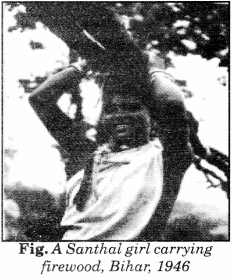
NCERT Solutions for Class 8 Social Science History Chapter 4 Tribals, Dikus and the Vision of a Golden Age
Baiga men hunted animals and cut big trees while the women cut stalks that were already reaped, collected wood for burning and cooking. Actually all the tribals had the same pattern. For menfolk it was mostly hunting and cutting big tree while for women folk some changes of work was noticed.

Activity 2
Find out whether the conditions of work in the mines have changed now. Check how many people die in mines every year, and what are the reasons for their death?
Answer:
Yes, now a days a lot of changes has occurred in the condition of work in the mines. Today, computer and modern technology is being used for mining. However, in developing countries the conditions of work are not that advanced. These countries use the same old pattern of mining. Even today many people die in the mines. The reasons are old methods of mining, no modern tools , poisonous gases, old technology and not much experience.

NCERT Solutions for Class 8 Social Science

NCERT Solutions for Class 8 Sanskrit Ruchira Bhag 3 | Download Class 8th Sanskrit Solutions

NCERT Solutions Class 8 Sanskrit

NCERT Solutions for Class 8 Sanskrit Ruchira Bhag 3: Do you want to finish your Sanskrit homework efficiently and learn how to tackle questions in exams then make use of our NCERT Solutions of 8th Class Sanskrit. CBSE Class 8 Sanskrit Notes available here make it easy for you to score well in exams. Elaborate Solutions provided by experts will develop the required skills and you can handle difficult questions too with ease.

Students can easily access the NCERT Solutions for Class 8 Sanskrit New Book Ruchira Bhag 3 रुचिरा भाग 3 Text Book Questions and Answers are designed as per the latest CBSE Curriculum and guidelines. Download the Student-Friendly NCERT Book Solutions of Class 8 Sanskrit Ruchira Bhag 3 PDF for free and kickstart your preparation.

NCERT Solutions of Class 8 Sanskrit रुचिरा भाग 3 | Sanskrit Class 8 NCERT Solutions

Here you can access the Chapterwise NCERT Solutions of Class 8 Sanskrit via quick links available. Just tap on the respective chapter you wish to prepare and learn the topics associated easily.

MCQ Questions for Class 8 Sanskrit

  1. सुभाषितानि Class 8 MCQ
  2. बिलस्य वाणी न कदापि में श्रुता Class 8 MCQ
  3. डिजीभारतम् Class 8 MCQ
  4. सदैव पुरतो निधेहि चरणम् Class 8 MCQ
  5. कण्टकेनैव कण्टकम् Class 8 MCQ
  6. गृहं शून्यं सुतां विना Class 8 MCQ
  7. भारतजनताऽहम् Class 8 MCQ
  8. संसारसागरस्य नायकाः Class 8 MCQ
  9. सप्तभगिन्यः Class 8 MCQ
  10. नीतिनवनीतम् Class 8 MCQ
  11. सावित्री बाई फुले Class 8 MCQ
  12. कः रक्षति कः रक्षितः Class 8 MCQ
  13. क्षितौ राजते भारतस्वर्णभूमिः Class 8 MCQ
  14. आर्यभटः Class 8 MCQ
  15. प्रहेलिकाः Class 8 MCQ

MCQ Questions for Class 8 Sanskrit Grammar with Answers व्याकरण

NCERT Sanskrit Class 8 Solutions PDF Download

Boost your exam preparation by taking the help of the quick resources over here. Class 8th Sanskrit Ruchira Bhag 3 NCERT Solutions are easy to comprehend and help you understand all the topics in a much better way. In our NCERT Solutions for 8th Std Sanskrit, you will find all chapterwise and exercise-wise questions. You can have a strong base and can be useful in the long run as you can use them from anywhere and anytime.

If you are unable to find answers to any of the questions then you can rely on our NCERT Books for Class 7 Sanskrit as they are highly accurate and straightforward. start gearing up with this NCERT Solutions of Class 7th Sanskrit and reach good grades in your academics.

FAQs on Class 8th संस्कृत रुचिरा भाग NCERT Solutions PDF

1. Which website offers Chapterwise NCERT Solutions of Class 8 Sanskrit?

NCERTBooks.guru offers Chapterwise NCERT Solutions of Class 8 Sanskrit all explained in detail.

2. How to download Class 8 Sanskrit NCERT Book Solutions?

You can download Class 8 Sanskrit NCERT Book Solutions by simply clicking on the quick links available.

3. Does preparing from NCERT Sanskrit Ruchira Bhag 3 Solutions for Class 8 help me score well?

Yes, you can score well by preparing from the NCERT Solutions for Class 8 Ruchira Bhag 3 as you will get a complete overview of the syllabus.

Final Words

If you feel the article is worthy do share it among your friends and help them learn from the best resources too. For any suggestions or feedback do reach us via the comment section. Keep connected to us to have the latest information on NCERT Solutions of all subjects at your fingertips.