NCERT Solutions for Class 10 Maths Chapter 6 Triangles

NCERT Solutions for Class 10 Maths Chapter 6 Triangles

Class 10 Maths NCERT Solutions Chapter 6: In this article, you will find all the Solutions for Class 10 Maths Chapter Triangles. Make use of them during your preparation and score decent marks in the board examination. Enhance your knowledge of Class 10 Maths Triangles with the best NCERT solutions prepared by our experts. You can continue reading to avail all the Notes, Important Questions and Formulas related to Class 10 Maths NCERT Chapter 6 Triangles. Get to know the CBSE NCERT Class 10 Maths Solutions for Triangles in an elaborate way. By Practicing the Class 10 Maths NCERT Chapter 6 Solutions on a regular basis you can overcome the exam pressure. In addition, you will have all the Exercises(6.6, 6.5, 6.4, 6.3, 6.2, 6.1) Solutions for Class 10 Maths Triangles in both Hindi and Engish Mediums. Download the PDF for NCERT Class 10 Maths Chapter 6 using the link prevailing on our page and practice them as and when you need it.

NCERT Solutions for Class 10 Maths Chapter 6 – Triangles

All the Class 10 Maths NCERT Solutions for Triangles are prepared by our experts with an aim to help students in solving difficult questions too with ease. Complex Fundamentals are made simple to understand by you with a step by step solution. For a better understanding of the Questions continue reading the article and ease your preparation for the NCERT Class 10 Maths Exam.

Class 10
Subject Maths
Book Mathematics
Chapter Number 6
Name of the Chapter Triangles

Class 10 Maths NCERT Solutions Chapter 6 Triangles Ex 6.1

NCERT Solutions for Class 10 Maths Chapter 6 Triangles Ex 6.1 1 NCERT Solutions for Class 10 Maths Chapter 6 Triangles Ex 6.1 2

Class 10 Maths NCERT Solutions Chapter 6 Triangles Ex 6.2

NCERT Solutions for Class 10 Maths Chapter 6 Triangles Ex 6.2 1 NCERT Solutions for Class 10 Maths Chapter 6 Triangles Ex 6.2 2 NCERT Solutions for Class 10 Maths Chapter 6 Triangles Ex 6.2 3 NCERT Solutions for Class 10 Maths Chapter 6 Triangles Ex 6.2 4 NCERT Solutions for Class 10 Maths Chapter 6 Triangles Ex 6.2 5 NCERT Solutions for Class 10 Maths Chapter 6 Triangles Ex 6.2 6 NCERT Solutions for Class 10 Maths Chapter 6 Triangles Ex 6.2 7 NCERT Solutions for Class 10 Maths Chapter 6 Triangles Ex 6.2 8 NCERT Solutions for Class 10 Maths Chapter 6 Triangles Ex 6.2 9 NCERT Solutions for Class 10 Maths Chapter 6 Triangles Ex 6.2 10 NCERT Solutions for Class 10 Maths Chapter 6 Triangles Ex 6.2 11 NCERT Solutions for Class 10 Maths Chapter 6 Triangles Ex 6.2 12 NCERT Solutions for Class 10 Maths Chapter 6 Triangles Ex 6.2 13

Class 10 Maths NCERT Solutions Chapter 6 Triangles Ex 6.3

NCERT Solutions for Class 10 Maths Chapter 6 Triangles Ex 6.3 1 NCERT Solutions for Class 10 Maths Chapter 6 Triangles Ex 6.3 2 NCERT Solutions for Class 10 Maths Chapter 6 Triangles Ex 6.3 3 NCERT Solutions for Class 10 Maths Chapter 6 Triangles Ex 6.3 4 NCERT Solutions for Class 10 Maths Chapter 6 Triangles Ex 6.3 5 NCERT Solutions for Class 10 Maths Chapter 6 Triangles Ex 6.3 6 NCERT Solutions for Class 10 Maths Chapter 6 Triangles Ex 6.3 7 NCERT Solutions for Class 10 Maths Chapter 6 Triangles Ex 6.3 8 NCERT Solutions for Class 10 Maths Chapter 6 Triangles Ex 6.3 9 NCERT Solutions for Class 10 Maths Chapter 6 Triangles Ex 6.3 10 NCERT Solutions for Class 10 Maths Chapter 6 Triangles Ex 6.3 11 NCERT Solutions for Class 10 Maths Chapter 6 Triangles Ex 6.3 12 NCERT Solutions for Class 10 Maths Chapter 6 Triangles Ex 6.3 13 NCERT Solutions for Class 10 Maths Chapter 6 Triangles Ex 6.3 14 NCERT Solutions for Class 10 Maths Chapter 6 Triangles Ex 6.3 15 NCERT Solutions for Class 10 Maths Chapter 6 Triangles Ex 6.3 16

Class 10 Maths NCERT Solutions Chapter 6 Triangles Ex 6.4

NCERT Solutions for Class 10 Maths Chapter 6 Triangles Ex 6.4 1 NCERT Solutions for Class 10 Maths Chapter 6 Triangles Ex 6.4 2 NCERT Solutions for Class 10 Maths Chapter 6 Triangles Ex 6.4 3 NCERT Solutions for Class 10 Maths Chapter 6 Triangles Ex 6.4 4 NCERT Solutions for Class 10 Maths Chapter 6 Triangles Ex 6.4 5 NCERT Solutions for Class 10 Maths Chapter 6 Triangles Ex 6.4 6 NCERT Solutions for Class 10 Maths Chapter 6 Triangles Ex 6.4 7

Class 10 Maths NCERT Solutions Chapter 6 Triangles Ex 6.5

NCERT Solutions for Class 10 Maths Chapter 6 Triangles Ex 6.5 1 NCERT Solutions for Class 10 Maths Chapter 6 Triangles Ex 6.5 2 NCERT Solutions for Class 10 Maths Chapter 6 Triangles Ex 6.5 3 NCERT Solutions for Class 10 Maths Chapter 6 Triangles Ex 6.5 4 NCERT Solutions for Class 10 Maths Chapter 6 Triangles Ex 6.5 5 NCERT Solutions for Class 10 Maths Chapter 6 Triangles Ex 6.5 6 NCERT Solutions for Class 10 Maths Chapter 6 Triangles Ex 6.5 7 NCERT Solutions for Class 10 Maths Chapter 6 Triangles Ex 6.5 8 NCERT Solutions for Class 10 Maths Chapter 6 Triangles Ex 6.5 9 NCERT Solutions for Class 10 Maths Chapter 6 Triangles Ex 6.5 10 NCERT Solutions for Class 10 Maths Chapter 6 Triangles Ex 6.5 11 NCERT Solutions for Class 10 Maths Chapter 6 Triangles Ex 6.5 12 NCERT Solutions for Class 10 Maths Chapter 6 Triangles Ex 6.5 13

Class 10 Maths NCERT Solutions Chapter 6 Triangles Ex 6.6

NCERT Solutions for Class 10 Maths Chapter 6 Triangles Ex 6.6 1 NCERT Solutions for Class 10 Maths Chapter 6 Triangles Ex 6.6 2 NCERT Solutions for Class 10 Maths Chapter 6 Triangles Ex 6.6 3 NCERT Solutions for Class 10 Maths Chapter 6 Triangles Ex 6.6 4 NCERT Solutions for Class 10 Maths Chapter 6 Triangles Ex 6.6 5 NCERT Solutions for Class 10 Maths Chapter 6 Triangles Ex 6.6 6 NCERT Solutions for Class 10 Maths Chapter 6 Triangles Ex 6.6 7 NCERT Solutions for Class 10 Maths Chapter 6 Triangles Ex 6.6 8 NCERT Solutions for Class 10 Maths Chapter 6 Triangles Ex 6.6 9 NCERT Solutions for Class 10 Maths Chapter 6 Triangles Ex 6.6 10 NCERT Solutions for Class 10 Maths Chapter 6 Triangles Ex 6.6 12 NCERT Solutions for Class 10 Maths Chapter 6 Triangles Ex 6.6 13

Maths NCERT Solutions Class 10 Chapter 6 – Solved Exercises

Mindmap and brush up the concepts well with the Example Problems and Solutions given here. Go through the formulas and notes existing as per the latest NCERT Class 10 Syllabus prescribed by UP, MP, CBSE boards. Use the solutions for NCERT Class 10 Triangles Ex 6.1, 6.2, 6.3, 6.4, 6.5, 6.6 in the further sections and understand the method used to approach. In that way, you can score good marks in your Class 10 Maths Board Examination.

You will have a maximum weightage from chapter 6 constituting a total weightage of 8 Marks. Out of which there will be a 1 Mark, 3 Mark, and 4 Marks Question. There are chances of getting Theorems either in 3 or 4 Marks Question. So, Practice theorems more as they are important and can get you a good score.

Avail the PDF for NCERT Class 10 Maths Chapter 6 Triangles and keep them handy to practice as often as possible. For the sake of your comfort, we have compiled NCERT Class 10 Maths Solutions in Hindi and English mediums respectively.

I hope this article on Class 10 Maths NCERT Solutions Chapter 6 has shed some light on you in understanding the concepts better. For any queries or suggestions do contact us via the comment section and we will try to resolve them within a short notice.

Chapter-wise NCERT Textbook Solutions of Class 10 Science PDF Download Free

NCERT Solutions for Class 10 Science PDF Download

NCERT Solutions for Class 10 Science PDF links available here are free to view and download on your devices. From CBSE 10th Science NCERT Solutions Chapterwise PDFs, you can discover various solved and unsolved questions and exercises along with sample papers & a list of important questions for every concept. Practicing all these questions and answers from the chapters of physics, chemistry, and biology will aid students to enhance their subject knowledge and secure good grades in the exams.

Free PDF Download of NCERT Solutions for Class 10 Science English and Hindi Medium

Class 10 NCERT Science Solutions Book is the only guide that covers the complete syllabus with extra knowledge. From this ultimate guide, CBSE students can gain subject skills and utilize them during their final exams for better scores. If you are worried about who has been prepared these NCERT Textbook Solutions for 10th std science can keep their worries aside.

As it is designed by experienced subject teachers as per the latest Class 10 Science CBSE Syllabus. Download the free pdf links of English and Hindi medium 10th science NCERT Book Solutions along with CBSE Class 10 Science book PDF and kickstart your preparation without any hurdles.

  1. Chemical Reactions and Equations (रासायनिक अभिक्रियाएँ और समीकरण )
  2. Acids, Bases and Salts (अम्ल, क्षार एवं लवण )
  3. Metals and Non-metals (धातु और अधातु )
  4. Carbon and Its Compounds (कार्बन और इसके यौगिक )
  5. Periodic Classification of Elements (तत्वों के आवर्त वर्गीकरण )
  6. Life Processes (जैव-प्रक्रम )
  7. Control and Coordination (नियंत्रण एवं समन्वय )
  8. How do Organisms Reproduce? (जीव जनन कैसे करते है )
  9. Heredity and Evolution (अनुवांशिकता एवं जैव विकास )
  10. Light Reflection and Refraction (प्रकाश-परावर्तन एवं अपवर्तन )
  11. Human Eye and Colourful World (मानव-नेत्र एवं रंगबिरंगी दुनियाँ )
  12. Electricity (विद्युत )
  13. Magnetic Effects of Electric Current (विद्युत धारा का चुम्बकीय प्रभाव )
  14. Sources of Energy (उर्जा के स्रोत )
  15. Our Environment (हमारा पर्यावरण )
  16. Management of Natural Resources (प्राकृतिक संसाधनों का प्रबंधन)

MCQ Questions for Class 10 Science

Students preparing for the board examination should opt for CBSE Class 10 Science NCERT Solutions PDF and MCQ Questions for 10th Science with Answers PDF Study Resources as they play a crucial role in scoring better marks. So, download Physics, chemistry, biology MCQs with Answers Chapterwise PDFs from the below links & practice daily.

MCQ Questions for Class 10 Science Chemistry with Answers

Biology MCQs For Class 10 Chapter Wise with Answers

MCQ Questions for Class 10 Science Physics with Answers

NCERT Solutions for Class 10 Science PDF Download

Along with NCERT Solutions and Multiple choice questions for class 10 science, we would also advise you to study important questions for class 10 Science from the material link dropped here. In the below sections, we are going to discuss each and every chapter covered in NCERT Science Textbook in short.

Class 10 NCERT Science Solutions for Physics Chemistry Biology Chapters Brief

The most important subjects for class 10 pursuing students are Science and Maths. Science plays a vital role in assisting students to select their streams in higher studies. If you are interested in science streams then having a good grip on the fundamentals concepts of science is very important. So, understand the concepts by following the NCERT Solutions for Class 10 Science PDF chapters brief discussed below and score high in exams.

Chapter 1 – Chemical Reactions and Equations (रासायनिक अभिक्रियाएँ और समीकरण )

In class 10 science, the first chapter is introduced with the chemistry concepts that help students to learn deeply about the basics of chemical reactions and equations. From this chapter, you will understand the way of writing chemical equations and balance them, types of chemical reactions, combination reaction, displacement reaction, double displacement reaction, effects of oxidation reactions, corrosion, rancidity.

Chapter 2 – Acids, Bases, and Salts (अम्ल, क्षार एवं लवण )

After getting a good grip on chemical reactions & equations concepts, it’s time to learn what are chemical properties and how they make things taste sour or bitter, their acidic or basic nature, and how substances are used to test this nature.

Moreover, you may acquire perfect knowledge about the importance of pH in everyday life, the pH range of acidic, basic &neutral solutions, and the wide applications of pH scale, chemical formulae, preparation, and chemical reactions of various important salts that are used in day-to-day life from this chapter.

Chapter 3 – Metals and Non-metals (धातु और अधातु )

Metals and Non-metals come under chemistry subject where it provides knowledge about physical properties, chemical properties of different metals and non-metals. Apart from that, you can also learn the reactivity of metals with non-metals and the properties of ionic compounds.

Chapter 4 – Carbon and Its Compounds (कार्बन और इसके यौगिक )

NCERT Class 10 Science Solutions of Chapter 4 deals with organic chemistry. Also, the chapter is about Carbon which is a versatile element found in many organic and inorganic compounds. Furthermore, you will learn the concepts like Covalent bonds in carbon, compounds derived from carbon, versatile nature, chemical properties of carbon, properties of Ethanol and Ethanoic acid, soaps, and detergents & their cleansing actions in this chapter.

Chapter 5 – Periodic Classification of Elements (तत्वों के आवर्त वर्गीकरण )

Have you ever wondered how the periodic table formed? If yes, then look at this chapter and learn how scientists classified elements based on their properties and organized them into the modern periodic table. Some of the major topics explained here are Döbereiner’s Triads, Newlands’ Law of Octaves and their limitations, trends in atomic size, valency, and physical & chemical properties of elements across the Modern Periodic Table.

Chapter 6 – Life Processes (जैव-प्रक्रम )

NCERT Solutions For Class 10 Science Chapter 6 Life Processes covers the discussion and explanation of various biological processes and reactions taking place in organisms. Apart from this, you will also learn a few major topics like What are Life Process?, Nutrition in Organisms: Autotrophic and Heterotrophic Nutrition, How do organisms obtain their nutrition, Nutrition in human beings: Respiration, Transportation & Excretion, Excretion in human beings and Plants in this chapter.

Chapter 7 – Control and Coordination (नियंत्रण एवं समन्वय )

In chapter 7 NCERT Solutions, kids will get the basic knowledge about the nervous system of human beings, an explanation about the anatomy of the Human Brain, coordination in plants, and hormones in animals.

Chapter 8 – How do Organisms Reproduce? (जीव जनन कैसे करते है )

Biology chapters can be very interesting for students to learn as they explain various modes of reproduction, including asexual and sexual reproductions, advanced types of reproduction, and diverse processes of reproduction.

Chapter 9 – Heredity and Evolution (अनुवांशिकता एवं जैव विकास )

One more biology chapter in NCERT Science solutions of class 10 is Heredity and Evolution. It completely deals with the passing of genes between different generations, details about the process of sex determination, Charles Darwin Theory to get familiar with the concept of Evolution, and many more.

Chapter 10 – Light Reflection and Refraction (प्रकाश-परावर्तन एवं अपवर्तन )

NCERT Solutions for class 10 science chapter 10 Light Reflection and Refraction illustrates the theories of reflection and refraction of light. Moreover, you will get a deeper knowledge about Image formation by plane mirror/curved mirrors and lenses. From this chapter, you can also get the knowledge about a few important topics such as:

  • Reflection of light
  • Power of Lens
  • Image formation by spherical lenses
  • Image formation by spherical mirrors
  • Mirror formula and magnification
  • Sign convention for reflection by spherical mirrors
  • Refraction of Light
  • Refraction through a rectangular glass slab
  • Refractive index
  • Refraction by spherical lenses
  • Sign Convention for refraction by spherical lenses
  • Lens Formula and Magnification

Chapter 11 – Human Eye and Colourful World (मानव-नेत्र एवं रंगबिरंगी दुनियाँ )

This chapter entirely focuses on the human eye structure and the functions which are involved in every single part of the eye. Some other concepts like various eye defects such as myopia, hypermetropia, refraction through a prism, depression of white light by a glass prism, refraction through the atmosphere, Tyndall effect, and Scattering of light are explained here as it helps students to understand how to cure people eye problems in their life.

Chapter 12 – Electricity (विद्युत )

Chapter 12 deals all about Electricity which we use in our day-to-day life. Having a better grip on all electricity concepts helps you understand the problems that you face in real life. Here in this chapter, you will learn the concepts of electric current, circuit diagram, potential difference, resistance, the combination of resistance, heating effects of current and electrical power, constituents of electricity, current flow in an electrical circuit, Ohm’s law, resistivity, Joule’s law, electric fuse, electric power.

Chapter 13 – Magnetic Effects of Electric Current (विद्युत धारा का चुम्बकीय प्रभाव )

Studying the magnetic effects of electric current is more important for students to know that Electricity and Magnetism are related phenomena. Practical applications – electromagnets, electric motor (magnetic effect of electric current), and electric generators (electric effect of moving magnets) are some of the important topics explained deeply in this chapter.

Chapter 14 – Sources of Energy (उर्जा के स्रोत )

NCERT Class 10 Science Chapter 14 Sources of Energy Solutions are explained here. The major concepts included in this chapter are as follows:

  • Ideal source of energy
  • Non-Conventional Sources of Energy: Solar Energy, Energy from Sea, Geothermal Energy, Nuclear Energy
  • Conventional sources of energy: Fossil fuels, thermal power plants, hydro-power plants
  • Renewable and non-renewable sources of energy and their availability in the long run
  • Bio-Mass and wind energy as major energy resources

On the other hand, this chapter also explains different forms of energy and their sources

Chapter 15 – Our Environment (हमारा पर्यावरण )

Knowledge about the environment that we live in is a must for all human beings not only students. So, this chapter completely deals with the importance of preserving the environment, ecosystem and its components, food chain, food web, waste management, biodegradable and non-biodegradable substances, a tropic level, biotic and abiotic components, producers, consumers, ozone formations & its depletion. Besides, the chapter also explains how to manage the garbage that humans produce

Chapter 16 – Management of Natural Resources (प्राकृतिक संसाधनों का प्रबंधन)

NCERT Solutions for class 10 science chapter 16 Sustainable Management of Natural Resources covers detailed information about different natural resources, their advantages, and conservation efforts. But, primarily the chapter concentrates on the following concepts:

  • Management of forests and wild-life
  • Management of fossil fuels; Coal and Petroleum
  • Natural resources and their management
  • Water harvesting
  • Dams

Unit-Wise Marking Scheme of CBSE Class 10 Science Term 2 Exam (Theory)

The unit-wise marks weightage list provided here is completely based on the latest CBSE Class 10 Science exam paper:

Unit Name Weightage
1 Chemical Substances-Nature and Behaviour 26
2 World of Living 23
3 Natural Phenomena 12
4 Effects of Current 14
5 Natural Resources 05
Total Marks 80
20 Marks will be Internal Assessment

FAQs on CBSE Class 10 Physics Chemistry Biology NCERT Solutions PDF

1. How students can find Solutions for NCERT 10th Science exercises questions online?

Students can find all chapters of NCERT solutions for class 10 science exercise questions online at NCERTBooks.Guru

2. How many chapters & what are there in the 10th NCERT Solutions Science?

NCERTBooks.Guru provided NCERT Solutions for Class 10 Science cover all the 16 textbook chapters. The list of all the chapters covered in the solutions of NCERT 10th std science are as follows:

  1. Chemical Reactions and Equations
  2. Acids, Bases, and Salts
  3. Metals and Non-metals
  4. Carbon and its Compounds
  5. Periodic Classification of Elements
  6. Life Processes
  7. Control and Coordination
  8. How do Organisms Reproduce?
  9. Heredity and Evolution
  10. Light – Reflection and Refraction
  11. The Human Eye and the Colorful World
  12. Electricity
  13. Magnetic Effects of Electric Current
  14. Sources of Energy
  15. Our Environment
  16. Sustainable Management of Natural Resources

3. Will NCERT 10th Class Solutions for Science PDFs be enough to score well in the board exam?

Yes, NCERT 10th Class Solutions for Science PDFs are enough to score high in the board exam. As it covers all chapters textbook and exercise questions with detailed solutions that clear all your doubts and improves your subject knowledge.

Conclusion

Students of Class 10 may also refer to the study materials like NCERT Class 10 Science Exemplar, NCERT Textbooks, NCERT 10th Science Syllabus as well as NCERT Solutions for Class 10 Science PDF at NCERTbooks.Guru for better preparation for exams. We believe this article has been helpful to you. If you have any questions, ask in the comment section below and we will get back to you at the earliest.

NCERT Solutions for Class 9 Social Science Civics Chapter 1 Democracy in the Contemporary World

NCERT Solutions for Class 9 Social Science Civics Chapter 1 Democracy in the Contemporary World

Textbook Exercises

1. Which of the following does not to the spread of democracy in the first decade after 1945?
(a) Struggle by the people
(b) Invasion by foreign countries
(c) End of colonialism
(d) People’s desire for freedom.
Answer:
(d) People’s desire for freedom.

2. Which of the following statement is true about today’s world:
(a) Monarchy as a form of government has vanished.
(b) The relationship betwefen different countries has become more democratic than ever before,
(c) In more and more countries, rulers are being elected by the people.
(d) There are no more military dictators in the world.
Answer:
(c) In more and more countries, rulers are being elected by the people.

3. Use one of {he following statements to complete the Sentence. Democracy in international organisations requires that:
(a) The rich countries should have a greater say
(b) Countries should have a say according to their military power.
(c) Countries should be treated with respect in proportion to their population
(d) All countries in the world should be treated equally.
Answer:
(d) All countries in the world should be treated equally.

4. Based on the information given in thischapter, match the following countries and Nhe path democracy has taken in that country:

Country Path to Democracy
(a) Chile I. Freedom from British colonial rule.
(b) Nepal II. End of military dictator-ship.
(c) Poland III. End of one Party rule
(d) Ghana IV. King agreed to give up his powers.

Answer:

Country Path to Democracy
(a) Chile II. End of military dictator-ship.
(b) Nepal IV. King agreed to give up his powers.
(c) Poland III. End of one Party rule
(d) Ghana I. Freedom from British colonial rule.

Question 1.
What are the difficulties people face in a non-democractic country ? Give answers drawing from the examples given in this chapter.
Answer:
People face numerous difficulties in a non-democratic country. Some such difficulties are as under :

  1. People are deviod of their basic rights;
  2. They are not allowed to protest against the atrocities inflicted on them;
  3. They are not permitted to express and demonstrate their opposition;
  4. They are not allowed to form, . organisations to state their grievances.
  5. They do not choose their rulers, nor change them.
  6. They do riot possess freedom; they do not express their opinion nor can they organise protest and political action.

Question 2.
Which freedoms are usually taken away when a demcoracy is overthrown by the military ?
Answer:
When a democracy is overthrown by a military, the people lose all their freedoms. They do not have the freedom to speech and, expression of their opinion. They cannot , form political organisations, or organise their protest and action.

Question 3.
Which of the following positions can contribute to democracy at the global level? Give reasons for your answer in each case.
(a) My country gives more money to international institutions. Therefore, I want to be treated with more respect and exercise more power.
(b) My country may be small or poor. But my voice must be, heard, with equal respect, because these decisions will affect my country.
(c) Wealthy nations will have a greater say in international affairs. They cannot let their interests suffer just because they are outnumbered by poor nations.
(d) Big countires like India must have a greater say in international organisations.
Answer:
(a) By merely giving more money to the international institutions, a country should not be treated with more respect and exercise power. Democracy does not thrive on luxuries, nor by the rich. It is platoracy, the rule of the rich, and hot the rule of the people.

(b) A country may be small in size and poor economically. Democracy will strength-en if all the countires, irrespective of their size oreconOmy, are treated equally. Decisions in democracy affect all the countries equally.

(c) If wealthy nations, because of their wealth, have a greater say in international affairs, they would make decisions which would promote; their interests. This would not contribute to democracy, rather it would harm it adversely.

(d) Countries Which are large in population and bigger in size such as India should have their say not at the cost of smaller ones. Representation of interests and number should be given corresponding weightage. John Stuart Mill was strongly of the view that the interest should not be sacrificed at the cost of number, nor the vice-versa.

Question 4.
Here are three opinions heard in a television debate on the struggle for democracy in Nepal. Which of these do you agr4e with and why?
Guest 1: India is a democracy. Therefore, the Indian government must support he people of Nepal who . are stuggling against’monarchy and for democracy.
Guest 2: That is a dangerous arugment. We would be in the same position as the US was in Iraq. Remember, no outside force can promote democracy.
Guest 3: But why should we bother about the internal affairs of another country? We should be worried about our business interests there, not about democracy.
Answer:
Democracy breeds from within. Imposition of democracy on others or from above is, indeed, dangerous as the USA. really did in Iraq. It is impertinent that any democratic country, India including, should encourage democracy wherever it exists, but no country should implant democracy. One can teach people swimming if they do not learn themselves to swim. The opinion of guest 3 is really weighty, for we should protect our interests in other countries, not that we make them democrat by losing our interest.

Question 5.
In an imaginary country called Happyland, the people overthrew the foreign ruler and brought back the old royal family. They said : “After all their ancestors were our kings before foreigners started ruling us. It is good that we have one strong ruler, – who can help us become rich and powerful”. When someone talked about democracy the wise men said it is a foreign idea. Their struggle was to throw the foreigners and their ideas out of the country. When someone demanded freedom for the media, the elders thought that too much criticism of the ruler would not help them improve their living standards. “After, all, the king is so kind and interested in the welfare of all the subjects. Why create problems for him. Don’t we all want to be happy?”
After reading the above passage, Chaman, Champa and Chandra made the following observations:
Chaman: Happyland is a democratic country because people were able to throw out the foreign rulers and bring back the king.

Champa: Happyland is not a democratic Country because people cannot criticise the ruler. The king may be nice and may provide economic prosperity, but a king cannot give a democratic rule.

Chandra: What people heed is happiness. So they are willing to allow their new ruler to take decisions for them. If people are happy to must be democracy.

What is your opinion about each of these statements? What do you think about the form of government in this country?
Answer:
Democracy means the rule of the people, by them and for them. A slave country is never a democratic Country. National independence is one where people are free from the foreign rule.

The liberation from the British and independence of India were connected with the democratic idea. But, if a country libertes itself from foreign rule and reverts back to the monarchical system does not make that democray, for monarchy is not democracy.

In fact, Where the rulers are hot subject to criticism by the people in general, there one does not find democracy. The essence of democracy is that the people rule themselves, that they can criticize their rulers and that they have freedom of opinion, and expression, and that they can change their rulers through election:

Democracy and happiness are not the same, A happy man is not a democratic man, though for a democracy, there is a need to have a good economy. People can build democracy and can also build their economy : the two supplement each other.

A country which has a kihg at its head is a monarchy and not a democracy, if the king is only a constitutional head, a country can be, as in Britain, a democratic form of a government.

These Solutions are part of NCERT Solutions for Class 9 Social Science. Here we have given NCERT Solutions for Class 9 Social Science Civics Chapter 1 Democracy in the Contemporary World.

NCERT Solutions for Class 12 Economics Free PDF Download | Chapterwise Class 12th Economics NCERT Book Solutions

NCERT Solutions Class 12 Economics PDF

NCERT Solutions of Class 12 Economics assists students in getting a firm grip on the subject. Our Expert Teachers have designed the NCERT Solutions for Class 12th Economics Textbook will guide you to understand the topics clearly. NCERT Solutions of Economics Class 12 gives you an overall idea of the subject as well as to score well in exams. The questions provided in the NCERT Books for Class 12 Economics have higher chances of appearing in exams.

Download Complete NCERT Solutions for class 6th to 12th

NCERT Solutions for Class 12 Economics Free PDF Download

Our Chapterwise NCERT Solutions of Class 12 Economics can be quite handy for you to complete your homework. Class 12th Economics NCERT Book Solutions acts as a step-by-step guide for all the textbook questions. 12th Class NCERT Solutions of Economics are present in a simple and easy-to-understand language and helps you perform better in exams. Chapterwise 12th Std NCERT Solutions of Economics will give you a good experience and provides opportunities to learn new things.

NCERT Solutions for Class 12 Micro Economics

NCERT Solutions for Class 12 Macro Economics

Download Free NCERT Textbooks PDF

CBSE Class 12 Economics NCERT Solutions

NCERT Solutions of Class 12 Economics are prepared in accordance with CBSE Guidelines. Evaluate your learning immediately taking the help of the 12th Class Economics NCERT Book Solutions. Make the most out of the CBSE Class 12 Economics Notes over here provided in a comprehensive manner and clear your doubts. Check your preparation standard by using other resources like MCQ Questions for Class 12 Economics with Answers and identify the areas of improvement. Download Class 12th Economics NCERT Book Solutions PDF and get a command over the subject.

Importance of Economics NCERT Solutions for Class 12?

There are plenty of advantages referring to the NCERT Solutions of Class 12 Economics. They are as follows

  • NCERT Solutions of Class 12 Economics Book provided are as per the Latest CBSE Class 12 Economics Syllabus.
  • Economics NCERT Solutions for Class 12th are provided in a simple and easy-to-understand language.
  • Downloadable PDF Versions make it easy for you to access anywhere and anytime in the world.
  • All the Solutions provided here will not just lay a strong foundation for the subject but also helps you revise the entire syllabus.
  • You can have immense practice using these Class 12 NCERT Book Solutions and enhance your memory.

FAQs on CBSE Class 12 Economics NCERT Solutions

1. Is there any website that offers the Class 12th Economics NCERT Book Solutions for free?

NCERTBooks.guru is a trusted website that offers the Class 12th Economics NCERT Solutions for free.

2. How many Chapters are there in the CBSE Class 12 Economics?

There are 12 Chapters in CBSE Class 12 Micro Economics & 10 Chapters in Class 12 Macro Economics.

3. How to download 12th Class NCERT Solutions of Economics?

You can download 12th Class NCERT Solutions of Economics by simply tapping on the quick links available.

Summary

Hope the information prevailing on our page with regards to NCERT Solutions of Class 12 Economics has shed some light on you. If you have any queries do reach us via comment box so that we can get back to you. Stay connected to our site to avail latest updates on NCERT Books, MCQ Questions with Answers, NCERT Solutions of other classes, etc.

NCERT Solutions for Class 9 Social Science Economics Chapter 4 Food Security in India

NCERT Solutions for Class 9 Social Science Economics Chapter 4 Food Security in India

Textbook Exercises

Question 1.
Some peoplesay that Bengal famine happened because there, was a shortage of rice. Study the table and find out whether you agree with the statement?
Answer:
Bengal famine occurred due to increasing price of rice.

Question 2.
Which year shows a drastic decline in food availability?
Ans. 1940.

Question 3.
Why is agriculture a seasonal activity
Answer:
Agriculture is a seasonal activity because it employs labour only during times of sowing, transplanting and harvesting.

Question 4.
Why is Ramu unemployed for about four months?
Answer:
Ramu works as a casual labourer in agriculture. Agriculture is a seasonal activity therefore he remains unemployed for about 4 months during the period of plant consolidation and maturing.

Question 5.
What does Ramu do when he is .unemployed?
Answer:
When he is unemployed he looks for work in other activities. Sometime he gets employment in brick laying or in construction activities in the village

Question 6.
Who are supplementing income in Ramu’s family.
Answer:
Ramu’s eldest son Somu and his wife Sundari are supplementing his income.

Question 7.
Why does Ramu face difficulty when he is unable to have work?
Answer:
Ramu and his family faces difficulty when he is unable to have work. Sometimes his kids have to sleep without food. He becomes food insecure during months when he remains unemployed.

Question 8.
When is Ramu food insecure?
Answer:
Ramu is food insecure when he is unemployed for 4 months.

Question 9.
Does Ahmad have a regular income from riskshaw-pulling?
Answer:
Ahmad’s income is not regular. His earnings fluctuate everyday.

Question 10.
How does the yellow card help Ahmad ran his family even with small, eamings from rickshaw-pnlling?
Answer:
The yellow card of Ahmad is a PDS card for people below poverty line; With this card, Ahmad gets sufficient quantity of wheat, rice, sugar and kerosene oil for his dailyuse. He gets these essentials at half of the market price. He purchases his monthly stock during a particular day when ration shop is opened for below poverty line. Thus, he is able to eke out his survival with less than sufficient earnings for his big family.

Question 11.
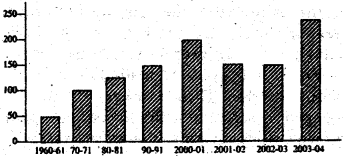
Study the graph 4.1 and answer the following questions:
NCERT Solutions for Class 9 Social Science Economics Chapter 4 Food Security in India 1
Graph 4.1 Production of food-grains in India (million tonnes)
Answer:
(a) In the year 2003-2004.
(b) Between 1960 to 1970. (c) No, it is not.

Question 12.
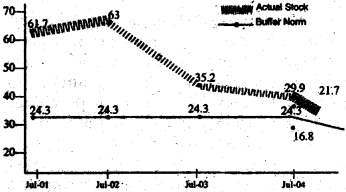
Study die graph 4.2 and answer the following questions:
NCERT Solutions for Class 9 Social Science Economics Chapter 4 Food Security in India 2
Graph 4.2 Central roodgrains (wheat + rice) Stock and Minimum Buffer Norm (million tonnes)
(a) In which recent year food-grains stock with the government as maximum?
(b) What is the minimum buffet stock norm for the FCI7
(c) Why were the FGI granaries over-flowing With food grains?
Answer:
(a) In July 2002.
(b) 24.3 million tonnes.
(c) Public distribution system, including the minimum support price and procurement has contributed to an “increase in food-grain production.
It made FCI granaries to overflow.

Question 13.
How is food security ensured in India?
Answer:
Indian government is trying to achieve self sufficiency in food-grains since independence. With the help of green revolution it succeeded in achieving it. Since 1970’s variety of crops are grown all over the country. The availability of food-grains at the country level has been further ensured with, a carefully designed food security system by the government. This system has two components: (a) buffer stock and, (b) public distribution system.

(a) Buffer stock—The stock of food-grains procured by the government through Food Corporation of India is called as buffer stock: The FCI procures these food grains from areas Where they are surplus. It purchases them from farmers at pre-announced price. Government maintains buffer stock to distribute food grains in the deficit areas and among the poorer strata .of society at a price lower than the market, price. This also helps resolve the problem of shortage of food during adverse weather conditions or during the calamity.

(b) Public distribution system—Supply of essential commodities by the govemment to the people is referred to as public distribution system. The food procured by the FCI is distributed through government regulated ration shops among the poorer section of the society. Ration shops are. also known as fair , price shops. These shops keep stock of food- grains, sugar, kerosene, oil for cooking. These items are sold to people at a.price lower than the market price.

Question 14.
Which are the people more prone to food insecurity?
Answer:
Although a large section of people suffer from food and nutrition insecurity in India, the worst affected groups are landless people with little or no land to depend upon, traditional artisans, providers of traditional services, petty self employed workers and destitutes including beggars. In the urban areas the food insecure families are those whose working members are generally employed in ill-paid occupations and causal labours market. These workers are largely engaged in seasonal activities and are paid very low wages that just ensure bare survival.

Question 15.
Which states are most food insecure in India?
Answer:
The food .insecure people are disproportionately large in some regions of the country, such as economically backward states with high incidence of poverty, tribal and remote areas, regions more prone, to natural disasters etc. In fact the state of Uttar Pradesh (eastern and south eastern parts), Bihar, Jharkhand, Orissa, West-Bengal, Chattisgarh, parts of Madhya Pradesh and Maharashtra account for largest number of food insecure people in the country.

Question 16.
Do you believe that green revolution has made India self sufficient in food-grains? How?
Answer:
In late 1960’s India adopted a new strategy in agriculture which resulted in the ‘green revolution’ especially in the production of wheat and rice.

But the increase of food-grains was, however, disproportionate. The highest rate of growth was achieved in Punjab and Haryana, where food-grain production jumped from 7.23 million tonnes in 1964-65 to reach an all time high of 30.33 million tonnes in 1995¬96. Production in Maharashtra, Madhya Pradesh, Bihar, Orissa and the north-eastern states continued to stagger. Tamil Nadu and Andhra Pradesh, on the other hand, recorded significant increases in rice yield.

Question 17.
A section of people in India are still without food? Explain?
Answer:
A section of the people is insecure during a few months when they remain unemployed because of the seasonal nature of agricultural work. They are engaged in seasonal activities and are paid very low wages that just ensure bare survival. At times it so happens that they have to stay without food.

Question 18.
What happens to supply of foods when there is a disaster or calamity?
Answer:
Due to a natural calamity, say draught, total production of food-grains decreases. It creates a shortage of food in the affected areas. Due to shortage of food, the prices go up. At the high prices, some people cannot afford to buy food. If such calamity happens in a very widespread areas or is stretched over longer time period, it may cause a situation of starvation. A massive starvation might take a turn of famine.

Question 19.
Differentiate between seasonal hunger and chronic hunger?
Answer:
Chronic hunger is a consequence of diets persistently inadequate in terms of quantity and/or quality. Poor people suffer from chronic hunger because of their very low income and in turn inability to buy food . even for survival. Seasonal hunger is related to cycles of food growing and harvesting. This is prevalent in rural areas because of the seasonal nature of agricultural activities and in urban areas because of the casual labour, e.g., there is less work for casual construction labour during the rainy season. This type of hunger exists when a person is unable to get work for the entire year.

Question 20.
What has our government done to provide food security to the poor? Discuss any two schemes launched by the government?
Answer:
Indian government is trying to achieve self sufficiency in. food-grams since independence. With the help of green revolution it succeeded in achieving it. Green revolution has avoided famine even during adverse weather conditions. Since 1970’s variety of crops are grown all over the country. The availability of food-grains at the country level has been further ensured with a carefully designed food security system by the government. This system has two components: (a) buffer stock and, (b) public distribution system.

(a) Buffer stock—The stock of food-grains
procured by the government through Food Corporation of India is called as buffer stock. The FCI procures these food-grains from areas where they are surplus. It purchases them from farmers at pre-announced price. Government maintains buffer stock to distribute food grains in the deficit areas and among the poorer strata of society at a price lower than the market price. This also helps resolve the problem of shortage of food during adverse weather conditions or during the calamity.

(b) Public distribution system—Supply of essential commodities by the government to the people is referred to as public distribution system. The food procured by the FCI is distributed through government regulated ration shops among the poorer section of the society. Ration shops are also known as fair price shops. These shops keejp stock of food- grains, sugar, kerosene, oil for cooking. These items, are sold to people at a price lower than the market’price.

Question 21.
Why is a buffer stock created by the government?
Answer:
Buffer stock is created to distribute food-grains in the deficit areas and among the poorer strata of society at a price lower than the market price also known as issue price.

Question 22.
Write notes on:
(a) Minimum support price,
(b) Buffer stock,
(c) Issue price,
(d) Fair price shops,
Answer:
(a) Minimum support price—
It is aprice at which FCI purchases food grain from farmers. This price is pre-announced. to encourage farmers for raising the production of crops. The price is announced every year before sowing. MSP has raised the the government.

(b) Buffer stock—
It is the stock of food grains, particularly wheat and rice, which the government procures through the Food Corporation of India (FCI). The FCI purchases these cereals directly from the farmers of those states where they are in surplus. The price of these commodities are announced much before the actual sowing season of these crops. The food grains thus purchased by the FCI are kept in big granaries and called ‘Buffer Stock’.

(c) Issue price—
It is the price at which the government distributes food- grains ‘ in the deficit areas and among the poorer strata of society. This price is lower than the market price.

(d) Fair price shops—
The food grains procured by the government through the Food Corporation of India are distributed among the poorer sections of the society through ration shops. These are called ‘Fair Price Shops’ because food grains are supplied to the poor through these shops at a price lower than the market price, which is often high.

Question 23.
What are the problems of functioning of ration shops?
Answer:
The problems of functioning of ration shops aire—
(i) The price of APL family is as high as market price.
(ii) Shopkeepers of these shops divert the grains to open market to earn profits.
(iii) Poor quality grains are sold at ration shops.
(iv) Irregular opening of shops.
(v) Unsold stocks of poor quality of grains are left. Thus a massive stock piles up with FQ. This increases maintenance cost.

Question 24.
Write a note on the role of co-operatives in providing food and related items.
Answer:
The co-operatives are also playing an important role in food security in India especially in the southern and western parts of the country. The cooperative societies set up shops to sell low priced foods to poor people. For example, out of all fair price shops running in Tamil Nadu, around 94 percent are being run by the co-operatives. In Delhi, Mother Dairy is making strides inprovision of milk and vegetables to toe consumers at con¬trolled rate decided by government of Delhi.

Similarly, in Maharashtra, Academy of Development Science (ADS) has facilitated a network of NGOs for setting up grain banks in different regions. ADS organises training and capacity building programmers on food-security for NGOs. Grain Banks are now slowly taking shape in different parts of Maharastra. ADS efforts to set up Grain Banks, to facilitate replication through other NGOs and to influence the government’s policy on food security are thus paying rich dividends. The ADS Grain Bank programme is acknowledged as a successful and innovative food security intervention.

Activity

Gather detailed information about some of the programmes initiated by the government, which have food component Discuss with your teacher.
Answer:

  1. Rural wage employment programme.
  2. Employment gurantee scheme.
  3. Sampuma Grameen Rojgar-Yojana.
  4. Mid day meal scheme.
  5. Integrated child development services etc.

These Solutions are part of NCERT Solutions for Class 9 Social Science. Here we have given NCERT Solutions for Class 9 Social Science Economics Chapter 4 Food Security in India.
NCERT Solutions for Class 10 Sanskrit Shemushi Chapter 8 विचित्रः साक्षी

Shemushi Sanskrit Class 10 Solutions Chapter 8 विचित्रः साक्षी

अभ्यासः

प्रश्ना 1.
अधोलिखितानां प्रश्नानाम् उत्तराणि संस्कृतभाषया लिखत-
(क) निर्धनः जनः कथं वित्तम् उपार्जितवान्?
उत्तर:
निर्धनः जनः अत्यधिक परिश्रम्य वितं उपार्जितवान्।

(ख) जनः किमर्थं पदातिः गच्छति?
उत्तर:
जनः अर्थपिडीतेन् पदातिः गच्छति।

(ग) प्रसृते निशान्धकारे स किम् अचिन्तयत्?
उत्तर:
प्रसृते निशान्धकारे स अचिन्तयत, यत् “विजने प्रदेशे पदयात्रा न शुभावह।”

(घ) वस्तुतः चौरः कः आसीत्?
उत्तर:
वस्तुतः चौरः आरक्षी एव आसीत्।

(ङ) जनस्य क्रन्दनं निशम्य आरक्षी किमुक्तवान्?
उत्तर:
जनस्य क्रन्दनं निशम्य आरक्षी उक्तवान्-“रे दुष्ट! तास्मिन् दिने त्वया अहं चोरितायाः मजूषायाः वारितः इदानी निज कृत्यस्य फलं भुङक्ष्व! आस्मिन् चौर्या भियोगे, त्वं वर्ष त्रयस्य कारादण्ड लाप्स्यसे इति।

(च) मतिवैभवशालिनः दुष्कराणि कार्याणि कथं साधयन्ति?
उत्तर:
मतिवैभवशालिनः दुष्कराणि कार्याणि नीतिं युक्त च समालम्ब्य लीलयैव साधयन्ति।

प्रश्ना 2.
रेखाङ्कितपदमाधृत्य प्रश्ननिर्माणं कुरुत-
(क) पुत्रं द्रष्टुं सः प्रस्थितः।
उत्तर:
कं द्रष्टुं सः प्रस्थितः?

(ख) करुणापरो गृही तस्मै आश्रयं प्रायच्छत्।
उत्तर:
करुणापरो गृही कस्मै आश्रयं प्रायच्छत्?

(ग) चौरस्य पादध्वनिना अतिथिः प्रबुद्धः।
उत्तर:
कस्य पादध्वनिना अतिथिः प्रबुद्धः?

(घ) न्यायाधीशः बंकिमचन्द्रः आसीत्।
उत्तर:
न्यायाधीशः कः आसीत्?

(ङ) स भारवेदनया क्रन्दति स्म।
उत्तर:
कथम् क्रन्दति स्म?

(च) उभौ शवं चत्वरे स्थापितवन्तौ।
उत्तर:
उभौ शवं कुत्र स्थापितवन्तौ?

प्रश्ना 3.
यथानिर्देशमुत्तरत–
(क) ‘आदेशं प्राप्य उभौ अचलताम्’ अत्र किं कर्तृपदम्?
उत्तर:
आरक्षी चौर्ययौ च

(ख) ‘एतेन आरक्षिणा अध्वनि यदुक्तं तत् वर्णयामि’-अत्र ‘मार्गे’ इत्यर्थे किं पदं प्रयुक्तम्?
उत्तर:
अध्वनि

(ग) ‘करुणापरो गृही तस्मै आश्रयं प्रायच्छत्’- अत्र ‘तस्मै’ इति सर्वनामपदं कस्मै प्रयुक्तम्?
उत्तर:
निर्धन जनाय

(घ) ‘ततोऽसौ तौ अग्रिमे दिने उपस्थातुम् आदिष्टवान्’ अस्मिन् वाक्ये किं क्रियापदम्?
उत्तर:
आदिस्टवान्

(ङ) ‘दुष्कराण्यपि कर्माणि मतिवैभवशालिनः’-अत्र विशेष्यपदं किम्?
उत्तर:
मति

प्रश्ना 4.
सन्धि/सन्धिविच्छेदं च कुरुत
(क) पदातिरेव – …………………. + ………………….
उत्तर:
पदातिरेव – पदातिः + एव

(ख) निशान्धकारे – …………………. + ………………….
उत्तर:
निशान्धकारे – निशा + अन्धकारे

(ग) अभि + आगतम् – ………………….
उत्तर:
अभि + आगतम् – अभ्यागतम्

(घ) भोजन + अन्ते – ………………….
उत्तर:
भोजन + अन्ते – भोजनान्ते

(ङ) चौरोऽयम् – …………………. + ………………….
उत्तर:
चौरोऽयम् – चौरः + अयम्

(च) गृह + अभ्यन्तरे – ………………….
उत्तर:
गृह + अभ्यन्तरे – गृहाभ्यन्तरे

(छ) लीलयैव – …………………. + ………………….
उत्तर:
लीलयैव – लीलया + एव

(ज) यदुक्तम् – …………………. + ………………….
उत्तर:
यदुक्तम् – यत् + उक्तम्

(झ) प्रबुद्धः + अतिथि: – ………………….
उत्तर:
प्रबुद्धः + अतिथि:- प्रबुद्धोऽतिथिः

प्रश्ना 5.
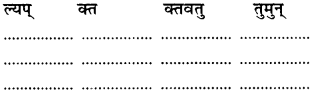
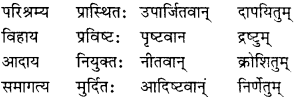
अधोलिखितानि पदानि भिन्न-भिन्नप्रत्ययान्तानि सन्ति। तानि पृथक् कृत्वा निर्दिष्टानां प्रत्ययानामधः लिखत-
परिश्रम्य, उपार्जितवान्, दापयितुम्, प्रस्थितः, द्रष्टुम् . विहाय, पृष्टवान्, प्रविष्टः, आदाय, क्रोशितुम्, नियुक्तः, नीतवान्, निर्णेतुम्, आदिष्टवान्, समागत्य, मुदितः।
NCERT Solutions for Class 10 Sanskrit Shemushi Chapter 8 विचित्रः साक्षी 1
उत्तर:
ल्यप् क्त क्तवतु तुमुन्
NCERT Solutions for Class 10 Sanskrit Shemushi Chapter 8 विचित्रः साक्षी 2

प्रश्ना 6.
(अ) अधोलिखितानि वाक्यानि बहुवचने परिवर्तयत-
(क) स बसयानं विहाय पदातिरेव गन्तुं निश्चयं कृतवान्।
उत्तर:
ते बसयानं विहाय पदातिरेव गंतुम् निश्चयं कृतवन्तः।

(ख) चौरः ग्रामे नियुक्तः राजपुरुषः आसीत्।
उत्तर:
चौराः ग्रामे नियुक्ताः राजपुरुषाः आसन्।

(ग) कश्चन चौरः गृहाभ्यन्तरं प्रविष्टः।
उत्तर:
केचन चौराः गृहाभ्यन्तरं प्रविष्टाः।

(घ) अन्येद्युः तौ न्यायालये स्व-स्व-पक्षं स्थापितवन्तौ।
उत्तर:
अन्येद्युः ते न्यायालये स्व-स्व-पक्षं स्थापितवन्त।

(आ) कोष्ठकेषु दत्तेषु पदेषु यथानिर्दिष्टां विभक्तिं प्रयुज्य रिक्तस्थानानि पूरयत
(क) सः ……….. निष्क्रम्य बहिरगच्छत्। (गृहशब्दे पंचमी)
उत्तर:
गृहात्

(ख) गृहस्थः आश्रयं प्रायच्छत्। (अतिथिशब्दे चतुर्थी)
उत्तर:
अतिथये

(ग) तौ …………. प्रति प्रस्थितौ। (न्यायाधिकारिन् शब्दे द्वितीया)
उत्तर:
न्यायोधिशं

(घ) …………… चौर्याभियोगे त्वं वर्षत्रयस्य कारादण्ड लप्स्यसे। (इदम् शब्दे सप्तमी)
उत्तर:
अस्मिन्

(ङ) चौरस्य …………….. प्रबुद्धः अतिथि:। (पादध्वनिशब्दे तृतीया)
उत्तर:
पादध्वनिना

प्रश्ना 7.
भिन्नप्रकृतिकं पदं चिनुत
(क) विचित्रा, शुभावहा, शङ्कया, मञ्जूषा
उत्तर:
शङ्कया

(ख) कश्चन, किञ्चित्, त्वरितं, यदुक्तम्
उत्तर:
कश्चन

(ग) पुत्रः, तनयः, व्याकुलः, तनूजः
उत्तर:
व्याकुलः

(घ) करुणापरः, अतिथिपरायणः, प्रबुद्धः, जनः
उत्तर:
प्रबुद्धः

अन्यपरीक्षोपयोगी प्रश्नाः

प्रश्ना 1.
रेखाड्किंत-पदानि आधृत्य प्रश्ननिर्माण कुरुत-
(क) सः न्यायाधीशम् अभिवाद्य निवेदितवान्।
उत्तर:
सः कम् अभिवाद्य निवेदितवान्?

(ख) शवं न्यायालये आनेतुम् आदिष्टवान्।
उत्तर:
शवं कुत्र आनेतुम् आदिष्टवान्?

(ग) ग्रामस्य आरक्षी एव चौरः आसीत्।
उत्तर:
कस्य आरक्षी एव चौरः आसीत्?

(घ) असौ गन्तव्यात दूरे आसीत्।
उत्तर:
असौ कस्मात् दूरे आसीत्?

(च) रुग्ण्ताम् आकर्ण्य व्याकुलः जातः।
उत्तर:
काम् आकर्ण्य व्याकुलः जातः?

प्रश्ना 2.
प्रस्तुत पाठं पठित्वा अधोलिखिति प्रश्नानां उत्तराणि लिखत-

1. एकपदेन उत्तरत
(क) पिता कस्य रुग्णताम् आकर्ण्य व्याकुलः जातः?
उत्तर:
तनूजस्य

(ख) गृही कीदृशः आसीत्?
उत्तर:
करुणापरः

(ग) वस्ततुः चौरः कः आसीत्?
उत्तर:
आरक्षी

(घ) न्यायाधीशः कं दोषभाजनम् अमन्यत?
उत्तर:
आरक्षिणम्

(च) सुपुष्टदेहः कः आसीत्?
उत्तर:
आरक्षी।

योग्यताविस्तारः

(क) विचित्रः साक्षी
न्यायो भवति प्रमाणाधीनः। प्रमाणं विना न्यायं कर्तुं न कोऽपि क्षमः सर्वत्र। न्यायालयेऽपि न्यायाधीशाः यस्मिन् कस्मिन्नपि विषये प्रमाणाभावे न समर्थाः भवन्ति। अतएव, अस्मिन् पाठे चौर्याभियोगे न्यायाधीशः प्रथमतः साक्ष्यं (प्रमाणम्) विना निर्णेतुं नाशक्नोत्। अपरेछुः यदा स शवः न्यायाधीश सर्वं निवेदितवान् सप्रमाणं तदा सः आरक्षिणे कारादण्डमादिश्य तं जनं ससम्मानं मुक्तवान्। अस्य पाठस्य अयमेव सन्देशः।

(ख) मतिवैभवशालिनः
बुद्धिसम्पत्तिसम्पन्नाः। ये विद्वांसः बुद्धिस्वरूपविभवयुक्ताः ते मतिवैभवशालिनः भवन्ति। ते एव बुद्धिचातुर्यबलेन असम्भवकार्याणि अपि सरलतया कुर्वन्ति।

(ग) स शवः
न्यायाधीश बंकिमचन्द्रमहोदयैः अत्र प्रमाणस्य अभावे किमपि प्रच्छन्नः जनः साक्ष्यं प्राप्तुं नियुक्तः जातः। यद् घटितमासीत् सः सर्वं सत्यं ज्ञात्वा साक्ष्यं प्रस्तुतवान्। पाठेऽस्मिन् शवः एव ‘विचित्रः साक्षी’ स्यात्।

These Solutions are part of NCERT Solutions for Class 10 Sanskrit. Here we have given NCERT Solutions for Class 10 Sanskrit Shemushi Chapter 8 विचित्रः साक्षी.