NCERT Solutions for Class 7 Social Science History Chapter 1 Tracing Changes Through a Thousand Years

Tracing Changes Through a Thousand Years Class 7 Questions and Answers History Chapter 1

Class 7 History Chapter 1 NCERT Textbook Questions and Answers

Question 1.
Who was considered a ‘Foreigner’ in the past?
Answer:
In the medieval period the term ‘Foreigner’ was used for any stranger who appeared say in a given village who was not a part of that society or culture. For example, a city-dweller, might have regarded a forest-dweller as a ‘foreigner’.

Question 2.
State whether true or false.
Answer:
(i) We do not find inscriptions for the period after 700.
(i) The Marathas asserted their political importance during this period.
(iii) Forest-dwellers were sometimes pushed out of their lands with the spread of agricultural settlements.
(iv) Sultan Ghiyasuddin Balban controlled Assam, Manipur and Kashmir.
Answer:
(i) False
(ii) True
(iii) False
(iv) False

Question 3.
Fill in the blanks
1. Archives were places where ………….. are kept.
2. ………….. was a fourteenth-century chronicler.
3. ………….., ………….., ………….. , ………….. and ………….. were some of the new crops introduced into the subcontinent during this period.
Anwer:
1. Manuscripts and documents
2. Ziyuddin Bami
3. Potatoes, Com, Chillies, Tea, Coffee.

Question 4.
List some of the technological changes associated with this period.
Answer:
Some technological changes associated with this period are”

  1. The use of the Persian wheel for irrigation.
  2. The use of shining wheel for wearing.
  3. The use of firearms in combat.

Question 5.
What were some of the major religion developments during this period?
Answer:
Some major religion developments of this period were”

  1. In Hinduism” They included the worship of new deities, constructed royal temples and there was growing importance of Brahamans.
  2. Another important development of this period was the emergence of Bhakti movement.

Question 6.
In what ways has the meaning of the term “Hindustan” changed over the centuries?
Answer:
Today, the term “Hindustan” we understand it as “India” However, when the term was used in the thirteenth century by Minhaj-i-Siraj, a chronicler who wrote in Persian, he meant the areas of Punjab, Haryana and the lands between the Ganga and Yamuna. He used the term in a political sense for lands that were a part of the dominions of The Delhi Sultan. However, in the early sixteenth century Babar used Hindustan to describe the geography the fauna and the culture of the inhabitants of the sub continent.

Though the idea of a geographical and cultural entity like “India” did exist the term “Hindustan” did not carry the political and national meaning which we associate with it today.

Question 7.
How were the affairs of Jatis regulated?
Answer:
Jatis framed their own rules and regulations to manage the conduct of their members. These regulations were informed by an assembly of elders, known as jati panchayat. The Jatis were required to follow the rules of their villages.

Question 8.
What does the term pan-regional empire mean?
Answer:
The term pan-regional empire refers to an empire spanning over diverse regions. The empires of Chola, Khalst, Tughlqs and Mughals were the examples of pan-regional empire. All there empires were equally successful and stable.

Question 9.
What are the difficulties historians face in using manuscripts?
Answer:
Manuscripts are hand written accounts of the contemporary world. During that time there were no printing press, so scribes copied manuscripts by hand. As scribes copied manuscripts they also introduced small changes-a word here, a sentence there. There brief differences grew over the centuries of copying until manuscripts of the same text became substantially different from one another. This created a lot of difference and created difficulties to the historians, what the original author was trying to say.

Question 10.
How do historians divide the past into periods ? Do they face any problems in doing so?
Answer:
The historians divide the past according to the time division. The study of time is made easier by dividing past into large segments and periods-that possess common characteristics.

The British historians divided the Indian history into three periods’

  1. Muslim Period
  2. Hindu period
  3. British Period

The above division was done on the basis of ideas that the religions of rulers was the only important change that took place and no other important change took place in the field of social and cultural life. However, the modem historians classify the history into the following three parts

  1. Ancient history
  2. Medieval history
  3. Modem history

The thousand year of Indian history witnessed considerable change. After all, the sixteenth and eighteenth centuries were quite different for the eight or the eleventh centuries. Therefore deserting the entire period as one historical unit is not without its problems.

Question 11.
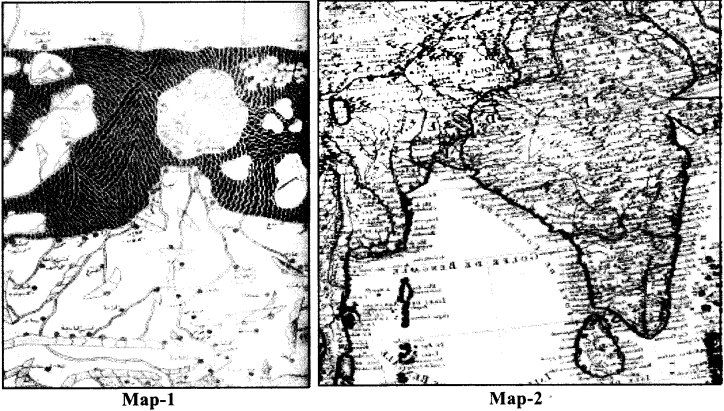
Compare either Map 1 or Map 2 with the present-day map of the subcontinent, listing as many similarities and differences as you can find.
NCERT Solutions for Class 7 Social Science History Chapter 1 Tracing Changes Through a Thousand Years 1
Answer:
Differences

  • Map 1 was made in the 12th century and Map 2 was made in the 18th century.
  • In both maps, parallel of latitude and longitudes were not shown.

Similarities

  • Both maps show the same geographical area.
  • The names mentioned in both maps are some what familiar.

Question 12.
Find out where records are kept in your village or city. Who writes their records? Is there an archive? Who manages it? What kinds of documents are stored there? Who are the people use are it?
Answer:
In a village, all records are kept in the panchayat Ghar. In cities records are kept in Municipal committees or Municipal Corporation. In village records are written by munshis and in cities records are written by clerks. Both in village and cities records are kept in almirahs in a store troom. All kinds of documents are stored here. The staff of the panchayat Ghar and MC use them when required
NCERT Solutions for Class 7 Social Science

NCERT Solutions for Class 10 Sanskrit Shemushi Chapter 4 शिशुलालनम्

Shemushi Sanskrit Class 10 Solutions Chapter 4 शिशुलालनम्

अभ्यासः

प्रश्ना 1.
अधोलिखितानां प्रश्नानाम् उत्तराणि संस्कृतभाषया लिखत-
(क) रामाय कुशलवयोः कण्ठाश्लेषस्य स्पर्शः कीदृशः आसीत्?
उत्तर:
रामाय कुशलवयोः कण्ठाश्लेषस्य स्पर्शः हद्धयग्राही आसीत्।

(ख) रामः लवकुशौ कुत्र उपवेशयितुम् कथयति?
उत्तर:
रामः लवकुशौ सिंहासनम् उपरि उपवेशयितुम् कथयति।

(ग) बालभावात् हिमकरः कुत्र विराजते?
उत्तर:
बालभावात् हिमकरः पशुपति मस्तके विराजते।

(घ) कुशलवयोः वंशस्य कर्ता कः?
उत्तर:
कुशलवयोः वंशस्य कर्ता भगवान सूर्यः।

(ङ) केन सम्बन्धेन वाल्मीकिः कुशलवयोः गुरुः आसीत्?
उत्तर:
उपनयनोपदेशन्: वाल्मीकिः कुशलवयोः गुरुः आसीत्।

(च) कुशलवयोः मातरं वाल्मीकिः केन नाम्ना आह्वयति?
उत्तर:
कुशलवयोः मातरं वाल्मीकिः ‘वधूः’ इति नाम्ना आह्वयति?

प्रश्ना 2.
रेखाङ्कितेषु पदेषु विभक्तिं तत्कारणं च उदाहरणानुसारं निर्दिशत-
यथा- राजन्! अलम् अतिदाक्षिण्येन
(क) रामः लवकुशौ आसनार्धम् उपवेशयति।
(ख) धिङ् माम् एवं भूतम्।
(ग) अटव्यवहितम् अध्यास्यतां सिंहासनम्
(घ) अलम् अतिविस्तरेण
(ङ) रामम् उपसृत्य प्रणभ्य च।
उत्तर:

विभक्तिः तत्कारणम्
(क) तृतीया ‘अलम्’ योगे
(ख) द्वितीया उपविश योगे
(ग) द्वितीया अधि + आस योगे
(घ) तृतीया अलम् योगे,
(ङ) द्वितीया उपसृत्य योगे

प्रश्ना 3.
यथानिर्देशम् उत्तरत
(क) ‘जानाम्यहं तस्य नामधेयम्’ अस्मिन् वाक्ये कर्तृपदं किम्?
उत्तर:
अहं

(ख) ‘किं कुपिता एवं भणति उत प्रकृतिस्था’- अस्मात् वाक्यात् ‘हर्षिता’ इति पदस्य विपरीतार्थकपदं चित्वा लिखत।
उत्तर:
कुपिता

(ग) विदूषकः (उपसृत्य) ‘आज्ञापयतु भवान्!’ अत्र भवान् इति पदं कस्मै प्रयुक्तम्?
उत्तर:
रामाय

(घ) ‘तस्मादक-व्यवहितम् अध्यास्याताम् सिंहासनम्’ – अत्र क्रियापदं किम्?
उत्तर:
अध्यास्याताम्

(ङ) ‘वयसस्तु न किञ्चिदन्तरम्’-अत्र ‘आयुषः इत्यर्थे किं पदं प्रयुक्तम्?
उत्तर:
वयः

प्रश्ना 4.
अधोलिखितानि वाक्यानि कः कं प्रति कथयति-
(क) सव्यवधानं न चारित्र्यलोपाय।
(ख) किं कुपिता एवं भणति, उत प्रकृतिस्था?
(ग) जानाम्यहं तस्य नामधेयम्।
(घ) तस्या द्वे नाम्नी।
(ङ) वयस्य! अपूर्व खलु नामधेयम्।
उत्तर:

कः कम्
रामः कुशलवौ प्रति
विदूषकः कुशं प्रति
कुशः राम प्रति
लवः विदूषक प्रति
रामः कुशं प्रति

प्रश्ना 5.
मञ्जूषातः पर्यायद्वयं चित्वा पदानां समक्षं लिखत-
शिवः शिष्टचारः शशिः चन्द्रशेखरः सतः इदानीम अधुना पुत्रः सूर्यः सदाचारः निशाकरः भानुः उत्तराणि
(क) हिमकरः – ………… + …………..
उत्तर:
हिमकरः – शशिः निशाकर

(ख) सम्प्रति – ………… + …………..
उत्तर:
सम्प्रति – इदानीम् अधुना

(ग) समुदाचारः – ………… + …………..
उत्तर:
समुदाचारः – शिष्टाचारः सदाचारः

(घ) पशुपतिः – …………. + …………..
उत्तर:
पशुपतिः – शिव चन्द्रशेखर

(ङ) तनयः – ………… + …………..
उत्तर:
तनयः – सतः पुत्रः

(च) सहस्रदीधितिः – ………… + …………..
उत्तर:
सहस्रदीधितिः- सूर्यः भानुः

प्रश्ना 6.
(अ) उदाहरणमनुसृत्य अधोलिखितेषु पदेषु प्रयुक्त-प्रकृतिं प्रत्ययञ्च लिखत-
पदानि – प्रकृतिः – प्रत्ययः
यथा- आसनम् – आस् + ल्युट् प्रत्ययः
(क) युक्तम् – ……………. + …………….
उत्तर:
युक्तम् – भुज् + क्त

(ख) भाजनम् – ……………. + …………….
उत्तर:
भाजनम् – भाज् + ल्युट्

(ग) शालीनता – ……………. + …………….
उत्तर:
शालीनता – शालीन + तल

(घ) लालनीयः – ……………. + …………….
उत्तर:
लालनीयः – लालन + अनीयर

(ङ) छदत्वम् – ……………. + …………….
उत्तर:
छदत्वम् – छद + त्व

(च) सन्निहितः – ……………. + …………….
उत्तर:
सन्निहितः – सत+नि + धा+क्त

(छ) सम्माननीया – ……………. + …………….
उत्तर:
सम्माननीया – सम्मानीय + ताप

(आ) विशेषण-विशेष्यपदानि योजयत-
यथा- विशेषण पदानि विशेष्य पदानि

श्लाघ्या कथा
(1) उदात्तरम्यः (क) समुदाचारः
(2) अतिदीर्घः (ख) स्पर्शः
(3) समरूपः (ग) कुशलवयोः
(4) हृदयग्राही (घ) प्रवासः
(5) कुमारयोः (ङ) कुटुम्बवृत्तान्तः

उत्तर:

श्लाघ्या कथा
(1) उदात्तरम्यः (क) समुदाचारः
(2) अतिदीर्घः (घ) प्रवासः
(3) समरूपः (ङ) कुटुम्बवृत्तान्तः
(4) हृदयग्राही (ख) स्पर्शः
(5) कुमारयोः (ग) कुशलवयोः

प्रश्ना 7.
(क) अधोलिखितपदेषु सन्धिं कुरुत

(क) द्वयोः + अपि – ………….
उत्तर:
द्वयोः + अपि – द्वयोरपि

(ख) द्वौ + अपि – ………….
उत्तर:
द्वौ + अपि – द्वावपि

(ग) कः + अत्र – ………………
उत्तर:
कः + अत्र – कोऽत्र

(घ) अनभिज्ञः + अहम् – ……….
उत्तर:
अनभिज्ञः + अहम् – अनभिज्ञोऽहम्

(ङ) इति + आत्मानम् – ………..
उत्तर:
इति + आत्मानम् – इत्यात्मानम्

(ख) अधोलिखितपदेषु विच्छेदं कुरुत-

(क) अहमप्येतयोः – ………….
उत्तर:
अहमप्येतयोः – अहम् + अपि + एतयोः

(ख) वयोऽनुरोधात् – ………….
उत्तर:
वयोऽनुरोधात् – वयः + अनरोधात्

(ग) समानाभिजनौ – ………….
उत्तर:
समानाभिजनौ – समान् + अभिजनौ

(घ) खल्वेतत् – ………….
उत्तर:
खल्वेतत् – खल + एतत्

परीक्षा उपयोगी अन्य प्रश्नाः

प्रश्ना 1. प्रस्तुत पाठ पठित्वा अधीलिखित प्रश्नानां उत्तराणि-लिखत
(प्रस्तुत पाठ को पढ़कर निम्नलिखित प्रश्नों के उत्तर लिखिए)

1. एकपदेन उत्तरत
(क) ‘अम्बा’ इति कः कथयति?
उत्तर:
कुशः

(ख) तयोः गुरोः नाम किम्?
उत्तर:
वाल्मीमिः

(ग) “निरनुक्रोशः’ इति कः भणति?
उत्तर:
अम्बा

(घ) ‘केन सम्बधेन’? इति कः पृच्छति?
उत्तर:
श्रीरामः

(च) ‘उपनयनोपदेशेन’ इति कः कथयति?
उत्तर:
लवः।

2. पूर्णवाक्येन उत्तरत-
(क) रामस्य अन्तिकं कः प्रेष्यताम्?
उत्तर:
रामस्य अन्तिकं लक्ष्मणः प्रेष्यातम्।

(ख) सरस्वत्यवतार कीदृशः?
उत्तर:
सरस्वत्यवतारः अपूर्वः।

(ग) पुराणः व्रतनिधिः कः?
उत्तर:
पुराणः व्रतनिधिः वाल्मीकिः।

(घ) सवाष्पं कः अवलोकयति?
उत्तर:
सवाष्पं श्रीरामः अवलोकयति।

(च) अपूर्व खलु किम् आसीसत्?
उत्तर:
अपूर्व खलु नामधेयम् आसीत्।

2. भवति शिशुजनो वयोऽनुरोधाद्
गुणमहतामपि लालनीय एव।
व्रजतिध हिमकरोऽपि बालभावात्
पशुपति-मस्तक-केतकच्छत्वम्॥

अन्वय-
गुणमहताम् अपि वयोऽनुरोधात् शिशुजनः लालनीयः एव भवति। बालभावात् हि हिमकरः अपि पशुपति-मस्तक-केतच्छदत्वम् व्रजति।

भाव-
अत्यधिक गुणी लोगों के लिए भी छोटी उम्र के कारण बालक लालनीय ही होता है। चन्द्रमा बालभाव के कारण ही शटर के मस्तक का आभूषण बनकर केतकी पुष्पों से निर्मित चूड़ा की भाँति शोभित होता है।

भवन्तौ गायन्तौ कविरपि पुराणों व्रतनिधिर्
गिरां सन्दर्भेऽयं प्रथमवतीणों वसुमतीम्।
कथा चेयं श्लाघ्या सरसिरुहनाभस्य नियतं,
पुनाति श्रोतार रमयति च सोऽयं परिकरः॥

अन्वय-
भवन्तौ गायन्तौ, पुराणः व्रतनिधिः कविः अपि, वसुमतीम् प्रथमं अवतीर्णः गिराम् अयं सन्दर्भः, सरसिरुिहनाभस्य च इंच श्लाघ्या कथा, सः च अयं परिकरः नियंत श्रोतारं पुनाति रमयति च।

भाव-
भगवान् वाल्मीकि द्वारा निबद्ध पुराणपुरुष की कथा, कुश लव द्वारा श्री राम को सुनायी जानी थी, उसी की सूचना देते हुए नेपथ्य से कुश और लव को बिना समय नष्ट किये अपने कर्तव्य का पालन करने का निर्देश दिया जाता है। दोनों राम से आज्ञा लेकर जाना चाहते हैं तब श्री राम उपर्युक्त श्लोक के माध्यम से उस रचना का सम्मान करते हैं।

आप दोनों (कुश और लव) इस कथा का गान करने वाले हैं, तपोनिधि पुराण मुनि (वाल्मीकि) इस रचना के कवि हैं, धरती पर प्रथम बार अवतरित होने वाला स्फुट वाणी का यह काव्य है और इसकी कथा कमलनाभि विष्णु से सम्बद्ध है इस प्रकार निश्चय ही यह संयोग श्रोताओं को पवित्र और आनन्दित करने वाला है।

योग्यताविस्तारः

नाट्य-प्रसङ्गः
कुन्दमाला के लेखक दिङ्नाग ने प्रस्तुत नाटक में रामकथा के करुण अवसाद भरे उत्तरार्ध की नाटकीय सम्भावनाओं को मौलिकता से साकार किया है। इसी कथानक पर प्रसिद्ध नाटककार भवभूति का उत्तररामचरित भी आश्रित है। कुन्दमाला के छहों अटों का दृश्यविधान वाल्मीकि-तपोवन के परिसर में ही केन्द्रित है। प्रस्तुत नाटकांश पञ्चम अट से सम्पादित कर सटलित किया गया है। लव और कुश से मिलने पर राम के हृदय में उनसे आलिंगन की लालसा होती है। उनके स्पर्शसुख से अभिभूत हो राम, उन्हें अपने सिंहासन पर, अपनी गोद में बिठाकर लाड़ करते हैं। इसी भाव की पुष्टि में नाटक में यह श्लोक उद्धत है-

भवति शिशुजनो वयोऽनुरोधाद्
गुणमहतामपि लालनीय एव।
व्रजति हिमकरोऽपि बालभावात्
पशुपति-मस्तक-केतकच्छदत्वम्।।

शिशुस्नेहसमभावश्लोकाः
अनेन कस्यापि कुलाङ्कुरेण
स्पृष्टस्य गात्रेषु सुखं ममैवम् ।
कां निर्वृतिं चेतसि तस्य कुर्याद्
यस्यायमङ्कात् कृतिनः प्ररूढः ।। (कालिदासस्य)

अन्त:करणतत्त्वस्य दम्पत्योः स्नेहसंश्रयात् ।
आनन्दग्रन्थिरेकोऽयमपत्यमिति पठ्यते ।। (भवभूतेः)

धूलीधूसरतनवः
क्रीडाराज्ये स्वके च रममाणाः ।
कृतमुखवाद्यविकाराः
क्रीडन्ति सुनिर्भरं बालाः ॥ (कस्यचित्)

अनियतरुदित स्मित विराजत्
कतिपयकोमलदन्तकुड्मलाग्रम् ।
वदनकमलकं शिशोः स्मरामि
स्खलदसमञ्जसमञ्जुजल्पितं ते ।।

These Solutions are part of NCERT Solutions for Class 10 Sanskrit. Here we have given NCERT Solutions for Class 10 Sanskrit Shemushi Chapter 4 शिशुलालनम्.

NCERT Solutions for Class 12 Accountancy PDF Free Download | Accounts Class 12th NCERT Book Solutions

NCERT Solutions Class 12 Accountancy

NCERT Solutions for Class 12 Accountancy is considered an extremely helpful resource for exam preparation. Our Profuse Supply of NCERT Solutions of Class 12th Accountancy is created by experts in accordance with the CBSE Guidelines. NCERT Solutions of Class 12 Accountancy will give you the ability to tackle difficult questions too easily and lays a strong foundation in the Subject. Class 12 Accountancy NCERT Textbook Solutions are given in a simple and easy-to-understand language and gives you an extra edge in your preparation.

Here we are providing NCERT Solutions for class 12 Accountancy, the solutions are the latest and updated. You can download Solutions for each and every chapter listed below chapter-wise.

NCERT Solutions for Class 12 Accountancy Free PDF Download

All the NCERT Solutions of Class 12 Accountancy are as per the Latest Edition of NCERT Textbooks adhering to the CBSE Class 12 Accountancy Syllabus. You can find the Chapterwise Accountancy NCERT Solutions for Class 12 for both Parts I & II through the quick links below. Just tap on them and prepare the intended chapter you wish to access.

NCERT Solutions for Class 12 Part I (Accountancy: Partnership Accounts) 

NCERT Solutions for Class 12 Part II (Accountancy: Company Accounts and Analysis of Financial Statements)

Download Free NCERT Textbooks PDF

Class 12th Accountancy NCERT Solutions Download

Accountancy NCERT Solutions of Class 12 aids you in quickly revision of concepts. You can get a clear insight into the topics as all of them are explained in detail. There are more chances of appearing these questions in the CBSE Final Exams. All the Accountancy 12th Std NCERT Solutions covers the questions from NCERT Books Class 12 Accountancy.

Benefits of preparing from Accountancy Class XII NCERT Solutions

There are numerous benefits of referring to Class 12 Accountancy NCERT Solutions and we have outlined few of them below for your reference. They are as follows

  • NCERT Class 12 Accountancy Solutions provide a wide range of illustrative examples that aid students to comprehend and learn the concepts quickly.
  • 12th Std Accountancy NCERT Solutions will lay a strong foundation in basic accounting methodologies and principles.
  • The NCERT Textbook Solutions available here are handy and helps students in their exam and homework routine.
  • Preparation Material over here will assist students in learning the concepts in-depth as well as to reach better grades in exams.

FAQs on Class 12 Accountancy NCERT Book Solutions

1. Which books should I prefer for accountancy in class XII to make my accounts perfect?

NCERT Books can be great for Class XII students to prepare Accountancy Topics as the majority of the questions are asked from these books. Referring to too many books will only confuse you thus stick to 1 or 2 books and prepare well.

2. How many Chapters are there in Class 12 Board Accounts Books?

There are 11 Chapters in total for both the Parts in Class 12th Board Accounts Books.

3. Which is the best website that offers the Class 12th NCERT Accountancy Solutions?

NCERTBooks.guru offers the Class 12th NCERT Accountancy Solutions organized efficiently and you can access them for free.

Summary

Hope the knowledge shared with regards to NCERT Solutions of Class 12 Accountancy has shed some light on you. If you have any suggestions do ask us through the comment box so that we can get back to you. Keep connected to us to get the latest updates on NCERT Books, NCERT Solutions, MCQ Questions, CBSE Syllabus, etc.

NCERT Solutions Class 12 Chemistry PDF | Chemistry Class 12th Chapterwise NCERT Solutions

NCERT Solutions for Class 12 Chemistry available here will help students prepare the complex topics too efficiently. Class 12th Chemistry NCERT Solutions PDF here includes questions from the NCERT Books Class 12 Chemistry all arranged in a systematic format. 12th Class Chemistry Book NCERT Solutions are given after extensive research to make it easier for students to revise the entire syllabus before the exams themselves.

To cater to the needs of students learning we have outlined the Class 12 Chemistry NCERT Solutions both in offline and online formats. Make use of the study materials available for class 12 chemistry for free and get your doubts cleared. Practice the areas you are weak in regularly and attempt them confidently in exams and score well.

Class 12 Chemistry NCERT Solutions Free PDF Download Chapter wise

Have a strong conceptual base by referring to the quick resources over here for Class 12 Chemistry NCERT Solutions. Enhance problem-solving and analytical skills in you by answering the CBSE Class 12 NCERT Solutions for Chemistry Book. Chapterwise 12th Class Chemistry NCERT Solutions will give you a complete overview of the CBSE Class 12 Chemistry Syllabus and you can revise the concepts wisely.

You can also Download Free NCERT Textbooks for class 1st to 12th

NCERT Solutions Class 12 Chemistry Chapterwise Details

Have an overview of all the topics within each chapter of Class 12 Chemistry Books by referring below. Prepare accordingly and stand out from your peers.

Class 12 Chemistry Chapter 1 The Solid State

The first chapter for NCERT solutions for class 12 chemistry has 11 topics in it. As this is the first chapter it is very important to study and learn this chapter well. This CBSE Chemistry chapter will form a foundation for many other chapters in the Plus Two Chemistry textbook later on. In general, this chapter consists of the difference between crystalline solids and amorphous, solid-state, unit cells, imperfections among solids, etc. There are exercises at the end that can help students develop a better understanding of the chapter.

Class 12 Chemistry Chapter 2 Solutions

A minimum of 5 marks has always been asked from this NCERT 12 Chemistry chapter. Thus, this chapter becomes important for students to learn and understand. This Chemistry Solutions Class 12 chapter consists of topics like the concentration of solutions and various types of solutions. Furthermore, it also consists of solubility of gases and solids in liquid, the vapor pressure in a liquid solution, Raoult’s law, abnormal mola masses, non-ideal and ideal solutions, determination of molar masses, etc.

Class 12 Chemistry Chapter 3 Electrochemistry

Once this chapter is finished, a student will be told what an electrochemical cell is. Along with this, he will also learn about the difference between galvanic cells and electrolytic cells. This Chemistry NCERT Solutions Class 12 chapter also discusses the relationship between the standard potential of various cells, Gibbs energy cell, and its equilibrium constant.

Class 12 Chemistry Chapter 4 Chemical Kinetics

The students who want to pursue their careers in medical science and engineering should pay special attention to this chapter. This Class 12 Chemistry Solutions chapter has a total of 6 topics which covers topics like rate of a chemical reaction, factors influencing the rate of chemical reaction, integrated rate of equations, the rate of reaction due to the dependence of temperature, the first-order reaction of pseudo, etc.

Class 12 Chemistry Chapter 5 Surface Chemistry

In the 5th chapter of NCERT Solutions Class 12, 6 topics are explained. In this chapter, a 12th Chemistry student will be able to learn about adsorption and its classifications, classifying emulsions, describing interfacial phenomena along with their significance, explaining the results of adsorption on the basis of Freundlich adsorption isotherms, etc.

Class 12 Chemistry Chapter 6 General Processes and Principles of Isolation of Elements

There are 8 important topics that are discussed in this Class 12 Chemistry NCERT Solutions chapter. It is advisable for students to solve each and every question of this chapter seriously. This will help them develop a deep and detailed knowledge of this chapter along with its solutions. The topics that are covered in this 12 Chemistry chapter are the concentration of ores, the occurrence of metals, cleaning processes, extracting crude from ores, electrochemical and thermodynamic principles of metallurgy, use of iron, zinc, aluminum, copper, the refining process, and many more.

Class 12 Chemistry Chapter 7 p Block Elements

This is one of the longest chapters in the Chemistry Textbook. It is important that students go through this chapter well. Some topics that will be discussed in this chapter are oxides of nitrogen, group 15 elements, oxoacids of phosphorus, elements of group 16, allotropic forms of sulfur, chlorine, and many more.

Class 12 Chemistry Chapter 8 The d and f Block Elements

This NCERT Class 12 Chemistry chapter talks about the physical and general properties of elements in the transition group (d block), the formation of complex compounds and colored ions, variation in atomic sizes, ionic sizes, ionization of enthalpies, oxidation states, and magnetic properties. The Class 12 Chemistry Chapter specifically talks about the d and f block in the modern periodic table, chemical reactivity of transition metals, electronic configuration, and oxidation states.

Class 12 Chemistry Chapter 9 Coordination compounds

This is one of the complex chapters of the NCERT Solution Chemistry textbook and is related to chemical reactions and atoms. A total number of 8 topics are covered in this topic. Some of the important topics of this chapter are coordination compounds, coordination compounds and their bondings, coordination compounds and Werner’s theory, nomenclature, and isomerism of coordination compounds, etc. There are a few questions at the end of this Chemistry Solutions chapter for students to practice and detailed explanations for important questions is also given.

Class 12 Chemistry Chapter 10 Haloalkanes and Haloarenes

This 10th chapter in the NCERT 12 Chemistry Solutions textbook deals with haloarenes and haloalkanes. Once the chapter is completed, students will be able to name haloarenes and haloalkanes based ln the IUPAC nomenclature from the given structure. Furthermore, this chapter will help you understand various applications of organometallic compounds, correlate structures of haloarenes and haloalkanes with different types of reactions. Chemistry for Class 12 Students will also understand the reactions that are involved in the preparation of haloarenes and haloalkanes and the different types of reactions that they undergo.

Class 12 Chemistry Chapter 11 Alcohols Phenols and Ethers

A total of 6 topics in this 12th Chemistry chapter will help students in writing the names of phenols, ethers, and alcohols based on the IUPAC nomenclature. Furthermore, NCERT Chemistry students will also about the various physical properties of phenols, ethers, and alcohols. They will also understand the reactions that are involved in the process of making alcohols from phenols, alcohols, and others.

Class 12 Chemistry Chapter 12 Carboxylic Acids and Aldehydes Ketones

NCERT solutions for class 12 chemistry has all the chapters and their solutions that can help students solve the questions easily and understand the concepts better. After completing this chapter, students will be able to write common names and IUPAC names of aldehydes, ketones, and carboxylic acid. They will also define the structure of the compounds that contain functional groups of carbonyl and carboxyl groups and discuss various chemical and physical reactions of aldehydes, ketones, and carboxylic acid.

Class 12 Chemistry Chapter 13 Amines

This chapter dwells on the branch of organic chemistry and will help students understand topics like preparation of amines, the structure of amines, chemical reactions and physical properties of amines, the importance of diazonium salts while synthesizing aromatic compounds, etc.

Class 12 Chemistry Chapter 14 Biomolecules

This Chemistry NCERT Class 12 chapter deals with topics such as starch, glycogen, cellulose, etc. In this chapter, students will be able to learn about nucleic acids, proteins, carbohydrates, and vitamins based on their structures. They will also learn about explaining various characteristics of hormones, carbohydrates, nucleic acids, and proteins.

Class 12 Chemistry Chapter 15 Polymers

This entire NCERT Solutions for Class 12 Chemistry chapter is dedicated to polymers and you will learn about various topics like polymers, monomer, polymerization, classifying polymers based on their characteristics, source, etc. Students will also learn about the network or cross-linked polymers, linear branched-chain, and polymers that are useful for commercial purposes.

Class 12 Chemistry Chapter 16 Chemistry in Everyday Life

This is the chapter that explains the usefulness of chemistry in day-to-day life. The topics covered in this 12th Chemistry chapter are the classification of drugs, target interaction of drugs, therapeutic actions of drugs of different classes, chemicals added in foods, and many more. It is advisable to go through the questions given at the end of the Class 12 Chemistry NCERT chapter for better practice and understanding.

Besides this overview, we will also keep you updated on NCERT Solutions for class 12 chemistry. To complement your preparation use our other resources like MCQ Questions for Class 12 Chemistry with Answers and self examine your preparation standards.

Download Complete NCERT Solutions PDF from class 6th to 12th.

Benefits of NCERT Solutions of Class 12 Chemistry

Features of Class 12 Chemistry NCERT Solutions are as follows.

  • Concise and to-the-point answers make it easy for you to grasp the concepts better than ever before.
  • Step by Step explanations provided for all the questions will aid in understanding difficult topics too with ease.
  • Easily accessible and downloadable PDF Files allow students to prepare them both online and offline at their convenience.
  • All the solutions for Class 12 Chemistry are given after extensive research under expert supervision.
  • If you aren’t able to solve any question from textbooks the reference material over here can be quite handy.

FAQs on CBSE Class 12 Chemistry NCERT Solutions PDF Download

1. Does NCERT Solutions of Class 12 Chemistry help me in scoring well in board exams?

Yes, NCERT Solutions of Class 12 Chemistry help me in scoring well in board exams as they cover the entire syllabus.

2. Where can I find the Chapterwise NCERT Solutions for Class 12th Chemistry PDF?

You can find the Chapterwise NCERT Solutions for Class 12th Chemistry PDF on our page.

3. How many chapters are there in Class 12 Chemistry NCERT Solutions?

There are 16 chapters in total in the Class 12 Chemistry NCERT Solutions.

NCERT Solutions for Class 7 Social Science Civics Chapter 2 Role of the Government in Health

Role of the Government in Health Class 7 Questions and Answers Civics Chapter 2

Class 7 Civics Chapter 2 NCERT Textbook Questions and Answers

Question 1.
Would you associate all or some of these pictures with ‘health’ ? In what ways ? Discuss in groups.
Answer:
Some pictures are associated with health. Pollution and hair cutting saloons, etc. can create pollution and affect our health.

Question 2.
Pick two situations from the above collage (textbook) that are not related to illness and write two sentences on how they are related to health.
Answer:

  • Green vegetables and jogging are not related to illness.
  • Green vegetables are necessary in our diet.
  • Jogging helps to keep our body fit and healthy.

Question 3.
Can you provide a title to these columns?

India has the largest number of medical colleges in the world and is among the largest producers of doctors.
Approximately 15,000 new doctors qualify every year.
Most doctors settle in urban areas.

People in rural areas have to travel long distances to reach a doctor. The number of doctors with respect to the population is much less in rural areas.

Healthcare facilities have grown substantially over the years. In 1950, there were only 2,717 hospitals in Inida.

In 1991, there were 11,174 hospitals. In 2000, the number grew to 18,218.

About five lakh people die from tuberculosis every year. This number is almost unchanged since Independence!

Almost two million cases of malaria are reported every year and this number isn’t decreasing.

India gets a large number of medical tourists from many countries. They come for treatment in some of the hospitals in India that compare with the best in the world. We are not able to provide clean drinking water to all. 21 per cent of all Communicable diseases are water borne. For example, diarrhoea, worms, hepatitis, etc.
India is the fourth largest producer of medicines in the world and is also a large exporter of medicines. Half of all children in India do not get adequate food to eat and are undernourished.

Answer:
India is a developed country. Money more important than work.

Question 4.
In India, it is often said that we are unable to provide health services for all because the government does not have enough money and facilities. After reading the left hand column, do you think this is true ? Discuss.
Answer:
Hints :
No it is not true.
Most of the politicians and others in our country are corrupt. They think of themselves and not the people.

Question 5.
Why did Ranjan have to spend so much money? Give reasons.
Answer:
Ranjan was admitted in a private hospital and thus, he had to spend a lot of money. Private hospitals charge a lot and all tests are very expensive.

Question 6.
What problems did Aman face in the public hospital? How do you think the hospital can work in a better manner? Discuss.
Answer:
In the public hospital, Aman had to face many problems

  • He and his family had to wait in a long queue at the OPD counter.
  • For the blood test he had to stand in another queue.
  • The hospital was over crowded.

Question 7.
Where do you go when you are ill? Are there any problems that you face ? Write a paragraph based on your experience.
Answer:
When I am ill, I usually go to a private doctor. Most of the public hospitals are over crowded. However, in a private doctor’s clinic, there is also a rush but not like the public hospital. The charges of a private doctor are high and he normally gives medicine from his own clinic. Private doctors normally take four or five days to cure a patient, so that they can get the amount of fees from the patient.

Question 8.
What problems do we face in private hospitals? Discuss.
Answer:
In private hospital fees of doctor’s are very high

  • For every mild desease they recommend various tests.
  • The doctors prescribe a lot of medicines to the patients.

Question 9.
In what ways is the public health system meant for everyone?
Answer:
The public health service is a chain of health centres and hospitals run by the government. The resources needed to run these hospitals are obtained form the money that we, the public pay to the government as taxes. One of the most important aspects of public health system is that it is meant to provide quality health care services either free or at a low cost, so that even the poor can seek treatment.

Question 10.
In this chapter you have read that health is a wider concept than illness. Look at this quote from the constitution and explain the terms ‘living standard and public health’ in your own words.
Quote from the Constitution
An important part of the Constitution says it is the “duty of the state to raise the level of nutrition and the standard of living and to improve public health”.
Answer:
Living Standard :
The facilities that are provided to us by the government and also our parents to lead our lives is called living standard. Living standard also depends on the person’s income.

Public health :
Public health refers to the health of the entire population of a country. Since we our citizens of our country; we pay taxes; thus, it is the duty of the state or the central government to provide us all facilities to lead a better life. If the population remains weak and unhealthy a country cannot progress. Thus, it is the duty of the state to raise the level of nutrition and the standard of living and to improve public health.

Question 11.
What are the different ways through which the government can take steps to provide health care for all? Discuss.
Answer:
The government should open a number of hospitals and public health centres.

  • Free medicines should be provided to the poor at public health centres.
  • The government should provide safe drinking water, sanitation, mutrition and housing.
  • The government should introduce health education at all levels in schools. Knowledge about health is an essential part of education at all levels.

Question 12.
What differences do you find between private and public health services in your area ? Use the following table to compare and contrast these.

Facility Cost of services Availability of service
Private
Public

Answer:

Facility Cost of services Availability of service
Private Expensive All time
Public Cheaper Not all time

However, in both private and public centres well qualified doctors are available. Medicines given to the patients are more or less same.

Question 13.
‘Improvement in water and sanitation can control many diseases.’ Explain with the help of examples.
Answer:
Water and sanitations are essential part of life. Both can control many diseases. If we have no proper arrangement for water and sanitation, it will give birth to a number of diseases. To stop the spread of any disease we most take essential steps to improve sanitation conditions and the quality of drinking water.

For example, if we listen to the rules set by the government to clean coolers weekly; do not allow water to stagnate; throw waste in the proper assigned places; drink boiled or pourified water; we can prevent the spread of many diseases. Thus, improvement in water and sanitation can control many diseases.

NCERT Solutions for Class 7 Social Science

NCERT Solutions for Class 10 Free PDF Download

If you ask me how important it is for you to score really well in your high school, then I must tell you that this is the most crucial step towards a better and brighter career for you in future. Maybe all you have different dreams and aspirations about your future and your career.

However, in any case, it is necessary that you think of building a solid base so that when you are going for any course or any career option, you don’t have to look back and think if only you would have done something differently.

So, when you are preparing for the first big exam of your life, your 10th boards, it is necessary that you get access to the right kind of study materials that will offer you all the necessary insights as well as trains you so that you can score really well and your future path becomes eventually smoother for you.

Hence, it is necessary that you start searching for NCERT solutions for Class 10 that will help you prepare for your exam as well as solve the exemplary problems so that you can shine through when the stakes will be too high.

These solutions are designed keeping the pattern and subjects of class 10 CBSE in mind. With the downloaded authentic PDFs you will be able to stay ahead from all your peers while honing your skills to make sure that you score well in your boards.

NCERT Solutions for Class 10

Now, you must be wondering in which subjects you can get the solutions so that you can rest assured in terms of study materials. To ease your worries and to provide you with the peace of mind, here are the options we offer you,

The solution for Maths contains the chapters like Real numbers, Polynomials, Pair of linear equations with two variables and Quadratic equation. Apart from that, Arithmetic progression, geometry as well as the introduction and application of trigonometry are also part of the syllabus. The solution will cover them all and help you get prepared to solve the problems during the exam.

NCERT Science solutions contain the chapters of physical science like electricity, the source of energy and magnetic effects. There are also the chapters of chemistry included which consist of chemical reactions and equations, acid, bases and salt, carbon and compounds. A huge part of the solution is for biology that includes life process, heredity and evolution, reproduction of the organism and so on.

NCERT Solutions for English Class 10 include the First Flight and Footprints without Feet which helps you get prepared for the boards without worrying too much.

NCERT Hindi solutions include Kritika, Kshitij, Sanchayan, Sparsh which completes your preparation in the second language.

NCERT Social science Class 10 solutions cover economic development, the history of India as well as contemporary world along with democratic politics. If you are going to study humanities, later on, this solution will create the solid base for you.

Why Do You Need to Score Good Marks

When you are appearing for the first biggest exam of your life, it is necessary that you score good marks. And for that, it is important that you don’t leave any score unturned. Why am I stressing about scoring high marks in class 10? Well, there are several reasons. Take a look at the following points to know more.

Stepping Stone for Future

If you are going to build a mansion, it is necessary that you create a solid foundation. Similarly, when you are aspiring to a brighter career, it is necessary that you take your first big exam, your class 10 very seriously. If you are scoring well in this stage, you will never have to look back again and regret as later on, getting higher marks and admission in the right courses will get tougher.

Easiest Step to Score High

The more you will go higher in academics, the more it will become tougher for you to score better. That is why you must think of scoring high in the first place so that later on when it comes to weighing the overall percentage, the calls 10 results can keep you ahead of your peers.

Advantages in Next Step

What are you going to choose as your stream after class 10? Humanities, commerce or science? No matter what is your preference, you must score well so that you can choose the subjects you want, especially if you are planning to go ahead with studying science.

So, now as you know how important it is to score higher in class 10 and how NCERT class 10 solutions can keep you in an advantageous position, what are you waiting for? Find out a reliable source from where you can get the authentic PDFs and prepare yourself. Remember, this is the time when you must get ready for the big run.