Difference between Football and Soccer

Difference between Football and Soccer

Football refers to an array of sports. Football (American Football) is the term used across Canada and US for a team sport which two teams each of 11 players play on a rectangular field having goalposts at two width edges. On the other hand, Soccer (also known as Association Football) is a team sport played with a spherical ball between two teams of 11 players each. Soccer is also the most popular sport worldwide.

You can also find differences between articles on various topics that you need to know. Just tap on the quick link available and get to know the basic differences between them.

Difference Between Football and Soccer

What Is the Difference Between Football and Soccer?

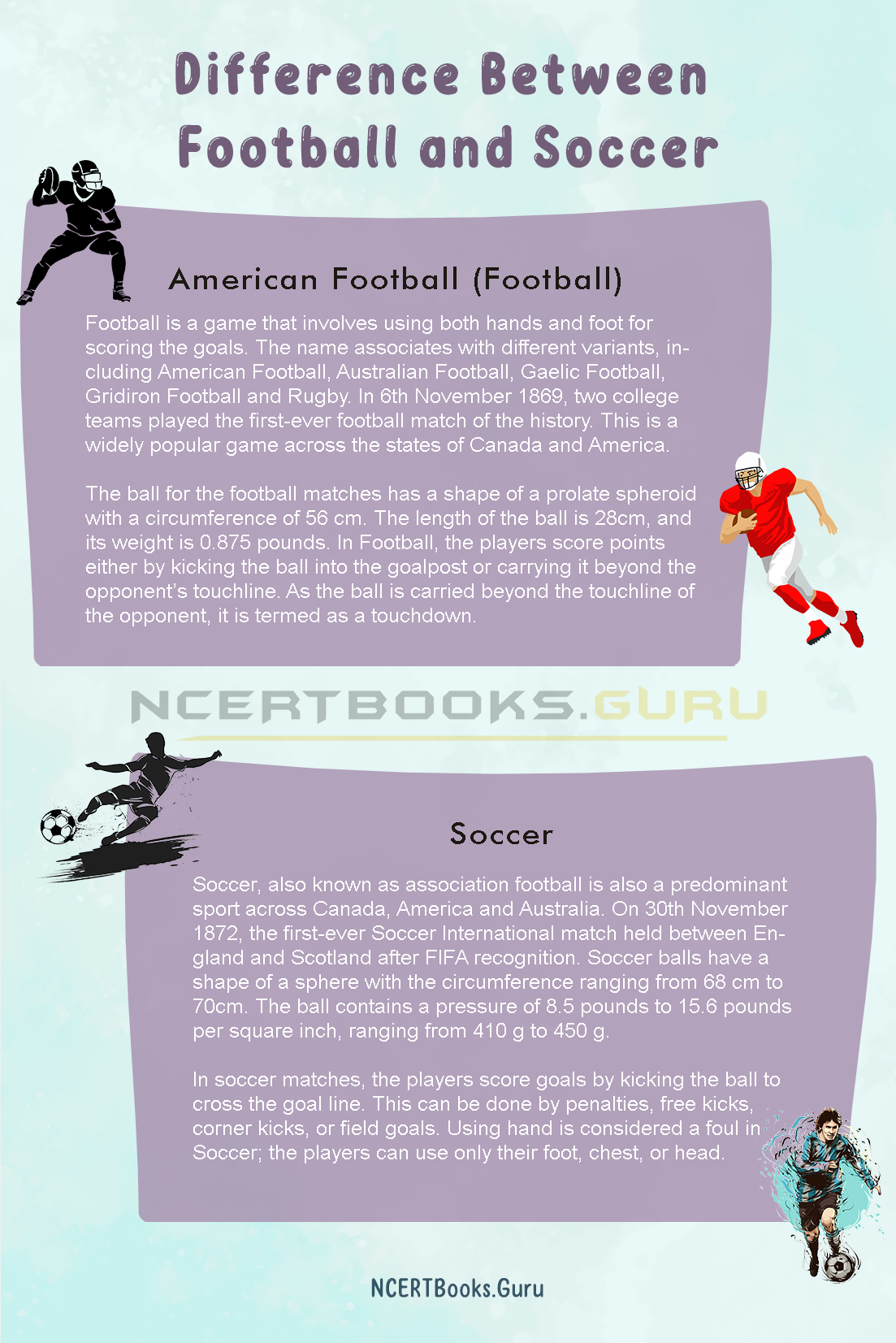
American Football (Football)

Football is a game that involves using both hands and foot for scoring the goals. The name associates with different variants, including American Football, Australian Football, Gaelic Football, Gridiron Football and Rugby. In 6th November 1869, two college teams played the first-ever football match of the history. This is a widely popular game across the states of Canada and America.

The ball for the football matches has a shape of a prolate spheroid with a circumference of 56 cm. The length of the ball is 28cm, and its weight is 0.875 pounds. In Football, the players score points either by kicking the ball into the goalpost or carrying it beyond the opponent’s touchline. As the ball is carried beyond the touchline of the opponent, it is termed as a touchdown.

Soccer

Soccer, also known as association football is also a predominant sport across Canada, America and Australia. On 30th November 1872, the first-ever Soccer International match held between England and Scotland after FIFA recognition. Soccer balls have a shape of a sphere with the circumference ranging from 68 cm to 70cm. The ball contains a pressure of 8.5 pounds to 15.6 pounds per square inch, ranging from 410 g to 450 g.

In soccer matches, the players score goals by kicking the ball to cross the goal line. This can be done by penalties, free kicks, corner kicks, or field goals. Using hand is considered a foul in Soccer; the players can use only their foot, chest, or head.

Difference between Football and Soccer

Soccer and Football are two very confusing terms. Both of them refer to different sports, but there is a wider confusion globally regarding their characteristics. Football is a game played with prolate spheroid shaped ball, and Soccer is played with a spherical ball. The football field dimensions are 110m x 50m, whereas that of a soccer field is between 100m x 64m to 110m x 75m. Football matches are divided into four quarters of 15 minutes each, and there is also a half time intermission held after the second quarter. On the other hand, Soccer matches are 90 minutes long and are divided into two halves.

Football matches have 3 to 6 referees, but Soccer has a single referee whom two other ones assist. The number of substitution is also only 3 in Soccer but is unlimited in case of Football. The guards that a football player can use are chest pad, shoulder protector, helmet, upper leg padding, and mouthguard. Whereas, the Soccer players can use shin guards and boots only as of the protective guards.

International Federation of American Football, established in 1998, governs the Football. On the other hand, the governing body of Soccer is Federation Internationale de Football Association, founded in 1904 and currently having 211 national associations as members. Football’s most popular league in the history is National Football League, one of the four major American professional sports leagues. In contrast, the most popular leagues of Soccer are European Continental league (also called Champions League), English Premier League, Germany’s Spanish La Liga Bundesliga, and Italian Serie A.

Difference Between Gram Sabha and Gram Panchayat & Their Similarities

Difference Between Gram Sabha and Gram Panchayat

Introduction

The Raj of Panchayati in India signifies the system of rural local self-governance. Panchayat entrusts people with rural development. The Panchayati Raj structure is a three-tier consisting of the Panchayat Samiti, Gram Panchayat and Zila Parishad.

The Gram Panchayat is further gets divided into Gram Sabha and Nyaya Panchayat/ The Panchayati Raj System.

You can also find differences between articles on various topics that you need to know. Just tap on the quick link available and get to know the basic differences between them.

What is the Difference Between Gram Sabha and Gram Panchayat?

About Gram Panchayat

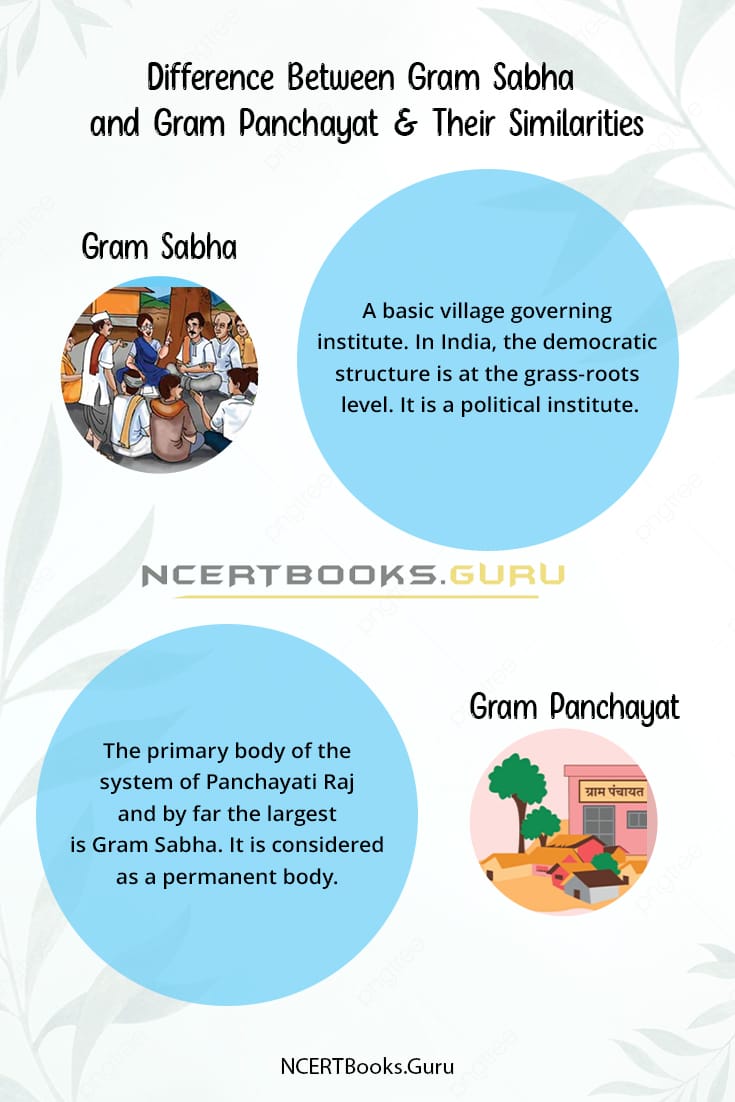
In Indian villages, Gram Panchayat (English: Village council) is a basic village governing institute. In India, the democratic structure is at the grass-roots level. It is a political institute.

The Panchayat Raj system established in various states of India has three tiers: at the district level is Jila Parishad; at the block level is Nagar Palika; and Gram panchayat, at the village level. It acts as a cabinet centre of the village.

About Gram Sabha

The primary body of the system of Panchayati Raj and by far the largest is Gram Sabha. It is considered as a permanent body. The Panchayat implements supervision, monitoring and development programs under the overarching mandate of the Gram Sabha.

Through the Gram Sabha, all decisions of the Panchayat are taken, and no decision is valid and official without the consent of the Gram Sabha.

Difference Between Gram Sabha and Gram Panchayat 2

The difference between Gram Panchayat and Gram Sabha

Area of Difference Gram Panchayat Gram Sabha
Defination Gram Panchayat functions at the village level and is the lower element of the Panchayati Raj. The legislative body that actually operates at the village level and audit reports and considers the annual budget of the Gram Panchayat is Gram Sabha.
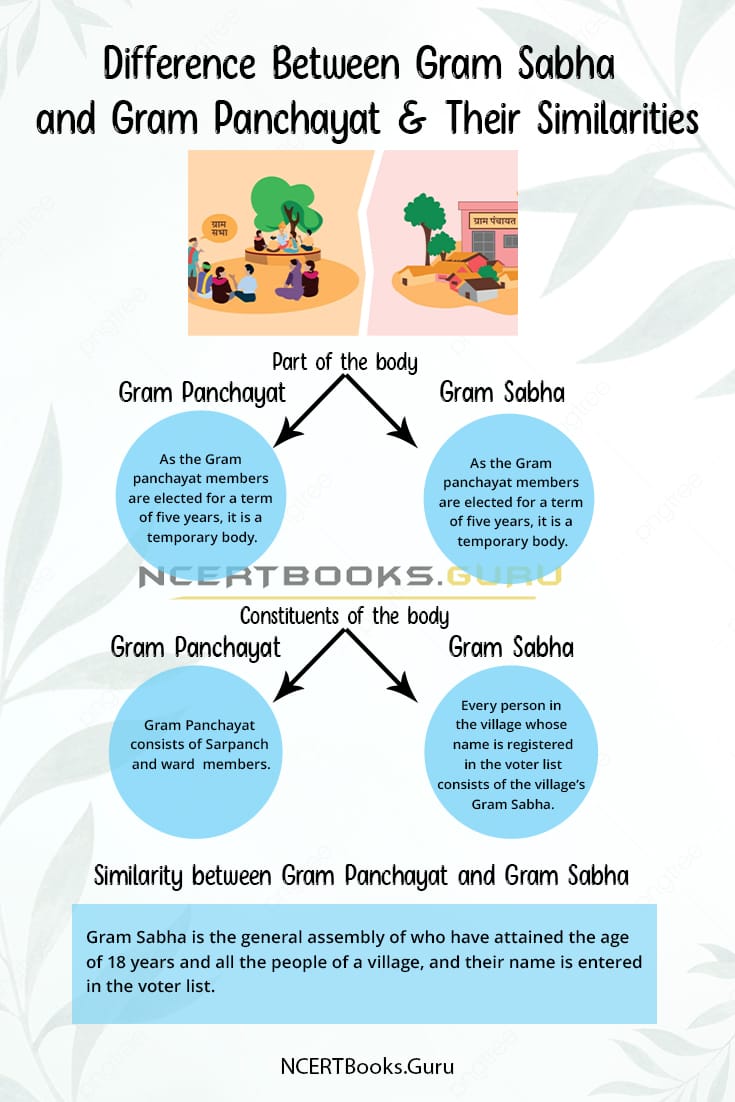
Part of the body As the Gram panchayat members are elected for a term of five years, it is a temporary body. Gram Sabha is a permanent body.
Constituents of the body The Gram Panchayat consists of Sarpanch and ward members. Every person in the village whose name is registered in the voter list consists of the perspective village’s Gram Sabha.
Election of Members The members of the Gram Sabha directly elects the members of the Gram Panchayat. The members are not elected in Gram Sabha.

Difference Between Gram Sabha and Gram Panchayat 1

Similarities between Gram Panchayat and Gram Sabha

  • The Panchayati Raj System was constitutionalized and came into effect on April 24, 1993. Through the 73rd Act of the Constitutional Amendment Act of 1992 in the Gram Panchayat is further divided into Gram Sabha Nyaya Panchayat.
  • Gram Sabha is the general assembly of who have attained the age of 18 years and all the people of a village, and their name is entered in the voter list.
  • The Gram Sabha executive committee is known as Gram Panchayat, which consists of the representatives elected by the Sabha.

Frequently Asked Question on Difference Between Gram Sabha And Gram Panchayat

Question:
What is the difference between the Gram Sabha and Gram Panchayat Class?

Answer:
A Gram Sabha is a meeting of all adults who live in the area covered by a Panchayat. The Gram Panchayat includes a Secretary who is not an elected person but is appointed by the government and is also the Gram Sabha Secretary.

Question:
Who is called Sarpanch?

Answer:
The successful candidate whom votes are given of all the wards form the panch. The head of the Panchas is called the Sarpanch, who is selected through voting among the Panchas.

Question:
What is the main aim of gram panchayat?

Answer:
Gram Panchayats and SDGs have the Panchayati Raj system’s twin objectives as envisaged by India’s Constitution to ensure local economic development and social justice.

MCQ Questions on Central Problems of an Economy

MCQ Questions on Central Problems of an Economy

MCQ Questions on Central Problems of an Economy: Below, You will find a list of Commerce MCQ Questions as per the latest prescribed syllabus. Ace up your preparation with the Objective Questions available on Central Problems of an Economy and enhance your subject knowledge. Understand the concept clearly by consistently practicing the Multiple Choice Questions and score well in your exams.

MCQ Questions on Central Problems of an Economy

1. The law of scarcity
(a) States that the want of a consumer will never be satisfied completely
(b) Indicates that the want of consumer will be satisfied in a socialistic system
(c) Is only for underdeveloped countries
(d) Is not for rich and developed countries

Answer

Answer: (a)


2. To make a rational decision a person needs
(a) Choices that don’t have trade-offs
(b) Choices that never change
(c) Choices that are consistent with a similar goal every time
(d) Logical choices without error.

Answer

Answer: (c)


3. The central problem of an economy is
(a) Assigning limited resources in a way that unlimited desires and needs of the society are satisfied
(b) Ensuring a minimum income for each citizen.
(c) Assuring that production happens in the most effective way.
(d) Analyzing the demand with market economies.

Answer

Answer: (a)


4. An economy succeeds in producing resources efficiently when
(a) Goods and services are produced without resources being wasted.
(b) The total number of goods manufactured is high.
(c) The resources employe are the best
(d) The resources employed for highly valued uses.

Answer

Answer: (a)


5. Which option is a disadvantage for allocating resources utilizing a market system?
(a) Profits will be less
(b) Impossible to stop the wastage of scarce resources
(c) Notable unemployment may take place
(d) Uneven distribution of income

Answer

Answer: (d)


6. Which branch of economic theory is associated with the difficulty of resources allocation
(a) Econometrics.
(b) Micro-economic theory
(c) Macro-economic theory
(d) None of the above

Answer

Answer: (b)


7. The creation of choice is done by
(a) Scarcity of resources
(b) Less choice option
(c) The urgency of needs
(d) Abundance of resources

Answer

Answer: (a)


Difference Between Himalayan and Peninsular Plateau & Their Similarities

Difference Between Himalayan and Peninsular Plateau

Introduction

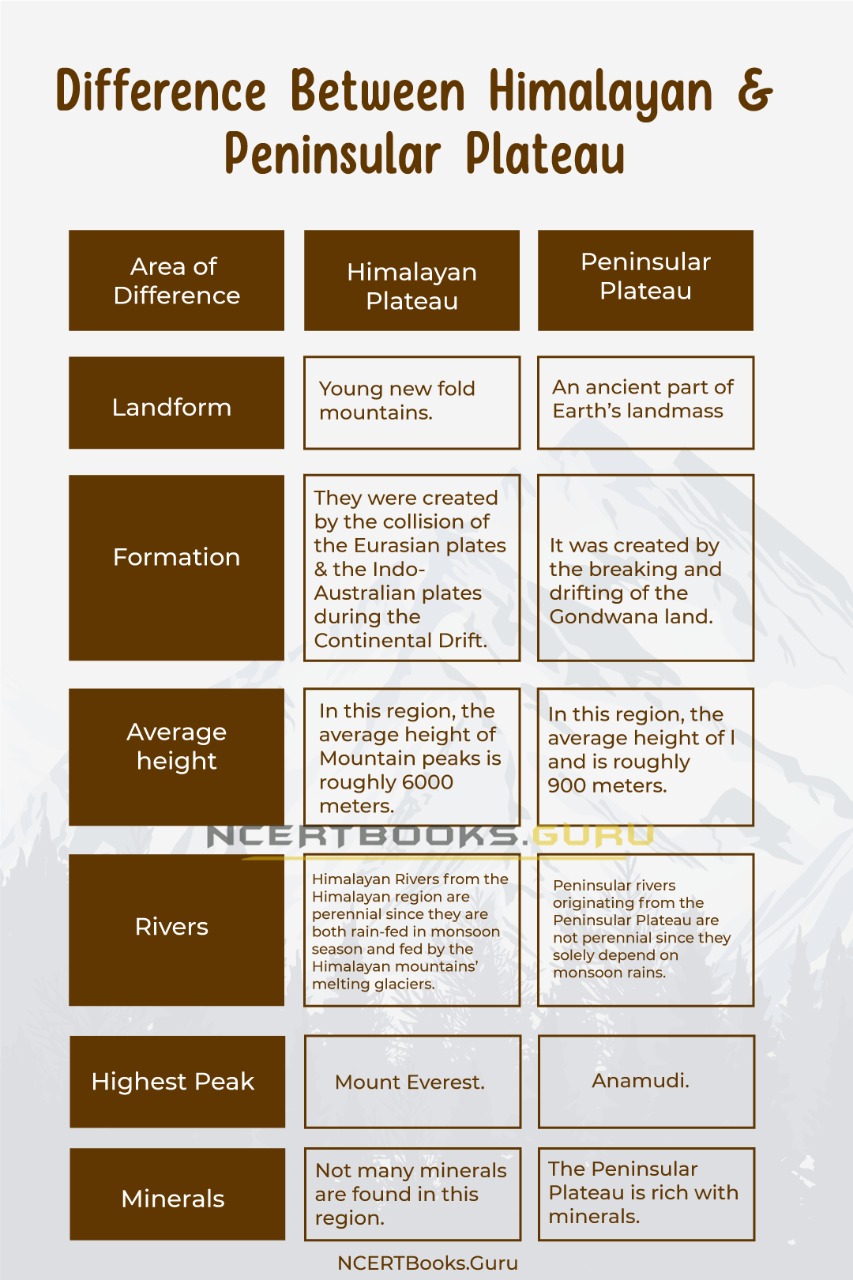
The difference between the Himalayan and Peninsular Plateau is explained in this article in detail. One of the major differences between these two landscapes is that the Himalayan Plateau or Tibetan Plateau displays a very youthful topography with high summits, deep valleys, and fast-flowing glacial rivers compared to the peninsular plateau which consists of igneous and metamorphic rocks along with small hills and wide valleys.

You can also find differences between articles on various topics that you need to know. Just tap on the quick link available and get to know the basic differences between them.

What is the Difference Between the Himalayan and Peninsular Plateau?

About Himalayan Plateau

The Tibetan Plateau, or known as the Himalayan Plateau in India, is a vast elevated plateau in South Asia, Central Asia and East Asia. It stretches approximately 1,000 kilometres north to south and 2,500 kilometres east to west.

It is the world’s highest and largest plateau with an average elevation exceeding 14,800 ft and is surrounded by the world’s two highest summits, Mount Everest and K2.

The Tibetan Plateau is referred to as “the Roof of the World”. The Tibetan Plateau tens of thousands of glaciers serve as a “water tower” storing water and maintaining flow. It is sometimes termed the Third Pole as it contains the largest reserve of freshwater outside the poles.

About Peninsular Plateau

Deccan plateau or the Peninsular Plateau covers India’s entire southern peninsula, south of the Narmada River, and its marked centrally by a high triangular tableland. The plateau is bordered on the east and west by the Ghats. Its northern part of it is the Satpura Range.

The average elevation of the Deccan Plateau is about 2,000 feet, sloping generally eastward. The major rivers of this region are—the Godavari, Krishna, and Kaveri (Cauvery). It flows from the Western Ghats eastward to the Bay of Bengal. The climate there is drier than that on the coasts and is arid in places.

Difference Between Himalayan and Peninsular Plateau 1

Difference Between Himalayan and Peninsular Plateau

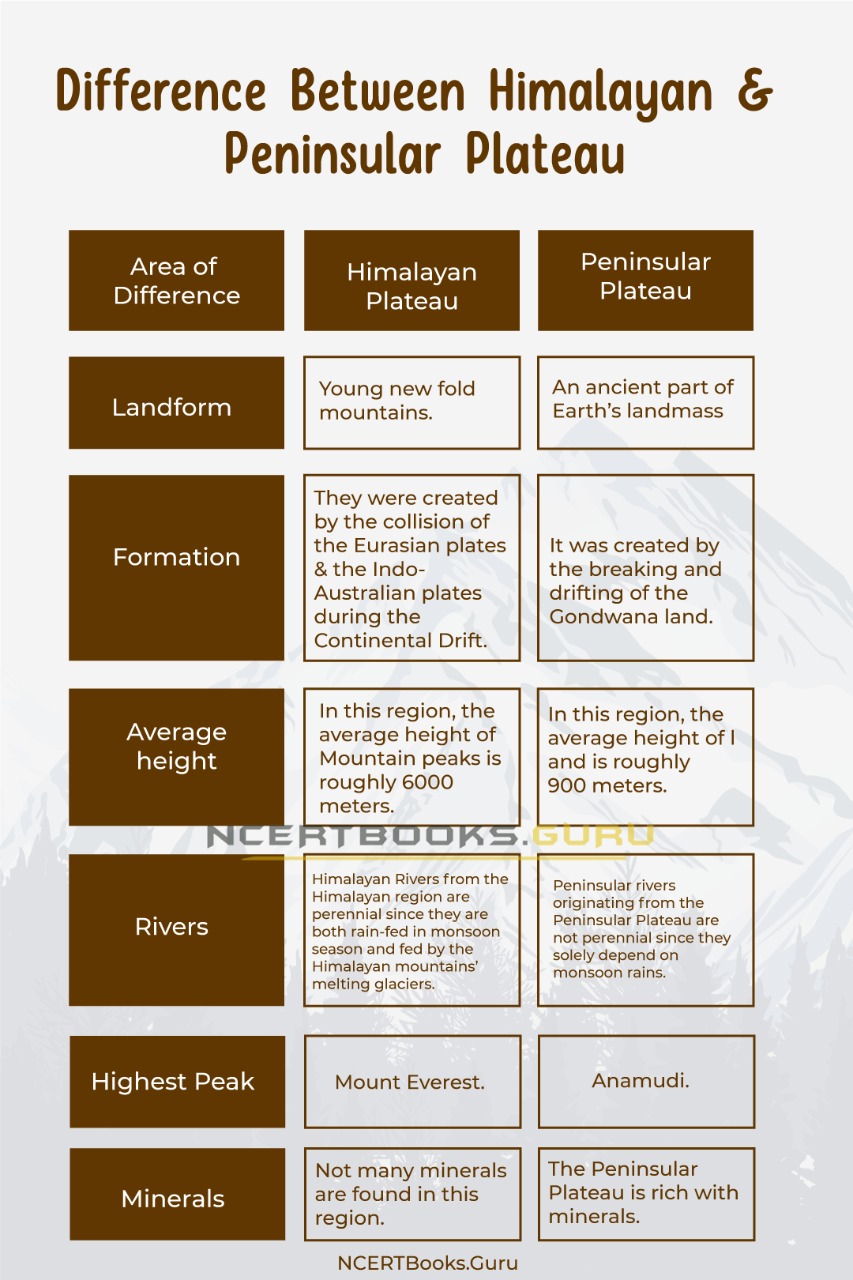
Area of Differentiation Himalayan Plateau

Peninsular Plateau

Landform Young new fold mountains. An ancient part of Earth’s landmass
Formation They were created by the collision of the Eurasian plates and the Indo-Australian plates during the Continental Drift. It was created by the breaking and drifting of the Gondwana land.
Average height In this region, the average height of Mountain peaks is roughly 6000 meters. In this region, the average height of land is roughly 900 meters.
Rivers Himalayan Rivers from the Himalayan region are perennial since they are both rain-fed in monsoon season and fed by the Himalayan mountains’ melting glaciers. Peninsular rivers originating from the Peninsular Plateau are not perennial since they solely depend on monsoon rains.
Highest Peak Mount Everest. Anamudi.
Minerals Not many minerals are found in this region. The Peninsular Plateau is rich with minerals.

Difference Between Himalayan and Peninsular Plateau 2

Similarities of Himalayan and Peninsular Plateau

  • Both the Himalayan and Peninsular land consist of large expanses of the plateau, an area of a highland consisting of flat terrain.
  • These regions are drier than their surroundings.
  • Both these regions are more than 2000ft above the sea level.

Frequently Asked Questions on Difference Between Himalayan And Peninsular Plateau

Question
What is the highest peak in the Himalayan Plateau region?

Answer:
Mount Everest.

Question
Are the rivers in Peninsular Plateau region perennial rivers?

Answer:
No, the rivers in Peninsular Region are rain-fed and regional.

Question
Which region is colder- the Himalayan or Peninsular region?

Answer:
The Himalayan Plateau region is colder.

MCQs on Diseases Caused by Bacteria

MCQs on Diseases Caused by Bacteria for NEET 2020

NEET Biology is the scoring paper in the medical entrance examination. Here, you will discover the NEET Biology MCQ Questions for all Concepts as per the latest syllabus. Practice more on a regular basis with these NEET Biology objective questions on air pollution and improve your subject knowledge & problem-solving skills along with time management. NEET Biology Diseases Caused by Bacteria Multiple Choice Questions make you feel confident in answering the question in the exam & increases your scores to high.

MCQs on Diseases Caused by Bacteria

1. Diseases caused due to the inflammation of the vermiform appendix of the digestive system is known as
(a) Appendectomy
(b) Appendicitis
(c) Intestinal cancer
(d) Amoebic dysentery

Answer

Answer: (b)


2. This set includes bacteria diseases
(a) Malaria, poliomyelitis, mumps
(b) Mumps, cholera, typhoid
(c) Plague, Leprosy, Diphtheria
(d) Measles, Tuberculosis, Tetanus

Answer

Answer: (c)


3. In Ayurveda, the disease that is called as Vishuchika is
(a) Chicken pox
(b) Smallpox
(c) Cholera
(d) Diphtheria

Answer

Answer: (c)


4. Vibrio cholerae is a motile bacteria belonging to the group of
(a) Lophotrichous
(b) Peritrichous
(c) Monotrichous
(d) Amphitrichous

Answer

Answer: (c)


5. ‘Syphilis’, a sexually transmitted diseases is caused by
(a) Vibrio
(b) Leptospira
(c) Treponema pallidum
(d) Pasteurella

Answer

Answer: (c)


6. This is a symptom of Diphtheria
(a) Bleeding gum
(b) Hydrophobia
(c) Suffocation
(d) Excessive watering

Answer

Answer: (a)


7. Widal test is used for susceptibility of
(a) Typhoid
(b) Cholera
(c) Malaria
(d) Cholera

Answer

Answer: (a)


8. “Tuberculosis” is caused by
(a) Malnutrition
(b) Protozoan
(c) Bacterium
(d) Virus

Answer

Answer: (c)


9. ‘Cholera’ is caused by
(a) Fungi
(b) Bacteria
(c) Virus
(d) Protozoan

Answer

Answer: (b)


10. ‘Leprosy’ is caused by
(a) Salmonella
(b) Mycobacterium
(c) TMV
(d) Monocystis

Answer

Answer: (b)


MCQ Questions for Class 10 Maths Areas Related to Circles with Answers

Free PDF Download of CBSE Class 10 Maths Chapter 12 Areas Related to Circles Multiple Choice Questions with Answers. MCQ Questions for Class 10 Maths with Answers was Prepared Based on Latest Exam Pattern. Students can solve NCERT Class 10 Maths Areas Related to Circles MCQs with Answers to know their preparation level.

Class 10 Maths MCQs Chapter 12 Areas Related to Circles

Circle Multiple Choice Question 1. The area of the circle is 154 cm2. The radius of the circle is
(a) 7 cm
(b) 14 cm
(c) 3.5 cm
d) 17.5 cm

Answer/ Explanation


Areas Related To Circles Class 10 MCQ With Answer: dExplaination: Reason: Area of circle = 154 cm²
⇒ nr² = 154 cm2
⇒ \(\frac{22}{7}\) × r² = 154
⇒ r² = 154 × \(\frac{22}{7}\)
⇒ r² = 7 × 7 = 49
∴ r = √49 = 7


2. If angle of sector is 60°, radius is 3.5 cm then length of the arc is
(a) 3 cm
(b) 3.5 cm
(c) 3.66 cm
(d) 3.8 cm

Answer/ Explanation

Answer: c
Explaination: Reason: Here r = 3.5 cm = \(\frac{35}{10}\) = \(\frac{7}{2}\) cm θ = 60°
Length of arc = \(\frac{θ}{360}\) × 2πr = \(\frac{60}{360}\) × 2 × \(\frac{22}{7}\) = × \(\frac{7}{2}\) × \(\frac{1}{6}\) × 22 = \(\frac{11}{6\3}\) = 3.66 cm


Areas Related To Circles MCQs Question 3. The area of a quadrant of a circle whose circumference is 22 cm, is
MCQ Questions for Class 10 Maths Areas Related to Circles with Answers 4

Answer/ Explanation

Answer: d
Explaination: Reason: Here 2πr = 22 cm
2 × \(\frac{22}{7}\) × r = 22
⇒ r = 22 × \(\frac{7}{22}\) × \(\frac{1}{2}\) = \(\frac{7}{2}\) cm
∴ Area of quadrant of circle = \(\frac{1}{4}\)πr² = \(\frac{1}{4}\) × \(\frac{22}{7}\) × \(\frac{7}{2}\) × \(\frac{7}{2}\) = \(\frac{77}{8}\) cm²


4. If 0 is the angle in degrees of a sector of a circle of radius V, then area of the sector is
MCQ Questions for Class 10 Maths Areas Related to Circles with Answers 5

Answer

Answer: b


5. A horse is tied to a peg at one corner of a square shaped grass field of side 15 m by means of a 7 m long rope. The area of that part of the field in which the horse can graze, is
(a) 77 cm²
(b) \(\frac{77}{2}\) cm²
(c) 154 cm²
(d) \(\frac{77}{4}\) cm²

Answer/ Explanation

MCQ on Areas Related To Circles With Answer: b
Explaination:
MCQ Questions for Class 10 Maths Areas Related to Circles with Answers 2
MCQ Questions for Class 10 Maths Areas Related to Circles with Answers 1


6. The area of the circle whose diameter is 21 cm is
(a) 346.5 cm²
(b) 37.68 cm²
(c) 18.84 cm²
(d) 19.84 cm²

Answer/ Explanation

Answer: a
Explaination: Reason: Here diameter = 21 cm
∴ Radius r = \(\frac{21}{2}\) cm
Area of the circle, A = πr²
∴ \(A=\frac{22}{7} \times \frac{21}{2} \times \frac{21}{2}=11 \times 3 \times \frac{21}{2}=\frac{693}{2}=346.5 \mathrm{cm}^{2}\)


7. The area of the sector of a circle with radius 6 cm and of angle 60° is
(a) 9.42 cm²
(b) 37.68 cm²
(c) 18.84 cm²
(d) 19.84 cm²

Answer/ Explanation

Answer: c
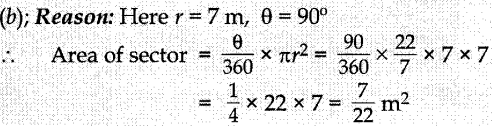
Explaination: Reason: Here r = 6 cm, θ = 60°
Area of the sector = \(\frac{θ}{360}\)
∴ Area = \(\frac{60}{360}\) × 3.14 × 6 × 6 = \(\frac{1}{6}\) × 3.14 × 6 × 6 = 3.14 × 6 = 18.84 cm²


8. The area of a circle whose circumference is 22 cm, is
(a) 11 cm²
(b) 38.5 cm²
(c) 22 cm²
(d) 77 cm²

Answer/ Explanation

Answer: b
Explaination:
MCQ Questions for Class 10 Maths Areas Related to Circles with Answers 3


9. The area of a circle is 154 cm2. Its diameter is
(a) 7 cm
(b) 14 cm
(c) 21 cm
(d) 28 cm

Answer/ Explanation

Answer: b
Explaination: Reason: Here area of the circle, A = 154 cm², Radius, r = ?
Area of the circle = 154 cm² …(Given)
∴ πr² = 154
⇒ \(\frac{22}{7}\) × r² = 154
⇒ r² = 154 × latex]\frac{7}{22}[/latex] = 7 × 7
⇒ r = 7 cm
∴ Diameter of the circle = 2 × r = 2 × 7 = 14 cm


10. The length of the minute hand of a clock is 14 cm. The area swept by the minute hand in 5 minutes is
(a) 153.9 cm²
(b) 102.6 cm²
(c) 51.3 cm²
(d) 205.2 cm²

Answer/ Explanation

Answer: c
Explaination: Reason: Angle swept by the minute hand in 1 minute = (360° ÷ 60) = 6°
∴ θ = 30°
∴ Angle swept by the minute hand in 5 minutes = 6° × 5 = 30°
Length of minute hand (r) = 14 cm
∴ Area swept = \(\frac{θ}{360}\)πr² = \(\frac{30}{360}\) × \(\frac{22}{7}\) × 14 × 14 = \(\frac{154}{3}\) = 51.3 cm²


MCQ Questions For Class 10 Maths Areas Related To Circles Question 11. The radii of two circles are 19 cm and 9 cm respectively. The radius of the circle which has circumference equal to the sum of the circumference of two circles is
(a) 35 cm
(b) 10 cm
(c) 21 cm
(d) 28 cm

Answer/ Explanation

Answer: d
Explaination: Reason: Let the radii of two circles be r1 and r2 and the radius of large circle be r.
∴ r1 = 19 cm, r2 = 9 cm
Circumference of two circles = C1+ C2 …(where C = circle)
= 2πr1 + 2πr2 = 2π × 19 + 2π × 9 = 38π + 18π = 56π
∴ Circumference of large circle = 56π
⇒ 2πr = 56π
⇒ r = 28
∴ Radius of large circle = 28 cm


12. The area of the circle that can be inscribed in a square of side 6 cm, is
(a) 18π cm²
(b) 12π cm²
(c) 9π cm²
(d) 14π cm²

Answer/ Explanation

Answer: c
Explaination: Reason: Size of square = 6 cm, radius = \(\frac{6}{2}\) = 3 cm;
Area of the circle = πr² = π × 3 × 3 = 9π cm²


13. The radii of two circles are 4 cm and 3 cm respectively. The diameter of the circle having area equal to the sum of the areas of the two circles (in cm) is [Delhi 2011]
(a) 5
(b) 7
(c) 10
(d) 14

Answer/ Explanation

Answer: c
Explaination:
MCQ Questions for Class 10 Maths Areas Related to Circles with Answers 15


MCQ on Area Related To Circles Class 10 Question 14. The perimeter (in cm) of a square circumscribing a circle of radius a cm, is [AI2011]
(a) 8 a
(b) 4 a
(c) 2 a
(d) 16 a

Answer/ Explanation

Answer: a
Explaination:
(a) Side of a square circumscribing a circle of radius a cm = diameter of circle = 2 a cm
∴ Perimeter of the square
= 4 × 2a = 8a cm


15. If the area of a circle is numerically equal to twice its circumference, then the diameter of the circle is
(a) 4 units
(b) n units
(c) 8 units
(d) 2 units

Answer/ Explanation

Answer: c
Explaination:
(c) πr² = 2πr × 2
⇒ r = 4
⇒ 2r = 8 units


16. If the circumference of a circle is 352 metres, then its area in square metres is
(a) 5986
(b) 6589
(c) 7952
(d) 9856

Answer/ Explanation

Answer: d
Explaination:
MCQ Questions for Class 10 Maths Areas Related to Circles with Answers 16


Area Related To Circle Class 10 MCQ Question 17. The diameter of a wheel is 1.26 m. The distance travelled in 500 revolutions is
(a) 2670 m
(b) 2880 m
(c) 1980 m
(d) 1596 m

Answer/ Explanation

Answer: c
Explaination:
(c) Radius of the wheel = \(\frac{1.26}{2}\) = 0.63 m
Distance travelled in one revolution
= 2πr = 2 × \(\frac{22}{7}\) × 0.63
= 3.96 m
∴ Distance travelled in 500 revolutions
= 500 × 3.96
= 1980 m.


18. If the sum of the circumferences of two circles with radii Rj and R2 is equal to the circumference of a circle of radius R, then [NCERT Exemplar Problems]
(a) R1 + R2 = R
(b) R1 + R2 > R
(C) R1 + R2 < R
(d) nothing definite can be said about the relation among Rp1, R2 and R.

Answer/ Explanation

Answer: a
Explaination:
(a) 2πR1 + 2πR2 = 2πR
⇒ R1 + R2 = R.


19. If the circumference of a circle and the perimeter of a square are equal, then [NCERT Exemplar Problems]
(a) area of the circle = area of the square
(b) area of the circle > area of the square
(c) area of the circle < area of the square
(d) nothing definite can be said about the relation between the areas of the circle and square.

Answer/ Explanation

Answer: b
Explaination:
(b) Let circumference of a circle = C
2πr = C C
⇒ r = \(\frac{C}{2π}\)
Perimeter of a square = C
⇒ 4a = C
⇒ a = \(\frac{C}{4}\)


MCQ on Area Related To Circles Question 20. Area of the largest triangle that can be inscribed in a semi-circle of radius r units is [NCERT Exemplar Problems]
(a) r² sq. units
(b) \(\frac{1}{2}\) r² sq. units
(c) 2 r² sq. units
(d) √2 r² sq. units

Answer/ Explanation

Answer: a
Explaination:
MCQ Questions for Class 10 Maths Areas Related to Circles with Answers 18


21. Match the columns
MCQ Questions for Class 10 Maths Areas Related to Circles with Answers 6
(a) 1 → A, 2 → C, 3 → D, 4 → E
(b) 1 → B, 2 → C, 3 → F, 4 → E
(c) 1 → D, 2 → B, 3 → A, 4 → F
(d) 1 → D, 2 → B, 3 → E, 4 → F

Answer/ Explanation

Answer: c
Explaination: (c) Formulae


22. In the given figure, three sectors of a circle of radius 7 cm, making angles of 60°, 80° and 40° at the centre are shaded. The area of the shaded region (in cm2) is [Using π = \(\frac{22}{7}\)] [Foreign 2012]
MCQ Questions for Class 10 Maths Areas Related to Circles with Answers 7
(a) 77
(b) 154
(c) 44
(d) 22

Answer/ Explanation

Answer: a
Explaination:
(a) Area of shaded region = area of sector with angle
(60° + 80° + 40°) = \(\frac{180^{\circ}}{360^{\circ}} \times \frac{22}{7} \times 7 \times 7\)
= 77 cm²


Areas Related To Circles Question 23. If the difference between the and the radius of of a circle is 37 cm, then 22 using π = \(\frac{22}{7}\) the circumference (in cm) of the circle is: [Delhi 2013]
(a) 154
(b) 44
(c) 14
(d) 7

Answer/ Explanation

Answer: b
Explaination:
MCQ Questions for Class 10 Maths Areas Related to Circles with Answers 21


24. If 7i is taken as \(\frac{22}{7}\), the distance (in metres) covered by a wheel of diameter 35 cm, in one revolution, is [AI2013]
(a) 2.2
(b) 1.1
(c) 9.625
(d) 96.25

Answer/ Explanation

Answer: b
Explaination:
(b) Distance covered by a wheel in one
revolution = 2 πr = 2 × \(\frac{22}{7}\) × \(\frac{35}{2}\)
= 110 cm = 1.1 m


Circle MCQ Pdf Question 25. If the circumferences of two circles are in the ratio 4 : 9, then the ratio in their area is
(a) 9 : 4
(b) 4 : 9
(c) 2 : 3
(d) 16 : 81

Answer/ Explanation

Answer: d
Explaination:
MCQ Questions for Class 10 Maths Areas Related to Circles with Answers 22


26. The ratio of the areas of the incircle and circumcircle of a square is
(a) 1 : 2
(b) 1 : 3
(c) 1 : 4
(d) 1 : √2

Answer/ Explanation

Answer: a
Explaination:
(a) Let side of square = x units
∴ Diagonal of the square = √2 x units
Diameter of the incircle = x units
Diameter of the circumcircle = √2 x units
MCQ Questions for Class 10 Maths Areas Related to Circles with Answers 23


27. A circular wire of radius 42 cm is cut and bent into the form of a rectangle whose sides are in the ratio of 6 : 5. The smaller side of the rectangle is
(a) 30 cm
(b) 60 cm
(c) 70 cm
(d) 80 cm

Answer/ Explanation

Answer: b
Explaination:
(b) Length of wire = 2πrr = 2πr × 42
= 2 × \(\frac{22}{7}\) × 42 = 264 cm
Let sides of rectangle are 6x and 5x
⇒ 2(6x + 5x) = 264
⇒ 11x = 132
⇒ x = 12
∴ Smaller side = 12 × 5 = 60 cm


28. Match the columns.
MCQ Questions for Class 10 Maths Areas Related to Circles with Answers 8
(a) 1 → B, 2 → C, 3 → D, E → 4
(b) 1 → B, 2 → D, 3 → C, E → 4
(c) 1 → A, 2 → C, 3 → D, E → 4
(d) 1 → B, 2 → C, 3 → D, E → 4

Answer/ Explanation

Answer: b
Explaination: (b) Formulae


29. ABC is an equilateral triangle. The area of the shaded region if the radius of each of the circle is 1 cm, is
MCQ Questions for Class 10 Maths Areas Related to Circles with Answers 10
MCQ Questions for Class 10 Maths Areas Related to Circles with Answers 11

Answer/ Explanation

Answer: c
Explaination:
MCQ Questions for Class 10 Maths Areas Related to Circles with Answers 30


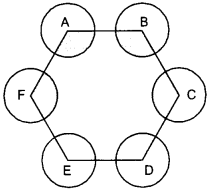
30. ABCDEF is any hexagon with different vertices A, B, C, D, E and F as the centres of circles with same radius r are drawn. The area of the shaded portion is
MCQ Questions for Class 10 Maths Areas Related to Circles with Answers 12
(a) πr²
(b) 2πr²
(c) 3πr²
(d) 4πr²

Answer/ Explanation

Answer: b
Explaination:
MCQ Questions for Class 10 Maths Areas Related to Circles with Answers 31


31. In the figure, PQRS is a square and O is centre of the circle. If RS = 10 √2, then area of shaded region is
MCQ Questions for Class 10 Maths Areas Related to Circles with Answers 13
(a) 90 π – 90
(b) 80 π – 80
(c) 50 π-100
(d) 100 π – 100

Answer/ Explanation

Answer: c
Explaination:
(c) Diagonal of square = √2 × (10√2) = 20 units
∴ Diameter of circle = 20 units
Area of circle = π × (10)² = 100π sq.units
Area of square = (10√2)² = 200 sq. units
Area of circle not included in the square = (100π – 200) sq.units
∴ Area of shaded portion = \(\frac{1}{2}\)(100π – 200)
= 50π – 100.


32. The diameter of the wheel of a bus is 1.4 m. The wheel makes 10 revolutions in 5 seconds. The speed of the vehicle (in kmph) is ______ .

Answer/ Explanation

Answer:
Explaination:
MCQ Questions for Class 10 Maths Areas Related to Circles with Answers 19


33. The area of a quadrant of a circle whose circumference is 44 cm is ______ .

Answer/ Explanation

Answer:
Explaination:
MCQ Questions for Class 10 Maths Areas Related to Circles with Answers 20


34. If the wheel of an engine of a train is 4\(\frac{2}{7}\)m in circumference makes seven revolutions in 4 seconds, then the speed of the train is _____ km/h.

Answer/ Explanation

Answer:
Explaination:
MCQ Questions for Class 10 Maths Areas Related to Circles with Answers 24


35. The area of the largest possible square inscribed in a circle of unit radius (in sq. units) is ______.

Answer/ Explanation

Answer:
Explaination:
2 units
Hints: Diameter of circle = 2 units
∴ Diagonal of the square = 2 units
Side of the square = \(\frac{2}{\sqrt{2}}\) = √2 units
∴ Area of the square = (√2)² = 2 sq. units


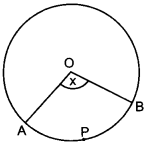
36. In the fig., O is the centre of a circle. The area of sector OAPB is \(\frac{5}{18}\) of the area of the circle. Find x.
MCQ Questions for Class 10 Maths Areas Related to Circles with Answers 9

Answer/ Explanation

Answer:
Explaination:
MCQ Questions for Class 10 Maths Areas Related to Circles with Answers 32


37. Find the perimeter of the given figure, where \(\widehat{\mathrm{AED}}\) is a semicircle and ABCD is a rectangle.

Answer/ Explanation

Answer:
Explaination:
MCQ Questions for Class 10 Maths Areas Related to Circles with Answers 33
Length of \(\widehat{\mathrm{AED}}\) = πr
= π x 7 cm = 7π cm
AB + BC + DC = 20 + 14 + 20 = 54 cm
∴ Perimeter of figure = (7π + 54) cm


38. A bicycle wheel makes 5000 revolutions in moving 11 km. Find the diameter of the wheel. (use π = \(\frac{22}{7}\))

Answer/ Explanation

Answer:
Explaination:
MCQ Questions for Class 10 Maths Areas Related to Circles with Answers 25


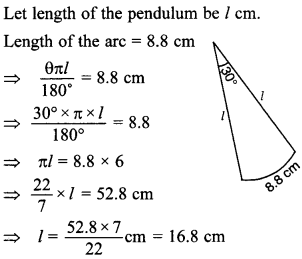
39. A pendulum swings through an angle of 30° and describes an arc 8.8 cm in length. Find the length of pendulum, (use π = \(\frac{22}{7}\))

Answer/ Explanation

Answer:
Explaination:
MCQ Questions for Class 10 Maths Areas Related to Circles with Answers 26


40. An arc of a circle is of length 5TI cm and the sector it bounds has an area of 20π cm². Find the radius of the circle.

Answer/ Explanation

Answer:
Explaination:
MCQ Questions for Class 10 Maths Areas Related to Circles with Answers 27
MCQ Questions for Class 10 Maths Areas Related to Circles with Answers 28


41. If the diameter of a semicircular protractor is 14 cm, then find its perimeter. [π = \(\frac{22}{7}\)]

Answer/ Explanation

Answer:
Explaination:
MCQ Questions for Class 10 Maths Areas Related to Circles with Answers 29


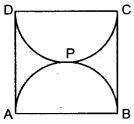
42. Find the perimeter of the shaded region in figure, if ABCD is a square of side 14 cm and APB and CPD are semicircles. [Use π = \(\frac{22}{7}\)]
MCQ Questions for Class 10 Maths Areas Related to Circles with Answers 14

Answer/ Explanation

Answer:
Explaination:
Perimeter = AD + BC + length of DPC + length of APB
= 14 + 14 + πr + πr
= 28 + 2 × \(\frac{22}{7}\) × \(\frac{14}{2}\)= 72 cm


We hope the given MCQ Questions for Class 10 Maths Areas Related to Circles with Answers will help you. If you have any query regarding CBSE Class 10 Maths Chapter 12 Areas Related to Circles Multiple Choice Questions with Answers, drop a comment below and we will get back to you at the earliest.