MCQ Questions for Class 10 Maths Application of Trigonometry with Answers

Free PDF Download of CBSE Class 10 Maths Chapter 9 Application of Trigonometry Multiple Choice Questions with Answers. MCQ Questions for Class 10 Maths with Answers was Prepared Based on Latest Exam Pattern. Students can solve NCERT Class 10 Maths Application of Trigonometry MCQs with Answers to know their preparation level.

Class 10 Maths MCQs Chapter 9 Application of Trigonometry

MCQ On Application Of Trigonometry Class 10 Question 1. The shadow of a tower is equal to its height at 10-45 a.m. The sun’s altitude is
(a) 30°
(b) 45°
(c) 60°
(d) 90°

Answer/ Explanation

Answer: b
Explaination: Reason: Let the height of tower BC = rm and sun’s altitude = θ
Then Length of its shadow, AB = x m
MCQ Questions for Class 10 Maths Application of Trigonometry with Answers 9
In rt. ∆ABC, tan θ = \(\frac{BC}{AB}\) = \(\frac{x}{x}\) = 1
⇒ tan θ = tan 450
∴ θ = 45°


2. In given figure, the value of CE is
MCQ Questions for Class 10 Maths Application of Trigonometry with Answers 1
(a) 12 cm
(b) 6 cm
(c) 9 cm
(d) 6√3 cm

Answer/ Explanation

Answer: a
Explaination: Reason: In rt. ∆EBC, cos 60° = \(\frac{BC}{CE}\)
⇒ \(\frac{1}{2}\) = \(\frac{6}{CE}\)
⇒ CE = 12 cm


MCQ Questions For Class 10 Maths Trigonometry Question 3. In given figure, the value of ZC is
MCQ Questions for Class 10 Maths Application of Trigonometry with Answers 2
(a) 90°
(b) 45°
(c) 30°
(d) 60°

Answer/ Explanation

Answer: d
Explaination: Reason: In rt. ∆ABC, cos C = \(\frac{BC}{AB}\) = \(\frac{7}{14}\) = \(\frac{1}{2}\)
⇒ cos C = cos 60°
∴ C = 60°


MCQ On Application Of Trigonometry Question 4. In given Fig., the angle of depression from the observing position D and E of the object at A are
MCQ Questions for Class 10 Maths Application of Trigonometry with Answers 3
(a) 60°, 60°
(b) 30°, 30°
(c) 30°, 60°
(d) 60°, 30°

Answer/ Explanation

Answer: c
Explaination:
MCQ Questions for Class 10 Maths Application of Trigonometry with Answers 10
Reason: ∵ APD, ∠1 = 90° – 60° = 30°
∴ APE, ∠2 = ∠EAB …[alt Zs]
∴ ∠2 = 60°
Hence the angles of depression at D and E are 30° and 60° respectively.


Some Applications Of Trigonometry Class 10 MCQ Question 5. In given figure, the length of AP is
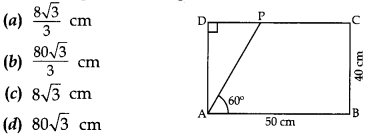
MCQ Questions for Class 10 Maths Application of Trigonometry with Answers 4

Answer/ Explanation

Answer: b
Explaination:
MCQ Questions for Class 10 Maths Application of Trigonometry with Answers 11


MCQ NCERT Application Of Trigonometry Class 10 Question 6. In given figure, the value of AE is
MCQ Questions for Class 10 Maths Application of Trigonometry with Answers 5

Answer/ Explanation

Answer: a
Explaination: Reason: ∠AED = ∠EAB = 30°
MCQ Questions for Class 10 Maths Application of Trigonometry with Answers 12
In rt. ∆AED, sin 30° = \(\frac{AD}{AP}\)
⇒ \(\frac{1}{2}\) = \(\frac{45}{AE}\)
⇒ AE = 90 cm


Trigonometry MCQ Class 10 Question 7. In given figure, AD = 4 cm, BD = 3 cm and CB = 12 cm. The value of tan θ is
MCQ Questions for Class 10 Maths Application of Trigonometry with Answers 6

Answer/ Explanation

Answer: c
Explaination: Reason: In rt ∆ADB,
AB² = AD² + BD² = (4)² + (3)² = 16 + 9 = 25
∴ AB = √25 = 5
∴ In rt ∆ABC, tan θ \(\frac{AB}{BC}\) = \(\frac{5}{12}\)


8. In figure given ABCD is a rectangle, the value of CE is
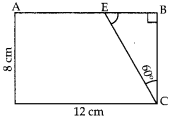
MCQ Questions for Class 10 Maths Application of Trigonometry with Answers 7
(a) 1 cm
(b) 2 cm
(c) 3 cm
(d) 4 cm

Answer/ Explanation

Answer: d
Explaination: Reason: Since ABCD is a rectangle
∴ BC = AD = 8 cm and B = 90°
In rt ∆CBE, cos 60° = \(\frac{CE}{BC}\)
⇒ \(\frac{1}{2}\) = \(\frac{CE}{8}\)
∴ CE = \(\frac{8}{2}\) = 4 cm


Trigonometry MCQ Questions Question 9. In given figure, ABCD is a || gm. The lenght of AP is
MCQ Questions for Class 10 Maths Application of Trigonometry with Answers 8
(a) 2 cm
(b) 4 cm
(c) 6 cm
(d) 8 cm

Answer/ Explanation

Answer: c
Explaination: Reason: Since ABCD is a || gm
∴ AD = BC = 4√3
In rt ∆APD, sin 60° = \(\frac{AP}{AD}\)
⇒ \(\frac{\sqrt{3}}{2}=\frac{\mathrm{AP}}{4 \sqrt{3}}\)
⇒ 2AP = 4 × 3 = 12
∴ AP = 6 cm


MCQ On Trigonometry For Class 10 With Solutions Question 10. When the length of shadow of a vertical pole is equal to √3 times of its height, the angle of elevation of the Sun’s altitude is
(a) 30°
(b) 45°
(c) 60°
(d) 15°

Answer/ Explanation

Answer: a
Explaination: Reason: Let the height of the vertical pole, BC = h m
∴ Shadow AB = √3 h m and the angle of elevation ZBAC = θ
MCQ Questions for Class 10 Maths Application of Trigonometry with Answers 13
In rt ∆ABC, tan θ = \(\frac{B C}{A B}=\frac{h}{\sqrt{3} h}=\frac{1}{\sqrt{3}}\) = tan 30°
∴ θ = 30°
Hence the Sun’s altitude is 30°


MCQ Trigonometry Class 10 Question 11. The angle of elevation of top of a tower from a point on the ground, which is 30 m away from the foot of the tower is 30°. The length of the tower is
(a) √3 m
(b) 2√3 m
(c) 5√3m
(d) 10√3 m

Answer/ Explanation

Answer: d
Explaination:
MCQ Questions for Class 10 Maths Application of Trigonometry with Answers 14


MCQ Questions On Trigonometry For Class 10 Question 12. A plane is observed to be approaching the airport. It is at a distance of 12 km from the point of observation and makes an angle of elevation of 60°. The height above the ground of the plane is
(a) 6√3 m
(b) 4√3 m
(c) 3√3 m
(d) 2√3 m

Answer/ Explanation

Answer: a
Explaination:

MCQ Questions for Class 10 Maths Application of Trigonometry with Answers 15


Trigonometry Multiple Choice Questions And Answers Pdf Question 13. The upper part of a tree is broken by the wind and makes an angle of 30° with the ground. The distance from the foot of the tree to the point where the top touches the ground is 5 m. The height of the tree is
(a) 10√33 m
(b) 5√33 m
(c) √3 m
(d) √3/5 m

Answer/ Explanation

Answer: b
Explaination:
MCQ Questions for Class 10 Maths Application of Trigonometry with Answers 16


MCQ On Trigonometry 10th Question 14. The angles of elevation of the top of a rock from the top and foot of 100 m high tower are respectively 30° and 45°. The height of the rock is
(a) 50 m
(b) 150 m
(c) 5o√3m
(d) 50(3 + √3)

Answer

Answer: d


Trigonometry MCQs Question 15. The tops of two poles of height 20 m and 14 m are connected by a wire. If the wire makes an angle of 30° with horizontal, the length of the wire is
(a) 6 m
(b) 10 m
(c) 12 m
(d) 20 m

Answer

Answer: c


Trigonometry MCQ Questions For 10th Pdf Question 16. The angle of depression of a car, standing on the ground, from the top of a 75 m high tower, is 30°. The distance of the car from the base of the tower (in m) is:
(a) 25√3
(b) 50√3
(c) 75√3
(d) 150

Answer/Explanation

Answer: c
Explaination:
MCQ Questions for Class 10 Maths Application of Trigonometry with Answers 17


MCQ On Trigonometry Class 10 Question 17. A ladder 15 m long just reaches the top of a vertical wall. If the ladder makes an angle of 60° with the wall, then the height of the wall is
MCQ Questions for Class 10 Maths Application of Trigonometry with Answers 32

Answer/Explanation

Answer: b
Explaination:
MCQ Questions for Class 10 Maths Application of Trigonometry with Answers 18


MCQs On Trigonometry Question 18. The line drawn from the eye of an observer to the point in the object viewed by the observer is known as
(a) horizontal line
(b) vertical line
(c) line of sight
(d) transversal line

Answer

Answer: c


MCQ On Trigonometry Question Question 19. The tops of two poles of heights 20 m and 14 m are connected by a wire. If the wire makes an angle of 30° with the horizontal, then the length of the wire is
(a) 8 m
(b) 10 m
(c) 12 m
(d) 14 m

Answer/Explanation

Answer: c
Explaination:
MCQ Questions for Class 10 Maths Application of Trigonometry with Answers 19


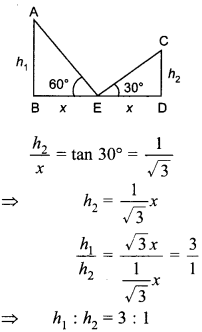
Trigonometry MCQs With Answers Question 20. If two towers of heights h1 and h2 subtend angles of 60° and 30° respectively at the mid-point of the line joining their feet, then h1 : h2 =
(a) 1 : 2
(b) 1 : 3
(c) 2 : 1
(d) 3 : 1

Answer/Explanation

Answer: d
Explaination:
MCQ Questions for Class 10 Maths Application of Trigonometry with Answers 20
MCQ Questions for Class 10 Maths Application of Trigonometry with Answers 21


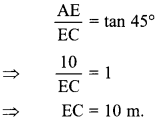
MCQ On Trigonometry For Class 10 Question 21. The angle of elevation of the top of a tower from a point 20 metres away from its base is 45°. The height of the tower is
(a) 10 m
(b) 20 m
(c) 30 m
(d) 20√3 m

Answer/Explanation

Answer: b
Explaination:
MCQ Questions for Class 10 Maths Application of Trigonometry with Answers 22


Maths Application Questions Question Question 22. Two poles are 25 m and 15 m high and the line joining their tops makes an angle of 45° with the horizontal. The distance between these poles is
(a) 5 m
(b) 8 m
(c) 9 m
(d) 10 m

Answer/Explanation

Answer: c
Explaination:
MCQ Questions for Class 10 Maths Application of Trigonometry with Answers 23
MCQ Questions for Class 10 Maths Application of Trigonometry with Answers 24


Multiple Choice Questions On Trigonometry Question 23. A portion of a 60 m long tree is broken by tornado and the top struck up the ground making an angle of 30° with the ground level. The height of the point where the tree is broken is equal to
(a) 30 m
(b) 35 m
(c) 40 m
(d) 20 m

Answer/Explanation

Answer:
Explaination:
MCQ Questions for Class 10 Maths Application of Trigonometry with Answers 25


Trigonometry Objective Questions For Class 10 Question 24. The angle of elevation of the top of a 15m high tower at a point 15m away from the base of the tower is ____ .

Answer/Explanation

Answer:
Explaination:
Hints:
∵ Height of tower = distance of point from the base
∴ Angle of elevation = 45°.


25. The ratio of the height of a tower and the length of its shadow on the ground is √3 : 1. What is the angle of elevation of the sun? [Delhi 2017]

Answer/Explanation

Answer:
Explaination:
MCQ Questions for Class 10 Maths Application of Trigonometry with Answers 26


26. An observer, 1.5 m tall, is 28.5 m away from a 30 m high tower. Determine the angle of elevation of the top of the tower from the eye of the observer. [Delhi 2017 (C)]

Answer/Explanation

Answer:
Explaination:
MCQ Questions for Class 10 Maths Application of Trigonometry with Answers 27
Here, AB = DM = 1.5 m
CM = CD – DM
= 30 – 1.5 = 28.5 m
Let 0 be the angle of elevation of the top of the tower from the eye of the observer.
∴ In ∆ACM
tan θ = \(\frac{C M}{A M}=\frac{28.5}{28.5}\)
tan θ = 1
tan θ = tan 45°
θ = 45°


27. If a tower 30 m high, casts a shadow 10√3 m long on the ground, then what is the angle of elevation of the sun?
[AI 2017]

Answer/Explanation

Answer:
Explaination:
MCQ Questions for Class 10 Maths Application of Trigonometry with Answers 28


28. If two towers of height h1 and h2 subtends angles of 60° and 30° respectively at the mid points of line joining their feet, find h1 : h2

Answer/Explanation

Answer:
Explaination:
MCQ Questions for Class 10 Maths Application of Trigonometry with Answers 29
MCQ Questions for Class 10 Maths Application of Trigonometry with Answers 30


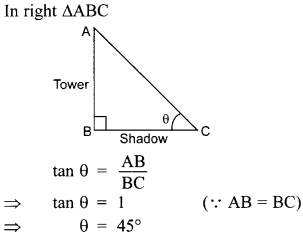
29. At some time of the day the length of the shadow of a tower is equal to its height. Find the sun’s altitude at that time. [Foreign 2011]

Answer/Explanation

Answer:
Explaination:
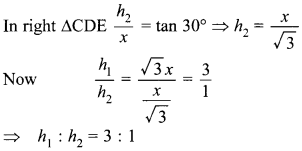
MCQ Questions for Class 10 Maths Application of Trigonometry with Answers 31


We hope the given MCQ Questions for Class 10 Maths Application of Trigonometry with Answers will help you. If you have any query regarding CBSE Class 10 Maths Chapter 9 Application of Trigonometry Multiple Choice Questions with Answers, drop a comment below and we will get back to you at the earliest.
MCQ Questions on Debentures

MCQ Questions on Debentures

MCQ Questions on Debentures: Below, You will find a list of Commerce MCQ Questions as per the latest prescribed syllabus. Ace up your preparation with the Objective Questions available on Debentures and enhance your subject knowledge. Understand the concept clearly by consistently practicing the Multiple Choice Questions and score well in your exams.

MCQ Questions on Debentures

1. Debenture holders are
(a) Debtors of the Company
(b) Creditors of the Company
(c) Debtors of the Company
(d) Owners of the Company

Answer

Answer: (b)


2. Debentures indicate the
(a) Short-term Borrowings of a Company
(b) Directors’ shares in a company
(c) The Investment of Equity-Shareholders
(d) Long-term Borrowings of a Company

Answer

Answer: (d)


3. In debenture, interest payable is
(a) Transferred to general reserve
(b) Transferred to falling fund investment account
(c) Charged against the firm’s profits
(d) Appropriation of the company’s profits

Answer

Answer: (c)


4. The owner of the debenture is qualified for
(a) Fixed-rate interest
(b) Company’s voting rights
(c) Firm’s Profits share
(d) Fixed dividend

Answer

Answer: (a)


5. On company liquidation, the principal amount of debentures is returned
(a) After Equity Capital
(b) Before Equity Capital
(c) Last of All
(d) First of All

Answer

Answer: (b)


6. Which of the below-mentioned statement is not true?
(a) The issue price and redemption value of debentures cannot differ
(b) Interest on debenture is a charge against profits
(c) It is common to prefix debentures with the agreed interest rate
(d) A debenture is a kind of public borrowing

Answer

Answer: (a)


7. Point out the false statements
(a) A firm can buy its own debentures and shares.
(b) A Company can issue convertible debentures.
(c) A business can issue debentures with voting rights.
(d) An organization can issue redeemable debentures.

Answer

Answer: (c)


8. Which options are not a feature of Bearer Debentures?
(a) The interest is paid to the holder irrespective of identity
(b) It is transferred by mere delivery.
(c) The transfer of bearer debenture requires transfer deed
(d) It is a negotiable tool.

Answer

Answer: (c)


9. Debenture Application A/c is in the form of
(a) Current Account
(b) Nominal Account
(c) Personal Account
(d) Real Account

Answer

Answer: (c)


10. The form of a discount on issue of Debentures is in the nature of
(a) Deferred Revenue Expenditure
(b) Capital loss
(c) Revenue loss
(d) None of the above

Answer

Answer: (b)


MCQs on Bryophyta

MCQs on Bryophyta for NEET

NEET Biology is the scoring paper in the medical entrance examination. Here, you will discover the NEET Biology MCQ Questions for all Concepts as per the latest syllabus. Practice more on a regular basis with these NEET Biology objective questions on air pollution and improve your subject knowledge & problem-solving skills along with time management. NEET Biology Bryophyta Multiple Choice Questions make you feel confident in answering the question in the exam & increases your scores to high.

MCQs on Bryophyta

1. Which among the following is also known as bog moss?
(a) Riccia
(b) Sphagnum
(c) Marchantia
(d) Funaria

Answer

Answer: (b)


2. The thalloid plant body is found in
(a) Marchantia
(b) Sphagnum
(c) Funaria
(d) Salvinia

Answer

Answer: (a)


3. In some of the liverworts, spore dispersal is aided by
(a) elaters
(b) peristome teeth
(c) indusium
(d) calyptra

Answer

Answer: (a)


4. Peat moss is used for transporting plants to distant places because
(a) it is hygroscopic
(b) it reduces transpiration
(c) it is easily available
(d) it serves as a disinfectant

Answer

Answer: (a)


5. Find the true statement about bryophytes
(a) they have chloroplasts
(b) they have archegonia
(c) they are thalloid
(d) all of the above

Answer

Answer: (d)


6. In mosses, meiosis takes place during
(a) gamete formation
(b) antheridia and archegonia formation
(c) spore germination
(d) spore formation

Answer

Answer: (d)


7. A characteristic feature of bryophytes is
(a) a dominant and parasitic sporophyte
(b) a dominant and spore-producing gametophyte
(c) a small sporophyte phase, which is dependent on the gametophyte
(d) sporophytes stay for a longer duration

Answer

Answer: (c)


8. The antherozoids of Funaria are
(a) monociliated
(b) biciliated
(c) multiciliated
(d) aciliated

Answer

Answer: (b)


9. All the plants like fern and mosses, which produce spores are grouped under
(a) bryophytes
(b) cryptogams
(c) thallophytes
(d) sporophytes

Answer

Answer: (b)


10. Independent male and female gametophytes are present in
(a) Pinus
(b) mustard
(c) castor
(d) Sphagnum

Answer

Answer: (d)


MCQs On Hormonal Control Digestion

MCQs On Hormonal Control Digestion for NEET 2020

NEET Biology is the scoring paper in the medical entrance examination. Here, you will discover the NEET Biology MCQ Questions for all Concepts as per the latest syllabus. Practice more on a regular basis with these NEET Biology objective questions on air pollution and improve your subject knowledge & problem-solving skills along with time management. NEET Biology Hormonal Control Digestion Multiple Choice Questions make you feel confident in answering the question in the exam & increases your scores to high.

MCQs on Hormonal Control Digestion

1. Enterogastrone is
(a) hormone secreted by intestinal mucosa
(b) hormone secreted by mucosa
(c) secreted by endocrine glands related to digestion
(d) hormone secreted by gastric mucosa

Answer

Answer: (a)


2. Juice containing sodium glycocholate is secreted under the influence of
(a) enterogastrone
(b) cholecystokinin
(c) enterokinin
(d) secretin

Answer

Answer: (b)


3. Gall bladder contractions and Pancreatic secretion are triggered by
(a) enterogastrone
(b) enterocrinin
(c) gastrin
(d) cholecystokinin

Answer

Answer: (d)


4. Cholecystokinin hormone which is released from the intestinal epithelium triggers
(a) release of bile from gallbladder
(b) conversion of protein to peptones
(c) conversion of fats into glycerol
(d) secretion of pancreatic juice

Answer

Answer: (a)


5. The hormone secretin triggers
(a) gallbladder
(b) pancreas
(c) crypts of Lieberkuhn
(d) stomach

Answer

Answer: (b)


6. This regulates the enzymatic quantity in pancreatic juice
(a) Cholecystokinin
(b) Gastrin
(c) Pancreozymin
(d) Secretin

Answer

Answer: (c)


7. In a mammal, the release of pancreatic juice from the pancreas is triggered by
(a) cholecystokinin
(b) trypsinogen
(c) secretin
(d) enterokinase

Answer

Answer: (c)


8. This body part secretes secretin hormone
(a) Oesophagus
(b) Ileum
(c) Duodenum
(d) Stomach

Answer

Answer: (c)


9. The hormone gastrin is secreted by
(a) pancreas
(b) liver
(c) stomach
(d) intestine

Answer

Answer: (c)


10. Secretion of gastric juice is controlled by
(a) cholecystokinin
(b) gastrin
(c) enterogastrone
(d) none of the above

Answer

Answer: (b)


NCERT Solutions for Class 10 Sanskrit Shemushi Chapter 4 शिशुलालनम्

Shemushi Sanskrit Class 10 Solutions Chapter 4 शिशुलालनम्

अभ्यासः

प्रश्ना 1.
अधोलिखितानां प्रश्नानाम् उत्तराणि संस्कृतभाषया लिखत-
(क) रामाय कुशलवयोः कण्ठाश्लेषस्य स्पर्शः कीदृशः आसीत्?
उत्तर:
रामाय कुशलवयोः कण्ठाश्लेषस्य स्पर्शः हद्धयग्राही आसीत्।

(ख) रामः लवकुशौ कुत्र उपवेशयितुम् कथयति?
उत्तर:
रामः लवकुशौ सिंहासनम् उपरि उपवेशयितुम् कथयति।

(ग) बालभावात् हिमकरः कुत्र विराजते?
उत्तर:
बालभावात् हिमकरः पशुपति मस्तके विराजते।

(घ) कुशलवयोः वंशस्य कर्ता कः?
उत्तर:
कुशलवयोः वंशस्य कर्ता भगवान सूर्यः।

(ङ) केन सम्बन्धेन वाल्मीकिः कुशलवयोः गुरुः आसीत्?
उत्तर:
उपनयनोपदेशन्: वाल्मीकिः कुशलवयोः गुरुः आसीत्।

(च) कुशलवयोः मातरं वाल्मीकिः केन नाम्ना आह्वयति?
उत्तर:
कुशलवयोः मातरं वाल्मीकिः ‘वधूः’ इति नाम्ना आह्वयति?

प्रश्ना 2.
रेखाङ्कितेषु पदेषु विभक्तिं तत्कारणं च उदाहरणानुसारं निर्दिशत-
यथा- राजन्! अलम् अतिदाक्षिण्येन
(क) रामः लवकुशौ आसनार्धम् उपवेशयति।
(ख) धिङ् माम् एवं भूतम्।
(ग) अटव्यवहितम् अध्यास्यतां सिंहासनम्
(घ) अलम् अतिविस्तरेण
(ङ) रामम् उपसृत्य प्रणभ्य च।
उत्तर:

विभक्तिः तत्कारणम्
(क) तृतीया ‘अलम्’ योगे
(ख) द्वितीया उपविश योगे
(ग) द्वितीया अधि + आस योगे
(घ) तृतीया अलम् योगे,
(ङ) द्वितीया उपसृत्य योगे

प्रश्ना 3.
यथानिर्देशम् उत्तरत
(क) ‘जानाम्यहं तस्य नामधेयम्’ अस्मिन् वाक्ये कर्तृपदं किम्?
उत्तर:
अहं

(ख) ‘किं कुपिता एवं भणति उत प्रकृतिस्था’- अस्मात् वाक्यात् ‘हर्षिता’ इति पदस्य विपरीतार्थकपदं चित्वा लिखत।
उत्तर:
कुपिता

(ग) विदूषकः (उपसृत्य) ‘आज्ञापयतु भवान्!’ अत्र भवान् इति पदं कस्मै प्रयुक्तम्?
उत्तर:
रामाय

(घ) ‘तस्मादक-व्यवहितम् अध्यास्याताम् सिंहासनम्’ – अत्र क्रियापदं किम्?
उत्तर:
अध्यास्याताम्

(ङ) ‘वयसस्तु न किञ्चिदन्तरम्’-अत्र ‘आयुषः इत्यर्थे किं पदं प्रयुक्तम्?
उत्तर:
वयः

प्रश्ना 4.
अधोलिखितानि वाक्यानि कः कं प्रति कथयति-
(क) सव्यवधानं न चारित्र्यलोपाय।
(ख) किं कुपिता एवं भणति, उत प्रकृतिस्था?
(ग) जानाम्यहं तस्य नामधेयम्।
(घ) तस्या द्वे नाम्नी।
(ङ) वयस्य! अपूर्व खलु नामधेयम्।
उत्तर:

कः कम्
रामः कुशलवौ प्रति
विदूषकः कुशं प्रति
कुशः राम प्रति
लवः विदूषक प्रति
रामः कुशं प्रति

प्रश्ना 5.
मञ्जूषातः पर्यायद्वयं चित्वा पदानां समक्षं लिखत-
शिवः शिष्टचारः शशिः चन्द्रशेखरः सतः इदानीम अधुना पुत्रः सूर्यः सदाचारः निशाकरः भानुः उत्तराणि
(क) हिमकरः – ………… + …………..
उत्तर:
हिमकरः – शशिः निशाकर

(ख) सम्प्रति – ………… + …………..
उत्तर:
सम्प्रति – इदानीम् अधुना

(ग) समुदाचारः – ………… + …………..
उत्तर:
समुदाचारः – शिष्टाचारः सदाचारः

(घ) पशुपतिः – …………. + …………..
उत्तर:
पशुपतिः – शिव चन्द्रशेखर

(ङ) तनयः – ………… + …………..
उत्तर:
तनयः – सतः पुत्रः

(च) सहस्रदीधितिः – ………… + …………..
उत्तर:
सहस्रदीधितिः- सूर्यः भानुः

प्रश्ना 6.
(अ) उदाहरणमनुसृत्य अधोलिखितेषु पदेषु प्रयुक्त-प्रकृतिं प्रत्ययञ्च लिखत-
पदानि – प्रकृतिः – प्रत्ययः
यथा- आसनम् – आस् + ल्युट् प्रत्ययः
(क) युक्तम् – ……………. + …………….
उत्तर:
युक्तम् – भुज् + क्त

(ख) भाजनम् – ……………. + …………….
उत्तर:
भाजनम् – भाज् + ल्युट्

(ग) शालीनता – ……………. + …………….
उत्तर:
शालीनता – शालीन + तल

(घ) लालनीयः – ……………. + …………….
उत्तर:
लालनीयः – लालन + अनीयर

(ङ) छदत्वम् – ……………. + …………….
उत्तर:
छदत्वम् – छद + त्व

(च) सन्निहितः – ……………. + …………….
उत्तर:
सन्निहितः – सत+नि + धा+क्त

(छ) सम्माननीया – ……………. + …………….
उत्तर:
सम्माननीया – सम्मानीय + ताप

(आ) विशेषण-विशेष्यपदानि योजयत-
यथा- विशेषण पदानि विशेष्य पदानि

श्लाघ्या कथा
(1) उदात्तरम्यः (क) समुदाचारः
(2) अतिदीर्घः (ख) स्पर्शः
(3) समरूपः (ग) कुशलवयोः
(4) हृदयग्राही (घ) प्रवासः
(5) कुमारयोः (ङ) कुटुम्बवृत्तान्तः

उत्तर:

श्लाघ्या कथा
(1) उदात्तरम्यः (क) समुदाचारः
(2) अतिदीर्घः (घ) प्रवासः
(3) समरूपः (ङ) कुटुम्बवृत्तान्तः
(4) हृदयग्राही (ख) स्पर्शः
(5) कुमारयोः (ग) कुशलवयोः

प्रश्ना 7.
(क) अधोलिखितपदेषु सन्धिं कुरुत

(क) द्वयोः + अपि – ………….
उत्तर:
द्वयोः + अपि – द्वयोरपि

(ख) द्वौ + अपि – ………….
उत्तर:
द्वौ + अपि – द्वावपि

(ग) कः + अत्र – ………………
उत्तर:
कः + अत्र – कोऽत्र

(घ) अनभिज्ञः + अहम् – ……….
उत्तर:
अनभिज्ञः + अहम् – अनभिज्ञोऽहम्

(ङ) इति + आत्मानम् – ………..
उत्तर:
इति + आत्मानम् – इत्यात्मानम्

(ख) अधोलिखितपदेषु विच्छेदं कुरुत-

(क) अहमप्येतयोः – ………….
उत्तर:
अहमप्येतयोः – अहम् + अपि + एतयोः

(ख) वयोऽनुरोधात् – ………….
उत्तर:
वयोऽनुरोधात् – वयः + अनरोधात्

(ग) समानाभिजनौ – ………….
उत्तर:
समानाभिजनौ – समान् + अभिजनौ

(घ) खल्वेतत् – ………….
उत्तर:
खल्वेतत् – खल + एतत्

परीक्षा उपयोगी अन्य प्रश्नाः

प्रश्ना 1. प्रस्तुत पाठ पठित्वा अधीलिखित प्रश्नानां उत्तराणि-लिखत
(प्रस्तुत पाठ को पढ़कर निम्नलिखित प्रश्नों के उत्तर लिखिए)

1. एकपदेन उत्तरत
(क) ‘अम्बा’ इति कः कथयति?
उत्तर:
कुशः

(ख) तयोः गुरोः नाम किम्?
उत्तर:
वाल्मीमिः

(ग) “निरनुक्रोशः’ इति कः भणति?
उत्तर:
अम्बा

(घ) ‘केन सम्बधेन’? इति कः पृच्छति?
उत्तर:
श्रीरामः

(च) ‘उपनयनोपदेशेन’ इति कः कथयति?
उत्तर:
लवः।

2. पूर्णवाक्येन उत्तरत-
(क) रामस्य अन्तिकं कः प्रेष्यताम्?
उत्तर:
रामस्य अन्तिकं लक्ष्मणः प्रेष्यातम्।

(ख) सरस्वत्यवतार कीदृशः?
उत्तर:
सरस्वत्यवतारः अपूर्वः।

(ग) पुराणः व्रतनिधिः कः?
उत्तर:
पुराणः व्रतनिधिः वाल्मीकिः।

(घ) सवाष्पं कः अवलोकयति?
उत्तर:
सवाष्पं श्रीरामः अवलोकयति।

(च) अपूर्व खलु किम् आसीसत्?
उत्तर:
अपूर्व खलु नामधेयम् आसीत्।

2. भवति शिशुजनो वयोऽनुरोधाद्
गुणमहतामपि लालनीय एव।
व्रजतिध हिमकरोऽपि बालभावात्
पशुपति-मस्तक-केतकच्छत्वम्॥

अन्वय-
गुणमहताम् अपि वयोऽनुरोधात् शिशुजनः लालनीयः एव भवति। बालभावात् हि हिमकरः अपि पशुपति-मस्तक-केतच्छदत्वम् व्रजति।

भाव-
अत्यधिक गुणी लोगों के लिए भी छोटी उम्र के कारण बालक लालनीय ही होता है। चन्द्रमा बालभाव के कारण ही शटर के मस्तक का आभूषण बनकर केतकी पुष्पों से निर्मित चूड़ा की भाँति शोभित होता है।

भवन्तौ गायन्तौ कविरपि पुराणों व्रतनिधिर्
गिरां सन्दर्भेऽयं प्रथमवतीणों वसुमतीम्।
कथा चेयं श्लाघ्या सरसिरुहनाभस्य नियतं,
पुनाति श्रोतार रमयति च सोऽयं परिकरः॥

अन्वय-
भवन्तौ गायन्तौ, पुराणः व्रतनिधिः कविः अपि, वसुमतीम् प्रथमं अवतीर्णः गिराम् अयं सन्दर्भः, सरसिरुिहनाभस्य च इंच श्लाघ्या कथा, सः च अयं परिकरः नियंत श्रोतारं पुनाति रमयति च।

भाव-
भगवान् वाल्मीकि द्वारा निबद्ध पुराणपुरुष की कथा, कुश लव द्वारा श्री राम को सुनायी जानी थी, उसी की सूचना देते हुए नेपथ्य से कुश और लव को बिना समय नष्ट किये अपने कर्तव्य का पालन करने का निर्देश दिया जाता है। दोनों राम से आज्ञा लेकर जाना चाहते हैं तब श्री राम उपर्युक्त श्लोक के माध्यम से उस रचना का सम्मान करते हैं।

आप दोनों (कुश और लव) इस कथा का गान करने वाले हैं, तपोनिधि पुराण मुनि (वाल्मीकि) इस रचना के कवि हैं, धरती पर प्रथम बार अवतरित होने वाला स्फुट वाणी का यह काव्य है और इसकी कथा कमलनाभि विष्णु से सम्बद्ध है इस प्रकार निश्चय ही यह संयोग श्रोताओं को पवित्र और आनन्दित करने वाला है।

योग्यताविस्तारः

नाट्य-प्रसङ्गः
कुन्दमाला के लेखक दिङ्नाग ने प्रस्तुत नाटक में रामकथा के करुण अवसाद भरे उत्तरार्ध की नाटकीय सम्भावनाओं को मौलिकता से साकार किया है। इसी कथानक पर प्रसिद्ध नाटककार भवभूति का उत्तररामचरित भी आश्रित है। कुन्दमाला के छहों अटों का दृश्यविधान वाल्मीकि-तपोवन के परिसर में ही केन्द्रित है। प्रस्तुत नाटकांश पञ्चम अट से सम्पादित कर सटलित किया गया है। लव और कुश से मिलने पर राम के हृदय में उनसे आलिंगन की लालसा होती है। उनके स्पर्शसुख से अभिभूत हो राम, उन्हें अपने सिंहासन पर, अपनी गोद में बिठाकर लाड़ करते हैं। इसी भाव की पुष्टि में नाटक में यह श्लोक उद्धत है-

भवति शिशुजनो वयोऽनुरोधाद्
गुणमहतामपि लालनीय एव।
व्रजति हिमकरोऽपि बालभावात्
पशुपति-मस्तक-केतकच्छदत्वम्।।

शिशुस्नेहसमभावश्लोकाः
अनेन कस्यापि कुलाङ्कुरेण
स्पृष्टस्य गात्रेषु सुखं ममैवम् ।
कां निर्वृतिं चेतसि तस्य कुर्याद्
यस्यायमङ्कात् कृतिनः प्ररूढः ।। (कालिदासस्य)

अन्त:करणतत्त्वस्य दम्पत्योः स्नेहसंश्रयात् ।
आनन्दग्रन्थिरेकोऽयमपत्यमिति पठ्यते ।। (भवभूतेः)

धूलीधूसरतनवः
क्रीडाराज्ये स्वके च रममाणाः ।
कृतमुखवाद्यविकाराः
क्रीडन्ति सुनिर्भरं बालाः ॥ (कस्यचित्)

अनियतरुदित स्मित विराजत्
कतिपयकोमलदन्तकुड्मलाग्रम् ।
वदनकमलकं शिशोः स्मरामि
स्खलदसमञ्जसमञ्जुजल्पितं ते ।।

These Solutions are part of NCERT Solutions for Class 10 Sanskrit. Here we have given NCERT Solutions for Class 10 Sanskrit Shemushi Chapter 4 शिशुलालनम्.

Species Diversity Questions With Answers

Species Diversity for NEET

NEET Biology is the scoring paper in the medical entrance examination. Here, you will discover the NEET Biology MCQ Questions for all Concepts as per the latest syllabus. Practice more on a regular basis with these NEET Biology objective questions on air pollution and improve your subject knowledge & problem-solving skills along with time management. NEET Biology Species Diversity Multiple Choice Questions make you feel confident in answering the question in the exam & increases your scores to high.

MCQs on Species Diversity

1. The following practice has led to the maximum damage to the diversity of Indian forests
(a) Block cutting
(b) Selective harvesting
(c) Jhum cultivation
(d) Taungya cultivation

Answer

Answer: (c)


2. Plant species on the verge of extinction as a result of over-exploitation is
(a) Gloriosa
(b) Centella
(c) Podophyllum
(d) All of the above

Answer

Answer: (c)


3. This endangered animal is the source of the world’s finest, lightest, warmest and the most expensive wool – the shahtoosh
(a) Cheetal
(b) Kashmiri goat
(c) Nilgai
(d) Chiru

Answer

Answer: (d)


4. This group of vertebrates comprises of the highest number of endangered species
(a) Fishes
(b) Birds
(c) Reptiles
(d) Mammals

Answer

Answer: (d)


5. Indri-indri lemur is found in
(a) India
(b) Sri lanka
(c) Madagaskar
(d) Mauritius

Answer

Answer: (c)


6. This is not under situ conservation
(a) Botanic Garden
(b) National park
(c) Statuary
(d) Biosphere reserve

Answer

Answer: (a)


7. One of the endangered species of the Indian medicinal plants is
(a) Garlic
(b) Ocimum
(c) Nependenthes
(d) Podophyllum

Answer

Answer: (d)


8. Siberian crane is a regular visitor of bird sanctuary
(a) Bharatpur (Rajasthan)
(b) Ranaganathittu (Karnataka)
(c) Lalbagh (Karnataka)
(d) Vedanthangal (T.N)

Answer

Answer: (a)


9. Sacred groves are useful in
(a) Preventing soil erosion
(b) generating environmental awareness
(c) conservation rare and threatened species
(d) year-round flow of water in rivers

Answer

Answer: (c)


10. Species very near to extinction if conservation measures are promptly not take up are
(a) Rare species
(b) threatened species
(c) endangered species
(d) vulenrable species

Answer

Answer: (c)