NCERT Solutions for Class 9 Social Science Economics Chapter 2 People as Resource

NCERT Solutions for Class 9 Social Science Economics Chapter 2 People as Resource

Textbook Exercises

Question 1.
Do you notice any difference between the two friends? What are those?
Answer:
Yes there was a difference between two friends Sakai and Vilas. Sakai was an healthy boy whereas Vilas was a patient of arthritis. Sakai had done a vocational course in computers which helped him in getting a job in some private firm. Both his parents were eager to teach him. On the other hand, Vilas was illiterate. Vilas, did not have father. His mother earned a meager income of Rs. 20 to 30 a day. There was no family to support him. Therefore he could not go to school. As such he like his mother started selling fish therefore, could earn only a meager income.

Question 2.
Study the graph below and answer the following questions?
1. Has the literacy rates of the population increased since 1951?
2. In which year India has the highest literacy rates?
3. Why literacy rate is high among the males of India?
4. Why are women less educated than men?
5. How would you calculate literacy.
6. What is your projection about India’s literacy rate in 2010?

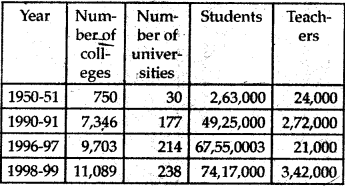
Table 2.1: Number of institutions of higher education enrolment and faculty.
NCERT Solutions for Class 9 Social Science Economics Chapter 2 People as Resource 1
Answer:
1. Literacy rates have increased from 18% in 1951 to 65% in 2001.

2. Literacy rate is highest in the year 2001.

3. Literacy rate is high among males of x India because from the very beginning girls are neglected. Equal opportunities are not given to them. In our society it is thought that boys are the bread earners, therefore, they enjoy many privileges.

4. Women are less educated because it is thought their work is to perform household chores. They are not given equal opporunities

5. Do it yourself.

6. The government of India has started many policies to increase literacy rate in India. Policies like Sarva Siksha Abhiyan, back-to-school camps, mid-day meal etc, could add to literate population of India. With such policies it seems that we will be able to achieve 100% literacy rate by 2010 at least in the age group of six to fourteen years.

Question 3.
Discuss this table in the classroom and answer the following questions.
(i) Is the increase in number of colleges adequate to admit the increasing number of strident.
(ii) Do you think one should have more number of universities?
(iii) What is the increase noticed among the teachers in the year 1998-99.
(iv) What is your idea about future college and universities?

Table 2.1: Number of institutions of higher education enrolment and faculty
NCERT Solutions for Class 9 Social Science Economics Chapter 2 People as Resource 2
Answer:
(i) Over the past fifty years, there has been a significant growth in the number of university and institutions of higher learning in specialized areas. But still as compared to the number of students the number of universities is not adequate.

(ii) Yes, we should have more number of universities.

(iii) There has been a tremendous and manifold increase in the number of teachers. In the year 1950-51, there were only 24,000 teachers. By the year 1998-99 it rose to 3,42,000.

(iv) The future college’s and universities should focus more on quality of education. They should encourage vocational courses, networking and information technology which helps in getting direct jobs They should also focus on distant education.

Question 4.
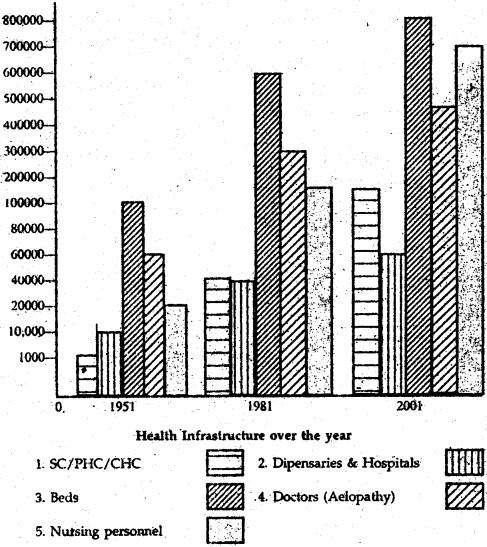
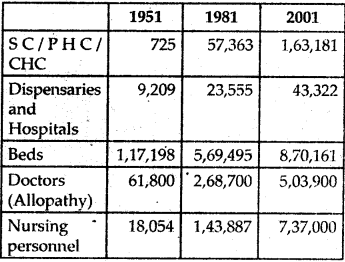
Study the table 2.2 and answer the following questions,
(i) What is the percentage increase in dispensaries from 1951 to 2001?
(ii) What is the percentage increase in doctors and nursing personnel from 1951 to 2001?
(iii) Do you think the increase in the number of doctor and nurses adequate for India ? Why?
(iv) What other facilities would you like to provide in a hospital?
(v) Discuss about the hospital you have visited?
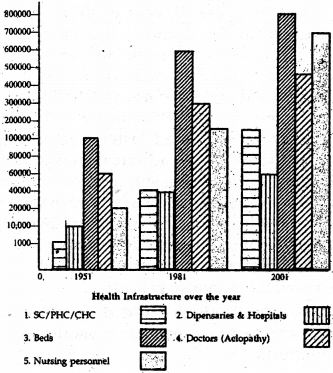
(vi) Can you draw graph using this table.

Table 2.2: Health infrastructure over the years.
NCERT Solutions for Class 9 Social Science Economics Chapter 2 People as Resource 3
Answer:
(i) The percentage increase in dispensaries from 1951 to 2001 is 370.43.

(ii) The percentage increase in doctors and nursing personnel from 1951 to 2001 is 715.37 and 3982.2.

(iii) Over the past five decades India has built up a vast health infrastructure and manpower required at primary secondary and tertiary care in government as well as private’ sector. But still as compared to our population growth the increase in number of doctprs and nurses is inadequate. For a population of above 100 crores we have only 5,03,900 doctors and 7,37,000 nurses.

(iv) Apart from routine check up and curing of illness, health centres like hospitals should provide information on nutritional values, family welfare, health awareness, etc. specially among underprivileged segment of population. Health centres should organise camps to provide information regarding hygiene, nutritious diet, viral diseases etc.

(v) Students are required to do it themselves
NCERT Solutions for Class 9 Social Science Economics Chapter 2 People as Resource 4

Question 5.
What do you understand by people as a resource?
Answer:
People as a resource is a way of referring to a country’s working people in terms of their existing productive skills and abilities. Like other resources population is Iso a resource. This is looking at the positive de of population. When the existing human resource is developed by providing good education and health facility it is called as human capital formation.

Question 6.
How is human resource different from other resources like land and physical capital?
Answer:
Human capital is superior to other resources like land and physical capital. It capital cannot become useful on its own. Skilled and educated population make the efficient use of other resources like land and capital.

Question 7.
What is the role of education in human capital formation?
Answer:
Education plays a vital role in human capital formation. Education opens new horizon, provides aspiration, and develop values of life. It contributes towards the growth of society. It enhances the national income, cultural richness and increase the efficiency of governance. Investment in human capital through education yields a return just like investment in physical capital. This, can be seen directly in the form of higher incomes earned because of higher productivity of the more educated or better-trained persons.

Question 8.
What is the role of health in human capital formation?
Answer:
A healthy person has higher productivity than an unhealthy person. The health of a person helps him to realise his potential and the ability to fight illness. An unhealthy person becomes the liability for an organisation which hires him. Health is an indispensable basis for realising one’s own well being. Investment in human capital via health yields greater return in future therefore, improvement in the health status of the population has been the priority of the country.

Question 9.
What part does health play in the individual’s working life.
Answer:
Health plays a vital role in an individual’s working life since no firm would be induced to employ people who might not work efficiently as healthy workers because of ill health and not only that, people who are physically or mentally ill cannot work.

Question 10.
What are the various activities undertaken in the primary sector, secondary sector, and tertiary sector?
Answer:
The various activities undertaken in different sectors are as follows—
(i) Primary sector—It includes agriculture, fishing, poultry farming, and mining.
(ii) Secondary sector— Quarrying and manufacturing is included in the secondary sector.
(iii) Tertiary sector—This sector includes trade, transport, communication, banking, education, health, tourism, services etc.

Question 11.
What is the difference between economic activities and non-economic activities?
Answer:
An activity which results in generation of income is called as economic activity, for example workers working in factories, banks etc. On the other hand, an activity which does not give any income is called as non-economic activity, for example, a woman performing domestic cores. Economic activities add to national income whereas noneconomic activities do not add to it.

Question 12.
Why are women employed in low paid work?
Answer:
Education and skill are the major determinants of the earning of any individual in the market. A majority of women have meagre education and low skill formation. Therefore, women are paid low compared to men.

Question 13.
How will you explain the term unemployment?
Answer:
Unemployment is said to exist when people who are willing to work at existing wages cannot find jobs. Unemployment can be of many types. In India two types of unemployment are prominent seasonal and disguised unemployment. Unemployment leads to wastage of resources and is detrimental to the growth of an economy.

Question 14.
What is the difference between disguised unemployment and seasonal unemployment?
Answer:
Disguised unemployment is a situation in which number of people engaged in an activity are more than actually required for it. On the other hand, when some people get work only for me part of the year and remain unemployed for the remaining part due to seasonal nature of work, it is called as seasonal unemployment.

Question 15.
Why is educated unemployment, a peculiar problem of India.
Answer:
In India, in case of urban areas educated unemployment has become a common phenomenon. Many youth with matriculation, graduation, and post graduation degrees are not able to find job. The unemployment of graduate and post-graduate has increased faster than among matriculates. A paradoxical manpower situation is witnessed as surplus of manpower in-certain categories co-exist with shortage of manpower in others. There is unemployment among technically qualified person on one hand, while there is a dearth of technical skills required for economic growth.

Question 16.
In which field do you think India can build the maximum employment opportunity.
Answer:
India can build the maximum employment opportunity in tertiary sector. Now various new services are appearing like biotechnology information technology and so on.

Question 17.
Can you suggest some measures in the education system to mitigate the problem of the educated unemployed?
Answer:
Following are some measures to mitigate the problem of the educated unemployed
(i) to start vocational courses which can provide immediate job.
(ii) government can provide loan at low interest rate to help unemployed youth to start their own business.
(iii) by allowing foreign companies to set up their industries in India. This will help absorb the man-power.
(iv) by changing the education system. Instead of producing army of. unemployed graduates, universities should provide practical education which can help youth in their work fields.

Question 18.
Which capital would you consider the best—land, labour, physical capital and human capital? Why?
Answer:
Among all the factors of production viz. land, labour, physical capital and human capital, the human capital is best. It is because human capital is required to put together land, labour and physical capital to produce an output. Land and physical capital cannot become useful on its own.

These Solutions are part of NCERT Solutions for Class 9 Social Science. Here we have given NCERT Solutions for Class 9 Social Science Economics Chapter 2 People as Resource.

NCERT Solutions for Class 8 Sanskrit Chapter 3 डिजीभारतम्

We have given detailed NCERT Solutions for Class 8 Sanskrit Ruchira Chapter 3 डिजीभारतम् Questions and Answers will cover all exercises given at the end of the chapter.

NCERT Solutions for Class 8 Sanskrit Ruchira Chapter 3 डिजीभारतम्

अभ्यासः

प्रश्न 1.
अधोलिखिताना प्रश्नानाम् उत्तराणि एकपदेन लिखत-
(क) कुत्र “डिजिटल इण्डिया” इत्यस्य चर्चा भवति?
उत्तरम्:
संपूर्ण विश्वे

(ख) केन सह मानवस्य आवश्यकता परिवर्तते?
उत्तरम्:
कालपरिवर्तनेन।

(ग) आपणे वस्तूनां क्रयसमये केषाम् अनिवार्यता न भविष्यति?
उत्तरम्:
रुप्यकाणाम्।

(घ) कस्मिन् उद्योगे वृक्षाः उपयुज्यन्ते?
उत्तरम्:
कर्गद-उद्योगे।

(ङ) अद्य सर्वाणि कार्याणि केन साधितानि भवन्ति?
उत्तरम्:
संगणकयन्त्रेण।

प्रश्न 2.
अधोलिखितानां प्रश्नान् पूर्णवाक्येन उत्तरत-
(क) प्राचीनकाले विद्या कथं गृह्यते स्म?
उत्तरम्:
प्राचीनकाले विद्या श्रुतिपरम्परया गृह्यते स्म।

(ख) वृक्षाणां कर्तनं कथं न्यूनतां यास्यति?
उत्तरम्:
संगणकस्य अधिकाधिक प्रयोगेण वृक्षाणां कर्तनं न्यूनतां यास्यति।

(ग) चिकित्साल्ये कस्य आवश्यकता अद्य नानुभूयते?
उत्तरम्:
चिकित्सालये रूप्यकाणाम् आवश्यकता अद्य नानुभूयते।

(घ) वयम् कस्यां दिशि अग्रेसरामः?
उत्तरम्:
वयं डिजिटल भारतम् इति अस्यां दिशि अग्रसरामः।

(ङ) वस्त्रपुटके केषाम् आवश्यकता न भविष्यति?
उत्तरम्:
वस्त्रपुटके रूप्यकाणाम् आवश्यकता न भविष्यति।

प्रश्न 3.
रेखांकितपदान्यधिकृत्य प्रश्ननिर्माणं कुरुत-
(क) भोजपत्रोपरि लेखनम् आरब्धम्।
उत्तरम्:
भोजपत्रोपरि किम् आरब्धम्?

(ख) लेखनार्थम् कर्गदस्य आवश्यकतायाः अनुभूतिः न भविष्यति।
उत्तरम्:
लेखनार्थम् कस्य आवश्यकतायाः अनुभूतिः न भविष्यति?

(ग) विश्रामगृहेषु कक्षं सुनिश्चितं भवेत्।
उत्तरम्:
केषु कक्षं सुनिश्चितं भवेत्?

(घ) सर्वाणि पत्राणि चलदूरभाषयन्त्रे सुरक्षितानि भवन्ति।
उत्तरम्:
सर्वाणि पत्राणि कुत्र सुरक्षितानि भवन्ति?

(ङ) वयम् उपचारार्थम् चिकित्साल्यं गच्छामः?
उत्तरम्:
वयम् किमर्थम् चिकित्साल्यं गच्छामः?

प्रश्न 4.
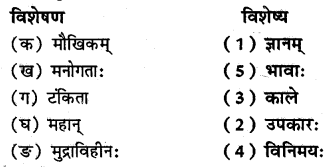
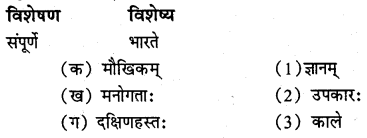
उदाहरणमनुसृत्य विशेषण विशेष्यमेलनं कुरुत-
NCERT Solutions for Class 8 Sanskrit Chapter 3 डिजीभारतम् Q4
NCERT Solutions for Class 8 Sanskrit Chapter 3 डिजीभारतम् Q4.1
उत्तरम्:
NCERT Solutions for Class 8 Sanskrit Chapter 3 डिजीभारतम् Q4.2

प्रश्न 5.
अधोलिखितपदयोः संधि कृत्वा लिखत-
पदस्य + अस्य = ________
तालपत्र + उपरि = ________
च + अतिष्ठत = ________
कर्गद + उद्योगे = ________
क्रय + अर्थम् = ________
इति + अनयोः = ________
उपचार + अर्थम् = ________
उत्तरम्:
पदस्य + अस्य = पदस्यास्य
तालपत्र + उपरि = तालपत्रोपरि
च + अतिष्ठत = चातिष्ठत
कर्गद + उद्योगे = कर्गदोद्योगे
क्रय + अर्थम् = क्रयार्थम्
इति + अनयोः = इत्यनयोः
उपचार + अर्थम् = उपचारार्थम्

प्रश्न 6.
उदाहरणमनुसत्य अधोलिखितेन पदेन लघु वाक्य निर्माणं कुरुत-
यथा- जिज्ञासा – मम मनसि वैज्ञानिकानां विषये जिज्ञासा अस्ति
(क) आवश्यकता – ______________
(ख) सामग्री – ______________
(ग) पर्यावरण सुरक्षा – ______________
(घ) विश्रामगृहम् – ______________
उत्तरम्:
(क) आवश्यकता – रूप्यकाणाम् आवश्यकता प्रायेणाध समाप्ता एव।
(ख) सामग्री – लिखिता सामग्री दूरभाषयन्त्रे सुरक्षिता भवति।
(ग) पर्यावरण सुरक्षा – यदा वृक्षाणां कर्तन न भविष्यति तदा पर्यावरण-सुरक्षा सुनिश्चिता भविष्यति इति विश्वासः अस्ति।
(घ) विश्रामगृहम् – यात्रिणः विश्रामगृहं गत्वा तिष्ठन्ति।

प्रश्न 7.
उदाहरणानुसारम् कोष्ठकप्रदत्तेषु पदेषु चतुर्थी प्रयुज्य रिक्तस्थानपूर्ति कुरुत-
यथा : भिक्षुकाय धनं ददातु। (भिक्षुक)
(क) ___________ पुस्तकं देहि। (छात्र)
(ख) अहम् ___________ वस्त्राणि ददामि। (निर्धन)
(ग) ___________ पठनं रोचते। (लता)
(घ) रमेशः ___________ अलम्। (सुरेश)
(ङ) ___________ नमः। (अध्यापक)
उत्तरम्:
(क) छात्राय पुस्तकं देहि।
(ख) अहम् निर्धनाय वस्त्राणि ददामि।
(ग) लतायै पठनं रोचते।
(घ) रमेशः सुरेशाय अलम्।
(ङ) अध्यापकाय नमः।

योग्यता-विस्तारः
इंटरनेट : ज्ञान का महत्त्वपूर्ण माध्यम है।
इंटरनेट से किसी बात का ज्ञान आसानी से मिल सकता है। केवल एक “क्लिक” से ज्ञान-विज्ञान के अनेक पहलुओं तक पहुंचा जा सकता है। यह ज्ञान का महा-समुद्र है जिसमें एक सूक्ष्म बैक्टीरिया जैसे जीवाणु से लेकर ब्लैकहोल तक, राजनीति या व्यापार तक, अंतर्राष्ट्रीय संबंधों से लेकर विज्ञान संबंधी असीम उन्नति तक की जानकारी मिल जाती है। सामान्य रूप से हमें किसी बात की जानकारी के हेतु लाइब्रेरी जाना पड़ता है, परंतु अब हम घर बैठे सब पा लेते हैं। यह सामाजिक मंच है, जहाँ हम संसार के किसी स्थान पर स्थित व्यक्ति से किसी भी बारे में विचार-विनिमय कर सकते हैं। ई-मेल, वीडियो कॉलिंग आदि की सुविधाएँ सर्व सुलभ हैं। ऑनलाइन दूरस्थ शिक्षा (Online distance education) के द्वारा लोग घर बैठे अपना पाठ्यक्रम पूरा कर सकते हैं। यह मनोरंजन का फ्री साधन है। इसकी नेविगेशन सुविधा लोगों को एक से दूसरी जगह पहुंचाने में समर्थ है। कभी इसका अवकाश नहीं होता। यह हमें 24×7 मिल रहा है।

1. अनेक शब्दों के लिए एक शब्द-
ज्ञातुम् इच्छा – जिज्ञासा – जानने की इच्छा
कर्तुम् इच्छा – चिकीर्षा – करने की इच्छा
पातुम् इच्छा – पिपासा – पीने की इच्छा
भोक्तुम् इच्छा – बुभुक्षा – खाने की इच्छा
जीवितुम् इच्छा – जिजीविषा – जीले की इच्छा
गन्तुम् इच्छा – जिगमिषा जाने की इच्छा

2. “तुमुन्” प्रत्यय में ‘तुम्’ शेष बचता है। यह प्रत्यय के लिए अर्थ में प्रयुक्त होता है। जैसे।
कृ + तुमुन् – कर्तुम् – करने के लिए
दा + तुमुन् – दातुम् – देने के लिए
खाद् + तुमुन् – खादितुम् – खाने के लिए
पठ् + तुमुन् – पठितुम् – पढ़ने के लिए
लिख् + तुमुन् लिखितुम् – लिखने के लिए
गम् + तुमुन् – गन्तुम् – जाने के लिए

Class 8 Sanskrit Chapter 3 डिजीभारतम् Summary

पाठ-परिचयः
यह पाठ “डिजिटल इण्डिया” की मूल भावना पर आधारित निबंधात्मक पाठ है। इस पाठ में विज्ञान की उन्नति के उन पहलुओं को उभारा गया है, जिनमें हम (मानव) एक “क्लिक” के माध्यम से काफी कुछ कर सकते हैं। आज के समय में इंटरनेट ने मानव-जीवन को कितना आसान बना दिया है। भौगोलिक दृष्टिकोण से आज का मानव एक-दूसरे के काफी नज़दीक आ गया है। इससे जीवन के अधिकांश कार्य सुविधापूर्ण हो गए हैं। ऐसे ही विचारों को यहाँ आसान संस्कृत भाषा में प्रकट किया गया है।

मूलपाठः
अद्य संपूर्णविश्वे “डिजिटलइण्डिया” इत्यस्य चर्चा श्रूयते। अस्य पदस्य कः भावः इति मनसि जिज्ञासा उत्पद्यते। कालपरिवर्तने सह मानवस्य आवश्यकताऽपि परिवर्तते। प्राचीनकाले ज्ञानस्य आदान-प्रदानं मौखिकम् आसीत्, विद्या च श्रुतिपरम्परया गृह्यते स्म। अनन्तरं तालपत्रोपरि भोजपत्रोपरि च लेखनकार्यम् आरब्धम्। परवर्तिनि काले कर्गदस्य लेखन्याः च आविष्कारेण सर्वेषामेव मनोगतानां भावानां कर्गदोपरि लेखनं प्रारब्धम्। टंकणयंत्रस्य आविष्कारेण तु लिखिता सामग्री टंकिता सती बहुकालाय सुरक्षिता अतिष्ठत्।

वैज्ञानिकप्रविधेः प्रगतियात्रा पुनरपि अग्रे गता। अद्य सर्वाणि कार्याणि संगणकनामकेन यंत्रेण साधितानि भवन्ति। समाचार-पत्राणि, पुस्तकानि च कम्प्यूटमाध्यमेन पठ्यन्ते लिख्यन्ते च। कर्गदोद्योगे वृक्षाणाम् उपयोगेन वृक्षाः कर्त्यन्ते स्म, परम् संगणकस्य अधिकाधिक-प्रयोगेण वृक्षाणां कर्तने न्यूनता भविष्यति इति विश्वासः। अनेन पर्यावरणसुरक्षायाः दिशि महान् उपकारो भविष्यति।

अधुना आपणे वस्तुक्रयार्थम् रूप्यकाणाम् अनिवार्यता नास्ति। “डेबिट कार्ड”,”क्रेडिट कार्ड” इत्यादि सर्वत्र रूप्यकाणां स्थानं गृहीतवन्तौ। वित्तकोशस्य (बैंकस्य) चापि सर्वाणि कार्याणि संगणकयंत्रेण सम्पाद्यन्ते। बहुविद्याः अनुप्रयोगाः (APP) मुद्राहीनाय विनिमयाय (Cashless Transaction) सहायकाः सन्ति।

कुत्रापि यात्रा करणीया भवेत् रेलयानयात्रापत्रस्य, वायुयानयात्रापत्रस्य अनिवार्यता अद्य नास्ति। सर्वाणि पत्राणि अस्माकं चलदूरभाषयन्त्रे ‘ई-मेल’ इति स्थाने सुरक्षितानि भवन्ति यानि सन्दर्य वयं सौकर्येण यात्रायाः आनन्द ग्रहीमः। चिकित्सालयेऽपि उपचारार्थ रूप्यकाणाम् आवश्यकताद्य नानुभूयते। सर्वत्र कार्डमाध्यमेन, ई-बैंकमाध्यमेन शुल्कम् प्रदातुं शक्यते।

तदिनं नातिदूरम् यदा वयम् हस्ते एकमात्रं चलदूरभाषयन्त्रमादाय सर्वाणि कार्याणि साधयितुं समर्थाः भविष्यामः। वस्त्रपुटके रूप्यकाणाम् आवश्यकता न भविष्यति। ‘पासबुक’ चैक्बुक’ इत्यनयोः आवश्यकता न भविष्यति। पठनार्थ पुस्तकानां समाचारपत्राणाम् अनिवार्यता समाप्तप्राया भविष्यति। लेखनार्थम् अभ्यासपुस्तिकायाः कर्गदस्य वा, नूतनज्ञानान्वेषणार्थम् शब्दकोशस्यावाऽपि आवश्यकतापि न भविष्यति। अपरिचित-मार्गस्य ज्ञानार्थम् मार्गदर्शकस्य मानचित्रस्य आवश्यकतायाः अनुभूतिः अपि न भविष्यति। एतत् सर्व एकेनेव यन्त्रेण कर्तुम्, श्क्यते। शाकादिक्रयार्थम्, फलक्रयार्थम्, विश्रामगृहेषु कक्षं सुनिश्चितं कर्तुम् चिकित्सालये शुल्क प्रदातुम्, विद्यालये महाविद्यालये चापि शुल्कं प्रदातुम्, किंबहुना दानमपि दातुम् चलदूरभाषयन्त्रमेव अलम्। डिजीभारतम् इति अस्यां दिशि वयं भारतीयाः द्रुतगत्या अग्रेसरामः।

सन्धिविच्छेदः
आवश्यकताऽपि = आवश्यकता + अपि।
प्रदानं मौखिकम् = प्रदानम् + मौखिकम्।
अनन्तरं तालपत्रोपरि = अनन्तरम् + तालपत्र + उपरि।
मनोगता नां भावानां कर्गदोपरि = मनः + गतानाम् + भावानाम् + कर्गद + उपरि।
लेखनं प्रारब्धम् – लेखनम् + प्रारब्धम्।
कर्गदोद्योग = कर्गद + उद्योगे।
अधिकाधिक = अधिक + अधिक।
वृक्षाणां कर्तने = वृक्षाणाम् + कर्तने।
पर्यावरण = परि + आवरण।
उपकारो भविष्यति = उपकारः + भविष्यति।
रुप्याकाणां स्थानं गृहीतवन्तौ = रुप्यकाणाम् + स्थानम् + गृहीतवन्तौ।
चापि = च + अपि।
कुत्रापि = कुत्र + अपि।
वयं सौकर्येण = वयम् + सौकोण।
आनन्दं गृहणीमः = आनन्दम् + गृहणीमः।
चिकित्सालयेऽपि – चिकित्साल्ये + अपि।
नानुभूयते = न + अनुभूयते।
प्रदातुं शक्यते = प्रदातुम् + शक्यते।
तद्दिनं नातिदूरम् = तत् + दिनम् + न + अतिदूरम्।
साधयितुं समर्थाः = साधयितुम् + समर्थाः।
इत्यनयोः = इति + अनयो:।
नूतनज्ञानान्वेषणार्थम् = नूतनज्ञान + अन्वेषण + अर्थम्।
आवश्यक तापि = आवश्यकता + अपि।
ज्ञानार्थम् = ज्ञान + अर्थम्।
एकेनैव = एकेन + एव।
शाकादिक्रयार्थम् = शाक + आदि + क्रय + अर्थम्।
कक्षं सुनिश्चितं कर्तुम् = कक्षम् + सुनिश्चितम् + कर्तुम्।
विद्यालये = विद्या + आलये।
चापि = च + अपि।
किंबहुना = किम् + बहुना।
दानमपि = दानम् + अपि।
अस्यां दिशि = अस्याम् + दिशि।
वयं भारतीयाः = वयम् + भारतीया:।

संयोगः
सर्वेषामेव = सर्वेषाम् + एव।
चलदूरभाषयन्त्रमादाय = चलदूरभाषयन्त्रम् + आदाय।
दानमपि = दानम् + अपि।
यन्त्रमेव = यन्त्रम् + एव।

पदार्थबोध:
अद्य = आज (अद्यतनीयं दिनम्)।
चर्चा = जिक्र (वार्ता)।
जिज्ञासा = जानने की इच्छा (ज्ञातुम् इच्छा)।
प्राचीनकाले = पुराने समय में (प्राचीने/पूर्वस्मिन् काले)।
श्रुतिपरम्परया = सुनने की परंपरा से (श्रवणस्य परम्परया)।
टंकणयंत्रस्य = कंप्यूटर का (कंप्यूटरस्य)।
आपणे = दुकान में (वस्तुक्रयस्थले)।
सङ्गणकयन्त्रेण = कंप्यूटर से (टंकनयंत्रेण)।
यात्रापत्रस्य = टिकट की (चिटिकाया)।
अनिवार्यता = ज़रूरत (आवश्यकता)।
दूरभाषयन्त्रं = मोबाइल फोन (दूरध्वनियन्त्रम्)।
वस्त्रपुरके = बटुए में (पॉकेटे)।
अग्रेसरामः = आगे बढ़ रहे हैं (अग्रेगच्छामः, चलामः)।

सरलार्थ
आज पूरी दुनिया में “डिजिटल इण्डिया” की चर्चा सुनाई देती है। इस शब्द का क्या मतलब है। मन में यह जानने की इच्छा उत्पन्न होती है। समय बदलने के साथ मनुष्य को आवश्यकता भी बदलती रहती है। पुराने समय में ज्ञान का आदान-प्रदान मौखिक रूप से होता था और सुनने की परंपरा से विद्या प्राप्त की जाती थी। बाद में ताल और भोजपात्र पर लेखन कार्य शुरू हुआ। समय बदलता गया और कागज़ एवं पैन के आविष्कार से सभी मनोभावों का लेखन कागज पर होने लगा। टाईपराइटर के आविष्कार से तो इस्तलिखित सामग्री टाईप करके बहुत समय के लिए सुरक्षित हो जाती है। वैज्ञानिक तकनीकी की विकास-यात्रा फिर आगे बढ़ी। आज सारे कार्य कम्प्यूटर से कर लिए जाते हैं। अखबार एवं किताबें कम्प्यूटर से पढी व लिखी जा रही हैं। कागज़ के उहोग में पेड़ों की कटाई की जाती थी, लेकिन कम्प्यूटर के ज्यादा-से-ज्यादा प्रयोग से पेड़ों की कटाई में कमी आएगी, ऐसा विश्वास है। इससे पर्यावरण सुरक्षा की दिशा में बड़ा उपकार होगा।

अब दुकान से वस्तुएँ खरीदने के लिए रुपयों की जरूरत नहीं है। “डेबिट कार्ड”, “क्रेडिट कार्ड” आदि उपकरणों ने रुपयों की जगह ले ली है। बैंक के भी सा कामकाज कम्प्यूटर से हो रहे हैं। अनेक अनुप्रयोग (APP) मुद्राहीन विनिमय के लिए (Cashless Transaction) सहायक हैं।

कहीं भी यात्रा करनी हो, रेल टिकट हाई ‘टकट की आज अनिवार्यता समाप्त हो गई। सारे टिकट हमारे स्मार्ट फोन में ‘ई-मेल’ बॉक्स में सुरक्षित होते हैं, न दिखाकर हम आसानी से यात्रा का आनंद लेते हैं। अस्पताल में भी इलाज के लिए रुपयों की आवश्यकता महसूस नहीं की जाती। सब जगह कार्ड से या ई-बैंकिंग से फीस दी जा सकती है।

वह दिन दूर नहीं, जब हम हाथ में एक स्मार्टफोन लेकर सारे कार्य करने में सक्षम होंगे। पर्स में रुपये रखने की ज़रूरत नहीं होगी। पासबुक व चैकबुक की भी ज़रूरत नहीं रहेगी। पढ़ने के लिए पुस्तकों या अखबारों की अनिवार्यता लगभग समाप्त हो जाएगी। लिखने के लिए कॉपी या कामल, नये ज्ञान की खोज के शब्दकोश की भी ज़रूरत नहीं रह जाएगी। अनजान रास्ते की जानकारी के लिए मार्गदर्शक मानचि. की आवश्यकता का अनुभव भी नहीं होगा। ये सारे कार्य एक यंत्र के द्वारा किए जा सकते हैं। शाक-सब्जी-फल ते लिए, होटलों में कमरा बुक कराने के लिए, अस्पतालों में फीस जमा कराने के लिए, स्कूल-कॉलेजों में फीस द हे और अधिक क्या दान के लिए भी मोबाइल फोन ही पर्याप्त है। डिजिटल भारत की ओर हम भारतवासी बड़ी तेजी से आगे बढ़ रहे हैं।

भावार्थ
निश्चित रूप से डिजिटल इण्डिया की धूम आज देश में ही नहीं वरन् दुनिया भर में है। इससे अनेक सुविधाएँ हमारी मुट्ठी में हैं।

NCERT Solutions for Class 7 Social Science Geography Chapter 2 Inside our Earth

Inside our Earth Class 7 Questions and Answers Geography Chapter 2

Class 7 Geography Chapter 2 NCERT Textbook Questions and Answers

Question 1.
Answer the following questions :
(i) What are the three layers of the earth?
Answer:
The three layers of the earth are :

  1. Crust
  2. Mantle
  3. Core

(ii) What is a rock?
Answer:
Rock is a hard material that makes up the earth’s crust. Various combinations of minerals made up hundreds of different types of rocks.

(iii) Name three types of rocks.
Answer:
The three types of rocks are :

  1. Igneous rocks
  2. Sedimentary rocks
  3. Metamorphic rocks

(iii) How are extrusive and intrusive rocks formed?
Answer:
Extrusive rocks:
When the molten lava comes on the earth’s surface, it rapidly cools down and become solid. Rocks formed in such a way on the crust are called extrusive igneous rocks.

Intrusive rocks:
Sometimes the molten magma cools down deep inside the earth’s crust. Solid rocks so formed are called intrusive igneous rocks.

(iv) What do you mean by a rock cycle?
Answer:
When one type of rock changes to another type under certain conditions in a cyclic manner, this process is known as rock cycle.

(v) What are the uses of rocks?
Answer:
Rocks are useful to us in the following ways:

The hard rocks are used for making roads, houses and buildings.

Some stones are used in games such as, seven stones (pitthoo) hop-scotch (stapu/kit kit), five stones (gitti), etc.

(vi) What are metamorphic rocks?
Answer:
The Greek word metamorphose means change of form. Metamorphic rocks change their original form without any disintegration. Igneous and sedimentary rocks undergo changes in their appearance under great heat and pressure. The new rocks formed are called metamorphic rocks. For example, clay changes into state and limestone into marble.

Question 2.
Tick the correct answer :
(i) The rock which is made up of motten magma is :
(a) Igneous
(b) Sedimentary
(c) Metamorphic
Answer:
(a) Igneous.

(ii) The innermost layer of the earth is :
(a) crust
(b) core
(c) Mantle
Answer:
(b) Core.

(iii) Gold, petroleum and coal are examples of :
(a) Rocks
(b) Minerals
(c) Fossils
Answer:
(b) Minerals

(iv) Rocks which contain fossils are :
(a) Sedimentary rocks
(b) Metamorphic rocks
(c) Igneous rocks
Answer:
(a) Sedimentary rocks,

(v) The thinnest layer of the earth is :
(a) Crust
(b) Mantle
(c) Core
Answer:
(a) Crust.

Question 3.
Match the following :

(i) Core (a) changes into slate
(ii) Minerals (b) used for roads and buildings
(iii) Rocks (c) made of silicon and alumina
(iv) Clay (d) has definite chemical composition
(v) Sia! (e) innermost layer

Answer:

(i) Core (e) innermost layer
(ii) Minerals (d) has definite chemical composition
(iii) Rocks (b) used for roads and buildings
(iv) Clay (a) changes into slate
(v) Sia! (c) made of silicon and alumina

Question 4.
Give reasons :
1. We cannot go to the centre of the earth.
2. Sedimentary rocks are formed from sediments.
3. Limestone is changed into marble.
Answer:
1. We cannot go to the centre of the earth because the core of the earth has very high temperature and pressure.

2. Sedimentary rocks are formed from sediments because the sediments are transported/ deposited by wind, water, etc. These loose sediments are compressed and hardened to form layers of rocks, which are known as sedimentary rocks.

3. Limestone (metamorphic rock) is changed into marble because igneous and sedimentary rocks change into metamorphic rocks under great heat and pressure.

Question 5.
For fun :
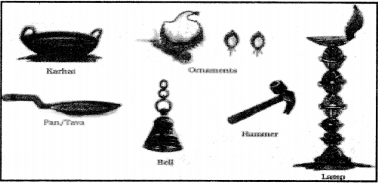
(a) What are the minerals most commonly used in the following objects?
(b) Identify some more objects made of different minerals.
NCERT Solutions for Class 7 Social Science Geography Chapter 2 Inside our Earth 1
Answer:
(a) The above materials can be made of the following :
(i) Iron, stainless steel
(ii) Brass
(iii) Copper
(iv) Aluminium
(v) Silver/Gold
(vi) Wood/iron
(vii) Glass/beads, etc.

(b) Almirah, cooler, glass, plates, frypan, etc.

NCERT Solutions for Class 7 Social Science

NCERT Solutions for Class 8 Social Science Geography Chapter 1 Resources

Resources Class 8 Questions and Answers Geography Chapter 1

Geography Class 8 Chapter 1 NCERT Textbook Questions and Answers

Class 8 Geography Chapter 1 Question 1.
List out five resources you use in your home and five you used in your classroom.
Answer:

Resources used in home Resources used in classroom
Television Fan
Fridge Tubelight
Radio Computer
Gas cooker Black-board
Almirah Chalk

Question 2.
Activity: Circle those resource from Amna’s list that are regarded as having no commercial value.
Answer:
Cotton cloth, Intelligence, medical knowledge, clean environment, old folk songs, affection, fun, friends and family.

Question 3.
Think of few renewable resources and mention how their stock may get affected by overuse.
Answer:
A beautiful scenery
Agricultural land
Pure water Deforestation.
These stock of the given resources can be affected by overusing, pollution, construction, urbanisation, etc.

Question 4.
Make a list of five human made resources that you can observe around you.
Answer:
Roads, buildings, machinery, computer, vehicles, etc.

Question 5.
Answer the following questions.
(i) Why are resources distributed unequally over the earth?
(ii) What is resource conservation?
(iii) Why are human resources important?
(iv) What is sustainable development?
Answer:
(i) The distribution of resources depends on various factors. There include topography, climate, height above sea level, etc. Since these factors vary in different parts of the world, hence, resources are unevenly distributed over the earth.

(ii) Resource development is a type of method of utilising our intelligence in order to improve the quality, tuneability, and utility of a resource.

(iii) Human beings have an intelligent mind which can make best use of nature to create more resources. In the absence of human beings, different substances would not have been resources. The utility of resources can only be realised by human beings. Hence, human resources are important.

(iv) Resources should be used in such a balanced way that they not only satisfy our needs best also can be used in future. This concept is called sustainable development.

Question 6.
Tick the correct answer.
(i) Which one of the following does NOT make substance a resource?
(a) utility
(b) value
(c) quantity
Answer:
(c) quantity

(ii) Which one of the following is a human made resource?
(a) medicines to treat cancer
(b) spring water
(c) tropical forests
Answer:
(b) spring water

(iii) Complete the statement.
Biotic resources are
(a) derived from living things
(b) made by human beings
(c) derived from non-living things
Answer:
(a) derived from living things

Question 3.
Differentiate between the followings :
(a) Potential and actual resources
Answer:

Potential resources Actual resources
1. This resource is not being used currently. 1. This resource is being used currently.
2. This resource can prove useful and become an actual resource in future. 2. This resource might have been a potential resource in the past. It may end in the future.
3. The entire quantity of a potential resource may not be known. 3. The actual quantity of an actual resource is known.
4. Example : Uranium deposits in Ladakh. 4. Example : Coal deposits.

(b) Ubiquitous and localised resources
Answer:

Ubiquitous resources Localised resources
1. This resource is found all over the world. 1. This resource is found in a particular region or physical condition.
2. The presence of this resource is not governed by physical condition. 2. The presence of this resource is governed by physical condition.
3. Example : air 3. Example : minerals

Question 4.
Activity
“Rahiman paani raakhiye,
Bin paani sab soon.
Panni gaye na ubere
Moti, manus, choon…”
[Says Rahim, keep water, as without water there is nothing. Without water pearl, swan and dough cannot exist.]
These line were written by the poet Abdur Rahim Khankhana, one of the nine gems of Akbar’s court. What kind of resource is the poet referring to? Write in 100 words what would happen if this resource disappeared?
Answer:
According to the poet the resource referred is water. Water is one of the most indispensable resources of life. No living being can live without water. In the absence of water we cannot perform activities like drinking, cleaning washing etc. All our agricultural products depend on water. Rainwater is important for irrigation. Now- a days water is used to generate electricity. Water is also required for most of the industries. Thus, no life form or many activities can go without water.

For Fun
1. Pretend that you live in the prehistoric times on a high windy plateau. What are the uses you and your friends could put the fast winds to? Can you call the wind a resource?
Now imagine that you are living in the same place in the year 2138. Can you put the winds to any use? How? Can you explain why the wind is an important resource now?
Answer:
If I and my friends had lived in the prehistorie period, on a high windy plateau, we could not have understood the utility of the high winds because during that time technology was absent. As time passed sciene and technology have developed. At present. I would have setup windmills and other factories to bring its utility.

But if considered that we are in the year 2138, we will totally depend on wind energy. We would perform all our tasks using the power of the wind.

2. Pick up a stone, a leaf, a paper straw and a twig. Think of how you can use these as resources. See the example given below and get creative!

You can use a stone … Use/Utility
To play stapu toy
As a paper-weight tool
To crush spices tool
To decorate your garden/room decoration piece
To open a bottle tool
In a catapult weapon


You can use a leaf … Use/Utility
You can use a straw … Use/Utility


You can use a twig … Use/Utility

Answer:

You can use a leaf … Use/Utility
To use as a disposable plate utensil
To use as fodder for cattle food
Banana leaf used in puja puja item


You can use a straw … Use/Utility
To drink juice tool
To use a small pipe tool
To use as flute toy
To play as water pipe toy


You can use a twig … Use/Utility
To build nest by a bird tool
To make fire tool
To drive cattle weapon

NCERT Solutions for Class 8 Social Science

NCERT Solutions for Class 9 Sanskrit Shemushi Chapter 8 लौहतुला

We have given detailed NCERT Solutions for Class 9 Sanskrit Shemushi Chapter 8 लौहतुला Questions and Answers will cover all exercises given at the end of the chapter.

Shemushi Sanskrit Class 9 Solutions Chapter 8 लौहतुला

अभ्यासः

प्रश्न 1.
अधोलिखतानां प्रश्नानाम् उत्तराणि संस्कृत भाषा लिखत –

(क) देशान्तरं गन्तुमिच्छन् वणिक्पुत्रः किं व्यचिन्तयत्?
उत्तर:
वणिक्पुत्रः व्यचिन्तयत्-“यत्र पूर्व भोगः भुक्ताः तत्र विभवहीनः सन् न वसेत्।

(ख) स्वतुला याचमान जीर्णधनं श्रेष्ठी कि अकथयत्?
उत्तर:
सः अकथयत्-“भोः! नास्ति तुला सा तु मूषकैः भक्षिता”।

(ग) जीर्णधनः गिरिगुहाद्वार कया आच्छद्य गृहमागतः।
उत्तर:
जीर्णधनः गिरिगुहाद्वार महत्या शिलया आच्छाद्य गृहमागतः।

(घ) स्नानान्तर पुत्र विषये पृष्टः वणिक्पुत्रः श्रेष्ठिन किम् उवाच?
उत्तर:
वणिक्पुत्रः उवाच-‘” भोः! तव पुत्र नदीतटात् श्येनेन

(ङ) धर्माधिकारिभिः जीर्णधन श्रेष्ठिनौ कथं सन्तोषितौ?
उत्तर:
धर्माधिकारिभिः तौ परस्परं तुला-शिशु-प्रदानेन सन्तोपितो।

प्रश्न 2.
स्थूलपदान्यधिकृत्य प्रश्ननिर्माणकुरुत –

(क) जीर्णधनः विभवक्षयात् देशान्तरं गन्तुमिच्छन व्यचिन्तयत्।
उत्तर:
क: विभवक्षयात् देशान्तरं गन्तुमिच्छान व्यचिन्तयत्?

(ख) श्रेष्ठिन: शिशु स्नानोपकरणमदाय अभ्यागतेन सह प्रस्थितः।
उत्तर:
श्रेष्ठिनः शिशु स्नानोपकरणमदाय केन सह प्रस्थितः?

(ग) श्रेष्ठी उच्चस्वरेण उवाच- भो: अब्रह्ममण्यम् अब्रह्ममण्यम्।
उत्तर:
श्रेष्ठी उच्चस्वरेण किम् उवाच?

(घ) सभ्यैः तौ परस्परं संबोध्य तुला-शिश-प्रदानेन सन्तोषितौ।
उत्तर:
सभ्यः तौ परस्परं संबोध्य कथं सन्तोषितौ।

प्रश्न 3.
अधोलिखितानां श्लोकानाम् अपुर्णोऽन्वयः प्रदत्तः पाठमाधृत्य तम् पूरयत –

(क) यत्र देशे अथवा स्थाने ……… भोगः भुक्ता …………… विभवहीनः यः ……………. स पुरुषाधमः।
(ख) राजन्! यत्र लौहसहस्त्रस्य …………. मूषकाः ………… तत्र श्येन: ………… हरेत् अत्र संशयः न।
उत्तर:
(क) यत्र देशे अथवा स्थाने स्ववीर्यतः भोगः भुक्ता तस्मिन् विभवहीनः य वसेत् स पुरुषाधमः।
(ख) राजन्! यत्र लौहसहस्त्रस्य तुलां मूषकाः खादन्ति तत्र श्येन : बालक हरेत् अत्र संशयः न।

प्रश्न 4.
तत्पदं रेखाङ्कितं कुरुत यत्र –

(क) ल्यप् प्रत्ययः नास्ति
विहस्य, लौहसहस्त्रस्य, संबोध्य, आदाय
उत्तर:
लौहसहस्त्रस्य।

(ख) यत्र द्वितीया विभक्तिः नास्ति
श्रेष्ठिनम्, स्नानोपकरणम्, सत्वरम्, कार्यकारणम्
उत्तर:
सत्वरम्।

(ग) यत्र षष्ठी विभक्तिः नास्ति
पश्यतः, स्ववीर्यतः, श्रेष्ठिनः, सभ्यानाम्
उत्तर:
स्ववीर्यंत

प्रश्न 5.
सन्धिना सन्धिविच्छेद वा रिक्तस्थनानि पूरयत –

(क) श्रेष्ठ्याह = ……………….. + आह
(ख) ……………… = द्वौ + अपि
(ग) पुरुषोपार्जिता = पुरुष + …………
…………… = यथा + …….
(ङ) स्नानोपकरणम् = ………………. + उपकरणम्
(च) …………. = स्नान + अर्थम्
उत्तर:
(क) श्रेष्ठ्याह = श्रेष्ठी + आह
(ख) द्वावपि = द्वौ + अपि
(ग) पुरुषोपार्जिता = पुरुष + उपार्जित
(घ) यथेच्छया = यथा + इच्छया
(ङ) स्नानोपकरणम् – स्नान + उपकरणम्
(च) स्नानार्थम् = स्नान + अर्थम्

प्रश्न 6.
समस्तपदं विग्रह वा लिखत –

विग्रहः – समस्तपदम्
(क) स्नानस्य उपकरणम् = …………..
(ख) …………. …………. = गिरिगुहायाम्
(ग) धर्मस्य अधिकारी = ………………
(घ) …………. ………… = विभवहीना:
उत्तर:
(क) स्नानस्य उपकरणम् = स्नानोपकरणम्
(ख) गिरेः गुहायता = गिरिगुहायाम्
(ग) धर्मस्य अधिकारी = धर्माधिकारी
(घ) विभवेन हीनाः = विभवहीना:

प्रश्न 7.
यथापेक्षम् अधोलिखितानां शब्दानां सहायता “लौहतुला” इति कथायाः सारांश संस्कृतभाषया लिखत –

वणिक्पुत्रः – स्नानार्थम्
लौहतुला – अयाचत्
वृत्तान्तं – ज्ञात्वा
श्रेष्ठिनं – प्रत्यागतः
गतः – प्रदानम्
उत्तर:
एक: वणिक्पुत्रः आसीत्। सः स्वलौहतुला एकस्य श्रेष्ठिनः गृहे निपेक्षभूतां कृत्वा देशान्तर गतः। किञ्चित् कालान्तर सः पुनस्तत्र प्रत्यागतः:। सः श्रेष्ठिनं स्वलौहतुला अयाचत्। श्रेष्ठि तं अकथयत्-“भोः नास्ति सा लौहतुला । सा तु मूषकैः खादिता”। वणिक्पुत्रः बुद्धिमान् आसीत्। स अजानत् यत् तुला दृश्ट्वा श्रेष्ठिनः मनसि लोभः सञ्जातः। अतः स उवाच-“भो: नास्ति तव दोषः, ईदृगेवायं संसारः।”

परं अहं स्नानार्थ नदी तट गन्तुं इच्छामि अतः त्वं स्वपुत्रं मया सह प्रेषय। तेन पेषितः। तत्र पुत्रं एकस्यां गिरिगुहायांनिक्षिप्य द्वारं शिलया आच्छाद्य गृह प्रत्यागतः। तेन पुत्रविषये पृष्टे सति स उवाच-“भो:! तव पुत्रः श्येनेन अपहृतः”। श्रेष्ठी उच्चस्वरेण आह-भोः! असत्यवादिन्! श्येनोऽपि क्वचित् बालं हर्त शक्नोति? अर्पय में बालम्। एवं विवदमानौ तौ राजकुलं गत्वा निवेदितवतौ। धर्माधि कारिणः सर्व वृत्तान्तं ज्ञात्वा तौ संबोध्य परस्परं तुला-शिशु-प्रदानेन सन्तोषितौ।

व्याकरणात्मकः बोधः

1. पदपरिचयः-(क)

अधिष्ठाने – ‘अधि स्था’ से निष्पन्न शब्द अधिष्ठान, सप्तमी विभक्ति, एकवचन बस्ती में।
श्रेष्ठिन: – श्रेष्ठ्नि शब्द, षष्ठी विभक्ति, एकवचन। सेठ के।
एनम् – एतत् (पु.) शब्द का द्वितीया में ‘एनम्’ रूप। इसको। एतम् की जगह (एकवचन) प्रयुक्त।
अनेन – इदम् (पु.) शब्द तृतीया विभक्ति, एकवचन। इसके द्वारा।
भवता – भवत् (पु.) शब्द, तृतीया विभक्ति, एकवचन। आपके द्वारा।
मया – अस्मद् शब्द. तृतीया विभक्ति, एकवचन। मेरे द्वारा। त्वया-युष्मद् शब्द, तृतीया विभक्ति, एकवचन। तेरे द्वारा। (ख)
आसीत् – अस् + धातु. लङ्लकार, प्रथम पुरुष, एकवचन (था)

व्यचिन्तयत् – वि + चिन्त, लङ्लकार, प्रथम पुरुष, एकवचन (सोचा)
प्रेषय – प्र रु इष्, धातु. लोट्लकार, मध्यम पुरुष, एकवचन, (भेजो)
कथ्यताम् – कथ् धातु (कर्मवाच्य में) लोट्लकार, प्रथम पुरुष, एकवचन (कहिए)
प्रोवाच – प्र + वच्, लिट्लकार, प्रथम पुरुष, एकवचन। (कहां)
निवेदयमास – नि + विद् + णिच्, लिट्लकार, प्रथम पुरुष, एकवचन। निवेदन किया गया।

2. प्रकृति प्रत्यय विभागः

भुक्ताः – भुज् + क्तः, बहुवचन
उपार्जिता – उप + अर्जु + क्त + टाप
भक्षिता – भक्ष् + क्तः + टाप
आच्छाद्य – आ + छद् + ल्यप्
पृष्टः – प्रच्छ + क्त:
हर्तुम् – हु + तुमुन्
अभिहितम् – अभि + धा + क्तः

संधि परिचयः

वि + अचिन्तयत् = व्यचिन्तयत् (यण् सन्धिः)
इति +आदिः = इत्यादिः (यण् सन्धिः)
मधु + अरिः . = मध्वरिः (यण् सन्धिः)
मातृ + आज्ञा = मात्राज्ञा (यण् सन्धिः)

यणसन्धिः – जब (इ, उ, ऋ) कार के सामने इनसे (भिन्न)स्वर आ जाए तोइ के स्थान पर यकार, 3 के स्थान पर वकार तथा ‘ऋ’ के स्थान पर कार हो जाता है। जैसे- उपर्युक्त उदाहरणों में देखा गया है। जैसे –
श्रेष्ठी + आह – श्रेष्ट्याह
संयोग-परिचय: –

गन्तुम् + इच्छन् = गन्तुमिच्छन्
स्वरपुरम् + आगत्य = स्वपुरमागत्य
शाश्वतम् + अस्ति = शाश्वतमस्ति
स्वपुत्रम् + उवाच = स्वपुत्रमुवाच
गम्यताम् + अनेन = गम्यतामनेन
स्नानोपकरणम् + आदाय = स्नानोपकरणमादाय
गृहम् + आगतः = गृहमागतः
सत्यम् + अभिहितम् = सत्यमभिहितम्
कथम् + एतत् = कथमेतत्

सन्धि व संयोग में भेद – दो अत्यन्त समीपवर्ती वर्गों के मेल से होने वाले परिवर्तन (विकार) को सन्धि कहा कहा जाता है। परन्तु उन्हीं दो निकटवर्ती वणों में सामीप्यतावश मेल तो होता है परन्तु कोई विकार नहीं होता तो वह मेल सन्धि नहीं संयोग (वणों का संयोग) कहलाता है। संयोग में पूर्ववर्ती हलन्त (व्यन्जन वर्ण)में उत्तरवर्ती स्वर आ मिलता है, कोई परिवर्तन नहीं होता। जैसे उपर्युक्त उदाहरणों में देखा गया है।

Class 9 Sanskrit Shemushi Chapter 8 लौहतुला Summary Translation in Hindi

आसीत्………….. व्यचिन्तयत्

सरलार्थ – किसी सथान पर जीर्णधन नामक कोई व्यापारी था। (व्यापार में) धनकी हानि होने के कारण प्रदेश (अन्य स्थान पर) जाने की इच्छा से उसने सोचा –

यत्र देशेऽथवा स्थाने भोग भुक्ताः स्ववीर्यतः।
तस्मिन् विभवहीनों ये वसेत् से पुरुषाधमः।।

सरलार्थ – जिस देश अथवा स्थान पर अपनी शाक्ति अर्थात् परिश्रम से खूब भोग (ऐश – आराम) भोगे हों, उसी स्थान पर जो मनुष्य वैभन (धन दौलत) से हीन (निर्धन) होकर रहे वह नराधम (नीच) माना जाता है।

तस्य च गृहे ……….मूषकैर्भक्षिता” इति

सरलार्थ – उसके घर में (उसकों) पूर्वजोंसे चली आ रही एक लोहे की बनी तराजु थी। वह उस (तुला) को किसी सेठ के घर धरोहर रखकर प्रदेश चला गया। उसके पश्चात् बहुत समय त यथेच्छ से प्रदेश में घूम-फिर कर, फिर से अपने उसी नगर में आकर उस सेठ से बोला-“मुझे धरोहर रूप में रखी वह तुला दीजिए”। उसने कहा – “अरे! वह तुला (अब) नहीं है. तुम्हारी उस तुला को चूहे खा गए”।

जीर्णधन ने कहा ………………… प्रेषय” इति

सरलार्थ – जीर्णधन ने कहा – “सेठ जी! यदि उसे चूहे ख गए तो आपका कोई दोष नहीं है। यह संसार ऐसा ही है। यहां कुछ भी शाश्वत (सनातन) नहीं है। परन्तु मैं स्नान करने हेतु नदी पर जा रहा हूं तो तुम अपने इस बालक को, जिसका नाम धनदेव है, स्नानोपयोगी सामग्री लेकर मेरे साथ भेज दो”।

स श्रेष्ठी …………………….. सार्धम्” इति

सीलार्थ – वह सेठ अपने पुत्र से बोला – “पुत्र! ये तुम्हारे चाचा हैं जो स्नान हेतु(नदी पर) जा रहे हैं ,अत: तुम इनके साथ चले जाओं”।

अथासौ …………………. गृहमागतः

सालार्थ – इसके बाद वह बणिये का पुत्र स्नानोचित सामान्य लेकर प्रसन्न मन हुआ उस अतिथि (व्यापारी) के साथ चला गया। वैसा हो जाने पर वह व्यापारी स्नान करके उस बालक को पर्वत की एक गुफा में छिपाकर और उसके द्वारा को एक बड़ी शिला से ढककर शीघ्र घर आ गया।

पष्टश्च तेन…………….निवेदष्यिामि

सलारर्थ – उस वणिक् ने पूछा – “अर! अतिथि। बताओं मेरा वह पुत्र कहां है जो तुम्हारे साथ नदी पर गया था?” वह बोला – उसे नदी के किनारे से एक बाज उठा ले गया। सेठ बोला अरे झूठे। क्या कहीं बाज भी बालक को उठाकर ले जा सकता है? तो तुम मेरे पुत्र को मुझे सोप दो नहीं तो मैं राजदरबार में तुम्हारी शिकायत करूँगा

स आह ………………………..अपहृतः! इति

सरलार्थ – वह(वणिक्) बोला – “अरे! सत्यवादी! जैसे एक बाज बच्चे को नहीं ले जो सकता, वैसे ही चूहं भी लोहे की बनी तराजू को नहीं खा सकते। इसलिए यदि तुम्हें अपना बालक चाहिए तो मुझे मेरी तराजू सौंप दो”।

अथ धमीधिकारिण …………………………समों भवति?

सरलार्थ – तब न्यायाधीशों ने उससे कहा – “अरे! वणिका! सेठ का पुत्र दे दो”। वह बोला – मैं क्या करता? मेरे देखते – देखते, बालक को दी के तट से बाज उठा ले गया। यह सुनकर उन (न्यायाधीशों) ने कहा – अर! आपके द्वारा कहा गया सच नहीं है – क्या कभी बाज भी बच्चे का अपहरण कर सकता है?

स आह……………. मद् वचः

सरलार्थ – उसने कहा – हे आदरणीयो! मेरी बात सुनें

तुला लौहसहस्वस्य यत्र खादन्ति मूषकाः।
राजन्नत्र हरेच्छ्येनो बालक नात्र संशयः।।

प्रसंग – उपरोक्त श्लोक हमारी पाठ्य – पुस्तक “शेषुमी – प्रथम भागः” के “लौह तुला” नामक पाठ से अवतरित है जो विष्णु शर्मा रचित लोक प्रसिद्ध ग्रन्थ “पञ्चतन्त्रम्” से संग्रहीत है। जब वणिक् द्वारा धरोहर रखी तुला को संठ लोभवश देने से इन्कार कर देता है, कहता है – उसे तो चूह खा गए, तब वणिक् ने स्नान के बहाने उसके बच्चे को पर्वत् गुफा में छुपाकर घर आकर एसे उठा ले गया। यही बात जब उसने न्यायालय में कही तो उन सभी ने कहा कि “आप सत्य नहीं कह रहै” तब वह वणिक् कहता है

सरलार्थ – जहाँ एक टन (1000 कि, ग्रा.) की लौह तुला को चहे ख सकते हैं, हे राजन्! वहां पर बाज जी बालक को उठा सकता अर्थात् उपहरण कर सकता हैं, इसमें कोई सन्देह नहीं होना चाहिए।

ते प्राचु: ………………सन्तोषितौ

सरलार्थ – उन्होंने कहा (पूछा) वह कैसे? तब उस सेठ (वणिक् पुत्र) ने धर्माधिकारियों के आगे शुरू से लेकर (अन्य तक) सारा वृत्तान्त सुनाया। तब उन (ध माधिकारियों) ने हँसते हुए उन दोनों को आपस में समझा – बुझा कर, परस्पर तुला व बालक का विनिमय कराकर सन्तुष्ट कर दिया।

NCERT Solutions for Class 10 Maths Chapter 3 Pair of Linear Equations in Two Variables

NCERT Solutions for Class 10 Maths Chapter 3 Pair of Linear Equations in Two Variables

Class 10 Maths NCERT Solutions Chapter 3 is an important chapter in Class 10 Syllabus and it includes a variety of topics. To help you out we have mentioned all the detailed solutions for NCERT Class 10 Maths Chapter Pair of Linear Equations. You can revise the concepts and score good marks in the board examination. Furthermore, our experts prepared solutions as per CBSE, UP, MP and other boards NCERT Textbooks.

We tried providing an elaborate explanation for all the exercises based on the NCERT Textbooks. Keeping in mind the interests of students searching for NCERT Class 10 Maths Solutions Pair of Linear Equations in two variables we gave them in both Hindi and English Medium. Understand the concepts better and improve your confidence in the Exam, score good marks. Tackling the CBSE Class 10 Maths Board Exam will be a bit easier with the NCERT Class 10 Maths Pair of Linear Equations in two variables PDF.

NCERT Solutions for Class 10 Maths Chapter 3 – Pair of Linear Equations in two variables

You can score good marks referring to our Class 10 Maths Pair of Linear Equations in two variables solutions as they simplify complex fundamentals. Students can overcome the board pressure and tackle the CBSE NCERT Syllabus with ease after going through these Maths Class 10 NCERT Solutions for Chapter 3. Continue reading to get CBSE NCERT Solutions for Class 10 Maths Chapter 3.

Class 10
Subject Maths
Book Mathematics
Chapter No. 3
Name of the Chapter Pair Of Linear Equations In Two Variables

Class 10 Maths NCERT Solutions Chapter 3 Pair of Linear Equations in two variables Ex 3.1

NCERT Solutions for Class 10 Maths Chapter 3 Pair of Linear Equations in Two Variables Ex 3.1 1
NCERT Solutions for Class 10 Maths Chapter 3 Pair of Linear Equations in Two Variables Ex 3.1 2
NCERT Solutions for Class 10 Maths Chapter 3 Pair of Linear Equations in Two Variables Ex 3.1 3

NCERT Solutions for Class 10 Maths Chapter 3 Pair of Linear Equations in Two Variables Ex 3.1 4

Class 10 Maths NCERT Solutions Chapter 3 Pair of Linear Equations in two variables Ex 3.2

NCERT Solutions for Class 10 Maths Chapter 3 Pair of Linear Equations in Two Variables Ex 3.2 1
NCERT Solutions for Class 10 Maths Chapter 3 Pair of Linear Equations in Two Variables Ex 3.2 2
NCERT Solutions for Class 10 Maths Chapter 3 Pair of Linear Equations in Two Variables Ex 3.2 3

NCERT Solutions for Class 10 Maths Chapter 3 Pair of Linear Equations in Two Variables Ex 3.2 4
NCERT Solutions for Class 10 Maths Chapter 3 Pair of Linear Equations in Two Variables Ex 3.2 5
NCERT Solutions for Class 10 Maths Chapter 3 Pair of Linear Equations in Two Variables Ex 3.2 6
NCERT Solutions for Class 10 Maths Chapter 3 Pair of Linear Equations in Two Variables Ex 3.2 7
NCERT Solutions for Class 10 Maths Chapter 3 Pair of Linear Equations in Two Variables Ex 3.2 8
NCERT Solutions for Class 10 Maths Chapter 3 Pair of Linear Equations in Two Variables Ex 3.2 9
NCERT Solutions for Class 10 Maths Chapter 3 Pair of Linear Equations in Two Variables Ex 3.2 10
NCERT Solutions for Class 10 Maths Chapter 3 Pair of Linear Equations in Two Variables Ex 3.2 11
NCERT Solutions for Class 10 Maths Chapter 3 Pair of Linear Equations in Two Variables Ex 3.2 12
NCERT Solutions for Class 10 Maths Chapter 3 Pair of Linear Equations in Two Variables Ex 3.2 13
NCERT Solutions for Class 10 Maths Chapter 3 Pair of Linear Equations in Two Variables Ex 3.2 14
NCERT Solutions for Class 10 Maths Chapter 3 Pair of Linear Equations in Two Variables Ex 3.2 15

Class 10 Maths NCERT Solutions Chapter 3 Pair of Linear Equations in two variables Ex 3.3

NCERT Solutions for Class 10 Maths Chapter 3 Pair of Linear Equations in Two Variables Ex 3.3 1
NCERT Solutions for Class 10 Maths Chapter 3 Pair of Linear Equations in Two Variables Ex 3.3 2
NCERT Solutions for Class 10 Maths Chapter 3 Pair of Linear Equations in Two Variables Ex 3.3 3
NCERT Solutions for Class 10 Maths Chapter 3 Pair of Linear Equations in Two Variables Ex 3.3 4
NCERT Solutions for Class 10 Maths Chapter 3 Pair of Linear Equations in Two Variables Ex 3.3 5
NCERT Solutions for Class 10 Maths Chapter 3 Pair of Linear Equations in Two Variables Ex 3.3 6
NCERT Solutions for Class 10 Maths Chapter 3 Pair of Linear Equations in Two Variables Ex 3.3 7
NCERT Solutions for Class 10 Maths Chapter 3 Pair of Linear Equations in Two Variables Ex 3.3 8
NCERT Solutions for Class 10 Maths Chapter 3 Pair of Linear Equations in Two Variables Ex 3.3 9

Class 10 Maths NCERT Solutions Chapter 3 Pair of Linear Equations in two variables Ex 3.4

NCERT Solutions for Class 10 Maths Chapter 3 Pair of Linear Equations in Two Variables Ex 3.4 1
NCERT Solutions for Class 10 Maths Chapter 3 Pair of Linear Equations in Two Variables Ex 3.4 2
NCERT Solutions for Class 10 Maths Chapter 3 Pair of Linear Equations in Two Variables Ex 3.4 3
NCERT Solutions for Class 10 Maths Chapter 3 Pair of Linear Equations in Two Variables Ex 3.4 4
NCERT Solutions for Class 10 Maths Chapter 3 Pair of Linear Equations in Two Variables Ex 3.4 5
NCERT Solutions for Class 10 Maths Chapter 3 Pair of Linear Equations in Two Variables Ex 3.4 6
NCERT Solutions for Class 10 Maths Chapter 3 Pair of Linear Equations in Two Variables Ex 3.4 7
NCERT Solutions for Class 10 Maths Chapter 3 Pair of Linear Equations in Two Variables Ex 3.4 8

Class 10 Maths NCERT Solutions Chapter 3 Pair of Linear Equations in two variables Ex 3.5

NCERT Solutions for Class 10 Maths Chapter 3 Pair of Linear Equations in Two Variables Ex 3.5 1
NCERT Solutions for Class 10 Maths Chapter 3 Pair of Linear Equations in Two Variables Ex 3.5 2
NCERT Solutions for Class 10 Maths Chapter 3 Pair of Linear Equations in Two Variables Ex 3.5 3
NCERT Solutions for Class 10 Maths Chapter 3 Pair of Linear Equations in Two Variables Ex 3.5 4
NCERT Solutions for Class 10 Maths Chapter 3 Pair of Linear Equations in Two Variables Ex 3.5 5

NCERT Solutions for Class 10 Maths Chapter 3 Pair of Linear Equations in Two Variables Ex 3.5 6

NCERT Solutions for Class 10 Maths Chapter 3 Pair of Linear Equations in Two Variables Ex 3.5 7
NCERT Solutions for Class 10 Maths Chapter 3 Pair of Linear Equations in Two Variables Ex 3.5 8
NCERT Solutions for Class 10 Maths Chapter 3 Pair of Linear Equations in Two Variables Ex 3.5 9
NCERT Solutions for Class 10 Maths Chapter 3 Pair of Linear Equations in Two Variables Ex 3.5 10

Class 10 Maths NCERT Solutions Chapter 3 Pair of Linear Equations in two variables Ex 3.6

NCERT Solutions for Class 10 Maths Chapter 3 Pair of Linear Equations in Two Variables Ex 3.6 1
NCERT Solutions for Class 10 Maths Chapter 3 Pair of Linear Equations in Two Variables Ex 3.6 2
NCERT Solutions for Class 10 Maths Chapter 3 Pair of Linear Equations in Two Variables Ex 3.6 3
NCERT Solutions for Class 10 Maths Chapter 3 Pair of Linear Equations in Two Variables Ex 3.6 4
NCERT Solutions for Class 10 Maths Chapter 3 Pair of Linear Equations in Two Variables Ex 3.6 5
NCERT Solutions for Class 10 Maths Chapter 3 Pair of Linear Equations in Two Variables Ex 3.6 6
NCERT Solutions for Class 10 Maths Chapter 3 Pair of Linear Equations in Two Variables Ex 3.6 7
NCERT Solutions for Class 10 Maths Chapter 3 Pair of Linear Equations in Two Variables Ex 3.6 8
NCERT Solutions for Class 10 Maths Chapter 3 Pair of Linear Equations in Two Variables Ex 3.6 9
NCERT Solutions for Class 10 Maths Chapter 3 Pair of Linear Equations in Two Variables Ex 3.6 10
NCERT Solutions for Class 10 Maths Chapter 3 Pair of Linear Equations in Two Variables Ex 3.6 11

Class 10 Maths NCERT Solutions Chapter 3 Pair of Linear Equations in two variables Ex 3.7

NCERT Solutions for Class 10 Maths Chapter 3 Pair of Linear Equations in Two Variables Ex 3.7 1
NCERT Solutions for Class 10 Maths Chapter 3 Pair of Linear Equations in Two Variables Ex 3.7 2
NCERT Solutions for Class 10 Maths Chapter 3 Pair of Linear Equations in Two Variables Ex 3.7 3
NCERT Solutions for Class 10 Maths Chapter 3 Pair of Linear Equations in Two Variables Ex 3.7 4
NCERT Solutions for Class 10 Maths Chapter 3 Pair of Linear Equations in Two Variables Ex 3.7 5

NCERT Solutions for Class 10 Maths Chapter 3 Pair of Linear Equations in Two Variables Ex 3.7 6
NCERT Solutions for Class 10 Maths Chapter 3 Pair of Linear Equations in Two Variables Ex 3.7 7
NCERT Solutions for Class 10 Maths Chapter 3 Pair of Linear Equations in Two Variables Ex 3.7 8
NCERT Solutions for Class 10 Maths Chapter 3 Pair of Linear Equations in Two Variables Ex 3.7 9
NCERT Solutions for Class 10 Maths Chapter 3 Pair of Linear Equations in Two Variables Ex 3.7 10

NCERT Solutions Class 10 Maths Chapter 3 Solved Exercises

We tried providing you the NCERT solutions for class 10 Maths of various exercises in a detailed way. You can get NCERT Exercises 3.1, 3.2, 3.3, 3.4, 3.5, 3.6, 3.7 Class 10 Maths Solutions for practice. By doing regular practice of the solutions you will no longer have exam fear. Free Download the Pair of Linear Equations in two variables Class 10 Maths Solutions PDF and make use of them whenever you need it.

NCERT Class 10 Maths Pair of Linear Equations in two variables Solutions can be of great help. There will be questions of 1 Mark, 2 Mark, 3 Mark, 4 Marks in the NCERT Class 10 Maths Question Paper. From Pair of Linear Equations in two variables, you will be getting a 2 Mark and 3 Mark Questions constituting a total of 5 Marks from the whole chapter. Practice a number of solutions by brainstorming the formulas and creating mindmaps.

Word Polynomial is the concept that has maximum chances of coming in the NCERT CBSE Class 10 Maths Exam. Important Questions, Exemplar Problems, notes that cover all the concepts as per the latest UP, CBSE, MP Boards are provided here.

We believe the Class 10 Maths NCERT Solutions Chapter 3 provided here helped you to an extent in your preparation. You can leave your suggestions via the comment section so that we can add any information if necessary.