Difference between Microeconomics and Macroeconomics & Their Detailed Comparisons

Difference between Microeconomics and Macroeconomics

Microeconomics and Macroeconomics: Economics is classified into two sections; Microeconomics and Macroeconomics. In more simplistic terms, the study of economics at a more individual level is known as microeconomics, whereas the studies of economic policy at a government-level or country are known as macroeconomics.

You can also find differences between articles on various topics that you need to know. Just tap on the quick link available and get to know the basic differences between them.

What is the difference between Microeconomics and Macroeconomics?

Microeconomics deals with economic conclusions made at a micro or low level alternatively of macroeconomics, which approaches economics from a macro level. While they are interdependent and complement each other, they are still radically different from each other.

The strategy and the scope in which both terms are applied is where the differentiation rises.  In 1933 Norwegian economist Ragnar Frisch, the co-recipient of the first Nobel Memorial Prize in Economic Sciences in 1969 introduced the difference between microeconomics and macroeconomics.

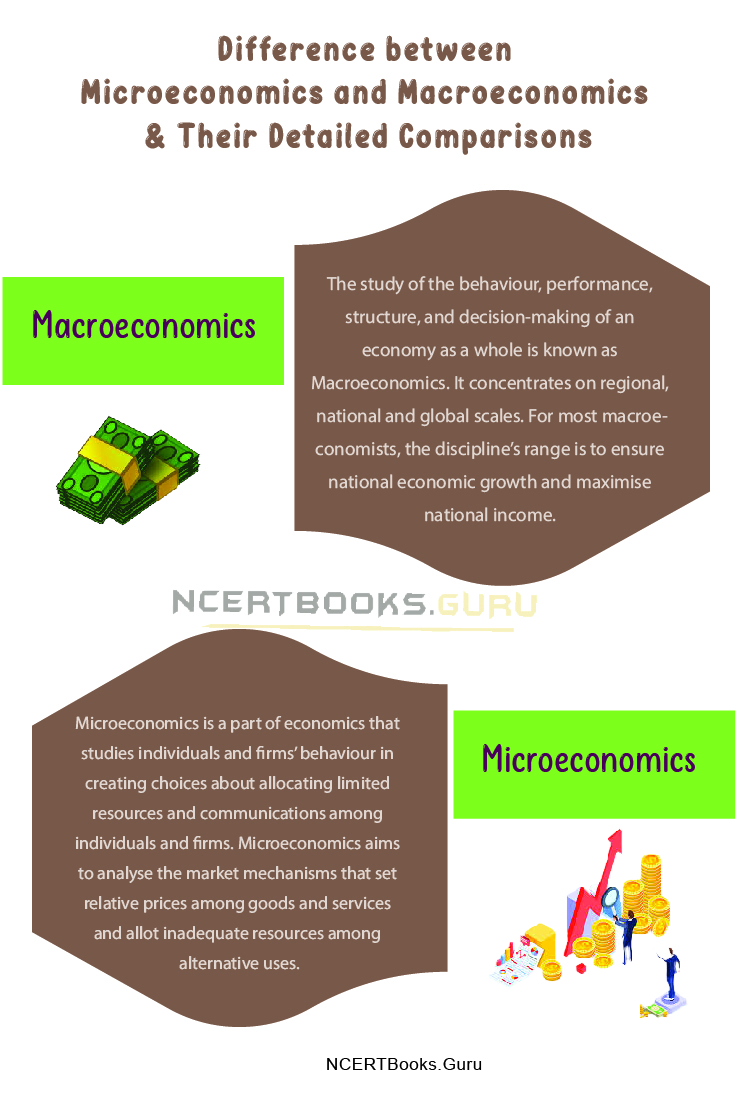
Macroeconomics

The study of the behaviour, performance, structure, and decision-making of an economy as a whole is known as Macroeconomics. It concentrates on regional, national and global scales. For most macroeconomists, the discipline’s range is to ensure national economic growth and maximise national income. Economists expect that this growth translates to developing utility and improving living standards for the economy’s members.

Macroeconomists develop models that demonstrate the connection between factors such as output, consumption, national income, unemployment, savings, inflation, investment and international trade. Macroeconomics concentrates on econometric correlations and aggregates and for this purpose, governments agencies depend on macroeconomics to formulate fiscal and economic policy.

Microeconomics

Microeconomics is a part of economics that studies individuals and firms’ behaviour in creating choices about allocating limited resources and communications among individuals and firms. Microeconomics aims to analyse the market mechanisms that set relative prices among goods and services and allot inadequate resources among alternative uses.

Microeconomics talks about demand and supply and other forces that decide price levels. Microeconomic choices by both individuals and small businesses are essentially caused by benefit and cost factors. Microeconomics displays conditions under which free markets lead to desirable allocations. Microeconomics also analyses the failure of the market, where markets fail to produce efficient results.

Microeconomics also deals with the impacts of economic systems on microeconomic behaviour. Microeconomic theory progresses by defining a competing budget collection which is a subset of the consumption set.
Difference between Microeconomics and Macroeconomics 1

Difference between Microeconomics and Macroeconomics

Microeconomics Macroeconomics
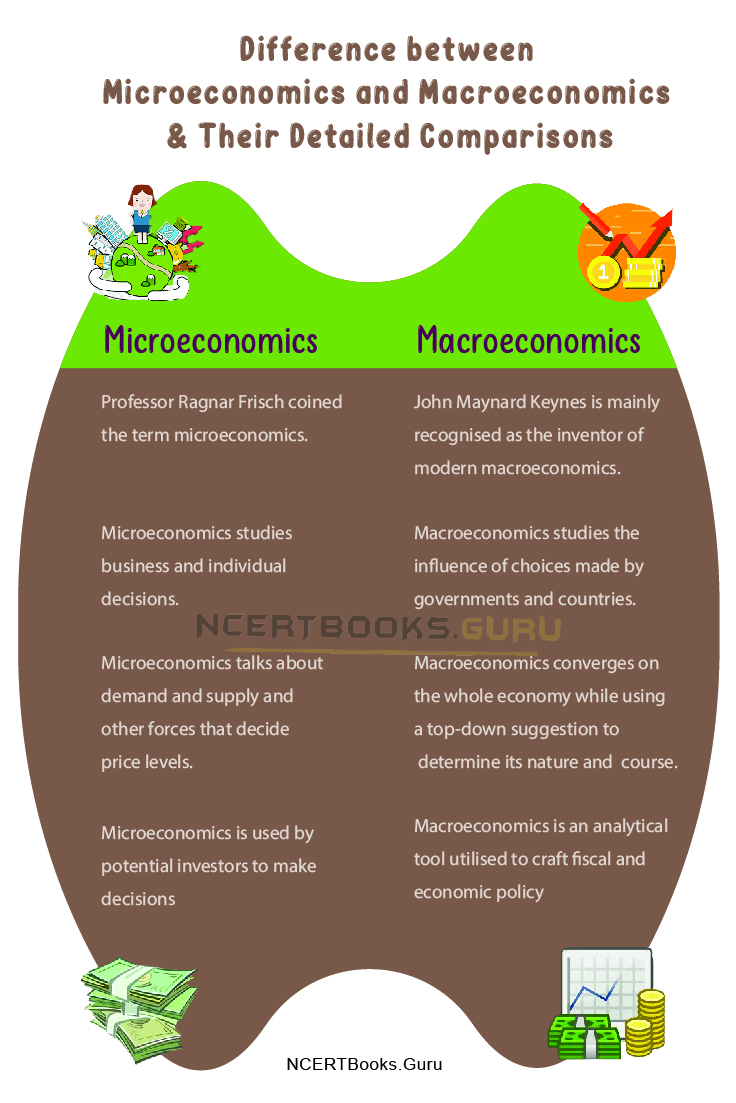
Professor Ragnar Frisch coined the term microeconomics. John Maynard Keynes is mainly recognised as the inventor of modern macroeconomics.
Microeconomics studies business and individual decisions. Macroeconomics studies the influence of choices made by governments and countries.
Microeconomics talks about demand and supply and other forces that decide price levels. Macroeconomics converges on the whole economy while using a top-down suggestion to determine its nature and  course.
Microeconomics is used by potential investors to make decisions Macroeconomics is an analytical tool utilised to craft fiscal and economic policy
Microeconomics contributes a picture of the goods and services required for a strong economy. It also predicts which services and goods will have future demand. Macroeconomics assure that the economic resources prepared in the country are utilised optimally

Difference between Microeconomics and Macroeconomics 2

Difference between Primary, Secondary and Tertiary Sectors & Their Comparisons

Difference between Primary, Secondary and Tertiary Sectors

Primary, Secondary and Tertiary Sectors: The primary, secondary and tertiary sectors represent different business classes and the goods they obtain and sell in an economic structure. Each sector is dependent on the other sector so that the economy as a whole works accurately and efficiently.

You can also find differences between articles on various topics that you need to know. Just tap on the quick link available and get to know the basic differences between them.

What is the Difference between Primary, Secondary and Tertiary Sectors

The primary sector provides the materials for the secondary sector. In the secondary sector, the product is then made into a consumable item, scattered by the tertiary sector.

In the early parts of the 20th century, Colin Clark and AGB Fisher, both notable economists, also spoke for these models.

Primary Sector

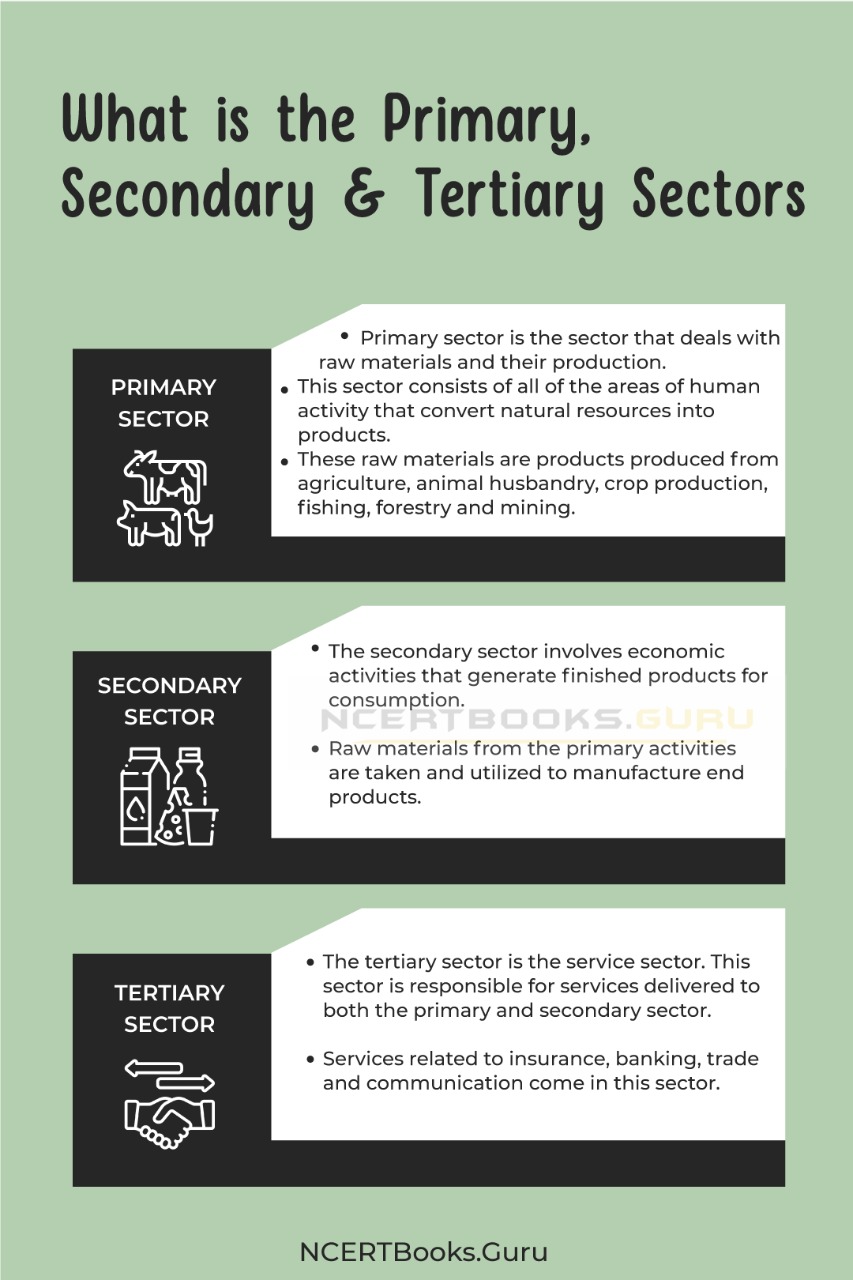
Primary sector is the sector that deals with raw materials and their production. This sector consists of all of the areas of human activity that convert natural resources into products. These raw materials are products produced from agriculture, animal husbandry, crop production, fishing, forestry and mining. In less advanced economies, the primary sector will include most of the economy in these areas. Generally, as the economy’s growth is achieved, there will also be an increase in labour productivity that will enable workers to leave the agricultural sector and transfer to other sectors, such as the service or the manufacturing sector.

Secondary Sector

The secondary sector involves economic activities that generate finished products for consumption. Raw materials from the primary activities are taken and utilized to manufacture end products. In further technical explanation, the secondary sector is what we call industry. It’s an important sector in most of the world economies, and it started to alter society during the industrial revolution.

Tertiary Sector

The tertiary sector is the service sector. This sector is responsible for services delivered to both the primary and secondary sector. The tertiary sector employment share has developed in the ensuing years. It is an organised sector and uses better methods. Services related to insurance, banking, trade and communication come in this sector.

Difference between Primary, Secondary and Tertiary Sectors 2

Difference between Primary, Secondary and Tertiary Sectors

Primary Secondary  Tertiary
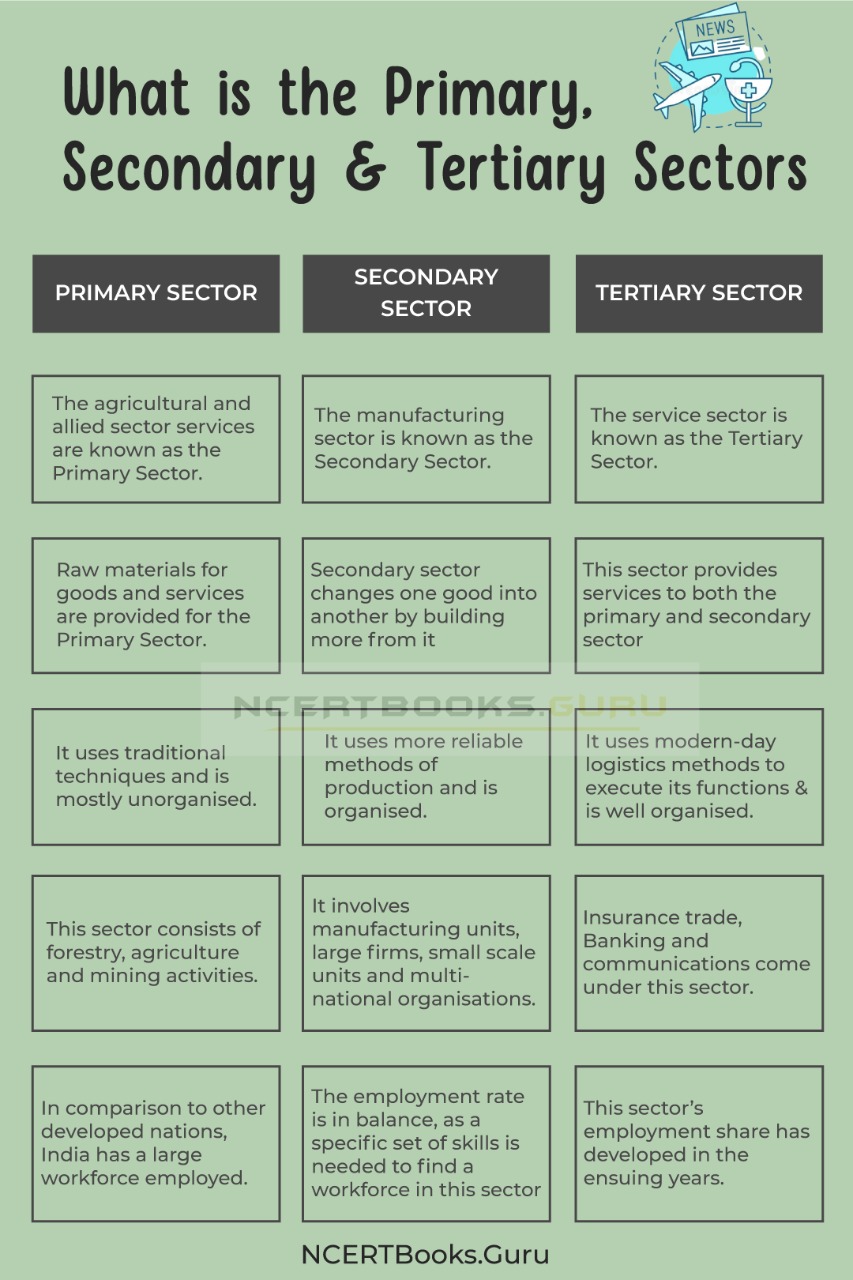
The agricultural and allied sector services are known as the Primary Sector. The manufacturing sector is known as the Secondary Sector. The service sector is known as the Tertiary Sector.
Raw materials for goods and services are provided for the Primary Sector. Secondary sector changes one good into another by building more from it This sector provides services to both the primary and secondary sector
The primary sector uses traditional techniques and is mostly unorganised. The secondary sector uses more reliable methods of production and is organised. This sector uses modern-day logistics methods to execute its functions and is well organised.
This sector consists of forestry, agriculture and mining activities. It involves manufacturing units, large firms, small scale units and multinational organisations. Insurance trade, Banking and communications come under this sector.
In comparison to other developed nations, India has a large workforce employed. The employment rate is in balance, as a specific set of skills is needed to find a workforce in this sector This sector’s employment share has developed in the ensuing years.

Difference between Primary, Secondary and Tertiary Sectors 1

Difference Between Tropical Evergreen and Tropical Deciduous Forest & Their Similarities

Difference Between Tropical Evergreen And Tropical Deciduous Forest

Introduction

Tropical forests land area is approximately bounded by the Tropic of Cancer and Capricorn as prevailing winds. Tropical forests are extensive, making just under half the world’s total forests, followed by boreal temperate and subtropical domains. Deciduous and evergreen forests are the two major types of forest under the tropical categories and have distinct characteristics of their own.

You can also find differences between articles on various topics that you need to know. Just tap on the quick link available and get to know the basic differences between them.

What is the Difference Between Tropical Evergreen and Tropical Deciduous Forest?

About Tropical Evergreen Forests

A tropical evergreen forest is a forest made up of evergreen trees only. They occur across an extensive range of climatic zones and include trees such as coniferous and holly. These trees are evergreen as there is no period of drought and are mostly tall and hardwood.

Tropical evergreen forests are a dominant part of the natural vegetation of a nation. They are found in areas having more than 200 cm of rainfall and are useful for the continued survival of animals and plants in the forest ecosystem.

About Tropical Deciduous Forests

In the areas of botany, the term deciduous means, “falling off at maturity” or ” tending to fall off”, in reference to trees and shrubs that seasonally shed leaves, petals, or even fruits after flowering.

Tropical deciduous forest occurs in regions with heavy rainfall for part of the Year followed by a dry season. These forest formations are dense, and lush during summers, but become dry landscape during dry winter when most trees shed their leaves.

Difference Between Tropical Evergreen and Tropical Deciduous Forest 1

Difference Between Tropical Evergreen and Tropical Deciduous Forest

Area of differentiation

Tropical evergreen forest

Tropical deciduous forest

Density Tropical evergreen forests are very dense. Tropical deciduous forests are less denser compared to tropical evergreen forests.
Rainfall Tropical evergreen forests are found in regions receiving more than 200 cm of rainfall. Tropical deciduous forests are found in the region having rainfall in the range of 70 cm to 200 cm.
Shedding The trees of the tropical evergreen forest have no particular shedding season for their leaves. The trees of the deciduous forest shed their leaves for about six to eight months during the dry season.
Species found Some tree species found in tropical evergreen forests are ebony, mahogany, rosewood, etc. Some tree species found in tropical deciduous forests are teak, sal, sandalwood, etc.

Difference Between Tropical Evergreen and Tropical Deciduous Forest 2

Similarities Between Tropical Evergreen and Tropical Deciduous Forests

  • Tropical evergreen forest and tropical deciduous forest are two types of forests that are classified based on the pattern and seasonality of the foliage group.
  • The trees of both the topical evergreen forest and tropical deciduous forest are green and full of leaves during spring. This means that they don’t shed their leaves during the season.
  • Tropical evergreen forests and tropical deciduous forests have large amounts of precipitation and warm temperature in both biomes.
  • The trees of tropical evergreen forest and tropical deciduous forest shed their leaves. The only difference is that day shed it at different times.
  • Trees of tropical evergreen and tropical deciduous forest can be found in regions receiving about 200 cm of rainfall.

Frequently Asked Questions on Difference Between Tropical Evergreen and Tropical Deciduous Forest

Question:
Which trees are found in the tropical deciduous forest?

Answer:
Deciduous woodlands are home to trees such as oak, birch, beech, aspen, elm, and maple. The tropical and subtropical forest also has teak trees, palm trees, and bamboo.

Question:
Which plants are found in the tropical evergreen forests?

Answer:
Some commercially important trees of tropical evergreen forest ebony, mahogany, rosewood, rubber, and cinchona.

Question:
What is the maximum height of the trees present in the tropical evergreen forests?

Answer:
Tropical evergreen forests are well satisfied, with layers closer to the ground covered with shrubs and creepers, followed by short structure trees, further followed by a tall variety of trees. In most of these forests, trees reach great heights up to 60 m or above.

Difference Between Magistrate and Judge & Their Similarities

Difference Between Magistrate and Judge

Introduction

A judge can be portrayed as an arbitrator, i.e. the person who decides on a matter in the court. On the contrary, a magistrate may be a regional judicial officer who is elected by the judges or the arbiters of the Supreme Court of the state to take care of law and order in a specific region or area.

You can also find differences between articles on various topics that you need to know. Just tap on the quick link available and get to know the basic differences between them.

What is the Difference Between Magistrate and Judge?

About Magistrate

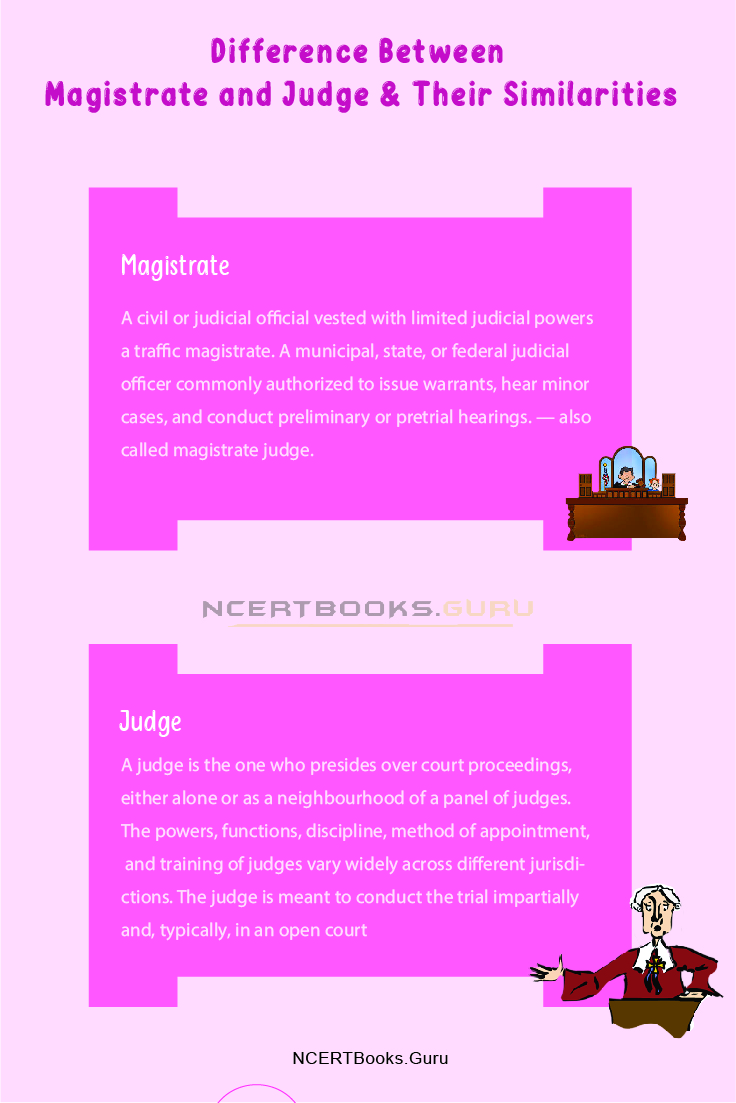
A civil or judicial official vested with limited judicial powers a traffic magistrate. A municipal, state, or federal judicial officer commonly authorized to issue warrants, hear minor cases, and conduct preliminary or pretrial hearings. — also called magistrate judge.

There are four categories of magistrates within the Judiciary Of India. This classification is given within the Criminal Procedure Code, 1973 (CrPC). It specifies that in each sessions district, there shall be:

  • A Chief Judicial Magistrate
  • A Sub-Divisional Judicial Magistrate
  • A Judicial Magistrates First Class, and
  • An Executive Magistrates [including DM, ADMs, SDMs]

These magistrates are generally conferred on the officers of the Revenue Department, although a politician is often appointed exclusively as an Executive Magistrate. Usually, the Collector of the district is in charge as the DM.

About Judge

A judge is the one who presides over court proceedings, either alone or as a neighbourhood of a panel of judges. The powers, functions, discipline, method of appointment, and training of judges vary widely across different jurisdictions. The judge is meant to conduct the trial impartially and, typically, in an open court.

The judge hears all the witnesses and the other evidence presented by the barristers or solicitors of the case, assesses the parties’ credibility and arguments, and then issues a verdict on the matter at hand based on their interpretation or understanding of the law and their judgment in personal. In some jurisdictions, the judge’s powers could also be shared with a jury.

Difference Between Magistrate and Judge 1

Difference Between Magistrate And Judge

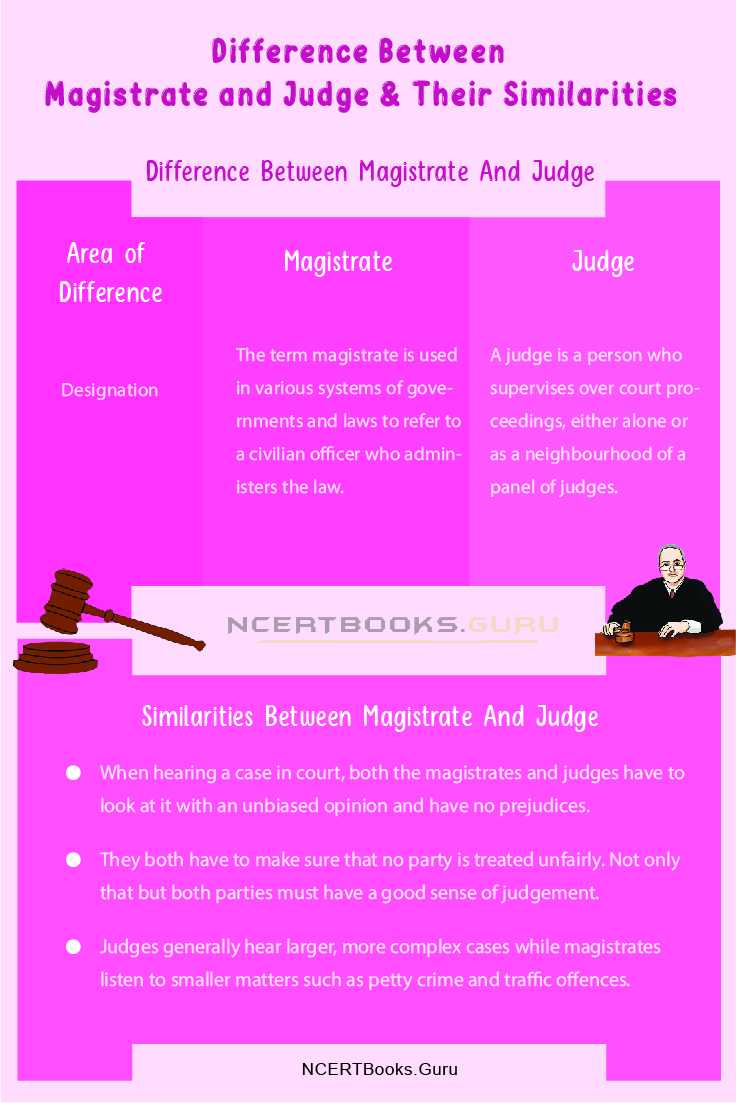
Area Of Difference Magistrate Judge
Designation The term magistrate is used in various systems of governments and laws to refer to a civilian officer who administers the law. judge is a person who supervises over court proceedings, either alone or as a neighbourhood of a panel of judges.
Discipline Of Work There are four categories of magistrates within the Judiciary Of India. This classification is given within the Criminal Procedure Code, 1973 (CrPC). The judge is meant to conduct the trial impartially and, typically, in an open court.

Difference Between Magistrate and Judge 2

Similarities Between Magistrate And Judge

  • When hearing a case in court, both the magistrates and judges have to look at it with an unbiased opinion and have no prejudices.
  • They both have to make sure that no party is treated unfairly. Not only that but both parties must have a good sense of judgement.
  • Judges generally hear larger, more complex cases while magistrates listen to smaller matters such as petty crime and traffic offences.

Frequently Asked Questions on Difference Between Magistrate and Judge

Question
Is magistrate and judge the same?

Answer
Judges generally hear larger, more complex cases while magistrates hear smaller matters such as petty crime and traffic offences.

Question:
Who is more powerful? The judge or the magistrate?

Answer:
A Judge is bestowed with more powers than a Magistrate. A magistrate has only administrative and limited law enforcement powers.

Difference Between Communalism, Regionalism and Secularism

Difference Between Communalism, Regionalism and Secularism

Communalism, regionalism, and Secularism are three different, yet very important political ideologies. All of them have their belief systems and varying modes of Application. All three are effective in shaping the fundamental growth factor of a country. In India, all three factors play a vital role in assuring peace in society. Additionally, for the development of a nation as a whole, they all play equally important roles.

Communalism stands for prioritising affiliations towards a person’s separate ethnic group instead of the entire society.

Regionalism stands for the political ideologies that focus on developing a social or political system based on one or many regions.

Secularism is the principle stating that all the state affairs are distinct from religious issues and beliefs, and vice versa.

You can also find differences between articles on various topics that you need to know. Just tap on the quick link available and get to know the basic differences between them.

What is the Difference between Communalism, Regionalism, and Secularism

Communalism, Regionalism, and Secularism are three vital aspects of a political system. There are many variations in the beliefs and ideologies of all the three factors, and they are differentiated below based on the stated varying factors:

Difference Between Communalism, Regionalism and Secularism 1

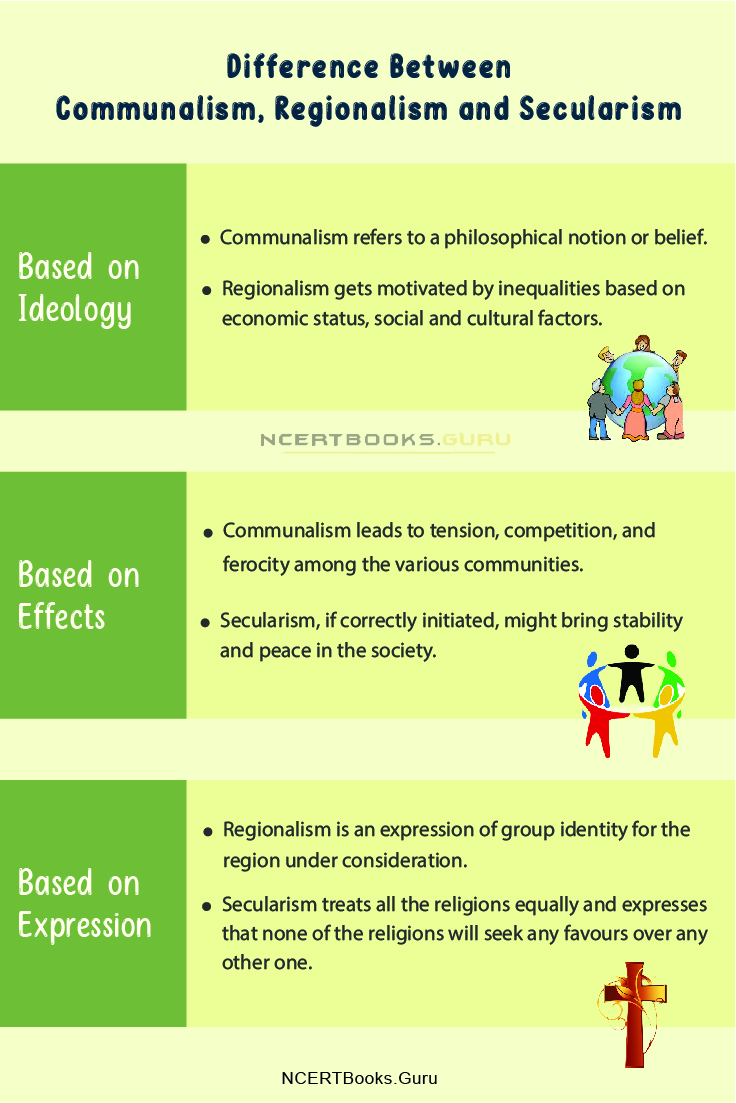
Based on Ideology:

  • Communalism refers to a philosophical notion or belief.
  • Regionalism gets motivated by inequalities based on economic status, social and cultural factors.
  • Secularism is a belief that any state and religion must never interfere in each other’s affairs.

Based on Effects:

  • Communalism leads to tension, competition, and ferocity among the various communities.
  • Regionalism threatens the unity and integrity of the nation.
  • Secularism, if correctly initiated, might bring stability and peace in the society.

Based on Expression:

  • Communalism demonstrates the expression of any community’s superiority and other communities’ intolerance.
  • Regionalism is an expression of group identity for the region under consideration.
  • Secularism treats all the religions equally and expresses that none of the religions will seek any favours over any other one.

Difference Between Communalism, Regionalism and Secularism 2

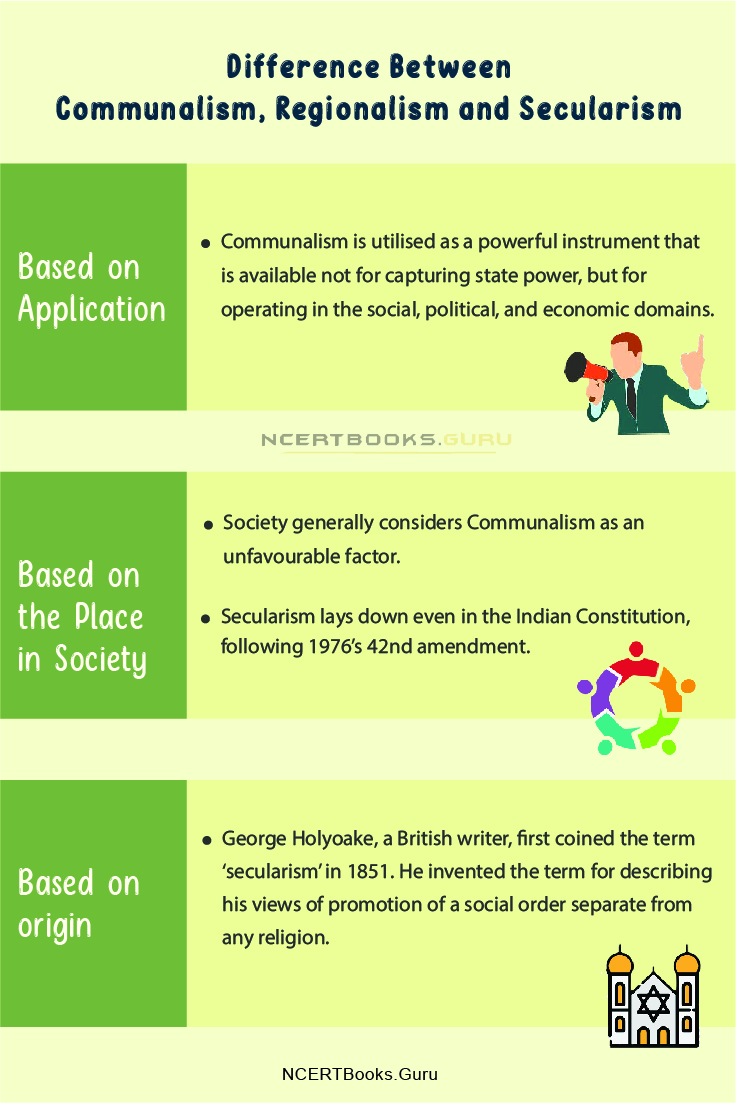
Based on Application:

  • Communalism is utilised as a powerful instrument that is available not for capturing state power, but for operating in the social, political, and economic domains.
  • Regionalism applies by any religious groups or parties to expand their interest at other regions’ expenses. It is a major drawback of Federalism in India.
  • Secularism applies mainly to societies that have people of different cultures and religions. It aims at making the state neutral for the residents of all the religions.

Based on the Place in Society:

  • Society generally considers Communalism as an unfavourable factor.
  • The lower segment of the entire population denies supporting regionalism. The segment that does not believe the factor does not believe in the country’s upliftment.
  • Secularism lays down even in the Indian Constitution, following 1976’s 42nd amendment.

Based on origin:

  • Murray Bookchin, a socialist author, coined the term ‘communalism’ in the early 20th century.
  • Pointing out the exact origin of the term ‘regionalism’ is a harder act. Still, experts believe that the ancient empires’ imperialistic practices were the earliest manifestations for the concept.
  • George Holyoake, a British writer, first coined the term ‘secularism’ in 1851. He invented the term for describing his views of promotion of a social order separate from any religion.

Difference Between City and Village

Difference Between City and Village

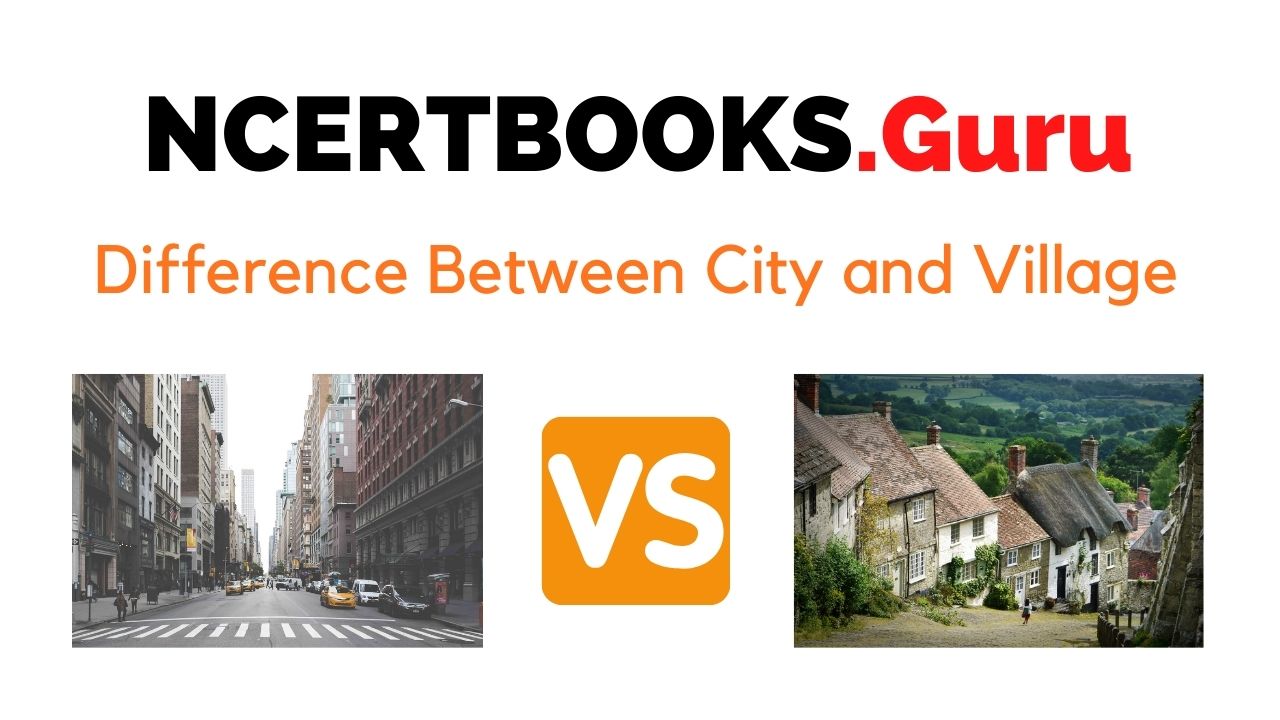
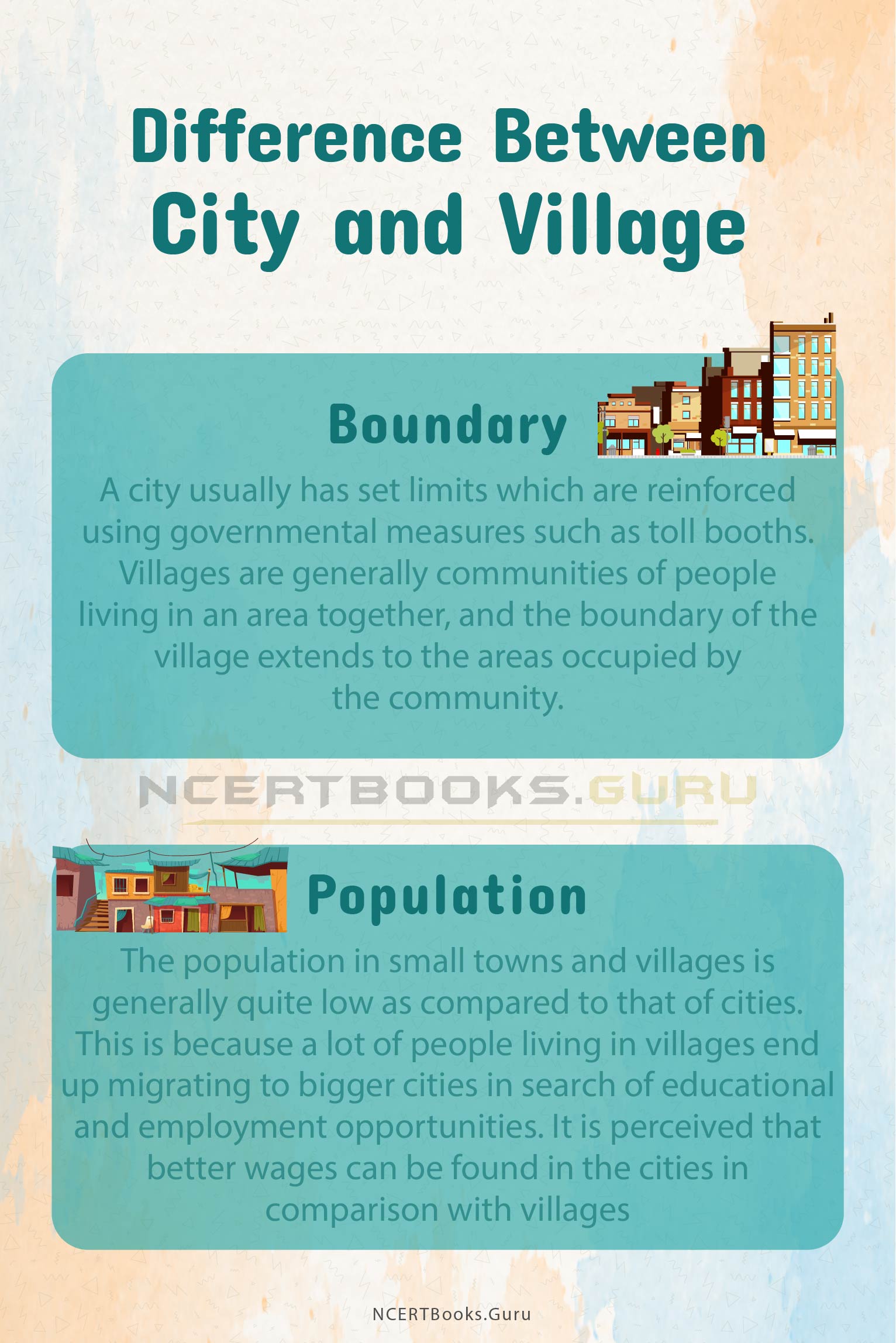
When we think of the word ‘city’ we often think of tall buildings with glass windows, good roads, lots of traffic and a very high number of people populating the area. On the other hand, when we think of the word ‘village’ we usually think of cowsheds, huts, kutcha roads, lots of agricultural fields and a very less number of people populating the area. However, these are very mild generalisations that we have about what a city and a village is. The following are some of the differences between city and village.

You can also find differences between articles on various topics that you need to know. Just tap on the quick link available and get to know the basic differences between them.

What is the Difference Between City and Village

Difference Between City and Village 1


Boundary

A city usually has set limits which are reinforced using governmental measures such as toll booths. Villages are generally communities of people living in an area together, and the boundary of the village extends to the areas occupied by the community. The difference is that cities have properly demarcated boundaries whereas villages generally do not.

Population

The population in small towns and villages is generally quite low as compared to that of cities. This is because a lot of people living in villages end up migrating to bigger cities in search of educational and employment opportunities. It is perceived that better wages can be found in the cities in comparison with villages (and as per the minimum wage requirements, this also holds true). Thus, there is an influx of villagers into cities, increasing by the year, decreasing the population of villages by transferring these people to cities.

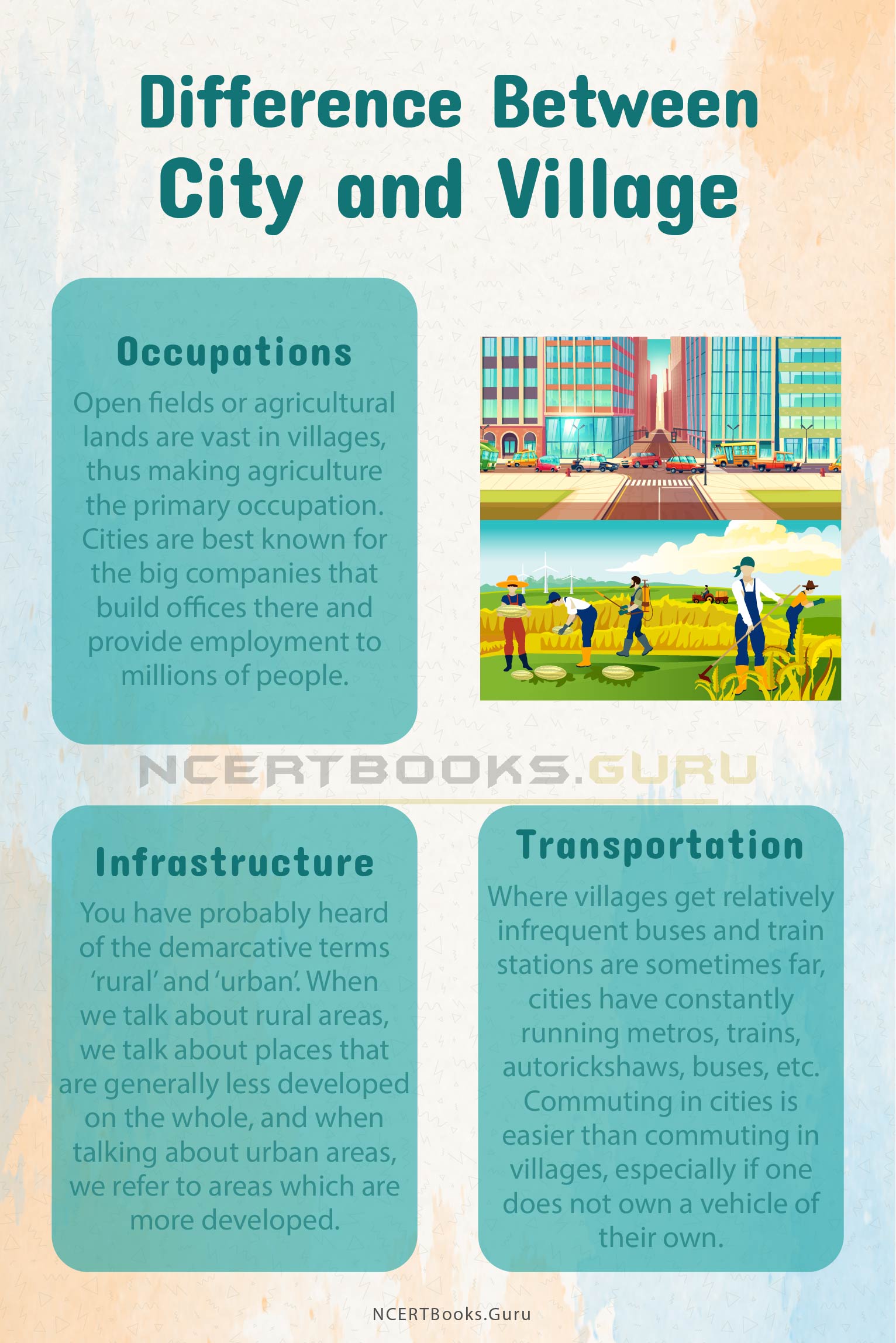
Occupations

The most common occupation in villages, since these are remote areas, is agriculture and related occupations. The families in villages either own their land or work as tillers on someone else’s land and are paid for it. Open fields or agricultural lands are vast in villages, thus making agriculture the primary occupation. Cities are best known for the big companies that build offices there and provide employment to millions of people. A lot of people aspire for jobs in the IT or finance industry, which are abundant in cities, as employees of companies in such industries get paid hefty salaries along with great benefits as well.

Infrastructure

You have probably heard of the demarcative terms ‘rural’ and ‘urban’. When we talk about rural areas, we talk about places that are generally less developed on the whole, and when talking about urban areas, we refer to areas which are more developed. The infrastructure consists of the institutions and systems that a government is meant to provide for its people, such as educational institutions like schools and colleges, medical institutions like hospitals and clinics, electricity supply, water supply, paved roads, etc.

Usually, villages face shortages in most infrastructural areas, whereas cities are developed and have more infrastructure put in place. This is also the reason why a lot of people living in villages aspire to migrate to big cities to accomplish their goals of education and employment because it is more accessible and widely available in cities as compared to villages.

Transportation

While transportation is a form of infrastructure, it holds a lot of value in itself. There is a large difference in the transportation facilities between cities and villages. Where villages get relatively infrequent buses and train stations are sometimes far, cities have constantly running metros, trains, autorickshaws, buses, etc. Commuting in cities is easier than commuting in villages, especially if one does not own a vehicle of their own.

Difference Between City and Village 2