Best Books for BCECE | Exam Pattren, Details, Syllabus, Carrer Oppurtunities and Scope

Best Books for BCECE

Best Books for BCECE: The Bihar Combined Entrance Competitive Exam, commonly known as BCECE conducts an exam every year for candidates willing to take admission in agriculture, medical and engineering courses. BCECE provides an opportunity to thousands of applicants to get admitted to brilliant colleges and pursue courses of their own choice. However, to taste success, one needs to put in a lot of hard work and so choosing the right books for preparation is equally important. Therefore, stay glued to the article to know about Best Books for BCECE.

Best Books for BCECE Overview

BCECE is one of the most significant exams in India. This year in 2020, the exam was slated to be held on October 10th and 11th. Students applying for BCECE next year must be aware of exam pattern and eligibility criteria.

BCECE Exam Pattern

Unlike most of the competitive entrance exams, the BCECE exam is held in an offline mode, wherein each question carries 4 marks while for every wrong answer 1 mark is deducted.

The exam stretches for 1 1/2 hours.

The exam is conducted in two stages:

  • Stage I: In stage one, students are asked questions from physics, chemistry, biology or mathematics. The total number of questions is 150 wherein each section carries 50 marks. The good news is, there is no negative marking in this stage.
  • Stage II: In stage II, there are 100 questions in each subject -Physics, Chemistry, Biology or Mathematics, while the total marks account for 300. Candidates need to be cautious here as this stage includes negative marking.

As mentioned above, for every correct answer students are awarded 4 marks while for every wrong answer 1 mark is deducted.

BCECE Entrance Exam Syllabus

The entrance exam syllabus includes some important topics from Physics, Chemistry and Mathematics/Biology:

Take a glance at some of the important topics in all four subjects:

Physics

  • Electromagnetic waves
  • Oscillations and waves
  • Laws of motion
  • Kinematics
  • Current and Magnetism- Magnetic effects
  • Electrostatics
  • Dual nature of matter and radiation
  • Heat and thermodynamics
  • Electromagnetic induction and alternating

Chemistry

  • Structure of atoms
  • Chemical Kinetics
  • Organic Chemistry
  • Equilibrium
  • Biomolecules
  • Chemical Bonding and Molecular structure
  • Coordination Compounds
  • Redox reactions
  • Ketones and Carboxylic Acids
  • General principles and processes of isolation and it’s elements
  • P-block elements

Biology

  • Biological Classification
  • Diversity in Living World
  • Structure and Function of Cell
  • Plant and Human Physiology
  • Microbes in human welfare
  • Sexual reproduction in flowering plants
  • Environmental issues
  • Genetics and evolution
  • Biotechnology and its applications
  • Ecology

Mathematics

  • Sets, Functions and Algebra I
  • Relation and Functions
  • Trigonometric functions
  • Calculus I and Calculus II
  • Probability and Statistics
  • Vectors and three-dimensional geometry
  • Linear programming
  • Mathematical reasoning
  • Coordinate geometry

Best Books for BCECE

Students preparing for BCECE can seek help from the following reference books:

Physics 

  • Science for Everyone: Aptitude Test Problem in Physics by S.S.Krotov
  • Fundamentals of Physics, class 11, set of textbook and practice book by David Halliday
  • NCERT Physics Book of Class 11th and 12th
  • Objective Physics by Pradeep
  • BCECE Explorer by Arihant/MTG

Chemistry 

  • Modern Approach to Chemical Calculations by R. C. Mukherjee
  • Numerical Chemistry by Dr. P. Bahadur
  • NCERT Chemistry Book of Class 11th and 12th
  • BCECE Explorer by Arihant /MTG

Biology 

  • Textbook of Biology Class XII by PS Dhami
  • Trueman’s Biology for Class XI and XII
  • NCERT Biology Book of Class 11th and 12th
  • BCECE Explorer by Arihant /MMTG

Mathematics 

  • A Problem Book in Mathematical Analysis by GN Berman
  • Higher Algebra by Hall and Knight
  • R. D. Sharma Objective
  • NCERT Maths Book of Class 11th and 12th
  • BCECE Explorer by Arihant /MMTG

BCECE Career Opportunities and Scope

There is immense scope for engineers, doctors, and those who wish to pursue a career in biotechnology. Fast lifestyle, increase in population and advancements in technology have paved a way for engineering, development of apps, technology, infrastructure, the invention of efficient and cost-effective tools for agriculture that demand the human workforce. Therefore, the jobs of doctors, engineers, those engaged in the field of agriculture and biotechnology can never cease to exist. Students pursuing these courses would certainly land in good jobs and umpteen opportunities.

FAQ’s on Best Books for BCECE

Question 1.
How many marks are deducted in negative marking?

Answer:
For every wrong answer, 1 mark is deducted in stage II.

Question 2.
Is studying the basics of PCM/B of class XI and XII helpful in the exam?

Answer:
Yes, questions are generally asked from the NCERT syllabus of class XI and XII. However, there are more reference books given in the article that may prove helpful.

Question 3.
How many marks are awarded for each question in BCECE?

Answer:
Every question in each subject carries 4 marks both in stage I and stage II.

Assam CEE Books | Details, Overview, Carrer Oppurtunities, Scope

Assam CEE Books

Assam CEE Books: Competitive exams are really tough, there are no compromising studies when it comes to entrance exams as well. One needs to burn the midnight oil and study hard to score well. It is sometimes a yes or no situation for many people. And therefore, the choice of books one uses for preparation is significant. Assam CEE is one such exam wherein more than 20,000 applicants appear and try their luck. In such a case it is crucial to start preparing from now on for the upcoming Assam CEE.

Assam CEE Books Overview

For those who are unaware, Assam CEE is a common entrance exam which is conducted by Assam Science and Technology University. Owned and controlled by the central government, the university offers courses for engineering students admitted to its affiliated colleges.

Candidates who are willing to apply for the exam must fulfill the following eligibility criteria:

  • They must be citizens of India and must have a domicile of Assam.
  • They must have scored at least 45-50% in 10+2.
  • Candidates must score at least 45-50% in physics, chemistry, and maths in the entrance exam respectively if applying for a B. Tech or BE course.
  • They must be 17-21 years of age.

Seats are reserved for certain sections of the society for the entrance as under:

  • Scheduled Caste-7%
  • Scheduled Tribes (residing in plain areas) – 10%
  • Scheduled Tribes (hilly regions) – 5%
  • Other Backward Classes- In accordance with the norms set by the government
  • Tea garden labour community- 1seat in each college
  • Ex tea garden labour community- 1 seat in each college.
  • If a child of ex-servicemen- 1 seat in each college.
  • Child or a grandchild of a freedom fighter – 2 seats in AEC, 2 seats in JEC, 1 seat in JIST
  • Specially abled- 3% of college intake capacity
  • NCC/Sportsman/Moran/Motak Communities- 1 seat in each college

Before we talk about Assam CEE Books, let us first look at the subjects in the syllabus of the university, covered during the entrance exam:

Subjects  Topics
Physics Solids and Semi-Conductors Devices, Ray Optics, Units and Measurement, Description of Motion in One Dimension, Description of Motion in Two and Three Dimensions, Units and Measurement,  Oscillations,  Thermal and Chemical Effects of Currents, Electromagnetic Induction and Alternating Currents, Electromagnetic Waves  Atoms, Molecules, and Nuclei, Work, Energy and Power, Transference of Heat, Electrostatics Solids and Semi-Conductors Devices, Atoms, Molecules and Nuclei, Waves Description of Motion in One Dimension, Current Electricity, Laws of Motion, Rotational Motion and Moment of Inertia
Chemistry States of Matter, Atomic Structure, Redox Reactions and Electrochemistry, Surface Chemistry Some Basic Concepts, Chemical Equilibrium, Chemical Energetics and Thermodynamics, Rates of Chemical Reactions and Chemical Kinetics, Chemistry of Non-Metals – 1, Chemistry of Non-metals-II,  Synthetic and Natural Polymers, Chemistry In Action, Environmental Chemistry, Hydrocarbons, Heavy Metals  Transition, MetalsIncluding Lanthanides  Coordination Chemistry and Organo-Metallics, Purification and Characterisation of Organic Compounds, Chemical Bonding and Molecular Structure, Chemistry of Lighter Metals, Chemistry of Representative Elements, Some Basic Principles Organic Compound Containing Halogens, Organic Compounds Containing Nitrogen, Nuclear Chemistry
Maths Permutations and Combinations, Mathematical Induction and Its Application, Binomial Theorem and Its Applications, Vector Algebra Sets, Relations and Functions Permutations and Combinations, Binomial Theorem and Its Applications, Complex numbers, Differential Calculus, Differential Equations, Dynamics Integral Calculus, Sequences and Series, Two-Dimensional Geometry, Three Dimensional Geometry, Measures of Central Tendency and Dispersion Statics Dynamics Trigonometry Matrices and Determinants

Now, let us discuss the best Assam CEE Books to prepare for entrance exams:

Assam CEE Books

Physics 

  • Xam Idea Physics of class 12th
  • Objective Physics by Pradeep NCERT
  • Physics books of class 11th and 12th Concepts of Physics by H. C. Verma

Chemistry 

  • BCECE Chemistry of Arihant
  • Objective Chemistry by Pradeep
  •  Xam Idea Chemistry of class 12th
  • NCERT Chemistry books of class 11th and 12th

Maths

  •  NCERT Mathematics books of Class 11th and 12th
  • BCECE Mathematics by Arihant
  • Objective Mathematics by R.D. Sharma
  • Xam Idea Mathematics of class 12th

Assam CEE Books Career Opportunities and Scope

Over a decade, technology in every field has grown widely, and therefore there is a call for an engineer or related field in every industry from healthcare to information and technology. For engineers and science students who are willing to accomplish big goals, this is one of the best and never-ending fields of their careers for them.

FAQ’s on Assam CEE Books

Question 1.
Where do I get the previous year’s question paper for Assam CEE?

Answer:
Candidates can avail of the benefit of downloading the last 10 years question paper from the official site of Assam CEE.

Question 2.
What was the cut off previous year?

Answer:
In 2017 cut-offs were as under:

  • General- 110
  • Sc – 94
  • ST hills and plains respectively- 67 and 80
  • OBC – 107

Question 3.
Are Assam CEE books for entrance exams available online?

Answer:
Yes, they are available on online platforms.

Question 4.
Is there negative marking in the test?

Answer:
Yes, 1 mark is deducted for every wrong answer.

NCERT Solutions for Class 12 Physics Chapter 2 Electrostatic Potential and Capacitance

NCERT Solutions for Class 12 Physics Chapter 2

NCERT Solutions for Class 12 Physics Chapter 2 Electrostatic Potential and Capacitance is the most important & scoring chapter in class 12 physics. Students can get more subject knowledge about chapter Electrostatic Potential and Capacitance from these NCERT Solutions of class 12 physics. We presented step by step solutions for each question given in NCERT Class 12 Physics Textbook as per CBSE Board guidelines.

Thus, referring to the NCERT Solutions for 12th Physics Ch 2 is the smart way to ace up board & competitive exam preparation. NCERT Solutions for Class 12 Physics Chapter 2 Electrostatic Potential and Capacitance Exercises and Added Exercises free download PDF format links are provided here. So, download 12th Physics NCERT Exercises Questions for all concepts of Electrostatic Potential and Capacitance chapter in Hindi & English for a better practice.

Class 12 Physics NCERT Solutions Chapter 2 Electrostatic Potential and Capacitance

One of the scoring chapters in 12th physics is chapter 2 Electrostatic Potential and Capacitance. It offers the best weightage for numeric problems and derivations. You can find the effective numerical problems on the topic capacitance of a complex combination of capacitors in the final exams from this chapter. Also, you will deal with some of the important topics like electrostatic potential and its various factors, the difference between the two electric fields, etc in ch 2 Physics.

All the topics & subtopics important answered questions are covered in the NCERT Solutions Class 12 Physics Chapter 2 Electrostatic Potential and Capacitance PDF. So, refer to the 12th physics NCERT Exercises Questions provided here on Ch 2 Electrostatic Potential and Capacitance & score well.

Class 12
Subject Physics
Book Physics
Chapter Number 2
Chapter Name Electrostatic Potential and Capacitance

NCERT Exercise Questions of Class 12 Physics Chapter Electrostatic Potential and Capacitance

Class 12 NCERT Physics Solutions for Chapter 2 Electrostatic Potential and Capacitance Questions are given here for all students of CBSE board & other state boards. They can refer to these NCERT solutions for better understanding and clarification of the chapter Electrostatic Potential and Capacitance. Here, we have provided online as well as the PDF version of NCERT solutions for Electrostatic Potential and Capacitance.

Question 1.
Two charges 5 x 10⁻⁸ C and -3 x 10⁻⁸ C are located 16 cm apart. At what point(s) on the line joining the two charges is the electric potential zero ? Take the potential at infinity to be zero. Ans. Let the potential be zero at 0, then
Answer:
Let the potential be zero at 0, then
vA + VB= 0,
NCERT Solutions for Class 12 physics Chapter 2

where VA is electric potential due to charge qA and VB is the electric potential due to charge qB.
NCERT Solutions for Class 12 physics Chapter 2.1

Question 2.
A regular hexagon of side 10 cm has a charge 5 μC at each of its vertices. Calculate the potential at the center of the hexagon.
Answer:
Total potential at O is given by,
vedantu class 12 physics Chapter 2.2

Question 3.
Two charges 2μC and -2μC are placed at points A and B, 6 cm apart.
(a) Identify an equipotential surface of the system. % What is the direction of the electric field at every through the mid-point. On this plane, potential is zero everywhere.
(b) The direction of electric field is from positive to negative charge i.e. A to B, which is infact perpendicular to the equipotential plane.
Answer:
(a) The eguipotential surface is the plane pependicuIarto the line AB joining the two charges and passing through the mid-point. On this plane, potential is zero everywhere.
(b) The direction of electric field is from positive to negative charge i.e. A to B, which is infact perpendicular to the equipotential plane.

Question 4.
A spherical conductor of radius 12 cm has a charge of 1.6 x 10⁻⁷ C distributed uniformly on its surface. What is the electric field
(a) inside the sphere
(b) just outside the sphere
(c) at a point 18 cm from the center of the sphere?
Answer:
(a) inside a conductor, the electric field is zero because the charge resides on the surface of a conductor.
(b) Electric field just outside the sphere is given by
NCERT Solutions for Class 12 physics Chapter 2.3
Question 5.
A parallel plate capacitor with air between the plates has a capacitance of 8 pF
(1 pF = 10-12 F.) What will be the capacitance if the distance between the plates is reduced by half, and the space between them is filled with a substance of dielectric constant 6?
Answer:
NCERT Solutions for Class 12 physics Chapter 2.4

Question 6.
Three capacitors each of capacitance 9 pF are connected in series.
(a) What is the total capacitance of the combination?
(b) What is the potential difference across each capacitor if the combination is connected to a 120 V supply ?
Answer:
vedantu class 12 physics Chapter 2.5

Question 7.
Three capacitors of capacitances 2 pF, 3 pF and 4pF are connected in parallel.
(a) What is the total capacitance of the combination?
(b) Determine the charge on each capacitor if the combination is connected to a 100 V supply.
Answer:
(a) Total capacitance
= c1 + c2 + c3
= 2 + 3+ 4 = 9pF.
(b) Using C = qv we get q = CV
∴ qx = C1V = 2 x 10-12 x 100
= 2 x 10⁻¹⁰ C = 200 pC
q2 = c2V
= 3 x 10-12 x 100
= 3 x 10⁻¹⁰ C = 300 pC
q3 = c3v
= 4 x 10-12 x 100
= 4 x 10⁻¹⁰ C = 400 pC

Question 8.
In a parallel plate capacitor with air between the plates, each plate has an area of
6 x 10⁻³ in2 and the distance between the plates is 3 mm. Calculate the capacitance of the capacitor. If this capacitor is connected to a 100 V supply, what is the charge on each plate of the capacitor ?
Answer:
NCERT Solutions for Class 12 physics Chapter 2.6

Question 9.
Explain what would happen if in the capacitor given in Q. 2.8, a 3 mm thick mica sheet (of dielectric constant = 6) were inserted between the plates,
(a) while the voltage supply remained connected.
(b) after the supply was disconnected.
Answer:
NCERT Solutions for Class 12 physics Chapter 2.7

Question 10.
A 12 pF capacitor is connected to a 50 V battery.How much electrostatic energy is stored in the capacitor ?
Answer:
E = 12 CV2 = 12 x 12 x 10-12 x 50 x 50 = 1.5 2 2 x 10⁻⁸J.

Question 11.
A 600 pF capacitor is charged by a 200 V supply. It is then disconnected from die supply and is connected  to another uncharged 600 pF capacitor. How much electrostatic energy is lost in the process ?
Ans.
Here, C1 = 600pF = 6 x 10⁻¹⁰ F, C2 =
6 x 10⁻¹⁰ F, V1 = 200V, V2 = 0
vedantu class 12 physics Chapter 2.8

Question 12.
A charge of 8 mC is located at the origin. Calculate the work done in taking a small charge of -2 x 10⁻⁹ C from a point P(0, 0, 3 cm) to a point Q (0, 4 cm, 0), via a point
R(0, 6 cm, 9 cm.)
Answer:
The work done by electrostatic force on a charge is independent of the path followed by the charge. It depends only on the initial and final positions of the charge.
NCERT Solutions for Class 12 physics Chapter 2.9
Question 13.
A cube of side b has a charge q at each of its vertices. Determine the potential and electric field due to this charge array at the center of the cube.
Answer:
(1) Distance of the center of the cube from vertex is half of the diagonal of the cube
NCERT Solutions for Class 12 physics Chapter 2.10
NCERT Solutions for Class 12 physics Chapter 2.11

(2) From symmetry, it is clear that electric field at center of the cube is zero.

Question 14.
Two tiny spheres carrying charges 1.5 μc and 2.5 μc are located 30 cm apart. Find the potential and electric field :
(a) at the mid point of the line joining the two charges,
(b) at a point 10 cm from this mid-point in a plane normal to the line and passing through the mid­point.
Answer:
NCERT Solutions for Class 12 physics Chapter 2.12
vedantu class 12 physics Chapter 2.13
NCERT Solutions for Class 12 physics Chapter 2.14
NCERT Solutions for Class 12 physics Chapter 2.15

Question 15.
A spherical conducting shell of inner radius rand outer radius r2 has a charge Q.
(a) A charge q is placed at the center of the shell. What is the surface charge density on the inner and outer surfaces of the shell ?
(b) Is the electric field inside a cavity (with no charge) zero, even if the shell is not spherical, but has any irregular shape ? Explain.
Answer:
(a) Charge Q appears on the outer surface.
NCERT Solutions for Class 12 physics Chapter 2.16
When charge q is placed at the center, it induces – q charge on the inner surface and +q on the outer surface.
.’. charge density of the inner surface,

NCERT Solutions for Class 12 physics Chapter 2.17
and charge density of the outer surface,
vedantu class 12 physics Chapter 2.18
Consider a cavity of irregular shape with net charge to be zero inside it. Let a closed loop be partially inside and the rest outside the cavity. The field inside the conductor is zero, so some work is done by the field to carry a test charge in the closed loop, but this is against the provisions of an electrostatic field because as per Gauss’ law, the net charge inside a Gaussian surface must be zero. Thus, there cannot be field lines inside the cavity irrespective of its shape.

Question 16.
(a) Show that the normal component of electrostatic field has a discontinuity from one side of a charged surface to another given by
NCERT Solutions for Class 12 physics Chapter 2.19
where n^ is a unit vector normal to the surface at a point and a is the surface charge density at that point. (The direction of h is from side 1 to side 2.) Hence show that just outside a conductor, the electric field is σn^ /ε0
(b) Show that the tangential component of electrostatic field is continuous from one side of a charged surface to another.[Hint. For (a), use Gauss’s law. For, (b) use the fact that work done by electrostatic field on a closed loop is zero.]
Answer:
Consider a sheet of charge having charge density a. E on either side of the sheet, perpendicular to the plane of sheet, has same magnitude at all points equidistant from the sheet.
Electric field intensity on the left side of the sheet,
NCERT Solutions for Class 12 physics Chapter 2.20
The electric field tangential to the plate is continuous throughout.

Question 17.
long charged cylinder of linear charged density A. is surrounded by a hollow co-axial conducting cylinder. What is the electric field in the space between the two cylinders ?
Answer:
A cylinder P has linear charge density, λ, length l and radius r1
The charge on cylinder P, q = XL A hollow co-axial conducting cylinder of length / and radius r2 surrounds the cylinder P. Charge on cylinder Q = – q.
NCERT Solutions for Class 12 physics Chapter 2.21
Consider a Gaussian surface in the form of a cylinder of radius rand length /. The electric flux through the curved surface of the Gaussian surface,

vedantu class 12 physics Chapter 2.22

Question 18.

In a hydrogen atom, the electron and proton are bound at a distance of about 0.53 Å :
(a) Estimate the potential Energy of the system in eV, taking the zero of the potential energy at infinite separation of the electron from proton.
(b) What is the minimum work required to free the electron, given that its kinetic energy in the orbit is half the magnitude of potential energy obtained in (a) ?
(c) What are the answers to (a) and (b) above if the zero of potential energy is taken at 1.06 A separation?
Answer:
NCERT Solutions for Class 12 physics Chapter 2.23
NCERT Solutions for Class 12 physics Chapter 2.24

Question 19.
If one of the two electrons of a H2 molecule is removed, we get a hydrogen molecular ion H+.In the ground state of an H+2, the two protons are separated by roughly 1.5 Å, and the electron is roughly Å from each proton. Determine the potential energy of the system. Specify your choice of the zero of potential energy.
Answer:
NCERT Solutions for Class 12 physics Chapter 2.25

Question 20.
Two charged conducting spheres of radii a and b are connected to each other by a wire. What is the ratio of electric field at the surfaces of the two spheres ? Use the result obtained to explain why charge density on the sharp and pointed ends of a conductor is higher than on its flatter portions.
Answer:
Two charged conducting spheres of radii a and b connected by a wire will reach to same potential.
NCERT Solutions for Class 12 physics Chapter 2.26
Clearly electric charge density for the pointed surface will be more because a flat surface can be equated to a spherical surface of large radius and a pointed portion to a spherical surface of small radius.

Question 21.
Two charges -q and + q are located at points (0, 0, -a) and (0, 0, a), respectively.
(a) What is the electrostatic potential at the points (0, 0, z) and (x, y, 0) ?
(b) Obtain the dependence of potential on the distance r of a point from the origin when r/a > > 1.
(c) How much work is done in moving a small test charge from the point
(5, 0, 0) to (-7, 0, 0) along the x-axis ? Does the answer change if the path of the test charge between the same points is not along the x-axis ?
Answer:
vedantu class 12 physics Chapter 2.27
The point (x, y, 0) is perpendicular to Z-axis, there­fore, potential at (x, y, 0) is zero.
(b) Consider P to be the point of observation at a distance r from the center (O) of the electric dipole.
Let OP make an angle 0 with the dipole moment p
and r1, r2 be the distances of point P from – q charge and + q charge respectively. Potential at P due to – q charge,
NCERT Solutions for Class 12 physics Chapter 2.28
NCERT Solutions for Class 12 physics Chapter 2.29
NCERT Solutions for Class 12 physics Chapter 2.30
Answer does not change because in electrostatics, the work done does not depend upon actual path, it simply depends upon the initial and final positions.

Question 22.
Figure shows a charge array known as an electric quadrupole. For a point on the axis of the quadrupole, obtain the dependence of potential on r for r/a > > l, and contrast your results with that due to an electric dipole, and an electric monopole
(i.e., a single charge.)
NCERT Solutions for Class 12 physics Chapter 2.31
Answer:
NCERT Solutions for Class 12 physics Chapter 2.32
(2) Due to electric dipole, the potential is of 1/rtype.
(3) Due to an electric monopole, the potential is of 1/r type.

Question 23.
An electrical technician requires a capacitance of 2 μF in a circuit across a potential difference of 1 kV. A large number of 1 μF capacitors are available to him each of which can withstand a potential difference of not more than 400 V. Suggest a possible arrangement that requires the minimum number of capacitors.
Answer:
Let N capacitors be used in m rows when each row has n capacitor i.e. N = mn
In series
NCERT Solutions for Class 12 physics Chapter 2.33
Question 24.
What is the area of the plates of a 2 F parallel plate capacitor, given that the separation between the plates is 0.5 cm ? (You will realise from your answer why ordinary capacitors are in the range of μF or less. However, electrolytic capacitors do have a much larger capacitance ((0.1 F) because of very minute separation between the conductors.)
Answer:
NCERT Solutions for Class 12 physics Chapter 2.34

Question 25.
Obtain the equivalent capacitance of the network in figure. For a 300 V supply, determine the charge and voltage across each capacitor. (C.B.S.E. 2008)
vedantu class 12 physics Chapter 2.35
Answer:
The equivalent circuit is as shown below :
NCERT Solutions for Class 12 physics Chapter 2.36
Potential difference across C4 is in the ratio 2:1
i.e., 200 V
.’. Charge on C4 = C4V4
= 100 x 200 x 10-12 = 2 x 10⁻⁸ C
Potential difference across C1= 100 V
Charge on C1 = C1x V1
=100 x 100 x 10-12 = 1 x 10⁻⁸ C
Potential difference across C2 and C3 is 50 v each
∴ 
Charge on C2 or C3 = C2V2
= 200 X 50 x 10-12 = 10-8 C.

Question 26.
The plates of a parallel plate capacitor have an area of 90 cm2 each and are separated by 2.5 mm. The capacitor is charged by connecting it to a 400 V supply.
(a) How much electrostatic energy is stored by the capacitor ?
(b) View this energy as stored in the electrostatic field between the plates, and obtain the energy per unit volume Hence arrive at a relation between u and the magnitude of electric field E between the plates.
Answer:
NCERT Solutions for Class 12 physics Chapter 2.37
Question 27.
A 4 μF capacitor is charged by a 200 V supply. It is then disconnected from the supply, and is connected to another uncharged 2 μF capacitor. How much electrostatic energy of the first capacitor is lost in the form of heat and electromagnetic radiation ?
Answer:
NCERT Solutions for Class 12 physics Chapter 2.38

Question 28.
Show that the force on each plate of a parallel plate capacitor has a magnitude equal to (1/2) QE, where Q is the charge on the capacitor and E is the magnitude of electric field between the plates. Explain the origin of the factor (1/2).
Answer:
Let F be the force on each plate of the capacitor. If the distance between the plates of the capacitor is increased by dx, then work done = F dx. This work done is stored as the potential energy of the capacitor. The increase in the volume of capacitor = A dx
NCERT Solutions for Class 12 physics Chapter 2.39
NCERT Solutions for Class 12 physics Chapter 2.40

Question 29.
A spherical capacitor consists of two concentric spherical conductors held in position by suitable insulating supports (Figure.) Show that the capacitance of a spherical capacitor is given by
vedantu class 12 physics Chapter 2.41
where rx and r2 are the radii of outer and inner spheres, respectively.
Answer:
It consists of two concentric spherical shells A and B of radii a and b with charge +q and charge -q respectively. (Outer sphere is grounded)
NCERT Solutions for Class 12 physics Chapter 2.42
NCERT Solutions for Class 12 physics Chapter 2.43
vedantu class 12 physics Chapter 2.44
NCERT Solutions for Class 12 physics Chapter 2.45

Question 30.
A spherical capacitor has an inner sphere of radius 12 cm and an outer sphere of radius 13 cm. The outer sphere is earthed and the inner sphere is given a charge of 2.5 pC. The space between the concentric spheres is filled with a liquid of dielectric constant 32.
(a) Determine the capacitance of the capacitor.
(b) What is the potential of the inner sphere ?
(c) Compare the capacitance of this capacitor with that of an isolated sphere of radius 12 cm. Explain why the latter is much smaller.
Answer:
NCERT Solutions for Class 12 physics Chapter 2.46
Question 31.
Answer carefully :
(a)Two large conducting spheres carrying charges Q1 and Q2 are brought close to each other. Is the magnitude of electrostatic force between them exactly given by Q1Q2/4Πε0r2, where r is the distance between their centers ?
(b) If Coulomb’s law involved 1/r3 dependence (instead of 1/r2), would Gauss’s law be still true ?
(c) A small test charge is released at rest at a point in an electrostatic field configuration. Will it travel along the field line passing through that point?
(d) What is the work done by the field of a nucleus in a complete circular orbit of the electron ? What if the orbit is elliptical ?
(e) We know that electric field is discontinuous across the surface of a charged conductor. Is electric potential also discontinuous there ?
(f) What meaning would you give to the capacitance of a single conductor ?
(g) Guess a possible reason why water has a much greater dielectric constant (= 80) than say, mica (=6).
Answer:
(a) No, because the distribution of charge on the conducting spheres becomes non-uniform when they are brought closer to each other. Coulomb’s law is valid for point charges only or for spheres on which charge distribution is uniform.
(b) If dependence of Coulomb’s law involves 1/r3 dependence then Gauss’ law in the existing state will not be true.
(c) It is true only if field line is a straight line.
(d) Whatever may be the shape of the closed orbit, it is zero.
(e) Potential is continuous.
(f) It means that a single conductor is a capacitor whose other plate can be considered to be at infinity.
(g) A water molecule has permanent dipole moment
so its dielectric constant is high.
Mica does not have polar molecules.

Question 32.
A cylindrical capacitor has two co-axial cylinders of length 15 cm and radii 1.5 cm and 1.4 cm. The outer cylinder is earthed and the inner cylinder is given a charge of 3.5 pC. Determine the capacitance of the system and the potential of the inner cylinder. Neglect end effects, (i.e., bending of field lines at the end)
Answer:
Capacitance of a cylindrical capacitor is given by
NCERT Solutions for Class 12 physics Chapter 2.47

Question 33.

A parallel plate capacitor is to be designed with a voltage rating 1 kV, using a material of dielectric constant 3 and dielectric strength about 107 Vm_1 . (Dielectric strength is the maximum electric field a material can tolerate without breakdown, i.e., without starting to conduct electricity through partial ionisation.) For safety, we should like the field never to exceed, say 10% of the dielectric strength. What minimum area of the plates is required to have a capacitance of 50 pF ?
Answer:
10% of the given field i.e. 107 V m1 gives E = 0.1 X 10⁷ Vnr1
NCERT Solutions for Class 12 physics Chapter 2.48
Question 34.
Describe schematically the equi-potential surfaces corresponding to
(a) a constant electric field in the z-direction,
(b) a field that uniformly increases in magnitude but remains in a constant (say, z) direction,
(c) a single positive charge at the origin, and
(d) a uniform grid consisting of long equally spaced parallel charged wires in a plane.
Answer:
(a) A plane parallel to xy plane.
(b) Plane parallel to xy plane but the planes having different fixed potential will become closer with the increase in field intensity.
(c) Concentric spheres with origin as center.
(d) A time dependent changing shape nearer to grid which slowly becomes planar and parallel to the grid at far off distances from the grid.

Question 35.
In a van de Graaff type generator a spherical metal shell is to be a 15 X 106 V electrode. The dielectric strength of the gas surrounding the electrode is 5 x 10⁷ vm_1. What is the minimum radius of the spherical shell required ? (You will learn from this exercise why one cannot build an electrostatic generator using a very small shell which requires a small charge to acquire a high potential.) (C.B.S.E. 2008)
Answer:
Minimum radius of the shell of van de Graaff generator is given by the relation
vedantu class 12 physics Chapter 2.49
Question 36.
A small sphere of radius r1 and charge q1 is enclosed by a spherical shell of radius r2 and charge q.Show that if q1 is positive, charge will necessarily flow from the sphere to the shell (when the two are connected by a wire) no matter what the charge
q2 on the shell is.
Answer:
Charge resides on the outer surface of a conductor. So the charge on inner sphere will flow towards the shell through the conducting wire. Moreover, from Gauss’ law, no electric field exists inside a Gaussian surface and also the charges enclosed by a closed surface only contribute towards the field. So q2 does not matter in this case.If is positive, potential difference is also positive.

Question 37.
Answer the following:
(a) The top of the atmosphere is at about 400 kV with respect to the surface of the earth, corresponding to an electric field that decrases with altitude. Near the surface of the earth, the field is about 100 Vm_1. Why then do we not get an electric shock as we step out of our house into the open ? (Assume the house to be a stell cage so there is no field inside !)
(b) A man fixes outside his house one evening a two meter high insulating slab carrying on its top a large aluminium sheet of area 1 m2. Will he get an electric shock if he touches the metal sheet next morning ?
(c) The discharging current in the atmosphere due to the small conductivity of air is known to be 1800 A on an average over the globe. Why then does the atmosphere not discharge itself completely in due course and become electrically neutral ? In other words, what keeps the atmosphere charged ?
(d) What are the forms of energy into which the electrical energy of the atmosphere is dissipated during a lightning ?
[Hint. The earth has an electric field of about 100 Vm-1 at its surface in the downward direction, corresponding to a surface charge density = -10-9 C m-2. Due to the slight conductivity of the atmosphere up to about 50 km (beyond which it is good conductor), about +1800 C is pumped every second into the earth as a whole. The earth, however, does not get discharged since thunderstorms and lightning occurring continually all over the globe pump an equal amount of negative charge on the earth.]
Answer:
(a) Our body and the earth surface become equipotential (at equal potential). It means there is no potential difference between the earth and our body. Hence no current flows through our body and therefore we do not experience an electric shock.

(b) The aluminium sheet and the earth form a capacitor with the insulating slab as dielectric. The down pour of the atmospheric charge will raise the potential of the sheet of aluminium. When we touch the aluminium sheet, charge will flow to the earth through our body. This flow of charge constitutes on electric current and we will experience a shock.

(c) No doubt the atmosphere continuously gets charged due to lightning, thunder storms but simultaneously it gets discharged through normal weather zones. This keeps the system balanced.

(d) Electrical energy of the atmosphere appears as light, sound and heat energies during thunder storms and lightning.

Chapter 2 Electrostatic Potential and Capacitance Physics Class XII NCERT Exercise Questions & Solutions hold special importance in Engineering entrance exams also. NCERT Solutions of 12th Physics chapter 2 have 16 topics along with few subtopics which deal with the electrostatics concept. Therefore, Students are recommended to refer to all topics & subtopics conceptual explanation from NCERT Physics Books and then start solving the questions with ease.

Summary

Hope the knowledge shed regarding NCERT Solutions of Class 12 Physics Chapter 2 Electrostatic Potential and Capacitance has been beneficial in clarifying your queries. If you have any other queries don’t hesitate to feel free to reach us via comment section and our expert team will reach you at the soonest. Stay connected to our site for the latest updates on NCERT Solutions, Books, Notes, Study Materials, and other preparation related stuff in no time. 

Invitation Letter Format, Template, Samples | Writing Tips for Invitation Letter

invitation letter format sample and tips

Invitation Letter: It is a formal and informal document where a person requests any individual or group of people or guest to attend the event. Such letters can be written or emailed on the events like marriage, business meetings, graduation ceremonies, engagements, college fests, etc. A letter of invitation can be drafted in both languages formal and informal.

Remember the purpose of the event and write an invitation letter to a specific guest or known people. Also, with the help of an invitation letter, hosts can estimate the count of people who attends the event so that arrangements can be done accordingly.

However, for your comfort, we listed the standard formal and informal format of the invitation letter in the below modules. So, learn the styles of Invitation Letter Writing with Samples, then write one on your own. Check out the Writing Guidelines and Tips to Draft effective and attractive Invitation letters.

Pick from Letter Writing Topics belonging to formal and informal writing styles and learn how to draft different letters as per your necessity.

How to Write a Letter to Invite? Invitation Letter Writing Tips

By referring to the general format of the invitation letter both formal and informal, you will get an idea of how to start and end the invitation letter. One of the best ways to make your invitation letter more effective is following the writing tips and guidelines which are mentioned here. These tips will assist you throughout your life whenever you write an invitation letter.

  • Ensure that you write the letter in a concise and grammatically correct.
  • You can use both formal and informal language in the letter according to the event.
  • Should include the address, date, and time of the event on the left side of the letter.
  • Mention the suitable salutation at the beginning and your signature at the ending of the letter.
  • Be brief and straight to the point.
  • Explain the purpose of the occasion.
  • The host must express his or her warm welcome to the guests.
  • Also, you can request a confirmation of presence.
  • Mention your personal details where the recipient can reach you easily.

Format for Invitation Letter Writing

Following box styles & images will help you out to learn about the formal and informal invitation letter formats. Make use of these formats and include all important content while drafting an invitation letter on your own:

Formal Invitation Letter Format

The below format of the invitation letter include the following details-

  • Name of the host
  • Standard expression
  • Purpose of the invitation
  • Name of the honouree
  • Day, date, and time of the event
  • Name of the place, location with complete address
  • RSVP (Respond if it pleases you)- Include an RSVP – means “Please respond”, so that you can have an idea to organize things accordingly on the basis of their convenience.
  • Telephone or mobile number or address of the host
  • Any other relevant details

invitation letter format

Format of an informal invitation

  • SENDER’s ADDRESS
  • DATE (In expanded)
  • RECEIVER’s ADDRESS
  • SUBJECT
  • SALUTATIONS
  • BODY
  • COMPLEMENTARY CLOSURE
  • DESIGNATION

Invitation Letter Samples | Download Free

Make use of these below-attached invitation letters and invite your known people for an event occurring at your house. Here are the samples for writing an invitation letter:

Sample Invitation Letter for Funeral

invitation letter sample

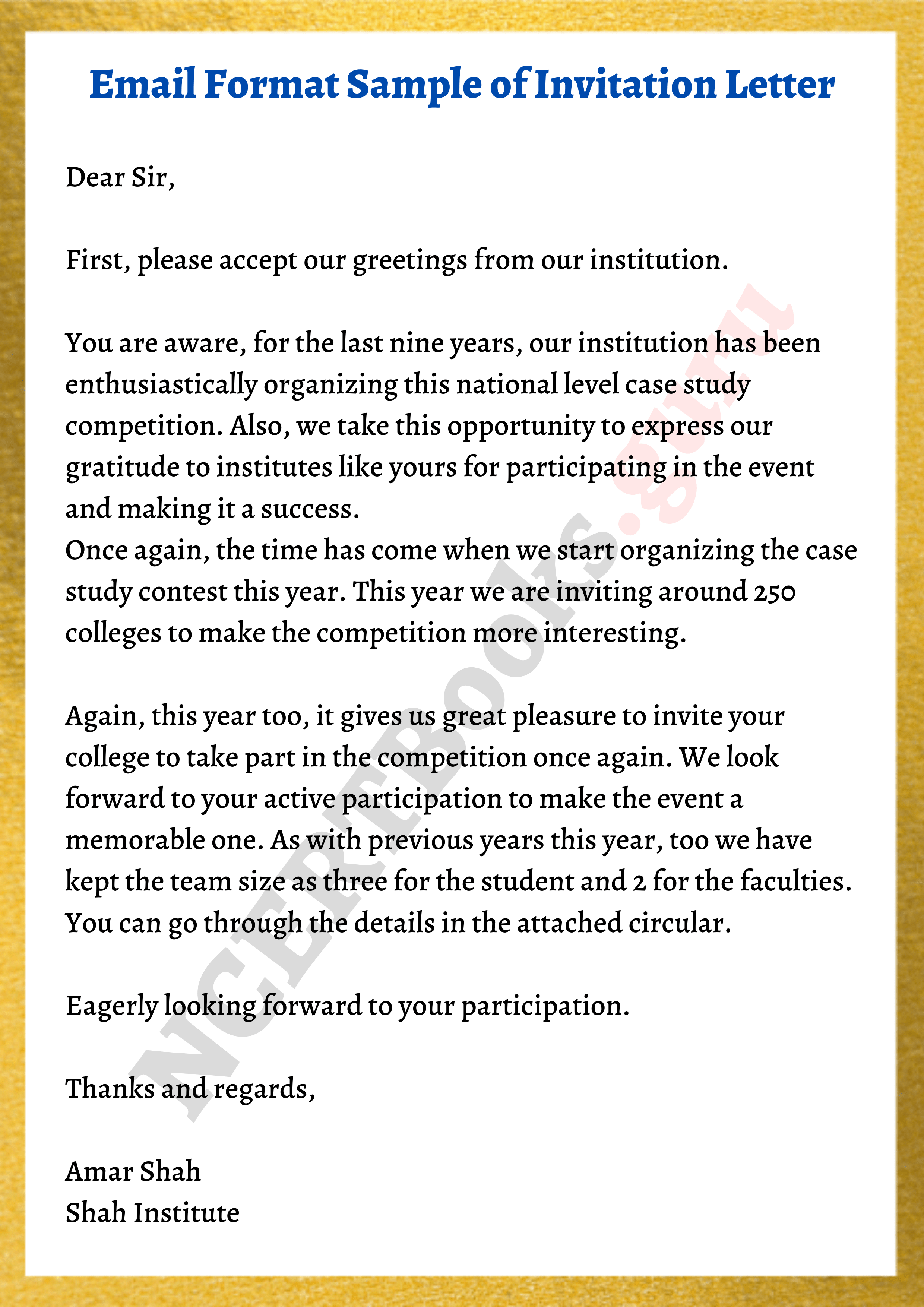
Invitation Letter Sample in Email Format

invitation letter sample in email format

FAQs on Invitation Letter Writing

1. What is the definition of an invitation letter?

An Invitation Letter is a document that gives an official request for the presence of an individual, a group of people, or an organization at an event. An invitation letter may be formal or informal.

2. How to write an invitation letter for business events?

Here are some writing tips that assist you while drafting an invitation letter to a business event:

  • Approach the guests professionally.
  • Write the invitation letters in Formal language and a professional tone.
  • Specify precisely the details of the event including date, time, venue, and purpose.
  • Mention the purpose of the event and what the guests will benefit from.

3. What is the purpose of writing an invitation letter?

There are two major purposes of writing an invitation letter. One is to invite the person to the event and the other one is to make sure that the person holding the letter wants to attend.

B.Sc Syllabus 2023 | Overview, Subjects, Duration and Exam Preparation

B.Sc Syllabus

B.Sc Syllabus: B.Sc is abbreviated as a Bachelor of Science; it is an undergraduate 3-years course offered by almost all colleges and universities in India. B.Sc is a popular course, especially in recent years as this course helps students reach heights in their science careers. Some of the popular methods students pursue in B.Sc are B.Sc in Mathematics, B.Sc in Computer Science, B.Sc in Biology, and many more.

The B.Sc course is available in both formats – correspondence and full-time. This course is usually opted by students who have a strong interest in computers, science, and mathematics. After completing a B.Sc course, candidates can pursue higher studies in the field of their specialization.

B.Sc Eligibility Criteria

If you want to join the B.Sc course, you have to meet the given eligibility criteria.

  • A candidate must secure 50%-60% marks in 10+2 from a recognized board.
  • There will be 5% relaxation for SC/ST caste students.

B.Sc Course Duration

The duration of the B.SC course is three years, and the curriculum comprises six semesters. Candidates need to pass each semester to become eligible for the degree.

B.Sc Syllabus

As mentioned earlier, a B.Sc student can pursue various streams, so here we have listed down popular subjects of the syllabus as specializations in B.Sc such as physics, maths, computers, and chemistry.

Mathematics Syllabus

Algebra Probability theory
Basic statistics & probability Ring theory and linear algebra
Matrices Real analysis
Discrete mathematics Calculus
Real functions Mechanics
Vector analysis Complex analysis
Analytical solid geometry Numerical analysis
Linear programming Data structure and operating systems

Physics Syllabus

Mechanics Quantum Mechanics and applications
Oscillations and waves Technical writing
Optics Statistical mechanics
Numerical analysis Kinetic theory and thermodynamics
Atomic and molecular physics Analog system and applications
Elements of modern physics Waves and optics
Mechanics and wave motion Microprocessors & computer programming
Digital system and applications Electronic devices

Computer Science Syllabus

Fundamental of computer organization Introduction of programming concepts
Computer graphics Linux
Arrays Data communication & networking
C++ programming Networking & security
Operating systems Computer Graphics
DBMS C language
Computer networks Theory of computation
Internet technologies Web design & Dot Net

B.Sc Entrance Exam Preparation

There are many colleges and universities conducting entrance exams for students and candidates to pass the test with good marks. Here is the list of top entrance exams.

  • NEST
  • OUAT
  • UPCATET
  • GSAT
  • IISER
  • ICAR
  • CIT
  • PUBDET

Get to Know More about other types of Course Details Streamwise, and Category wise.

B.Sc Entrance Exam Pattern

To better understand the study material and subjects, students should look down the given exam pattern.

subjects No of questions Marks
General section 10 30
Biology 15 50
chemistry 15 50
mathematics 15 50
physics 15 50

How to Prepare for the B.Sc Entrance Exam?

To crack the exam, candidates should have to learn the best study material and books that could help them understand the concepts, and you could make the best. Here are some preparation tips you can follow.

  • Attempt mock tests
  • Take advice from teachers
  • Mark the concepts and understand it
  • Make schedule
  • Follow the regular study routine
  • Read-only useful things

Also, See:

FAQ’s on B.Sc Syllabus

Question 1.
What are the best books for the NEST exam?

Answer:
For a candidate, it is required to follow the best study material, and that’s why we have listed top recommended books that could help learn only useful concepts.

  • NEST exam books by SURA BOOKS experts
  • Objective chemistry by RPH editorial
  • Mathematics by RD Sharma
  • Physics by DC Pandey

Question 2.
Which is the best course in B.Sc?

Answer:
All the courses involved in B.Sc have excellent career scope for the students. Here, we have listed top courses that usually students pick as the best career option such as:

  • B.Sc in Agriculture
  • B.Sc in Natural science
  • B.Sc in Nursing
  • B.Sc in Fisheries
  • B.Sc in Physics
  • B.Sc in Maths
  • B.Sc in Horticulture
  • B.Sc in Computer science

Question 3.
Is B.Sc good after 10+2?

Answer:
When you complete 10+2, you have many career options and streams to pick. But as a student, you should choose a field you are interested in, as this would help to grow in that field quickly. Besides, B.Sc is a uniquely designed course for students who are interested in computers and science.

NCERT Solutions for Class 11 Maths Chapter 1 Sets

NCERT Solutions for Class 11 Maths Chapter 1

NCERT Solutions for Class 11 Maths Chapter 1 here are prepared by subject experts after enormous research. Class 11 Maths NCERT Solutions helps students to solve problems efficiently. NCERT Solutions prevailing are as per the latest CBSE Curriculum and covers all the concepts in NCERT Textbooks. You can find NCERT Solutions Class 11 Maths Chapter 1 Exercises 1.1, 1.2, 1.3, 1.4, 1.5, 1.6 from here. Download the NCERT Solutions of Class 11 Maths Chapter 1 Sets PDF through the quick links available.

We strive our best to provide you the step by step solutions for all the NCERT Problems so that it is easy for students to understand. Get a good grip on the Sets with our Class 11 NCERT Maths Ch 1 Solutions provided covering all the topics in detail. To help you out, we have listed the NCERT Solutions for 11th Class Maths Sets in different mediums such as English, Hindi.

Class 11 Maths NCERT Solutions Chapter 1 Sets

Class 11 Maths Chapter 1 of NCERT has basic definitions and Operations involving Sets. In general, Sets are used to define the concepts of functions and relations. It is necessary to have basic knowledge of Sets as they are needed in the further study of sequences, geometry, probability. Sets is the easiest chapter among all the chapters and can be quite scoring. You will learn about Empty, Finite, Infinite, Equal, Subsets in this Chapter. You will also have Operations on Sets like Difference of Sets, Intersection of Sets and Union of Sets, etc. covered.

Avail the CBSE 11th Class NCERT Solutions for Chapter 1 Sets Ex 1.1, Ex 1.2, Ex 1.3, Ex 1.4, Ex 1.5, Ex 1.6, and brush up your fundamentals.

Class 11
Book Mathematics
Subject Maths
Chapter Number 1
Name of the Chapter Sets

Download NCERT Solutions for Class 11 Maths Sets – Solved Exercises

In order to score more marks in the board exams practice NCERT Solutions of Class 11 Maths Sets on a frequent basis. Students of CBSE, UP, MP, Gujarat and other boards can follow the NCERT Solutions prepared as per the latest syllabus. You can rely on these NCERT Maths Class 11 Solutions for Sets during your practice as all of them are prepared by subject expertise. Apart from NCERT Solutions, you will get Notes, Study Material, Important questions, Formulas, Exemplar Problems, etc. regarding the Sets.

Start Practicing the NCERT Maths Class 11 Solutions of Sets PDF at the earliest and attempt well in the board exams. For the sake of your convenience, we even listed the Class 11 Maths Ch 1 NCERT Solutions in both English & Hindi Mediums. Make the most out of them and stand out from the rest of the crowd.

Summary

We wish the knowledge shared above regarding NCERT Solutions for Class 11 Maths Chapter 1 has been beneficial to an extent. If you have any other queries feel free to drop us a comment so that we can revert back to you at the soonest possible. Bookmark our site for the latest updates on NCERT Solutions, Books, Syllabus, Previous Papers, Study Materials, and many more.