Job Offer Letter Template, Examples | What’s Included in Job Offer Letter?

job offer letter writing tips, format, and samples

Format & Samples of Job Offer Letter: It is an official document where the company offer or sent to selected candidates for employment. One of the great ideas to clear all the details and conditions of a job for the employee and the employer is to have written confirmation of an offer. This Job Offer Letter can be made over the phone or email, probably it is most likely to be a formal letter that confirms employment information like a job description, salary, benefits, paid leave, and management structure.

In the mail or written job offer letter at the end, the hired candidates may find the declaration part where they should reply to the letter in acceptance or denying. If the candidates agree to the declaration mentioned in the offer letter, they need to sign it and submit it to the company.

Provided below are downloadable job offer formats and samples. Get them for free and make use of the given job offer letter template and examples as a reference and make one on your own. Also, our site is providing numerous Letter Writing Topics in both Formal and Informal types so you can get familiar with all the styles of letter writing in one place.

Job Offer Letter Format

A job offer letter is given to the selected candidates in an interview for a specific position in the company. Here, you will view the standard format of the job offer letter. Have a look at the letter and use it as a reference:

  • Employer Address
  • Contact Information
  • Hiring Manager Details
  • Job Title
  • Date of joining
  • Office timings
  • Salary package offered
  • Benefits and compensation
  • Company policies
  • Probation period
  • At-will status

job offer letter format

Also, Check more Offer Letter Formats by using this link and also add them under your reference articles.

Job Offer Letter Samples

job offer letter sample

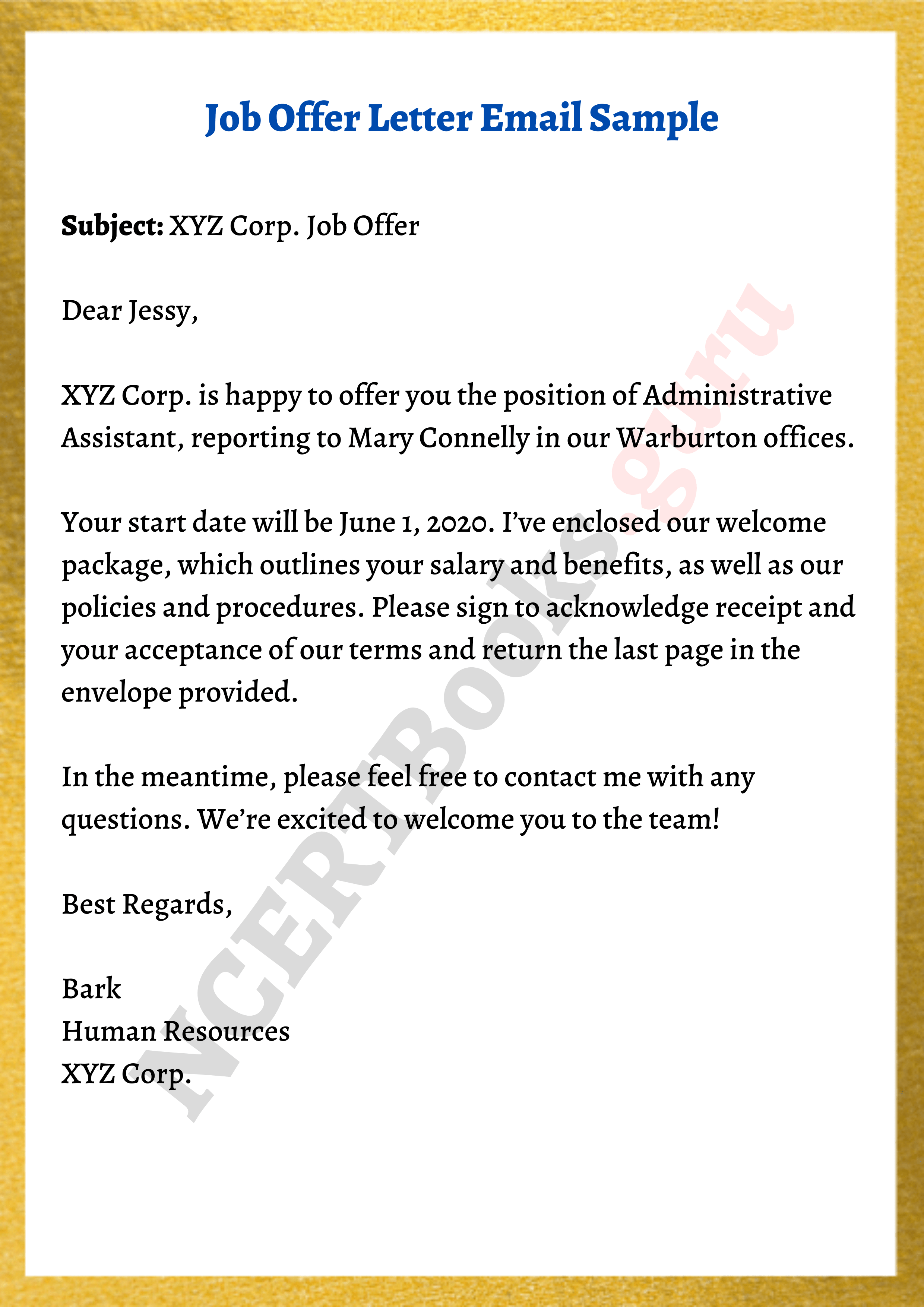
Email Format Sample for Job Offer Letter

email formatted job offer letter sample

FAQs on Job Offer Letter Writing

1. How to write a Job Offer Letter?

Follow these three steps and learn how to write a job offer letter:

  • Mention the company name and job title at the top of the page.
  • After that, use the greeting with “Dear Applicant Name,” and congratulate him/her.
  • Include the details about the offering job like the job title, start date, main duties, compensation, benefits, and who the person will be reporting to.

2. What is Included in a Job Offer Letter?

An offer letter confirms employment details such as:

  • Job description
  • Job title
  • Reporting structure
  • Starting date of employment
  • Salary
  • Benefits information and eligibility
  • Acknowledgment of offer and confirmation of acceptance

3. Is the job offer letter important?

Yes, job offer letters are very important & still required. As they are not legal documents, they can confirm a job offer, promote the new opportunity, and develop excitement about working for your company with the candidate.

RPSC Books | Details, Syllabus, Exam Notes and Study Materials

RPSC Books

RPSC Books and Study Materials: The Rajasthan Public Service Commission (RPSC) is the conducting body designing the Rajasthan Administrative Services (RAS) exam. The RPSC is the highest state-level civil services exam conducted as a gateway to enter into the RAS.

The RPSC is a three-step civil exam that tests a candidate’s factual and conceptual information. To crack the RPSC examination, candidates should conduct thorough preparation.

Sources of information like books, reference materials, notes, and sample papers play a vital role as they provide a crisp and detailed structure of the RPSC syllabus. Therefore, candidates should understand and read through all the topics falling under the RPSC syllabus before commencing with their preparation. It’s always better for candidates to refer to the RPSC books and study materials as a few topics under the curriculum may be confusing.

  • RPSC Exam Syllabus
  • RPSC Exam Notes and Books
  • RPSC Exam Study Materials
  • Conclusion

RPSC Exam Syllabus

The conducting body sets the Exam syllabus for the RAS or RTS Combined Competitive Exam- Rajasthan Public Service Commission (RPSC).

For all PSC exams, candidates should study and learn topics from the State’s perspective as well. The RPSC exam falls similar in line to the other civil service examinations, including the UPSC IAS exam.

The RPSC exam occurs in three stages- the RPSC Preliminary Stage, the RPSC Main Stage, and the RPSC Interview Stage. However, the RPSC exam curriculum falls under two categories-

  • RPSC Prelims Syllabus and
  • RPSC Mains Syllabus.

The detailed structure of the RPSC syllabus is as follows

RPSC Preliminary Syllabus

The RPSC Prelims is a screening test for which the marks remain unaccounted for the final merit list. The RPSC Prelims conducts only one paper. The paper comprises objective-type questions on General Science and General Knowledge.

The RPSC Prelims paper comprises 150 questions for 200 marks and three hours.

The basic overview comprising a list of the topics that fall under the RPSC Prelims subdivides into topics or section focusing on Rajasthan and general topics as follows:

General Topics Rajasthan-Specific Topic
Indian Economy and Economic Concepts Economy of Rajasthan
Indian History regarding to Ancient, Medieval, and Modern period Rajasthan’s Literature, Tradition, Culture, Art, History and Heritage
Reasoning and Mental Ability Administrative and Political System of Rajasthan
Indian Political System, Indian Constitution and Indian Governance Rajasthan’s Geography Features
Geography regarding to India and World Current Affairs and Event-related to Rajasthan
Science and Technology
Current Affairs and Events

RPSC Mains Syllabus

The RPSC Mains conducts four papers. The paper comprises theoretical or descriptive type questions sectioned as short, medium and long questions. Each paper holds three units on General subjects and General Knowledge. Each of the RPSC Mains papers is for 200 marks and three hours. The RPSC Mains holds no optional papers unlike a few of the other civil service exams. The marks obtained from the RPSC Mains remain counted in the final merit list.

Paper-One General Studies Paper-I
  • Unit-1 is on  History
  • Unit-2 is about Economics
  • Unit-3 is about Sociology, Management, Accounting and Auditing
Paper-Two General Studies Paper-II
  • Unit-1 based on Administrative Ethics
  • Unit-2 based on General Science and Technology
  • Unit-3 based on Earth Science regarding to Geography and Geology
Paper-Three General Studies Paper-III
  • Unit-1 based on Indian Political System, World Politics and Current Affairs
  • Unit-2 based on Concepts, Issues and Dynamics of Public Administration and Management
  • Unit-3 based on Sports and Yoga, Behaviour and Law
Paper-Four General English and General Hindi Papers
  • Unit-1 based on Grammar and Usage
  • Unit-2 based on Comprehension, Translation and Precis Writing
  • Unit-3 based on Composition and Letter Writing

The RPSC Interview or Viva Voce or Personality Test stage is for 100 marks and the questions asked during this stage aims to test the candidate’s attitude, personality and assess his or her overall suitability for a career in administration.


RPSC Exam Notes and Books

The RPSC exam is a Combined Competitive Exam (CCE) conducted by the Rajasthan Government to recruit eligible candidates for several vacancies in the Administrative department.

The RPSC exam tests the conceptual and factual information of the candidates and the standard of papers test the subject knowledge and current affairs or events about the State.

Candidates can check the below-mentioned important books broken up in a subject-wise manner. These books aim to aid the preparation for the Rajasthan state-related topics or questions in the RPSC exam.

Subject Name Book Name
History of Rajasthan
  • Book published by Lakhya publication
  • Rajasthan Sahitya Akademi Publications Book
Political Science and Administrative System of Rajasthan
  • Laxmikant’s Indian Polity Rajasthan Book
  • Indian parliament by Subhash Kasyshap
Current Affairs or Current General Knowledge Rajasthan Patrika and Dainik Bhaskar
History of India NCERT Class XII history Notes
The Economy of Rajasthan
  • Rajasthan Studies School Textbooks
  • Book by Lakshya publication
Math’s, Mental Ability and Reasoning
  • Kiran Publication Mathematics Book
  • R.S. Agarwal and S.Chand publications Book
Art, Culture, Literature, Tradition and Heritage of Rajasthan
  • Book by Rai publications
  • Book by Lakshya Prakashan
  • Book by Arihant publications
Geography of India
  • NCERT Class XII  Books
  • NCERT Class XI  Books
Rajasthan General Knowledge
  • The monthly Sujas
  • Pratiyogita Darpan Extra Edition
  • Bharat 2013
  • Monthly edition of  P.D. and Chronicle
The Economy of India
  • Indian Economy by Mishra and Puri
  • Shastri IAS Economy Guide
  • Bhartiya Arthvayavastha by Datt Sundaram
Geography of Rajasthan
  • Books by Rajasthan Sahitya Akademi Publications
  • Raj Kumar Sharma’s Rajasthan Geography Book
General Science and Technology NCERT Class VI to Class X Science TextBooks

RPSC Exam Study Materials

The Rajasthan Government conducts the RPSC civil services examination to recruit eligible candidates for various vacancies in the State Administration. The RPSC exam designs standard papers to test a candidate’s subject knowledge along with State and Country’s current affairs and events.

Apart from subject books knowledge, candidates should also refer and practice various other study materials such as the NCERT Notes and Newspapers. Candidates can even download NCERT notes from the official website and refer them for their RPSC preparation. Given below are a list of a few of the recommended RPSC preparation study materials that aid the candidate’s reading and practice:

  • Budget and Economic Surveys
  • State Board Notes
  • NCERT Notes

As stated earlier, NCERT Notes are universally recommended for starters or beginners preparing for any of the Civil Services examinations as these notes are of great help. Candidates can segregate the highlights and jolt make their notes from the NCERT books as it helps during the time of revision. A few of the recommended NCERT books for the RPSC examination as are follows:

  • NCERT Notes on Ancient Indian and Rajasthan History Notes
  • NCERT Notes on Art And Culture
  • NCERT Notes on Medieval Indian and Rajasthan History Notes
  • NCERT Notes on Geography Notes
  • NCERT Notes on Modern Indian and Rajasthan History Notes

Candidates can also refer to the subject-based notes from their schools either in English or Hindi such as- Environment Notes, Polity Notes, Science and Technology Notes, and Economics Notes. These study materials play a crucial role in the holistic RPSC exam preparation.

Conclusion on RPSC Books

The RPSC exam organised by the Rajasthan Government is a well-known civil service examination. A few of the best and highly recommended subjects books, notes, and other various study materials mentioned in this article aim to help the aspiring candidates at the time of preparations.

FAQ’s on RPSC Books

Question 1. 
What are a few preparation tips that aid the study for RPSC exams?

Answer:
A few RPSC preparation tips that help candidates to crack the exam are-

  • Candidates preparing for the RPSC exam should have a good collection of right text and reference books.
  • Candidates must avoid Television and other screens that act as distractions.
  • Candidates must start their preparation through a proper timetable and schedule each subject accordingly.
  • Read more newspapers, books, magazines and various other news sources that keep one updated on current affairs and events.
  • Candidates must ensure to revise often and solve sample papers as revision.

Question 2. 
What are the eligibility criteria to apply for the RPSC examination?

Answer:
The eligibility criteria for the RPSC examination comprises age limit, nationality, and educational qualification.

  • For educational qualification: Candidates must hold a graduate degree either from a university recognised by the Government in consultation with the RPSC or the University incorporated by an Act of the Central Legislature.
  • Age Limit: The lower age limit is 21 years of age, and the Upper age limit is 40 years of age.
  • Nationality: The aspiring candidate must be an Indian citizen.

Question 3.
How many papers does the RPSC exam hold?

Answer:
The RPSC exam occurs in three stages- the RPSC Preliminary Stage, the RPSC Main Stage, and the RPSC Interview Stage.

The RPSC Prelims conducts only one paper that comprises objective-type questions on General Science and General Knowledge for 200 marks and three hours.

The RPSC Mains conducts four papers which are either theoretical or descriptive, and each paper holds three units for 200 marks and three hours.

The RPSC Interview or Viva Voce or Personality Test stage is for 100 marks and the questions test candidate’s attitude, personality and assess his or her overall suitability for a career in administration.

National Interactive Science Olympiad [NISO] | Registration, Eligibility, Syllabus, Sample Paper, Admit Card, Exam Pattern, Results

National Interactive Science Olympiad [NISO]

National Interactive Science Olympiad [NISO]: National Interactive Science Olympiad [NISO] 2020 focuses on making students see the practical aspects and uses of science and research. NISO is introduced to create Science and Research. It helps students to acquire their knowledge in the practical aspect of life. EduHeal Foundation conducts Olympiad Exam and helps students focus on the skills that improve logical and analytical thinking.

  • National Interactive Science Olympiad [NISO] Highlights
  • National Interactive Science Olympiad [NISO] 2020
  • National Interactive Science Olympiad [NISO] Registration
  • National Interactive Science Olympiad [NISO] Eligibility
  • National Interactive Science Olympiad [NISO] Syllabus
  • National Interactive Science Olympiad [NISO] Sample Paper
  • National Interactive Science Olympiad [NISO] Admit Card
  • National Interactive Science Olympiad [NISO] Exam Pattern
  • National Interactive Science Olympiad [NISO] Results

Get to Know More about other types of Silverzone Olympiads and their details from here.

National Interactive Science Olympiad [NISO] Highlights

Exam name National Interactive Science Olympiad 2020
Managing organisation EduHeal Foundation
NISO Exam Date Duration December 2020 (schools have to select a date in this duration)
Registration Last Date August 2020
NISO Venue Participating schools
Mode of Exam OMR, computer-based
NISO 2020 result date (Tentative) February 2021
Eligible Candidates CBSE, ICSE, state boards, or NIOS students studying in class 1 to 12

National Interactive Science Olympiad [NISO] 2020

The NISO exam 2020 allows the Indian students to participate along with the international students. EduHeal is trying to create an interest in science in students. It will help the students to understand how science works in different fields and also different kinds of research.

NISO 2020 exam is conducted in 3 levels.

  • Level 1: This is the state or the city level exam. The mode of exam is OMR (Pen Paper Test). The test is based on MCQs, and students can perform their exams in the registered school
  • Level 2: This is the National level exam. The top qualified students from level 1  Olympiad rank list are eligible to take up the top positions in the level-two examination. The mode of exam is online/computer-based test and will be conducted all over India in February 2021
  • Level 3: The level three examination is an offline mode of exam conducted in New Delhi. Toppers from level 2 will be chosen for the International Olympiad Training Camps (IOTC) conducted by Oracle Foundations ThinkQuest. The head scientist from IIT, Delhi will mentor IOTC

National Interactive Science Olympiad [NISO] Registration

The National Interactive Science Olympiad [NISO] 2020 is a national level Olympiad led by EduHeal Foundation. Schools can register themselves by filling up their respective forms. Institutions affiliated under CBSE, ICSE, and other state boards are qualified to apply for the National Interactive Science Olympiad [NISO] 2020 exam. There is a list of forms for the NISO registration. Each has a distinct purpose, and the details in the form should be filled accurately.

Form A 

  • The school coordinator should provide full details of the school
  • The school coordinator is responsible for the number of students and the total fees collected
  • Candidates should pay Rs 150 per person for the exam to the respective school coordinator
  • School coordinators should pay the amount through demand draft or online payment
  • The demand draft is payable at EHF Learning Media (P) Ltd. payable at New Delhi

Form B

  • Here the details are for the school coordinators. Teachers will be designated to the following items based on the strength of the student competing in the EHF olympiads
  • Participation gifts and certificate
  • Olympiad coordinators wards can attend the NISO exam without registration fees
  • Free participation in online National Teacher’s Evaluation Test (if interested)

Form C

This form is for the registration of the order of two preparatory books- Activity books and workbooks sold by EHF for the NISO exam. The cost of each book is Rs 80.

Form D

The form D registration is known as the student registration form. The details of the students, father’s name and the name of the exams are filled in the form.

National Interactive Science Olympiad [NISO] Eligibility

  • Only competing school students are eligible to fill the Eduheal NISO 2020 registration form
  • Candidates must be from class 1 to 12 from CBSE, ICSE or other major boards
  • Students should have the necessary general information

National Interactive Science Olympiad [NISO] Syllabus

The National Interactive Science Olympiad syllabus is very essential to help students prepare for NISO 2020. NISO Exam focuses on aiding students in enhancing their learning of science and its uses. By focusing on the subject-wise materials, students will allot separate amounts of time henceforth performing their preparation effectively. The course curriculum mainly comprises questions that are based on environmental sciences and its basic nature.

Class 1 Syllabus

  • About Plants
  • About animal
  • Air
  • Water
  • Weather
  • Sky and space
  • Safety first
  • Our needs and habits
Class 2 Syllabus

  • Plants
  • Animals
  • Air around us
  • Water
  • Up in the sky
  • Our body
  • Food and nutrition
  • Safety and first – aid
Class 3 Syllabus

  • Family and friends
  • Food
  • Shelter
  • Water
  • Travel
  • Things we do
Class 4 Syllabus

  • Family and friends
  • Food
  • Shelter
  • Water
  • Travel
  • Things we make and do
Class 5 Syllabus

  • Family and friends
  • Food
  • Shelter
  • Water
  • Travel
  • Things we do and make
Class 6 Syllabus

  • Food
  • Materials
  • The world of Living
  • How do things work?
  • Natural Phenomena
  • Natural Resources
Class 7 Syllabus

  • Food
  • Materials
  • The world of Living
  • How do things work?
  • Natural Phenomena
  • Natural Resources
  • Moving things, People and Ideas
Class 8 Syllabus

  • Food
  • Materials
  • The world of Living
  • How do things work?
  • Natural Phenomena
  • Natural Resources
  • Moving things, People and Ideas
Class 9 Syllabus

  • Matter in our surroundings
  • Is matter around us pure
  • Tissues- types of plant and animal tissue
  • Forces and laws of motion
  • Natural resources
  • Sound
  • Improvement in food quality
Class 10 Syllabus

  • Chemical Reaction and Equation
  • Acids bases and Salt
  • Life Processes
  • Light
  • Electricity
  • Magnetic Effects of Electric Current
  • Carbon and its Compound
Class 11 Syllabus

  • Physics
  • Chemistry
  • Biology
Class 12 Syllabus

  • Physics
  • Chemistry
  • Biology

National Interactive Science Olympiad [NISO] Sample Paper

Olympiad sample papers are updated on the official website of EHF. Students need to go to the official website after they finish the registration for the exam. Students writing computer-based exams are given access to online sample papers for them to practice. The list of previous year question papers are given below :

2011 2013 2014 2015 2016 2017 2018
Class 1 Class 1 Class 1 Class 1 Class 1 Class 1 Class 1
Class 2 Class 2 Class 2 Class 2 Class 2 Class 2 Class 2
Class 3 Class 3 Class 3 Class 3 Class 3 Class 3 Class 3
Class 4 Class 4 Class 4 Class 4 Class 4 Class 4 Class 4
Class 5 Class 5 Class 5 Class 5 Class 5 Class 5 Class 5
Class 6 Class 6 Class 6 Class 6 Class 6 Class 6 Class 6
Class 7 Class 7 Class 7 Class 7 Class 7 Class 7 Class 7
Class 8 Class 8 Class 8 Class 8 Class 8 Class 8 Class 8
Class 9 Class 9 Class 9 Class 9 Class 9 Class 9 Class 9
Class 10 Class 10 Class 10 Class 10 Class 10 Class 10 Class 10
Class 11 Class 11 Class 11 Class 11 Class 11 Class 11 Class 11
Class 12 Class 12 Class 12 Class 12 Class 12

National Interactive Science Olympiad [NISO] Admit Card

It is mandatory to bring the NISO admit card at the exam centre for verification purposes. No applicant will be permitted to enter the examination hall without a hall ticket or admit card, and it should be carried along with the identification card. The enrollment number (unique for each candidate) can also be used while checking the NISO 2020 result. NISO admit cards are emailed to the school email id registered to Eduheal foundation. Students can reach their respective school coordinators to obtain the NISO 2020 admit card. An SMS is also sent to the student on their registered mobile number. The NISO hall ticket consist of the following details :

  • Student name
  • School name
  • Class
  • Exams attending
  • Dates of the exam
  • Enrollment number
  • Exam center

National Interactive Science Olympiad [NISO] 2020 Exam Pattern

  • One mark each question
  • No negative marking
Class No. of questions Exam duration Section-wise division of questions
Section Questions
I- VI 40 40 General IQ 10
Subject 15
Interactive 15
VII-XII 60 60 General IQ 10
Subject 30
Interactive 20

National Interactive Science Olympiad [NISO] Results

The result of NISO is declared a few weeks after the exam. The result is available online for 15 days after the declaration. Students should follow the steps to get the result from the official website :

  • Register on the EduHeal app
  • Click on the NISO result link
  • Select the exam and enter your name, email id, enrollment number and mobile number as given in your admit card.
  • OMR, question papers with answer sheets, and aptitude reports will be available on the site.

Prize distribution ceremony for top scorers of NISO exam April 2020 will be held at the International convention centre, Bombay Stock Exchange (BSE), Dalal Street, Mumbai. A personal invitation will be sent to concerned students, teachers, and principals.

National Interactive Science Olympiad [NISO] Fees Structure

The participation fee amount for the National Interactive Science Olympiad [NISO] 2020 is Rs 150 per student/per exam. The school may also acquire a small amount up to Rs. 20/- to compensate for the expenses towards payment of the invigilator, postal expenses, DD charges, and photocopying, etc.

Mode of Payment: The mode of payment for schools is through demand draft or internet banking.

FAQ’s on National Interactive Science Olympiad [NISO]

Question 1. 
What is the mode of payment for the National Interactive Science Olympiad [NISO]?

Answer:
The mode of payment for the National Interactive Science Olympiad [NISO] is through demand draft or internet banking.

Question 2.
What are the eligibility criteria for NISO?

Answer:
The eligibility criteria for the NISO exam is students studying from class 1 to 12 from a CBSE, ICSE, state boards, or any major board can apply for the exam.

Question 3.
How will the National Interactive Science Olympiad help a student?

Answer:
NISO helps students focus on helping students see the practical aspects and use of science and research.

Question 4.
What is the reference material for the NISO exam?

Answer:
The reference material for the NISO exam is activity books and subject wise workbooks.

About Scientific Names | What is in a Scientific Name? | List of Scientific Names of Animals, Birds, Flowers, Plants, Fruits

All about scientific names

Scientific Names: Have you ever wondered why every species has its own scientific names? Because the regional name of the species can differ from one state to another. In order to avoid this confusion, scientists introduced scientific names for every species and used to call the species. Scientific names are also known as biological names. Excited to know the full story about the scientific name? Then, getting into this ultimate article and reading out the details provided here helps you a lot to understand why we need a scientific name? and what is in a biological name?

Also, this concept is very beneficial for students or candidates who are preparing for various competitive exams or General Knowledge Quizzes, etc. Okay, let’s start knowing it briefly via direct links given below.

This Blog Includes: 

What is a Scientific Name?

The scientific name uses binomial nomenclature or a two-word naming system. The name of the species is denoted by two names the first name is known as a genus name and the second name is known as a specific name or specific epithet. Also, there is a third name denoted as author citation in the form of abbreviation. The third name in the scientific notation is optional so in short, the biological name is a two-way naming system.

The third name is put forward in accordance with the rules and regulations provided by ICBN and ICZN. Present, ICBN is known as the International Code of Nomenclature for algae, fungi, and plants(ICN). Check out the further modules to have an idea about the rules of writing scientific names.

A Few Common Name with their Scientific Names as Examples

  • Humans – Homo sapiens
  • Orange – Citrus aurantium
  • Tomato – Lycopersican esculentum
  • Blackbuck – Antelope cervicapra
  • Cheetah – Acinonyx jubatus
  • Red Fox – Vulpes vulpes
  • Indian Python – Python molurus
  • Carrot – Daucas carota
  • Green Gram – Phaseolies auicus
  • Coriander – Coriandrum sativum
  • Great horned owl – Bubo virginianus

The above list of binomial names covers all species and things like animals, vegetables, fruits, birds, humans, etc. Want to check the other common names with their scientific names of particular species then click on the available direct links.

Species Wise List of Scientific Names

Scientific Name of Flowers
Scientific Names of Plants, Fruits & Vegetables
Birds Scientific Names

Why Scientific Name is Important?

By the biological names, scientists and biologists can easily understand the details about the species. There are various important points that should be known about the scientific names. They are as such

  • Each Organism with a single unique scientific name that seldom differs.
  • A universally accepted name understood globally.
  • Also, scientific names are often descriptive names that give some details about the organism of the particular species.

Rules for Writing Binomial Nomenclature

If you want to write a scientific name for any new species then there are certain rules to be followed. The rules that are must follow while writing scientific names are as such:

  • Generally, Scientific names are in Latin and written in Italics.
  • In the biological name, the first word indicates genus whereas the second word or name indicates Species/ Specific Epithet.
  • Also, there is a rule to write the first letter of the genus in Capital letter and the first letter in a specific name in Small letter.
  • Both the names in the Scientific name, when handwritten must be separately underlined.
  • The name of the author occurs at the end of the scientific name and is write down in abbreviated form.

Why do we need Scientific Names?

People who are researching about the scientific names or studying about them can relate to this section. As their mind will always raise a question ie., Why do we need a biological name? This module is specially framed to answer this question.

For a better understanding of the concept, let’s take an example ie., cat. In Arabic it is called qat, in the Chinese language it is Mao, in Hindi it is Billee, and in Russian it is kat. Here, we are calling the same organism with different names in different languages in different countries. Sometimes, even within a country in various locality, the word of this specific organism may differ. The perfect solution to face this great confusion by biologists across the globe is the scientific name.

Also, we have some common names that are often misleading or often a misnomer. For example, take the common name ie, jellyfish, it is not a fish whereas it belongs to invertebrates which relate to corals and animals. So, this is not a fish. Thus in common names, there are many misleading things or misnomers to avoid all these things we have Biological Names.

What is in a Scientific Names?

Scientific names are the universal names for particular species. It holds a maximum amount of information within them. The biological names tie that organism back to its species descriptions and to its closest relatives. The names are written in Latin.

Also, it conveys details or characteristics about the organism. Some animals are named by their significance whereas some are named after celebrities. While researching on this topic, one of the reports stated that ‘In 2011 Australian researchers named horsefly as Scaptia beyonceae after Beyonce. Now, there are around one million animals with scientific names and many other organisms are still waiting for their binomial names.

Uses of Biological Names/Binomial Names

  • The other term for scientific names is Binomial names and they are universally recognized and standardized.
  • Classification and organization: These are comprehensively organized which makes understanding and studying characteristics of specific organisms easy and organized.
  • Precision and clarity
  • These are recognized even if the species are transferred to another genus on the basis of new knowledge.
  • These are so unique that identifying organisms won’t lead to confusion.
  • Helps in grasping the similarities and differences between various species that belong to the same genera.

FAQs on Scientific Name for All Species

1. What is the full form of ICBN?

Now, ICBN is changed to the International Code of Nomenclature for algae, fungi, and plants(ICN). Before ICBN Stands for International Code for Botanical Nomenclature.

2. ICZN stands for?

The abbreviation of ICZN is International Code for Zoological Nomenclature.

3. How important a scientific name is? 

It is very important to name every species with a scientific name. It is nothing but a universal name of the particular organism. Also, people across the globe can understand the characteristics of the organism by its scientific name.

State-Wise School Books for Classes 12, 11, 10, 9, 8, 7, 6, 5, 4, 3, 2, 1 | Download School Textbooks Pdf Online for free

school books

Students believe that the board examinations are the toughest task to perform every year in their education period. But with the proper learning and guidance from teachers and parents end will help students to crack the exams. For more support, we have come up with a new guide called “School Books”. School Books are the most important source to guide the students for better preparation and to score good marks.

Today, we are here with the best Online School Books for all state boards, CBSE & ICSE. If you are wishing to score better marks in all board examinations then cover the entire syllabus with the help of subject-wise School books for Class 1, 2, 3, 4, 5, 6, 7, 8, 9, 10, 11, 12. Make use of these CBSE & state-wise board books during your preparation and complete the entire syllabus accordingly.

Students can download State Boards, CBSE, ICSE School Textbooks in PDF from the official website or else check out the below modules and directly attain the handy school textbooks in Pdf format for free of cost. These books are available for all students who are studying in particular state government and private schools.

List of all State Boards School Books – PDF Free Download

School Books are the ultimate preparation tool for students and the best materials for teachers. Without using textbooks your learning would be incomplete. So, all government and private schools follow the textbook education system until now and frame textbooks for all academic years as per the CBSE, ICSE & State board guidelines. These School Books are prepared by subject experts by covering everything from base to a higher level.

These textbooks are written in simple language and topics are illustrated in a detailed manner. Moreover, these books are prepared as per the latest academic year board syllabus for all classes. So, students are advised to study all the subjects with the help of these school books. Here, students will get state-wise school textbooks from class 1 to 12 for all the subjects.

Download State-wise School Textbooks & e-Books for Class 1 to 12

To access the particular state boards, CBSE, ICSE books online and to download school textbooks for free, we have listed the direct links below. Also, these school books are available in English and Hindi Language for some state boards like BSEB, GSEB, HBSE, and more. Utilize these school e-books as a prime savior for class 1 to 12 CBSE, State Board exams, and score more marks. You can download these school books from the official site of any state board, CBSE, ICSE, or else directly download school textbooks for Class 1 to 12 from here for free.

FAQs on CBSE, ICSE, State Boards School Text Books Online

1. Which is the best website for Online School Books?

NCERTBooks.Guru is one of the largest and most renowned web portals in India today. It is helping many of the students by providing an extensive set of exam resources from their end to understand the concept easily and score better grades in any type of examinations.
For CBSE students, this site is listing all NCERT Solutions for all classes and subjects, as well as for state board students, they are offering the best School Books online and offline.

2. Are School Books enough to get more than 95% in State Boards?

Yes, School Text Books & e-Books are more than enough for a student to clear any state board examination. Because it includes all types of exam resources for efficient preparation.

3. Where Can I find School Textbooks Online for free?

Candidates preparing for State Board Exams 2020 can discover the required online school books and study materials absolutely free of cost from this page. Use the state-wise links available over here and access the needed state board school textbooks for all classes and subjects and score more grades.

4. Is there any chance to download State-wise School Books in Pdf format?

Yes, of course you can download School textbooks for any state board exams or CBSE, ICSE exams from our site ncertbooks.guru for free. On this page, we have listed all state boards pdf formatted school textbooks online for all secondary and senior secondary level students to download and make use of them during exam preparation.

Final Words

We hope the shed data and the list of school books for CBSE, State Boards, ICSE will aid you during your preparation and support you to understand all the topics in a detailed & easy manner. If you are in search of some other school textbooks online which are not shared here, then leave a comment to us via the below comment box. we will reach you out at the earliest possibility. Stay in touch with our site Ncertbooks.guru and avail the latest updates on School books for CBSE, ICSE, GSEB, BSEB, HPBOSE, JKBOSE, and many more.

Eduheal Foundation Olympiad 2020 | Features, Benefits and List of Eduheal Foundation Olympiad Examinations

Eduheal Foundation Olympiad

Eduheal Foundation Olympiad 2020: Eduheal foundation conducts a series of Olympiad examinations for students from school and educational institutions. These foundations aim to promote and enhance the knowledge, skills and proficiency of students in the fields of science, mathematics, English, computer science and general knowledge.

EduHeal foundation is a non-profit making organization that is supported by leading educationalists, corporate heads and media houses. The organisation reaches out to around four thousand schools in India. These olympiads help students push their boundaries to work harder and improve and increase their knowledge about subjects.

Get to Know More about other types of Silverzone Olympiads and their details from here.

The organisation conducts various olympiads all around the year. Therefore, achieving its goal of reaching out to all the schools in India. Based on these olympiads, it pushes students to enhance their skills and knowledge in various fields.

Eduheal Foundation Olympiad Features

The EduHeal foundation helps identify the talents students studying in various institutes across the country. This is done through multiple levels of the olympiads. There are three levels of exams conducted to test the knowledge and skills of the students. Students who pass each level, finally reach the last group of the Olympiad. The previous level of the olympiad is a sponsored program by institutions and organisations which are renowned around the world. It’s an effective way to expose the students to research and development if each of the sectors.

Here are some of the features of EduHeal Olympiad:

  • EduHeal conducts online examinations as well as offline examinations. It has a paper-based test.
  • The paper-based test is for the first level of the olympiad. On the second level, candidates need to write their examinations online.
  • Students get to pay a visit to two important places in the country- the Bombay Stock Exchange and Indian Space Research Organisation. It’s a great learning opportunity for the students.
  • There are national workshops which are conducted by EduHeal Foundation which students can participate in it too.
  • All the students who pass the olympiads receive certificates of participation, and many students who are toppers receive medals. Students who pass level 2 receive many exciting gifts.
  • Candidates who pass level three of the olympiad receive exciting gifts form the sponsors of the olympiad. Students who pass the BIFO and NSSO receive certificates with the logos of the two organisations – the Bombay Stock Exchange and the Indian Space Research Organisation.

List of Eduheal Foundation Olympiad Examinations

EduHeal Foundation conducts nine primary olympiads on an annual basis. The details of the nine olympiads are given below:

  1. EduHeal International Cyber Olympiad (ICO): The EduHeal International’s Cyber Olympiad is an annually conducted international level olympiad. It is related to computers and all the necessary things you need to know about in the field of computers.
  2. EduHeal International English Olympiad (IEO): The EduHeal International English Olympiad is an olympiad which is meant to improve the English language of students. When students take part in the EduHeal International English Olympiad, they are getting exposed to learning and completion.
  3. National Interactive Maths Olympiad (NIMO): The National Interactive Maths Olympiad is another olympiad conducted by the EduHeal Foundation. It is the olympiad that helps students learn mathematics quickly and in a fun way. The fear that students of mathematics are what this Olympiad seeks to remove.
  4. National Interactive Science Olympiad (NISO): The National Interactive Science Olympiad is an olympiad which is conducted to make science fun and interesting for students.
  5. International General Knowledge Olympiad (IGO): The General Knowledge Olympiad, which is conducted by EduHeal Foundation, is performed on an international level. It is an olympiad which promotes and encourages students to be aware of past events and presentations.
  6. Arts & Sports Clinic Contest (ACC &SCC): The Arts & Sports Clinic is an olympiad that aims at creating and enhancing the skills of students in the sphere of arts and sports.
  7. BSE International Finance Olympiad (BIFO): The BSE International Finance Olympiad (BIFO) is an olympiad conducted by EduHeal Foundation. It is an olympiad which aims at encouraging students to explore and learn about the financial world by holding the Business & International Finance Olympiad (BIFO).
  8. National Biotechnology Olympiad (NBTO): The National Biotechnology Olympiad is another EduHeal Olympiad related to the field of science. It is an olympiad that aims at creating and spearing awareness of biotechnology and its concepts among students.
  9. National Space Science Olympiad (NSSO): The National Space Science Olympiad is an olympiad conducted by EduHeal Foundation. It is an olympiad to motivate students to discover new things about space and spark an interest in them. The National Space Science Olympiad is conducted in collaboration with the Indian Space Research Organisation.

Benefits of Eduheal Foundation Olympiad

EduHeal Foundation is the body that conducts all the EduHeal Olympiads in schools across the country. It aims to enhance the learning skills of the students beyond the subject matter that they are taught in school. Here are some of the benefits of Eduheal Olympiad Examinations.

  • It enhances the knowledge of students for future examinations and competitive tests.
  • The olympiad examination provides students with a high level of quality learning about various topics.
  • Students are awarded awards and receive a certificate for participating in the Eduheal Olympiad.
  • Students receive certificates from organisations like the Bombay Stock Exchange certificate and Indian Space Research Organisation, for BIFO and NSSO olympiads respectively.

FAQ’S on Eduheal Foundation Olympiad

Question 1.
Who conducts the Eduheal Olympiads?

Answer:
The body that conducts the Eduheal Olympiad annually is the EduHeal Foundation, which is a non-profit organization that promotes the increasing of a student’s knowledge.

Question 2.
What are the benefits of the EduHeal Olympiad?

Answer:
There are many benefits of the Eduheal Olympiads that are held in various subjects annually. Here are some of the help:

  • It enhances the knowledge of students for future examinations and competitive tests.
  • The olympiad examination provides students with a high level of quality learning about various topics.
  • Students are awarded awards and receive a certificate for participating in the Eduheal Olympiad.

Question 3.
What is the National Space Science Olympiad (NSSO)?

Answer:
The National Space Science Olympiad is an olympiad conducted by EduHeal Foundation. It is an olympiad to motivate students to discover new things about space and spark an interest in them. The National Space Science Olympiad is conducted in collaboration with the Indian Space Research Organisation.

Question 4.
What is the BSE International Finance Olympiad (BIFO)?

Answer:
The BSE International Finance Olympiad (BIFO) is an olympiad conducted by EduHeal Foundation. It is an olympiad which aims at encouraging students to explore and learn about the financial world by holding the Business & International Finance Olympiad (BIFO).

Question 5.
What is the EduHeal Foundation?

Answer:
The EduHeal Foundation is a non-profit making organisation which conducts olympiads in various subjects to expand the knowledge of students.