Physics MCQs for Class 12 with Answers Chapter 4 Moving Charges and Magnetism

Free PDF Download of CBSE Physics Multiple Choice Questions for Class 12 with Answers Chapter 4 Moving Charges and Magnetism. Physics MCQs for Class 12 Chapter Wise with Answers PDF Download was Prepared Based on Latest Exam Pattern. Students can solve NCERT Class 12 Physics Moving Charges and Magnetism MCQs Pdf with Answers to know their preparation level.

Moving Charges and Magnetism Class 12 Physics MCQs Pdf

1. Two charged particles traverse identical helical paths in a completely opposite sense in a uniform magnetic field B = B0\(\hat{k}\). [NCERT Exemplar]
(a) They have equal z-components of momenta.
(b) They must have equal charges.
(c) They necessarily represent a particle- antiparticle pair.
(d) The charge to mass ratio satisfy:
\(\left(\frac{e}{m}\right)_{1}+\left(\frac{e}{m}\right)_{2}=0\)

Answer/Explanation

Answer: d
Explaination:
(d) Charged particles traverse identical helical paths in a completely opposite sense in a uniform magnetic field B.
Therefore
\(\left(\frac{e}{m}\right)_{1}+\left(\frac{e}{m}\right)_{2}=0\)


2. Biot-Savart law indicates that the moving electrons (velocity v) produce a magnetic field B such that [NCERT Exemplar]
(a) B ⊥ v.
(b) B || v.
(c) it obeys inverse cube law.
(d) it is along the line joining the electron and point of observation.

Answer/Explanation

Answer: a
Explaination:
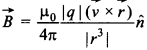
(a) Magnetic field is given by
Physics MCQs for Class 12 with Answers Chapter 4 Moving Charges and Magnetism 12
Where n is the direction of \(\vec{B}\) which is in the direction of cross product of \(\vec{v}\) and \(\vec{r}\). Or we can say that \(\vec{B}\) ⊥ to both \(\vec{v}\) and \(\vec{r}\).


3. A current carrying circular loop of radius R is placed in the x-y plane with centre at the origin. Half of the loop with x > 0 is now bent so that it now lies in the y – z plane. [NCERT Exemplar]
(a) The magnitude of magnetic moment now diminishes.
(b) The magnetic moment does not change.
(c) The magnitude of B at (0.0.z), z» R increases.
(d) The magnitude of B at (0, 0, z), z » R is unchanged.

Answer/Explanation

Answer: a
Explaination:
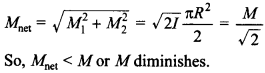
(a) Direction of magnetic moment (M= I A) of circular loop is perpendicular to the loop as per right hand thumb rule.
The magnitudes of magnetic moment of each semicircular loop of radius R lie in the x-y plane and y-z plane is M1 – M2= \(I \frac{\pi R^{2}}{2}\) and the direction of magnetic moments are along z-direction and ^-direction respectively. Their resultant
Physics MCQs for Class 12 with Answers Chapter 4 Moving Charges and Magnetism 13


4. An electron is projected with uniform velocity along the axis of a current carrying long solenoid. Which of the following is true? [NCERT Exemplar]
(a) The electron will be accelerated along the axis.
(b) The electron path will be circular about the axis.
(c) The electron will experience a force at 45° to the axis and hence execute a helical path.
(d) The electron will continue to move with uniform velocity along the axis of the solenoid.

Answer/Explanation

Answer: d
Explaination:
(d) F = -evB sin 180° = 0 (i.e 0= 0°or 180° in both cases F = 0). The electron will continue to move with uniform velocity or will go undeflected along the axis of the solenoid.


5. In a cyclotron, a charged particle [NCERT Exemplar]
(a) undergoes acceleration all the time.
(b) speeds up between the dees because of the magnetic field.
(c) speeds up in a dee.
(d) slows down within a dee and speeds up between dees.

Answer/Explanation

Answer: a
Explaination:
(a) It is based on the fact that the electric field accelerates a charged particle and the perpendicular magnetic field keeps it revolving in circular orbits of constant frequency.


6. A circular current loop of magnetic moment Mis in an arbitrary orientation in an external magnetic field B. The work done to rotate the loop by 30° about an axis perpendicular to its plane is [NCERT Exemplar]
(a) MB
(b) √3\(\frac{MB}{2}\)
(c) \(\frac{MB}{2}\)
(d) zero

Answer/Explanation

Answer: d
Explaination:
(d) The rotation of the loop by 30° about an axis perpendicular to its plane makes no change in the angle made by axis of the loop with the direction of magnetic field, therefore, the work done to rotate the loop is zero.


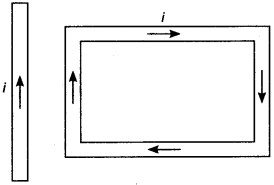
7. A rectangular loop carrying a current i is situated near a long straight wire such that the wire is parallel to the one of the sides of the loop and is in the plane of the loop. If a steady current I is established in wire as shown in figure, the loop will
Physics MCQs for Class 12 with Answers Chapter 4 Moving Charges and Magnetism 6
(a) rotate about an axis parallel to the wire.
(b) move away from the wire or towards right.
(c) move towards the wire.
(d) remain stationary.

Answer

Answer: c


8. A circular coil of radius 4 cm and of 20 turns carries a current of 3 amperes. It is placed in a magnetic field of intensity of 0.5 weber/m². The magnetic dipole moment of the coil is
(a) 0.15 ampere-m²
(b) 0.3 ampere-m²
(c) 0.45 ampere-m²
(d) 0.6 ampere-m²

Answer

Answer: b


9. A cubical region of space is filled with some uniform electric and magnetic fields. An electron enters the cube across one of its faces with velocity v and a positron enters via opposite face with velocity -v. At this instant,
(a) the electric forces on both the particles cause identical accelerations.
(b) the magnetic forces on both the particles cause equal accelerations.
(c) Only electron gains or looses energy.
(d) the motion of the centre of mass (CM) is determined by E alone.

Answer

Answer: b


10. Consider a wire carrying a steady current, I placed in a uniform magnetic field B perpendicular to its length. Consider the charges inside the wire. It is known that magnetic forces do not work. This implies that,
(a) motion of charges inside the conductor is unaffected by B, since they do not absorb energy.
(b) Some charges inside the wire move to the surface as a result of B.
(c) if the wire moves under the influence of B, no work is done by the force.
(d) If the wire moves under the influence of B, no work is done by the electric force on the ions, assumed fixed within the wire.

Answer

Answer: b


11. Two identical current carrying coaxial loops, carry current I in an opposite sense. A simple amperian loop passes through both of them once. Calling the loop as C,
(a) \(\oint_{C}\)B.dl = ± 2µ0I.
(b) the value of \(\oint_{C}\)B.dl is independent of sense of C. c
(c) there may be a point on C where, B and dl are parallel.
(d) B vanishes everywhere on C.

Answer/Explanation

Answer: b
Explaination:
(b) Ampere’s law gives another method to calculate the magnetic field due to a given current distribution.
Applying the Ampere’s circuital law, we have
\(\oint_{C}\)B.dl = i0(I – I) = 0 (because current is in opposite sense).
Also, there may be a point on C where B and dl are perpendicular and hence \(\oint_{C}\)B.dl = 0


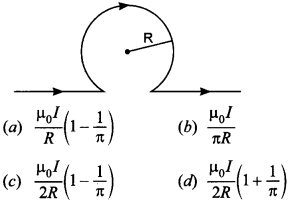
12. The strength of magnetic field at the centre of circular coil is
Physics MCQs for Class 12 with Answers Chapter 4 Moving Charges and Magnetism 7

Answer/Explanation

Answer: c
Explaination:
(c) B = Field to circular portion
– Field due to straight portion
Physics MCQs for Class 12 with Answers Chapter 4 Moving Charges and Magnetism 14


13. If a charged particle moves through a magnetic field perpendicular to it
(a) both momentum and energy of particle change.
(b) momentum as well as energy are constant.
(c) energy is constant but momentum changes.
(d) momentum is constant but energy changes.

Answer/Explanation

Answer: c
Explaination:
(c) Since the direction of velocity of a particle varies so momentum changes but direction of magnetic force is always perpendicular to direction of charged particle. So no work is done, i.e. energy remains the same.


14. A current carrying closed loop of an irregular shape lying in more than one plane when placed in uniform magnetic field, the force acting on it
(a) will be more in the plane where its larger position is covered.
(b) is zero.
(c) is infinite.
(d) may or may not be zero.

Answer/Explanation

Answer: b
Explaination:
(b) A current carrying closed loop of any shape when placed in a uniform magnetic field does not experience any force.


15. The maximum current that can be measured by a galvanometer of resistance 40 Ω is 10 mA. It is converted into voltmeter that can read upto 50 V. The resistance to be connected in the series with the galvanometer is
(a) 2010 Ω
(b) 4050 Ω
(c) 5040 Ω
(d) 4960 Ω

Answer/Explanation

Answer: d
Explaination:
Physics MCQs for Class 12 with Answers Chapter 4 Moving Charges and Magnetism 15


16. A current loop placed in a non-uniform magnetic field experiences
(a) a force of repulsion.
(b) a force of attraction.
(c) a torque but not force.
(d) a force and a torque.

Answer/Explanation

Answer: d
Explaination:
(d) In non-uniform magnetic field, current loop experiences an unequal opposite force which forms torque.


17. What is the net force on the rectangular coil?
Physics MCQs for Class 12 with Answers Chapter 4 Moving Charges and Magnetism 8
(a) 25 × 10-7 N towards wire.
(b) 25 × 10-7 N away from wire.
(c) 35 × 10-7 N towards wire.
(d) 35 × 10-7 N away from wire.

Answer/Explanation

Answer: a
Explaination:
Physics MCQs for Class 12 with Answers Chapter 4 Moving Charges and Magnetism 16


18. If the beams of electrons and protons move parallel to each other in the same direction, then they
(a) attract each other.
(b) repel each other.
(c) no relation.
(d) neither attract nor repel.

Answer/Explanation

Answer: b
Explaination:
(b) As current carried by electrons and protons are in opposite direction.


19. A conducting circular loop of radius r carries a constant current i. It is placed in a uniform magnetic field B, such that B is perpendicular to the plane of the loop. The magnetic force acting on the loop is
(a) irB.
(b) 2πriB
(c) zero
(d) πriB

Answer/Explanation

Answer: c
Explaination:
(c) Net force on a current carrying closed loop is always zero, if it is placed in an uniform magnetic field.


20. The gyro-magnetic ratio of an electron in an H-atom, according to Bohr model, is
(a) independent of which orbit it is in.
(b) neutral
(c) positive
(d) increases with the quantum number n.

Answer/Explanation

Answer: a
Explaination:
(a) The gyro-magnetic ratio is given by
\(\mu_{l}=\frac{-e}{2 m} L, \mathrm{L}\) – Angular momentum of electron


21. An electron is projected along the axis of a circular conductor carrying the same current. Electron will experience
(а) a force along the axis.
(б) a force perpendicular to the axis.
(c) a force at an angle of 4° with axis.
(d) no force experienced.

Answer/Explanation

Answer: d
Explaination:
(d) Since electron is moving parallel to direction of magnetic field of the conductor
Force (F) = qvB sin 0 = 0


22. Three long, straight parallel wires, carrying current are arranged as shown in the figure. The force experienced by a 25 cm length of wire C is
Physics MCQs for Class 12 with Answers Chapter 4 Moving Charges and Magnetism 9
(a) 10-3 N
(b) 2.5 × 10⁻³ N
(c) zero
(d) 1.5 × 3 N

Answer/Explanation

Answer: c
Explaination:
(c) Force of repulsion by wire D and G on wire C is equal and opposite.


23. In a circular coil of radius r, the magnetic field at the centre is proportional to
(a) r²
(b) r
(c) \(\frac{1}{r}\)
(d) \(\frac{1}{r²}\)

Answer/Explanation

Answer: c
Explaination:
Physics MCQs for Class 12 with Answers Chapter 4 Moving Charges and Magnetism 17


24. A positive charge enters in a magnetic field and travels parallel to but opposite the field. If experiences
(a) an upward force.
(b) a downward force.
(c) an accelerated force.
(d) no force.

Answer/Explanation

Answer: c
Explaination: (c) Force of repulsion by wire D and G on wire C is equal and opposite.


25. When a magnetic compass needle is carried nearby to a straight wire carrying current, then
(I) the straight wire cause a noticeable deflection in the compass needle.
(II) the alignment of the needle is tangential to an imaginary circle with straight wire as its centre and has a plane perpendicular to the wire
(a) (I) is correct
(b) (II) is correct
(c) both (I) and (II) are correct
(d) neither (I) nor (II) is correct

Answer

Answer: c


26. A strong magnetic field is applied on a stationary electron. Then the electron
(a) moves in the direction of the field.
(b) remained stationary.
(c) moves perpendicular to the direction of the field.
(d) moves opposite to the direction of the field.

Answer

Answer: b


27. In an inertial frame of reference, the magnetic force on a moving charged particle is \(\vec{F}\) Its value in another inertial frame of reference will be
(a) remained same
(b) changed due to change in the amount of charge
(c) changed due to change in velocity of charged particle
(d) changed due to change in field direction

Answer

Answer: c


28. Which one of the following is correct statement about magnetic forces?
(a) Magnetic forces always obey Newton’s third law.
(b) Magnetic forces do not obey Newton’s third law.
(c) For very high current, magnetic forces obey Newton’s third law.
(d) Inside low magnetic field, magnetic forces obey Newton’s third law.

Answer

Answer: b


29. A charged particle is moving on circular path with velocity v in a uniform magnetic field B, if the velocity of the charged particle is doubled and strength of magnetic field is halved, then radius becomes
(a) 8 times
(b) 4 times
(c) 2 times
(d) 16 times

Answer

Answer: b


30. Two a-particles have the ratio of their velocities as 3 : 2 on entering the field. If they move in different circular paths, then the ratio of the radii of their paths is
(a) 2 : 3
(b) 3 : 2
(c) 9 : 4
(d) 4 : 9

Answer

Answer: b


31. A charged particle is moving in a cyclotron, what effect on the radius of path of this charged particle will occur when the frequency of the ratio frequency field is doubled?
(a) It will also be doubled.
(b) It will be halved.
(c) It will be increased by four times.
(d) It will remain unchanged.

Answer

Answer: d


32. Which of the following is not correct about cyclotron?
(a) It is a machine to accelerate charged particles or ions to high energies.
(b) Cyclotron uses both electric and magnetic fields in combination to increase the energy of charged particles.
(c) The operation of the cyclotron is based on the fact that the time for one revolution of an ion is independent of its speed or radius of its orbit.
(d) The charged particles and ions in cyclotron can move on any arbitrary path.

Answer

Answer: d


33. If an electron is moving with velocity \(\vec{ν}\) produces a magnetic field \(\vec{B}\), then
(a) the direction of field \(\vec{B}\) will be same as the direction of velocity \(\vec{ν}\) .
(b) the direction of field \(\vec{B}\) will be opposite to the direction of velocity \(\vec{ν}\) .
(c) the direction of field \(\vec{B}\) will be perpendicular to the direction of velocity \(\vec{ν}\) .
(d) the direction of field \(\vec{B}\) does not depend upon the direction of velocity \(\vec{ν}\) .

Answer

Answer: c


34. Current flows through uniform, square frames as shown in the figure. In which case is the magnetic field at the centre of the frame not zero?
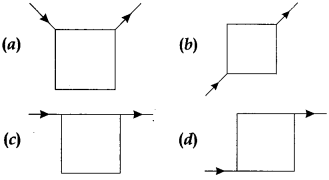
Physics MCQs for Class 12 with Answers Chapter 4 Moving Charges and Magnetism 1

Answer

Answer: c


35. Ampere’s circuital law is given by
Physics MCQs for Class 12 with Answers Chapter 4 Moving Charges and Magnetism 2

Answer

Answer: b


36. Two identical current carrying coaxial loops, carry current I in opposite sense. A simple amperian loop passes through both of them once. Calling the loop as C, then which statement is correct?
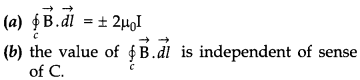
Physics MCQs for Class 12 with Answers Chapter 4 Moving Charges and Magnetism 3
(c) there may be a point on C where B and dl are
parallel.
(d) none of these

Answer

Answer: b


37. The correct plot of the magnitude of magnetic field \(\vec{B}\) vs distance r from centre of the wire is, if the radius of wire is R
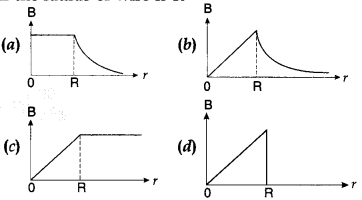
Physics MCQs for Class 12 with Answers Chapter 4 Moving Charges and Magnetism 4

Answer

Answer: b


38. The nature of parallel and anti-parallel currents are
(a) parallel currents repel and antiparallel cur¬rents attract.
(b) parallel currents attract and antiparallel cur-rents repel.
(c) both currents attract. ’
(d) both currents repel.

Answer

Answer: b


39. The magnetic moment of a current I carrying circular coil of radius r and number of turns N varies as
(a) \(\frac{1}{r²}\)
(b) \(\frac{1}{r}\)
(c) r
(d) r²

Answer

Answer: d


40. A short bar magnet has a magnetic moment of 0. 65 J T-1, then the magnitude and direction of the magnetic field produced by the magnet at a distance 8 cm from the centre of magnet on the axis is
(a) 2.5 × 10⁻⁴ T, along NS direction
(b) 2.5 × 10⁻⁴ T along SN direction
(c) 4.5 × 10⁻⁴ T, along NS direction
(d) 4.5 × 10⁻⁴ T, along SN direction

Answer

Answer: b


41. A current carrying loop is placed in a uniform magnetic field. The torqe acting on it does not depend upon
(a) area of loop
(b) value of current
(c) magnetic field
(d) None of these

Answer

Answer: d


42. In a moving coil galvanometer the deflection (Φ) on the scale by a pointer attached to the spring is
Physics MCQs for Class 12 with Answers Chapter 4 Moving Charges and Magnetism 5

Answer

Answer: c


43. A moving coil galvanometer can be converted into an ammeter by
(a) introducing a shunt resistance of large value in series.
(b) introducing a shunt resistance of small value in parallel.
(c) introducing a resistance of small value in series.
(d) introducing a resistance of large value in parallel.

Answer

Answer: b


44. The conversion of a moving coil galvanometer into a voltmeter is done by
(a) introducing a resistance of large value in series.
(b) introducing a resistance of small value in parallel.
(c) introducing a resistance of large value in parallel.
(d) introducing a resistance of small value in series.

Answer

Answer: a


45. Deflection produced in a galvanometer when a unit current flows through it is known as _________ .

Answer/Explanation

Answer:
Explaination: current sensitivity.


46. A moving coil galvanometer can be converted into voltmeter by connecting a large resistance R in _________ with it.

Answer/Explanation

Answer:
Explaination: series


47. Maximum torque acts on a current carrying coil when it is suspended in magnetic field such that its plane is _________ to magnetic field.

Answer/Explanation

Answer:
Explaination: parallel


48. An ammeter is _________ resistance galvanometer.

Answer/Explanation

Answer:
Explaination: low


49. The magnetic field due to a straight current carrying conductor of infinite length at a perpendicular distance a is equal to _________ .

Answer/Explanation

Answer:
Explaination: \(B=\frac{\mu_{0} I}{2 \pi a}\)


50. Relation between S.I. unit and C.G.S unit magnetic field is _________ .

Answer/Explanation

Answer:
Explaination: 1 T=104 G


51. According to ampere circuital law, the line integral of the magnetic field \(\vec{B}\) around any closed path enclosing current 7, is equal to _________ .

Answer/Explanation

Answer:
Explaination: µ0I


52. Force on a charge q moving in a magnetic field B with velocity v at angle 0 is equal to _________ .

Answer/Explanation

Answer:
Explaination: F = Bqv sin θ


53. Force on a current carrying conductor in a magnetic field is _________ .

Answer/Explanation

Answer:
Explaination: F = BIl sin θ


54. The magnetic field of a straight solenoid carrying current l and having n turns per unit length is _________ .

Answer/Explanation

Answer:
Explaination: B = µ0nI


55. Why does a moving charge experience a force when placed in a magnetic field? [HOTS]

Answer/Explanation

Answer:
Explaination:
A moving charge produces a magnetic field. This magnetic field interacts with another magnetic field of a magnet and hence, it experiences force.


56. Write the expression, in a vector form, for the Lorentz magnetic force \(\vec{F}\) due to a charge moving with velocity \(\vec{v}\) in a magnetic field \(\vec{B}\). What is the direction of the magnetic force? [Delhi 2014]

Answer/Explanation

Answer:
Explaination:
Lorentz magnetic force (\(\vec{F}_{m}\)) = q(\(\vec{v}\) × \(\vec{B}\)). The direction of magnetic force is perpendicular to the plane containing velocity and magnetic field vectors.


57. Define one tesla using the expression for the magnetic force acting on a particle of charge q moving with velocity \(\vec{v}\) in a magnetic field \(\vec{B}\). [Foreign 2014]

Answer/Explanation

Answer:
Explaination:
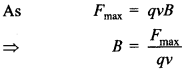
Physics MCQs for Class 12 with Answers Chapter 4 Moving Charges and Magnetism 18
If Fmax = 1N, q = +1C and v = 1 m/s and
θ = 90°, then B = IT
Hence, one tesla is the magnetic field in which a normally entering + 1C charge, moving at 1 ms-1 experiences a maximum force of 1 N.


58. A beam of a-particles projected along +x-axis, experiences a force due to a magnetic field along the +y-axis. What is the direction of the magnetic field? [AI2010]
Physics MCQs for Class 12 with Answers Chapter 4 Moving Charges and Magnetism 10

Answer/Explanation

Answer:
Explaination:
Physics MCQs for Class 12 with Answers Chapter 4 Moving Charges and Magnetism 19
Therefore, the direction of magnetic field is towards the negative direction of z-axis.


59. A long straight wire carries a steady current l along the positive y-axis in a coordinate system. A particle of charge +Q is moving with a velocity \(\vec{v}\) along the x-axis. In which direction will the particle experience a force? [Foreign 2013]

Answer/Explanation

Answer:
Explaination:
By the right-hand thumb rule, the direction of magnetic field due to current / acts normally into the plane of paper. So, \(\vec{B}=-B \hat{k}\), i.e. along negative z-axis. The magnetic Lorentz force is given by

Physics MCQs for Class 12 with Answers Chapter 4 Moving Charges and Magnetism 20
Thus, the force on charge +Q is along +y axis.


60. In a certain region of space, electric field \(\vec{E}\) and magnetic field \(\vec{B}\) are perpendicular to each other. An electron enters in the region perpendicular to the directions of both \(\vec{B}\) and \(\vec{E}\) and moves undeflected. Find the velocity of the electron. [Foreign 2013]

Answer/Explanation

Answer:
Explaination:
∵ qvB = qE ⇒ v = \(\frac{E}{B}\)


61. An electron and a proton moving with the same speed enter the same magnetic field region at right angles to the direction of the field. For which of the two particles will the radius of circular path be smaller? [HOTS]

Answer/Explanation

Answer:
Explaination:
As r = \(\frac{mv}{qB}\) for same v and B r ∝ \(\frac{m}{q}\).
Since \(\frac{m}{q}\) is smaller for an electron, the radius of the circular path followed by the electron will be smaller.


62. A proton and an electron travelling along parallel paths enter a region of uniform magnetic field, acting perpendicular to their paths. Which of them will move in a circular path with higher frequency? [CBSE 2018]

Answer/Explanation

Answer:
Explaination:
Electron
Reason:
Physics MCQs for Class 12 with Answers Chapter 4 Moving Charges and Magnetism 21
Thus electron will move in circular path with higher frequency.


63. Write the expression for the magnetic moment of a circular coil of area A carrying a current I, in a vector form. [Foreign 2014]

Answer/Explanation

Answer:
Explaination:
M\(\vec{M}=\overrightarrow{I A}\), as vector \(\vec{A}\) is perpendicular to the surface, the magnetic moment M will also be perpendicular to the plane of circular coil.


64. Magnetic field lines can be entirely confined within the core of a toroid, but not within a straight solenoid. Why?

Answer/Explanation

Answer:
Explaination:
At the edges of a solenoid, the field lines get diverged due to other fields or non-availability of dipole loops, while in a toroid, the dipoles (in loops) orient continuosly.


65. Using the concept of force between two infinitely long parallel current carrying conductors, define one ampere of current. [A1 2014]

Answer/Explanation

Answer:
Explaination:
One ampere is that amount of current which when flows through two thin infinitely long straight conductors kept parallel to each other at 1 m distance produces a force per unit length of magnitude 2 × 10⁷ N/m.


66. Which has greater resistance
(a) milliammeter or ammeter
(b) milliammeter or voltmeter?

Answer/Explanation

Answer:
Explaination:
(a) Milliammeter
(b) Voltmeter


67. A voltmeter, an ammeter and a resistance are connected in series with a battery. The voltmeter gives same deflection but the deflection of ammeter is almost zero. Explain why?

Answer/Explanation

Answer:
Explaination:
When a voltmeter is connected in series, the current in the circuit decreases because the resistance of voltmeter is high. Therefore, it will show some deflection. But in an ammeter, the majority of this current will pass through the shunt and a very small fraction will pass through the galvanometer.


68. State the law used to determine the direction of magnetic field at the centre of current carrying circular coil.

Answer/Explanation

Answer:
Explaination:
The right-hand thumb rule gives the direction of magnetic field which is stated as under:
Curl the palm of your right hand around a circular wire with the fingers, pointing in the direction of the current and the right hand thumb gives the direction of magnetic field.


69. A narrow beam of protons and deuterons, each having the same momentum, enters a region of uniform magnetic field directed perpendicular to their direction of momentum. What would be the ratio of the radii of the circular paths described by them? [Similar Delhi 2019, Foreign 2011]

Answer/Explanation

Answer:
Explaination:
Physics MCQs for Class 12 with Answers Chapter 4 Moving Charges and Magnetism 22


70. Write two properties of a material used as a suspension wire in a moving coil galvanometer.

Answer/Explanation

Answer:
Explaination:
(i) Low value of k (torsional constant), (ii) High conductivity.


71. A charged particle enters into a uniform magnetic field and experiences an upward force as indicated in the figure. What is the charge sign on the particle?
Physics MCQs for Class 12 with Answers Chapter 4 Moving Charges and Magnetism 11

Answer/Explanation

Answer:
Explaination:
Physics MCQs for Class 12 with Answers Chapter 4 Moving Charges and Magnetism 23


72. How does the magnetic moment of an electron in a circular orbit of radius r and moving with a speed v change, when the frequency of revolution is doubled?

Answer/Explanation

Answer:
Explaination:
As M ∝ v, the magnetic moment also gets doubled, when the frequency of revolution is doubled.


73. A current carrying loop is free to turn in a uniform magnetic field B. Under what conditions, will the torque acting on it be
(i) minimum and
(ii) maximum?

Answer/Explanation

Answer:
Explaination:
T = MB sin θ
(i) Torque is minimum when the area vector of the loop and the magnetic field vector are in the same direction, i.e. A\\B.
(ii) Torque is maximum when ALB.


74. Write two factors by which voltage sensitivity of a galvanometer can be increased.

Answer/Explanation

Answer:
Explaination:
As we know that \(V_{s}=\left(\frac{N A B}{k}\right) \frac{1}{R}\)
Thus, (i) Resistance should be less.
(ii) Torsional constant should be less.


75. An ammeter and a milliammeter are converted from the same galvanometer. Out of the two, which current measuring instrument has higher resistance? [HOTS]

Answer/Explanation

Answer:
Explaination:
The higher is the range, the lower will be the value of shunt, so a milliammeter will be having higher resistance.


76. What is the advantage of using radial magnetic field in a moving coil galvanometer? [HOTS] [Delhi 2019]

Answer/Explanation

Answer:
Explaination:
(i) Maximum torque is experienced.
(ii) Current is directly proportional to the deflection.
(iii) The plane of the coil is parallel to the direction of magnetic field.


77. Why is it necessary for voltmeter to have a high resistance?

Answer/Explanation

Answer:
Explaination:
Since voltmeter is to be connected across two ends of a conductor in parallel, if it has high resistance, then only a very small part of current will pass through, and it will not affect the actual potential difference to be measured.


78. What is figure of merit of a galvanometer? [DoE]

Answer/Explanation

Answer:
Explaination:
Figure of merit is defined as the amount of current which produces unit deflection in the galvanometer.


79. Define gyromagnetic ratio.

Answer/Explanation

Answer:
Explaination:
It is the ratio of the magnetic dipole moment to the angular momentum of the electron revolving round the nucleus.


80. Can we decrease the range of an ammeter?

Answer/Explanation

Answer:
Physics MCQs for Class 12 with Answers Chapter 4 Moving Charges and Magnetism 24
Explaination: will become negative, which is not possible.


We hope the given Physics MCQs for Class 12 with Answers Chapter 4 Moving Charges and Magnetism will help you. If you have any query regarding CBSE Class 12 Physics Moving Charges and Magnetism MCQs Pdf, drop a comment below and we will get back to you at the earliest.

Physics MCQs for Class 12 with Answers Chapter 3 Current Electricity

Free PDF Download of CBSE Physics Multiple Choice Questions for Class 12 with Answers Chapter 3 Current Electricity. Physics MCQs for Class 12 Chapter Wise with Answers PDF Download was Prepared Based on Latest Exam Pattern. Students can solve NCERT Class 12 Physics Current Electricity MCQs Pdf with Answers to know their preparation level.

Current Electricity Class 12 Physics MCQs Pdf

1. Consider a current carrying wire current I in the shape of a circle. Note that as the current progresses along the wire, the direction of j (current density) changes in an exact manner, while die current/remain unaffected. The agent that is essentially responsible for is [NCERT Exemplar]
(a) source of emf.
(b) electric field produced by charges accumulated on the surface of wire.
(c) the charges just behind a given segment of wire which push them just the right way by repulsion.
(d) the charges ahead.

Answer/Explanation

Answer: b
Explaination:
(b) Current density j changes due to electric field produced by charges accumulated on the surface of wire.


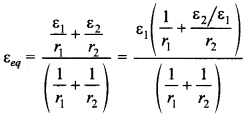
2. Two batteries of ε1 and ε22 > ε1) and internal resistance r1 and r2 respectively are connected in parallel as shown in figure. [NCERT Exemplar]
Physics MCQs for Class 12 with Answers Chapter 3 Current Electricity 7
(a ) The equivalent emf εeq of the two cells is between ε1 and ε2 i.e. ε1 < εeq < ε2.
(b) The equivalent emf εeq is smaller than ε1.
(c) The eeq is given by εeq= ε1 + ε2 always.
(d) zeq is independent of internal resistances r1 and r2.

Answer/Explanation

Answer: a
Explaination:
(a) The equivalent emf of this combination is given by
Physics MCQs for Class 12 with Answers Chapter 3 Current Electricity 21
Physics MCQs for Class 12 with Answers Chapter 3 Current Electricity 22
Physics MCQs for Class 12 with Answers Chapter 3 Current Electricity 23


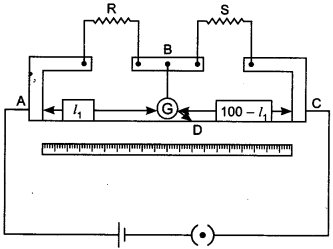
3. A resistance R is to be measured using a meter bridge. Student chooses the standard resistance S to be 100 Ω He finds the null point at l1 = 2.9 cm. He is told to attempt to improve the accuracy. Which of the following is a useful way? [NCERT Exemplar]
(a) He should measure l1 more accurately.
(b) He should change Sto 1000 Ω and repeat the experiment.
(c) He should change S to 3 Ω and repeat the experiment.
(d) He should give up hope of a more accurate measurement with a meter bridge.

Answer/Explanation

Answer: c
Explaination:
(c) The bridge is said to be balanced if the ratio of the resistances in same branch is equal
Physics MCQs for Class 12 with Answers Chapter 3 Current Electricity 24
Since here, R : S = 2.9 : 97.1, then the value of S is nearly 33 times to that of R. In order to make this ratio 1 : 1, it is necessary to reduce the value of S nearly \(\frac{1}{33}\) times i.e., nearly 3 Ω.
Physics MCQs for Class 12 with Answers Chapter 3 Current Electricity 25


4. Two cells of emf’s approximately 5 V and 10 V are to be accurately compared using a potentiometer of length 400 cm. [NCERT Exemplar]
(a) The battery that runs the potentiometer should have voltage of 8 V.
(b) The battery of potentiometer can have a voltage of 15 V and R adjusted so that the potential drop across the wire slightly exceeds 10 V.
(c) The first portion of 50 cm of wire itself should have a potential drop of 10 V.
(d) Potentiometer is usually used for comparing resistances and not voltages.

Answer/Explanation

Answer: b
Explaination:
(b) The potential drop along the wires of potentiometer should be greater than emfs of cells. Here, values of emfs of two cells are given as 5 V and 10 V, therefore, the potential drop along the potentiometer wire must be more than 10 V.


5. Consider a simple circuit shown in figure stands for a variable resistance R’. R’ can vary from R0 to infinity, r is internal resistance of the battery (r << R << R0). [NCERT Exemplar]
Physics MCQs for Class 12 with Answers Chapter 3 Current Electricity 8
(a) Potential drop across AB is not constant as R0 is varied.
(b Current through R0 is nearly a constant as R0 is varied.
(c) Current I depends sensitively on R0.
(d) \(I \geq \frac{V}{r+R}\) always.

Answer/Explanation

Answer: d
Explaination:
(d) In parallel grouping of resistance, same potential difference appeared across each resistance but current distributed in reverse ratio of their resistance,
i.e i ∝ \(\frac{1}{R}\)
P.d across AB and r = v, equivalent resistance of parallel combination R’ < R, therefore current
\(I \leq \frac{V}{R+r}\)


6. In a meter bridge, the point D is a neutral point (figure). [NCERT Exemplar]
Physics MCQs for Class 12 with Answers Chapter 3 Current Electricity 9
(a) The meter bridge can have other neutral point for this set of resistances.
(b) When the jockey contacts a point on meter wire left of D, current flows to B from the wire.
(c) When the jockey contacts a point on the meter wire to the right of D, current flows from B to the wire through galvanometer.
(d) When R is increased, the neutral point shifts to left.

Answer/Explanation

Answer: c
Explaination:
(c) If in balanced position of bridge AB = l,
Physics MCQs for Class 12 with Answers Chapter 3 Current Electricity 26
When there is no deflection in galvanometer there is no current across the galvanometer, then points B and D are at same potential. That point at which galvanometer shows no deflection is called null point, When the jockey contacts a point on the meter wire to the right of D, the potential drop across AD is more than potential drop across AB, which brings the potential of point D less than that of B, hence current flows from B to D in the galvanometer wire.


7. Which of the following is wrong? Resistivity of a conductor is
(a) independent of temperature.
(b) inversely proportional to temperature.
(c) independent of dimensions of conductor.
(d) less than resistivity of a semiconductor.

Answer/Explanation

Answer: a
Explaination:
(a) Resistivity is property of material and inversely proportional to temperature for conductor, \(\rho=\frac{m}{n e^{2} \tau}\).


8. Drift velocity vd varies with the intensity of electric field as per the relation
(a) vd ∝ E
(b) vd ∝ \(\frac{1}{E}\)
(c) vd = constant
(d) vd ∝ E²

Answer/Explanation

Answer: a
Explaination:
(a) Drift velocity vd = \(\frac{e E}{m} \tau\), i.e. vd ∝ E


9. For measurement of potential difference, a potentiometer is preferred over voltmeter because
(a) potentiometer is more sensitive than voltmeter.
(b) the resistance of potentiometer is less than voltmeter.
(c) potentiometer is cheaper than voltmeter.
(d) potentiometer does not take current from the circuit.

Answer/Explanation

Answer:
Explaination: (d) Potentiometer works on null deflection method.


10. For a cell, the graph between the potential difference (V) across the terminals of the cell and the current (I) drawn from the cell is shown in the figure.
Physics MCQs for Class 12 with Answers Chapter 3 Current Electricity 10
The e.m.f. and the internal resistance of the cell are
(a) 2V, 0.5 Ω
(b) 2V, 0.4 Ω
(c) > 2V, 0.5 Ω
(d) > 2V, 0.4 Ω

Answer/Explanation

Answer: b
Explaination:
(b) E.m.f. is the value of voltage, when no current is drawn from the circuit so E= 2 V.
Also r = slope = \(\frac{2}{5}\) = 0.4 Ω


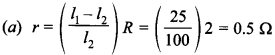
11. A Daniel cell is balanced on 125 cm length of a potentiometer wire. Now the cell is short-circuited by a resistance 2 ohm and the balance is obtained at 100 cm. The internal resistance of the Daniel cell is
(a) 0.5 ohm
(b) 1.5 ohm
(c) 1.25 ohm
(d) 4/5 ohm

Answer/Explanation

Answer:
Explaination: a
Physics MCQs for Class 12 with Answers Chapter 3 Current Electricity 27


12. When there is an electric current through a conducting wire along its length, then an electric field must exist
(a) outside the wire but normal to it.
(b) outside the wire but parallel to it.
(c) inside the wire but parallel to it.
(d) inside the wire but normal to it.

Answer/Explanation

Answer: c
Explaination:
(c) Electric field parallel to wire inside creates potential difference and electrostic force on electrons.


13. Three resistors each of 2 ohm are connected together in a triangular shape. The resistance between any two vertices will be
Physics MCQs for Class 12 with Answers Chapter 3 Current Electricity 11
(a) 4/3 ohm
(b) 3/4 ohm
(c) 3 ohm
(d) 6 ohm

Answer/Explanation

Answer: a
Explaination:
(a) Equivalent resistance of the combination
Physics MCQs for Class 12 with Answers Chapter 3 Current Electricity 28


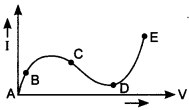
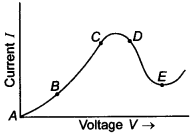
14. From the graph between current I and voltage V shown below, identify the portion corresponding to negative resistance
Physics MCQs for Class 12 with Answers Chapter 3 Current Electricity 12
(a) AB
(b) BC
(c) CD
(d) DE

Answer/Explanation

Answer: c
Explaination:
(c) For portion CD slope of the curve is negative i.e. resistance be negative.


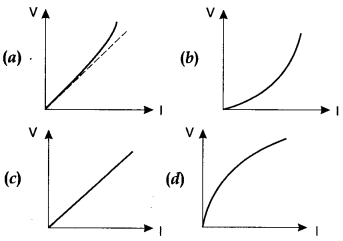
15. A battery consists of a variable number V of identical cells having internal resistances connected in series. The terminals of battery are short circuited and the current i is measured. Which of the graph below shows the relationship between i and n?
Physics MCQs for Class 12 with Answers Chapter 3 Current Electricity 13

Answer/Explanation

Answer: d
Explaination: (d) I = \(\frac{n E}{n r}=\frac{E}{r}\). current is independent of n.


16. A charge is moving across a junction, then
(a) momentum will be conserved.
(b) momentum will not be conserved.
(c) at some places momenturii will be conserved and at some other places momentum will not be conserved.
(d) none of these.

Answer

Answer: d


17. Which of the following I-V graph represents ohmic conductors?
Physics MCQs for Class 12 with Answers Chapter 3 Current Electricity 1

Answer

Answer: a


18. The I-V characteristics shown in figure represents
Physics MCQs for Class 12 with Answers Chapter 3 Current Electricity 2
(a) ohmic conductors
(b) non-ohmic conductors
(c) insulators
(d) superconductors

Answer

Answer: b


19. Which of the following is correct for V-I graph of a good conductor?
Physics MCQs for Class 12 with Answers Chapter 3 Current Electricity 3

Answer

Answer: a


20. The resistivity of alloy manganin is
(a) Nearly independent of temperature
(b) Increases rapidly with increase in temperature
(c) Decreases with increase in temperature
(d) Increases rapidly with decrease in temperature

Answer

Answer: a


21. An electric heater is connected to the voltage supply. After few seconds, current gets its steady value then its initial current will be
(a) equal to its steady current
(b) slightly higher than its steady current
(c) slightly less than its steady current
(d) zero

Answer

Answer: b


22. In the series combination of two or more than two resistances
(a) the current through each resistance is same.
(b) the voltage through each resistance is same.
(c) neither current nor voltage through each re-sistance is same.
(d) both current and voltage through each resis¬tance are same.

Answer

Answer: a


23. Combine three resistors 5 Q, 4.5 Q and 3 Q in such a way that the total resistance of this combination is maximum
(a) 12.5 Q
(b) 13.5 Q
(c) 14.5 Q
(d) 16.5 Q

Answer

Answer: a


24. A cell having an emf E and internal resistance r is connected across a variable external resistance R. As the resistance R is increased, the plot of potential difference V across R is given by
Physics MCQs for Class 12 with Answers Chapter 3 Current Electricity 4

Answer

Answer: b


25. In parallel combination of n cells, we obtain
(a) more voltage
(b) more current
(c) less voltage
(d) less current

Answer

Answer: b


26. If n cells each of emf e and internal resistance r are connected in parallel, then the total emf and internal resistance will be
Physics MCQs for Class 12 with Answers Chapter 3 Current Electricity 5

Answer

Answer: a


27. In a Wheatstone bridge if the battery and galvanometer are interchanged then the deflection in galvanometer will
(a) change in previous direction
(b) not change
(c) change in opposite direction
(d) none of these.

Answer

Answer: b


28. When a metal conductor connected to left gap of a meter bridge is heated, the balancing point
(a) shifts towards right
(b) shifts towards left
(c) remains unchanged
(d) remains at zero

Answer

Answer: a


29. In a potentiometer of 10 wires, the balance point is obtained on the 7th wire. To shift the balance point to 9th wire, we should
(a) decrease resistance in the main circuit.
(b) increase resistance in the main circuit.
(c) decrease resistance in series with the cell whose emf is to be measured.
(d) increase resistance in series with the cell whose emf is to be determined.

Answer

Answer: d


30. AB is a wire of potentiometer with the increase in the value of resistance R, the shift in the balance point J will be
Physics MCQs for Class 12 with Answers Chapter 3 Current Electricity 6
(a) towards B
(b) towards A
(c) remains constant
(d) first towards B then back towards A.

Answer

Answer: a


31. There are n similar conductors each of resistance R. The resultant resistance comes out to be x when connected in parallel. If they are connected in series, the resistance comes out to be ________ .

Answer/Explanation

Answer:
Explaination:
n²x
In parallel, x = \(\frac{R}{n}\) or R = nx n
In series, R + R + R …. n times = nR = n(nx) = n²x


32. In the circuit shown, potential difference between X and Y is ________ and across 40 Ω is ________ .
Physics MCQs for Class 12 with Answers Chapter 3 Current Electricity 14

Answer/Explanation

Answer:
Explaination: 120 V, 0 V [In open circuit of a cell V = E for XY and no current flows though 40 Ω]


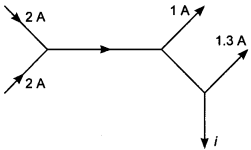
33. The figure below shows currents in a part of electric circuit. The current i is ________ .
Physics MCQs for Class 12 with Answers Chapter 3 Current Electricity 15

Answer/Explanation

Answer:
Explaination: 1.7 A


34. A wire is stretched so as to change its length by 0.1%, the percentage increase in its resistance will be _______ .

Answer/Explanation

Answer:
Explaination:
Physics MCQs for Class 12 with Answers Chapter 3 Current Electricity 29


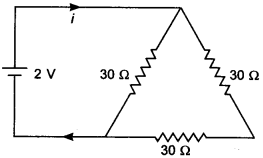
35. The current in the given circuit will be ________ .
Physics MCQs for Class 12 with Answers Chapter 3 Current Electricity 16

Answer/Explanation

Answer:
Explaination:
Physics MCQs for Class 12 with Answers Chapter 3 Current Electricity 30


36. A cell of emf E is connected with an external resistance R, then p.d. across cell is V. The internal resistance of cell will be ________ .

Answer/Explanation

Answer:
Explaination:
Physics MCQs for Class 12 with Answers Chapter 3 Current Electricity 31


37. The figure shows a network of current and the magnitude of current. The current I will be ________ .
Physics MCQs for Class 12 with Answers Chapter 3 Current Electricity 17

Answer/Explanation

Answer:
Explaination: 23 A, using KirchhofTs law 7=15 + 5 + 3 = 23 A


38. When electrons drift in a metal from lower to higher potential, does it mean that all the free electrons of the metal are moving in the same direction? [NCERT Example; Delhi 2012]

Answer/Explanation

Answer:
Explaination: No. As the collision is a random process, the electrons cannot get deflected in the same direction.


39. A steady current flows in a metallic conductor of non-uniform cross-section. Which of these quantities is constant along the conductor: current, current density, drift speed and electric field?

Answer/Explanation

Answer:
Explaination: Current, because in series, the current is same throughout the wire.


40. The electron drift arises due to the force experienced by electrons in the electric field inside the conductor. But force should cause acceleration. Why then do the electrons acquire a steady average drift speed?

Answer/Explanation

Answer:
Explaination:
An electron does accelerate but loose its drift speed during the subsequent collisions with a positive ion of the metal. Therefore, it is the average drift speed which is acquired by the electron.


41. The electron drift speed is estimated to be only a few mm s-1 for currents in the range of a few amperes? How then is current established almost the instant a circuit is closed?

Answer/Explanation

Answer:
Explaination:
It is the electric field which spreads throughout a circuit with speed of light. At every point, a local electron drift is induced by the field. This way, the current attains its steady value almost instantaneously.


42. Is there a net field inside the cell when the circuit is closed and a steady current passes through? Explain.

Answer/Explanation

Answer:
Explaination:
When circuit is closed, the current flows in the direction of electrostatic field outside, and opposite to the direction of electrostatic field inside the cell. The latter fact shows that there is a net field inside the cell opposite to the electrostatic field.


43. Plot a graph showing the variation of resistance of a conducting wire as a function of its radius, keeping the length of the wire and its temperature as constant. [Foreign 2013]

Answer/Explanation

Answer:
Explaination:
Physics MCQs for Class 12 with Answers Chapter 3 Current Electricity 32


44. V-I graph for a metallic wire at two different temperatures Tx and T2 is as shown in the figure. Which of the two temperatures is higher and why?
Physics MCQs for Class 12 with Answers Chapter 3 Current Electricity 18

Answer/Explanation

Answer:
Explaination:
Since, resistance = slope of V – I graph. In the figure, the slope of Tx is large, so T1 represents the higher temperature as the resistance increases with the temperature for a conductor.


45. The emf of a cell is always greater than its terminal voltage. Why? Give reason. [Delhi 2013]

Answer/Explanation

Answer:
Explaination:
The current always flows from higher to lower potential. To produce the current to an external circuit, the emf must be greater than the terminal voltage, i.e. the potential difference across the external circuit.
ε = V + Ir


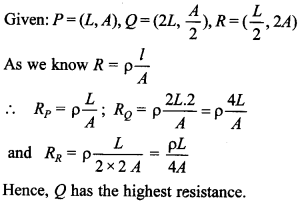
46. You are given three constantan wires P, Q and R of length and area of cross-section (L, A), (2L, \(\frac{A}{2}\)), (\(\frac{L}{2}\)2A) respectively. Which has highest resistance? [DoE]

Answer/Explanation

Answer:
Explaination:
Physics MCQs for Class 12 with Answers Chapter 3 Current Electricity 33


47. Two wires of equal length, one of copper and the other of manganin have the same resistance. Which wire is thicker? [AI2012]

Answer/Explanation

Answer:
Explaination:
Physics MCQs for Class 12 with Answers Chapter 3 Current Electricity 34
As the resistivity of manganin (2) is greater than the resistivity of copper (1). So, the manganin wire is thicker.


48. Nichrome and copper wires of same length and same radius are connected in series. Current/is passed through them. Which wire gets heated up more? Justify your answer. [AI 2017]

Answer/Explanation

Answer:
Explaination:
Nichrome wire having more resistivity () will heat up more, as heat produced = I²R = I²\(\frac{l}{A}\)


49. State the condition for maximum current to be drawn from a cell.

Answer/Explanation

Answer:
Explaination:
\(I=\frac{E}{R+r}\); when the external resistance,
R = 0 (i.e. cell is short-circuited), then the maximum current will be drawn from a cell.


50. State the condition under which the terminal potential difference across a battery and its emf are equal.

Answer/Explanation

Answer:
Explaination:
∵ V = E – Ir, when the battery is in open circuit, i.e. no current is being drawn from the cell. Therefore, terminal potential difference is equal to the emf to the cell.


51. A car battery is of 12 V. Eight dry cells of 1.5 V connected in series also give 12 V, but such a combination is not used to start a car. Why?

Answer/Explanation

Answer:
Explaination:
Dry cells used in series will have high resistance (=10 Ω) and hence provide low current, while a car battery has low internal resistance (0.1 Ω) and hence gives high current for the same emf, needed to start the car.


52. Graph showing the variation of current versus voltage for a material GaAs is shown in the figure. Identify the region of
Physics MCQs for Class 12 with Answers Chapter 3 Current Electricity 19
(i) negative resistance, [Dehradun 2019]
(ii) where Ohm’s law is obeyed. [Delhi 2015].

Answer/Explanation

Answer:
Explaination:
(i) DE is the negative resistance region.
(ii) Ohm’s law is obeyed in the region AB.


53. Define the term ‘electrical conductivity’ of a metallic wire. Write its SI unit. [Delhi 2014]

Answer/Explanation

Answer:
Explaination:
Electric conductivity () is defined as the reciprocal of electric resistivity
i.e. \(\sigma=\frac{1}{\rho}\)
Its SI unit is Ω-1 m-1, mho m-1 or siemen m-1.


54. Give an example of a material each for which temperature coefficient of resistivity is
(i) positive and
(ii) negative. [CBSE Sample Paper 2016]

Answer/Explanation

Answer:
Explaination:
The temperature coefficient of resistivity is
(i) positive for Cu (copper) and nichrome, and
(ii) negative for Si (semiconductor).


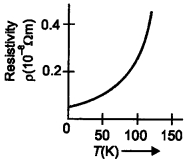
55. Show variation of resistivity of copper as a function of temperature in a graph. [Chennai 2019, Delhi 2014]

Answer/Explanation

Answer:
Explaination:
Physics MCQs for Class 12 with Answers Chapter 3 Current Electricity 35


56. Two identical cells, each of emf E, having negligible internal resistance r, are connected in parallel with each other across an external resistance R. What is the current through this resistance? [AI2013]

Answer/Explanation

Answer:
Explaination:
For parallel arrangement of two identical cells, the total resistance of the circuit = R (cells have negligible internal resistance) Potential difference across the resistor = E.
So, current through the resistance, \(I=\frac{E}{R}\)


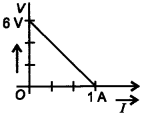
57. The plot of the variation of potential difference across a combination of three identical cells in series, versus current is as shown here. What is the emf of each cell?
Physics MCQs for Class 12 with Answers Chapter 3 Current Electricity 20

Answer/Explanation

Answer:
Explaination:
When7=0, Vmax = E = 6V
Thus, an emf of each cell = \(\frac{6}{3}\) = 2 volts.


58. Why resistance becomes more in series combination?

Answer/Explanation

Answer:
Explaination:
It is due to the increase in effective length of the conductor, because R ∝ l.


59. Why resistance becomes less in parallel combination?

Answer/Explanation

Answer:
Explaination:
It is due to the increase in effective area of cross-section ofthe conductor, because R ∝ l/A.


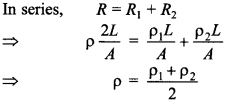
60. Two similar wires of same length and same area of cross-section but of different material,, having resistivity p, and p2 are connected end to end (in series). Calculate the effective resistivity of their combination.

Answer/Explanation

Answer:
Explaination:
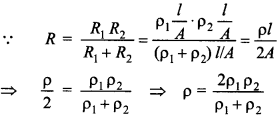
Physics MCQs for Class 12 with Answers Chapter 3 Current Electricity 36


61. Two similar wires of same length and same area of cross-section but of different material having resistivity pj and p2 are connected side by side i.e. in parallel. Calculate the effective resistivity of their combination.

Answer/Explanation

Answer:
Explaination:
Physics MCQs for Class 12 with Answers Chapter 3 Current Electricity 37


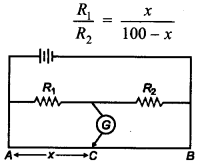
62. In an experiment on meter bridge, if the balancing length AC is x, what would be its value, when the radius of the meter bridge wire AB is doubled? Justify your answer. [AI 2011C]

Answer/Explanation

Answer:
Explaination:
At the balance point, we have
Physics MCQs for Class 12 with Answers Chapter 3 Current Electricity 38
As R1 and R2 remain the same, then x will also remain the same. It will not depend upon the diameter of the wire.


63. A cell of negligible internal resistance is connected in series to the wire of a potentiometer. If potentiometer wire is changed and in its place another wire of different material having diameter twice of the first wire is used keeping the length constant, then how the balance point will change?

Answer/Explanation

Answer:
Explaination: Balance point will not change.


64. How can we increase the sensitivity of a potentiometer? [Foreign 2017]

Answer/Explanation

Answer:
Explaination:
By reducing potential gradient.
Potential gradient can be reduced by
(i) increasing length of the wire, and
(ii) reducing current in the main circuit.


65. Why is the potentiometer preferred .to a voltmeter for measuring emf of a cell? [Dehradun 2019]

Answer/Explanation

Answer:
Explaination:
Emf measured by the potentiometer is more accurate because the cell is in open circuit giving no current.


We hope the given Physics MCQs for Class 12 with Answers Chapter 3 Current Electricity will help you. If you have any query regarding CBSE Class 12 Physics Current Electricity MCQs Pdf, drop a comment below and we will get back to you at the earliest.

Physics MCQs for Class 12 with Answers Chapter 2 Electrostatic Potential and Capacitance

Free PDF Download of CBSE Physics Multiple Choice Questions for Class 12 with Answers Chapter 2 Electrostatic Potential and Capacitance. Physics MCQs for Class 12 Chapter Wise with Answers PDF Download was Prepared Based on Latest Exam Pattern. Students can solve NCERT Class 12 Physics Electrostatic Potential and Capacitance MCQs Pdf with Answers to know their preparation level.

Electrostatic Potential and Capacitance Class 12 Physics MCQs Pdf

1. A positively charged particle is released from rest in an uniform electric field. The electric potential energy of the charge [NCERT Exemplar]
(a) remains a constant because the electric field is uniform.
(b) increases because the charge moves along the electric field.
(c) decreases because the charge moves along the electric field.
(d) decreases because the charge moves opposite to the electric field.

Answer/Explanation

Answer: c
Explaination:
(c) The positively charged particle experiences electrostatic force along the direction of electric field, hence moves in the direction of electric field. Electric potential decreases in the direction of electric field. Thus, positive work is done by the electric field on the charge.
We = -ΔU = -qΔV=q(Vin – Vf)
Hence electrostatic potential energy of the positive charge decreases.


2. Figures show some equipotential lines distributed in space. A charged object is moved from point A to point B. [NCERT Exemplar]
Physics MCQs for Class 12 with Answers Chapter 2 Electrostatic Potential and Capacitance 3
(a) The work done in Fig. (i) is the greatest.
(b) The work done in Fig. (ii) is least.
(c) The work done is the same in Fig. (i), Fig.(ii) and Fig. (iii).
(d) The work done in Fig. (iii) is greater than Fig. (ii) but equal to that in Fig. (i).

Answer/Explanation

Answer: c
Explaination:
(c) The work done by the electric field on the charge will be negative.
Welectrical = -ΔU = – qΔV— q( Vinitial – Vfinal) Here initial and final potentials are same in all three cases and the same charge is moved, so work done is same in all three cases.


3. Equipotentials at a great distance from a collection of charges whose total sum is not zero are approximately [NCERT Exemplar]
(a) spheres
(b) planes
(c) paraboloids
(d) ellipsoids

Answer/Explanation

Answer: a
Explaination:
(a) The collection of charges at great distance is considered as a single point charge. The equipotential surfaces due to a point charge are spherical.


4. Two small spheres each carrying a charge q are placed r metre apart. If one of the spheres is taken around the other one in a circular path of radius r, the work done will be equal to
(a) force between them × r
(b) force between them × 2πr
(c) force between them/2πr
(d) zero

Answer/Explanation

Answer: d
Explaination: (d) The force is perpendicular to the displacement.


5. The electric potential V at any point O (x, y, z all in metres) in space is given by V = 4x² volt. The electric field at the point (1 m, 0, 2 m) in volt/metre is
(a) 8 along negative x-axis
(b) 8 along positive x-axis
(c) 16 along negative x-axis
(d) 16 along positive z-axis

Answer/Explanation

Answer: a
Explaination: (a) The electric field E = \(\frac{-dV}{dx}\) = -8x V/m


6. If a unit positive charge is taken from one point to another over an equipotential surface, then
(a) work is done on the charge.
(b) work is done by the charge.
(c) work done is constant.
(d) no work is done.

Answer/Explanation

Answer: d
Explaination:
(d) On the equipotential surface, electric field is normal to the charged surface (where potential exists) so that no work will be done.


7. A hollow metal sphere of radius 5 cm is charged so that the potential on its surface is 10 V. The potential at the centre of the sphere is
(a) 0 V
(b) 10 V
(c) Same as at point 5 cm away from the surface
(d) Same as at point 25 cm away from the surface

Answer/Explanation

Answer: b
Explaination: (b) Since potential inside the hollow sphere is same as that on the surface.


8. The electrostatic force between the metal plates of an isolated parallel plate capacitor C having a charge Q and area A, is
(a) proportional to the square root of the distance between the plates.
(b) linearly proportional to the distance between the plates.
(c) independent of the distance between the plates.
(d) inversely proportional to the distance between the plates.

Answer/Explanation

Answer: c
Explaination:
(c) For isolated capacitor Q = Constant,
force between plate = \(\frac{Q^{2}}{2 A \varepsilon_{0}}\).


9. A capacitor is charged by a battery. The battery is removed and another identical uncharged capacitor is connected in parallel. The total electrostatic energy of resulting system
(a) increases by a factor of 4.
(b) decreases by a factor of 2.
(c) remains the same.
(d) increases by a factor of 2.

Answer/Explanation

Answer: b
Explaination: (b) Using, Vc = \(\frac{V}{2}\), U = \(\frac{1}{2}\)CV².


10. A conductor with a positive charge
(a) is always at +ve potential.
(b) is always at zero potential.
(c) is always at negative potential.
(d) may be at +ve, zero or -ve potential.

Answer/Explanation

Answer: d
Explaination:
(d) May be at positive, zero or negative potential, it is according to the way one defines the zero potential.


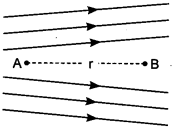
11 v Figure shows the electric lines of force emerging from a charged body. If the electric field at A and B are EA and EB respectively and if the displacement between A and B is r then
Physics MCQs for Class 12 with Answers Chapter 2 Electrostatic Potential and Capacitance 4
(a) EA > EB
(b) EA < EB
(c) EA = EB/r
(d) EA = EB /r²

Answer/Explanation

Answer: a
Explaination: (a) In non-uniform electric field, intensity is more, where the lines are more denser.


12. Which of the following options are correct? If a conductor has a potential V 4- 0 and there are no charges anywhere else outside, then [NCERT Exemplar]
(a) there must not be charges on the surface or inside itself.
(b) there cannot be any charge in the body of the conductor.
(c) there must be charges only on the surface.
(d) there must be charges inside the surface.

Answer/Explanation

Answer: b
Explaination:
(b) The charge resides on the outer surface of a closed charged conductor. Hence there cannot be any charge in the body of the conductor. Hence option (b) is correct.


13. Which of the following options is correct? In a region of constant potential [NCERT Exemplar]
(a) the electric field is uniform.
(b) the electric field is zero.
(c) there can be charge inside the regiofi.
(d) the electric field shall necessarily change if a charge is placed outside the region.

Answer/Explanation

Answer: b
Explaination:
(b) as E = \(\frac{-dV}{dr}\)
Since, V = constant, \(\frac{-dV}{dr}\) = 0 this implies that electric field intensity E=0. If some charge is present inside the region then electric field cannot be zero at that region, for this V=constant is not valid.


14. 64 drops each having the capacity C and potential V are combined to form a big drop. If the charge on the small drop is q, then the charge on the big drop will be
(a) 2q
(b) 4q
(c) 16q
(d) 64q

Answer/Explanation

Answer: d
Explaination: (d) By using Q = nq or Q = 6Aq


15. The radii of two metallic spheres A and B are r1 and r2 respectively (r1 > r2). They are connected by a thin wire and the system is given a certain charge. The charge will be greater
(a) on the surface of the sphere B.
(b) on the surface of the sphere A.
(c) equal on both.
(d) zero on both.

Answer/Explanation

Answer: b
Explaination:
(b) After connection of wire, potential becomes equal, i.e, Q1/r1 = Q2/r2 or Q1/Q2 = r1/r2 when r1 > r2, then Q1 > Q2.


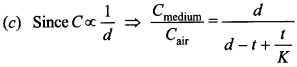
16. A parallel plate condenser is connected with the terminals of a battery. The distance between the plates is 6mm. If a glass plate (dielectric constant K = 9) of 4.5 mm is introduced between them, then the capacity will become
(a) 2 times.
(b) the same.
(c) 3 times.
(d) 4 times.

Answer/Explanation

Answer:
Explaination:
Physics MCQs for Class 12 with Answers Chapter 2 Electrostatic Potential and Capacitance 12


17. Three charges Q, +q and +q are placed at the vertices of an equilateral triangle of side l as shown in the figure. If the net electrostatic energy of the system is zero, then Q is equal to
Physics MCQs for Class 12 with Answers Chapter 2 Electrostatic Potential and Capacitance 5
(a) -q
(b) +q
(c) zero
(d) –\(\frac{q}{2}\)

Answer/Explanation

Answer:
Explaination:
Physics MCQs for Class 12 with Answers Chapter 2 Electrostatic Potential and Capacitance 13


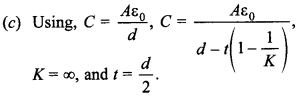
18. Two metal plates form a parallel plate capacitor. The distance between the plates is d. A metal sheet of thickness \(\frac{d}{2}\) and of the same area is introduced between the plates.
What is the ratio of the capacitance in the two cases?
(a) 2 : 1
(b) 3 : 1
(c) 2 : 1
(d) 5 : 1

Answer/Explanation

Answer:
Explaination:
Physics MCQs for Class 12 with Answers Chapter 2 Electrostatic Potential and Capacitance 14


19. Acapacitor of 4 pF is connected as shown in the circuit. The internal resistance of the battery is 0.5 Q. The amount of charge on the capacitor plates will be [NCERT Exemplar]
Physics MCQs for Class 12 with Answers Chapter 2 Electrostatic Potential and Capacitance 6
(a) 0
(b) 4
(c) 16 μC
(d) 8 μC

Answer/Explanation

Answer:
Explaination:
Physics MCQs for Class 12 with Answers Chapter 2 Electrostatic Potential and Capacitance 15


20. A capacitor is charged by using a battery which is then disconnected. A dielectric slab
then slipped between the plates, which results in
(a) reduction of charge on the plates and increase of potential difference across the plates.
(b) increase in the potential difference across the plate, reduction in stored energy, but no change in the charge on the plates.
(c) decrease in the potential difference across the plates, reduction in the stored energy, but no change in the charge on the plates.
(d) none of these

Answer/Explanation

Answer: c
Explaination:
(c) Battery in disconnected so Q will be constant. As
C ∝ K so with introduction of dielec-tric slab, the capacitance will increase and using Q = CV, V will decrease.
Using U = \(\frac{Q²}{2C}\)


21. Which of the following statement is true?
(a) Electrostatic force is a conservative force.
(b) Potential at a point is the work done per unit charge in bringing a charge from any point to infinity.
(c) Electrostatic force is non-conservative
(d) Potential is the productof charge and work.

Answer

Answer: a


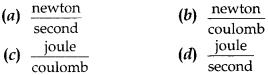
22. 1 volt is equivalent to
Physics MCQs for Class 12 with Answers Chapter 2 Electrostatic Potential and Capacitance 1

Answer

Answer: c


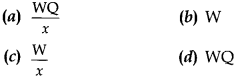
23. The work done in bringing a unit positive charge from infinite distance to a point at distance x from a positive charge Q is W. Then the potential at that point is
Physics MCQs for Class 12 with Answers Chapter 2 Electrostatic Potential and Capacitance 2

Answer

Answer: b


24. Consider a uniform electric field in the z-direction. The potential is a constant
(a) for any x for a given z
(b) for any y for a given z
(c) on the x-y plane for a given z
(d) all of these

Answer

Answer: d


25. Equipotential surfaces
(a) are closer in regions of large electric fields compared to regions of lower electric fields.
(b) will be more crowded near sharp edges of a conductor.
(c) will always be equally spaced.
(d) both (a) and (b) are correct.

Answer

Answer: d


26. In a region of constant potential
(a) the electric field is uniform.
(b) the electric field is zero.
(c) there can be no charge inside the region.
(d) both (b) and (c) are correct.

Answer

Answer: d


27. A test charge is moved from lower potential point to a higher potential point. The potential energy of test charge will
(a) remain the same
(b) increase
(c) decrease
(d) become zero

Answer

Answer: c


28. An electric dipole of moment \(\vec{p}\) is placed in a uniform electric field \(\vec{E}\) . Then
(i) the torque on the dipole is \(\vec{p} \times \overrightarrow{\mathrm{E}}\)
(ii) the potential energy of the system is \(\vec{p} . \overrightarrow{\mathrm{E}}\)
(iii) the resultant force on the dipole is zero. Choose the correct option.
(a) (i), (ii) and (iii) are correct
(b) (i) and (iii) are correct and (ii) is wrong
(c) only (i) is correct
(d) (i) and (ii) are correct and (iii) is wrong

Answer

Answer: b


29. If a conductor has a potential V ≠ 0 and there are no charges anywhere else outside, then
(a) there must be charges on the surface or in¬side itself.
(b) there cannot be any charge in the body of the conductor.
(c) there must be charges only on the surface.
(d) both (a) and (b) are correct.

Answer

Answer: c


30. Which of the following statements is false for a perfect conductor?
(a) The surface of the conductor is an equipoten-tial surface.
(b) The electric field just outside the surface of a conductor is perpendicular to the surface.
(c) The charge carried by a conductor is always uniformly distributed over the surface of the conductor.
(d) None of these.

Answer

Answer: d


31. Dielectric constant for a metal is
(a) zero
(b) infinite
(c) 1
(d) 10

Answer

Answer: b


32. When air is replaced by a dielectric medium of constant K, the maximum force of attraction between two charges separated by a distance
(a) increases K times
(b) remains unchanged
(c) decreases K times
(d) increases K-1 times

Answer

Answer: c


33. In a parallel plate capacitor, the capacity increases if
(a) area of the plate is decreased.
(b) distance between the plates increases.
(c) area of the plate is increased.
(d) dielectric constantly decreases.

Answer

Answer: c


34. A parallel plate air capacitor is charged to a potential difference of V volts. After disconnecting the charging battery the distance between the plates of the capacitor is increased using an insulating handle. As a result the potential difference between the plates
(a) increases
(b) decreases
(c) does not change
(d) becomes zero

Answer

Answer: a


35. Two identical capacitors are joined in parallel, charged to a potential V, separated and then connected in series, the positive plate of one is connected to the negative of the other. Which of the following is true?
(a) The charges on the free plated connected to-gether are destroyed.
(b) The energy stored in ths system increases.
(c) The potential difference between the free plates is 2V.
(d) The potential difference remains constant.

Answer

Answer: c


36. A capacitor has some dielectric between its plates, and the capacitor is connected to a dc source. The battery is now disconnected and then the dielectric is removed, then
(a) capacitance will increase.
(b) energy stored will decrease.
(c) electric field will increase.
(d) voltage will decrease.

Answer

Answer: c


37. Two spherical conductors each of capacity C are charged to potential V and -V. These are then connected by means of a fine wire. The loss of energy is
(a) zero
(b) \(\frac{1}{2}\)CV2
(c) CV2
(d) 2 CV2

Answer

Answer: c


38. Work done in taking an electron around a proton in a circular loop is zero. Should the proton necessarily be at the centre of the circular loop?

Answer/Explanation

Answer:
Explaination:
No, because electrostatic force is a conservative force, and work done by a conservative force in a closed path is zero.


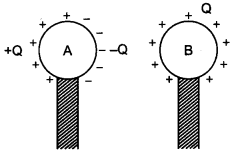
39. An uncharged insulated conductor A is brought near a charged insulated conductor B. What happens to charge and potential of 5?

Answer/Explanation

Answer:
Explaination:
Initially the potential of conductor B = V. When an uncharged conductor A is brought near to the conductor B, then the charges will induce on A. If -V1 is the potential due to the negative induced charge at A, and V2 is the potential due to the positive induced charge, then |-V1| > |V2| (as -ve charge is near to B).
Physics MCQs for Class 12 with Answers Chapter 2 Electrostatic Potential and Capacitance 16
∴ Net potential on B = V – V1 + V2, which is less than V. But charge on B remains same.


40. While defining the electrostatic potential energy, why do we bring a unit positive charge from infinity?

Answer/Explanation

Answer:
Explaination:
Because, at infinity, the electrostatic forces are zero. Therefore, the electrostatic potential energy is also zero.


41. What is the work done in moving a test charge q through a distance of 1 cm along the equatorial axis of an electric dipole?

Answer/Explanation

Answer:
Explaination: Zero.


42. A metal sphere is surrounded by an uncharged concentric thin spherical shell with a charge q and the potential difference between them is V. What is the new potential difference between them, if the shell is now given an additional charge q?

Answer/Explanation

Answer:
Explaination:
The potential difference remains unchanged, because the addition of charge q will increase the potential of both spherical shell and metal sphere by an equal amount.


43. Why is electrostatic potential constant throughout the volume of the conductor and has the same value (as inside) on its surface? [Panchkula 2019, Delhi 2012]

Answer/Explanation

Answer:
Explaination:
As we know that the electrostatic field inside the conductor is zero, therefore no work is done in moving a small test charge, within the conductor and on its surface. We find there is no potential difference between the two points inside or on the surface, which implies the electrostatic potential is constant throughout.


44. A and B are two conducting spheres of the same radius, A being solid and B hollow. Both are charged to the same potential. What will be the relation between the charges on the two spheres?

Answer/Explanation

Answer:
Explaination:
Since the radii of both the spheres are same, and according to the question,
The potential of sphered=potential of sphere B.
Physics MCQs for Class 12 with Answers Chapter 2 Electrostatic Potential and Capacitance 17


45. If a point charge +q is taken first from A to C and then from C to B of a circle drawn with another point charge +q at centre, then along which path more work will be done?
Physics MCQs for Class 12 with Answers Chapter 2 Electrostatic Potential and Capacitance 7

Answer/Explanation

Answer:
Explaination:
Since both the points A and B are equidistant from the electric charge +q.
∴ VA = VB
∴ Work done WA→C = q (VC– VA)
= q(VC – VB) = WB→C
= -WC→B


46. A uniform electric field E exists between two charged plates as shown in figure. What would be the work done in moving a charge q along the closed rectangular path ABCDA?
Physics MCQs for Class 12 with Answers Chapter 2 Electrostatic Potential and Capacitance 8

Answer/Explanation

Answer:
Explaination:
Work done in moving a charge q along a closed rectangular path ABCD is calculated as
W = WAB + WBC + WCD + WDA
W = qE + 0 – qE + 0 = 0 [∵ AB = CD]


47. “For any charge configuration, equipotential surface through a point is normal to the electric field.” Justify. [Delhi 2014]

Answer/Explanation

Answer:
Explaination:
If the electric field is not normal, it will have non-zero component along the surface. In that case, the work done in moving a charge oh the equipotential surface will not be zero.


48. What is the geometrical shape of equipotential surfaces due to a single isolated charge? [Delhi 2013]

Answer/Explanation

Answer:
Explaination: The geometrical shape is spherical.


49. Why is there no work done in moving a charge from one point to another on an equipotential surface? [Foreign 2012]

Answer/Explanation

Answer:
Explaination:
Potential difference between any two points of an equipotential surface is zero. So no work is done in moving a charge from one point to another.


50. Can two equipotential surfaces intersect each other? Justify your answer. [Delhi 2011C]

Answer/Explanation

Answer:
Explaination:
Two equipotential surfaces cannot intersect. The direction of electric field is always perpendicular to the equipotential surface. If they intersect, there will be two directions of the electric field at the point of intersection which is not possible.


51. Why is electrostatic potential energy of a pair of like point charges positive?

Answer/Explanation

Answer:
Explaination: Because the work has to be done against the electrostatic force of repulsion.


52. In the expression W = pE (cos 0O – cos 0j), why is 0Q is taken as n/2 for obtaining expression for the potential energy of electric dipole?

Answer/Explanation

Answer:
Explaination:
When the dipole axis is perpendicular to the electric field, i.e. θO = π/2, the work done against the external electric field \(\vec{E}\) in bringing the charges +q and -q is equal and opposite, and cancel out, i.e. q[V(r1) – V(r2)] = 0. Therefore, initial potential energy is zero.


53. Why should electrostatic field be zero inside a conductor? [Delhi 2012]

Answer/Explanation

Answer:
Explaination:
In the static situation, there is no excess charge. Hence, electric field is zero everywhere inside the conductor.


54. Why can the interior of a conductor have no excess charge in the static situation?

Answer/Explanation

Answer:
Explaination:
Consider any volume element V enclosed by the Gaussian surface S inside the conductor. According to the Gauss’s law,
Physics MCQs for Class 12 with Answers Chapter 2 Electrostatic Potential and Capacitance 18
Therefore, in the static situation, the charge will reside only on the outer surface.


55. Why does the electric field inside a dielectric decrease when it is placed in an external electric field?

Answer/Explanation

Answer:
Explaination:
An electric field is developed inside the dielectric due to induction in a direction opposite to the direction of external electric field. Thus, net electric field decreases.


56. For what position of an electric dipole in a uniform electric field its potential energy is
(i) minimum and
(ii) maximum?

Answer/Explanation

Answer:
Explaination:
(i) Potential energy of dipole in external field is minimum when \(\vec{p}\) and \(\vec{E}\) are parallel, i.e. θ = 0°.
∴ U = -pE cos θ
⇒ Umin = -pE
(ii) The potential energy of dipole in the external field is maximum when \(\vec{p}\) and \(\vec{E}\) are anti-parallel, i.e. θ = 180° and Umax = +pE.


57. If the electric potential equals to zero at a point, must the electric field be zero at that point?

Answer/Explanation

Answer:
Explaination:
No. for example, at any point on the equitorial line of the electric dipole; the electric potential is zero, but the electric field is not zero.


58. If electric field at a point equals to zero, must the electric potential at that point be zero?

Answer/Explanation

Answer:
Explaination:
No. Inside a charged conducting sphere, E = 0, but the potential is constant and is not zero.


59. A hollow metal sphere of radius 5 cm is charged such that the potential on its surface is 10 V. What is the potential at the centre of the sphere? [AI 2011]

Answer/Explanation

Answer:
Explaination: 10 V, as the potential inside the hollow metal sphere is same everywhere.


60. A point charge Q is placed at point O as shown in the figure. Is the potential difference VA – VB positive, negative or zero, if Q is (i) positive (ii) negative? [Foreign 2017, Delhi 2011]
Physics MCQs for Class 12 with Answers Chapter 2 Electrostatic Potential and Capacitance 9

Answer/Explanation

Answer:
Explaination:
As V ∝ \(\frac{1}{r}\)
(i) For Q having +ve value, VA > VB, i.e. VA – VB is +ve.
(ii) For Q having -ve value, VA < VB, i.e. VA – VB is negative.


61. Figure given below shows three points A, B and C in a uniform electrostatic field. At which of the points will the electric potential be maximum?
Physics MCQs for Class 12 with Answers Chapter 2 Electrostatic Potential and Capacitance 10

Answer/Explanation

Answer:
Explaination:
At B, the electric potential will be maximum, because E = –\(\frac{dV}{Dr}\).


62. Why is the potential inside a hollow spherical charged conductor constant and has the same value as on its surface? [Foreign 2012]

Answer/Explanation

Answer:
Explaination:
Electric field inside a hollow charged conductor is zero and there is no tangential component on the surface of the conductor. So, work done is zero in moving a charge inside and on the surface of the conductor.
E = –\(\frac{dV}{Dr}\)
From this, we conclude that potential inside the spherical charged conductor is constant and it is same on the surface. In inside a hollow charge conductor,
E = 0
V = constant


63. Define dielectric strength of a medium. What is its value for vacuum?

Answer/Explanation

Answer:
Explaination:
It is the maximum value of electric field that can exist inside a dielectric without causing its electrical breakdown. For vacuum, its value is infinity.


64. A charge q is moved from a point A above dipole of dipole moment P to a point B below the dipole in equatorial plane without acceleration. Find the work done in the process. [AI 2016]
Physics MCQs for Class 12 with Answers Chapter 2 Electrostatic Potential and Capacitance 11

Answer/Explanation

Answer:
Explaination:
The work done is zero, as electrostatic potential at any point in equitorial plane is zero.


65. If the plates of a charged capacitor be suddenly connected to each other by a wire, what will happen?

Answer/Explanation

Answer:
Explaination:
Capacitor will be discharged immediately, and the part of electrical energy will be converted in the form of heat and light (sparks will be produced).


66. Name the physical quantity whose SI unit is F m-1 (farad/metre).

Answer/Explanation

Answer:
Explaination:
Electrical permittivity (\(\varepsilon \text { or } \varepsilon_{0}\)).


67. Where does the energy of a capacitor reside?

Answer/Explanation

Answer:
Explaination: Electrical energy resides in the space, within the plates.


We hope the given Physics MCQs for Class 12 with Answers Chapter 2 Electrostatic Potential and Capacitance will help you. If you have any query regarding CBSE Class 12 Physics Electrostatic Potential and Capacitance MCQs Pdf, drop a comment below and we will get back to you at the earliest.

Physics MCQs for Class 12 with Answers Chapter 1 Electric Charges and Fields

Free PDF Download of CBSE Physics Multiple Choice Questions for Class 12 with Answers Chapter 1 Electric Charges and Fields. Physics MCQs for Class 12 Chapter Wise with Answers PDF Download was Prepared Based on Latest Exam Pattern. Students can solve NCERT Class 12 Physics Electric Charges and Fields MCQs Pdf with Answers to know their preparation level.

Electric Charges and Fields Class 12 Physics MCQs Pdf

1. When a glass rod is rubbed with silk, it
(a) gains electrons from silk.
(b) gives electrons to silk.
(c) gains protons from silk.
(d) gives protons to silk.

Answer/Explanation

Answer: b
Explaination:
(b) On rubbing a glass rod with silk, excess electrons are transferred from glass to silk. So glass rod becomes positive and silk becomes negative.


2. In general, metallic ropes are suspended on the carriers taking inflammable materials. The reason is
(a) to control the speed of the carrier.
(b) to keep the centre of gravity of the carrier nearer to the earth.
(c) to keep the body of the carrier in contact with the earth.
(d) none of these.

Answer/Explanation

Answer: c
Explaination:
(c) For providing a path to the charge induced on the surface of the carriers.


3. Two charges q1 and q2 are placed in vacuum at a distance d and the force acting between them is F. If a medium of dielectric constant 4 is introduced around them, the force now will be ______ .

Answer/Explanation

Answer:
Explaination: \(\frac{F}{4}\).In the presence of medium, force becomes \(\frac{1}{K}\) time


4. When 1014 electrons are removed from a neutral metal sphere, the charge on the sphere becomes ______ .

Answer/Explanation

Answer:
Explaination:
16 µC, Q = ne= 1014 x 1.6 × 10-19 or 0=1.6 × 10⁻⁵ C = 16 µC
As electrons are removed, so charge will be positive.


5. Two similar spheres having +Q and -Q charges are kept at a certain distance. F force acts between the two. If at the middle of two spheres, another similar sphere having +Q charge is kept, then it experiences a force in magnitude and direction as
(a) zero having no direction.
(b) 8F towards +Q charge.
(c) 8F towards -Q charge.
(d) 4F towards +Q charge.

Answer/Explanation

Answer: c
Explaination:
(c) Initially, force between A and C,
Physics MCQs for Class 12 with Answers Chapter 1 Electric Charges and Fields 16
When a similar sphere B having charge +Q is kept at the mid-point of line joining A and C, then net force on B is
Physics MCQs for Class 12 with Answers Chapter 1 Electric Charges and Fields 17
The direction is shown in figure.


6. A charge Q is divided into two parts of q and Q – q. If the coulomb repulsion between them when they are separated is to be maximum, the ratio of Q/q should be
(a) 2:1
(b) 1/2
(c) 4:1
(d) 1/4

Answer/Explanation

Answer: a
Explaination:
(a) Let separation between two parts be r, then
F = k.q(Q – q)/r² , For F to be maximum dF/dq = 0 then Q/q = 2/1 = 2 : 1


7. Four equal charges q are placed at the four comers A, B, C, D of a square of length a. The magnitude of the force on the charge at B will be
Physics MCQs for Class 12 with Answers Chapter 1 Electric Charges and Fields 5

Answer/Explanation

Answer: c
Explaination:
Physics MCQs for Class 12 with Answers Chapter 1 Electric Charges and Fields 18
Physics MCQs for Class 12 with Answers Chapter 1 Electric Charges and Fields 19


8. Dielectric constant for metal ______ .

Answer/Explanation

Answer:
Explaination:
Infinite [Dielectric constant K = \(\frac{\varepsilon}{\varepsilon_{0}}\)
Permittivity of metals (\(\E \)) is assumed to be very high.]


9. Two charges of equal magnitudes kept at a distance r exert a force F on each other. If the charges are halved and distance between them is doubled, then the new force acting on each charge is
Physics MCQs for Class 12 with Answers Chapter 1 Electric Charges and Fields 6

Answer/Explanation

Answer: d
Explaination:
(d) F = \(\frac{k \cdot Q^{2}}{r^{2}}\). If Q is halved, r is doubled then F = \(\frac{1}{16}\) time


10. The electric field inside a spherical shell of uniform surface charge density is
(a) zero.
(b) constant, less than zero.
(c) directly proportional to the distance from the centre.
(d) none of the these

Answer/Explanation

Answer: a
Explaination:
(a) All charges reside on the outer surface of the shell so according to Gauss’s law, electric field inside the shell is zero.


11. A cylinder of radius R and length L is placed in a uniform electric field E parallel to the cylinder axis. The total flux for the surface of the cylinder is given by
Physics MCQs for Class 12 with Answers Chapter 1 Electric Charges and Fields 7

Answer/Explanation

Answer: d
Explaination:
Physics MCQs for Class 12 with Answers Chapter 1 Electric Charges and Fields 20


12. Electric field at a point varies as r° for
(a) an electric dipole
(b) a point charge
(c) a plane infinite sheet of charge
(d) a line charge of infinite length

Answer

Answer: c


13. An electric charge q is placed at the centre of a cube of side a. The electric flux on one of its faces will be
Physics MCQs for Class 12 with Answers Chapter 1 Electric Charges and Fields 8

Answer/Explanation

Answer:
Explaination: (a) Using Gauss’s theorem


14. Total electric flux coming out of a unit positive charge kept in air is
Physics MCQs for Class 12 with Answers Chapter 1 Electric Charges and Fields 9

Answer/Explanation

Answer: b
Explaination:
(b) Total flux coming out from the unit charge is
Physics MCQs for Class 12 with Answers Chapter 1 Electric Charges and Fields 21


15. The electric field intensity due to an infinite cylinder of radius R and having charge q per unit length at a distance rir r(r > R) from its axis is
(a) directly proportional to r².
(b) directly proportional to r3.
(c) inversely proportional to r.
(d) inversely proportional to r².

Answer/Explanation

Answer: c
Explaination:
Physics MCQs for Class 12 with Answers Chapter 1 Electric Charges and Fields 22


16. A point charge q is placed at a distance a/2 directly above the centre of a square of side a. The electric flux through the square is
Physics MCQs for Class 12 with Answers Chapter 1 Electric Charges and Fields 10

Answer/Explanation

Answer: d
Explaination:
(d) An imaginary cube can be made by considering charge q at the centre and given square is one of its face. So flux through the given square (i.e. one face)
Physics MCQs for Class 12 with Answers Chapter 1 Electric Charges and Fields 23


17. Which of the following graphs shows the variation of electric field E due to a hollow spherical conductor of radius R as a function of distance from the centre of the sphere?
Physics MCQs for Class 12 with Answers Chapter 1 Electric Charges and Fields 11

Answer/Explanation

Answer: a
Explaination:
(a) Electric field due to a hollow spherical conductor is governed by equations E = 0, for r < R …(i)
and \(E=Q / 4 \pi \varepsilon_{0} r^{2}\) for r ≥ R ….(ii)
i.e. inside the conductor, electric field will be zero and outside the conductor it will vary according to E oc 1/r².


18. The magnitude of electric field intensity E is such that, an electron placed in it would experience an electrical force equal to its weight is given by
(a) mge
(b) mg/e
(c) e/mg
(d) e²g/m²

Answer/Explanation

Answer: b
Explaination: (b) According to the question, eE = mg or E = mg/e


19. In Fig. (i) two positive charges q2 and q3 fixed along the y-axis, exert a net electric force in the +x direction on a charge q1 fixed along the x-axis. If a positive charge Q is added at (x, 0) in figure (ii), the force on q1 is [NCERT Exemplar]
Physics MCQs for Class 12 with Answers Chapter 1 Electric Charges and Fields 12
(a) shall increase along the positive x-axis.
(b) shall decrease along the positive x-axis.
(c) shall point along the negative x-axis.
(d) shall increase but the direction changes because of the intersection of Q with q2 and qy

Answer/Explanation

Answer: a
Explaination:
(a) The net electrostatic force on the charge q1 by the charges q2 and q3 is along the positive x-direction. Hence the nature of force between qu q2 and qx, q3 should be attractive. It means qx should be negative.


20. Which of the following statement is correct? The electric field at a point is [NCERT Exemplar]
(a) always continuous.
(b) continuous if there is a charge at that point.
(c) discontinuous only if there is a negative charge at that point.
(d) discontinuous if there is a charge at that point.

Answer/Explanation

Answer: d
Explaination:
(d) The electric field due to any charge will be continuous, if there is no other charge in the medium. It will be discontinuous if there is a charge at the point under consideration.


21. A point charge +q is placed at a distance d from an isolated conducting plane. The field at a point P on the other side of the plane is [NCERT Exemplar]
(a) directed perpendicular to the plane and away from the plane.
(b) directed perpendicular to the plane but towards the plane.
(c) directed radially away from the point charge.
(d) directed radially towards the point charge.

Answer/Explanation

Answer: a
Explaination:
(a) The electric field lines are away from positive charge and perpendicular to the surface. Hence the field at a point P on the other side of the plane is directed perpendicular to the plane and away from the plane.


22. Gauss’s law will be invalid if
(a) there is magnetic monopoles.
(b) the inverse square law is not exactly true.
(c) the velocity of light is not a universal constant.
(d) none of these.

Answer

Answer: b


23. SI unit of permittivity of free space is
(a) Farad
(b) Weber
(c) C2N-1 m-2
(d) C2N-1 m-2

Answer

Answer: c


24. A charge Q is placed at the centre of the line joining two point charges +q and +q as shown in the figure. The ratio of charges Q and q is
Physics MCQs for Class 12 with Answers Chapter 1 Electric Charges and Fields 1
(a) 4
(b) 1/4
(c) -4
(d) -1/4

Answer

Answer: d


25. The force per unit charge is known as
(a) electric flux
(b) electric field
(c) electric potential
(d) electric current

Answer

Answer: b


26. Electric field lines provide information about
(a) field strength
(b) direction
(c) nature of charge
(d) all of these

Answer

Answer: d


27. Which of the following figures represent the electric field lines due to a single negative charge?
Physics MCQs for Class 12 with Answers Chapter 1 Electric Charges and Fields 2

Answer

Answer: b


28. The SI unit of electric flux is
(a) N C-1 m-2
(b) N C m-2
(c) N C-2 m2
(d) N C-1 m2

Answer

Answer: d


29. The unit of electric dipole moment is
(a) newton
(b) coulomb
(c) farad
(d) debye

Answer

Answer: d


30. Consider a region inside which, there are various types of charges but the total charge is zero. At points outside the region
(a) the electric field is necessarily zero.
(b) the electric field is due to the dipole moment of the charge distribution only.
(c) the dominant electric field is inversely pro-portional to r3, for large r (distance from ori-gin).
(d) the work done to move a charged particle along a closed path, away from the region will not be zero.

Answer

Answer: c


31. The surface considered for Gauss’s law is called
(a) Closed surface
(b) Spherical surface
(c) Gaussian surface
(d) Plane surface

Answer

Answer: c


32. The total flux through the faces of the cube with side of length a if a charge q is placed at corner A of the cube is
Physics MCQs for Class 12 with Answers Chapter 1 Electric Charges and Fields 3
Physics MCQs for Class 12 with Answers Chapter 1 Electric Charges and Fields 4

Answer

Answer: a


33. Which of the following statements is not true about Gauss’s law?
(a) Gauss’s law is true for any closed surface.
(b) The term q on the right side side of Gauss’s law includes the sum of all charges enclosed by the surface.
(c) Gauss’s law is not much useful in calculating electrostatic field when the system has some symmetry.
(d) Gauss’s law is based on the inverse square dependence on distance contained in the coulomb’s law

Answer

Answer: c


34. Four charges are arranged at the comers of a square ABCD, as shown. The force on the charge kept at the centre O is
Physics MCQs for Class 12 with Answers Chapter 1 Electric Charges and Fields 13
(a) zero
(b) along the diagonal AC
(c) along the diagonal BD
(d) perpendicular to side AB

Answer/Explanation

Answer: c
Explaination:
(c) Place a unit positive charge at O. Resultant force due to the charges placed at A and C is zero and resultant charge due to B and D is towards D along the diagonal BD.


35. One end of a copper wire is connected to a neutral pith ball and other end to a negatively charged plastic rod. What will be the charge acquired by a pith ball? [Chennai 2019]

Answer/Explanation

Answer:
Explaination: Negative charge.


36. Distinguish between an insulator (dielectric) and a conductor.

Answer/Explanation

Answer:
Explaination:
Dielectrics do not have free electrons, while conductors have free electrons. When some charge is transferred to a conductor, it readily gets distributed over the entire surface of the conductor, but on insulators, the charge stays at the same place.


37. Why does a nylon or plastic comb get electrified on combing or rubbing but a metal spoon does not?

Answer/Explanation

Answer:
Explaination:
The charge on a metal spoon discharges through our body to the ground as both are conductors. But when a nylon or plastic comb is rubbed, due to the friction its acquires a negative (-ve) charge, which stays on it as it is an insulator.


38. Two metallic spheres having same shape and size, but one of Cu and other of Al, are both placed in an identical electric field. In which metallic sphere will more charge be induced?

Answer/Explanation

Answer:
Explaination:
Same charge will be induced on both the spheres. As the dielectric constant K = oo for metals and the induced charge is given by q’ = \(=-q\left(1-\frac{1}{K}\right)\).


39. What causes the charging of an object?

Answer/Explanation

Answer:
Explaination:
When an object looses or gains electrons by friction/conduction/induction, then it is charged.


40. What does the additive nature of electric charge mean?

Answer/Explanation

Answer:
Explaination:
It means an electric charge is a scalar quantity and is added like algebraic numbers.


41. When does a charged ring behave as a point charge?

Answer/Explanation

Answer:
Explaination:
When the radius of ring is much smaller than the distance under consideration.


42. Two insulated charged copper spheres A and B of identical size have charges qA and qB respectively. A third sphere C of the same size but uncharged is brought in contact with the first and then in contact with the second and finally removed from both. What are the new charges on A and B1 [Chennai 2019, Foreign 2011]

Answer/Explanation

Answer:
Explaination:
Physics MCQs for Class 12 with Answers Chapter 1 Electric Charges and Fields 24


43. What does q1 + q2 = 0 signify?

Answer/Explanation

Answer:
Explaination:
q1 + q2 = 0
⇒ q1 = – q2
∴ q1 and qq2 are the two charges of an electric dipole.


44. What is the cause of quantisation of electric charge?

Answer/Explanation

Answer:
Explaination:
The minimum charge that is stable, is charge of an electron. Since, electrons are transferred from one object to another, therefore, electric charge is said to be quantised.


45. What do you mean by conservative nature of the electric force?

Answer/Explanation

Answer:
Explaination:
The electric force is conservative in nature, because the work done by it in moving a charge is path independent.


46. If a body contains n1 electrons and n2 protons, then what will be the total amount of charge on the body?

Answer/Explanation

Answer:
Explaination:
Electric charge on n1 electrons = – n1e and electric charge on n2 protons = + n2e Therefore, the total charge = (n2 – n1)e.


47. What is the limitation of Coulomb’s law?

Answer/Explanation

Answer:
Explaination: It is applied only for point charges.


48. What does e(absolute permittivity) signify?

Answer/Explanation

Answer:
Explaination: It is a measure of the degree to which a medium can resist the movement of charges.


49. Define 1 coulomb (1 C) of electric charge.

Answer/Explanation

Answer:
Explaination:
One coulomb is that charge, when placed in vacuum at a distance of one metre from an equal and similar charge, would repel it with a force of 9 × 10⁹ N.


50. Write two properties of an electrostatic force.

Answer/Explanation

Answer:
Explaination:
(a) It is conservative in nature.
(b) It depends on medium between the two charges.


51. Is the force acting between two point electric charges qx and q2 kept at some distance apart in air, attractive or repulsive when
(i) q1q2 > 0
(ii) q1q2 < 0?

Answer/Explanation

Answer:
Explaination:
(i) When q1q2 > 0, force is repulsive.
(ii) When q1q2 < 0, force is attractive.


52. The force on an electron kept in an electric field in a particular direction is F. What will be the magnitude and direction of the force experienced by a proton kept at the same point in the field? Mass of the proton is about 1836 times the mass of the electron.
Physics MCQs for Class 12 with Answers Chapter 1 Electric Charges and Fields 14

Answer/Explanation

Answer:
Explaination: Same in magnitude and opposite in the direction as F = e.E


53. How does the coulomb force between two point charges depend upon the dielectric constant of the intervening medium?

Answer/Explanation

Answer:
Explaination:
Physics MCQs for Class 12 with Answers Chapter 1 Electric Charges and Fields 25
Coulomb force is inversely proportional to the dielectric constant of the intervening medium.


54. State principle of superposition of forces.

Answer/Explanation

Answer:
Explaination:
Net force experienced by any charge in a group of charges is the vector sum of the forces acting on it due to rest of the charges of the group.


55. Define the dielectric constant of a medium. What is its unit? [Delhi 2011C]

Answer/Explanation

Answer:
Explaination:
Dielectric constant of a medium is defined as the ratio of the force between two charges placed a certain distance apart in vacuum to the force between the same two charges placed the same distance apart in the medium. It has no units.


56. Two equal balls having equal positive charge q coulombs are suspended by two insulating strings of equal length. What would be the effect on the force when a plastic sheet is inserted between the two? [AI 2014]

Answer/Explanation

Answer:
Explaination:
Electric force will reduce as plastic is an insulator. The force between the two charges will reduce by 1/K, where K is the dielectric constant of plastic.


57. Two electric field lines never cross each other. Why?

Answer/Explanation

Answer:
Explaination:
Two field lines can never cross each other. If they did, the field at the point of intersection will not have a unique direction, which is absurd.


58. Draw the electric field lines due to apoint charge
(i) Q > 0 and (ii) Q< 0.

Answer/Explanation

Answer:
Explaination:
(i) Q > 0 (ii) Q < 0
Physics MCQs for Class 12 with Answers Chapter 1 Electric Charges and Fields 26


59. Why do the electric field lines not form any closed loops?

Answer/Explanation

Answer:
Explaination:
Because they originate from positive (+ve) charge and terminate at negative (-ve) charge.


60. Draw electric field lines for a system of two charges q1 and q2 such that
(i) q1q2 >0; q1>q2>0
(ii) q1 q2 <0; q1 > |-q2| < 0, |q1|> |-q2|

Answer/Explanation

Answer:
Explaination:
Physics MCQs for Class 12 with Answers Chapter 1 Electric Charges and Fields 27


61. Draw the electric field lines if (i) a point charge + q is placed at the centre (ii) a point charge + q is placed at a distance R/2 from the centre.

Answer/Explanation

Answer:
Explaination:
Physics MCQs for Class 12 with Answers Chapter 1 Electric Charges and Fields 28


62. What is the physical significance of electric field?

Answer/Explanation

Answer:
Explaination:
From the knowledge of electic field intensity at any point, we can readily calculate the magnitude and the direction of force experienced by any .charge q0 placed at that point.


63. Define the term electric dipole moment. Is it a scalar or a vector quantity?

Answer/Explanation

Answer:
Explaination:
The product of the magnitude of one of the point charges constituting an electric dipole and the separation between them is termed as electric dipole moment.
It is a vector quantity.


64. What is an ideal (point) dipole?

Answer/Explanation

Answer:
Explaination:
An ideal dipole is the dipole whose size (2a) is vanishingly small, and the magnitude of electric charges constituting by it is very large, and the product, i.e. 2aq is finite.


65. What is the value of \(\left|\frac{E_{a x}}{E_{e q}}\right|\) for a short electric dipole?

Answer/Explanation

Answer:
Explaination:
Physics MCQs for Class 12 with Answers Chapter 1 Electric Charges and Fields 29


66. Two point charges +q and -q are placed at a distance d apart. What are the points at which the resultant electric field is parallel to the line joining the two charges?

Answer/Explanation

Answer:
Explaination:
(i) At any point on axial line.
(ii) At any point on equitorial line of a dipole.


67. If F is the magnitude of force experienced by a unit charge placed at a distance of 1 cm from an infinitely large charged sheet, then what will be the force experienced by the same charge placed at a distance of 2 cm from the same sheet? [HOTS]

Answer/Explanation

Answer:
Explaination:
In case of sheet of charge, the electric field is constant. Hence, F – qE will be same irrespective of distance.


68. What is the direction of net force on electric dipole, placed in a non-uniform electric field?
Physics MCQs for Class 12 with Answers Chapter 1 Electric Charges and Fields 15

Answer/Explanation

Answer:
Explaination:
Since, the electric field at the location of charge -q is more than that of field at charge +q. Therefore, the direction of net force will be in the direction opposite to the direction of \(\vec{E}\).


69. When does an electric dipole placed in a non-uniform electric field experience a zero torque but non-zero force?

Answer/Explanation

Answer:
Explaination: When the dipole axis is parallel to the direction of electric field.


70. Name the physical quantity whose SI unit is V.m. Is it a vector or a scalar quantity?

Answer/Explanation

Answer:
Explaination: The physical quantity is an electric flux. It is a scalar quantity.


71. Define the term electric flux. Write its SI unit. [Foreign 2017]

Answer/Explanation

Answer:
Explaination:
Electric flux through an area is the product of magnitude of area and the component of electric field vector normal to it.
Physics MCQs for Class 12 with Answers Chapter 1 Electric Charges and Fields 30


72. What is a Gaussian surface?

Answer/Explanation

Answer:
Explaination:
A Gaussian surface is an imaginary closed surface in three dimensional space through with the flux of a vector field is calculated.


73. What is the use of a Gaussian surface?

Answer/Explanation

Answer:
Explaination:
A Gaussian surface is used to determine the electric field intensity around a point charge or charged body.


74. Why can a Gaussian surface not pass through any discrete charge?

Answer/Explanation

Answer:
Explaination:
Because the electric field due to a system of discrete charges is not defined at the location of any charge.


75. Two charges of magnitudes -2 Q and + Q are located at points (a, 0) and (4a, 0) respectively. What is the electric flux due to these charges through a sphere of radius 3a with its centre at the origin? [AI 2013]

Answer/Explanation

Answer:
Explaination:
According to the Gauss’s theorem, the total electric flux through any closed surface is equal to \(\frac{1}{\varepsilon_{0}}\) times, the total charge enclosed eo by the surface.
Physics MCQs for Class 12 with Answers Chapter 1 Electric Charges and Fields 31


76. Does the charge given to a metallic sphere depend on whether it is hollow or solid? Give reason for your answer. [Delhi 2017]

Answer/Explanation

Answer:
Explaination: No. Electric charge resides on the outer surface only.


We hope the given Physics MCQs for Class 12 with Answers Chapter 1 Electric Charges and Fields will help you. If you have any query regarding CBSE Class 12 Physics Electric Charges and Fields MCQs Pdf, drop a comment below and we will get back to you at the earliest.

Maths MCQs for Class 12 with Answers Chapter 8 Application of Integrals

Free PDF Download of CBSE Maths Multiple Choice Questions for Class 12 with Answers Chapter 8 Application of Integrals. Maths MCQs for Class 12 Chapter Wise with Answers PDF Download was Prepared Based on Latest Exam Pattern. Students can solve NCERT Class 12 Maths Application of Integrals MCQs Pdf with Answers to know their preparation level.

Application of Integrals Class 12 Maths MCQs Pdf

1. Area bounded by the curve y = sin x and the x-axis between x = 0 and x = 2π is
(a) 2 sq units
(b) 0 sq units
(c) 3 sq units
(d) 4 sq units

Answer/Explanation

Answer: d
Explaination:
(d), as sin x is positive in 1st and 2nd quadrant and negative is 3rd and 4th quadrant.
Maths MCQs for Class 12 with Answers Chapter 8 Application of Integrals 2


2. Area of the region bounded by the curve y = \(\sqrt{49-x^{2}}\) and the x-axis is
(a) \(\frac{49}{2}\)π sq units
(b) 98π sq units
(c) 49π sq units
(d) 240π sq units

Answer/Explanation

Answer:
Explaination:
Maths MCQs for Class 12 with Answers Chapter 8 Application of Integrals 6


3. Area of the region bounded by the curve x = 2y + 3, the y-axis and between y = -1 and y = 1 is
(a) 4 sq units 3
(b) \(\frac{3}{2}\) sq units
(c) 6 sq units
(d) 8 sq units

Answer/Explanation

Answer: c
Explaination: (c), as area = \(\int_{-1}^{1}\) (2y + 3)dy = 6 sq units


4. The area of the region bounded by the curve y = \(\frac{1}{x}\), the x-axis and between x = 1 to x = 6 is ________ .

Answer/Explanation

Answer:
Explaination:
Maths MCQs for Class 12 with Answers Chapter 8 Application of Integrals 3


5. The area enclosed by the curve y = x² and y = 8 is________.

Answer/Explanation

Answer:
Explaination:
Maths MCQs for Class 12 with Answers Chapter 8 Application of Integrals 4


6. The area of the region bounded by the curve y² = x, the y-axis and between y = 2 and y = 4 is \(\frac{56}{3}\) sq units. State true or false.

Answer/Explanation

Answer:
Explaination:
Maths MCQs for Class 12 with Answers Chapter 8 Application of Integrals 5


7. Find the area of the region bounded by the curve y = \(\frac{41}{x}\), x-axis and between x = 1, x = 4.

Answer/Explanation

Answer:
Explaination:
Maths MCQs for Class 12 with Answers Chapter 8 Application of Integrals 7
Maths MCQs for Class 12 with Answers Chapter 8 Application of Integrals 8


8. Write an expression for finding the area bounded by the curves y = sin x and y = cos x, between x = 0, x = \(\frac{\pi}{2}\) and the x-axis. [HOTS]
Maths MCQs for Class 12 with Answers Chapter 8 Application of Integrals 1

Answer/Explanation

Answer:
Explaination:
Maths MCQs for Class 12 with Answers Chapter 8 Application of Integrals 9


9. Find the area of the region bounded by the curve y = x² and the line y = 4. [NCERT]

Answer/Explanation

Answer:
Explaination:
Maths MCQs for Class 12 with Answers Chapter 8 Application of Integrals 10


10. Using integration find the area of the region bounded by the parabola y = x² and the line y = x. [Delhi 2013(C)]

Answer/Explanation

Answer:
Explaination:
Maths MCQs for Class 12 with Answers Chapter 8 Application of Integrals 11


11. Find the area bounded by the curve y² = 4ax and the line y = 2a and the y-axis.

Answer/Explanation

Answer:
Explaination:
Maths MCQs for Class 12 with Answers Chapter 8 Application of Integrals 13


12. Find the area bounded by the curve y = cos x between x = 0 and x = 2π. [NCERT]

Answer/Explanation

Answer:
Explaination:
Maths MCQs for Class 12 with Answers Chapter 8 Application of Integrals 14


We hope the given Maths MCQs for Class 12 with Answers Chapter 8 Application of Integrals will help you. If you have any query regarding CBSE Class 12 Maths Application of Integrals MCQs Pdf, drop a comment below and we will get back to you at the earliest.

Maths MCQs for Class 12 with Answers Chapter 7 Integrals

Free PDF Download of CBSE Maths Multiple Choice Questions for Class 12 with Answers Chapter 7 Integrals. Maths MCQs for Class 12 Chapter Wise with Answers PDF Download was Prepared Based on Latest Exam Pattern. Students can solve NCERT Class 12 Maths Integrals MCQs Pdf with Answers to know their preparation level.

Integrals Class 12 Maths MCQs Pdf

1. Given ∫ 2x dx = f(x) + C, then f(x) is
Maths MCQs for Class 12 with Answers Chapter 7 Integrals 1

Answer/Explanation

Answer: c
Explaination:
Maths MCQs for Class 12 with Answers Chapter 7 Integrals 63


2.
Maths MCQs for Class 12 with Answers Chapter 7 Integrals 2
(a) sin² x – cos² x + C
(b) -1
(c) tan x + cot x + C
(d) tan x – cot x + C

Answer/Explanation

Answer: d
Explaination:
Maths MCQs for Class 12 with Answers Chapter 7 Integrals 64
Maths MCQs for Class 12 with Answers Chapter 7 Integrals 65


3.
Maths MCQs for Class 12 with Answers Chapter 7 Integrals 3
(a) 2(sin x + x cos θ) + C
(b) 2(sin x – x cos θ) + C
(c) 2(sin x + 2x cos θ) + C
(d) 2(sin x – 2x cos θ) + C

Answer/Explanation

Answer: a
Explaination:
Maths MCQs for Class 12 with Answers Chapter 7 Integrals 66


4. ∫cot²x dx equals to
(a) cot x – x + C
(b) cot x + x + C
(c) -cot x + x + C
(d) -cot x – x + C

Answer/Explanation

Answer: d
Explaination: (d), ∫ (cosec²x -1)dx = -cot x – x + C


5.
Maths MCQs for Class 12 with Answers Chapter 7 Integrals 4
(a) log |sin x + cos x|
(b) x
(c) log |x|
(d) -x

Answer/Explanation

Answer: d
Explaination:
Maths MCQs for Class 12 with Answers Chapter 7 Integrals 67


6. If ∫ sec²(7 – 4x)dx = a tan (7 – 4x) + C, then value of a is
(a) 7
(b) -4
(c) 3
(d) \(-\frac{1}{4}\)

Answer/Explanation

Answer: d
Explaination:
(d), ∫sec²(7 – 4x)dx = \(\frac{\tan (7-4 x)}{-4}\) + C = –\(\frac{1}{4}\) tan (7 – 4x) + C.


7. The value of X for which
Maths MCQs for Class 12 with Answers Chapter 7 Integrals 13
(a) 1
(b) loge4
(c) loe4 e
(d) 4

Answer/Explanation

Answer: b
Explaination:
Maths MCQs for Class 12 with Answers Chapter 7 Integrals 79


8.
Maths MCQs for Class 12 with Answers Chapter 7 Integrals 30

Answer/Explanation

Answer: c
Explaination:
Maths MCQs for Class 12 with Answers Chapter 7 Integrals 105


9.
Maths MCQs for Class 12 with Answers Chapter 7 Integrals 31
then value of a is equal to
(a) 3
(b) 6
(c) 9
(d) 1

Answer/Explanation

Answer: c
Explaination:
Maths MCQs for Class 12 with Answers Chapter 7 Integrals 106
Maths MCQs for Class 12 with Answers Chapter 7 Integrals 107


10.
Maths MCQs for Class 12 with Answers Chapter 7 Integrals 38
Maths MCQs for Class 12 with Answers Chapter 7 Integrals 39

Answer/Explanation

Answer:
Explaination:
Maths MCQs for Class 12 with Answers Chapter 7 Integrals 114
Maths MCQs for Class 12 with Answers Chapter 7 Integrals 115


11.
Maths MCQs for Class 12 with Answers Chapter 7 Integrals 40

Answer/Explanation

Answer: c
Explaination:
Maths MCQs for Class 12 with Answers Chapter 7 Integrals 116


12.
Maths MCQs for Class 12 with Answers Chapter 7 Integrals 41
(a) I1 > I2
(b) I2 > I1
(c) I1 = I2
(d) I1 > 2I2

Answer/Explanation

Answer: b
Explaination:
Maths MCQs for Class 12 with Answers Chapter 7 Integrals 117


13. If a is such that \(\int_{0}^{a} x d x\) ≤ a + 4, then
(a) 0 ≤ a ≤ 4
(b) -2 ≤ a ≤ 0
(c) a ≤ -2 or a ≤ 4
(d) -2 ≤ a ≤ 4

Answer/Explanation

Answer: d
Explaination:
(d), as \(\int_{0}^{a}\) x dx ≤ a + 4
⇒ \(\frac{a²}{2}\) ≤ a + 4
⇒ a² – 2a — 8 ≤ 0
⇒ (a – 1)² ≤ (3)²
⇒ -3 ≤ a – 1 ≤ 3
⇒ -2 ≤ a ≤ 4


14. If \(\frac{d}{dx}\) f(x) = g(x), then antiderivative of g(x) is ________ .

Answer/Explanation

Answer:
Explaination:
f(x), as \(\frac{d}{dx}\) f(x) = g(x)
⇒ ∫ g(x)dx = f(x).


15. Derivative of a function is unique but a function can have infinite antiderivatives. State true or false.

Answer/Explanation

Answer:
Explaination: True, as ∫ f(x)dx = g(x) + C, C is constant can take different values but \(\frac{d}{dx}\) [g(x) + C]
=f(x) only


16.
Maths MCQs for Class 12 with Answers Chapter 7 Integrals 5

Answer/Explanation

Answer:
Explaination: \(\frac{2}{3}\) ∫ cosec x . cot x dx = –\(\frac{2}{3}\) ∫ cosec x + C


17. Find ∫(ax + b)3dx [AI 2011]

Answer/Explanation

Answer:
Explaination:
Maths MCQs for Class 12 with Answers Chapter 7 Integrals 68


18. If ∫(ax + b)² dx = f(x) + C, find f(x)

Answer/Explanation

Answer:
Explaination:
Maths MCQs for Class 12 with Answers Chapter 7 Integrals 69


19. We have \(\frac{d}{dx}\)(3x² + sin x – ex) = 6x + cos x -ex. Represent the expression in the form of anti derivative.

Answer/Explanation

Answer:
Explaination:
\(\frac{d}{dx}\) (3x² + sin x – ex) = 6x + cos x – ex
⇒ ∫ (6x + cos x – ex) = 3x² + sin x – ex


20.
Maths MCQs for Class 12 with Answers Chapter 7 Integrals 6

Answer/Explanation

Answer:
Explaination:
Maths MCQs for Class 12 with Answers Chapter 7 Integrals 70


21.
Maths MCQs for Class 12 with Answers Chapter 7 Integrals 7

Answer/Explanation

Answer:
Explaination:
Maths MCQs for Class 12 with Answers Chapter 7 Integrals 71


22. Evaluate ∫ (sin x + cos x)² dx

Answer/Explanation

Answer:
Explaination:
∫ (sin x + cos x)² dx = ∫ (sin²x + cos²x + 2sin x cos x)dx
= ∫(1 + sin 2x)dx = x – \(\frac{\cos 2 x}{2}\) + C


23.
Maths MCQs for Class 12 with Answers Chapter 7 Integrals 8

Answer/Explanation

Answer:
Explaination:
Maths MCQs for Class 12 with Answers Chapter 7 Integrals 72


24.
Maths MCQs for Class 12 with Answers Chapter 7 Integrals 9

Answer/Explanation

Answer:
Explaination:
Maths MCQs for Class 12 with Answers Chapter 7 Integrals 73


25. Find ∫(ex log a + ea log x + ea log a)dx

Answer/Explanation

Answer:
Explaination:
Maths MCQs for Class 12 with Answers Chapter 7 Integrals 74


26. Evaluate \(\int e^{\frac{1}{2} \log x} d x\).

Answer/Explanation

Answer:
Explaination:
Maths MCQs for Class 12 with Answers Chapter 7 Integrals 75


27.
Maths MCQs for Class 12 with Answers Chapter 7 Integrals 10
(a) 3x + x3 + C
(b) log |3x + x3| + C
(c) 3x²+ 3x loge 3 +C
(d) log |3x² + 3x loge 3| + C

Answer/Explanation

Answer: d
Explaination:
Maths MCQs for Class 12 with Answers Chapter 7 Integrals 76


28.
Maths MCQs for Class 12 with Answers Chapter 7 Integrals 11

Answer/Explanation

Answer:
Explaination:
Maths MCQs for Class 12 with Answers Chapter 7 Integrals 77


29.
Maths MCQs for Class 12 with Answers Chapter 7 Integrals 12

Answer/Explanation

Answer:
Explaination:
Maths MCQs for Class 12 with Answers Chapter 7 Integrals 78


30.
Maths MCQs for Class 12 with Answers Chapter 7 Integrals 14

Answer/Explanation

Answer:
Explaination:
Maths MCQs for Class 12 with Answers Chapter 7 Integrals 80


31. Find ∫ sec² (7 – x)dx

Answer/Explanation

Answer:
Explaination:
Maths MCQs for Class 12 with Answers Chapter 7 Integrals 81


32. Find \(\int \frac{\sin \sqrt{x}}{\sqrt{x}} d x\)

Answer/Explanation

Answer:
Explaination:
Maths MCQs for Class 12 with Answers Chapter 7 Integrals 82


33. Find ∫2x sin(x² + 1) dx

Answer/Explanation

Answer:
Explaination:
Maths MCQs for Class 12 with Answers Chapter 7 Integrals 83


34.
Maths MCQs for Class 12 with Answers Chapter 7 Integrals 15

Answer/Explanation

Answer:
Explaination:
Maths MCQs for Class 12 with Answers Chapter 7 Integrals 84


35.
Maths MCQs for Class 12 with Answers Chapter 7 Integrals 16

Answer/Explanation

Answer:
Explaination:
Maths MCQs for Class 12 with Answers Chapter 7 Integrals 85


36.
Maths MCQs for Class 12 with Answers Chapter 7 Integrals 17

Answer/Explanation

Answer:
Explaination:
Maths MCQs for Class 12 with Answers Chapter 7 Integrals 86


37.
Maths MCQs for Class 12 with Answers Chapter 7 Integrals 18

Answer/Explanation

Answer:
Explaination:
Maths MCQs for Class 12 with Answers Chapter 7 Integrals 87


38.
Maths MCQs for Class 12 with Answers Chapter 7 Integrals 19

Answer/Explanation

Answer:
Explaination:
Maths MCQs for Class 12 with Answers Chapter 7 Integrals 88


39.
Maths MCQs for Class 12 with Answers Chapter 7 Integrals 20

Answer/Explanation

Answer:
Explaination:
Maths MCQs for Class 12 with Answers Chapter 7 Integrals 89


40.
Maths MCQs for Class 12 with Answers Chapter 7 Integrals 21

Answer/Explanation

Answer:
Explaination:
Maths MCQs for Class 12 with Answers Chapter 7 Integrals 90


41.
Maths MCQs for Class 12 with Answers Chapter 7 Integrals 22

Answer/Explanation

Answer:
Explaination:
Maths MCQs for Class 12 with Answers Chapter 7 Integrals 91


42.
Maths MCQs for Class 12 with Answers Chapter 7 Integrals 23

Answer/Explanation

Answer:
Explaination:
Maths MCQs for Class 12 with Answers Chapter 7 Integrals 92


43.
Maths MCQs for Class 12 with Answers Chapter 7 Integrals 24

Answer/Explanation

Answer:
Explaination:
Maths MCQs for Class 12 with Answers Chapter 7 Integrals 93


44. Evaluate ∫ sec4 x tan x dx

Answer/Explanation

Answer:
Explaination:
Maths MCQs for Class 12 with Answers Chapter 7 Integrals 94


45.
Maths MCQs for Class 12 with Answers Chapter 7 Integrals 25

Answer/Explanation

Answer:
Explaination:
Maths MCQs for Class 12 with Answers Chapter 7 Integrals 95


46.
Maths MCQs for Class 12 with Answers Chapter 7 Integrals 26

Answer/Explanation

Answer:
Explaination:
Maths MCQs for Class 12 with Answers Chapter 7 Integrals 96


47. Find ∫ cot x . log(sin x) dx [NCERT]

Answer/Explanation

Answer:
Explaination:
Maths MCQs for Class 12 with Answers Chapter 7 Integrals 97Maths MCQs for Class 12 with Answers Chapter 7 Integrals 98


48.
Maths MCQs for Class 12 with Answers Chapter 7 Integrals 27

Answer/Explanation

Answer:
Explaination:
Maths MCQs for Class 12 with Answers Chapter 7 Integrals 99


49. Find ∫(ex + 3x)² (ex + 3)dx

Answer/Explanation

Answer:
Explaination:
Maths MCQs for Class 12 with Answers Chapter 7 Integrals 100


50.
Maths MCQs for Class 12 with Answers Chapter 7 Integrals 28

Answer/Explanation

Answer:
Explaination:
Maths MCQs for Class 12 with Answers Chapter 7 Integrals 101


51.
Maths MCQs for Class 12 with Answers Chapter 7 Integrals 29

Answer/Explanation

Answer:
Explaination:
Maths MCQs for Class 12 with Answers Chapter 7 Integrals 102


52. Find ∫ (cosx – sinx)² dx

Answer/Explanation

Answer:
Explaination:
Maths MCQs for Class 12 with Answers Chapter 7 Integrals 103


53. Evaluate \(\int \sqrt{1+\sin \frac{x}{4}} d x\)

Answer/Explanation

Answer:
Explaination:
Maths MCQs for Class 12 with Answers Chapter 7 Integrals 104


54.
Maths MCQs for Class 12 with Answers Chapter 7 Integrals 32

Answer/Explanation

Answer:
Explaination:
Maths MCQs for Class 12 with Answers Chapter 7 Integrals 108


55.
Maths MCQs for Class 12 with Answers Chapter 7 Integrals 33

Answer/Explanation

Answer:
Explaination:
Maths MCQs for Class 12 with Answers Chapter 7 Integrals 109


56.
Maths MCQs for Class 12 with Answers Chapter 7 Integrals 34

Answer/Explanation

Answer:
Explaination:
Maths MCQs for Class 12 with Answers Chapter 7 Integrals 110


57.
Maths MCQs for Class 12 with Answers Chapter 7 Integrals 35

Answer/Explanation

Answer:
Explaination:
Maths MCQs for Class 12 with Answers Chapter 7 Integrals 111


58.
Maths MCQs for Class 12 with Answers Chapter 7 Integrals 36

Answer/Explanation

Answer:
Explaination:
Maths MCQs for Class 12 with Answers Chapter 7 Integrals 112


59.
Maths MCQs for Class 12 with Answers Chapter 7 Integrals 37

Answer/Explanation

Answer:
Explaination:
Maths MCQs for Class 12 with Answers Chapter 7 Integrals 113


60. ∫ ex sec x(1 + tan x)dx = ________ + C.

Answer/Explanation

Answer:
Explaination:
ex sec x, as ∫ex (sec x + sec x tan x) dx,
i.e. f(x) = sec x
f'(x) = sec x tan x,
using formula ∫ ex {f(x) + f'(x)}dx
= ex f(x) + C


61. If \(\int_{-1}^{4}\) f(x) dx =4 and \(\int_{2}^{4}\) (3 – f(x))dx = 7, then the value of \(\int_{-2}^{-1}\) f(x) dx is ________ .

Answer/Explanation

Answer:
Explaination:
Maths MCQs for Class 12 with Answers Chapter 7 Integrals 118
Maths MCQs for Class 12 with Answers Chapter 7 Integrals 119


62.
Maths MCQs for Class 12 with Answers Chapter 7 Integrals 42

Answer/Explanation

Answer:
Explaination:
Maths MCQs for Class 12 with Answers Chapter 7 Integrals 120


63.
Maths MCQs for Class 12 with Answers Chapter 7 Integrals 43

Answer/Explanation

Answer:
Explaination:
Maths MCQs for Class 12 with Answers Chapter 7 Integrals 121


64.
Maths MCQs for Class 12 with Answers Chapter 7 Integrals 45

Answer/Explanation

Answer:
Explaination:
Maths MCQs for Class 12 with Answers Chapter 7 Integrals 122


65.
Maths MCQs for Class 12 with Answers Chapter 7 Integrals 46

Answer/Explanation

Answer:
Explaination:
Maths MCQs for Class 12 with Answers Chapter 7 Integrals 123


66. If \(\int_{0}^{a}\) 3x² dx = 8 write the value of a. [Foreign 2017]

Answer/Explanation

Answer:
Explaination:
Maths MCQs for Class 12 with Answers Chapter 7 Integrals 124


67. Evaluate. \(\int_{2}^{3}\) 3x dx [Delhi 2017]

Answer/Explanation

Answer:
Explaination:
Maths MCQs for Class 12 with Answers Chapter 7 Integrals 125


68.
Maths MCQs for Class 12 with Answers Chapter 7 Integrals 47

Answer/Explanation

Answer:
Explaination:
Maths MCQs for Class 12 with Answers Chapter 7 Integrals 126


69. \(\int_{0}^{2a}\)f(x)dx = 2 \(\int_{0}^{a}\) f(x)dx if f(2a -x)= f(x). State true or false.

Answer/Explanation

Answer:
Explaination: True; result


70.
Maths MCQs for Class 12 with Answers Chapter 7 Integrals 48
then value of a is ________ .

Answer/Explanation

Answer:
Explaination:
Maths MCQs for Class 12 with Answers Chapter 7 Integrals 127


71.
Maths MCQs for Class 12 with Answers Chapter 7 Integrals 49

Answer/Explanation

Answer:
Explaination:
Maths MCQs for Class 12 with Answers Chapter 7 Integrals 128


72. \(\int_{-1}^{1}\) |(1 – x)| dx is equal to ________ .

Answer/Explanation

Answer:
Explaination:
Maths MCQs for Class 12 with Answers Chapter 7 Integrals 129


73.
Maths MCQs for Class 12 with Answers Chapter 7 Integrals 50
is equal to 0.State true or false.

Answer/Explanation

Answer:
Explaination:
Maths MCQs for Class 12 with Answers Chapter 7 Integrals 130


74. The value of \(\int_{0}^{\pi}\) | cos x|dx is 2. State true or false.

Answer/Explanation

Answer:
Explaination:
Maths MCQs for Class 12 with Answers Chapter 7 Integrals 131


75. The value of \(\int_{-\pi}^{\pi}\) sin3x cos²x dx is ________ .

Answer/Explanation

Answer:
Explaination: 0, as f(x) = sin3 x. cos² x dx is an odd function


76.
Maths MCQs for Class 12 with Answers Chapter 7 Integrals 51

Answer/Explanation

Answer:
Explaination:
Maths MCQs for Class 12 with Answers Chapter 7 Integrals 132


77.
Maths MCQs for Class 12 with Answers Chapter 7 Integrals 52

Answer/Explanation

Answer:
Explaination:
Maths MCQs for Class 12 with Answers Chapter 7 Integrals 133


78.
Maths MCQs for Class 12 with Answers Chapter 7 Integrals 53

Answer/Explanation

Answer:
Explaination:
Maths MCQs for Class 12 with Answers Chapter 7 Integrals 134


79.
Maths MCQs for Class 12 with Answers Chapter 7 Integrals 54

Answer/Explanation

Answer:
Explaination:
Maths MCQs for Class 12 with Answers Chapter 7 Integrals 135


80. Evaluate \(\int_{-1}^{1}\) x|x|dx

Answer/Explanation

Answer:
Explaination:
Consider \(\int_{-1}^{1}\) x|x| dx
f(x) = x|x|, f(-x) = (-x)|-x| = -x|x| = -f(x)
Odd function.
∴ \(\int_{-1}^{1}\) x|x|dx = 0
[using \(\int_{-a}^{a}\) f(x) = 0, if f(x) is odd function]


81. Evaluate \(\int_{0}^{2\pi}\) cos5x dx [Foreign 2017]

Answer/Explanation

Answer:
Explaination:
Maths MCQs for Class 12 with Answers Chapter 7 Integrals 136


82.
Maths MCQs for Class 12 with Answers Chapter 7 Integrals 55

Answer/Explanation

Answer:
Explaination:
Maths MCQs for Class 12 with Answers Chapter 7 Integrals 137


83. Evaluate \(\int_{0}^{1}\) [2x]dx

Answer/Explanation

Answer:
Explaination:
Maths MCQs for Class 12 with Answers Chapter 7 Integrals 138


84. Evaluate \(\int_{1}^{4}\) f(x) dx, where
Maths MCQs for Class 12 with Answers Chapter 7 Integrals 56

Answer/Explanation

Answer:
Explaination:
Maths MCQs for Class 12 with Answers Chapter 7 Integrals 139


85.
Maths MCQs for Class 12 with Answers Chapter 7 Integrals 57

Answer/Explanation

Answer:
Explaination:
Maths MCQs for Class 12 with Answers Chapter 7 Integrals 140


86. Evaluate \(\int_{-\pi}^{\pi}\) (sin-93 x + x295) dx

Answer/Explanation

Answer:
Explaination:
\(\int_{-\pi}^{\pi}\) (sin-93 x + x295)dx,f(x) is odd function as f(-x) = -f(x)
∴ \(\int_{-\pi}^{\pi}\) (sin-93 x + x295) dx=0


87.
Maths MCQs for Class 12 with Answers Chapter 7 Integrals 58

Answer/Explanation

Answer:
Explaination:
Maths MCQs for Class 12 with Answers Chapter 7 Integrals 141


88.
Maths MCQs for Class 12 with Answers Chapter 7 Integrals 59

Answer/Explanation

Answer:
Explaination:
Maths MCQs for Class 12 with Answers Chapter 7 Integrals 142


89.
Maths MCQs for Class 12 with Answers Chapter 7 Integrals 60

Answer/Explanation

Answer:
Explaination:
Maths MCQs for Class 12 with Answers Chapter 7 Integrals 143


90. \(\int_{1}^{e}\) log x. dx

Answer/Explanation

Answer:
Explaination:
Maths MCQs for Class 12 with Answers Chapter 7 Integrals 144


91. Evaluate \(\int_{0}^{1}\) x(1 – x)89dx

Answer/Explanation

Answer:
Explaination:
Maths MCQs for Class 12 with Answers Chapter 7 Integrals 145


92.
Maths MCQs for Class 12 with Answers Chapter 7 Integrals 61

Answer/Explanation

Answer:
Explaination:
Maths MCQs for Class 12 with Answers Chapter 7 Integrals 146


93. Evaluate \(\int_{0}^{1}\) x²(1 -x)ndx

Answer/Explanation

Answer:
Explaination:
Maths MCQs for Class 12 with Answers Chapter 7 Integrals 147


94.
Maths MCQs for Class 12 with Answers Chapter 7 Integrals 62

Answer/Explanation

Answer:
Explaination:
Maths MCQs for Class 12 with Answers Chapter 7 Integrals 148


95. Evaluate \(\int_{0}^{\pi}\) |cos x|dx [DoE]

Answer/Explanation

Answer:
Explaination:
Maths MCQs for Class 12 with Answers Chapter 7 Integrals 149


We hope the given Maths MCQs for Class 12 with Answers Chapter 7 Integrals will help you. If you have any query regarding CBSE Class 12 Maths Integrals MCQs Pdf, drop a comment below and we will get back to you at the earliest.