Chemistry MCQs for Class 12 with Answers Chapter 3 Electrochemistry

Free PDF Download of CBSE Chemistry Multiple Choice Questions for Class 12 with Answers Chapter 3 Electrochemistry. Chemistry MCQs for Class 12 Chapter Wise with Answers PDF Download was Prepared Based on Latest Exam Pattern. Students can solve NCERT Class 12 Chemistry Electrochemistry MCQs Pdf with Answers to know their preparation level.

Electrochemistry Class 12 Chemistry MCQs Pdf

1. A new galvanic cell of E^u more than E°dl of Daniel cell is connected to Daniel cell in a manner that new cell gives electrons to cathode, what will happen
(a) Ecell will increase
(b) Ecell will decrease
(c) No change will take place
(d) Daniel cell will work as electrolytic cell where Zn will be deposite on zinc rod and copper will dissolve from copper rod.

Answer/Explanation

Answer: d
Explaination:
(d) is correct.
∵ external emf is greater than emf of Daniel cell.


2. Ag+(aq) + e → Ag(s) E° = + 0.80 V
Fe2+(aq)+ + 2e → Fe(s) E° = – 0.44 V
What is emf of
Fe(s) + 2Ag+(aq) → Fe2+(aq) + 2Ag(s)
(a) 1.16 V
(b) 1.24 V
(c) 2.04 V
(d) -1.16 V

Answer/Explanation

Answer: b
Explaination:
Chemistry MCQs for Class 12 with Answers Chapter 3 Electrochemistry 9


3. A conductivity cell containing electrodes made up of
(a) Gold
(b) Silver
(c) Platinised platinum
(d) Copper

Answer/Explanation

Answer: c
Explaination:
(c) Electrodes are made up platinised platinum because it is inert.


4. Which of the following expression is correct for ‘Ka’ in terms of Λ° and Λ, where ‘C’ is molarity.
Chemistry MCQs for Class 12 with Answers Chapter 3 Electrochemistry 1

Answer/Explanation

Answer: b
Explaination:
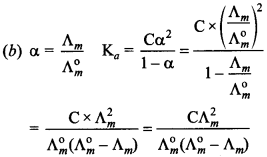
Chemistry MCQs for Class 12 with Answers Chapter 3 Electrochemistry 10


5. What is pH of the half cell Pt|H2fe)|H+ if \(\mathrm{E}_{\mathrm{H}^{+} \mathrm{H}_{2}}^{\circ}\) =-0.0295 V
(a) 1
(b)2
(c) 0.5
(d) 3

Answer/Explanation

Answer: c
Explaination:
Chemistry MCQs for Class 12 with Answers Chapter 3 Electrochemistry 11


6.
Chemistry MCQs for Class 12 with Answers Chapter 3 Electrochemistry 2
What is the value of ‘K’ for above reaction?
(a) 1 × 10⁸
(b) 1 × 10²
(c) 4 × 10³
(d) 3 × 10⁴

Answer/Explanation

Answer: b
Explaination:
Chemistry MCQs for Class 12 with Answers Chapter 3 Electrochemistry 12


7. Which of the following statement is correct?
(a) ECell and ∆rG of cell reaction both are extensive properties.
(b) ECell and ∆rG of cell reaction both are . intensive properties.
(c) ECell is an intensive property while ∆rG of cell reaction is an extensive property.
(d) ECell is an extensive property while ∆rG of cell reaction is an intensive property.

Answer/Explanation

Answer: c
Explaination:
(c) \(\mathrm{E}_{\mathrm{cell}}^{\circ}\) depends upon concentration (amount) of substance therefore, intensive property but AG is extensive property.


8. While charging the lead storage battery _________ . [NCERT Exemplar]
(a) PbSO4 anode is reduced to Pb.
(b) PbSO4 cathode is reduced to Pb.
(c) PbSO4 cathode is oxidised to Pb.
(d) PbSO4 anode is oxidised to PbO2.

Answer/Explanation

Answer: a
Explaination:
(a) 2PbSO4 + 2H2O → Pb + PbO2 + 2H2SO4


9. On the basis of following E°values, the strongest oxidising agent is
Chemistry MCQs for Class 12 with Answers Chapter 3 Electrochemistry 3

Answer/Explanation

Answer: b
Explaination:
(b) It is because \(\mathrm{E}_{\mathrm{Fe}^{3+} / \mathrm{Fe}^{2+}}\) = 0.77 V, it means Fe3+ can gain electron early to form Fe2+.


10. Λ of M/32 solution of weak acid is 8 S cm2 mol-1 and limiting molar conductivity is 400 S cm2 mol1. Ka for acid is
(a) 1.25 × 10⁻⁶
(b) 6.25× 10⁻⁴
(c) 1.25 × 10⁻⁴
(d) 1.25 × 10⁻⁵

Answer/Explanation

Answer: d
Explaination:
Chemistry MCQs for Class 12 with Answers Chapter 3 Electrochemistry 13
Chemistry MCQs for Class 12 with Answers Chapter 3 Electrochemistry 14


Note: In the following questions two or more options may be correct. (Q.11 to Q.14)
11. The positive value of the standard electrode potential of Cu2+/Cu indicates that _________ [NCERT Exemplar]
(a) this redox couple is a stronger reducing agent than the H+/H2 couple.
(b) this redox couple is a stronger oxidising agent than H+/H2.
(c) Cu can displace H2 from acid.
(id) Cu cannot displace H2 from acid.

Answer/Explanation

Answer: b
Explaination:
(b) and (d) are correct.
Cu is less reactive than H2 so cannot displace H2 from acid. Redox couple is good oxidising
agent as Cu2+ + 2e → Cu(s) is possible due to +ve emf.


12. \(\mathrm{E}_{\text {cell }}^{\circ}\) for some half cell reactions are given below. On the basis of these mark the correct answer. [NCERT Exemplar]
Chemistry MCQs for Class 12 with Answers Chapter 3 Electrochemistry 4
(a) In dilute sulphuric acid solution hydrogen ion will be reduced at cathode.
(b) In concentrated sulphuric acid solution, water will be oxidised at anode.
(c) In dilute sulphuric acid solution, water will be oxidised at anode.
(d) In dilute sulphuric acid solution, \(\mathrm{SO}_{4}^{2-}\) ion will be oxidised to tetrathionate ion at anode.

Answer/Explanation

Answer: a
Explaination:
(a) and (c) are correct.
Chemistry MCQs for Class 12 with Answers Chapter 3 Electrochemistry 15


13. \(\mathrm{E}_{\mathrm{Cell}}^{\ominus}\) = 1.1V for Daniel cell. Which of the following expressions are correct description of state of equilibrium in this cell? [NCERT Exemplar]
Chemistry MCQs for Class 12 with Answers Chapter 3 Electrochemistry 5

Answer/Explanation

Answer:
Explaination:
Chemistry MCQs for Class 12 with Answers Chapter 3 Electrochemistry 16


14.
Chemistry MCQs for Class 12 with Answers Chapter 3 Electrochemistry 6

Answer/Explanation

Answer:
Explaination:
Chemistry MCQs for Class 12 with Answers Chapter 3 Electrochemistry 17


15. The charge required for the reduction of 1 mol of MnO2 to MnO2 is
(a) 1 F
(b) 3 F
(c) 5 F
(d) 6 F

Answer

Answer: b


16. The cell reaction of the galvanic cell.
Chemistry MCQs for Class 12 with Answers Chapter 3 Electrochemistry 1

Answer

Answer: d


17. Which of the following reaction is used to make fuel cell?
Chemistry MCQs for Class 12 with Answers Chapter 3 Electrochemistry 2

Answer

Answer: c


18. If limiting molar conductivity of Ca2+ and Cl are 119.0 and 76.3 S cm2 mol-1, then the value of limiting molar conductivity of CaCl2 will be
(a) 195.3 S cm2 mol-1
(b) 271.6 S cm2 mol-1
(c) 43.3 S cm2 mol-1
(d) 314.3 S cm2 mol-1.

Answer

Answer: b


19. NH4NC>3 is used in salt bridge because
(a) it forms a jelly like material with agar-agar.
(b) it is a weak electrolyte.
(c) it is a good conductor of electricity.
(d) the transport number of NH4+ and NO3 ions are almost equal.

Answer

Answer: d


20.
Chemistry MCQs for Class 12 with Answers Chapter 3 Electrochemistry 3

Answer

Answer: b


21. The reaction, 3ClO (aq) → ClO3 (aq) + 2Cl (aq) is an example of
(a) Oxidation reaction
(b) Reduction reaction
(c) Disproportionation reaction
(d) Decomposition reaction

Answer

Answer: c


22. The emf of the cell:
Ni / Ni2+ (1.0 M) // Au3+ (1.0 M) / Au (E° = -0.25 V for Ni2+/Ni; E° = 1.5 V for Au3+/Au) is
(a) 1.25 V
(b) -1.25 V
(c) 1.75 V
(d) 2.0 V

Answer

Answer: c


23. The standard emf of a galvanic cell involving cell reaction with n = 2 is formed to be 0.295 V at 25° C. The equilibrium constant of the reaction would be
(a) 1.0 × 10¹⁰
(b) 2.0 × 10¹¹
(c) 4.0 × 10¹²
(d) 1.0 × 10²
[Given F = 96500 (mol-1); R = 8.314 JK-1 mol-1]

Answer

Answer: a


24. If E°Fe2+/Fe = -0.441 V and E°Fe2+/Fe2+ = 0.771 V, the standard EMF of the reaction,
Fe + 2Fe3+ → 3Fe2+ will be
(a) 1.212 V
(b) 0.111 V
(C) 0.330 V
(d) 1.653 V

Answer

Answer: a


25. Match the terms given in Column I with the units given in Column II. [NCERT Exemplar]
Chemistry MCQs for Class 12 with Answers Chapter 3 Electrochemistry 21

Answer/Explanation

Answer:
Explaination:
Chemistry MCQs for Class 12 with Answers Chapter 3 Electrochemistry 18


26. Match the terms given in Column I with the items given in Column II.
Chemistry MCQs for Class 12 with Answers Chapter 3 Electrochemistry 22

Answer/Explanation

Answer:
Explaination:
Chemistry MCQs for Class 12 with Answers Chapter 3 Electrochemistry 19


27. Match the items of Column I and Column II. [NCERT Exemplar]
Chemistry MCQs for Class 12 with Answers Chapter 3 Electrochemistry 23

Answer/Explanation

Answer:
Explaination:
(a) Lead storage battery-Pb is anode, Pb02 is cathode
(b) Mercury cell gives steady potential (Constant value)
(c) Fuel cell has maximum efficiency.
(d) Rusting is prevented by galvanisation.


Note: In the following questions a statement of assertion followed by a statement of reason is given. Choose the correct answer out of the following choices. (Q.18 to Q.20)
(а) Assertion and reason both are correct statements and reason is correct explanation for assertion.
(b) Assertion and reason both are correct statements but reason is not correct explanation for assertion.
(c) Assertion is correct statement but reason is wrong statement.
(d) Assertion is wrong statement but reason is correct statement.
28. Assertion: ECe|, should have a positive value for the cell to function.
Reason: Ecathode, < Eanode . [NCERT Exemplar]

Answer/Explanation

Answer: c
Explaination:
(c) Assertion is correct statement but reason is wrong statement.


29. Assertion: Am for weak electrolytes shows a sharp increase when the electrolytic solution is diluted.
Reason: For weak electrolytes degree of dissociation increases with dilution of solution. [NCERT Exemplar]

Answer/Explanation

Answer: a
Explaination:
(a) Assertion and reason both are correct statements and reason is correct explanation for assertion.


30. Assertion: For measuring resistance of an ionic solution an AC source is used.
Reason: Concentration of ionic solution will change if DC source is used. [NCERT Exemplar]

Answer/Explanation

Answer: a
Explaination:
(a) Assertion and reason both are correct statements and reason is correct explanation for assertion.


31. A° for weak electrolyte is determined by _________ .

Answer/Explanation

Answer:
Explaination: Kohlrausch law


32. The quantity of change required to obtain 1 mole of Al from Al2O3 is _________ .

Answer/Explanation

Answer:
Explaination: 3F


33. \(\frac{2}{3}\)Al2O3 → \(\frac{4}{3}\)Al + 2O2, number of moles of electrons gained or lost = _________ .

Answer/Explanation

Answer:
Explaination: n = 4


34. If \(\mathrm{E}_{\text {cell }}^{\circ}\) is -ve, cell will not work. [True/False]

Answer/Explanation

Answer:
Explaination: True.


35. If external emf opposing Daniel cell is less than 1.10 V, cell will keep in working. [True/False]

Answer/Explanation

Answer:
Explaination: True.


36. Salt bridge completes internal circuit and prevents accumulation of charges. [True/False]

Answer/Explanation

Answer:
Explaination: True.


37. Inert electrolyte in salt bridge reacts with solution of half cells. [True/False]

Answer/Explanation

Answer:
Explaination:
False, (Inert electrolyte does not react with any of the electrolyte present in half cell).


38. Represent the galvanic cell in which the reactions is
Zn(s) + Cu2+(aq) → Zn2+(aq) + Cu(s) [Delhi 2013(C)]

Answer/Explanation

Answer:
Explaination:
Zn | ZnSO4 (1M) || CuSO4 (1M) | Cu(s)


39. Consider the following diagram in which an electrochemical cell is coupled to an eletrolytic cell. What will be the polarity of electrodes ‘A’ and ‘B’ in the electrolytic cell?
Chemistry MCQs for Class 12 with Answers Chapter 3 Electrochemistry 7

Answer/Explanation

Answer:
Explaination:
‘A’ will have negative polarity, whereas ‘B’ will have positive polarity.


40. Can absolute electrode potential of an electrode be measured?

Answer/Explanation

Answer:
Explaination:
No, because electrode potential of a single electron cannot be mentioned.


41. The standard reduction potential for Zn2+(aq)/Zn(s) is – 0.76 V. Write the reactions occurring at the electrodes when coupled with NHE or SHE (standard hydrogen electrode).

Answer/Explanation

Answer:
Explaination:
Zn → Zn2+ + 2e is reaction at anode
when Zn is coupled with NHE or SHE (Standard Hydrogen Electrode).
2H+ + 2e → H2 at cathode.


42. E° (reduction potential) of Cu and Zn are + 0.34 V and – 0.76 V respectively. Which of them is stronger reducing agent?

Answer/Explanation

Answer:
Explaination:
Zn is stronger reducing agent because it has lower standard reduction potential than that of Cu.


43. Predict whether F2 and Na will react with one another. Give reason.
Chemistry MCQs for Class 12 with Answers Chapter 3 Electrochemistry 8

Answer/Explanation

Answer:
Explaination:
Chemistry MCQs for Class 12 with Answers Chapter 3 Electrochemistry 24
Since E°ell is +ve, ∆G° will be -ve, reaction will take place. Na will react with F2.


44. Write the correct representation of cell:
2Cr(s) + 3Cd2+(aq) → 2Cr3+(aq) + 3Cd(s)

Answer/Explanation

Answer:
Explaination:
Chemistry MCQs for Class 12 with Answers Chapter 3 Electrochemistry 25


45. Fe3+(aq) + e → Fe3+(aq), E° = +0.77 V
Cl2(g) + 2e → 2Cl(aq), E° = +1.36 V
Write the reaction which could be feasible using above half cells.

Answer/Explanation

Answer:
Explaination:
Chemistry MCQs for Class 12 with Answers Chapter 3 Electrochemistry 26


46. If E° for the reaction Fe3+(aq) + e → Fe2+(aq) is + 0.77 V, what will be E° value for the reaction 2Fe3+(aq) + 2e → 2Fe2+(aq)?

Answer/Explanation

Answer:
Explaination:
E° = 0.77 V, i.e. e.m.f. of cell will remain the same for reaction
Chemistry MCQs for Class 12 with Answers Chapter 3 Electrochemistry 27


47. Write Nemst equation for the following chemical reaction:
2Cr + 3Fe2+ → 2Cr3+ + 3Fe

Answer/Explanation

Answer:
Explaination:
Chemistry MCQs for Class 12 with Answers Chapter 3 Electrochemistry 28


48. Can \(\mathrm{E}_{\text {cell }}^{\circ}\) or ∆rG° for a cell reaction ever be equal to zero?

Answer/Explanation

Answer:
Explaination:
No, but Ecell or ArG of reaction can be zero at equilibrium.


49. Define specific conductivity (specific conductance).

Answer/Explanation

Answer:
Explaination:
Specific conductance is defined as the conductance of electrolyte when distance between electrodes is 1 cm and area of cross section is 1 cm². It is represented by Greek symbol ‘K’ (kappa) and it is expressed in S cm-1.


50. What is meant by cell constant? What is its use?

Answer/Explanation

Answer:
Explaination:
It is the ratio of distance between electrodes to the area of cross section. It is used to measure the resistance or conductivity of solution.


51. What do you mean by limiting molar conductivity?

Answer/Explanation

Answer:
Explaination:
When the concentration of electrolyte approaches zero, the molar conductivity is known as limiting molar conductivity (\(\Lambda_{m}^{\circ}\))
\(\Lambda_{m}^{\circ}\) = (Λm) when C → 0


52. Complete: Λ° Na2SO4 =

Answer/Explanation

Answer:
Explaination:
Chemistry MCQs for Class 12 with Answers Chapter 3 Electrochemistry 29


53. HCl does not give acidic solution in benzene. Why?

Answer/Explanation

Answer:
Explaination:
It does not dissociates ions in benzene (non-polar solvent).


54. How much charge in Faraday is required for the reduction of 1 mol of Ag+ to Ag? [AI 2015 Guwahati]

Answer/Explanation

Answer:
Explaination:
Ag+ + e → Ag(5)
1 Faraday of charge is required (charge on 1 mole of electrons).


55. How much charge is required for the reduction of 1 mole of Zn2+ to Zn? [AI 2015 Patna]

Answer/Explanation

Answer:
Explaination:
Zn2+ + 2e → Zn(s)
2 Faradays or 2 × 96500 C of charge is required.


56. How much charge in Faraday is required for reduction of 1 mole of Al3+ to AI? [AI 2015 Chennai & Trivandrum; DoE]

Answer/Explanation

Answer:
Explaination:
Al3+ + 3e → Al(s), i.e. 3 Faradays of charge is required.


57. How many Faradays of charge are required to convert:
1 mole of MnO4“ to Mn2+ ion,

Answer/Explanation

Answer:
Explaination:
Chemistry MCQs for Class 12 with Answers Chapter 3 Electrochemistry 20


58. What mass of zinc (II) ion will be reduced by 1 mole of electrons?

Answer/Explanation

Answer:
Explaination:
Zn2+(aq) + 2e → Zn(s)
∵ 2 Faradays, i.e. 2 moles of electrons will deposit 65 g of zinc
∴ 1 Faraday, i.e. 1 mole of electrons will deposit 32.5 g of zinc.


59. How many Faradays are required to liberate 2 moles of hydrogen gas in electrolysis of acidified water?

Answer/Explanation

Answer:
Explaination:
4 Faraday. 4H+ + 4e → 2H2(g)


60. What are the factors which depend on the products of electrolysis?

Answer/Explanation

Answer:
Explaination:
(i) The nature of material being used, and
(ii) The type of electrodes being used.


61. What is primary cell? Give an example.

Answer/Explanation

Answer:
Explaination:
It is a cell in which products cannot be changed back into reactants, i.e. it is not rechargeable, e.g. dry cell and mercury cell. In this cell, electrical energy is produced by the redox reaction occurring in the cell.


62. What are secondary cells? [AI 2014]

Answer/Explanation

Answer:
Explaination:
Those cells which are rechargeabe, i.e. products can be converted back into reactants.


63. Which electrolyte is used in fuel cell?

Answer/Explanation

Answer:
Explaination:
Concentrated aqueous KOH solution is used as an electrolyte in fuel cell.


64. Why does alkaline medium inhibit rusting of iron?

Answer/Explanation

Answer:
Explaination:
It will remove H+ which are essential for rusting.


65. What is the value of potential of SHE?

Answer/Explanation

Answer:
Explaination:
The potential of standard hydrogen electrode (SHE) is zero.


We hope the given Chemistry MCQs for Class 12 with Answers Chapter 3 Electrochemistry will help you. If you have any query regarding CBSE Class 12 Chemistry Electrochemistry MCQs Pdf, drop a comment below and we will get back to you at the earliest.

Chemistry MCQs for Class 12 with Answers Chapter 2 Solutions

Free PDF Download of CBSE Chemistry Multiple Choice Questions for Class 12 with Answers Chapter 2 Solutions. Chemistry MCQs for Class 12 Chapter Wise with Answers PDF Download was Prepared Based on Latest Exam Pattern. Students can solve NCERT Class 12 Chemistry Solutions MCQs Pdf with Answers to know their preparation level.

Solutions Class 12 Chemistry MCQs Pdf

1. The molality of pure water is
(a) 55.5
(b) 50.5
(c) 18
(d) 60.5

Answer/Explanation

Answer: a
Explaination:
(a) Molality = Number of moles/kg of solvent
Chemistry MCQs for Class 12 with Answers Chapter 2 Solutions 3


2. The number of moles of NaCl in 3 litres of 3M solution is
(a) 1
(b) 3
(c) 9
(d) 27

Answer/Explanation

Answer: c
Explaination:
(c) 3M solution means 3 moles in 1 litre.
∴ 9 moles in 3 litre.


3. 4L of 0.02 M aqueous solution of NaCl was diluted by adding one litre of water. The molality of the resultant solution is ________ .[NCERT Exemplar]
(a) 0.004
(b) 0.008
(c) 0.012
(d) 0.016

Answer/Explanation

Answer: d
Explaination:
(d) M1V1 = M2V2
0.02 × 4 = M2 × (4 + 1)
⇒ M2 = \(\frac{0.08}{5}\) = 0.016


4. Low concentration of oxygen in the blood and tissues of people living at high altitude is due to _________ .[NCERT Exemplar]
(a) low temperature
(b) low atmospheric pressure
(c) high atmospheric pressure
(d) both low temperature and high atmospheric pressure

Answer/Explanation

Answer: b
Explaination:
(b) Low atmospheric pressure will lead to low concentration of oxygen blood.


5. Considering the formation, breaking and strength of hydrogen bond, predict which of the following mixtures will show a positive deviation from Raoult’s law? [NCERT Exemplar]
(a) Methanol and acetone.
(b) Chloroform and acetone.
(c) Nitric acid and water.
(d) Phenol and aniline.

Answer/Explanation

Answer: a
Explaination:
(a) CH3OH and acetone, on mixing force of attraction will decrease.


6. Which of the following aqueous solutions should have the highest boiling point? [NCERT Exemplar]
(a) 1.0 M NaOH
(b) 1.0 M Na2SO4
(c) 1.0 M NH4NO3
(d) 1.0 M KNO3

Answer/Explanation

Answer: b
Explaination:
(b) Because i = 3, ∆Tb ∝ i, Boiling point ∝ ∆Tb.


7. In comparison to a 0.01 M solution of glucose, the depression in freezing point of a 0.01 M MgCl2 solution is _________ . [NCERT Exemplar]
(a) the same
(b) about twice
(c) about three times
(d) about six times

Answer/Explanation

Answer: c
Explaination:
(c) It will be nearly 3 times because number of particles in MgCl2 → Mg2+ + 2Cl are thrice than glucose.


8. An unripe mango placed in a concentrated salt solution to prepare pickle, shrivels because _________ . [NCERT Exemplar]
(a) it gains water due to osmosis.
(b) it loses water due to reverse osmosis.
(c) it gains water due to reverse osmosis.
(d) it loses water due to osmosis.

Answer/Explanation

Answer: b
Explaination:
(d) Concentrated salt solution is hypertonic solution, therefore, fluids inside mango will come out and it shrivels.


9. Which of the following statements is false? [NCERT Exemplar]
(а) Two different solutions of sucrose of same molality prepared in different solvents will have the same depression in freezing point.
(b) The osmotic pressure of a solution is given by the equation π = CRT (where C is the molarity of the solution).
(c) Decreasing order of osmotic pressure for 0.01 M aqueous solutions of barium chloride, potassium chloride, acetic acid and sucrose is
BaCl2 > KCl > CH3COOH > sucrose.
(d) According to Raoult’s law, the vapour pressure exerted by a volatile component of a solution is directly proportional to its mole fraction in the solution.

Answer/Explanation

Answer:
Explaination:
(a) is false because ∆Tf will depend upon nature of solvent and their Kf.


10. The value of Henry’s constant KH is _________ .[NCERT Exemplar]
(а) greater for gases with higher solubility.
(b) greater for gases with lower solubility.
(c) constant for all gases.
(d) not related to the solubility of gases.

Answer/Explanation

Answer:
Explaination:
(b) Higher the value of KH, lower will be solubility.


11. Consider the figure and mark the correct option. [NCERT Exemplar]
Chemistry MCQs for Class 12 with Answers Chapter 2 Solutions 1
(a) water will move from side (A) to side (B) if a pressure lower than osmotic pressure is applied on piston (B).
(b) water will move from side (B) to side (A) if a pressure greater than osmotic , pressure is applied on piston (B).
(c) water will move from side (B) to side (A) if a pressure equal to osmotic pressure is applied on piston (B).
(d) water will move from side (A) to side (B) if pressure equal to osmotic pressure is applied on piston (A).

Answer/Explanation

Answer: b
Explaination:
(b) Reverse osmosis will take place.


12. We have three aqueous solutions of NaCl labelled as ‘A’, ‘B’ and ‘C’ with concentrations 0.1M, 0.01M and 0.001M, respectively. The value of van’t Hoff factor for these solutions will be in the order __________ . [NCERT Exemplar]
(a) iA < iB < iC
(b) iA > iB > iC
(c) iA = iB = iC
(d) iA < iB > iC

Answer/Explanation

Answer: c
Explaination:
(c) van’t Hoff factor (i) does not depend upon concentration.


13. A solution containing 10 g per dm3 of urea (molar mass 60 g mol-1) is isotonic with 5% solution of non-volatile solute, MB of solute is
(a) 300 g mol-1
(b) 350 g mol-1
(c) 200 g mol-1
(d) 250 g mol-1

Answer/Explanation

Answer: a
Explaination:
(a) \(\frac{1}{60}=\frac{5}{x}\)
⇒ x = 300 g mol-1
1000 cm3 contains 10 g
100 cm3 contains 1 g, i.e., 1%.


14. Cone. H2SO4 is 98 % H2SO4 by mass has d = 1.84 g cm-3. Volume of acid required to make one litre of 0.1 M H2SO4 is
(a) 5.55 mL
(b) 10 mL
(c) 20 mL
(d) 30 mL

Answer/Explanation

Answer: a
Explaination:
Chemistry MCQs for Class 12 with Answers Chapter 2 Solutions 4


15. What is mole fraction of solute in 1.00 m aqueous solution?
(a) 0.0354
(b) 0.0177
(c) 0.177
(d) 1.770

Answer/Explanation

Answer: b
Explaination:
Chemistry MCQs for Class 12 with Answers Chapter 2 Solutions 5


16. When 1 mole of benzene is mixed with 1 mole of toluene (vapour pressure of benzene – 12.8 kPa, Toluene = 3.85 kPa)
(a) The vapour will contain equal amount of benzene and toluene.
(b) Not enough information is given for prediction.
(c) The vapour will contain a higher percentage of benzene.
(d) The vapour will contain higher percentage of toluene.

Answer/Explanation

Answer: c
Explaination:
(c) It is because benzene has high vapour pressure, it will form more vapours as compared to toluene.


17. At 100°C, the vapour pressure of a solution of 6.5 g of solute in 100 g of water is 732 mm. If Kb is 0.52 K/m, the boiling point of solution will be [HOTS]
(a) 102°C
(b) 103°C
(c) 101 °C
(d) 100°C

Answer/Explanation

Answer: c
Explaination:
Chemistry MCQs for Class 12 with Answers Chapter 2 Solutions 6


18. Which of the following is incorrect for an ideal solution?
(a) ∆Hmix =0
(b) ∆Vmix = 0
(c) ∆P = Pobs – Pcalculated = 0
(d) ∆Gmix = 0

Answer/Explanation

Answer: d
Explaination:
(d) ∆G cannot be equal to zero because mixing does not lead to equilibrium.


19. If molality of dilute solution is doubled, the value of molal depression constant (Kf) will be
(a) halved
(b) tripled
(c) unchanged
(d) doubled

Answer/Explanation

Answer: c
Explaination:
(c) Kf does not depend upon ‘mMt depends upon nature of solvent.


20. The temperature at which 10% aqueous solution of (W/V) of glucose will show the osmotic pressure of 16.4 atom is (R = 0.082 L atom K-1 mol-1)
(a) 360°C
(b) 180 K
(c) 300 K
(d) 360 K

Answer/Explanation

Answer: d
Explaination:
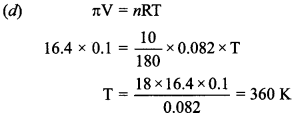
Chemistry MCQs for Class 12 with Answers Chapter 2 Solutions 7


21. Which has the highest freezing point?
(a) 1 M glucose
(b) 1 M NaCl
(c) 1 M CaCl2
(d) 1 M AlF3

Answer/Explanation

Answer: a
Explaination:
(a) 1 M glucose solution has highest freezing point because it has lowest ∆Tf because i = l.


Note: In the following questions two or more options may be correct. (Q.22 to Q.24)
22. Which of the following is correct. [NCERT Exemplar]
(a) KJJ increases with increase in temperature (KH is Henry’s law constant).
(b) Solubility of gas in liquid decreases with increases in temperature.
(c) KJJ decreases with increase in temperature.
(d) Solubility of gas in liquid increases with increase in temperature.

Answer/Explanation

Answer: a
Explaination:
(a) and (b) are correct pgas = KH × xgas
KH increases with increase in temperature, decreases, i.e., solubility of gas in liquid decreases with increase in temperature.


23. Benzoic acid, when dissolved in benzene, which of the following is correct. [NCERT Exemplar]
(a) The benzoic acid will undergo dissociation.
(b) The benzoic acid will undergo association.
(c) Observed molar mass of benzoic acid in benzene will less than normal molar mass.
(d) Observed molar mass of benzoic acid in benzene is more than normal molar mass.

Answer/Explanation

Answer: b
Explaination:
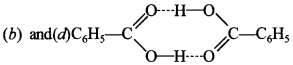
Chemistry MCQs for Class 12 with Answers Chapter 2 Solutions 8
Molar mass will be nearly double due to dimerisation.


24. Relative lowering of vapour pressure is a colligative property because ________ . [NCERT Exemplar]
(а) It depends on the concentration of a non electrolyte solute in solution and does not depend on the nature of the solute molecules.
(b) It depends on number of particles of electrolyte solute in solution and does not depend on the nature of the solute particles.
(c) It depends on the concentration of a non electrolyte solute in solution as well as on the nature of the solute molecules.
(d) It depends on the concentration of an electrolyte or nonelectrolyte solute in solution as well as on the nature of solute molecules.

Answer/Explanation

Answer: a
Explaination:
(a) and (b) colligative property depends upon number of particles of solute in both electrolyte and non-electrolyte.


25. Match the items given in Column I with the type of solutions given in Column II. [NCERT Exemplar]
Chemistry MCQs for Class 12 with Answers Chapter 2 Solutions 2

Answer/Explanation

Answer:
Explaination:
(a) – (v)
(b) – (iii)
(c) – (iv)
(d) – (ii)
(e) – (i)


26. In the following question a statement of assertion followed by a statement of reason is given. Choose the correct answer out of the following choices.
(a) Assertion and reason both are correct statements and reason is correct explanation for assertion.
(b) Assertion and reason both are correct statements but reason is not correct explanation for assertion.
(c) Assertion is correct statement but reason is wrong statement.
(d) Assertion and reason both are incorrect statements.
(e) Assertion is wrong statement but reason is correct statement.
Assertion: When methyl alcohol is added to water, boiling point of water increases. Reason: When a volatile solute is added to a volatile solvent elevation in boiling point is observed. [NCERT Exemplar]

Answer/Explanation

Answer: d
Explaination:
(d) Assertion and reason both are incorrect statements.


27. Mole fraction of glycerine C3H5(OH)3 in solution containing 36 g of water and 46 g of glycerine is
(a) 0.46
(b) 0.40
(c) 0.20
(d) 0.36

Answer

Answer: c


28. Out of molality (m), molarity (M), formality (F) and mole fraction (x), those which are independent of temperature are
(a) M, m
(b) F, x
(c) m, x
(d) M, x

Answer

Answer: c


29. Which of the following condition is not satisfied by an ideal solution?
(a) ΔHmixing = 0
(b) ΔVmixing = 0
(c) Raoult’s Law is obeyed
(d) Formation of an azeotropic mixture

Answer

Answer: d


30. The boiling point of an azeotropic mixture of water and ethanol is less than that of water and ethanol. The mixture shows
(a) no deviation from Raoult’s Law.
(b) positive deviation from Raoult’s Law.
(c) negative deviation from Raoult’s Law.
(d) that the solution is unsaturated.

Answer

Answer: b


31. Which has the lowest boiling point at 1 atm pressure?
(a) 0.1 M KCl
(b) 0.1 M Urea
(c) 0.1 M CaCl2
(d) 0.1 M A1Cl3

Answer

Answer: b


32. Osmotic pressure of a solution is 0.0821 atm at a temperature of 300 K. The concentration in moles/litre will be
(a) 0.33
(b) 0.666
(c) 0.3 × 10⁻²
(d) 3

Answer

Answer: c


33. People add sodium chloride to water while boiling eggs. This is to
(a) decrease the boiling point.
(b) increase the boiling point.
(c) prevent the breaking of eggs.
(d) make eggs tasty.

Answer

Answer: b


34. The van’t Hoff factor (i) accounts for
(a) degree of solubilisation of solute.
(b) the extent of dissociation of solute.
(c) the extent of dissolution of solute.
(d) the degree of decomposition of solution.

Answer

Answer: b


35. Which relationship is not correct?
Chemistry MCQs for Class 12 with Answers Chapter 2 Solutions

Answer

Answer: b


36. The molal elevation constant depends upon
(a) nature of solute.
(b) nature of the solvent.
(c) vapour pressure of the solution.
(d) enthalpy change.

Answer

Answer: b


37. The process used for desalination of water is _________ .

Answer/Explanation

Answer:
Explaination: reverse osmosis


38. Vapour pressure is _________ proportional to temperature.

Answer/Explanation

Answer:
Explaination: directly


39. Ethylene glycol is used as _________ .

Answer/Explanation

Answer:
Explaination: antifreeze


40. All intravenous injections must be isotonic with body fluids. [True/False]

Answer/Explanation

Answer:
Explaination: True.


41. Diabetic patients are likely to have high blood pressure. [True/False]

Answer/Explanation

Answer:
Explaination: True.


42. Common salt is non-electrolyte. [True/False]

Answer/Explanation

Answer:
Explaination: False, common salt is electrolyte.


43. State the main advantage of molality over molarity as the unit of concentration. [DoE]

Answer/Explanation

Answer:
Explaination:
Molality is more accurate than molarity because molality does not depend on temperature as mass does not change with temperature.


44. Define molality in terms of elevation in boiling point.

Answer/Explanation

Answer:
Explaination:
Molality is defined as the ratio of elevation in boiling point and KA (molal elevation constant).


45. State Raoulf s law for a solution containing volatile components. [Foreign 2012,11]

Answer/Explanation

Answer:
Explaination:
The vapour pressure of each component is directly proportional to the mole fraction of each component.
\(P_{A}=P_{A}^{\circ} x_{A}, P_{B}=P_{B}^{\circ} x_{B}\)
where PA and PB = Vapour pressure of components ‘A’ and ‘B’.
\(p_{A}^{\circ} \text { and } p_{B}^{\circ}\) = Vapour pressure of pure components ‘A’ and ‘B.
xA and xB = Mole fractions of ‘A’ and ‘B’.


46. Two liquids A and 5 boil at 145 °C and 190 °C respectively. Which of them has a higher vapour pressure at 80 °C?

Answer/Explanation

Answer:
Explaination:
‘A’ because lower the boiling point, higher will be vapour pressure.


47. What are the values of AH and AV for an ideal solution of two liquids?

Answer/Explanation

Answer:
Explaination:
∆H = 0, ∆V = 0 for an ideal solution of two liquids.


48. Give reason when 30 mL of ethyl alcohol and 30 mL of water are mixed, the volume of resulting solution is more than 60 mL.

Answer/Explanation

Answer:
Explaination:
It is because forces of attraction between ethyl alcohol and water are less than ethanol-ethanol and water-water. It shows positive deviation.


49. 10 mL of liquid A was mixed with 10 mL of liquid B. The volume of the resulting solution was found to be 19.9 mL. What do you conclude? [Delhi 2018(C) Blind]

Answer/Explanation

Answer:
Explaination:
It means solution shows -ve deviation from Raoult’s law due to increase in force of attraction, volume decreases, e.g. chloroform and acetone.


50. What are azeotropes? Give an example. [Delhi 2014]

Answer/Explanation

Answer:
Explaination:
Azeotropes are constant boiling mixtures which distill out unchanged in their composition, e.g. ethanol and water.


51. Define Ebullioscopic constant or molal elevation constant. [Foreign 2012; DoE]

Answer/Explanation

Answer:
Explaination:
Molal Elevation Constant (Ebullioscopic Constant): It is equal to elevation in boiling point of 1 molal solution, i.e. 1 mole of solute is dissolved in 1 kg of solvent. It is also called ebullioscopic constant. The units of Kb is K/m or °C/m or K kg mol-1, where ‘m’ is molality.


52. Calculate the freezing point of a solution containing 60 g of glucose (molar mass 180 g mol-1) in 250 g of water. [Kf for water = 1.86 K kg mol-1] [CBSE 2018]

Answer/Explanation

Answer:
Explaination:
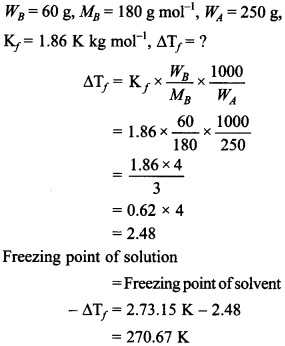
Chemistry MCQs for Class 12 with Answers Chapter 2 Solutions 9


53. What is anti-freeze?

Answer/Explanation

Answer:
Explaination:
Anti-freeze is a substance which is added to solvent to lower its freezing point. It is used in car radiators to lower the freezing point of water, e.g. ethylene glycol.


54. What is ‘semipermeable’ membrane?

Answer/Explanation

Answer:
Explaination:
It is the membrane which has sub- microscopic pores through which small solvent molecules like water can pass but bigger solute particles cannot pass.


55. Define osmotic pressure. [AI 2013; DoE]

Answer/Explanation

Answer:
Explaination:
It is the extra pressure which must be applied on solution side so as to prevent the flow of solvent molecules from solution through semipermeable membrane.


56. Measurement of which colligative property is preferred for determination of molar mass 112 la^etAen- Objective Type Questions of macromolecules such as proteins and polymers. [Foreign 2013,17; DoE; CBSE 2016,18]

Answer/Explanation

Answer:
Explaination: Osmotic pressure.


57. A person suffering from high blood pressure should take less common salt, why? [DoE]

Answer/Explanation

Answer:
Explaination:
Common salt contains Na+ and Cl which increase osmotic pressure of blood, therefore, increase blood pressure.


58. What is meant by ‘reverse osmosis’? [AI 2011; DoE]

Answer/Explanation

Answer:
Explaination:
Reverse Osmosis: If extra pressure is applied on the solution side and exceeds the osmotic pressure, the osmosis can be reversed. That is, pure water can be forced out of the solution to pass through the pores of the membrane in the opposite direction. This is called reverse osmosis.


59. Give an example of a material used for making semipermeable membrane for carrying out reverse osmosis.

Answer/Explanation

Answer:
Explaination: Cellulose acetate.


60. A 10% solution of urea is isotonic with 20% solution of V at same temperature. Calculate molecular weight of x.

Answer/Explanation

Answer:
Explaination:


61. Why do doctors advise gargles by saline water in case of sore throat? [HOTS]

Answer/Explanation

Answer:
Explaination:
Saline water is hypertonic solution, therefore, fluids causing irritation in throat will come out.


62. When outer shell of two eggs are removed, one of the eggs is placed in pure water and other is placed in saturated solution of NaCl, what will be observed and why? [HOTS]

Answer/Explanation

Answer:
Explaination:
The egg placed in pure water will swell, whereas the egg placed in saturated solution of NaCl will shrink.


63. Of 0.1 molal solutions of glucose and potassium chloride respectively, which one will have a higher boiling point? [CBSE 2018]

Answer/Explanation

Answer:
Explaination:
0.1 molal KC1 solution will have higher boiling point because KC1 dissociates into K+ and CF ions, therefore, number of particles will be doubled.


64. What is expected value of van’t Hoff factor for K3[Fe(CN)6].

Answer/Explanation

Answer:
Explaination:
Chemistry MCQs for Class 12 with Answers Chapter 2 Solutions 10


65. What would be the value of van’t Hoff factor for a dilute solution of K2SO4 in water?

Answer/Explanation

Answer:
Explaination:
Chemistry MCQs for Class 12 with Answers Chapter 2 Solutions 11


66. In the determination of molar mass of A+ B using a colligative property, what may be the value of van’t Hoff factor if the solute is 50% dissociated?

Answer/Explanation

Answer:
Explaination:
Chemistry MCQs for Class 12 with Answers Chapter 2 Solutions 12


67. What possible value of ‘i’ will it have if solute molecules undergo association in solution? [AI 2014(C)]

Answer/Explanation

Answer:
Explaination:
i < 1, if solute molecules undergo association.


68. Predict whether van’t Hoff factor, (i) is less than one or greater than one in the following:
(i) CH3COOH dissolved in water.
(ii) CH3COOH dissolved in benzene. [Chennai 2019]

Answer/Explanation

Answer:
Explaination:
(i) It will be more than 1 because
CH3COOH will dissociate into CH3COO and H+.
(ii) CH3COOH dissolved in benzene will form dimer i.e. undergo association, therefore, i < 1.


69. Why is osmotic pressure of l M KCl is higher than that of l M urea solution?

Answer/Explanation

Answer:
Explaination:
l M KCl solution dissociates into K+ and Cl, therefore, its osmotic pressure is higher than that of l M solution of urea which does not dissociate.


70. State how does osmotic pressure vary with temperature.

Answer/Explanation

Answer:
Explaination:
Osmotic pressure increases with increase in temperature.


We hope the given Chemistry MCQs for Class 12 with Answers Chapter 2 Solutions will help you. If you have any query regarding CBSE Class 12 Chemistry Solutions MCQs Pdf, drop a comment below and we will get back to you at the earliest.

Physics MCQs for Class 12 with Answers Chapter 8 Electromagnetic Waves

Free PDF Download of CBSE Physics Multiple Choice Questions for Class 12 with Answers Chapter 8 Electromagnetic Waves. Physics MCQs for Class 12 Chapter Wise with Answers PDF Download was Prepared Based on Latest Exam Pattern. Students can solve NCERT Class 12 Physics Electromagnetic Waves MCQs Pdf with Answers to know their preparation level.

Electromagnetic Waves Class 12 Physics MCQs Pdf

1. Which of the following has minimum wavelength?
(a) Blue light
(b) γ-rays
(c) infrared rays
(d) microwave

Answer/Explanation

Answer: b
Explaination:
(b) γ-rays have maximum frequency so minimum wavelength among electromagnetic waves.


2. Which of the following has maximum penetrating power?
(a) Ultraviolet radiation
(b) Microwaves
(c) γ-rays
(d) Radio waves

Answer/Explanation

Answer: c
Explaination:
(c) γ-rays have maximum frequency and energy of proton, therefore maximum penetrating power.


3. Electromagnetic waves travelling in a medium having relative permeability μr = 1.3 and relative permittivity Er = 2.14. The speed of electromagnetic waves in medium must be
(a) 1.8 × 10⁸ ms-1
(b) 1.8 × 10⁴ms1
(c) 1.8 × 10⁶ms1
(d) 1.8 × 10² ms-1

Answer/Explanation

Answer: a
Explaination: (a) speed of emw
Physics MCQs for Class 12 with Answers Chapter 8 Electromagnetic Waves 8


4. In electromagnetic waves the phase difference between electric and magnetic field vectors are
(a) zero
(b) \(\frac{\pi}{4}\)
(c) \(\frac{\pi}{2}\)
(d) π

Answer/Explanation

Answer: a
Explaination: (a) Electric and magnetic field vectors always vary in same phase.


5. The quantity \(\sqrt{\mu_{0} \varepsilon_{0}}\) represents
(a) speed of sound
(b) speed of light in vacuum
(c) speed of e.m.w.
(d) inverse of speed of light in vacuum

Answer/Explanation

Answer: d
Explaination: (d) Speed of light in vacuum, \(c=\frac{1}{\sqrt{\varepsilon_{0} \mu_{0}}}\)


6. In electromagnetic wave if ue and um are mean electric and magnetic energy densities respectively, then
Physics MCQs for Class 12 with Answers Chapter 8 Electromagnetic Waves 5

Answer/Explanation

Answer: a
Explaination: (a) Energy is equally distributed among electric field and magnetic field


7. Which of the following is called heat radiation?
(a) X-rays
(b) γ-rays
(c) Infrared radiation
(d) Microwave

Answer

Answer: c


8. From Maxwell’s hypothesis, a charging electric field gives rise to
(a) an electric field.
(b) an induced emf.
(c) a magnetic field.
(d) a magnetic dipole.

Answer/Explanation

Answer: c
Explaination: (c) A charging electric field gives rise to a magnetic field.


9. Electromagnetic waves are transverse in nature is evident by
(a) polarisation.
(b) interference,
(c) reflection.
(d) diffraction.

Answer/Explanation

Answer: a
Explaination: (a) Only transverse waves can be polarised.


10. Which of the following are not electromagnetic waves?
(a) Cosmic rays
(b) γ-rays
(c) β-rays
(d) X-rays

Answer/Explanation

Answer: c
Explaination: (c) β-rays consists of electrons which are not electromagnetic nature.


11. 10 cm is a wavelength corresponding to the spectrum of
ia) infraredrays
(b) ultraviolet rays
(c) microwaves
(d) X-rays

Answer/Explanation

Answer: c
Explaination: (c) Microwaves have wavelength around 10 cm.


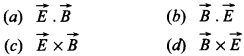
12. If \(\vec{E}\) and \(\vec{B}\) represent electric and magnetic field vector of the electromagnetic waves then the direction of propagation of the em wave is that of
Physics MCQs for Class 12 with Answers Chapter 8 Electromagnetic Waves 6

Answer/Explanation

Answer: c
Explaination: (c) \(\vec{E} \times \vec{B}\)


13. The structure of solids is investigated by using
(a) cosmic rays
(b) X-rays
(c) γ-rays
(d) infrared rays

Answer/Explanation

Answer: b
Explaination: (b) X-rays are used to investigate structure of solids.


14. The condition under which a microwave over heats up a food item containing water molecules most efficiently is
(a) The frequency of the microwaves must match the resonant frequency of the water molecules.
(b) The frequency of the microwaves has no relation with natural frequency of the water molecules.
(c) Microwaves are heat waves, so always produce heating.
(d) Infrared waves produce heating in a microwave oven.

Answer/Explanation

Answer: a
Explaination:
(a) When frequency of microwave matches with frequency of water molecules i.e., resonant condition. Maximum energy is transferred to water molecules as their K.E. energy.


15. Which radiations are used in treatment of muscle ache?
(a) Infrared
(b) Ultraviolet
(c) Microwave
(d) X-rays

Answer/Explanation

Answer: a
Explaination:
(a) Infrared radiations are used in the treatment of muscle ache.


16. The correct option, if speeds of gamma rays, X-rays and microwave are Vg, Vx and Vm respectively will be.
(a) Vg > Vx > Vm
(b) Vg < Vx < Vm
(c) Vg > Vx > Vm
(d) Vg = Vx = Vm

Answer/Explanation

Answer: d
Explaination: (d) All electromagnetic waves travel with the speed of light in space.


17. Waves in decreasing order of their wavelength are
(a) X-rays, infrared rays, visible rays, radio waves
(b) radio waves, visible rays, infrared rays, X-rays.
(c) radio waves, infrared rays, visible rays, X-rays.
(d) radio waves, ultraviolet rays, visible rays, X-rays.

Answer

Answer: c


18. The electric field associated with an e.m wave in vacuum is given by \(\vec{E}\) =40 cos (kz – 6 × 10⁸) \(\vec{i}\), where E, Z and t are in volt/m, metre and seconds respectively. The value of wave vector K is
(a) 2 m-1
(b) 0.5 m-1
(c) 6 m-1
(d) 3 m-1

Answer/Explanation

Answer: a
Explaination:
(a) Wave vector, \(k=\frac{W}{C}=\frac{6 \times 10^{8}}{3 \times 10^{8}}=2 \mathrm{m}^{-1}\)


19. Electromagnetic waves with wavelength λ are used by a FM radio station for broadcasting. Here λ belongs to
(a) radio waves
(b) VHF radio waves
(c) UHF radio waves
(d) microwaves

Answer

Answer: b


20. The oscillating magnetic field in a plane electromagnetic wave is given as By = (8 × 10⁻⁶) sin [2 × 10¹¹t+ 300πx] T, wavelength of the em wave is
(a) 0.80 cm
(b) 1 × 10³m
(c) 2 × 10⁻²cm
(d) 0.67 cm

Answer/Explanation

Answer: d
Explaination:
(d) wavelength \(\lambda=\frac{2 \pi}{300 \pi}=\frac{1}{150} \mathrm{m}\)
= 0.67 cm


21. Maxwell in his famous equations of electromagnetism introduced the concept of
(a) ac current
(b) displacement current
(c) impedance
(d) reactance

Answer

Answer: b


22. The conduction current is same as displacement current when source is
(a) ac only
(b) dc only
(c) either ac or dc
(d) neither dc nor ac

Answer

Answer: c


23. If a variable frequency ac source is connected to a capacitor then with decrease in frequency the displacement current will
(a) increase
(b) decrease
(c) remains constant
(d) first decrease then increase

Answer

Answer: b


24. An electromagnetic wave can be produced, when charge is
(a) moving with a constant velocity
(b) moving in a circular orbit
(c) falling in an electric field
(d) both (b) and (c)

Answer

Answer: d


25. Which of the following statement is false for the properties of electromagnetic waves?
(a) Both electric and magnetic field vectors attain the maxima and minima at the same place and same time.
(b) The energy in electromagnetic waves is divided equally between electric and magnetic field vectors.
(c) Both electric and magnetic field vectors are parallel to each other and perpendicular to the direction of propagation of wave.
(d) These waves do not require any material medium for propagation.

Answer

Answer: c


26. Which of the following has/have zero average value in a plane electromagnetic wave?
(a) Both magnetic and electric fields
(b) Electric field only
(c) Magnetic field only
(d) None of these

Answer

Answer: a


27. A charged particle oscillates about its mean equilibrium position with a frequency of 109 Hz. The frequency of electromagnetic waves produced by the oscillator is
(a) 106 Hz
(b) 107 Hz
(c) 108 Hz
(d) 109 Hz

Answer

Answer: d


28. If E and B denote electric and magnetic fields respectively, which of the following is dimensionless?
Physics MCQs for Class 12 with Answers Chapter 8 Electromagnetic Waves

Answer

Answer: a


29. The ultra high frequency band of radio waves in electromagnetic wave is used as in
(a) television waves
(b) cellular phone communication
(c) commercial FM radio
(d) both (a) and (c)

Answer

Answer: b


30. The waves used by artificial satellites for communication is
(a) microwaves
(b) infrared waves
(c) radio waves
(d) X-rays

Answer

Answer: a


31. Which of the following electromagnetic waves is used in medicine to destroy cancer cells?
(a) IR-rays
(b) Visible rays
(c) Gamma rays
(d) Ultraviolet rays

Answer

Answer: c


32. A linearly polarized electromagnetic wave given as E = E0 \(\hat{i}\) cos (kz – ωt) is incident normally on a perfectly reflecting infinite wall at z = a. Assuming that the material of the wall is optically inactive, the reflected wave will be given as [NCERT Exemplar]
(a) Er = -E0 \(\hat{i}\) cos (kz – ωt).
(b) Er = E0 \(\hat{i}\) cos (kz + ωt).
(c) Er = -E0 \(\hat{i}\) cos (kz + ωt).
(d) Er = E0 \(\hat{i}\) sin (kz – ωt).

Answer

Answer: b


33. Light with an energy flux of 20 W/cm2 falls on a non-reflecting surface at normal incidence. If the surface has an area of 30 cm2, the total momentum delivered (for complete absorption) during 30 minutes is , [NCERT Exemplar]
(a) 36 × 10-5 kg m/s.
(b) 36 × 10-4 kg m/s.
(c) 108 × 104 kgm/s.
(d) 1.08 × 10⁷ kg m/s.

Answer

Answer: b


34. The electric field intensity produced by the radiations coming from 100 W bulb at a 3 m distance is E. The electric field intensity produced by the radiations coming from 50 W bulb at the same distance is [NCERT Exemplar]
Physics MCQs for Class 12 with Answers Chapter 8 Electromagnetic Waves 2

Answer

Answer: d


35. If E and B represent electric and magnetic field vectors of the electromagnetic wave, the direction of propagation of electromagnetic wave is along [NCERT Exemplar]
(a) E.
(b) B.
(c) B × E.
(d) E × B.

Answer

Answer: d


36. An EM wave radiates outwards from a dipole antenna, with E0 as the amplitude of its electric field vector. The electric field E0 which transports significant energy from the [NCERT Exemplar]
Physics MCQs for Class 12 with Answers Chapter 8 Electromagnetic Waves 3

Answer

Answer: c


37. An electromognetic wave travels in vacuum along z direction: E = (E{i + E2j) cos(kz – cot). Choose the correct optinons from the following:
Physics MCQs for Class 12 with Answers Chapter 8 Electromagnetic Waves 4
(c) The given electromagnetic field is circularly polarised.
(d) The given electromagnetic wave is unpolarised.

Answer

Answer: a


38. An electromagnetic wave travelling along z-axis is given as-E=E0 cos (kz – cot). Choose the incorrect option from the following;
(a) The associated magnetic field is given as B = \(\frac{1}{c}\)\(\hat{k}\) × E = \(\frac{1}{\omega}\)(\(\hat{k}\) × E)
(b) The electromagnetic field can be written in terms of the associated magnetic field as E = c(B × \(\hat{k}\))
(c) \(\hat{k}\).E = 0, \(\hat{k}\).B =0.
(d) \(\hat{k}\) × E = 0, k\(\hat{k}\) × B = 0.

Answer

Answer: d


39. A plane electromagnetic wave propagating along x direction can have the following pairs of Eand B
(a) Ex,By.
(b) Ey, Bz.
(c) Bx, Ey.
(d) None of these

Answer

Answer: b


40. A charged particle oscillates about its mean equilibrium position with a frequency of 109 Hz. For producing electromagnetic waves which one is not true?
(a) They will have frequency of 109 Hz.
(b) They will have frequency of 2 × 10⁹ Hz.
(c) They will have a wavelength of 0.3 m.
(d) They fall in the region of radio waves.

Answer

Answer: b


41. The source of electromagnetic waves can be a charge
(a) moving with a constant velocity.
(b) moving in a circular orbit.
(c) at rest.
(d) falling in a magnetic field.

Answer

Answer: b


42. One requires 11 eV of energy to dissociate a carbon monoxide molecule into carbon and oxygen atoms. The minimum frequency of the appropriate electromagnetic radiation to achieve the dissociation lies in [NCERT Exemplar]
(a) visible region.
(b) infrared region.
(c) ultraviolet region.
(d) microwave region.

Answer

Answer: c


43. The ratio of contributions made by the electric field and magnetic field components to the intensity of an EM wave is [NCERT Exemplar]
(a) c : 1
(6) c² : 1
(c) 1 : 1
(d) √c : 1

Answer

Answer: c


44. An EM wave of intensity I falls on a surface kept in vacuum and exerts radiation pressure p on it. Which of the following is not true? [NCERT Exemplar]
(a) Radiation pressure is I/c if the wave is totally absorbed.
(b) Radiation pressure is I/c if the wave is totally reflected.
(c) Radiation pressure is 2I/c if the wave is totally reflected.
(d) Radiation pressure is in the range I/c < p < 2I/c for real surfaces.

Answer/Explanation

Answer: b


45. Speed of electromagnetic wave related to electric field and magnetic field vector in vacuum.
Physics MCQs for Class 12 with Answers Chapter 8 Electromagnetic Waves 7

Answer

Answer: a


46. Which of the following statement is false for the properties of em waves?
(a) The energy of em wave is divided equally between electric and magnetic fields.
(b) Both electric and magnetic field vectors are parallel to each and perpendicular to the direction of propagation of wave.
(c) These waves do not require any material medium for propagation.
(d) Both electric and magnetic field vectors attain the maximum and minimum at the same place and same time.

Answer/Explanation

Answer: d
Explaination:
(b) Electric and magnetic field vectors are mutually perpendicular to each other directed along the propagation of wave.


47. Electromagnetic waves possess both ________ and ________ .

Answer/Explanation

Answer:
Explaination: energy, momentum


48. Electromagnetic waves produced by bombard ment of high energy electrons on a metal target is ________ .

Answer/Explanation

Answer:
Explaination: X-rays


49. Electromagnetic waves used in RADAR are ________ .

Answer/Explanation

Answer:
Explaination: microwaves


50. Displacement current is produced in the region of changing ________ .

Answer/Explanation

Answer:
Explaination: displacement current


51. Ampere-Maxwell’s law states that line integral of magnetic field along the boundary of a closed path is equal to ________ .

Answer/Explanation

Answer:
Explaination: μ0(Ic + Id)


52. Displacement current across a capacitor is ________ to conduction current in connecting wires.

Answer/Explanation

Answer:
Explaination: equal


53. Electromagnetic waves are produced by ________ electric charge.

Answer/Explanation

Answer:
Explaination: oscillating


54. To which part of the electromagnetic spectrum does a wave of frequency 5 × 10¹⁹ Hz belong? [AI 2014]

Answer/Explanation

Answer:
Explaination: The wave of frequency 5 × 10¹⁹ Hz corresponds to X-rays or γ-region of the em spectrum.


55. How are infrared waves produced? What is the range of their wavelength?

Answer/Explanation

Answer:
Explaination:
Infrared waves are produced by hot bodies due to the vibrations of the atoms and molecules. Their wavelength ranges from, 1 mm to 700 nm.


56. Write two uses of X-rays. [Foreign 2011]

Answer/Explanation

Answer:
Explaination:
(i) X-rays are used as a diagnostic tool in medicine.
(ii) X-rays are used in the treatment of certain forms of cancer.


57. How are microwaves produced? [AI 2011]

Answer/Explanation

Answer:
Explaination:
Microwaves are produced by special vacuum tubes like klystrons, magnetrons and gunn diodes.


58. What are the directions of electric and magnetic field vectors relative to each other and relative to the direction of propagation of electromagnetic waves?

Answer/Explanation

Answer:
Explaination: Mutually perpendicular.


59. Name the part of electromagnetic spectrum whose wavelength lies in the range of 10-10 m. Give its one use.

Answer/Explanation

Answer:
Explaination: X-rays. X-rays are used as a diagnostic tool in medicine.


60. Which part of electromagnetic spectrum has largest penetrating power?

Answer/Explanation

Answer:
Explaination: γ-rays.


61. What is the frequency of electromagnetic waves produced by oscillating charge of frequency v? [Delhi 2011C]

Answer/Explanation

Answer:
Explaination: The frequency of electromagnetic waves produced by an oscillating charge of frequency v is also v.


62. A capacitor has been charged by a dc source. What are the magnitudes of conduction and displacement currents, when it is fully charged? [Delhi 2013]

Answer/Explanation

Answer:
Explaination: Conduction current and displacement current both are zero.


63. How are radio waves produced? [AI 2011]

Answer/Explanation

Answer:
Explaination: By rapid acceleration and deceleration of electrons in conducting wires.


64. Which part of electromagnetic spectrum is absorbed from sunlight by ozone layer?

Answer/Explanation

Answer:
Explaination: Ultraviolet rays.


65. Welders wear special goggles or face masks with glass windows to protect their eyes from electromagnetic radiations. Name the radiations and write the range of their frequency. [AI 2013]

Answer/Explanation

Answer:
Explaination:
Ultraviolet rays (UV rays)
The frequency range of UV rays is 0.75 × 10¹⁵ Hz to 0.5 × 10¹⁸ Hz.


66. Name the electromagnetic radiations used for
(a) water purification, and
(b) eye surgery. [CBSE 2018]

Answer/Explanation

Answer:
Explaination: UV rays in both the cases.


67. Write two uses of infrared rays. [Foreign 2011]

Answer/Explanation

Answer:
Explaination:
(i) In electronic devices.
(ii) Infrared lamps are used in physical therapy.


68. The speed of an electromagnetic wave in a material medium is given by v = \(\frac{1}{\sqrt{\mu \varepsilon}}\), μ being the permeability of the medium and ε its permittivity. How does its frequency change? [AI2012]

Answer/Explanation

Answer:
Explaination: It will remain same.


69. Name the electromagnetic waves, which
(i) maintain the Earth’s warmth, and
(ii) are used in aircraft navigation. [Foreign 2012]

Answer/Explanation

Answer:
Explaination: (i) Infrared (ii) Microwaves


70. How are X-rays produced? [AI 2011]

Answer/Explanation

Answer:
Explaination: By bombarding a metal target by high energy electrons.


71. Arrange the following electromagnetic waves in order of increasing frequency:
γ-rays, microwaves, infrared rays and ultraviolet rays. [Foreign 2014]

Answer/Explanation

Answer:
Explaination: γ-rays > ultraviolet rays > infrared rays > microwaves.


72. What oscillates in electromagnetic waves? Are these waves transverse or longitudinal? [CBSE Sample Paper 2011]

Answer/Explanation

Answer:
Explaination:
(i) The electric and magnetic fields oscillate in mutually perpendicular directions in electromagnetic waves.
(ii) Electromagnetic waves are transverse in nature.


73. Name em radiations used for detecting fake currency notes.

Answer/Explanation

Answer:
Explaination: UV radiation.


74. Write the expression for speed of electromagnetic waves in a medium of electrical permittivity e and magnetic permeability μ. [Foreign 2017]

Answer/Explanation

Answer:
Explaination:
Speed of electromagnetic waves in a medium is given by \(v=\frac{1}{\sqrt{\mu \varepsilon}}\)


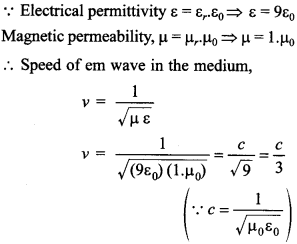
75. The relative electric permittivity of a medium is 9 and the relative permeability is close to unity. What is the speed of em waves in the medium?

Answer/Explanation

Answer:
Explaination:
Physics MCQs for Class 12 with Answers Chapter 8 Electromagnetic Waves 9


76. Let the wavelengths of the electromagnetic waves used quite often for
(i) killing germs in household water purifiers,
(ii) remote sensing
(iii) treatment of cancer, be labelled as λ1, λ2 and λ3 in increasing order. [CBSE Sample Paper 2011]

Answer/Explanation

Answer:
Explaination:
(i) UV radiation (λ1),
(ii) Microwaves (λ2),
(iii) γ-rays (λ3)
The increasing order of wavelength is λ3 < λ1 < λ2.


77. Why are microwaves used in radar?

Answer/Explanation

Answer:
Explaination:
Microwaves have the wavelengths of the order of a few millimetres. Due to their short wavelengths, they are not diffracted easily, and can travel longer distances.


78. Is the ratio of frequencies of ultraviolet rays and infrared rays in glass more than, less than or equal to 1?

Answer/Explanation

Answer:
Explaination:
More than 1, because the frequency of ultraviolet rays is greater than that of infrared rays.


79. For which frequency of light, the human eye is most sensitive?

Answer/Explanation

Answer:
Explaination:
Human eye is sensitive to the light of wavelength, X = 555 nm. So, its frequency is
Physics MCQs for Class 12 with Answers Chapter 8 Electromagnetic Waves 10


80. What is the time period of visible light for which human eye is most sensitive?

Answer/Explanation

Answer:
Explaination:
Physics MCQs for Class 12 with Answers Chapter 8 Electromagnetic Waves 11


81. The velocity of propagation (in vacuum) and the frequency of (i) X-rays and (ii) radiowaves are denoted by (vx, nx) and (vR, nR) respectively.
How do the values of
(a) vx and vR
(b) nx and nR, compare with each other?

Answer/Explanation

Answer:
Explaination: (a) vx = vR (b) nx > nR


82. In which directions do the electric and magnetic field vectors oscillate in an electromagnetic wave propagating along the x-axis? [AI 2017]

Answer/Explanation

Answer:
Explaination: y-axis and z-axis respectively.


83. Which of the following, if any, can act as a source of electromagnetic waves?
(i) A charge moving with a constant velocity.
(ii) A charge moving in a circular orbit.
(iii) A charge at rest. [DoE]

Answer/Explanation

Answer:
Explaination: (ii) A charge moving in a circular orbit


84. What is the phase difference between electric and magnetic field vectors in an em wave? [DoE]

Answer/Explanation

Answer:
Explaination: Zero


85. What feature of electromagnetic waves led Maxwell to conclude that light itself is an electromagnetic wave?

Answer/Explanation

Answer:
Explaination:
The feature of electromagnetic waves is the emergence of the speed of light from purely electromagnetic consideration which led Maxwell to conclude that light itself is an electromagnetic wave.


86. What evidence is there that sound is not electromagnetic in nature?

Answer/Explanation

Answer:
Explaination:
Sound wave requires an inertial medium for their propagation which shows that sound is not electromagnetic in nature.


87. Do electromagnetic waves carry energy and momentum? [Dehradun-2019] [AI 2017]

Answer/Explanation

Answer:
Explaination:
Yes. For example, the tail of the comet always stays away from the sun due to the radiation pressure exerted on the tail by the light.


88. Why is the velocity of all types of electromagnetic waves same in free space?

Answer/Explanation

Answer:
Explaination:
The speed of em wave in free space is given by \(c=\frac{1}{\sqrt{\mu_{0} \varepsilon_{0}}}\). The value of c is same for all types of em waves because the constants μ0 and ε0 do not depend on the frequency or wavelength of the em waves. They only depend on the medium.


89. How is the speed of em-waves in vacuum determined by the electric and magnetic fields? [Delhi 2017]

Answer/Explanation

Answer:
Explaination: The speed v of e-m waves in vacuum is determined by the relation|
Physics MCQs for Class 12 with Answers Chapter 8 Electromagnetic Waves 12


90. What is the main difference between characteristic X-rays and γ-rays?

Answer/Explanation

Answer:
Explaination:
Characteristic X-rays are emitted when an orbital electron jumps from a higher energy level to a lower energy level in the atom of high mass number, whereas γ-rays are emitted by radioactive nuclei.


91. Out of microwaves, ultraviolet rays and infrared rays, which radiation will be most effective for emission of electrons from a metallic surface?

Answer/Explanation

Answer:
Explaination:
Ultraviolet rays will be most effective for emission of electrons because these rays have the highest frequency and hence more energetic.


We hope the given Physics MCQs for Class 12 with Answers Chapter 8 Electromagnetic Waves will help you. If you have any query regarding CBSE Class 12 Physics Electromagnetic Waves MCQs Pdf, drop a comment below and we will get back to you at the earliest.

Physics MCQs for Class 12 with Answers Chapter 7 Alternating Current

Free PDF Download of CBSE Physics Multiple Choice Questions for Class 12 with Answers Chapter 7 Alternating Current. Physics MCQs for Class 12 Chapter Wise with Answers PDF Download was Prepared Based on Latest Exam Pattern. Students can solve NCERT Class 12 Physics Alternating Current MCQs Pdf with Answers to know their preparation level.

Alternating Current Class 12 Physics MCQs Pdf

1. The phase difference between the alternating current and emf is TE/2. Which ofthe following cannot be the constituent of the circuit?
(a) C alone
(b) L alone
(c) L and C
(d) R and L

Answer/Explanation

Answer: c
Explaination:
(c) When both L and C components are there then phase difference could be zero, less than or greater than \(\frac{\pi}{2}\).


2. In an LCR-series ac circuit, the voltage across each of the component L, C and R is 50 V. The voltage across the LC-combination will be
(a) 50 V
(b) 50√2 V
(c) 100 V
(d) zero

Answer/Explanation

Answer: d
Explaination:
(d) The voltage across L and C are out of phase. Hence the voltage across the LC combination is zero.


Physics MCQs with Answers for Class 12 Question 3. An ac circuit has a resistance of 12 ohm and an impedance of 15 ohm. The power factor of the circuit will be
(a) 0.8
(b) 0.4
(c) 0.125
(d) 1.25

Answer/Explanation

Answer: a
Explaination:
(a) Power factor, cos Φ = \(\frac{R}{Z}\) = \(\frac{12}{15}\) = 0.8


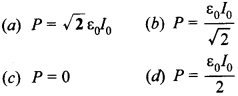
4. In an ac circuit the voltage applied is s = s0 sin (tit. The resulting current in the circuit is I = 70 sin (cot – nil). The power consumption in the circuit is given by
Physics MCQ Questions for Class 12 Pdf Download

Answer/Explanation

Answer: c
Explaination:
(c) Here, Φ = \(\frac{\pi}{2}\),
SO pav = εrms Irms COS Φ = 0


Physics MCQs for Class 12 Chapter wise with Answers Pdf Question 5. In an LCR circuit, capacitance is charged from C to 2C. For resonant frequency to remain unchanged, the inductance should be changed from L to
(a) 4 L
(b) 2 L
(c) L/2
(d) L/4

Answer/Explanation

Answer: c
Explaination:
(c) Since, Resonance frequency,
\(v_{r}=\frac{1}{2 \pi \sqrt{L C}}\)
when C is changed 2C, L should be change to L/2.


6. The core of any transformer is laminated so as to
(a) reduce the energy loss due to eddy currents.
(b) make it light weight.
(c) make it robust and strong.
(d) increase the secondary voltage.

Answer

Answer: a


MCQ Questions for Class 12 Physics with Answers Pdf Question 7. In an a.c. generator, a coil with N turns, all of the same area A and total resistance R, rotates with frequency ω in a magnetic field B the maximum value of emf generated in the coil is
(a) NABR
(b) NABω
(c) NABRω
(d) NAB

Answer/Explanation

Answer: b
Explaination:
(b) emf induced, ε = NABGω sin ωt,
ε0 = NBAω


8. If coil is open, then L and R becomes
(a) infinity, zero
(b) zero, infinity
(c) infinity, infinity.
(d) zero, zero

Answer/Explanation

Answer: b
Explaination:
(b) No current flows through an open circuit so magnetic flux is zero and hence, L = 0.
Also as I = 0, so R = ∞.


Physics Multiple Choice Questions with Answers for Class 12 Pdf Question 9. In a series, LCR-circuit, resonant frequency depends on
Physics MCQs for Class 12 with Answers Chapter 7 Alternating Current 9

Answer/Explanation

Answer: c
Explaination: (c) Resonance frequency, vr = \(\frac{1}{\sqrt{LC}}\)


10. Which quantity is increased in a step-down transformer?
(a) Current
(b) Voltage
(c) Power
(d) Frequency

Answer/Explanation

Answer: a
Explaination: (a) In a step-down transformer current increases and voltage decreases.


11. If an AC voltage is applied to an ICi? circuit, which of the following is true?
(a) I and V are out of phase with each other inR.
(b) I and V are in phase in L while in C, they are out of phase.
(c) I and V are out of phase in both C and L.
(d) I and V are out of phase in L and in phase in C.

Answer

Answer: c


12. The peak value of ac voltage on a 220 V mains is
(a) 200√2 V
(b) 230√2 V
(c) 220√2 V
(d) 240√2 V

Answer/Explanation

Answer: c
Explaination:
(c) Peak value of ac voltage V0 = √2 Vrms.
= 220√2 V.


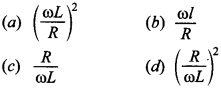
13. Series ac circuit has inductance L, resistance R and angular frequency to, the quality factor Q is
Class 12 Physics MCQ Pdf

Answer/Explanation

Answer: b
Explaination:
(b) Quality factor is measure of sharpness of resonance, is equal to \(\frac{\omega L}{R}\).


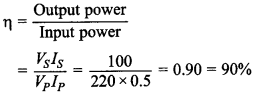
Physics MCQ Questions for Class 12 Pdf Question 14. A transformer is used to light a 100 W and 110 V lamp from a 220 V mains. If the main current is 0.5 A, the efficiency of the transformer is approximately
(a) 30%
(b) 50%
(c) 90%
(d) 10%

Answer/Explanation

Answer: c
Explaination:
(c) Since efficiency of a transformer,
Physics MCQs for Class 12 Chapter Wise with Answers Pdf Download


15. Choose the correct statement.
(a) A capacitor can conduct a dc circuit but not an inductor.
(b) In a dc circuit the inductor can conduct but not a capacitor.
(c) In dc circuit both the inductor and capacitor cannot conduct.
(d) The inductor has infinite resistance in a dc circuit.

Answer/Explanation

Answer: b
Explaination:
(b) In dc circuit, an inductor offers zero resistance to dc, while a capacitor offers infinite resistance.


16. What is the value of inductance L for which the current is maximum in a series LCR- circuit with C = 10 μF and ω = 1000 s-1?
(a) 100 mH
(b) 1 mH
(c) 10 mH
(d) cannot be calculated unless R is known

Answer/Explanation

Answer: a
Explaination:
(a) Current is maximum at resonance, when
Alternating Current Class 12 MCQ


17. A coil of self-inductance L is connected in series with a bulb B and an ac source. Brightness of the bulb decreases when
(a) frequency of the ac source is decreased.
(b) number of turns in the coil is reduced.
(c) a capacitance of reactance Xc = XL in included.
(d) an iron rod is inserted in the coil.

Answer/Explanation

Answer: d
Explaination:
(d) Brightness of the bulb decreases when inductive reactance increases, i.e. when iron rod is inserted in the coil, its inductance L increases, hence current decreases.


MCQs Of Physics Class 12 Question 18. The reactance of a capacitor C is X. If both the frequency and capacitance be doubled, then new reactance will be
(a) X
(b) 2X
(c) 4X
(d) \(\frac{X}{4}\)

Answer/Explanation

Answer:
Explaination:
Physics MCQs for Class 12 with Answers Chapter 7 Alternating Current 15
when f and C both are doubled.


19. A transformer works on the principle of
(a) converter.
(b) inverter.
(c) mutual inductance.
(d) self-inductance.

Answer/Explanation

Answer: c
Explaination: (c) Transformer works on the principle of mutual inductance.


20. The line that draws power supply to your house from street has
(a) zero average current.
(b) 220 V average voltage.
(c) voltage and current out of phase by 90°.
(d) voltage and current are in phase.

Answer/Explanation

Answer: a
Explaination: (a) zero average current.


21. Alternating current cannot be measured by dc ammeter, because
(a) ac cannot pass through ac ammeter.
(b) ac charges direction.
(c) average value of current of complete cycle is zero.
(d) ac ammeter will get damaged.

Answer/Explanation

Answer: a
Explaination: (a) ac cannot pass through ac ammeter.


22. Average power generated in an inductor connected to an a.c. source is
(a) \(\frac{1}{2}\)LI²
(b) LI²
(c) zero
(d) none of these

Answer/Explanation

Answer: c
Explaination:
(c) Average power dissipated in an inductor connected to an ac source is zero,
Pav = V0I0 cos = 0(Phase angle is \(\frac{\pi}{2}\))


23. The power factor varies between
(a) 2 and 2.5
(b) 3.5 to 5
(c) 0 to 1
(d) 1 to 2

Answer/Explanation

Answer: c
Explaination: (c) Power factor cos Φ in an ac circuit varies between 0 and 1.


24. Reciprocal of impedance is
(a) susceptance
(b) conductance
(c) admittance
(d) transconductance

Answer/Explanation

Answer: c
Explaination: (c) admittanc


25. Alternating voltage (V) is represented by the equation
(a) V(t) = Vm eωt
(b) V(t) = Vm sin ωt
(c) V(t) = Vm cot ωt
(d) V(t) = Vm tan ωt

Answer

Answer: b


26. The rms value of potential difference V shown in the figure is
Physics MCQs for Class 12 with Answers Chapter 7 Alternating Current 1

Answer

Answer: c


27. The phase relationship between current and voltage in a pure resistive circuit is best represented by
Physics MCQs for Class 12 with Answers Chapter 7 Alternating Current 2
Physics MCQs for Class 12 with Answers Chapter 7 Alternating Current 3

Answer

Answer: b


28. In the case of an inductor
(a) voltage lags the current by \(\frac{π}{2}\)
(b) voltage leads the current by \(\frac{π}{2}\)
(c) voltage leads the current by \(\frac{π}{3}\)
(d) voltage leads the current by \(\frac{π}{4}\)

Answer

Answer: b


29. Which of the following graphs represents the correct variation of inductive reactance XL with frequency u?
Physics MCQs for Class 12 with Answers Chapter 7 Alternating Current 4

Answer

Answer: b


30. In a pure capacitive circuit if the frequency of ac source is doubled, then its capacitive reactance will be
(a) remains same
(b) doubled
(c) halved
(d) zero

Answer

Answer: c


31. Which of the following graphs represents the correct variation of capacitive reactance Xc with frequency v u?
Physics MCQs for Class 12 with Answers Chapter 7 Alternating Current 5

Answer

Answer: c


32. In an alternating current circuit consisting of elements in series, the current increases on increasing the frequency of supply. Which of the following elements are likely to constitute the circuit?
(a) Only resistor
(b) Resistor and inductor
(c) Resistor and capacitor
(d) Only inductor

Answer

Answer: c


33. In which of the following circuits the maximum power dissipation is observed?
(a) Pure capacitive circuit
(b) Pure inductive circuit
(c) Pure resistive circuit
(d) None of these

Answer

Answer: c


34. In series LCR circuit, the phase angle between supply voltage and current is
Physics MCQs for Class 12 with Answers Chapter 7 Alternating Current 6

Answer

Answer: a


35. In a series LCR circuit the voltage across an inductor, capacitor and resistor are 20 V, 20 V and 40 V respectively. The phase difference between the applied voltage and the current in the circuit is
(a) 30°
(b) 45°
(c) 60°
(d) 0°

Answer

Answer: d


36. At resonance frequency the impedance in series LCR circuit is
(a) maximum
(b) minimum
(c) zero
(d) infinity

Answer

Answer: b


37. At resonant frequency the current amplitude in series LCR circuit is
(a) maximum
(b) minimum
(c) zero
(d) infinity

Answer

Answer: a


38. Quality factor and power factor both have the dimensions of
(a) time
(b) frequency
(c) work
(d) angle

Answer

Answer: d


39. The natural frequency (ca0) of oscillations in LC circuit is given by
Physics MCQs for Class 12 with Answers Chapter 7 Alternating Current 7

Answer

Answer: c


40. A transformer works on the principle of
(a) self induction
(b) electrical inertia
(c) mutual induction
(d) magnetic effect of the electrical current

Answer

Answer: c


41. For an ideal-step-down transformer, the quantity which is constant for both the coils is
(a) current in the coils
(b) voltage across the coils
(c) resistance of coils
(d) power in the coils

Answer

Answer: d


42. If the rms current in a 50 Hz ac circuit is 5 A, the value of the current 1/300 seconds after its value becomes zero is [NCERT Exemplar]
(a) 5√2A
(b) \(5 \sqrt{3 / 2}\)A
(c) 5/6 A
(d) 5√2A

Answer

Answer: b


43. An alternating current generator has an internal resistance Rg and an internal reactance Xg. It is used to supply power to a passive load consisting of a resistance Rg and a reactance XL For maximum power to be delivered from the generator to the load, the value of XL is equal to [NCERT Exemplar]
(a) zero.
(b) Xg.
(c) -Xg.
(d) Rg.

Answer

Answer: c


44. When a voltage measuring device is connected to AC mains, the meter shows the steady input voltage of 220 V. This means [NCERT Exemplar]
(a) input voltage cannot be AC voltage, but a DC voltage.
(b) maximum input voltage is 220V.
(c) the meter reads not v but < v² > and is . calibrated to read √< v² > .
(d) the pointer of the meter is stuck by some mechanical defect.

Answer

Answer: c


45. To reduce the resonant frequency in an LCR series circuit with a generator [NCERT Exemplar]
(a) the generator frequency should be reduced.
(b) another capacitor should be added in parallel to the first.
(c) the iron core of the inductor should be removed.
(d) dielectric in the capacitor should be removed.

Answer

Answer: b


46. Which of the following combinations should be selected for better tuning of an LCR circuit used for communication? [NCERT Exemplar]
(a) R = 20, L= 1.5 H, C = 35 μF.
(b) R = 25 , L = 2.5 H, C = 45 μF.
(c) R = 15 , L = 3.5 H, C = 30 μF.
(d) R = 25 , L = 1.5 H, C = 45 μF.

Answer

Answer: c


47. An inductor of reactance 1 Ω and a resistor of 2 Ω are connected in series to the terminals of a 6 V (rms) a.c. source. The power dissipated in the circuit is [NCERT Exemplar]
(a) 8 W.
(b) 12 W.
(c) 14.4 W.
(d) 18 W.

Answer

Answer: c


48. The output of a step-down transformer is measured to be 24 V when connected to a 12 watt light bulb. The value of the peak current is [NCERT Exemplar]
(a) 1/√2 A.
(b) √2A.
(c) 2 A.
(d) 2√2 A.

Answer

Answer: a


49. As the frequency of an ac circuit increases, the current first increases and then decreases. What combination of circuit elements is most likely to comprise the circuit? [NCERT Exemplar]
(a) Inductor and capacitor.
(b) Resistor and inductor.
(c) Resistor and capacitor.
(d) Inductor only.

Answer

Answer: a


50. In an alternating current circuit consisting of elements in series, the current increases on increasing the frequency of supply. Which of the following elements are likely to constitute the circuit?
(a) Only resistor.
(b) Resistor and an inductor.
(c) Resistor and a capacitor.
(d) Only an inductor.

Answer

Answer: c


51. Electrical energy is transmitted over large distances at high alternating voltages. Which of the following statements is not correct?
(a) For a given power level, there is a lower current.
(b) Lower current implies less power loss.
(c) Transmission lines can be made thinner.
(d) It is easy to reduce the voltage at the receiving end using step-down transformers.

Answer

Answer: c


52. For an LCR circuit, the power transferred from the driving source to the driven oscillator is P = I²Z cos Φ. Which of the following is incorrect?
(a) Here, the power factor cos Φ ≥ 0, P ≥ 0.
(b) The driving force can give no energy to the oscillator (P = 0) in some cases.
(c) The driving force cannot syphon out (P < 0) the energy out of oscillator.
(d) The driving force can take away energy out of the oscillator.

Answer

Answer: d


53. When an AC voltage of 220 V is applied to the capacitor C
(a) the maximum voltage between plates is 220 V.
(b) the current is in phase with the applied voltage.
(c) the charge on the plates is not in phase with the applied voltage.
(d) power delivered to the capacitor is zero.

Answer

Answer: d


54. Average value of ac over a complete cycle _________ .

Answer/Explanation

Answer:
Explaination: zero


55. Inductive reactance increases with _________ in frequency of ac.

Answer/Explanation

Answer:
Explaination: increase


56. In ac generator _________ is converted into electrical energy of alternating form.

Answer/Explanation

Answer:
Explaination: mechanical energy


57. Electric current that varies in magnitude dontinuously and reverses its direction periodically is known as _________ .

Answer/Explanation

Answer:
Explaination: alternating current.


58. Current which flows with a constant magnitude in same fixed direction is known as _________ .

Answer/Explanation

Answer:
Explaination: direct current.


59. Average or mean value of ac over a half cycle is _________ .

Answer/Explanation

Answer:
Explaination: 0.637 I0


60. Rms or virtual value of alternating current is _________ .

Answer/Explanation

Answer:
Explaination: 0.707 I0


61. Current in the inductive a.c. circuit _________ the voltage.

Answer/Explanation

Answer:
Explaination: lag behind


62. Capacitive reactance increases with _________ in frequency of ac.

Answer/Explanation

Answer:
Explaination: increase


63. Capacitive reactance Xc increases with _________ in frequency of ac and current in the capacitive ac circuit _________ the ac voltage.

Answer/Explanation

Answer:
Explaination: decrease, leading ahead


64. Can ever the rms value be equal to the peak value of an ac?

Answer/Explanation

Answer:
Explaination: Yes, when the ac is a square wave.


65. Which is more dangerous 220 ac or 220 dc and why?

Answer/Explanation

Answer:
Explaination:
Physics MCQs for Class 12 with Answers Chapter 7 Alternating Current 16
∴ ac is more dangerous than dc because its peak value is very high and also ac is in nature.


66. The peak value of emf in ac is E0. Write its
(i) rms, and (ii) average value over a complete cycle. [Foreign 2011]

Answer/Explanation

Answer:
Explaination: (i) Erms = \(\frac{E_{0}}{\sqrt{2}}\) (ii) Zero.


67. The current flowing through a pure inductor of inductance 4mH is i= 12 cos 300 t ampere. What is (i) rms, and (ii) average value of the current for a complete cycle? [Foreign 2011]

Answer/Explanation

Answer:
Explaination: (i) Irms = \(\frac{12}{\sqrt{2}}\) (ii) Iav = zero


68. Calculate the rms value of the alternating current shown in the figure. [HOTS]
Physics MCQs for Class 12 with Answers Chapter 7 Alternating Current 11

Answer/Explanation

Answer:
Explaination:
Physics MCQs for Class 12 with Answers Chapter 7 Alternating Current 17
The rms value of the alternating current shown in the figure is 2 A.


69. When an alternating current is passed through a moving coil galvanometer, it shows no deflection. Why?

Answer/Explanation

Answer:
Explaination: A moving coil galvanometer measures an average value of current, which is zero for ac. Hence, no deflection is shown by galvanometer


70. Which of the following curves may represent the reactance of a series LC combination? [DoE]
Physics MCQs for Class 12 with Answers Chapter 7 Alternating Current 12

Answer/Explanation

Answer:
Explaination:
(b) AS XC-XL = \(\frac{1}{2 \pi v C}\) – 2πvL


71. In a series LCR circuit, the voltages across an inductor, a capacitor and a resistor are 30 V, 30V and 60V respectively. What is the phase difference between the applied voltage and the current in the circuit?

Answer/Explanation

Answer:
Explaination: Zero. As VL = VC, circuit is resistive in nature.


72. Can a capacitor of suitable capacitance replace a inductor coil in an AC circuit?

Answer/Explanation

Answer:
Explaination: Yes, because average power consumed in both is least while controlling an AC.


73. At an airport, a person is made to walk through the doorway of a metal detector, for security reasons. Is she/he is carrying anything made of metal, the metal detector emits a sound. On what principle does this detector work? [NCERT Exempler]

Answer/Explanation

Answer:
Explaination: The metal detector works on the principle of resonances in ac circuits.


74. A capacitor blocks dc and allows ac. Why?

Answer/Explanation

Answer:
Explaination:
The capacitive reactance is XC =\(\frac{1}{2 \pi v C}\).
For dc, v = 0 ⇒ XC = ∞
i.e. a capacitor offers infinite resistance to dc and hence blocks it.
For ac, v ≠ 0, ⇒ XC ≠ ∞ , but has some finite value.
Therefore, an ac can pass through the capacitor.


75. A bulb and a capacitor are connected in series to an ac source of variable frequency. How will the brightness of the bulb change on increasing the frequency of the ac source?

Answer/Explanation

Answer:
Explaination:
The brightness will increase (∵ XC ∝ \(\frac{1}{v}\)), and heat produced H ∝ I², where
Physics MCQs for Class 12 with Answers Chapter 7 Alternating Current 18


76. Is there are any device by which direct current can be controlled without any loss of energy?

Answer/Explanation

Answer:
Explaination:
By the definition, value of the alternating voltage is equal to 110V.


77. A 110 V dc heater is used on an ac source, such that the heat produced is the same. What would be the value of the alternating voltage?

Answer/Explanation

Answer:
Explaination: cos Φ = 1.


78. The power factor of an ac circuit is 0.5. What is the phase difference between voltage and current in this circuit? [Foreign 2015]

Answer/Explanation

Answer:
Explaination:
∵ Power factor, cos Φ=0.5
∴ Φ = 60° or π/3
So, the phase difference between voltage and current is \(\frac{\pi}{3}\).


79. Why does a low power factor imply large power loss in transmission for circuits used for transporting electric power? [NCERT Example]

Answer/Explanation

Answer:
Explaination:
We know that P = TV cos Φ, where cos Φ is the power factor. To supply a given power, at a given voltage, if cos Φ is small, we have to increase the current accordingly. But this will lead to large power loss (I²R) in transmission.


80. The instantaneous current and voltage of an ac circuitaregivenby I = 10sin314tA and V=50sin (314 t + \(\frac{\pi}{2}\)) V. What is the power of dissipation m the circuit?

Answer/Explanation

Answer:
Explaination:
Phase difference between the current and voltage is π/2. So, the power dissipation Pav = Prms cos Φ is zero.


81. Why is the use of ac voltage preferred over dc voltage? [AI2014]

Answer/Explanation

Answer:
Explaination:
An ac voltage can be stepped up or down using a transformer, but not the dc voltage.


82. Does a step down transformer violate the principle of conservation of energy?

Answer/Explanation

Answer:
Explaination:
No. In a transformer, if a voltage is increased, the current is decreased in the same ratio and the product VI (power) remains the same.


83. Can we measure 110 V, 50 Hz a.c. using moving coil galvanometers? How can we measure it.

Answer/Explanation

Answer:
Explaination:
No.
Reason: As average value of a.c. voltage over one complete cycle is zero.
We can measure the rms value of a.c. voltage using hot wire meters.


84. What is an acceptor circuit and where it is used?

Answer/Explanation

Answer:
Explaination: Series LCR circuit is called acceptor circuit radio or TV sets.


85. Why do we prefer carbon brushes than copper in an ac generator? [DoE]

Answer/Explanation

Answer:
Explaination: Corrosion free and small expansion on heating maintains proper contact.


86. In a series LCR circuit, XL, Xc and R are the inductive reactance, capacitive reactance and resistance respectively at a certain frequency f If the frequency of ac is doubled, what will be the values of reactances and resistance of the circuit? [DoE]

Answer/Explanation

Answer:
Explaination:
Resistance R remains unchanged; XL will be doubled and XC will be halved.


87. In a series L-R circuit, XL = R and power factor of the circuit is P1 When a capacitor with capacitance C such that XL = Xc is put in series, the power factor becomes P2 Find P1/P2

Answer/Explanation

Answer:
Explaination: 1 : √2


We hope the given Physics MCQs for Class 12 with Answers Chapter 7 Alternating Current will help you. If you have any query regarding CBSE Class 12 Physics Alternating Current MCQs Pdf, drop a comment below and we will get back to you at the earliest.
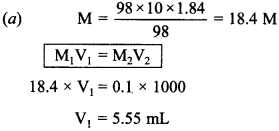
Physics MCQs for Class 12 with Answers Chapter 6 Electromagnetic Induction

Free PDF Download of CBSE Physics Multiple Choice Questions for Class 12 with Answers Chapter 6 Electromagnetic Induction. Physics MCQs for Class 12 Chapter Wise with Answers PDF Download was Prepared Based on Latest Exam Pattern. Students can solve NCERT Class 12 Physics Electromagnetic Induction MCQs Pdf with Answers to know their preparation level.

Electromagnetic Induction Class 12 Physics MCQs Pdf

1. Two coils are placed closed to each other. The mutual inductance of the pair of coils depends upon
(a) the rate at which currents are changing in the two coils.
(b) relative position and orientation of two coils.
(c) the material of the wires of the coils.
(d) the currents in the two coils.

Answer/Explanation

Answer: b
Explaination:
(b) Mutual induction depends upon the relative orientation and position of coil w.r.t. each other.


2. When current in a coil changes from 5 A to 2 A in 0.1 s, average voltage of 50 V is produced. The self-inductance of the coil is
(a) 1.67 H
(b) 6 H
(c) 3 H
(d) 0.67 H

Answer/Explanation

Answer:
Explaination:
Physics MCQs for Class 12 with Answers Chapter 6 Electromagnetic Induction 29


3. A coil having 500 sq. loops of side 10 cm is placed normal to magnetic flux which increases at a rate of 1 T/s. The induced emf is
(a) 0.1 V
(b) 0.5 V
(c) 1 V
(d) 5 V

Answer/Explanation

Answer:
Explaination:
Physics MCQs for Class 12 with Answers Chapter 6 Electromagnetic Induction 30


4. A coil of 100 turns carries a current of 5 mA and creates a magnetic flux of 10-5 weber. The inductance is
(a) 0.2 mH
(b) 2.0 mH
(c) 0.02 mH
(d) 0.002 H

Answer/Explanation

Answer:
Explaination:
Physics MCQs for Class 12 with Answers Chapter 6 Electromagnetic Induction 31


5. Lenz’s law of electromagnetic induction is as per law of conservation of
(a) energy.
(b) momentum angular.
(c) charge.
(d) electromotive force.

Answer/Explanation

Answer: a
Explaination:
(a) Work done in changing magnetic flux, is produced as induced e.m.f.


6. The current flows from A to B is as shown in the figure. The direction of the induced current in the loop is
Physics MCQs for Class 12 with Answers Chapter 6 Electromagnetic Induction 6
(a) clockwise.
(b) anticlockwise.
(c) straight line.
(d) no induced e.m.f. produced.

Answer/Explanation

Answer: a
Explaination:
(a) By lenz’s law, the induced current must produce inward flux to counter magnetic flux of AB. So induced current is clockwise in the loop.


7. In a coil of self-induction 5 H, the rate of change of current is 2 As-1. Then emf induced in the coil is
(a) 10 V
(b) -10 V
(c) 5 V
(d) -5 V

Answer/Explanation

Answer: b
Explaination:
(b) Induced e.m.f. ε = -L\(\frac{dI}{dt}\) = – 5 × 2 = -10 V


8. The north pole of a long bar magnet was pushed slowly into a short solenoid connected to a short galvanometer. The magnet was held stationary for a few seconds with the north pole in the middle of the solenoid and then withdrawn rapidly. The maximum deflection of the galvanometer was observed when the magnet was
(a) moving towards the solenoid
(b) moving into the solenoid
(c) at rest inside the solenoid
(d) moving out of the solenoid

Answer

Answer: d


9. The magnetic flux linked with a coil of N turns of area of cross section A held with its plane parallel to the field B is
Physics MCQs for Class 12 with Answers Chapter 6 Electromagnetic Induction 1

Answer

Answer: d


10. Faraday’s laws are consequence of the conservation of
(a) charge
(b) energy
(c) magnetic field
(d) both (b) and (c)

Answer

Answer: b


11. Two identical coaxial coils P and Q carrying equal amount of current in the same direction are brought nearer. The current in
(a) P increases while in Q decreases
(b) Q increases while in P decreases
(c) both P and Q increases
(d) both P and Q decreases

Answer

Answer: d


12. Direction of current induced in a wire moving in a magnetic field is found using
(a) Fleming’s left hand rule
(b) Fleming’s right hand rule
(c) Ampere’s rule
(d) Right hand clasp rule

Answer

Answer: b


13. Lenz’s law is a consequence of the law of conservation of
(a) charge
(b) energy
(c) induced emf
(d) induced current

Answer

Answer: b


14. A solenoid is connected to a battery so that a steady current flows through it. If an iron core is inserted into the solenoid, the current will
(a) increase
(b) decrease
(c) remain same
(d) first increase then decrease

Answer

Answer: b


15. Which of the following statements is not correct?
(a) Whenever the amount of magnetic flux linked with a circuit changes, an emf is induced in circuit.
(b) The induced emf lasts so long as the change in magnetic flux continues.
(c) The direction of induced emf is given by Lenz’s law.
(d) Lenz’s law is a consequence of the law of conservation of momentum.

Answer

Answer: d


16. There is a uniform magnetic field directed perpendicular and into the plane of the paper. An irregular shaped conducting loop is slowly changing into a circular loop in the plane of the paper. Then
(a) current is induced in the loop in the anti-clockwise direction.
(b) current is induced in the loop in the clockwise direction.
(c) ac is induced in the loop.
(d) no current is induced in the loop.

Answer

Answer: a


17. In the given figure current from A to B in the straight wire is decreasing. The direction of induced current in the loop is A
Physics MCQs for Class 12 with Answers Chapter 6 Electromagnetic Induction 2
(a) clockwise
(b) anticlockwise
(c) changing
(d) nothing can be said

Answer

Answer: b


18. The north pole of a bar magnet is rapidly introduced into a solenoid at one end (say A). Which of the following statements correctly depicts the phenomenon taking place?
(a) No induced emf is developed.
(b) The end A of the solenoid behaves like a south pole.
(c) The end A of the solenoid behaves like north pole.
(d) The end A of the solenoid acquires positive potential.

Answer

Answer: c


19. A metal plate can be heated by
(a) passing either a direct or alternating current through the plate.
(b) placing in a time varying magnetic field.
(c) placing in a space varying magnetic field, but does not vary with time.
(d) both (a) and (b) are correct.

Answer

Answer: d


20. Identify the wrong statement.
(a) Eddy currents are produced in a steady magnetic field.
(b) Eddy currents can be minimized by using laminated core.
(c) Induction furnace uses eddy current to produce heat.
(d) Eddy current can be used to produce braking force in moving trains.

Answer

Answer: a


21. Which of the following does not use the application of eddy current?
(a) Electric power meters
(b) Induction furnace
(c) LED lights
(d) Magnetic brakes in trains

Answer

Answer: c


22. If number of turns in primary and secondary coils is increased to two times each, the mutual inductance
(a) becomes 4 times
(b) becomes 2 times
(c) becomes A times
(d) remains unchanged 4

Answer

Answer: a


23. When the rate of change oic current is unity, the induced emf is equal to
(a) thickness of coil
(b) number of turns in coil
(c) coefficient of self inductance
(d) total flux linked with coil

Answer

Answer: c


24. Two inductors of inductance .L each are connected in series with opposite? magnetic fluxes. The resultant inductance is
(Ignore mutual inductance)
(a) zero
(b) L
(c) 2L
(d) 3L

Answer

Answer: c


25. A square of side L metres lies in the x-y plane in a region, where the magnetic field is given by B = B0{li + 3j + 4k) T, where Bo is constant. The magnitude of flux passing through the square is [NCERT Exemplar]
(a) 2BoL² Wb.
(b) 3BoL² Wb.
(c) 4BoL² Wb.
(d) √29 BoL² Wb.

Answer

Answer: c


26. A loop, made of straight edges has six comers at A(0, 0, 0), B(L, 0, 0) C(L, L, 0), D(0, L, 0), E(0, L, L) and F(0,0, L). A magnetic field B = Bo (\(\hat{i}+\hat{k}\))T is present in the region. The flux passing through the loop ABCDEFA (in that order) is [NCERT Exemplar]
(a) BoL² Wb.
(b) 2BoL² Wb.
(c) √2BoL² Wb.
(d) 4BoL² Wb.

Answer

Answer: b


27. A cylindrical bar magnet is rotated about its axis (Figure). A wire is connected from the axis and is made to touch the cylindrical surface through a contact. Then [NCERT Exemplar]
Physics MCQs for Class 12 with Answers Chapter 6 Electromagnetic Induction 3
(a) a direct current flows in the ammeter A.
(b) no current flows through the ammeter A.
(c) an alternating sinusoidal current flows through the ammeter A with a time period T = \(\frac{2 \pi}{\omega}\)
(d) a time varying non-sinosoidal current flows through the ammeter.

Answer

Answer: a


28. There are two coils A and B as shown in Figure. A current starts flowing in B as shown, when A is moved towards B and stops when A stops moving. The current in A is counterclockwise. B is kept stationary when A moves. We can infer that [NCERT Exemplar]
Physics MCQs for Class 12 with Answers Chapter 6 Electromagnetic Induction 4
(a) there is a constant current in the clockwise direction in A.
(b) there is a varying current in A.
(c) there is no current in A.
(d) there is a constant current in the counterclockwise direction in A.

Answer

Answer: d


29. Same as question 4 except the coil A is made to rotate about a vertical axis (Figure). No current flows in B if A is at rest. The current in coil A, when the current in B (at t = 0) is counterclockwise and the coil A is as shown at this instant, t = 0, is [NCERT Exemplar]
Physics MCQs for Class 12 with Answers Chapter 6 Electromagnetic Induction 5
(a) constant current clockwise.
(b) varying current clockwise.
(c) varying current counterclockwise.
(d) constant current counterclockwise.

Answer

Answer: a


30. An e.m.f is produced in a coil, which is not connected to an external voltage source. This is not due to
(a) the coil being in a time varying magnetic field.
(b) the coil moving in a time varying magnetic field.
(c) the coil moving in a constant magnetic field.
(d) the coil is stationary in external spatially varying magnetic field, which does not change with time.

Answer

Answer: d


31. Total number of magnetic lines of force crossing a surface normally is called _________ .

Answer/Explanation

Answer:
Explaination: magnetic flux


32. Relation between S.I. unit and C.G.S. unit of magnetic flux is _________ .

Answer/Explanation

Answer:
Explaination: 1 Weber = 108 Maxwell


33. Phenomenon of production of induced emf due to change of magnetic flux linked with a closed circuit is known as _________ .

Answer/Explanation

Answer:
Explaination: electromagnetic induction


34. Direction of induced current is such that it _________ the cause which produces it.

Answer/Explanation

Answer:
Explaination: opposes


35. A long straight current carrying wire passes normally through the centre of circular loop. If the current through the wire increases, will there be an induced emf in the loop? Justify.
[Delhi 2017]

Answer/Explanation

Answer:
Explaination: No current will be induced since the field lines are lying in the plane of the closed loop.


36. The electric current flowing in a wire in the direction from B to A is decreasing. Find out the direction of the induced current in the metallic loop kept above the wire as shown. [AI 2014]
Physics MCQs for Class 12 with Answers Chapter 6 Electromagnetic Induction 7

Answer/Explanation

Answer:
Explaination: Clockwise.


37. What is the direction of induced currents in metal rings 1 and 2 when current I in the wire is increasing steadily? [AI2017]
Physics MCQs for Class 12 with Answers Chapter 6 Electromagnetic Induction 8

Answer/Explanation

Answer:
Explaination:
The direction of induced current is clockwise in metal ring 1 and anticlockwise in metal ring 2.


38. Use Lenz’s law to determine the direction of the induced current when a rectangular conducting loop abed is moved into a region of magnetic field which is directed normal to the plane of the loop away from the reader. [Foreign 2014]
Physics MCQs for Class 12 with Answers Chapter 6 Electromagnetic Induction 9

Answer/Explanation

Answer:
Explaination:
On moving a rectangular conducting loop into the field, the flux increases. According to Lenz’s law, the induced current would be anticlockwise.


39. A triangular loop of wire placed at abc is moved completely inside a magnetic field ’which is directed normal to the plane of the loop away from the reader to a new position a’b’c’. What is the direction of the current induced in the loop? Give reason. [Foreign 2014]
Physics MCQs for Class 12 with Answers Chapter 6 Electromagnetic Induction 10

Answer/Explanation

Answer:
Explaination:
A triangular loop remains inside the magnetic field throughout its motion. The free charges do not find path to complete the circuit. So, no current is induced.


40. Two bar magnets are quickly moved towards a metallic loop connected across a capacitor C as shown in the figure. Predict the polarity of the capacitor. [AI 2017, 2011]
Physics MCQs for Class 12 with Answers Chapter 6 Electromagnetic Induction 11

Answer/Explanation

Answer:
Explaination: The upper plate is having +ve polarity and the lower plate is having -ve polarity.


41. Give the direction in which the induced current flows in the coil mounted on an insulating stand when a bar magnet is quickly moved along the axis of the coil from one side to the other as show in the figure.
Physics MCQs for Class 12 with Answers Chapter 6 Electromagnetic Induction 12

Answer/Explanation

Answer:
Explaination: Anticlockwise: As seen from the side opposite to the magnet.


42. A closed loop is held stationary in the magnetic field between the north and south poles of two permanent magnets held fixed. Can we hope to generate current in the loop by using very strong magnets?

Answer/Explanation

Answer:
Explaination:
No. However strong the magnet may be, current can be induced only by changing the magnetic flux through the loop.


43. A closed loop moves normal to the constant electric field between the plates of a large capacitor. Is a current induced in the loop
(i) when it is wholly inside the region between the capacitor plates, and
(ii) when it is partially outside the plates of the capacitor? The electric field is normal to the plane of the loop.

Answer/Explanation

Answer:
Explaination:
No current is induced in either case. Current cannot be induced by changing the electric flux.


44. A bar magnet is moved in the direction indicated by the arrow between two coils PQ and CD. Predict the directions of induced current in each coil.
Physics MCQs for Class 12 with Answers Chapter 6 Electromagnetic Induction 19

Answer/Explanation

Answer:
Explaination:
The direction of induced current clockwise in coil PQ as seen from magnet side.
The direction of induced current clockwise in coil CD as seen from magnet side.


45. Twelve wires of equal length are connected to form a skeleton cube which moves with a velocity v parallel to the magnetic field \(\vec{B}\). What will be the induced emf in each arm of the cube? [HOTS]
Physics MCQs for Class 12 with Answers Chapter 6 Electromagnetic Induction 20

Answer/Explanation

Answer:
Explaination:
\(F=q(\vec{v} \times \vec{B}) \cdot \operatorname{As} \vec{v} \| \vec{B}\) force on electrons in any arm of the cube is zero. Hence, no emf is induced.


46. Two spherical bobs, one metallic and the other of glass, of the same size are allowed to fall freely from the same height above the ground. Which of the two would reach earlier and why? [Delhi 2014]

Answer/Explanation

Answer:
Explaination:
A glass bob, as in the glass bob, there is no effect of electromagnetic induction due to the presence of earth’s magnetic field, unlike in the case of a metallic bob.


47. A circular loop is moved through the region of uniform magnetic field. Find the direction of induced current (clock wise or antic lock wise) when the loop moves (i) into the e field, and (ii) out of the field. [Foreign 2010]
Physics MCQs for Class 12 with Answers Chapter 6 Electromagnetic Induction 21

Answer/Explanation

Answer:
Explaination: (i) Anticlockwise, (ii) Clockwise


48. A rectangular loop of wire is p right, away from the long straight wire through which a steady current I flows upwards. What is the direction of induced current in the loop?
Physics MCQs for Class 12 with Answers Chapter 6 Electromagnetic Induction 22

Answer/Explanation

Answer:
Explaination: Clockwise.


49. When a coil is rotated in a uniform magnetic field at constant angular velocity, will the magnitude of induced emf set up in the coil be constant? Why? [HOTS]

Answer/Explanation

Answer:
Explaination:
No, the induced emf will vary with time and will be sinosoidal due to the change in orientation of the coil w.r.t. the magnetic field.


50. A light metal disc on the top of an electromagnet is thrown up as the current is switched on. Why? Give reason. [AI2013]

Answer/Explanation

Answer:
Explaination:
Due to the eddy currents. As these currents produce opposite polarity on the lower side of the disc.


51. A current carrying wire (straight) passes inside a triangular coil as shown in figure. The current in the wire is perpendicular to paper inwards. Find the direction of induced current in the loop if current in the wire is increasing with time. [DoE]
Physics MCQs for Class 12 with Answers Chapter 6 Electromagnetic Induction 23

Answer/Explanation

Answer:
Explaination:
The magnetic field lines are tangential to the triangular plane, i.e.
θ = 90.
Physics MCQs for Class 12 with Answers Chapter 6 Electromagnetic Induction 32
Hence. Φ = 0.
∴ Induced emf = 0
∴ Induced current = 0


52. How does the mutual inductance of a pair of coils change when
(i) distance between the coils is increased and
(ii) number of turns in the coils is increased? [AI 2013]

Answer/Explanation

Answer:
Explaination:
(i) When the distance between a pair of coils is increased, the magnetic flux linked with the secondary coil decreases and hence, the mutual inductance between them will decrease.
(ii) Since M ∝ N1 N2, so, when number of turns in the coil is increased, the mutual inductance will also increase.


53. The closed loop (PQRS) of wire is moved into a uniform magnetic field at right angles to the plane of the paper as shown in the figure. Predict the direction of the induced current in the loop. [Foreign 2012]
Physics MCQs for Class 12 with Answers Chapter 6 Electromagnetic Induction 24

Answer/Explanation

Answer:
Explaination: Anticlockwise.


54. The current i in an induction coil varies with time t according to the adjoining graph.
Physics MCQs for Class 12 with Answers Chapter 6 Electromagnetic Induction 25
Draw the graph of induced emf with time. [DoE]

Answer/Explanation

Answer:
Explaination: Induced emf, E = -L\(\frac{dI}{dt}\)
Physics MCQs for Class 12 with Answers Chapter 6 Electromagnetic Induction 33


55. A rod PQ of length 1 is moved in uniform magnetic field \(\vec{B}\) as shown. What will be the emf induced in it?
Physics MCQs for Class 12 with Answers Chapter 6 Electromagnetic Induction 26

Answer/Explanation

Answer:
Explaination: e = Blv sin θ


56. Predict the direction of induced current in a metal ring when the ring is moved towards a straight conductor
with constant speed v. The conductor is carrying current I in the direction shown in the figure. [Delhi 2012]
Physics MCQs for Class 12 with Answers Chapter 6 Electromagnetic Induction 27

Answer/Explanation

Answer:
Explaination: Clockwise.


57. A wire and a rod AB are in the same plane. The rod moves parallel to the wire with the velocity v, then which end of the rod is at higher potential? [DoE]
Physics MCQs for Class 12 with Answers Chapter 6 Electromagnetic Induction 28

Answer/Explanation

Answer:
Explaination: End A will be at higher potential.


We hope the given Physics MCQs for Class 12 with Answers Chapter 6 Electromagnetic Induction will help you. If you have any query regarding CBSE Class 12 Physics Electromagnetic Induction MCQs Pdf, drop a comment below and we will get back to you at the earliest.

Physics MCQs for Class 12 with Answers Chapter 5 Magnetism and Matter

Free PDF Download of CBSE Physics Multiple Choice Questions for Class 12 with Answers Chapter 5 Magnetism and Matter. Physics MCQs for Class 12 Chapter Wise with Answers PDF Download was Prepared Based on Latest Exam Pattern. Students can solve NCERT Class 12 Physics Magnetism and Matter MCQs Pdf with Answers to know their preparation level.

Magnetism and Matter Class 12 Physics MCQs Pdf

MCQ on Magnetism Class 12 Question 1. A toroid of n turns, mean radius R and crosssectional radius a carries current I. It is placed on a horizontal table taken as x-y plane. Its magnetic moment m [NCERT Exemplar]
(a) is non-zero and points in the z-direction by symmetry.
(b) points along the axis of the tortoid (m = mΦ).
(c) is zero, otherwise there would be a field falling as \(\frac{1}{r^{3}}\) at large distances outside r3 the toroid.
(d) is pointing radially outwards.

Answer/Explanation

Answer: c
Explaination:
(c) For any point inside the empty space surrounded by toroid and outside the toroid, the magnetic field B is zero because the net current enclosed in these spaces is zero.


MCQ Physics Class 12 Question 2. The magnetic field of Earth can be modelled by that of a point dipole placed at the centre of the Earth. The dipole axis makes an angle of 11.3° with the axis of Earth. At Mumbai, ‘declination is nearly zero. Then, [NCERT Exemplar]
(a) the declination varies between 11.3° W to 11.3° E.
(b) the least declination is 0°.
(c) the plane defined by dipole axis and Earth axis passes through Greenwich.
(d) declination averaged over Earth must be always negative.

Answer/Explanation

Answer: a
Explaination:
(a) The axis of the dipole does not coincide with the axis of rotation of the earth and it is tilted at some angle.


3. In a permanent magnet at room temperature [NCERT Exemplar]
(a) magnetic moment of each molecule is zero.
(b) the individual molecules have non-zero magnetic moment which are all perfectly aligned.
(c) domains are partially aligned.
(d) domains are all perfectly aligned.

Answer/Explanation

CBSE Class 12 Physics MCQs with Answer: c
Explaination:
(c) At room temperature, the permanent magnet retains ferromagnetic property for a long period of time.


Physics MCQs For Class 12 with Answers Chapter wise Pdf Question 4. Consider the two idealized systems:
(i) a parallel plate capacitor with large plates and small separation and (ii) a long solenoid of length L » R, radius of cross-section. In (i) E is ideally treated as a constant between plates and zero outside. In (ii) magnetic field is constant inside the solenoid and zero outside. These idealised assumptions, however, contradict fundamental laws as below: [NCERT Exemplar]
(a) case (i) contradicts Gauss’s law for electrostatic fields.
(b) case (ii) contradicts Gauss’s law for magnetic fields.
(c) case (i) agrees with ∫ E.dl = 0 .
(d) case (ii) contradicts ∫ H.dl = Ien

Answer/Explanation

Answer: b
Explaination:
(b) The electrostatic field lines do not form a continuous closed path, while the magnetic field lines form the closed paths.


5. A paramagnetic sample shows a net magnetisation of 8 Am-1 when placed in an external magnetic field of 0.6 T at a temperature of 4K. When the same sample is placed in an external magnetic field of 0.2 T at a temperature of 16 K, the magnetisation will be [NCERT Exemplar]
(a) \(\frac{32}{3}\) Am-1
(b) \(\frac{2}{3}\) Am-1
(c) 6 Am-1
(d) 2.4 Am-1

Answer

Answer: b


6. S is the surface of a lump of magnetic material.
(a) Lines of B are not necessarily continuous across S.
(b) Some lines of B must be discontinuous across S.
(c) Lines of H are necessarily continuous across S.
(d) Lines of H cannot all be continuous across S.

Answer

Answer: d


7. The primary origin(s) of magnetism lies in
(a) Pauli exclusion principle.
(b) polar nature of molecules.
(c) intrinsic spin of electron.
(d) None of these.

Answer/Explanation

Answer: b
Explaination:
(b) The primary origin of magnetism lies in the fact that the electrons are revolving and spinning about the nucleus of an atom.


8. A long solenoid has 1000 turns per metre and carries a current of 1 A. It has a soft iron core of μr = 1000. The core is heated beyond the Curie temperature, Tc .
(a) The H field in the solenoid is (nearly) unchanged but the B field decreases drastically.
(b) The H and B fields in the solenoid are nearly unchanged.
(c) The magnetisation in the core reverses direction.
(d) The magnetisation in the core does not diminishes.

Answer/Explanation

Answer: a
Explaination:
(a) At normal temperature, a solenoid behaves as a ferromagnetic substance and at the temperature beyond the Curie temperature, it behaves as a paramagnetic substance.


9. Essential difference between electrostatic shielding by a conducting shell and magne-tostatic shielding is due to
(a) electrostatic field lines cannot end on ’ charges and conductors do not have free charges.
(b) lines of B can also end but conductors cannot end them.
(c) lines of B cannot end. on any material and perfect shielding is not possible.
(d) shells of high permeability materials cannot be used to divert lines of B from the interior region.

Answer/Explanation

Answer: c
Explaination:
(c) As magnetostatic shielding is done by using an enclosure made of a high permeability magnetic material to prevent a static magnetic field outside the enclosure from reaching objects inside it or to confine a magnetic field within the enclosure


10. Let the magnetic field on earth be modelled by that of a point magnetic dipole at the centre of earth. The angle of dip at a point on the geographical equator
(a) is always zero.
(b) can be zero at specific points.
(c) cannot be positive or negative.
(d) is not bounded.

Answer/Explanation

Answer: b
Explaination:
(b) As the angle of dip at a point on the geographical equator is bounded in a range from positive to negative value.


11. A magnetic needle is kept in a non-uniform magnetic field. It experiences
(a) a torque but not a force.
(b) neither a force nor a torque.
(c) a force and a torque.
(d) a force but not a torque.

Answer/Explanation

Answer: c
Explaination:
(c) As magnetic needle experiences both torque and force in a non-uniform magnetic field, because unequal and non-linear forces are exerted on its poles.


MCQ on Magnetism Class 12 Pdf Question 12. A 25 cm long solenoid has radius 2 cm and 500 total number of turns. It carries a current of 15 A. If it is equivalent to a magnet of the same size and magnetisation \(\overline{\mathbf{M}}\), then |\(\overline{\mathbf{M}}\)| is
(a) 3 π Am-1
(b) 30000 π Am-1
(c) 300 Am-1
(d) 30000 Am-1

Answer/Explanation

Answer:
Explaination:
MCQ Questions For Class 12 Physics with Answers Pdf


13. Three needles N1 N2 and N3 are made of a ferromagnetic, a paramagnetic and a diamagnetic substance respectively. A magnet, when brought close to them, will
(а) attract N1 strongly, but repel N2 and N3 weakly.
(b) attract all three of them.
(c) attract N1 and N2 strongly but repel N3.
(d) attract N1 strongly, N2 weakly and repel N3 weakly.

Answer

Answer: d


14. Curie temperature is the temperature above which
(a) a ferromagnetic material becomes paramagnetic.
(b) a ferromagnetic material becomes diamagnetic.
(c) a paramagnetic material becomes diamagnetic.
(d) a paramagnetic material becomes ferromagnetic.

Answer/Explanation

Answer: a
Explaination:
(a) A ferromagnetic material becomes paramagnetic above the curie temperature.


15. The material suitable for making electromagnets should have
(a) high retentivity and high coercivity.
(b) low retentivity and low coercivity.
(c) high retentivity and low coercivity.
(d) low retentivity and high coercivity.

Answer

Answer: c


16. Curie law xT = constant, relating magnetic susceptibility (x) and absolute temperature (T) of magnetic substance is obeyed by
(a) all magnetic substances.
(b) paramagnetic substances.
(c) diamagnetic substances.
(d) ferromagnetic substances.

Answer

Answer: b


17. If Mis magnetic moment and B is magnetic field intensity, then the torque is given by
Physics MCQs For Class 12 Chapter wise with Answers Pdf Download

Answer/Explanation

Answer: c
Explaination:
(c) Torque, \(\bar{\tau}=\overline{\mathbf{M}} \times \overline{\mathbf{B}}\)


18. Angle of dip is 90° at
(a) poles.
(b) equator.
(c) both at equator and poles.
(d) tropic of cancer.

Answer

Answer: a


19. Lines of force, due to earth’s horizontal magnetic field, are
(a) elliptical
(b) curved lines
(c) concentric circles
(d) parallel and straight

Answer

Answer: d


20. If the magnetising field on a ferromagnetic material is increased, its permeability.
(a) is decreased
(b) is increased
(c) is unaffected
(d) may be increased or decreased.

Answer/Explanation

Answer: a
Explaination:

(a), Since, \(\mu=\frac{\mathrm{B}}{\mathrm{H}} \Rightarrow \mu \propto \frac{1}{\mathrm{H}}\)


21. A magnetic needle suspended parallel to a magnetic field requires /3 J of work to turn it through 60°. The torque needed to maintain the needle in this position will be
Physics MCQ Questions for Class 12 Pdf Download

Answer/Explanation

Answer:
Explaination:
Physics MCQs For Class 12 Chapter wise with Answers Pdf


22. The magnetic susceptibility of an ideal diamagnetic substance is
(a) +1
(b) 0
(c) -1
(d) ∞

Answer/Explanation

Answer: c
Explaination: (c) Since, for diamagnetic -1 ≤ xm < 0


23. The best material for the ore of a transformer is
(a) stainless steel
(b) mild steel
(c) hard steel
(d) soft iron

Answer/Explanation

Answer: d
Explaination: (d) Since, soft iron has high permeability and low retentivity.


24. Domain formation is the necessary feature of
(a) diamagnetism.
(h) Paramagnetis.
(c) ferromagnetism.
(d) all of these.

Answer/Explanation

Answer: c
Explaination: (c) Ferromagnetism is explained on the basis of domain formation.


Physics Class 12 MCQs Pdf Question 25. The variation of magnetic susceptibility with the temperature of a ferromagnetic material can be plotted as

Physics MCQs for Class 12 with Answers Chapter 5 Magnetism and Matter 6

Answer/Explanation

Answer: b
Explaination:
(b) Since susceptibility (xm) of ferromagneticmaterial decreases with increase in temperature and above curie temperature Tc, it becomes paramagnetic.


26. In which type of material the magnetic susceptibility does not depend on temperature?
(a) Diamagnetic
(b) Paramagnetic
(c) Ferromagnetic
(d) Ferrite

Answer

Answer: a


27. A diamagnetic material in a magnetic field moves
(a) perpendicular to the field.
(b) from weaker to stronger parts.
(c) from stronger to weaker parts.
(d) in random direction.

Answer/Explanation

Answer: c
Explaination:
(c) A diamagnetic material is repelled by magnetic field so it moves slowly from stronger to weaker part.


28. At a certain place on earth, \(B_{H}=\frac{1}{\sqrt{3}} B_{V}\) angle of dip at this place is
(a) 60°
(b) 30°
(c) 45°
(d) 90°

Answer/Explanation

Answer:
Explaination:
Physics MCQs for Class 12 with Answers Chapter 5 Magnetism and Matter 9


29. The universal property among all substances is
(a) diamagnetism.
(b) paramagnetism.
(c) ferromagnetism.
(d) all of these.

Answer/Explanation

Answer: a
Explaination: (a) Diamagnetism is the universal property of all substances.


30. At a point on the right bisector of a magnetic dipole, the magnetic
(a) potential varies as \(\frac{1}{r²}\)
(b) potential is zero at all points on the right bisector.
(c) field varies as r3.
(d) field is perpendicular to the axis of dipole.

Answer/Explanation

Answer: b
Explaination:
(b) At any point on the right bisector the potential due to the two poles are equal and opposite.


31. A magnet of dipole moment M is aligned in equilibrium position in a magnetic field of intensity B. The work done to rotate it through an angle 0 with the magnetic field is
(a) MB sin θ
(b) MB cos θ
(c) MB (1 – cos θ)
(d) MB(l – sin θ)

Answer/Explanation

Answer: c
Explaination:
(c) , At equilibrium position θ = 0,
Work done, W = \(\int_{0}^{\theta}\) MB sin θ d θ
= MB( 1 – sin θ)


32. A magnet can be completely demagnetised by
(a) breaking the magnet into small pieces.
(b) heating it slightly.
(c) dropping it into ice cold water.
(d) a reverse field of appropriate strength.

Answer

Answer: d


33. The primary origin of magnetism lies in
(a) atomic current and intrinsic spin of electrons.
(b) polar and non polar nature of molecules.
(c) pauli exclusion principle.
(d) electronegative nature of materials.

Answer

Answer: a


34. Magnetic moment for solenoid and corresponding bar magnet is
(a) equal for both
(b) more for solenoid
(c) more for bar magnet
(d) none of these

Answer

Answer: a


35. Which of the following is correct about magnetic monopole?
(a) Magnetic monopole exist.
(b) Magnetic monopole does not exist.
(c) Magnetic monopole have constant value of monopole momentum.
(d) The monopole momentum increase due to increase at its distance from the field.

Answer

Answer: b


36. Two identical bar magnets are fixed with their centres at a distance d apart. A stationary charge Q is placed at P in between the gap of the two magnets at a distance D from the centre O as shown in the figure. The force on the charge Q is
Physics MCQs for Class 12 with Answers Chapter 5 Magnetism and Matter 1
(a) zero
(b) directed along OP
(c) directed along PO
(d) directed perpendicular to the plane of paper

Answer

Answer: a


37. A current carrying loop is placed in a uniform magnetic field in four different orientations as shown in figure. Arrange them in the decreasing order of potential energy.
Physics MCQs for Class 12 with Answers Chapter 5 Magnetism and Matter 2
(a) 4, 2, 3,1
(b) 1, 4, 2, 3
(c) 4, 3, 2,1
(d) 1, 2, 3, 4

Answer

Answer: b


38. Which of the following is not showing the essential difference between electrostatic shielding by a conducting shell and magnetostatic shielding?
(a) Electrostatic field lines can end on charges and conductors have free charges.
(b) Magnetic field lines can end but conductors cannot end them.
(c) Lines of magentic field cannot end on any material and perfect shielding is not possible.
(d) Shells of high permeability materials can be used to divert lines of magnetic field from the interior region.

Answer

Answer: b


39. The net magnetic flux through any closed surface, kept in a magnetic field is
(a) zero
(b) \(\frac{\mu_{0}}{4 \pi}\)
(c) 4πμ0
(d) \(\frac{4 \mu_{0}}{\pi}\)

Answer

Answer: a


40. Point out the correct direction of magnetic field in the given figures.
Physics MCQs for Class 12 with Answers Chapter 5 Magnetism and Matter 3

Answer

Answer: d


41. The earth behaves as a magnet with magnetic field pointing approximately from the geographic
(a) North to South
(b) South to North
(c) East to West
(d) West to East

Answer

Answer: b


42. The strength of the earth’s magnetic field is
(a) constant everywhere.
(b) zero everywhere.
(c) having very high value.
(d) vary from place to place on the earths surface.

Answer

Answer: d


43. Which of the following is responsible for the earth’s magnetic field?
(а) Convective currents in earth’s core
(б) Diversive current in earth’s core.
(c) Rotational motion of earth.
(d) Translational motion of earth.

Answer

Answer: a


44. Which of the following independent quantities is not used to specify the earth’s magnetic field?
(a) Magnetic declination (θ).
(b) Magnetic dip (δ).
(c) Horizontal component of earth’s field (BH).
(d) Vertical component of earth’s field (BV).

Answer

Answer: d


45. Let the magnetic field on earth be modelled by that of a point magnetic dipole at the centre of earth. The angle of dip at a point on the geographical equator is
(a) always zero
(b) positive, negative or zero
(c) unbounded
(d) always negative

Answer

Answer: b


46. The angle of dip at a certain place where the horizontal and vertical components of the earth’s magnetic field are equal is
(a) 30°
(b) 75°
(c) 60°
(d) 45°

Answer

Answer: d


47. The vertical component of earth’s magnetic field . at a place is √3 times the horizontal component
the value of angle of dip at this place is
(a) 30°
(b) 45°
(c) 60°
(d) 90°

Answer

Answer: c


48. At a given place on earth’s surface the horizontal component of earth’s magnetic field is 2 × 10³-5 T and resultant magnetic field is 4 × 10³-5 T. The angle of dip at this place is
(a) 30°
(b) 60°
(c) 90°
(d) 45°

Answer

Answer: b


49. Which of the following property shows the property of ferromagnetic substances?
(a) The ferromagnetic property depends on tem-perature. ‘
(b) The ferromagnetic property does not depend on temperature.
(c) At high enough temperature ferromagnet becomes a diamagnet.
(d) At low temperature ferromagnet becomes a paramagnet.

Answer

Answer: a


50. Gauss’s law in magnetism indicates that magnetic ________ do not exist.

Answer/Explanation

Answer:
Explaination: monopoles.


51. Magnetic dipole moment associated with an electron due to its orbital motion in first orbit of H-atom is known as ________ .

Answer/Explanation

Answer:
Explaination: Bohr magneton.


52. Magnetic lines of force form closed loop. They converge at ________ pole and diverge at ________ pole.

Answer/Explanation

Answer:
Explaination: south, north


53. Angle between the geographical meridian and magnetic meridian at the given place is known as ________ .

Answer/Explanation

Answer:
Explaination: magnetic declination (∝)


54. Angle made by the earth’s total magnetic field with the horizontal direction is known as ________ .

Answer/Explanation

Answer:
Explaination: angle of dipole (δ)


55. S.I. unit of magnetic dipole moment is ________ .

Answer/Explanation

Answer:
Explaination: Am²


56. Magnetic moment developed per unit volume of a material when placed in a magnetising field is known as ________ .

Answer/Explanation

Answer:
Explaination: intensity of magnetisation.


57. Which orientation of a magnetic dipole in a uniform magnetic field will correspond to its stable equilibrium? [HOTS]

Answer/Explanation

Answer:
Explaination:
In stable equilibrium, the dipole moment vector and the magnetic field vector are in same direction.


58. Magnetic field arises due to charges in motion. Can a system have magnetic moments even though its net charge is zero?

Answer/Explanation

Answer:
Explaination:
Yes. The average of the charge in the system may be zero. Yet, the mean of the magnetic moments due to various current loops may not be zero. In paramagnetic material, the atoms have net dipole moment though their net charge is zero.


59. If magnetic monopoles existed, how would the Gauss’s law of magnetism be modified? [Delhi 2019]

Answer/Explanation

Answer:
Explaination:
Gauss’s law of magnetism states that the flux of B through any closed surface is always zero \(\oint_{s}\)B .ds = 0. If the monopole existed, then Gauss’s law would have been \(\oint \vec{B} \cdot \overrightarrow{d s}\) = μ0qm where qm is magnetic charge (monopole) enclosed by the surface.


60. Must every magnetic configuration have a north pole and a south pole? What about the field due to a toroid?

Answer/Explanation

Answer:
Explaination:
Not necessarily. True only if the source of the field has a net non-zero magnetic moment. This is not so for a toroid or even for a straight infinite conductor.


61. Does a bar magnet exert a toque on itself due to its own field? Does on element of a current-carrying wire exert a force on another element of the same wire?

Answer/Explanation

Answer:
Explaination:
No. There is no force or torque on a element due to the field produced by that element itself. But there is a force (or torque) on an element of the same wire.


62. A magnetised needle in a uniform magnetic field experiences a torque but no net force. An iron nail near a bar magnet, however, experiences a force of attraction in addition to a torque. Why?

Answer/Explanation

Answer:
Explaination:
No force, if the field is uniform. The iron nail experiences a non-uniform field due to the bar magnet. There is induced magnetic moment in the nail, therefore, it experiences both force and torque. The net force is attractive because the induced south pole (say) in the nail is closer to the north pole of magnet than induced north pole.


63. How does the (i) pole strength, and (ii) magnetic moment of each part of a bar magnet change if it is cut into two equal pieces transverse to its length? [HOTS]

Answer/Explanation

Answer:
Explaination:
(i) The pole strength does not change.
(ii) The magnetic moment reduces to half.


64. What happens if a bar magnet is cut into two pieces: (i) transverse to its length, (ii) along its length?

Answer/Explanation

Answer:
Explaination:
In either case, one gets two magnets, each with a north and south pole.


65. How does the (i) pole strength and (ii) magnetic moment of each part of a bar magnet change if it is cut into two equal pieces along its length? [HOTS]

Answer/Explanation

Answer:
Explaination:
(i) The pole strength becomes half.
(ii) The magnetic magnet becomes half.


66. Magnetic field lines show the direction (at every point) along which a small magnetised needle aligns (at the point). Do the magnetic field lines also represent the lines of force on a moving charged particle at every point?

Answer/Explanation

Answer:
Explaination:
No. The magntic force is always normal to B (remember magnetic force = q(\(\vec{v} \times \vec{B}\)). Therefore it is misleading to call magnetic field lines as lines of force.


67. Magnetic field lines can be entirely confined ’within the core of a toroid, but not within a straight solenoid. Why?

Answer/Explanation

Answer:
Explaination:
According to the Gauss’s law, \(\oint \vec{B} \cdot \overrightarrow{d s}\) =0, which is true for a as has no ends. But, in case of a solenoid, at each end the magnetic flux will not be zero, if the magnetic field lines were entirely confined within the solenoid.


68. What is the angle of dip at a place where the horizontal and vertical components of the earth’s magnetic field are equal? [Foreign 2012]

Answer/Explanation

Answer:
Explaination:
Angle of dip is 45°.


69. Two identical looking iron bars A and B are given, one of which is definitely known to be magnetised. (We do not know which one.) How would one ascertain which one? [Use nothing else but the bars A and B.]

Answer/Explanation

Answer:
Explaination:
Let, two bars are A and B. Now, bring one end of A near to B, and move it slowly (from one end to the middle).
If force experienced by bar A reduces as we move towards middle, then bar B is magnetised, and A is not.
If A experiences repulsion, then both the bars are magnetised.


70. A magnetic needle, free to rotate in a vertical plane, orients itself vertically at a certain place on the Earth. What are the values of (i) horizontal component of earth’s magnetic field, and (ii) angle of dip at this placed? [Foreign 2012]

Answer/Explanation

Answer:
Explaination: (i) Zero (ii) 90°


71. At a place, the horizontal component of earth’s magnetic field is B and angle of dip is 60°. What is the value of horizontal component of the earth’s magnetic field at equator? [Delhi 2017]

Answer/Explanation

Answer:
Explaination:
Physics MCQs for Class 12 with Answers Chapter 5 Magnetism and Matter 10


72. Which of the following substances are paramagnetic?
Bi, Al, Cu, Ca, Pb and Ni [Delhi 2013]

Answer/Explanation

Answer:
Explaination: Al and Ca.


73. Which of the following substances are diamagnetic?
Bi, Al, Na, Cu, Ca and Ni [Delhi 2013]

Answer/Explanation

Answer:
Explaination: Bi and Cu.


74. The susceptibility of a magnetic material is -4.2 × 10⁻⁶. Name the type of magnetic material it represents. [Chennai 2019] [Delhi 2011]

Answer/Explanation

Answer:
Explaination: Diamagnetic.


75. The susceptibility of a magnetic material is 0.9853. Identify the type of magnetic material. Draw the modification of the field pattern on keeping a piece of this material in a uniform magnetic field. [CBSE 2018]

Answer/Explanation

Answer:
Explaination: Paramagnetic


76. What are permanent magnets? Give one example. [Delhi 2013]

Answer/Explanation

Answer:
Explaination:
Permanent magnets are the materials which retain their ferromagnetic properties for a long time at room temperature, e.g. a bar magnet.


77. The susceptibility of a magnetic material is 1.9 × 10⁻⁵. Name the type of magnetic materials it represents.

Answer/Explanation

Answer: d
Explaination: Paramagnetic


We hope the given Physics MCQs for Class 12 with Answers Chapter 5 Magnetism and Matter will help you. If you have any query regarding CBSE Class 12 Physics Magnetism and Matter MCQs Pdf, drop a comment below and we will get back to you at the earliest.