MCQ Questions for Class 8 Maths Chapter 4 Practical Geometry with Answers

MCQ Questions for Class 8 Maths Chapter 4 Practical Geometry with Answers

Free PDF Download of CBSE Maths Multiple Choice Questions for Class8 with Answers Chapter 4 Practical Geometry. Maths MCQs for Class 8 Chapter Wise with Answers PDF Download was Prepared Based on Latest Exam Pattern. Students can solve NCERT Class 8 Maths Practical Geometry MCQs Pdf with Answers to know their preparation level.

Practical Geometry Class 8 Maths MCQs Pdf

1. To construct a square, we need to know:
a) All the interior angles
b) All the side lengths
c) Only one interior angle
d) Only one side length

Answer/Explanation

Answer: (d)
Explanation: A square has all its sides equal and all the interior angles measure 90 degrees. Hence, if the length of one side is known, then we can construct a square easily.


2. To construct a parallelogram we need to know:
a) Length of its parallel sides
b) Measure of interior angles
c) Two adjacent sides and one angle
d) Two adjacent sides and two angles

Answer/Explanation

Answer: (c)
Explanation: Parallelogram has its parallel sides equal. Also, if one angle is known to us, then we can determine the other angle since the two angles are supplementary.


3. To construct a rectangle, we need to know:
a) All the interior angles
b) All the Sides
c) Only Length and breadth
d) Only one angle measure

Answer/Explanation

Answer: (c)
Explanation: A rectangle has its parallel sides equal and all the interior angles measure 90 degrees. Hence, if the length and breadth rectangle is known, then we can construct it easily.


4. If two diagonals are given, then we can construct a:
a) Rhombus
b) Rectangle
c) Kite
d) Parallelogram

Answer/Explanation

Answer: (a)
Explanation: The two diagonals of a rhombus bisect each other at 90 degrees.


5. What is the appropriate condition to construct a quadrilateral?
a) When four sides and one diagonal are given
b) When three sides and one diagonal are given
c) When two sides and one diagonal are given
d) None of the above

Answer

Answer: (a)


6. If two diagonals and three sides are given, then:
a) A quadrilateral cannot be constructed
b) A quadrilateral can be constructed
c) Insufficient information
d) Any polygon can be constructed

Answer

Answer: (b)


7. To construct a quadrilateral, we need to know two adjacent side and _____ angles.
a) One
b) Two
c) Three
d) All four angles

Answer

Answer: (c)


8. To construct a quadrilateral, we need to know two diagonals and _____ sides.
a) One
b) Two
c) Three
d) All four sides

Answer

Answer: (c)


9. To construct a quadrilateral, we need to know three sides and _____ included angles.
a) One
b) Two
c) Three
d) All four angles

Answer

Answer: (b)


10. How many measurements are required to construct a quadrilateral, uniquely?
a) Four
b) Five
c) Six
d) Three

Answer

Answer: (b)


11. A simple closed curve made up of only ______________ is called a polygon .
(a)curves
(b) line segments
(c) lines
(d) closed curves

Answer

Answer: (b)


12. A polygon with minimum number of sides is
(a) Pentagon
(b) Square
(c) triangle
(d) angle

Answer

Answer: (c)


13. Polygons that have no portions of their diagonals in their exteriors are called
(a) Squares
(b) triangles
(c) convex
(d) concave

Answer

Answer: (c)


14. Polygons that have any portions of their diagonals in their exteriors are called
(a) Squares
(b) triangles
(c) convex
(d) concave

Answer

Answer: (d)


15. All the sides of a regular polygon are ______________.
(a) Parallel
(b) equal in length
(c) not parallel
(d) not equal

Answer

Answer: (b)


16. All the angles of a regular polygon are of ______________.
(a) 90°
(b) 60°
(c) equal measure
(d) equal length

Answer

Answer: (c)


17. Sum of all interior angles of a polygon with (n) sides is given by
(a) (n – 2 ) × 180°
(b) n – 2 × 180°
(c) (n + 2 ) × 180°
(d) n + 2 × 180°

Answer

Answer: (a)


18. Maximum number of right angles in a right angled triangle are
(a) 2
(b) 1
(c) 3
(d) 0

Answer

Answer: (b)


19. Sum of all interior angles of a parallelogram is
(a) 180°
(b) 360°
(c) 540°
(d) 240°

Answer

Answer: (b)


20. The angle sum of all interior angles of a convex polygon of sides 7 is
(a) 180°
(b) 540°
(c) 630°
(d) 900°

Answer

Answer: (d)


21. Each exterior angle of a regular hexagon is of measure
(a) 120°
(b) 80°
(c)100°
(d) 60°

Answer

Answer: (d)


22. The number of sides in a regular polygon is 15 , then measure of each exterior angle is
(a) 24°
(b) 36°
(c)20°
(d)18°

Answer

Answer: (a)


23. The measure of each interior angle of a regular polygon is 140o, then number of sides that regular polygon has ______________.
(a) 15
(b) 12
(c) 9
(d) 10

Answer

Answer: (c)


24. Which of the following polygons is convex polygon ?

MCQ Questions for Class 8 Maths Chapter 4 Practical Geometry with Answers 1

Answer

Answer: (c)


25. Which of the following is concave polygon?

MCQ Questions for Class 8 Maths Chapter 4 Practical Geometry with Answers 2

Answer

Answer: (d)


26. The value of (x) in the following figure is
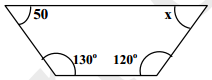
MCQ Questions for Class 8 Maths Chapter 4 Practical Geometry with Answers 3

(a) 120°
(b) 80°
(c) 100°
(d) 60°

Answer

Answer: (d)


27. A quadrilateral which has 2 pairs of equal adjacent sides but unequal opposite sides is called ______________.
(a) parallelogram
(b) rhombus
(c) kite
(d) square

Answer

Answer: (c)


28. The value of x in the following figure is
MCQ Questions for Class 8 Maths Chapter 4 Practical Geometry with Answers 4

(a) 100°
(b) 90°
(c) 108°
(d) 120°

Answer

Answer: (c)


29. The value of x in the following figure is
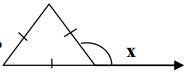
MCQ Questions for Class 8 Maths Chapter 4 Practical Geometry with Answers 5

(a) 120°
(b) 180°
(c) 60°
(d) 100°

Answer

Answer: (a)


30. A parallelogram each of whose angles measures 90o is ______________.
(a) rectangle
(b) rhombus
(c) kite
(d) trapezium

Answer

Answer: (a)


31. A parallelogram whose all sides are equal is called
(a) square
(b) rhombus
(c) rectangle
(d) trapezium

Answer

Answer: (b)


32. the diagonals of a rhombus bisect each other at ______________ angles.
(a) acute
(b) right
(c) obtuse
(d) reflex

Answer

Answer: (b)


33. Diagonals of a rectangle:
(a) equal to each other
(b) not equal
(c) one is double of the other
(d) none of these

Answer

Answer: (a)


34. The diagonals of a square bisect each other at ______________ angle.
(a) acute
(b) right
(c) obtuse
(d) reflex

Answer

Answer: (b)


35. the value of x in the following figure is:
(a) 60°
(b) 70°
(c) 180°
(d) 90°

Answer

Answer: (b)


36. Minimum possible interior angle in a regular polygon is ______________.
(a) 70°
(b) 60°
(c) 90°
(d) 120°

Answer

Answer: (b)


37. Maximum possible exterior angle in a regular polygon is ______________.
(a) 70°
(b) 60°
(c) 90°
(d) 120°

Answer

Answer: (d)


38. How many sides does a heptagon have ?
(a) 2
(b) 4
(c) 7
(d) 5

Answer

Answer: (c)


39. Name the closed figure with 4 sides ?
(a) Hexagon
(b) Triangle
(c) Pentagon
(d) Quadrilateral

Answer

Answer: (d)


40. How many diagonals does a regular Hexagon has ?
(a) 2
(b) 9
(c) 3
(d) 5

Answer

Answer: (b)


41. What is the number of sides in Hexagon ?
(a) 4
(b) 7
(c) 6
(d) 5

Answer

Answer: (c)


42. What is the sum of the measures of angles of a convex quadrilaterals?
(a) 180°
(b) 90°
(c) 360°
(d) 45°

Answer

Answer: (c)


43. If the three angles of a quadrilateral are 120o , 130o, 10o then what is the fourth angle ?
(a) 30°
(b) 100°
(c) 40°
(d) 90°

Answer

Answer: (b)


44. The opposite angles of a parallelogram are ______________ .
(a) Unequal
(b) equal
(c) complementary
(d) supplementary

Answer

Answer: (b)


45. The perimeter of parallelogram PQRS is:
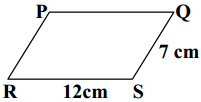
MCQ Questions for Class 8 Maths Chapter 4 Practical Geometry with Answers 6

(a) 12 cm
(b) 7 cm
(c) 38 cm
(d) 19 cm

Answer

Answer: (c)


46. The diagonals of a square are ______________ each other
(a) equal to
(b) unequal to
(c) perpendicular bisectors of
(d) none of these

Answer

Answer: (c)


47. A parallelogram with sides of equal length is called______________.
(a) trapezium
(b) square
(c) rectangle
(d) rhombus

Answer

Answer: (d)


48. How many measurements can determine a quadrilateral uniquely?
(a) 2
(b) 3
(c) 4
(d) 5

Answer

Answer: (d)


49. Diagonals of a parallelogram _______________ each other.
(a) bisect
(b)equal to
(c)perpendicular to
(d)none of these

Answer

Answer: (a)


50.How many sides does decagon has?
(a) 8
(b) 10
(c) 6
(d)

Answer

Answer: (b)


We hope the given Maths MCQs for Class 8 with Answers Chapter 4 Practical Geometry will help you. If you have any query regarding CBSE Class 8 Maths Practical Geometry MCQs Pdf, drop a comment below and we will get back to you at the earliest.

MCQ Questions for Class 8 Maths Chapter 7 Cubes and Cube Roots with Answers

MCQ Questions for Class 8 Maths Chapter 7 Cubes and Cube Roots with Answers

Free PDF Download of CBSE Maths Multiple Choice Questions for Class8 with Answers Chapter 7 Cubes and Cube Roots. Maths MCQs for Class 8 Chapter Wise with Answers PDF Download was Prepared Based on Latest Exam Pattern. Students can solve NCERT Class 8 Maths Cubes and Cube Roots MCQs Pdf with Answers to know their preparation level.

Cubes and Cube Roots Class 8 Maths MCQs Pdf

1. The one’s digit of the cube of 53 is:
a) 9
b) 3
c) 7
d) 1

Answer/Explanation

Answer: (c)
Explanation: 533 = 53 x 53 x 53

33 = 3x3x3 = 27

Hence, at unit place we will get 7.

Recheck: 533 = 53 x 53 x 53 = 148877


2. The prime factorisation of 64 is:
a) 2 x 2 x 2
b) 4 x 4 x 4
c) 8 x 8 x 8
d) None of the above

Answer/Explanation

Answer: (b)
Explanation: 64 = 43 = 4 x 4 x 4


3. Which of the following is not a perfect cube?
a) 216
b) 1000
c) 243
d) 1331

Answer/Explanation

Answer: (c)
Explanation: 243 = 3 × 3 × 3 × 3 × 3 = 33 × 32


4. By what number should 81 be divided to get a perfect cube?
a) 3
b) 6
c) 7
d) 9

Answer/Explanation

Answer: (a)
Explanation: The prime factorisation of 81 will be:

81 = 3 × 3 × 3 × 3

81 = 33 × 3

Hence, we need to divide 81 by 3 to get:

81/3 = 27 = 33


5. By what number should we divide 135 to get a perfect cube?
a) 3
b) 5
c) 7
d) 9

Answer/Explanation

Answer: (b)
Explanation: 135 = 3 x 3 x 3 x 5

We can see, 5 is the extra number which cannot be paired in a group of 3.

Hence, 135/5 = 27


6. Cube root of 512 is:
a) 4
b) 6
c) 8
d) 12

Answer/Explanation

Answer: (c)
Explanation: By prime factorisation we get:

512 = 2 × 2 × 2 × 2 × 2 × 2 × 2 × 2 × 2

3√512 = 2 × 2 × 2 = 8


7. What should be divided by 53240 to make it a perfect cube?
a) 5
b) 10
c) 15
d) 20

Answer/Explanation

Answer: (a)
Explanation: The prime factorisation of 53240

53240 = 2 × 2 × 2 × 11 × 11 × 11 × 5 = 23 × 113 × 5

Hence, we need to divide 53240 by 5

53240/5 = 10648 is a perfect cube.


8. The value of 43√1000 is:
a) 400
b) 40
c) 10
d) 4

Answer/Explanation

Answer: (b)
Explanation: 43√1000 = 43√(10×10×10) = 4 × 10 = 40


9. A perfect cube does not end with _____ zeros.
a) 1
b) 2
c) 3
d) 4

Answer/Explanation

Answer: (b)
Examples: 103 = 1000

203 = 8000

303 = 27000


10. Cube root of 15625 is:
a) 5
b) 15
c) 25
d) 35

Answer/Explanation

Answer: (c)
Explanation: 15625 = 5 x 5 x 5 x 5 x 5 x 5

3√15625 = 5 × 5 = 25


11. Which of the following is not a perfect cube?
(a) 1
(b) 9
(c) 8
(d) 27

Answer

Answer: (b)


12. The cube of 4 is _______________ .
(a) 12
(b) 8
(c) 4
(d) 64

Answer

Answer: (d)


13. The value of 5³ is __________ .
(a) 125
(b) 15
(c) 10
(d) 75

Answer

Answer: (d)


14. The cube of an even number is always ____________ .
(a) odd number
(b) even number
(c) prime number
(d) none of these

Answer

Answer: (b)


15. The cube of an odd number is always __________ .
(a) odd number
(b) even number
(c) prime number
(d) none of these

Answer

Answer: (a)


16. Each prime factor appears _________ times in its cube?
(a) 2
(b) 3
(c) 1
(d) 4

Answer

Answer: (b)


17. Which of the following is Hardy-Ramanujan Number?
(a) 1724
(b)1725
(c) 1727
(d) 1729

Answer

Answer: (d)


18. By which smallest natural number 392 must be multiplied so as to make the product a perfect cube?
(a) 2
(b) 14
(c) 7
(d) 49

Answer

Answer: (c)


19. The smallest natural number by which 243 must be multiplied to make the product a perfect cube is __________ .
(a) 3
(b) 9
(c) 8
(d) 7

Answer

Answer: (a)


20. The smallest natural number by which 704 must be divided to obtain a perfect cube is
(a) 22
(b) 12
(c) 11
(d) 13

Answer

Answer: (c)


21. The smallest natural number by which 135 must be divided to obtain a perfect cube is
(a) 5
(b) 3
(c) 15
(d) 9

Answer

Answer: (a)


22. Which of the following is not a perfect cube?
(a) 216
(b) 343
(c) 125
(d) 108

Answer

Answer: (d)


23. The expansion of a³ is ___________ .
(a) 3 × a
(b) a+a+a
(c) 3 × 3 × 3
(d) a × a × a

Answer

Answer: (d)


24. What will be the unit digit of the cube of a number ending with 2?
(a) 8
(b) 4
(c) 2
(d) 6

Answer

Answer: (a)


25. What will be the unit digit of the cube of a number ending with 4?
(a) 4
(b) 6
(c) 2
(d) 8

Answer

Answer: (a)


26. What will be the unit digit of the cube of a number ending with 6?
(a) 4
(b) 6
(c) 2
(d) 8

Answer

Answer: (b)


27. A cuboid has dimensions 5cm , 2cm, 5cm .How many such cuboid will be needed to form a cube?
(a) 20
(b) 10
(c) 5
(d) 2

Answer

Answer: (a)


28. How many cuboids of dimensions 15cm, 30cm ,15cm will be needed to form a cube?
(a) 15
(b) 4
(c) 30
(d) 5

Answer

Answer: (b)


29. 729 is the value of _______________ .
(a) 8³
(b) 9³
(c) 6³
(d) 4³

Answer

Answer: (b)


30. Which of the following is a perfect cube?
(a) 125
(b) 135
(c) 145
(d) 115

Answer

Answer: (a)


31. What is the volume of a cube whose edge is 2cm?
(a) 8
(b) 6
(c) 10
(d) 4

Answer

Answer: (a)


32. The symbol for cube root is __________ .
MCQ Questions for Class 8 Maths Chapter 7 Cubes and Cube Roots with Answers

Answer

Answer: (b)


33. The cube root of 512 is ________ .
(a) 8
(b) 32
(c) 16
(d) 2

Answer

Answer: (a)


34. The value of \(\sqrt[3]{343}\) is ____ .
(a) 8
(b) 7
(c) 6
(d) 3

Answer

Answer: (b)


35. Which of the following is true for any natural number n?
(a) n²>n³
(b) n³>n²
(c) n²=n³
(d) none of these

Answer

Answer: (b)


36. If the volume of a cube is 125 cm3 then what would be the length of its side?
(a) 25
(b) 5
(c) 4
(d) 15

Answer

Answer: (b)


37. What will be the unit digit of the cube root of a number ends with 8?
(a) 2
(b) 8
(c) 4
(d) 6

Answer

Answer: (a)


38. What will be the unit digit of the cube root of a number ends with 2?
(a) 2
(b) 8
(c) 4
(d) 6

Answer

Answer: (b)


39. What will be the unit digit of the cube root of a number ends with 3?
(a) 3
(b) 7
(c) 5
(d) 2

Answer

Answer: (b)


40. What will be the unit digit of the cube root of a number ends with 7?
(a) 3
(b) 7
(c) 6
(d) 5

Answer

Answer: (a)


41. 9 is the cube root of __________ .
(a) 343
(b) 729
(c) 629
(d) 81

Answer

Answer: (b)


42. The number of digits in the cube root of a 6-digit number is _______ .
(a) 3
(b) 2
(c) 4
(d) 6

Answer

Answer: (b)


43. How many digits will be there in the cube root of 46656?
(a) 2
(b) 1
(c) 3
(d) 4

Answer

Answer: (a)


44. How many digits will be there in the cube root of 512?
(a) 1
(b) 2
(c) 3
(d) 4

Answer

Answer: (a)


45. What will be the unit digit of \(\sqrt[3]{15625}\)?
(a) 5
(b) 0
(c) 3
(d) 4

Answer

Answer: (a)


46. How many zeros will be there in the cube root of 27000?
(a) 3
(b) 0
(c) 1
(d) 2

Answer

Answer: (c)


47. How many zeros will be there in the cube root of 800?
(a) 3
(b) 0
(c) 1
(d) cube root does not exist

Answer

Answer: (d)


48. If 7³=343 , then \(\sqrt[3]{343}\) = _________ .
(a) 3
(b) 7
(c) 13
(d) 9

Answer

Answer: (b)


49. If 8³ = 512 , then \(\sqrt[3]{512}\) = __________ .
(a) 3
(b) 7
(c) 13
(d) 9

Answer

Answer: (a)


50. What will be the unit digit of \(\sqrt[3]{216}\)?
(a) 3
(b) 6
(c) 4
(d) 2

Answer

Answer: (b)


We hope the given Maths MCQs for Class 8 with Answers Chapter 7 Cubes and Cube Roots will help you. If you have any query regarding CBSE Class 8 Maths Cubes and Cube Roots MCQs Pdf, drop a comment below and we will get back to you at the earliest.
MCQ Questions for Class 8 Maths Chapter 6 Squares and Square Roots with Answers

MCQ Questions for Class 8 Maths Chapter 6 Squares and Square Roots with Answers

Free PDF Download of CBSE Maths Multiple Choice Questions for Class8 with Answers Chapter 6 Squares and Square Roots. Maths MCQs for Class 8 Chapter Wise with Answers PDF Download was Prepared Based on Latest Exam Pattern. Students can solve NCERT Class 8 Maths Squares and Square Roots MCQs Pdf with Answers to know their preparation level.

Squares and Square Roots Class 8 Maths MCQs Pdf

1. The Pythagorean triples whose smallest number is 8:
a) 8, 16 17
b) 8, 17, 18
c) 8, 15, 17
d) 8, 15, 16

Answer/Explanation

Answer: (c)
Explanation: The general form of Pythagorean triplets is 2m, m2-1, m2+1

Given, 2m = 8

So, m = 4

m2 – 1= 42-1 = 16-1 = 15

m2+1=42+1= 16+1 = 17


2. Which of the following is a perfect square?
a) 1057
b) 625
c) 7928
d) 64000

Answer/Explanation

Answer: (b)
Explanation: The natural numbers which end with 0,2,3,7 and 8 are not perfect squares. Hence, 625 is a perfect square.

25 x 25 = 625


3. Which of the following will have 6 at unit place?
a) 192
b) 112
c) 242
d) 132

Answer/Explanation

Answer: (c)
Explanation: 242 = 24 x 24 = 576


4. If 5278 is squared, then what will be at unit place?
a) 8
b) 7
c) 6
d) 4

Answer/Explanation

Answer: (d)
Explanation: If we square the unit digit of the number 5278 we get:

82 = 64

Hence, at the unit place of 52782 the number is 4.


5. What will be the number of zeros in square of 400?
a) 2
b) 3
c) 4
d) 6

Answer/Explanation

Answer: (c)
Explanation: 4002 = 400 x 400 = 160000


6. How many natural numbers lie between 92 and 102?
a) 17
b) 18
c) 19
d) 20

Answer/Explanation

Answer: (b)
Explanation: The number of natural numbers between n2 and (n+1)2 is equal to 2n.

Here, n = 9

Therefore, 2n = 2 x 9 = 18


7. What is the sum of first four odd natural numbers?
a) 16
b) 17
c) 18
d) 20

Answer/Explanation

Answer: (a)
Explanation: The sum of first odd natural numbers = n 2

Here, n = 4

So, n2 = 42 = 16


8. The value of 92 – 1 is equal to:
a) 81
b) 80
c) 79
d) None of the above

Answer/Explanation

Answer: (b)
Explanation: 92-1 = 81 – 1 = 80


9. The sum of 1 + 3 + 5 + 7 + 9 + 11 + 13 + 15 + 17 +19 is:
a) 121
b) 120
c) 100
d) 110

Answer/Explanation

Answer: (c)
Explanation: Sum of n odd numbers = n2

102 = 100


10. The square of 42 is:
a) 1764
b) 1664
c) 1564
d) 1504

Answer/Explanation

Answer: (a)
Explanation: 422 = (40 + 2)2 = 40(40 + 2) + 2(40 + 2)

= 402 + 40 x 2 + 2 x 40 + 22

= 1600 + 80 + 80 + 4

= 1764


11.Which of the following is not a square number?
(a) 4
(b) 9
(c) 16
(d) 24

Answer

Answer: (d)


12. The square of 23 is :
(a) 529
(b) 526
(c) 46
(d) 429

Answer

Answer: (a)


13. The square of which of the following would be even number?
(a) 2826
(b) 7779
(c) 1057
(d) 131

Answer

Answer: (a)


14. The square of which of the following would be odd number?
(a) 431
(b) 272
(c) 1234
(d) 7928

Answer

Answer: (a)


15. Which of the following is a perfect square ?
(a) 45
(b) 81
(c) 18
(d) 54

Answer

Answer: (b)


16. What will be the “ one’s digit” in the square of 1234?
(a) 6
(b) 2
(c) 8
(d) 9

Answer

Answer: (a)


17. What will be the number of zeros in the square of 400?
(a) 5
(b) 1
(c) 3
(d) 4

Answer

Answer: (d)


18. The perfect square number between 30 and 40 is :
(a) 35
(b) 39
(c) 36
(d) 32

Answer

Answer: (c)


19. Which of the following number would have digit 6 at units place?
(a) 192
(b) 242
(c) 252
(d) 132

Answer

Answer: (b)


20. Which of the following number would have digit 5 at units place :
(a) 952
(b) 592
(c) 242
(d) 422

Answer

Answer: (a)


21. Which of the following number would have digit 1 at units place?
(a) 812
(b) 182
(c) 542
(d) 952

Answer

Answer: (a)


22. How many natural numbers lie between 9² and 10²?
(a) 15
(b) 19
(c) 18
(d) 17

Answer

Answer: (c)


23. How many non square numbers lie between 11² and 12²?
(a) 21
(b) 23
(c) 22
(d) 20

Answer

Answer: (c)


24. 25 can be express as the sum of first _________consecutive odd numbers.
(a)
(b) 4
(c) 6
(d) 3

Answer

Answer: (a)


25. How many numbers lie between square of 12 and 13?
(a) 21
(b) 23
(c)22
(d)24

Answer

Answer: (d)


26. What will be the value of „ x‟ in Pythagorean triplet (6,8, x)?
(a) 5
(b) 7
(c)10
(d) 11

Answer

Answer: (c)


27. The square of -9 is
(a) -81
(b) 81
(c) 18
(d) -18

Answer

Answer: (b)


28. The square root of 6400 is
(a) 80
(b) 81
(c) 32
(d) 23

Answer

Answer: (a)


29. By which smallest number 90 must be multiplied so as to make it a perfect square?
(a) 10
(b) 2
(c) 5
(d) 3

Answer

Answer: (a)


30. By which smallest number 48 must be divided so as to make it a perfect square ?
(a) 2
(b) 3
(c) 6
(d) 4

Answer

Answer: (b)


31. which smallest number should be added to 80 so as to make it a perfect square?
(a) 2
(b) 3
(c) 1
(d) 4

Answer

Answer: (c)


32. What could be the possible “one’s digit” of the square root of 625?
(a) 5
(b) 0
(c) 4
(d) 8

Answer

Answer: (a)


33. Which is the smallest three-digit perfect square?
(a) 100
(b) 101
(c) 121
(d) 144

Answer

Answer: (a)


34. Which is the greatest three-digit perfect square?
(a) 999
(b) 961
(c) 962
(d) 970

Answer

Answer: (b)


35. Which is the greatest 4-digit perfect square?
(a) 9999
(b) 9990
(c) 9800
(d) 9801

Answer

Answer: (a)


36. Which is the smallest 4-digit perfect square?
(a) 1024
(b) 1025
(c) 1000
(d) 1016

Answer

Answer: (d)


37. What will be the number of digits in the square root of 25600?
(a) 3
(b) 2
(c) 5
(d) 4

Answer

Answer: (a)


38. What will be the number of digits in the square root of 1296?
(a) 2
(b) 3
(c) 1
(d) 4

Answer

Answer: (a)


39. The square root of 12.25 is _______________ .
(a) 3.5
(b) 2.5
(c) 35
(d) 25

Answer

Answer: (a)


40. What is the length of the side of a square whose area is 441 cm²?
(a) 21
(b) 22
(c) 20
(d) 12

Answer

Answer: (a)


41. In a right angle triangle ABC , right angled at B, AB=6cm, BC=8cm ,then AC= ____ .
(a) 10
(b) 12
(c) 21
(d) 14

Answer

Answer: (a)


42. Which least number should be subtracted from 629 so as to get a perfect square?
(a) 4
(b) 5
(c) 6
(d) 3

Answer

Answer: (a)


43. The square root of 1.21 is
(a) 1.1
(b) 11
(c) 21
(d) 2.1

Answer

Answer: (a)


44. What is the smallest square number which is divisible by each of the numbers 6,9 and 15 ?
(a) 900
(b) 810
(c) 630
(d) 720

Answer

Answer: (a)


45. The square of 1.2 is
(a) 144
(b) 1.44
(c) 14.4
(d) 2.4

Answer

Answer: (b)


46. The square root of 169 is
(a) -13
(b) 1.3
(c) -1.3
(d) \(\frac{13}{10}\)

Answer

Answer: (a)


47. What is the length of the diagonal of a rectangle having dimensions 3cm and 4cm?
(a) 5
(b) 7
(c) 1
(d) 4

Answer

Answer: (a)


48. What will be the length of third side of a right angled triangle whose hypotenuse is 5cm and one of the side is 3 cm?
(a) 2
(b) 3
(c) 4
(d) 5

Answer

Answer: (c)


49. Which of the following is not a perfect square?
(a) 81
(b) 18
(c) 100
(d) 121

Answer

Answer: (b)


40. Which is the smallest square number that is divisible by each of the number 4, 9 and 10?
(a) 900
(b) 810
(c) 800
(d) 920

Answer

Answer: (a)


We hope the given Maths MCQs for Class 8 with Answers Chapter 6 Squares and Square Roots will help you. If you have any query regarding CBSE Class 8 Maths Squares and Square Roots MCQs Pdf, drop a comment below and we will get back to you at the earliest.
MCQ Questions for Class 8 Maths Chapter 5 Data Handling with Answers

MCQ Questions for Class 8 Maths Chapter 5 Data Handling with Answers

Free PDF Download of CBSE Maths Multiple Choice Questions for Class8 with Answers Chapter 5 Data Handling. Maths MCQs for Class 8 Chapter Wise with Answers PDF Download was Prepared Based on Latest Exam Pattern. Students can solve NCERT Class 8 Maths Data Handling MCQs Pdf with Answers to know their preparation level.

Data Handling Class 8 Maths MCQs Pdf

1. The width or size of the class interval 30-40 is:
a) 10
b) 30
c) 40
d) 70

Answer/Explanation

Answer: (a)
Explanation: Width of class interval = upper class limit-lower class limit

= 40-30

= 10


2. If a coin is flipped in the air, what is the probability of getting a tail?
a) 0
b) ½
c) 1
d) 2

Answer/Explanation

Answer: (b)
Explanation: A coin has two sides, Head and tails.

Hence, probability = Number of possible outcomes/Total number of outcomes

We know, Tail is present on one side of a coin and in total there could be two outcomes H&T

Hence, Probability = ½


3. A bag has 4 red balls and 4 green balls, what is the probability of getting a red ball randomly?
a) 1/4
b) 1/8
c) 1/2
d) 0

Answer/Explanation

Answer: (c)
Explanation: Total number of balls in bag = 4+4 = 8

Total number of red balls = 4

Probability of getting a red ball = 4/8 = ½


4. If a die is thrown in air, the probability of getting even numbers is:
a) ½
b) ⅙
c) ⅓
d) ⅔

Answer/Explanation

Answer: (b)
Explanation: A die has six sides each consisting numbers from 1 to 6.

Number of even numbers in die = 3 (2,4,6)

Total possible outcomes = 6

Probability = 3/6 = 1/2


5. Pictorial representation of data using symbols is known as:
a) Bargraph
b) Pictograph
c) Piechart
d) None of these

Answer

Answer: (b)


6. Double bar graphs display ______ sets of data simultaneously.
a) Four
b) Three
c) Two
d) No

Answer

Answer: (c)


7. _________ gives the number of times a particular entry occurs.
a) Organisation of data
b) Collection of Data
c) Representation of Data
d) Frequency distribution table

Answer

Answer: (d)


8. In grouped data, each of the group is called:
a) Class interval
b) Collection of data
c) Frequency
d) Grouped frequency distribution

Answer

Answer: (a)


9. If 20-30 is the class interval of grouped data, then lower class limit is:
a) 50
b) 30
c) 20
d) 10

Answer

Answer: (c)


10. The difference between the upper class limit and lower class limit of a class interval is called:
a) Frequency
b) Width
c) Grouped data
d) Ungrouped data

Answer

Answer: (b)


Frequency distribution of daily income of 550 workers of a factory is given bellow
Read the table given above and answer the following questions (Q1 – Q5)
11. What is the size of class intervals?
(a) 24
(b) 25
(c) 26
(d) 15

Answer

Answer: (b)


12. Which class has the highest frequency?
(a) 200-225
(b) 300-325
(c) 175-200
(d) 150-175

Answer

Answer: (a)


13. Which class has the lowest frequency?
(a) 100-125
(b) 300-325
(c) 175-200
(d) 150-175

Answer

Answer: (b)


14. What is the upper limit of the class interval 250-275?
(a) 250
(b) 275
(c) 25
(d) 525

Answer

Answer: (b)


15. Which two classes have the same frequency?
(a) III & IV
(b) I & II
(c) II & V
(d) V & VI

Answer

Answer: (a)


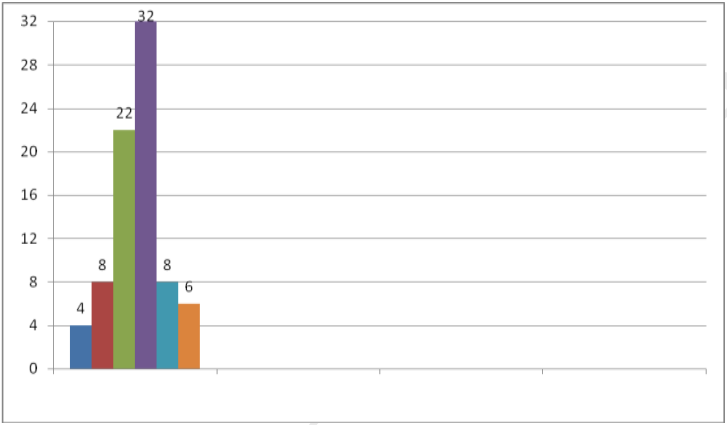
The number of hours for which students of particular class watched television during holidays is shown through the graph given below:
MCQ Questions for Class 8 Maths Chapter 5 Data Handling with Answers 1

16. For how many hours did the maximum number of students watch TV?
(a) 4-5 hrs
(b) 6-7 hrs
(c) 3-4 hrs
(d) 2-3hrs

Answer

Answer: (a)


17. How many students watched TV for less than 4 hrs?
(a) 12
(b) 34
(c) 4
(d) 8

Answer

Answer: (b)


18. How many students spent more than 5 hrs in TV watching?
(a) 14
(b) 0
(c) 6
(d) 8

Answer

Answer: (a)


19. For how many hours did the minimum number of students watch TV?
(a) 2-3 hrs
(b) 6-7 hrs
(c) 1-2 hrs
(d) 3-4hrs

Answer

Answer: (c)


20. How many students spent less than 5 hrs in TV watching?
(a) 34
(b) 32
(c) 8
(d) 66

Answer

Answer: (d)


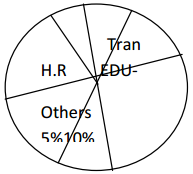
Adjoining pie-chart gives the expenditure (in %age) on various items and savings of a family during a month .
Study the given pie chart and answer the following questions (Q11-Q15)
MCQ Questions for Class 8 Maths Chapter 5 Data Handling with Answers 2

21. On which item the expenditure was maximum?
(a) food
(b) education
(c) others
(d) transport

Answer

Answer: (a)


22. On which item the expenditure was minimum?
(a) food
(b) education
(c) others
(d) transport

Answer

Answer: (d)


23. Expenditure on which item is equal to total savings of the family?
(a) food
(b) education
(c) others
(d) transport

Answer

Answer: (b)


24. If the monthly savings of the family is Rs 3000, What is the monthly expenditure on cloths?
(a) 3000
(b) 2000
(c) 2500
(d) 1000

Answer

Answer: (b)


25. What is the monthly expenditure on education for children?
(a) 3000
(b) 2000
(c) 2500
(d) 1000

Answer

Answer: (a)


Numbers 1 to 10 are written on ten separates slips (one number on one slip ), kept in a
box and mixed well. One slip is chosen from the box without looking in to it .Answer the
following questions (Q16-Q20)

26. What is the probability of getting a number 6?
(a) 1
(b) 0
(c) \(\frac{1}{10}\)
(d) \(\frac{1}{2}\)

Answer

Answer: (c)


27. What is the probability of getting a number less than 6?
(a) 1
(b) 0
(c) \(\frac{1}{10}\)
(d) \(\frac{1}{2}\)

Answer

Answer: (d)


28. What is the probability of getting a number greater than 6?
(a) 1
(b) 0
(c) \(\frac{1}{10}\)
(d) \(\frac{2}{5}\)

Answer

Answer: (d)


29. What is the probability of getting a 1-digit number?
(a) 1 (b) 0
(c) \(\frac{1}{10}\)
(d) \(\frac{9}{10\)

Answer

Answer: (d)


30. What is the probability of getting an even number?
(a) 1
(b) 0
(c) \(\frac{1}{10}\)
(d) \(\frac{1}{2}\)

Answer

Answer: (d)


We hope the given Maths MCQs for Class 8 with Answers Chapter 5 Data Handling will help you. If you have any query regarding CBSE Class 8 Maths Data Handling MCQs Pdf, drop a comment below and we will get back to you at the earliest.
MCQ Questions for Class 7 Maths Chapter 7 Congruence of Triangles with Answers

MCQ Questions for Class 7 Maths Chapter 7 Congruence of Triangles with Answers

Free PDF Download of CBSE Maths Multiple Choice Questions for Class 7 with Answers Chapter 7 Congruence of Triangles. Maths MCQs for Class 7 Chapter Wise with Answers PDF Download was Prepared Based on Latest Exam Pattern. Students can solve NCERT Class 7 Maths Congruence of Triangles MCQs Pdf with Answers to know their preparation level.

Congruence of Triangles Class 7 Maths MCQs Pdf

1. ‘Under a given correspondence, two triangles are congruent if the three sides of the one are equal to the three corresponding sides of the other.’
The above is known as
(a) SSS congruence of two triangles
(b) SAS congruence of two triangles
(c) ASA congruence of two triangles
(d) RHS congruence of two right-angled triangles

Answer

Answer: (a)


2. ‘Under a given correspondence, two triangles are congruent if two sides and the angle included between them in one of the triangles are equal to the corresponding sides and the angle included between them of the other triangle.’
The above is known as
(a) SSS congruence of two triangles
(b) SAS congruence of two triangles
(c) ASA congruence of two triangles
(d) RHS congruence of two right-angled triangles

Answer

Answer: (b)


3. ‘Under a given correspondence, two triangles are congruent if two angles and the side included between them in one of the triangles are equal to the corresponding angles and the side included between them of the other triangle.’
The above is known as
(а) SSS congruence of two triangles
(b) SAS congruence of two triangles
(c) ASA congruence of two triangles
(d) RHS congruence of two right-angled triangles

Answer

Answer: (c)


4. ‘Under a given correspondence, two right-angled triangles are congruent if the hypotenuse and a leg of one of the triangles are equal to the hypotenuse and the corresponding leg of the other triangle.’
The above is known as
(а) SSS congruence of two triangles
(b) SAS congruence of two triangles
(c) ASA congruence of two triangles
(d) RHS congruence of two right-angled triangles

Answer

Answer: (d)


5. For two given triangles ABC and PQR, how many matchings are possible?
(a) 2
(b) 4
(c) 6
(d) 3

Answer/Explanation

Answer: (c)
Explanation : ABC ↔ PQR, ABC ↔ PRQ,
ABC ↔ QRP, ABC ↔ QPR,
ABC ↔ RPQ, ABC ↔ RQP.


6. The symbol for congruence is
(a) ≡
(b) ≅
(c) ↔
(d) =

Answer

Answer: (b)


7. The symbol for correspondence is
(a) =
(b) ↔
(c) ≡
(d) ≅

Answer

Answer: (b)


8. If ∆ ABC = ∆ PQR, then \(\overline { AB } \) corresponds to
(a) \(\overline { PQ } \)
(b) \(\overline { QR } \)
(c) \(\overline { RP } \)
(d) none of these

Answer

Answer: (a)


9. If ∆ ABC = ∆ PQR, then \(\overline { BC } \) corresponds to
(a) \(\overline { PQ } \)
(b) \(\overline { QR } \)
(c) \(\overline { RP } \)
(d) none of these

Answer

Answer: (b)


10. If ∆ ABC = ∆ PQR, then \(\overline { CA } \) corresponds to
(a) \(\overline { PQ } \)
(b) \(\overline { QR } \)
(c) \(\overline { RP } \)
(d) none of these

Answer

Answer: (c)


11. If ∆ ABC = ∆ PQR, then ∠A corresponds to
(a) ∠P
(b) ∠Q
(c) ∠R
(d) none of these

Answer

Answer: (a)


12. If ∆ ABC = ∆ PQR, then ∠B corresponds to
(a) ∠ P
(b) ∠ Q
(c) ∠ R
(d) none of these

Answer

Answer: (b)


13. If ∆ ABC= ∆ PQR, then ∠C corresponds to
(a) ∠ P
(b) ∠ Q
(c) ∠ R
(d) none of these

Answer

Answer: (c)


14. We want to show that ∆ ART = ∆ PEN and we have to use SSS criterion. We have AR = PE and RT = EN. What more we need to show?
(a) AT = PN
(b) AT = PE
(c) AT = EN
(d) none of these

Answer

Answer: (a)


15. We want to show that ∆ ART = ∆ PEN. We have to use SAS criterion. We have ∠ T = ∠ N, RT = EN. What more we need to show?
(a) PN = AT
(b) PN = AR
(c) PN = RT
(d) None of these

Answer

Answer: (a)


16. We want to show that ∆ ART = ∆ PEN. We have to use ASA criterion. We have AT = PN, ∠ A = ∠ P. What more we need to show?
(a) ∠T = ∠N
(b) ∠T = ∠E
(c) ∠T = ∠P
(d) None of these

Answer

Answer: (a)


17. Which congruence criterion do you use in the following?
NCERT Solutions for Class 7 Maths Chapter 7 Congruence of Triangles 20
Given AC = DF
AB = DE
BC = EF
So, ∆ ABC ≅ ∆ DEF
(a) SSS
(b) SAS
(c) ASA
(d) RHS

Answer

Answer: (a)


18. Which congruence criterion do you use in the following?
NCERT Solutions for Class 7 Maths Chapter 7 Congruence of Triangles 21
Given : ZX = RP
RQ = ZY
∠ PRQ = ∠ XZY
So, ∆ PRQ = ∆ XYZ
(a) SSS
(b) SAS
(c) ASA
(d) RHS

Answer

Answer: (b)


19. Which congruence criterion do you use in the following?
study rankers class 7 maths Chapter 7 Congruence of Triangles 22
(a) SSS
(b) SAS
(c) ASA
(d) RHS

Answer

Answer: (c)


20. Which congruence criterion do you use in the following?
NCERT Solutions for Class 7 Maths Chapter 7 Congruence of Triangles 23
(a) SSS
(b) SAS
(c) ASA
(d) RHS

Answer

Answer: (d)


21. In the following figure, the two triangles are congruent. The corresponding parts are marked. We can write ∆ RAT = ?
NCERT Solutions for Class 7 Maths Chapter 7 Congruence of Triangles 24
(a) ∆ WON
(b) ∆ WNO
(c) ∆ OWN
(d) ∆ ONW

Answer

Answer: (a)


22. Complete the congruence statement ∆ BCA = ?
NCERT Solutions for Class 7 Maths Chapter 7 Congruence of Triangles 25
(a) ∆ BTA
(b) ∆ BAT
(c) ∆ ABT
(d) ∆ ATB

Answer

Answer: (a)


23. Complete the congruence statement ∆ QRS
NCERT Solutions for Class 7 Maths Chapter 7 Congruence of Triangles 26
(a) ∆ TPQ
(b) ∆ TQP
(c) ∆ QTP
(d) ∆ QPT

Answer

Answer: (a)


24. If ∆ ABC and ∆ PQR are to be congruent, name one additional pair of corresponding parts
NCERT Solutions for Class 7 Maths Chapter 7 Congruence of Triangles 27
(a) BC = QR
(b) BC = PQ
(c) BC = PR
(d) none of these

Answer

Answer: (a)


25. By which congruence, is ∆ ABC = ∆ FED?
study rankers class 7 maths Chapter 7 Congruence of Triangles 28
(a) SSS
(b) SAS
(c) ASA
(d) RHS

Answer/Explanation

Answer: (c)
Explanation : ∠B = ∠E, BC = ED, ∠D = ∠C
(By angle sum property of a triangle).


We hope the given Maths MCQs for Class 7 with Answers Chapter 7 Congruence of Triangles will help you. If you have any query regarding CBSE Class 7 Maths Congruence of Triangles MCQs Pdf, drop a comment below and we will get back to you at the earliest.
MCQ Questions for Class 7 Maths Chapter 6 The Triangle and its Properties with Answers

MCQ Questions for Class 7 Maths Chapter 6 The Triangle and its Properties with Answers

Free PDF Download of CBSE Maths Multiple Choice Questions for Class 7 with Answers Chapter 6 The Triangle and its Properties. Maths MCQs for Class 7 Chapter Wise with Answers PDF Download was Prepared Based on Latest Exam Pattern. Students can solve NCERT Class 7 Maths The Triangle and its Properties MCQs Pdf with Answers to know their preparation level.

The Triangle and its Properties Class 7 Maths MCQs Pdf

1. How many elements are there in a triangle?
(a) 3
(b) 6
(c) 4
(d) None of these.

Answer/Explanation

Answer: (b)
Explanation : See a triangle.


2. How many vertices does a triangle have?
(a) 1
(b) 2
(c) 3
(d) 4

Answer/Explanation

Answer: (c)
Explanation : See a triangle.


3. How many sides are there in a triangle?
(a) 1
(b) 2
(c) 3
(d) 4

Answer/Explanation

Answer: (c)
Explanation : See a triangle.


4. How many angles are there in a triangle?
(a) 1
(b) 2
(c) 3
(d) 4

Answer/Explanation

Answer: (c)
Explanation : See a triangle.


5. If two sides of a triangle are not equal, the triangle is called
(a) scalene
(b) isosceles
(c) equilateral
(d) right-angled

Answer/Explanation

Answer: (a)
Explanation : Definition of a scalene triangle.


6. If two sides of a triangle are equal, the triangle is called
(a) isosceles
(b) equilateral
(c) scalene
(d) right-angled

Answer/Explanation

Answer: (a)
Explanation : Definition of an isosceles triangle.


7. If all the three sides of a triangle are equal, the triangle is called
(a) equilateral
(b) right-angled
(c) isosceles
(d) scalene

Answer/Explanation

Answer: (a)
Explanation : Definition of an equilateral triangle.


8. If all the angles of a triangle are acute, the triangle is called
(a) obtuse-angled
(b) acute-angled
(c) right-angled
(d) none of these

Answer/Explanation

Answer: (b)
Explanation : Definition of an acute-angled triangle.


9. If one angle of a triangle measures 90°, the triangle is called
(a) acute-angled
(b) obtuse-angled
(c) right-angled
(d) none of these

Answer/Explanation

Answer: (c)
Explanation : Definition of a right triangle.


10. If one angle of a triangle is obtuse, the triangle is called
(a) acute-angled
(b) obtuse-angled
(c) right-angled
(d) none of these

Answer/Explanation

Answer: (b)
Explanation : Definition of an obtuse angled triangle.


11, How many medians can a triangle have?
(a) 1
(b) 2
(c) 3
(d) 4

Answer/Explanation

Answer: (c)
Explanation : Draw medians and count.


12. How many altitudes can a triangle have?
(a) 1
(b) 2
(c) 3
(d) 4

Answer/Explanation

Answer: (c)
Explanation : Draw altitudes and count.


13. The total measure of the three angles of a triangle is
(a) 360°
(b) 90°
(c) 180°
(d) none of these

Answer/Explanation

Answer: (c)
Explanation : Angle Sum Property of a triangle.


14. The measure of each angle of an equilateral triangle is
(a) 30°
(b) 45°
(c) 90°
(d) 60°

Answer/Explanation

Answer: (d)
Explanation : x° + x° + x° = 180° ⇒ x° = 60°.


15. Which of the following statements is true?
(a) A triangle can have two right angles
(b) A triangle can have two obtuse angles
(c) A triangle can have two acute angles
(d) A triangle can have all the three angles less than 60°

Answer/Explanation

Answer: (c)
Explanation :


16. Which of the following statements is true?
(a) A triangle can have all the three angles equal to 60°.
(b) A triangle can have all the three angles greater than 60°.
(c) The sum of any two angles of a triangle is always greater than the third angle.
(d) The difference between the lengths of any two sides of a triangle is greater than the length of the third side

Answer/Explanation

Answer: (a)
Explanation :


17. Which of the following statement is false?
(a) The sum of the lengths of any two sides of a triangle is less than the third side.
(b) In a right-angled triangle, the square on the hypotenuse = sum of the squares on the legs.
(c) If the Pythagorean property holds, the triangle must be right-angled.
(d) The diagonal of a rectangle produce ‘by itself the same area as produced by its length and breadth

Answer/Explanation

Answer: (a)
Explanation :


18. Two angles of a triangle measure 90° and 30°. The measure of the third angle is
(a) 90°
(b) 30°
(c) 60°
(d) 120°

Answer/Explanation

Answer: (c)
Explanation : Third angle = 180° – (90° + 30°) = 60°.


19. The ratio of the measures of the three angles of a triangle is 2 : 3 : 4. The measure of the largest angle is
(a) 80°
(b) 60°
(c) 40°
(d) 180°

Answer/Explanation

Answer: (a)
Explanation : Largest angle = \(\frac { 4 }{ 2+3+4 } \) × 180° = 80°.


20. In the following figure, the side BC of ∆ ABC is extended up to the point D. If ∠ A = 55° and ∠ B = 60°, then the measure of ∠ACD is
NCERT Solutions for Class 7 Maths Chapter 6 The Triangle and its Properties 34
(a) 120°
(b) 110°
(c) 115°
(d) 125°

Answer/Explanation

Answer: (c)
Explanation : ∠ ACD = 60° + 55° = 115°.


21. In the following figure, the measure of ∠A is
NCERT Solutions for Class 7 Maths Chapter 6 The Triangle and its Properties 35
(a) 30°
(b) 45°
(c) 90°
(d) 30°

Answer/Explanation

Answer: (d)
Explanation : ∠ A – 180° – [(180° – 120°) + (180° – 120°)] = 60°.


22. In the following figure, the measure of ∠A is
NCERT Solutions for Class 7 Maths Chapter 6 The Triangle and its Properties 36
(a) 70°
(b) 90°
(c) 80°
(d) 100°

Answer/Explanation

Answer: (c)
Explanation : ∠A – 180° – (60° + 40°) = 80°


23. In the following figure, m || QR. Then, the measure of ∠QPR is
byjus class 7 maths Chapter 6 The Triangle and its Properties 37
(a) 80°
(b) 85°
(c) 75°
(d) 70°

Answer/Explanation

Answer: (b)
Explanation : ∠ PQR = 50°
∴ ∠ QPR – 180° – (50° + 45°) = 85°.


24. In the following figure, find ∠ x and ∠ y, if ∠x – ∠y – 10°
NCERT Solutions for Class 7 Maths Chapter 6 The Triangle and its Properties 38
(a) 65°, 55°
(b) 55°, 45°
(c) 45°, 35°
(d) 60°, 60°

Answer/Explanation

Answer: (a)
Explanation : ∠x + ∠y = 120°; ∠x – ∠y = 10° Solve to get ∠x = 65°, ∠y = 55°.


25. In the following figure, find ∠ B.
NCERT Solutions for Class 7 Maths Chapter 6 The Triangle and its Properties 39
(a) 30°
(b) 45°
(c) 40°
(d) 60°

Answer/Explanation

Answer: (d)
Explanation : ∠B = 180° – [(180° – 110°) + 50°] = 60°.


26. In the following figure, ∆ ABC is an equilateral triangle. Find ∠x.
NCERT Solutions for Class 7 Maths Chapter 6 The Triangle and its Properties 40
(a) 30°
(b) 45°
(c) 60°
(d) 90°

Answer/Explanation

Answer: (a)
Explanation : ∠ABC = 60°.
∴ ∠ABD = 180° – 60° = 120°
∴ x = 180° – (120° + 30°) = 30°.


27. In the following figure, one angle of triangle ABC is 40°. If the difference of the other two angles is 30°, find the larger of the other two angles.
NCERT Solutions for Class 7 Maths Chapter 6 The Triangle and its Properties 41
(a) 85°
(b) 80°
(c) 75°
(d) 70°

Answer/Explanation

Answer: (a)
Explanation : x + y = 180° – 40° = 140° x – y = 30°. Solve to get x = 85°.


28. In the following figure, find
byjus class 7 maths Chapter 6 The Triangle and its Properties 42
(a) 60°
(b) 70°
(c) 80°
(d) 75°

Answer/Explanation

Answer: (b)
Explanation : x + x = 140° ⇒ x = 70°.


29. In the following figure, find x if BA || CE.
NCERT Solutions for Class 7 Maths Chapter 6 The Triangle and its Properties 43
(a) 60°
(b) 40°
(c) 45°
(d) 65°

Answer/Explanation

Answer: (d)
Explanation : ∠ECD = ∠ABC = 50°;
∴ x = 180° – (65° + 50°) = 65°.


30. Find the value of the unknown interior angle x in the following figure:
NCERT Solutions for Class 7 Maths Chapter 6 The Triangle and its Properties 44
(a) 30°
(b) 35°
(c) 40°
(d) 45°

Answer/Explanation

Answer: (c)
Explanation : x + 90° = 130° ⇒ x = 40°.


31. Find the value of unknown x in the following figure:
NCERT Solutions for Class 7 Maths Chapter 6 The Triangle and its Properties 45
(a) 40°
(b) 50°
(c) 45°
(d) 55°

Answer/Explanation

Answer: (b)
Explanation : x + 40° + 90° = 180° ⇒ x = 50°.


32. Find the value of unknown x in the following figure:
NCERT Solutions for Class 7 Maths Chapter 6 The Triangle and its Properties 46
(a) 10°
(b) 15°
(c) 20°
(d) 25°

Answer/Explanation

Answer: (b)
Explanation : x + 5x + 90° = 180° ⇒ x = 15°.


33. Find angle x in the following figure:
byjus class 7 maths Chapter 6 The Triangle and its Properties 47
(a) 90°
(b) 80°
(c) 95°
(d) 100°

Answer/Explanation

Answer: (a)
Explanation : x + 45 + 45° = 180° ⇒ x = 90°.


34. Find angle x in the following figure:
NCERT Solutions for Class 7 Maths Chapter 6 The Triangle and its Properties 48
(a) 40°
(b) 50°
(c) 45°
(d) 60°

Answer/Explanation

Answer: (b)
Explanation : x = 50°.


35. Find angle x in the following figure:
NCERT Solutions for Class 7 Maths Chapter 6 The Triangle and its Properties 49
(a) 40°
(b) 30°
(c) 25°
(d) 35°

Answer/Explanation

Answer: (b)
Explanation : x + x + 120° = 180° ⇒ x = 30°.


36. Find angle x in the following figure:
NCERT Solutions for Class 7 Maths Chapter 6 The Triangle and its Properties 53
(a) 40°
(b) 45°
(c) 35°
(d) 50°

Answer/Explanation

Answer: (a)
Explanation : x + 140° = 180° ⇒ x = 40°.


37. Find angle x in the following figure:
byjus class 7 maths Chapter 6 The Triangle and its Properties 50
(a) 58°
(b) 59°
(c) 57°
(d) 56°

Answer/Explanation

Answer: (a)
Explanation : x + x = 116° ⇒ x = 58°.


38. Find angle x in the following figure:
NCERT Solutions for Class 7 Maths Chapter 6 The Triangle and its Properties 51
(a) 45°
(b) 40°
(c) 35°
(d) 50°

Answer/Explanation

Answer: (a)
Explanation : x = 45°.


39. In which case of the following lengths of sides of a triangle, is it possible to draw a triangle?
(а) 3 cm, 4 cm, 7 cm
(b) 2 cm, 3 cm, 7 cm
(c) 3 cm, 4 cm, 5 cm
(d) 3 cm, 3 cm, 7 cm

Answer/Explanation

Answer: (c)
Explanation : 3 + 4 > 5; 4 + 5 > 3; 5 + 3 > 4.


40. Which of the following cannot be the sides of a right triangle?
(а) 2 cm, 2 cm, 4 cm
(b) 5 cm, 12 cm, 13 cm
(c) 6 cm, 8 cm, 10 cm
(d) 3 cm, 4 cm, 5 cm

Answer/Explanation

Answer: (a)
Explanation : 22 + 22 = 8; 42 = 16
∴ 22 + 22 ≠ 42


We hope the given Maths MCQs for Class 7 with Answers Chapter 6 The Triangle and its Properties will help you. If you have any query regarding CBSE Class 7 Maths The Triangle and its Properties MCQs Pdf, drop a comment below and we will get back to you at the earliest.