10 Lines on Save Environment for Kids and Students in English

10 Lines on Save Environment for Kids

10 Lines on Save Environment for Kids: Our environment is the place that provides us with our home and everything else that we need to survive in the world, including food, water, shelter, medicines, raw materials for building things.

The environment is being destroyed little by little through human activities such as the pollution of water bodies, air pollution, global warming, and many other such phenomena. With the rising levels of pollution, we must raise more awareness about the problems which will be caused if we do not actively focus on saving the environment.

Read More: Paragraph Say No To Plastic Bags Essay

Below, there are several sets of 10 lines on save environment for kids and students which will be useful for writing essays and paragraphs about this topic.

Enhance your vocabulary and writing skills with 10 Lines Essays available. Spark up the creativity in you and access various Topics on 10 Lines all in one place.

Set 1 – 10 Lines on Save Environment for kids

This set of 10 lines on save environment for kids of junior school will be helpful for those in classes 1, 2, 3, 4 and 5.

  1. The environment is what nature is made up of and it includes all of our surroundings, which are the trees, plants, air, water bodies, etc.
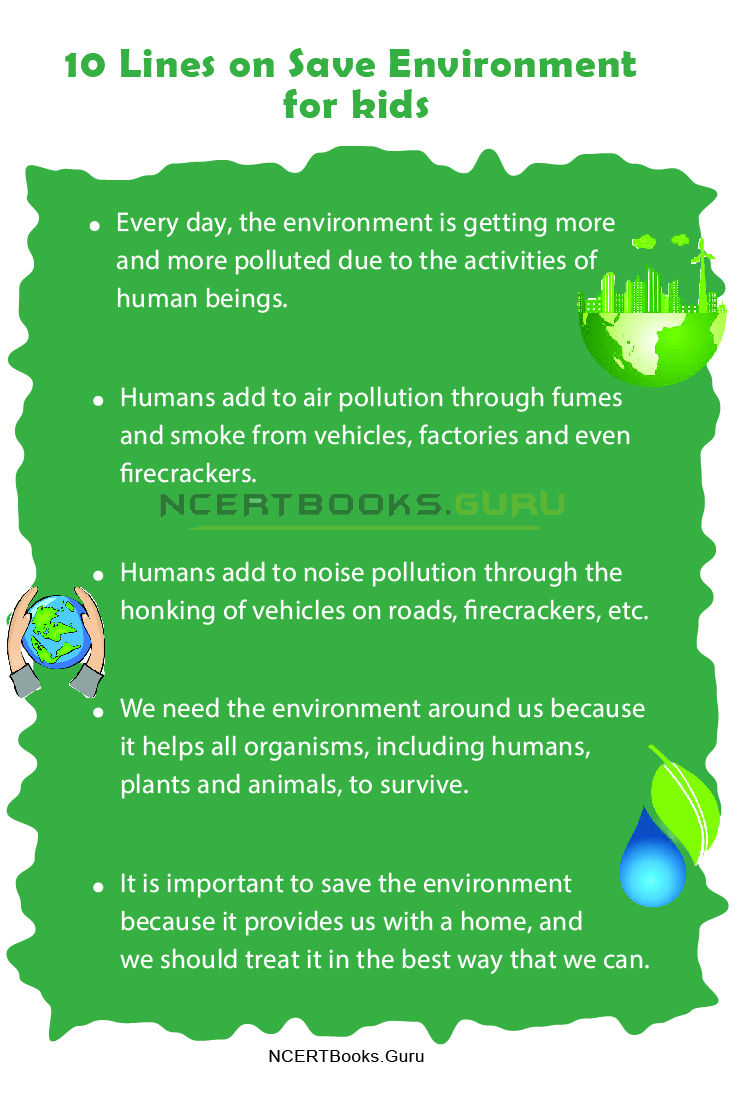
  2. Every day, the environment is getting more and more polluted due to the activities of human beings.
  3. Humans add to air pollution through fumes and smoke from vehicles, factories and even firecrackers.
  4. Humans also continually add to soil pollution and water pollution by dumping lots of waste materials like garbage and factory waste in rivers, seas, lakes, and on open land or anywhere on the land they want to throw it.
  5. Humans add to noise pollution through the honking of vehicles on roads, firecrackers, etc.
  6. We need the environment around us because it helps all organisms, including humans, plants and animals, to survive.
  7. The environment provides air to breathe, water to drink, food to eat, medicines for when we are sick and also all the material we need to use for building our homes and all other structures like schools and hospitals.
  8. If we don’t take care to save the environment, all of the resources we get from the environment will disappear too and none of the organisms on earth will be able to survive.
  9. To save the environment, we must plant more and more trees, we should always throw our trash in a dustbin rather than on the floor, we should make sure we always switch off lights and fans when we are not using them, etc.
  10. It is important to save the environment because it provides us with a home, and we should treat it in the best way that we can.
10 Lines on Save Environment 1

Set 2 – 10 Lines on Save Environment for School Children

The following set of 10 lines on save environment for kids of middle school will be suitable for classes 6, 7, 8 and 9.

  1. The environment refers to all the natural components of the earth that surround us, including all the water bodies, plants like shrubs, trees and flowers, the air, etc.
  2. Human activities contribute highly to the corruption and pollution of the environment, which is harmful to all the living beings which depend on it.
  3. The four kinds of pollution are air pollution, water pollution, soil pollution and noise pollution, each of which is harmful to the environment and the organisms living in that environment.
  4. An example of air pollution is the smoke that comes out from the chimneys of factories which goes into the atmosphere.
  5. An example of water pollution would be the dumping of waste in rivers and lakes close to cities or industrial areas.
  6. The dumping of garbage and toxic waste on barren lands is also an example of soil pollution.
  7. Vehicles on the road which are constantly honking and the whirring of machines in factories are two major examples of noise pollution.
  8. All kinds of pollution cause some or the other harm to the environment, and this is not good because the environment provides us with all the resources that all living beings need to survive.
  9. Some individual ways in which we can protect and save the environment is by not littering our roads, using less electricity wherever we can, carpooling or using public transport instead of using multiple cars, etc.
  10. It is incredibly important to implement ways in our lives which will save the environment because day by day, the pollution is increasing and we need to battle it to save the natural resources which come from the environment.

Set 3 – 10 Lines on Save Environment for Higher Class Students

This set of 10 lines on save environment for kids of senior school is suitable for classes 10, 11 and 12.

  1. The environment refers to all of our surroundings, but in a narrower sense, it refers to all of our natural surroundings, such as trees, bushes, shrubs, rivers, seas, lakes, the air that we breathe, and all other resources found in nature.
  2. Day by day, the levels of pollution in our environment keep on increasing due to activities conducted by human beings, which is not good for the rest of the living beings that live in the environment, such as birds, insects, amphibians, and other animals.
  3. The four kinds of pollution are widely known, and they are air, water, soil and noise pollution, all of which affect the environment – even noise pollution is harmful to plants and animals (alongside humans) because noise can hinder the growth of plants and it can traumatise animals.
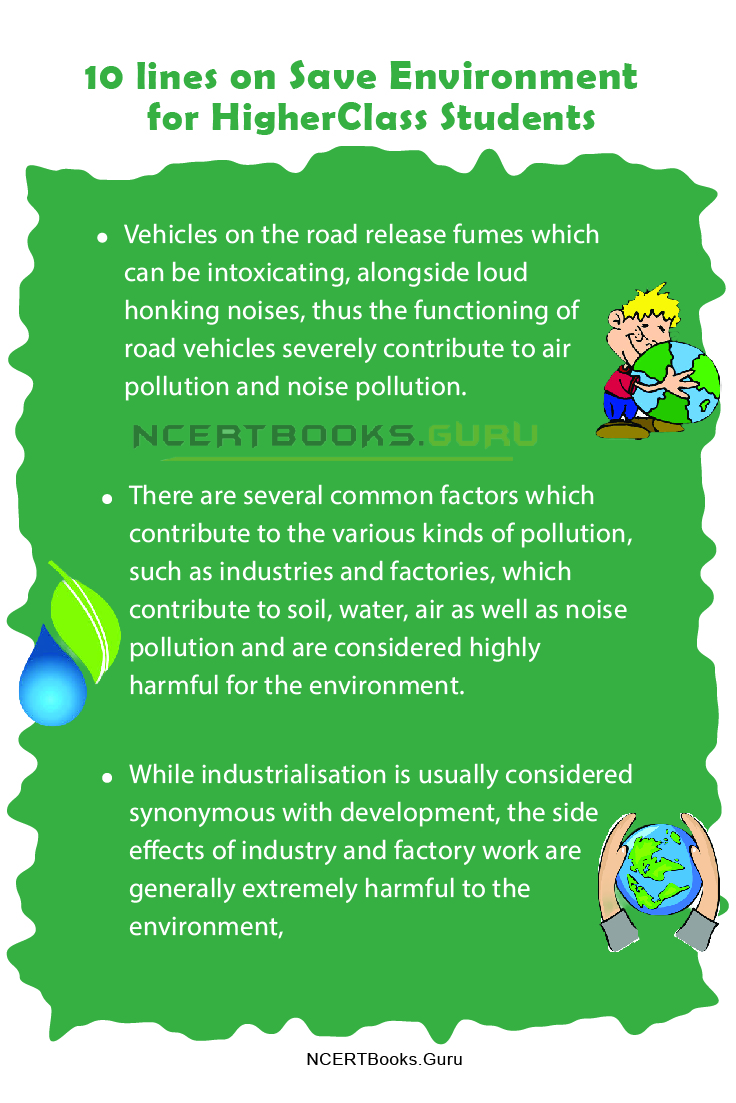
  4. There are several common factors which contribute to the various kinds of pollution, such as industries and factories, which contribute to soil, water, air as well as noise pollution and are considered highly harmful for the environment.
  5. Vehicles on the road release fumes which can be intoxicating, alongside loud honking noises, thus the functioning of road vehicles severely contribute to air pollution and noise pollution.
  6. While industrialisation is usually considered synonymous with development, the side effects of industry and factory work are generally extremely harmful to the environment, especially when the waste is not treated before being let out into the water bodies and bodies of land in an area.
  7. There are several ways in which an individual can make a change in one’s own life to inculcate greener habits and choices in order to do better for the environment, and this includes reducing one’s carbon footprint and reducing the amount of per capita waste generated in a country.
  8. A carbon footprint refers to the amount of carbon waste released into the environment by an individual, and this can be reduced when a person chooses greener methods to travel such as walking, cycling or using public transport rather than driving a car alone.
  9. Per capita waste refers to the amount of waste generated by a single person in a country in a given year, and the higher this value is, the higher the amount of waste that has been generated by the whole country, and keeping this amount low is imperative to protect and save our environment.
  10. It is highly vital to recognise the different ways in which one contributes to environmental pollution and figure out ways to battle the same to protect and save environment by doing our level best.
10 Lines on Save Environment 2

Frequently Asked Questions on Save Environment

Question 1.
What is a carbon footprint?

Answer:
A carbon footprint refers to the amount of carbon waste generated by an individual, and it increases the more we use practices which are harmful to the environment such as travelling in a car alone, which burns a lot of fossil fuels for just one person. Rather, if we carpool in one car, the carbon footprint of all the people travelling in that car will be less compared to if one person was travelling alone.

Question 2.
What can I do to save the environment?

Answer:
On an individual level, we can do several things to save the environment. We can switch to more environmentally friendly options in terms of the different ways in which we can do things. For example, using public transport, using biodegradable products instead of plastic, carrying cloth bags to the grocery store, taking part in tree plantation drives, etc.

Question 3.
Why is it important to save the environment?

Answer:
The environment is all around us and it includes the air we breathe, the water we drink, the food we eat, etc. and this doesn’t just hold true for humans, but for all living beings that are on the planet earth. We all collectively depend on the environment to provide us with the bare necessities of life, which is it is important to protect and save it.

Question 4.
Explain pollution with examples.

Answer:
Pollution refers to when the environment gets contaminated by harmful substances which are generally the result of human activity. There are four kinds of pollution:

  1. Air pollution: For example, the fumes from the burning of fossil fuels, the smoke from factories, etc.
  2. Water pollution: For example, the toxic untreated wastes flowing into rivers and seas, civilian garbage being dumped in water bodies, etc.
  3. Soil pollution: For example, huge garbage dumps, littered streets, land becoming barren and losing fertility due to toxic chemicals like factory waste seeping into the soil, etc.
  4. Noise pollution: Noise pollution doesn’t only affect and annoy humans, but it also hinders the growth of plants and traumatises animals. For example, the sound of firecrackers, vehicles honking on the roads, etc.
10 Lines on Importance of Books for Students and Children in English

10 Lines on Importance of Books

10 Lines on Importance of Books: It is rightly said that one good book is worth one hundred friends. There is the immense importance of books in our life as they lead us on the right path to achieve our goals. Reading books is a noble habit which everyone should follow.

Finding the perfect book is also one of the essential things that one needs to focus on as choosing a book that is not of your choice or genre can be boring for any person. The book’s impact can always be held higher irrespective of the situation as the education gained from the experiences can last a lifetime.

Enhance your vocabulary and writing skills with 10 Lines Essays available. Spark up the creativity in you and access various Topics on 10 Lines all in one place.

Read More: Importance Of English Essay

Set 1 – 10 Lines on Importance of Books for kids

Set 1 is helpful for students of Classes 1, 2, 3, 4 and 5.

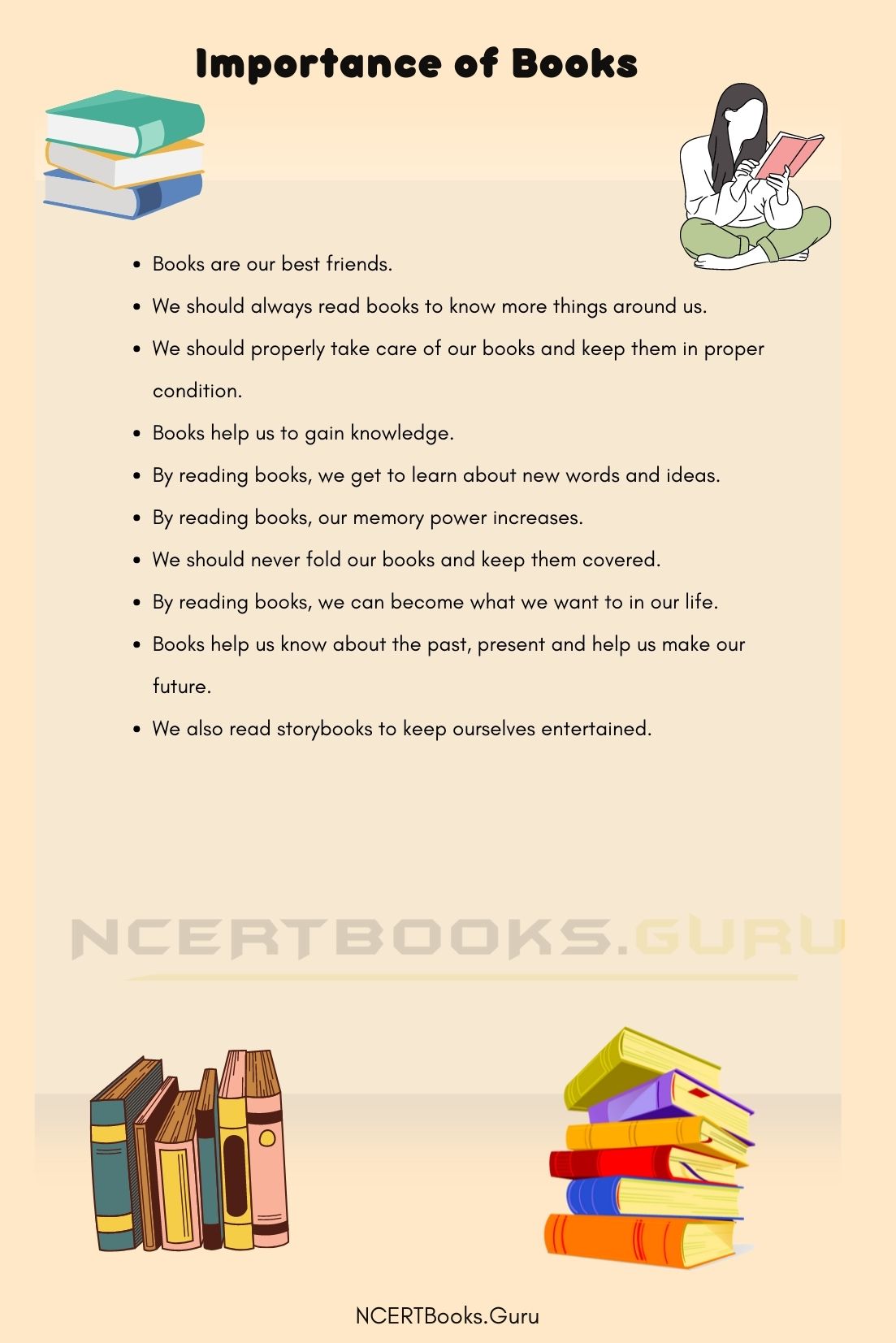
  1. Books are our best friends.
  2. We should always read books to know more things around us.
  3. We should properly take care of our books and keep them in proper condition.
  4. Books help us to gain knowledge.
  5. By reading books, we get to learn about new words and ideas.
  6. By reading books, our memory power increases.
  7. We should never fold our books and keep them covered.
  8. By reading books, we can become what we want to be in our life.
  9. Books help us know about the past and present and help us make our future.
  10. We also read storybooks to keep ourselves entertained.

10 Lines on Importance of Books 1

Set 2 – 10 Lines on Importance of Books for School Children

Set 2 is helpful for students of Classes 6, 7 and 8.

  1. We get knowledge from books, they help us guide us to walk in the proper path of life and face the least number of problems.
  2. Reading books help us to improve our confidence as it adds to our learning process.
  3. By reading scientific books, we develop the scientific temperament and know about the technologies, cosmos, life on earth, the chemicals and their uses.
  4. By reading spiritual books like The Bhagwad Gita, Quran, Bible etc., we build our character better and seek inner happiness.
  5. By reading history books, we learn about the pasts of the cities in which we dwell, the state, the nation, and the world’s history, so that we can prevent ourselves from committing the same mistakes done in the past.
  6. By reading biographies and autobiographies of great personalities, we learn about their lifestyle and remember to follow their glorious path to succeed in life.
  7. we must take care of the books and not throw it here and after that reading them but keep it properly keep them arranged on the shelves.
  8. Reading books make us wise, intelligent and brainy.
  9. By reading books, we learn so many good things and follow good values to become good human beings in life and help the needy and poor people around us.
  10. Not only this, but books are a beautiful mystery when they are storybooks, which keep our interests on as we delve into it and are entertained.

Set 3 – 10 Lines on Importance of Books for Higher Class Students

Set 3 is helpful for students of Classes 9, 10, 11, 12 and Competitive Exams.

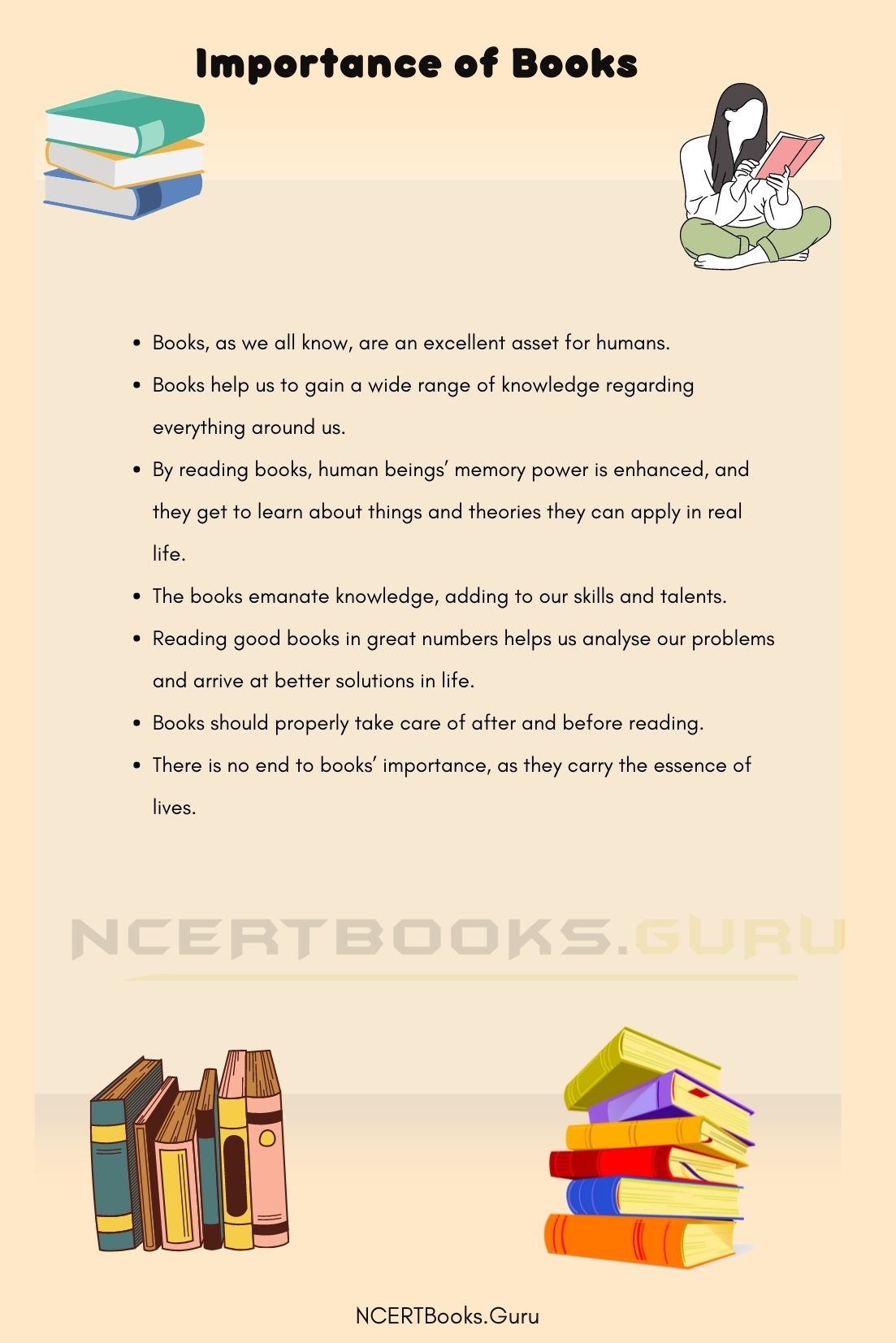
  1. Books, as we all know, are an excellent asset for humans.
  2. Books help us to gain a wide range of knowledge regarding everything around us.
  3. By reading books, human beings’ memory power is enhanced, and they get to learn about things and theories they can apply in real life.
  4. If we want to become knowledgeable persons and hold various prestigious jobs, including doctors, engineers, lawyers pilots etc., we must read more and more books.
  5. The books emanate knowledge, adding to our skills and talents.
  6. Students and everyone at every stage of their life can read books and enlighten themselves with things that they do not know, as there is no end to learning.
  7. By reading several books of several languages, we learn about the culture of several places, several regions’ language, and enrich our vocabulary.
  8. Reading good books in great numbers helps us analyse our problems and arrive at better solutions in life.
  9. Books should properly take care of after and before reading.
  10. There is no end to books’ importance, as they carry the essence of lives.

10 Lines on Importance of Books 2

Frequently Asked Questions on Importance of Books

Question 1.
What are the kinds of books that children should read?

Answer:
Since the children are in an age of learning, they should prefer to read the encyclopedia for study and read moral stories to build a good character inculcating all good habits.

Question 2.
What should one do after reading a book?

Answer:
After one has read every bit of the book and no more needs it, he or she should pass it on to a needy and give it for recycling.

10 Lines on Makar Sankranti for Students and Children in English

10 Lines on Makar Sankranti

10 Lines on Makar Sankranti: To mark the initial day of the sun’s transition to Capricorn, people in India commemorate Makar Sankranti. This day is the midwinter end and the duration of the day increases after this day.

With distinct names in distinct parts of India, we commemorate Makar Sankranti. In Bengal, the day is well-known as PoushParbon, in Gujarat it is Uttarayan. This festival marks the solar cycle while the other Indian festival follows the Hindu calendar’s lunar cycle.

Enhance your vocabulary and writing skills with 10 Lines Essays available. Spark up the creativity in you and access various Topics on 10 Lines all in one place.

Set 1 – 10 Lines on Makar Sankranti for kids

Set 1 is helpful for students of Classes 1, 2, 3, 4 and 5.

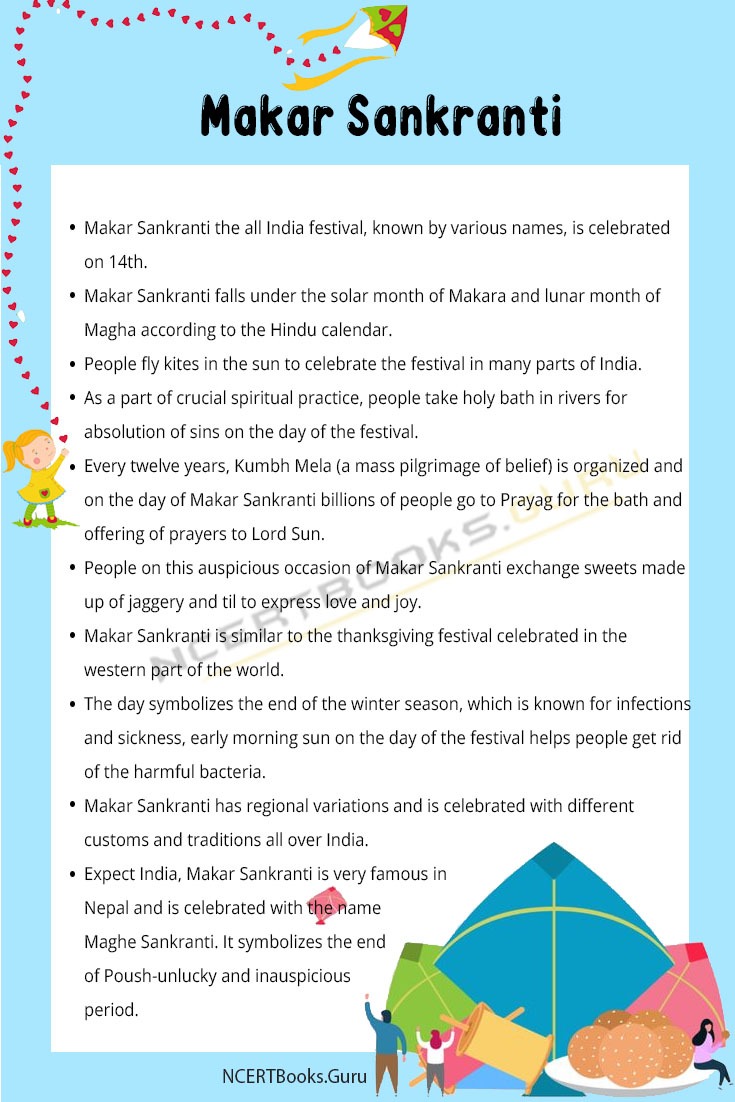
  1. Makar Sankranti the all India festival, known by various names, is celebrated on 14th
  2. Makar Sankranti falls under the solar month of Makara and lunar month of Magha according to the Hindu calendar.
  3. People fly kites in the sun to celebrate the festival in many parts of India.
  4. As a part of crucial spiritual practice, people take holy bath in rivers for absolution of sins on the day of the festival.
  5. Every twelve years, Kumbh Mela (a mass pilgrimage of belief) is organized and on the day of Makar Sankranti billions of people go to Prayag for the bath and offering of prayers to Lord Sun.
  6. People on this auspicious occasion of Makar Sankranti exchange sweets made up of jaggery and til to express love and joy.
  7. Makar Sankranti is similar to the thanksgiving festival celebrated in the western part of the world.
  8. The day symbolizes the end of the winter season, which is known for infections and sickness, early morning sun on the day of the festival helps people get rid of the harmful bacteria.
  9. Makar Sankranti has regional variations and is celebrated with different customs and traditions all over India.
  10. Expect India, Makar Sankranti is very famous in Nepal and is celebrated with the name Maghe Sankranti. It symbolizes the end of the Poush-unlucky and inauspicious period.

10 Lines on Makar Sankranti 1

Set 2 – 10 Lines on Makar Sankranti for School Children

Set 2 is helpful for students of Classes 6, 7 and 8.

  1. In Andhra and Telangana, the celebration of Makar Sankranti carnival is for four days by lighting bonfire, singing, dancing, wearing new clothes and presenting traditional foods to ancestors.
  2. In Assam, people build temporary huts from bamboos and leaves prepare the food under the hut, and after relishing the feast, they destroy huts the very next morning.
  3. Magh Bihu carnival of Assam also includes traditional games like buffalo fighting and pot breaking competition.
  4. In Bihar and Jharkhand it is commemorated as Khichdi, people after taking holy bath people eat seasonal delicacies like Chura, tilgul, sweets. In the night they prepare a special dish called Khichdi.
  5. In Karnataka, cows and bulls are embellished and are left for grazing in the green field. They are shown as a symbol of the harvest festival for the farmers. Read: cow paragraph 
  6. Girls in southern India wear new clothing and visit other homes of other family members with presenting in a plate having ground nuts, coconut and jaggery.
  7. The ritual of exchanging delicacies on Makar Sankranti in south India is called “Ellu Birodhu”.
  8. In Orissa, on the auspicious occasion of Sankranti festival, many people visit temples and perform ritual practices while fasting.
  9. Some people in Orissa prepare makar Chula (a mixture of rice, banana, coconut, jaggery, rasagola) as a gift to gods and goddesses.
  10. People of western Orissa have common rituals of friendship on the day of Makar Sankranti. The individual ties the friendship band on each other’s wrists and addresses the other as “Marsad” for a year.

Set 3 – 10 Lines on Makar Sankranti for Higher Class Students

Set 3 is helpful for students of Classes 9, 10, 11, 12 and Competitive Exams.

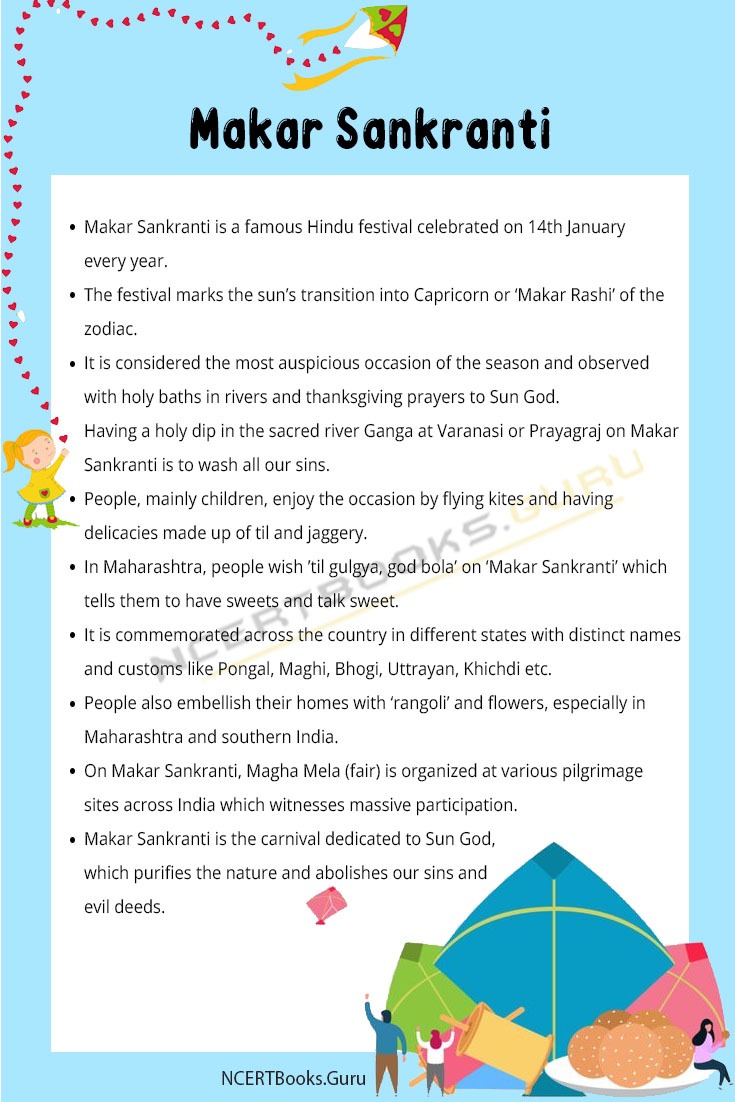
  1. Makar Sankranti is a famous Hindu festival celebrated on 14th January every year.
  2. The festival marks the sun’s transition into Capricorn or ‘Makar Rashi’ of the zodiac.
  3. It is considered the most auspicious occasion of the season and observed with holy baths in rivers and thanksgiving prayers to Sun God.
  4. Having a holy dip in the sacred river Ganga at Varanasi or Prayagraj on Makar Sankranti is to wash all our sins.
  5. People, mainly children, enjoy the occasion by flying kites and having delicacies made up of til and jaggery.
  6. In Maharashtra, people wish ’til gulgya, god bola’ on ‘Makar Sankranti’ which tells them to have sweets and talk sweet.
  7. It is commemorated across the country in different states with distinct names and customs like Pongal, Maghi, Bhogi, Uttrayan, Khichdi etc.
  8. People also embellish their homes with ‘rangoli’ and flowers, especially in Maharashtra and southern India.
  9. On Makar Sankranti, Magha Mela (fair) is organized at various pilgrimage sites across India which witnesses massive participation.
  10. Makar Sankranti is the carnival dedicated to Sun God, which purifies the nature and abolishes our sins and evil deeds.

10 Lines on Makar Sankranti 2

Frequently Asked Questions on Makar Sankranti

Question 1.
What is the main reason for the celebration of Makar Sankranti?

Answer:
We commemorate Makar Sankranti when the sun enters the Capricorn.

Question 2.
Why people select warm clothes to wear in Makar Sankranti?

Answer:
Sankranti always falls in January, which is a chilly month. Warm clothes help people to be warm during the celebration.

10 Lines on Summer Vacation for Students and Children in English

10 Lines on Summer Vacation

10 Lines on Summer Vacation: Summer vacation is the time when all schools remain closed for protecting the future of our country from the approaching heat waves, approaching risks of sunstroke, etc. It spans the time of April, May, and June generally. The summer vacation is an important part of the course curriculum.

The students find ample time for merry-making and preparation for future exams and aims, provided with the luxuries of mangoes, watermelons, coconuts, ice creams, cold drinks, lemon juice, etc. Below are 10 points on summer vacation that have been compiled, keeping in view three age groups.

Enhance your vocabulary and writing skills with 10 Lines Essays available. Spark up the creativity in you and access various Topics on 10 Lines all in one place.

Set 1 – 10 Lines on Summer Vacation for kids

Set 1 is helpful for students of Classes 1, 2, 3, 4 and 5.

  1. Summer vacation is the holiday given in summer days.
  2. The summer vacation is longer than that of the winter vacation.
  3. We enjoy our parents during the summer holidays by playing games, watching movies and television, etc.
  4. We plan trips to different tourist places inside as well as outside the country in summer vacation.
  5. We may also stay together at relatives’ places during these vacations.
  6. Summer vacation is the time when we can give better attention to our studies.
  7. We are given with holiday home works too to complete.
  8. We all love to eat ice creams during the vacation, drink cold drinks, go to cool beaches, etc.
  9. We usually wear cotton and light-coloured dresses at this time.
  10. We all love the long summer vacation and thus look forward to it every year.

10 Lines on Summer Vacation 2

Set 2 – 10 Lines on Summer Vacation for School Children

Set 2 is helpful for students of Classes 6, 7 and 8.

  1. Summer vacation is the long summer holiday provided to school going students during the scorching summer months of April, May, June.
  2. This is done keeping in view the travelling of students under the scorching sun, decreased efficiency, proneness to sunstrokes, etc.
  3. The summer vacation ends with the onset of the first shower of monsoon.
  4. Although the summer vacation is pre-scheduled before the beginning of the term, it may get preponed in the initiation
  5. and delayed in suspension due to the heat waves and erratic nature of the Indian monsoon.
  6. The holiday home works are assigned to the students depending on their course structure and time left for the exam.
  7. The assignments may well be out of the box to induce some creativity and fun into the curriculum, like crafting, learning a new art form, learning a new poem, etc.
  8. The fruits that adorn the months of summer vacation are mangoes, watermelon, dates, etc.
  9. Students of higher classes prefer to undertake the rigorous practice of newer concepts and chapters to enrich their exam preparation.
  10. The vacation is the other name for enjoying them by adventuring new places, going to relative’s houses, etc.
    Summer vacations are the best time in a student’s life.

Set 3 – 10 Lines on Summer Vacation for Higher Class Students

Set 3 is helpful for students of Classes 9, 10, 11, 12 and Competitive Exams.

  1. Summer vacation is the term denoted to the long term holidays provided to school continuing students to prevent them from approaching heat waves and from sun strokes, fainting, etc.
  2. The vacation is called off once the overall daily temperature of the area where the school is located starts decreasing or the first showers of monsoon have an onset.
  3. An academic term’s schedule always includes the months of April, May, and June (generally) as the time for summer vacation, but this is tentative and may be manipulated as required.
  4. The summer vacation is when students get enough free time to go hiking, adventuring, and enjoying themselves at their relative’s houses.
  5. Schools also provide assignments to the students to efficiently utilize the time, thus provided fruitfully. The assignments are rarely based on the calibre and rather based on creativity.
  6. Nevertheless, higher standards channel students this time to prepare for the upcoming exams and better knowledge gaining. Some students also go for crash courses in swimming, typing, computer certifications, etc., to enrich their curriculum vitae.
  7. Some schools prefer to complete their exams before the summer vacation, whereas some others prefer vice versa. It solely depends on the school authorities and the academic curriculum.
  8. The peculiarity of summer vacation lies in light-coloured dresses, cotton fabric, mangoes, watermelons, ice creams, cold drinks, sorbets, etc.
  9. Students utilize their time with proper pre-planning.
  10. This time is deemed the longest break and best time in the life of a student.

10 Lines on Summer Vacation 1

Frequently Asked Questions on Summer Vacation

Question 1.
How can summer vacations be best utilized?

Answer:
The higher standards channel this time to prepare for the upcoming exams and better knowledge gaining. Some students may also prefer to go for crash courses in swimming, typing, computer certifications, etc., to enrich their curriculum vitae.

Question 2.
How can we enjoy summer vacation?

Answer:
By trekking, tourism, enjoying summer delicacies or at a relative’s home.

Read More: Summer Vacation Essay

10 Lines on Earthquake for Students and Children in English

10 Lines on Earthquake

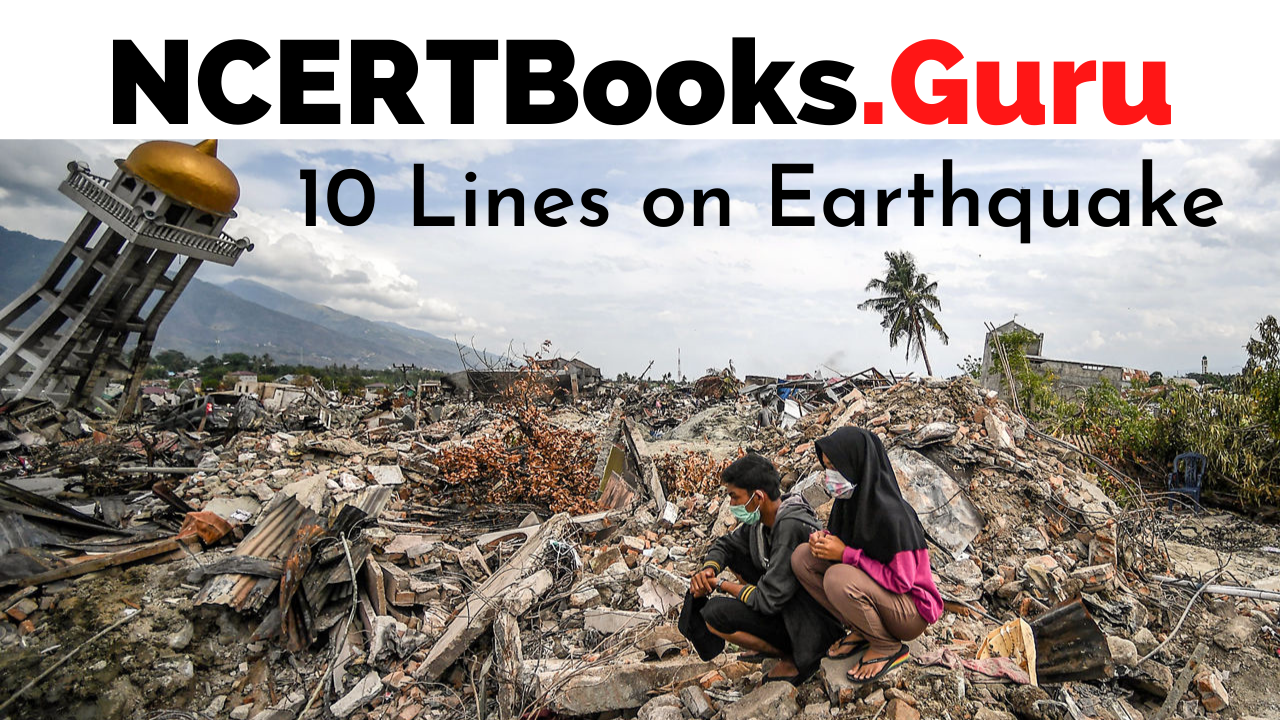
10 Lines on Earthquake: An earthquake is the name given to the vibrations that we feel when the tectonic plates just under the surface of the earth shift in their positions. It refers to when the tectonic plates shift away from one another or collide into each other.

Earthquakes can be rather mild vibrations of the earth or they can even be extremely powerful and highly destructive. Many cities were known to have been destroyed by earthquakes. The mildness or extremeness of an earthquake is called its magnitude, which is measured by specialists using a seismograph. Below, there are three sets of 10 lines of earthquakes which will be useful for students who are looking to write essays or write assignments about earthquakes.

Enhance your vocabulary and writing skills with 10 Lines Essays available. Spark up the creativity in you and access various Topics on 10 Lines all in one place.

Set 1 – 10 Lines on Earthquake for kids

The following set of 10 lines on earthquakes will be useful for students and children who are in classes 1, 2, 3, 4 and 5.

  1. When there is some movement of rocks under the earth’s surface, it makes strong waves which make vibrations on the earth.
  2. The vibrations which come from under the earth’s surface are called earthquakes and they are called seismic waves.
  3. The strength of an earthquake is called the magnitude in scientific terms and it is measured on the Richter scale.
  4. Magnitudes are measured by specialists using a device called a seismograph.
  5. The magnitude of an earthquake can be from 1 to 10, where 1 to 2.5 can barely be felt, but more than 7 can cause a lot of destruction.
  6. The lace on the earth where an earthquake originates is called the epicentre.
  7. The epicentre is the centre of the earthquake, while the seismic waves travel in circles around it.
  8. Earthquakes can cause a lot of danger, that’s why one must always be prepared for it.
  9. During earthquakes, we should stand in an open field so that nothing can fall on us and we are safe.
  10. If there are no open fields, one should bend and sit under a surface like a table to protect oneself.

10 Lines on Earthquake 2

Set 2 – 10 Lines on Earthquake for School Children

The following set of 10 lines on earthquakes will be useful for students who are in classes 6, 7, 8 and 9.

  1. Earthquakes are caused when the tectonic plates under the surface of the earth shift in their places.
  2. The waves created by an earthquake are called seismic waves, which are the vibrations we feel during the earthquake.
  3. The area where the seismic waves originate from is the epicentre, and the seismic waves follow a circular pattern around this epicentre.
  4. The magnitude of an earthquake denotes how powerful it was and it is generally measured on the Richter scale.
  5. The magnitude of an earthquake is measured using a seismograph on the Richter scale from 1 to 10.
  6. Earthquakes with a magnitude of 1 to 3 are considered minor and are usually very light, but are strong enough for a seismograph to catch.
  7. Earthquakes with a magnitude of 3 to 6.9 are considered moderate or strong, where there can be destruction caused, especially in areas with a high density of population.
  8. Earthquakes with a magnitude of 7 to 8 are considered major earthquakes which have the capability to topple buildings and cause other serious damage.
  9. Those earthquakes with a magnitude of 8.1 or more are considered to be great earthquakes and have the ability to destroy entire cities, especially towns which lie on the epicentre.
  10. It is important to stay safe during an earthquake to avoid any severe injuries, such as crouching under tables or evacuating to safe spaces like open fields.

Set 3 – 10 Lines on Earthquake for Higher Class Students

The following set of 10 lines on earthquakes will be useful for students who are in classes 10, 11 and 12.

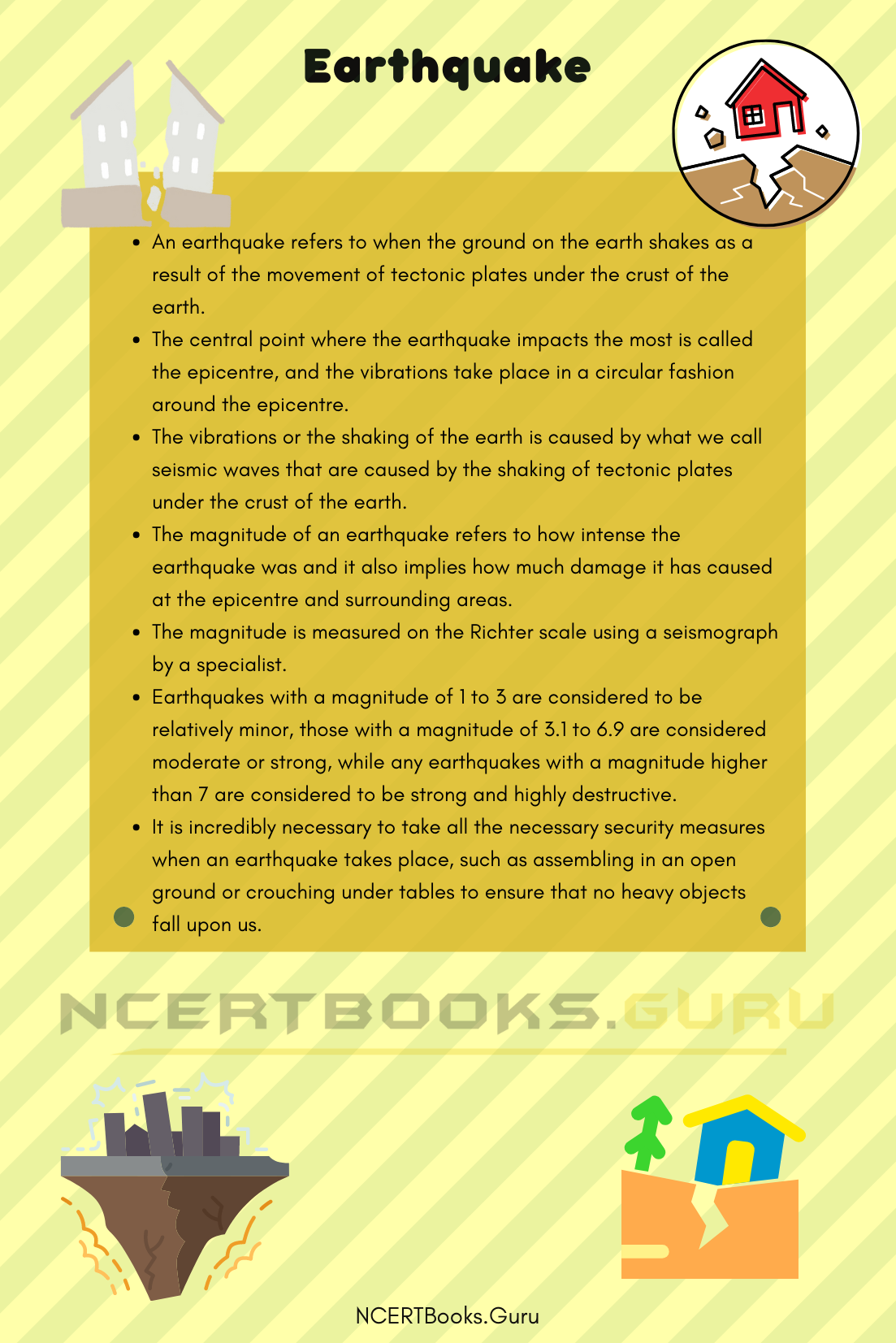
  1. An earthquake refers to when the ground on the earth shakes as a result of the movement of tectonic plates under the crust of the earth.
  2. The central point where the earthquake impacts the most is called the epicentre, and the vibrations take place in a circular fashion around the epicentre.
  3. The vibrations or the shaking of the earth is caused by what we call seismic waves that are caused by the shaking of tectonic plates under the crust of the earth.
  4. The magnitude of an earthquake refers to how intense the earthquake was and it also implies how much damage it has caused at the epicentre and surrounding areas.
  5. The magnitude is measured on the Richter scale using a seismograph by a specialist.
  6. Earthquakes with a magnitude of 1 to 3 are considered to be relatively minor, those with a magnitude of 3.1 to 6.9 are considered moderate or strong, while any earthquakes with a magnitude higher than 7 are considered to be strong and highly destructive.
  7. It is incredibly necessary to take all the necessary security measures when an earthquake takes place, such as assembling in an open ground or crouching under tables to ensure that no heavy objects fall upon us.
  8. There are several earthquake hazards such as displacement of the ground and the falling of buildings, trees, light poles, etc. due to the pressure, flooding in case a dam or levee breaks due to the seismic waves, and fires caused by gas lines which may break.
  9. It is important to be aware of the various hazards that an earthquake can bring, and also take the appropriate safety measures during earthquakes, such as assembling in an open field or hiding underneath solid and stable furniture such as a desk or bed so as to prevent any objects falling on you.
  10. The worst earthquake in the history of the world is called the Valdivia Earthquake, which took place near Chile in the year 1960, and had a magnitude of 9.5, killing nearly 5700 people and leaving a million homeless.

Read More: Essay On Fire Safety

10 Lines on Earthquake 1

Frequently Asked Questions on Earthquake

Question 1.
What does magnitude mean?

Answer:
Magnitude is the word we use when referring to the ‘size’ of an earthquake, and it based on the measurement of the rigour of the earthquake provided by a seismograph. Magnitude is measured on a scale of 1 to 10, where magnitudes of 1 to about 2.5 can hardly be felt, but are yet recorded by a seismograph. Earthquakes with magnitudes 3 to 7 are moderate and strong and can cause severe amounts of damage. Earthquakes above the magnitude of 8, and especially 9, are disastrous and can bring long-term destruction of the epicentre and its surrounding areas.

Question 2.
What are some earthquakes which caused a lot of destruction?

Answer:
The Valdivia Earthquake of 1960 took place in Chile. It had a magnitude of 9.5, had 5700 casualties and many more injured, and it rendered 1 million people homeless.

The 1964 Great Alaska Earthquake in Southern Alaska had a magnitude of 9.2 and 131 people died, while damages incurred crossed 300 million dollars at the time. The Indian Ocean Earthquake of 2004 was coupled with the Indian Ocean Tsunami of 2004, with a magnitude of 9.1 and 227898 deaths along the coast of the Indian Ocean.

Question 3.
What is a seismograph?

Answer:
A seismograph is a device which is used to measure the magnitude of an earthquake. It is also called a seismometer.

Question 4.
What is a tectonic plate?

Answer:
The crust of the earth is divided into several tectonic plates, which are small layers of the upper mantle of the earth. As these tectonic plates collide, they create mountains, and as they separate, they create canals, canyons, etc. and when there is a movement in these plates, the surface of the earth shakes as what we call an earthquake.

10 Lines on Education for Students and Children in English

10 Lines on Education

10 Lines on Education: The roots of modern society are based on Education. Humans evolved from nomads to civilized creatures climbing the ladder to experience learnings, i.e., Education. If we hear the term “Education,” the very first thing that tickles our mind is knowledge. Education is the magic wand to supply humans with knowledge, information, skills, which makes them aware of the purposes of their existence.

We all know humans are also a category of animals, but the thing that makes them different from those wild creatures and helps them evolve as the best living creatures on the globe is their intelligence and Education. Therefore, Education plays a significant role in the framing of the modern industrialized world. Every individual requires the light of proper knowledge and education to flourish in their life. The current era of technology is bent on the pillars of Education and learning, enabling an individual to survive in this world of competition and develop a convenient solution of their day to day problems.

Proper Education possesses the power to turn human society into a well-managed community of possibilities. Appropriate Education can transform the youth around the globe into well-behaved and well-employed youth. Education in modern society generated a bridge of dissimilates between the literates and the illiterates, as the uneducated are devoid of the world and it’s processing, therefore are swayed in any direction according to the needs of educated people.

So, in today’s time, society makes a clarion call to raise the tide of Education and cast its spell to Educate every single soul on this planet to assist the growth of the world and society, to frame a better living world. In this article, we will discuss the actual values of Education in our life, and here we present you 10 lines on Education for all ages of students ranging from the kids to the youngsters.

Enhance your vocabulary and writing skills with 10 Lines Essays available. Spark up the creativity in you and access various Topics on 10 Lines all in one place.

Read More: Essays About Importance Of Education

Set 1 – 10 Lines on Education for kids

This set is specially designed for students from classes 1, 2, 3, 4, and 5.

  1. Education assists in the acquisition of knowledge and skills.
  2. Education helps to develop one’s character by providing him with the perfect knowledge.
  3. It helps in framing the personality and confidence of a person.
  4. Education is a tool to explore different possibilities of the world.
  5. Education is not very costly and is freely available on the Internet today.
  6. Education opens the doors of better future scopes for an individual.
  7. Education supplies you fame, money, and comfort in life.
  8. Proper Education helps to fight against social evils.
  9. There are many ways to spread Education, such as research, teaching, training, and many more.
  10. For young kids, the storytelling mechanism is ideal to pass Education.

10 Lines on Education 1

Set 2 – 10 Lines on Education for School Children

This set is fruitful for students from 6, 7, and 8.

  1. Education is a method to impart knowledge, learnings, and explore various life opportunities, which assist human beings in developing into a more confident soul.
  2. An efficient education mechanism helps to develop a healthy world by fighting social evils to uproot them.
  3. Academic Education is divided into two branches – Kindergarten, Primary Education, Secondary Education, and Higher Secondary Education.
  4. The modern world witnessed the confinement of Education within the walls of Academic curriculum under educators’ supervision.
  5. The age of the Internet turned the pages of the traditional school-based Education mechanism to provide individuals with an opportunity to explore different genres of Education and Learnings at ineligible charges.
  6. Education involves various methods like direct analysis, storytelling, research, teaching, training, discussion, and much more.
  7. Mankind is continuously trying to uplift the vitalities and quality of Education to frame the best education system.
  8. Education presents as a platform to develop our personality and to sharpen our skills and learnings.
  9. Education opened the doors of innovation and creativity for the people.
  10. It is an efficient mechanism to climb the ladder of success and to earn love and respect from society.

Set 3 – 10 Lines on Education for Higher Class Students

This set is beneficial for students from classes 9, 10, 11, and 12. Students preparing for competitive examinations can also follow this set.

  1. Education’s importance came into existence from ancient times when the gurus or the adults of prehistory trained the youngsters in society with knowledge, skills, and passion.
  2. The art of storytelling was propagated since ancient ages to spread knowledge, Education, and values from one generation to another.
  3. The first foundation of primary learning in Europe was led by Plato, as the Academy in Athens. In those days, with
  4. Confucius, China of the State of Lu established to be the most influential provision with highly educated Philosophers and teachers.
  5. Education is paramount of modern society – Education is one of the strong foundations of modern society, and It popularises the true value of knowledge and contribution to framing a sensible and growing society.
  6. Education creates humans with enhanced qualities as it a powerful mechanism to craft the thinking proper and perspective of the individual, which makes them aware of the moral values of life and ensures various methodologies to deal with the problematic situations.
  7. The Right to Education makes it compulsory for every individual to receive the primary level of Education, which makes it the government bodies’ responsibility to propagate quality education among the youngsters.
  8. Education is the key to the mental, physical, spiritual, and social development of humans. It frames the different aspects of an individual’s life like the intellectual, social, financial parts, to establish one as a self-reliant and independent human being.
  9. The rising tide of technology and the spread of the Internet at cheap rates has altered Education. Mechanism and transformed it into online Education as the new normal.
  10. The education techniques and methods modify the personality and behaviour of humans to polish their skills and knowledge.

10 Lines on Education 2

Frequently Asked Questions on Education

Question 1.
Why is Education important for human beings?

Answer:
Quality Education is the base of a well-developed modern society. Education frame the overall growth of a human in terms of character, intellectual, social, financial aspects. It also helps them grab financial and social independence and develop a healthy mindset that pushes the world towards growth.

Question 2.
Why is the role of Education in Women Empowerment?

Answer:
Education plays a crucial role in Women’s Empowerment. Education’s power can diminish old practices like Sati Pratha, the Prohibition of Remarrying Widows, and many more. The reach of proper Education to women can assist them to revolt against these practices.

Question3.
How is the government trying to propagate Education?

Answer:
The government is taking strict actions to propagate quality education among the masses by passing laws for Right to Education and developing different government schools and government colleges and universities to portray quality education.

Question 4.
Who led the foundation of primary learning in Europe?

Answer:
The first foundation of primary learning in Europe was led by Plato.