Maternity Leave Application Format | Maternity Leave Letter Samples in English & Hindi

maternity leave application format & samples

Maternity Leave Application: Maternity leave is the formal letter where a woman takes a certain period of time as a break from work because she is about to have, or has, or just had, a baby. Maternity leave is an important task to plan. Planning this maternity leave application at the perfect time helps the mother and her family experience no financial challenges so that she can enjoy beautiful baby moments & play most of the time with her baby.

For your comfort, we curated the complete information about maternity leave letter such as Format, What should be included, How to Write a maternity leave application along with Samples in the coming modules. Check out many Formal and Informal Letter Writing Topics and get acquainted with different letter styles so that you can write one on your own as per requirement.

How to Write a Maternity Leave Letter in English?

If you are unaware of How does a Maternity Leave Letter look? Then, refer to the below Format of Maternity Leave Application and take it as a reference while drafting your own. If you are confused about how to write a maternity leave letter, here are some precise steps you should consider:

  1. Add specific dates
  2. Include a recommendation for your work
  3. Address any communication during maternity leave
  4. Include requests regarding schedule changes

Along with these steps you can also take some help from the below Maternity Leave Letter Format as it is available in the sharable image and also in the text form for quick access.

Maternity Leave Application Format

Sender’s Name,
Address.

Date: XX-XX-XXX.

To,
Receiver’s Name,
Address.

Subject: Request for Maternity Leave Application Letter for Teachers after Delivery

Sir/Madam (Respected Principal),

Body of the Letter (Describe the application for maternity leave after delivery)

Thanking you.

Your’s Sincerely,

Sender’s signature
Name of the sender

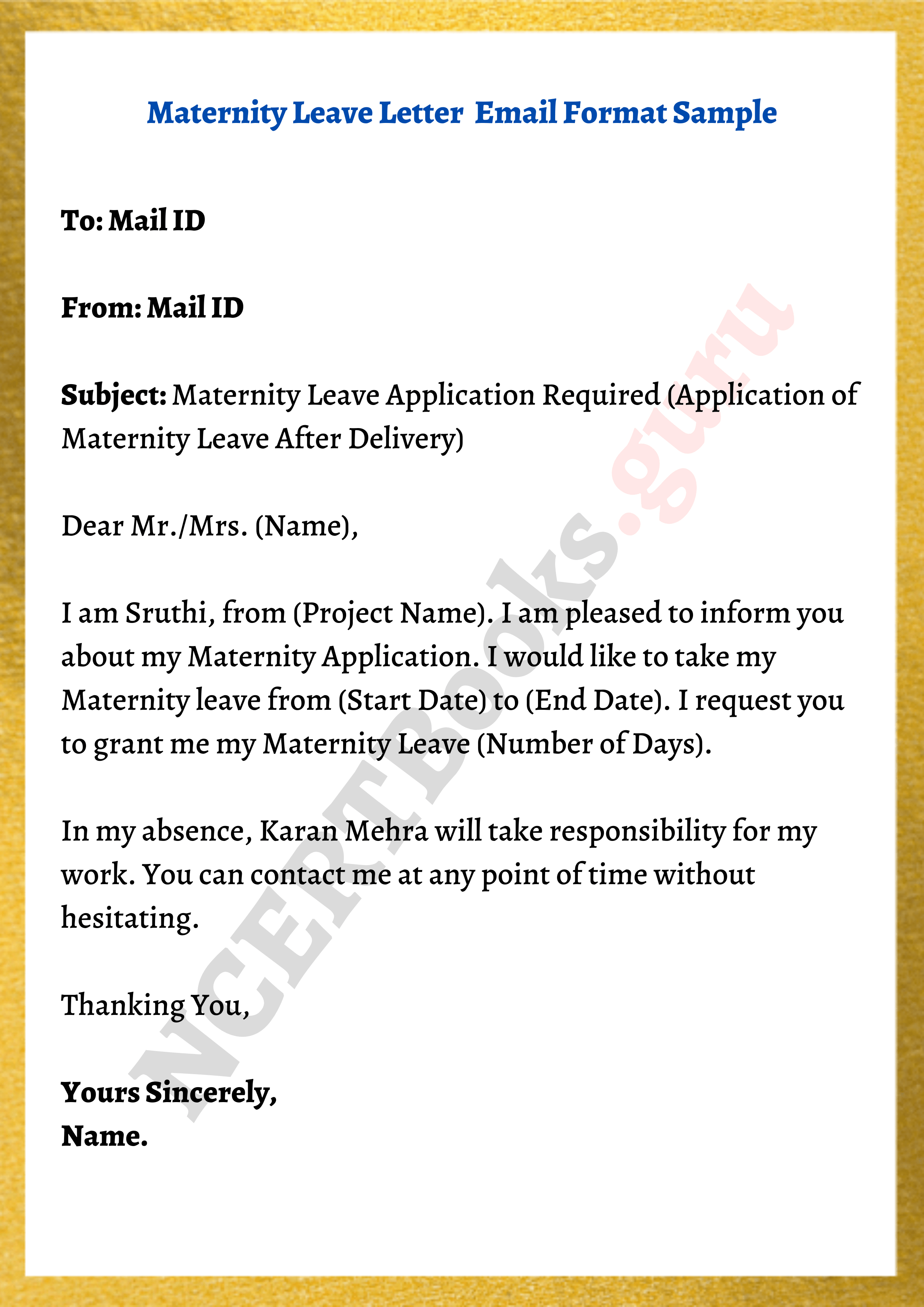
Email Format of Maternity Leave Application In English

maternity leave letter email format

Maternity Leave Letter Samples in English & Hindi

In this section, we have placed some images where you find sample maternity leave applications for your reference. You can use these samples & draft your own for required designations like Maternity leave application for private offices, Maternity Leave Letter for the School Principals, Maternity Leave Application for Teachers.

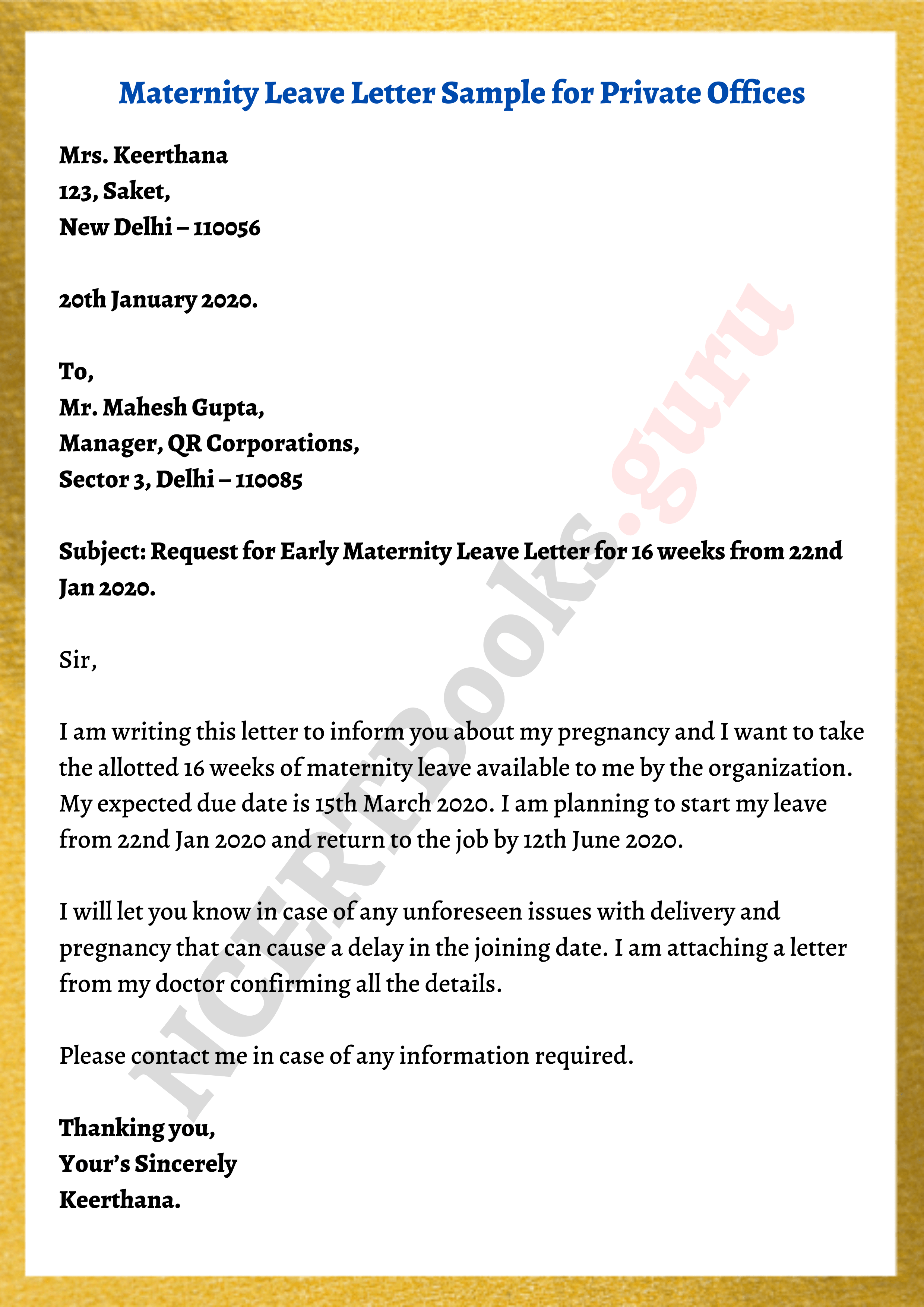
Maternity Leave Application for Manager/Boss of the Office – Sample 1

sample for private offices maternity leave application

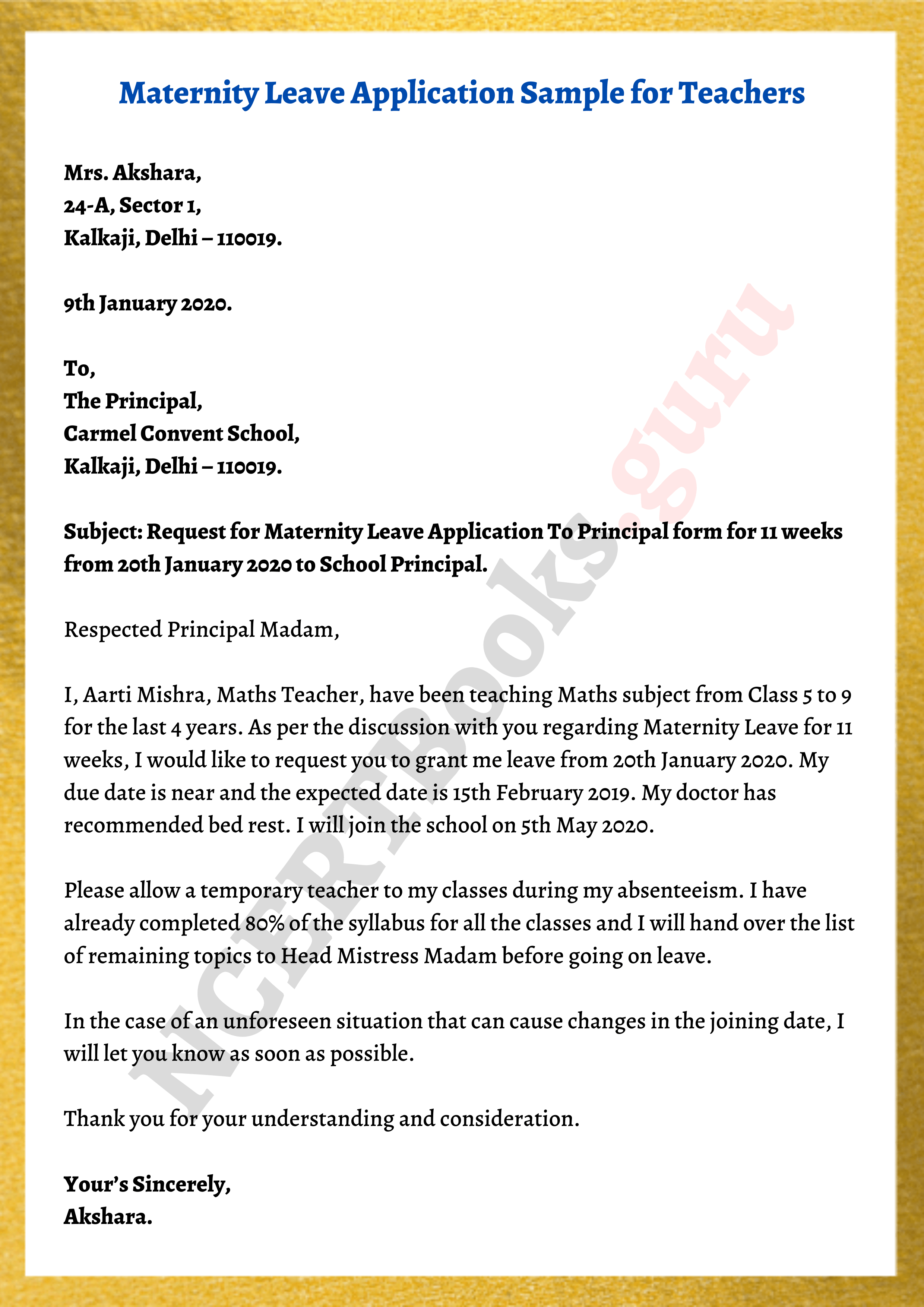
Sample 2 – Maternity Leave Application Form for Teachers

maternity leave letter for teachers sample

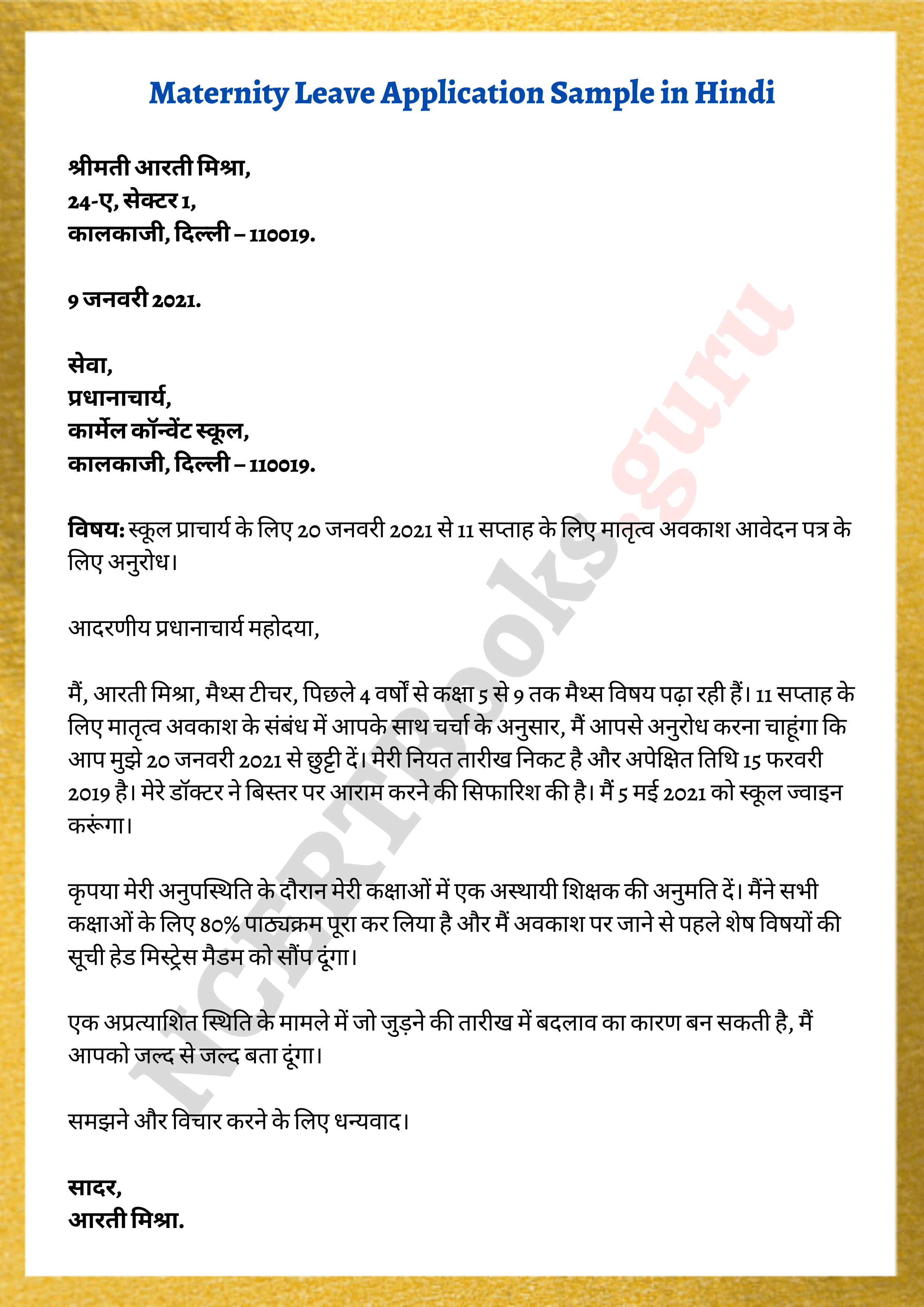
मैटरनिटी लीव एप्लीकेशन लेटर इन हिंदी | Maternity Leave Application Sample in Hindi

sample of maternity leave application in hindi

FAQs on Maternity Leave Application Writing

1. What is a maternity leave letter?

A maternity leave letter is a formal letter that makes your employer know when you plan to take maternity leave and for how long.

2. What period will be the maternity leave for an employee?

The period of maternity leave alters in many countries and many organizations and usually carries both a legally enforceable maternity leave and maternity pay.

3. What is the rule of maternity leave?

According to the Act, maternity benefits are eligible to a woman who has been working as an employee in an establishment for a period of at least 80 days within the past 12 months.

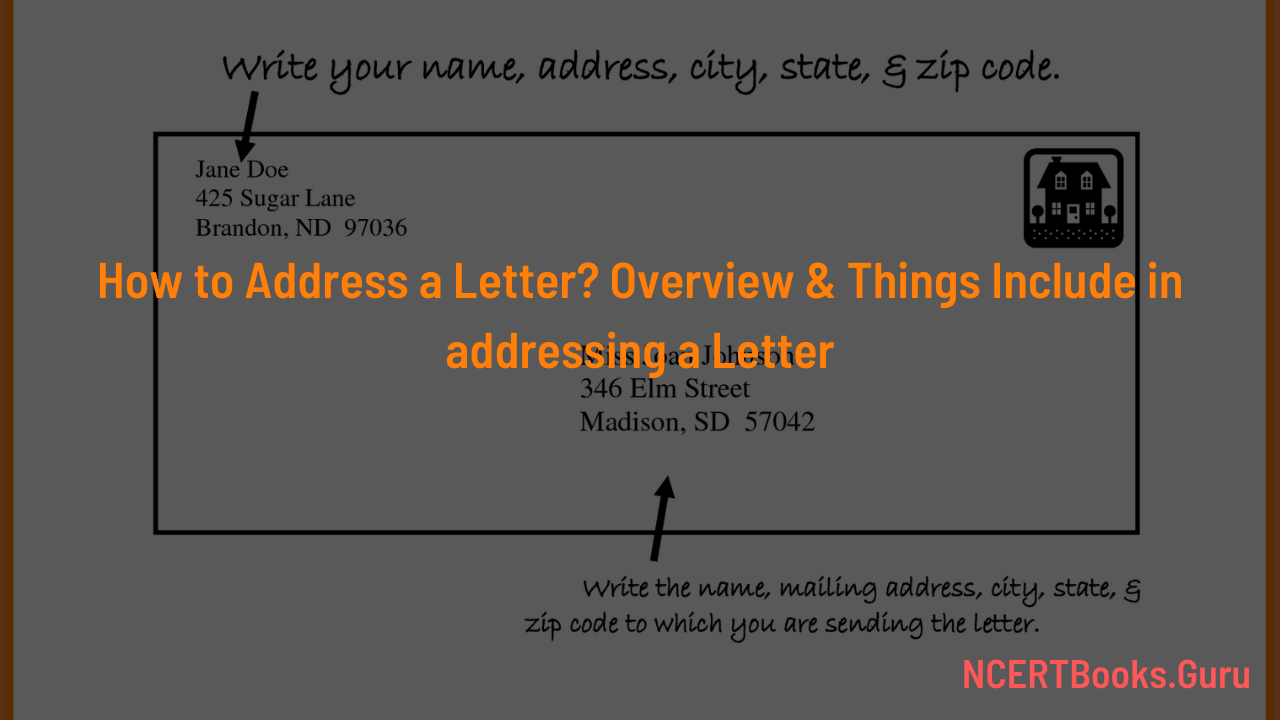
How to Address a Letter? Details to Include in the Format of Addressing a Letter

how to address a letter with detailed information

How to Address a Letter: This generation of people are having numerous available sources to address the letter such as SMS, Phone, and Emails. Formal or professional people are using the SMS or email platforms to write a letter to the recipient & getting a response in return. However, professional letter writing is an outstanding skill when you’re job hunting, career networking, or sending other business-related correspondence.

Hence, the letter should follow all the rules of professional letter writing, especially the sender’s contact information, date, salutations, and recipient’s address. Studying & practicing how to write a letter the right way improves the sender’s stand out from the rest and creates a positive impression on the recipient.

So, read this article completely and learn how to address a letter perfectly. Also, you can explore more Letter Writing Topics both formal and informal from our site and get familiar with various letter writing styles.

What is the Format to Address a letter?

While writing a letter, ensure that you consider the proper address format for the envelope along with the letter itself. At the time of business or expert letter writing, one should follow a few things for the letter. Also, in the process of learning how to address a letter, below are part of the things to include in the letter:

  • Contact Details
  • Date
  • Name and Address of Recipient
  • Salutation

Dive into the below sections, and learn briefly about each point mentioned above:

1. Contact Details at the top: At first, knowing the person who you are addressing is a must, and want to write the person’s name, your designation, where you come from, and the address which will be used when replying to your letter. The sender’s contact information is as follows:

  • First line: Full name
  • Second line: Company name
  • Third line: Street address
  • Fourth line: City or town, followed by the state name and zip code. The state name can be shortened to its official postal two-letter abbreviation.
  • The address should appear under the sender’s name and must align to the left.
  • In case you are drafting the letter to another country person, then the name of the country should be in the fourth line.
  • In order to communicate easily, you should include an email address and phone number.

2. Date: After addressing the contact information, one more important details that you need to follow is to write the date on which the letter was sent, and align it to the left or right margin. For instance, the date can be written as December 15, 2020, or 15-12-2020.

3. Recipient’s Name and Address: Once you have entered the sender’s address and date to the left margin, the recipient’s name and address should appear. Here, you have to enter the name and mailing address of the intended recipient. Also, you can write the title or degrees that the recipient holds.

For instance, you’re drafting a letter to the professor, then you have to address the recipient’s address as “John Jones, Ph.D.” Under the name, write the company name on the second line following with the rest of the address like street and city, and state and zip code in the last line. If the recipient is in another country, indicate the name of the country in the fourth line.

4. Salutations: After the recipient’s address, leave one line and write the greeting/salutation. The choice of salutation depends on the recipient of the letter. If you know the recipient then you can use this salutation as “Dear,” and is advised if you’ve never met the recipient of the letter. The salutation is followed by the person’s name and punctuated with a colon or comma.

In case you don’t have any idea about the recipient is a man or a woman, then make use of this “Dear Sir or Madam” followed by a colon. If the recipient is a woman and doesn’t know the material status then use “Ms.” in the salutation. This rule is the same for the professional titles as well so you can use Dr., Professor, and Honorable. Examples of salutations include:

  • Dear Mr. Jones
  • Dear Ms. Jones
  • Dear Dr. John
  • Dear Professor Markle

Sample of Addressing a Letter

The following sample letter in the box will help you understand how to address a professional letter:

Rohit Malkani

Address

Your City, State Zip Code

Phone: 999XXXX999

Email: [email protected]

Date: January 10, 2021

Praneet

Manager

XYZ company

Address

City, State Zip Code

Dear Mr.Praneet,

I’m writing regarding your institute’s upcoming career development event. I would like to book a booth as we are looking to hire two assistant software professionals.

We are from the Web DTA Designs company, and we would like to get in touch with some of your computer science students who are in their final years. We work in the web development field.

Kindly let me know if you can reserve a room at your event. You can get in touch with me through my mail id or phone number, anytime.

Sincerely,

Signature (if required)

Rohit Malkani

FAQs on Addressing a Letter both Formal and Informal

1. How do you address a letterhead?

Usually, the sender’s address is entered on the letterhead. When you’re not using any letterhead, the sender’s address to be included at the top of the letter one line above the date. All the way what you need to include in the sender’s address is the street address, city, and zip code.

2. How do you address a letter when you don’t know the recipient?

Technically the correct way to address a letter when you don’t know the recipient’s name is ‘Dear Sir’, but nowadays people are preferring ‘Dear Sir or Madam’ to address the letter.

3. How do you properly address a letter?

While writing a letter to someone professional or informal, you should follow the below format of addressing the letter:

  • Recipient’s name.
  • Business’s name (if applicable)
  • Street address (with apartment or suite number)
  • City, State, and ZIP code (on the same line)*
  • Country*

NCERT Solutions for Class 8 Sanskrit Chapter 8 संसारसागरस्य नायकाः

We have given detailed NCERT Solutions for Class 8 Sanskrit Ruchira Chapter 8 संसारसागरस्य नायकाः Questions and Answers will cover all exercises given at the end of the chapter.

NCERT Solutions for Class 8 Sanskrit Ruchira Chapter 8 संसारसागरस्य नायकाः

अभ्यासः

प्रश्न 1.
एकपदेन उत्तरत-
(क) कस्य राज्यस्य भागेषु गजधरः शब्दः प्रयुज्यते?
उत्तरम्:
राजस्थानस्य।

(ख) गजपरिमाणं कः धारयति?
उत्तरम्:
गजधरः।

(ग) कार्यसमाप्तौ चेतनानि अतिरिच्य गजधरेभ्यः किं प्रदीयते स्म?
उत्तरम्:
सम्मानम्।

(घ) के शिल्पिरूपेण न समादृताः भवन्ति?
उत्तरम्:
गजधरा:।

प्रश्न 2.
अधोलिखितानां प्रश्नानामुत्तराणि लिखत-
(क) तडागाः कुत्र निर्मीयन्ते स्म?
उत्तरम्:
तडागाः सम्पूर्ण देशे निर्मीयन्ते स्म।

(ख) गजधराः कस्मिन् रूपे परिचिताः?
उत्तरम्:
गजधराः वास्तुकाराणां रूपे परिचिताः।

(ग) गजधराः किं कुर्वन्ति स्म?
उत्तरम्:
गजधराः नगरनियोजनात् लघुनिर्माणपर्यन्तं सर्वाणि कार्याणि कुर्वन्ति स्म।

(घ) के सम्माननीया:?
उत्तरम्:
गजधराः सम्माननीयाः।

प्रश्न 3.
रेखाङ्कितानि पदानि आधुत्य प्रश्न निर्माणं कुरुत-
(क) सुरक्षाप्रबन्धनस्य दायित्वं गजधराः निभालयन्ति स्म।
उत्तरम्:
कस्य दायित्वं गजधराः निभालयन्ति स्म?

(ख) तेषां स्वामिनः असमर्थाः सन्ति।
उत्तरम्:
केषां स्वामिनः असमर्थाः सन्ति?

(ग) कार्यसमाप्तौ वेतनानि अतिरिच्य सम्मानमपि प्राप्नुवन्ति।
उत्तरम्:
कार्यसमाप्तौ कानि अतिरिच्य सम्मानपमपि प्राप्नुवन्ति?

(घ) गजधरः सुन्दरः शब्दः अस्ति।
उत्तरम्:
कः सुन्दरः शब्दः अस्ति?

(ङ) तडागाः संसारसागराः कथ्यन्ते।
उत्तरम्:
के संसारसागराः कथ्यन्ते?

प्रश्न 4.
अधोलिखितेषु यथापेक्षितं सन्धि विच्छेदं कुरुत-
(क) अद्य + अपि = ___________
(ख) ___________ + ___________ = स्मरणार्थम्
(ग) इति + अस्मिन् = ___________
(घ) ___________ + ___________ = एतेष्वेव
(ङ) सहसा + एव = ___________
उत्तरम्:
(क) अद्य + अपि = अद्यापि
(ख) स्मरण + अर्थम् = स्मरणार्थम्
(ग) इति + अस्मिन् = इत्यस्मिन्
(घ) एतेषु + एव = एतेष्वेव
(ङ) सहसा + एव = सहसैव

प्रश्न 5.
मञ्जूषातः समुचितानि पदानि चित्वा रिक्तस्थानानि पूरयत-
NCERT Solutions for Class 8 Sanskrit Chapter 8 संसारसागरस्य नायकाः Q5
(क) छात्राः पुस्तकानि ________ विद्यालयं गच्छन्ति।
(ख) मालाकाराः पुष्पैः मालाः ________।
(ग) मम मनसि एका ________ वर्तते।
(घ) रमेशः मित्रैः ________ विद्यालयं गच्छति।
(ङ) ________ बालिका तत्र अहसत।
उत्तरम्:
(क) छात्रा: पुस्तकानि गृहीत्वा विद्यालयं गच्छन्ति।
(ख) मालाकाराः पुष्पैः माला: रचयन्ति।
(ग) मम मनसि एका जिज्ञासा वर्तते।
(घ) रमेशः मित्रैः सह विद्यालयं गच्छति।
(ङ) सहसा बालिका तत्र अहसत।

प्रश्न 6.
पदनिर्माणं कुरुत-
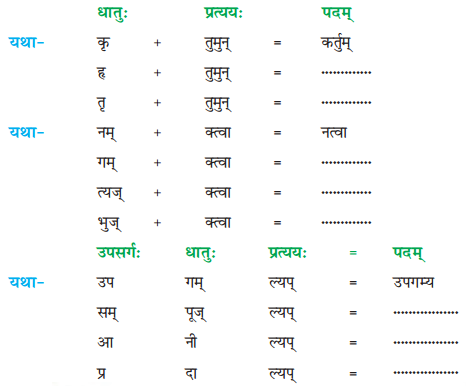
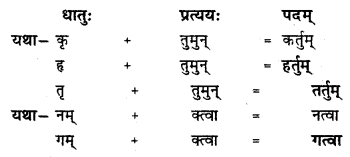
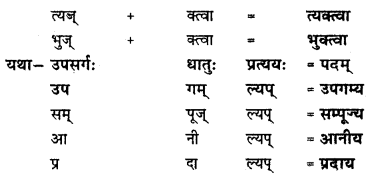
NCERT Solutions for Class 8 Sanskrit Chapter 8 संसारसागरस्य नायकाः Q6
उत्तरम्:
NCERT Solutions for Class 8 Sanskrit Chapter 8 संसारसागरस्य नायकाः Q6.1
NCERT Solutions for Class 8 Sanskrit Chapter 8 संसारसागरस्य नायकाः Q6.2

प्रश्न 7.
कोष्ठकेषु दत्तेषु शब्देषु समुचितां विभक्तिं योजयित्वा रिक्तस्थानानि पूरयत-
यथा- विद्यालयं परितः वृक्षाः सन्ति। (विद्यालय)
(क) ________ उभयतः ग्रामाः सन्ति। (ग्राम)
(ख) ________ सर्वत: अट्टालिकाः सन्ति। (नगर)
(ग) धिक् ________। (कापुरुष)
यथा- मृगाः मृगैः सह धावन्ति। (मृग)
(क) बालकाः ________ सह पठन्ति। (बालिका)
(ख) पुत्रः ________ सह आपणं गच्छति। (पितृ)
(ग) शिशुः ________ सह क्रीडति। (मातृ)
उत्तरम्:
यथा- विद्यालयं परितः वृक्षाः सन्ति। (विद्यालय)
(क) ग्रामम् उभयतः ग्रामाः सन्ति। (ग्राम)
(ख) नगरं सर्वतः अट्टालिकाः सन्ति। (नगर)
(ग) धिक् कापुरुषम्। (कापुरुष)
यथा- मृगाः मृगैः सह धावन्ति। (मृग)
(क) बालका: बालिकाभिः सह पठन्ति। (बालिका)
(ख) पुत्रः पित्रा सह आपणं गच्छति। (पितृ)
(ग) शिशुः मात्रा सह क्रीडति। (मातृ)

योग्यता-विस्तारः
अनुपम मिश्र- जल संरक्षण के पारंपरिक ज्ञान को समाज के सामने लाने का श्रेय जिन लोगों को है श्री अनुपम मिश्र (जन्म 1948) उनमें अग्रगण्य हैं। ‘आज भी खरे हैं तालाब’ और ‘राजस्थान की रजत बूंदें’ पानी पर उनकी बहुप्रशंसित पुस्तकें हैं।

भाषा-विस्तारः
कारक
सामान्य रूप से दो प्रकार की विभक्तियाँ होती हैं-

  1. कारक विभक्ति
  2. उपपद विभक्ति।

कारक चिह्नों के आधार पर जहाँ पदों का प्रयोग होता है उसे कारक विभक्ति कहते हैं। किन्तु किन्हीं विशेष पदों के कारण जहाँ कारक चिह्नों की उपेक्षा कर किसी विशेष विभक्ति का प्रयोग होता है उसे उपपद विभक्ति कहते हैं, जैसे-
‘सर्वतः अभितः, परितः, धिक्’ आदि पदों के योग में द्वितीया विभक्ति होती है।
उदा-
(क) विद्यालय परितः पुष्पाणि सन्ति।
(ख) धिक् देशद्रोहिणम्।
‘सह, साकम्, सार्द्धम्, समं’ के योग में तृतीया विभक्ति होती है।

उदा-
(क) जनकेन सह पुत्रः गतः।
(ख) दुर्जनेन समं सख्यम्।
‘नमः, स्वस्ति, स्वाहा, स्वधा’ के योग में चतुर्थी विभक्ति प्रयुक्त होती है-

उदा-
(क) देशभक्ताय नमः।
(ख) नमः एतादृशेभ्यः शिल्पिभ्यः।
(ग) जनेभ्य: स्वस्ति।
‘अलम्’ शब्द के दो अर्थ हैं-पर्याप्त एवं मत (वारण के अर्थ में)। पर्याप्त के अर्थ में चतुर्थी विभक्ति होती है जैसे-देशद्रोहिणे अलं देशरक्षकाः।
मना करने के अर्थ में तृतीया विभक्ति होती है, जैसे- अलं विवादेन।

विना के योग में द्वितीया, तृतीया एवं पञ्चमी विभक्तियाँ होती हैं, जैसे-परिश्रम/परिश्रमेण/परिश्रमात् विना न गतिः।

निम्नलिखित क्रियाओं के एकवचन बनाने का प्रयास करेंआकलयन्ति, संगृह्णन्ति, प्रस्तुन्वन्ति।

जिज्ञासा-जानने की इच्छा। इसी प्रकार के अन्य शब्द हैं- पिपासा, जिग्मिषा, विवक्षा, बुभुक्षा।

भाव-विस्तारः
अगर हम ध्यान से देखें तो हमारे चारों तरफ ज्ञान एवं कौशल के विविध रूप दिखाई देते हैं। इसमें कुछ ज्ञान और कौशल फलते-फूलते हैं और कई निरंतर क्षीण होते हैं। इसके कई उदाहरण हमारे सामने हैं। पानी का व्यवस्थापन संरक्षण और खेती-बाड़ी का पारंपरिक तौर-तरीका, शिल्प तथा कारीगरी का ज्ञान दुर्लभ और विलुप्त होने के कगार पर है। वहीं अभियान्त्रिकी एवं संचार से संबंधित ज्ञान नए उभार पर हैं। दरअसल किस तरह का ज्ञान और कौशल आगे विकसित और प्रगुणित होगा और किस तरह का ज्ञान एवं कौशल पिछड़ेगा, विलुप्त होने के लिए विवश होगा यह इस बात पर निर्भर करता है कि देश और समाज किस तरह के ज्ञान एवं कौशल के विकास में अपना भविष्य सुरक्षित एवं सुखमय मानता है।

परियोजना-कार्यम्
आने वाली छुट्टियों में अपने आस-पास के क्षेत्र के उन पारंपरिक ज्ञान एवं कौशलों का पता लगाएँ जिनका स्थान समाज में अब निरंतर घट रहा है। उन्हें कोई उचित प्रोत्साहन नहीं मिल रहा है या वे विलुप्त होने के कगार पर हैं। उनकी एक सूची भी तैयार करें और उनके लिए प्रयुक्त होने वाले संस्कृत शब्द लिखें। अपने और अपने मित्रों द्वारा तैयार की गई अलग-अलग सूचियों को सामने रखते हुए इन पारंपरिक कौशलों के विलुप्त होने के कारणों का पता लगाएँ।

Class 8 Sanskrit Chapter 8 संसारसागरस्य नायकाः Summary

पाठ-परिचयः
जल संरक्षण पर कार्य करने वालों में श्री अनुपम मिश्र (जन्म 1948) का नाम बड़े आदर से लिया जाता है। आपकी रचनओं में तालाबों पर एक प्रमुख कृति है-“आज भी खरे हैं तालाब”। प्रस्तुत पाठ इसी रचना के ‘संसार सागर के नायक’ नामक अध्याय से लिया गया है। इसमें विलुप्त होते जा रहे पारम्परिक ज्ञान, कौशल एवं शिल्प के धनी गजधर क सम्बन्ध में चर्चा की गयी है। पानी के लिए मानव निर्मित तालाब, बावड़ी जैसे निर्माणों को लेखक ने यहाँ संसार सागर के रूप में चित्रित किया है। लेखक का कार्य अत्यधिक सराहनीय है।

मूलपाठः
के आसन् ते अज्ञातनामानः?
शतशः सहस्त्रशः तडागाः सहसैव शून्यात् न प्रकटीभूताः।
इमे एव तडागाः, अत्र संसारसागराः इति। एतेषाम् आयो जनस्य नेपथ्ये निर्मापयितृणाम् एककम्, निर्मातीि च दशकम् आसीत्। एतत् एककं दशकं च आहत्य शतकं सहस्रं वा रचयतः स्म। परं विगतेषु द्विशतवणेषु नूतनपद्धत्या समाजेन यत्किञ्चित् पठितम्। पठितेन तेन समाजेन एककं दशक सहस्त्रकञ्च इत्येतानि शून्ये एव परिवर्तितानि। अस्य नूतनसमाजस्य मनसि इयमपि जिज्ञासा नैव उद्भता यद् अस्मात्पूर्वम् एतावतः तडागान् के रचयन्ति स्म? एतादृशानि कार्याणि कर्तुं ज्ञानस्य यो नूतनः प्रविधिः विकसितः, तेन प्रविधिनाऽपि पूर्व सम्पादितम् एतत्कार्यं मापयितुं न केनापि प्रयतितम्।

अद्य ये अज्ञातनामानः वर्तन्ते, पुरा ते बहुप्रथिताः आसन्। अशेषे हि देशे तडागाः निर्मीयन्ते स्म, निर्मातारोऽपि अशेषे देशे निवसन्ति स्म।

गजधरः इति सुन्दरः शब्दः तडागनिर्मातीि सादरं स्मरणार्थम्। राजस्थानस्य केषुचिद भागेषु शब्दोऽयम् अद्यापि प्रचलति। कः गजधरः? यः गजपरिमाणं धारयति स गजधरः। गजपरिमाणम् एव मापनकार्ये उपयुज्यते। समाजे त्रिहस्त परिमाणात्मिकीं लौहयष्टिं हस्ते गृहीत्वा चलन्तः गजधराः इदानीं शिल्पिरूपेण नैव समादृताः सन्ति। गजधरः, यः समाजस्य गाम्भीर्य मापयेत् इत्यस्मिन् रूपे परिचितः।

गजधराः वास्तुकाराः आसन्। कामं ग्रामीणसमाजो भवतु नागरसमाजो वा तस्य नव-निर्माणस्य सुरक्षाप्रबन्धनस्य च दायित्वं गजधराः निभालयन्ति स्म। नगरनियोजनात् लघुनिर्माणपर्यन्तं सर्वाणि कार्याणि एतेष्वेव आधृतानि आसन्। ते योजना प्रस्तुन्वन्नि स्म, भाविव्ययम् आकलयन्ति स्म, उपकरणभारान् संगृहन्ति स्म। प्रतिदाने ते न तद् याचन्ते स्म यद् दातुं तेषां स्वामिनः असमर्थाः भवेयुः। कार्यसमाप्ती वेतनानि अतिरिच्य गजधरेभ्यः सम्मानमपि प्रदीयते स्म।
नमः एतादृशेभ्यः शिल्पिभ्यः।

सन्धिविच्छेदः
सहसैव = सहसा + एव।
किञ्चित् = किम् + चित्।
सहस्रकञ्च = सहस्रकम् + च।
इत्येतानि = इति + एतानि।
नैव = न + एव।
यद् अस्मात् = यत् + अस्मात्।
यो नूतनः = यः + नूतनः।
प्रविधिनाऽपि = प्रविधिना + अपि।
केनापि = केन + अपि।
निर्मितारोऽपि = निर्मितार: + अपि।
स्मरणार्थम् = स्मरण + अर्थम्।
केषुचिद् भागेषु = केषुचित् + भागेषु।
शब्दोऽयम् = शब्दः + अयम्।
अद्यापि = अद्य + अपि।
इत्यस्मिन् = इति + अस्मिन्।
समाजोभवतु = समाजः + भवतु।
समाजो वा = समाज: + वा।
एतेष्वेव = एतेषु + एव।
तद्याचन्ते = तत् + यान्चन्ते।

संयोगः
इयमपि = इयम् + अपि।
समादृताः = सम् + आदृताः।
सम्मानमपि = सम्मानम् + अपि।

पदार्थबोध:
सहसा = अचानक (अकस्मात्)।
तडागाः = तालाब (सरांसि)।
निर्मापयितृणाम् = बनाने वालों की (रचयितृणाम्)।
एककम् = इकाई।
सहस्रकम् = हजार (दशशतकम्)।
जिज्ञासा = जानने की इच्छा (ज्ञातुमिच्छा)।
उद्भता = उत्पन्न हुई (भूता, जाता)।
पूर्वम् = पहले (पूर्व, प्राक)।
मापयितुम् = मापने/नापने के लिए (मापनार्थम्)।
प्रयतितम् = प्रयत्न किया (प्रयतितवान्)।
बहुप्रथिताः = बहुत प्रसिद्ध (सुविख्याता:)।
अशेषे = सम्पूर्ण (सम्पूर्णे, समग्रे)।
निर्मातारः = बनाने वाले (रचयितारः)।
गजधरः = गज (वाली छड़) को धारण करने वाला (गजधारक:)।
लौहयष्टिम् = लोहे की छड़ को (अयोयष्टिम्)।
समादृताः = आदर को प्राप्त (सम्मानिताः)।
गाम्भीर्यम् = गहराई (अगाधत्वम्)।
वास्तुकाराः = राज मिस्त्री लोग (भवननिर्मातारः)।
कामम् = चाहे (नु, यद्वा)।
निभालयन्ति स्म = निभाते थे (निर्वहन्ति स्म)।
आकलयन्ति स्म = अनुमान करते थे (अनुमीयन्ते स्म)।
उपकरणसम्भारान् = साधन सामग्री को (साधनसामग्रीम्)।
प्रतिदाने = बदले में (प्रतिग्रहणे)।
अतिरिच्य = अतिरिक्त, अलावा (अन्यथा, पृथक्)।
प्रदीयते स्म = दिया जाता था (ददाति स्म)।

सरलार्थः
कौन थे वे बिना नाम वाले?
सैंकड़ों, सहस्रों (हजारों) तालाब अचानक (स्वयं) प्रकार नहीं हुए। ये तालाब ही यहाँ संसार-सागर कहे गए हैं। इनके आयोजन के नेपथ्य में निर्माण कराने वालों की इकाई (एक-एक) तथा निर्माण करने वालों की दहाई (दस-दस) थी। इस इकाई और दहाई को जोड़कर सैकड़ा या हजार रचते थे। परन्तु पिछले दो शतकों में नई रीति से समाज ने जो कुछ पढ़ा। उस पढ़ाई से समाज ने (उस) इकाई, दहाई और हज़ार को शून्य में बदल दिया।

इस नूतन समाज के मन में यह जिज्ञासा भी उत्पन्न नहीं हुई कि इससे पूर्व इतने तालाबों को कौन रचते थे? ऐसे कार्यों को करने के लिए ज्ञान की जो नई विधि विकसित हुई, उस विशेष पद्धति के द्वारा भी पहले किए गए इन कार्यों को मापने के लिए किसी ने भी प्रयास नहीं किया।

आज जो अज्ञात नाम वाले हैं, पहले वे बहुत प्रसिद्ध थे। पूरे देश में तालाब बनाए जाते थे। बनाने वाले भी पूरे देश में रहते थे।

‘गजधर’ यह सुन्दर शब्द तालाब बनाने वालों के सादर स्मरण के लिए है। राजस्थान के कुछ भागों में यह शब्द आज भी प्रचलित है। गजधर कौन? जो ‘गज’ की माप को धारण करता है वह ‘गजधर’ है। गज की माप दी मापने (नापने) के काम में प्रयुक्त होती है। समाज में तीन हाथ (तीन फुट) की नाम वाली लोहे की छड़ी को हाथ में लेकर चलने वाले गजधर अथ शिल्पी के रूप में सम्मानित नहीं हैं। गजधर, जो समाज की गहराई मापे इस रूप में परिचित है।

गजधर ही वास्तुकार थे। चाहे ग्रामीण समाज हो या नगरीय समाज उसके नवनिर्माण और सुरक्षा की व्यवस्था का दायित्व गजधर ही निभाते थे। नगरीय व्यवस्था से लघु निर्माण तक सारे कार्य इन्हीं पर आधारित थे। वे योजना प्रस्तुत करते थे, होने वाले व्यय का आकलन (अनुमान) करते थे, साधन-सामग्री का संग्रह (भी) करते थे। बदले में वे वह नहीं माँगते थे जो उनके स्वामी देने में असमर्थ होते थे। काम की समाप्ति पर वेतन के अलावा गजधरों को सम्मान भी दिया जाता था।

नमस्कार है ऐसे शिल्पियों को।

NCERT Solutions for Class 12 Physics Chapter 7 – Alternating Current

NCERT Solutions for Class 12 Physics Chapter 7

NCERT Solutions for Class 12 Physics Chapter 7 Alternating Current is provided here in PDF for free of charge. Students of CBSE, UP, MP, Gujarat, Bihar State Boards can make use of these NCERT Solutions 12th Physics Ch 7 to boosts up their exam preparations and score high in their board and entrance examinations.

Download NCERT Solved Exercises for Class 12 Physics Ch 7 in PDF format in both Hindi and English mediums and easily understand all the concepts of Alternating Current chapter. Also, these NCERT Class 12 Physics Solutions for Chapter 7 covered with all-important questions along with other important exam resources like Previous questions, MCQ’s, etc. So, let’s dive in!

Class 12 Physics NCERT Solutions Chapter 7 Alternating Current

Alternating current is the 7th chapter in class 12 physics. And it refers to the current that directions often after a fixed interval of time. Mostly, it relates to the power supply. AC voltage applied in a resistor, AC voltage in a series LCR circuit, alternating current, a capacitor, and many other important topics are covered in these NCERT Physics Class 12 chapter 7 Alternating Current Solutions PDF.

Furthermore, you may also find the solutions for a total number of 9 topics covered in the Ch 7 Alternating Current NCERT Solutions. Refer to these Ch 7 NCERT Solved Questions of 12th Physics and get a good grip on each concept of Alternating Current easily & effortlessly.

Class 12
Subject Physics
Book Physics
Chapter Number 7
Chapter Name Alternating Current

NCERT Questions and Solutions of Class 12 Physics Ch 7 – Solved Exercises

Here on this page, we have curated NCERT Ch 7 Solutions for Class 12 Physics students to strengthen their skills in the concept of Alternating Current. With NCERT Class 12 Physics Solutions for Chapter 7 Alternating Current PDF, a student can easily prepare the concept thoroughly by referring to the questions and solved answers from each topic.

Question 1.
A 100 Ω resistor is connected to a 220 V, 50 Hz ac supply.
(a) What is the rms value of current in the circuit ?
(b) What is the net power consumed over a full cycle ?
Answer:
NCERT Solutions for Class 12 physics Chapter 7
Question 2.
(a) The peak voltage of an a.c. supply is 300 V. What is the rms voltage ?
(b) The rms value of current in an ac circuit is 10 A. What is the peak current ?
Answer:
NCERT Solutions for Class 12 physics Chapter 7.1
Question 3.
A 44 mH inductor is connected to 220 V, 50 Hz ac supply. Determine the rms value of the current in the circuit.
Answer:
Here, reactance XL = 2 Πv L = 2Π X 50 x 44 x 10-3
NCERT Solutions for Class 12 physics Chapter 7.2

Question 4.
A 60 μF capacitor is connected to a 110 V, 60 Hz ac supply. Determine the rms value of the current in the circuit.
Answer:
byjus class 12 physics Chapter 7.3

Question 5.
In Exercise 7.3 and 7.4, what is the net power absorbed by each circuit over a complete cycle. Explain your answer.
Answer:
In case of an ideal inductor or capacitor, there is no power loss.

Question 6.
Obtain the resonant frequency ωr of a series LCR circuit with L =2.0 H, C = 32 μF and
R = 10 Ω. What is the Q-value of this circuit ?
Answer:
NCERT Solutions for Class 12 physics Chapter 7.4

Question 7.
A charged 30 μF capacitor is connected to a 27 mil inductor. What is the angular frequency of free oscillations of the circuit ?
Answer:
NCERT Solutions for Class 12 physics Chapter 7.5

Question 8.
Suppose the initial charge on the capacitor in Exercise 7.7 is 6 mC. What is the total energy stored in the circuit initially ? What is the total energy at later time ?
Answer:
NCERT Solutions for Class 12 physics Chapter 7.6
byjus class 12 physics Chapter 7.7
At later time, energy is shared between capacitor and inductor, However, total energy remains the same, provided there is no loss of energy.

Question 9.
A series LCR circuit with R = 20 Ω, L = 1.5 H and C = 35 μF is connected to a variable-frequency 200 V ac supply. When the frequency of the supply equals the natural frequency of the circuit, what is the average power transferred to the circuit in one complete cycle ?
Answer:
At natural frequency
NCERT Solutions for Class 12 physics Chapter 7.8

Question 10.
A radio can tune over the frequency range of a portion of MW broadcast band : (800 kHz to 1200 kHZ). If its LC circuit has an effective inductance of 200 pH, what must be the range of its variable capacitor ?
[Hint. For tuning, the natural frequency i.e., the frequency of free oscillations for the LC circuit should be equal to the frequency of the radiowave.]
Answer:
NCERT Solutions for Class 12 physics Chapter 7.9
Thus, the range of variable capacitor must be 88 pF to 198 pF.

Question 11.
Figure shows a series LCR circuit connected to a variable frequency 230 V source. L = 5.0 H, C = 80 μF, R = 40 Cl.
NCERT Solutions for Class 12 physics Chapter 7.10
(a) Determine the source frequency which drives the circuit in resonance.
(b) Obtain the impedance of the circuit and the amplitude of current at the resonating frequency.
(c) Determine the rms potential drops across the three elements of the circuit. Show that the potential drop across the LC combination is zero at the resonating frequency.            (C.B.S.E. 1994, 1998, 2006)
Answer:
(a) Resonant angular frequency,
byjus class 12 physics Chapter 7.11

Question 12.
An LC circuit contains a 20 mH inductor and a 50 μF capacitor with an initial charge of 10 mC. The resistance of the circuit is negligible. Let the instant the circuit is closed
be t = 0.
(a) What is the total energy stored initially ? Is it conserved during LC oscillations ?
(b) What is the natural frequency of the circuit ?
(c) At what time is the energy stored :
(i) completely electrical (i.e., stored in the capacitor) ?
(ii) completely magnetic (i.e., stored in the inductor) ?
(d) At what times is the total energy shared equally between the inductor and the capacitor ?
(e) If a resistor is inserted in the circuit, how much energy is eventually dissipated as
heat ? (C.B.S.E. Sample Paper 1998)
Answer:
(a) Total initial energy
NCERT Solutions for Class 12 physics Chapter 7.12
NCERT Solutions for Class 12 physics Chapter 7.13
byjus class 12 physics Chapter 7.14
(e) Total initial energy of 1 J will be lost as heat due to Joule’s heating effect in the resistor.

Question 13.

A coil of inductance 0.50 H and resistance 100 Ω is connected to a 240 V, 50 Hz ac supply.
(a) What is the maximum current in the coil ?
(b) What is the time lag between the voltage maximum and the current maximum ?
Answer:
NCERT Solutions for Class 12 physics Chapter 7.15
NCERT Solutions for Class 12 physics Chapter 7.16

Question 14.

Obtain the answers (a) to (b) in Exercise 7.13 if the circuit is connected to a high frequency supply (240 V, 10 kHz). Hence, explain the statement that at very high frequency, an inductor in a circuit nearly amounts to an open circuit. How does an inductor behave in a dc circuit after the steady state ?
Answer:
For the given high frequency, ω = 2 Π v = 2 Π x 104 rad s_1
byjus class 12 physics Chapter 7.17

I0 in this case is too small, so it can be concluded that at high frequencies an inductor behaves as on open circuit.
In a steady d.c. circuit v = 0, so inductor acts as a simple conductor.

Question 15.
A 100 μF capacitor in series with a 40 Ω resistance is connected to a 110 V, 60 Hz supply.
(а)    What is the maximum current in the circuit ?
(b)  What is the time lag between the current maximum and the voltage maximum ?
Answer:
NCERT Solutions for Class 12 physics Chapter 7.18NCERT Solutions for Class 12 physics Chapter 7.19
Question 16.
Obtain the answers to (a) and (b) in Exercise 7.15 if the circuit is connected to a 110 V, 12 kHz supply. Hence, explain the statement that a capacitor is a conductor at very high frequencies. Compare this behaviour with that of a capacitor in a dc circuit after the steady state
Answer:
NCERT Solutions for Class 12 physics Chapter 7.18
or n is nearly zero at high frequency. In part (a) C term is negligible at high frequency so it acts like a resistor. For a steady d. c. we have v like an open circuit for steady d.c.

Question 17.
Keeping the source frequency equal to the resonating frequency of the series LCR circuit, if the three elements. L, C and R are arranged in parallel, show that the total current in the parallel LCR circuit is minimum at this frequency. Obtain the current rms value in each branch of the circuit for the elements and source specified in Exercise 7.11 for this frequency.
Answer:
In case of parallel LCR circuit, impedence is given by,
byjus class 12 physics Chapter 7.21
NCERT Solutions for Class 12 physics Chapter 7.22

Question 18.
A circuit containing a 80 mil inductor and a 60 μF capacitor in series is connected to a 230 V, 50 Hz supply. The resistance of the circuit is negligible.
(a) Obtain the current amplitude and rms values.
(b) Obtain the rms values of potential drops across each element.
(c) What is the average power transferred to the inductor ?
(d) What is the average power transferred to the capacitor ?
(e) What is the total average power absorbed by the circuit ?
[‘Average’ implies ‘averaged over one cycle’.]
Answer:
NCERT Solutions for Class 12 physics Chapter 7.23
NCERT Solutions for Class 12 physics Chapter 7.24

Question 19.
Suppose the circuit in Exercise 7.18 has a resistance of 15 Ω. Obtain the average power transferred to each element of the circuit, and the total power absorbed.
Answer:
NCERT Solutions for Class 12 physics Chapter 7.25

Question 20.
A series LCR circuit with L = 0.12 H, C = 480 nF, R = 23 Ω is connected to a 230 V variable frequency supply.
(a) What is the source frequency for which current amplitude is maximum. Obtain this maximum value.
(b) What is the source frequency for which average power absorbed by the circuit is maximum. Obtain the value of this maximum power.
(c) For which frequencies of the source is the power transferred to the circuit half the power at resonant frequency ? What is the current amplitude at these frequencies ?
(d) What is the Q-factor of the given circuit ? (C.B.S.E. 1992 )
Answer:
byjus class 12 physics Chapter 7.26
NCERT Solutions for Class 12 physics Chapter 7.27
Question 21.
Obtain the resonant frequency and Q-factor of a series LCR circuit with L = 3.0 H,
C = 27 μF, and R = 7.4 Ω. It is desired to improve the sharpness of the resonance of the circuit by reducing its ‘full width at half maximum’ by a factor of 2. Suggest a suitable way.
Answer:
NCERT Solutions for Class 12 physics Chapter 7.28
Question 22.
Answer the following questions :
(a) In any ac circuit, is the applied instantaneous voltage equal to the algebraic sum of the instantaneous voltages across the series elements of the circuit ? Is the same true for rms voltage ?
(b) A capacitor is used in the primary circuit of an induction coil.
(c) An applied voltage signal consists of a superposition of a dc voltage and an ac voltage of high frequency. The circuit consists of an inductor and a capacitor in series. Show that the dc signal will appear across C and the ac signal across L.
(d) A choke coil in series with a lamp is connected to a dc line. The lamp is seen to shine brightly. Insertion of an iron core in the choke causes no change in the lamp’s brightness. Predict the corresponding observations if the connection is to an ac line.
(e) Why is choke coil needed in the use of fluorescent tubes with ac mains ? Why can we not use an ordinary resistor instead of the choke coil ?
Answer:
(a) Yes, the first part is true but it is incorrect for r.m.s. voltage because the potential difference across various components may not be in phase.
(b) When the primary circuit of induction coil breaks, high voltage is induced which is used to charge the capacitor. This avoids sparking in the circuit.
(c)
NCERT Solutions for Class 12 physics Chapter 7.29
For d.c., XL = 0, therefore, XL = 0 and Xc = oo. Hence, d.c. signal appears across capacitor.For high frequency a.c., XL → High and Xc → 0. Hence, a.c. signal appears across inductor.
(d) For d.c, XL = 0. It means, insertion of an iron core in choke or inductor does not affect XL. However, in case of a.c. XL = ωL = 2ΠvL. When iron core in a choke is inserted, value of L increases. Hence, current decreases and the brightness of the lamp decreases.
For d.c, XL = 0. It means, insertion of an iron core in choke or inductor does not affect XL. However, in case of a.c. XL = coL = 2n When iron core in a choke is inserted, value of L increases. Hence, current decreases and the brightness of the lamp decreases.
(E) Choke is an inductor which reduces the supply voltage to an appropriate value to operate the tube without any power loss. However, when resistor is used, power is dissipated in the form of heat.

Question 23.
A power transmission line feeds input power at 2300 V to a step-down transformer with its primary windings having 4000 turns. What should be the number of turns in the secondary in order to get output power at 230 V ? (C.B.S.E. 1997)
Answer:

byjus class 12 physics Chapter 7.30

Question 24.
At a hydroelectric power plant, the water pressure head is at a height of 300 m and the water flow available is 100 m3s-1. If the turbine generator efficiency is 60%, estimate the electric power available from the plant (g = 9.8 ms-2).
Answer:
NCERT Solutions for Class 12 physics Chapter 7.31NCERT Solutions for Class 12 physics Chapter 7.34

Question 25.
A small town with a demand of 800 kW of electric power at 220 V is situated 15 km away from an electric plant generating power at 440 V. The resistance of the two wire line carrying power is 0.5 Q per km. The town gets power from the line through a
4000-220 V step-down transformer at a sub-station in the town.
(a) Estimate the line power loss in the form of heat.
(b) How much power must the plant supply, assuming there is negligible power loss due to leakage ?
(c) Characterise the step up transformer at the plant.(C.B.S.E. Sample Paper 2003)
Answer:
byjus class 12 physics Chapter 7.32

Question 26.
Do the same exercise as above with the replacement of the earlier transformer by a 40,000 – 220 V step- down transformer (Neglect, as before, leakage losses though this may not be a good assumption any longer because of the very high voltage transmission involved). Hence, explain why high voltage transmission is preferred.
Answer:
NCERT Solutions for Class 12 physics Chapter 7.33

These NCERT solutions are quite simple to understand as our expert teacher has prepared them in an easy language to convey the entire meaning of each concept and formulas of the chapter Alternating current. In these NCERT Solutions for Class 12 Physics Chapter 7 AC, you will also find the other exam resources that helps you to ace up your preparation and score well in the exams.

Conclusion

We hope the given details about the NCERT Solutions for Class 12 Physics Chapter 7 are enough for your exam preparation. If you think some of the necessary information is missing then leave your comments below and we’ll add if needed. Meanwhile, visit our site NCERTBooks.guru and check for more updates on class 12 Physics Ch 7 NCERT Solved Exercises of Alternating current.


NCERT Solutions for Class 6 Sanskrit Chapter 6 समुद्रतटः

NCERT Solutions for Class 6 Sanskrit Ruchira Chapter 6 समुद्रतटः

अभ्यासः

पाठ का सम्पूर्ण सरलार्थ-

1. अहं नमामि ………….. करोमि सर्वदा॥ (पद्य संख्या 1, 2, 3; पृष्ठ-46)

हिन्दी सरलार्थ-
मैं माँ को नमस्कार करता हूँ।
गुरु को आदर के साथ नमस्कार करता हूँ।
हमेशा स्वयम् पढ़ता हूँ।
हमेशा प्रिय बोलता हूँ।
हमेशा भला करता हूँ।
हमेशा अच्छे कार्य करता हूँ।

2. हरिं नमामि ……………….. नमामि मातरम्॥ (पद्य संख्या 4,5,6,7, पृष्ठ-46)

हिन्दी सरलार्थ-
मैं आदर के साथ ईश्वर को नमस्कार करता हूँ।
आदर के साथ गुरु को नमस्कार करता हूँ।
नीति के सच्चे रास्ते पर चलता हूँ।
मातृभूमि की पीड़ा को दूर करता हूँ।
सज्जनता के व्रत को धारण करता हूँ।
यश की सच्ची कहानी की रचना करता हूँ।
आदर के साथ ईश्वर का जाप करता हूँ।
मैं माँ को नमस्कार करता हूँ।

पाठ्य-पुस्तक के प्रश्न-अभ्यास

प्रश्नः 1.
एतां कवितां सस्वरं गायत।

प्रश्नः 2.
कवितायाः निम्नलिखितासु पदिषु रिक्तस्थानानि पूरयत-
(क) …………. पठामि सर्वदा।
(ख) हितं …………….. सर्वदा।
(ग) चलामि नीति …………..।
(घ) दधामि ………… व्रतम्।
(ङ) प्रभुं ………….. सादरम्।
उत्तर:
(क) स्वयम्
(ख) करोमि
(ग) सत्पथे
(घ) साधुता
(ङ) जपामि

प्रश्नः 3.
एकशब्देन उत्तरं लिखत
(क) अहं कं नमामि?
(ख) अहं प्रभु कथं जपामि?
(ग) अहं किं हरामि?
(घ) अहं किं व्रतं दधामि?
(ङ) अहं किं सृजामि?
उत्तर:
(क) मातरं गुरुं हरिं च
(ख) सादरम्
(ग) मातृभूव्यथाम्
(घ) साधुताव्रतम्
(ङ) कीर्तिसत्कथाम्

प्रश्न: 4.
एतैः क्रियापदैः वाक्यानि रचयत-
1. नमामि
2. पठामि
3. सृजामि
4. चलामि
5. जपामि
6. करोमि
उत्तर:
1, नमामि – अहं प्रभुं नमामि।
2. पठामि – अहं पुस्तकं पठामि।
3. सृजामि – अहं चित्रं सृजामि।
4. चलामि – अहं सत्पथे चलामि।
5. जपामि – अहं प्रभुं जपामि।
6. करोमि – अहं हितं करोमि।

प्रश्नः 5.
स्वकल्पनां कृत्वा वाक्यानि रचयत-
यथा- अहं – चित्रं – सृजामि।
(क) वयं – ………….. – ……………..।
(ख) ……………. – ……………… – वदामि।
(ग) अहं – ………………. – ……………।
(घ) ……………….. – ……………… – चलामः।
(ङ) त्वं – …………………. – ………………..।
उत्तर:
(क) वयं – चित्राणि – सृजामः।
(ख) अहं – सत्यं – वदामि।
(ग) अहं – प्रभुं – जपामि।
(घ) वयं – सत्पथे – चलामः।
(ङ) त्वं – मातरम्न – मसि।

प्रश्नः 6.
प्रश्नानाम् उत्तराणि लिखत
(क) त्वं नित्यं कां नमसि?
(ख) त्वं स्वयं किं किं करोषि?
(ग) त्वं कस्याः व्यथां हरिष्यसि?
(घ) त्वं किं व्रतं धारयसि?
(ङ) त्वं किं सृजसि?
उत्तर:
(क) अहं नित्यं गुरुं नमामि।
(ख) अहं स्वयम् पठामि, हितं च करोमि।
(ग) अहं मातृभूमेः व्यथां हरामि।
(घ) अहं साधुता-व्रतं धारयामि।
(ङ) अहं कीर्ति-सत्कथाम् सृजामि।

प्रश्नः 7.
मञ्जूषातः समुचितपदं गृहीत्वा वाक्यं पूरयत
यूयम्, बालकौ, त्वम्, वयम्, बालिकाः
(क) ……………. पापं हरसि।
(ख) ……………. गृहकार्य कुरुतः।
(ग) ……………… चित्राणि सजथ।
(घ) ……………… ‘राष्ट्रगीतं गायामः।
(ङ) …………….. देवीं नमन्ति।
उत्तर:
(क) त्वम्
(ख) बालकौ
(ग) यूयम्
(घ) वयम्
(ङ) बालिकाः

NCERT Solutions for Class 6 Sanskrit

Drawing for Kids | History, Importance, Skillset, Stages of Drawing for Kids

Drawing for Kids

Drawing for Kids: Drawing is a sort of visual art where a person uses different drawing instruments to mark on a paper. Tools include pen and ink, graphite pencils various kinds of colors, inked brushes, crayons, charcoal, chalk, pastels, different types of erasers, markers, styluses, etc. It plays a significant role in our cognitive development. It can help us to think creatively and learn writing, improves hand-eye coordination, and sharpens analytic skills.

Artists have been drawing for many ages. They paint on paper or on other surfaces where the marks show up. Drawing is not something that is restricted to art lessons – it’s a talent that can perform a part in many different areas in school education, and later on in the workplace.

Paper is considered the most common surface for drawing. It has many colors and textures. Artists often use smooth paper for beautiful art. Many artists today use computers to design pictures. Special software allows artists to create art with a mouse or a drawing pad.

Get to Know More about other types of Course Details in Stream wise, and Category wise

Drawing for Kids History

During ancient times, people drew on cave walls, on rocks, and apparently on the sand. Early drawings finally developed into writing. Old Egyptian book, called hieroglyphics, was a system of picture symbols. Many of the signs in Chinese literature also were sketches at first.

In Europe, during the Renaissance, drawing became a sort of fine art. Artists in Italy, like Leonardo da Vinci, Raphael, and Michelangelo, made many excellent drawings. Da Vinci sketched pictures of the human body as well as scientific drawings. The artist Albrecht Durer made detailed pen-and-ink illustrations of religious subjects, in Germany.

In today’s world, drawing is still a common form of art. Fashion artists and designers use sketches to represent their work. Illustrators and cartoonists draw images for newspapers, books, and magazines. Also, many children and adults sketch just for fun or relaxation.

Importance of Drawing for Kids

Drawing is an essential method for a Child’s Development. There are many causes why drawing at an early age can help children to improve their creative skills. One of the primary things a child can do is pick up a pencil and start sketching.

Research has proved that children can learn to memorize things more efficiently through creative exercises like drawing. Drawing from their memory, children can improve their visual memory when they recall the circumstances of what they have seen.

Drawing is an especially important outlet for youngsters who don’t yet have the verbal skills to speak their feelings. When a toddler draws something familiar to them, for instance, a cat, they need the chance to believe what they know and the way they feel towards this animal. They also use their memory to recall what they realize cats, successively extending their concentration and thought-processing skills. Drawing also helps to develop manipulative skills which will assist children in writing down.

The Shapes and drawings a kid starts forming from a tender age are:

  • scribbles
  • vertical and horizontal lines
  • multiple line drawings
  • roughly drawn circles

As the kid starts growing, he/she starts drawing more detailed drawing such as

  • Squares, circles, and rectangles
  • Attempts at triangles and diamonds, although they may not be able to form them.
  • Crosses
  • Pretend writing letters
  • They can draw images such as houses, animals, vehicles, trees, plants, flowers, sun, etc. They can include details such as drawing a house with a door, windows, chimney, and roof.

Drawing is an essential exercise during the toddler and preschool years. It

  • builds a child’s excellent motor skills
  • develops hand-eye coordination
  • develops creative expression through a free drawing
  • is the foundation of pre-writing skills
  • creates a child’s attention span
  • develops the cognitive understanding of concepts

Drawing for Kids Skillset

It is a significant skill for a child’s development – here are some of the reasons given below:

  • Allows them to be highly imaginative: Drawing helps the child’s vision to grow more productively. Each time they draw, they enter their world of imagination and make physical descriptions of what is going in their mind. It helps them to imbibe non-conformity in their vision. Imaginations have also allowed people to create things that are used and are girdled every day.
  • Helps them to become expressive: One can gains a perspicacity into their child’s thoughts and feelings through their drawings. Kids can not always express themselves using actions and words, so drawing is another essential form of communication. Being able to show what they feel also encourages a child’s emotional intelligence.
  • Develops problem-solving skills: While drawing, a child faces countless choices like ‘what color should I use ?’ or ‘Where do I draw the bird ?’ These questions challenge them to solve problems. Asking them why they drew certain elements or why they used specific colors helps them come with solutions of their own, and it helps them in problem-solving skills.
  • Improves children’s motor skills: Drawing can improve your child’s motor skills from a young age. Starting drawing from an early age helps children develop their hand and eye coordination and also fine-tune their finger muscles. From a small scratch to a beautiful image that is placed on any part of the house brings a lot of pride and confidence for the child.

Stages of Drawing for Kids

Drawings were visible descriptions of our thoughts when we were small; we would have imagined things all the time.

When people state they can’t draw, what they mean is that they can’t draw something precisely as it resembles in their mind or what they see. But, like any other skill, the drawing must also be trained.

There are six stages of drawing. These includes:

  1. Scribbling Stage: This stage is from 2 to 4 yearsChildren undergo a process of understanding that their physical actions can dictate the marks they create. Initially, this is a random scribble (kinesthetic activity) but develops into a more controlled event.
  2. Pre-schematic Stage: This stage is from 4 to 7 years. Children begin to practice symbols and shapes to understand relationships and their environment.
  3. Schematic Stage: This stage is from 7 to 9 years. Children acquire a “schema”, or consistent way of describing an object or person or an environment. These images generally display their knowledge about something.
  4. Realistic Stage: This stage is from 9 to 12 years. Children start to concentrate on detail and practical traits in their drawings. They are aware of their peers and the level of specialty in their pictures they draw.
  5. Pseudo-naturalistic Stage: This stage is from 12 to 14 years. Children start to focus on the result, whether the image looks great and is pleasing to their friends and parents. They begin to have an opinion of three-dimensional space in their sketches. Students can often be vexed with the result.
  6. Artistic decision: This stage is from 14 to 17 years. This is the teenage phase, where kids make a deliberate choice is to continue drawing and engage in visual thinking. Images designed to become highly individualized.

Drawing can be instrumental in improving the welfare of an individual. Apart from gaining intellectual and psychological abilities, an individual may encounter improved sensory and motor skills through continuous painting and drawing. These activities are worth a try for the kids.

FAQ’s on Drawing for Kids

Question 1.
How does drawing help a child?

Answer:
Drawing at an early age can help children to improve their creative skills. Children can improve their visual memory

Question 2.
What are the benefits of Drawing for Kids?

Answer:
Benefits of Drawing for Kids. It:

  • builds a child’s excellent motor skills
  • develops hand-eye coordination
  • creates a child’s attention span
  • develops the cognitive understanding of concepts

Question 3.
Is drawing important for kids?

Answer:
Yes, it is essential for kids as it helps them to become expressive and even improve their motor skills.