NCERT Solutions for Class 12 Physics Chapter 4 Moving Charge and Magnetism

NCERT Solutions for Class 12 Physics Chapter 4

Want to get NCERT Solutions for Class 12 Physics Chapter 4 Moving Charge and Magnetism PDF for free of cost? You have come to the correct spot. We as a team tried providing the essential resource material for helping students of CBSE and other state boards in their preparation. It is nothing but NCERT Solutions for each question covered in the class 12 physics NCERT Textbooks.

You will avail the answers in a detailed explanation of each concept included in Ch 4 Moving charge and Magnetism class 12 physics NCERT Solutions. These solutions are prepared by subject experts based on the latest ncert books for physics and CBSE guidelines. Going through with these NCERT Solved Questions of 12th Physics Ch 4 helps you get strong basics on the concept of Moving charge & Magnetism and it leads to score well in the exams.

Class 12 Physics NCERT Solutions Chapter 4 Moving Charge and Magnetism

Chapter 4 is so important because many of the coming learnings will have their base. So, pay some more attention while practicing this ch 4 Moving charge and magnetism concept. This Class 12 Physics NCERT chapter 4 illustrates what a magnetic force is and it’s motion in a magnetic field in a detailed manner. A total of 11 topics are addressed in this Physics Class 12 Moving charge and Magnetism Chapter.

Mostly it talks about ampere’s circuital law and Biot-savarat’s law. Also, it proposes students to the toroid and the solenoid, motion in combined magnetic and electric fields, etc. So, Class 12 Physics NCERT Solutions for Chapter 4 Moving Charges and Magnetism presented here can aid students to clarify all their queries instantly.

Class 12
Subject Physics
Book Physics
Chapter Number 4
Chapter Name Moving Charge and Magnetism

NCERT Exercise Questions & Answers of 12th Class Physics Ch 4

12th Class NCERT Solutions for Physics chapter 4 by Ncertbooks.guru is a reliable study material for your learning process. Class 12 Physics NCERT Solutions of Chapter 4 Moving Charges and Magnetism benefits CBSE class 12 Science students to an extent & make them feel confident while attempting the final exam.

Question 1.
A circular coil of wire consisting of 100 turns, each of radius 8.0 cm carries a current of 0.40 A. What is the magnitude of the magnetic field B at the center of the coil ?
Answer:
NCERT Solutions for Class 12 physics Chapter 4.31
Question 2.
A long straight wire carries a current of 35 A. What is the magnitude of the Held B at a point 20 cm from the wire ?
Answer:
tiwari academy class 12 physics Chapter 4.32

Question 3.
A long straight wire in the horizontal plane carries a current of 50 A in north to south direction. Give the magnitude and direction of R at a point 2.5 m east at the wire.
Answer:
NCERT Solutions for Class 12 physics Chapter 4.33

Question 4.
A horizontal overhead power line carries a current of 90A in east to west direction. What is the magnitude and direction of the magnetic field due to the current 1.5 m below the line ?
Answer:
NCERT Solutions for Class 12 physics Chapter 4.34
tiwari academy class 12 physics Chapter 4.35

Question 5.
What is the magnitude of magnetic force per unit length on a wire carrying a current of 8 A and making an angle of 30° with the direction of a uniform magnetic field of 0.15 T ?
Answer:
NCERT Solutions for Class 12 physics Chapter 4.36

Question 6.
A 3.0 cm wire carrying a current of 10A is placed inside a solenoid perpendicular to its axis. The magnetic field inside the solenoid is given to be 0.27 T. What is the magnetic force on the wire ?
Answer:
Using F = BIl, we get
F = 0.27 x 10 x 3 x 10 x 10-2
= 8.1 x 10⁻² N
The direction of force is perpendicular to the direction of magnetic field as well as to the direction of current.

Question 7.
Two long and parallel straight wires A and B carrying currents of 8*0 A and 5*0 A in the same direction are separated by a distance of 4-0 cm. Estimate the force on a 10 cm section of wire A.
Answer:
NCERT Solutions for Class 12 physics Chapter 4.38

Question 8.
A closely wound solenoid 80 cm long has 5 layers of windings of 400 turns each. The diameter of the solenoid is 1.8 cm. If the current carried is 8.0 A, estimate the magnitude of B inside the solenoid near its center.
Answer:
tiwari academy class 12 physics Chapter 4.8

Question 9.
A square coil of side 10 cm consists of 20 turns and carries a current of 12 A. The coil is suspended vertically and the normal to the plane of the coil makes an angle of 30° with the direction of a uniform horizontal magnetic field of magnitude 0.80 T. What is the magnitude of torque experienced by the coil ?
Answer:
Using τ= NIAB sin θ, we get
τ = 20 x 12 x 10 x 10 x 10-4 x 0.8 x sin 30
= 0.96 Nm

Question 10.
Two moving .coil meters, M1and M2 have the following particulars:
R1 = 10 Ω, N1 = 30, A1= 3.6 x 10⁻³m2, B1= 0.25 T
R2 = 14 Ω, N2 = 42, A2 = 1.8 x 10⁻³ m2, B2 = 0.50 T (The spring constants are identical for the two meters). Determine the ratio of (a) current sensitivity and (b) voltage sensitivity of M2 and M1.
Answer:
Using Current sensitivity = NBA/k
For M1 Current Sensitivity
NCERT Solutions for Class 12 physics Chapter 4.10
NCERT Solutions for Class 12 physics Chapter 4.11
Question 11.
In a chamber, a uniform magnetic field of 6.5G (1G = RHT) is maintained. An electron is shot into the field with a speed of 4.8 x 10⁶ ms-1 normal to the field. Explain why the path of the electron is a circle. Determine the radius of the circular orbit,
(e =1.6 x 10⁻¹⁹ C, m = 9.1 x 10⁻³¹ kg).
Answer:
tiwari academy class 12 physics Chapter 4.12

Question 12.
In Exercise 4.11 obtain the frequency of revolution of the electron in its circular orbit. Does the answer depend on the speed of the electron ? Explain.
Answer:
NCERT Solutions for Class 12 physics Chapter 4.13

Question 13.
(a) A circular coil of 30 turns and radius 8-0 cm carrying a current of 6-0 A is suspended vertically in a uniform horizontal magnetic field of magnitude 1.0 T. The field lines make an angle of 60° with the normal of the coil. Calculate the magnitude of the counter torque that must be applied to prevent the coil from turning.
(b) Would your answer change, if the circular coil in (a) were replaced by a planar toil of some irregular shape that encloses the same area ? (All other particulars are also unaltered)  (C.B.S.E. 1998 C )
Answer:
(a) Using τ = NBIA sin 9, we get
τ= 30 X 1 x 6 x n (8 X 10⁻²)2 sin 60
= 180 x it (8 x 10⁻²)2 0.866
= 3.13 N m
The magnitude of the counter torque is 3 .13 N m
(b) Answer will not change because torque does not depend upon shape of the coil provided it encloses same area.

Question 14.
Two concentric circular coils X and Y of radii 16 cm and 10 cm, respectively, lie in the same vertical plane containing the north to south direction. Coil X has 20 turns and carries a current of 16 A : coil Y has 25 turns and carries a current of 18 A. The sense of the current in X is anticlockwise, and clockwise in Y, for an observer looking at the coils facing west. Give the magnitude and direction of the net magnetic field due to the coils at their center.
Answer:
For Coil X
tiwari academy class 12 physics Chapter 4.15
Question 15.
A magnetic field of 100 G (1 G = 10-4 T) is required which is uniform in a region of linear dimension about 10 cm and area of cross-section about 10-3 m2. The maximum current-carrying capacity of a given coil of wire is 15 A and the number of turns per unit length that can be wound round a core is at most 1000 turns m-1. Suggest some appropriate design particulars of a solenoid for the required purpose. Assume the core is not ferromagnetic.
Answer:
NCERT Solutions for Class 12 physics Chapter 4.16
We may take I = 10 A and n = 800. The given solenoid may have length of 50 cm having 400 turns and area of cross-section = 5 x 10⁻³m2 (five times the given value.)

Question 16.
For a circular coil of radius R and N turns carrying current I, the magnitude of the magnetic field at a point on its axis at a distance x from its center is given by,
NCERT Solutions for Class 12 physics Chapter 4.17
(a) Show that this reduces to the familiar result for field at the center of the coil.
(b) Consider two parallel co-axial circular coils of equal radius R, and number of turns N, carrying equal currents in the same direction, and separated by a distance R. Show that the field on the axis around the mid-point between the coils is uniform over a distance that is small as compared to R, and is given by,
NCERT Solutions for Class 12 physics Chapter 4.18
(Such an arrangement to produce a nearly uniform magnetic field over a small region is known as Helmholtz coils.)
Answer:
NCERT Solutions for Class 12 physics Chapter 4.45
(b) Let there be two coils as mentioned in the statement. Magnetic field in a small region of length 2d about the mid-point of the space between the two coils is given by,
NCERT Solutions for Class 12 physics Chapter 4.19
NCERT Solutions for Class 12 physics Chapter 4.20
Question 17.
A toroid has a core (non-ferromagnetic) of inner radius 25 cm and outer radius 26 cm, around which 3500 turns of a wire are wound. If the current in the wire is 11 A, what is the magnetic field (i) outside the toroid, (ii) inside the core of the toroid, and (iii) in the empty space surrounded by the toroid.
Answer:
(i) Zero
tiwari academy class 12 physics Chapter 4.21

Question 18.
Answer the following questions :
(a) A magnetic field that varies in magnitude from point to point but has a constant direction (east to west) is set up in a chamber. A charged particle enters the chamber and travels undeflected along a straight path with constant speed. What can you say about the initial velocity of the particle ?

(b) A charged particle enters an environment of a strong and non-uniform magnetic field varying from point to point both in magnitude and direction, and comes out of it following a complicated trajectory. Would its final speed equal the initial speed if it suffered no collisions with the environment ?

(c) An electron travelling west to east enters a chamber having a uniform electrostatic field in north to south direction. Specify the direction in which a uniform magnetic field should be set up to prevent the electron from deflection from its straight line path.
Ans.
(a) The particle goes undeflected so it does not experience magnetic force.
Using F = qυ B sin θ. It is clear that the initial velocity u is either parallel or anti-parallel to magnetic field (B) i.e. θ is either 0° or 180°.

(b) Yes. the final speed is equal to the initial speed because the magnetic force can change the direction of o but the magnitude of o can not be changed by it.

(c) Force acting on electron due to electrostatic field ( E ),
Fe =-eE

The direction of this force is towards North. Therefore, electron is deflected towards North. Force acting on electron due to magnetic field, Fm= -e v xB. The electron will not be deflected and move in a straight line path, if the force due to magnetic field on the electron is towards South. According to Fleming’s left hand rule, the direction of B is along the vertical in downward direction.

Question 19.
An electron emitted by a heated cathode and accelerated through a potential difference of 2.0 kV, enters a region with uniform magnetic field of 0.15 T. Determine the trajectory of the electron if the field (a) is transverse to its initial velocity, (b) makes an angle of 30° with the initial velocity.
Answer:
K.E, acquired by electron while passing through V
NCERT Solutions for Class 12 physics Chapter 4.22
(b) When electron moves with velocity r making an angle of 30° with the direction of magnetic field, then r cos θ is
tiwari academy class 12 physics Chapter 4.39

Question 20.

A magnetic field set up using Helmholtz coils (described in Exercise 4.16) is uniform in a small region and has a magnitude of 0.75 T. In the same region, a uniform electrostatic field is maintained in a direction normal to the common axis of the coils. A narrow beam of (single species) charged particles all accelerated through 15 kV enters this region in a direction perpendicular to both the axis of the coils and the electrostatic field. If the beam remains undeflected when the electrostatic field is 9.0 x 10⁵ V m-1, make a simple guess as to what the beam contains. Why is the answer not unique.
Answer:
NCERT Solutions for Class 12 physics Chapter 4.40
The given particle may be deutron.
The result is not unique because this e/m ratio can be true for He+ + , Li + + + etc.

Question 21.
A straight horizontal conducting rod of length 0.45 m and mass 60 g is suspended by two vertical wires at its ends. A current of 5.0 A is set up in the rod through the wires.”
(a) What magnetic field should be set up normal to the conductor in order that the tension in the wires is zero ?
(b) What will be the total tension in the wires if the direction of current is reversed keeping the magnetic field same as before ? (Ignore the mass of the wires.) g = 9.8 ms-2.
Answer:
(a) The tension in the wire is zero if force on the current  carrying wire due to current is equal and opposite to the weight of the wire. This is, BIl= mg
NCERT Solutions for Class 12 physics Chapter 4.41
(b) In case current is reversed, the tension is equal to the force acting on the wire due to magnetic field plus weight of the wire. This is,
T = BlL + mg
= 0.26 x 5 x 0.45 + 60 x 10-3 x 9.8
= 1.18 N.

Question 22.
The wires which connect the battery of an automobile to its starting motor carry a current of 300 A (for a short time). What is the force per unit length between the wires if they are 70 cm long and 1.5 cm apart ? Is the force attractive or repulsive (H.S.E.B.2001)
Answer:
NCERT Solutions for Class 12 physics Chapter 4.23
Since the currents in two wires are in opposite direction so the force is repulsive.

Question 23.
A uniform magnetic field of 1.5 T exists in a cylindrical region of radius 10.0 cm, its direction parallel to the axis along east to west. A wire carrying current of 7.0 A in the north to south direction passes through this region. What is the magnitude and direction of the force on the wire if,
(a) the wire intersects the axis,
(b) the wire is turned from N-S to northeast-northwest direction.
(c) the wire in the N-S direction is lowered from the axis by a distance of 6.0 cm ?
Answer:
tiwari academy class 12 physics Chapter 4.24

NCERT Solutions for Class 12 physics Chapter 4.44
Question 24.
A uniform magnetic field of 3000 G is established along the positive z-direction. A rectangular loop of sides 10 cm and 5 cm carries a current of 12 A. What is the torque on the loop in the different cases shown in Figure? What is the force on each case ? Which case corresponds to stable equilibrium ?
NCERT Solutions for Class 12 physics Chapter 4.26
Answer:
tiwari academy class 12 physics Chapter 4.27
NCERT Solutions for Class 12 physics Chapter 4.28

Question 25.
A circular coil of 20 turns and radius 10 cm is placed in a uniform magnetic field of 0.10 T normal to the plane of the coil. If the current in the coil is 5.0 A, what is the
(a) total torque on the coil,
(b) total force on the coil,
(c) average force on each electron in the coil due to the magnetic field ?
(The coil is made of copper wire of cross-sectional area 10-5 m2, and the free electron density in copper is given to be about 1029 m3)
Answer:
NCERT Solutions for Class 12 physics Chapter 4.29

Question 26.
A solenoid 60 cm long and of radius 4.0 cm has 3 layers of windings of 300 turns each. A 2.0 cm long wire of mass 2.5 g lies inside the solenoid (near its center) normal to its
axis ; both the wire and the axis of the solenoid are in the horizontal plane. The wire is connected through two leads parallel to the axis of the solenoid to an external battery which supplies a current of 6.0 A in the wire. What value of current (with appropriate sense of circulation) in the windings of the solenoid can support the weight of the wire ? g = 9.8 ms-2.
Answer:
NCERT Solutions for Class 12 physics Chapter 4.30

Question 27.
A galvanometer coil has a resistance of 12 Q and the meter shows full scale deflection for a current of 3 mA. How will you convert the meter into a voltmeter of range 0 to 18 V ?
Answer:
Here 1=3 mA = 3 x 10⁻³ A
Galvanometer resistance, G = 12 Ω The galvanometer can be converted into the voltmeter of range 0 to V (here V = 18 V) by connecting a high series resistance R given
tiwari academy class 12 physics Chapter 4.42

Question 28.
A galvanometer coil has a resistance of 15Ω and the meter shows full scale deflection for a current of 4 mA. How will you convert the meter into an ammeter of range 0 to 6 ?Answer:
NCERT Solutions for Class 12 physics Chapter 4.43

In this chapter 4 certain topics have an allotment of good marks like magnetic field and direction of a circular coil, magnetic force, etc. So, give some extra time to practice all these important concepts questions and answers covered in the NCERT Textbooks for class 12 Physics. You can 100% rely on the NCERT solutions for 12th class physics ch 4 Moving charge and Magnetism during the exam prep and score max. marks in the physics board exam paper.

Conclusion

We at NCERTBooks.Guru provides the best and trusted study materials, exam resources for students’ assistance at the time of their exam preparation. So, the provided NCERT Solutions for class 12 physics chapter 4 helps you a lot during the exam time to score more marks. Download Moving Charge and Magnetism ch 4 Physics NCERT Exercise Questions PDF for free from here & Bookmark our site by pressing CTRL+D for more details like this.
Character Reference Letter Sample, Format | Tips to write a Character Reference Letter

It’s quite often that you get to write a Character Reference Letter and if you don’t know how to begin you can have a look at the samples provided here. A Character Reference Letter is a letter written by someone who knows the job candidate at a personal level and can speak about his personality traits and qualities. However, the person writing the reference is not an employer.

After going through the entire article you will learn What to Include in a Character Reference Letter, How to write one, Samples, Tips for Character or Personal Reference Letter Writing, etc. Check out the Examples Provided and learn How to Create a Sample on your own.

Avail different Letter Writing Topics belonging to formal and informal categories all under one roof and become familiar with different letter writing styles.

What must be Included in Character Reference Letter?

A Character Reference Letter should include the below-listed details in it. They are in the following fashion

  • Overview of how the writer knows you
  • List out the Positive Traits of the Person with examples
  • A general recommendation
  • Contact details

How to Write a Character Reference Letter? | Format for Character Reference Letter

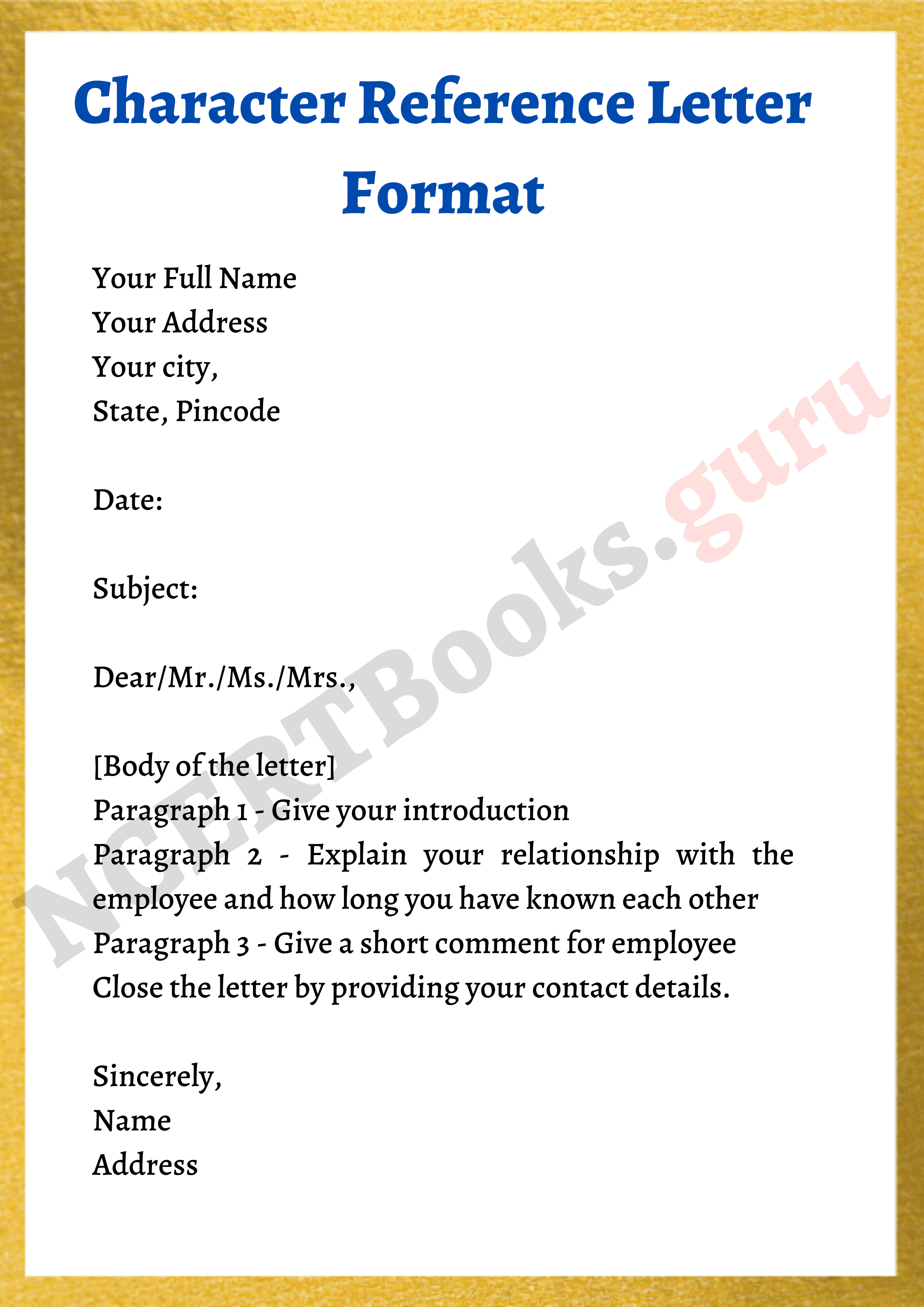
Character Reference Letter should be simple and needs to be around 1 page. While drafting a Character Reference Letter you need to follow a standard format and they are as such

Introduction: Usually, in the Introduction, you need to mention who you are and how you have known the individual and what made you write this letter of recommendation.

Body Paragraphs: In the Body, you need to make a major argument stating how the recommended individual is a personal fit for the role/position. In fact, state two or more personality traits that make them unique and suitable for the respective position. Try to provide examples supporting the qualities.

Conclusion: At Last, Provide your Contact Information if you are comfortable so that employer can contact you for further queries.

Character Reference Letter Format

Tips for Writing a Character Reference Letter

Keep the general instructions in mind while writing a Character Reference Letter Sample on your own. They are along the lines

  • Think before you say yes: Be Sure Whether you can write a positive letter or not about the person. If not so, graciously say no so that the person can request others so that they can write a stronger letter
  • Request Information: Make sure to collect all the information you need if you decide to choose one. Also, have an idea of what the letter is for.
  • State your relationship with the person and explain how come you know the person and also how long you have known them.
  • Be Specific and try to explain the traits that they have and that you feel makes them fit for the position.
  • Make that recommendation and keep the letter short and concise.
  • If you are comfortable try to mention the contact information so that employer can contact you if you have any further queries.
  • Before you send the letter proofread and edit so as to avoid any grammatical and spelling mistakes.

Sample Character Reference Letters

Character Reference Letter Example

Character Reference Letter Example

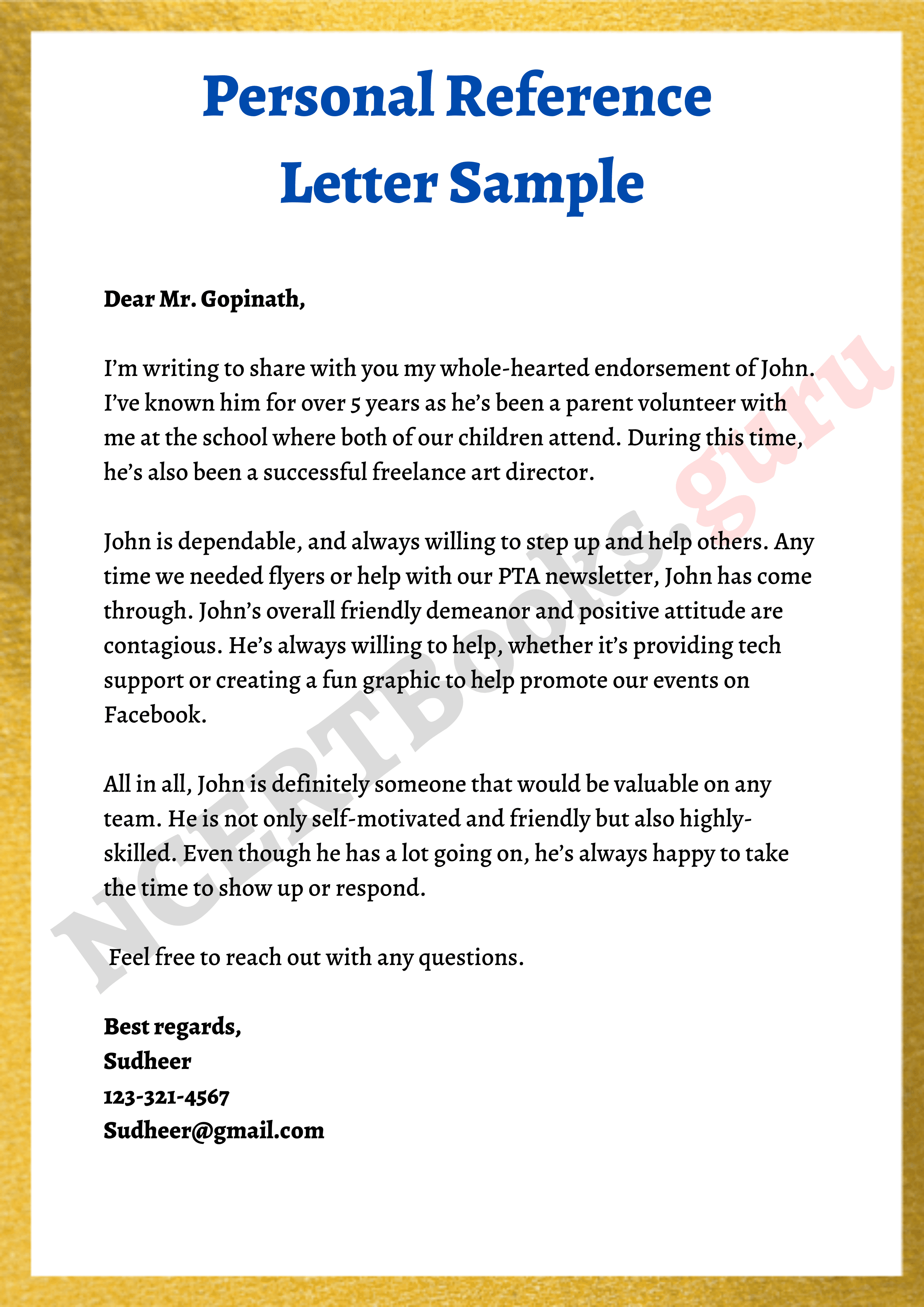
Personal Reference Letter Sample

Personal Reference Letter Sample

FAQs on Character Reference Letter

1. What is a Character Reference Letter?

A Character Reference or Personal Reference Letter is a letter written by Someone who knows the candidate explaining his/her character and his abilities.

2. What Should be Included in a Character Reference Letter?

Below are basic details that a Personal Reference Letter should include in it. They are as follows

  • Start by explaining your relationship to the candidate.
  • Include long you’ve known the candidate.
  • Add positive personal qualities with specific examples.
  • Close with a statement of recommendation.
  • Offer your contact information.

3. What is the Format for a Character Reference Letter?

A Character Reference Letter Format should include the following details

  • Introduction
  • Body Paragraphs
  • Conclusion

National Interactive Maths Olympiad [NIMO] | Registration, Syllabus, Sample Paper, Admit Card, Results, Fee Structure, Reference Books

National Interactive Maths Olympiad [NIMO]

National Interactive Maths Olympiad [NIMO] Exam 2020: The National Interactive Maths Olympiad [NIMO] is a national-level exam that evaluates mathematical abilities and problem-solving skills. EduHeal Foundations arranges a National Interactive Maths Olympiad [NIMO] annually to determine the competency of the candidates in mathematics.

The National Interactive Maths Olympiad [NIMO] 2020-2021 examination will be held tentatively in November 2020 for its first level exam.  All students from the first grade to the twelfth grade are eligible to appear for the test.  However, only selected students will appear In mid-February 2021 for the second level of the National Interactive Maths Olympiad [NIMO] examination.

Get to Know More about other types of Silverzone Olympiads and their details from here.

National Interactive Maths Olympiad Highlights

The National Interactive Maths Olympiad [NIMO] 2020 is a national-level examination to encourage students to sharpen their abilities in Mathematics.  It develops a student’s mathematical analysis and prepares them for advanced competition.

Below you will find the National Interactive Maths Olympiad [NIMO] highlights for 2020 exams in a tabular form for your convenience.

Full Exam Name National Interactive Maths Olympiad
Conducting Body EduHeal Foundation (EHF)
Frequency of conduction Once a year
Category Overview
Exam-level Intermediate
Date of exam November 2020
Mode of Application Offline
Mode of Exam OMR or Computer Based Test
Languages English
Exam Duration One hour

National Interactive Maths Olympiad 2020

EduHeal Foundation holds the examination of the National Interactive Maths Olympiad yearly at an intermediate-level examination. There are two levels of examinations.  Level one is a national exam, whereas level two is an International level exam.

Level One: The first level of the National Interactive Maths Olympiad 2020 exams is open for all students from standard I to XII.  Students from all streams are eligible to participate in the examination.  All students with ICSE/CBSE/State board can appear at the national level of examination.

Level Two: The second level of examination is an international level of examination.  Only selected top-ranked students are eligible to attend the second level of the National Interactive Maths Olympiad [NIMO] 2020.

Note: The mode of examination is the decision of the respective schools.

National Interactive Maths Olympiad 2020 Registration

Schools can register themselves for the National Interactive Maths Olympiad 2020 exam by filling up the respective form applicable to their school.  Schools affiliated under CBSE, ICSE, and other state boards are qualified to apply for the National Interactive Maths Olympiad 2020 exam.

Interested schools and educational institutions can download the registration forms of the National Interactive Maths Olympiad 2020 by EduHeal Foundation. Individual registration of interested students is encouraged through participating schools and institutions.

  • Date of Registration: The last date to register for the National Interactive Maths Olympiad 2020 exam is in August.
  • Registration Fee: Each student can pay an approximate fee amount of INR 150/- for the National Interactive Maths Olympiad 2020 to their respective schools or coordinators via internet banking or demand draft. Schools can keep a small portion of the amount to meet the expenses of conducting the examination.

National Interactive Maths Olympiad 2020 Syllabus

When students study according to their syllabus, they can systematically prepare for their National Interactive Maths Olympiad 2020. Usually, the test of NIMO 2020 is similar to their school curriculum. They do not need to study anything extra. The only difference is that they need to have a strong conceptual knowledge as the questions are tricky.

Students from standard I to VI students need to attempt a total of 40 questions. The breakup is as follows – 10 questions on general IQ, 15 questions on the Subject, and 15 questions on Interactive.

Students from standard VII to XII students need to attempt a total of 60 questions. The breakup is as follows – 10 questions on general IQ, 30 questions on the Subject, and 20 questions on Interactive.

Below you will find a class-wise breakup of the syllabus.

Standard I Standard II Standard III
Introduction to geometry, Numbers, Money and coins, Measurement, Time, and Data handling. Numbers, Addition and subtraction, Introduction to multiplication and division, Money, Mental arithmetic, Measurement of time, weight, length, and volume, Patterns, Data handling, Geometrical shapes and understanding of 3D and 2D figures. Spatial understanding and geometrical shapes, Mental arithmetic, numbers (sequence up to 1000), Addition and subtraction, Money, Multiplication and division, Measurement of volume, time, length, and weight, Patterns, Data handling.
Standard IV Standard V Standard VI
Numbers and operation, Fractional numbers, Measurement of length, volume, weight, and time, Money, Data handling, Patterns, Geometric shapes, and Mental maths. Number operation, Fractional number, Measurement, Data handling, Money, Patterns, Percentage, average, and ratio proportion, Profit and loss, Geometrical shapes and spatial understanding, and mental arithmetic. Number systems, Geometry, Algebra, Menstruation, and Data handling.
Standard VII Standard VIII Standard IX
Number systems, Geometry, Algebra, Menstruation, Data handling, and Area. Number systems, Geometry, Algebra, Menstruation, Data handling, and Introduction to graphs. Number systems, Coordinate geometry, Statistics, Algebra, Menstruation, and Probability.
Standard X Standard XI Standard XII
Number systems, Coordinate geometry, Mensuration,  Algebra, Trigonometry, Data handling, and Geometry. Sets and functions, Calculus, Coordinate geometry, Algebra, Mathematical reasoning, Statistics, and Probability. Relations and Functions, Algebra, Linear programming, Probability, Calculus, Vectors and 3D geometry (Science stream)/partnership, bills of exchange (non-science stream).

National Interactive Maths Olympiad Solved Sample Paper

It is always best to prepare in advance. Preparations with the help of sample papers or previous years’ question papers yield excellent results for the National Interactive Maths Olympiad 2020 exam. These National Interactive Maths Olympiad [NIMO] sample papers help students in determining how well they are prepared for the final exam.  Students become familiar with the pattern of the test.

Click on the links given below to get a good idea of the National Interactive Maths Olympiad test papers. The solved papers will prove highly beneficial for students preparing for the exam.

Class Links
Class I Click Here for Solved Sample Paper
Class II Click Here for Solved Sample Papers
Class III Click Here for SolvedSample Papers
Class IV Click Here for Solved Sample Papers
Class V Click Here for Solved Sample Papers
Class VI Click Here for Solved Sample Papers
Class VII Click Here for Solved Sample Papers
Class VIII Click Here for Solved Sample Papers
Class IX Click Here for Solved Sample Papers
Class X Click Here for Solved Sample Papers
Class XI Click Here for Sample Papers
Class XII Click Here for Sample Papers

National Interactive Maths Olympiad 2020 Admit Card

The admit card is a crucial document to authorise students to sit in the National Interactive Maths Olympiad [NIMO] examination.

In most cases, the organiser, EduHeal Foundation sends the admit card of the registered candidates to their respective schools.   The mode of sending the admit card is through the school’s registered email account.  Further, the school will also receive SMS intimation.

Registered students need to make arrangements to pick up the admit card from their affiliated school since they need to produce it beforehand.

The admit card bears the details of the registration form. Once the students fill the information in the registration form, there is no scope of changes in the admit card. Thus, students should ensure that they have not made any errors while filling up the registration form.

National Interactive Maths Olympiad 2020 Results

The date of the National Interactive Maths Olympiad 2020 is still tentative. However, the expected result declaration is in December 2020. It usually takes two to three weeks to evaluate the answer sheets.

EduHeal Foundation declares the result nationwide for all the students. Students can either visit the official website to know the results of the National Interactive Maths Olympiad exam. Deserving students will receive awards by EHF on the rank obtained.

National Interactive Maths Olympiad 2020 Fee Structure

Students who choose to register for the National Interactive Maths Olympiad 2020 need to pay a nominal fee. The school keeps a small amount of the fees to meet the expenses towards the invigilator’s honorarium, examination centre expenses, DD charges, photocopying, etc.

National Interactive Maths Olympiad 2020 Reference Materials

Though the syllabus of the National Interactive Maths Olympiad [NIMO] is aligned with the school curriculum, students have the option to use other reference books or materials for more practice.

The students should get used to mental maths conceptual questions of the National Interactive Maths Olympiad exam. Students can practice the sample test papers, previous year’s booklet, booklet provided for the National Interactive Maths Olympiad, etc. to get a better rank.

FAQ’s on National Interactive Maths Olympiad [NIMO]

Question 1.
When is the next National Interactive Maths Olympiad 2020 held?

Answer:
The next National Interactive Maths Olympiad is held in November 2020.

Question 2.
What is the syllabus of the National Interactive Maths Olympiad 2020?

Answer:
The syllabus of the National Interactive Maths Olympiad is related to the student’s school curriculum.

Question 3.
Is the question paper of the National Interactive Maths Olympiad 2020 difficult?

Answer:
The question paper of the National Interactive Maths Olympiad 2020 has different difficulty levels to activate the mathematical skills.

Question 4.
Does the Level 2 syllabus of the National Interactive Maths Olympiad 2020 different from the Level 1?

Answer:
No, the syllabus of both the levels is the same. Only, the difference is the level of difficulty.

International Cyber Olympiad [ICO] 2020 | Examination Pattern, Registration, Syllabus, Sample Paper, Admit Card, Results, Fee Structure

International Cyber Olympiad [ICO]

International Cyber Olympiad [ICO] 2020: The International Cyber Olympiad [ICO] is an international level examination for students from class 1 to class 12. It is an examination which tests the knowledge of students in the field of computers.

The knowledge and literacy towards computers are increasingly growing. EduHeal foundation conducts the International Cyber Olympiad [ICO] annually to test the ability of students in this field. Schools and educational organisations can hold the International Cyber Olympiad [ICO] 2020-2021 olympiad from July 2020 to February 2021.

  • International Cyber Olympiad [ICO] 2020 Highlights
  • International Cyber Olympiad [ICO] 2020
  • International Cyber Olympiad [ICO] 2020 Examination Pattern
  • International Cyber Olympiad [ICO] 2020 Registration
  • International Cyber Olympiad [ICO] 2020 Syllabus
  • International Cyber Olympiad [ICO] 2020 Sample Paper
  • International Cyber Olympiad [ICO] 2020 Admit Card
  • International Cyber Olympiad [ICO] 2020 Results
  • International Cyber Olympiad [ICO] 2020 Fee Structure

Get to Know More about other types of Silverzone Olympiads and their details from here.

International Cyber Olympiad [ICO] 2020 Highlights

The International Cyber Olympiad [ICO] is an olympiad to test the knowledge that students have in the field of computers. It is an annually conducted olympiad.

The International Cyber Olympiad [ICO] 2020 highlights are mentioned in the table given below:

Full Examination Name International Cyber Olympiad [ICO]
Conducting Body EduHeal foundation
Frequency of conduction Annually Once
Category Overview
Date of exam July 2020 to February 2021
Mode of Application Offline
Mode of Exam OMR or Computer Based Test
Language English
Exam Duration One hour

International Cyber Olympiad [ICO] 2020

The International Cyber Olympiad [ICO] 2020 is an olympiad which is conducted annually on a global level. The International Cyber Olympiad [ICO] is organised by the EduHeal Foundation every year. International Cyber Olympiad [ICO] 2020 aims at testing the knowledge of the students in the field of computers.

Education institutes are free to conduct International Cyber Olympiad [ICO] 2020 from July 2020 to February 2021. Candidates from class 1 to class 12 can apply for the International Cyber Olympiad [ICO] 2020.

International Cyber Olympiad [ICO] 2020 Exam Pattern

The International Cyber Olympiad [ICO] 2020 has a simple examination pattern. The pattern of the question paper is the same for all the classes. Here is the Paper Pattern of International Cyber Olympiad [ICO] 2020:

  • There will be a total of 40 questions in the question paper.
  • The total duration for candidates to complete the examination is One hour or sixty minutes.
  • There are two sections in the question paper which the candidate has to attempt.
  • The first section is the General Ability section which will have five questions.
  • Candidates must try all the five items in the General Ability section.
  • The second section is the computer science section which has 35 questions.
  • Candidates must attempt the thirty-five questions in the computer science section.

International Cyber Olympiad [ICO] 2020 Registration

The registration form for International Cyber Olympiad [ICO] 2020 will be sent to the schools and educational institutions of the students. All the students who are interested in the International Cyber Olympiad [ICO] 2020 should register for it.

  • The registration for the International Cyber Olympiad [ICO] 2020 is open for students from classes 1 to 12.
  • Students have to register for the examination through the schools which have the prescribed form of registration.
  • The fee that candidates need to pay for registering for the International Cyber Olympiad [ICO] 2020 is Rs.125. A small section of the payment will go to the schools for its expenses for holding the examination.
  • Students must fill the examination form before the last date of registration for International Cyber Olympiad [ICO] 2020.

International Cyber Olympiad [ICO] 2020 Syllabus

Students who come under the different boards are eligible for the International Cyber Olympiad [ICO] 2020. The concepts and theories that are taught in these books suffice for preparing for this examination. Given below is the syllabus for all the classes from which students are eligible to appear for the International Cyber Olympiad [ICO] 2020 exam.

ICO Class 1 Syllabus

  • Computer- Basic understanding of a computer
  • Main parts
  • Devices used with a computer
  • Operation of a computer
  • Functions of a computer

ICO Class 2 Syllabus

  • Computers Environment
  • Parts of a computer
  • Application of a computer
  • Starting and shutting down a computer
  • Keyboard
  • Input and Output devices
  • MS- Paint

ICO Class 3 Syllabus

  • Generations of a computer
  • Hardware and software
  • Exploring the Keyboard
  • Input and output devices
  • Data storage
  • Windows
  • Paintbrush

ICO Class 4 Syllabus

  • Generations of computers
  • Computer and its peripherals
  • Computer memories
  • Memory Devices: Characteristics
  • Software classification
  • Computer language: Introduction
  • Hands-on with paintbrush
  • Ms-word

ICO Class 5 Syllabus

  • Categories of computers and memory devices
  • Windows
  • Ms-Word
  • Multimedia: Application
  • Internet

ICO Class 6 Syllabus

  • World of computers
  • Input and output devices
  • Word processing
  • Spreadsheet
  • Windows
  • Multimedia
  • Networking and internet

ICO Class 7 Syllabus

  • Computers
  • Types of Computer Language
  • Computer networking and usages
  • Windows Explorer
  • Word
  • World of Internet
  • Excel
  • Power-point

ICO Class  8 Syllabus

  • Technological development of computers
  • Working on a computer
  • Computer software fundamental
  • Coding with logo
  • Managing windows
  • Word processing with MS-Words
  • Surfing the Net

ICO Class 9 Syllabus

  • Computer devices and programming language
  • Operating system
  • Computer and communication
  • MS-Word
  • MS-excel
  • Powerpoint

ICO Class 10 Syllabus

  • World of internet
  • World wide web
  • Internet usage
  • HTML
  • MS- access

ICO Class 11 Syllabus

  • Computer Hardware
  • Windows server and website
  • C++
  • Algorithms
  • Oracle
  • Visual basic

ICO Class 12 Syllabus

  • C++
  • Visual basic
  • Networking
  • Multimedia and web technology
  • RDBMS

International Cyber Olympiad [ICO] 2020 Sample Paper

Sample papers are fundamental in the process of preparing for an examination. They serve as important reference material for the study. Before the review, candidates can test their knowledge by attempting to answer the sample question papers.

Below are sample question papers for the International Cyber Olympiad [ICO] 2020 exam. These will give the candidates a better idea of the question paper pattern for the olympiad. Candidates will get a clear idea about the questions that they can be tested on in the olympiad.

Class  Sample Paper
I Click Here
II Click Here
III Click Here
IV Click Here
V Click Here
VI Click Here
VII Click Here
VIII Click Here
IX Click Here
X Click Here
XI Click Here
XII Click Here

International Cyber Olympiad [ICO] 2020 Admit Card

Admit card is the essential thing that you should carry while you write the examination. If you don; ’t have the admit card, you will not be eligible to write the exam. Candidates must download and print the admit card before the examination.

  • Admit Card: Candidates must download the admit card from the official website of the EduHeal Foundation. After they download the admit card, they should check the details on it and print it.
  • Distribution: The admit cards will be disturbed on the online website of EduHeal foundation. Schools will not get a copy of the admit card.
  • Information: The admit card carries all the essential details about the candidates. Some of the pieces are Student name, class, reference number, date of birth and basic rules of the olympiad.

Candidates must check the details on their admit card after they print it. The reason they should do that is to check if all the details on it are correct.

International Cyber Olympiad [ICO] 2020 Results

  • The results of the International Cyber Olympiad [ICO] 2020 will be declared on the official website of EduHeal Foundation.
  • Schools will get a copy of the results of the International Cyber Olympiad [ICO] 2020 too.
  • Candidates should keep their admit cards so that they can enter the credentials and check their products.
  • The results of the International Cyber Olympiad [ICO] 2020 will tentatively be declared by February 2021.

International Cyber Olympiad [ICO] 2020 Fee Structure

The participation fee for the candidates registering for International Cyber Olympiad [ICO] 2020 is Rs. 125. A small section of the payment will go to the schools for its expenses for holding the examination. The candidates will have to pay the fees through demand drafts or online transactions.

FAQ’s on International Cyber Olympiad [ICO] 2020

Question 1.
What is the International Cyber Olympiad [ICO] 2020?

Answer:
The International Cyber Olympiad [ICO] 2020 is an international olympiad for testing the knowledge and computer literacy of students. It is an examination that is held annually by the EduHeal Foundation.

Question 2.
Who is eligible for the International Cyber Olympiad [ICO] 2020?

Answer:
The students from class 1 to class 12 from schools and educational institutions across the world are eligible for the International Cyber Olympiad [ICO] 2020.

Question 3.
What is the fee structure of the International Cyber Olympiad [ICO] 2020?

Answer:
The participation fee for the students who register for the International Cyber Olympiad [ICO] 2020 is Rs. 125, which they can pay online or through demand drafts.

Question 4.
How will candidates receive their admit cards?

Answer:
Candidates can download they are admitted card from the official website of EduHeal Foundation. They will have to put their registration number for accessing the admit card.

10 Lines on Rain for Students and Children in English

10 Lines on Rain

10 Lines on Rain: Rain is the water that falls from the sky, as surreal as that sounds. Rain comes from the clouds of water vapour in the sky, which collect in the sky as a result of evaporation in the water cycle.

Rain can come in many forms, including a light drizzle, heavy rainfall with thunder and lightning such as a storm, or even as hail and snow. Rain is an essential part of the water cycle and is necessary for the planet earth to continue forth as it is. Let’s now see three sets of 10 lines on rain for students of different classes.

Enhance your vocabulary and writing skills with 10 Lines Essays available. Spark up the creativity in you and access various Topics on 10 Lines all in one place.

Set 1 – 10 Lines on Rain for kids

The following set of 10 lines on rain will be helpful for children or the students of classes 1, 2, 3, 4 and 5.

  1. Rain is the water that falls from the clouds after the cloud becomes too heavy.
  2. Rain consists of water droplets which are formed when water vapour goes into the sky.
  3. Evaporation is the process where heat makes the water turn into vapour and go into the sky.
  4. There is a lot of rain in the tropical and hot areas of our planet.
  5. In the areas where it does not rain a lot, we call them deserts.
  6. Rain is very important for agriculture as it waters the crops and gives them the irrigation they need to grow.
  7. Rain can be of many kinds, such as drizzling (very light rain), or even thunderstorms, where rain pours heavily and there is also thunder and lightning.
  8. Rain can be very powerful, as it can even make trees fall sometimes, and it can even cause floods.
  9. Playing in the rain with our siblings or our friends is a lot of fun.
  10. It is important to carry an umbrella when we live in an area where it rains a lot so that we can keep ourselves covered.

10 Lines about Rain

Set 2 – 10 Lines on Rain for School Children

The following set of 10 lines on rain will be useful for students of middle in school, in classes 6, 7, 8 and 9.

  1. Rain, in its definition, consists of droplets of water which fall from the clouds once they become too heavy to hold any more water vapour.
  2. Clouds are formed when the process of evaporation takes place by turning water into vapour which rises and leads to the formation of clouds.
  3. Rain can sometimes be severely heavy, such as on a stormy day when there are thunder and lightning as well.
  4. Very heavy rain is capable of causing a lot of destruction, by creating floods or by toppling trees, light poles and even buildings.
  5. Rain can also be very light and mild, where you may not even be able to tell that it is raining, at times.
  6. Rain can also come in the form of hail, which refers to small pieces of frozen rain (ice) which can hurt if they hit the head.
  7. Snow is also a form of precipitation which falls in the form of ice crystals, which are different from frozen ice or hail.
  8. A good level of rainfall is necessary for crops to grow properly and for them to be well-nourished.
  9. Rainfall is also important for all living beings, as we all are made up mostly of water, among other things.
  10. Rain is one of the most important parts of the water cycle, as it brings the water down from the atmosphere back to the earth’s hydrosphere where it can be utilised by living beings.

Set 3 – 10 Lines on Rain for Higher Class Students

The following set of 10 lines on rain for senior school will be helpful and useful for students in classes 10, 11 and 12.

  1. Rain refers to the droplets of water which fall from the clouds in the sky when they become too heavy to contain any more water vapour.
  2. Clouds are formed as part of the water cycle of the earth, where water turns into water vapour and through the process of evaporation, goes into the sky and turns into clouds, which then fall as rain.
  3. Rain is incredibly important to keep the hydrological balance of the earth in check, as it carries on the water cycle as it continues from the sky to earth.
  4. Rain is very essential to the growth of crops and the cultivation of agriculture and its allied activities, such as horticulture and floriculture.
  5. Rain is also important in terms of clearing the air of toxins and air pollutants from the atmosphere.
  6. Rain can be a light drizzle which we can barely feel, or it can be moderate where it is not that heavy but it still creates puddles on the ground.
  7. The last kind of rain is the destructive rain where it is so heavy that it creates floods and even causes buildings and light poles, even trees, to topple and create a lot of destruction.
  8. It usually rains the most in the monsoon season, which is usually right after the summer months, and it rains much more heavily in tropical areas than anywhere else.
  9. It is important for cities to have appropriate rainwater drainage and rainwater harvesting systems in place to ensure that it is being treated properly and is also being saved wherever it can be saved.
  10. It can be fun to play in the rain, but one may also get sick doing so, thus, it is important to stay safe when it rains and be sure to always carry an umbrella with you.

10 Lines for Rain

Frequently Asked Questions on Rain

Question 1.
Which are the monsoon months?

Answer:
Monsoon is the season in which the highest amount of rain occurs, especially in the tropical areas of the earth. The monsoon months generally follow the hot summer months of March to May, thus monsoons usually occur from the months of June to September. In some places, they may even resume in the winter months.

Question 2.
What is rainwater harvesting?

Answer:
Rainwater harvesting refers to the collection of rainwater in a huge reservoir tank, for utilisation later. This was an idea that was introduced in order to curb water pollution and also battle the problem of shortages of water, by utilising the rainwater rather than letting it all go to waste.

Question 3.
What are cyclones and hurricanes?

Answer:
Cyclones and hurricanes are two kinds of rainstorms which are quite similar. When there is low pressure in the atmosphere, the winds begin to move in a circular fashion which moves in an anti-clockwise direction from the northern to the southern hemisphere of the earth. This creates an anti-clockwise circular pattern in the water, too, along with strong winds and heavy rainfall, which is called a cyclone. A hurricane is also known as a tropical cyclone, and the difference between cyclones and hurricanes is only their geographical location. Cyclones usually start in the northern Indian Ocean, while hurricanes start in the Atlantic Ocean and the northern Pacific Ocean.

Question 4.
Where does rain come from?

Answer:
Rain is a result of the water cycle. Evaporation and condensation are two processes through which water turns into water vapour and travels skywards. Several water vapour droplets join to create one cloud, and when that cloud becomes too heavy, and gravity starts pulling on the cloud, the vapour begins to drop back down the earth in the form of rain. Thus, rain falls in the form of droplets known as raindrops.

SBI Call Letter | Check How to Download State Bank of India Hall Ticket/Call Letter?

SBI Call Letter imp dates and steps to download the admit card

SBI Call Letter: Candidates who have shortlisted for the main examinations can download their call letters from the official website ie., sbi.co.in after the release date. Moreover, State Bank of India (SBI) officials intimate the elected aspirants for the release of the SBI Hall tickets via the registered Email ID or SMS. Candidates will not receive the Call letter through post or courier everyone has to visit the SBI official site and download their admit cards. Candidates can download the SBI Call letter easily by entering their Roll Number or Registration Number, and Date of Birth, or Password.

Complete information on how to download the call letter and what are the required documents candidates have to carry to the exam are given here. So, aspirants are advised to read the article thoroughly and download the SBI call letter for both the prelims and mains exams. Also, avail Letter Writing Topics for all kinds of categories in one place and be aware of various writing styles.

SBI Call Letter Important Dates for PO Examinations

SBI PO Admit Card 2021
Events Dates
Admit Card for SBI PO Mains Exam 19th January 2021
Last Date to Download Admit Card 29th January 2021
SBI PO Exam Date – Mains 29th January 2021
Conduct of Group Exercises & Interview February/ March 2021

State Bank of India Clerk Mains Hall Ticket 2021 Important Dates

SBI Clerk Admit Card 2021
Events Dates
Prelims exam February-March 2021
Release of admit card February 2021
Mains exam To be notified
Mains admit card To be notified
Admit card for pre-exam training To be notified

Steps To Download SBI Call Letter/Admit Card?

The following steps will aid applicants on how to download SBI Prelims & Mains Call Letter / Admit Card from the official website in a simple manner:

  1. Go to the official portal of SBI: www.sbi.co.in/careers
  2. Search for the Admit card and hit on the link to download the Call Letter.
  3. Provide your Registration Number or Roll Number, Date of Birth or Password, and Security Code in the respective fields.
  4. After entering the details, tap on the ‘Login’ to view the SBI Call Letter.
  5. Next, the SBI Admit Card will be displayed on the screen to view & download.
  6. Check the details stated in the Call Letter before downloading it.
  7. Then, download and take a printout of the Call Letter.

Details Issued in SBI Clerk Admit Card 2021

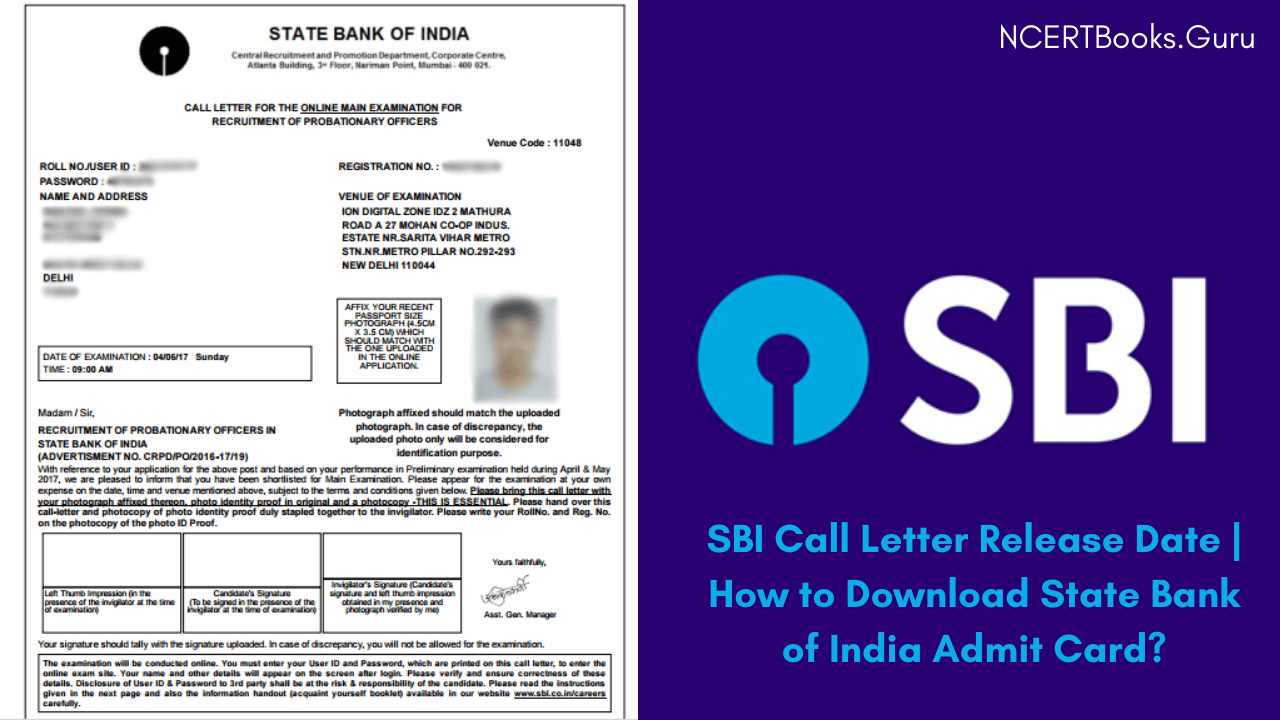
State Bank of India Call Letter contains the aspirant’s details along with information related to the exam. Below data tails are printed in the SBI Clerk hall ticket/call letter 2021.

  • Roll number/user ID
  • Venue of exam
  • Password
  • Date of exam
  • Name and address
  • Exam time
  • Place
  • Space for affixing photograph
  • Registration number
  • Scanned photograph
  • Scanned Signature
  • Space for left thumb impression
  • Space for candidate’s signature
  • Space for invigilators signature

Do’s and Dont’s while downloading SBI Hall Ticket/Call Letter 2021

The following points aid you in the understanding of what to do and what not to do while downloading the State Bank of India Call Letter:

  • Make sure that the details provided on the call letter is accurate or not, check them out while downloading the SBI Admit Card.
  • Confirm the SBI PO or Clerk Exams Venue and Time once you download the SBI Hall Ticket.
  • Protection of Call Letter is necessary to evade any trouble during the examination.
  • Check the photo and signature on the Admit Card. Ensure, it is not spread at any cost before the start of the examination.
  • Read all the instructions mentioned on the SBI Call Letter and follow them carefully during the examination to avoid any inconvenience.

Required Documents & ID Proofs Along With SBI Admit Card

Applicants need to carry the following identity proofs to the exam center along with the state bank of India call letter:

  • Printout of the SBI Clerk Mains Admit Card / Call Letter
  • Original Valid Photo ID Proof as given-below:
    • Aadhaar Card
    • PAN Card
    • Driving License
    • Voter’s Card
    • Bank Passbook
    • Passport
    • Identity Card issued by School or College/Gazetted Officer
  • A Passport Size Photograph

FAQs on State Bank of India Call Letter

1. How to correct mistakes in SBI Hall Ticket?

Applicants are urged to verify all details printed on the admit card thoroughly. If aspirants notice any error in the details, they should directly contact the examination authority for correction. Once the errored details are corrected by the examination authority, applicants will receive a new admit card for SBI Examination.

2. What is the contact number of the SBI Authority?

SBI Authorities Contact Number are 022-2282 0427, 022-2282 0411.

3. When and how can I download the SBI Call Letter/ Admit card?

Aspirants can download the admit card online from the official website @ www.sbi.co.in a few days before the exam.

4. Can I receive a separate call letter for the SBI mains exam?

Yes, candidates who passed the prelims exam will get separate admit cards for the mains exam by the official authorities.