10 Lines on Dussehra for Students and Children in English

10 Lines on Dussehra

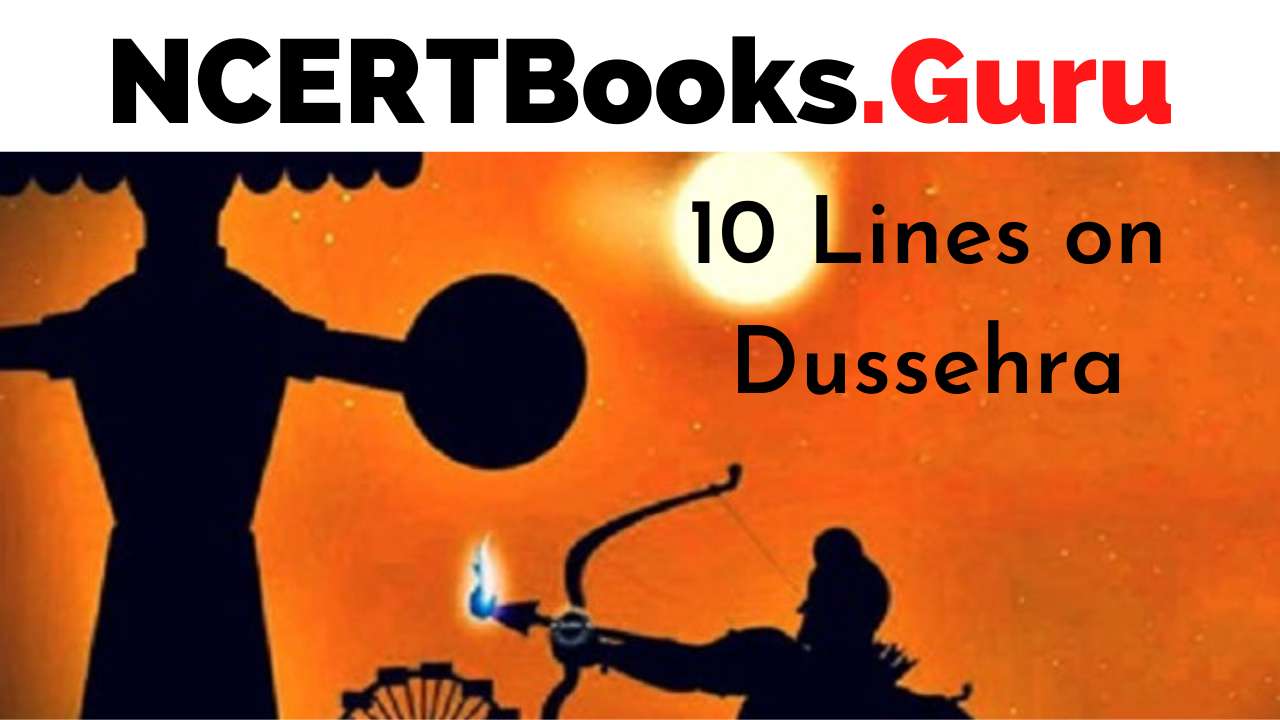
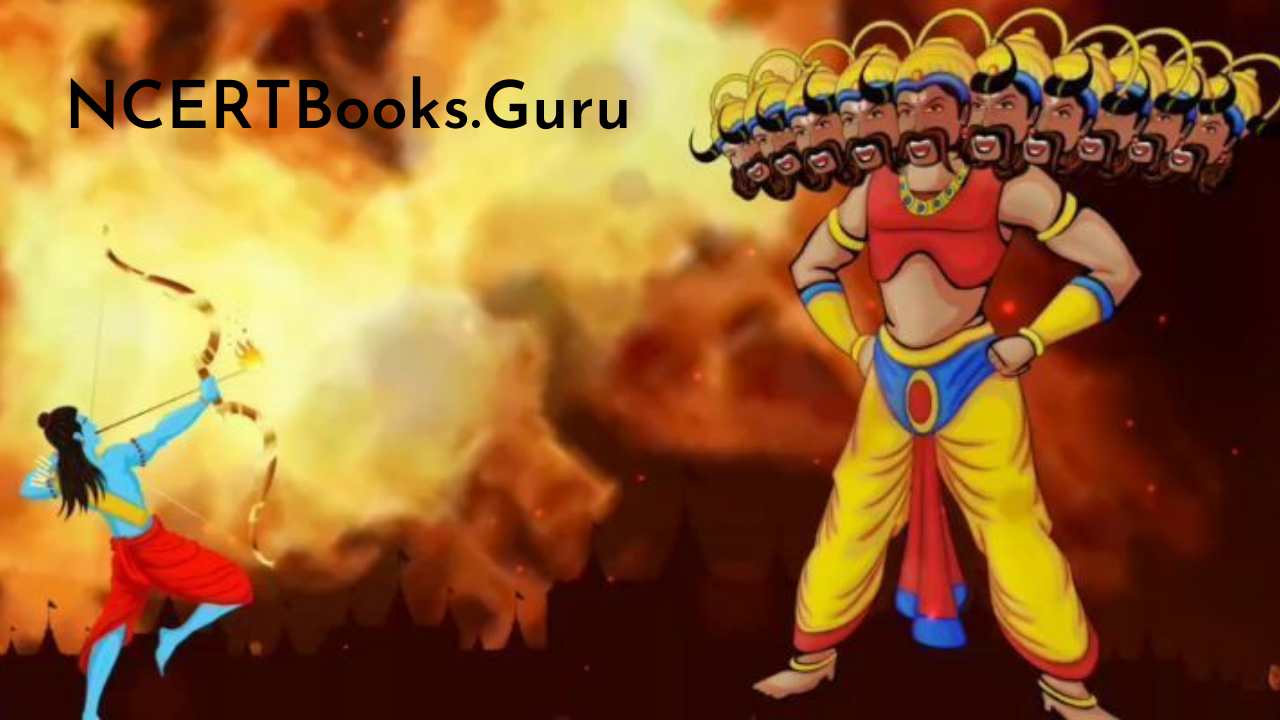
10 Lines on Dussehra: Dussehra is a Hindu festival celebrated all over India. It is observed in the memory of Lord Rama. On this day, Ram defeated the evil soul Ravana who was the king of Sri Lanka. On this day people burn a demon-like structure of Ravan which is made up of wood and crackers. And other beliefs regarding this day are that West Bengal people believe that Maa Durga came to visit her father’s house on earth. Maa Durga defeated Mahishasura on this day. It is a festival showing the greatness of good over evil, light over dark, and increases God’s belief.

Enhance your vocabulary and writing skills with 10 Lines Essays available. Spark up the creativity in you and access various Topics on 10 Lines all in one place.

Set 1 – 10 Lines on Dussehra for kids

Set 1 is helpful for the student of class 1,2,3,4 and 5

  1. Dussehra is one of the Hindu festivals celebrated in India.
  2. It is the festival of Hindus all over India but celebrated by all religions in different regions.
  3. It is also known as Vijayadashami.
  4. It is a festival celebrated with immense enthusiasm, happiness and joy all over the country.
  5. It begins with Navratri, and it is a ten days long festival.
  6. Students get ten days long holidays to enjoy the festival.
  7. This is the festival to celebrate the belief of good over evil.
  8. People of all ages want this festival it Unites the people.
  9. On this day people wear new saree and cloth and visit several places and enjoy street food.
  10. On this day, sweets are prepared and distributed and exchanged gifts with family and friends.

10 Lines about Dussehra

Set 2 – 10 Lines on Dussehra for School Children

Set 2 is useful for students of class 6,7 and 8

  1. Dussehra is a Hindu festival celebrated all over India.
  2. It is observed in the memory of Lord Rama. On this day Ram defeated the evil soul Ravanwho was the king of Sri Lanka.
  3. On this day people burn a demon-like structure of Ravan which is made up of wood crackers.
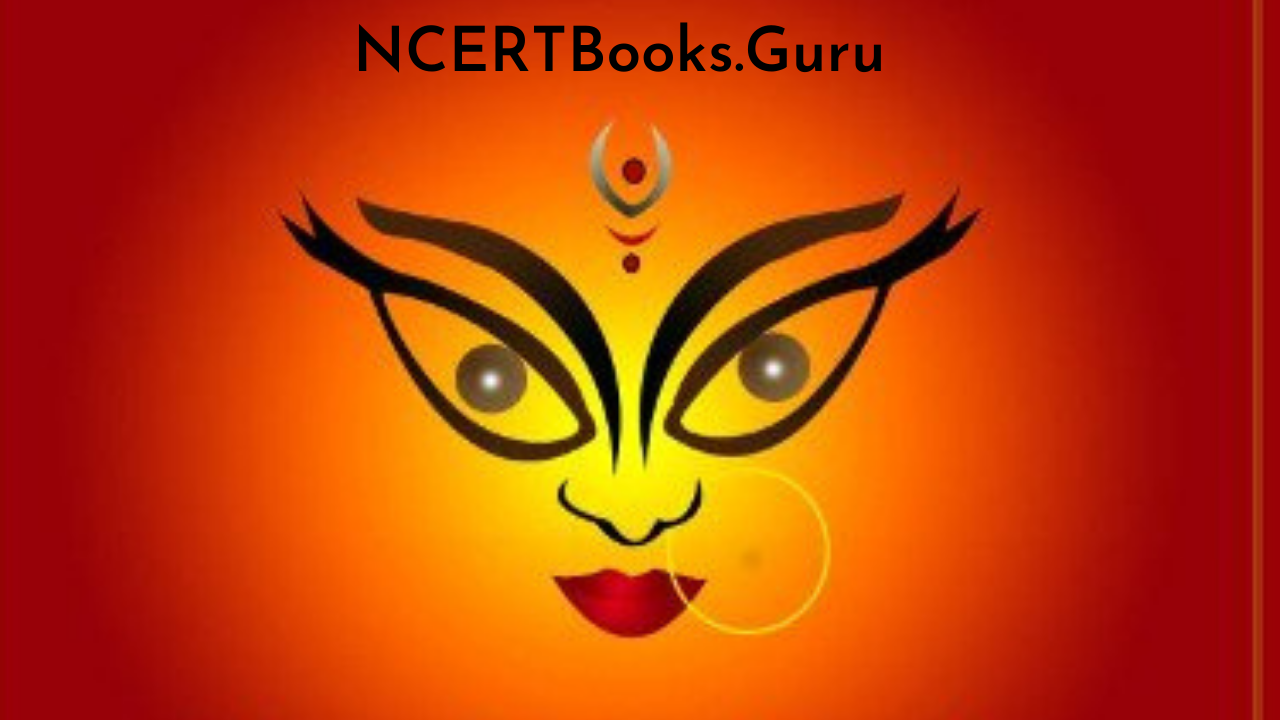
  4. And other beliefs regarding this day are that West Bengal people believe that Maa Durga came to visit her father’s house on earth.
  5. People in North India celebrate Ram Leela by burning effigies of Ravana. Effigies are filled with explosive crackers, and someone aims an arrow to the effigies and catches fire.
  6. Dussehra celebrated two or three weeks before Diwali. It is valley Falls around September to October everyone waited for this festival eagerly.
  7. The main motto of the festival is the victory of good over evil. People all over India celebrate Dussehra with enthusiasm, pomp and show. The different cultures do not harm the celebration of festivals.
  8. Dussehra marks the victory of Lord Rama and Ravana. Thus people assume that battle was for ten days between them.
  9. All the family members spend time with each other and eat good food and watch Firework.
  10. In this festival, some local theatres celebrate the play of Ramleela, which is based on Ramayana.

Set 3 – 10 Lines on Dussehra for Higher Class Students

Set 3 is helpful for students of class 9,10,11,12 and competitive exams.

  1. Dussehra is celebrated on the 10th day of Shukla paksha of Ashwini month. Dussehra is the final day of Navratri celebration of Dussehra making a massive contribution to a country’s economy and became a source for people involved in statue making local shop decorator and vendors.
  2. All the family members dressed well in new beautiful clothes. In some areas, some little festivals are organised to celebrate the beauty of the day.
  3. All the people get an opportunity to work for this festival. The Government of India carries the responsibility of cleaning the area and maintaining during the celebration.
  4. Dussehra is one of the highly celebrated holidays in India. It is mainly a Hindu festival, but in India, people of various regional religions enjoy themselves. All the streets are decorated with flower lights and songs.
  5. In some places, statues of Maa Durga and Mahishasura are made which catch the eye of visitors.
  6. In some cases, Dussehra is celebrated at Vijaya Dashami while Bengal and Odisha are marked as a Dussehra. On this day people say goodbye to Maa Durga and welcome Maa Kali.
  7. This festival adds a lot of rituals and worship ceremonies. Some people fast for all nine days while some fast only on the first and last days they worship goddess Durga to get the blessing on the tenth-day people to celebrate Dussehra in Lord Rama’s joy.
  8. Different religions and regions of the country have different customs and traditions for celebrating Dussehra. In some places, it is celebrated for a full ten days with mantras and stories from Ramayana while in some days it is celebrated for three days.
  9. 9th days of Navratri is known as Durga Puja on who is Goddess Durga worshipped in her nine forms; stop the Ramleela reminding of the history of Sita subduction and Ram’s victory and the defeat of Ravana and his son Meghnath and his brother Kumbhakarna.
  10. There is a belief regarding this Dussehra celebration that Goddess Durga defeated mahishasura and killed his evil from the earth. Another believes that lord Rama won a victory over Ravana.

10 Lines for Dussehra

Frequently Asked Questions on Dussehra

Question 1.
What is the main motto of Dussehra?

Answer:
It is a festival which signifies the win of good over evil.

Question 2.
How do people celebrate Dussehra?

Answer:
People all over India celebrate Dussehra in their different ways with wearing new sarees and burning of Ravan and brothers.

Question 3.
When does Dussehra occur?

Answer:
Dussehra is celebrated on the 10th day of Shukla paksha of Ashwini month. Generally, it is in September or October month.

Question 4.
What is the mythological history behind Dussehra?

Answer:
There is a belief regarding this Dussehra celebration that Goddess Durga defeated mahishasura and killed his evil from the earth. Another believes that lord Rama won the victory over Ravana.

How to Write a Effective Sponsorship Letter & Grab the deal? Guidelines & Samples for Sponsorship Letter Writing

sponsorship letter writing format, template, and samples

Sponsorship Letter: Getting Sponsorship is a big challenge for every kind of organization owner or employer. Ultimately, A sponsorship letter is a formal letter where employees or students, or business peoples sent to some X company for financial assistance for an event or project. This sponsorship letter conveys your purpose and event details and why you should sponsor the event. The main aim of writing a sponsorship letter is to get sponsors for the project and run the event without any hurdles and also sponsored company can attain the benefits of increasing brand awareness and recognition.

Here, we have tried to mention all about the Sponsorship Letter starting with How to write a sponsorship letter in 5 steps and writing tips or guidelines for perfect letter writing to sponsors for your reference. Check out this page completely and also find the needed details such as Sponsorship Letter Format and Samples and make your draft even more effective & grab the deals immediately. Keep all your focus on writing an effective Sponsorship Letter by referring to these best samples & avoid any mistakes before sending or mailing the letter.

Avial many Formal & Informal Letter Writing Topics from our website Ncertbooks.Guru and discover complex styles of letter writing samples for better communication.

How to Write a Sponsorship Letter?

Points to be noted & followed while writing a letter of sponsorship for special events are as follows:

  1. Open a Word Document
  2. Details of the Company and Recipient
  3. Body of the Letter
  4. Closing Statement
  5. Sender Information

Guidelines and Writing Tips for Sponsorship Letter Writing

Below are some of the important Sponsorship Letter Writing Tips & Guidelines to keep in mind while drafting the letter:

  • Describe the event and its purpose, theme, dates, and location.
  • Tell some information regarding your organization (which conducts the event).
  • Highlight the publication and the free branding that can connect with the event.
  • After that, use the best practices to influence the sponsors that fit in and their suggestions for the event.
  • Give options – a sponsorship letter should have to write in various levels of available sponsorships together with its respective purposes and advantages.
  • Explain directly and the exact purpose of the event and make sure to give a high-level summary of the event.
  • Begin sending the sponsorship letter to previous sponsors who invested in your past events.
  • Finally, this letter should be in a formal way so use all formal letter writing tips and format and make conventions.
  • One more main thing you need to do is proof-read the letter for factual or grammatical errors.

Various Sponsorship Letter Samples | Examples for Sponsorship Letter Writing

Here we have given a few sample letters for writing a perfect sponsorship letter and get a great sponsor for your various scenarios:

Corporate Sponsorship Letter Sample

sample letter for corporate sponsorship

Sample Sponsorship Letter for College Fest

College fest sponsorship letter sample

Sample Sponsorship Letter for Food

food sponsorship letter writing sample

FAQs on Writing a Letter of Sponsorship

1. What are the Types of Sponsorship Letters?

Below is the list of sponsorship letter types, that you can draft:

  • For Events
  • For Food
  • For Corporate Requests
  • For Schools
  • For Explaining Sponsorship Levels
  • For Sports Clubs
  • For Requesting Monetary Donations
  • For Requesting Volunteers
  • For Auction Items
  • For In-Kind Donations
  • For Churches

2. How to write a Sponsorship Letter?

The following manner helps people to write a perfect Sponsorship letter:

  • Place yourself and your opportunity
  • Mention why you got in touch and the request for sponsorship
  • Explain them regarding your audience
  • Express your activation possibilities
  • Specify when you will follow up and do so, strictly.

3. How do you request sponsorship for any event?

Take a look at the below points and get an idea about a great sponsor proposal:

  • Begin with a story.
  • Describe what you do.
  • Benefits.
  • Describe your demographics.
  • Create an advisory board.
  • Ask for the money.
  • Promise deliverables.
  • Don’t sell yourself short.

KPSC KAS Books | Syllabus, Notes, Study and Reference Materials

KPSC KAS Books

KPSC KAS Books: The KPSC KAS exam is officially known as the Gazetted Probationers Exam (GPE) to fill the Group A and Group B vacancies in the Karnataka State Administration.

The KPSC KAS examination is a two-step public service exam conducted by the Karnataka Government-

  • Preliminary stage and
  • Main stage

which tests aspirant’s conceptual and factual informational abilities.

For students aspiring to participate in the KPSC KAS examination, this article provides a detailed exam preparation strategy and a comprehensive booklist for the ongoing stages of the study.

KPSC KAS Books and Reference Materials

The KPSC KAS examination is an annual Gazetted Probationers Exam (GPE) conducted to select eligible contenders for the various Group I and Group II posts in the various administrative departments of the State.

The KPSC KAS examination tests candidates with questions related to the background of an event and the current affairs of the State and country. Therefore, participating candidates should pay more attention to the current affairs of the State and country.

The only way to ace the KPSC KAS examination is through thorough preparation. Books, reference materials, notes, and sample papers play a vital role in fostering a strong base. Therefore, candidates should understand and refer to all the topics that fall under the KPSC KAS curriculum before commencing with the preparation. Students can refer to the KPSC KAS books and study materials as a few topics under the curriculum may be confusing and also to guide their practice.

  • KPSC KAS Syllabus
  • KPSC KAS Notes and Books
  • KPSC KAS Study Materials
  • Conclusion

KPSC KAS Syllabus

The KPSC KAS exam, like the other civil service exams, offers a three-set curriculum- the Preliminary KPSC KAS paper, the Main KPSC KAS Paper, and the Interview set. The detailed and structured curriculum for both the steps of the KPSC KAS exam is as follows-

KPSC KAS Preliminary Paper

The KPSC KAS Preliminary Paper holds two generic papers- Paper I and Paper-II. Both the papers consist of objective type MCQ questions for 100 marks with 0.25 negative marking. Paper-I and Paper-II are for two hours.

The level of Mental Ability questions for the KPSC KAS Preliminary Syllabus will be of the SSLC level (standard X). The remaining questions in the prelims will be of the Degree level. The structured curriculum for KPSC KAS Prelims are as follows-

Paper One: General Studies Part-I

Paper-I holds two sections- Section-I comprises 40 questions from General Studies (both of National and International Importance). Section-II comprises 60 questions from Humanities. The detailed curriculum structure for Paper-I is as follows-

Subject Topics or Concepts
Indian History
  • Special Emphasis on Karnataka State and Government
  • Broad Understanding of the Economic, Cultural, Political, and Social aspects
  • Indian National Movement
Polity and Indian Economy
  • Social Sector initiatives
  • Economic Reforms
  • Poverty Alleviation and Rural Development
  • Political System in India
Current Affairs
  • The Hindu
  • Yojana Magazine
  • Stories of National and International Importance
  • PIB
Indian and World Geography
  • State Geography
  • Indian Geography
  • World Geography

Paper Two – General Studies Part-II

Paper-II holds three sections- Section-I comprises 40 questions based on General Studies (State Importance). Section-II Comprises 30 questions from General Science and Technology along with Environment and Ecology. Section-III Comprises 30 questions on General Mental Ability. The detailed curriculum structure for Paper-I is as follows-

Section-I Section-II Section-III
Current events based on the State Government
  • General Science and Technology
  • Contemporary issues or developments and their implications
  • Broad understanding of the subject and the encompassed topics
Comprehension
Important State Government schemes Environment and Ecology

  • Broad understanding of the generic issues on Climate change, Biodiversity, Health, and Ecology
Basic numeracy
Data interpretation and its concepts based on Charts, Data sufficiency, Graphs, Tables, etc.
Logical reasoning and analytical ability

KPSC KAS Main Paper

The KPSC KAS Mains holds a total of nine theory papers out of which two papers are Language paper- Kannada and English Language that are qualifying in nature. The remaining papers fall under the merit-ranking category. The structured curriculum for KPSC KAS Mains are as follows-

Qualifying Papers- Language papers- Kannada and English, fall under the Qualifying Category. Each paper holds 35 percent of the qualifying criteria and is for 150 marks for a period of two hours. Both the  Kannada and English Language qualifying papers aim to test the candidate’s ability to read, understand and express in the given language.

Kannada Papers English Papers
Precis writing
Short Essay Writing
Comprehension
Communicational Skills
Usage of words
Vocabulary
Precis writing
Short Essay Writing
Comprehension
Communicational Skills
Usage of words
Vocabulary

The merit-Ranking category consist of seven papers

  • Essay type Questions
  • General Studies Part-I
  • General Studies Part-II
  • General Studies Part-III
  • General Studies Part-IV
  • Optional Paper Part-I
  • Optional Paper Part-II

The Essay Paper is for 250 marks and a period of three hours. The Essay papers hold two questions- either for Kannada or English, each for 125 marks. The first topic will be on an issue of National or International Importance, and the second topic will be based on the State or Local issues.

Each General Studies Paper comprises three sections for 250 marks for three hours. The KPSC KAS curriculum for the General Studies papers in the Main exam is given in the table below:

General Paper-I Section I: Cultural Heritage and History of Karnataka and India
Section II: Political and Social Perspective
Section III: Planning, Indian Economy, Rural Development- Data Collection, Analysis and Interpretation
General Paper-II Section I: Natural Resources and Physical Features
Section II: An Overview of the Indian Constitution
Section III: International Relations, Public Administration and Management
General Paper-III Section I: Role or Impact of Science and Technology in Indian Development, and the Information Technology in Public Domain
Section II: Modern trends and Advancements in Life Sciences, Natural Sciences, Agriculture Science, Hygiene and Health
Section III: Issues and Challenges of Development on Ecology and Environment
General Paper-IV Section I: Ethics
Section II: Integrity
Section III: Aptitude

For optional papers, candidates have to choose any one of the subjects.

KPSC KAS Notes and Books

The KPSC KAS exam is a civil services examination conducted by the Karnataka Government to recruit eligible candidates for several Group A and Group B posts. The KPSC KAS exam is vital, and the standard of papers test the subject knowledge and current affairs of the participating candidates. With exemplary performance, the KAS officers can also be promoted to IAS officers.

The subject-wise break-up of the best books for Kannada medium aspirants that aid the preparation for the Karnataka state-related topics or questions in the KPSC KAS exam are as follows:

Subject Recommended Books
Internal Relations Book by N Halappa
History
  • The History Of Modern India (Adhunika Bharatada Itihasa) by Bipan Chandra and translated by HS Gopal Rao
  • Samagra Bhaarathada Ithihaasa book by K. Sadashiv
  • A Concise History Of Karnataka Book by Suryanath U Kamath
Environment and Ecology
  • Book by Dr. Ranganath and VS SomaShekar
  • Parisara Adhyayana pr the Environmental Studies Book by P.V. Bhyrappa
Magazines
  • Gnana Sadhana
  • Spardha Vijetha Monthly Magazine
Geography
  • Geography of India Book by Dr. Ranganath
  • Geography of Karnataka Book by Dr. Ranganath
Polity
  • Book by PS Gangadhar
  • Book by KM Suresh

KPSC KAS Study Materials

The KPSC KAS exam is a civil services examination conducted by the Karnataka Government to recruit eligible candidates in various Group I and Group II posts in the State Administration. The KPSC KAS exam is vital, and the standard of papers tests a candidate’s knowledge on the subject and current events about State and the country.

Apart from subjects books, candidates should refer and practice various other study materials such as the NCERT Notes. Candidates can also download the NCERT notes from the official website for thorough preparation for the KPSC KAS exam. Given below are a list of a few of the recommended KPSC KAS preparation materials that aid the reference and practice:

  • Budget and Economic Surveys
  • State Board books
  • NCERT books

As stated earlier, NCERT books are of valuable help and are universally recommended for starters or beginners preparing for any of the Civil Services examinations. Candidates can even segregate and jolt down points from the NCERT books as it helps during the time of revision. A few of the recommended NCERT books for the KPSC KAS examination as are follows-

  • NCERT Notes on Ancient Indian History Notes
  • NCERT Notes on Art And Culture
  • NCERT Notes on Medieval Indian History Notes
  • NCERT Notes on Geography Notes
  • NCERT Notes on Modern Indian History Notes

Candidates can also refer to the subject-based notes either in English or Kannada such as

  • Environment Notes
  • Polity Notes
  • Science and Technology Notes
  • Economics Notes and
  • Other Vital Study Materials

are required for the holistic KPSC KAS exam preparation provided on credible websites.

Notes are essential sources for any of the civil service exams as well as for other State Service Exams as they provide a brief yet important take on every subject. Additional study materials make preparation easy and less confusing. A few of the available subject-based notes available below-

  • Polity Notes
  • Differences Between Articles
  • Economics Notes
  • Science and Technology Notes
  • Environment Notes

Current Affairs play a significant role in any of the civil service examinations. The golden rule for any of the State or Central-based civil service exam preparation is a daily dose of the newspaper and staying up-to-date with the State as well as current Central affairs.

A few essential sources for current affair preparation are-

  • Newspapers- The Hindu or The New Indian Express
  • Press Information Bureau
  • Rajya Sabha TV
  • Yojana Magazine
  • Daily News Analysis
  • Government Schemes

Conclusion on KPSC KAS Books

The KPSC KAS exam is a well-known civil service examination conducted by the Karnataka Administration for various Group I and Group II posts. A few of the best and highly recommended Books, Notes, and Study Materials mentioned above aim to help the aspiring candidates at the time of preparations. Candidates can refer and practice from the provided KPSC KAS Books, Notes and Study materials from this article.

FAQ’s on KPSC KAS Books

Question 1. 
What is the KPSC KAS examination?

Answer:
The Karnataka Public Service Commission (KPSC) is a well-known recruiting agency for various administrative service posts in the State of Karnataka. The KPSC KAS is an annual competitive and departmental examination conducted for filling the Group A, Group B, and Group C vacancies in the state machinery.

Question 2. 
How does one prepare for the current affairs in the KPSC KAS exam?

Answer:
Current Affairs play a significant role in any of the civil service examinations. Candidates should have a daily update of the newspaper and stay up-to-date with the State as well as current Central affairs. A few essential sources for current affair preparation are

  • Newspapers- The Hindu or The New Indian Express
  • Press Information Bureau
  • Rajya Sabha TV
  • Yojana Magazine
  • Daily News Analysis
  • Government Schemes

Question 3. 
How many Papers do the Merit-Ranking paper in the KPSC KAS Mains paper hold?

Answer:
The merit-Ranking category consists of seven papers

  • Essay type Questions
  • General Studies Part-I
  • General Studies Part-II
  • General Studies Part-III
  • General Studies Part-IV
  • Optional Paper Part-I
  • Optional Paper Part-II

The Essay Paper is for 250 marks and a period of three hours. The Essay papers hold two questions- either for Kannada or English, each for 125 marks. The first topic will be on an issue of National or International Importance, and the second topic will be based on the State or Local issues. Each General Studies Paper comprises three sections for 250 marks for three hours.

Question 4. 
What are a few preparation tips that aid the KPSC KAS exam preparation?

Answer:
A few tips that boost the KPSC KAS exam preparation are

  • Practising and solving previous years’ question papers
  • Solving subject-wise MCQs for KPSC KAS Preliminary exam
  • Practising answer writing for KPSC KAS Main exam.

BSE International Finance Olympiad [BIFO] 2020 | Levels, Details, Reference Materials

BSE International Finance Olympiad [BIFO]

BSE International Finance Olympiad [BIFO]: The BSE International Finance Olympiad(BIFO) 2020 is a joint initiative between the Bombay Stock Exchange (BSE) and the EduHeal Foundation to promote learning, application, advancement, and discovery of the commercial and financial world.

The BSE International Finance Olympiad(BIFO) 2020 exam is designed for students from class IX, X, XI and XII of any school in India to discover, learn, explore, and become familiar with the need and art of managing money through analytical and problem-solving skills.

Get to Know More about other types of Silverzone Olympiads and their details from here.

Schools play a vital role through the introduction of creative and new ideas as a part of the BSE International Finance Olympiad(BIFO) 2020 campaign and assist students in developing skills that will be essential to their career and future endeavours.

  • BSE International Finance Olympiad 2020
  • BSE International Finance Olympiad 2020 Levels
  • EduHeal BSE International Finance Olympiad 2020 Details

BSE International Finance Olympiad 2020

The EduHeal Foundation conducts the BSE International Finance Olympiad(BIFO) 2020 annual examination to create awareness as well as to encourage students to learn, explore, and discover more about the financial world.

The BSE International Finance Olympiad(BIFO) 2020 exam paper comprises 50 percent of the questions from general economics, aptitude, and financial literacy, while the remaining 50 percent revolves around other subjects of study.

The BSE International Finance Olympiad(BIFO) 2020 is conducted for students from classes IX, X, XI, and XII who belong to the ICSE, CBSE, NIOS, or State Boards across India.

BSE International Finance Olympiad(BIFO) 2020 Highlights
Full Exam Name BSE International Finance Olympiad(BIFO)
Conducting Body EduHeal Foundation
Frequency of conduction Annual
Last Date for Registration August 2020
Date of exam July 2020, to January 2021

Note: Schools have to set the date of examination within this period, to conduct the BIFO exam.

Date of Result Declaration February 2021
Mode of Exam Online mode
Languages English
Exam Duration Sixty-minutes
Exam-level State, National, Finals

BSE International Finance Olympiad 2020 Levels

The BSE International Finance Olympiad(BIFO) 2020 examination is a three-level annual exam conducted for students from IX to XII.

The school charges a nominal fee amount of Rs 125 (USD 9). The school also sets an additional amount of Rs.25 (USD 1) for its expenses towards the conduction of the BIFO exam.

Details regarding the BSE International Finance Olympiad(BIFO) 2020 examination is provided in the Registration forms forwarded to schools across India.

Level 1: City or State

The school organises the level one of the BSE International Finance Olympiad(BIFO) 2020 examination. The nomination form is enclosed along with the prospectus, and each participating school is required to nominate three deserving aspirants each from classes IX to XII.

The school is eligible to conduct an intro-level school quiz to facilitate the selection of students. Sample quiz questions are enclosed.

Level-2: National 

The second-level of the BIFO exam is scheduled in the first week of January 2021. Students who top the level one of the BSE International Finance Olympiad(BIFO) 2020 examination is selected for the second level BIFO exam.

The second-level of the BSE International Finance Olympiad(BIFO) 2020 examination is an online mode of exam organised by the EduHeal Foundation at various online centres across India.

For the level-two of the BIFO exam, the mode of examination is a computer-based exam at the conducting school. Schools must ensure that there are enough computers with a stable internet connection. Each participating student will receive a unique question paper which comprises 50 percent on general economics, aptitude, and financial literacy. The remaining 50 percent of the question paper is from the other subjects at study.

The syllabus for the second-level exam is based on the CBSE, ICSE, State Boards and NCF (National Curriculum Framework).

Level-3: Quiz Finals

The third-level Quiz Finals of the BSE International Finance Olympiad (BIFO) 2020 examination invites only 48 merit students across India, held in January 2021.

Upon completion, only the top three students from the lot will emerge as national winners of the BSE International Finance Olympiad(BIFO) 2020 examination and will receive certificates and awards.

Awards

The top three rank holders or winners from each class division of IX to XII, each one of the nine zones, will receive a cash award of Rs. 12,000, Rs. 10,000, and Rs. 8,000, respectively, along with a medal and certificate.

Those students participating in the BSE International Finance Olympiad(BIFO) 2020 will receive Rs. 8,000 to Rs. 12,000, respectively, based on rank and will receive a certificate along with the to and fro travel fare.

EduHeal BSE International Finance Olympiad 2020 Details

Given below are the details regarding the BSE International Finance Olympiad(BIFO) 2020 examination:

BSE International Finance Olympiad(BIFO) Process Details
BSE International Finance Olympiad(BIFO) 2020 Examination Registration Form
  • The registration form will be sent to the school, the responsible conducting body, for interested candidates as no individual registrations are encouraged.
  • The students must submit the Registration form on or before August 2020.
  • The Registration Form must be filled and presented under the guidance of parents and school authorities.
BSE International Finance Olympiad(BIFO) 2020 Examination Admit Card
  • The BSE International Finance Olympiad (BIFO) 2020 admit card upon successful completion of the registration process.
  • The Admit Card will be available on the official website for students to download and hold a hard copy.
BSE International Finance Olympiad(BIFO) 2020 Examination Syllabus
  • The BSE International Finance Olympiad (BIFO) 2020 exam is conducted for students from IX to XII.
  • The BSE International Finance Olympiad(BIFO) 2020 examination syllabus provides class-wise break-ups of the exam curriculum.
  • Students can download the BIFO curriculum for reference.
BSE International Finance Olympiad(BIFO) 2020 Examination Sample Papers
  • The BSE International Finance Olympiad (BIFO) 2020 examination sample papers give a class-wise break-up of BIFO solved sample papers to impart aspirants about the structure and type of questions asked in the BSE International Finance Olympiad (BIFO) 2020 examination.
  • Through the practice of the sample papers, students receive a hand on analysis of the subject-specific documents.
BSE International Finance Olympiad(BIFO) 2020 Examination Results
  • The  BSE International Finance Olympiad (BIFO) 2020 examination results will be declared by the end of February or March 2021 (tentative dates).
  • The results for the  BSE International Finance Olympiad (BIFO) 2020 examination are enlisted on the official EduHeal Foundation website, and the list will be forwarded to all the participating schools across the country.
  • Students can check the  BSE International Finance Olympiad (BIFO) 2020 examination results by entering the credentials ( school code-class-section-roll number).
  • Students can hold a hard copy of the BIFO exam result from the official website for future reference.

BSE International Finance Olympiad Reference Materials

The official EduHeal website has posted various reference materials and books on the official website for students appearing from IX to XII. The reference books for BSE International Finance Olympiad (BIFO) is as follows:

  • Comprehensive book
  • Previous year question paper booklet
  • Excellence guide

FAQ’s on BSE International Finance Olympiad [BIFO]

Question 1.
When will the BSE International Finance Olympiad (BIFO) 2020 examination be conducted?

Answer:
The BSE International Finance Olympiad (BIFO) 2020 examination is to be conducted by the participating school anytime between July 2020, to January 2021.

Question 2.
What is the registration process for the BSE International Finance Olympiad (BIFO) 2020 examination?

Answer:
The registration form for the BSE International Finance Olympiad (BIFO) 2020 will be sent to the school, the responsible conducting body, for interested candidates as no individual registrations are encouraged. The students must submit the Registration form on or before August 2020. The Registration Form must be filled and presented under the guidance of parents and school authorities.

Question 3.
What happens in the first level of the BSE International Finance Olympiad (BIFO) 2020 examination?

Answer:
The school organises the level one of the BSE International Finance Olympiad (BIFO) 2020 examination. The nomination form is enclosed along with the prospectus, and each participating school is required to nominate three deserving aspirants each from classes IX to XII.

The school is eligible to conduct an intro-level school quiz to facilitate the selection of students. Sample quiz questions are enclosed.

Question 4.
What are the different reference materials to refer to the BSE International Finance Olympiad (BIFO) 2020 examination?

Answer:
The official EduHeal website has posted various reference materials and books on the official website for students appearing from IX to XII. The reference books for BSE International Finance Olympiad (BIFO) is as follows:

  • Comprehensive book
  • Previous year question paper booklet
  • Excellence guide

10 Lines on APJ Abdul Kalam for Students and Children in English

10 Lines on APJ Abdul Kalam

10 Lines on APJ Abdul Kalam: APJ Abdul Kalam’s full name was Avul Pakir Nainulabdeen Abdul Kalam, and he was the 11th President of the Republic of India. He was in power for a period of 5 years, from the years 2002 to 2007, and was elected by NDA with support from its opposition parties as well. Being elected as President by a largely Hindutva ideological party despite being a Muslim speaks volumes to how influential he was.

Even before his presidency, Kalam was an important asset to the government of India for his contributions to the Defense Research and Development Organisation (DRDO), where he was the scientific adviser of the defence minister of India. He is also known for contributing in research to the Indian Space Research Organisation (ISRO).

For his contributions to the Indian defence ministry, Kalam won the title of “Missile Man” and also won several awards in the international as well as Indian spheres, such as the Padma Vibhushan and Bharat Ratna awards. Let us take a look at a few sets of 10 lines on APJ Abdul Kalam for all age groups which will help us to write essays and long paragraphs about the scientist and politician, and will also help us to improve our general knowledge.

Enhance your vocabulary and writing skills with 10 Lines Essays available. Spark up the creativity in you and access various Topics on 10 Lines all in one place.

Set 1 – 10 lines on APJ Abdul Kalam for kids

This set of 10 lines on APJ Abdul Kalam for junior school will be helpful for children who are students of classes 1, 2, 3, 4 and 5.

  1. APJ Abdul Kalam is the most well-known for being the 11th President of India from the years 2002 to 2007.
  2. He was also the scientific advisor for the defence minister of India from 1992 to 1997.
  3. APJ Abdul Kalam earned his degree in aeronautical engineering, which is the building of aeroplanes from Madras Institute of Technology.
  4. After he got his degree, Kalam joined the DRDO, an organisation which researches defence in the country.
  5. Kalam helped to create several missiles while he was in the DRDO, which gave him the nickname “Missile Man”
  6. Kalam also joined ISRO, which is an organisation that researches space.
  7. At ISRO, Kalam helped the government build a machine called SLV-III, which is a machine used to launch a satellite into space.
  8. APJ Abdul Kalam created a plan called Technology Vision 2020 in the year 1998 to help bring development to India by the year 2020 through technology.
  9. APJ Abdul Kalam won the Padma Vibhushan award in the year 1990, the Bharat Ratna award in 1997 and also many international awards.
  10. APJ Abdul Kalam has also written many books, including Wings of Fire (his autobiography), I Am Kalam, etc.

10 Lines about APJ Abdul Kalam

Set 2 – 10 Lines on APJ Abdul Kalam for School Children

This set of 10 lines on APJ Abdul Kalam should be useful for students in middle school in classes 6, 7, 8 and 9.

  1. APJ Abdul Kalam was the 11th President of India and he was in power from 2002 to 2007 from the NDA Hindutva government.
  2. While he was President, Kalam focused on technology to advance the level of development in the country and devised the Technology Vision 2020 plan for the development of India.
  3. Kalam was born in Rameshwaram, on October 15th 1931 and he passed away in Shillong on July 27th 2015.
  4. Kalam earned his degree in aeronautical engineering from the Madras Institute of Technology in the late 1950s.
  5. After attaining his engineering degree, Kalam joined the Defense Research and Development Organisation in 1958, which he left and joined back in 1982.
  6. When Kalam rejoined the DRDO, he became the scientific advisor to the defence minister, and he also became principal defence minister later on.
  7. Kalam made significant contributions to the engineering and creation of missiles in the country while being the scientific advisor, earning himself the nickname “Missile Man”
  8. Before rejoining the DRDO, Kalam joined ISRO (Indian Space Research Organisation) and helped in the creation of the SLV-III, a satellite launch vehicle designed in India for the first time.
  9. Kalam won several awards for his work in the DRDO as well as the ISRO, including some of India’s highest awards like the Padma Vibhushan in 1990 and the Bharat Ratna in 1997.
  10. Kalam has written several famous books, including his autobiography, Wings of Fire.

Set 3 – 10 Lines on APJ Abdul Kalam for Higher Class Students

The following set of 10 lines on APJ Abdul Kalam for senior school is suitable for students in classes 10, 11 and 12.

  1. APJ Abdul Kalam was born on 15th October 1931 in Rameshwaram and died on 27th July 2015 while in Shillong.
  2. APJ Abdul Kalam made significant contributions in the defence industry of India during his time spent at the DRDO (Defence Research and Development Organisation) in the area of nuclear weapons such as missiles, thus earning him the nickname of “Missile Man”
  3. APJ Abdul Kalam was on the team of people who designed and built India’s first satellite vehicle launcher, the SLV-III.
  4. APJ Abdul Kalam acted as a scientific advisor through the years 1992 to 1997 to the defence minister, and later as the principal scientific advisor through the years 1998 to 2001.
  5. In the year 1998, APJ Abdul Kalam played a prominent role in the testing of nuclear weapons in India, which made him a hero in the eyes of the nation.
  6. In the year 2002, APJ Abdul Kalam became the 11th President of India and served as the same through the years 2002 to 2007.
  7. Kalam was elected as President by the NDA Hindutva alliance despite his religious identity, and also had the support of its opposition parties such as the Indian National Congress, which speaks volumes to how influential he was.
  8. APJ Abdul Kalam believed in advancing the country through means of technology and he emphasised upon this in his  Technology Vision 2020 plan to increase productivity in agriculture, for increasing economic growth and also using technology to better the medical and educational infrastructure for the country.
  9. APJ Abdul Kalam authored several inspirational books, one of which was his autobiography titled “Wings of Fire” and also “India 2020: A Vision for the New Millennium” emphasizing his Technology Vision 2020 plan of 1998.
  10. APJ Abdul Kalam has received a high amount of international recognition and has also received Indian awards of the highest statures, such as the Padma Vibhushan in 1990 and the Bharat Ratna award in 1997.

10 Lines for APJ Abdul Kalam

Frequently Asked Questions on APJ Abdul Kalam

Question 1.
Which organisations was APJ Abdul Kalam associated with?

Answer:
APJ Abdul Kalam was associated with the following organisations:

  1. Madras Institute of Technology, from where he graduated with a degree in aeronautical engineering.
  2. Defence Research and Development Organisation (DRDO) where he made significant contributions to India’s defence sector.
  3. Indian Space Research Organisation (ISRO) where he was part of the team which designed the SLV-III.
  4. National Democratic Alliance (NDA) was his political affiliation when he became President of India.

Question 2.
Why was APJ Abdul Kalam known as “Missile Man”?

Answer:
APJ Abdul Kalam was nicknamed the “Missile Man” because of his contribution to the development of missiles (nuclear weapons) in India and also for carrying out nuclear weapon testing in 1998 in India.

Question 3.
Which awards did APJ Abdul Kalam win?

Answer:
APJ Abdul Kalam won several Indian as well as international awards:

  1. Padma Bhushan in 1981
  2. Padma Vibhushan in 1990
  3. Bharat Ratna in 1997
  4. Indira Gandhi Award for National Integration in 1997
  5. Ramanujan Prize in 2000
  6. King Charles II Medal in 2007
  7. International von Karman Wings Award in 2009
  8. Hoover Medal in 2009
  9. IEEE Honorary Membership in 2011
  10. Von Braun Award in 2013

Question 4.
What is Technology Vision 2020?

Answer:
Technology Vision 2020 was a plan devised by APJ Abdul Kalam in the year 1998 to make India, a developing economy, a developed nation by the year 2020. He focused on the importance of technology in bringing development to India, such as in the agriculture sector, economic growth, and for getting better infrastructure.

10 Lines on Delhi for Students and Children in English

10 Lines on Delhi

10 Lines on Delhi: Delhi is the capital of India and was recognised as a Union territory in the year 1956. It was officially declared as the capital of India after the Independence in 1947. Delhi has been a place of historical importance since the beginning when the Pandavas ruled in the city, which was then called Indraprastha.

Delhi is presently the second wealthiest city of the country after Mumbai. The Delhi-NCR region includes the neighbouring cities of Gurgaon, Noida, Faridabad and Ghaziabad. Every year students and people of the working population come to Delhi in search of better opportunities. The city boasts some of the country’s finest universities and colleges.

Enhance your vocabulary and writing skills with 10 Lines Essays available. Spark up the creativity in you and access various Topics on 10 Lines all in one place.

Short Essay on Delhi

The NCT or National Capital Territory of Delhi is a city containing New Delhi, the capital of India. The city is bordered by Haryana on three sides and shares border with Uttar Pradesh on the eastern side. The total population of the city is roughly 30 million. The city is home to all the major bureaucrats and the high ranked government officials. The three arms of the government – the Legislative, the Executive and the Judiciary are located in the city.

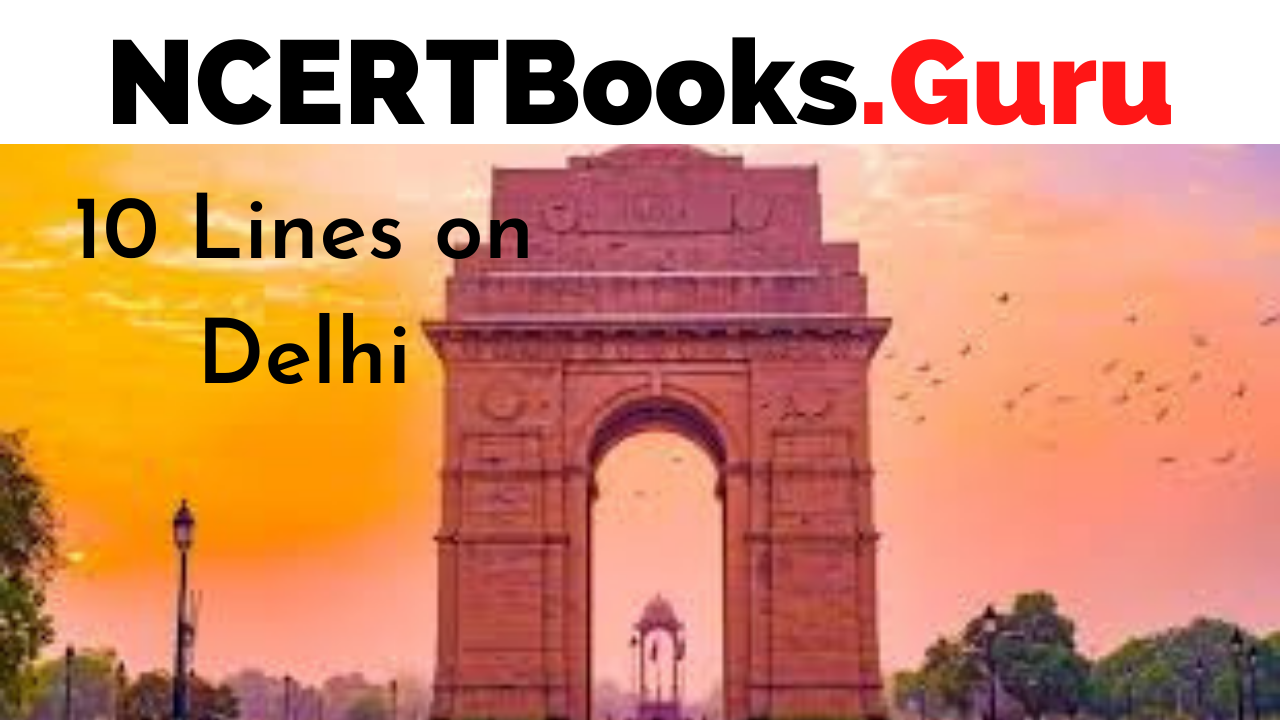
Delhi also boasts some of the important cultural heritage sites of the country such as Red Fort, Qutub Minar, Humayun’s tomb, Jama Masjid, India Gate, Akshardham temple, Agrasen ki Baoli etc. The city is also home to the headquarters of almost all government agencies. Given below are sets of 10 lines about Delhi. Students or anyone can use this information in discovering more about the city.

Set 1 – 10 Lines on Delhi for kids

The first set is meant for the students of primary classes from 1-5. It gives basic information about the city.

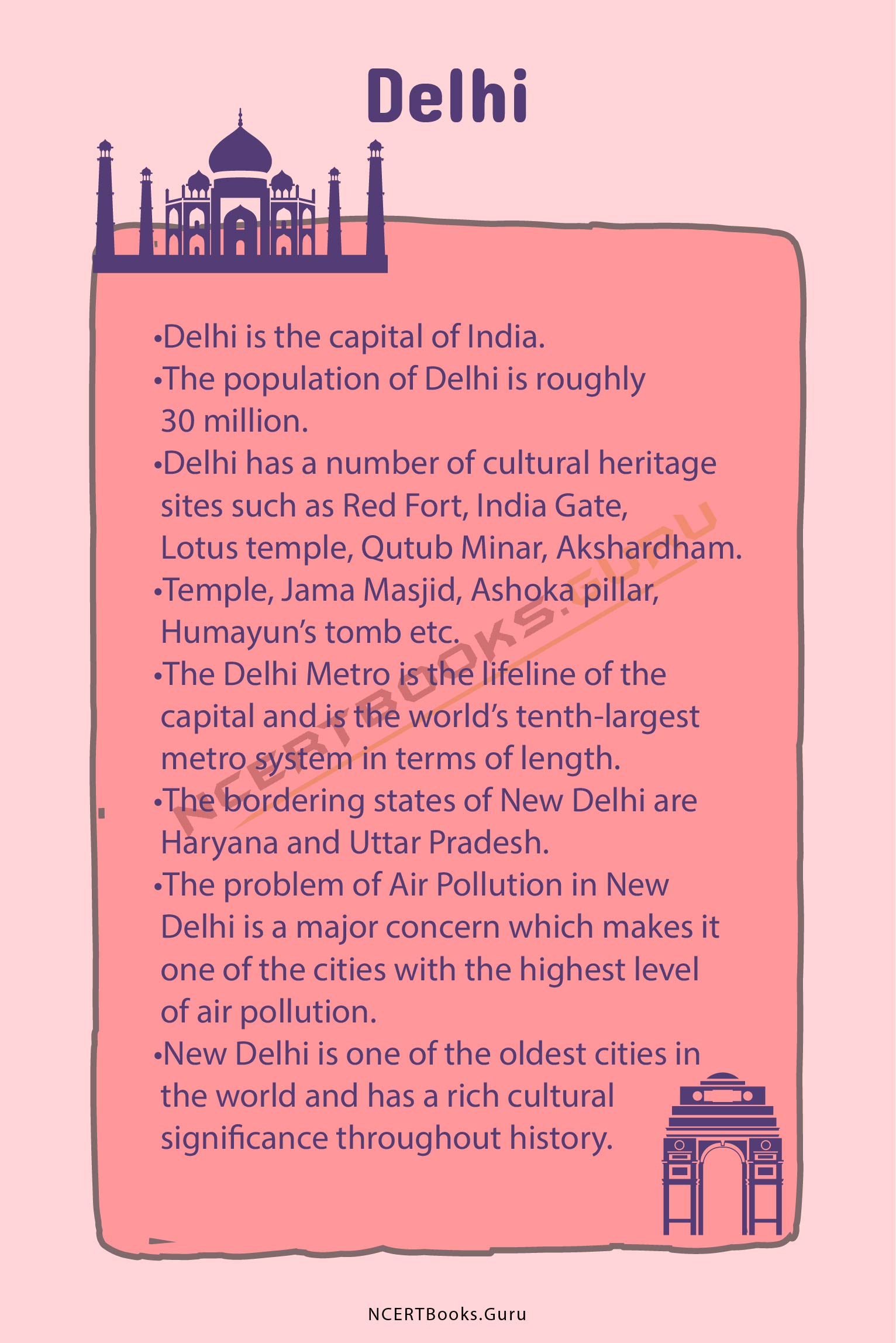
  1. Delhi is the capital of India.
  2. The population of Delhi is roughly 30 million.
  3. Delhi has a number of cultural heritage sites such as Red Fort, India Gate, Lotus temple, Qutub Minar, Akshardham
  4. Temple, Jama Masjid, Ashoka pillar, Humayun’s tomb etc.
  5. The Delhi Metro is the lifeline of the capital and is the world’s tenth-largest metro system in terms of length.
  6. The bordering states of New Delhi are Haryana and Uttar Pradesh.
  7. The problem of Air Pollution in New Delhi is a major concern which makes it one of the cities with the highest level of air pollution.
  8. New Delhi is one of the oldest cities in the world and has a rich cultural significance throughout history.
  9. The Delhi- NCR region includes the cities of Noida, Ghaziabad, Faridabad and Gurgaon.
  10. Indira Gandhi International Airport is situated in New Delhi which serves as the aviation hub for the rest of northern India. The National Capital Territory covers an area of almost 1484 square kilometres.

10 Lines on Delhi 1

Set 2 – 10 Lines on Delhi for School Children

The second set gives a detailed analysis of the city. This set is meant for the students of class 6-10.

  1. Delhi is home to almost all the ministers and high-ranked officials such as Prime Minister, President, Cabinet ministers, ambassadors.
  2. The Supreme Court, The Parliament House, Indian Army headquarters are some of the major institutions in Delhi.
  3. IIT Delhi is among the top IITs in the country.
  4. The present Chief Minister of Delhi is Shri Arvind Kejriwal and the Lt. Governor of Delhi is Shri Anil Baijal.
  5. Delhi University is one of the most prestigious universities in the country and every year lakhs of students apply for admission in colleges like Hindu College, Hansraj College, SRCC, St. Stephens, LSR, Gargi College, Shaheed Sukhdev College of Business Studies etc.
  6. The NCT or National Capital Territory of Delhi resembles a state with its own legislature, high court and a council of ministers.
  7. The administration powers in New Delhi are distributed between the central government and the local government of New Delhi.
  8. The city has been inhabited since the 6th century and has been home to different kingdoms in different periods.
  9. The city is bordered by Haryana on three sides and borders with Uttar Pradesh on the east side.
  10. The Delhi Transport Corporation and other public transport vehicles run entirely on Compressed Natural Gas.

Set 3 – 10 Lines on Delhi for Higher Class Students

The third set provides an in-depth picture of the city and about its history. The set is meant for senior secondary students and higher.

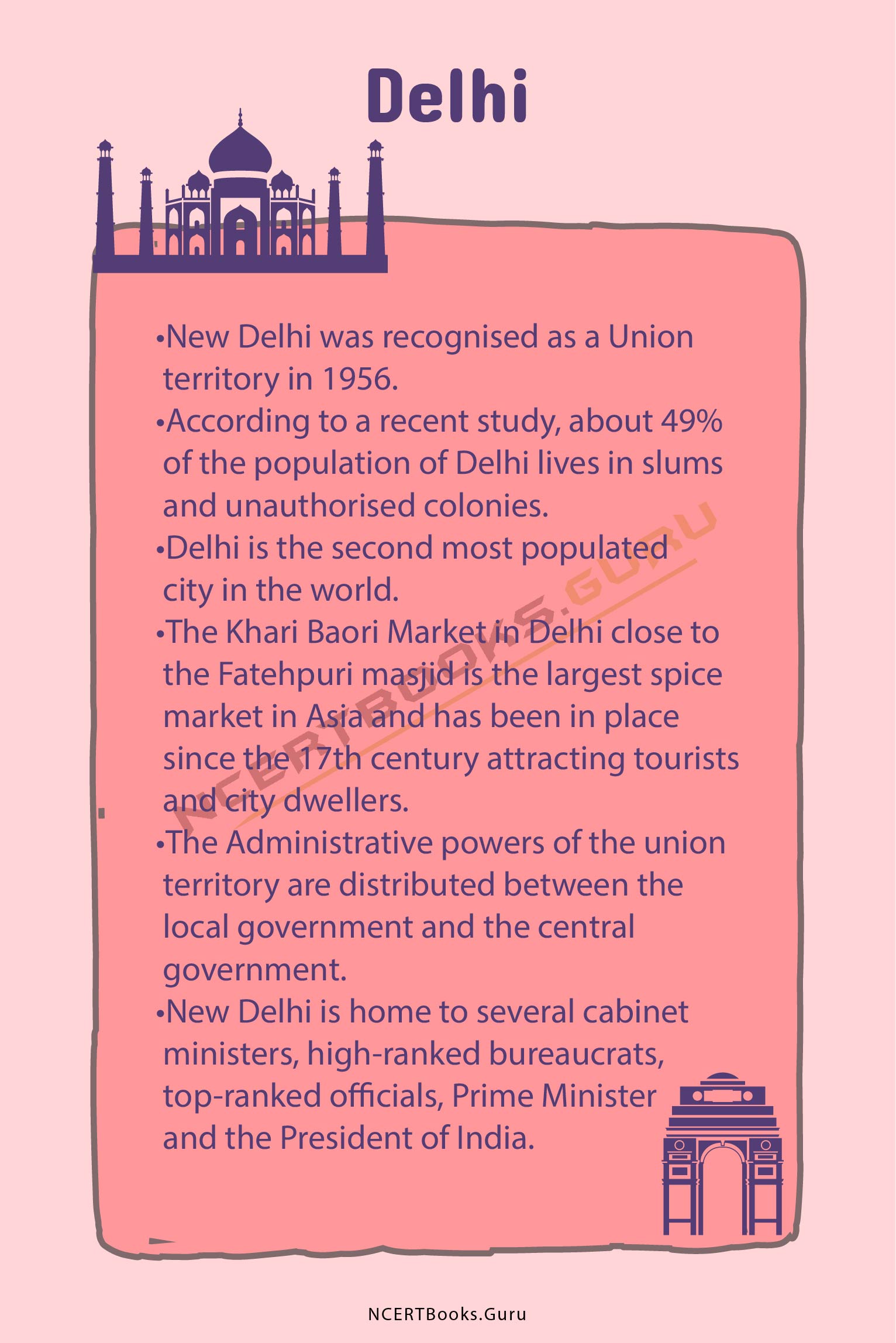
  1. New Delhi was recognised as a Union territory in 1956.
  2. The local civic administration in New Delhi is divided among five bodies- the North Delhi municipal corporation, the South Delhi municipal corporation, the New Delhi municipal corporation and the Delhi cantonment board.
  3. According to a recent study, about 49% of the population of Delhi lives in slums and unauthorised colonies.
  4. Delhi is the second most populated city in the world.
  5. The Khari Baori Market in Delhi close to the Fatehpuri masjid is the largest spice market in Asia and has been in place since the 17th century attracting tourists and city dwellers.
  6. The Administrative powers of the union territory are distributed between the local government and the central government.
  7. New Delhi is home to several cabinet ministers, high-ranked bureaucrats, top-ranked officials, the Prime Minister and the President of India.
  8. On Republic day every year, a large parade is organised from the Rashtrapati Bhawan to the India gate moving on the Rajpath.
  9. The city also has a rich cultural heritage and includes sites of cultural importance such as India Gate, Red Fort, Qutub Minar, Jama Masjid, Akshardham Temple, Humayun’s tomb etc.
  10. New Delhi is the seat of the three important arms of the government- the Legislative, the Executive and the Judiciary.

10 Lines on Delhi 2

Frequently Asked Questions on Delhi

Question 1.
What are the main causes of air pollution in New Delhi?

Answer:
The toxic quality of air in New Delhi is the effect of several reasons.

  1. Stubble burning by the farmers of the neighbouring states of Punjab, Haryana and Uttar Pradesh.
  2. Vehicular pollution and traffic menace is a major contributing factor in the city which leads to the degradation of air quality and the formation of smog.
  3. The situations worsen in Winter season as the dust particles remain locked in the air due to stagnant winds.
  4. Over-population is yet another reason for the declining levels of air quality in the capital.
  5. Less investment in Public transport and public infrastructure leads to more traffic and hence more pollution.
  6. Industrial pollution and garbage dumps add to the degrading quality of air.
  7. Large-scale construction in the Delhi-NCR region increases the dust particles in the air.

Question 2.
Comment on the Delhi metro rail system.

Answer:
The Delhi Metro Rail Corporation is the nodal authority responsible for the metro system in the capital. The first corridor opened in 2002 from Shahdara to Tis Hazari. The present metro system is 389 kilometres long with a total of 285 stations. The rail system moves underground, elevated and on the ground level in different regions.

The Delhi Metro Rail Network has expanded to the neighbouring regions of Noida, Ghaziabad, Gurgaon, Faridabad, Bahadurgarh and Ballabhgarh. Apart from providing a reliable mode of the transport system to the people of the capital, the Delhi Metro Rail Corporation also works to reduce the amount of air pollution in the air. It reduces greenhouse emissions by 6.3 lakh tons every year and also has solar panels set up on the roofs of stations.

Question 3.
What are some of the heritage sites located in Delhi?

Answer:
New Delhi is home to several rich heritage sites of the world. Some of the well-recognised heritage sites are-

  1. Humayun’s Tomb- The heritage site sits on the banks of the river Yamuna and is an architectural marvel built during the Mughal period.
  2. Qutub Minar- The landmark sit built in the 13th century is the world’s tallest brick minaret. Qutub Minar attracts thousands of tourists every day being a UNESCO world heritage site.
  3. India Gate- The India gate is situated at the eastern end of the Rajpath and stands tall as a War memorial built-in 1921 in memory of the soldiers who laid down their lives in the First World War.
  4. Red Fort – The Red Fort or Lal Quila was the home of Mughals for a period of 200 years and was a place of hosting important ceremonies. Even today on Independence Day, the Prime Minister addresses the entire country from the Red Fort.
  5. Jama Masjid- Jama Masjid stands tall in the Old Delhi region built in the Mughal period by the emperor Shah Jahan.

Question 4.
Comment on the historical significance of New Delhi.

Answer:
The capital of the country has a rich and significant historical background and has been ruled by some of the most powerful emperors. The historical pieces of evidence trace back to the Mahabharata Period. The city was called Indraprastha where the Pandavas used to live.

The city has gone from being ruled by Hindu kings to Muslim emperors from one ruler to another. In 1803, the Britishers claimed control over the city and later shifted their capital from Calcutta to New Delhi in the year 1911. After the Independence of India, New Delhi was officially declared as the capital of the country.