SCERT Kerala Textbooks for Class 10 Arabic | Kerala State Syllabus 10th Standard Textbooks English Malayalam Medium

SCERT Kerala Books Class 10 Arabic: The State Council of Education Research and Training(SCERT Kerala) publishes Arabic textbooks for Class 10. The SCERT Samagra Kerala Class 10th Arabic textbooks are well known for it’s updated and thoroughly revised syllabus. The SCERT Kerala Arabic Books are based on the latest exam pattern and Kerala State syllabus.

SCERT Kerala keeps on updating the Arabic books with the help of the latest question papers of each year. The Class 10 Arabic books of SCERT Kerala are very well known for its presentation. The use of SCERT Kerala State Books for Class 10 Arabic is not only suitable for studying the regular syllabus of various boards but it can also be useful for the candidates appearing for various competitive exams, Engineering Entrance Exams, and Olympiads.

SCERT Kerala Class 10 Arabic Books PDF Download

SCERT Kerala Class 10 Arabic Books are provided in PDF form so that students can access it at any time anywhere. Class 10 SCERT Kerala Syllabus Arabic Books are created by the best professors who are experts in Arabic and have good knowledge in the subject.

The SCERT Kerala syllabus mainly focuses on this book to make it student-friendly to make it useful for both the students and the competitive exam aspirants. The book covers a detailed Arabic based on the syllabuses of various boards. SCERT Kerala Arabic Books for Class 10 is perfectly compatible with almost every Indian education state and central boards.

We hope that this detailed article on SCERT Kerala Samagra Textbooks for Class 10 Arabic helps you in your preparation and you crack the SSLC exams or competitive exams with excellent scores.

MCQ Questions for Class 12 Economics Chapter 5 Market Equilibrium with Answers

Market Equilibrium Class 12 MCQs Questions with Answers

Question 1.
Which is a characteristic of the market ?
(a) One Area
(b) Presence of both Buyers and Sellers
(c) Single Price of the Commodity
(d) All the above

Answer

Answer: (d) All the above


Question 2.
Which is a basic for the classification of the market ?
(a) Perfect Competition
(b) Zero Competition (Monopoly)
(c) Imperfect Competition
(d) All the above

Answer

Answer: (d) All the above


Question 3.
Which of the following is a feature of perfect competition ?
(a) Large Number of Buyers and Sellers
(b) Homogeneous Units of the Product
(c) Perfect Knowledge of the Market
(d) All the above

Answer

Answer: (d) All the above


Question 4.
In which market product differentiation is found ?
(a) Pure Competition
(b) Perfect Competition
(c) Monopoly
(d) Monopolistic Competition

Answer

Answer: (c) Monopoly


Question 5.
Which of the following is true in perfect competition ?
(a) Firm is price-taker, not price-maker
(b) Firm’s demand curve is perfectly elastic
(c) AR = MR
(d) All the above

Answer

Answer: (d) All the above


Question 6.
Which one is a feature of monopoly ?
(a) Single Seller and Many Buyers
(b) Lack of Close Substitutes
(c) Restrictions of New Firm entry
(d) All of these

Answer

Answer: (d) All of these


Question 7.
Which one of the following is true for monopoly ?
(a) Firm is price-maker
(b) Demand curve slopes downward
(c) Price discrimination possibility arises
(d) All the above

Answer

Answer: (d) All the above


Question 8.
Which one is a feature of monopolistic competition ?
(a) Differentiated Product
(b) Selling Cost
(c) Imperfect Knowledge of the Market
(d) All the above

Answer

Answer: (d) All the above


Question 9.
A market in which there is free entry and exit, the market is:
(a) Monopolistic Competitive Market
(b) Imperfect Competitive Market
(c) Perfectly Competitive Market
(d) None of these

Answer

Answer: (c) Perfectly Competitive Market


Question 10.
What does a monopolist market show ?
(a) Production process
(b) Distribution system
(c) Nature of market
(d) None of these

Answer

Answer: (c) Nature of market


Question 11.
Price discrimination is found in which market ?
(a) Pure Competition
(b) Perfect Competition
(c) Monopoly
(d) Monopolistic Competition

Answer

Answer: (c) Monopoly


Question 12.
Which of the following is the feature of pure competition ?
(a) Perfect knowledge of the market
(b) Perfect mobility of factors
(c) Homogenity by products
(d) All the above

Answer

Answer: (d) All the above


Question 13.
Market situation where there is only one buyer is:
(a) Monopoly
(b) Monopsony
(c) Duropoly
(d) None of these

Answer

Answer: (b) Monopsony


Question 14.
The concept of monopolistic competition is given by:
(a) Hicks
(b) Chamberlin
(c) Mrs. Robinson
(d) Samuelson

Answer

Answer: (b) Chamberlin


Question 15.
Which of the following is not a feature of perfect competition ?
(a) Large number of buyers and sellers
(b) Homogeneity of product
(c) Advertisement and selling cost
(d) Perfect knowledge of the market

Answer

Answer: (c) Advertisement and selling cost


Question 16.
In which market is AR equal to MR ?
(a) Perfect competition
(b) Oligopoly
(c) Imperfect competition
(d) Monopoly

Answer

Answer: (a) Perfect competition


Question 17.
Which factor determines Equilibrium Price ?
(a) Demand for Commodity
(b) Supply of Commodity
(c) Both (a) and (b)
(d) None of the above

Answer

Answer: (c) Both (a) and (b)


Question 18.
“Price is determined by Demand and Supply. Whose statement is this ?
(a) Jevons
(b) Walras
(c) Marshall
(d) None of these

Answer

Answer: (c) Marshall


Question 19.
Price of a commodity is determined at a point where :
(a) Demand exceeds
(b) Supply exceeds
(c) Demand equals supply
(d) None of these

Answer

Answer: (c) Demand equals supply


Question 20.
What is true for perfect competition market ?
(a) Price is determined by both Demand and Supply Forces
(b) Price is determined by the industry
(c) Each firm of the industry is Price-taker
(d) All the above

Answer

Answer: (d) All the above


Question 21.
Who gave the concept of ‘Time Element’ in price determination process ?
(a) Ricardo
(b) Walras
(c) Marshall
(d) J. K. Mehta

Answer

Answer: (c) Marshall


Question 22.
How many categories of production duration have been made by Marshall on the basis of supply ?
(a) Two
(b) Three
(c) Four
(d) Seven

Answer

Answer: (b) Three


Question 23.
Which is a reason of change in demand ?
(a) Change in Consumer’s Income
(b) Change in Prices of Related Goods
(c) Population increase
(d) All the above

Answer

Answer: (d) All the above


Question 24.
Which statement is correct ?
(a) In very short period, supply is perfectly inelastic, price is affected by both demand conditions.
(b) Supply curve elasticity depends on time period
(c) Both (a) and (b)
(d) None of the above

Answer

Answer: (c) Both (a) and (b)


Question 25.
Market Price is found in:
(a) Short Period Market
(b) Long Period Market
(c) Very Long Period Market
(d) None of these

Answer

Answer: (a) Short Period Market


Question 26.
The price of a good is determined by:
(a) Demand
(b) Supply
(c) Both demand and supply
(d) Government

Answer

Answer: (c) Both demand and supply


Question 27.
Market price is associated with:
(a) Price of very short period
(b) Normal price
(c) Permanent price
(d) All of these

Answer

Answer: (a) Price of very short period


Question 28.
The price of a goods in perfect competition is determined by:
(a) Bargaining
(b) Production cost
(c) Marginal utility
(d) Demand and supply

Answer

Answer: (d) Demand and supply


Question 29.
In perfect competition, a firm:
(a) Determines price
(b) Obtains price
(c) Both (a) and (b)
(d) None of these

Answer

Answer: (b) Obtains price


Question 30.
In very short period, supply will be:
(a) Perfectly elastic
(b) Perfectly Inelastic
(c) Elastic
(d) None of these

Answer

Answer: (b) Perfectly Inelastic


Question 31.
Which is not a condition for equilibrium of a monopoly form ?
(a) Average Revenue = Marginal Cost
(b) Marginal Revenue = Marginal Cost
(c) Marginal Cost should cut the Marginal Revenue Curve from below
(d) Both (b) and (c)

Answer

Answer: (a) Average Revenue = Marginal Cost


Question 32.
In perfect competition, these is……. profit
(a) Normal
(b) Maximum
(c) Zero
(d) None of these

Answer

Answer: (a) Normal


Question 33.
A Seller Cannot influence the market price under:
(a) Perfect Competition
(b) Monopoly
(c) Monopolistic Competition
(d) All of these

Answer

Answer: (a) Perfect Competition


Question 34.
Which determines the equilibrium price ?
(a) Demand
(b) Supply
(c) Both (a) and (b)
(d) None of the above

Answer

Answer: (c) Both (a) and (b)


Question 35.
Which is the component of factor price determination ?
(a) Rent
(b) Wages
(c) Interest
(d) All of these

Answer

Answer: (d) All of these


Question 36.
Price of a goods is determined at a point where :
(a) Demand > Supply
(b) Demand < Supply
(c) Demand = Supply
(d) None of these

Answer

Answer: (c) Demand = Supply


Question 37.
None of these Rent is = ?
(a) Actual Income – Transfer Earnings
(b) Actual Income + Transfer Earnings
(c) Transfer Earnings
(d) None of these

Answer

Answer: (a) Actual Income – Transfer Earnings


Question 38.
Which of the following is correct ?
(a) Labour Demand comes from producer
(b) Demand of labour depends on its productivity.
(c) Marginal productivity of labour is its maximum wage
(d) All the above

Answer

Answer: (d) All the above


Question 39.
Main feature of perfectly competitive market is:
(a) Uniform price
(b) Homogeneous product
(c) Large number of buyers and sellers
(d) All of the above.

Answer

Answer: (d) All of the above.


Question 40.
The market in which there is free entry and exit is:
(a) Monopolistic competition market
(b) Imperfect competition market
(c) Perfect competitions market
(d) None of these.

Answer

Answer: (c) Perfect competitions market


Question 41.
There is inverse relation between demand and price of goods in:
(a) Only monopoly
(b) Only monopolistic competition
(c) Both (a) and (b)
(d) Only perfect competition.

Answer

Answer: (d) Only perfect competition.


Question 42.
According to which economist “Price of a commodity is determined by the forces of demand and supply”:
(a) Jevons
(b) Valros
(c) Marshall
(d) None of these.

Answer

Answer: (c) Marshall


Question 43.
Not a condition of equilibrium of monopoly firm:
(a) Average revenue = Marginal revenue
(b) Marginal revenue = Marginal cost
(c) Marginal cost curve cuts marginal revenue curve from downwards.
(d) Both (b) and (c).

Answer

Answer: (a) Average revenue = Marginal revenue


Question 44.
Market price is found in:
(a) Short period market
(b) Long period market
(c) Very long period market
(d) None of these.

Answer

Answer: (a) Short period market


Question 45.
Demand curve of a firm is perfectly elastic in:
(a) Perfect competition
(b) Monopoly
(c) Monopolistic competition
(d) Oligopoly.

Answer

Answer: (a) Perfect competition


Questions 46.
Administrative price is:
(a) Price ceiling
(b) Price floor
(c) Both (a) and (b)
(d) None of these.

Answer

Answer: (c) Both (a) and (b)


Questions 47.
Minimum support price of wheat is called:
(a) Price ceiling
(b) Price floor
(c) Market price
(d) Equilibrium price.

Answer

Answer: (b) Price floor


Questions 48.
Which of the following is the component of instrument pricing:
(a) Rent
(b) Wages
(c) Interest
(d) None of these.

Answer

Answer: (c) Interest


Questions 49.
Which factors help in the determination of equilibrium price:
(a) Demand
(b) Supply
(c) Both (a) and (b)
(d) None of the above.

Answer

Answer: (d) None of the above


Questions 50.
Which among the following statement is not true:
(a) Demand of labor is done by the producer
(b) Demand of labor depends open its productivity
(c) Marginal productivity of a labor is his maximum wages
(d) All of the above.

Answer

Answer: (d) All of the above


Questions 51.
Excess demand can be seen in:
(a) Fixed market price
(b) Lowest fixed price
(c) Highest fixed price
(d) None of these.

Answer

Answer: (c) Highest fixed price


Fill in the blanks:

1. The price on which demand and supply are equal, is called ………………..

Answer

Answer: Normal


2. Price discrimination is possible in ……………….. market.

Answer

Answer: Monopolistic


3. Increase in total revenue by the sale of additional unit of the commodity is called ………………..

Answer

Answer: Marginal revenue


4. If the supply of any good remains unchanged, and with the increase in demand its ……………….. increases.

Answer

Answer: Increase


5. In perfect competition market, a firm is a ………………..

Answer

Answer: Price takes


6. Price ceiling is done by the ………………..

Answer

Answer: Government


7. In the ………………..period demand force is more effective.

Answer

Answer: Short period


8. In ………………..market there should be two or more two firms.

Answer

Answer: Oligopoly


9. A group of firms is called ………………..

Answer

Answer: Industry


10. The market for petrol is ………………..

Answer

Answer: International.


11. Price range and price floor are also called ………….. prices.

Answer

Answer: Administrative


12. The other name of minimum determined price is ………………..

Answer

Answer: Price floor


13. According to modem view point, rent increases because of land.

Answer

Answer: Scarcity


14. ………….. presented FAD principle.

Answer

Answer: Prof. Amartya Sen


15. …………….. Instrument demand is demand.

Answer

Answer: Derivative.


State true or false:

1. Market of bricks is provincial.

Answer

Answer: False


2. Normal price is imaginary.

Answer

Answer: True


3. Imperfect competition is a practical approach.

Answer

Answer: True


4. The forces of demand and supply remains in the state of equilibrium for a long period.

Answer

Answer: False


5. Among the forces of demand and supply, either of the two determines the price of the goods.

Answer

Answer: False


6. Under perfect competition firms themselves determine the price.

Answer

Answer: False


7. Under monopolistic competition demand curve is uncertain.

Answer

Answer: True.


8. Main objective of price range determination is to earn profit.

Answer

Answer: False


9. The price floor is also called lowest fixed price.

Answer

Answer: True


10. In independent market system, prices of goods and services are determined by the forces of demand and supply.

Answer

Answer: True


11. Price range and price floor differ from market oriented prices.

Answer

Answer: True.


Match the following:

1.

‘A’ ‘B’
1. Gold (a) National market
2. Clothes (b) Local market
3. Normal profit (c) International market
4. Equilibrium of firm (d) AR = MR
5. Milk (e) Zero profit.
Answer

Answer:

‘A’ ‘B’
1. Gold (c) International market
2. Clothes (a) National market
3. Normal profit (e) Zero profit.
4. Equilibrium of firm (d) AR = MR
5. Milk (b) Local market

2.

‘A’ ‘B’
1. Price range (a) Excess supply
2. Price floor (b) Public Distribution System
3. Problem of price floor (c) Minimum wage provision.
Answer

Answer:

‘A’ ‘B’
1. Price range (b) Public Distribution System
2. Price floor (c) Minimum wage provision.
3. Problem of price floor (a) Excess supply

MCQ Questions for Class 12 Economics Chapter 3 Production and Costs with Answers

Production and Costs Class 12 MCQs Questions with Answers

Question 1.
In production function, production is a function of:
(a) Price
(b) Factors of Production
(c) Total Expenditure
(d) None of these

Answer

Answer: (b) Factors of Production


Question 2.
The basic reason of operating the Law of Diminishing Returns is:
(a) Scarcity of Factors
(b) Imperfect Substitution between Factors
(c) Both (a) and (b)
(d) None of the above

Answer

Answer: (c) Both (a) and (b)


Question 3.
Which of the following explains the short-run production function ?
(a) Law of Demand
(b) Law of Variable Proportion
(c) Returns to Scale
(d) Elasticity of Demand

Answer

Answer: (b) Law of Variable Proportion


Question 4.
Long-run production function is related to:
(a) Law of Demand
(b) Law of Increasing Returns
(c) Laws of Returns to Scale
(d) Elasticity of Demand

Answer

Answer: (c) Laws of Returns to Scale


Question 5.
In which stage of production a rational producer likes to operate in shot-run production ?
(a) First Stage
(b) Second Stage
(c) Third Stage
(d) None of these

Answer

Answer: (b) Second Stage


Question 6.
Law of variable proportion explains three stages of production. In the first stage of production:
(a) Both MP and AP rise
(b) MP rises
(c) AP Falls
(d) MP is zero

Answer

Answer: (a) Both MP and AP rise


Question 7.
At which time all the factors of production may be changed ?
(a) Short run
(b) Long run
(c) Very Long run
(d) All the three

Answer

Answer: (b) Long run


Question 8.
Production function is expressed as:
(a) Qx = Px
(b) Qx = f(A, B, C, D)
(c) Qx = Dx
(d) None of these

Answer

Answer: (b) Qx = f(A, B, C, D)


Question 9.
Which factors among following we find in short-run production process ?
(a) Fixed Factors
(b) Variable Factors
(c) Both (a) and (b)
(d) None of these

Answer

Answer: (c) Both (a) and (b)


Question 10.
The cycle which increases first and after being constant starts to reduce is called :
(a) APP
(b) MPP
(c) TPP
(d) All of these

Answer

Answer: (d) All of these


Question 11.
Which of the following is a saurce of production ?
(a) Land
(b) Labour
(c) Capital
(d) All of these

Answer

Answer: (d) All of these


Question 12.
Law of variable proportion is related to :
(a) Both short-run and long run
(b) Long-run
(c) Short-run
(d) Very Long-run

Answer

Answer: (c) Short-run


Question 13.
An active factor of production is:
(a) Capital
(b) Labour
(c) Land
(d) None of these

Answer

Answer: (b) Labour


Question 14.
If all the factors of production are increased by same proportion and as a result output increases by a greater proportion than it is called :
(a) Constant returns to scale
(b) Decreasing returns to scale
(d) All of these
(d) None of these

Answer

Answer: (d) All of these


Question 15.
Which of the following is included in money cost ?
(a) Normal Profit
(b) Explicit Cost
(c) Implicit Cost
(d) All of these

Answer

Answer: (d) All of these


Question 16.
Which of the following is not fixed cost ?
(a) Insurance Premium
(b) Interest
(c) Cost of Raw Material
(d) Rent of the Factory

Answer

Answer: (c) Cost of Raw Material


Question 17.
With the increase in production the difference between total cost and total fixed cost:
(a) Remains Constant
(b) Increases
(c) Decreases
(d) Both Increases or Decreases

Answer

Answer: (b) Increases


Question 18.
Changes in production quantity affect:
(a) Both Fixed and Variable Cost
(b) Only Variable Cost
(c) Only Fixed Cost
(d) None of the above

Answer

Answer: (b) Only Variable Cost


Question 19.
What happens when production is shut down ?
(a) Fixed Cost Increases
(b) Variable Costs Decline
(c) Variable Costs become zero
(d) Fixed Costs become zero

Answer

Answer: (c) Variable Costs become zero


Question 20.
The alternative name of opportunity cost is:
(a) Economic Cost
(b) Equilibrium Price
(c) Marginal Cost
(d) Average Cost

Answer

Answer: (a) Economic Cost


Question 21.
When average cost is decreasing what status marginal cost has as compared to average cost ?
(a) MC > AC
(b) MC = AC
(c) MC ≤ AC
(d) MC ≠ AC

Answer

Answer: (c) MC ≤ AC


Question 22.
Which statement of the following is true ?
(a) AC=TFC – TVC
(b) AC = AFC + TVC
(c) AC=TFC + AVC
(d) AC = AFC + AVC

Answer

Answer: (d) AC = AFC + AVC


Question 23.
What is an opportunity cost ?
(a) The alternative foregon
(b) The opportunity lost
(c) Transfer earnings
(d) All of these

Answer

Answer: (d) All of these


Question 24.
The shape of average cost curve is :
(a) U-shaped
(b) Reactangular Hyperbola shaped
(c) Line parallel to x-axis
(d) None of these

Answer

Answer: (a) U-shaped


Question 25.
The average fixed cost at 5 units of output is Rs. 20. Average variable cost at 5 units of output is Rs. 40. Average cost of producing 5 units is:
(a) Rs. 20
(b) Rs. 40
(c) Rs.56
(d) Rs.60

Answer

Answer: (d) Rs.60


Question 26.
Which of the following is correct ?
(a) TVC = TC – TFC
(b) TC = TVC-TFC
(c) TFC = TVC + TC
(d) TC = TVC x TFC

Answer

Answer: (a) TVC = TC – TFC


Question 27.
Average variable costs can be defined as:
(a) TVC x Q
(b) TVC + Q
(c) TVC-Q
(d) TVC ÷ Q

Answer

Answer: (d) TVC ÷ Q


Question 28.
With increase in output, the difference between total cost and total variable cost:
(a) Decreases
(b) Increases
(c) Remains Constant
(d) None of the above

Answer

Answer: (c) Remains Constant


Question 29.
Which factors are used in short-run production process ?
(a) Fixed Factors
(b) Variable Factors
(c) Both (a) and (b)
(d) None of the above

Answer

Answer: (c) Both (a) and (b)


Question 30.
Following figure shows:
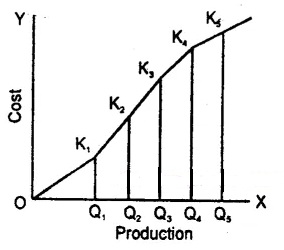
MCQ Questions for Class 12 Economics Chapter 3 Production and Costs with Answers 1
(a) Total Fixed Cost
(b) Total Variable Cost
(c) Total Cost
(d) None of these

Answer

Answer: (b) Total Variable Cost


Question 31.
In which market MR may become zero or negative ?
(a) Monopoly
(b) Monopolistic Competition
(c) Both (a) and (b)
(d) Perfect Competition

Answer

Answer: (c) Both (a) and (b)


Question 32.
In which market AR = MR ?
(a) Monopoly
(b) Monopolistic Competition
(c) Both (a) and (b)
(d) Perfect Competition

Answer

Answer: (d) Perfect Competition


Question 33.
In monopoly and monopolistic competition :
(a) AR = MR
(b) AR > MR
(c) AR < MR
(d) None of these

Answer

Answer: (b) AR > MR


Question 34.
To which market, following figure belongs ?
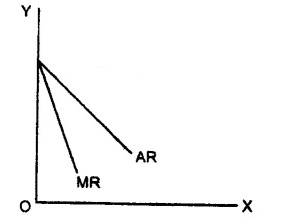
MCQ Questions for Class 12 Economics Chapter 3 Production and Costs with Answers 2
(a) Perfect Competition
(b) Monopoly
(c) Monopolistic Competition
(d) None of the above

Answer

Answer: (b) Monopoly


Question 35.
With which condition, firm will get maximum profit ?
(a) Where MR = MC
(b) Where MC cuts MR from below
(c) Both (a) and (b)
(d) None of the above

Answer

Answer: (c) Both (a) and (b)


Question 36.
In perfect competition, which of the following remains constant ?
(a) AR
(b) MR
(c) Both AR and MR
(d) None of the both

Answer

Answer: (c) Both AR and MR


Question 37.
In perfect competition:
(a) AR = MR
(b) AR > MR
(c) MR < MC
(d) MR = MC = 0

Answer

Answer: (a) MR = MC


Question 38.
When 5 units of a goods are sold, total revenue is Rs. 100. When 6 units are sold, marginal revenue is Rs. 8. At what price are 6 units sold ?
(a) Rs. 28 per unit
(b) Rs. 20 per unit
(c) Rs. 18 per unit
(d) Rs. 12 per unit

Answer

Answer: (c) Rs. 18 per unit


Question 39.
MR is shown as:
(a) \(\frac { ΔTR }{ ΔQ }\)
(b) \(\frac { TR }{ Q }\)
(c) \(\frac { ΔAR }{ Q }\)
(d) None of these

Answer

Answer: (a) \(\frac { ΔTR }{ ΔQ }\)


Question 40.
AR is shown as:
(a) \(\frac { TR }{ Q }\)
(b) \(\frac { ΔQ }{ P }\)
(c) \(\frac { ΔTR }{ ΔQ }\)
(d) None of these

Answer

Answer: (a) \(\frac { TR }{ Q }\)


Question 41.
In which market AR curve is parallel to X-axis ?
(a) Perfect Competition
(b) Monopoly
(c) Monopolistic Competition
(d) In all the above

Answer

Answer: (a) Perfect Competition


Question 42.
Which of the following is a true statement ?
(a) AR indicates price
(b) AR Curve and Demand Curve are the same
(c) Both (a) and (b)
(d) None of the above

Answer

Answer: (c) Both (a) and (b)


Question 43.
The basic condition of firm’s equilibrium is:
(a) MC = MR
(b) MR = TR
(c) MR = AR
(d) AC = AR

Answer

Answer: (a) MC = MR


Question 44.
In final equilibrium of firm:
(a) MC cuts MR from above
(b) MC cuts MR from below
(c) Both (a) and (b) are
(d) None of the above is true

Answer

Answer: (b) MC cuts MR from below


Question 45.
For every market, which condition has to be fulfilled for firm’s equilibrium ?
(a) AR = MC
(b) MR = MC
(c) MC should cut MR from below
(d) Both (b) and (c)

Answer

Answer: (d) Both (b) and (c)


Question 46.
Which is a method of producer’s equilibrium ?
(a) TR and TC Method
(b) MR and MC Method
(c) Both (a) and (b)
(d) None of the above

Answer

Answer: (c) Both (a) and (b)


Question 47.
For a firm’s equilibrium:
(a) MR = MC
(b) MR > MC
(c) MR < MC
(d) MR = MC = 0

Answer

Answer: (a) MR = MC


Question 48.
On which assumption, the law of supply depends ?
(a) There should be no change in income levels of buyers and sellers in the market.
(b) Prices of factors of production remain stable
(c) Technological level remains constant
(d) All the above

Answer

Answer: (d) All the above


Question 49.
If other things being same, what does the positive relationship between price and supply quantity signify ?
(a) Law of Demand
(b) Elasticity of Supply
(c) Law of Supply
(d) Supply Function

Answer

Answer: (c) Law of Supply


Question 50.
The reason of decrease in supply is:
(a) Increase in Production Cost
(b) Increase in Price of Substitutes
(c) Fall in number of Firms in the Industry
(d) All the above

Answer

Answer: (d) All the above


Question 51.
The figure given below shows:
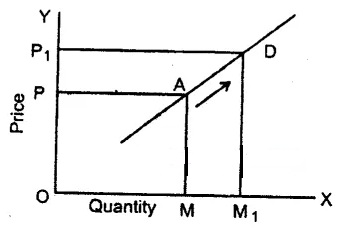
MCQ Questions for Class 12 Economics Chapter 3 Production and Costs with Answers 3
(a) Extension in Supply
(b) Contraction in Supply
(c) Elasticity of supply
(d) Elasticity of demand

Answer

Answer: (a) Extension in Supply


Question 52.
The quantity of a goods which the seller is ready to sell in the market at fixed price and time is called ?
(a) Supply
(b) Demand
(c) Elasticity of supply
(d) Elasticity of Demand

Answer

Answer: (a) Supply


Question 53.
Supply is associated with:
(a) A Time Period
(b) Price
(c) Both (a) and (b)
(d) None of the above

Answer

Answer: (c) Both (a) and (b)


Question 54.
Determinating factor of supply of goods is:
(a) Price of Goods
(b) Price of Related Goods
(c) Price of Factor of Production
(d) All the above

Answer

Answer: (d) All the above


Question 55.
Which of the following statement is true ?
(a) Price and quantity have direct relationship
(b) Supply curve rises from left to right
(c) Supply is affected by many factors
(d) All the above

Answer

Answer: (d) All the above


Question 56.
Which of the following function shows the laws of supply ?
(a) S = f(P)
(b) S = f(a/p)
(c) S = f(Q)
(d) None of the above

Answer

Answer: (a) S = f(P)


Question 57.
Following figure shows :
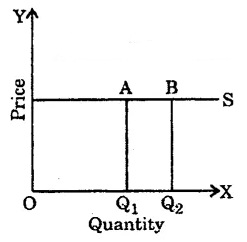
MCQ Questions for Class 12 Economics Chapter 3 Production and Costs with Answers 4
(a) Perfectly Elastic Supply
(b) Perfectly Inelastic Supply
(c) Elastic Supply
(d) Inelastic Supply

Answer

Answer: (a) Perfectly Elastic Supply


Question 58.
Which of the following is correct ?
(a) Perfectly Elastic Supply es = ∞
(b) High Elastic Supply es > 1
(c) Perfectly Inelastic Supply es = 0
(d) All the above

Answer

Answer: (d) All the above


Question 59.
es = 0 means that elasticity of supply is:
(a) Perfectly Elastic Supply
(b) Perfectly Inelastic Supply
(c) Less Elastic Supply
(d) Unit Elastic Supply

Answer

Answer: (b) Perfectly Inelastic Supply


Question 60.
If the price of goods rises by 60% but supply increases by only 5%, the supply of goods will be:
(a) Highly Elastic
(b) Elastic
(c) Inelastic
(d) Perfectly Inelastic

Answer

Answer: (c) Inelastic


Question 61.
The elasticity of a straight line supply curve originating from the centre of origin is:
(a) Less than unity,
(b) greater than unity
(c) equal to unity
(d) equal to zero

Answer

Answer: (c) equal to unity


Question 62.
When supply increases more with a result of small increase in price, the nature of supply will be :
(a) Elastic
(b) Inelastic
(c) Perfectly Elastic
(d) Perfectly Inelastic

Answer

Answer: (a) Elastic


Question 63.
When the proportionate change in the supply of goods is more than the proportionate change in its price, the elasticity of supply will be:
(a) Less than Unit
(b) Equal to Unit
(c) Greater than Unit
(d) Infinite

Answer

Answer: (c) Greater than Unit


Question 64.
If the price of the goods rises by 60% and supply increases by only 5%, the supply of goods will be :
(a) Highly Elastic
(b) Elastic
(c) Inelastic
(d) Perfectly Inelastic

Answer

Answer: (c) Inelastic


Question 65.
The measurement of the elasticity of supply is expressed as:
(a) \(\frac { ΔQ_s/Q_s }{ ΔP/P }\)
(b) \(\frac { Q_s }{ ΔP }\).\(\frac { 1 }{ P }\)
(c) \(\frac { Q_s }{ Q_s }\).ΔY
(d) \(\frac { ΔP }{ Q_s }\).\(\frac { P }{ ΔQ_s }\)

Answer

Answer: (a) \(\frac { ΔQ_s/Q_s }{ ΔP/P }\)


Question 66.
There are factors of productions:
(a) Two
(b) Three
(c) Four
(d) Five

Answer

Answer: (d) Five


Question 67.
Fixed cost is also known as:
(a) Variable cost
(b) Actual cost
(c) Supplementary cost
(d) Short-term cost

Answer

Answer: (c) Supplementary cost


Question 68.
Supply falls on the same price when:
(a) Where there is decrease in supply
(b) When there is contraction in supply
(c) When supply increases
(d) When there is expansion in supply.

Answer

Answer: (a) Where there is decrease in supply


Question 69.
Active factor of production:
(a) Capital
(b) Labour
(c) Land
(d) None of these.

Answer

Answer: (b) Labour


Question 70.
In the short-run following factors are included in the process of production:
(a) Fixed factors
(b) Variable factors
(c) Both (a) and (b)
(d) None of these.

Answer

Answer: (c) Both (a) and (b)


Fill in the blanks:

1. Short-term production function is known as ……………

Answer

Answer: Law of variable proportion


2. Returns to scale is related to ……………

Answer

Answer: Long term


3. Cost incurred in per unit production is ……………

Answer

Answer: Average cost


4. Increase in income from a unit of production is called ……………

Answer

Answer: Marginal cost


5. A producer is in the state of equilibrium when he earns ……………

Answer

Answer: Profit


6. Law of supply shows …………… relation between price and supply.

Answer

Answer: Direct


7. The elasticity of supply for milk and related good is ……………

Answer

Answer: Elastic.


State true or false:

1. Rent theory of Ricardo is based on the law of Diminishing returns.

Answer

Answer: True


2. Law of decreasing returns to scale arises due to Non-divisibility.

Answer

Answer: False


3. Fixed cost is also known as supplementary cost.

Answer

Answer: True


4. In case of perfect competition, a firm attains maximum satisfaction when MC curve cut MR curve.

Answer

Answer: False


5. There is inverse relation between price and supply.

Answer

Answer: False


6. The supply of perishable goods is inelastic.

Answer

Answer: True


7. There are four laws of production.

Answer

Answer: False.


Match the following:

‘A” ‘B’
1. Causes for the operation of the law of diminishing returns (a) Firms’s equilibrium
2. Long term process (b) Imperfect substitute of factors of production
3. Marginal Revenue = Average Revenue. (c) Returns to scale
4. Elasticity of supply (d) es = 1.
5. Elastic supply (e) Proportionate change in supply proportionate change in price.
Answer

Answer:

‘A” ‘B’
1. Causes for the operation of the law of diminishing returns (b) Imperfect substitute of factors of production
2. Long term process (c) Returns to scale
3. Marginal Revenue = Average Revenue. (a) Firms’s equilibrium
4. Elasticity of supply (e) Proportionate change in supply proportionate change in price.
5. Elastic supply (d) es = 1.

Do You get Stuck for Words While Speaking? Here Is the Tips to Improve

Speaking in English is an art that needs a lot of practice to excel. Sometimes it is hard to have verbal communication, even though you are very good at written English. The fundamental problem that people face while conversing in English is get stuck by a word which you know in your native tongue.

Speaking in English takes a lot of in-depth knowledge other than in writing. It is because you can pause while writing; however, you cannot just sit and recall the words while conversing. If you are speaking to your boss or in a debate, pausing for the word can be your worst enemy. Such cases immediately kill your confidence.
The question that might arise in your mind is the leading cause behind such long pauses while conversing and how not to do that the next time.

Gather Information Regarding Basic English Skills and become proficient in the language and speak fluently with confidence. Try the Tips over here and Improve your English Writing and Speaking Skills.

Stuck On Words? Why Does It Take Place?

It is often the case that the language we write so well to express becomes our worst enemy during conversations. There are a few reasons that might lead you to such discomfort.

Stage Fright– One of the common causes of getting stuck on a word while having a conversation is nervousness. Most of us have felt discomfort while addressing a small group at school, even between family or friends and got stuck on a word. This can immediately break your confidence.

You might even recall the word after some time and feel embarrassed for yourself, but you are not alone. It is common among best of the speakers. Only practising to speak in front of a crowd will help you to overcome the fear and bring you confidence.

Lack of Vocabulary– Sometimes, people cannot get through some words simply because they do not have a stalk of a lot of these words. Vocabulary English mostly involves passive voice; however, when you do not have the knowledge of words, framing sentences can become a problem.

There are some of the words which are common, and most of us are comfortable to understand them. Words like gigantic, solitude, outplay, marvellous are common which we can easily read and listen. However, do we use them while speaking or writing? When we try to start a conversation, we use common words like eating, wash, run and more.

People who get stuck with words while speaking are considered to have even less vocabulary than others. Lack of reading books or watching movies can be the two main reasons behind the struggle.

How to Improve Your English Vocabulary?

Pausing in between a conversation for finding a problematic word is pretty standard. There are many people, and even the best of speakers can face it. Frustration, embarrassment, and guilt are the exact feelings that all people face during such time. Here we have some of the best ways to get rid of such moments while addressing an audience.

Grammar Book Will Not Always Help– you need to know that every time you face such challenges, going back to your grammar book wouldn’t help. Some people even look for n vocabulary application which is pretty standard, but did it ever work out for you?

It would help if you had a chance to see some real difference. Challenging yourself is always a good option. Stepping out of your comfort zone is equally important. Speaking practice is best to develop your skills and be more confident. Here we have five ways to get a better fluency in English.

  • There are various applications available which help you to join language clubs, look for language exchange deals and more. The language exchange program is a great opportunity when it comes to learning a new language. Since you will be teaching your first language to somebody, there won’t be any embarrassing moment.
  • The international institute of toastmasters helps to develop leadership skills and public speaking abilities. You can get better networks, communicate and give representations, all of this with small membership payment.
  • Hire Professional- One on one classes are one of the effective ways for better progress, and you will learn faster. Look for a site which provides trained speakers, anywhere anytime classes, and free trials. You can quickly start and focus on your goals.
  • Group Classes Online- group classes can be a great way to learn a new language, especially when you have stage fright. Addressing a small group of friends all at a similar level can be an easy and fun way to learn.
  • Recording Your Speech-Another great way of learning fluent English is by recording yourself. A self-record can help you to realize the way your sound, you can correct your pronunciations and better the areas that you think you stutter.

Other than these, you can also lookout for some of the recommendations that the students provide from online or offline classes.

Do It Today and Don’t Think About Tomorrow.

It is not at all important that you start from zero to correct yourself from the broken knowledge of English. Sometimes, focusing on what you need can save you time and work as well. However, to do that you need to know where you went wrong and study on that.

When you decide to do something about your word problems, start it now and don’t leave it for later. You can keep a fixed time for your English improvement thrice a week. The best way to do this is by taking weekly classes online; that way, you can check your lesson anytime you want and practice accordingly.

Practising at home and applying what you have learned is crucial. Whenever you get a chance, try to rehearse your lessons loudly. Speaking the language is very important because that is what you are planning to improve.

No matter where you think you are, it is okay to start from wherever you want to. Try to think about the new day and the endless opportunities that lie ahead of you.

No Shame to Take Help

If you feel that it is a problem for you to correct your mistakes by yourself, be free to take professional help. If you are in school or college, you can always consult your professor. If you are opting for higher studies, it is very crucial to know fluent English. There is no shame in hiring a professional to improve your English fluency.

Instead, a professional can help you learn the language without any stress and embarrassment. You will get the proper guidance and test yourself through various tests and assessments. Since it will be a one on one class, you can ask your doubts easily, and it’s a smart investment.

How to Improve English Fluency at Home

Many people are studying English for years and are yet not able to speak the language fluently. It takes years of practice and habits to learn fluency in any language. The worst of all is getting stuck for words in the middle of a conversation in a class or among friends.

You need to know that to learn English fluently, and real life experiences work best. Bookish knowledge can help you to write, but for vocabulary, it is best to practice through daily habits.

Surround Yourself with Friends Who Speak the Language

There is no better way to learn English fluency rather than surrounding yourself among native speakers. Listening to them having conversations will help you understand the language better. It will help you learn faster, and the process becomes comprehensive as well. Since you will hear the correct pronunciations, it will make your basics strong.

Read! Read! Read!

Children are asked to read books from the beginning of their school journey. The main reason is that reading habits help you concentrate, get better knowledge and explore new words. It also helps you to imagine and be creative.

Reading can help you improve a language, get knowledge from magazines and articles. You will get an idea of forming new sentences through various other ways. Reading helps you to connect words with phrases and understand the structure of sentences.

Use English Verbally at Home to Communicate

Talking in English and recording will help you to recognise your flaws and also learn a lot from it. If you are working at home, talk loudly, or converse with your siblings and friends in the language. You will not only know the terms of household items but also improve your grammar.

Listen to Podcasts

It is not important what you like, but what you need. Listening to podcasts helps you to learn a lot about the language. You will get a lot of information about the language and how to use it. This will also help you sound normal.

Textbooks Are Not Always the Best Idea

You cannot learn grammar from textbooks. Practical use of knowledge is critical when it comes to learning a language fluently. Reading newspapers, books and watching movies can help you a lot with English.

Learn New Words Everyday

Learning new words is very important to improve your vocabulary. Words that sound similar or means the same can be beneficial for fluency. Exploring new words and framing new sentences can be a plus point.

Always Carry a Journal

Keeping a journal and writing down what words you come across and learn can be a plus point to improve your English. It will not only help you to improve grammar errors, but it will always help you to learn to join the words to form meaningful sentences.

Join a Community

There are various communicates that will help you connect with other English learners. You can stay in touch with them and learn new words and their uses. You might face difficulties with some phrases or words that you can easily discuss with them to solve.

Imitate Other Speakers

Imitating speakers can help you develop an accent. After all, no one wants to sound like a foreigner. You can follow a movie or a piece of music and practice it every day by imitating them. Repeating and pronouncing the same words over and over can help you develop an accent.

It would be best if you also watched English movies every day or at least one episode from the series. This will help you to develop skills and interest. Fluency can help you from being stuck for words in between conversations and save you the embarrassment.

FAQs on Stuck for Words While Speaking

Where Do I Find a Professional?

There are various ways to hire a professional. You can look for an English teacher in your locality, or you can look for online courses that will help you to get through smoothly with tests and assessments.

How much is English Required to speak fluently?

When you are looking for fluency classes, you must know the basics of the language. Simple grammar, sentence framing, can help you speak fluently. However, if you are an absolute beginner, various beginner level classes are available online.

How are spoken English classes conducted?

Spoken English classes require a lot of conversations among you and other students in the class. You can talk about any topic you are interested in and improve your skills. It will help you detect the places you are going wrong and rectify them for better results.

Is Learning Grammar a Part of Spoken English?

Grammar is a significant part of learning English. It will help you to speak correct English while conversing with your friends or in class. Grammar is the base of the English language, and wrong grammar can be a significant negative point when you go for job interviews.

Conclusion

Many people feel embarrassed when they get stuck during a speech or a conversation for a word. However, many speakers face the similar issue and try to improve themselves through classes. If you think you are not fluent enough to speak in English, try taking classes or doing the daily practices for better results.

MCQ Questions for Class 12 Economics Chapter 2 Theory of Consumer Behaviour with Answers

Theory of Consumer Behaviour Class 12 MCQs Questions with Answers

Question 1.
Who gave the cardinal concept of utility?
(a) Marshall
(b) Pigou
(c) Hicks
(d) Samuelson

Answer

Answer: (a) Marshall


Question 2.
Consumer’s behaviour is studied in:
(a) Micro Economics
(b) Macro Economics
(c) Income Analysis
(d) None of these

Answer

Answer: (a) Micro Economics


Question 3.
Which of the following statement is true ?
(a) Utility means want-satisfying power
(b) Utility is a function of intensity of desire
(c) Desire of consumption gives birth to utility
(d) All of these

Answer

Answer: (d) All of these


Question 4.
Which is the First Law of Gossen?
(a) Law of Demand
(b) Law of Diminishing Marginal Utility
(c) Law of Equi-marginal Utility
(d) Consumer’s Surplus

Answer

Answer: (b) Law of Diminishing Marginal Utility


Question 5.
Which of the following is a characteristic of utility ?
(a) Utility is a psychological phenomenon
(b) Utility is subjective
(c) Utility is a relative concept
(d) All of these

Answer

Answer: (d) All of these


Question 6.
How we calculate marginal utility ?
(a) ∆TU/∆Q
(b) ∆MU/∆Q
(c) ∆Q/∆TU
(d) ∆Q/∆MU

Answer

Answer: (a) ∆TU/∆Q


Question 7.
When TU becomes maximum, MU is:
(a) Positive
(b) Negative
(c) Zero
(d) None of these

Answer

Answer: (c) Zero


Question 8.
Which of the following is true ?
(a) TU increases till MU is positive
(b) TU is maximum when MU is equal to zero
(c) TU declines when MU is negative
(d) All of these

Answer

Answer: (d) All of these


Question 9.
Who basically propounded the concept of Law of Equimarginal Utility ?
(a) Marshall
(b) Gossen
(c) Ricardo
(d) J. S. Mill

Answer

Answer: (c) Ricardo


Question 10.
In difference curve is:
(a) Convex to the origin
(b) Concave to the origin
(c) Both (a) and (b) true
(d) All of these false

Answer

Answer: (a) Convex to the origin


Question 11.
The ability of satisfying human want in a goods is called its:
(a) Productivity
(b) Satisfaction
(c) Utility
(d) Profitability

Answer

Answer: (c) Utility


Question 12.
Slope of budget line or price line is:
(a) –\(\frac{P_x}{P_y}\)
(b) –\(\frac{P_y}{P_x}\)
(c) +\(\frac{P_x}{P_y}\)
(d) +\(\frac{P_y}{P_x}\)

Answer

Answer: (a) –\(\frac{P_x}{P_y}\)


Question 13.
Utility is related to:
(a) Usefulness
(b) Morality
(c) Satisfaction of human wants
(d) All the above

Answer

Answer: (d) All the above


Question 14.
Utility can be measured by:
(a) Money
(b) Exchange of goods
(c) Weight of the good
(d) None of these

Answer

Answer: (a) Money


Question 15.
Law of Equi-marginal utility is called:
(a) Law of increasing utility
(b) Law of diminishing utility
(c) Law of substitution
(d) None of these

Answer

Answer: (c) Law of substitution


Question 16.
Indifference curve slopes:
(a) From right to left
(b) From left to right
(c) Both (a) and (b)
(d) None of these

Answer

Answer: (b) From left to right


Question 17.
The addition of utilities obtained from all units of a goods is called :
(a) Marginal Utility
(b) Total Utility
(c) Maximum Satisfaction
(d) Additional Utility

Answer

Answer: (b) Total Utility


Question 18.
Who propounded the ordinal utility theory’ ?
(a) Marshall
(b) Pigou
(c) Hicks and Allen
(d) Ricardo

Answer

Answer: (c) Hicks and Allen


Question 19.
The propounder of law of diminishing marginal utility is:
(a) Gossen
(b) Adam smith
(c) Chapman
(d) Hicks

Answer

Answer: (a) Gossen


Question 20.
Consumer’s equilibrium takes at a point where:
(a) MU = Price
(b) MU < Price
(c) MU > Price
(d) None of these

Answer

Answer: (a) MU = Price


Question 21.
The capability of a commodity to satisfy human wants is:
(a) Consumption
(b) Utility
(c) Quality
(d) Taste

Answer

Answer: (b) Utility


Question 22.
For the maximum satisfaction of consumer:
(a) Marginal utility of a good should be equal to its price.
(b) Marginal utility of a good should be greater than its price.
(c) There is no relation between marginal utility and price.
(d) None of these

Answer

Answer: (a) Marginal utility of a good should be equal to its price.


Question 23.
When marginal utility is negative, then total utility:
(a) is maximum
(b) Starts decreasing
(c) increases at decreasing rate
(d) None of these

Answer

Answer: (b) Starts decreasing


Question 24.
According to the law of equi-marginal utility, the condition for consumer’s equilibrium is:
(a) \(\frac{MU_A}{P_A}\)
(b) \(\frac{MU_B}{P_B}\)
(c) Both (a) and (b)
(d) Undefined

Answer

Answer: (c) Both (a) and (b)


Question 25.
According to Marshall, utility of a commodity:
(a) Can be measured by money
(b) Cannot be measured by money
(c) Can be measured in cardinal numbers
(c) Both (a) and (b)

Answer

Answer: (c) Both (a) and (b)


Question 26.
Which element is essential for demand ?
(a) Desire to consume
(b) Availability of adequate resources
(c) Willingness to consume
(d) All of these

Answer

Answer: (d) All of these


Question 27.
Demand Curve generally slopes:
(a) Upward from left to right
(b) Downward from left to right
(c) Parallel to X-axis
(d) Parallel to Y-axis

Answer

Answer: (b) Downward from left to right


Question 28.
In which goods, price fall does not make any increase in demand ?
(a) Necessities Goods
(b) Comfort Goods
(c) Luxuries Goods
(d) None of these

Answer

Answer: (a) Necessities Goods


Question 29.
Which of the following factor affects demand ?
(a) Price
(b) Change in income
(c) Taste of the Consumer
(d) All of these

Answer

Answer: (d) All of these


Question 30.
Goods, which can alternatively be used, are called:
(a) Complementary Goods
(b) Substitutes
(c) Comforts
(d) None of these

Answer

Answer: (b) Substitutes


Question 31.
Law of Demand is a:
(a) Qualitative Statement
(b) Quantitative Statement
(c) Both (a) and (b)
(d) None of these

Answer

Answer: (a) Qualitative Statement


Question 32.
Which of the following is a demand function ?
(a) PX
(b) DX = PX
(c) Dx = (Px)
(d) None of these

Answer

Answer: (c) Dx = (Px)


Question 33.
When change in the price of goods-X affects the demand of goods-Y, this demand is called:
(a) Price Demand
(b) Income Demand
(c) Cross Demand
(d) All of these

Answer

Answer: (d) All of these


Question 34.
For normal goods, Law of Demand states the relationship between price and quantity of goods:
(a) Direct
(b) Positive
(c) Indirect
(d) None of the above

Answer

Answer: (c) Indirect


Question 35.
Which of the following is a reason for fall in demand ?
(a) Fall in Income
(b) Fall in Number of Buyers
(c) Fall in Taste of Consumer
(d) All the above

Answer

Answer: (d) All the above


Question 36.
With rise in coffee price, the demand of tea:
(a) Rises
(b) Falls
(c) Remains stable
(d) None of these

Answer

Answer: (a) Rises


Question 37.
Contraction in demand appears when:
(a) Price rises and demand falls
(b) Price rises and demand also rises
(c) Price remains stable and demand falls
(d) Price falls but demand remains stable

Answer

Answer: (a) Price rises and demand falls


Question 38.
Which is a reason of change in demand ?
(a) Change in consumer’s income
(b) Change in price of related goods
(c) Population increase
(d) All pf these

Answer

Answer: (d) All pf these


Question 39.
For a change in which of the following, there is no change in demand ?
(a) Change in price
(b) Change in income
(c) Change in taste and fashion
(d) None of these

Answer

Answer: (d) None of these


Question 40.
With a rise in price the demand for ‘Giffin’ goods:
(a) increases
(b) decreases
(c) remains constant
(d) becomes unstable

Answer

Answer: (a) increases


Question 41.
Hie slope of the demand Curve of a normal goods is:
(a) Negative
(b) Positive
(c) Zero
(d) Undefined

Answer

Answer: (a) Negative


Question 42.
With an increase in income consumer decreases the consumption of which goods ?
(a) Inferior goods
(b) Normal goods
(c) Giffin goods
(d) Both (a) and (b)

Answer

Answer: (c) Giffin goods


Question 43.
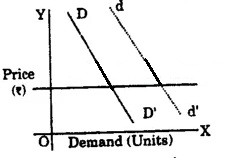
The demand curve of a good shifts from DD’ to dd
MCQ Questions for Class 12 Economics Chapter 2 Theory of Consumer Behaviour with Answers 1
(a) fail in the price of the goods
(b) rise in the price of the goods
(c) rise in the price of substitute goods
(d) rise in the price of complementary goods

Answer

Answer: (c) rise in the price of substitute goods


Question 44.
Elasticity of demand is a:
(a) Qualitative Statement
(b) Quantitative Statement
(c) Both (a) and (b)
(d) None of the above

Answer

Answer: (b) Quantitative Statement


Question 45.
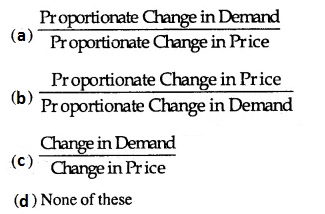
Which of the following is a formula for measuring the elasticity of demand ?
MCQ Questions for Class 12 Economics Chapter 2 Theory of Consumer Behaviour with Answers 2

Answer

Answer: (a)


Question 46.
For Giffin goods, price elasticity of demand is :
(a) Negative
(b) Positive
(c) Zero
(d) None of these

Answer

Answer: (b) Positive


Question 47.
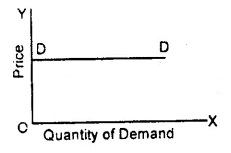
Following figure shows:
MCQ Questions for Class 12 Economics Chapter 2 Theory of Consumer Behaviour with Answers 3
(a) High Elastic Demand
(b) Perfectly Elastic Demand
(c) Perfectly Inelastic Demand
(d) Inelastic Demand

Answer

Answer: (b) Perfectly Elastic Demand


Question 48.
Which of the following shows elasticity less than one ?
(a) Necessity Goods
(b) Comforts
(c) Luxuries
(d) All of these

Answer

Answer: (a) Necessity Goods


Question 49.
With which method, elasticity of demand is measured ?
(a) Total Expenditure Method .
(b) Percentage or Proportionate Method
(c) Point Method
(d) All of these

Answer

Answer: (d) All of these


Question 50.
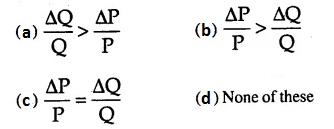
Elastic demand is shown by:
MCQ Questions for Class 12 Economics Chapter 2 Theory of Consumer Behaviour with Answers 4

Answer

Answer: (a) \(\frac{ΔQ}{Q} > \frac{ΔP}{P}\)


Question 51.
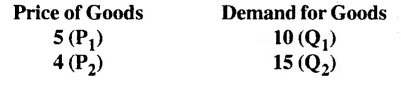
What is the price elasticity in following example ?
MCQ Questions for Class 12 Economics Chapter 2 Theory of Consumer Behaviour with Answers 5
(a) -2.5
(b) + 3.5
(c) + 4.0
(d) None of these

Answer

Answer: (a) -2.5


Question 52.
Who propounded the percentage or proportionate method of measuring elasticity of demand ?
(a) Marshall
(b) Flux
(c) Hicks
(d) None of these

Answer

Answer: (b) Flux


Question 53.
Which of the following factor affects elasticity of demand ?
(a) Nature of Goods
(b) Price Level
(c) Income Level
(d) All of these

Answer

Answer: (d) All of these


Question 54.
How many types elasticity of uemand has ?
(a) Three
(b) Five
(c)Six
(d) Seven

Answer

Answer: (b) Five


Question 55.
Elasticity of demand for necessities is :
(a) Zero
(b) Unlimited
(c) Greater than unity
(d) Less than unity

Answer

Answer: (a) Zero


Question 56.
Price elasticity of demand means :
(a) Change in demand due to change in price
(b) Change in demand
(c) Change in real income
(d) Change in Price

Answer

Answer: (a) Change in demand due to change in price


Question 57.
The elasticity of demand at the mid-point of a straight line demand curve:
(a) will be zero
(b) will be unity
(c) will be infinity
(d) None of these

Answer

Answer: (b) will be unity


Question 58.
If the demand for a good changes by 60% due to 40% change in price, the elasticity of demand is :
(a) 0.5
(b) -1.5
(c) 1
(d) zero

Answer

Answer: (b) -1.5


Question 59.
For luxury goods the demand is:
(a) Inelastic
(b) Elastic
(c) Highly elastic
(d) Perfectly Inelastic

Answer

Answer: (c) Highly elastic


Question 60.
Any statement about demand for a good is considered complete only when the following is/are mentioned in:
(a) Price of the good
(b) Quantity of the good
(c) Period of time
(d) All of these

Answer

Answer: (a) Price of the good


Question 61.
Consumer is in equilibrium when:
(a) MUx = PUx
(b) MUx > PUx
(c) MUx < Px
(d) MUx ÷ Px

Answer

Answer: (a) MUx = PUx


Question 62.
Marshall has given the law of Equimarginal utility related:
(a) Related to goods
(b) Related to money
(c) In relation to both
(d) None of these.

Answer

Answer: (a) Related to goods


Question 63.
How many tremendous curves can touch the budget line:
(a) One
(b) Two
(c) Several
(d) Depends on the basis of indifference maps.

Answer

Answer: (a) One


Question 64.
Indifference curves were first introduced by the English economist in 1881 by:
(a) Edge worth
(b) Pareto
(c) Myers
(d) Hicks.

Answer

Answer: (a) Edge worth


Question 65.
Any statement about the demand of an object is considered complete when it is mentioned in the following:
(a) Price of good
(b) Demand of good
(c) Time period
(d) All of the above.

Answer

Answer: (d) All of the above.


Question 66.
If price of goods ‘X’ falls leading to increase in demand of goods ‘ Y’ then both the goods are:
(a) Substitute goods
(b) Complementary goods
(c) Not related
(d) Competitor.

Answer

Answer: (b) Complementary goods


Question 67.
According to total outlay method, the demand of a good is sinelastic when:
(a) Price will fall with the increase in amount spent
(b) When price of good decreases and money spent decreases
(c) Expenditure remains the same, even if price falls
(d) Expenditure decreases with the increase in price.

Answer

Answer: (b) When price of good decreases and money spent decreases


Fill in the blanks:

1. Consumer is a …………. human being.

Answer

Answer: Rational


2. If the price of substitute goods increases then the demand curve shifts to the ………….

Answer

Answer: Right


3. …………. propounded the law of Diminishing Returns.

Answer

Answer: Gossen


4. According to Marshall utility can be measured in terms of ………….

Answer

Answer: Money


5. An indifference curve gives …………. level of satisfaction to the consumers.

Answer

Answer: Equal


6. Car and Petrol are goods ………….

Answer

Answer: Substitute


7. There is …………. relation between price and demand.

Answer

Answer: inverse


State true or false:

1. Utility is an intensive assumption.

Answer

Answer: True


2. The proportion of the cost of two goods measures the slope of budget line.

Answer

Answer: True


3. Demand curve is generally negative sloped.

Answer

Answer: False


4. Budget set is a collection of all bundles that a consumer purchases from their income at market prices.

Answer

Answer: True


5. The elasticity of the demand of the object and the expenditure on the object is closely related.

Answer

Answer: True


Match the following:

‘A” ‘B’
1. Inelastic (a) Utility analysis
2. Substitute goods (b) Demand of Necessary or Essential goods
3. Marshall (c) Gossen’s second law
4. Indifference curve (d) Cross demand
5. Law of equi marginal utility (e) Does not cut each ether
Answer

Answer:

‘A” ‘B’
1. Inelastic (b) Demand of Necessary or Essential goods
2. Substitute goods (d) Cross demand
3. Marshall (a) Utility analysis
4. Indifference curve (e) Does not cut each ether
5. Law of equi marginal utility (c) Gossen’s second law

NCERT Class 2 Urdu Book PDF Download [Updated 2023-24]

NCERT Books for Class 2 Urdu PDF Download

Download NCERT Books for Class 2 Urdu as per the Latest CBSE Syllabus 2021-22. Study from NCERT Class 2 Urdu Notes & score well in exams.

Class 2 Urdu Ibtedai NCERT Book PDF Download