MCQ Questions for Class 12 Economics Chapter 1 Introduction to Micro Economics with Answers

Introduction to Micro Economics Class 12 MCQs Questions with Answers

Question 1.
Which Economist divided Economics in two branches of micro and macro on the basis of economic activity?
(a) Marshall
(b) Ricardo
(c) Ragnar Frish
(d) None of these

Answer

Answer: (d) None of these


Question 2.
Which of the following is studied under Micro Economics ?
(a) Individual unit
(b) Economic Aggregate
(c) National Income
(d) None of these

Answer

Answer: (d) None of these


Question 3.
Which of the following economic activities are included in the subject-matter of Economics?
(a) Economic Activities related to Unlimited Wants
(b) Economic Activities related to Limited Resources
(c) Both (a) and (b)
(d) None of these

Answer

Answer: (c) Both (a) and (b)


Question 4.
On which base structure of economic problems has been installed?
(a) Unlimited Wants
(b) Limited Resources
(c) Both (a) and (b)
(d) None of the above

Answer

Answer: (c) Both (a) and (b)


Question 5.
‘Micros’, which means ‘Small’ belongs to:
(a) Arabian word
(b) Greek word
(c) German word
(d) English word

Answer

Answer: (b) Greek word


Question 6.
Which of the following statement is true?
(a) Human wants are infinite
(b) Resources are limited
(c) Scarcity problem gives birth to choice .
(d) All of these

Answer

Answer: (c) Scarcity problem gives birth to choice


Question 7.
Which of the following is the salient feature of factors (or resources) ?
(a) These are limited as compared to wants
(b) These have alternative uses
(c) Both (a) and (b)
(d) None of the above

Answer

Answer: (c) Both (a) and (b)


Question 8.
Which is a central problem of an economy ?
(a) Allocation of Resources
(b) Optimum Utilisation of Resources
(c) Economic Development
(d) All of these

Answer

Answer: (d) All of these


Question 9.
Which of the following Is a type of economic activities ?
(a) Production
(b) Consumption
(c) Exchange and Investment
(d) All of these

Answer

Answer: (d) All of these


Question 10.
To which factor, economic problem is basically related to:
(a) Choice
(b) Consumer’s Selection
(c) Firm Selection
(d) None of these

Answer

Answer: (a) Choice


Question 11.
Economy may be classified as:
(a) Capitalist
(b) Socialist
(c) Mixed
(d) All of these

Answer

Answer: (d) All of these


Question 12.
Which economy has a co-existence of private and public sectors ?
(a) Capitalist
(b) Socialist
(c) Mixed
(d) None of these

Answer

Answer: (c) Mixed


Question 13.
The main objective of a socialist economy is…….
(a) Maximum production
(b) Economic freedom
(c) Earning profit
(d) Maximum public welfare

Answer

Answer: (d) Maximum public welfare


Question 14.
In which economy decisions are taken on the basis of price mechanism ?
(a) Socialist
(b) Capitalist
(c) Mixed
(d) All of these

Answer

Answer: (b) Capitalist


Question 15.
The slope of a production possibility curve falls:
(a) From left to right
(b) From right to left
(c) From top to bottom
(d) From bottom to top

Answer

Answer: (c) From top to bottom


Question 16.
Production Possibility Curve is:
(a) Concave to the axis
(b) Convex to the axis
(c) Parallel to the axis
(d) Vertical to the axis

Answer

Answer: (a) Concave to the axis


Question 17.
Mention the name of the curve which shows economic problem:
(a) Production Curve
(b) Demand Curve
(c) Indifference Curve
(d) Production Possibility Curve

Answer

Answer: (d) Production Possibility Curve


Question 18.
Which of the following is studied under Macro Economics ?
(a) National Income
(b) Full. Employment
(c) Total Production
(d) All of these

Answer

Answer: (d) All of these


Question 19.
Which of the following Is a branch of Micro Economics ?
(a) Product Price Determination
(b) Factor Price Determination
(c) Economic Welfare
(d) All of these

Answer

Answer: (d) All of these


Question 20.
Which of the following is a source of production ?
(a) Land
(b) Labour
(c) Capital
(d) All of these

Answer

Answer: (d) All of these


Question 21.
Who said, “Economics is a science of wealth.”
(a) Marshall
(b) Robbins
(c) Adam Smith
(d) J.K. Mehta

Answer

Answer: (c) Adam Smith


Question 22.
“Economics is a science of logic.’’ Who said it ?
(a) Hicks
(b) Keynes
(c) Robbins
(d) Marshall

Answer

Answer: (c) Robbins


Question 23.
Micro Economics includes:
(a) Individual unit
(b) Small units
(c) Individual price determination
(d) All of these

Answer

Answer: (d) All of these


Question 24.
Who was the father of Economics ?
(a) I. B. Say
(b) Malthus
(c) Adam Smith
(d) Joan Robinson

Answer

Answer: (c) Adam Smith


Question 25.
Who gave the definition of Economics related to welfare ?
(a) Adam Smith
(b) Marshall
(c) Robbins
(d) Samuelson

Answer

Answer: (b) Marshall


Question 26.
The word ‘micro’ was firstly used by:
(a) Marshall
(b) Boulding
(c) Keynes
(d) Ragnar Frish

Answer

Answer: (d) Ragnar Frish


Question 27.
According to whom, Economics is a science of human welfare ?
(a) A Marshall
(b) Paul Samuelson
(c) J. S. Mill
(d) Adam Smith

Answer

Answer: (a) A Marshall


Question 28.
Which of the following is not a factor of production ?
(a) Land
(b) Labour
(c) Money
(d) Capital

Answer

Answer: (c) Money


Question 29.
The central problem of an economy is:
(a) What to produce ?
(b) How to produce ?
(c) How to distribute produced goods ?
(d) All of these

Answer

Answer: (d) All of these


Question 30.
Consumer behaviour is studied in:
(a) Micro Economics
(b) Income Theory
(c) Mac o Economics
(d) None of these

Answer

Answer: (a) Micro Economics


Question 31.
Indian economy is:
(a) Centrally planned economy
(b) Market economy
(c) Mixed economy
(d) None of these.

Answer

Answer: (c) Mixed economy


Question 32.
Who used the word ‘micro’ for the first time:
(a) Marshall
(b) Boulding
(c) Keynes
(d) Ragnar Frisch

Answer

Answer: (d) Ragnar Frisch


Question 33.
Who said economics is the ‘Science of wealth:
(a) Prof. Robbins
(b) Prof. J.K. Mehta
(c) Prof. Marshall
(d) Prof. Adam Smith

Answer

Answer: (d) Prof. Adam Smith


Question 34.
What is the shape of production possibility curve:
(a) Concave to the origin
(b) Concave
(c) Straight line
(d) None of the above.

Answer

Answer: (a) Concave to the origin


Question 35.
The reason for downward shape of production possibility curve is:
(a) Increasing opportunity cost
(b) Decreasing opportunity cost
(c) Same opportunity cost
(d) Negative opportunity cost

Answer

Answer: (b) Decreasing opportunity cost


Question 36.
The point of optimum utilization of resources lies on which side of PPC curve:
(a) Towards left
(b) Towards right
(c) Inside
(d) Upwards

Answer

Answer: (d) Upwards


Fill in the blanks:

1. Every person has ………………… quantity of goods.

Answer

Answer: Few


2. ……………………economics is the study of individual economic units.

Answer

Answer: Micro-economics


3. Opportunity cost ………………….. in production list.

Answer

Answer: Changes


4. Micro and Macro-economics are ……………………… to each other.

Answer

Answer: Complement


5. Economic growth is related to ………………………… economics.

Answer

Answer: Macro


6. Economy is a group of ………………….. units.

Answer

Answer: Production


7. Mixed economy is composed of ………………………. and …………………………

Answer

Answer: Socialism, Capitalism


8. The goods and services which help in the production of other goods and services are ………………………. goods.

Answer

Answer: Intermediate


State true or false:

1. Production possibility curve is convex towards main point.

Answer

Answer: False


2. Central problem in the capitalist economy is solved by price mechanism.

Answer

Answer: True


3. An economy can be capitalist, socialist or opportunist.

Answer

Answer: False


4. Today all economics of the world are almost mixed economics.

Answer

Answer: True


5. Macro-economics is the study of the problems of unemployment, price inflation etc.

Answer

Answer: True


6. In socialism, the feeling of personal profit is prominent.

Answer

Answer: False


Match the following:

‘A’ ‘B’
1. The mechanism of micro-economics (a) Capitalist economy
2. Basic financial problem (b) All resources are efficiently used
3. No state inteference (c) Price analysis
4. No restrictions on trade (d) Limitation and election
5. Main assumptions of production possibility curve (e) Open economy.
Answer

Answer:

‘A’ ‘B’
1. The mechanism of micro-economics (c) Price analysis
2. Basic financial problem (d) Limitation and election
3. No state inteference (a) Capitalist economy
4. No restrictions on trade (e) Open economy.
5. Main assumptions of production possibility curve (b) All resources are efficiently used

SCERT Kerala Books for Class 12 Computer Science | Kerala State Syllabus 12th Standard Textbooks English Medium

SCERT Kerala Books for Class 12 Computer Science

SCERT Kerala Books Class 12 Computer Science: The State Council of Education Research and Training(SCERT Kerala) publishes Computer Science textbooks for Class 12. The SCERT Samagra Kerala Class 12th Computer Science textbooks are well known for it’s updated and thoroughly revised syllabus. The SCERT Kerala Computer Science Books are based on the latest exam pattern and Kerala State syllabus.

SCERT Kerala keeps on updating the Computer Science books with the help of the latest question papers of each year. The Class 12 Computer Science books of SCERT Kerala are very well known for its presentation. The use of SCERT Kerala State Books for Class 12 Computer Science is not only suitable for studying the regular syllabus of various boards but it can also be useful for the candidates appearing for various competitive exams, Engineering Entrance Exams, and Olympiads.

SCERT Kerala Class 12 Computer Science Books PDF Download

Students can download the Samagra SCERT Kerala Textbooks for Class 12

SCERT Kerala State Syllabus Class 12 Computer Science Books:

SCERT Kerala Class 12 Computer Science Books are provided in PDF form so that students can access it at any time anywhere. Class 12 SCERT Kerala Syllabus Computer Science Books are created by the best professors who are experts in Computer Science and have good knowledge in the subject.

The SCERT Kerala syllabus mainly focuses on this book to make it student-friendly to make it useful for both the students and the competitive exam aspirants. The book covers a detailed Computer Science based on the syllabuses of various boards. SCERT Kerala Computer Science Books for Class 12 is perfectly compatible with almost every Indian education state and central boards.

We hope that this detailed article on SCERT Kerala Samagra Textbooks for Class 12 Computer Science helps you in your preparation and you crack the exams or competitive exams with excellent scores.

How to Think in English and The Importance of Thinking in English

How to Think in English

“Do you need to think about something?” Then start to think in English, and not in your native language!

Studies have revealed that thinking about anything in a foreign language allows you to execute your choices more reliably. Not only thinking in English can be an advantage in better decision making, but it can also help in learning the language faster. If you’re “articulating” English in your mind, it becomes simpler to speak it with your mouth.

When we speak, our speech might get slower. This happens because our mind is still translating from our native language, which can also sound synthetic. But this can change if we start thinking in English, which is a step closer to fluency. It is not very challenging, but it does take conscious practice and effort.

Gather Information Regarding Basic English Skills and become proficient in the language and speak fluently with confidence. Try the Tips over here and Improve your English Writing and Speaking Skills.

Importance of English

English is one of the most influential languages on the planet, which has its impression on every phase of life. It is very easy to notice just how essential English is around the world. Many global businesses conduct conferences in English, and most universities teach courses in English and, also, travelers and tourists use English as a standard language around the world. Here are some pointers describing why English is Important.

  • It is believed that English is understood or spoken by 1 to 1.6 billion people. English is an authoritative business language, and it has become almost an obligation for people to speak English if they are to join a global workforce. Researchers from all across the globe reveal that cross-border business communication is mostly directed in English.
  • English has a protracted and fascinating history that traverses invasions, wars, and leadership from around the globe. Education that has helped develop modern English include Vikings, Romans and the French. For this reason, it’s a hybrid language composed of Germanic, Latin and Romance factors.
  • One of English’s greatest assets is its versatility: you can frequently find various ways to describe the same as it has a spectrum of vocabulary. It is assumed to have well above 750,000 words and is adding new ones every year.
  • Most of the contents created on the internet are in English, and therefore English is also known as the language of the internet. So knowing English will help you access a large amount of information which might not be available quickly.
  • English as a language is significantly malleable. Nonnative speakers account the varied ways of speaking the language. One main reason for this is the nondiscriminating nature of the language. One can use the language in their own manner. For example, Singapore has invented its own unique way of speaking English, called as ‘Singlish’, incorporating facets of mandarin and Malay.

The Importance of Thinking in English

In the beginning, we all transcribe a thought or a sentence in our native language and then translate it to English; this is because our mind needs to understand the words and then speak. But if we analyse the sentence in English first, then we don’t have to translate it, which later will help us become more fluent in English.

Thinking in our native language and then interpreting it in the English language pauses our conversation. If we begin to think in English, we will sound notably fluent and natural. Another considerable advantage of thinking in English is lots of practice in English. Thinking is nothing but speaking to yourself silently. To sum, if we can think in English alternately of our native language, we will not only get loads of additional practice but also reduce uncomfortable intervals while speaking.

When we start thinking in English, it helps us internalise the language. This means we will learn the language so well that we no longer need to think before we speak. Internalising English means we don’t require to retain the precepts and pronunciations every time we speak. Native English speakers don’t think why or what they speak is accurate because they’ve internalised the English language. One should not worry about saying things correctly or being understood by others. They can make mistakes in pronunciation and still learn and understand!

Additionally, thinking in English is a fantastic way to build your vocabulary with words. It’s essential to know many words, but it’s even more important to understand words that we apply in everyday conversations.

Steps to Think in English

  • Start with Single words: Commence by thinking in single words. One might not be capable of making essential decisions in English, but you can observe your surroundings in English by recalling the names of things that you notice or activities that you do. At the beginning, one might find it hard to retrieve in English, but if we continue to work on it, then over a span of time, it will progressively reduce, and one will be on track to think in English like we do in our native language.
  • Train your brain to think in English: The fundamental purpose of training our brain is practising to think in English because behind these exercises is the agility in thinking without worrying for accuracy. One needs to aim for completing these exercises.  In the beginning, one might take ponderously long pauses and even make mistakes. But the good part is no one notices as we will be speaking or thinking to ourselves. Practices can be like words or sentences one can think in a minute.
  • Be Creative: We always observe that there are infinite ways to express things. Even if you don’t understand a word, we can perceive our idea beyond by considering the words creatively and using different words. For instance, if we’re trying to describe to someone that “I lost my key”, but can’t retrieve the word “key,” we can rather say to them that “I can’t open my door because it’s locked or “I lost the thing that opens the door.” Both these sentences don’t apply the word “key,” but both are fair enough to be understood. This can be a great habit if we have an actual discussion and can’t revive a word. To sharpen these skills in creative speaking, one can try playing some fun games with friends or a speaking partner.
  • Start Narrating: Narration is the use of a verbal or written explanation to communicate a story to an audience. In novels, the narrator is the character without dialogue, who describes what is happening in the story. In the same way, we can pretend to be the narrator in our own life. We can narrate our own day to day experience in our own voice or impersonate someone else describing our life in English. This will benefit us in practising by using commonly used terms, as well as speaking in complete, correct sentences.

Conclusions

One can certainly stop thinking in their native language and think undeviatingly in English, but it’s easier said than done. We often fall back to thinking in our native language, and the change won’t be as agile as we would like. The given ideas are to show discipline in our practice over the long term, keeping in mind a few fundamentals that will benefit us to become efficient learners of the English Language and overcome frustrating times in our learning.

NCERT Class 1 Urdu Book PDF Download [Updated 2023-24]

NCERT Books for Class 1 Urdu PDF Download

Download NCERT Books for Class 1 Urdu as per the Latest CBSE Syllabus 2021-22. Study from NCERT Class 1 Urdu Notes & score well in exams.

Class 1 Urdu Ibtedai NCERT Book PDF Download

MCQ Questions for Class 7 Hindi Chapter 17 वीर कुवर सिंह with Answers

वीर कुवर सिंह Class 7 MCQs Questions with Answers

Question 1.
इस पाठ में किस स्थान पर 1857 में भीषण विद्रोह नहीं हुआ था।
(a) कानपुर
(b) बुंदेलखंड
(c) आजमगढ़
(d) रूहेलखंड।

Answer

Answer: (d) रूहेलखंड।


Question 2.
इनमें कौन-सा वीर प्रथम स्वतंत्रता आंदोलन में शामिल नहीं था?
(a) नाना साहेब
(b) तात्या टोपे
(c) सरदार भगत सिंह
(d) रानी लक्ष्मीबाई।

Answer

Answer: (c) सरदार भगत सिंह


Question 3.
वीर कुंवर सिंह का जन्म किस राज्य में हुआ था?
(a) बंगाल
(b) उत्तर प्रदेश
(c) बिहार
(d) उड़ीसा।

Answer

Answer: (c) बिहार


Question 4.
इस पाठ के लेखक कौन हैं?
(a) यतीश अग्रवाल
(b) विजय तेंदुलकर
(c) विभागीय
(d) जैनेंद्र कुमार।

Answer

Answer: (c) विभागीय


Question 5.
मंगल पांडे ने अंग्रेजों के विरुद्ध कहाँ बगावत किया था?
(a) दानापुर
(b) कानपुर
(c) आज़मगढ़
(d) बैरकपुर

Answer

Answer: (d) बैरकपुर


Question 6.
11 मई 1857 को भारतीय सैनिकों ने किस पर कब्जा कर लिया?
(a) लखनऊ
(b) आरा
(c) मेरठ
(d) दिल्ली

Answer

Answer: (d) दिल्ली


Question 7.
अंग्रेज़ी सेना और स्वतंत्रता सेनानियों के मध्य कहाँ भीषण युद्ध हुआ?
(a) बरेली
(b) कानपुर
(c) आरा
(d) उपर्युक्त सभी।

Answer

Answer: (d) उपर्युक्त सभी।


Question 8.
कुंवर सिंह का जन्म-बिहार राज्य के किस जनपद में हुआ।
(a) शाहाबाद
(b) आरा
(c) जहानाबाद
(d) छपरा।

Answer

Answer: (a) शाहाबाद


(1)

वीर कुंवर सिंह के बचपन के बारे में बहुत अधिक जानकारी नहीं मिलती। कहा जाता है कि कुँवर सिंह का जन्म बिहार में शाहाबाद जिले के जगदीशपुर में सन् 1782 ई० में हुआ था। उनके पिता का नाम साहबजादा सिंह और माता का नाम पंचरतन कुँवर था। उनके पिता साहबजादा सिंह जगदीशपुर रियासत के ज़मींदार थे, परंतु उनको अपनी ज़मींदारी हासिल करने में बहुत संघर्ष करना पड़ा। पारिवारिक उलझनों के कारण कुँवर सिंह के पिता बचपन में उनकी ठीक से देखभाल नहीं कर सके। जगदीशपुर लौटने के बाद ही वे कुंवर सिंह की पढ़ाई-लिखाई की ठीक से व्यवस्था कर पाए।

Question 1.
वीर कुंवर सिंह का जन्म किस राज्य में हुआ था?
(a) पंजाब
(b) उत्तर प्रदेश
(c) उड़ीसा
(d) बिहार।

Answer

Answer: (d) बिहार।


Question 2.
कुँवर सिंह में देशभक्ति की भावना किसने जगाया?
(a) उनके मित्र ने
(b) मंगल पाण्डेय ने
(c) उनके पिता जी ने
(d) बसुरिया बाबा ने।

Answer

Answer: (d) बसुरिया बाबा ने।


Question 3.
कुँवर सिंह के पिता थे-
(a) राजा
(b) ज़मींदार
(c) जागीरदार
(d) इनमें से कोई नहीं।

Answer

Answer: (b) ज़मींदार


Question 4.
सोनपुर का मेला कब लगता था?
(a) कार्तिक पूर्णिमा को
(b) कार्तिक अमावस्या को
(c) सावन के महीने में
(d) दीपावली से पूर्व।

Answer

Answer: (a) कार्तिक पूर्णिमा को


Question 5.
कुँवर सिंह गुप्त योजनाएँ कहा बनाया करते थे।
(a) अपने घर पर
(b) सोनपुर के पशु मेले में
(c) जंगल में
(d) सभाओं में।

Answer

Answer: (b) सोनपुर के पशु मेले में


(2)

जगदीशपुर के जंगलों में ‘बासुरिया बाबा’ नाम के एक सिद्ध संत रहते थे। उन्होंने ही कुँवर सिंह में देशभक्ति एवं स्वाधीनता की भावना उत्पन्न की थी। उन्होंने बनारस, मथुरा, कानपुर, लखनऊ आदि स्थानों पर जाकर विद्रोह की सक्रिय योजनाएँ बनाईं। वे 1845 से 1846 तक काफ़ी सक्रिय रहे और गुप्त ढंग से ब्रिटिश हुकूमत के खिलाफ़ विद्रोह की योजना बनाते रहे। उन्होंने बिहार के प्रसिद्ध सोनपुर मेले को अपनी गुप्त बैठकों की योजना के लिए चुना। सोनपुर के मेले को एशिया का सबसे बड़ा पशु मेला माना जाता है। यह मेला कार्तिक पूर्णिमा के अवसर पर लगता है। यह हाथियों के क्रय-विक्रय के लिए भी विख्यात है। इसी ऐतिहासिक मेले में उन दिनों स्वाधीनता के लिए लोग एकत्र होकर क्रांति के बारे में योजना बनाते थे।

Question 1.
बासुरिया बाबा कौन थे?
(a) एक सैनिक
(b) एक सिद्ध संत
(c) स्वतंत्रता सेनानी
(d) शिक्षक।

Answer

Answer: (b) एक सिद्ध संत


Question 2.
किस स्थान को गुप्त मेले के लिए चुना गया?
(a) पुष्कर मेले को
(b) नालंदा को
(c) बक्सर को
(d) सोनपुर मेले को।

Answer

Answer: (d) सोनपुर मेले को।


Question 3.
सोनपुर का मेला किस राज्य में आयोजित किया है?
(a) उड़ीसा
(b) उत्तर प्रदेश
(c) बिहार
(d) असम।

Answer

Answer: (c) बिहार


Question 4.
सोनपुर का मेला किसके क्रय-विक्रय के लिए विख्यात है?
(a) कपड़े के लिए
(b) घोड़ों के
(c) हाथियों के लिए
(d) बकरियों के लिए।

Answer

Answer: (c) हाथियों के लिए


Question 5.
“ऐतिहासिक’ शब्द में प्रयुक्त प्रत्यय कौन-सा है?
(a) इक
(b) विक
(b) आसिक
(d) क।

Answer

Answer: (a) इक


(3)

दानापुर और आरा की इस लड़ाई की ज्वाला बिहार में सर्वत्र व्याप्त हो गई थी, लेकिन देशी सैनिकों में अनुशासन की कमी, स्थानीय ज़मींदारों का अंग्रेजों के साथ सहयोग करना एवं आधुनिकतम शस्त्रों की कमी के कारण जगदीशपुर का पतन रोका न जा सका। 13 अगस्त को जगदीशपुर में कुँवर सिंह की सेना अंग्रेजों से परास्त हो गई। किंतु इससे वीरवर कुँवर सिंह का आत्मबल टूटा नहीं और वे भावी संग्राम की योजना बनाने में तत्पर हो गए। वे क्रांति के अन्य संचालक नेताओं से मिलकर इस आजादी की लड़ाई को आगे बढ़ाना चाहते थे। कुंवर सिंह सासाराम से मिर्जापुर होते हुए रीवा, कालपी, कानपुर एवं लखनऊ तक गए। लखनऊ में शांति नहीं थी इसलिए बाबू कुँवर सिंह ने आज़मगढ़ की ओर प्रस्थान किया। उन्होंने आज़ादी की इस आग को बराबर जलाए रखा। उनकी वीरता की कीर्ति पूरे उत्तर भारत में फैल गई। कुँवर सिंह की इस विजय यात्रा से अंग्रेजों के होश उड़ गए।

Question 1.
जगदीशपुर के पतन का प्रमुख कारण क्या था?
(a) नए शस्त्रों की कमी
(b) सैनिकों में अनुशासन का आभाव
(c) ज़मींदारों का अंग्रेजों के साथ सहयोग करना
(d) उपर्युक्त सभी।

Answer

Answer: (d) उपर्युक्त सभी।


Question 2.
दानापुर और आरा की लड़ाई का क्या परिणाम हुआ।
(a) स्थानीय लड़ाई बनकर रह गई
(b) पूरे बिहार में आज़ादी की आग फैल गई
(c) सारे देश में इसका परिणाम हुआ
(d) बिहार में चारों तरफ़ आतंक का वातावरण छा गया।

Answer

Answer: (b) पूरे बिहार में आज़ादी की आग फैल गई


Question 3.
अंग्रेजों से पराजय के बाद कुँवर सिंह का आत्मबल-
(a) बढ़ गया
(b) टूट गया
(c) लूट गया
(d) ठीक रहा।

Answer

Answer: (a) बढ़ गया


Question 4.
लखनऊ से कुँवर सिंह ने कहाँ प्रस्थान किया?
(a) कानपुर
(b) मिर्जापुर
(c) आरा
(d) आजमगढ़।

Answer

Answer: (d) आजमगढ़।


Question 5.
‘वीरता’ में ‘ता’ क्या है?
(a) उपसर्ग
(b) प्रत्यय
(c) मूलशब्द
(d) अन्य।

Answer

Answer: (b) प्रत्यय


(4)

वीर कुंवर सिंह ने ब्रिटिश हुकूमत के साथ लोहा तो लिया ही उन्होंने अनेक सामाजिक कार्य भी किए। आरा ज़िला स्कूल के लिए ज़मीन दान में दी जिस पर स्कूल के भवन का निर्माण किया गया। कहा जाता है कि उनकी आर्थिक स्थिति बहुत अच्छी नहीं थी, फिर भी वे निर्धन व्यक्तियों की सहायता करते थे। उन्होंने अपने इलाके में अनेक सुविधाएँ प्रदान की थीं। उनमें से एक है-आराजगदीशपुर सड़क और आरा-बलिया सड़क का निर्माण। उस समय जल की पूर्ति के लिए लोग कुएँ खुदवाते थे और तालाब बनवाते थे। वीर कुंवर सिंह ने अनेक कुएँ खुदवाए और जलाशय भी बनवाए।

Question 1.
वीर कुंवर सिंह ने क्या-क्या सामाजिक कार्य किए?
(a) स्कूल के लिए जमीन दान दिए
(b) सड़कें बनाए
(c) कुएँ तथा तलाब बनवाए
(d) उपर्युक्त सभी।

Answer

Answer: (d) उपर्युक्त सभी।


Question 2.
कुंवर सिंह ने आरा की ज़मीन दान में क्यों दी?
(a) वृद्धाश्रम हेतु
(b) विद्यालय हेतु
(c) बाग-बगीचे के लिए
(d) स्वतंत्रता सेनानियों के लिए।

Answer

Answer: (b) विद्यालय हेतु


Question 3.
कुंवर सिंह ने किस सड़क का निर्माण करवाया?
(a) आरा
(b) आरा-जगदीशपुर
(c) आरा से बलिया तक
(d) जगदीशपुर व बलिया।

Answer

Answer: (c) आरा से बलिया तक


Question 4.
कुँवर सिंह के किस प्रकार के व्यक्तित्व थे?
(a) उदार
(b) संवेदनशील
(c) परोपकारी
(d) उपर्युक्त सभी।

Answer

Answer: (d) उपर्युक्त सभी।


Question 5.
‘लोहा लेना’ मुहावरे का क्या अर्थ है?
(a) बदला देना
(b) परेशान करना
(c) धाक जमाना
(d) उपर्युक्त सभी।

Answer

Answer: (a) बदला देना


(5)

सन् 1857 के व्यापक-सशस्त्र विद्रोह ने भारत में ब्रिटिश शासन की जड़ों को हिला दिया। भारत में ब्रिटिश शासन ने जिस दमन नीति को आरंभ दिया उसके विरुद्ध विद्रोह शुरू हो गया था। मार्च 1857 में बैरकपुर में अंग्रेजों के विरुद्ध बगावत करने पर मंगल पांडे को 8 अप्रैल 1857 को फाँसी दे दी गई। 10 मई 1857 को मेरठ में भारतीय सैनिकों ने ब्रिटिश अधिकारियों के विरुद्ध आंदोलन किया और सीधे दिल्ली की ओर कूच कर गए। दिल्ली में तैनात सैनिकों के साथ मिलकर 11 मई को उन्होंने दिल्ली पर कब्जा कर लिया और अंतिम मुगल शासक बहादुरशाह ज़फ़र को भारत का शासक घोषित कर दिया।

Question 1.
सन् 1857 के सशस्त्र विद्रोह का भारत में ब्रिटिश शासन पर क्या असर हुआ?

Answer

Answer: सन् 1857 के सशस्त्र विद्रोह का भारत में ब्रिटिश शासन पर असर यह हुआ कि वह कमज़ोर हो गया।


Question 2.
भारतीयों ने अंग्रेजों की किस नीति का विद्रोह किया था?

Answer

Answer: भारतीयों ने अंग्रेज़ों के दमन नीति का विद्रोह किया।


Question 3.
मंगल पांडे को फांसी क्यों दी गई?

Answer

Answer: मंगल पांडे को फाँसी इसलिए दिया गया क्योंकि मार्च 1857 में बैरकपुर में अंग्रेजों के विरुद्ध बगावत करने पर मंगल पांडे को 18 अप्रैल 1857 को फाँसी दे दी गई।


Question 4.
मेरठ में विद्रोह करने के बाद भारतीय सैनिक कहाँ चले गए।

Answer

Answer: 10 मई 1857 को मेरठ में भारतीय सैनिकों ने ब्रिटिश अधिकारियों के विरुद्ध आंदोलन किया और सीधे वे दिल्ली कूच कर गए।


(6)

वीर कुंवर सिंह के बचपन के बारे में बहुत अधिक जानकारी नहीं मिलती। कहा जाता है कि कुँवर सिंह का जन्म बिहार में शाहाबाद जिले के जगदीशपुर में सन् 1782 ई० में हुआ था। उनके पिता का नाम साहबज़ादा सिंह और माता का नाम पंचरतन कुँवर था। उनके पिता साहबज़ादा सिंह जगदीशपुर रियासत के ज़मींदार थे, परंतु उनको अपनी ज़मींदारी हासिल करने में बहुत संघर्ष करना पड़ा। पारिवारिक उलझनों के कारण कुँवर के पिता बचपन में उनकी ठीक से देखभाल नहीं कर सके। जगदीशपुर लौटने के बाद ही वे कुँवर सिंह की पढ़ाई-लिखाई की ठीक से व्यवस्था कर पाए।

Question 1.
वीर कुंवर सिंह का जन्म कब और कहाँ हुआ था?

Answer

Answer: वीर कुंवर सिंह का जन्म बिहार में शाहाबाद जिले के जगदीशपुर नामक स्थान पर सन् 1782 में हुआ था।


Question 2.
कुँवर सिंह के माता-पिता कौन थे?

Answer

Answer: वीर कुंवर सिंह के पिता का नाम साहबजादा सिंह व माता का नाम पंचरतन कुँवर था।


Question 3.
इनके पिता बचपन में इसकी देखभाल क्यों नहीं कर पाए?

Answer

Answer: वीर कुंवर सिंह के पिता जगदीशपुर रियासत के ज़मींदार थे। उन्हें अपनी ज़मींदारी हासिल करने के लिए काफ़ी संघर्ष करना पड़ा। इसके अलावे पारिवारिक उलझनों के कारण वे अपने बेटे कुँवर सिंह की देखभाल सही रूप में न कर सके।


Question 4.
कुँवर सिंह के पिता कैसे व्यक्ति थे?

Answer

Answer: वीर कुंवर सिंह के पिता वीर होने के साथ-साथ स्वाभिमानी एवं उदार स्वभाव के व्यक्ति थे।


Question 5.
कुँवर सिंह की प्रारंभिक शिक्षा-दीक्षा किस प्रकार हुई ?

Answer

Answer: वीर कुंवर सिंह के पिता जगदीशपुर रियासत के ज़मींदार थे। उन्होंने उनकी प्रारंभिक शिक्षा की व्यवस्था घर पर ही कर दिया था, जहाँ उन्होंने हिंदी, संस्कृत और फारसी सीखी, लेकिन पढ़ने-लिखने से ज़्यादा उनका मन घुड़सवारी तलवारबाज़ी और कुश्ती लड़ने में लगता था।


(7)

आज़मगढ़ की ओर जाने का उनका उद्देश्य था-इलाहाबाद एवं बनारस पर आक्रमण कर शत्रुओं को पराजित करना और अंततः जगदीशपुर पर अधिकार करना। अंग्रेजों और कुँवर सिंह की सेना के बीच घमासान युद्ध हुआ। उन्होंने 22 मार्च 1858 को आजमगढ़ पर कब्जा कर लिया। अंग्रेजों ने दोबारा आज़मगढ़ पर आक्रमण किया। कुँवर सिंह ने एक बार फिर आज़मगढ़ में अंग्रेजों को हराया। इस प्रकार अंग्रेज़ी सेना को परास्त कर वीर कुंवर सिंह 23 अप्रैल 1858 को स्वाधीनता की विजय पताका फहराते हुए जगदीशपुर पहुँच गए। किंतु इस बूढ़े शेर को बहुत अधिक दिनों तक इस विजय का आनंद लेने का सौभाग्य न मिला। इसी दिन विजय उत्सव मनाते हुए लोगों ने यूनियन जैक (अंग्रेज़ों का झंडा) उतारकर अपना झंडा फहराया। इसके तीन दिन बाद ही 26 अप्रैल 1858 को यह वीर इस संसार से विदा होकर अपनी अमर कहानी छोड़ गया।

Question 1.
वीर कुंवर सिंह का आजमगढ़ की ओर बढ़ने का क्या उद्देश्य था? लिखिए ?

Answer

Answer: वीर कुंवर सिंह का आज़मगढ़ की ओर बढ़ने का उद्देश्य था इलाहाबाद और बनारस पर आक्रमण करके शत्रुओं को पराजित करके अंत में जगदीशपुर पर अपना आधिपत्य जमाना था।


Question 2.
आजमगढ़ में कुँवर सिंह ने अंग्रेजों का सामना कैसे किया?

Answer

Answer: आज़मगढ़ में वीर कुंवर सिंह और अंग्रेजों के बीच घमासान युद्ध हुआ। 22 मार्च 1858 को कुंवर सिंह की सेना ने आज़मगढ़ पर अधिकार कर लिया। अंग्रेजों ने पुनः आक्रमण कर दिया। कुँवर सिंह ने उन्हें दुबारा परास्त कर दिया।


Question 3.
जगदीशपुर में स्वाधीनता की विजय पताका कब फहराई गई?

Answer

Answer: वीर कुंवर सिंह द्वारा जगदीशपुर में स्वाधीनता की विजय पताका 23 अप्रैल 1858 को फहराई गई।


Question 4.
वीर कुंवर सिंह की मृत्यु कब हुई ?

Answer

Answer: वीर कुंवर सिंह की मृत्यु 26 अप्रैल 1858 को हुई।


Question 5.
‘स्वाधीनता’ और ‘पराधीनता’ शब्द का विलोम लिखिए।

Answer

Answer:

शब्द विलोम शब्द
स्वाधीनता पराधीनता
सौभाग्य दुर्भाग्य

(8)

वीर कुंवर सिंह ने ब्रिटिश हुकूमत के साथ लोहा तो लिया ही उन्होंने अनेक सामाजिक कार्य भी किए। आरा जिला स्कूल के लिए ज़मीन दान में दी जिस पर स्कूल के भवन का निर्माण किया गया। कहा जाता है कि उनकी आर्थिक स्थिति बहुत अच्छी नहीं थी, फिर भी वे निर्धन व्यक्तियों की सहायता करते थे। उन्होंने अपने इलाके में अनेक सुविधाएँ प्रदान की थीं। उनमें से एक है-आराजगदीशपुर सड़क और आरा-बलिया सड़क का निर्माण। उस समय जल की पूर्ति के लिए लोग कुएँ खुदवाते थे और तालाब बनवाते थे। वीर कुंवर सिंह ने अनेक कुएँ खुदवाए और जलाशय भी बनवाए।

Question 1.
वीर कुंवर सिंह ने क्या-क्या काम किए?

Answer

Answer: वीर कुंवर सिंह ने आरा जिला स्कूल के लिए जमीन दान में दिए, गरीबों की आर्थिक मदद की, सड़कें बनवाईं, कुएँ खुदवाए, तालाब बनवाए, इसके अलावे मदरसों का निर्माण करवाए।


Question 2.
कुंवर सिंह की चारित्रिक विशेषताएँ क्या-क्या थीं?

Answer

Answer: वीर कुंवर सिंह की प्रमुख चारित्रिक विशेषताएँ थीं कि वे धर्मनिरपेक्ष थे। उनकी सेना में हिंदुओं के साथ-साथ मुसलमान भी उच्च पदों पर आसीन थे। इसके अतिरिक्त उन्होंने पाठशालाओं के साथ-साथ मदरसे भी बनवाए। उनके दरबार में हिंदुओं और मुसलमानों के सभी त्योहार एक साथ मिलकर मनाए जाते थे।


Question 3.
कुँवर सिंह की धर्मनिरपेक्षता किन बातों से पता चलता है?

Answer

Answer: वीर कुंवर सिंह की प्रमुख चारित्रिक विशेषताएँ थीं कि वे धर्मनिरपेक्ष थे। उनकी सेना में हिंदुओं के साथ-साथ मुसलमान भी उच्च पदों पर आसीन थे। इसके अतिरिक्त उन्होंने पाठशालाओं के साथ-साथ मदरसे भी बनवाए। उनके दरबार में हिंदुओं और मुसलमानों के सभी त्योहार एक साथ मिलकर मनाए जाते थे।


Question 4.
उन्होंने किस विशेष सड़क का निर्माण करवाया?

Answer

Answer: उन्होंने आरा-जगदीशपुर और आरा-बलिया सड़क का निर्माण करवाया।


Question 5.
कुँवर सिंह की लोकप्रियता का पता किससे चलता है ?

Answer

Answer: वीर कुंवर सिंह की लोकप्रियता का पता उन गीतों से चलता है जो बिहार की लोक भाषाओं में उनकी प्रशस्ति के रूप में गाए जाते हैं।


Difference Between Early and Late Vedic Period | Similarities Between Early Vs Later Vedic Period

Difference between Early and Late Vedic Period

Difference Between Early Vedic Period And Later Vedic Period: The Vedic period is a period of the Late Bronze and Early Iron age in India. It started in northern Indian after the Indus Valley Civilization. The Brahmanical ideology was an influencing factor for the various Vedic texts that were created during the Kuru Reign that was a tribal union of different Indo-Aryan tribes. The Vedas contain very detailed explanations of how life was lived during the times, the type of culture and a lot of primary sources that help understand the period much better. In ancient Indian History, the Vedic period was a significant era it is based on two periods based on the time that is the early Vedic period and the later Vedic period. Read on to find more about Similarities Between Early Vedic Period And Later Vedic Period also. Compare And Contrast The Life In The Early And Later Vedic Period to know the factors and Various texts.

You can also find differences between articles on various topics that you need to know. Just tap on the quick link available and get to know the basic differences between them.

What is the Difference Between Early Vedic Period and Later Vedic Period?

What is the difference between Early and Late Vedic Period

Early Vedic Period

The Rigveda holds a lot of information and it holds information on the various conflicts between the Aryas, Dasas and Daysyus. In the Rigveda, it tells the readers how the Dasyus and the Dasas as people who do not obey any commandments or perform any commandments of gods. The Mridhra describes the speech as abusive, hostile, uncouth and soft.

The various other interpretations are for the physical appearance of the people. Throughout the early Vedic period there were various accounts of different military conflicts and wars between different tribes. Some of the more notable conflicts that occurred are the battle of the ten kings and the battle fought between the tribe Bharatada against the confederation of ten tribes.

Later Vedic period

The Rig Veda had taken its final form after the twelfth century BCE where it is associated with the Kuru – Panchala region, here in northern India they were not the only Indo Aryan people that lived.  During the early Vedic period the Jada had moved around a lot as they were nomads but after acquiring a lot of lands they had finally settled, once they settled they started agricultural practices.

For a lot of the Vedic leader’s possession of horses was important as they needed to be remnant to their nomadic lifestyle, by doing so they would trade horses and create the Hindu kush route. These horses became a part of their lifestyle and also a part of the cavalry. After the thousand BCE, the use of ploughs and iron axes was common and was quickly adopted all over.

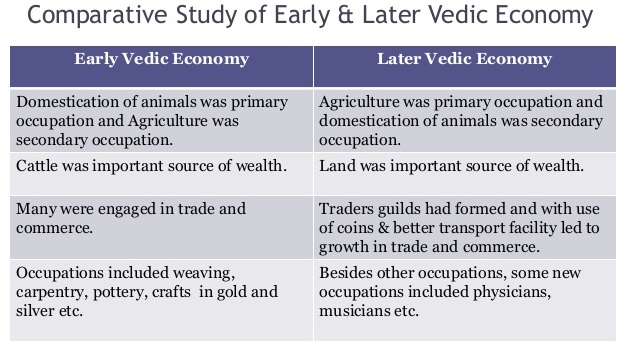
Comparison Between Early And Later Vedic Period

In the early Vedic period the caste system was based on profession and was quite flexible but during the later Vedic period it became more rigid and was based on the birth of the person. The early Vedic period had no concept of untouchables or Shudras but the later Vedic period did.

During the early Vedic period the women were given more freedom and enjoyed political participation up to a certain limit but in the later Vedic period women were given more docile roles. In the early Vedic period the kings were elected by a small assembly known as the samiti but in the later Vedic period the need for a more long-term and stable king was required therefore kings rule became more important.