MCQ Questions for Class 10 Maths Arithmetic Progressions with Answers

Free PDF Download of CBSE Class 10 Maths Chapter 5 Arithmetic Progressions Multiple Choice Questions with Answers. MCQ Questions for Class 10 Maths with Answers was Prepared Based on Latest Exam Pattern. Students can solve NCERT Class 10 Maths Arithmetic ProgressionsMCQs with Answers to know their preparation level.

Class 10 Maths MCQs Chapter 5 Arithmetic Progressions

1. The nth term of an A.P. is given by an = 3 + 4n. The common difference is
(a) 7
(b) 3
(c) 4
(d) 1

Answer/Explanation

Answer: c
Explaination:Reason: We have an = 3 + 4n
∴ an+1 = 3 + 4(n + 1) = 7 + 4n
∴ d = an+1 – an
= (7 + 4n) – (3 + 4n)
= 7 – 3
= 4


2. If p, q, r and s are in A.P. then r – q is
(a) s – p
(b) s – q
(c) s – r
(d) none of these

Answer/Explanation

Answer: c
Explaination:Reason: Since p, q, r, s are in A.P.
∴ (q – p) = (r – q) = (s – r) = d (common difference)


3. If the sum of three numbers in an A.P. is 9 and their product is 24, then numbers are
(a) 2, 4, 6
(b) 1, 5, 3
(c) 2, 8, 4
(d) 2, 3, 4

Answer/Explanation

Answer: d
Explaination:Reason: Let three numbers be a – d, a, a + d
∴ a – d +a + a + d = 9
⇒ 3a = 9
⇒ a = 3
Also (a – d) . a . (a + d) = 24
⇒ (3 -d) .3(3 + d) = 24
⇒ 9 – d² = 8
⇒ d² = 9 – 8 = 1
∴ d = ± 1
Hence numbers are 2, 3, 4 or 4, 3, 2


4. The (n – 1)th term of an A.P. is given by 7,12,17, 22,… is
(a) 5n + 2
(b) 5n + 3
(c) 5n – 5
(d) 5n – 3

Answer/Explanation

Answer: d
Explaination:Reason: Here a = 7, d = 12-7 = 5
∴ an-1 = a + [(n – 1) – l]d = 7 + [(n – 1) -1] (5) = 7 + (n – 2)5 = 7 + 5n – 10 = 5M – 3


5. The nth term of an A.P. 5, 2, -1, -4, -7 … is
(a) 2n + 5
(b) 2n – 5
(c) 8 – 3n
(d) 3n – 8

Answer/Explanation

Answer: c
Explaination:Reason: Here a = 5, d = 2 – 5 = -3
an = a + (n – 1)d = 5 + (n – 1) (-3) = 5 – 3n + 3 = 8 – 3n


6. The 10th term from the end of the A.P. -5, -10, -15,…, -1000 is
(a) -955
(b) -945
(c) -950
(d) -965

Answer/Explanation

Answer: a
Explaination:Reason: Here l = -1000, d = -10 – (-5) = -10 + 5 = – 5
∴ 10th term from the end = l – (n – 1 )d = -1000 – (10 – 1) (-5) = -1000 + 45 = -955


7. Find the sum of 12 terms of an A.P. whose nth term is given by an = 3n + 4
(a) 262
(b) 272
(c) 282
(d) 292

Answer/Explanation

Answer: a
Explaination:Reason: Here an = 3n + 4
∴ a1 = 7, a2 – 10, a3 = 13
∴ a= 7, d = 10 – 7 = 3
∴ S12 = \(\frac{12}{2}\)[2 × 7 + (12 – 1) ×3] = 6[14 + 33] = 6 × 47 = 282


8. The sum of all two digit odd numbers is
(a) 2575
(b) 2475
(c) 2524
(d) 2425

Answer/Explanation

Answer: b
Explaination:Reason: All two digit odd numbers are 11,13,15,… 99, which are in A.P.
Since there are 90 two digit numbers of which 45 numbers are odd and 45 numbers are even
∴ Sum = \(\frac{45}{2}\)[11 + 99] = \(\frac{45}{2}\) × 110 = 45 × 55 = 2475


9. The sum of first n odd natural numbers is
(a) 2n²
(b) 2n + 1
(c) 2n – 1
(d) n²

Answer/Explanation

Answer: d
Explaination:Reason: Required Sum = 1 + 3 + 5 + … + upto n terms.
Here a = 1, d = 3 – 1 = 2
Sum = \(\frac{n}{2}\)[2 × 1 + (n – 1) × 2] = \(\frac{n}{2}\)[2 + 2n – 2] = \(\frac{n}{2}\) × 2n = n²Reason: All two digit odd numbers are 11,13,15,… 99, which are in A.P.
Since there are 90 two digit numbers of which 45 numbers are odd and 45 numbers are even
∴ Sum = \(\frac{45}{2}\)[11 + 99] = \(\frac{45}{2}\) × 110 = 45 × 55 = 2475


10. If (p + q)th term of an A.P. is m and (p – q)tn term is n, then pth term is
MCQ Questions for Class 10 Maths Arithmetic Progressions with Answers 1

Answer/Explanation

Answer: d
Explaination:Reason: Let a is first term and d is common difference
∴ ap + q = m
ap – q = n
⇒ a + (p + q – 1)d = m = …(i)
⇒ a + (p – q – 1)d = m = …(ii)
On adding (i) and (if), we get
2a + (2p – 2)d = m + n
⇒ a + (p -1)d = \(\frac{m+n}{2}\) …[Dividing by 2
∴ an = \(\frac{m+n}{2}\)


11. If a, b, c are in A.P. then \(\frac{a-b}{b-c}\) is equal to
MCQ Questions for Class 10 Maths Arithmetic Progressions with Answers 2

Answer/Explanation

Answer: a
Explaination:Reason: Since a, b, c are in A.P.
∴ b – a = c – b
⇒ \(\frac{b-a}{c-b}\) = 1
⇒ \(\frac{a-b}{b-c}\) = 1


12. The number of multiples lie between n and n² which are divisible by n is
(a) n + 1
(b) n
(c) n – 1
(d) n – 2

Answer/Explanation

Answer: d
Explaination:Reason: Multiples of n from 1 to n² are n × 1, n × 2, n × 3, …, m× n
∴ There are n numbers
Thus, the number of mutiples of n which lie between n and n² is (n – 2) leaving first and last in the given list: Total numbers are (n – 2).


13. If a, b, c, d, e are in A.P., then the value of a – 4b + 6c – 4d + e is
(a) 0
(b) 1
(c) -1.
(d) 2

Answer/Explanation

Answer: a
Explaination:Reason: Let common difference of A.P. be x
∴ b = a + x, c = a + 2x, d = a + 3x and e = a + 4x
Given equation n-4b + 6c-4d + c
= a – 4(a + x) + 6(A + 2r) – 4(n + 3x) + (o + 4.v)
= a – 4a – 4x + 6a + 12x – 4a – 12x + a + 4x = 8a – 8a + 16x – 16x = 0


14. The next term of the sequence
MCQ Questions for Class 10 Maths Arithmetic Progressions with Answers 3

Answer/Explanation

Answer: a
Explaination:
MCQ Questions for Class 10 Maths Arithmetic Progressions with Answers 4


15. nth term of the sequence a, a + d, a + 2d,… is
(a) a + nd
(b) a – (n – 1)d
(c) a + (n – 1)d
(d) n + nd

Answer/Explanation

Answer: a
Explaination:Reason: an = a + (n – 1)d


16. The 10th term from the end of the A.P. 4, 9,14, …, 254 is
(a) 209
(b) 205
(c) 214
(d) 213

Answer/Explanation

Answer: a
Explaination:Reason: Here l – 254, d = 9-4 = 5
∴ 10th term from the end = l – (10 – 1 )d = 254 -9d = 254 = 9(5) = 254 – 45 = 209


17. If 2x, x + 10, 3x + 2 are in A.P., then x is equal to
(a) 0
(b) 2
(c) 4
(d) 6

Answer/Explanation

Answer: d
Explaination:Reason: Since 2x, x + 10 and 3x + 2 are in A.P.
∴ 2(x + 10) = 2x + (3x + 2)
⇒ 2x + 20 – 5x + 2
⇒ 2x – 5x = 2 – 20
⇒ 3x = 18
⇒ x = 6


18. The sum of all odd integers between 2 and 100 divisible by 3 is
(a) 17
(b) 867
(c) 876
(d) 786

Answer/Explanation

Answer: b
Explaination:Reason: The numbers are 3, 9,15, 21, …, 99
Here a = 3, d = 6 and an = 99
∴ an = a + (n – 1 )d
⇒ 99 = 3 + (n – 1) x 6
⇒ 99 = 3 + 6n – 6
⇒ 6n = 102
⇒ n = 17
Required Sum = \(\frac{n}{2}\)[a + an] = \(\frac{17}{2}\)[3 + 99] = \(\frac{17}{2}\) × 102 = 867


19. If the numbers a, b, c, d, e form an A.P., then the value of a – 4b + 6c – 4d + e is
(a) 0
(b) 1
(c) -1
(d) 2

Answer/Explanation

Answer: a
Explaination:Reason: Let x be the common difference of the given AP
∴ b = a + x, c = a + 2x, d = a + 3x and e = a + 4x
∴ a – 4b + 6c – 4d + e = a – 4 (a + x) + 6(a + 2x) – 4(a + 3x) + (a + 4x)
= a – 4a – 4x + 6a + 12x – 4a – 12x + a + 4x = 8a – 8a + 16x – 16x = 0


20. If 7 times the 7th term of an A.P. is equal to 11 times its 11th term, then 18th term is
(a) 18
(b) 9
(c) 77
(d) 0

Answer/Explanation

Answer: d
Explaination:Reason: We have 7a7 = 11a11
⇒ 7[a + (7 – 1)d] = 11[a + (11 – 1 )d]
⇒ 7(a + 6d) = 11(a + 10d)
⇒ 7a + 42d = 11a + 110d
⇒ 4a = -68d
⇒ a = -17d
∴ a18 = a + (18 – 1)d = a + 17d = -17d + 17d = 0


21. If p, q, r are in AP, then p3 + r3 – 8q3 is equal to
(a) 4pqr
(b) -6pqr
(c) 2pqr
(d) 8pqr

Answer/Explanation

Answer: b
Explaination:
∵ p, q, r are in AP.
∴ 2q = p + r
⇒ p + r – 2q = 0
∴ p3 + r3 + (-2p)3 = 3 × p × r × -2q
[Using ifa + 6 + c = 0 ⇒ a3 + b3 + c3 = 3 abc]
⇒ p3 + r3 – 8q3 = -6pqr.


22. In an AP, if a = 3.5, d = 0, n = 101, then a will be [NCERT Exemplar Problems]
(a) 0
(b) 3.5
(c) 103.5
(d) 104.5

Answer/Explanation

Answer: b
Explaination: (b) a101 = 3.5 + 0(100) = 3.5


23. The list of numbers -10, -6, -2, 2, … is [NCERT Exemplar Problems]
(а) an AP with d = -16
(b) an AP with d = 4
(c) an AP with d = -4
(d) not an AP

Answer/Explanation

Answer: b
Explaination: (b) An AP with d = 4.


24. Two APs have the same common difference. . The first term of one of these is -1 and that of the other is -8. Then the difference between their 4th terms is [NCERT Exemplar Problems]
(a) -1
(b) -8
(c) 7
(d) -9

Answer/Explanation

Answer: c
Explaination:
a4 – b4 = (a1 + 3d) – (b1 + 3d)
= a1 – b1= – 1 – (-8) = 7


25. In an AP, if d = -2, n = 5 and an = 0, the value of a is
(a) 10
(b) 5
(c) -8
(d) 8

Answer/Explanation

Answer: d
Explaination:
d = – 2, n = 5, an = 0
∵ an = 0
⇒ a + (n – 1)d=0
⇒ a + (5 – 1)(- 2) = 0
⇒ a = 8
Correct option is (d).


26. If the common difference of an AP is 3, then a20 – a15 is
(a) 5
(b) 3
(c) 15
(d) 20

Answer/Explanation

Answer: c
Explaination:
Common difference, d = 3
a20 – a15 = (a + 19d) – (a+ 14d)
= 5d=5 × 3 = 15


27. The next term of the AP √18, √50, √98, …….. is
(a) √146
(b) √128
(c) √162
(d) √200

Answer/Explanation

Answer: c
Explaination:
(c) √18, √50, √98, ….. = 3√2, 5√2, 7√2, ……
∴ Next term is 9√2 = √162


28. The common difference of the AP
MCQ Questions for Class 10 Maths Arithmetic Progressions with Answers 5
(a) p
(b) -p
(c) -1
(d) 1

Answer/Explanation

Answer: c
Explaination: (c) Common difference = a2 – a1


29. If the nth term of an AP is (2n +1), then the sum of its first three terms is
(a) 6n + 3
(b) 15
(c) 12
(d) 21

Answer/Explanation

Answer: b
Explaination:
a1= 2 × 1 + 1 = 3,
a2 = 2 × 2 + 1 = 5,
a3 = 2 × 3 + l= 7
∴ Sum = 3 + 5 + 7 = 15


30. An AP consists of 31 terms. If its 16th term is m, then sum of all the terms of this AP is
(a) 16 m
(b) 47 m
(c) 31 m
(d) 52 m

Answer/Explanation

Answer: c
Explaination:
S31 =\(\frac{31}{2}\) (2a + 30d)
a16 = a + 15d = zw
⇒ S31 = \(\frac{31}{2}\) × 2(a + 15d)
⇒ S31 = 31m


31. The first term of an AP of consecutive integers is p² + 1. The sum of 2p + 1 terms of this AP is
(a) (p + 1)²
(b) (2p + 1) (p + 1)²
(c) (p+1)3
(d) p3 + (p + 1)3

Answer/Explanation

Answer: d
Explaination:
MCQ Questions for Class 10 Maths Arithmetic Progressions with Answers 9


32. If the sum of first n terms of an AP is An + Bn² where A and B are constants, the common difference of AP will be
(a) A + B
(b) A – B
(c) 2A
(d) 2B

Answer/Explanation

Answer: d
Explaination:
Sn = An + Bn²
S1 = A × 1 +B × 1²
= A + B
∵ S1 = a1
∴ a1 = A + B … (1)
and S2 = A × 2 + B × 2²
⇒ a1 + a2 = 2A + 4B
⇒ (A + B) + a2 = 2A + 4B[Using (i)]
⇒ a2 = A + 3B
∴ d = a2 – a1 = 2B


33. If p – 1, p + 3, 3p – 1 are in AP, then p is equal to ______ .

Answer/Explanation

Answer:
Explaination:
∵ p – 1, p + 3 and 3p – 1 are in AP.
∴ 2(p + 3) = p – 1 + 3p – 1
⇒ 2p + 6 = 4/> -2.
⇒ -2p = -8
⇒ p = 4.


34. Write down the first four terms of the sequences whose general terms are
(i) Tn = 2n + 3
(ii) Tn =3n + 1
(iii) T1 = 2, Tn = Tn-1+ 5, n ≥ 2

Answer/Explanation

Answer:
Explaination:
(i) Tn= 2n + 3
T1 = 2 × 1 + 3 = 5,
T2 = 2 × 2 + 3 = 7,
T3 = 2 × 3 + 3 = 9,
T4 = 2 × 4 + 3 = 11
∴ Ist four terms are 5, 7, 9 and 11.

(ii) Tn = 3n+1
⇒ T1 = 31+1 = 9,
T2 = 32+1 = 27,
T3= 33+1 = 81,
T4 = 34+1 = 243
∴ Ist four terms are 9, 27, 81 and 243

(iii) T1 = 2, Tn = Tn-1 + 5, n ≥ 2
⇒ T2 = T2-1 + 5
= T1 + 5 = 2 + 5 = 7
T3 = T3-1 + 5
= T2 + 5 = 7 + 5 = 12
and T4=T4-1 + 5
= T3 + 5 = 12 + 5 = 17
∴ Ist four terms are 2, 7, 12 and 17.


35. Find:
The 10th term of 10.0, 10.5, 11.0, 11.5, …..

Answer/Explanation

Answer:
Explaination:
a=10, d = 10.5 – 10 = 0.5
a10 = a + 9d= 10 + 9 × 0.5 = 14.5


36. In an A.P., if the common difference (d) = – 4 and the seventh term (a7) is 4, then find the first term. [CBSE 2018]

Answer/Explanation

Answer:
Explaination:
Let a = first term,
Given, d = – 4, a7 = 4
⇒ a + (7 – 1)d = 4
[ ∵ nth term of an AP = an = a + (n – 1)d]
⇒ a + 6d = 4
⇒ a + 6 × (-4) = 4
⇒ a – 24 = 4.
⇒ a = 4 + 24 = 28
∴ First term, a = 28


37. Write the nth term of the A.P. [Delhi 2017 (C)]
MCQ Questions for Class 10 Maths Arithmetic Progressions with Answers 6

Answer/Explanation

Answer:
Explaination:
MCQ Questions for Class 10 Maths Arithmetic Progressions with Answers 7


38. Which term of the AP 21, 18, 15, … , is zero?

Answer/Explanation

Answer:
Explaination:
Here, a = 21, J= 18-21 = -3
Let an = 0
⇒ a + (n – 1 )d = 0
⇒ 21 +(n – 1)(-3) = 0
⇒ (n – 1)(- 3) = -21
⇒ n – 1 = \(\frac{-21}{-3}\)
⇒ n = 8
∴ 8th term is zero.


39. For what value ofp, are 2p+ 1, 13, 5p – 3 three consecutive terms of an AP?

Answer/Explanation

Answer:
Explaination:
If terms are in AP, then
13 – (2p + 1) = (5p – 3) – 13
⇒ 13 – 2p – 1 = 5p – 3 – 13
⇒ 28 = 7p
⇒ p = 4.


40. What is the common difference of an A.P. in which a21 – a7 = 84? [AI 2017]

Answer/Explanation

Answer:
Explaination:
Let ‘cf be the common difference of the AP whose first term is ‘a’
Now, a21 – a7 = 84
⇒ (a + 20d) – (a + 6d)= 84
⇒ 20d – 6d = 84
⇒ 14d = 84
⇒ d = 6


41. The first term of an AP is p and its common difference is q. Find its 10th term.

Answer/Explanation

Answer:
Explaination:
∵ a = p and d = q
an = a + (n – 1)d
⇒ a10 =p + 9q


42. Which term of the AP 14, 11, 8, ….is -1?

Answer/Explanation

Answer:
Explaination:
Here, a = 14, d= 11 – 14 = – 3
Let an = – 1
⇒ a + (n – 1 )d = – 1
⇒ 14 + (n – 1)(- 3) = – 1
⇒ (n – 1)(- 3) = – 1 – 14
⇒ n – 1 = \(\frac{-15}{-3}\) = 5
⇒ n = 6
∴ 6th term of the AP is -1.


43. Write the next two terms of the AP: 1,-1, -3, -5, …

Answer/Explanation

Answer:
Explaination:
a1 = 1
a1 = a2 – a1 = – 1 – 1 = – 2
a5 = a1 + 4d
= 1 + 4(-2)
= 1 – 8 = — 7
a6 = a5 + d = – 7 – 2 = – 9
Next two terms are – 7 and – 9.


44. If an = \(\frac{n(n-3)}{n+4}\), then find 18th term of this sequence.

Answer/Explanation

Answer:
Explaination:
MCQ Questions for Class 10 Maths Arithmetic Progressions with Answers 8


45. If the first term of an AP is 2 and common difference is 4, then sum of its first 40 terms is ______ .

Answer/Explanation

Answer:
Explaination:
S40(2 × 2 + 39 × 4)
= 40 × (80)= 3200


46. Three numbers in an AP have sum 24. Its middle term is ____ .

Answer/Explanation

Answer:
Explaination:
Let numbers be a – d, a and a + d.
⇒ a – d+a + a + d= 24
⇒ 3a = 24
⇒ a = 8
∴ Middle term = 8.


47. The value of the expression 1 – 6 + 2 – 7 + 3 – 8 + ….. to 100 terms is ______ .

Answer/Explanation

Answer:
Explaination:
1 – 6 + 2 – 7 + 3 – 8 + … 100 terms
= (1 + 2 + 3 +… up to 50 terms) + (-6 -7 – 8 – … up to 50 terms)
= \(\frac{50}{2}\)[2 × 1 + 49 × 1] + [\(\frac{50}{2}\){2 × (-6) + 49 × (-1)}]
= 25 × 51 + 25 x (-12 – 49) = 25(51 – 61)
= -250.


48. If the sum of first m terms of an AP is 2m² + 3m, then what is its second term?

Answer/Explanation

Answer:
Explaination:
Sm = 2m² + 3m
∴ S1 = 2 × 1² + 3 × 1 = 5 = a1
and S2 = 2 × 2² + 3 × 2 = 14 …(i)
⇒ a1 + a2 = 14
⇒ 5 + a2 = 14
⇒ a2 = 9


49. If the sum of first p terms of an AP is ap² + bp, find its common difference.

Answer/Explanation

Answer:
Explaination:
Sp = ap² + bp
S1= a × 1² + b × 1
= a + b = a1
and S2 = a × 2² + b × 2 = 4a + 2b …(i)
⇒ a1 + a2 = 4a + 2b
⇒ a + b + a2 = 4a + 2b
⇒ a2 = 3a + b [Using eq. (i)]
Now, d = a2 – a1
= (3a + b)-(a + b) = 2a.


50. If sum of first n terms of an AP is 2n² + 5n. Then find S20.

Answer/Explanation

Answer:
Explaination:
Sn = 2n² + 5n
S20 = 2(20)² + 5 × 20
= 2 × 400 + 100 = 900


We hope the given MCQ Questions for Class 10 Maths Arithmetic Progressions with Answers will help you. If you have any query regarding CBSE Class 10 Maths Chapter 5 Arithmetic Progressions Multiple Choice Questions with Answers, drop a comment below and we will get back to you at the earliest.
MCQ Questions for Class 10 Maths Pair of Linear Equations in Two Variables with Answers

Free PDF Download of CBSE Class 10 Maths Chapter 3 Pair of Linear Equations in Two Variables Multiple Choice Questions with Answers. MCQ Questions for Class 10 Maths with Answers was Prepared Based on Latest Exam Pattern. Students can solve NCERT Class 10 Maths Pair of Linear Equations in Two Variables MCQs with Answers to know their preparation level.

Class 10 Maths MCQs Chapter 3 Pair of Linear Equations in Two Variables

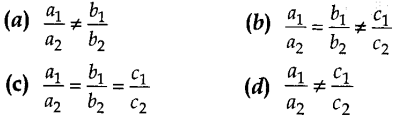
1. A pair of linear equations a1x + b1y + c1 = 0; a2x + b2y + c2 = 0 is said to be inconsistent, if
MCQ Questions for Class 10 Maths Pair of Linear Equations in Two Variables with Solutions 1

Answer

Answer: b


2. Graphically, the pair of equations 7x – y = 5; 21x – 3y = 10 represents two lines which are
(a) intersecting at one point
(b) parallel
(c) intersecting at two points
(d) coincident

Answer

Answer: b


3. The pair of equations 3x – 5y = 7 and – 6x + 10y = 7 have
(a) a unique solution
(b) infinitely many solutions
(c) no solution
(d) two solutions

Answer

Answer: c


4. If a pair of linear equations is consistent, then the lines will be
(a) always coincident
(b) parallel
(c) always intersecting
(d) intersecting or coincident

Answer

Answer: d


5. The pair of equations x = 0 and x = 5 has
(a) no solution
(b) unique/one solution
(c) two solutions
(d) infinitely many solutions

Answer

Answer: c


6. The pair of equation x = – 4 and y = – 5 graphically represents lines which are
(a) intersecting at (- 5, – 4)
(b) intersecting at (- 4, – 5)
(c) intersecting at (5, 4)
(d) intersecting at (4, 5)

Answer

Answer: b


7. For what value of k, do the equations 2x – 3y + 10 = 0 and 3x + ky + 15 = 0 represent coincident lines
MCQ Questions for Class 10 Maths Pair of Linear Equations in Two Variables with Solutions 2

Answer

Answer: a


8. If the lines given by 2x + ky = 1 and 3x – 5y = 7 are parallel, then the value of k is
MCQ Questions for Class 10 Maths Pair of Linear Equations in Two Variables with Solutions 3

Answer

Answer: a


9. One equation of a pair of dependent linear equations is 2x + 5y = 3. The second equation will be
(a) 2x + 5y = 6
(b) 3x + 5y = 3
(c) -10x – 25y + 15 = 0
(d) 10x + 25y = 15

Answer

Answer: c


10. If x = a, y = b is the solution of the equations x + y = 5 and 2x – 3y = 4, then the values of a and b are respectively
(a) 6, -1
(b) 2, 3
(c) 1, 4
(d) 19/5,  6/5

Answer

Answer: d


11. The graph of x = -2 is a line parallel to the
(a) x-axis
(b) y-axis
(c) both x- and y-axis
(d) none of these

Answer

Answer: b


12. The graph of y = 4x is a line
(a) parallel to x-axis
(b) parallel to y-axis
(c) perpendicular to y-axis
(d) passing through the origin

Answer

Answer: d


13. The graph of y = 5 is a line parallel to the
(a) x-axis
(b) y-axis
(c) both axis
(d) none of these

Answer

Answer: a


14. Two equations in two variables taken together are called
(a) linear equations
(b) quadratic equations
(c) simultaneous equations
(d) none of these

Answer

Answer: c


15. If am bl then the system of equations ax + by = c, lx + my = n, has
(a) a unique solution
(b) no solution
(c) infinitely many solutions
(d) none of these

Answer

Answer: a


16. If in the equation x + 2y = 10, the value of y is 6, then the value of x will be
(a) -2
(b) 2
(c) 4
(d) 5

Answer

Answer: a


17. The graph of the equation 2x + 3y = 5 is a
(a) vertical line
(b) straight line
(c) horizontal line
(d) none of these

Answer

Answer: b


18. The value of k, for which equations 3x + 5y = 0 and kx + lOy = 0 has a non-zero solution is
(a) 6
(b) 0
(c) 2
(d) 5

Answer

Answer: a


19. The value of k, for which the system of equations x + (k + l)y = 5 and (k + l)x + 9y = 8k – 1 has infinitely many solutions is
(a) 2
(b) 3
(c) 4
(d) 5

Answer

Answer: a


20. The value of k for which the equations (3k + l)x + 3y = 2; (k2 + l)x + (k – 2)y = 5 has no solution, then k is equal to
(a) 2
(b) 3
(c) 1
(d) -1

Answer

Answer: d


21. The pair of equations x = a and y = b graphically represents lines which are
(a) parallel
(b) intersecting at (b, a)
(c) coincident
(d) intersecting at (a, b)

Answer

Answer: d


22. Asha has only ₹1 and ₹2 coins with her. If the total number of coins that she has is 50 and the amount of money with her is ₹75, then the number of ₹1 and ₹2 coins are, respectively
(a) 35 and 15
(b) 15 and 35
(c) 35 and 20
(d) 25 and 25

Answer

Answer: d


23. The father’s age is six times his son’s age. Four years hence, the age of the father will be four times his son’s age. The present ages of the son and the father are, respectively
(a) 4 and 24
(b) 5 and 30
(c) 6 and 36
(d) 3 and 24

Answer

Answer: c


24. The sum of the digits of a two-digit number is 9. If 27 is added to it, the digits of the number get reversed. The number is
(a) 27
(b) 72
(c) 45
(d) 36

Answer

Answer: d


25. The pair of linear equations 2x + 3y = 5 and 4x + 6y= 10 is
(a) inconsistent
(b) consistent
(c) dependent consistent
(d) none of these

Answer/Explanation

Answer: c
Explaination:
MCQ Questions for Class 10 Maths Pair of Linear Equations in Two Variables with Solutions 8


26. The pair of equations y = 0 and v = -7 has [NCERT Exemplar Problems]
(a) one solution
(b) two solutions
(c) infinitely many solutions
(d) no solution

Answer/Explanation

Answer: d
Explaination: (d) No solution (parallel lines)


27. The pair of equations x = a and y = b graphically represents lines which are
(a) parallel
(b) intersecting at (b, a)
(c) coincident
(d) intersecting at (a, b)

Answer/Explanation

Answer: d
Explaination: (d) Intersecting at (a, b)


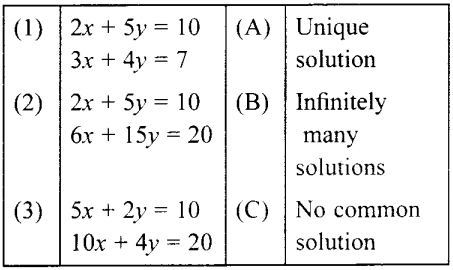
28. Match the Column:
MCQ Questions for Class 10 Maths Pair of Linear Equations in Two Variables with Solutions 4
(a) 1 – A, 2 – B, 3 – C
(b) 1 – B, 2 – C, 3 – A
(c) 1 – C, 2 – B, 3 – A
(d) 1 – A, 2 – C, 3 – B

Answer/Explanation

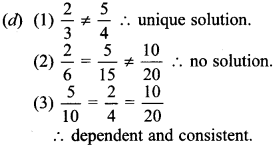
Answer: d
Explaination:
MCQ Questions for Class 10 Maths Pair of Linear Equations in Two Variables with Solutions 9


29. The pair of equations x = 4 and y = 3 graphically represents lines which are
(a) parallel
(b) intersecting at (3, 4)
(c) coincident
(d) intersecting at (4, 3)

Answer/Explanation

Answer: d
Explaination:
(d) When lines x = 4, y = 3 will intersect, then x coordinate = 4, y-coordinate = 3


30. a1x + b1y + c1 = 0 and a2x + b2y + c2 = 0, where a1, b1, c1, a2, b2, c2 are all real numbers and a12+ b12 ≠ 0, a22 + b22 ≠ 0, is called a
(a) family of two different straight lines
(b) family of two coincident lines
(c) pair of linear equations in two variables
(d) none of these

Answer/Explanation

Answer: c
Explaination:
(c) Definition of pair of linear equations in two variables.


31. Match the Column:
MCQ Questions for Class 10 Maths Pair of Linear Equations in Two Variables with Solutions 5
(a) 1 – A, 2 – B, 3 – C
(b) 1 – B, 2 – A, 3 – C
(c) 1 – B, 2 – C, 3 – A
(d) 1 – C, 2 – A, 3 – B

Answer/Explanation

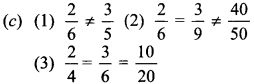
Answer: c
Explaination:
MCQ Questions for Class 10 Maths Pair of Linear Equations in Two Variables with Solutions 10


32. A pair of linear equations which has a unique solution x = 2, y = -3 is [NCERT Exemplar Problems]
(a) x + y = —1; 2x – 3y = -5
(b) 2x + 5y = -11; 4x + 10y = -22
(c) 2x – y = 1 ; 3x + 2y = 0
(d) x-4y- 14 = 0; 5x-y- 13 = 0

Answer/Explanation

Answer: b
Explaination:
(b) 2x + 5y = – 11; 4x + 10y = – 22


33. The father’s age is six times of his son’s age. Four years hence, the age of the father will be four times of his son’s age. The present ages, in years, of the son and the father are, respectively. [NCERT Exemplar Problems]
(a) 4 and 24
(b) 5 and 30
(c) 6 and 36
(d) 3 and 24

Answer/Explanation

Answer: c
Explaination:
Let F and S be the ages of father and sos respectively.
ATQ F = 6S …(i)
F + 4 = 4(S + 4)
⇒ F + 4 = 4S + 16 …(ii)
Substituting F = 6S in (ii), we get
6S + 4 = 4S + 16
2S = 12 .
⇒ S = 6; F = 36


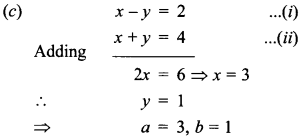
34. If x = a, y = b is the solution of the pair of equations x – y = 2 and x + y = 4, then the respective values of a and b are
[CBSE 2018(C)]
(a) 3, 5
(b) 5, 3
(c) 3, 1
(d) -1, -3

Answer/Explanation

Answer: c
Explaination:
MCQ Questions for Class 10 Maths Pair of Linear Equations in Two Variables with Solutions 16


35. The difference between a two digit number and the number obtained by interchanging the digits is 27. What is the difference betw een the two digits of the number?
(a) 9
(b) 6
(c) 12
(d) 3

Answer/Explanation

Answer: d
Explaination:
Let number is 10x + y (x, y are the digits).
Number obtained by interchanging the digits = 10y+x
∴ 10x + y – (10y + x) = 27
9(x -y) = 27
∴ x – y = 3


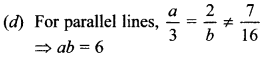
36. The pair of equations ax + 2y = 7 and 3x + by = 16 represent parallel lines if
(a) a = b
(b) 3a = 2b
(c) 2 a = 3 b
(d) ab = 6

Answer/Explanation

Answer: c
Explaination:
MCQ Questions for Class 10 Maths Pair of Linear Equations in Two Variables with Solutions 19


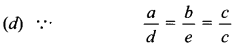
37. The equations ax + by + c = 0 and dx + ey + c = 0 represent the same straight line if
(a) ad = be
(b) ac = bd
(c) be = ad
(d) ab = de

Answer/Explanation

Answer: d
Explaination:
MCQ Questions for Class 10 Maths Pair of Linear Equations in Two Variables with Solutions 21
MCQ Questions for Class 10 Maths Pair of Linear Equations in Two Variables with Solutions 22


38. Using the following equations:
\(\frac{4}{x}\) + 6y = 10
\(\frac{1}{x}\) – 6y = 5
find the value of p if p = 5x.
(a) 1
(b) 2
(c) 3
(d) 4

Answer/Explanation

Answer: a
Explaination:
MCQ Questions for Class 10 Maths Pair of Linear Equations in Two Variables with Solutions 26


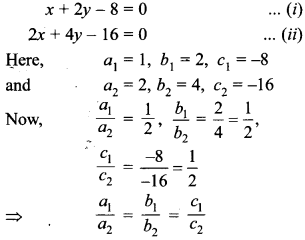
39. Find the number of solutions of the following pair of linear equations:
x + 2y — 8 = 0
2x + 4 v =16

Answer/Explanation

Answer:
Explaination:
MCQ Questions for Class 10 Maths Pair of Linear Equations in Two Variables with Solutions 11
∴ Given pair of linear equations has infinite many solutions.


40. Write whether the following pair of linear equations is consistent or not. x + y = 14, x – y = 4

Answer/Explanation

Answer:
Explaination:
MCQ Questions for Class 10 Maths Pair of Linear Equations in Two Variables with Solutions 12
⇒ The equations have unique solution.
∴ Pair of linear equations is consistent.


41. Given the linear equation 3x + 4y – 8 = 0, write another linear equation in two variables such that the geometrical representation of the pair so formed is parallel lines.

Answer/Explanation

Answer:
Explaination:
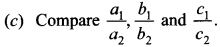
Lines are parallel when \(\frac{a_{1}}{a_{2}}=\frac{b_{1}}{b_{2}} \neq \frac{c_{1}}{c_{2}}\)
∴ One of the linear equation in two variables can be 6x + 8y + k = 0 where k is constant not equal to -16.


42. Find the value of k for which the given pair of linear equations has no common solution.
4x + Ay = 5
8x + 12y = 10

Answer/Explanation

Answer:
Explaination:
MCQ Questions for Class 10 Maths Pair of Linear Equations in Two Variables with Solutions 13


43. Find the value of p for which the given pair of linear equations has infinite many solutions.
4x + 3y – 4=0
px + 9y + 12 = 0

Answer/Explanation

Answer:
Explaination:
MCQ Questions for Class 10 Maths Pair of Linear Equations in Two Variables with Solutions 14


44. The larger of two supplementary angles exceeds the smaller by 20 degrees. Find the angles.

Answer/Explanation

Answer: c
Explaination:
Let larger angle = x° and smaller angle =y° Now x -y = 20 andx +y = 180
∴ Algebraic representation is x – y = 20, x+y= 180


45. On solving the following pair of linear equations: 2x – y = 2; 5x + 2y = 14 by substitution method, values of x and y are _____ and _____ respectively.

Answer/Explanation

Answer:
Explaination:
2x – y = 2 …(i)
5x + 2y = 14 …(ii)
Substituting y = 2x – 2 in (ii), we get 5x + 2(2x – 2)=14
9x – 4 = 14
⇒ x= \(\frac{18}{9}\) = 2
⇒ x = 2, y = 2


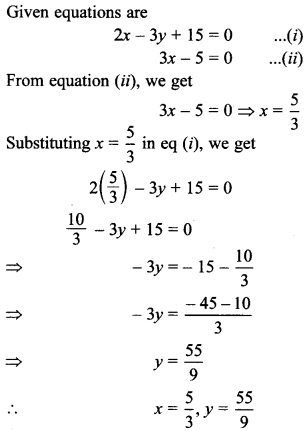
46. Solve the following pair of linear equations by substitution method 2x – 3y +15 = 0; 3x – 5 = 0.

Answer/Explanation

Answer: c
Explaination:
MCQ Questions for Class 10 Maths Pair of Linear Equations in Two Variables with Solutions 15


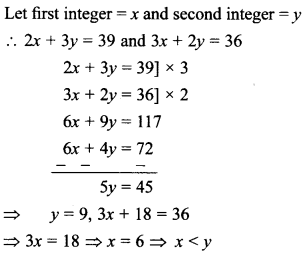
47. There are two positive numbers such
that sum of twice the first and thrice the second is 39, while the sum of thrice the first and twice the second is 36. The larger of the two is _____ .

Answer/Explanation

Answer: c
Explaination:
MCQ Questions for Class 10 Maths Pair of Linear Equations in Two Variables with Solutions 17


48. Solve for x and y by the method of elimination:
4x -3 y = 1; 5x – 7y = 2.

Answer/Explanation

Answer:
Explaination:
Given equations are
4x – 3y = 1 …(i)
5x – 7y = -2 …(ii)
For making coefficient of y equal in both the equations multiplying equation (/) with 7, we get
7 × (4x – 3y) = 7 × 1
⇒ 28x – 21y = 7 …(iii)
Multiplying equation (ii) with 3, we get
3 × (5x – 7y) = 3 × -2
⇒ 15x – 21y = -6 …(iv)
Subtracting equation (iv) from (iii), we get
MCQ Questions for Class 10 Maths Pair of Linear Equations in Two Variables with Solutions 18
when x – 1, equation (i) becomes
4 × – 3y = 1
⇒ -3y = -3
⇒ y = 1
∴ x= 1, y= 1


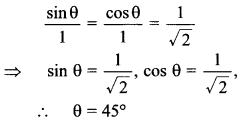
49. If the pair of equations x + y = √2 and x sin θ + y cos θ = 1 has infinitely many solutions, then θ = _____ .

Answer/Explanation

Answer:
Explaination:
MCQ Questions for Class 10 Maths Pair of Linear Equations in Two Variables with Solutions 20


50. Find the value of k so that the following system of equation has infinite solutions: 3x – y – 5 = 0, 6x – 2y + k = 0

Answer/Explanation

Answer:
Explaination:
MCQ Questions for Class 10 Maths Pair of Linear Equations in Two Variables with Solutions 23


51. For which values of p, does the pair of equations given below has unique solution? 4x + py + 8 = 0 and 2x + 2y + 2 = 0

Answer/Explanation

Answer:
Explaination:
For unique solution, \(\frac{a_{1}}{a_{2}} \neq \frac{b_{1}}{b_{2}} \Rightarrow \frac{4}{2} \neq \frac{p}{2}\)
⇒ p ≠ 4


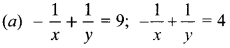
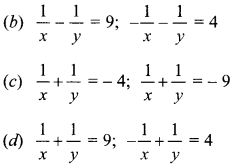
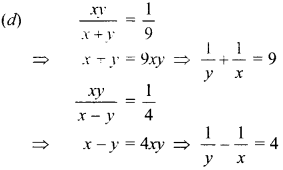
52. The equations \(\frac{x y}{x+y}=\frac{1}{9}\) and \(\frac{x y}{x-y}=\frac{1}{4}\) are equivalent to the equations:
MCQ Questions for Class 10 Maths Pair of Linear Equations in Two Variables with Solutions 6
MCQ Questions for Class 10 Maths Pair of Linear Equations in Two Variables with Solutions 7

Answer/Explanation

Answer: d
Explaination:
MCQ Questions for Class 10 Maths Pair of Linear Equations in Two Variables with Solutions 24


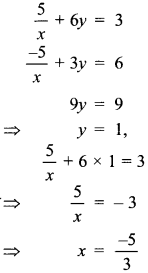
53. On solving the following equations: \(\frac{5}{x}\) + 6y = 3; \(\frac{-5}{x}\) + 3y = 6, values of x and y are ____ and ____ respectively.

Answer/Explanation

Answer:
Explaination:
MCQ Questions for Class 10 Maths Pair of Linear Equations in Two Variables with Solutions 25


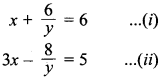
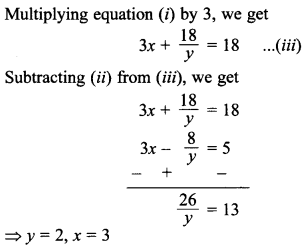
54. Solve forx andy : x + \(\frac{6}{y}\) = 6, 3x – \(\frac{8}{y}\) = 5

Answer/Explanation

Answer:
Explaination:
MCQ Questions for Class 10 Maths Pair of Linear Equations in Two Variables with Solutions 27
MCQ Questions for Class 10 Maths Pair of Linear Equations in Two Variables with Solutions 28


We hope the given MCQ Questions for Class 10 Maths Pair of Linear Equations in Two Variables with Answers will help you. If you have any query regarding CBSE Class 10 Maths Chapter 3 Pair of Linear Equations in Two Variables Multiple Choice Questions with Answers, drop a comment below and we will get back to you at the earliest.
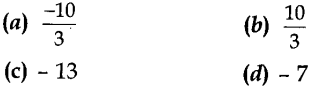
MCQ Questions for Class 10 Maths Polynomials with Answers

Free PDF Download of CBSE Class 10 Maths Chapter 2 Polynomials Multiple Choice Questions with Answers. MCQ Questions for Class 10 Maths with Answers was Prepared Based on Latest Exam Pattern. Students can solve NCERT Class 10 Maths Polynomials MCQs with Answers to know their preparation level.

Class 10 Maths MCQs Chapter 2 Polynomials

1. If one zero of the quadratic polynomial x² + 3x + k is 2, then the value of k is
(a) 10
(b) -10
(c) 5
(d) -5

Answer

Answer: b


2. Given that two of the zeroes of the cubic poly-nomial ax3 + bx² + cx + d are 0, the third zero is
MCQ Questions for Class 10 Maths Polynomials with Solutions 1

Answer

Answer: a


3. If one of the zeroes of the quadratic polynomial (k – 1) x² + kx + 1 is – 3, then the value of k is
MCQ Questions for Class 10 Maths Polynomials with Solutions 2

Answer

Answer: a


4. A quadratic polynomial, whose zeroes are -3 and 4, is
(a) x²- x + 12
(b) x² + x + 12
(c) \(\frac{x^{2}}{2}-\frac{x}{2}-6\)
(d) 2x² + 2x – 24

Answer

Answer: c


5. If the zeroes of the quadratic polynomial x2 + (a + 1) x + b are 2 and -3, then
(a) a = -7, b = -1
(b) a = 5, b = -1
(c) a = 2, b = -6
(d) a – 0, b = -6

Answer

Answer: d


6. The number of polynomials having zeroes as -2 and 5 is
(a) 1
(b) 2
(c) 3
(d) more than 3

Answer

Answer: d


7. Given that one of the zeroes of the cubic polynomial ax3 + bx² + cx + d is zero, the product of the other two zeroes is
MCQ Questions for Class 10 Maths Polynomials with Solutions 3

Answer

Answer: b


8. If one of the zeroes of the cubic polynomial x3 + ax² + bx + c is -1, then the product of the
other two zeroes is
(a) b – a + 1
(b) b – a – 1
(c) a – b + 1
(d) a – b – 1

Answer

Answer: a


9. The zeroes of the quadratic polynomial x2 + 99x + 127 are
(a) both positive
(b) both negative
(c) one positive and one negative
(d) both equal

Answer

Answer: b


10. The zeroes of the quadratic polynomial x² + kx + k, k? 0,
(a) cannot both be positive
(b) cannot both be negative
(c) are always unequal
(d) are always equal

Answer

Answer: a


11. If the zeroes of the quadratic polynomial ax² + bx + c, c # 0 are equal, then
(a) c and a have opposite signs
(b) c and b have opposite signs
(c) c and a have the same sign
(d) c and b have the same sign

Answer

Answer: c


12. If one of the zeroes of a quadratic polynomial of the form x² + ax + b is the negative of the other, then it
(a) has no linear term and the constant term is negative.
(b) has no linear term and the constant term is positive.
(c) can have a linear term but the constant term is negative.
(d) can have a linear term but the constant term is positive.

Answer

Answer: a


13. Which of the following is not the graph of quadratic polynomial?
MCQ Questions for Class 10 Maths Polynomials with Solutions 4

Answer

Answer: d


14. The number of polynomials having zeroes as 4 and 7 is
(a) 2
(b) 3
(c) 4
(d) more than 4

Answer

Answer: d


15. A quadratic polynomial, whose zeores are -4 and -5, is
(a) x²-9x + 20
(b) x² + 9x + 20
(c) x²-9x- 20
(d) x² + 9x- 20

Answer

Answer: b


16. The zeroes of the quadratic polynomial x² + 1750x + 175000 are
(a) both negative
(b) one positive and one negative
(c) both positive
(d) both equal

Answer

Answer: a


17. The zeroes of the quadratic polynomial x² – 15x + 50 are
(a) both negative
(b) one positive and one negative
(c) both positive
(d) both equal

Answer

Answer: c


18. The zeroes of the quadratic polynomial 3x² – 48 are
(a) both negative
(b) one positive and one negative
(c) both positive
(d) both equal

Answer

Answer: b


19. The zeroes of the quadratic polynomial x² – 18x + 81 are
(a) both negative
(b) one positive and one negative
(c) both positive and unequal
(d) both equal and positive

Answer

Answer: d


20. The zeroes of the quadratic polynomial x² + px + p, p ≠ 0 are
(a) both equal
(b) both cannot be positive
(c) both unequal
(d) both cannot be negative

Answer

Answer: b


21. If one of the zeroes of the quadratic polynomial (p – l)x² + px + 1 is -3, then the value of p isMCQ Questions for Class 10 Maths Polynomials with Solutions 5

Answer

Answer: b


22. If the zeroes of the quadratic polynomial Ax² + Bx + C, C # 0 are equal, then
(a) A and B have the same sign
(b) A and C have the same sign
(c) B and C have the same sign
(d) A and C have opposite signs

Answer

Answer: b


23. If x3 + 1 is divided by x² + 5, then the possible degree of quotient is
(a) 0
(b) 1
(c) 2
(d) 3

Answer

Answer: b


24. If x3 + 11 is divided by x² – 3, then the possible degree of remainder is
(a) 0
(b) 1
(c) 2
(d) less than 2

Answer

Answer: d


25. If x4 + 3x² + 7 is divided by 3x + 5, then the possible degrees of quotient and remainder are:
(a) 3, 0
(b) 4, 1
(c) 3, 1
(d) 4, 0

Answer

Answer: a


26. If x5 + 2x4 + x + 6 is divided by g(x), and quotient is x² + 5x + 7, then the possible degree of g(x) is:
(a) 4
(b) 2
(c) 3
(d) 5

Answer

Answer: c


27. If x5 + 2x4 + x + 6 is divided by g(x) and quo-tient is x² + 5x + 7, then the possible degree of remainder is:
(a) less than 1
(b) less than 2
(c) less than 3
(d) less than 4

Answer

Answer: c


28. What is the number of zeroes that a linear poly-nomial has/have:
(a) 0
(b) 1
(c) 2
(d) 3

Answer

Answer: b


29. What is the number(s) of zeroes that a quadratic polynomial has/have:
(a) 0
(b) 1
(c) 2
(d) 3

Answer

Answer: c


30. What is the number(s) of zeores that a cubic polynomial has/have:
(a) 0
(b) 1
(c) 2
(d) 3

Answer

Answer: d


31. If one of the zeroes of the cubic polynomial x3 + px² + qx + r is -1, then the product of the other two zeroes is
(a) p + q + 1
(b) p-q- 1
(c) q – p + 1
(d) q – p – 1

Answer

Answer: c


32. If one zero of the quadratic polynomial x² + 3x + b is 2, then the value of b is
(a) 10
(b) -8
(c) 9
(d) -10

Answer

Answer: d


33. If 1 is one of the zeroes of the polynomial x² + x + k, then the value of k is:
(a) 2
(b) -2
(c) 4
(d) -4

Answer

Answer: b


34. If p(x) is a polynomial of at least degree one and p(k) = 0, then k is known as
(a) value of p(x)
(b) zero of p(x)
(c) constant term of p{x)
(d) none of these

Answer/Explanation

Answer: b
Explaination:
Zero of p(x)
Let p(x) = ax + b
Put x = k
p(k) = ak + b = 0
∴ k is zero of p(x).


35. If one of the zeroes of the quadratic polynomial (k -1)x² + kx + 1 the value of k is [NCERT Exemplar Problems]
MCQ Questions for Class 10 Maths Polynomials with Solutions 6

Answer/Explanation

Answer: c
Explaination:
(k – 1)² + kx + 1
One zero is – 3, so it must satisfy the equation and make it zero.
∴ (k- 1) (- 3)² + k(-3) + 1 =0
⇒ 9k – 9 – Ik + 1 = 0
⇒ 6k – 8 = 0
⇒ k = \(\frac{8}{6}\) = \(\frac{4}{3}\)


36. If the zeroes of the quadratic polynomial x² + (a + 1) x + b are 2 and -3, then [NCERT Exemplar Problem, CBSE 2011]
(a) a = -7, b = -1
(b) a = 5, b = -1
(c) a = 2, b = -6
(d) a = 0, b = -6

Answer/Explanation

Answer: d
Explaination:
x² + (a + 1)x + b
∵ x = 2 is a zero
and x = – 3 is another zero
∴ (2)² + (a + 1)² + 6 = 0
and (- 3)² + (a + 1) (- 3) + b = 0
⇒ 4 + 2cr + 2 + & = 0
and 9 – 3a – 3 + b = 0
⇒ 2a + b = – 6 …(i)
and – 3a + b = – 6 …(ii)
Solving (i) and (ii), we get 5a = 0
⇒ a = 0 and b = – 6.


37. Which of the following is not the graph of a quadratic polynomial?[NCERT Exemplar Problems]
MCQ Questions for Class 10 Maths Polynomials with Solutions 7

Answer/Explanation

Answer: a
Explaination:
∵ It crosses the x-axis in three points.


38. Zeroes of a polynomial can be determined graphically. No. of zeroes of a polynomial is equal to no. of points where the graph of polynomial
(a) intersects y-axis
(b) intersects x-axis
(c) intersects y-axis or intersects x-axis
(d) none of these

Answer/Explanation

Answer: b
Explaination:
(b) Intersects x-axis.


39. If graph of a polynomial does not intersects the x-axis but intersects y-axis in one point, then no. of zeroes of the polynomial is equal to
(a) 0
(b) 1
(c) 0 or 1
(d) none of these

Answer/Explanation

Answer: a
Explaination:
(a) Zero


40. A polynomial of degree n has
(a) only 1 zero
(b) at least n zeroes
(c) atmost n zeroes
(d) more than n zeroes

Answer/Explanation

Answer: c
Explaination:
Maximum number of zeroes of a
polynomial = degree of the polynomial.


41. If p(x) = axr + bx + c, then –\(\frac{b}{a}\) is equal to
(a) 0
(b) 1
(c) product of zeroes
(d) sum of zeroes

Answer/Explanation

Answer: d
Explaination:
(d) Sum of zeroes = –\(\frac{b}{a}\)


42. If p(x) = ax² + bx + c one zero is and a + b + c = 0, then one zero is
(a) \(\frac{-b}{a}\)
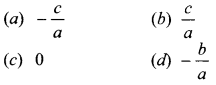
(b) \(\frac{c}{a}\)
(c) \(\frac{b}{c}\)
(d) none of these

Answer/Explanation

Answer: b
Explaination:
p(1) = 0; a(1)² + b(1) + c = 0
⇒ a + b + c = 0
∴ one zero (α) = 1
αβ = product of zeroes = \(\frac{c}{a}\)
⇒ 1.β = \(\frac{c}{a}\)
⇒ β = \(\frac{c}{a}\)
∴ zeroes are 1 and \(\frac{c}{a}\)


43. If p{x) = ax2 + bx + one of the zeroes is c and a + c = b, then
MCQ Questions for Class 10 Maths Polynomials with Solutions 13

Answer/Explanation

Answer: c
Explaination:
p(-1) = 0; a(-1)² + b(-1) + c = 0
⇒ a – b + C = 0,
∴ One zero (a) = -1
αα = product of zeroes = \(\frac{c}{a}\)
⇒ (-1).β = \(\frac{c}{a}\)
⇒ β = \(\frac{-c}{a}\)


44. The number of polynomials having zeroes as -2 and 5 is [NCERT Exemplar Problems]
(a) 1
(b) 2
(c) 3
(d) more than 3

Answer/Explanation

Answer: d
Explaination:
∵ x² – 3x – 10, 2x² – 6x – 20,
\(\frac{1}{2}\)x² – \(\frac{3}{2}\)x – 5, 3x² – 9x – 30 etc.,
have zeroes – 2 and 5.


45. Given that one of the zeroes of the cubic polynomial ax3 + bx2 + cx + d is zero, the product of the other two zeroes is [NCERT Exemplar Problems]
MCQ Questions for Class 10 Maths Polynomials with Solutions 14

Answer/Explanation

Answer: b
Explaination:
∵ αβ + βγ + γα = \(\frac{c}{a}\)
Let, α = 0
So, 0 + βγ + 0 = \(\frac{c}{a}\)
⇒ βγ= \(\frac{c}{a}\)


46. If one of the zeroes of a quadratic polynomial of the form x² + ax + b is the negative of the other, then it
(a) has no linear term and the constant term is negative.
(b) has no linear term and the constant term is positive.
(c) can have a linear term but the constant term is negative.
(d) can have a linear term but the constant term is positive.

Answer/Explanation

Answer: a
Explaination:
f(x) = x² + ax + b
Given: zeroes are α and – α
Sum of zeroes = α – α = 0
∴ f(x) = x² + b, which is not linear
Product of zeroes = α(-α) = – α² = \(\frac{b}{1}\)
⇒ -α² = b
It is possible when, b < 0.
Hence, it has no linear term and the constant term is negative.


47. If 4x² – 6x – m is divisible by x – 3, the value of m is exact divisor of
(a) 9
(b) 45
(c) 20
(d) 36

Answer/Explanation

Answer: a
Explaination:
Here p(3) = 0
⇒ 4(3)² – 6 × 3-m = 0
⇒ 36 – 18 – m = 0
⇒ m=18
∴ Value of m is exactly divisible by 9.


48. Which one of the following statements is correct
(a) if x6 + 1 is divided by x + 1, then the remainder is -2.
(b) if x6 + 1 is divided by x – 1, then the remainder is 2.
(c) if x6 + 1 is divided by x + 1, then the remainder is 1.
(d) if x6 + 1 is divided by x – 1, then the remainder is -1.

Answer/Explanation

Answer: b
Explaination:
p(x) = x6 + 1
when divided by x – 1, then remainder = p(1)
∴ p(1) = 16 + 1 = 2


49. Consider the following statements
(i) x – 2 is a factor of x3 – 3x² + 4x – 4.
(ii) x + 1 is a factor of 2x3 + 4x + 6.
(iii) x – 1 is a factor of x5 + x4 – x3 + x² -x + 1.
In these statements
(a) 1 and 2 are correct
(b) 1, 2 and 3 are correct
(c) 2 and 3 are correct
(d) 1 and 3 are correct

Answer/Explanation

Answer: a
Explaination:
x – 2 is a factor of x3 – 3x² + 4x – 4
∵ remainder is zero Similarly x + 1 is a factor of 2x3 + 4x + 6
but x – 1 is not a factor of x5 + x4 – x3 + x² – x + 1
∵ remainder is not zero
∴ Statements 1 and 2 are correct.


50. If f(x) = 5x – 10 is divided by x – √2, then the remainder will be
(a) non zero rational number
(b) an irrational number
(c) 0
(d) \(f\left(\frac{1}{\sqrt{2}}\right)\)

Answer/Explanation

Answer: b
Explaination:
Remainder = f(√2) = 5 × √2 – 10
= an irrational number


51. Zeroes of p(z) = z² – 27 are ______ and ______ .

Answer/Explanation

Answer:
Explaination:
For zeroes z² – 27 = 0
⇒ z² = 27
⇒ z = ±√27
⇒ z = ± 3√3


52. Verify that x = 3 is a zero of the polynomial. p(x) = 2x3 – 5x² – 4x + 3

Answer/Explanation

Answer:
Explaination:
Here p(x) = 2x3 – 5x² – 4x + 3
∴ p{3) = 2(3)3 – 5 x (3)² -4 x 3 + 3
= 54 – 45- 12 + 3 = 0
∵ P(3) = 0
∴ x = 3 is a zero of p(x)


53. The graph of y =f(x) is given below. How many zeroes are there of f(x)?
MCQ Questions for Class 10 Maths Polynomials with Solutions 8

Answer/Explanation

Answer:
Explaination:
Graph of y = f(x) intersect x-axis in one point only.
Therefore number of zeroes of f(x) is one.


54. The graph of y = f(x) is given, how many zeroes are there of f(x)?
MCQ Questions for Class 10 Maths Polynomials with Solutions 9

Answer/Explanation

Answer:
Explaination:
∵ Graph y =f(x) does not intersect x-axis.
∴ f(x) has no zeroes.


55. The graph of y = f(x) is given below, for some polynomial f(x). Find the number of zeroes of f(x).
MCQ Questions for Class 10 Maths Polynomials with Solutions 10

Answer/Explanation

Answer:
Explaination:
∵ Graph of f(x) intersects x-axis at three different points.
∴ Number of zeroes of f(x) = 3.


56. The graph of x = p(y) is given below, for some polynomial p(y). Find the number of zeroes of p(y).
MCQ Questions for Class 10 Maths Polynomials with Solutions 11

Answer/Explanation

Answer:
Explaination:
∵ Graph of p(y) intersects y-axis in four different points.
∴ Numbers of zeroes = 4


57.MCQ Questions for Class 10 Maths Polynomials with Solutions 12
Graph of the polynomial p(x) =px² + 4x – 4 is given as above. Find the value of p.

Answer/Explanation

Answer:
Explaination:
Graph of p(x) touches the x-axis at (2, 0)
∴ x = 2 is a zero of the p(x)
⇒ p(2) = 0
⇒ p(2)² + 4 × 2 – 4 = 0
4p + 4 = 0
⇒ p = -1


58. If the product of the zeroes of x2 – 3kx + 2k1 – 1 is 7, then values of k are _____ and _____ .

Answer/Explanation

Answer:
Explaination:
Product of zeroes = 7
⇒ 2k² – 1 = 7
⇒ 2k² = 8
⇒ k² = 4
⇒ k = ± 2


59. If zeroes ofp(x) = 2x² -Ix + k are reciprocal of each other, then value of k is _____ .

Answer/Explanation

Answer:
Explaination:
∵ Zeroes are reciprocal of each other
∴ Product of zeroes = 1
⇒ \(\frac{k}{2}\) = 1
⇒ k = 2


60. Find the product of the zeroes of – 2x² + kx + 6.

Answer/Explanation

Answer:
Explaination:
Here a = – 2, b = k, c = 6
Product of zeroes = \(\frac{c}{a}\)
i. e., α × β = \(\frac{6}{-2}\) = -3


61. Find the sum of the zeroes of the given quadratic polynomial -3x² + k.

Answer/Explanation

Answer:
Explaination:
Since polynomial is -3x² + 0x + k
∴ a = -3, b = 0, c = k
and sum of zeroes = \(\frac{-b}{a}\)
i. e., α + β = \(\frac{-b}{a}\)
⇒ α + β = \(\frac{0}{-3}\) = 0


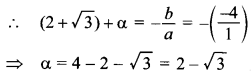
62. If one zero of the polynomial x² -4x+ 1 is 2 + √3, write the other zero.

Answer/Explanation

Answer:
Explaination:
Let other zero be α ,
MCQ Questions for Class 10 Maths Polynomials with Solutions 15


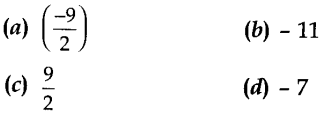
63. Write the polynomial, the product and sum of whose zeroes are –\(\frac{9}{2}\) and –\(\frac{3}{2}\) respectively.

Answer/Explanation

Answer:
Explaination:
MCQ Questions for Class 10 Maths Polynomials with Solutions 16


64. The value of m, in order that x² – mx – 2 is the quotient where x3 + 3x² – 4 is divided by x + 2 is ____ .

Answer/Explanation

Answer:
Explaination:
MCQ Questions for Class 10 Maths Polynomials with Solutions 17
Since quotient = x² – mx – 2
∴ x² – mx – 2 = x² + x – 2
On comparison of coefficient of x, we get m = – 1.


65. If one factor of x3 + 7kx² – 4kx + 12 is (x + 3), then the value of k is ______ .

Answer/Explanation

Answer:
Explaination:
p(x) = x3 + Ike – 4kx + 12
p(-3) = (-3)3 + 7k(-3)² – 4k (- 3) + 12
∵ x + 3 is a factor
∴ p(-3) = 0
⇒ -27 + 63k + 12k+ 12 = 0
⇒ 75k – 15 = 0
⇒ k = \(\frac{1}{2}\)


66. A polynomial of degree five is divided by a quadratic polynomial. If it leaves a remainder, then find the degree of remainder.

Answer/Explanation

Answer:
Explaination:
Degree of remainder is always less than divisor.
∴ Degree of remainder will be less than 2.
Hence, degree is 1 or 0.


67. Check whether 3x – 7 is a factor of polynomial 6x3 + x² – 26x – 25?

Answer/Explanation

Answer:
Explaination:
MCQ Questions for Class 10 Maths Polynomials with Solutions 18


68. If x3 + x² – ax + b is divisible by x² – x, write the values of a and b.

Answer/Explanation

Answer:
Explaination:
∵ p(x) = x3+xl-ax + b is divisible by x² -x.
x (x – 1) is a factor of p(x).
⇒ x = 0 and x = 1 are zeroes of p(x).
⇒ p(0) = 0
⇒ (0)3 + (0)² – a × 0 + b = 0
⇒ b = 0 and p(1) = 0
⇒ 13 + (1)² – a × 1 + b = 0
⇒ 2 – a + 0 — 0
⇒ a = 2


We hope the given MCQ Questions for Class 10 Maths Polynomials with Answers will help you. If you have any query regarding CBSE Class 10 Maths Chapter 2 Polynomials Multiple Choice Questions with Answers, drop a comment below and we will get back to you at the earliest.
Bipolar Junction Transistor MCQs For NEET

Bipolar Junction Transistor MCQs For NEET

NEET  Physics is the scoring paper in the medical entrance examination. Here, you will discover the NEET Physics MCQ Questions for all Concepts as per the latest syllabus. Practice more on a regular basis with these NEET Physics objective questions on air pollution and improve your subject knowledge & problem-solving skills along with time management. NEET Physics BJT Multiple Choice Questions make you feel confident in answering the question in the exam & increases your scores to high.
MCQs on Bipolar Junction Transistor

1. For a transistor to operate in an active region what is the essential possible condition of biasing?
(a) Collector-base and emitter-base junctions are reverse biased.
(b) Collector-base junction is reverse biased and the emitter-base is forward biased
(c) Collector-base and emitter-base junctions are forward biased
(d) Collector-base junction is forward biased  and emitter-base is reverse biased

Answer

Answer: (b) Collector-base junction is reverse biased and the emitter-base is forward biased


2. Which operating region of BJT enables Emitter-base & collector-base junctions to undergo perfect short-circuit configuration?
(a) Saturation Region
(b) Cut-off Region
(c) Active Region
(d) None

Answer

Answer: (b) Saturation Region


3. When zero input control signal is applied which functional mode enables the BJT to act as an open switch?
(a) Reversed biased mode of BE junction
(b) Reversed as well as the forward-biased mode of BE junction
(c) Forward biased mode of BE junction
(d) None

Answer

Answer: (d) None


4. The power dissipated by a transistor approximately equals the collector current times.
(a) Collector-emitter voltage
(b) Base-emitter voltage
(c) Base supply voltage
(d) 0.7 V

Answer

Answer: (a) collector-emitter voltage


5. Which of the following leakage current causes a small collector current with zero base current
(a) Collector diode
(b) Base diode
(c) Emitter diode
(d) Transistor

Answer

Answer: (a) Collector diode


6. What will be the answer if we recalculate the collector-emitter voltage with the second approximation?
(a) The same as the ideal value
(b) Larger than the ideal value
(c) Smaller than the ideal value
(d) incorrect

Answer

Answer: (b) Larger than the ideal value


7. Will a transistor act as a closed switch by defining the requisite magnitude of saturation level with an equivalent amount of 
(a) negative control voltage
(b) both negative & positive control voltages
(c) positive control voltage
(d) none of the above

Answer

Answer: (a) positive control voltage


8. Which current source is connected between collector and base terminals in order to supervise the consequences of base control in an active region DC Model of BJT?
(a) αIB
(b) βIB
(c) αIE
(d) βIE

Answer

Answer: (b) βIB


9. What is the collector current when the base resistor is open?
(a) 1 mA
(b) 2 mA
(c) 0
(d) 10 mA

Answer

Answer: (c) 0


10. For the second approximation what is the base-emitter voltage?
(a) 0.3 V
(b) 0.7 V
(c) 0
(d) 1 V

Answer

Answer: (b) 0.7 V


Alternating Current MCQs for NEET

NEET  Physics is the scoring paper in the medical entrance examination. Here, you will discover the NEET Physics MCQ Questions for all Concepts as per the latest syllabus. Practice more on a regular basis with these NEET Physics objective questions on air pollution and improve your subject knowledge & problem-solving skills along with time management. NEET Physics Alternating Current Multiple Choice Questions make you feel confident in answering the question in the exam & increases your scores to high.

MCQ on Alternating Current

1. What is the frequency of a 5μF capacitor that has a reactance of 1000 Ω?
(a) 200 cycle/sec
(b) 100/π cycle/sec
(c) 5000 cycles/sec
(d) 1000/π cycles/sec

Answer

Answer: (b) 100/π cycle/sec


2. What is the reciprocal of impedance?
(a) Admittance
(b) Inductance
(c) Reactance
(d) Conductance

Answer

Answer: (d) Conductance


3. What is the time taken by the alternating current of 50 Hz with an r.m.s value of 10 ampere to reach from zero to a maximum value and the peak value of current?
(a) 2 × 10⁻² sec and 14.24 amp
(b) 5 × 10⁻³ sec and 8.07 amp
(c) 5 × 10⁻³ sec and 14.14 amp
(d) 1 × 10⁻² sec and 7.07 amp

Answer

Answer: (c) 5×10⁻³ sec and 14.14 amp


4. What is the voltage applied across the resonant circuit if the ac voltage across resistance R, inductance L and capacitance C is 5 V, 10 V and 10 V respectively?
(a) 5 V
(b) 10 V
(c) 20 V
(d) 25 V

Answer

Answer: (a) 5 V


5. Why can’t the DC ammeter measure an alternating current?
(a) AC cannot pass through a DC ammeter
(b) AC changes its direction
(c) AC is virtual
(d) The average value of a complete cycle is zero

Answer

Answer: (d) The average value of a complete cycle is zero


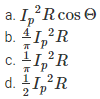
6. If the peak current is given by Ipthen how much power is dissipated by a sinusoidal ac current which flows through resistor of resistance R?
Alternating Current MCQs for NEET 1

Answer

Answer: (d) \(\frac{1}{2} I_{p}^{2} R\)


7. What is the frequency of ac mains in India?
(a) 120 Hz
(b) 60 Hz
(c) 50 Hz
(d) 30 Hz

Answer

Answer: (c) 50 Hz


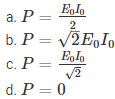
8. If a current I given by I0sin(ωt−\(\frac{\pi}{2}\)) flows across an AC circuit with potential E=E0sinωt, then what is the power consumption in the circuit?
Alternating Current MCQs for NEET 2

Answer

Answer: (d) P = 0


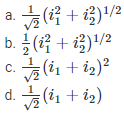
9. What is the r.m.s current value of an alternating current given by the equation of i=i1cosωt+i2sinωt ?
Alternating Current MCQs for NEET 3

Answer

Answer: (a) \(\frac{1}{\sqrt{2}}\left(i_{1}^{2}+i_{2}^{2}\right)^{1 / 2}\)


10. What is the peak value of the voltage of an electric lamp connected to a 220 V, 50 Hz supply?
(a) 311 V
(b) 320 V
(c) 211 V
(d) 210 V

Answer

Answer: (a) 311 V


Second Law of Motion MCQs for NEET

NEET  Physics is the scoring paper in the medical entrance examination. Here, you will discover the NEET Physics MCQ Questions for all Concepts as per the latest syllabus. Practice more on a regular basis with these NEET Physics objective questions on air pollution and improve your subject knowledge & problem-solving skills along with time management. NEET Physics Second Law of Motion Multiple Choice Questions make you feel confident in answering the question in the exam & increases your scores to high.

MCQ on Second Law of Motion

1. A bullet of 5 gms travels with a velocity of 100 m/sec. It penetrates a wooden block up to 6 cm. What is the average force imposed on the block by the bullet?
(a) 0
(b) 417 N
(c) 830 N
(d) 830 N

Answer

Answer: (b) 417 N


2. The second law of motion gives the measure of which of the following?
(a) Force
(b) Acceleration
(c) Momentum
(d) Angular Momentum

Answer

Answer: (a) Force


3. What is the velocity of a body of mass 5 gm if a force of 100 dynes acts on the body for 10 seconds?
(a) 2000 cm/sec
(b) 200 cm/sec
(c) 20 cm/sec
(d) 2 cm/sec

Answer

Answer: (b) 200 cm/sec


4. An object will possess uniform motion as long as the
(a) resultant force acting on it begins to decrease
(b) resultant force on acting on it increases continuously
(c) resultant force is right angles to its rotation
(d) resultant force acting on it is zero

Answer

Answer: (d) resultant force acting on it is zero


5. What is the accelerating force on the Diwali rocket if it ejects 0.05 kg of gases per second at a velocity fo 400 m/s?
(a) 20 N
(b) 20 dynes
(c) 1000 N
(d) 22 dynes

Answer

Answer: (a) 20 N


6. A coin dropped in the lift takes time t1 to reach the floor when the lift is stationary and time t2 when the lift moves with a constant acceleration. Which of the following relation is true?
(a) t1>t2
(b) t2>t1
(c) t1=t2
(d) t1>>t2

Answer

Answer: (a) t1>t2


7. A person standing in the elevator finds his weight to be lesser than his actual weight in which of the following cases?
(a) When the elevator moves upward with constant acceleration
(b) When the elevator moves downward with constant acceleration
(c) When the elevator moves upward with constant velocity
(d) When the elevator moves downward with constant velocity

Answer

Answer: (b) When the elevator moves downward with constant acceleration


8. A parachutist weighing w strikes the ground with his legs fixed and comes to rest with an upward acceleration of 3 g. What is the force exerted by him during landing?
(a) w
(b) 2w
(c) 3w
(d) 4w

Answer

Answer: (d) 4w


9. A man stands on a weighing machine in the lift. When the lift is stationary his weight is recorded as 40 kg. If the lift accelerates upwards with an acceleration of 2 m/s2 what weight will the machine show?
(a) 40 kg
(b) 48 kg
(c) 42 kg
(d) 32 kg

Answer

Answer: (b) 48 kg


10. Two trolleys of mass m and 3m are connected by a string. When they are compressed and released, they move off in opposite directions and come to rest after covering a distance of S1 and S2 respectively. Assuming the coefficient of friction to be constant, the ratio of S1: S2 is
(a) 1:9
(b) 1:3
(c) 3:1
(d) 9:1

Answer

Answer: (d) 9:1


11. What will happen if the body at rest is made to move in a straight line and obstructed by an opposite force?
(a) The body slows down
(b) The body changes direction
(c) The body will continue to move in the same direction with the same speed
(d) All of the above

Answer

Answer: (a) The body slows down


12. What is the apparent weight of the body travelling upwards with an acceleration of 2 m/s2 and has a mass of 10 kg?
(a) 198 N
(b) 140 N
(c) 118 N
(d) 164 N

Answer

Answer: (c) 118 N


13. On a body of 20 kg, a force of 10 N acts for 10 seconds. What is the change in its momentum?
(a) 1000 kg.m/s
(b) 200 kg.m/s
(c) 100 kg.m/s
(d) 5 kg.m/s

Answer

Answer: (c) 100 kg.m/s


14. A machine gun fires a bullet of mass 40 g with a velocity of 1200 ms-1. The man holding it cam exert a maximum force of 144 N on the gun. How many bullets can he fire per second at the most?
(a) One
(b) Two
(c) Three
(d) Four

Answer

Answer: (c) Three


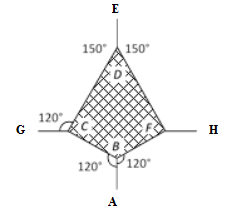
15. The figure shows a horizontal stretched net with a force of 10 N. The tension in sections BC and BF are
Second Law of Motion MCQs for NEET 1
(a) 10 N, 10 N
(b) 10 N, 11 N
(c) 10 N, 6 N
(d) Can’t calculate due to insufficient data

Answer

Answer: (a) 10 N, 10 N