MCQs on Photoelectric Effect For NEET

MCQs on Photoelectric Effect For NEET

NEET  Physics is the scoring paper in the medical entrance examination. Here, you will discover the NEET Physics MCQ Questions for all Concepts as per the latest syllabus. Practice more on a regular basis with these NEET Physics objective questions on air pollution and improve your subject knowledge & problem-solving skills along with time management. NEET Physics Photoelectric Effect Multiple Choice Questions make you feel confident in answering the question in the exam & increases your scores to high.

MCQ on Photoelectric Effect

1. Photoelectric effect was explained by
(a) Einstein
(b) Faraday
(c) Plank
(d) Hertz

Answer

Answer: (a) Einstein


2. In a photoelectric experiment for 4000 Å incident radiation, the potential difference to stop the ejection is 2 V. If the incident light is changed to 3000 Å, then the potential required to stop the ejection of electrons will be
(a) 2 V
(b) Less than 2 V
(c) Zero
(d) Greater than 2 V

Answer

Answer: (d) Greater than 2 V


3. Light of wavelength 4000 Å is incident on a sodium surface for which the threshold wavelength of photo-electrons is 5420 Å. The work function of sodium is
(a) 5 eV
(b) 3 eV
(c) 2.29 eV
(d) 0.57 eV

Answer

Answer: (c) 2.29 eV


4. Photocell is a device to
(a) Store photons
(b) Measure light intensity
(c) Convert photon energy into mechanical energy
(d) Store electrical energy for replacing storage batteries

Answer

Answer: (b) Measure light intensity


5. Photoelectrons stopping potential depends on
(a) Frequency of incident light and nature of the cathode material
(b) The intensity of the incident light
(c) The frequency of the incident light
(d) Nature of cathode material

Answer

Answer: (a) Frequency of incident light and nature of the cathode material


6. What is the value of the maximum kinetic energy acquired by electron due to radiation of wavelength 100 nm?
(a) 12 eV
(b) 6.2 eV
(c) 100 eV
(d) 300 eV

Answer

Answer: (b) 6.2 eV


7. The stopping potential value is 0.6 V when the light source is kept at a distance of 20 cm. When the source is kept at 40 cm away, the stopping potential will be
(a) 0.6 V
(b) 0.3 V
(c) 1.2 V
(d) 2.4 V

Answer

Answer: (a) 0.6 V


8. If the work function for a certain metal is 3.2 x 10⁻¹⁹ joule and it is illuminated with light of frequency 8 x 10¹⁴ Hz. The maximum kinetic energy of the photo-electrons would be (h= 6.63 x 10⁻³⁴ Js).
(a) 2.1 x 10⁻¹⁹ J
(b) 8.5 x 10⁻¹⁹ J
(c) 5.3 x 10⁻¹⁹ J
(d) 3.2 x 10⁻¹⁹ J

Answer

Answer: (a) 2.1 x 10⁻¹⁹ J


9. A photocell is receiving light from a source placed at a distance of 1m. If the same source is to be placed at a distance of 2 m, then the ejected electron
(a) Moves in one-fourth energy as that of the initial energy
(b) Moves with one-fourth momentum as that of the initial momentum
(c) Will be half in number
(d) Will be one-fourth in number

Answer

Answer: (d) Will be one-fourth in number


10. The minimum energy required to remove an electron is called
(a) Stopping potential
(b) Kinetic energy
(c) Work function
(d) None of these

Answer

Answer: (c) Work function


Oscillation MCQs for NEET

Oscillation MCQs for NEET

NEET  Physics is the scoring paper in the medical entrance examination. Here, you will discover the NEET Physics MCQ Questions for all Concepts as per the latest syllabus. Practice more on a regular basis with these NEET Physics objective questions on air pollution and improve your subject knowledge & problem-solving skills along with time management. NEET Physics Oscillation Multiple Choice Questions make you feel confident in answering the question in the exam & increases your scores to high.

MCQs on Oscillation

1. The time period of a simple pendulum is T remaining at rest inside a lift. Find the time period of the pendulum when the lift starts to move up with an acceleration of g/3
(a) T
(b) T/2
(c) 2T/5
(d) T√3/2

Answer

Answer: (d) T√3/2


2. The length of the second’s pendulum on the surface of the earth is 1m. The length of the same pendulum on the surface of the moon, where the acceleration due to gravity is (⅙)th of the g on the surface of the earth is
(a) 36 m
(b) 1m
(c) 1/36 m
(d) ⅙ m

Answer

Answer: (d) ⅙ m


3. The displacement of a particle performing simple harmonic motion is given by,x= 8 sin ωt + 6 cos ωt, where distance is in cm and time is in second. The amplitude of motion is
(a) 10 cm
(b) 14 cm
(c) 2 cm
(d) 3.5 cm

Answer

Answer: (a) 10 cm


4. A particle executes S.H.M of amplitude A. At what distance from the mean position is its kinetic energy equal to its potential energy?
(a) 0.51 A
(b) 0.61 A
(c) 0.71 A
(d) 0.81 A

Answer

Answer: (c) 0.71 A


5. A simple pendulum on length l and mass m is suspended vertically. The string makes an angle θ with the vertical. The restoring force acting on the pendulum is
(a) mg tanθ
(b) mg sinθ
(c) – mg sinθ
(d) – mg cosθ

Answer

Answer: (c) – mg sinθ


6. The mass and diameter of a planet are twice those of earth. The period of oscillation of pendulum on this planet will be (if it is a second’s pendulum on earth)
(a) 1/√2 second
(b) 2 x √2 second
(c) 2 second
(d) ½ second

Answer

Answer: (b) 2 x √2 second


7. A particle of mass m is hanging vertically by an ideal spring of force constant k. If the mass is made to oscillate vertically, its total energy is
(a) Maximum at extreme position
(b) Maximum at mean position
(c) Minimum at mean position
(d) Same at all positions

Answer

Answer: (d) Same at all positions


8. A a place where g = 980 cm/secthe length of seconds pendulum is about
(a) 50 cm
(b) 100 cm
(c) 2 cm
(d) 2 m

Answer

Answer: (b) 100 cm


9. The maximum velocity for a particle in S.H.M is 0.16 m/s and maximum acceleration is 0.64 m/s2 .The amplitude is
(a) 4 x 10⁻² m
(b) 4 x 10⁻¹ m
(c) 4 x 10 m
(d) 4 x 100 m

Answer

Answer: (a) 4 x 10⁻² m


10. For a magnet of a time period T magnetic moment is M. If the magnetic moment becomes one-fourth of the initial value, then the time period of oscillation becomes
(a) Half of the initial value
(b) One-fourth of the initial value
(c) Double of the initial value
(d) Four times the initial value

Answer

Answer: (c) Double of the initial value


MCQ Questions on Human Physiology

MCQ Questions on Human Physiology

MCQ Questions on Human Physiology

1. Name the site where digestion of proteins occurs.
(a) Pancreas
(b) Rectum
(c) Liver
(d) IIeum

Answer

Answer: (d) IIeum


2. Stomach epithelial cells in the body secrete ________
(a) Hydrochloric acid
(b) Oxytocin
(c) Adrenaline
(d) Testosterone

Answer

Answer: (a) Hydrochloric acid


3. Night blindness and xerophthalmia are generally conditions associated with the deficiency of which vitamin?
(a) Vitamin B
(b) Vitamin K
(c) Vitamin B2
(d) Vitamin A

Answer

Answer: (d) Vitamin A


4. ___________ are functional units of food absorption.
(a) Red blood cells
(b) Small intestine
(c) Villi
(d) Aggregated lymphoid nodules

Answer

Answer: (c) Villi


5. Where are the parotid glands located?
(a) Below the stomach
(b) Behind and above the pancreas
(c) Below and in front of the ear canal
(d) Underneath the armpits

Answer

Answer: (c) Below and in front of the ear canal


6. The maximum amount of carbon dioxide in the human body is transported as:
(a) Bicarbonate
(b) Carbide
(c) Amylase
(d) None of the above

Answer

Answer: (a) Bicarbonate


7. Which of the following organisms have book lungs?
(a) Spider
(b) Ant
(c) Penguin
(d) Sealion

Answer

Answer: (a) Spider


8. Altitude sickness is typically caused due to:
(a) The partial pressure of oxygen
(b) Increased levels of CO2 in blood
(c) Cold temperatures
(d) None of the above

Answer

Answer: (a) The partial pressure of oxygen


9. Hypopnea is a condition where:
(a) The airway becomes partially obstructed
(b) The blood does not clot properly
(c) The lungs cannot eliminate the excess carbon dioxide from the body
(d) The blood oxygen levels are abnormally low

Answer

Answer: (a) The airway becomes partially obstructed


10. Emphysema is characterized by:
(a) Loss of peripheral vision
(b) Shortness of breath
(c) Chronic Diarrhea
(d) Slow clotting from wounds

Answer

Answer: (b) Shortness of breath


11. Humans have _____ lobes in the left lung.
(a) 3
(b) 2
(c) 4
(d) 1

Answer

Answer: (b) 2


12. Jellyfish breathe through:
(a) Book lungs
(b) Gills
(c) Diffusion
(d) None of the above

Answer

Answer: (c) Diffusion


13. Which of the following statements are false?
(a) Pituitary Gland is found at the base of the brain
(b) Adrenal glands are found on top of the kidneys
(c) Lymph nodes are found only near the neck and armpits
(d) Thyroid glands are ductless glands

Answer

Answer: (c) Lymph nodes are found only near the neck and armpits


14. The primary function of the cerebrospinal fluid is to:
(a) Protect the brain
(b) Provide nutrients to the surrounding tissues
(c) Remove waste products
(d) All of the above

Answer

Answer: (d) All of the above


15. The lungs are protected by:
(a) Sternum
(b) Rib cage
(c) Backbone
(d) All of the above

Answer

Answer: (d) All of the above


MCQs on Waves Optics for NEET

MCQs on Waves Optics for NEET

NEET  Physics is the scoring paper in the medical entrance examination. Here, you will discover the NEET Physics MCQ Questions for all Concepts as per the latest syllabus. Practice more on a regular basis with these NEET Physics objective questions on air pollution and improve your subject knowledge & problem-solving skills along with time management. NEET Physics Waves Optics Multiple Choice Questions make you feel confident in answering the question in the exam & increases your scores to high.

MCQ on Waves Optics

1. Polarisation phenomenon explains which nature of light?
(a) Transverse
(b) longitudinal
(c) Both transverse and longitudinal
(d) geometrical

Answer

Answer: (a) Transverse


2. A narrow slit is taken and a parallel beam of moving electrons is incident normally on it. At a larger distance from the slit, a fluorescent screen is placed. Which of the following statement is true if the size of the slit is further narrowed?
(a) The diffraction pattern cannot be observed on the screen
(b) The angular width of the central maxima of the diffraction pattern will increase
(c) The angular width of the central maxima of the diffraction pattern will decrease
(d) The angular width of the central maxima of the diffraction pattern remains the same

Answer

Answer: (b) The angular width of the central maxima of the diffraction pattern will increase


3. How does the diffraction band of blue light look in comparison with the red light?
(a) No changes
(b) Diffraction pattern becomes narrower
(c) Diffraction pattern becomes broader
(d) Diffraction pattern disappears

Answer

Answer: (b) Diffraction pattern becomes narrower


4. Two coherent sources of light can be obtained from
(a) Two different lamps
(b) Two different lamps but of the same colour
(c) Two different lamps of the same colour and having the same colour
(d) None of these

Answer

Answer: (d) None of these


5. Which of the following phenomenon is not explained by Huygen’s wave theory?
(a) Diffraction
(b) Interference
(c) Polarisation
(d) Photoelectric effect

Answer

Answer: (d) Photoelectric effect


6. What is the value of coherent time if L is the coherent length and c is the velocity of light?
(a) cL
(b) L/c
(c) c/L
(d) 1/Lc

Answer

Answer: (b) L/c


7. The ratio of the amplitude of the two sources producing interference 3 : 5, the ratio of intensities at maxima and minima is
(a) 25:6
(b) 5:3
(c) 16:1
(d) 25:9

Answer

Answer: (c) 16:1


8. The colours on the soap bubble is due to
(a) Interference
(b) Polarisation
(c) Diffraction
(d) Reflection

Answer

Answer: (a) Interference


9. Which of the following statements indicates that light waves are transverse?
(a) Light waves can be polarised
(b) Light waves can show interference
(c) Light waves undergo diffraction
(d) They travel in the vacuum

Answer

Answer: (a) Light waves can be polarised


10. In Young’s double-slit experiment, the phase difference between the light waves reaching the third bright fringe from the central fringe will be (λ=6000 Å)
(a) Zero
(b) 2π
(c) 4π
(d) 6π

Answer

Answer: (d) 6π


Lami’s Theorem MCQ for NEET

Lami’s Theorem MCQ for NEET

NEET  Physics is the scoring paper in the medical entrance examination. Here, you will discover the NEET Physics MCQ Questions for all Concepts as per the latest syllabus. Practice more on a regular basis with these NEET Physics objective questions on air pollution and improve your subject knowledge & problem-solving skills along with time management. NEET Physics Lami’s Theorem Multiple Choice Questions make you feel confident in answering the question in the exam & increases your scores to high.

MCQ on Lami’s Theorem

1. Three coplanar forces A, B and C acting at a point in the plane are in equilibrium. If the given value of A is 1.9318 kg wt and sinθ1 is 0.9659, what is the value of C?
(a) 1
(b) 2
(c) 0.9659
(d) ½

Answer

Answer: (a) 1


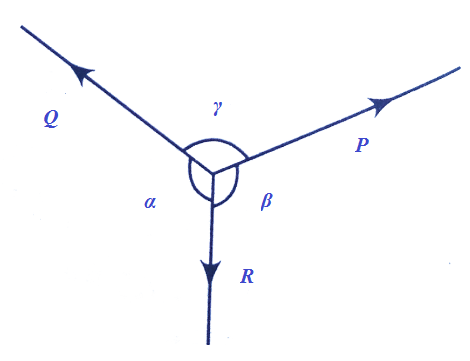
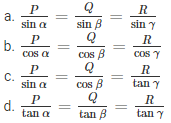
2. A body under the action of coplanar forces X, Y and Z, is in equilibrium as shown in the figure. Which of the following is the correct statement?
Lami’s Theorem MCQ for NEET 1
Lami’s Theorem MCQ for NEET 2

Answer

Answer: (a)


3. If the body is under equilibrium under the influence of a set of non-colinear force, then the minimum number of forces has to be
(a) Two
(b) Three
(c) Four
(d) Five

Answer

Answer: (b) Three


4. What is the minimum number of non-zero vectors in different planes that can be added to give a resultant of zero?
(a) Two
(b) Three
(c) Four
(d) Five

Answer

Answer: (c) Four


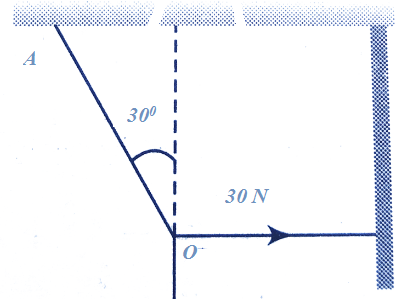
5. In the given figure, the tension in the horizontal cord is 30 N. What is the weight W and tension in the string OA in Netwon?
Lami’s Theorem MCQ for NEET 3
(a) 30√3, 30
(b) 60√3, 30
(c) 30√3, 60
(d) 60√3, 60

Answer

Answer: (c) 30√3, 60


6. According to Lami’s theorem which of the following statements is true?
(a) Three forces acting at a point will be in equilibrium.
(b) Three forces acting upon a particle will be in equilibrium if they are represented in magnitude and direction by the sides of a triangle, taken in order.
(c) If three forces acting at a point are in equilibrium, each force is proportional to the sine of the angle between the other two.
(d) Three forces acting at a point can be represented by a triangle, each side being proportional to the force.

Answer

Answer: (c) If three forces acting at a point are in equilibrium, each force is proportional to the sine of the angle between the other two.


7. Which of the following theories states that “if a body is in equilibrium under the action of three coplanar and concurrent forces, each of the forces is proportional to the sine of the angle between the other two.”
(a) Parallelogram Law of Forces
(b) Lami’s Theorem
(c) Triangle Law of Forces
(d) Polygon Law of Forces

Answer

Answer: (b) Lami’s Theorem


8. Which of the following is true about Lami’s theorem?
(a) The theorem is derived based on the cosine rule of trigonometry
(b) The theorem is only applicable to regular shaped bodies in equilibrium
(c) The theorem is helpful in determining the unknown forces acting at a point for an object in equilibrium.
(d) The theorem determines the forces acting on a moving body.

Answer

Answer: (c) The theorem is helpful in determining the unknown forces acting at a point for an object in equilibrium.


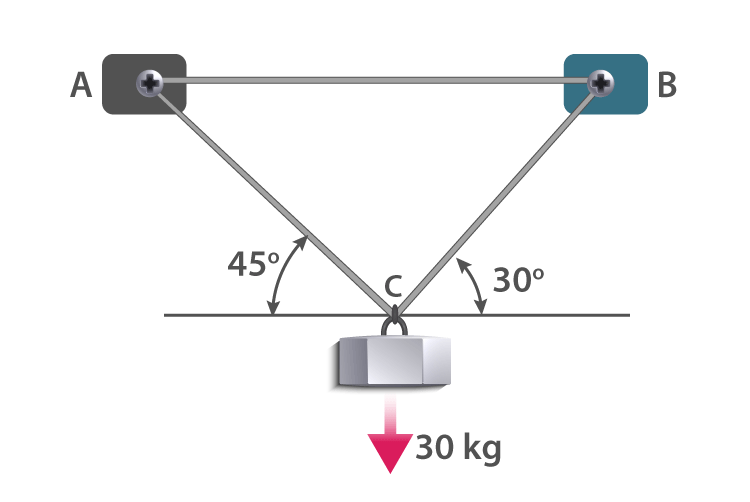
9. A 30 kg iron block is suspended using supports A and B as shown in the figure. What is the tension in both ropes?
Lami’s Theorem MCQ for NEET 4
(a) 263.566 N and 215.2 N
(b) 463.566 N and 415.2 N
(c) 663.566 N and 615.2 N
(d) 863.566 N and 815.2 N

Answer

Answer: (a) 263.566 N and 215.2 N


10. In the figure given below, the advertisement board having a mass of 6 kg is suspended by two strings which makes an angle of 450 with the signboard. How much is the tension in both the strings?
(a) 21.6 N
(b) 41.6 N
(c) 61.6 N
(d) 81.6 N

Answer

Answer: (b) 41.6 N


Semiconductor Diode MCQs for NEET

Semiconductor Diode MCQs for NEET

NEET  Physics is the scoring paper in the medical entrance examination. Here, you will discover the NEET Physics MCQ Questions for all Concepts as per the latest syllabus. Practice more on a regular basis with these NEET Physics objective questions on air pollution and improve your subject knowledge & problem-solving skills along with time management. NEET Physics Semiconductor Diode Multiple Choice Questions make you feel confident in answering the question in the exam & increases your scores to high.

MCQs on Semiconductor Diode

1. In the forward bias arrangements of a PN junction diode
(a) The N end is connected to the positive terminal of the battery
(b) The P end is connected to the positive terminal of the battery
(c) The direction of the current is from N end to the P end in the diode
(d) The P end is connected to the negative terminal of the battery

Answer

Answer: (b) The P end is connected to the positive terminal of the battery


2. In a PN junction diode
(a) The current in the reverse biased condition is generally very small
(b) The current in the reverse biased condition is generally very small but the forward-biased current is independent of the bias voltage
(c) The reverse-biased current is strongly dependent on the applied bias voltage
(d) The forward biased current is very small in comparison to reverse-biased current.

Answer

Answer: (a) The current in the reverse biased condition is generally very small


3. The cut-in voltage for silicon diode is approximately
(a) 0.2 V
(b) 0.6 V
(c) 1.1 V
(d) 1.4 V

Answer

Answer: (b) 0.6 V


4. The electrical resistance of the depletion layer is large because
(a) It has no change carriers
(b) It has a large number of charge carriers
(c) It contains electrons as charge carriers
(d) It has holes as charge carriers

Answer

Answer: (a) It has no change carriers


5. If the forward voltage in a semiconductor diode is doubled, the width of the depletion layer will
(a) Become half
(b) Become one-fourth
(c) Remain unchanged
(d) Become double

Answer

Answer: (a) Become half


6. The PN junction diode is used as
(a) An amplifier
(b) A rectifier
(c) An oscillator
(d) A modulator

Answer

Answer: (b) A rectifier


7. When a PN junction diode is reverse biased
(a) Electrons and holes are attracted towards each other and move towards the depletion region
(b) Electrons and holes move away from the junction depletion region
(c) Height of the potential barrier decreases
(d) No change in the current takes place

Answer

Answer: (b) Electrons and holes move away from the junction depletion region


8. A PN junction has a thickness of the order
(a) 1 cm
(b) 1 mm
(c) 10-6 m
(d) 10-12 cm

Answer

Answer: (c) 10-6 m


9. In the depletion region of an unbiased PN junction diode there are
(a) Only electrons
(b) Only holes
(c) Both electrons and holes
(d) Only fixed ions

Answer

Answer: (d) Only fixed ions


10. On increasing the reverse bias to a large value in a PN junction diode, current
(a) Increases slowly
(b) Remains fixed
(c) Suddenly increases
(d) Decreases slowly

Answer

Answer: (c) Suddenly increases