Biology MCQs for Class 12 with Answers Chapter 10 Microbes in Human Welfare

Free PDF Download of CBSE Biology Multiple Choice Questions for Class 12 with Answers Chapter 10 Microbes in Human Welfare. Biology MCQs for Class 12 Chapter Wise with Answers PDF Download was Prepared Based on Latest Exam Pattern. Students can solve NCERT Class 12 Biology Microbes in Human Welfare MCQs Pdf with Answers to know their preparation level.

Microbes in Human Welfare Class 12 Biology MCQs Pdf

1. Lactic acid is formed by the process of
(a) fermentation
(b) glycolysis
(c) citric acid cycle
(d) P-oxidation

Answer

Answer: a


2. Nitrogen fixation in root nodules of Alnus is brought about by
(a) Frankia
(b) Azospirillum
(c) Nostoc
(d) Rhizobium

Answer

Answer: a


3. Bacillus thuringiensis is used to control
(a) fungal pathogens
(b) nematodes
(c) bacterial pathogens
(d) insect pests.

Answer

Answer: d


4. Propionibacterium produces large holes in swiss cheese due to the
(a) process of oxidation of the dough
(b) formation of large amount of CO2
(c) consumption of carbohydrates
(d) all of these

Answer

Answer: b


5. The primary treatment of waste water involves the removal of [NCERT Exemplar]
(a) dissolved impurities
(b) stable particles
(c) toxic substances
(d) harmful bacteria.

Answer

Answer: b


6. Which one of the following is not a nitrogenfixing organism? [NCERT Exemplar]
(a) Anabaena
(b) Nostoc
(c) Azotobacter
(d) Pseudomonas

Answer

Answer: d


7. BOD of waste water is estimated by measuring the amount of [NCERT Exemplar]
(a) total organic matter
(b) biodegradable organic matter
(c) oxygen evolution
(d) oxygen consumption.

Answer

Answer: d


8. The vitamin whose content increases following the conversion of milk into curd by lactic acid bacteria is [NCERT Exemplar]
(a) vitamin C
(b) vitamin D
(c) vitamin B12
(d) vitamin E.

Answer

Answer: c


9. Which one of the following alcoholic drinks is produced without distillation? [NCERT Exemplar]
(a) Wine
(b) Whisky
(c) Rum
(d) Brandy

Answer

Answer: a


10. The residue left after methane production from cattle dung is [NCERT Exemplar]
(a) burnt
(b) burned in land fills
(c) used as manure
(d) used in civil construction.

Answer

Answer: c


11. Methanogens, growing anaerobically on cellulosic material, produce
(a) methane gas
(b) methane and carbon dioxide
(c) methane and hydrogen
(d) methane, carbon dioxide, hydrogen.

Answer

Answer: d


12. Cyanobacteria are used as biofertilisers because they
(a) are photosynthetic
(b) grow easily anywhere
(c) have mucilage
(d) fix atmospheric nitrogen

Answer

Answer: d


13. Alexander Fleming, Ernest Chain and ______ were awarded Nobel Prize for the discovery of penicillin.

Answer/Explanation

Answer:
Explaination: Howard Florey.


14. The enzymes, ______ are used in detergent formulations to remove oil stains.

Answer/Explanation

Answer:
Explaination: Lipases.


15. Treatment of sewage water is done by the _____ microbes naturally present in the sewage.

Answer/Explanation

Answer:
Explaination: Heterotrophic.


16. Filtration and ______ are used in the primary treatment of sewage.

Answer/Explanation

Answer:
Explaination: Sedimentation.


17. ______ species of fungi form mycorrhizae.

Answer/Explanation

Answer:
Explaination: Glomus.


18. ______ are organisms, which enrich the nutrient quality of the soil.

Answer/Explanation

Answer:
Explaination: Biofertilizers.


19. ______ are masses of bacteria associated with fungal hyphae.

Answer/Explanation

Answer:
Explaination: Floes.


20. ______ produces the enzyme, used as clot buster.

Answer/Explanation

Answer:
Explaination: Streptococcus.


21. Manufacture of beverages and other useful products for human welfare requires growing of microbes in large vessels, called ______ .

Answer/Explanation

Answer:
Explaination: Fermentors.


22. ______ is the traditional drink made by fermenting the sap from palms, in South India.

Answer/Explanation

Answer:
Explaination: Toddy.


23. Match the list of microbes in Column I with their commercially important products in Column II.

Column I Column II
A. Lactobacillus 1. Acetic acid
B. Clostridium butylicum 2. Citric acid
C. Aspergillusniger 3. Lactic acid
D. Saccharomyces cereviseae 4. Butyric acid
E. Acetobacter aceti
Answer/Explanation

Answer:
Explaination: A – 3, B – 4, C – 2, E – 1


24. Match the items in Column I with those in Column II.

Column I Column II
A. Penicillium notatum 1. Biogas
B. Propioni-bacterium sharmanii 2. Statins
C. Trichoderma polysporum 3. Antibiotic, Penicillin
D. Methano-bacterium 4. Swiss cheese
5. Cyclosporin A
Answer/Explanation

Answer:
Explaination: A – 3, B – 4, C – 5, D – 1


25. Trichoderma is a fungus used as a biocontrol agent. [True/False]

Answer/Explanation

Answer:
Explaination: True.


26. Cyclosporin A is used for lowering the blood cholesterol level. [True/False]

Answer/Explanation

Answer:
Explaination: False.


27. Biogas plants are more often built in rural areas. [True/False]

Answer/Explanation

Answer:
Explaination: True.


28. Ladybird beetle and mycorrhizae control many insect pests. [True/False]

Answer/Explanation

Answer:
Explaination: False.


29. Bacteria, viruses and fungi are used as biofertilisers. [True/False]

Answer/Explanation

Answer:
Explaination: False.


Directions: (Q30 to Q33): Mark the odd one in each of the following groups.
30. Anabaena, Streptococcus, Nostoc, Oscillatoria.

Answer/Explanation

Answer:
Explaination: Streptococcus


31. Dragonflies, Trichoderma, Baculoviruses, Streptococcus.

Answer/Explanation

Answer:
Explaination: Streptococcus


32. Whisky, Wine, Brandy, Rum.

Answer/Explanation

Answer:
Explaination: Wine


33. Clostridium, Lactobacillus, Aspergillus, Acetobacter.

Answer/Explanation

Answer:
Explaination: Aspergillus


34. What are prions?

Answer/Explanation

Answer:
Explaination: Prions are the proteinaceous infectious agents.


35. Name the nutrient that gets enhanced while curdling of milk by Lactobacillus. [Delhi 2013C]

Answer/Explanation

Answer:
Explaination: Vitamin B12.


36. Name the gas released and the process responsible for puffing up of the bread dough when Saccharomyces cereviseae is added to it. [Delhi 2013C]
Or
Name the metabolic pathway associated with the rising of dough in making bread. What makes the dough rise? [Delhi 2012C]

Answer/Explanation

Answer:
Explaination:
– The carbon dioxide released is responsible for the rising of dough.
– Fermentation is the process.


37. Which one of the following is the baker’s yeast used in fermentation?
Saccharum barberi, Saccharomyces cereviseae, Sonalika

Answer/Explanation

Answer:
Explaination: Saccharomyces cereviseae.


38. What is toddy?

Answer/Explanation

Answer:
Explaination: Toddy is a traditional drink made by fermenting sap from palms.


39. Write the scientific name of the microbe used for fermenting malted cereals and fruit juices. [Delhi 2011]

Answer/Explanation

Answer:
Explaination: Saccharomyces cereviseae


40. Give the scientific name of the source organism from which the first antibiotic was produced. [Foreign 2014]

Answer/Explanation

Answer:
Explaination: Penicillium notatum.


41. Who won the Nobel Prize for the discovery of Penicillin?

Answer/Explanation

Answer:
Explaination: Ernst Chain, Howard Florey and Alexander Fleming.


42. Why do we prefer to call secondary waste water treatment as biological treatment? [HOTS]

Answer/Explanation

Answer:
Explaination: Secondary treatment of waste water is a biological process as it employs the heterotrophic microbes naturally present in the sewage.


43. What are ‘floes’ formed during secondary treatment of sewage? [Delhi 2019]

Answer/Explanation

Answer:
Explaination: Floes are the masses of bacteria associated with fungal hyphae to form mesh-like structures.


44. Mention the information that the health workers derive by measuring BOD of a water body. [AI 2010]

Answer/Explanation

Answer:
Explaination:
– The greater the BOD of a waterbody, more is its polluting potential.
– BOD is the measure of uptake of oxygen by the miocrobes in the water sample and indicates the amount of organic matter present in the water.


45. Why is sewage water treated until the BOD is reduced? Give a reason. [Delhi 2010C]

Answer/Explanation

Answer:
Explaination: Sewage water is treated to reduce the BOD, because higher the BOD of the water, greater is its polluting potential.


46. Write any two places where methanogens can be found. [Delhi 2019]

Answer/Explanation

Answer:
Explaination:
– They are found in the rumen of cattle and anaerobic sludge produced during sewage treatment.


47. Why is cow dung used in the generation of biogas? [HOTS]

Answer/Explanation

Answer:
Explaination:
Cow dung contains both
(i) Cellulosic materials, i.e., the raw material.
(ii) Methanogens, i.e., the microbes needed for production of biogas.


48. Who developed the technology of biogas production in India?

Answer/Explanation

Answer:
Explaination: Indian Agricultural Research Institute and Khadi and Village Industries Commission.


49. What is meant by biocontrol?

Answer/Explanation

Answer:
Explaination: Biocontrol means the use of biological methods or living organisms for controlling pathogens and pests.


50. What makes the Nucleopolyhedrovirus a desirable biological control agent? [AI 2013C]
Or
What is the significance of Nucleopolyhe-drovirus in pest management? [AI 2012C]

Answer/Explanation

Answer:
Explaination: They are species-specific and narrow- spectrum insecticides; they have no negative impacts on other organisms.


We hope the given Biology MCQs for Class 12 with Answers Chapter 10 Microbes in Human Welfare will help you. If you have any query regarding CBSE Class 12 Biology Microbes in Human Welfare MCQs Pdf, drop a comment below and we will get back to you at the earliest.

Chemistry MCQs for Class 12 with Answers Chapter 10 Haloalkanes and Haloarenes

Free PDF Download of CBSE Chemistry MCQs for Class 12 with Answers Chapter 10 Haloalkanes and Haloarenes.  Chemistry MCQs for Class 12 Chapter Wise with Answers was Prepared Based on Latest Exam Pattern. Students can solve NCERT Class 12 Chemistry Haloalkanes and Haloarenes MCQs Pdf with Answers to know their preparation level.

Haloalkanes and Haloarenes Class 12 Chemistry MCQs Pdf

1. Which of the following undergoes nucleophilic substitution exclusively by SN 1 mechanism?
(a) Benzyl chloride
(b) Ethyl chloride
(c) Chlorobenzene
(d) Isopropyl chloride

Answer/Explanation

Answer: a
Explaination:
(a) It is because benzyl carbocation is stabilised by resonance.


2. The increasing order of nucleophilicity would be
(a) Cl < Br < I
(b) I < Cl < Br
(c) Br < Cl < F
(d) I < Br < Cl

Answer/Explanation

Answer: a
Explaination:
(a) l is best nucleophile because it can donate electron easily.


3.
Chemistry MCQs for Class 12 with Answers Chapter 10 Haloalkanes and Haloarenes 1

Answer/Explanation

Answer: a
Explaination:
(a) ∵ 3° carbocation is most stable.
Chemistry MCQs for Class 12 with Answers Chapter 10 Haloalkanes and Haloarenes 31


4. Which of the following is most reactive towards SN1 reaction?
(a) C6H5C(CH3)C6H5Br
(b) C6H5CH2Br
(c) C6H5CH(C6H5)Br
(d) C6H5CH(CH3)Br

Answer/Explanation

Answer: a
Explaination:
(a) Since it is 3° halide, carbocation is stabilised by resonance.


5. The correct order of increasing the reactivity of C—X bond towards nucleophile in following compounds
Chemistry MCQs for Class 12 with Answers Chapter 10 Haloalkanes and Haloarenes 2
(a) IV < III < I < II
(c) I < II < IV < III
(b) III < II < I < IV
(d) II < III < I < IV

Answer/Explanation

Answer: c
Explaination:
(c) III is most reactive due to stability of 3° carbocation, -NO2 (electron withdrawing) group increase nucleophilic substitution reaction.


6. m-Xylene reacts with Br2 in presence of FeBr3, what are products formed
Chemistry MCQs for Class 12 with Answers Chapter 10 Haloalkanes and Haloarenes 3
Chemistry MCQs for Class 12 with Answers Chapter 10 Haloalkanes and Haloarenes 4

Answer/Explanation

Answer: c
Explaination:
(c) It is due to stearic hinderance, these products will be formed, —CH3 group is o andp-directing.


7. Which of the following compound will undergo racemisation when reacts with aq. KOH?
Chemistry MCQs for Class 12 with Answers Chapter 10 Haloalkanes and Haloarenes 5
(a) (i) and (ii)
(b) (ii) and (iv)
(c) (iii) and (iv)
(d) (iv)

Answer/Explanation

Answer: d
Explaination:
(d) IV.
Since, it has chiral ‘C’ atom, others do not have.


8.
Chemistry MCQs for Class 12 with Answers Chapter 10 Haloalkanes and Haloarenes 6

Answer/Explanation

Answer: c
Explaination:
(c) Since, its carbocation is stabilised by resonance as well as +1 effect.


9. CH3CH2CH2Br + NaCN → CH3CH2CH2CN + NaBr, will be fastest in
(a) ethanol
(b) methanol
(c) N, N dimethyl formamide
(d) Water

Answer/Explanation

Answer: c
Explaination: (c) It is favoured by non-polar solvent.


10.
Chemistry MCQs for Class 12 with Answers Chapter 10 Haloalkanes and Haloarenes 7

Answer/Explanation

Answer: d
Explaination:
(d) It is substitution reaction but follows benzyne mechanism.
Chemistry MCQs for Class 12 with Answers Chapter 10 Haloalkanes and Haloarenes 32


11. A dihalogen derivative ‘X’ of a hydrocarbon with three carbon atoms react with ale. KOH and produces hydrocarbon which forms red ppt. with ammonical Cu2Cl2. ‘X’ gives an aldehyde on reaction with aq. KOH. The compound ‘X’ is
(a) 1, 3-Dichloropropane
(b) 1, 2-Dichloropropane
(c) 2, 2-Dichloropropane
(d) 1, 1-Dichloropropane

Answer/Explanation

Answer: d
Explaination: d
Chemistry MCQs for Class 12 with Answers Chapter 10 Haloalkanes and Haloarenes 33


12. The synthesis of alkyl fluoride is best accomplished by
(a) Finkelstein reaction
(b) Swartz reaction
(c) Free radical fluorination
(d) Sandmeyers reaction

Answer/Explanation

Answer: b
Explaination:
(b) C2H5Cl + AgF → C2H5F + AgCl.


13. How many chiral compounds are possible on monochlorination of 2-methyl butane?
(a) 2
(b) 4
(c) 6
(d) 8

Answer/Explanation

Answer:
Explaination:
Chemistry MCQs for Class 12 with Answers Chapter 10 Haloalkanes and Haloarenes 34


14. The increasing order of reactivity towards SN1 mechanism is
Chemistry MCQs for Class 12 with Answers Chapter 10 Haloalkanes and Haloarenes 8
(a) III < II < I
(b) II < I < III
(c) I < III < II
(d) II < III < I

Answer/Explanation

Answer: b
Explaination:
(b) ∵ 1° < 2° < Benzyl carbocation with OCH3 at p-position is order of stability of carbocation.


15. Arrange the following compounds in the increasing order of their densities. [NCERT Exemplar]
Chemistry MCQs for Class 12 with Answers Chapter 10 Haloalkanes and Haloarenes 9
(a) (i) < (ii) < (iii) < (iv)
(b) (i) < (iii) < (iv) < (ii)
(c) (iv) < (iii) < (ii) < (i)
(d) (ii) < (iv) < (iii) < (i)

Answer/Explanation

Answer: a
Explaination: (a) Higher the molecular weight, higher will be density.


16. What is ‘A’ in the following reaction? [NCERT Exemplar]
Chemistry MCQs for Class 12 with Answers Chapter 10 Haloalkanes and Haloarenes 10
Chemistry MCQs for Class 12 with Answers Chapter 10 Haloalkanes and Haloarenes 11

Answer/Explanation

Answer: c
Explaination:
(c) It is MarkownikofFs addition, secondary carbocation is more stable.


17. Which of the following alkyl halides will undergo SN1 reaction most readily? [NCERT Exemplar]
(a) (CH3)3 C—F
(b) (CH3)3 C—Cl
(c) (CH3)3 C—Br
(d) (CH3)3 C—I

Answer/Explanation

Answer: d
Explaination:
(d) It is because C—I bond is weakest due to longer bond length.


18. Which of the carbon atoms present in the molecule given below are asymmetric? [NCERT Exemplar]
Chemistry MCQs for Class 12 with Answers Chapter 10 Haloalkanes and Haloarenes 12
(a) 1, 2, 3, 4
(b) 2, 3
(c) 1, 4
(d) 1, 2, 3

Answer/Explanation

Answer: b
Explaination:
(b) 2 and 3 are chiral as these are linked with four different groups.


19. Which of the following compounds will give racemic mixture on nucleophilic substitution by OH” ion? [NCERT Exemplar]
Chemistry MCQs for Class 12 with Answers Chapter 10 Haloalkanes and Haloarenes 13

Answer/Explanation

Answer: a
Explaination:
(a) Since it is optically active 2° halide, will follow SN1 mechanism.


20. Which of the following compounds will give racemic mixture on nucleophilic substitution by OH” ion? [NCERT Exemplar]
1-Bromoethane, 1-Bromopropane, 1-Bromobutane, Bromobenzene
(a) Bromobenzene < 1-Bromobutane < 1-Bromopropane < 1-Bromoethane
(b) Bromobenzene < 1-Bromoethane < 1-Bromopropane < 1-Bromobutane
(c) 1-Bromopropane < 1-Bromobutane < 1-Bromoethane < Bromobenzene
(d) 1-Bromoethane < 1-Bromopropane < 1-Bromobutane < Bromobenzene

Answer/Explanation

Answer: d
Explaination:
(d) Higher the molecular weight, higher will be boiling point.


21. SN1 reaction of alkyl halides lead to
(a) Retention of configuration
(b) Racemisation
(c) Inversion of configuration
(d) None of these

Answer

Answer: b


22. p-djchlorobenzene has higher melting point than its o- and m- isomers because
(a) p-dichlorobenzene is more polar than o- and m- isomer.
(b) p-isomer has a symmetrical crystalline structure.
(c) boiling point of p-isomer is more than o- and m-isomer.
(d) All of these are correct reasons.

Answer

Answer: b


23. Chloropicrin is formed by the reaction of
(a) steam on carbon tetrachloride.
(b) nitric acid on chlorobenzene.
(c) chlorine on picric acid.
(d) nitric acid on chloroform.

Answer

Answer: d


24. Fitting reaction can be used to prepare
(a) Toluene
(b) Acetophenon
(c) Diphenyl
(d) Chlorobenzene

Answer

Answer: c


25. Identify the end product (C) in the following sequence:
Chemistry MCQs for Class 12 with Answers Chapter 10 Haloalkanes and Haloarenes 1

Answer

Answer: c


26.
Chemistry MCQs for Class 12 with Answers Chapter 10 Haloalkanes and Haloarenes 2

In the above reaction, the product D is
(a) Propane
(b) 2, 3-Dimethylbutane
(c) Hexane
(d) Allyl bromide

Answer

Answer: b


27. Identify X and Y in the following sequence
Chemistry MCQs for Class 12 with Answers Chapter 10 Haloalkanes and Haloarenes 3

(a) X = KCN, Y = LiAlH4
(b) X = KCN, Y = H3O+
(c) X = CH3Cl, Y = AlCl3 HCl
(d) X = CH3NH2, Y = HNO2

Answer

Answer: a


28. In the following sequence of reactions:
Chemistry MCQs for Class 12 with Answers Chapter 10 Haloalkanes and Haloarenes 4

(a) n-propylamine
(b) isopropylamine
(c) ethylamine
(d) ethylmethylamine

Answer

Answer: d


29.
Chemistry MCQs for Class 12 with Answers Chapter 10 Haloalkanes and Haloarenes 5

Answer

Answer: a


30.
Identifay Z in the series
Chemistry MCQs for Class 12 with Answers Chapter 10 Haloalkanes and Haloarenes 6
(a) C2H5I
(b) C2H5OH
(c) CHI3
(d) CH3CHO

Answer

Answer: c


Note: In the following questions two or more options may be correct. (Q.21 to Q.27)
Consider the following reaction and answer the questions No. 21-23.
Chemistry MCQs for Class 12 with Answers Chapter 10 Haloalkanes and Haloarenes 14
31. Which of the statements are correct about above reaction? [NCERT Exemplar]
(a) (i) and (v) both are nucleophiles.
(b) In (iii) carbon atom is sp3 hybridised.
(c) In (iii) carbon atom is sp2 hybridised.
(d) (i) and (v) both are electrophiles.

Answer/Explanation

Answer:
Explaination:
(a) and (c) are correct.
(i) and (v) are -vely charged
∴ nucleophile. ‘C’ is sp² hybridised as C—OH and C—Cl bonds are half broken and half formed.


32. Which of the following statements are correct about this reaction? [NCERT Exemplar]
(a) The given reaction follows SN2 mechanism.
(b) (ii) and (iv) have opposite configuration.
(c) (ii) and (iv) have same configuration.
(d) The given reaction follows SN1 mechanism.

Answer/Explanation

Answer:
Explaination:
(a) and (b). In SN2 mechanism, inversion of configuration takes place due to back side attack.


33. Which of the following statements are correct about the reaction intermediate? [NCERT Exemplar]
(a) Intermediate (iii) is unstable because in this carbon is attached to 5 atoms.
(b) Intermediate (iii) is unstable because carbon atom is sp² hybridised.
(c) Intermediate (iii) is stable because carbon atom is sp² hybridised.
(d) Intermediate (iii) is less stable than the reactant (ii).

Answer/Explanation

Answer:
Explaination:
(a) and (d), intermediate is unstable than reactant as well as product as ‘C’ is bonded to 5 carbon atoms.


Answer Q. No. 24 and 25 on the basis of the following reaction.
(i) (ii) (iii) (iv)
Chemistry MCQs for Class 12 with Answers Chapter 10 Haloalkanes and Haloarenes 15
34. Which of the following statements are correct about the mechanism of this reaction? [NCERT Exemplar]
(a) A carbocation will be formed as an intermediate in the reaction.
(b) OH will attach the substrate (ii) from one side and Cl will leave it simultaneously from other side.
(c) An unstable intermediate will be formed in which OH and Cl will be attached by weak bonds.
(d) Reaction proceeds through SN1 mechanism.

Answer/Explanation

Answer:
Explaination:
(a) and (d) are correct, In SN1 carbocation is formed. OH can attract freely from either of the side.


35. Which of the following statements are correct about the kinetics of this reaction? [NCERT Exemplar]
(a) The rate of reaction depends on the concentration of only (ii).
(b) The rate of reaction depends on concentration of both (i) and (ii).
(c) Molecularity of reaction is one.
(d) Molecularity of reaction is two.

Answer/Explanation

Answer:
Explaination:
(a) and (d).
∴ Molecularity is 2 and it follows SN1 mechanism, therefore, rate depends upon cone, of 3° halide only.


36. Haloalkanes contain halogen atom (s) attached to the sp3 hybridised carbon atom of an alkyl group. Identify haloalkane from the following compounds. [NCERT Exemplar]
(a) 2-Bromopentane
(b) Vinyl chloride (chloroethene)
(c) 2-chloroacetophenone
(d) Trichloromethane

Answer/Explanation

Answer:
Explaination:
(a) 2-Bromopentane (d) Trichloromethane have sp3 hybridised ‘C’.


37. Ethylene chlonde and ethylidene chloride are isomers. Identify the correct statements. [NCERT Exemplar]
(a) Both the compounds form same product on treatment with alcoholic KOH.
(b) Both the compounds form same product on treatment with aq.NaOH.
(c) Both the compounds form same product on reduction.
(d) Both the compounds are optically active.

Answer/Explanation

Answer:
Explaination:
Chemistry MCQs for Class 12 with Answers Chapter 10 Haloalkanes and Haloarenes 35


38. Match the the compounds given in Column I with the effects given in Column II. [NCERT Exemplar]

Column I Column II
(a) Chloramphenicol (i) Malaria
(b) Thyroxine (ii) Anaesthetic
(c) Chloroquine (iii) Typhoid fever
(d) Chloroform (iv) Goiter
(v) Blood substituent
Answer/Explanation

Answer:
Explaination:
(a) (iii)
(b) (iv)
(c) (i)
(d) (ii)


39. Match the items of Column I and Column II. [NCERT Exemplar]

Column I Column II
(a) SN1 reaction (i) vio-dibromides
(b) Chemicals in fire extinguisher (ii) gem-dihalides
(c) Bromination of alkenes (iii) Racemisation
(d) Alkylidene halides (iv) Saytzeffrule
(e) Elimination of HX from alkylhalide (v) Chlorobromocarbons
Answer/Explanation

Answer:
Explaination:
(a) (iii)
(b) (v)
(c)(i)
(d) (ii)
(e) (iv)


40. Match the reactions given in Column I with the types of reactions given in Column II. [NCERT Exemplar]
Chemistry MCQs for Class 12 with Answers Chapter 10 Haloalkanes and Haloarenes 16
Chemistry MCQs for Class 12 with Answers Chapter 10 Haloalkanes and Haloarenes 17

Answer/Explanation

Answer:
Explaination:
(a) Aromatic electrophilic substitution (ii)
(b) Electrophilic addition (iv)
(c) Nucleophilic substitution (v)
(d) Nucleophilic aromatic substitution (i)
(e) Saytzeff elimination (iii)


Note: In the following questions a statement of assertion followed by a statement of reason is given. Choose the correct answer out of the following choices. (Q.31 to Q.35)
(a) Assertion and reason both are correct and reason is correct explanation of assertion.
(b) Assertion and reason both are wrong statements.
(c) Assertion is correct but reason is wrong statement.
(d) Assertion is wrong but reason is correct statement.
(e) Assertion and reason both are correct statements but reason is not correct explanation of assertion.
41. Assertion: KCN reacts with methyl chloride to give methyl isocyanide.
Reason: CN is an ambident nucleophile. [NCERT Exemplar]

Answer/Explanation

Answer:
Explaination:
(d) Assertion is wrong but reason is correct statement. AgCN reacts with CH3Cl to give isocyanide, KCN gives cyanide. CN is ambident nucleophile.


42. Assertion: fert-Butyl bromide undergoes Wurtz reaction to give 2, 2, 3, 3-tetramethylbutane.
Reason: In Wurtz reaction, alkyl halides react with sodium in dry ether to give hydrocarbon containing double the number of carbon atoms present in the halide. [NCERT Exemplar]

Answer/Explanation

Answer:
Explaination:
(a) Assertion and reason both are correct and reason is correct explanation of assertion.
Chemistry MCQs for Class 12 with Answers Chapter 10 Haloalkanes and Haloarenes 36


43. Assertion: Presence of a nitro group at ortho or para position increases the reactivity of haloarenes towards nucleophilic substitution.
Reason: Nitro group, being an electron withdrawing group decreases the electron density over the benzene ring. [NCERT Exemplar]

Answer/Explanation

Answer:
Explaination:
(a) Assertion and reason both are correct and reason is correct explanation of assertion.


44. Assertion: In monohaloarenes, further electrophilic substitution occurs at ortho and para positions.
Reason: Halogen atom is a ring deactivator. [NCERT Exemplar]

Answer/Explanation

Answer:
Explaination:
(e) Assertion and reason both are correct statements but reason is not correct explanation of assertion.


45. Assertion: Aryl iodides can be prepared by reaction of arenes with iodine in the presence of an oxidising agent.
Reason: Oxidising agent oxidises I2 into HI. [NCERT Exemplar]

Answer/Explanation

Answer:
Explaination:
(c) Assertion is correct but reason is wrong statement.


46. Chloromethane on treatment with excess of ammonia gives __________ .

Answer/Explanation

Answer:
Explaination: Methanamine


47. The isomer of C4H9Br, (optical active) is __________ .

Answer/Explanation

Answer:
Explaination:
Chemistry MCQs for Class 12 with Answers Chapter 10 Haloalkanes and Haloarenes 37


48. Out of chlorobenzene, o-chlorotoluene, m-chloro toluene, least reactive towards nucleophilic substitution is __________ .

Answer/Explanation

Answer:
Explaination:
o-Chlorotoluene, because—CH3 group is electron releasing, decreases reactivity towards nucleophilic substitution reactions.


49.
Chemistry MCQs for Class 12 with Answers Chapter 10 Haloalkanes and Haloarenes 18
is allylic halide. [True or False]

Answer/Explanation

Answer:
Explaination: True.


50. When benzene reacts with Cl2 and FeCl3, the attacking electrophile is Cl+. [True or False]

Answer/Explanation

Answer:
Explaination:
Chemistry MCQs for Class 12 with Answers Chapter 10 Haloalkanes and Haloarenes 38


51. IUPAC name of Diethyl bromomethane is 3-Bromo-pentane.

Answer/Explanation

Answer:
Explaination: True.


52. Among isobutyl bromide, n-Butyl bromide, secondary butyl bromide and tertiary butyl bromide,
n-Butyl bromide has lowest boiling point. [True or False]

Answer/Explanation

Answer:
Explaination: False, it has highest boiling point 3° < isobutyl bromide < 2° < 1°.


53. Reactivity order of HI > HBr > HCl > HBr towards nucleophilic substitution reaction. [True or False]

Answer/Explanation

Answer:
Explaination: True. HI has lowest bond dissociation enthalphy.


54. Tert. halides undergo elimination reaction faster than nucleophilic substitution reaction. [True or False]

Answer/Explanation

Answer:
Explaination: True. Tertiary halides form carbocation followed by elimination.


55. Write the IUPAC name of the following compound:
CH2 =CHCH2Br [AI2011]

Answer/Explanation

Answer:
Explaination: 3-Bromoprop-1-ene.


56. Give the IUPAC name of the following compound. [Delhi 2012]
Chemistry MCQs for Class 12 with Answers Chapter 10 Haloalkanes and Haloarenes 19

Answer/Explanation

Answer:
Explaination: 3-Bromo-2-methylprop-1 -ene.


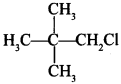
57. Write the IUPAC name of the following compound: (CH3)3CCH2Br [Delhi 2011]

Answer/Explanation

Answer:
Explaination:
Chemistry MCQs for Class 12 with Answers Chapter 10 Haloalkanes and Haloarenes 39


58. Write the IUPAC name of the following compound:
Chemistry MCQs for Class 12 with Answers Chapter 10 Haloalkanes and Haloarenes 20

Answer/Explanation

Answer:
Explaination: 1-Chloro-2, 2-dimethylpropane.


59. Write IUPAC name of the given compound: [Delhi 2019]
Chemistry MCQs for Class 12 with Answers Chapter 10 Haloalkanes and Haloarenes 21

Answer/Explanation

Answer:
Explaination: 4-chloro benzene sulphonic acid.


60. Draw the structure of 2-Bromopentane [Delhi 2014(C)]

Answer/Explanation

Answer:
Explaination:
Chemistry MCQs for Class 12 with Answers Chapter 10 Haloalkanes and Haloarenes 40


61. Write the structure of the following compound:
2 -(2-chlorophenyl)-l-iodoethane. [AI 2011(C)]

Answer/Explanation

Answer:
Explaination:


62. How can you obtain iodoethane from ethanol when no other iodine containing reagent except Nal is available in the laboratory?

Answer/Explanation

Answer:
Explaination:


63. What happens when bromine attacks
Chemistry MCQs for Class 12 with Answers Chapter 10 Haloalkanes and Haloarenes 22

Answer/Explanation

Answer:
Explaination:


64. Identify the products A and B formed in the following reaction:
Chemistry MCQs for Class 12 with Answers Chapter 10 Haloalkanes and Haloarenes 23

Answer/Explanation

Answer:
Explaination:


65. How will you convert methyl iodide from methyl bromide? What is the name of this reaction?

Answer/Explanation

Answer:
Explaination:
This is Finkelstein reaction.


66. Arrange the following haloalkanes in the increasing order of their densities:
Chemistry MCQs for Class 12 with Answers Chapter 10 Haloalkanes and Haloarenes 24

Answer/Explanation

Answer:
Explaination:
n-C3H7Cl < n-C3H7Br < n-C3H7I (Increasing order of density)


67. Which would undergo SN2 reaction faster in the following pair and why? [Delhi 2015]
Chemistry MCQs for Class 12 with Answers Chapter 10 Haloalkanes and Haloarenes 25

Answer/Explanation

Answer:
Explaination:
CH3CH2Br will react faster due to less stearic hindrance.


68. Which would undergo SN1 reaction faster in the following pair:
Chemistry MCQs for Class 12 with Answers Chapter 10 Haloalkanes and Haloarenes 26

Answer/Explanation

Answer:
Explaination:
Chemistry MCQs for Class 12 with Answers Chapter 10 Haloalkanes and Haloarenes 51
will react faster due to 2°halide, will give stable carbocation.


69. Why is f-butyl bromide more reactive towards SN1 reaction as compared to n-butyl bromide? [Uttarakhand 2019]

Answer/Explanation

Answer:
Explaination:
It is because tert. butyl carbocation is more stable than n-butyl carbocation.


70. Which would undergo SN2 reaction faster in the following pair and why? [Foreign 2015]
CH3—CH2—Cl or C6H6CH2Cl

Answer/Explanation

Answer:
Explaination:
CH3CH2l will undergo SN2 reaction faster because it has lower bond dissociation enthalpy of C—I bond due to longer bond length, r is better leaving group.


71. Which would undergo SN1 reaction faster in the following pair and why? [AI 2015]
Chemistry MCQs for Class 12 with Answers Chapter 10 Haloalkanes and Haloarenes 27

Answer/Explanation

Answer:
Explaination:

because it forms stable 3° carbocation.


72. Which alkyl halide from the following pair would you expect to react more rapidly by an SN2 mechanism? [Uttarakhand 2019]
Chemistry MCQs for Class 12 with Answers Chapter 10 Haloalkanes and Haloarenes 28

Answer/Explanation

Answer:
Explaination:


will react faster because it has less stearic hindrance.


73. Which will react faster in SN2 displacement, 1-bromopentane or 2-bromopentane, and why? [Foreign 2011]

Answer/Explanation

Answer:
Explaination:
1-Bromopentane will react faster in SN2 because it is 1° (primary) halide and has less stearic hindrance.


74. A solution of KOH hydrolyses CH3CHClCH2CH3 and CH3CH2CH2CH2Cl. Which one of these is more easily hydrolysed?

Answer/Explanation

Answer:
Explaination:
CH3—CH(Cl)CH2CH3 will be more easily hydrolysed because it will form secondary carbocation which is more stable than primary carbocation.


75. Which of the compounds will react faster in SN1 reaction with the OH ion?
CH3—CH2—Cl or C6H5—CH2—Cl

Answer/Explanation

Answer:
Explaination:
C6H5CH2Cl will react faster due to formation of resonance stabilised carbocation.


76. Explain why the following pairs of compound do not show optical activity.
Chemistry MCQs for Class 12 with Answers Chapter 10 Haloalkanes and Haloarenes 29

Answer/Explanation

Answer:
Explaination:
It is racemic mixture which contains equal amounts of dextro and laevorotatory substances. If half of the total number of molecules rotates the plane-polarised light towards left, remaining half of the molecules rotates towards right such that net optical rotation is zero.


77. Identify the chiral molecule in the following pair: [AI 2014]
Chemistry MCQs for Class 12 with Answers Chapter 10 Haloalkanes and Haloarenes 30

Answer/Explanation

Answer:
Explaination:


78. What is meant by enantiomers?

Answer/Explanation

Answer:
Explaination:
The stereoisomers which are non-superimposable mirror images are called enantiomers, e.g. d(+) glucose and l(-) glucose are enantiomers.


79. What is the major product formed from dehydrohalogenation of 2-Bromopentane?

Answer/Explanation

Answer:
Explaination:
Pen-2-ene (81%)


80. Give the chemical reaction involved in the formation of Grignard reagent. [Foreign 2011]

Answer/Explanation

Answer:
Explaination:


We hope the given Chemistry MCQs for Class 12 with Answers Chapter 10 Haloalkanes and Haloarenes will help you. If you have any query regarding CBSE Class 12 Chemistry Haloalkanes and Haloarenes MCQs Pdf, drop a comment below and we will get back to you at the earliest.

Chemistry MCQs for Class 12 with Answers Chapter 8 The d-and f-Block Elements

Free PDF Download of CBSE Chemistry Multiple Choice Questions for Class 12 with Answers Chapter 8 The d-and f-Block Elements. Chemistry MCQs for Class 12 Chapter Wise with Answers PDF Download was Prepared Based on Latest Exam Pattern. Students can solve NCERT Class 12 Chemistry The d-and f-Block Elements MCQs Pdf with Answers to know their preparation level.

The d-and f-Block Elements Class 12 Chemistry MCQs Pdf

1. In which of the following pairs, both the ions are coloured in aqueous solutions?
(a) Sc3+, Ti
(b) Sc3+, Co2+
(c) Ni2+, Cu+
(d) Ni2+, Ti3+
[Atomic no of Sc = 21, Ti = 22, Ni = 28, Co = 27, Cu = 29]

Answer/Explanation

Answer: d
Explaination:
(d) Ni2+, Ti3+ are coloured due to presence of unpaired electrons.


2. Which of the following is most stable in aqueous solution?
(a) Mn2+
(b) Cr3+
(c) V3+
(d) Ti3+

Answer/Explanation

Answer: b
Explaination:
(b) Cr3+
∵ t2g3+ (half filled p-orbitals) are more stable.


3. The number of moles of KMnO. that will be needed to react with one mole of SO32- in acidic solution.
(a) 1
(b) 3/5
(c) 4/5
(d) 2/5

Answer/Explanation

Answer: d
Explaination:
(d) 2 MnO4 + 5SO32 + 16H+ → 2Mn2+ + 5SO42+ + 8H20
5 moles of SO32- needs 2 moles of KMnO4
1 mole of SO32- needs 2/5 moles of KMnO4


4. The correct order of decreasing second ionisation enthalpy of Ti(22), V(23), Cr(24) Mn(25)
(a) V > Mn > Cr > Ti
(b) Mn > Cr > Ti > V
(c) Ti > V > Cr > Mn
(d) Cr > Mn > V > Ti

Answer/Explanation

Answer: d
Explaination:
(d) ∵ Cr+ (4s°3d5), Mn+ 4s13d5, V1(4s+3d3), Ti+4s13d2


5. Which of the following pairs has the same ionic size?
(a) Zr4+, Hf4+
(b) Zn2+, Hf4+
(c) Fe2+, Ni2+
(d) Zr4+, Ti4+

Answer/Explanation

Answer: a
Explaination:
(a) Zr4+, Hf have similar size due to lanthanoid contraction.


6. Acidified K2Cr207 solution turns green when S02 gas is passed through it due to formation of
(a) Cr2(SO4)3
(b) CrO42-
(c) Cr2(SO3)3
(d) CrSO4

Answer/Explanation

Answer: a
Explaination: (a) It is due to formation of chromium sulphate.


7. The stability of Mn2+, Fe2+, Cr2+, Co2+ is in order of (At No. of Mn = 25, Fe = 26, Cr = 24, Co = 27)
(a) Mn2+ > Fe2+ > Cr2+ > Co2+
(b) Fe2+ > Mn2+ > Co2+ > Cr2+
(c) Co2+ > Mn2+ > Fe2+ > Cr2+
(d) Cr2+ > Mn2+ > Co2+ > Fe2+

Answer/Explanation

Answer: a
Explaination:
(a) Mn2+ (3d5) is most stable, Fe2+ (3d6), Cr2+(3d4 Co2+(3d1)


8. Which of the following does not give 02 on heating?
(a) K2Cr2O7
(b) (NH4)2 Cr2O7
(c) KClO3
(d) Zn(ClO3)2

Answer/Explanation

Answer:
Explaination:
Chemistry MCQs for Class 12 with Answers Chapter 8 The d-and f-Block Elements 3


9. Which of the following lanthanoid ion is diamagnetic? (At No. of Ce = 58, Sm = 62, Eu = 63 Yb = 70)
(a) Eu2+
(b) Yb2+
(c) Ce2+
(d) Sm2+

Answer/Explanation

Answer: b
Explaination:
(b) Yb2+ (4f14) does not have unpaired election, therefore, diamagnetic.


10. The reaction of acidified KMnO. and FLO, gives
(a) Mn4+ and O2
(b) Mn2+ and O2
(c) Mn2+ and O3
(d) Mn4+ and MnO2

Answer/Explanation

Answer: b
Explaination:
(b) 2MnO4 + 6H4 + 5H2O2 → 2Mn2+ + 8H2O + 5O2


11. Magnetic moment of 2.83 BM is given by which of the following ion?
(a) Ti3+
(b) Ni2+
(c) Cr3+
(d) Mn2+

Answer/Explanation

Answer: b
Explaination:
(b) Ni2+ has 2 unpaired electrons.
Chemistry MCQs for Class 12 with Answers Chapter 8 The d-and f-Block Elements 4


12. The colour of KmnO, is due to
(a) L → M charge transfer transition
(b) a → σ* transition
(c) M → L charge transfer transition
(d) d → d transition.

Answer/Explanation

Answer:
Explaination:
(a) It is due to L → M charge transfer transition by absorbing light from visible region and radiates purple colour.


13. KMnO4 is not acidified by HCl instead of H2SO4 because
(a) H2 SO4 is stronger acid than HCl
(b) HCl is oxidised to Cl2 by KMnO4
(c) H2SO4 is dibasic acid
(d) rate is faster in presence of H2SO4

Answer/Explanation

Answer: b
Explaination:
(b) 2KMnO4 + 16 HCl → 2KCl + 2MnCl2 + 5Cl2 + 2H2O


14. Out of Mn2O7 V2O3, V2O5, CrO, Cr2O3, the basic oxides are
(a) Mn2O7, V2O3
(b) V2O3, V2O5
(c) V2O5, CrO
(d) V2O3 and CrO

Answer/Explanation

Answer: d
Explaination:
(d) V2O3 and CrO are basic oxides due to lower, oxidation states.


15. The oxidation state of Cr in final product formed by reaction of KI and acidified dichromate solution is
(a) +4
(b) +6
(c) +2
(d) +3

Answer/Explanation

Answer: d
Explaination:
(d) Cr3+ is formed.


16. KMnO4 gets reduced to
(a) K2MnO4 in neutral medium
(b) MnO2 in acidic medium
(c) Mn2+ in alkaline medium
(d) MnO2 in neutral medium

Answer/Explanation

Answer:
Explaination:
Chemistry MCQs for Class 12 with Answers Chapter 8 The d-and f-Block Elements 5


17. The electronic configuration of Cu(II) is 3d9 whereas that of Cu(I) is 3d10. Which of the following is correct? [NCERT Exemplar]
(a) Cu(II) is more stable
(b) Cu(II) is less stable
(c) Cu(I) and Cu(II) are equally stable
(d) Stability of Cu(I) and Cu(II) depends on nature of copper salts

Answer/Explanation

Answer: a
Explaination:
(a) Cu(II) is more stable due to higher hydration energy.


18. Metallic radii of some transition elements are given below. Which of these elements will have highest density? [NCERT Exemplar]
Chemistry MCQs for Class 12 with Answers Chapter 8 The d-and f-Block Elements 1
(a) Fe
(b) Ni
(c) Co
(d) Cu

Answer/Explanation

Answer: d
Explaination:
(d) Cu has highest density due to greater atomic mass.


19. Generally transition elements form coloured salts due to the presence of unpaired electrons. Which of the following compounds will be coloured in solid state?
(NCERT Exemplar]
(a) Ag2SO4
(b) CuF2
(c) ZnF2
(d) Cu2Cl2

Answer/Explanation

Answer: b
Explaination:
(b) CUF2 is coloured due to presence ofunpaired electron in d-orbital.


20. On addition of small amount of KMnO4 to concentrated H2SO4, a green oily compound is obtained which is highly explosive in nature. Identify the compound from the following. [NCERT Exemplar]
(a) Mn2O7
(b) MnO2
(c) MnSO4
(c) Mn2O3

Answer/Explanation

Answer: a
Explaination:
(a) It is due to formation of Mn2O7.


21. Which of the following reactions are dispro-portionation reactions? [NCERT Exemplar]
Chemistry MCQs for Class 12 with Answers Chapter 8 The d-and f-Block Elements 2
(a) (i), (ii)
(b) (i), (ii), (iii)
(c) (ii), (iii)
(iv) (d) (i), (iv)

Answer/Explanation

Answer: b
Explaination:
(b) (i), (ii), (iii) are disproportionation because same substance is oxidised as well as reduced.


22. When KMnO. solution is added to oxalic acid solution, the decolourisation is slow in the beginning but becomes instantaneous after some time because [NCERT Exemplar]
(a) CO2 is formed as the product.
(b) Reaction is exothermic.
(c) MnO4 catalyses the reaction.
(d) Mn2+ acts as autocatalyst.

Answer/Explanation

Answer: d
Explaination:
(d) Mn2+ acts as autocatalyst.


23. Anomalous electronic configuration in the 3d series are of
(a) Cr and Fe
(b) Cu and Zn
(c) Fe and Cu
(d) Cr and Cu

Answer

Answer: d


24. Which of the following are d-block elements but not regarded as transistion elements?
(a) Cu, Ag, Au
(b) Zn, Cd, Hg
(c) Fe, Co, Ni
(d) Ru, Rh, Pd

Answer

Answer: b


25. CuSO4. 5H2O is blue is colour because
(a) It contains water of crystallization.
(b) SO42- ions absorb red light.
(c) Cu2+ ions absorb orange red light.
(d) Cu2+ ions absorb all colours except red from the white light.

Answer

Answer: c


26. Transistion elements form alloys easily because they have
(a) Same atomic number
(b) Same electronic configuration
(c) Nearly same atomic size
(d) None of the above

Answer

Answer: c


27. Which one of the following characteristics of the transistion metals is associated with higher catalytic activity?
(a) High enthalpy of atomisation
(b) Paramagnetic behaviour
(c) Colour of hydrate ions
(d) Variable oxidation states

Answer

Answer: d


28. Which of the following has the maximum number of unpaired electrons?
(a) Mg2+
(b) Ti3+
(c) V3+
(d) Fe2+

Answer

Answer: d


29. The property which is not characteristic of transistion metals is
(a) variable oxidation states.
(b) tendency to form complexes.
(c) formation of coloured compounds.
(d) natural radioactivity.

Answer

Answer: d


30. Which of the following is incorrect for KMnO4 to be used as an oxidising agent?
(a) HCl cannot be used because some KMnO4 is consumed in the reaction.
(b) Nitric acid is not used for the above purpose because it itself acts as a self oxidising agent and will react with the reducing agent.
(c) The equivalent weight of KMnO4 in basic medium is 158.
(d) The number of electrons involved in oxidation of KMnO4 in acidic medium is 3.

Answer

Answer: d


31. Transistion metals, despite high E° oxidation, are poor reducing agents. The incorrect reason is
(a) high heat of vaporization.
(b) high ionization energies.
(c) low heats of hydration.
(d) complex forming nature.

Answer

Answer: d


32. Which of the following has magnetic moment value of 5.9?
(a) Fe2+
(b) Fe3+
(c) Ni2+
(d) Cu2+

Answer

Answer: b


Note: In the following questions two or more options may be correct. (Q.23 to Q.26)
33. In the form of dichromate, Cr (VI) is a strong oxidising agent in acidic medium but Mo (VI) in Mo03 and W (VI) in W03 are not because . [NCERT Exemplar]
(a) Cr (VI) is more stable than Mo(VI) and W(VI).
(b) Mo( VI) and W( VI) are more stable than Cr(VI).
(c) Higher oxidation states of heavier members of group-6 of transition series are more stable.
(d) Lower oxidation states of heavier *> members of group-6 of transition series are more stable.

Answer/Explanation

Answer:
Explaination:
(b) and (c) higher oxidation states are more stable.


34. Which of the following actinoids show oxidation states upto +7? [NCERT Exemplar]
(a) Am
(b) Pu
(c) U
(d) Np

Answer/Explanation

Answer:
Explaination:
(b) and (d) Pu and Np show oxidation state upto +7.


35. General electronic configuration of actionoids is (n – 2)f1 – 14 (n – 1)d0 – 2 ns².Which of the following actinoids have one electron in 6d orbital? [NCERT Exemplar]
(a) U (Atomic no. 92)
(b) Np (Atomic no. 93)
(c) Pu (Atomic no. 94)
(d) Am (Atomic no. 95)

Answer/Explanation

Answer:
Explaination:
(a) and (b) U and Np, U (5f36d17s2), Np (5f46d17S2)


36. Which of the following lanthanoids show +2 oxidation state besides the characteristic oxidation state +3 of lanthanoids? [NCERT Exemplar]
(a) Ce
(b) Eu
(c) Yb
(d) Ho.

Answer/Explanation

Answer:
Explaination:
(b) and (c) Eu2+ (4f7) and Yb2+ (4f14) are more stable.


37. Match the catalysts given in Column I with the processes given in Column II. [NCERT Exemplar]

Answer/Explanation

Answer:
Explaination:
(a) (iii)
(b) (iv)
(c) (ii)
(d) (v)
(e) (i)


38. Match the compounds/elements given in Column I with uses given in Column II.

Answer/Explanation

Answer:
Explaination:
(a) (ii)
(b) (i)
(c) (iv)
(d) (v)
(e) (iii)


39. Match the properties given in Column I with the metals given in Column II. [NCERT Exemplar]

Answer/Explanation

Answer:
Explaination:
(a) (iii)
(b) (i)
(c) (ii) Cr due to maximum number of unpaired electrons.


40. Match the statements given in Column I with the oxidation states given in Column II. [NCERT Exemplar]

Answer/Explanation

Answer:
Explaination:
(a) (iii)
(b) (i)
(c) (v)
(d) (ii)


41. In the following questions a statement of assertion followed by a statement of reason is given. Choose the correct answer out of the following choices.bvg
(a) Both assertion and reason are true, and reason is the correct explanation of the assertion.
(b) Both assertion and reason are true but reason is not the correct explanation of assertion.
(c) Assertion is not true but reason is true.
(d) Both assertion and reason are false. Assertion: Cu2+ iodide is not known.
Reason: Cu2+ oxidises I- to iodine.

Answer/Explanation

Answer: a
Explaination:
(a) Both assertion and reason are true, and reason is the correct explanation of the assertion.
Cu2+ 2I → 2Cu+ +I2


42.
Chemistry MCQs for Class 12 with Answers Chapter 8 The d-and f-Block Elements 7

Answer/Explanation

Answer:
Explaination: 10CO2


43. Cr2O72- + 14H+ + 6Isup>- → 2Cr3++ ____ +7H2O

Answer/Explanation

Answer:
Explaination: 3I2


44. Cr2O72-+ 14H+ + 6Fe2+ → 2Cr3+ + ______ + 7H2O

Answer/Explanation

Answer:
Explaination: 6Fe3+


45. Cu2+ is reduced by CN to Cu+ which forms the complex [Cu(CN)4]3-. [True/False]

Answer/Explanation

Answer:
Explaination: True.


46. The number of moles of Mohr’s salt required per mole of dichromate ion are 6. [True/False]

Answer/Explanation

Answer:
Explaination: True.


47. The colour of light absorbed by an aqueous solution of CuSO4 is orange red. [True/False]

Answer/Explanation

Answer:
Explaination: True.


48. There is hardly any increase in atomic size with increasing atomic numbers in a series of transition metals. Give reason. [AI2012]

Answer/Explanation

Answer:
Explaination:
It is because effective nuclear charge does not increase appreciably as pairing of electrons in d-orbitals take place which causes repulsion after Mn(25).


49. On what ground can you say that scandium (Z = 21) is a transition element but zinc (Z = 30) is not? [NCERT Example]

Answer/Explanation

Answer:
Explaination:
It is because Sc (21) has incompletely filled rf-orbital, that is why it is transition element, whereas Zn(30) does not have incompletely filled rf-orbitals, therefore, it is not regarded as transition element.


50. What is the lattice structure of Tc?

Answer/Explanation

Answer:
Explaination: hep.


51. Density of rf-block elements is quite high. Why?

Answer/Explanation

Answer:
Explaination:
This is due to the fact that their small atomic volume high nuclear charge and mass.


52. Ni(II) compounds are thermodynamically more stable than Pt(II) compounds. Why?

Answer/Explanation

Answer:
Explaination:
This is because that sum of ionisation energies (E1 + E2) is less in case of Ni than Pt.


53. Why do transition metals show variable oxidation states? [Delhi 2016,14(C)]

Answer/Explanation

Answer:
Explaination:
It is because electrons from both ‘s’ and d-orbitals can take part in bond formation.


54. Why the value of standard electrode potentials (E°) for Ni is more negative?

Answer/Explanation

Answer:
Explaination:
This is due to its highest value of hydration enthalpy (∆hydH°).


55. Which type of magnetic behaviour is generally shown by transition elements?

Answer/Explanation

Answer:
Explaination: Paramagnetism.


56. What is the colour of Mn2+ ions in aqueous solution?

Answer/Explanation

Answer:
Explaination: Pink.


57. Name two complex compounds formed by transition metals.

Answer/Explanation

Answer:
Explaination:
[FeCCN6)]4- and [Cu(NH3)4]2+


58. Name a catalyst used in contact process.

Answer/Explanation

Answer:
Explaination: Vanadium (V) oxide (V2O5).


59. Write any two interstitial compounds.

Answer/Explanation

Answer:
Explaination: Fe3H, TiC.


60. Give two physical properties of alloy formed by transition metals.

Answer/Explanation

Answer:
Explaination:
(i) They are usually hard.
(ii) They have often high melting points.


61. What is the geometry of chromate ion?

Answer/Explanation

Answer:
Explaination: Tetrahedral.


62. How will you convert Fe3+ ion (yellow) from Fe2+ ion (green)? Write chemical reaction equation.

Answer/Explanation

Answer:
Explaination:
Chemistry MCQs for Class 12 with Answers Chapter 8 The d-and f-Block Elements 6


63. Among lanthanoids, Ln(III) compounds are predominant. However, occasionally in solutions or in solid compounds, +2 and +4 ions are also obtained. Give reason. [AI 2012]

Answer/Explanation

Answer:
Explaination:
Lanthanoids show +3 oxidation state mostly as 2 electrons from outer 6s orbital and one electron from 5 d orbital take part in bond formation. Some show +2 and +4 oxidation states due to stability of half-filled and completely filled 4f orbitals.


64. Lanthanoids form primarily +3 ions, while the actinoids usually have higher oxidation states in their compounds, +4 or even +6 being typical. Give reason. [Delhi 2012]

Answer/Explanation

Answer:
Explaination:
In Actinoids, 5f, 6d and 7s orbitals have comparable energies and electrons from these orbitals can take part to show higher oxidation states.


65. Name an element oflanthanoid series which is well known to shown +4 oxidation state. Is it a strong oxidising agent or reducing agent? [Chennai 2019]

Answer/Explanation

Answer:
Explaination: Ce4+, it is good oxidising agent.


We hope the given Chemistry MCQs for Class 12 with Answers Chapter 8 The d-and f-Block Elements will help you. If you have any query regarding CBSE Class 12 Chemistry The d-and f-Block Elements MCQs Pdf, drop a comment below and we will get back to you at the earliest.

Chemistry MCQs for Class 12 with Answers Chapter 7 The p-Block Elements

Free PDF Download of CBSE Chemistry Multiple Choice Questions for Class 12 with Answers Chapter 7 The p-Block Elements. Chemistry MCQs for Class 12 Chapter Wise with Answers PDF Download was Prepared Based on Latest Exam Pattern. Students can solve NCERT Class 12 Chemistry The p-Block Elements MCQs Pdf with Answers to know their preparation level.

The p-Block Elements Class 12 Chemistry MCQs Pdf

1. Among the following, which one is a wrong statement.
(a) PH5 and BiCl5 do not exist.
(b) pπ-dπ bonds are present in SO2
(c) SeF4 and CH4 have same shape.
(d) I3 has bent geometry.

Answer/Explanation

Answer: c
Explaination:
(c) SeF4 has see-saw shape where as CH4 is tetrahedral.


2. In which of the pair of ions, both species contain S—S bond?
Chemistry MCQs for Class 12 with Answers Chapter 7 The p-Block Elements 1

Answer/Explanation

Answer:
Explaination:
Chemistry MCQs for Class 12 with Answers Chapter 7 The p-Block Elements 7


3. Which one of the following order is correct for the bond dissociation enthalpy of halogen molecule?
(a) Br2 > I2 > F2 > Cl2
(b) F2 > Cl2 > Br2 > I2
(c) I2 > Br2 > Cl2 > F2
(d) Cl2 > Br2 > F2 > I2

Answer/Explanation

Answer: d
Explaination:
(d) In F2, therefore, inter electronic repulsion, therefore, bond dissociation enthalpy is less.


4. Which is strongest acid in the following:
(a) HClO4
(b) H2SO3
(c) H2SO4
(d) HClO3

Answer/Explanation

Answer: a
Explaination:
(a) HClO4 is strongest because ‘Cl’ has +7 oxidation state.


5. In which of the following pairs, the two species are isostructural
Chemistry MCQs for Class 12 with Answers Chapter 7 The p-Block Elements 2

Answer/Explanation

Answer: c
Explaination:
(c) Both are pyramidal.
Chemistry MCQs for Class 12 with Answers Chapter 7 The p-Block Elements 8


6. The correct order of oxidising power is
(a) HClO4 > HClO3 > HClO2 > HCIO
(b) HOCl > HClO2 > HClO3 > HClO4
(c) HClO3 > HClO4 > HClO2 > HClO
(d) HCIO2 > HOCl > HClO3 > HClO4

Answer/Explanation

Answer: b
Explaination:
(b) HOCl → HCl + [O]
It is strongest oxidising agent whereas HClO4 is weakest.


7. The correct order of acid strength is
(a) HClO4 < HClO3 < HClO2 < HClO
(b) HCIO < HClO2 < HClO3 < HClO4
(c) HClO4 < HClO < HClO2 < HClO3
(d) HClO2 < HClO3 < HClO4 < HClO

Answer/Explanation

Answer: b
Explaination:
(b) As oxidation state increases, acid strength increases.


8. Among the following which is strongest oxidising agent.
(a) Br2
(b) I2
(c) Cl2
(d) F2

Answer/Explanation

Answer: d
Explaination:
(d) F2 is best oxidising agent.


9. The correct order of bond angles in the following species is
Chemistry MCQs for Class 12 with Answers Chapter 7 The p-Block Elements 3

Answer/Explanation

Answer: b
Explaination:
(b) ClO2 < Cl2O < ClO2 is increasing order of bond angle.


10. Sulphur trioxide can be obtained by which of the following:
Chemistry MCQs for Class 12 with Answers Chapter 7 The p-Block Elements 4

Answer/Explanation

Answer:
Explaination:
Chemistry MCQs for Class 12 with Answers Chapter 7 The p-Block Elements 9


11. When Cl2 reacts with hot and cone. NaOH, the oxidation number of chlorine changes from
(a) zero to +1 and zero to +5
(b) 0 to -1 and 0 to +5
(c) zero to -1 and zero to +3
(d) 0 to +1 and 0 to -3

Answer/Explanation

Answer: b
Explaination:
(b) Cl2 has oxidation number 0, in Cl (-1) and in ClO3(+5).
3Cl2 + 6NaOH(hot and cone.) → 5NaCl + NaClO3 + 3H2O


12. Acidity of diprotic acid in aqueous solution increases in the order.
(a) H2S < H2Se < H2Te
(b) H2Se < H2S < H2Te
(c) H2Te < H2S < H2Se
(d) H2Se < H2Te < H2S

Answer/Explanation

Answer: a
Explaination:
(a) Because bond dissociation enthalpy decreases as atomic size increases.


13. Which of the following statement is incorrect?
(a) ONF is isoelectronic with NO2
(h) OF2 is an oxide of fluoride
(c) Cl2O7 is an anhydride of perchloric acid
(d) O3 molecule is bent

Answer/Explanation

Answer: b
Explaination:
(b) It is fluoride of oxygen.
∵ ‘F’ is more electronegative than O.


14. Chlorine reacts with excess of NH3 to form
(a) NH4Cl
(b) N2 + HCl
(c) N2 + NH4Cl
(d) NCl3 + HCl

Answer/Explanation

Answer: c
Explaination:
(c) 8NH3 + 3Cl2 → 6NH4Cl + N2


15. Which of the following reactions is an example of redox reaction?
(a) XeF4 + O2F2 → XeF6 + O2
(b) XeF2 + PF5 → [XeF]+ [PF6]
(c) XeF6 + H2O → XeOF4 + 2HF
(d) XeF6 + 2H2O → Xeo2F2 + 2HF

Answer/Explanation

Answer: a
Explaination:
(a) Redox reaction becaueXe(+4) is getting oxidised to Xe(+6) and 0(+l) is reduced to zero.


16. On addition of cone. H2SO4 to a chloride salt, colourless fumes are evolved but in case of iodide salt, violet flames come out. This is because [NCERT Exemplar]
(a) H2SO4 reduces HI to I2
(b) HI is of violet colour
(c) HI gets oxidised to I2
(d) HI changes to HIO3

Answer/Explanation

Answer: c
Explaination:
(c) HI gets oxidised to I2


17. Which of the following pairs of ions are isoelectronic and isostructural? [NCERT Exemplar]
Chemistry MCQs for Class 12 with Answers Chapter 7 The p-Block Elements 5

Answer/Explanation

Answer: a
Explaination:
(a) CO3 and NO3 are isoelectronic (32 electrons) and Planar.
Chemistry MCQs for Class 12 with Answers Chapter 7 The p-Block Elements 10


18. Affinity for hydrogen decreases in the group from fluorine to iodine. Which of the halogen acids should have highest bond dissociation enthalpy? [NCERT Exemplar]
(a) HF
(b) HCl
(c) HBr
(d) HI

Answer/Explanation

Answer: a
Explaination:
(a) HF has highest bond dissociation enthalpy due to smaller bond length.


19. Bond dissociation enthalpy of E—H (E = element) bonds is given below. Which of the compounds will act as strongest reducing agent? [NCERT Exemplar]
Chemistry MCQs for Class 12 with Answers Chapter 7 The p-Block Elements 6
(a) NH3
(b) PH3
(c) AsH3
(d) SbH3

Answer/Explanation

Answer: d
Explaination:
(d) SbH3 due to lowest bond dissociation enthalpy.


20. Hot cone. H2SO4 acts as moderately strong oxidising agent. It oxidises both metals and non-metals. Which of the following element is oxidised by cone. H2SO4 into two gaseous products? [NCERT Exemplar]
(a) Cu
(b) S
(c) C
(d) Zn

Answer/Explanation

Answer: c
Explaination:
(c) C + 2H2SO4(conc.) → CO2 + SO2 + 2H2O


21. H2S is more acidic than H2O because
(a) oxygen is more electronegative than sulphur.
(b) atomic number of sulphur is higher than oxygen.
(c) H — S bond dissociation energy is less as compared to H — O bond.
(d) H — O bond dissociation energy is less also compared to H — S bond.

Answer

Answer: b


22. The boiling points of hydrides of group 16 are in the order
(a) H2O > H2Te > H2S > H2Se
(b) H2O > H2S > H2Se > H2Te
(c) H2O > H2Te > H2Se > H2S
(d) None of these

Answer

Answer: b


23. In the manufacture of sulphuric acid by contact process Tyndall box is used to
(a) convert SO2 and SO3
(b) test the presence of dust particles
(c) filter dust particles
(d) remove impurities

Answer

Answer: b


24. Fluorine differs from rest of the halogens in some of its properties. This is due to
(a) its smaller size and high electronegativity.
(b) lack of d-orbitals.
(c) low bond dissociation energy.
(d) All of the these.

Answer

Answer: b


25. The set with correct order of acidity is
(a) HClO < HClO2 < HClO3 < HClO4
(b) HClO4 < HClO3 < HClO2 < HClO
(c) HClO < HClO4 < HClO3 < HClO2
(d) HClO4 < HClO2 < HClO3 < HClO

Answer

Answer: b


26. When chlorine reacts with cold and dilute solution of sodium hydroxide, it forms
(a) Cl and ClO
(b) Cl and ClO2
(c) Cl and ClO3
(d) Cl and ClO4

Answer

Answer: a


27. The formation of O2+ [PtF6] is the basis for the formation of first xenon compound. This is because
(a) O2 and Xe have different sizes.
(b) both O2 and Xe are gases.
(c) O2 and Xe have comparable electro-negativities.
(d) O2 and Xe have comparable ionisation enthalpies.

Answer

Answer: d


28. Partial hydrolysis of XeF4 gives
(a) XeO3
(b) XeOF2
(c) XeOF4
(d) XeF2

Answer

Answer: b


29. Helium is preferred to be used in balloons instead of hydrogen because it is
(a) incombustible
(b) lighter than hydrogen
(c) more abundant than hydrogen
(d) non polarizable

Answer

Answer: a


30. The increasing order of reducing power of the halogen acids is
(a) HF < HCl < HBr < HI
(b) HI < HBr < HCl < HF
(c) HBr < HCl < HF < HI
(d) HCl < HBr < HF < HI

Answer

Answer: a


Note: In the following questions two or more options may be correct. (Q 21. to Q 24)
31. Which of the following options are not in accordance with the property mentioned against them? [NCERT Exemplar]
(a) F2 > Cl2 > Br2 > I2 Oxidising power.
(b) MI > MBr > MCI > MF Ionic character of metal halide.
(c) F2 > Cl2 >Br2 > I2 Bond dissociation enthalpy.
(d) HI < HBr < HCl < HF Hydrogen-halogen bond strength.

Answer/Explanation

Answer:
Explaination:
(b) MF > MCl > HBr > MI Ionic character
(c) Cl2 > Br2 > F2 > I2


32. Which of the following statements are correct? [NCERT Exemplar]
(a) Among halogens, radius ratio between iodine and fluorine is maximum.
(b) Leaving F—F bond, all halogens have weaker X—X bond than X—X’ bond in interhalogens.
(c) Among interhalogen compounds maximum number of atoms are present in iodine fluoride.
(d) Interhalogen compounds are more reactive than halogen compounds.

Answer/Explanation

Answer:
Explaination:
(a), (c) and (d) are correct.
F2 is more reactive than interhalogen compounds.
(b) is not correct, other halogens are less reactive than interhalogen compounds


33. Which of the following statements are correct for SO2 gas? [NCERT Exemplar]
(a) It acts as bleaching agent in moist conditions.
(b) It’s molecule has linear geometry.
(c) It’s dilute solution is used as disinfectant.
(d) It can be prepared by the reaction of dilute H2S04 with metal sulphide.

Answer/Explanation

Answer:
Explaination:
(b) and (d). Its molecule is bent.
Chemistry MCQs for Class 12 with Answers Chapter 7 The p-Block Elements 11
and Na2S + H2SO4 → Na2SO4 + H2S


34. Which of the following orders are correct as per the properties mentioned against each? [NCERT Exemplar]
(a) AS2O3 < SiO2 < P2O3 < SO2 Acid strength.
(b) AsH3 < PH3 < NH3 Enthalpy of vapourisation,
(c) S < O < Cl < F More negative electron gain enthalpy.
(d) H2O > H2S > H2Se > H2Te Thermal stability.

Answer/Explanation

Answer:
Explaination:
(a) and (d) are correct (b) and (c) are wrong.
(b) PH3 <ASH3 <NH3
(c) Cl > F > S > O


35. Match the compounds given in Column I with the hybridisation and shape given in Column II and mark the correct option. [NCERT Exemplar]

Column I Column II
(A) Xe F6 (1) sp3d3 – distorted octahedral
(B) Xe O3 (2) sp3d2 – square planar
(C) Xe OF4 (3) sp3– pyramidal
(D) Xe F4 (4) sp3 d2 – square pyramidal

Code:
(a) A (1) B (3) C (4) D (2)
(b) A (1) B (2) C (4) D (3)
(c) A (4) B (3) C (1) D (2)
(d) A (4) B (1) C (2) D (3)

Answer/Explanation

Answer:
Explaination:
(a) A (1) B (3) C (4) D (2)


36. Match the items of Columns I and II and mark the correct option. [NCERT Exemplar]

Column I Column II
(A) H2SO4 (1) Highest electron gain enthalpy
(B) CCl3NO2 (2) Chalcogen
(C) Cl2 (3) Tear gas
(D) Sulphur (4) Storage batteries

Answer/ExplanationCode:
(a) A (4) B (3) C (1) D (2)
(b) A (3) B (4) C (1) D (2)
(c) A (4) B (1) C (2) D (3)
(d) A (2) B (1) C (3) D (4)

Answer:
Explaination:
(a) A (4) B (3) C (1) D (2)

Note: In the following questions a statement of assertion followed by a statement of reason is given. Choose the correct answer out of the following choices. (Q.27 to Q.29)
(a) Both assertion and reason are correct statements, and reason is the correct explanation of the assertion.
(b) Both assertion and reason are correct statements, but reason is not the correct explanation of the assertion.
(c) Assertion is correct, but reason is wrong statement.
(d) Assertion is wrong but reason is correct statement.
(e) Both assertion and reason are wrong statements.
37. Assertion: HI cannot be prepared by the reaction of KI with concentrated H2SO4.
Reason: HI has lowest H-X bond strength among halogen acids.[NCERT Exemplar]

Answer/Explanation

Answer: b
Explaination:
(b) Both assertion and reason are correct statements, but reason is not the correct explanation of the assertion. HI gets oxidised to I2 as H2SO4(conc.) is oxidising agent.


38. Assertion: Both rhombic and monoclinic sulphur exist as S8 but oxygen exists as O2.
Reason: Oxygen forms pπ – pπ multiple bond due to small size and small bond length but pπ – pπ bonding is not possible in sulphur. [NCERT Exemplar]

Answer/Explanation

Answer: a
Explaination:
(a) Both assertion and reason are correct statements, and reason is the correct explanation of the assertion.


39. Assertion: NaCl reacts with concentrated H2SO4 to give colourless fumes with pungent smell. But on adding MnO2 the fumes become greenish yellow.
Reason: Mn02 oxidises HC1 to chlorine gas which is greenish yellow. [NCERT Exemplar]

Answer/Explanation

Answer: a
Explaination:
(a) Both assertion and reason are correct statements, and reason is the correct explanation of the assertion.
NaCl + H2SO4(conc.) → NaHSO4 + HCl
4HCl + MnO2 → MnCl2 + Cl2 + 2H2O


40. The mixture of cone. HCl and anhydrous ZnCl2 is called ___________ .

Answer/Explanation

Answer:
Explaination: Lucas reagent


41. Out of H2O and H2S which has higher bond angle? ___________ .

Answer/Explanation

Answer:
Explaination: H20


42. Tin reacts with excess of chlorine gas to form ___________ .

Answer/Explanation

Answer:
Explaination: SnCl4


43. Lead sulphide is heated with air to form ___________ .

Answer/Explanation

Answer:
Explaination: PbO + SO2


44. I22 gets oxidised to ___________ by cone. HNO3.

Answer/Explanation

Answer:
Explaination: HIO3


45. Interhalogen compounds are more reactive than helogens except fluorine. [True/False]

Answer/Explanation

Answer:
Explaination: True. It is due to less effective overlapping.


46. C1F is neutral molecule isoelectronic withCIO. [True/False]

Answer/Explanation

Answer:
Explaination: True. Both have 17 + 9 = 26 electrons.


47. NaF reacts with SbF6 to form Na+ [SbF7]. [True/False]

Answer/Explanation

Answer:
Explaination:
Chemistry MCQs for Class 12 with Answers Chapter 7 The p-Block Elements 12


48. Hydrolysis of XeF6 is redox reaction. [True/False]

Answer/Explanation

Answer:
Explaination: It is false. XeF6 + 3H2O > XeO3 + 6HF.


49. Ozone is thermodynamically less stable than O2. [True/False]

Answer/Explanation

Answer:
Explaination: True


50. Oxygen does not show +4 and +6 oxidation states like sulphur. Why?

Answer/Explanation

Answer:
Explaination: It is due to the absence of vacant d-orbital in oxygen.


51. Draw the structure of 03 molecule.

Answer/Explanation

Answer:
Explaination:
Chemistry MCQs for Class 12 with Answers Chapter 7 The p-Block Elements 13
It is bent molecule.


52. Write one chemical reaction equation to show that SO2 acts as a reducing agent.

Answer/Explanation

Answer:
Explaination:
Chemistry MCQs for Class 12 with Answers Chapter 7 The p-Block Elements 14


53. State reason for the following:
Sulphur has greater tendency for catenation than oxygen. [Delhi 2013; AI2016,12; DoE]
Or
O-O bond is weaker than S-S bond, why? [Chennai 2019]

Answer/Explanation

Answer:
Explaination:
It is because of strong S—S bond than 0—0 due to greater repulsion between valence electrons of smaller atoms of oxygen than sulphur atoms.


54. Write the formulae of any two oxoacids of sulphur. [AI 2015 Allahabad & Dehradun]

Answer/Explanation

Answer:
Explaination:
H2SO4 and H2SO3.


55. Write one chemical reaction equation to show that cone. H2S04 is a strong oxidising agent.

Answer/Explanation

Answer:
Explaination:
C + 2H2SO4(conc.) CO2+ 2H2O + 2SO2


56. Fluorine does not exhibit any positive oxidation state. Why? [Delhi 2013]

Answer/Explanation

Answer:
Explaination:
It is because Fluorine is most electronegative element and best oxidising agent.


57. Despite lower value of its electron gain enthalpy with negative sign, fluorine (F2) is a stronger oxidising agent than Cl2. [Delhi 2019; AI 2012; DoE]

Answer/Explanation

Answer:
Explaination:
It is due to higher standard reduction potential of F2 which is due to low bond dissociation energy of F—F bond due to inter electronic repulsion among small size F atoms, high electron gain enthalpy and highest hydration enthalpy.


58. Although the H-bonding in hydrogen fluoride is much stronger than that in water, yet water has a much higher boiling point than hydrogen fluoride. Why? [Foreign 2012]

Answer/Explanation

Answer:
Explaination:
It is because H20 molecules form H-bonds to more extent as compared to HF molecules.


59. Give a chemical reaction involved in chlorine with saturated hydrocarbon.

Answer/Explanation

Answer:
Explaination:
Chemistry MCQs for Class 12 with Answers Chapter 7 The p-Block Elements 15


60. Explain giving a reason for the following situation:
In aqueous medium, HCl is a stronger acid than HF. [Foreign 2011]

Answer/Explanation

Answer:
Explaination:
It is because bond dissociation energy of H—Cl is lower than HF due to longer bond length.


61. Give the chemical formula of any one halic acid.

Answer/Explanation

Answer:
Explaination: H0BrO2 (Bromic acid)


62. Give a chemical reaction involved in the preparation of interhalogen compound.

Answer/Explanation

Answer:
Explaination:
Chemistry MCQs for Class 12 with Answers Chapter 7 The p-Block Elements 16


63. Which compound led to the discovery of the compounds of noble gas?

Answer/Explanation

Answer:
Explaination:
which was the first compound of noble gas.


64. Complete the following reaction:
Xe + PtF6

Answer/Explanation

Answer:
Explaination:
Xe + PtF6 → Xe+[PtF6]


65. Sulphur disappears when boiled with an aqueous solution of sodium sulphite. Why?

Answer/Explanation

Answer:
Explaination:
It is due to the formation of sodium thiosulphate which is soluble in water, therefore, sulphur disappears.
Chemistry MCQs for Class 12 with Answers Chapter 7 The p-Block Elements 17


We hope the given Chemistry MCQs for Class 12 with Answers Chapter 7 The p-Block Elements will help you. If you have any query regarding CBSE Class 12 Chemistry The p-Block Elements MCQs Pdf, drop a comment below and we will get back to you at the earliest.

Chemistry MCQs for Class 12 with Answers Chapter 5 Surface Chemistry

Free PDF Download of CBSE Chemistry Multiple Choice Questions for Class 12 with Answers Chapter 5 Surface Chemistry. Chemistry MCQs for Class 12 Chapter Wise with Answers PDF Download was Prepared Based on Latest Exam Pattern. Students can solve NCERT Class 12 Chemistry Surface Chemistry MCQs Pdf with Answers to know their preparation level.

Surface Chemistry Class 12 Chemistry MCQs Pdf

1. The correct ascending order of adsorption of the following gases on the same mass of charcoal at same temperature and pressure is
(a) CH4 < H2 < SO2
(b) H2 < CH4 < SO2
(c) SO2 < CH4 < H2
(d) H2 < SO2 < CH4

Answer/Explanation

Answer: b
Explaination:
(b) The extent of adsorption increases with increase in polarity and molar mass.


2. The formation of micelles takes place only above
(a) Inversion temperature
(b) Boyle’s temperature
(c) Critical temperature
(d) Kraft temperature

Answer/Explanation

Answer: d
Explaination:
(d) The temperature above which micelles formation takes place is called Kraft temperature.


3. Colloidion is 4% solution of which one of the following in alcohol-ether mixture.
(a) Nitroglycerin
(b) Cellulose acetate
(c) Glycol dinitrate
(d) Nitrocellulose

Answer/Explanation

Answer: d
Explaination:
(d) Nitrocellulose dissolved in 4% alcohol-ether mixture is called colloidion.


4. If V is amount of adsorbate and ‘/n’ is amount of adsorbent, which of the following is related to adsorption process?
Chemistry MCQs for Class 12 with Answers Chapter 5 Surface Chemistry 1

Answer/Explanation

Answer: d
Explaination:
(d) is not related to adsorption.


5. A plot of log \(\frac{x}{m}\) vs log p for adsorption of gas on a solid gives in straight line with slope equal to
(a) n
(b) \(\frac{1}{n}\)
(c) log k
(d) -log k

Answer/Explanation

Answer:
Explaination:
Chemistry MCQs for Class 12 with Answers Chapter 5 Surface Chemistry 4


6. The protective power of lyophilic colloidal sol is expressed in terms of
(a) coagulation value
(b) gold number
(c) CMC (Critical Micelle Concentration)
(d) oxidation numbers

Answer/Explanation

Answer: b
Explaination:
(b) Gold number measures protective power of colloids. Lower the gold number more will be protective power, e.g., gelatin.


7. The coagulation values in millimoles per litre of the electrolyte for the coagulation of As2S3 sol are given
I. NaCl (52)
II. BaCl2 (0.69)
III. MgSO4 (0.22)
The correct order of coagulating power is
(a) I > II > III
(b) II > I > III
(c) III > II > I
(d) III > I > II

Answer/Explanation

Answer:
Explaination:
(c) III > II > I
∵ Lesser the coagulation value, more is coagulating power.


8. According to Freundlich adsorption isotherm, which of the following is correct?
(a) \(\frac{x}{m}\) ∝ p1
(b) \(\frac{x}{m}\) ∝ p1/n
(C) \(\frac{x}{m}\) ∝ p°
(d) All are correct of different ranges of pressure

Answer/Explanation

Answer:
Explaination:
(d) All are correct
(a) is correct at low pressure,
(b) is correct at moderate pressure and
(c) is correct at high pressure (saturation pressure).


9. 3g of activated charcoal was added to 50 ml of acetic acid solution (0.06 M) in a flask. After an hour it was filtered and the strength of filtrate was found to be 0.042 M. The amount of acetic acid adsorbed per gram of charcoal is
(a) 42 mg
(b) 54 mg
(c) 18 mg
(d) 36 mg

Answer/Explanation

Answer: b
Explaination:
(b) Molarity of CH3COOH adsorbed
= 0.06 – 0.042 = 0.018
Number of millimoles of CH3COOH
adsorbed = 0.018 × 50 ml = 0.90
Amount = 0.90 × 60 = 54 mg
[∵ molar mass of CH3COOH = 60 g mol-1]


10. During the adsorption of gas on the surface of solid, which of the following is true?
(a) ∆G < 0, ∆H > 0, ∆S < 0 (b) ∆G > 0, ∆H < 0, ∆S < 0
(c) ∆G < 0, ∆H < 0, ∆S < 0
(d) ∆G < 0, ∆H < 0, ∆S > 0

Answer/Explanation

Answer:
Explaination:
(c) ∆G < 0 means process is spontaneous because adsorption is exothermic, ∆H = -ve and entropy is decreasing, i.e., ∆S is -ve.


11. The best coagulant for the precipitation of Fe(OH)3 sol is
(a) Na2HPO3
(b) NaNO3
(c) Na3PO4
(d) Na2SO4

Answer/Explanation

Answer: c
Explaination:
(c) \(\mathrm{PO}_{4}^{3-}\) is most effective for +vely charged Fe(OH)3 sol due to higher charge.


12. Which is favourable for physical adsorption?
(a) High T and high P
(b) High T and low P
(c) Low T and high P
(d) T and P do not affect

Answer/Explanation

Answer: c
Explaination:
(c) Low temperature and high pressure favours physical adsorption because van der Waals’ forces of attraction will increase.


13. Identify the positively charged colloid.
(a) Haemoglobin
(b) As2S3
(c) Clay
(d) Gold sol

Answer/Explanation

Answer: a
Explaination:
(a) due to presence of Fe2+.


14. The stability of lyophobic sols is due to
(a) adsorption of covalent molecules on the colloid
(b) the size of the particles
(c) the charge on particles
(d) Tyndall effect.

Answer/Explanation

Answer: c
Explaination:
(c) same charge on particles cause repulsion and does allow particles to settle down.


15. Gold sol can be prepared by
(a) Hydrolysis of AUCl3
(b) Oxidation of Gold by aqua-regia
(c) Peptization
(d) Reduction of AUCl3 with HCHO solution.

Answer/Explanation

Answer: d
Explaination:
(d) 2AuCl3 + 3HCHO + 3H2O → 2Au + 3HCOOH + 6HCl


16. The term ‘sorption’ stands for ___________ . [NCERT Exemplar]
(a) absorption
(b) adsorption
(c) both absorption and adsorption
(d) desorption

Answer/Explanation

Answer: c
Explaination:
(c) When both adsorption and absorption takes place, it is called sorption, e.g., dying of cotton fibre.


17. Extent of adsorption of adsorbate from solution phase increases with ___________ . [NCERT Exemplar]
(a) increase in amount of adsorbate in solution.
(b) decrease in surface area of adsorbent.
(c) increase in temperature of solution.
(d) decrease in amount of adsorbate in solution.

Answer/Explanation

Answer: a
Explaination:
(a) \(\frac{x}{m}\) = k C1/n [where ‘C’ is concentration of solution]


18. Physical adsorption of a gaseous species may change to chemical adsorption with ___________ . [NCERT Exemplar]
(a) decrease in temperature
(b) increase in temperature
(c) increase in surface area of adsorbent
(d) decrease in surface area of adsorbent

Answer/Explanation

Answer: b
Explaination:
(b) At high temperature, covalent bond will be formed as activation energy will be provided.


19. On the basis of data given below predict which of the following gases shows least adsorption on a definite amount of charcoal? [NCERT Exemplar]
Chemistry MCQs for Class 12 with Answers Chapter 5 Surface Chemistry 2
(a) CO2
(b) SO2
(c) CH4
(d) H2

Answer/Explanation

Answer: b
Explaination:
(b) SO2, higher the critical temperature, more will be van der Waal’s forces of attraction, more will be extent of adsorption.


20. In which of the following reactions heter-ogenous catalysis is involved? [NCERT Exemplar]
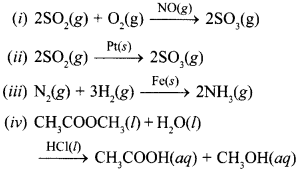
Chemistry MCQs for Class 12 with Answers Chapter 5 Surface Chemistry 3
(a) (ii), (iii)
(b) (ii), (iii), (iv)
(c) (i), (ii), (iii)
(d) (iv)

Answer/Explanation

Answer: a
Explaination:
(a) (ii) and (iii) use solid catalyst in gaseous reaction.
∴ Heterogeneous catalysis.


21. In Freundlich adsorption isotherm x/m = Kp1/n, the value of ‘n’ at low pressure is
(a) more than one.
(b) less than one.
(c) equal to one.
(d) from zero to one.

Answer

Answer: c


22. According to adsorption theory of catalysis, the speed of the reaction increases because
(a) the concentration of the reactant molecules at the active centres of the catalyst becomes high due to adsorption.
(b) in the process of adsoption, the activation energy of the molecules becomes large.
(c) adsorption produces heat which increases the speed of the reaction.
(d) adsorption lowers the activation energy of the reaction.

Answer

Answer: d


23. Which shape selective catalyst is used to convert alcohol to gasoline?
(a) Trpsin
(b) Calgon
(c) ZSM-5
(d) Zeigler-Natta catalyst

Answer

Answer: c


24. Which of the following is an example of heterogenous catalyst?
Chemistry MCQs for Class 12 with Answers Chapter 5 Surface Chemistry

Answer

Answer: c


25. When a small amount of FeCl3 is added to a freshly precipitated Fe(OH)3, b reddish brown colloidal solution is obtained. This pheno¬menon is known as
(a) dialysis
(b) peptization
(c) protection
(d) dissolution

Answer

Answer: c


26. Lyophillic colloids are stable due to
(a) charge on the particles.
(b) large size of the particles.
(c) small size of the particles.
(d) layer of dispersion of medium on the particles.

Answer

Answer: d


27. Cottrell precipitator is used to
(a) precipitate mud from muddy water.
(b) precipitate carbon particles from smoke.
(c) purify the ordinary drinking water.
(d) precipitate salts in qualitative analysis.

Answer

Answer: b


28. The potential difference between the fixed charged layer and the diffused layer having opposite charge is called
(a) Zeta potential
(b) Electrokinetic potential
(c) Both (a) and (b)
(d) Streaming potential

Answer

Answer: a


29. Peptization is a process of
(a) precipitation of colloidal particles.
(b) purification of colloids.
(c) dispersing precipitate into colloidal solution.
(d) movement of colloidal particles in the electric field.

Answer

Answer: c


30. An emulsifier is a substance which
(a) stabilises the emulsion.
(b) homogenises the emulsion.
(c) Coagulates the emulsion.
(d) Accelerates the disperson of liquid in liquid.

Answer

Answer: a


Note: In the following questions two or more options may be correct. (Q.21 to Q.23)
31. Which of the following statements are correct about solid catalyst? [NCERT Exemplar]
(a) Same reactants may give different product by using different catalysts.
(b) Catalyst does not change AH of reaction.
(c) Catalyst is required in large quantities to catalyse reactions.
(d) Catalytic activity of a solid catalyst does not depend upon the strength of chemisorption.

Answer/Explanation

Answer: a
Explaination:
(a) It is called selectivity of catalyst.
(b) Catalyst changes only Ea (Activation energy)


32. Freundlich adsorption isotherm is given by the expression \(\frac{x}{m}\) = k p1/n which of the mfollowing conclusions can be drawn from this expression. [NCERT Exemplar]
(a) When \(\frac{1}{n}\) = 0, the adsorption is independent of pressure.
(b) When \(\frac{1}{n}\) = 0, the adsorption is directly proportional to pressure.
(c) When n = 0, \(\frac{x}{m}\) vs p graph is a line parallel to x-axis.
(d) When n = 0, plot of \(\frac{x}{m}\) vs p is a curve.

Answer/Explanation

Answer: a
Explaination:
(a) and (c) are correct, when n = 0.
∴ \(\frac{x}{m}\) vs p graph is line parallel to x-axis.
when \(\frac{1}{n}\) = 0, \(\frac{x}{m}\) is independent of pressure at high pressure.


33. H2 gas is adsorbed on activated charcoal to a very little extent in comparison to easily liquefiable gases due to. [NCERT Exemplar]
(a) very strong van der Waal’s interaction.
(b) very weak van der Waals forces.
(c) very low critical temperature.
(d) very high critical temperature.

Answer/Explanation

Answer: b
Explaination:
(b) and (c). It is due to weak van der Waals’ forces of attraction and very low critical temperature.


34. Method of formation of solution is given in Column I. Match it with the type of solution given in Column II. [NCERT Exemplar]

Column I Column II
(a) Sulphur passed through cold water (i) Normal electrolyte solution
(b) Soap mixed water above critical micelle concentration (ii) Molecular colloids
(c) White of egg whipped with water (iii) Associated colloid
(d) Soap mixed water below critical micelle concentration (iv) Macro molecular colloids
Answer/Explanation

Answer:
Explaination:
(a) (ii)
(b) (iii)
(c) (iv)
(d) (i) It forms colloid above CMC.


35. Match the items given in Column I and Column II. [NCERT Exemplar]

Column I Column II
(a) Protective colloid (i) FeCl3 + NaOH
(b) Liquid – liquid colloid (ii) Lyophilic colloids
(c) Positively charged colloid (iii) Emulsion
(d) Negatively charged (iv) FeCl3 + hot water
Answer/Explanation

Answer:
Explaination:
(a) (ii)
(b) (iii)
(c) (iv) Fe(OH)3/Fe3+
(d) (i) Fe(OH)3/OH


36. Match the types of colloidal systems given in Column I with the name given in Column II. [NCERT Exemplar]

Column I Column II
(a) Solid in liquid (i) Foam
(b) Liquid in solid (ii) Sol
(c) Liquid in liquid (iii) Gel
(d) Gas in liquid (iv) Emulsio
Answer/Explanation

Answer:
Explaination:
(a) (ii)
(b) (iii)
(c) (iv)
(d) (i)


37. In the following questions a statement of assertion followed by a statement of reason is given. Choose the correct answer out of the following choices.
(a) Assertion and reason both are correct and the reason is correct explanation of assertion.
(b) Assertion and reason both are correct but reason does not explain assertion.
(c) Assertion is correct but reason is incorrect.
(d) Both assertion and reason are incorrect.
(e) Assertion is incorrect but reason is ’ correct.
Assertion: An ordinary filter paper impregnated with collodion solution stops the flow of colloidal particles.
Reason: Pore size of the filter paper becomes more than the size of colloidal particle. [NCERT Exemplar]

Answer/Explanation

Answer:
Explaination:
(c) Assertion is correct but reason is incorrect because pore size less than size of colloidal particles.


38. Greater the valency of ion, more will be coagulating power is __________ rule.

Answer/Explanation

Answer:
Explaination: Hardy-Schulze rule


39. Emulsion can be __________ by change in pH.

Answer/Explanation

Answer:
Explaination: broken


40. __________ of kidney separates waste products from blood.

Answer/Explanation

Answer:
Explaination: Dialysis


41. Electrokinetic potential is difference in potential of fixed layer and diffused layer which are oppositely charged. [True/False]

Answer/Explanation

Answer:
Explaination: True


42. Enzyme work at specific pH and optimum temperature. [True/False]

Answer/Explanation

Answer:
Explaination: True


43. Lead chamber process for H2S04 manufactureis homogeneous catalysis. [True/False]

Answer/Explanation

Answer:
Explaination:
Chemistry MCQs for Class 12 with Answers Chapter 5 Surface Chemistry 5


44. What is the difference between absorption and adsorption?

Answer/Explanation

Answer:
Explaination:
In absorption, a substance is uniformly distributed all over the surface, e.g., cotton dipped in blue ink while in adsorption the existence of a substance at a surface in different concentration than in the adjoining bulk is called adsorption. For example, O2, H2 or SO2 get adsorbed on the surface of charcoal.


45. What is sorption? [Foreign 2013]

Answer/Explanation

Answer:
Explaination:
Sorption is a process in which adsorption and absorption take place simultaneously, e.g. dyeing of cotton fibres by azo dyes.


46. What is meant by desorpton?

Answer/Explanation

Answer:
Explaination:
The process of removing an adsorbed substance from a surface on which it is adsorbed is called desorption, i.e. silica gel removes water.


47. What type of forces are responsible for the occurrence of physisorption? [Foreign 2015]

Answer/Explanation

Answer:
Explaination:
Weak van der Waals’ forces of attraction are responsible for the occurrence of physisorption.


48. What is meant by chemisorption? [Delhi 2011(C)]

Answer/Explanation

Answer:
Explaination:
Chemisorption: If the forces holding the adsorbate are as strong as in chemical bonds, the adsorption process is known as chemical adsorption or chemisorption.


49. What is the effect of temperature on chemisorption? [AI2015 Panchkula; DoE]

Answer/Explanation

Answer:
Explaination:
Chemisorption first increases and then decreases with increase in temperature.


50. Why is chemisorption referred to as activated adsorption?

Answer/Explanation

Answer:
Explaination:
It is because chemisorption needs high activation energy as it involves first bond breaking and then bond formation.


51. Why do physisorption and chemisorption behave differently with rise in temperature?

Answer/Explanation

Answer:
Explaination:
It is because physical adsorption involves weak forces of attraction, whereas chemisorption involves strong covalent bonds.


52. Physisorption is reversible while chemisorption is irreversible. Why? [Foreign 2015]

Answer/Explanation

Answer:
Explaination:
In physisorption, the forces of attraction are weak and no new substance is formed, therefore, it is reversible, whereas in chemisorption, new substances are formed, therefore, it is irreversible.


53. Which has a higher enthalpy of adsorption, physisorption or chemisorption? [AI 2013]

Answer/Explanation

Answer:
Explaination:
Chemisorption has higher enthalpy of adsorption because there is a strong forces of attraction between adsorbate and adsorbent.


54. Why is it important to have clean surface in surface studies?

Answer/Explanation

Answer:
Explaination:
It facilitates the adsorption of desired species (adsorbate) on the clean surface of adsorbent.


55. Out of NH3 and N2, NH3 gas will be adsorbed more readily on the surface of charcoal. Why?

Answer/Explanation

Answer:
Explaination:
It is due to the fact, that NH3 has greater molecular size and more easily liquefiable as compared to N2.


56. What is the drawback of Freundlich Adsorption Isotherm.

Answer/Explanation

Answer:
Explaination:
It fails in case of high concentration and high pressure of adsorbate.


57. Write a mathematical expression showing the relationship between the amount of solute adsorbed per unit mass of the solid adsorbent and the concentration of the solute in the solution.
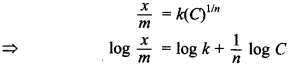
Chemistry MCQs for Class 12 with Answers Chapter 5 Surface Chemistry 6

Answer/Explanation

Answer:
Explaination:
where \(\frac{x}{m}\) is the extent of adsorption, x is the mass of adsorbate, m is the mass of adsorbent, C is the concentration of solute in solution and is a constant.


58. Freundlich isotherm becomes independent of pressure at high pressure for a gas absorbed on a solid. Give reason. [Uttarakhand 2019]

Answer/Explanation

Answer:
Explaination:
\(\frac{x}{m}\) ∝ p° at high pressure because extent of adsorption becomes maximum and this pressure is called saturation pressure.


59. What are promoters? Give an example.

Answer/Explanation

Answer:
Explaination:
These are substances which enhance the activity of a catalyst. In Haber’s process, molybdenum (Mo)(i) act as a promoter for Fe(s) which is used as a catalyst.
Chemistry MCQs for Class 12 with Answers Chapter 5 Surface Chemistry 7


60. Which catalyst is used in Ostwald’s process for the manufacture of nitric acid?

Answer/Explanation

Answer:
Explaination:
Platinised asbestos at 573 K temperature.


61. Give a chemical reaction which involves heterogeneous catalysis.

Answer/Explanation

Answer:
Explaination:
Chemistry MCQs for Class 12 with Answers Chapter 5 Surface Chemistry 8


62. What is not explained by the adsorption theory of heterogeneous catalysis?

Answer/Explanation

Answer:
Explaination:
It does not explain the action of catalytic promoters and poisons.


63. What are two important features of solid catalysts?

Answer/Explanation

Answer:
Explaination:
Activity and selectivity of a solid catalyst.


64. Name an important zeolite catalyst used in the petroleum industry.

Answer/Explanation

Answer:
Explaination: ZSM-5


65. What is the optimum temperature and optimum pH range for enzymatic activity?

Answer/Explanation

Answer:
Explaination:
(i) 298 – 310 K (optimum temperature range)
(ii) 5-7 (optimum pH range).


66. A delta is formed at the meeting point of sea water and river water. Why? [AI 2015 Allahabad & Dehradun; DoE]

Answer/Explanation

Answer:
Explaination:
Muddy river water is a colloidal solution, gets coagulated by electrolytes present in sea water.


67. Write the name of the states of (i) dispersed phase {it) dispersion medium in the case of butter. [AI 2015 Patna]

Answer/Explanation

Answer:
Explaination:
(i) Water is dispersed phase and,
(ii) Oil is dispersion medium.


68. Write the dispersed phase and dispersion jnedium in smoke. [AI 2015 Guwahati; Delhi 2013]

Answer/Explanation

Answer:
Explaination:
Dispersed phase is solid (carbon particles) and dispersion medium is gas (air).


69. Give one example each of sol and gel. [Delhi 2014]

Answer/Explanation

Answer:
Explaination:
Starch in water is ‘sol’, whereas cheese is ‘gel’.


70. Give one example each of lyophobic sol and lyophilic sol. [Delhi 2014]

Answer/Explanation

Answer:
Explaination:
Starch in water is lyophilic sol, whereas AS2S3 in water is lyophobic sol.


71. Write a method by which lyophobic colloids can be coagulated. [AI 2015]

Answer/Explanation

Answer:
Explaination:
If we add electrolyte, lyophobic sols can be coagulated.


72. Give an example of multimolecular and macro-molecular colloid each.

Answer/Explanation

Answer:
Explaination:
(i) Multimolecular colloid – Sulphur sol
(ii) Macromolecular colloid – Starch


73. Based on the type of dispersed phase, what type of colloid is micelles? [CBSE Sample Paper 2018; Foreign 2014]

Answer/Explanation

Answer:
Explaination:
Associated colloids.


74. Name the temperature above which the formation of micelles takes place. [Foreign 2014]

Answer/Explanation

Answer:
Explaination:
Kraft temperature.


75. What is meant by critical micelle concentration?

Answer/Explanation

Answer:
Explaination:
The lowest concentration of the surfactant (e.g. soap solution) at which micelle formation takes place is called CMC (Critica Micelle Concentration). For soaps, the CMC is 10-4-10-3 mol L-1.


76. Write a chemical reaction involved in the preparation of colloid by double decomposition.
Chemistry MCQs for Class 12 with Answers Chapter 5 Surface Chemistry 9

Answer/Explanation

Answer:
Explaination:


77. Name any two colloidal sols of metals which are prepared by electrical disintegration.

Answer/Explanation

Answer:
Explaination:
Gold and silver.


78. Name any one peptising agent.

Answer/Explanation

Answer:
Explaination: NaCl


79. Define Dialysis.

Answer/Explanation

Answer:
Explaination:
Dialysis: A process of removing a dissolved substance from a colloidal solution by means of diffusion through a suitable membrane is called dialysis.


80. Which process is used to made dialysis faster? Explain.

Answer/Explanation

Answer:
Explaination:
Electrodialysis: In this process, an electric field is applied if the dissolved substance in the impure colloidal solution is only an electrolyte.


81. What is the use of collodion solution in the process of ultrafiltration?

Answer/Explanation

Answer:
Explaination:
The pores of filter paper can be reduced in size by impregnating with collodion solution to stop the flow of colloidal particles.


82. Why the colligative properties are of small order in colloidal particles as compared to true solutions at same concentration?

Answer/Explanation

Answer:
Explaination:
This is because the number of particles in a colloidal solution is comparatively small as compared to a true solution.


83. True solution does not show Tyndall effect. Give reason. [Uttarakhand 2019]

Answer/Explanation

Answer:
Explaination:
Their particle size is too small (< lm), do not scatter light so do not show Tyndall effect.


84. What changes in colour are observed, as the size of particles increases in a red colour finest gold sol?

Answer/Explanation

Answer:
Explaination:
It appears purple, then blue and finally green.


85. Which property of colloidal solution is responsible for the stability of sols?

Answer/Explanation

Answer:
Explaination:
Brownian movement.


86. What will be the charge on Agl colloidal particles when it is prepared by addition of small amount of AgN03 to KI solution in water. What is responsible for development of this charge? [AI 2015 Bhubaneswar; Delhi 2012(C)]

Answer/Explanation

Answer:
Explaination:
It will be negatively charged due to the adsorption of I ions as KI is in excess.


87. What is the ‘coagulation’ process? [AJ2017]

Answer/Explanation

Answer:
Explaination:
The conversion of a colloidal solution into precipitate is called coagulation. In other words, the process of settling of colloidal particles is called coagulation.


88. Out of BaCl2 and KC1, which one is more effective in causing coagulation of a negatively charged colloidal Sol? Give reason. [Delhi 2015]

Answer/Explanation

Answer:
Explaination:
BaCl2 will be more effective because Ba2+ has higher charge than K+.


89. Why are substances like platinum and palladium often used for carrying out electrolysis of aqueous solutions?

Answer/Explanation

Answer:
Explaination:
It is because they are inert, i.e. least reactive.


90. Give one example each of ‘oil in water’ and ‘water in oil’ emulsions. [AI 2017]

Answer/Explanation

Answer:
Explaination:
Milk is an example of oil in water and liquefied butter is an example of water in oil emulsions. [AI 2017]


We hope the given Chemistry MCQs for Class 12 with Answers Chapter 5 Surface Chemistry will help you. If you have any query regarding CBSE Class 12 Chemistry Surface Chemistry MCQs Pdf, drop a comment below and we will get back to you at the earliest.

Chemistry MCQs for Class 12 with Answers Chapter 4 Chemical Kinetics

Free PDF Download of CBSE Chemistry Multiple Choice Questions for Class 12 with Answers Chapter 4 Chemical Kinetics. Chemistry MCQs for Class 12 Chapter Wise with Answers PDF Download was Prepared Based on Latest Exam Pattern. Students can solve NCERT Class 12 Chemistry Chemical Kinetics MCQs Pdf with Answers to know their preparation level.

Chemical Kinetics Class 12 Chemistry MCQs Pdf

1. The half life period of first order reaction is 1386 seconds. The specific rate constant of the reaction is
(a) 0.5 × 10⁻² s-1
(b) 0.5 × 10⁻³ s-1
(c) 5.0 × 10⁻² s-1
(d) 5.0 × 10⁻³ s-1

Answer/Explanation

Answer: b
Explaination:
Chemistry MCQs for Class 12 with Answers Chapter 4 Chemical Kinetics 10


2. The rate constant of a reaction A → B is 0.6 × 10³ mole per second. If the concentration of [A] is 5 M, then what will be concentration of [B] after 20 months?
(a) 0.36 M
(b) 0.72 M
(c) 1.08 M
(d) 3.60 M

Answer/Explanation

Answer: b
Explaination:
Chemistry MCQs for Class 12 with Answers Chapter 4 Chemical Kinetics 11


3. Which of the following is affected by catalyst?
(a) ∆H
(b) ∆S
(c) ∆G
(d) Ea

Answer/Explanation

Answer: d
Explaination:
(d) Catalyst affects activation energy. It does not affect, ∆H, ∆S, ∆G.


4. A first order reaction has specific reaction rate 10-2s-1. How much time it will take for 20g of reactant to reduce to 5g?
(a) 138.6 s
(b) 346.5 s
(c) 693.0 s
(d) 238.6 s

Answer/Explanation

Answer: a
Explaination:
Chemistry MCQs for Class 12 with Answers Chapter 4 Chemical Kinetics 12


5. The activation energy of a reaction can be determined from the slope of which of the following graph:
Chemistry MCQs for Class 12 with Answers Chapter 4 Chemical Kinetics 1

Answer/Explanation

Answer: a
Explaination:
(a) When we plot Ink Vs \(\frac{1}{T}\)
slope of line = \(-\frac{E_{a}}{R}\)


6. Mechanism of a hypothetical reaction X2 + Y2 → 2 × Y is given below:
Chemistry MCQs for Class 12 with Answers Chapter 4 Chemical Kinetics 2
(b) X + Y2 → XY + Y (slow)
(c) X + Y → XY (fast)
The overall order of reaction is
(a) 2
(b) 0
(c) 1.5
(d) 1

Answer/Explanation

Answer: c
Explaination:
Chemistry MCQs for Class 12 with Answers Chapter 4 Chemical Kinetics 13


7. The rate of first order reaction is 0.04 mol L-1 s-1 at 10 sec. and 0.03 mol L-1 at 2C seconds after initiation of the reaction. t1/2 of reaction is
(a) 44.1 s
(b) 54.1 s
(c) 24.1 s
(d) 34.1 s

Answer/Explanation

Answer: c
Explaination:
Chemistry MCQs for Class 12 with Answers Chapter 4 Chemical Kinetics 14
Chemistry MCQs for Class 12 with Answers Chapter 4 Chemical Kinetics 15


8. If the initial concentration of reactant is doubled, t1/2 is also doubled, the order of reaction is
(a) zero
(b) 1
(c) 2
(d) 3

Answer/Explanation

Answer: a
Explaination:
(a) In zero order of reaction t1/2 ∝ [R]0


9. For a reaction taking place in three steps,
Chemistry MCQs for Class 12 with Answers Chapter 4 Chemical Kinetics 3
(a) 30
(b) 40
(c) 60
(d) 50

Answer/Explanation

Answer: a
Explaination:
Chemistry MCQs for Class 12 with Answers Chapter 4 Chemical Kinetics 16


10. If cone, of reactant ‘A’ is increased 10 times and rate of reaction becomes 100 times. What is order with respect to ‘A’?
(a) 1
(b) 1
(c) 3
(d) 4

Answer/Explanation

Answer: b
Explaination:
(b) rate = k[A]x
100 x rate = k[10]x
⇒ x = 2.


11. In the first order reaction the concentration of reactant decreases from 0.6 M to 0.3 M in 30 minutes. The time taken for the concentration to change from 0.1 M to 0.025 M:
(a) 60 min
(b) 30 min
(c) 15 min
(d) 50 min

Answer/Explanation

Answer: a
Explaination:
(a) t3/4= 2t1/2 = 2 × 30 = 60 min.

0.6 M to 0.3 M means t1/2 = 30 min
∴ 0.1 M to 0.025 M, concentration has become 1/4

12. Consider Fig. and mark the correct option. [NCERT Exemplar]
(а) Activation energy of forward read ion is E1 + E2 and product is less stable than reactant.
(b) Activation energy of forward reaction is E1 + E2 and product is more stable than reactant.Chemistry MCQs for Class 12 with Answers Chapter 4 Chemical Kinetics 4
(c) Activation energy of both forward and backward reaction is E1 + E2 and reactant is more stable than product.
(d) Activation energy of backward reaction is E1 and product is more stable than reactant.

Answer/Explanation

Answer: a
Explaination:
(a) Ea = E1 + E2 and products are less stable due to higher energy.


13. Consider the Arrhenius equation given below and mark the correct option. [NCERT Exemplar]
k = A \(\mathrm{e}^{-\mathrm{E}_{\mathrm{a}} / \mathrm{RT}}\)
(a) Rate constant increases exponentially with increasing activation energy and decreasing temperature.
(b) Rate constant decreases exponentially with increasing activation energy and decreasing temperature.
(c) Rate constant increases exponentially with decreasing activation energy and decreasing temperature.
(d) Rate constant increases exponentially with decreasing activation energy and increasing temperature.

Answer/Explanation

Answer: d
Explaination:
(d) Rate constant (k) increases exponentially by decreasing activation energy and increasing temperature because lesser the activation energy and temperature, more will be rate of reaction and rate constant ‘k’


14. A first order reaction is 50% completed in 1.26 × 10¹⁴ s. How much time would it take for 100% completion? [NCERT Exemplar]
(a) 1.26 × 10¹⁵ s
(b) 2.52 × 10¹⁴ s
(c) 2.52 × 1028 s
(d) infinite

Answer/Explanation

Answer: d
Explaination:
(d) First order reaction is never 100% complete,
therefore, t100% = infinity.


15. Activation energy of a chemical reaction can be determined by __________ . [NCERT Exemplar]
(a) determining the rate constant at standard temperature.
(b) determining the rate constants at two temperatures.
(c) determining probability of collision.
(d) using catalyst.

Answer/Explanation

Answer: b
Explaination:
Chemistry MCQs for Class 12 with Answers Chapter 4 Chemical Kinetics 17
By knowing kx at T, and k2 at T2, we can determine Ea (activation energy)


16. For the reaction N2 + 3H2 → 2NH3 if \(\frac{\Delta\left[\mathrm{NH}_{3}\right]}{\Delta t}\) = 2 × 10⁻⁴ mol L-1s-1, the value of \(\frac{-\Delta\left[\mathrm{H}_{2}\right]}{\Delta t}\) would be
(a) 1 × 10⁻⁴ mol L-1s-1
(b) 3 × 10⁻⁴ mol L-1s-1
(c) 4 × 10⁻⁴ mol L-1s-1
(d) 6 × 10⁻⁴ mol L-1s-1

Answer

Answer: b


17. The rate of a certain hypothetical reaction
A + B + C → products
is given by r = \(\frac{-d[\mathbf{A}]}{d t} \mathbf{K}[\mathbf{A}]^{1 / 2}[\mathbf{B}]^{1 / 3}[\mathbf{C}]^{1 / 4}\). The order of the reaction is
(a) 13/11
(b) 13/14
(c) 12/13
(d) 13/12

Answer

Answer: d


18. In the formation of S02 by contact process;
2SO2 + O2 → 2SO3, the rate of reaction was measured as \(\frac{-d\left[\mathrm{O}_{2}\right]}{d t}\) = 2.5 × 10⁻⁴ mol L-1s-1. at
The rate of formation of of S03 will be
(a) -5.0 × 10⁻⁴ mol L-1s-1
(b) -1.25 × 10⁻⁴ mol L-1s-1
(c) 3.75 × 10⁻⁴ mol L-1s-1
(d) 5.00 × 10⁻⁴ mol L-1s-1

Answer

Answer: d


19. For a chemical reaction A→B, it is found that the rate of reaction doubles when the concentration of A is increased four times. The order of reaction is
(a) Two
(b) One
(c) Half
(d) Zero

Answer

Answer: c


20. The half life of the first order reaction having rate constant K = 1.7 x 10⁻⁵s-1 is
(a) 12.1 h
(b) 9.7 h
(c) 11.3 h
(d) 1.8 h

Answer

Answer: c


21. What will be the fraction of molecules having energy equal to or greater than activation energy, Ea?
(a) K
(b) A
(c) Ae-Ea/Rt
(d) e-Ea/Rt

Answer

Answer: d


22. Chemistry MCQs for Class 12 with Answers Chapter 4 Chemical Kinetics 1
What type of reaction is this?
(a) Second order
(b) Unimolecular
(c) Pseudo-unimolecular
(d) Third order

Answer

Answer: c


23. Which among the following is a false statement?
(a) Rate of zero order reaction is independent of initial concentration of reactant.
(b) Half life of a third order reaction is inversely proportional to square of initial concentration of the reactant.
(c) Molecularity of a reaction may be zero or fraction.
(d) For a first order reaction, \(t_{1 / 2}=\frac{0.693}{\mathrm{K}}\)

Answer

Answer: c


24. Which of the following statements about the catalyst is true?
(a) A catalyst accelerates the rate of reaction by bringing down the activation energy.
(b) A catalyst does not participate in reaction mechanism.
(c) A catalyst makes the reaction feasible by making ∆G more negative.
(d) A catalyst makes equilibrium constant more favourable for forward reaction.

Answer

Answer: a


25. An endothermic reaction with high activation energy for the forward reaction is given by the diagram.
Chemistry MCQs for Class 12 with Answers Chapter 4 Chemical Kinetics 2

Answer

Answer: c


Note: In the following questions two or more options may be correct. (Q.16 to Q.19)
26. Rate law cannot be determined from balanced chemical equation if __________ . [NCERT Exemplar]
(a) reverse reaction is involved.
(b) it is an elementary reaction.
(c) it is a sequence of elementary reactions.
(d) any of the reactants is in excess.

Answer/Explanation

Answer:
Explaination:
(a), (c) and (d). Rate law can be determined by balanced chemical equation if it is elementary reaction.


27. Which of the following statements are applicable to a balanced chemical equation of an elementary reaction? [NCERT Exemplar]
(a) Order is same as molecularity.
(b) Order is less than the molecularity.
(c) Order is greater than the molecularity.
(d) Molecularity can never be zero.

Answer/Explanation

Answer:
Explaination:
(a) and (d), order and molecularity are equal in elementary reaction. Order can be zero but molecularity can never be zero.


28. At high pressure the following reaction is zero order.
Chemistry MCQs for Class 12 with Answers Chapter 4 Chemical Kinetics 5
Which of the following options are correct for this reaction? [NCERT Exemplar]
(a) Rate of reaction = Rate constant
(b) Rate of the reaction depends on concentration of ammonia.
(c) Rate of decomposition of ammonia will remain constant until ammonia disappears completely.
(d) Further increase in pressure will change the rate of reaction.

Answer/Explanation

Answer: a
Explaination:
(a), (c) and (d) In zero order reaction k = rate of reaction.
• Rate of reaction does not depend on concentration of reactants in zero order.
• Further increase in pressure will increase the rate of reaction because more number of collisions will take place.


29. According to Maxwell Boltzmann distributon of energy, _________ . [NCERT Exemplar]
(a) the fraction of molecules with most probable kinetic energy decreases at higher temperatures.
(b) the fraction of molecules with most probable kinetic energy increases at higher temperatures.
(c) most probable kinetic energy increases at higher temperatures.
(d) most probable kinetic energy decreases at higher temperatures.

Answer/Explanation

Answer:
Explaination:
(a) and (d). Number of molecules possessing higher kinetic energy increases with increase in temperature but most probable kinetic energy and fraction of molecules with it decreases because they acquire more kinetic energy and shift to right side.


30. Match the graph given in Column I with the order of reaction given in Column II.
More than one item in Column I may link to the same item of Column II. [NCERT Exemplar]
Chemistry MCQs for Class 12 with Answers Chapter 4 Chemical Kinetics 6

Answer/Explanation

Answer:
Explaination:
(a) and (d) are for 1st order.
∵ Rate ∝ [cone.] and log [cone.] decreases with time with negative slope.
(a) and (c) are of zero order.
∴ rate ∝ [conc]°, cone, decreases with time.


31. MatchthestatementsgiveninColumnland Column II. [NCERT Exemplar]
Chemistry MCQs for Class 12 with Answers Chapter 4 Chemical Kinetics 7

Answer/Explanation

Answer:
Explaination:
(a) (iii) Catalyst alters the rate of reaction by lowering the activation energy.
(b) (i) Molecularity cannot be fraction or zero.
(c) (iv) Second half life of first order reaction is same as the first.
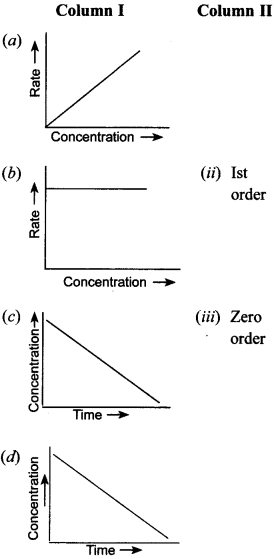
(d) (vi) \(\mathrm{e}^{-\mathrm{E}_{\mathrm{a}} / \mathrm{R} \mathrm{T}}\) refers to the fraction of molecules with energy equal to or greater than activation energy
(e) (ii) Energetically favourable reactions are sometimes slow, proper orientation is not there always.
(f) (v) Area under the Maxwell Boltzman curve is constant and total probability is one.


Note: In the following questions a statement of assertion followed by a statement of reason is given. Choose the correct answer out of the following choices. (Q.22 and Q.23)
(a) Both assertion and reason are correct and the reason is correct explanation of assertion.
(b) Both assertion and reason are correct but reason does not explain assertion.
(c) Assertion is correct but reason is incorrect.
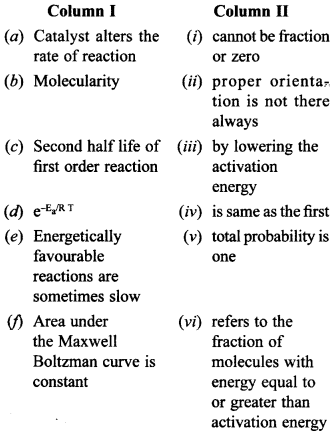
(d) Both assertion and reason are incorrect.
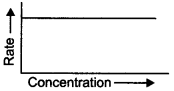
(e) Assertion is incorrect but reason is correct.
32. Assertion: Order of the reaction can be zero or fractional.
Reason: We cannot determine order from balanced chemical equation. [NCERT Exemplar]

Answer/Explanation

Answer:
Explaination:
(b) Both assertion and reason are correct but reason does not explain assertion.


33. Assertion: Order and molecularity are same.
Reason: Order is determined experimentally and molecularity is the sum of the stoichiometric coefficient of rate determining elementary step. [NCERT Exemplar]

Answer/Explanation

Answer: e
Explaination:
(e) Assertion is incorrect but reason is correct. Order and molecularity may or may not be same.


34. In Bimolecular reaction if one of the reactants is in excess it is called _________ .

Answer/Explanation

Answer:
Explaination: Pseudo first order


35. If activation energy for forward reaction (Ea)b = 150 kJ and (Ea)b is 260 kJ, ∆H of reaction

Answer/Explanation

Answer:
Explaination:
∆H = [Ea]f – [Ea]b = 150 – 260
= -110 kJ mol-1


36. If t of first order and zero order are same. Then the ratio of the initial rates of first order reaction to the zero order reaction is ______________ .

Answer/Explanation

Answer:
Explaination: 2 × 0.693


37. SN1 (substitution nucleophilic reaction) in Tertiary halide is bimolecular but order is 1. [True/False]

Answer/Explanation

Answer:
Explaination: True


38. SN2 (substitution nucleophilic reaction) in Primary halide is bimolecular and order is 2. [True/False]

Answer/Explanation

Answer:
Explaination: True


39. t99% = 2t90%, in first order reaction. [True/False]

Answer/Explanation

Answer:
Explaination: True


40. t1/2 is inversely proportional to initial concentration in zero order reaction. [True/False]

Answer/Explanation

Answer:
Explaination:
False, t1/2 is directly proportional to initial cone, in zero order.


41. Why does the rate of a reaction not remain constant throughout the reaction process?

Answer/Explanation

Answer:
Explaination:
It is because the concentration of reactants goes on decreasing with time.


42. Express the rate of the following reaction in “terms of disappearance of hydrogen in the reaction: 3H2 (g) + N2 (g) → 2NH3 (g).

Answer/Explanation

Answer:
Explaination:
\(-\frac{1}{3} \frac{d\left[\mathrm{H}_{2}\right]}{d t}\) represents rate of reaction.


43. What will be the units of rate of a reaction in gaseous reactions?

Answer/Explanation

Answer:
Explaination:
When the concentration of gases is represented in terms of their partial pressure then the units of the rate of a reaction will be atm s-1.


44. What is the difference between law of mass action and rate law?

Answer/Explanation

Answer:
Explaination:
The law of mass action is an theoretical law and it is based on the balanced chemical reaction whereas rate law is an experimental law.


45. For a reaction, , A → B, the rate of reaction can be denoted by \(-\frac{d[A]}{d t} \text { or }+\frac{d[B]}{d t}\). State the significance of plus and minus sign.

Answer/Explanation

Answer:
Explaination:
Minus sign indicates the decrease in the concentration of reactant A with time whereas plus sign indicates the increase in the concentration of product B with time.


46. What is meant by order of a reaction being zero?

Answer/Explanation

Answer:
Explaination:
It means the reaction is extremely fast and the rate of reaction does not vary with the concentration of the reactants as it gets completed within seconds.


47. The graph given below is a plot of the rate of a reaction vs concentration of the reactant. What is the order of the reaction?
Chemistry MCQs for Class 12 with Answers Chapter 4 Chemical Kinetics 8

Answer/Explanation

Answer:
Explaination: Zero order reaction.


48. The graph given below is a plot of the rate of reaction vs concentration of the reactant. What is the order of the reaction?
Chemistry MCQs for Class 12 with Answers Chapter 4 Chemical Kinetics 9

Answer/Explanation

Answer:
Explaination: First order reaction.


49. State a condition in which bimolecular reaction is kinetically first order reaction.

Answer/Explanation

Answer:
Explaination:
When one of the reactants is in excess, bimolecular reaction becomes kinetically first order.


50. Identify the reaction order from each of the following rate constants:
(i) k = 2.3 × 10⁻⁵ L mol-1 s-1
(ii) k = 3 × 10⁻⁴ s-1

Answer/Explanation

Answer:
Explaination:
(i) The unit of second order reaction is L mol-1 s-1 therefore, it represents second order reaction.
(ii) The unit of first order reaction is s-1, therefore, it is a first order reaction.


51. Calculate the overall order of a reaction which has the rate expression
(a) Rate = k [A]1/2 [B]3/2
(b) Rate = k [A]3/2 [B]-1 [Delhi 2011(C); AI 2011(C)]

Answer/Explanation

Answer:
Explaination:
Chemistry MCQs for Class 12 with Answers Chapter 4 Chemical Kinetics 18


52. For the reaction Cl2(g)+2NO(g) → 2NOCl(g), the rate law is expressed as rate = k[Cl2][NO]2
What is the overall order of this reaction?

Answer/Explanation

Answer:
Explaination:
The overall order of reaction is 3.


53. For which type of reactions, order and molecularity have same value?

Answer/Explanation

Answer:
Explaination:
If the reaction is elementary reaction, order and molecularity are equal.


54. Why is the probability of reaction with molecularity higher than three very rare?

Answer/Explanation

Answer:
Explaination:
It is because multimolecular collisions have least or rare probability.


55. For a hypothetical reaction A+ 2B → C, it is found that the rate = k [A] [B]. What is the most likely rate determining step?

Answer/Explanation

Answer:
Explaination:
A + B → C is most likely to be rate determining step.


56. What is the shape of graph between log k vs \(\frac{1}{T}\)?
What is the relationship between its slope and activation energy (Ea)?

Answer/Explanation

Answer:
Explaination:
It is a straight line whose slope is – \(\frac{E_{a}}{2.303 R}\).


57. Express the relation between the half-life period of a reactant and its initial concentration for a reaction of nth order.

Answer/Explanation

Answer:
Explaination:
t1/2 ∝ \(\frac{1}{[R]_{0}^{n-1}}\) where is the order of reaction.


58. In the Arrhenius equation, what does the factor e-Ea/RT corresponds to? [CBSE Sample Paper 2017]

Answer/Explanation

Answer:
Explaination:
It represents fraction of molecules possessing energy equal to or more than activation energy.


59. According to Arrhenius, rate of reaction increases with increase in temperature. Give reasons.

Answer/Explanation

Answer:
Explaination:
Rate of a reaction increases with increase in temperature because when kinetic energy of molecules increases, the number of molecules possessing activation energy also increases, i.e. number of effective collisions increases and therefore, the rate of reaction increases.


50. Define threshold energy of a reaction.

Answer/Explanation

Answer:
Explaination:
Threshold energy is the minimum energy which must be possessed by reacting molecules in order to undergo effective collision which leads to formation of product molecule.


We hope the given Chemistry MCQs for Class 12 with Answers Chapter 4 Chemical Kinetics will help you. If you have any query regarding CBSE Class 12 Chemistry Chemical Kinetics MCQs Pdf, drop a comment below and we will get back to you at the earliest.