NCERT Solutions for Class 12 Computer Science (C++) PDF Download | Chapterwise Class 12th Computer Science NCERT Solutions

NCERT Solutions Class 12 Computer Science

Enhance your conceptual base in the subject of Computer Science by referring to the NCERT Solutions of Class 12 Computer Science. Our NCERT Solutions for Class 12th Computer Science(C++) acts as a point of reference for students preparing for their board or competitive exams. Trail into the solutions whenever you need them as they are explained step by step.

Students can refer to the well-researched NCERT Solutions Class 12 Computer Science given as per the CBSE Class 12 Computer Science Syllabus. Solving the questions from the 12th Std Computer Science C++ NCERT Solutions you can learn how to write perfect solutions in exams and thus score well.

Class 12 Computer Science (C++) NCERT Solutions – PDF Free Download Chapter wise (will update soon)

Perform better in exams by accessing the Chapterwise NCERT Book Solutions of Class 12 Computer Science. Our Subject Experts have designed the NCERT Solutions in a simple manner so that you can get to know the concepts better as well as have a strong foundation for further studies. Simply click on the corresponding chapter you wish to study and learn the topics within accordingly.

UNIT – 1 : OBJECT ORIENTED PROGRAMMING IN C++

UNIT – II : DATA STRUCTURES

UNIT – III : DATABASE MANAGEMENT SYSTEM AND SQL

UNIT – IV : BOOLEAN ALGEBRA

UNIT – V : NETWORKING & OPEN SOURCE SOFTWARE

Advantages of using NCERT Solutions Class 12 Computer Science C++

Go through the endless benefits that one can have by referring to the 12th Class Computer Science NCERT Solutions and they are as below

  • Step by Step Explanations used while explaining all the questions from NCERT Textbooks can aid students in their homework as well as in exams.
  • One can gain good scores in exams by solving the NCERT Solutions of Class 12th Computer Science as they include a variety of questions for your practice purposes.
  • Class 12th NCERT Solutions of Computer Science acts as a great resource as it covers the entire concepts of CBSE Class 12 Computer Science NCERT Books.
  • The Solutions provided will upgrade your skills and develops an interest in the subject.

FAQs on CBSE Class 12 NCERT Solutions PDF for Computer Science Book

1. Where can I get the CBSE Class 12 Computer Science NCERT Solutions for free?

You can get the Class 12 Computer Science NCERT Solutions for free on our page.

2. How to download the 12th Class NCERT Solutions for Computer Science?

You can download the 12th Class NCERT Solutions for Computer Science by clicking on the quick links available on our page.

3. How many Chapters in NCERT Solutions of Class 12 Computer Science C++?

There are 14 Chapters in NCERT Solutions of Class 12 Computer Science C++.

Final Words

We as a team believe the knowledge shared regarding the NCERT Solutions Class 12 Computer Science is true and genuine. In case of any suggestions do reach us through the comment section so that we can get back to you. Bookmark our site for the latest updates on NCERT Solutions at your fingertips.

NCERT Solutions for Class 8 Social Science Civics Chapter 10 Law and Social Justice

Law and Social Justice Class 8 Questions and Answers Civics Chapter 10

Civics Class 8 Chapter 10 NCERT Textbook Questions and Answers

Question 1.
Why do we need a law on minimum wages?
Answer:
A law is needed on minimum wages so that the workers can get fair wages by their employers. Most often workers are denied for wages by the employers. The employers usually take advantage of the poverty of the workers and pay them less.

Question 2.
Find out :
1. What is the minimum wage for a construction worker in your state?
2. Do you think the minimum wage for a construction worker is adequate low or high?
3. Who sets the minimum wages?
Answer:

  1. It is about 150 per day
  2. Low
  3. The Ministry of labour sets the minimum wages.

Question 3.
Table 1 provides some important laws relating to the protection of these various interests. Columns (2) and (3) in Table 1 state why and for whom these laws are necessary. Based on discussions in the classroom, you have to complete the remaining entries in the table.
Table 1

Law Why is it necessary? Whose interests does the law protect?
1. Minimum Wages Act specifies that wages should not be below a specified minimum. Many workers are denied fair wages by their employers. Because they badly need work, workers have no bargaining power and are paid low wages. This law is meant to protect the interests of all workers; particularly, farm labourers, construction wor­kers, factory workers, domestic workers etc.
2. Law specifying that there be adequate safety measures in workplaces. For example, alarm system, emergency exits, properly-func­tioning machinery.
3. Law requiring that the quality of goods meet certain prescri­bed standard. For example electrical appliances have to meet safety standards. Consumers might be put to risk by +he poor quality of products such as electrical appliances, food, medicines.
4. Law requiring that the prices of essential goods are not high- For example, sugar kerosene, foodgrains. The interests of the poor who will otherwise be unable to afford these goods.
5. Laws requiring that factories do not pollute air or water.
6. Law against child labour in workplaces.
7. Law to form workers unions/ associations By organising themselves into unions, workers can use their combined power to demand fair wages and better working conditions.

Answer:

Law Why is it necessary? Whose interests does the law protect?
1. Minimum Wages Act specifies that wages should not be below a specified minimum. Many workers are denied fair wages by their employers. Because they badly need work, workers have no bargaining power and are paid low wages. This law is meant to protect the interests of all workers; particularly, farm labourers, construction wor­kers, factory workers, domestic workers etc.
2. Law specifying that there be adequate safety measures in workplaces. For example, alarm system, emergency exits, properly-func­tioning machinery. It is essential for safety of all parts of the body of the workers as well as for their lives’ safety and security. The all workers, employees, officials, owners and the property invested in the unit.
3. Law requiring that the quality of goods meet certain prescri­bed standard. For example electrical appliances have to meet safety standards. Consumers might be put to risk by the poor quality of products such as electrical appliances, food, medicines. This law is protecting the interests of the consumers.
4. Law requiring that the prices of essential goods are not high For example, sugar kerosene, foodgrains. Mainly, this law is necessary for poor people, people gett­ing fixed and low wages or pay packets people of middle classes etc. The interests of the poor who will otherwise be unable to afford these goods.
5. Law requiring that factories do not pollute air or water. It is necessary to have a check on the factory owners. To force legally to give complete com­pensation to working people and people of nearby areas.

To keep environment clean.

It is to protect the interest of workers and employees as well as the entire population. Safe and healthy environment is must for everyone.
6. Law against child labour in workplaces. It is necessary to protect the rights of the children. It protects the interests of the child. Children of every nation are the most valuable assets. The future of the country depends on them. In this way the law protect the interest of the nation also.
7. Law to form workers unions/ associations. By organising themselves into unions, workers can use their combined power to demand fair wages and better working conditions. This law will protect the interest of the labourers or workers.

Question 4.
Why do you think enforcement of safety laws is important in any factory?
Answer:
Enforcement of safety laws in any factory are important because in the absence of these laws there many occur serious disaster. For example, the Bhopal gas tragedy took place because the safety laws in our country were lose and whatever safety laws were there, there were not enforced.

Question 5.
Can you point to a few other situations were laws (a rules) exist but people do not follow them because of poor enforcement? (For example, our speeding by motorists). What are the problems in enforcement? Can you suggest some ways in which enforcement can be improved?
Answer:

  1. Standing on the footpath of a moving bus.
  2. Boarding a running bus.
  3. Not wearing a helmet while driving.
  4. Employing children under 14 years of ages as domestic helpers.
  5. Urinating at public places.
  6. Taking and giving dowry at the time of marriage.

For the above situation laws are not enforced because the government does not take them seriously. Even the public is not aware of it.

Enforcement can be improved if we follows the rules implemented properly.

Question 6.
A ‘clean environment is a public facility’. Can you explain this statement?
Answer:
Everyone needs or wants a clean environment. Since it is shared by many people at the same time, it is said to be a public facility.

Question 7.
Why do we need new laws?
Answer:
We need new laws to check pollution, clean rivers, banning the use of polythene bags, and crimes against women.

Question 8.
Why are companies and contractors able to violate environmental laws?
Answer:

Companies and contractors are able to violate environmental laws because these laws are not strictly enforced and also due to bribe.

Question 9.
Can you think of other ways in which the environment can be protected?
Answer:
The environment can be protected by the following ways :

  1. Minimum use of private vehicles
  2. Car-pooling
  3. Afforestation
  4. Stop use of polythene bags
  5. Proper disposal of sewage
  6. Stop polluting the rivers
  7. Use alternative sources of energy.

Question 10.
Talk to two workers (For example, construction workers, farm workers, factory workers, workers at any shop) to find out if they are receiving the minimum wages laid down by law.
Answer:
Construction Workers :
They are receiving below the minimum wages laid down by the law.

Factory Workers :
They are also receiving below the minimum wages.

Question 11.
What are the advantages to foreign companies in setting up production in India?
Answer:

  1. They can get cheap labour.
  2. They can get plots at cheaper rates.
  3. They can spend the least on housing facilities for workers.
  4. They can cut cost by including lower safely measures.

Question 12.
Do you think the victims of the Bhopal gas tragedy got justice? Discuss. Ans. No, the victims of the Bhopal gas tragedy did not get justice. Even after 25 years, the people are still fighting for safe drinking water, health care facilities and jobs affected by the Union Carbide factory.

Question 13.
What do we mean when we speak of law enforcement? Who is responsible for enforcement? Why is enforcement so important?
Answer:
Law enforcement refers that the provisions of law must be implemented. The government is responsible for law enforcement. It must see that the law applicable is equal to all without any discrimination.

Enforcement of law is necessary. In case any law is not enforced it can lead to serious disaster. The most stricting example is the Bhopal gas tragedy. This incident occurred because the safely measures, were lose in our country and even there weak measures were not properly enforced.

Question 14.
How can laws ensure that markets work in a manner that is fair? Give two examples to support your answer.
Answer:

  1. The government should regularly inspect worksites and punish those who are found guilty of violating the law.
  2. The government should control the activities of individuals or private companies.

Question 15.
Imagine yourself to be a worker working in a chemical factory, which has received orders from the government to move to a different site 100 kins away from the present location. Write about how your life would change? Read out your responses in the classroom.
Answer:
I am working in a chemical factory which is not far from my home. The government in its new policy has ordered to shift the chemical factory 100 kms away from the present location. It will cause many problems for me. I have to find a new house in that house which may not be suitable for my family and earning. The education of my children will also hamper. There is no good school in the locality. I am totally out of my mind, what to do and what not to do. If I leave the job it will be very difficult to find a new job. If I shift to the new place, my whole family will suffer. God! Please give show me the right path.

Question 16.
Write a paragraph on the various roles of the government that you have read about in this unit.
Answer:
The first priority of the government is to think about the welfare of the people. For this, it performs various functions and enacts various measures. The most important function of the government is to provide public facilities to the people. These include water, electricity, sanitation, public transport, etc. It should make laws to protect the interests of the workers. The minimum wages of the workers should be according to the wages set by the Minimum Wages Act. The government should see that workers are not exploited by the employers at the work place. By enforcing such laws, the activities of private companies can also be checked by the government.

Question 17.
What are the sources of environmental pollution in your area? Discuss with respect to (a) air; (b) water and (c) soil. What are the steps being taken to reduce the pollution? Can you suggest some other measures?
Answer:
The sources of pollution in our area are as follows :
1. Air : Many vehicles both private and public emit hazardous gases.
2. Water : Disposal of factory wastes, without checking, into the Yamuna river, immersion of idols, throwing of garbage directly into the river body.
3. Soil : Most of the area is constructed. Thus, there is no soil pollution. Suggestions :
Answer:

  1.  Old vehicles whether private or public should be banned. Use of CNG in all vehicles. Strictly checking of pollution norms.
  2. All factories should be shifted from residential areas. Proper pollution norms should be enacted in industrial areas.
  3. Banning of immersion of idols, water disposal in the Yamuna river.

Question 18.
How was environment treated earlier? What has been the change in perception? Discuss.
Answer:
In earlier times environment was treated as free entity. There were no restrictions. Any industry could pollute the air and water. All the natural elements of the environment were polluted, whether it was our rivers, air, soil and groundwater. The health of the people was completely ignored.

The tragedy at the Bhopal Union Carbide brought change in perception. New laws were introduced by the government for the environment. It was decided that the polluters were to be held accountable for the damage due to the environment. It is now felt that the environment is something that people over generations will share. It should not be destroyed merely for the development of industry.

Question 19.
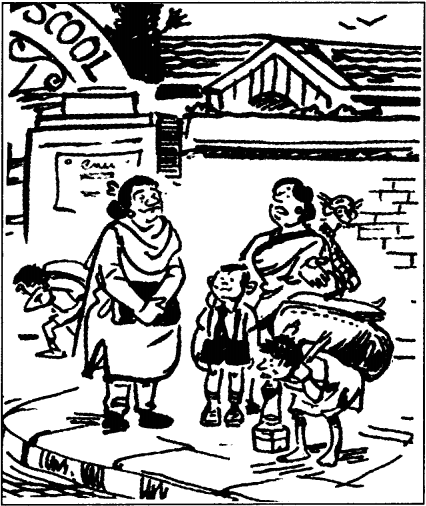
What do you think the famous cartoonist R.K. Laxman is trying to convey in this cartoon? How does it relate to the 2006 law that you read about on page 125?
NCERT Solutions for Class 8 Social Science Civics Chapter 10 Law and Social Justice 1
Answer:
In the above cartoon, the cartoonist, R.K. Laxman, brings to light how we treat children of the same age differently, the child who belongs to a rich family gets love and sympathy from his mother because she feels it is wrong to burden kids. On the other hand she is also putting all the burden on another kid because he is a poor kid and a child labourer. In our society, child labour is a menance. Because of this all children do not get the same treatment. Thus, this is injustice.

NCERT Solutions for Class 8 Social Science

NCERT Solutions for Class 8 Social Science History Chapter 3 Ruling the Countryside

Ruling the Countryside Class 8 Questions and Answers History Chapter 3

History Class 8 Chapter 3 NCERT Textbook Questions and Answers

Question 1.
Imagine a conversation between a planter and a peasant who is being forced to grew indigo. What reasons would the planters give to pursuade the peasant? What problems would the peasant point? Enact their conversation.
Answer:
Planter:
“I want you to grow Indigo for me only. Do not worry I will give you and your family enough work for the entire year. Do not worry about money, you will get enough. I will also admit your children in the school. You will also get medical facilities from me.”

Peasant :
“Sir, please don’t force me to grew Indigo only. How will we get rice, wheat and vegetables. After cultivation of Indigo, the soil will loose its fertility. We cannot grew any other crops on this soil again. Please allow us to cultivate other crops.”

Question 2.
Match the following :

ryot village
mahal peasant
nij cultivation of ryot’s lands
ryoti cultivation of planter’s own land.

Answer:

ryot peasant
mahal village
nij cultivation of planter’s own land.
ryoti cultivation of ryot’s lands

Question 3.
Fill in the blanks :
(a) Growers of woad in Europe saw ……………… as a crop which would provide competition to their earnings.
(b) The demand for Indigo increased in late eighteenth century Britain became of ……………………. .
(c) The international demand for Indigo was affected by the discovery of ……………………. .
(d) The Champaran movement was against ……………… .
Answer:
(a) it
(b) Industrial revolution
(c) woad
(d) Indigo-planters.

Question 4.
Describe the main features of the Permanent Settlement.
Answer:
The main features of the Permanent Settlement were :

  1. It took the place of the system of auctioning, which could not bring stability in income of the Company.
  2. This system was introduced in Bengal and Bihar. The Company decided to fix the land revenue on a permanent basis.
  3. It was introduced by Charles Cornwallis in 1793.
  4. According to it, the zamindar of an estate had to pay a fixed amount to the British Government every year within a specified period of time.
  5. This new system ensured to the Company regular income. It also created a new class of landlords which was loyal to the British.
  6. Assured to their ownership, many of these landlords stayed most of the time in towns from their estates and squeezed their tenants to the limit of the latter’s capacities.
  7. In 1799, they were empowered to exit the tenants and also to confiscate their property for non-payment of their due to the landlord.
  8. The Permanent Settlement was very useful to the zamindars. By Increasing the area under cultivation, their collection or rent went up, but the amount that they had to pay to the Government remained the same.

Question 5.
How was the Mahalwari System different from the Permanent Settlement?
Answer:

  1. The Permanent Settlement was introduced first of all in Bengal and Bihar. Later on it was extended to Orissa, the coastal districts of Andhra and to Benaras. On the other hand, the system of mahalwari was introduced in western part of Uttar Pradesh, in Punjab and Delhi.
  2. It came into effect in 1822, while the Permanent Settlement was introduced in 1793.
  3. Under Mahalwari System a mahal or village was considered an important social institution and therefore, it was preserved.
  4. The government officials inspected the land from village to village, they measured the fields and recorded the customs and rights of different groups. They estimated revenue of each plot within a village and then this was added up to calculate the revenue that each village (mahal) had to pay.
  5. The demand of land-revenue was to be revised periodically, not permanent fixed.
  6. The charge of collecting the revenue and paying it to the Company was given to the village headman, rather than the zamindar.

Question 6.
Give two problems which arose with the new Munro System of fixing revenue.
Answer:
The problems created by the Munro System of fixing revenue :

  • Driven by the desire to increase the income from land, revenue officials (captain Alexander Read and Thomas Munro) fixed to high a revenue demand. Peasants were unable to pay, ryots fled the countryside, and villagers become deserted in several areas.
  • Optimistic officials had imagined that the new systems would transform the peasants into rich enterprising farmers. But this did not happen.

Question 7.
Why were ryots reluctant to grow Indigo?
Answer:

  1. In March, 1859 thousands of ryots in Bengal refused to grow Indigo because the Indigo system was intensely oppressive.
  2. The Indigo ryots felt that they had the support of the local zamindars and village headmen in their rebellion against the planters.
  3. In many villages, headmen who had been forced to sign Indigo contracts, mobilised the Indigo peasants and fought pitched battles with the lathiyals.
  4. In other places even the zamindars went around villagers using the ryots to resist the planters. These zamindars were happy with the increasing power of the planters and angry at being forced by the planters to give them land on long leases.
  5. Change in the policy and attitude of the Government :
    (i) The Indigo peasants also imagined that the British Government would support them in their struggle against the planters.
    (ii) After the Revolt of 1857, the British government was particularly worried about the possibility of another popular rebellion. When the news spread of a simmering revolt in the Indigo districts, the Lieutenant Governor toured the region in the winter of 1859. The ryots saw the tour as a sign of government sympathy for their plight.
    (iii) When in Barasat, the magistrate Astley Eden issued a notice stating that ryots would not be compelled to accept Indigo contracts, word went around that Queen Victoria had declared that Indigo need not be sown.

Role of the Intellectuals :
As the rebellion spread, intellectuals from Calcutta rushed to the Indigo districts. They wrote the misery of the ryots, the tyranny of the planters and the horrors of the Indigo system.

Question 8.
What were the circumstances which led to the eventual collapse of Indigo production in Bengal?
Answer:
Circumstances leading to the eventual collapse of Indigo production in Bengal :

  1. In March, 1859 thousands of ryots in Bengal refused to grow Indigo. As the rebellion spread, ryots refused to pay rents to the planters and attacked Indigo factories with armed swords and spears bows and arrows. Women turned up to fight with pots, pans and kitchen implements.
  2. Those who worked for the planters were socially boycotted and the gomasthas agents of planters who come to collect rent were beaten up. Ryots swore they would no longer take advances to sow Indigo nor be bullied by the planters’ lathiyals, the lathi wielding strongmen maintained by the planters.
  3. Worried by the rebellion, the government brought in the military to protect the planters from assult, and set up the Indigo Commission to enquire into the system of Indigo production. The commission held the planters guilty and criticised them for the coercive methods they used with Indigo cultivators.
  4. The Indigo Commission declared that Indigo production was not profitable for ryots. The Commission asked the ryots to fulfil their existing contracts but also told them that they could refuse to produce Indigo in future.

Question 9.
Find out more about the Champaran Movement and Mahatma Gandhi’s role in it.
Answer:
After the Indigo production collapsed in Bengal, the European Indigo planters shifted their operation in Bihar. In the late nineteenth century their business was severely affected due to the discovery of synthetic dyes, but inspite of this they managed to expand production. When Mahatma Gandhi returned from South Africa, he visited Champaran to see the plight of the Indigo cultivation there.

Mahatma Gandhi’s role :
In 1917, the visit of Mahatma Gandhi, marked the beginning of the Champaran Movement against the Indigo planters. The European peasants oppressed the peasants and forced them to grow Indigo and sell their produce at cheaper rate. Gandhiji witnessed the miserable conditions of the peasants. When the District officials ordered him to leave Champaran, Gandhiji refused to leave and started the satyagraha. It was victory for Gandhiji. A Commission was appointed to examine the activities of the plantation owners in which Gandhiji was also kept as a member.

Question 10.
Look into the history of either tea or coffee plantations in India. See how the life of workers in these plantations was similar to or different from that of workers in Indigo plantation.
Answer:
Hints: Life in Tea Plantations of Assam:

  • Estate owners
  • Workers
    (a) Wages
    (b) Habitation
    (c) Facilities
  • Problems.
    Life in the Indigo Fields
  • Cultivators or Zamindars were the owners.
  • Generally, cultivators worked in fields themselves.

Activities

Activity 1
Why do you think Colebrook is concerned with the conditions of under ryots in Bengal? Read the preceding pages and suggest possible reasons.
Answer:
In 1806, H.T. Colebrook described the conditions of these under tenants in Bengal. He is concerned with the miserable conditions of the under-ryots in Bengal because he could understand that the work of farming depended on them. The following source given in the Textbook clearly indicates that he urges about the Bengal ryot.

The under tenants depressed by an excessive rent in kind, and by unsurious returns for the cattle, seed and subsistence, advanced to them, can never extricate themselves from debt. In so object a state, they cannot labour in spirit, when they earn a scanty subsistence, without hope of bettering their situation.

Activity 2
Imagine that you a Company representative sending a report back to England about the conditions in rural areas under Company rule, What would you write?
Answer:
Hints :

Permanent settlement introduced in 1793. The rajas and taluqdars are recognised as zamindars. They were asked to collect revenue for the Company. Revenue is fixed permanently.

The revenue was very high. Zamindars found it difficult to pay. Anyone who failed to pay the revenue lost his zamindari.

The cultivator formed the system very oppressive. The rent was high and the land was insecure. To pay the rent he had often to take a loan from the moneylender, and when he failed to pay the rent he was evicted from the land he had cultivated for generations.

Under the Munro System, revenue officials fixed too high a revenue demand. Peasants were unable to pay, ryots fled the countryside and villages became deserted in many regions.

Activity 3
Imagine you are a witness giving evidence before the Indigo Commission. W.S. Seton Karr asks you “On what condition will ryots grow Indigo?” What will your answer be?
Answer:
I would plainly say no for growing Indigo still if he urges me, I would simply tell him that if you want me to grew Indigo then please supply me a year’s ration in advance.

NCERT Solutions for Class 8 Social Science
NCERT Solutions Class 12 Biology Free PDF Download | Chapterwise Class 12th Biology NCERT Book Solutions

NCERT Solutions Class 12 Biology

NCERT Solutions of Class 12 Biology assists students to learn the concepts within CBSE Syllabus efficiently. Biology Class 12 NCERT Solutions are given by subject experts after extensive research. NCERT Solutions of 12th Std Biology will emphasize the understanding of concepts and you can learn them with ease. We have designed the Class 12 Biology NCERT Solutions as per the CBSE Syllabus for Class 12 Biology. Download the Class 12th NCERT Solutions of Biology in PDF Format for free and prepare effectively.

You can also Download Free NCERT Books for class 1st to 12th

NCERT Solutions for Class 12 Biology Free PDF Download Chapter wise

Access the Chapterwise Class 12 Biology NCERT Solutions given in a concise manner and face the exam without any fear. The NCERT Solutions of Class 12 Biology gives you ample study material to form a good base of fundamentals of the subject. Class 12th Biology NCERT Solutions are in accordance with the NCERT Books for Class 12 Biology. Easy explanations provided for all the concepts makes it easy for you to grasp the concepts. Simply click on the direct links available and learn the concepts within accordingly.

Download Complete NCERT Solutions PDF from class 6th to 12th.

Class 12th Biology NCERT Solutions Free PDF Download

If you feel any questions are tricky and needed any assistance while preparing you can always refer to the best study material i.e. Class 12 Biology NCERT Solutions. Get Precise answers to all the questions in the NCERT Books of Class 12 Biology and know how to write accurate and to-the-point answers in exams.

Downloadable PDF Files will let students study the concepts at their own pace. You can prepare from other resources like MCQ Questions for Class 12 Biology with Answers and self-examine your preparation standard.

Benefits of NCERT Class 12 Biology Solutions

There are several benefits of referring to the Class 12th Biology NCERT Solutions. They are as follows

  • Class 12 Biology NCERT Solutions present here are given by subject experts.
  • All the content formulated in the Biology Class 12 NCERT Solutions is as per the CBSE Curriculum.
  • 12th Std NCERT Solutions for Biology acts as the best resource in exam preparation.
  • Solutions existing are given here in a simple and easy-to-understand language.
  • CBSE Class 12th Biology Solutions are known for their simple and straightforward descriptions.

FAQs on CBSE Class 12 Biology NCERT Book Solutions

1. Do I need to pay for accessing the NCERT Solutions of Class 12 Biology?

No, you need not pay any amount for accessing the NCERT Solutions of Class 12 Biology and you can get them all for free.

2. Where can I find the Chapterwise Class 12th Biology NCERT Solutions?

You can find the Chapterwise Class 12th Biology NCERT Solutions on NCERTBooks.guru

3. How to download NCERT Solutions for Class 12 Biology?

You can download NCERT Solutions for Class 12 Biology by simply clicking on the quick links available.

Final Words

Hope the information existing on our page regarding the Class 12 Biology NCERT Solutions has been useful to you. In case of any further doubts do ask us through the comment section so that we can get back to you. Bookmark our site to avail latest updates on NCERT Books, MCQ Questions with Answers, NCERT Solutions of other Classes, etc.

NCERT Solutions for Class 7 Hindi Free PDF Download | CBSE NCERT 7th Textbook Solutions for Hindi (Vasant & Durva)

NCERT Solutions for Class 7 Hindi Pdf

Here you will come across comprehensive solutions for each and every question covered in the NCERT Textbook of Class 7 Hindi Vasant. Students who want to score high in their exams should access & download chapterwise NCERT Solutions for Class 7 Hindi (Vasant & Durva) and master in the subject.

NCERT Book Solutions for 7th Hindi PDF acts as the best guide to cover up your knowledge gap and lay strong basics of the concepts. It also helps students to score more marks and more subject knowledge. Hence, download NCERT Solutions of Class 7 Hindi Vasant Chapter-wise in pdf format by using the links available on this page.

Class 7 Hindi NCERT Solutions Chapterwise – Free PDF Download

Practice all textbook questions from every chapter and clarify your doubts by downloading the pdf formatted solutions of class 7 Hindi NCERT from the links available below. Moreover, you can also download complete NCERT Solutions for class 6th to 12th from our trusted website @Ncertbooks.guru and gain more integellience and highest grades in final exams.

NCERT Solutions for Class 7 Hindi Vasant 

All Chapters NCERT Solutions Class 7 Hindi Vasant Free PDF

The NCERT CBSE Solutions of  Class 7 Hindi PDF is helpful to learn all chapter-wise and exercise-wise solutions present at NCERTBooks.Guru. Also, the textbook solutions of NCERT aid students to assess their level of knowledge and boost their confidence to solve complex questions with ease.

After practicing with NCERT Class7 Hindi Solutions Pdf, you will definitely understand the important concepts easily and succeed in the final examinations. Simply download the free NCERT Textbooks pdf along with Class 7 Hindi NCERT Book Solutions PDF from here & increase your subject skills.

Final Thoughts

We at NCERTbooks.guru, decided to make the issue-free study time for students with our website. So, visit our site NCERTbooks.Guru and download all study materials like NCERT Solutions for Class 7 Hindi Vasant chapter-wise, MCQ Questions for Class 7 Hindi with Answers, NCERT Books for 7th Hindi PDF, lecture notes, etc. in pdf formats. So that you can easily clear all your queries regarding the subjects online and score high in your competitive or board exams.

NCERT Solutions for Class 12 Business Studies Free PDF Download | Chapterwise NCERT Solutions of Class 12th BST

NCERT Solutions Class 12 Business Studies PDF

NCERT Solutions for Class 12 Business Studies can be an extremely helpful resource for students in their preparation. Class 12 Business Studies NCERT Solutions covers questions from all the NCERT Books for Class 12 Business Studies. Class 12th NCERT Solutions of Business Studies will strengthen your fundamentals and help you score good grades in exams. NCERT Solutions of Class 12 Business Studies are given by experts adhering to the latest CBSE Syllabus Guidelines.

Download Complete NCERT Solutions PDF from class 6th to 12th as per your requirement and learn the concepts effectively.

Chapter-wise NCERT Solutions for Class 12 Business Studies Free PDF Download

Make the best out of the Chapterwise NCERT Solutions Class 12 Business Studies for both Parts 1 & 2 over here and resolve your queries regarding the subject. All you have to do is simply click on the respective chapter links and learn the concepts within quite easily. Students can complement their preparation by taking help of our article on Business Studies MCQs for Class 12 with Answers and improvise on the areas of need accordingly.

NCERT Solutions for Class 12 Business Studies Part 1 Principles and Functions of Management

NCERT Solutions for Class 12 Business Studies Part 2 Business Finance and Marketing

You can also Download Free NCERT Books for class 1st to 12th

Class 12th NCERT Solutions for Business Studies PDF Download

Business Studies Class 12 NCERT Solutions PDF Versions will help you understand how the subject is easy at surface level. Don’t worry about the accuracy of the solutions present here as all of them are explained to you after ample research. All the 12th Std Business Studies NCERT Solutions present here are as per the CBSE Class 12 Business Studies Syllabus. NCERT Book Solutions of Class 12 Business Studies include illustrative examples that help you comprehend and learn the concepts quickly.

Importance of Class 12 Business Studies NCERT Solutions

There are plenty of benefits referring to the 12th Std Business Studies NCERT Solutions and they are as below

  • Class 12 Business Studies NCERT Solutions offers in-depth explanations for all the complex topics.
  • CBSE Class 12th Business Studies Notes available is as per the Latest CBSE Curriculum.
  • 12th Class NCERT Book Business Studies Solutions can save you a lot of time as we have explained all the topics in one place.
  • You can learn and grab the concepts much quickly and effectively as well as score better grades in exams taking the help of the Business Studies NCERT Solutions for Class 12.
  • Solve the questions regularly and attempt the exam with utmost confidence.

FAQs on CBSE Class 12th NCERT Solutions of Business Studies

1. Where do I get Chapterwise NCERT Solutions of Class 12 Business Studies?

You can get Chapterwise NCERT Solutions of Class 12 Business Studies for free on NCERTBooks.guru a trusted portal.

2. How to download Business Studies Class 12th NCERT Solutions?

You can download Business Studies Class 12th NCERT Solutions by simply tapping on the quick links available.

3. How to study for the CBSE Business Studies Paper for Class 12?

You can study for the CBSE Business Studies Paper for Class 12  by using the preparation resources like NCERT Solutions of Class 12 Business Studies, CBSE Class 12 Business Studies Notes, BST Sample Papers, etc.

Conclusion

We wish the data shed regarding the CBSE Class 12 Business Studies NCERT Solutions has been useful to you. For any other queries do ask us through the comment section so that our team can guide you. Bookmark our site to avail latest updates on NCERT Books, MCQs, NCERT Solutions of other Classes in no time.