M.Sc MBA | Course Details, Eligibility Criteria, Fee Structure, Admission Process

M.Sc MBA

M.Sc MBA: M.Sc MBA is a two years-long double-degree integrated course program. This course is designed to provide an opportunity to combine practical experience and new knowledge.

MSc. MBA uses the integration of theory, practice, and research to convey the applications at regional, national, and international levels. M.Sc MBA connects students to a highly diverse and experienced cohort. Students are educated to learn about themselves as a business leader.

Get to Know More about other types of Course Details in Stream wise, and Category wise.

Depending on the choice or interest, students can choose a specialization that edges their business-oriented skills and aids them in constructing a career in this field. M.Sc MBA is an ideal course for students with an inclination towards advanced research in fundamental sciences and business.

After reading the guide, you will have an idea about:

  • Details about the course
  • Eligibility to get admission in the course
  • Skills required for the course
  • Syllabus of the course
  • Entrance Examinations for admissions
  • Fee Structure of the course
  • Internship options during the course
  • Career options after completing the course
  • Expected salary
  • Job profiles
  • Similar course to pursue

About M.Sc MBA

M.Sc MBA is a dual degree program that covers the vital aspects of MBA and MSc International Business. The two-year double-degree MSc-MBA program is an advanced integrated program offered to students to complement their intensive Master of Science coursework with a rigorous MBA program.

Earning both a Master’s degree and an MBA degree, in a total of two years, prepares students for senior management positions in areas that demand expertise in a specific business discipline. The course program combines foreign language skills with a passion for international business by integrating the fundamentals of research and science.

The MSc section of the dual degree is designed to prepare students to master the precise business field’s specific demands. The MBA section of the course aims to strengthen the student’s personal, communication, and leadership skills.

M.Sc. MBA provides at least two years of full-time work experience, ideally in designing and developing technology-intensive products.

M.Sc MBA Course Highlights

Particulars Details
Name of Course Master in Science + Master in Business Management Program
Course Level Dual-Masters level
Course Duration Course Duration of Master of Science [M.Sc.] + MBA. is two Years.
Eligibility
  • An aggregate of 55% to 60% and above undergraduates of computer science, engineering, or a related field, with a record of academic excellence, is eligible to apply.
  •  Candidates with first-class specifications in high and higher school ( 10 and 10+2) are eligible to apply.
  • Final year graduation students are eligible to apply.
Admission and Entrance Exams M.Sc. MBA course admission is based on a college or university’s qualifying examination and a standard entrance exam such as NMAC by GMAC, CAT, GRE, XAT, CMAT, MAT, ATMA, GMAT, etc
Top Colleges
  • Christ University, Bangalore
  • School of Business Management SVKM’s Narsee Monjee Institute of Management Studies, Mumbai
  • Rajiv Gandhi University, Itanagar
  • IIT- Madras
  • Chandigarh University, Punjab
  • Amrita School of Business, Bangalore
  • Lovely Professional University, Jalandhar
Similar Specifications
  • MBA Integrated
  • B.Tech-MBA
  • M.Sc-P.hD.

M.Sc. MBA Course Eligibility Criteria

The eligibility criterion for M.Sc. MBA degree is similar to various postgraduate or double degree programs in other disciplines. The following candidates are eligible for applying for an M.Sc. MBA course are as follows-

10+2 Stream/ Bachelor’s
  • An aggregate of 50% to 60% and above undergraduates of computer science, engineering, or a related field, with a record of academic excellence, is eligible to apply.
  • Candidates with first-class specifications in high and higher school ( 10 and 10+2) from any stream are eligible to apply.
Cut-off Marks A minimum of 50% to 60% aggregate score
Age Limit 20 years for General category, 23 for SC/ST/OBC, 25 for PWD
  • Any Bachelor’s degree program with a minimum of 50% to 60% aggregate, recognized by the Association of Indian Universities.
  • Candidates should have completed their 10+2+3 years of education.
  • Candidates must acquire a valid score from CAT/ MAT/ CMAT/ GMAT/ GRE/ XAT entrance examinations.Candidates must acquire a minimum IBT-TOEFL score of 79 or IELTS score of 6.5 with an individual category score of 6 or PTE score of 55 with individual category score of 50 to deem eligible for institutions overseas.
  • Candidates must secure a valid English test score to enroll for admissions.
  • Those candidates appearing for final year examinations of Bachelor’s degree are also eligible to apply. The students must submit their subject to the completion of their examinations and viva-voce before an institutional admission.
  • Candidates with work experience have an added advantage for admissions.

Skill Set Required for M.Sc. MBA Course

Aspiring students in a postgraduate degree represent a significant step-up from that encountered during the undergraduate studies. This combined, the two-degree program completes the student’s leadership profile granting you the operational, technical, and problem-solving skillsets.

These skills help students build leadership potential for top management positions. Aspiring students need to ideally possess the following qualities over and above the primary requirements listed in the previous section –

  • Informational Technology
  • Communication and teamwork
  • Critical thinking
  • Project management
  • Problem-solving
  • Data analysis
  • Independent thinking

M.Sc. MBA Course Curriculum

M.Sc. MBA hones the decision-making ability of students and imbibes them with in-depth knowledge of analytics and its bouquet of existing offerings. Several colleges or universities hold connections overseas to grant students with international experience. The 2-year program dual course program comprises of the following curriculum:

  • Three terms at Indian University
  • Two terms at universities overseas
  • One term dedicated to the internship

The M.Sc. MBA course curriculum emphasizes an understanding of sustainable and effective business models for development and discovery. It also overlays the ethical implications of new therapeutics and equitable access to the fruits of therapeutic discovery.

Key M.Sc. MBA Course Features

  • The course program focuses equally on both techniques and technologies. It aims to prepare the students for the current and future landscape of business data.
  • Students are introduced to broader exposure to various functional areas of business and how to make vital information.
  • Students are educated in any specific domains in analytics such as finance, supply chain, human resources, or marketing.
  • Students are educated in developing proficiencies with an in-depth analysis of a variety of software tools such as SQL, SAS, R, Python, and various big data technologies.
  • The course curriculum also includes a unique treatment of data, gamification, data modeling tools, analytics, and optimization modeling.
  • The course offers an 18-week industry internship under the guidance of a faculty.
  • The course project provides analytics projects and assignments on real data pre-tested for analytical accuracy.

Core Courses

First Trimester Second Trimester Third Trimester
Business Communication Economic Analysis- Macro Level Management Information System- Part II
Financial Accounting Organizational Behaviour- Part II Business Research Methods
Marketing Management- Part I Financial Marketing Human Resource Management
Economic Analysis- Micro Level Marketing Management- Part II Cost Management
Organizational Behaviour- Part I Production and Operations Management- Part I Economic and Environmental Policy
Data Analytics- Part I Data Analytics- Part II Production and Operations Management- Part II
Management Information System- Part I Introductory Statistic with R


Fourth Trimester Fifth Trimester Six Trimester
Strategic Management ITES Strategy and Policy Environmental Management and Sustainability Development
Enterprise Models Contracts Relationship and Management Innovation and Entrepreneurship
Analysis Modelling and Design Business Analytics Managerial Values and Business Ethics
IB Law and IP Management Software Project and Change Management
Information Assurance

Electives: M.Sc. MBA course offers optional courses of study to aspirants in the following areas

Electives in Analytics Electives in Finance Electives in Human Resource
Financial Analytics Commercial and Retail Banking Compensation and Benefits
Marketing Analytics Quantitative Equity Portfolio Management Industrial Relations and Labour Laws
HR Analytics Corporate Taxation Employee Training and Development
Supply Chain Analytics Financial Statement Analysis Performance Management
Machine Learning Financial Markets International HRM
Applied Statistics in Data Mining Corporate Valuation


Electives in Marketing Electives in Operation Electives in General Management
Sales and Distribution Management Manufacturing Planning and Control for Supply Chain Management Econometrics
Strategic Brand Management Supply Chain Management Health Care Management
B2B Consultative Sales Management Strategic Sourcing
Digital Marketing Business Process Re-Engineering
Retail Management Advanced Quality Planning and Management
Consumer Behaviour Theory of Constraints

Admission Procedure for M.Sc. MBA Course

The selection of students is a part of the admission process, and this process is done in two pathways, as explained below:

Part One:

Applicants to the M.Sc.-MBA course program will be shortlisted based on the eligibility criteria mentioned as follows:

  • A bachelor’s degree from a recognized university or institution with a minimum of 50% aggregate
  • Candidates must have completed 10+(2) with an aggregate of 50 percent marks in Mathematics.
  • Candidates must have secured a score of 209 or above in NMAT by GMAC, or
  • A valid GMAT score of 650 and above, or
  • A valid GRE Score of 319, or
  • Any other entrance examinations

Upon qualification, selected students will be called for a CDPI and offered a provisional offer of admission.

Part Two:

Upon the successful completion of Part one, selected candidates must complete the application requirements. This process applies to those universities that have tie-ups with institutions overseas.

For such institutions, the following procedure is followed:

Selected students must submit one Language Assessment Test- IELTS/ TOEFL for admission at the allied institution. Students must secure a minimum of 80 in the TOFEL test or a score of 6.5 or higher in the IELTS entrance examination to qualify them.

After initial screening and a personal interview process, students will be offered admission to the National and allied institutions.

M.Sc MBA Course Entrance Examinations

Aspirants must appear for an entrance examination to get admission into M.Sc.-MBA. There are various institutions-based entrance examinations for the M.Sc.-MBA degree program. However, the top four entrance examination are as follows:

Name of Examination Conducted by Eligibility
CAT Indian Institutes of Management IIMs
  • Candidates must secure an aggregate of 50% marks in 10+2 and Bachelor’s in the unreserved category and an aggregate of 45% marks in 10+2 and Bachelor’s in the reserved category
  • There is no age limit for General Category and SC/ST/PWD category candidates.
GRE Educational Testing Service (ETS)
  • There is no prescribed age limit or qualification for candidates to enroll for the GRE examination.
  • However, candidates are expected to have completed their undergraduate program with passing marks.
GMAT The Graduate Management Admission Council
  • GMAT examination has no upper age limit for candidates to appear for this exam. However,  the minimum age limit for GMACis that candidates must be of at least 18 years.
  • Candidates must hold basic understanding and fluency in the language of  English.
  • Candidates irrespective of their gender, age, nationality, religion, academic background, etc.are eligible to  appear for the exam without any discrimination
  • Candidates should have qualified in 10+2 or qualified from an equivalent system.
  • Candidates must have secured a minimum aggregate in the Bachelor’s degree from a recognized university or equivalent.
NMAT GMAC
  • Candidates must hold a bachelor’s degree, with a minimum of 50% aggregate or equivalent CGPA in the required discipline.

Other institution-based Entrance Examinations for M.Sc. MBA integrated degree program are:

  • XAT
  • CMAT
  • MAT
  • ATMA
  • GMAT
  • Others

Top Institutions Offering M.Sc. MBA Course

Two allied institutions usually grant M.Sc.-MBA dual degree. Here is a list of Indian universities that are allied with foreign universities to complete the two term-year course for this program:

  • Amrita School of Business, Bangalore: offers a collaborative program where the MBA is studied at Amrita. In contrast, the M.Sc course program is pursued at Management of IT services from the State University of New York at Buffalo, USA.
  • Lovely Professional University, Jalandhar: offers two choices- join a partner or receiving university overseas to complete the course program or complete the program at LPU without any international accreditation.
  • Christ University, Bangalore: offers a collab for three months with the FHWS, Germany, for MBA certification.
  • Narsee Monjee Institute of Management Studies, Mumbai: offers two terms of the MBA-MSc dual Degree program at Purdue University, USA. In contrast, the three-term and the 6-month internship program have to complete at NMIMS and India, respectively.

M.Sc. MBA Course Fee Structure

M.Sc-MBA course program fee structure varies significantly across government and private-run institutions. However, the standard fee structure falls between the below-mentioned table:

Tuition and Other Fee Structure Rs. 10.6 to Rs. 15.6 Lakhs per academic year
Hostel and Mess Fee Rs. 1.9 to Rs. 30.0 Lakhs per academic year
Total Fee Rs. 12.5 to Rs. 19.5 Lakhs per academic year

Additional cost for mandatory three to four weeks study trips to any allied universities overseas as part requirement for the MS-MBA Degree costs around three to five Lakhs – subjected to the currency rate and exchanges and is inclusive of everything.

Career Prospects Under M.Sc MBA Course

M.Sc MBA dual specialization offers an exciting and challenging career in the field. Still, the benefits it unfolds is huge as graduates can hold professional positions and earn the extra edge in competitive job markets. They are exposed to gain more skills and expertise is a must to secure the high paid and successful career.

M.Sc MBA course program leverages dedicated professionals, offers a robust career strategy process. It offers tailored one-on-one coaching and formal coursework and a robust suite of tools and resources.

MBA is a well-established post-graduation that opens a path in specializations as a primary qualification. However, with M.Sc alongside, graduates are offered roles that require analytical skills and critical thinking.

Today, graduates can trip over plenty of job opportunities if they are willing to work hard and smart and will be embraced with more significant opportunities. Graduates are qualified with high paying and high-intensity fields such as employment opportunities in the insurance, banking, and other allied industries.

Salary Prospects of an M.Sc MBA Graduate

The freshers in M.Sc-MBA earn around Rs. five lakh to Rs. Eight lakh per annum, the experienced professionals in the field earn between Rs.10 lakhs to Rs. 18 lakhs per annum.

Graduates in the field of Finance hold an average pay package of Rs. Five lacks to ten lakhs per annum. Graduates from Business Analytics in India earn around Rs. 11 lakhs per annum. The average pay package for a graduate in Marketing earns an average pay grade of Rs. 7,52,000 lakhs per annum. Graduates from HR earn a pay grade of Rs. 6, 03,000 per annum.

Employment Areas:

  •  As an entry-level investment banker, a graduate in the field can earn around Rs.6,80,000 lakhs per annum.
  • As an entry-level Project Management Manager, a graduate from the field earns around Rs.1,60,000 lakhs per annum.
  • As an entry-level Business Consultant, a graduate earns around Rs.4,37,000 lakhs per annum.

However, this pay package increases with time and experience.

Courses Similar to M.Sc. MBA

Apart from M.Sc.-MBA, there are some similar courses that you can pursue if you are interested in interior designing such as:

  • MBA Integrated
  • B.Tech-MBA
  • M.Sc-P.hD.

FAQ’s on M.Sc MBA Course

Question 1.
What is the upper-hand of M.Sc.-MBA over regular master courses?

Answer:
M.Sc-MBA dual course program covers twice the courseload in the stipulated time. While the MSc section of the dual degree is designed to cater to students to master the precise business field’s specific demands, the MBA section of the course aims to strengthen the student’s personal, communication, and leadership skills. Also, M.Sc. MBA education on the aspects of designing and developing technology-intensive products.

Question 2.
How long is the duration of the course?

Answer:
M.Sc-MBA course has a total duration of 2 years and is divided into six semesters.

Question 3. 
How beneficial is the M.Sc-MBA course program?

Answer:
Through the course program, you learn more and move forward to become a specialist in not just one, but two areas. Dual degrees are spread across different institutions in terms of network, so you get access to two big networks.

Question 4.
What is the eligibility criteria to be met for the M.Sc-MBA course program?

Answer:
Aspiring candidates must meet the following criteria:

  • An aggregate of 55% to 60% and above undergraduates of computer science, engineering, or a related field, with a record of academic excellence, is eligible to apply.
  • Candidates with first-class specifications in high and higher school ( 10 and 10+2) are eligible to apply.
  • Final year graduation students are eligible to apply.

Question 5. 
What are the top four institutions that offer M.Sc-MBA course program?

Answer:

  • Amrita School of Business, Bangalore
  • Lovely Professional University, Jalandhar
  • Christ University, Bangalore
  • Narsee Monjee Institute of Management Studies, Mumbai
RRB Group D Books | Reference Materials, Study Materials, Notes, Syllabus, Examination Levels

RRB Group D Books

RRB Group D Books: RRB Group D exam is administered by RRB to hire qualified candidates for several posts like Track Maintainer Grade-IV and in different departments of Indian Railways. The RRB Group D Exam dates CBT I will be conducted from December 15th, 2020 onwards by the Railway Recruitment Board(RRB) on account of the Railway Recruitment Cell (RRC). Applicants require a perfect study plan and smart supervision to crack the RRB Group D exam.

The article will provide you with the details about RRB Group D Notes and Books and other materials needed for the exam.

RRB Group D Books and Reference Materials

The RRB Group D exam prepares and guides your broad career. The syllabus for the main exam includes Maths, General Science, General Intelligence and reasoning and General Awareness on Current Affairs. Candidates can check out the RRB Group D books to read and refer to any topics.

  • RRB Group D Examination Levels
  • RRB Group D Syllabus
  • RRB Group D Notes and Books
  • RRB Group D Study Materials
  • Conclusion

RRB Group D Examination Levels

RRB Group D exam pattern provides details about the overall structure of the exam. Applicants will be able to know details about the marking scheme, different sections, syllabus and books and the total number of questions by going through this pattern. RRB Group D exam pattern is directed by the Railway Recruitment Boards (RRBs) for PET and CBT. Here are the exam pattern highlights:

Mode of exam Computer  Based Test (CBT)
Stages of exam CBT and Physical Efficiency Test (PET)
Duration of exam 90 minutes
Nature of questions Objective type multiple choice questions
Language of question paper 15 languages
Total questions 100
Total marks 100
Negative marking 1/3

RRB Group D Pattern for Computer Based Test (CBT)

RRB Group D exam pattern for CBT is divided into four sections. The structure of RRB Group D pattern for CBT is given below:

Sections Number of questions
General Science 25
Mathematics 25
General Intelligence and Reasoning 30
General Awareness and Current Affairs 20
Total 100

RRB Group D Pattern for Physical Efficiency Test (PET)

Candidates who have qualified the CBT exam are eligible for the PET exam.

  • Male Candidates should be capable of carrying and lifting 35 kg of weight in just one chance for a distance of 100 meters in 2 minutes without putting the weight down. In 4 minutes and 15 seconds, he should be able to run 1000 meters in just one chance.
  • Female Candidates should be capable of carrying and lifting 20 kg of weight in only one chance for a distance of 100 meters in 2 minutes without putting the weight down. In 5 minutes and 40 seconds, she should be able to run 1000 meters in just one chance.

RRB Group D Syllabus

RRB Group D syllabus highlights the topics of General Science, Mathematics, General Intelligence and Reasoning, and General Awareness and Current Affairs. It will help applicants to differentiate between the most important and less important topics and which books and study materials to use for the exam. The detailed syllabus of RRB Group D is given below:

RRB Group D Syllabus for Mathematics

The Mathematics section evaluates a candidate’s calculative abilities. Primary questions are asked in the exam which applicants have studied in class 10. The topics for the RRB Group D syllabus for Mathematics are given below:

Simple and Compound Interest LCM
Algebra Ratio and Proportion
BODMAS Percentages
Calendar and Clock Square root
Fractions Time and Work
Elementary Statistics Mensuration
Age Calculations Time and Distance
Pipes and Cistern Profit and Loss
Number System Geometry and Trigonometry
Decimals Square root

RRB Group D Syllabus for Reasoning and General Intelligence

Analogies Similarities and Differences
Coding and Decoding Classification
Alphabetical and Number Series Statement – Arguments and Assumptions
Syllogism Venn Diagram
Relationships Conclusions and Decision making
Jumbling Analytical Reasoning
Data Interpretation and Sufficiency Directions
Mathematical operations

RRB Group D Syllabus for General Science

  • Class 10 Physics
  • Class 10 Chemistry
  • Class 10 Life Sciences

RRB Group D Syllabus for General Awareness and Current Affairs

  • Science & Technology
  • Sports
  • Culture
  • Personalities
  • Economics
  • Politics

RRB Group D Notes and Books

The best books for RRB Group D covers the subjects of the exam thoroughly. They are easy to present material related to the RRB Group D syllabus and also give great practice questions. Here is a subject-wise listing of the most essential RRB Group D preparation books.

RRB Group D Books for Mathematics

Continuous revision is the only key for the RRB Group D mathematics preparation. Preparing for the Mathematics section is not a difficult task, dedicating 3-4 hours per day on this section can allow candidates to crack this section with high marks easily.

Here are some pointers to keep in mind during the preparation phase:

  • Divide the strong and weak sections after understanding the RRB Group D syllabus on mathematics.
  • Understand the basics and practice regularly
  • Study previous year’s question papers and take Free online Mock Tests daily.

Here is the list of essential books that will help you to prepare more for the exam.

Books Author / Publication
Quantitative Aptitude R.S. Aggarwal
Basic Maths and Pre-Algebra for Beginners Mark Zegarelli
Advance Maths Rakesh Yadav
NCERT Maths from Grade 6 to Grade 11 NCERT
Fast Track Rajesh Verma

RRB Group D Books for Reasoning and General Intelligence

General Intelligence and Reasoning is one of those subjects where the possibility of scoring the maximum aggregate of marks is relatively high.

Here are some pointers to keep in mind for RRB Group D General Intelligence and Reasoning preparation:

  • Solve different types of puzzles and play innovative games.
  • Understand the subject and segregate the weak and strong sections to practice correctly.
  • Mock tests must be practiced regularly to get a proper understanding of the exam pattern of General Intelligence and Reasoning
  • Solve previous years RRB Group D exam papers to get a better experience of the exam.

Here is the list of essential books that will help you to prepare more for the exam.

Books Author/Publication
General Intelligence and Reasoning Kuwar Ishwar Singh Rathore
A Modern Approach to Verbal and Non-Verbal Reasoning RS Aggarwal
General Intelligence and Test of Reasoning Vikas Publishing House
New Approach to Reasoning Verbal, Non-Verbal and Analytical BS Sijwali and Indu Sijwali

RRB Group D Books for General Science

The RRB Group D books for the general science section are the basic science books of class 10 and 12. The general Science preparation can be done by going through the NCERT Notes for basic physics, chemistry and life science. Here are some pointers to keep in mind for RRB Group D General Science preparation:

  • Revise Regularly
  • Solve previous years papers
  • Attempt free mock test

Here is the list of essential books that will help you to prepare more for the exam.

  • NCERT CBSE Class 12 Physics
  • NCERT CBSE Class 12 Chemistry
  • NCERT CBSE Class 12 Life Science

RRB Group D Books for General Awareness

The General Awareness books are based on Current Affairs. Attempting quizzes based on current affairs band reading newspapers will help you improve your General Knowledge / Awareness. Here are some pointers to keep in mind for RRB Group D General Awareness preparation:

  • Update yourself with the latest news and current Affairs
  • Attempt free mock test
  • Solve previous years papers

Here is the list of essential books that will help you to prepare more for the exam.

Books Author/Publication
Arihant General Knowledge 2019 Manohar Pandey
Lucent’s General Knowledge Lucent Publication
Manorama Year Book 2018 Malayala Manorama
Pratiyogita Darpan Upkar Publication

RRB Group D Study Materials

In addition to books, other references of study materials assist an individual’s RRB Group D preparation and promote an in-depth practice for students. A few more suggested reading references and study materials for RRB Group D preparation are as follows-

  • Governors in India
  • Members of Parliament
  • Members of Lok Sabha
  • Sample Papers
  • Current Affairs
  • Books in English
  • Newspapers
  • NCERT books and notes
  • List of Arjuna Award Winners
  • FIFA World Cup Winners List
  • Fathers of Various Fields

Conclusion on RRB Group D Books

The RRB Group D Books, Notes, and Study Materials are discussed above aim to help students at the time of exam preparations. Applicants can practice and refer to the given RRB Group D sample papers, Notes and Study materials from this article.

FAQ’s On RRB Group D Books

Question 1.
What is the time duration of the exam?

Answer:
The duration of the RRB Group D exam is  90 minutes.

Question 2.
What are the strategies to prepare for the RRB Group D exams?

Answer:
Applicants preparing for the RRB Group D exam can make proper notes on all related topics from the essential books and study materials for easy preparation. They should practice more mock tests and test series and explore more competitive books for RRB Group D. They should also practice the latest edition of competitive books. They should be acquainted with current affairs and also revise the syllabus in parts.

Question 3.
Who designates the syllabus of RRB Group D exam?

Answer:
The syllabus of RRB Group D is prescribed by the RRBs.

Question 4.
What are some of the major topics for General Intelligence and Reasoning?

Answer:
Some of the major topics for General Intelligence and Reasoning are, Coding and Decoding, Relationships, Syllogism, Mathematical operations, Analogies, Alphabetical and Number Series, Jumbling, Venn Diagram, Data Interpretation and Sufficiency, Conclusions, etc.

Best Books for JCECE | Details, Reference Materials, Study Materials, Sample Papers, Notes

Best Books for JCECE

Best Books for JCECE: JCECE refers to a state level examination conducted for the local as well as permanent residents of Jharkhand. It stands for Jharkhand Combined Entrance Competitive Examination. It is an entrance examination required to get admission into first-year professional courses such as medical, engineering, agricultural, and architecture in Government and Private affiliated colleges.

Choosing the best books for JCECE is one of the major priorities of the candidates appearing for the entrance exam. This article will help students to acknowledge the JCECE syllabus and best study material to crack the exam straightforwardly.

JCECE Books and Reference Materials

JCECE is a state-entrance examination organized for students who want to take admission in different UG courses in Jharkhand. To secure admission in different courses, aspirants must qualify for the JCECE exam. JCECE exam is conducted for three subject groups namely, PCM (Physics, Chemistry, and Mathematics), PCB (Physics, Chemistry, and Biology), and PCMB (Physics, Chemistry, Mathematics, and Biology). Students who dream of scoring good marks in the JCECE exam should start referring to the best books plus effective study material for the best preparation.

JCECE Examination

There are three groups of aspirants appearing for the JCECE exam based on the subject they choose- PCM, PCB, or PCMB. All the question papers are set based on class 11th and 12th syllabus. The subject-wise distribution of subjects and marks are listed:

Subjects Number of Questions
PCM- Physics, Chemistry, and Mathematics Physics- 50 questions
Chemistry- 50 questions
Mathematics- 50 questions
PCM- Physics, Chemistry, and Biology/ Biotechnology Physics- 50 questions
Chemistry- 50 questions
Biology/ Biotechnology – 50 questions
PCM- Physics, Chemistry, Mathematics and Biology/ Biotechnology Physics- 50 questions
Chemistry- 50 questions
Mathematics- 50 questions
Biology/ Biotechnology – 50 questions

JCECE Syllabus

The syllabus for the JCECE exam is based on the NCERT syllabus of 11th and 12th standard. It comprises of four main subjects with topics related to Mathematics, Physics, Chemistry, and Biology. It would be helpful for students if they go through the recommended books for the entrance exam.

Subject Topics
Physics Electrostatics
Magnetic Effect of Current and Magnetism
Current Electricity
Electromagnetic Waves
Electromagnetic Induction and Alternating Current
Optics
Atom and Nuclei
Dual Nature of Matter
Communication Systems
Electronic Devices
Chemistry Chemical Kinetics
Solid State
Surface Chemistry
Solutions
p-block Elements
General Principles and Processes of Isolation of Elements
Coordination Compounds
d and f block elements
Biomolecules
Alcohols, Phenols, and Ethers
Haloalkanes and Haloarenes
Organic Compounds containing Nitrogen
Aldehydes, Ketones, and Carboxylic Acids
Polymers
Mathematics Algebra
Relations and Functions
Calculus
Vectors and Three-Dimensional Geometry
Probability
Linear Programming
Biology Genetics
Human Physiology
Ecology and Environment
Biology and Human Welfare
Reproduction
Plant Physiology

JCECE Books and Notes

There are numerous books available in the market that claim to offer 100% results. However, candidates must prefer only those books and notes suggested by the experts and previous year rank holders of the JCECE exam. Rather than spending time searching for the best JCECE books, students can browse through the following section involving highly recommended books for interested aspirants:

Physics Books

Physics requires lots of practice to perform well in the entrance examination. NCERT Physics textbook of class 11th and 12th is highly recommendable for better preparation. However, students can also refer to:

Book Title Author
Understanding Physics Series D.C. Pandey
Concepts of Physics- Vol I and Vol II H.C. Verma
Modules by Aakash Institute Aakash Institute
Problems in General Physics I.E. Irodov
Advanced Level Physics Michael Nelson and Philip Parker

Chemistry Books

Students have to prepare for theoretical questions, several chemical reactions, and even some numerical part. Though most of the candidates prefer NCERT Chemistry of class 11th and 12th, however, it’s recommended to go through with the following books:

Book Title Author
Chemistry Textbook P. Bahadur
Organic Chemistry Arahant Prakashan
Organic Chemistry Bahal and Bahal

Mathematics Books

Acknowledging various formulas and exercise questions from the NCERT book is the best option to prepare for the JCECE exam. To practice a greater number of questions, students can go through with the following books:

Book Title Author
Maths R.S. Aggarwal
Plain Trigonometry S.L. Soney
Vectors Shanti Narayana
Coordinate Geometry S.L. Soni
Higher Algebra Hall and Knight
Algebra K.P. Basu

Biology Books

The biology section includes several questions based on diversity, wildlife, including scientific names, facts, and more. Hence, studying NCERT alone is not beneficial. Candidates should get the best books for the preparation of the JCECE exam like:

Book Title Author
Biology Truman
Biology Textbook Dinesh
Biology Textbook Pradeep
Botany A.C. Dutta

JCECE Study Materials

After board exams, students have about three months to prepare for the JCECE exam. So, they should utilize time wisely and can consider different study material for the best exam preparation.

JCECE Important Topics

Some of the topics in Physics, Chemistry, Mathematics, and Biology serve more weightage than others. Students can go through with those topics or chapters effectively for better preparation for the JCECE exam.

JCECE Preparation Notes

Candidates can make notes of all the crucial chapters, formulas, and concepts while studying. Even interested candidates can find notes of different topics online that help them to cover the entire syllabus in a short time.

JCECE Previous Year’s Question Papers

Undoubtedly, solving last year’s question papers enhances student’s confidence plus solving speed. Candidates can also solve JEE Main as well as JEE Advanced question paper for better preparation for the JCECE exam.

JCECE Mock Test

Students can practice mock tests online by solving different types of questions before going for the actual exam. It’s recommendable for students to solve mock tests within the given time for self-improvement.

Conclusion on Best Books for JCECE

All the interested aspirants can become familiar with JCECE exam preparation books and study material with the provided list in this article. With a good selection of books and notes, students can prepare outstandingly for the exam.

FAQs on Best Books for JCECE

Question 1.
What subjects are considered in the JCECE syllabus?

Answer:
JCECE exam contains the class 12th syllabus, which is topics from Physics, Chemistry, Biology, and Mathematics. Students have to prepare for these subjects to crack the entrance exam.

Question 2.
What are the important topics for JCECE Mathematics section?

Answer:
For the Mathematics section in the JCECE exam, students should focus on Vectors, Three-Dimensional Space, Derivatives and its Applications, Differential Calculus, Quadratic Equations, Sequence and Series, and Probability.

Question 3.
What is the easiest topic for the JCECE Chemistry section?

Answer:
Chemical Kinetics and Bonding, Thermodynamics, Carbonyl Compounds, Basics of Organic Chemistry, and Solid State, all these have equal weightage in the JCECE Chemistry section. However, students often found Carbonyl Compounds the easiest topic for better and quick preparation.

Question 4.
What are the dominating topics in JCECE Biology Section?

Answer:
Generally, Plant Physiology plus Ecology and Environment have high weightage in the JCECE Biology section. Most students find Plant Physiology tricky and difficult to crack, and Ecology and Environment quite an easy topic.

OBC Certificate | Format, Guidelines, How To Apply? Classification, Documents Required

OBC Certificate

OBC Certificate: What is OBC? The term OBC stands for Other Backward Class. It is collectively used by the Indian Government to identify castes that are socially deprived or educationally backward.

Need of OBC Certificate

Individuals who fall under this category are mostly underprivileged and need the aid of the government. Hence, this certificate is issued to such individuals seeking government-sponsored funding for education or professional benefit programs. The certificate also enabled the OBC candidates to seek government jobs with reservations for the same.

Classification of OBC

The OBC category is further divided into two categories:

  • Creamy Layer OBC
  • Non-creamy Layer OBC

Creamy Layer OBC

Individuals who fall under the creamy layer of OBC are defined as having an annual family income of more than INR 8 lakhs. Moreover, if the parents of candidates hold a group A or group B officer post before the age of 40, then the candidate is said to belong to the Creamy layer of OBC.

Non-creamy Layer OBC

Non-creamy layer OBC candidates will have an annual family income of less than INR 8 lakhs. Moreover, if the parents of such candidates do not hold a Group A or Group B government post, nor any constitutional post, then they are said to fall under the Non-creamy layer.

OBC Certificate

How to Apply for OBC Certificate

Candidates have the option of applying for an OBC certificate through offline and online means.

Offline Method to Apply for OBC Certificate

  • Candidates must visit either a Revenue Office, SETU/CSC centres, SDM office or Tehsil office.
  • Candidates must request an OBC Certificate application form from any of the above-stated offices
  • Ensure to fill up all the required details
  • If the candidate’s father is no more, then they will need their closest blood relative’s caste certificate
  • Choose the caste option that you are applying for
  • If the candidate has migrated from their home state, they need to mention this fact in their application
  • Self-declaration has to the signed for the application to be processed successfully
  • Submit a copy of the documents as stated in the application form. To ensure that the documents are self-attested
  • If all the aforementioned steps are performed correctly, then the candidate will get their certificate within a span of 30 – 35 days

Online Method to Apply for OBC Certificate

Note: not every state offers the provision to register online. Moreover, the process of online registration may slightly vary from state to state as their application portals are different. Following is a general guideline to apply through online means:

  • Visit your state’s respective website for applying for an OBC Certificate. Alternatively, candidates just can just google “OBC Certificate” along with the name of their state. Doing so will most likely show the website where the respective state’s application is processed.
  • In most instances, candidates will have to create a new account within the portal. This new account will also have a username and password to securely access their account.
  • Click on “apply for caste certificate” or any other link in the website which implies the same.
  • Fill in the required details correctly. Do not omit any details unless specified
  • Candidates will also have to upload scanned copies of their documents.
  • After filling in the application and uploading all the required documents, candidates must submit the application
  • After submission, candidates may get an acknowledgment, which they are instructed to save.
  • If the aforementioned process is done without errors, then the candidate will be issued their OBC certificate, which can be accessed from the portal or through their email.

List of Required Documents/Checklist for OBC Certificate

The following are the list of documents to be submitted/ uploaded at the time of application. Kindly ensure to attest to the copies of the documents before submission.

  • SSLC marksheet/ admit card/ school certificate of the applicant
  • Aadhar card of the candidate/ candidate’s father/ closest blood relative (in case the father is no more)
  • Caste certificate of a blood relative with the applicant
  • Voter ID/ Ration card of the application
  • Birth certificate of the applicant
  • Passport photographs of the applicant (3-5)
  • Domicile certificate (if required)
  • Income certificate issued from local councilor/ salary slip from the head of the department
  • Income tax returns for past 3 consecutive years

Official OBC Certificate Format

Following is a certificate format used by Other Backward Classes when applying for posts under the Government of India.

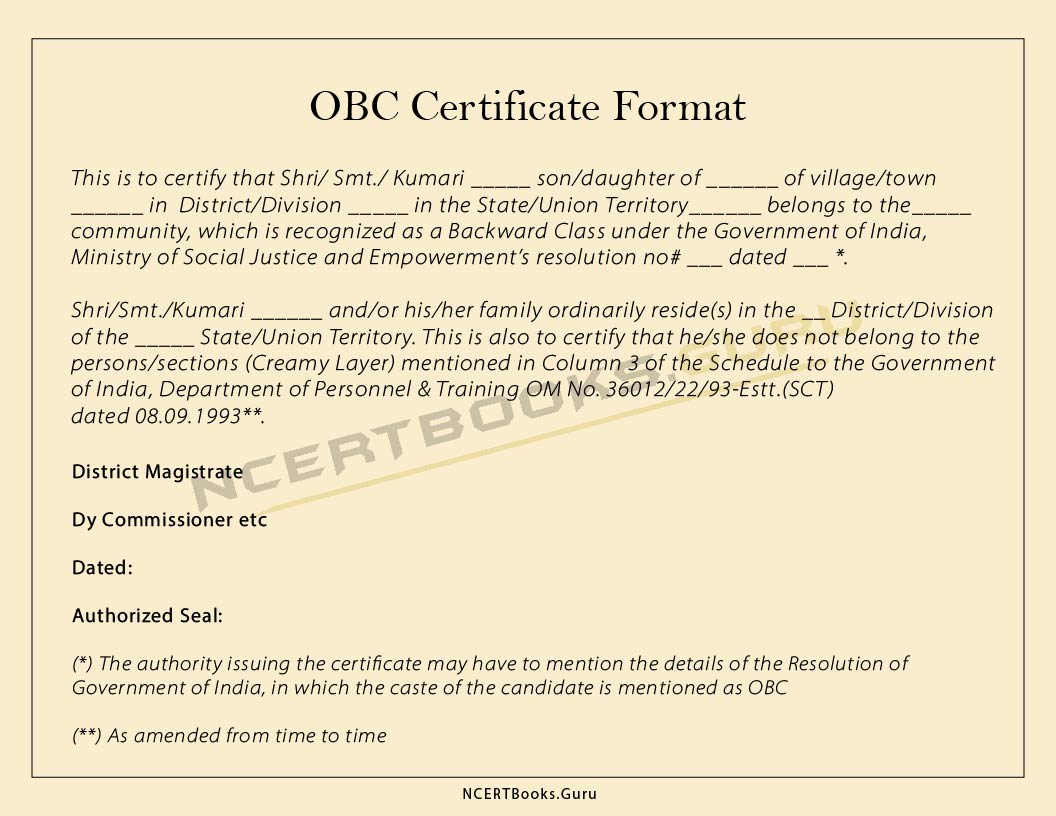
OBC Certificate Format

This is to certify that Shri/ Smt./ Kumari _____ son/daughter of ______ of village/town ______ in  District/Division _____ in the State/Union Territory ______ belongs to the _____community, which is recognized as a Backward Class under the Government of India, Ministry of Social Justice and Empowerment’s resolution no# ___ dated ___ *.

Shri/Smt./Kumari ______ and/or his/her family ordinarily reside(s) in the __ District/Division of the _____ State/Union Territory. This is also to certify that he/she does not belong to the persons/sections (Creamy Layer) mentioned in Column 3 of the Schedule to the Government of India, Department of Personnel & Training OM No. 36012/22/93-Estt.(SCT) dated 08.09.1993**.

District Magistrate

Dy Commissioner etc

Dated:

Authorized Seal:

(*) The authority issuing the certificate may have to mention the details of the Resolution of Government of India, in which the caste of the candidate is mentioned as OBC

(**) As amended from time to time

FAQ’s on OBC Certificate

Question 1.
What is OBC?

Answer:
OBC is an abbreviation for Other Backward Classes – a term used by the Indian Government to identify castes that are socially and/or educationally backward.

Question 2.
What is the purpose of an OBC Certificate?

Answer:
OBC certificates are issued to individuals that are socially and economically disadvantaged. It provides opportunities for such candidates to seek government-sponsored funding for education or even reservation for seeking government jobs.

Question 3.
What are the methods to apply for an OBC Certificate?

Answer:
Candidates can apply online or offline for their OBC certificate. For either, they will have to submit a filled application form along with supporting documents. However, please note that not every state has the provision to issue an OBC certificate online.

Question 4.
What are the categories of OBC?

Answer:
OBC category can be divided into two categories – Creamy Layer OBC and Non-creamy Layer OBC.

IBPS PO Books | Details, Study Materials, Reference Materials, Examination Levels, Syllabus

IBPS PO Books

IBPS PO Books: The Institute of Banking Personnel Selection administers various bank exams throughout the year. IBPS PO exam is for the selection of Probationary Officers for public sector banks.

These probationary officers work in the managerial hub of the PSBs (Public sector Bank) and become the top bankers in the nation. To ace IBPS PO Exam, it is essential to know the reference books and other materials for this exam.

In this article, we will confer you the best IBPS PO guides and books. To ace IBPS PO Exam, it is essential to know the Exam pattern and complete the syllabus of this exam.

IBPS PO Books and Reference Materials

The IBPS PO exam prepares and guides your broad career. The syllabus for the main exam includes Reasoning & Computer Aptitude, English Language, Quantitative, Aptitude & General Awareness. Applicants can check out the IBPS PO books to read and refer to any topics.

  • IBPS PO Examination Levels
  • IBPS PO Syllabus
  • IBPS PO Notes and Books
  • IBPS PO Study Materials
  • Conclusion

IBPS PO Examination Levels

The IBPS PO exams consist of 3 levels.

Level-1: Preliminary Exams- Prelims Exam is scheduled for October. It consists of 3 sections with 100 questions and a maximum score of 100 marks.

  • English Language: 30 Questions
  • Quantitative Aptitude: 35 Questions
  • Reasoning Ability: 35 Questions

Level-2: Mains Exam – The mains exam involves both subjective and objective type questionnaires. The exam duration is 60 minutes.

  • English Language: 2 Descriptive questions and 35 Objective
  • Computer Aptitude and Reasoning: 45 objective type questions
  • Quantitative Aptitude: 35 objective type questions
  • General Awareness, Banking and Economy: 40 objective type questions

Level-3: Interview – The IBPS PO interview is conducted for the shortlisted candidates from the mains exam. The total marks assigned for the exam is 100 marks.

IBPS PO Syllabus

The IBPS PO exam syllabus is divided into two parts based on the exam pattern.

IBPS PO Prelims Syllabus

Reasoning

  • Puzzle
  • Tabulation
  • Logical Reasoning
  • Alphanumeric Series
  • Ranking/Alphabet Test
  • Data Sufficiency
  • Coded Inequalities
  • Syllogism
  • Blood Relations
  • Input-Output
  • Coding-Decoding

Quantitative Aptitude

  • Simplification
  • Profit & Loss
  • Mixtures & Alligations
  • Simple Interest & Compound
  • Ratio & Percentage
  • Work & Time
  • Time & Distance
  • Mensuration –Sphere, Cylinder, Cone,
  • Data Interpretation
  • Number Systems
  • Sequence & Series
  • Permutation, Combination & Probability

English Language

  • Para jumbles
  • Error Spotting
  • Reading Comprehension
  • Fill in the blanks
  • Miscellaneous
  • Paragraph Completion

IBPS PO Mains Syllabus

Reasoning 

  • Double and Triple Lineups
  • Coding and Decoding
  • Seating Arrangements
  • Input/Output
  • Scheduling
  • Verbal and Non-Verbal Reasoning
  • Syllogism
  • Blood Relations
  • Ordering and Ranking
  • Sufficiency of Arguments and Data

Computer Aptitude:

  • Internet
  • Keyboard Shortcuts
  • Computer Related Terms Abbreviations
  • Operating Systems and GUI Basics
  • Computer Network
  • Computer Fundamentals
  • Microsoft Office and Spreadsheet Applications
  • Computer Hardware and Software
  • Microsoft Office
  • Microsoft Windows

General/Economy/Banking Awareness

  • Financial Knowledge
  • Basic Economics
  • National and International on financial news
  • General Knowledge on different topics of importance to financial institutions

English Language

  • Reading Comprehension
  • Vocabulary
  • Grammar
  • Usage of English in Business
  • Essay Writing
  • Verbal Ability

Data Analysis & Interpretation

  • Simplification
  • Statistics (Averages, Mean, Median etc.)
  • Representational Statistics (Graphs and Charts)
  • Ratio and Proportion
  • Percentages
  • Data Interpretation
  • Data Sufficiency
  • Mensuration
  • Geometry
  • Linear Equations
  • Quadratic Equations
  • Simple and Compound Interest
  • Speed, Distance and Time
  • Profit, Loss and Discounts
  • Time and Work Equations
  • Permutations and Combinations
  • Age Calculation Equations
  • Systems of Equation in Two Variables
  • Number Systems
  • Mixtures and Alligations

IBPS PO Books and Notes

The best books for IBPS PO covers the subjects of the exam thoroughly. They are easy to present material related to the IBPS PO syllabus and also give great practice questions. Here is a subject-wise listing of the most essential IBPS PO preparation books:

Books for English Language 

  • English Grammar by Wren & Martin
  • Practice Papers by Kiran Prakashan
  • Essential English Grammar – Murphy
  • English Grammar by SP Bakshi
  • Word Power Made Easy by Norman Lewis

Books for Quantitative Aptitude

  • Bank PO- The Complete Success Package – Arihant Publications
  • Arithmetic for General Competitions by Neetu Singh
  • Quantitative Aptitude for Competitive Examinations by S.Chand, R.S.Agarwal
  • N.K.Singh Quantitative Aptitude Test

Books for Reasoning Ability

In this section, candidates will get questions from Seating Arrangement, Blood Relations, Verbal Reasoning, Syllogism, Input-Output, Coding-Decoding, and many more . Applicants can buy the following books for this section.

  • Modern Approach to Verbal Reasoning – R.S.Agarwal
  • R.Gupta-Guide to Banking General Awareness
  • Non Verbal and Verbal Reasoning – R.S. Aggrawal
  • Analytical Reasoning – MK Pandey
  • BS Sijwali – A New Approach to Reasoning Verbal & Non-Verbal –
  • Manohar Pandey Book – Arihant Publications

Books for Computer Aptitude 

  • Computer by Rani Ahilya
  • Computer Awareness -Arihant Publication
  • Objective Computer Awareness by Somya Ranjan Behera
  • Objective Computer Knowledge & Literacy – Kiran Publication

Books for General Awareness

Questions from General Awareness are radically asked from current affairs, banking awareness, financial awareness, and general knowledge. Applicants should watch news and read magazines and newspapers to prepare this section. Here are a list of books that will help you

  • Rakesh Kumar – Banking and Economic Awareness
  • Manohar Pandey Book – Arihant Publications
  • R.Gupta-Guide to Banking General Awareness
  • I K Pavel-Banking, Financial & General Awareness
  • Pratiyogita Darpan (Monthly Edition)

Books for Data Analysis & Interpretation

  • Interpretation Data and Data Analysis Sufficiency by Kiran Prakashan

IBPS PO Exam Reference Books

Some of the other reference books for the preparation of IBPS PO exam are:

  • A New Approach to Logical Reasoning by Indu Sijwali and B.S.Sijwali
  • Quantitative Aptitude For Competitive Examinations by R. S. Aggarwal
  • A Modern Approach Logical Reasoning by R. S. Aggarwal
  • Basic Banking & Financial Issue by Gautam Majumdar
  • IBPS Bank PO Preliminary & Main 2017 Simplified (20 Practice Sets + General Knowledge 2018+Guide) – 4th edition by Disha Experts
  • Verbal Reasoning by R.S Aggarwal
  • Arihant Publications – Banking Awareness
  • Tarun Goyal – Objective Mathematics for Competitive Examinations

IBPS PO Study Materials

In addition to books, other references of study materials encourage an individual’s IBPS PO preparation and promote an in-depth practice for students. A few suggested reading references and study materials for IBPS PO preparation are as follows-

  • Sample Papers
  • Current Affairs
  • Books in English
  • The Hindu
  • Publications Division- India Year Book , Government of India
  • NCERT books and notes

Conclusion on IBPS PO Books

The IBPS PO Books, Notes, and Study Materials discussed above aim to help students at the time of exam preparations. Applicants can practice and refer to the given IBPS PO Books, Notes and Study materials from this article.

FAQ’s on IBPS PO Books

Question 1.
What are the topics covered in IBPS PO syllabus?

Answer:
The Topics covered in the IBPS PO syllabus for the prelims are English, Quantitative Aptitude, Reasoning Ability, and for the mains Reasoning & Computer Aptitude, General/Economy/Banking Awareness, English Language and Data Analysis Interpretation.

Question 2.
What are a few pointers for students to prepare for the PO exam?

Answer:
Applicants preparing for the IBPS PO exam can make proper notes on all related topics from the essential books and study materials for easy preparation. They should practice various IBPS PO mock tests to follow the exam in a better way. Applicants need to completely follow the question pattern as per the IBPS PO previous year paper to follow their preparation in a better manner.

Question 3.
Which books are good for Banking Awareness for IBPS PO exams?

Answer: 
The following books are the best for Banking Awareness for IBPS PO exam: Banking awareness by BSC publication, Banking Awareness by Lucent publication, Banking Awareness by Kiran publication and Banking Awareness by Arihant publication.

Question 4.
Are sample papers available in IBPS PO books?

Answer:
Yes, in most of the reference books for IBPS PO contains sample papers.

VITEEE Books | Details, Reference Materials, Study Materials, Sample Papers

VITEEE Books

VITEEE Books: Vellore Institute of Technology conducts Engineering Entrance Examination every year for admission to B.Tech programs. VITEEE is a computer-based examination that involves questions based on class 12th. The exam is conducted for certain B.Tech programs such as Computer Science, Civil, Bio-Technology, CSE, Mechanical, EEE, Production and Industrial Engineering, and so on.

In this article, we will offer you the best books for the preparation of the VITEEE exam. Candidates can go through with the syllabus and can get a quick idea about the nature of the exam to boost their preparation.

VITEEE Books and Reference Material

Formerly known as Vellore Engineering College, VIT University is considered one of the most leading universities for technical education after the 12th standard. The university conducts the VITEEE exam offering admission to Bachelor’s degree in Technology courses. Based on VITEEE scores, admission to B.Tech courses is directed.

To qualify the exam, with good marks, students must prepare from the best study material available. There are several books available in the market recommended by experts for the preparation of the VITEEE exam. Apart from books, aspirants can also solve previous year question papers and special question banks designed specifically for the exam.

VITEEE Syllabus

VITEEE exam includes a total of 125 questions, 35 questions in the Physics section, 35 in Chemistry, 40 in Mathematics/ Biology, 5 in English, and the Aptitude section contains ten questions. There is no negative marking, and students will get awarded one mark for every correct answer. Before starting the preparation process for VITEEE, the students should get familiar with the syllabus. By going through the syllabus, candidates will become capable of recognising the crucial topics which they must study for the exam.

Subjects Topics
Physics Dual Nature of Radiation and Atomic Physics
Current Electricity
Electro-statistics
Laws of Motion
Work, Energy, and Power
Electromagnetic Induction and Alternating Current
Nuclear Physics
Semiconductor Devices and their Applications
Chemistry Isomerism in Organic Compounds
Carboxylic Acids and their Derivatives
Coordination Chemistry and Solid State Chemistry
p-block elements, d and f block elements
Carbonyl Compounds
Thermodynamics
Alcohols and Ethers
Organic Nitrogen Compounds and Biomolecules
Electro-chemistry
Mathematics Integral Calculus and its Applications
Trigonometry and Complex Numbers
Vector Algebra
Differential Equations
Probability Distributions
Discrete Mathematics
Analytical Geometry of Three Dimensions
Matrices and their Applications
Differential Calculus
Biology Biotechnology and its Applications
Reproduction
Human Health and Diseases
Plant Physiology
Cell and Molecular Biology
Genetics and Evolution
Biochemistry
Biodiversity, Ecology and Environment
English Comprehension Questions that involve short passage, lines of poems, or else
Questions based on English Grammar and Punctuation
Aptitude Data Sufficiency
Data Interpretation
Clocks, Calendars, and Directions
Syllogism
Directions
Number Series, Coding-Decoding

Books for VITEEE Exam

English Books

Studying the best book can help you to score extra five questions asked in the English section. Candidates can start with books like:

Book Name Author
Objective General English S.P. Bakshi
Wren n Martin Revised by Dr. N.D.V. Prasada

Physics Books

To prepare for anything, students must cover up their base initially. That is why; interested candidates need to go with the NCERT Physics textbooks. This book will help aspirants to understand the basic concepts of Physics. Some of the basics of physics like magnetism, current electricity, optics, quantum theory, semiconductors, and more can fetch students’ extra marks. Some of the best Physics books for preparation of VITEEE includes:

Book Name Author
Concept of Physics- Part I HC Verma
Concept of Physics- Part II HC Verma
Problems in General Physics I.E. Irodov
Understanding Physics Series D.C. Pandey

Chemistry Books

Similar to Physics, the very first thing that students should do is to go through Chemistry NCERT textbooks thoroughly. Once candidates develop a good concept with NCERT book, they can further choose any of the best available books to go deeper with chemical reactions and numerical. Some of the other recommended Chemistry books for VITEEE preparation includes:

Book Name Author
Organic Chemistry Morrison Boyd.
Inorganic Chemistry O.P. Tandon
Organic Chemistry O.P. Tandon
Numerical Chemistry P. Bahadur
A modern approach to chemical calculations R.C. Mukherjee

Mathematics Books

Before starting practising mathematical problems, candidates should try to cover the basic concepts learned in the 12th standard. NCERT Math can be an ideal book to start with that covers all the concepts of the VITEEE Curriculum. After completing NCERT problems, candidates can go with:

Book Name Author
Class XII Mathematics R.D. Sharma
Problems in Calculus I.A. Maron
Trigonometry, Geometry Books S.L. Loney
Higher Algebra Hall and Knight

Biology Books

Students have to be regular to prepare for Biology as there are several scientific terms plus short forms. The interested aspirants can prepare their basic concepts with NCERT books and can further go with:

Book Name Author
Pradeep- Biology Textbook H.N. Srivastava, G. Chopra, P.S. Dhami
S Chand Biology Sarita Aggarwal
Elementary Biology for Class 12 K.N. Bhatia, M.P. Tyagi

VITEEE Study Material

Apart from the books, candidates can also refer to other study material for in-depth preparation of the VITEEE exam.

VITEEE Sample Papers

The sample papers serve as a great chance for candidates to prepare for VITEEE exam patterns and a certain time to finish the test. Students can become familiar with the type of questions asked in the exam.

VITEEE Question Bank

Common questions alone are not only efficient to crack the university entrance exam. It requires proper practising, thus, referring to the VITEEE Question Bank helps students to go through with a different variety of topics and questions.

VITEEE NCERT Notes

Students can find some NCERT Notes online for better preparation of the VITEEE paper. Through constant solving and practice, students can develop a thorough understanding and crack the exam.

Conclusion on VITEEE Books

VITEEE books mentioned above aim to help candidates at the time of entrance exam preparations. Interested aspirants can refer and practice from the provided list of some VITEEE books and notes from this article.

FAQ’s on VITEEE Books

Question 1.
Is it enough to prepare with only NCERT Books for VITEEE?

Answer:
Though NCERT books are the best source to prepare for any university entrance exam after class 12th, however, it’s recommendable that students should practice a greater number of questions from different sources. So, in addition to covering all the critical concepts from the NCERT book, students can solve the previous year’s question papers for Mathematics, Physics, and Chemistry.

Question 2.
Is the VITEEE exam tricky?

Answer:
VITEEE exam is not much difficult but requires adequate knowledge of basics learned in class 11 and 12 to crack it.

Question 3.
I did not have Physics as compulsory subjects in class 12th. Am I eligible for VITEEE?

Answer:
No. Any of the interested candidates applying for VITEEE must have studied Physics, Chemistry, and Mathematics/ Biology subjects in their 12th standard. Moreover, the examination consists of 35 questions each from Physics and Chemistry.

Question 4.
What are the topics vital to prepare for the VITEEE English section?

Answer:
Candidates can score extra five marks in VITEEE after preparing for comprehension as well as pronunciation and grammar-based questions. Students who do not consider English as their robust suit often make silly mistakes in the English section.