NCERT Solutions for Class 7 Social Science Civics Chapter 1 On Equality

On Equality Class 7 Questions and Answers Civics Chapter 1

Class 7 Civics Chapter 1 NCERT Textbook Questions and Answers

Question 1.
Do you think Kanta has enough reason to doubt whether she really is equal ? List three reasons from the story that might make her feel like this.
Answer:
Yes, Kanta has enough reason to doubt whether she really is equal.

Reasons

  1. She has the right to vote.
  2. She can earn money from the work she does.
  3. She can cast her vote in favour of her choice of candidate.

Question 2.
✓ ALLIANCE invited for 32/MMS/5’4″/fair/b’ful girl
working in IT Co. Mumbai from BE/MBA boy working in Mumbai/Abroad from IT Industry Caste no bar. SC/ST excuse. Send BHP (must)
PROF Qlfd B’ful tall girl 4 Gupta Boy 28/6′ CA Working MNC TXS USA $ 80k. TAMIL BRAHMIN Iyengar groom, 1981 born, Naithruvakashyapa Gothram, Swathi Star, 180cms, tall, fair.
Circle the reference to caste in the matrimonial advertisement given above.
Answer:

  1. SC/ST
  2. Gupta
  3. Brahmin.

Question 3.
Why do you think Omprakash Valmiki was being treated unequally by his teacher and his classmates? Imagine yourself as Omprakash Valmiki and write four lines about how you would feel if you were in the same situation as him.
Answer:
1. Omprakash Valmiki was a Dalit . The teacher and the classmates were of higher caste. They considered the Dalits unequal because of their lower caste and thus, discriminated them.

2. I felt very unpleased and disgusted. I want to remind my class teacher and classmates that I too, am a human being. The same blood is flowing in my body also. The constitution has granted us equal status. No body has the right to discriminate us.

Question 4.
Why do you think the Ansaris were being treated unequally? What would you do if you were in the Ansaris’ position and could not find a place to live because some people did not want to live next to you because of the religion you practice?
Answer:
1. The Ansaris’ were being treated unequally firstly for their surname and secondly they were non-vegetarian.

2. If I would be in the Ansaris’ place, I would argue with the landlady and take her to her neighbour’s house where fish was being cooked. I would also tell her that all human beings are equal and there should be no discrimination regarding caste.

Question 5.
If you were one of the Ansaris how would you have responded to the suggestion that you change your name?
Answer:
I would straightaway ask the property dealer to change his surname first.

Question 6.
Can you think of an incident in your life in which your dignity was violated? How did this make you fell?
Answer:

  • Yes.
  • Disgusted.

Question 7.
What is the midday meal programme? Can you list three benefits of the programme? How do you think this programme might help promote greater equality?
Answer:
Midday meal refers to a programme introduced in all government elemantary schools to provide children with cooked lunch.
Benefits :

  1. Poor children have began enrolling and regularly attending school.
  2. The children would often go to home and then did not return back to school. After this programme, they remain in school and their attendence has improved.
  3. This programme helped to promote greater equality because it reduces caste prejudices.

Question 8.
Find out about one government scheme in your area. What does this scheme do? Whom is this scheme set up to benefit?
Answer:
During winter (2010), about 5.5 lakh children of class I to HI in MCD- run primary schools in the capital will be given money to buy woollen caps or gloves.

This will be in addition to the Rupees 500 given to each student of the schools for purchasing winter uniforms. This scheme will help the poor children from the bitter winter cold and also help improve the attendence of the students.

Question 9.
In a democracy why is universal adult franchise important?
Answer:
Universal adult franchise is an essential aspect of all democracies. It is based on the idea of equality because it states that every adult in a country, irrespective of their wealth and the communities he/she belongs to, has one vote.

‘Universal adult franchise’ is important because all people can cast their votes without any discrimination.

Question 10.
Re-read the box on Article 15 and state two ways in which this Article addresses inequality?
Excerpt from Article 15 of the Indian Constitution
Prohibition of discrimination on grounds of religion, race, caste, sex or place of birth.
(1) The State shall not discriminate against any citizen on grounds only of religion, race, caste, sex, place of birth or any of them.
(2) No citizen shall, on grounds only of religion, race, caste, sex, place of birth or any of them, be subject to any disability, liability, restriction or condition with regard to-
(a) access to shops, public restaurants, hotels and places of public entertainment;
Or
(b) the use of wells, tanks, bathing ghats, roads and places of public resort maintained wholly or partly out of State funds or dedicated to the use of the general public.
Answer:
There is discrimination in India on basis of sex, race, caste and religion. But our constitution prohibited all these discriminations. There are also some inequalities even today such.

  1. Gender discrimination.
  2. Discrimination on the basis of caste still prevail in many part of our country.

Question 11.
In what ways was Omprakash Valmiki’s experience similar to that of the Ansaris?
Answer:
Similarity between their experience

  1. Both were discriminated on the basis on their caste (racial origin).
  2. Omprakash Valmiki’s had to sweep the ground while he (Ansari) was ignored and not to given the living apartment on rent in a colony.

Question 12.
What do you understand by term “all persons are equal before the law”? Why do you think it is important in a democracy?
Answer:
The Constitution recognise every person as equal. It means ever individual in the country including male and female from all castes, religions, tribes and educations are recognised equal.

The term all persons are equal before law means in the eyes of lawf all people are equal before law. Law makes no discrimination against them.

It is important in democracy because people can get the shelter to the court of get their Fundamental Rights enforced if they are not provided so.

Question 13.
The Government of India passed the Disabilities Act in 1995. This law states that persons with disabilities have equal rights, and that the government should make possible their full participation in society. The government has to provide free education and integrated children with disabilities into mainstream schools. This law also states that all public places including buildings, schools, etc., should be accessible and provided with ramps.
NCERT Solutions for Class 7 Social Science Civics Chapter 1 On Equality 1
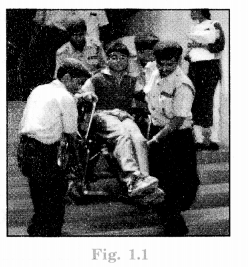
Look at the photograph and think about the boy who is being carried down the stairs. Do you think the above law is being implemented in his case? What needs to be done to make the building more accessible for him? How would his being carried down the stairs affect his dignity as well as Ms safety’?
Answer:
Yes, the above law is being implemented in his case, because ramp, facilities was not provided for the disabled people in this building.

Ramps facilities should be provided to make the building more accessible for him. As the disabled person on wheel chair is carried down stairs by the two security men, he feels insecure. It will affect his dignity as well as his safety. If he was provided with the facilities of lift or ramp he will definitely feel more secure.

NCERT Solutions for Class 7 Social Science

NCERT Solutions for Class 6 Sanskrit Chapter 9 क्रीडास्पर्धा

NCERT Solutions for Class 6 Sanskrit Ruchira Chapter 9 क्रीडास्पर्धा

अभ्यासः

पाठ का सम्पूर्ण सरलार्थ-

1. एतत् किम्? …………………….. च भ्रमन्ति। (पृष्ठ-64)
हिन्दी सरलार्थ-
यह क्या है? यह सुन्दर बगीचा है। इस बगीचे में कौन-कौन घूमते हैं? इस बगीचे में हरिण, बन्दर, मोर, कौआ आदि घूमते . हैं। यहाँ ही बच्चे, बूढ़े और महिलाएँ घूमती हैं।

2. एकः शिशुः ……………………… आकर्णयन्ति। (पृष्ठ-64)
हिन्दी सरलार्थ-
एक बच्चा बन्दर को देखता है। दो बालक हरिण को देखते हैं। तीन बूढ़े लोग वृक्ष पर कोयल के घोंसले को देखते हैं। चार मोर ‘के का’ की आवाज करते हैं। चार महिलाएँ कोयल की कूक (मधुर ध्वनि) सुनती हैं।

3. वृक्षेसु बहूनि ……………………. खादतः। (पृष्ठ-64)
हिन्दी सरलार्थ-
वृक्षों पर अनेक फल हैं। उनमें से एक वृक्ष पर चार फल पके हुए हैं। कौआ एक पका हुआ फल खाता है। एक बालिका
उद्यान से फूल ले जाती है। वहीं दो बालिकाएँ दो फल खाती हैं।

4. उद्याने एकः ……………………… एव कूर्दन्ति। (पृष्ठ-64-65)
हिन्दी सरलार्थ-
बगीचे में पानी से भरा हुआ एक तालाब भी है। वहाँ तीन कमल और तीन कुमुदनियाँ खिली हुई हैं। वहाँ चार हरिण जल पीते हैं। पाँच मछलियों पानी के ऊपर तैरती हैं। छः कछुए पानी में इधर-उधर घूम रहे हैं। सरोवर के किनारे पर
सात बच्चे खेल रहे हैं। आठ लोग दौड़ रहे हैं, नौ बन्दर वहाँ ही कूद रहे हैं।

5. जलाशयस्य ……………………… अर्चयन्ति। (पृष्ठ-65)
हिन्दी सरलार्थ-
तालाब के पास एक शिव मन्दिर है। शिव मन्दिर में बारह खम्भे हैं। वहाँ दीवार पर सोलह देवताओं की मूर्तियाँ बनी हैं। उसके परिसर में अट्ठारह अशोक के वृक्ष हैं। ग्यारह ब्रह्मचारी वेदों का पाठ करते हैं। बीस भक्त शिवजी की पूजा करते हैं।

पाठ्य-पुस्तक के प्रश्न-अभ्यास

प्रश्नः 1.
उच्चारणं कुरुत-
(क) एकः – एका – एकम्
द्वौ – द्वे – द्वे
त्रयः – तिस्रः – त्रीणि
चत्वारः – चतस्रः – चत्वारि
पञ्च – षट् – सप्त
अष्टौ (अष्ट) – नव – दश
एकादश – द्वादश – त्रयोदश
चतुर्दश – पञ्चदश – षोडश
सप्तदश – अष्टादश – एकोनविंशतिः (नवदश)
विंशतिः
उत्तर:
विद्यार्थी स्वयं उच्चारण करें।

(ख) शिष्ये – शिष्ययोः – शिष्येषु
जने – जनयोः – जनेषु
पत्रे- पत्रयोः – पत्रेषु
पुष्पे – पुष्पेषु – पुष्पयोः
प्रभायाम् – प्रभयोः – प्रभासु
विद्यायाम् – विद्ययोः – विद्यासु
उत्तर:
विद्यार्थी स्वयं उच्चारण करें।

प्रश्नः 2.
उदाहरणानुसारं रिक्तस्थानानि पूरयत-
यथा-
छात्रे – छात्रयोः – छात्रेषु
नरे – ………….. – …………
………….. – ………… – कमलेषु
…………. – वृक्षयोः – ……………..
………….. – ………… – नौकासु
…………. – वीणयोः – …………..

उत्तर:
यथा-
छात्रे – छात्रयोः – छात्रेषु
नरे – नरयोःनरेषु
कमलेकमलयोः – कमलेषु
वृक्षे – वृक्षयोः – वृक्षेषु
पत्रेपत्रयोः – पत्रेषु
नौकायाम्नौकयोः – नौकासु
वीणायाम् – वीणयोः – वीणासु

प्रश्नः 3.
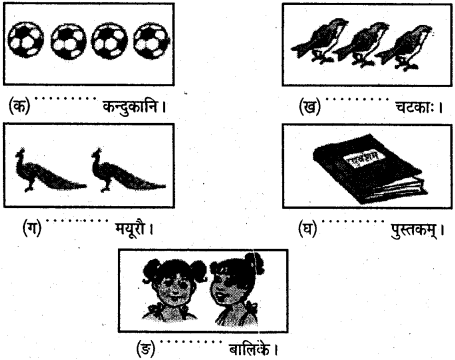
चित्राणि दृष्ट्वा संख्यां लिखत-
NCERT Solutions for Class 6 Sanskrit Chapter 9 क्रीडास्पर्धा 1
उत्तर:
(क) चत्वारि
(ख) तिस्रः
(ग) द्वौ
(घ) एकम्
(ङ) द्वे
(छ) षोडश

प्रश्नः 4.
अधोलिखितानां संख्याशब्दानां संस्कतपदानि लिखत-
यथा- नौ – नव
(क) आठ – ………..
(ख), ग्यारह – ………..
(ग) उन्नीस – ………..
(घ) पाँच – ………..
(ङ) अट्ठारह – ………..
(च) तेरह – ………..
उत्तर:
(क) अष्टौ
(ख) एकादश
(ग) एकोनविंशतिः
(घ) पञ्च
(ङ) अष्टादश
(च) त्रयोदश

प्रश्नः 5.
अधोलिखिताः संख्याः आरोहक्रमेण लिखत-
NCERT Solutions for Class 6 Sanskrit Chapter 9 क्रीडास्पर्धा 2
उत्तर:
अष्ट, नव, एकादश, द्वादश, षोडश, सप्तदश, अष्टादश, विंशतिः।

प्रश्नः 6.
मञ्जूषातः पदानि चित्वा रिक्तस्थानानि पूरयत

पुष्पेषु  गङ्गायाम्  विद्यालये  वृक्षयोः  उद्यानेषु  बालिकयोः

(क) वयं …………. पठामः।
(ख) जनाः ………….. भ्रमन्ति।
(ग) ……….. नौकाः सन्ति।
(घ) …………. भ्रमराः गुञ्जन्ति।
(ङ) ………….. नृत्यं रमणीयम् अस्ति।
(च) …………. फलानि पक्वानि सन्ति।
उत्तर:
(क) विद्यालये
(ख) उद्यानेषु
(ग) गङ्गायाम्
(घ) पुष्पेषु
(ङ) बालिकयोः
(च) वृक्षयोः

प्रश्नः 7.
कोष्ठकेषु दत्तेषु शब्देषु उचितां विभक्तिं प्रयुज्य वाक्यानि पूरयत-
यथा- सरोवरे मीनाः सन्ति। (सरोवर)
(क) ……. कच्छपाः भ्रमन्ति। (तडाग)
(ख) ……. सैनिकाः सन्ति। (शिविर)
(ग) यानानि ……. धावन्ति। (राजमार्ग)
(घ) ……. रत्नानि सन्ति। (धरा)
(ङ) छात्राः ……. प्रयोगं कुर्वन्ति। (प्रयोगशाला)
उत्तर:
(क) तड़ागे
(ख) शिविरे
(ग) राजमार्गे
(घ) धरायाम्
(ङ) प्रयोगशालायाम्

NCERT Solutions for Class 6 Sanskrit

NCERT Solutions for Class 8 Social Science Civics Chapter 6 Understanding Our Criminal Justice System

Understanding Our Criminal Justice System Class 8 Questions and Answers Civics Chapter 6

Civics Class 8 Chapter 6 NCERT Textbook Questions and Answers

Question 1.
Why do you think there is a rule that confessions made during police custody cannot be used as evidence against the accused?
Answer:
Yes, because there is a possibility that the police may are harsh steps against the accused in order to make confessions.

Question 2.
Now let us return to the story of Shanti and answer the following questions :
1. When Shanti way arrested for theft, S.I. Rao also kept her brother Sushil in the police lockup for two days. Was it legal for the police to detain him? Does it violate the D.K Basu guidelines?
2. Did S.I. Rao do enough to question witnesses and complete evidence before arresting Shanti and filing a case against her? In keeping with the duties of the police as stated above, what else do you think S.I. Rao could have done as part of his investigation.
Answer:
1. No, it was legal of the police to detect Shushil. It violates the D.K Basu’s guidelines.

2. No, S.I. Rao did not do enough to question witnesses and compile evidence before arresting Shanti and filing a case against her.

S.I. Rao should not have done anything in hurry. He should make investigations around the locality and ask different people about it. He arrested Shanti only on what Mr. Shinde told him. His decision was wrong because it was one-sided.

Question 3.
Now let us take a slightly different scenario. Shanti and her brother Sushil go to the police station to complain that Mr. Shinde’s 20 year old son had stolen Rs. 15,000 that they had been saving up. Do you think that the officer in charge of the police station will promptly lodge an FIR? List a few factors that in your opinion may influence the decision of the police to register or not register an FIR.
Answer:
The officer-in-charge may not promptly lodge an FIR is such a situation. In my opinion, political and social status are a few factors may influence the decision of the police to register FIR or not.

Question 4.
What did the judge say in Shanti’s case after hearing the testimony of all the witnesses?
Answer:
The judge said that the police did not invertegate Shanti’s case properly and thus, failed to prove that Shanti was guilty. This made Shanti innocent. The judge also showed enough evidence in favour of Shanti and finally acquitted her.

Question 5.
All of the processes, written in bold in page 74 (Text book) are crucial to a fair trail. Write in your own words that you understand of the following processes based on the above description of Shanti’s case.
1. Open Court
2. Basis of Evidence
3. Cross-examination of Prosecution witnesses
Answer:

  1. Open Court—The trial is held in public view.
  2. Basis of evidence—Witnesses regarding the case are produced and discussed in the court. This becomes the basis of judgement .
  3. Cross-examination of Prosecution Witnesses: Both the Public Prosecutor and defence lawyer are allowed to ask questions to witnesses.

Question 6.
Discuss in class what might have happened in Shanti’s case if the following procedures had not been observed.
(a) If she was not defended by a lawyer.
(b) If the court had not assumed her to be innocent.
Answer:
In both the cases, Shanti would not have got justice.

In a town called Peace Land, the supporters of the Fiesta football team learn that the supporters of the Jubilee football team in the nearby city about 40 km away have damaged the ground on which the Final between both teams is to be held the following day. A crowd of Fiesta fans armed with deadly weapons attacks the homes of the supporters of the Jubilee football team in the town. In the attack, 10 men are killed, 5 women are gravely hurt, many homes are destroyed and over 50 people injured.

Imagine that you and your classmates are now part of the criminal justice system. First divide the class into the following four groups of persons:

  1. Police
  2. Public Prosecutor
  3. Defence lawyer
  4. Judge

The column on the right provides a list of functions. Match these with the roles that are listed on the left. Have each group pick the functions that it needs to perform to bring justice to those who were affected by the violence of the Fiesta fans. In what order, will these functions be performed?

Roles Functions
Police hear the witness
record the statements of witnesses
Public Prosecutor cross examine the witnesses
take photographs of burnt homes
Defence Lawyer record the evidence
arrest the Fiesta fans
Judge write the judgment
argue the case for the victims
decide for how many years the accused will be put in jail
examine the witnesses in court
pass the judgment
get the assaulted women medically examined
conduct a fair trial
meet the accused persons

Now take the same situation but ask one student who is a supporter of the Fiesta Club to perform all the functions listed above. Do you think the victims would get justice if only one person performed all of the functions of the criminal justice system? Why not?
State two reasons why you believe that different persons need to play different roles as part of the criminal justice system.

Roles Functions
Police Take photographs of burnt homes as evidence
Arrest the Fieta fans
Get the assaulted women medically examined
Record the evidence
Public Prosecutor Record the statements of witnesses
Examine the witnesses in court
Defence Lawyer Cross-examine the witnesses
Argue the case for the victims
Meet the accused persons
Judge Listen to both the public prosecutor and defence lawyer
Write the judgment
Decides for how many years the occured will be put in jail.
Examine the witnesses in court
Pass the judgment
Conduct a fair trial.

Answer:
(a) No. If the same person performs all the above functions there is no chance of a fair trail. Judgment can never be given if one person may be biased or prejudiced or against the accused or he may even get confused. He can be over-powered by anyone. This may affect the process of investigation and influence the judgement.

(b) I think there are many reasons that different persons need to play as a part of the criminal justice system.

  1. to cheat the corrupt practises
  2. to protect the right of life
  3. to give right judgment without any hindrance.

NCERT Solutions for Class 8 Social Science

Convert Millimeters to Feet Calculator

Convert mm to ft Calculator: We use millimeters unit metric to measure small objects which are hard to measure at sometimes. If you take a paper it is best to measure in centimeters likewise if you take the width of the needle, it is best to measure with mm. In fact, you can convert the measurement into any other units like cm, m, ft, yd, in, etc. Don’t worry it just take a fraction of second to convert by using our millimeter conversion calculator. We have given individual calculators for all unit metrics to convert mm to other metric measurements.

Want to know how to convert millimeter to foot then just dig deep into this page. That’s it, you will get all required details about the conversion of millimeters to feet along with the definitions for mm, feet, formula to convert millimeter to foot, and many more. Apart from this, you can find how to use convert mm to ft calculator and solved examples for a better understanding of the concept.

What is meant by Millimeter?

The millimeter is defined as a unit of length or distance in the International System of Units (SI). Also, it is represented in terms of the meter, as 1/1000 of a meter, or the distance traveled by light in 1/299 792 458 000 of a second. The symbol for millimeter is ‘mm’.

What is meant by Foot?

The foot is defined as a unit of length used in the imperial and U.S. customary measurement systems. The symbol for Foot is ‘ft’. A foot was defined as exactly 0.3048 meters ≈ 305 meters in 1959 and also One foot is subdivided into 12 inches, and one yard is comprised of three feet.

How to Convert Millimeters to Feet?

We know that one millimeter is equivalent to 0.00328087559055118 foot. By using this statement we can convert a millimeter measurement to a foot measurement, by multiply the mm value by conversion ratio and change the units to foot. This is derived into a simple conversion formula which is presented below:

ft = mm * 0.0032808

Also, the distance ‘d’ in feet (ft) is equal to the distance ‘d’ in millimeters (mm) divided by 305. The conversion formula would be like this:

d(ft) = d(mm) / 305

To understand the concept and how to calculate the mm to ft conversion, we have provided an example with a detailed explanation. So, have a glance at the below mm to ft conversion solved example.

Example:

Convert 3500 mm to ft? (Steps with show work)

Solution:

One millimeter is equal to 0.0032808 feet.

To change the millimeters unit measurement to Feet unit measurement multiply the value of the mm by 0.0032808 feet or divide the value by 305.

Formula to convert mm to ft is given by

ft = mm * 0.0032808

= 3500 * 0.0032808

= 11.4828

∴ 3500 Millimeter = 11.4828 Foot. 

Steps to use Convert mm to ft Calculator

Are you wondering how to use millimeter to feet conversion calculator online? Then, you are in the correct section. Here, we have explained the stepwise process of using our handy & free online mm to ft calculator for better understanding. So, follow the below instructions without any fail and calculate your lengthy conversion math problems in less time.

  • At first, take your given input value and enter it in the provided mm input field.
  • Default our calculator is set in ft unit metric which you want to convert. If you need any other unit metric as an output then change the units as per your requirement by using the dropdown list available beside the input field.
  • Once you are done with the selection of the unit metric, click on the Convert button.
  • Finally, after a few seconds later you will get the units converted in the chosen required unit metric along with a neat explanation.

Millimeter to Foot Conversion Table

Millimeter [mm] Foot [ft]
0.01 mm 3.28084E-5 ft
0.1 mm 0.000328084 ft
1 mm 0.0032808399 ft
2 mm 0.0065616798 ft
3 mm 0.0098425197 ft
5 mm 0.0164041995 ft
10 mm 0.032808399 ft
20 mm 0.0656167979 ft
50 mm 0.1640419948 ft
100 mm 0.3280839895 ft
1000 mm 3.280839895 ft

FAQs on Millimetrer to Foot Converter Calculator

1. What size is 6mm to ft?

The formula to convert mm to ft is ft = mm / 305 (approximately).

ft = 6 /305 = 0.019673 ft.

2. How many feet mean one millimeter?

One Millimeter is equal to 0.00328084 Foot.

3. What is the formula to convert square mm to square feet?

The area in square feet is equivalent to the square millimeters multiplied by 1.0764E-5.

4. How do you convert millimeter to feet?

To convert mm to ft, you need to divide the given millimeter length by 304.8. The simple conversion formula for millimeter to foot is:

Foot = Millimeter * 0.0032808 ft

Convert Yards to Inches Calculator

Convert yd to in Calculator: Measuring a Golf fairway and need quick conversion from yards to Inches? Don’t bother we are here to reduce your struggle by listing a handy tool that converts Yards to Inches easily. All you need to do is simply enter the value of yards in the Input field provided and click on the Convert Button so that you will get the units changed.

To help you out in conversions we have come up with this free and instant tool so that you can easily convert the required unit conversions. Apart from this, we even listed the direct formula to convert yards to inches, definitions of the yard, inch, and steps to use yd to in calculator. Look out the solved examples and common conversion chart including conversions of the yard to inches for some units.

What is Yard?

A yard is a unit of length in both the imperial and US customary systems of measurement. The yard is denoted by the symbol yd. One yard is equal to 3 feet or 36 inches or 0.9144 meters.

What is Inches?

An inch is a unit of length in the imperial and US customary systems of measurement. Inch is denoted by the symbol in. One Inch is equal to 2.54 centimeters. There are 12 inches in a foot.

How to Convert Yard to Inches?

In order to convert the Yards unit to the Inches unit, you need to multiply the value of yards by the conversion ratio. Usually, One Yard is equal to 36 inches and have a look at the simple formula.

Length in Inches is equal to the yards multiplied by 36.

Formula to Convert Yards to Inches is given by

in = yd*36

You can understand the concept of Yard to Inches Conversion clearly by looking at enough examples explained in a detailed way.

Example

Convert 13 yards to Inches?

Solution:

One yard is equal to 36 inches

To change the yards unit measurement to Inches Measurement multiply the value of the yard by 36.

Formula to convert yards to inches is given by

in = yd*36

= 13*36

= 468 inches

∴ 13 Yards = 468.0 inches

How to use Yards to Inches Calculator?

Trying to figure out how to use Yards to Inches Calculator go through the simple steps listed below. Follow these guidelines without fail and you will arrive at the solution easily. They are as such

  • First and foremost enter the value of yards in the input field provided.
  • By default, our calculator will be set to inches if you want conversion with any other unit choose it from the list in the dropdown be it m, cm, mi, ft, km, etc.
  • After picking the unit you want to convert tap on the Convert button.
  • Thus, you will get the units changed in a fraction of seconds explaining the step by step procedure.

Yard to Inch Conversion Table

Yards Inches
1 yd 36″
2 yd 72″
3 yd 108″
4 yd 144″
5 yd 180″
6 yd 216″
7 yd 252″
8 yd 288″
9 yd 324″
10 yd 360″

FAQs on Yard to Inches

1. How many inches are in the yard?

A yard comprises of 36 inches.

2. How to convert yards to inches easily?

You can convert yards to inches by making use of our yd to in calculator. All you need to do is enter the input yard values and tap on the convert button to obtain the units changed to inches.

3. Where can I find solved examples on yards to Inches Conversion?

You will find solved examples on yards to inches conversion on our page.

4. What is the formula to convert Yards to Inches?

Formula to Convert Yards to Inches is in = yd*36


Convert Yards to Centimeters Calculator

Convert Yd to Cm Calculator: Are you Measuring Football Pitch Dimensions in Yards and need a conversion to Centimeter? You have come the right way and use our yards to centimeters Calculator. Enter the value in either the input field and click on the Convert button to get the required output in changed units.

For the sake of your convenience, we added a direct formula, step by step process explaining the conversion. Have a glance at the Conversion Chart, How to use our yd to cm Calculator, Procedure to Convert Yard to Centimeters, etc. Go through the solved examples including the Yard to Centimeter Conversion Calculation Work to help you understand the concept well.

What is Yard?

A yard is a unit of Length or Distance in both US Customary Units and Imperial System. The symbol for the yard is “yd”. There are 0.01093613 yards in a centimeter.

What is Centimeter?

A centimeter is a unit of Length or Distance in the Metric System. The symbol for centimeter is “cm”. There are 91.44 centimeters in a yard. The International spelling for this unit is centimetre.

Procedure to Convert Yards to Centimeter

To Change Yard to Centimeter Measurement multiply the length by the conversion ratio. Usually, One yard is equal to 91.44 centimeters. This basic thing can be employed to acquire the simple formula to Convert Yards to Centimeter. You need to multiply the Yards Value by 91.44 to obtain the outcome in the Centimeters Unit.

cm = yd * 91.44

If you have any other queries regarding the Yard to Centimeter Conversion Check out Solved Examples that explain the entire conversion process in detail.

Example 1

Convert 12 Yards to Centimeters Showing the Work?

Solution:

One yard is equal to 91.44 cm and we know the formula to convert yd to cm as cm = yd * 91.44

Substitute the given yard value in the formula of conversion

cm = 12*91.44

= 1097.28 Centimeters

∴ 12 Yards = 1097.28 Centimeters

Guidelines to use Yard to Centimeter Calculator

If you are stuck up at some point while using the yd to cm Calculator you can go through the below-listed steps to know the guidelines on how to use Yard to Centimeter Calculator. They are as follows

  • Initially, provide the input i.e. Value of Yard.
  • Usually, our calculator will be set to cm by default. If you need help with conversion to any other metric you can choose from the dropdown right after the input field.
  • After selecting the required metric click on the Convert button.
  • You will get the changed unit output i.e. in the units you have provided earlier within less time.

Yard to Centimeter Conversion Table

Yards Centimeters
1 yd 91.44 cm
2 yd 182.88 cm
3 yd 274.32 cm
4 yd 365.76 cm
5 yd 457.2 cm
6 yd 548.64 cm
7 yd 640.08 cm
8 yd 731.52 cm
9 yd 822.96 cm
10 yd 914.4 cm

FAQs on Yard to Centimeter

1.  How many cm are in a yard?

One Yard is equal to 91.44 Cms.

2. How to Convert Yards to Centimeters?

All you have to do is enter the input value of the yard in the input field provided and then click on the convert button to get the output changed to centimeters easily.

3. What is 3 Yards in Centimeters?

We know the formula to convert yards to centimeters as

cm = yd * 91.44

Substitute the value in the given formula and we get the result as such

= 3*91.44

= 274.32

∴ 3 Yards = 274.32 Centimeters

4. What is the conversion formula to change Yards to Centimeters?

Formula to convert yards to centimeters is cm = yd * 91.44