NCERT Solutions for Class 9 English Main Course Book Unit 2 Adventure Chapter 1 A The Final Flight

NCERT Solutions for Class 9 English Main Course Book Unit 2 Chapter 1 A The Final Flight  are part of NCERT Solutions for Class 9 English. Here we have given NCERT Solutions for Class 9 English Main Course Book Unit 2 Chapter 1 A The Final Flight.

Board CBSE
Textbook NCERT
Class Class 9
Subject English Main Course Book
Chapter Unit 2 Chapter 1
Chapter Name A The Final Flight
Category NCERT Solutions

CBSE 9 English Main Course Book Unit 2 Adventure Chapter 1 A The Final Flight

TEXTUAL EXERCISES
(pages 21)

What is adventure ? What are its characteristics ? (Read and discuss.)
Question 1.
Given helow are four headings and four magazine extracts. Match each heading to the corresponding extract and write it as a heading for the extract.
A The Final FlightNCERT Solutions for Class 9 English Main Course Book Unit 2 Adventure Chapter 1 A The Final Flight 14
(a)
A The Final FlightNCERT Solutions for Class 9 English Main Course Book Unit 2 Adventure Chapter 1 A The Final Flight 1
(b)
A The Final FlightNCERT Solutions for Class 9 English Main Course Book Unit 2 Adventure Chapter 1 A The Final Flight 2
(c)
A The Final FlightNCERT Solutions for Class 9 English Main Course Book Unit 2 Adventure Chapter 1 A The Final Flight 3
(d)
A The Final FlightNCERT Solutions for Class 9 English Main Course Book Unit 2 Adventure Chapter 1 A The Final Flight 4
Answer :
For reading and discussing at class level under the guidance of the teacher. Matching with the extract is given below :
A The Final FlightNCERT Solutions for Class 9 English Main Course Book Unit 2 Adventure Chapter 1 A The Final Flight 6

Question 2.
In pairs, discuss what is common about all the articles given above. Complete the web chart below, with the characteristics of adventure. (One has been done for you)
A The Final FlightNCERT Solutions for Class 9 English Main Course Book Unit 2 Adventure Chapter 1 A The Final Flight 7
Answer :
The comman thing about all the articles is the basic spirt of adventure.
A The Final FlightNCERT Solutions for Class 9 English Main Course Book Unit 2 Adventure Chapter 1 A The Final Flight 10

THE FINAL FLIGHT

Question 1.
Below are certain words that appear in the story of Amelia Earhart’s journey. The meanings have been given in a jumbled order. Match the words with their meanings.
Words :
(1) Navigator
(2) Skirting
(3) Dysentery
(4) Parachute
(5) Cable
(6) Precise
(7) Transmit
(8) Implement
9) Raft
10) Stowed
11) Aviator
12) Abandoned

Meanings :
(a) an infection of the bowels.
(b) a person who flies an aircraft.
(c) a person who plans a route for a ship or plane.
(d) to put something in a safe place.
(e) to leave something with no intention of returning.
(f) to be or go around the edge of something.
(g) a device that is attached to people or objects to make them fall slowly and safely.
(h) a small boat made of rubber or plastic that is filled with air.
(i) a set of wires, covered in plastic or rubber that carries electricity or telephone signals.
(j) carry out.
(k) exact.
(l) to send an electronic signal.
Answer :
The matching is as follows :
1. (c)
2. (f)
3. (a)
4.(g)
5. (i)
6. (k)
7. (l)
8. (j)
9. (h)
10. (d)
11. (b)
12. (e)

Question 2.
The world’s most famous female aviator, Amelia Earhart, disappeared in 1937, as she attempted to become the first woman to fly around the world with her navigator, Fred Noonan. She was last heard of from about 100 miles from the tiny Pacific Howland Island on July 2, 1937.
Read the story of her ‘Final Flight’ :
A The Final FlightNCERT Solutions for Class 9 English Main Course Book Unit 2 Adventure Chapter 1 A The Final Flight 8
On June 1, 1937 Amelia and her navigator Fred Noonan departed from Miami, Florida; bound for California. Their first destination was San Juan, Puerto Rico; from there, skirting the northeast edge of South America; and then on to Africa and the Red Sea. The flight to Karachi was another first… no one had previously flown non-stop from the Red Sea to India before. From Karachi the Electra flew to Calcutta on June 17… from there, on to Rangoon, Bangkok, Singapore and Bandoeng. The monsoon prevented departure from Bandoeng for several days.

Repairs were made on some of the ‘long distance’ instruments which had given trouble previously. During this time, Amelia became ill with dysentery that lasted for several days. It was June 27 before Amelia and Noonan were able to leave Bandoeng for Port Darwin, Australia. At Darwin the direction finder was repaired, and the parachutes were packed and shipped home… they would be of no value over the Pacific.

Amelia reached Lae in New Guinea on June 29. At this point they had flown 22,000 miles and there were 7,000 more to go… all over the Pacific. Amelia cabled her last commissioned article to the Herald Tribune. Photos show her looking very tired and ill during her time at Lae. The U.S. Coast Guard cutter, Itasca had been standing off Howland Island for some days to act as a radio contact for Amelia. Radio communications in the area were very poor and the Itasca was overwhelmed with commercial radio traffic that the flight had generated.
A The Final FlightNCERT Solutions for Class 9 English Main Course Book Unit 2 Adventure Chapter 1 A The Final Flight 9
Amelia left Lae at precisely 00:00 hours Greenwich Mean Time on July 2. It is believed that the Electra was loaded with 1,000 gallons of fuel, allowing for 20-21 hours of flying. At 07:20 hours GMT Amelia provided a position report placing the Electra on course at some 20 miles southwest of the Nukumanu Islands. The last weather report Amelia was known to have received was before take-off. The head wind speed had increased by 10-12 mph, but it is not known if she ever received the report. At 08:00 GMT Amelia made her last radio contact with Lae. She reported being on course for Howland Island at 12,000 feet. There is no real evidence as to the precise track of the aircraft after Nukumanu. No one saw or heard the plane fly over.

Several short transmissions were received by the Itasca with varying signal strengths but they were unable to get a fix on her location because they were too brief. At 19:30 GMT the following transmission was received from the Electra at maximum strength. “KHAQQ calling Itasca. We must be on you but cannot see you… gas is running low…” At 20:14 GMT, the Itasca received the last voice transmission from Amelia giving positioning data. The Itasca continued to transmit on all frequencies until 21:30 hours GMT. They determined that Amelia must have ditched at sea and began to implement search procedures.
It has been determined that the plane went down some 35-100 miles off the coast of Howland Island.

A life raft was stowed on board but no trace was ever found of the raft. Some experts felt that the empty fuel tanks could keep the plane afloat for a period of time. President Roosevelt authorized a search party of 9 naval ships and 66 air crafts at an estimated cost of over $4 million. On July 18, the search was abandoned by ships in the Howland area. George continued to seek help in the search, but by October he too abandoned all hope of finding them alive.

Amelia regularly sent letters to George at stops along her route. These were published in the book ‘Last Flight’. The book has a note from her to George….”Please know I am quite aware of the hazards… I want to do it because I want to do it. Women must try to do things as men have tried. When they fail, their failure must be but a challenge to others.”

Question 3.
The following is a time chart of Amelia’s aviation record in her attempt to go around the world. Complete it with the missing dates and events.
A The Final FlightNCERT Solutions for Class 9 English Main Course Book Unit 2 Adventure Chapter 1 A The Final Flight 13
Answer :
A The Final FlightNCERT Solutions for Class 9 English Main Course Book Unit 2 Adventure Chapter 1 A The Final Flight 12

Question 4.
During the summer vacation, your friends and you decide to enroll in “The School for Flying”. While training, you had an interesting and unforgettable experience. Here’s an account of it. Complete it using words from A.l. It was the most amazing summer camp that we have ever had. My friend Jonathan and I decided to join the flying-school. There was rigorous training and we gained a lot of expertise, Jonathan in charting the course of flying and I in flying the plane. 25 May 2010 was the Red Letter Day as we were to fly a plane for nearly half an hour without an instructor. At 6:15 GMT we took the flight, Jonathan as a (1) ________ and I the (2) ________. We remembered all the instructions given at the academy and we were (3) _____________ signals at frequent intervals. The day was clear but windy. We were (4) _____________ hills and were flying along the coast. Suddenly, the weather turned turbulent we (5) ________ our position asking for advice. But unfortunately there was no communication from the other end. All of a sudden, we heard an explosion. The fuel tank of our plane caught fire due to the lightning. We immediately decided to (6) ________ the plane and donned the (7) ___________ that were available. We were blown off 55-60 kms away from the coast and we landed in the outskirts of a dense forest. We were uninjured but hungry
and thirsty. We ate some wild fruit hoping it was safe. But unluckily it was disastrous for Jonathan as he had (8) __________ after that. We remembered our instructor’s clear and (9) ____________ instructions in case of such an emergency. We discussed various strategies and decided to (10) ______________ to the core the life saving strategies. We started exploring the forest. We must have wandered for about an hour or so along the coast when my eyes suddenly fell on something red in the crevice of a big rock. I went closer to it and to my great happiness and relief I saw a (11) __________. It was (12) _____________ away in a cosy nook. Oh! What a Answer relief it was, we were successful in rowing our way back. In the meanwhile, the coastal guards were hunting for us. In an instant we were celebrities.
Answer :
1. navigator
2. pilot
3. transmitting
4. flying over
5. reported
6. abandon
7. parachutes
8. dysentery
9. strict
10. implement
11. raft
12. stowed

Question 5.
You are a member of ‘Explorer’, an adventure club. Write a paragraph about one of your experiences of adventure activity.
Here are some words and phrases you can use :
A The Final FlightNCERT Solutions for Class 9 English Main Course Book Unit 2 Adventure Chapter 1 A The Final Flight 11
I and my four friends were the members of Rishikesh Adventure Club. One day we decided to do rafting in the Ganges. Luckily the water flow was Suitable for it. We felt greatly excited, thrilled and curious to know if we would be successful. A great euphoria dawned upon us. We started rafting and enjoyed its movement in swirling water. When the water fell over steep rock heads, it sent us chills. But we didn’t get easily discouraged though we sensed some insecurity. Before flowing with the rapids we had gathered extraordinary courage and prayed also, though we felt a little terrified. At last, the point was reached and lo ! our boat started misbehaving. We felt some agonized moments but we navigated the boat with full confidence. Also the boat swam majestically. We were grateful to the occasion, time and situation. We had completed the job nicely.

I and my four friends were the members of Rishikesh Adventure Club. One day we decided to do rafting in the Ganges. Luckily the water flow was Suitable for it. We felt greatly excited, thrilled and curious to know if we would be successful. A great euphoria dawned upon us. We started rafting and enjoyed its movement in swirling water. When the water fell over steep rockheads, it sent us chills. But we didn’t get easily discouraged though we sensed some insecurity. Before flowing with the rapids we had gathered extraordinary courage and prayed also, though we felt a little terrified. At last, the point was reached and lo ! our boat started misbehaving. We felt some agonized moments but we navigated the boat with full confidence. Also the boat swam majestically. We were grateful to the occasion, time and situation. We had completed the job nicely.

Question 6.
You have read an account of the final stages of Amelia’s life. It had been a saga of struggle and courage. Read about her early life-the factors that inspired her to become an aviator and the difficulties she faced. Make a project on her life. Here is a list of the reference books and websites which will guide you in your endeavour in making a project. It can be in the form of a CD.
REFERENCE ON AMELIA EARHART :

  • The Sound of Wings by Mary S. Lowell, 1989, Century Hutchinson Ltd., ISBN 0-09-173596-3
  • Last Flight by Amelia Earhart (arranged by George Palmer Puttman from correspondence), 1988, Crown Publishers, ISBN 0-517-56794-6
  • The Epic of Flight : Women Aloft by Valerie Mool mam, Time / Life Books, ISBN 0-8094-3289-7
  • Biography : Amelia Earhart by Blythe Randolph, 1987, Frankin Watts Publisher, ISBN 0-531-100331-5

WEBSITES :

  • www. ellensplace.net/eae intr.html
  • en.wikipedia.org/wiki/Amelia_Earhart
  • www.acepilots.com/earhart.html.

Answer :
Students to make projects individually under the guidance of class teacher. The projects can be in the form of CDs as desired by the teacher. Some guidelines and additional matter about the early life of Amelia together with the factors that inspired her to become an aviator and difficulties faced are given below :

1. Biography :

  • Bom : July 24, 1897, Atchison, Kansas (USA)
  • Best known as : The pioneering female pilot who disappeared in the South Pacific (Ocean).
  • Married to George Putnam from 1931 until her death.

2. More information about early life :

  • Until 12, lived with her wealthy maternal grandparents Alfred and Amelia Harres Otis, in Atchison, Kansas.
  • attended a private day school.
  • In 1909, went with sister Muriel to live with parents in Des Moines, Iowa.
  • Graduated from Hyde Park School in 1915.
  • attended Ogontz School in Philadelphia, an exclusive high school and junior college.
  • became a volunteer nurse in a hospital while in Toronto.
  • In 1919 entered Columbia University but left after one year to join her parents.
  • In 1920 winter Amelia saw her first air show and took her first airplane ride.
  • In 1928 Amelia joined the crew of a flight across the Atlantic.

3. Flying records :

  • 1931 : Altitude record in an autogiro
  • First person to fly an autogiro across the US and back
  • 1932 : fastest non-stop transcontinental flight by a woman
  • 1933 : breaks her own record
  • 1935 : first person to fly solo across the Pacific from Hawaii to California
  • First person to fly solo from Los Angeles to Mexico
  • Sets speed record for east-west crossing from Oakland to Honolulu.

We hope the NCERT Solutions for Class 9 English Main Course Book Unit 2 Chapter 1 A The Final Flight help you. If you have any query regarding NCERT Solutions for Class 9 English Main Course Book Unit 2 Chapter 1 A The Final Flight, drop a comment below and we will get back to you at the earliest.

NCERT Solutions for Class 9 English Main Course Book Unit 1 People Chapter 3 Can You Know People You Haven’t Met

NCERT Solutions for Class 9 English Main Course Book Unit 1 Chapter 3 Can You Know People You Haven’t MetCan are part of NCERT Solutions for Class 9 English. Here we have given NCERT Solutions for Class 9 English Main Course Book Unit 1 Chapter 3 Can You Know People People You Haven’t Met.

Board CBSE
Textbook NCERT
Class Class 9
Subject English Main Course Book
Chapter Unit 1 Chapter 3
Chapter Name Can You Know People You Haven’t Met
Category NCERT Solutions

CBSE Class 9 English Main Course Book Unit 1 People Chapter 3 Can You Know People You Haven’t Met

TEXTUAL EXERCISES
(Page 15)

Question 1.
Is it possible to make accurate guesses about the people you have not met ? Read the poem, to see how conclusions can be drawn about people.
Answer :
Abandoned Farmhouse He was a big man, says the size of his shoes On a pile of broken dishes by the house; A tall man too, says the length of the bed In an upstairs room; and a good, God-fearing man, Says the Bible with a broken back On the floor below a window, bright with sun; But not a man for farming, say the fields Cluttered with boulders and a leaky barn. A woman lived with him, says the bedroom wall Papered with lilacs and the kitchen shelves Covered with oilcloth, and they had a child Says the sandbox made from a tractor tire. Money was scarce, say the jars of plum preserves And canned tomatoes sealed in the cellar-hole, And the winters cold, say the rags in the window frames. It was lonely here, says the narrow country road. Something went wrong, says the empty house In the weed-choked yard. Stones in the fields Say he was not a farmer; the still-sealed jars In the cellar say she left in a nervous haste. And the child? Its toys are strewn in the yard Like branches after a storm – a rubber cow, a rusty tractor and a broken plow, a doll in overalls. Something went wrong, they say. ( Ted Kooser )
NCERT Solutions for Class 9 English Main Course Book Unit 1 People Chapter 3 Can You Know People You Haven’t Met 1

Question 2.
Complete the following sentences about the poem.
1. In the first stanza, the poet refers to four pieces of evidence : large shoes, a long bed, the Bible, fields cluttered with boulders and a leaky barn. This leads the poet to conclude that ‘the man of the house’ was ______________
2. I think that the child was probably about six years old because ______________
3. The poet suggests that a woman lived in the farmhouse because ______________
4, The family probably left the farmhouse because ______________
Answer :
1. In the first stanza, the poet refers to four pieces of evidence : large shoes, a long bed, the Bible, fields cluttered with boulders, and a leaky barn. This leads the poet to conclude that ‘the man of the house’ was big, tall, religious and not interested in farming.
2. I think that the child was probably about six years old because she had toys (a rubber cow, a rusty tractor, a broken plough, and a doll in overalls) to play with.
3. The poet suggests that a woman lived in the farmhouse because the bedroom wall was papered with lilacs, and the kitchen shelves were covered with oil-cloth.
4. The family probably left the farmhouse because of some natural calamity like a storm, etc, ; or kidnapping or raid by dacoits.

Question 3.
The poet draws conclusions about the family without having met them. He does this by lines such as :
Something went wrong, says the empty house
in the weed-choked yard…
This is a style of English that is very suitable for a poem. But in ordinary speech or writing we use expressions such as :
NCERT Solutions for Class 9 English Main Course Book Unit 1 People Chapter 3 Can You Know People You Haven’t Met 4
For example, we could say :

  • There are large shoes in the farmhouse. So it is likely that the farmer was a big man.
  • It seems that they had a child, because there is a sandbox made from a tractor tire.
  • The kitchen shelves were covered with oil cloth. This suggests that a woman lived in the farmhouse.

Make other sentences like this, using ideas from the poem.
Answer :

  1. There is the Bible with a broken back on the floor below a window. This suggests that the man was religious-minded and God-fearing.
  2. The man did not do farming. It is clear from the fields which were strewn with boulders and stones.
  3. There are the jars of plum preserves and canned tomatoes sealed in the cellar-hole. It indicates that the woman left the house in nervous haste and the man didn’t have enough money.

Students can write more sentences for practice using ideas from the poem on the pattern given above.

Question 4.
Imagine that a Social Worker comes to the abandoned farmhouse to find out what may have happened to the family. She makes the following observations in her note – pad
NCERT Solutions for Class 9 English Main Course Book Unit 1 People Chapter 3 Can You Know People You Haven’t Met 5
On the basis of these notes, the Social Worker presents the facts as she sees them to her Head of Department. Unfortunately she spills ink on her report. Complete her report.
NCERT Solutions for Class 9 English Main Course Book Unit 1 People Chapter 3 Can You Know People You Haven’t Met 2
Answer :
When I reached the farmhouse, I saw that the house was empty, which indicated that the inhabitants had left. I wondered where they might have gone. It was clear that the owner was not a farmer, because of the boulders in the field and the leaky barn. Presumably (There is a possibility that), the family was poor, because I saw several sealed jars in the cellar. Also it showed that a woman lived there. It was obvious she had left in a hurry. What was most touching was that the toys were scattered in the yard.

Question 5.
When we write informal letters (to a friend, or to a member of our family) we use this layout.
Answer :
NCERT Solutions for Class 9 English Main Course Book Unit 1 People Chapter 3 Can You Know People You Haven’t Met 6
Amit from Hyderabad has got admission to a college in Bengaluru. He has to share his room with another boy. When he arrives at the hostel he learns that his room-mate has gone home for a few days. Based on his observations of the room, Amit writes a letter to his friend, Sumit, about his new room-mate. (You may use some of the expressions suggested in C.3.) As Amit, write the letter. In your writing, remember to follow CODER
NCERT Solutions for Class 9 English Main Course Book Unit 1 People Chapter 3 Can You Know People You Haven’t Met 3
28th September, 2015
Dear Sumit
I hope all are feeling fine. I have been allotted the room but have to share it with another boy. I have yet to see him because when I came he had gone home for a few days. When I opened the room I found it in disorder. From the things I gathered that my room-mate is a happy-go-lucky young man.

He plays tennis and football. The tennis racket lay flat on his bed. The football lay on the floor near the bed. This suggests that my room-mate is a little casual in maintaining the room in a proper shape. This casual approach can be judged by the fact that the floor was littered with pens and pencils along with the papers. One sock was put on the bedpost as well the towel. The trousers were hanging on the chair. This suggests he was in a hurry to go out to play. The paper and pen lay on the table. One chappal lay stood up on the floor near the bedpost. The bedsheet also hung down from the bed. The pillow was also not properly placed but lay haphazardly. This suggests that he is hard-pressed for time. The picture on the wall bent downwards to its left. This shows that probably my room-mate is a bit careless about his things.

From all these things I conclude that my room-mate is a care-free young man. He is a sports enthusiast and enjoys living on his own.
Yours sincerely,
Amit.

We hope the NCERT Solutions for Class 9 English Main Course Book Unit 1 Chapter 3 Can You Know People You Haven’t Met help you. If you have any query regarding NCERT Solutions for Class 9 English Main Course Book Unit 1 Chapter 3 Can You Know People You Haven’t Met, drop a comment below and we will get back to you at the earliest.

NCERT Solutions for Class 9 English Main Course Book Unit 1 People Chapter 2 A Burglary Attempt

NCERT Solutions for Class 9 English Main Course Book Unit 1 Chapter 2 A Burglary Attempt are part of NCERT Solutions for Class 9 English. Here we have given NCERT Solutions for Class 9 English Main Course Book Unit 1 Chapter 2 A Burglary Attempt.

Board CBSE
Textbook NCERT
Class Class 9
Subject English Main Course Book
Chapter Unit 1 Chapter 2
Chapter Name A Burglary Attempt
Category NCERT Solutions

CBSE Class 9 English Main Course Book Unit 1 People Chapter 2 A Burglary Attempt

Question 1.
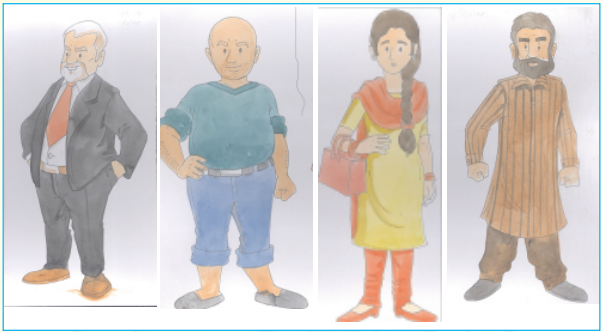
We notice lots of details about people and their appearance, but to describe them accurately and vividly, we need to be specific. Working in pairs, look carefully at the pictures given and complete the table with appropriate words from the box given on the next page. You may add words of your own to describe people.

NCERT Solutions for Class 9 English Main Course Book Unit 1 People Chapter 2 A Burglary Attempt
NCERT Solutions for Class 9 English Main Course Book Unit 1 People Chapter 2 A Burglary Attempt 13
Answer :
NCERT Solutions for Class 9 English Main Course Book Unit 1 People Chapter 2 A Burglary Attempt 14
The other words that describe the four people are :
NCERT Solutions for Class 9 English Main Course Book Unit 1 People Chapter 2 A Burglary Attempt 15

Question 2
When we meet people, we notice their faces more than anything else. The box below contains words which describe the features of a face. Work in pairs and list them under the appropriate headings, then add more words of your own.
NCERT Solutions for Class 9 English Main Course Book Unit 1 People Chapter 2 A Burglary Attempt 16
Answer :
NCERT Solutions for Class 9 English Main Course Book Unit 1 People Chapter 2 A Burglary Attempt 17
My Own Words
NCERT Solutions for Class 9 English Main Course Book Unit 1 People Chapter 2 A Burglary Attempt 18

Question 3.
Read the newspaper clipping.
BURGLAR ESCAPES WITH JEWELLERY :
NCERT Solutions for Class 9 English Main Course Book Unit 1 People Chapter 2 A Burglary Attempt 9
NCERT Solutions for Class 9 English Main Course Book Unit 1 People Chapter 2 A Burglary Attempt 19
Answer :
NCERT Solutions for Class 9 English Main Course Book Unit 1 People Chapter 2 A Burglary Attempt 20

Question 4.
Taking hints from,
NCERT Solutions for Class 9 English Main Course Book Unit 1 People Chapter 2 A Burglary Attempt 19
write a paragraph describing the burglar.
Answer :
Description of the burglar
The burglar had a well-built body which looked a bit plumpy. He was 6 ft tall. He wore old and faded clothes. His shirt was faded black. The colour of his trousers was dark which could be either black or blue. As regards the face of the burglar, it was oval-, shaped. His eyes were grey and he wore spectacles of a plastic frame. His complexion was dark. As regards his hair he had straight black hair. His nose was sharp and lips quite thick. Nothing can be said about his teeth. He had a special feature in his having six fingers on his right hand.

We hope the NCERT Solutions for Class 9 English Main Course Book Unit 1 Chapter 2 A Burglary Attempt help you. If you have any query regarding NCERT Solutions for Class 9 English Main Course Book Unit 1 Chapter 2 A Burglary Attempt, drop a comment below and we will get back to you at the earliest.

NCERT Solutions for Class 9 English Main Course Book Unit 1 People Chapter 1 An Exemplary Leader

NCERT Solutions for Class 9 English Main Course Book Unit 1 Chapter 1 An Exemplary Leader are part of NCERT Solutions for Class 9 English. Here we have given NCERT Solutions for Class 9 English Main Course Book Unit 1 Chapter 1 An Exemplary Leader.

Board CBSE
Textbook NCERT
Class Class 9
Subject English Main Course Book
Chapter Unit 1 Chapter 1
Chapter Name An Exemplary Leader
Category NCERT Solutions

CBSE Class 9 English Main Course Book Unit 1 People Chapter 1 An Exemplary Leader

TEXTUAL EXERCISES
(Page 5)

Question 1.
Read the following conversation between two friends.
Answer :
NCERT Solutions for Class 9 English Main Course Book Unit 1 People Chapter 1 An Exemplary Leader 1

Question 2.
In pairs, discuss the problem Ravi is facing. Do you think Ravi’s boss is right ? Give reasons for your answer. Tick mark the qualities that you feel desirable in a boss.
NCERT Solutions for Class 9 English Main Course Book Unit 1 People Chapter 1 An Exemplary Leader 2
Answer :
Various answers. For discussion at class level. One answer is as follows :
I think Ravi’s boss is right in his own way and in his official position. After all, the new project can’t be treated casually. But the other side, the human face of the situation, can’t be altogether neglected. Ravi’s daughter needs attention as she is sick. At the most, Ravi should be given some hours’ leave so that he attends to his daughter. In our society medications do work but
inter-personal relations can work wonders. If Ravi’s daughter sees her father, she can get well very soon. The project can be attended to after a few hours’ wait. Also someone can act in place of Ravi or the work Ravi has, that is, to attend to his ailing daughter, can be done by the boss himself.

The qualities desirable in a boss are and should be : trustworthy, problem-solving, oratory skills, ability to take decisions, willing to take risk.

Question 3.
An e-mail, short for electronic mail is a store and forward method of composing, sending, storing, and receiving messages over electronic communication systems. It is the quickest way to communicate in writing.
E-mail messages consist of two major sections :
Answer :
1. Header consisting of – subject, sender, receiver, date and time.
2. Body which contains the message. It can be a formal / informal letter depending on the purpose.
Study the following tips on composing e-mails :
NCERT Solutions for Class 9 English Main Course Book Unit 1 People Chapter 1 An Exemplary Leader 3

Subject :

  1. It should be brief
  2. It should give a clue to the content of the message
  3. It need not be a complete sentence

Salutation :
Dear Sir / first name of the person

Opening statement :

  1. Begin with a pleasantry or greeting
  2. When replying to a message – Thank you for your message / I received your message

Clarity and tone :

  1. When you expect a reply – ‘Please let me know’
  2. When you want help – ‘Please’ or ‘Kindly’

Paragraphs :

  1. Each main idea should be in a separate paragraph, making it easy for the reader to understand the message.
  2. Use complete sentences (no SMS language)

Complementary close :

  1. Regards / love
  2. Name

NCERT Solutions for Class 9 English Main Course Book Unit 1 People Chapter 1 An Exemplary Leader 4

Question 4.
Think of an occasion when you led a team for a competition. Were you successful ? Did you exhibit any of the qualities given in A.2. ? If so, to what extent were these qualities exhibited and how
did it lead to your success ? Through an e-mail, share your experience with a friend.
Answer :
NCERT Solutions for Class 9 English Main Course Book Unit 1 People Chapter 1 An Exemplary Leader 5
NCERT Solutions for Class 9 English Main Course Book Unit 1 People Chapter 1 An Exemplary Leader 6

Question 5.
Read a short story about an exemplary boss.
Answer :
Working 12 to 18 hours a day was not uncommon for scientists at the rocket launching station, Thumba. A group of such scientists was frustrated due to the work pressure and meeting their boss’ demands; however, they were loyal to him.
One day, a scientist gathered enough courage to go up to his boss and say, “Sir, I have promised my children that I will take them to the exhibition this evening. Therefore, I have to leave the office at 5.30 pm. Can I leave early today, Sir?” His boss replied, “Alright. You may leave early today.” The scientist was happy for having received the permission and went on to
continue his work. He stayed on to work after lunch, and, as always, got so engrossed in his work, that he peered at his watch only when he thought he was done. Unfortunately, it was past 08:15 pm.
NCERT Solutions for Class 9 English Main Course Book Unit 1 People Chapter 1 An Exemplary Leader 7
With a jolt, he remembered his promise to his children. He looked for his boss who was not in his office. Having told him just that morning, he wrapped up work and hurried home. As he drove home, he felt very guilty for having let his children down. When he reached, the children were not at home. His wife was busy reading. He felt that initiating any conversation with her would only add fuel to fire, so he stayed quiet. Looking up at him, his wife asked, “Do you want something hot to drink or have dinner right away?”

The man could only ask, “Where are the children?” His wife said, “Don’t you know? Your boss came here at 5.15 pm and took the children to the exhibition you had promised to take them to.” He was surprised, but, it did not take him too long to guess what had happened. The boss who granted him permission had observed him working very seriously well past 5.00 pm He must have thought that the scientist would not leave the work half done, but if he has promised his children a visit to the exhibition, then they deserve it. So, he took the lead in taking them to the exhibition himself. The boss does not have to do it every time. But once it is done, loyalty is established. No wonder, all scientists at Thumba continue to work under this boss in spite of the great pressure. This boss was none other than Dr APJ Abdul Kalam.

Question 6.
Following are eight incidents from the story but their order is mixed up. Put them in the right sequence.

(a) The scientist rushed home anticipating the disappointment of his children.
(b) Scientists were working for 12-18 hours at Thumba.
(c) The boss consented.
(d) Scientists had heavy work pressure but they were loyal.
(e) A scientist approached the boss for permission to leave at 5.30 pm to take his children to the exhibition.
(f) To his surprise, he learnt that his boss had kept his appointment for him.
(g) Suddenly, he remembered his promise to his children.
(h) The scientist became so engrossed in his work that he continued working till 8.15 pm.

Answer :
The proper order would be :

(b) Scientists were working for 12-18 hours at Thumba.
(d) Scientists had heavy work pressure but they were loyal.
(e) A scientist approached the boss for permission to leave at 5.30 pm to take his children to the exhibition.
(c) The boss consented.
(h) The scientist became so engrossed in his work that he continued working till 8.15 pm.
(g) Suddenly, he remembered his promise to his children.
(a) The scientist rushed home anticipating the disappointment of his children.
(f) To his surprise, he learnt that his boss had kept his appointment for him.

Question 7.
When we talk about people, we discuss their qualities. The box below contains some words which best describe people.
NCERT Solutions for Class 9 English Main Course Book Unit 1 People Chapter 1 An Exemplary Leader 8
Work in pairs and select the appropriate words for the following characters.
Answer :
To work in pairs at class level.
NCERT Solutions for Class 9 English Main Course Book Unit 1 People Chapter 1 An Exemplary Leader 9
NCERT Solutions for Class 9 English Main Course Book Unit 1 People Chapter 1 An Exemplary Leader 11

Question 8.
A story can have more than one ending. Rewrite the end of the story you have just read. You can begin like this “As he drove home, he felt guilty for having let his children down. He reached home, entered the house and saw his wife and children watching the television ….”
Answer :
… As he sat by their side, he looked at them with a guilty feeling on his face. As he was about to express his regrets over not having kept his promise, the little daughter came to him and sat in his lap. Then she spoke, “Papa, do you know who took us to the exhibition ? Uncle came to us and drove us himself to the exhibition. He served us ice¬cream and told a very good story about our great country.” The scientist felt that his eyes were getting wet due to the gratefulness towards his boss.

Question 9.
Listen to a speech by the honourable former President of India, Dr AP J Abdul Kalam, on his ‘Vision for India’. While listening, fill up the following details.
(a) The following countries captured our lands and conquered our minds ……….
(b) His first vision is that of ……….
(c) His second vision is ……….
(d) The three scientists who worked with him at ISRO are ……….
(e) India leads in ………. and is the second largest producer of ……….
Answer :
(а) Greece, Turkey, Portugal, Britain, France.
(b) freedom
(c) of development
(d)

  1. Dr. Vikram Sarabhai
  2. Prof. Satish Dhawan
  3. Dr. Brahm Prakash

(e) Remote Sensing Satellites, ………. rice

Question 10.
The Process of Writing : CODER
In your written work, it is advisable to follow the process outlined below. (We call it ‘CODER’-Collect your ideas ; Organise your ideas ; make your first Draft ; Edit your work ; Revise your
work.)

1. C-Collect your ideas :
Working in groups, recall and jot down the opinion that the ‘scientist’ formed of his boss in A.5.

2. O-Organise your ideas :
(a) Now work in pairs. Choose one or two opinions about the boss that you feel quite strongly about, or agree with.
(b) Also, note down the opinion that you prefer about the scientist.

3. D-make your first Draft :
Write the description individually. You may refer to some of the words in the boxes in
NCERT Solutions for Class 9 English Main Course Book Unit 1 People Chapter 1 An Exemplary Leader 2
And
NCERT Solutions for Class 9 English Main Course Book Unit 1 People Chapter 1 An Exemplary Leader 8
Note : At this stage of your course you should not worry about the language and tone of a formal description.

4. E-Edit your work :
Now exchange your description with your partner, and suggest improvements in grammar, spelling, punctuation etc.

5, R-Revise your work :
Rewrite your speech and check it carefully, before handing it to your teacher.
Answer :
1. Working in groups at class level :
The scientist formed a very good opinion about his boss. He got the boss’s permission and went on to continue his work. He found him kind-hearted, unassuming, sympathetic and sagacious.

2.
(a) To be done at class level in the form of discussion to agree with on these qualities.
(b) The scientist is disciplined, laborious, intelligent and a workaholic. He is laborious, thoughtful, diligent and sagacious.

3. Students to work on the lines given here. They may take clues from the above.

4. The written description to be exchanged with the partner and improvements to be suggested including errors in grammar, spelling, punctuation etc.

5. The speech may go on like I as the following : 
Worthy teacher, Sir and dear students As you know, I am going to relate my impression about the boss. I lack words in describing the impression about him. The boss is all human love, compassion, cooperation, fellow-feeling, both as a boss, as a colleague and a human being.

He has understanding and geniality. He, as a boss, knows his duties and responsibilities. He has a clear vision of how to take work from his peers and subordinates. He has a human side which has no parallel. Truly he mixes his humanism with the work ethics. He takes care of the scientist’s children as his own children and this steals the show in his favour. He emerges a great,
rather a super human being, who handles his responsibilities with a human and humane face.

How delighted the scientist is when he comes to know what his boss has done for him ! The boss is not alone but is the head of his own family of scientists in the organisation.

Question 11.
Now, using the ideas given below, write a speech on “The Role of Youth in Realising the Dreams of Dr Kalam”(Refer to CODER)

  1. fighting for equal rights
  2. fighting corruption
  3. empowering the masses
  4. looking for jobs within the country
  5. active involvement in social issues
  6. promoting national integration
  7. equal participation of women in all fields

Answer :
Students to refer to CODER on their own as required. The speech is given below :
The Role of Youth in Realising the Dreams of Dr. Kalam Respected Principal, teachers and dear friends I, Rahul, am before you to speak on the role of youth in realizing the dreams of Dr. Kalam. I personally feel that the youth are the reservoir of energy and with that they can make the country

great. They can use their energy in solving various social problems and can uplift the masses. You all will agree with me that corruption has spread like white ants in our society. They can eliminate it from the society by exposing the corrupt officials. They can fight against this by joining heads together following the teachings of Mahatma Gandhi. After getting education, they can seek jobs within the country. Social inequalities and discrimination are in plenty. These are the evils of the society which hamper the growth of the country. Students, too, can remove these by involving them in these social issues.

Superstitions, narrow-mindedness, blind beliefs eat the inner side of the society. Illiteracy and religious fanaticism rule. These can be dealt with properly by the youth by empowering the masses. Equally, the youth can cleanse up the society of its evils in a concerted way by joining together for good causes.

I personally feel that women are a neglected lot in the rural India. They are ill- treated and live like bonded labour. The youth can identify their problems in a proper manner. They can work for their equal participation from the grassroot levels to the top one. Female foeticide, today, is the greatest evil. It is likely to threaten the very basis of human existence. You all can imagine what will happen if there are not females equal to the number of males. The youth can stand against this female foeticide. The youth can remove all these evils from the society. They can work for the national integration. It shall be a true service to the dreams of Prof. APJ Abdul Kalam. Thanks a lot.

We hope the NCERT Solutions for Class 9 English Main Course Book Unit 1 Chapter 1 An Exemplary Leader help you. If you have any query regarding NCERT Solutions for Class 9 English Main Course Book Unit 1 Chapter 1 An Exemplary Leader, drop a comment below and we will get back to you at the earliest.

NCERT Solutions for Class 10 English Footprints Without Feet Chapter 10 The Book that Saved the Earth

NCERT Solutions for Class 10 English Footprints Without Feet Chapter 10 The Book that Saved the Earth are part of NCERT Solutions for Class 10 English. Here we have given NCERT Solutions for Class 10 English Footprints Without Feet Chapter 10 The Book that Saved the Earth.

Board CBSE
Textbook NCERT
Class Class 10
Subject English Footprints Without Feet
Chapter Chapter 10
Chapter Name The Book that Saved the Earth
Category NCERT Solutions

NCERT Solutions for Class 10 English Footprints Without Feet Chapter 10 The Book that Saved the Earth

TEXTUAL EXERCISES

Read and Find Out (Pages 63 & 65)

Question 1.
Why was the twentieth century called the ‘Era of the Book’ ? (V. Imp.) (CBSE 2011)
Answer:
The twentieth century was called the ‘Era of the Book’. It was because there were books about everything. These were from anteaters to Zulus. Then books taught the people almost everything.

Question 2.
Who tried to invade the earth in the twenty-first century ?
Answer:
The Martian people (Mars) tried to invade the earth in the year 2014.

Question 3.
What guesses are made by Think-Tank about the books found on earth ? (V. Imp.)
Answer:
Think-Tank first states that the books have been found on earth. These may be ‘sandwiches’. These may be for eye communication. Finally, these are ‘high explosives’.

Think About It (Page 74)

Question 1.
Noodle avoids offending Think-Tank but at the same time he corrects his mistakes. How does he manage to do that ? (V. Imp.)
Answer:
Noodle is Think-Tank’s deputy. Think-Tank says that books on the earth are ‘sandwiches’. But Noodle says they are ‘communication devices’. Think Tank agrees to it. Secondly, Think-Tank says that the ‘sandwiches’ are ‘communication devices’ as told by Noodle.

Question 2.
If you were in Noodle’s place, how would you handle Think-Tank’s mistakes? (V. Imp.)
Answer:
If I were in Noodle’s place, I would handle Think-Tank’s mistakes like Noodle. Noodle points out Think-Tank’s errors and corrects them. So shall I. Then he does so politely. So I shall also do so.

Question 3.
Do you think books are being replaced by the electronic media ? Can we do away with books altogether ? (CBSE 2011)
Answer:
Yes, I think that books are being replaced by the electronic media. These are called Compact Discs (CDs). But CDs can’t replace books. Books are permanent sort of things. They can never disappear. On the contrary, CDs are liable to corruption. Then they can blank out through a virus.

Question 4.
Why are books referred to as a man’s best companion ? Which is your favourite book and why ? Write a paragraph about that book.
Answer:
Books are referred to as a man’s best companion. They are permanent. Human friends can deceive, cheat or kill. But books can’t do so. They will continue to give advice after advice as the time passes.

My favourite book is The Ramayana. It is a treasurehouse of rich human values and virtues. All good human qualities are shown in it. These are shown through various characters. They are not characters but symbols. The real human aspect of human life is given in it. Then the fight between good and evil is also there. The book is actually all about how one should live life. Lord Rama is the symbol of a king and a good human being. Sita is a queen and an ideal woman. Lakshman is the symbol of a brother. Ravana is the symbol of evil. A fight between good and evil is shown in the book. Essentially, the book guides us about how life should be lived. Also how life can be made good for living.

Talk About It

Question 1.
In what ways does Think-Tank misinterpret innocent nursery rhymes as threats to the Martians ? Can you think of any incidents where you misinter¬preted a word or an action ? How did you resolve the misunderstanding ? (Imp.)
Answer:
Think-Tank misinterprets innocent nursery rhymes as threats to the Martians. He hears the nursery rhyme of‘Mistress Mary … row’. He hears the words ‘garden’, ‘cockle shells’ and ‘silver bells’ in it. He means that the Earthlings have discovered how to combine agriculture and mining. They can also grow high explosives. Secondly, he hears ‘Humpty Dumpty …’. He sees his picture. From this he concludes that the Earthlings are after his life and Mars.

It so happened that a father-in-law told his daughter-in-law one thing. If she didn’t behave like a responsible woman, both would have to fight legal battles. That would not be in the interest of both the families. But the daughter-in-law concluded that a divorce case was filed against her. Later the daughter-in-law realised her foolishness in ‘misinterpreting’. This brought things to normal.

Question 2.
The aliens in this play speak English. Do you think this is their language ? What could be the language of the aliens ?
Answer:
I don’t think the aliens’ language is English. Their language could be anything. But it would not any language found in this world. It may be dots, dashes, points etc. Or it could be anything. It depends upon imagination to think about it.

We hope the NCERT Solutions for Class 10 English Footprints Without Feet Chapter 10 The Book that Saved the Earth help you. If you have any query regarding NCERT Solutions for Class 10 English Footprints Without Feet Chapter 10 The Book that Saved the Earth drop a comment below and we will get back to you at the earliest.

NCERT Solutions for Class 9 English Literature Chapter 5 Best Seller

NCERT Solutions for Class 9 English Literature Chapter 5 Best Seller are part of NCERT Solutions for Class 9 English. Here we have given NCERT Solutions for Class 9 English Literature Chapter 5 Best Seller.

Board CBSE
Textbook NCERT
Class Class 9
Subject English Literature
Chapter Chapter 5
Chapter Name Best Seller
Number of Questions Solved 7
Category NCERT Solutions

NCERT Solutions for Class 9 English Literature Chapter 5 Best Seller

TEXTUAL EXERCISES
(Page 43)

Question 1.
Before you read the story write down the answers to these questions.

  1. Which was the latest hook that you read ?
  2. Who was the author ?
  3. Who were the main characters ?
  4. When did you read the book ?
  5. How long did you take to complete reading it ?
  6. What genre did it belong to ?
  7. Why would/ wouldn’t you recommend it ?

Answer

  1. It was Jude the Obscure.
  2. Thomas Hardy.
  3. Jude, Sue, Arabella, Phillotson.
  4. a month before.
  5. 12-15 days.
  6. Fiction.
  7. I would recommend it to my friends to read it because it is a gripping story. In it the hero struggles hard to fulfil his dreams. But the more he tries the more he fails. It seems that his own natural instincts and pressures of life become hurdles for him. Finally, he feels defeated at the hands of fate and physical situations. In the end he dies a tragic death.

Question 2.
Now read the story :
Answer
For students to read the story.

Question 3.
Based on your reading of the story, answer the following questions by choosing the correct option.
(a) The narrator says that John was “___ of the stuff that heroes are not often lucky enough to be made of. ” His tone is sarcastic because___

  1. he hated John.
  2. he felt that John was a threat to him.
  3. John was not particularly good-looking.
  4. nobody liked John.

(b) Pescud felt that best-sellers were not realistic as _____

  1. American farmers had nothing in common with European princesses.
  2. men generally married girls from a similar background.
  3. American men married girls who studied in America.
  4. American men did not know fencing and were beaten by the Swiss guards.

(c) “Bully”, said Pescud brightening at once. He means to say that _____

  1. he is a bully.
  2. his manager was a bully.
  3. he was being bullied by his co-workers.
  4. he was doing very well at his job.

(d) The narrator says that life has no geographical bounds implying that _____

  1. human beings are essentially the same everywhere.
  2. boundaries exist only on maps.
  3. one should work towards the good of mankind.
  4. he was happy to travel to other countries.

Answer
(a) 3
(b) 1
(c) 4
(d) 1

Question 4.
Answer the following questions briefly.

  1. One day last summer the author was travelling to Pittsburgh by chair car. What does he say about his co-passengers ?
  2. Who was the passenger of chair No. 9 ? What did he suddenly do ?
  3. What was John A. Pescud’s opinion about best sellers ? Why ?
  4. What does John say about himself since his last meeting with the author ?
  5. How did John’s first meeting with Jessie’s father go ? What did the author tell him ? [V. Imp.]
  6. Why did John get off at Coketown ?
  7. John is a hypocrite. Do you agree with this statement ? Substantiate your answer. [V. Imp.]
  8. Describe John A. Pescud with reference to the following points:
    • Physical appearance ………………
    • His philosophy on behaviour …………….
    • His profession …………….
    • His first impression of his wife …………..
    • His success ……………

Answer
1. He says that the most of the passengers were ladies. They were in brown-silk dresses cut with square rocks, laced ones and with dotted veils. There was the usual number of men. They might be in almost any business and were going anywhere.

2. John A. Pescud was in chair No. 9. He suddenly hurled a book to the floor between his chair and the window. It was ‘The Rose Lady and Trevelyan’.

3. John Pescud’s opinion about best sellers was that these were the kind where the hero was an American wealthy man. He was in love with a royal princess from Europe. The man was travelling under a false name to the girl’s father’s kingdom.

4. John says about himself that his salary had been raised twice. He was getting some commission. He had bought some real estate. Next year he was expecting to buy some shares of the company. Also he had built a house in the East End and had married too.

5. John’s first meeting with Jessie’s father went on well. At first he felt quite nervous and developed cold feet. He felt that the Colonel would throw him out of the window. But he soon developed rapport with him and their talk went on for two hours.

6. John A. Pescud got down at Coketown. He wanted cuttings and blossoms of petunia flowers for his wife. She desired them as she had been growing them in her old Virginia home.

7. I think John is a hypocrite. He criticizes the plot of the best sellers. But he himself has supported it (himself being the hero of the novel) by illustrating it from his own story. His story is actually the same plot of the best seller ‘The Rose Lady and Trevelyan’ which he had been reading. In a way he is ‘Trevelyan’ himself. The narrator calls him as such in the end after Pescud has alighted at Coketown.

8. John A. Pescud was made of a stuff that heroes were not often lucky enough to be made of. He was a small man with a wide smile. He had an eye. It seemed to be fixed upon that little red spot on the end of his nose.

  • His philosophy was that a man ought to be decent and law-abiding.
  • Pescud’s profession was of a travelling salesman. He was, at present, the travelling salesman of a plate-glass company named Cambria steel works.
  • His first impression of his wife was that she was the finest looking girl he had ever laid eyes on. She was not very spectacular. But she had the attributes that enabled her to be an ideal wife.
  • Pescud had progressed much. His salary had been raised twice since he met the narrator last. He got a commission. He had also bought a neat piece of real estate. Next year he was buying some shares of the company. He had built a house in the East End and had married. He had been living in his own house with his wife Jessie and her Colonel father.

Question 5.
Complete the flow chart in the correct sequence as it happens in the story.
Hint : it begins from the time John Pescud first saw Jessie till the time they marry.

  1. Jessie takes a sleeper to Louisville.
  2. Pescud sees a girl (Jessie) reading a book in the train.
  3. Pescud speaks to the girl (Jessie) for the first time.
  4. Pescud follows her but finds it difficult to keep up.
  5. Pescud goes to the village to find out about the mansion.
  6. Jessie arrives at Virginia.
  7. Pescud meets Jessie’s father.
  8. They get married a year later.
  9. Pescud instantly gets attracted to the girl (Jessie).
  10. Jessie informs Pescud that her father would not approve of them meeting.
  11. They meet alone two days later.

Answer.
The correct sequence as it happens in the story will be as follows :
2 → 9 → 4 → 1 → 6 → 5 → 3 → 7 → 10 → 11 → 8
2. Pescud sees a girl (Jessie) reading a book in the train.

9. Pescud instantly gets attracted to the girl (Jessie).

4. Pescud follows her but finds it difficult to keep up.

1. Jessie takes a sleeper to Louisville.

6. Jessie arrives at Virginia.

5. Pescud goes to the village to find out about the mansion.

3. Pescud speaks to the girl (Jessie) for the first time.

7. Pescud meets Jessie’s father.

10. Jessie informs Pescud that her father would not approve of them meeting.

11. They meet alone two days later.

8. They get married a year later.

Question 6.
Irony refers to the use of words to convey a meaning that is the opposite of their literal meaning. Working in pairs, bring out the irony in the following:

  1. The title of the story, “The Best seller”.
  2. Pescud’s claim, “When people in real life marry, they generally hunt up somebody in their own station. A fellow usually picks out a girl who went to the same high-school and belonged to the same singing-society that he did.”
  3. The name Trevelyan.

Answer
Meant for class level and for working in pairs. The following hints shall enable the pairs to discuss the use of irony in these situations.
1. What a best seller should be is well defined by John A. Pescud. It should be a story taken from the real-life situations. It should not be purely imaginative and as per the set formula. But the story of Pescud, which is the best seller, is not as per this definition.

2. Pescud claims that usually people in real life marry among their own kith and kin and of their own community. They also marry among people with the equal social status. But Pescud who is Trevelyan himself of the best seller ‘The Rose Lady and Trevelyan’ doesn’t conform to this. He is a travelling salesman of a plate-glass company. But his wife is the daughter of Colonel Allyn, a British titled nobleman.

3. ‘Trevelyan’ is the hero of the best seller ‘The Rose Lady and Trevelyan’ but he is Pescud himself.

Question 7.
A newspaper reporter hears of the marriage of Pescud and Jessie. He interviews them and writes an article for the paper entitled: A Modern Romance.
Working in groups of four, write the article.
Answer
Meant for class level and for working in groups of four. The article is given below.

A MODERN ROMANCE

The literacy meaning of‘romance’ is an exciting relationship between two people who love each other. Modern romance knows no caste, creed, colour, status or traditions. But in the past such things carried weight. The marriage of Pescud and Jessie is an appropriate example of a modern romance. There is an element of excitement and adventure throughout the story. Pescud sees Jessie for the first time and in a second chooses her to be his wife. He forgets all about his plate glass business and follows her to her place of living.

Not only that, he gathers courage to meet her and her father. His pursuing Jessie from one station to another is no less than a film romance. The suspense is maintained throughout. He meets her father, the Colonel who could throw him before the fox-hounds. But he meets him and reveals to him his heart. He is specific in calling a spade a spade. He tells him that he will try to get Jessie like him. His conversation with the Colonel appeals to the latter. The Colonel and Jessie like Pescud.

For the Colonel humorous anecdotes strengthen friendship. Both enjoy the company of each other. Soon Pescud marries Jessie. They build a house in East End and live happily. The Colonel waits for Pescud to relate him another story.

We hope the NCERT Solutions for Class 9 English Literature Chapter 5 Best Seller help you. If you have any query regarding NCERT Solutions for Class 9 English Literature Chapter 5 Best Seller, drop a comment below and we will get back to you at the earliest.
Frederick Douglass Question and Answers