NCERT Solutions for Class 5

Every student has been trained to know that the first biggest examination of their life is the class 10 board examinations. CBSE begs to differ. The first biggest examination which also acts as a stepping stone to a student’s life has to be Class 5. That is when you’ve fallen into the category of secondary life. School life has been divided into three parts- primary (class 1 to class 4), secondary (class 5 to class 10) and higher secondary (class 11 and class 12).

While the primary classes are a breeze to go through it starts getting difficult when you step into the secondary classes. Class 5, or the first secondary class that you go through is a very important class. Every student needs to study meticulously for this class because their ulterior aim is to win the class 10 examinations.

CBSE has this unique system of studies where, currently, the first time every student reaches class 5 and the first examination they take is the board pattern tests. This ensures that the students are practiced and well rehearsed for the marking pattern of the boards along with being able to finish the question paper on time.

NCERT Solutions for class 5

TS Grewal Accountancy Class 11 Solutions Chapter 5 Journal

TS Grewal Accountancy Class 11 Solutions Chapter 5 Journal – Here are all the TS Grewal solutions for Class 11 Accountancy Chapter 5. This solution contains questions, answers, images, explanations of the complete Chapter 5 titled Journal of Accountancy taught in Class 11. If you are a student of Class 11 who is using TS Grewal Textbook to study Accountancy, then you must come across Chapter 5 Journal. After you have studied lesson, you must be looking for answers of its questions. Here you can get complete TS Grewal Solutions for Class 11 Accountancy Chapter 5 Journal in one place.

TS Grewal Accountancy Class 11 Solutions Chapter 5 Journal

Question 1.
Journal
Without Goods and Services Tax (GST)
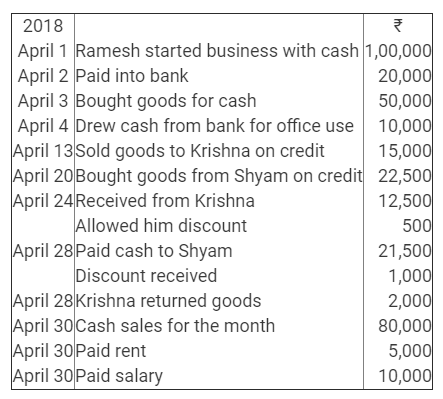
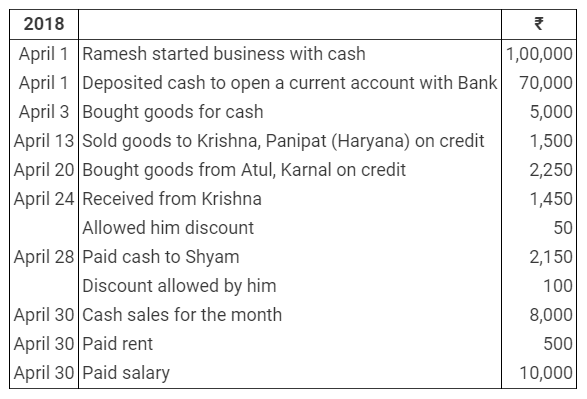
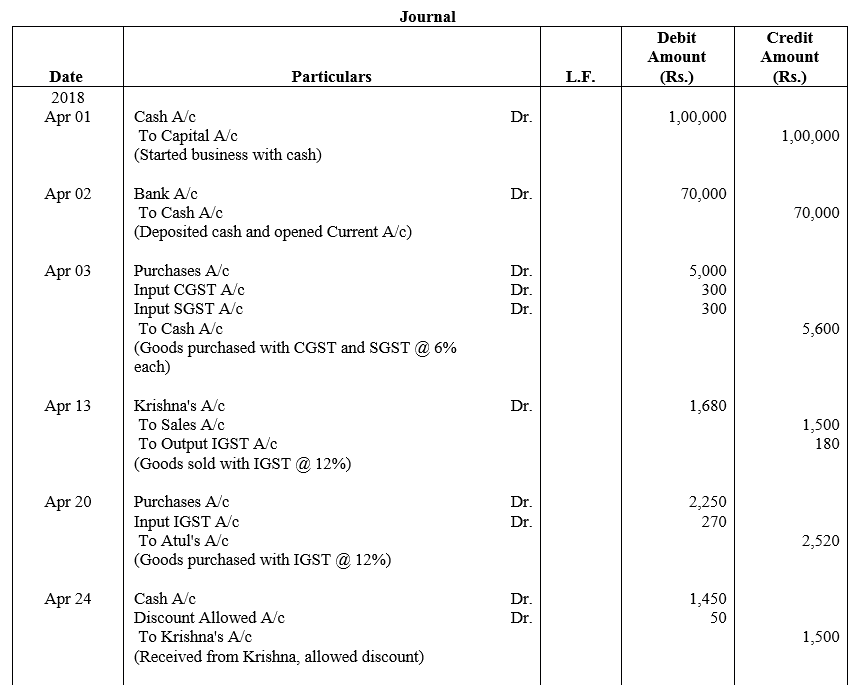
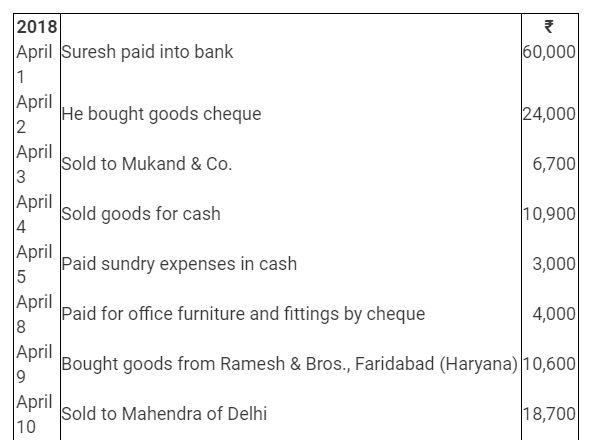
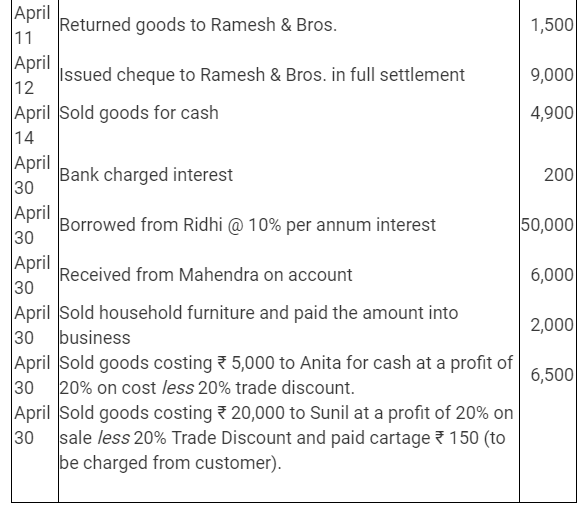
Following transactions of Ramesh for April,2018 are given below. Journalise them.
TS Grewal Accountancy Class 11 Solutions Chapter 5 Journal - 1
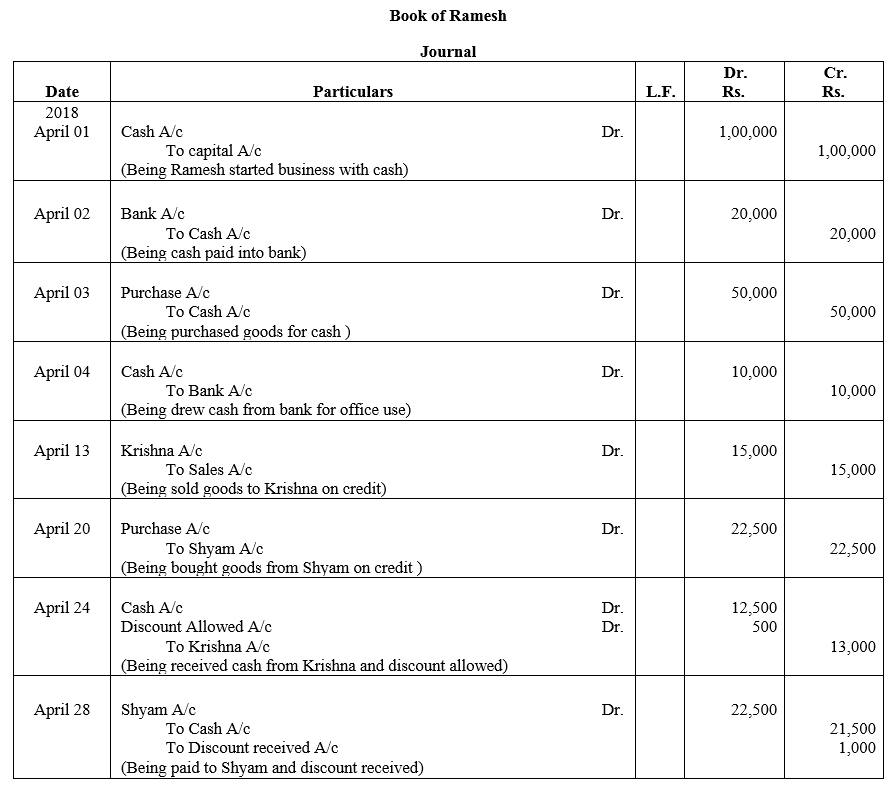
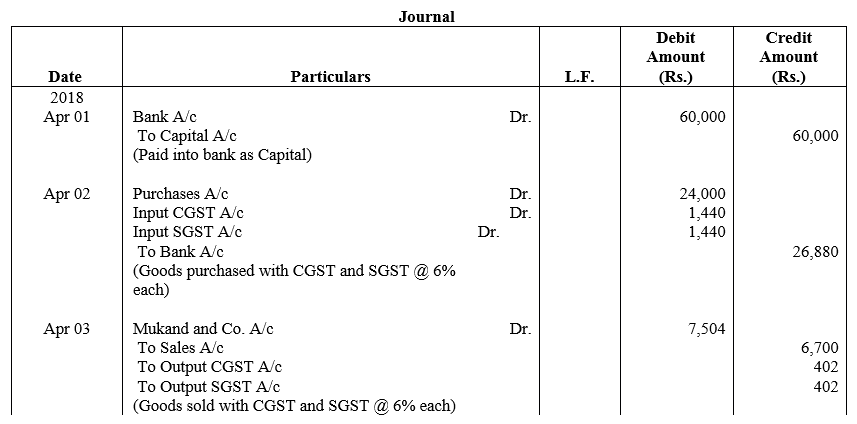
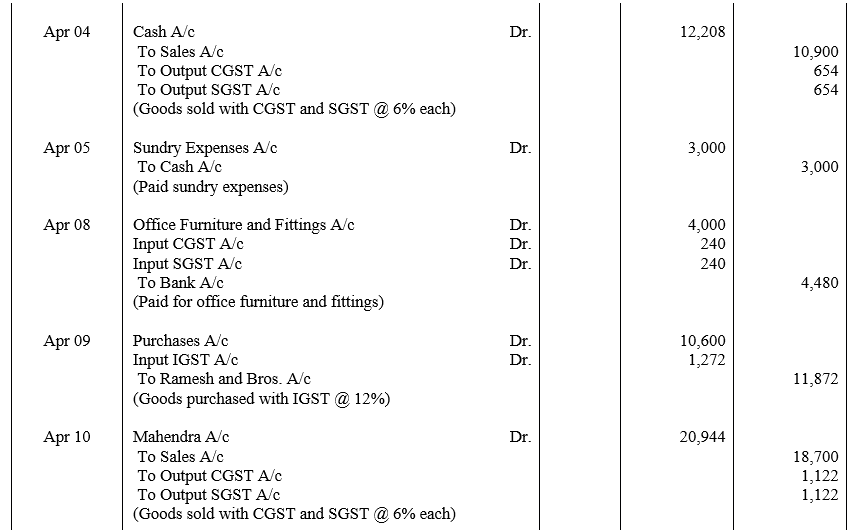
Solution:
TS Grewal Accountancy Class 11 Solutions Chapter 5 Journal - 2
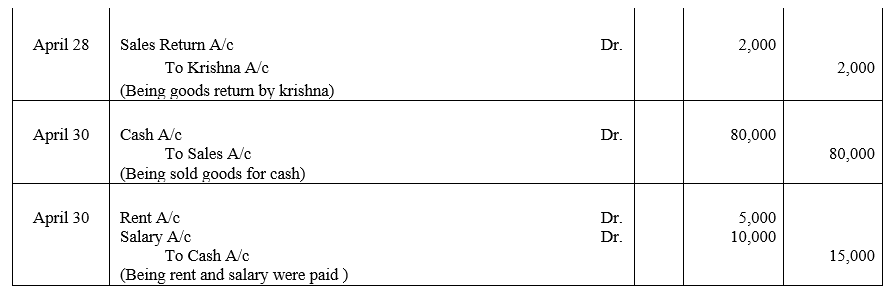
TS Grewal Accountancy Class 11 Solutions Chapter 5 Journal - 3

TS Grewal Accountancy Class 11 Solutions Chapter 5 Journal

Question 2.
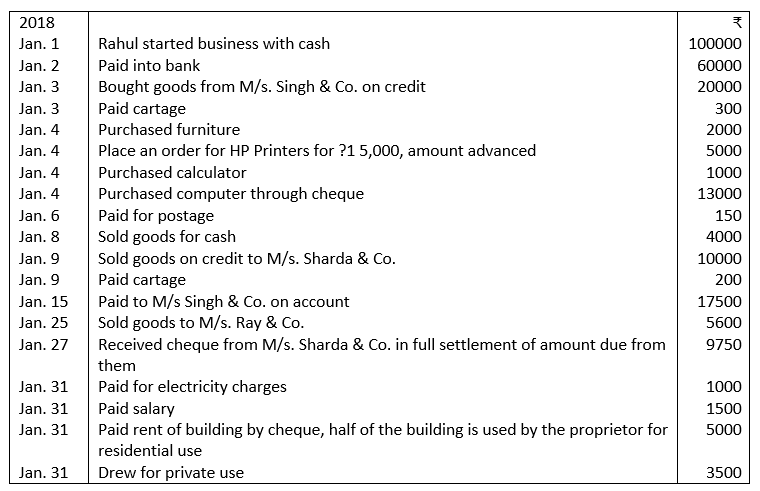
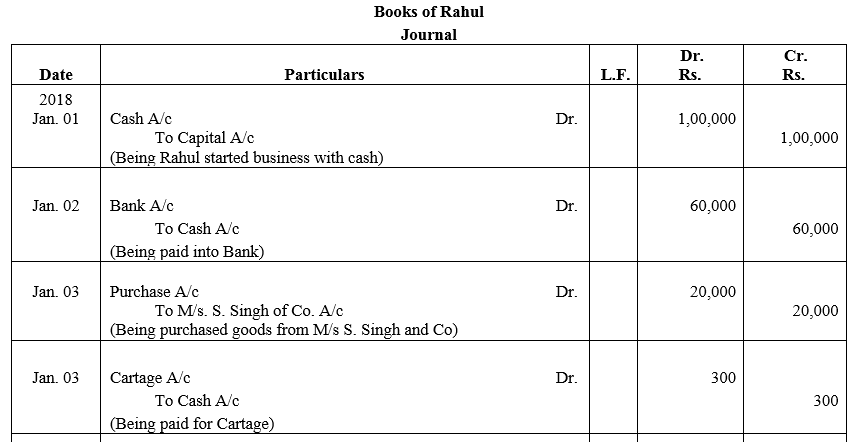
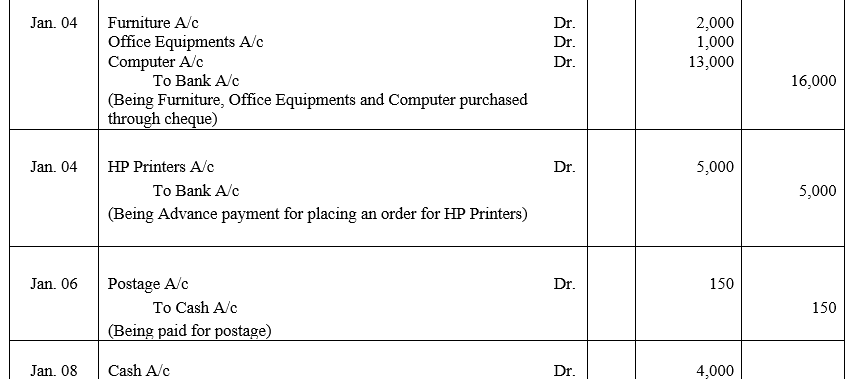
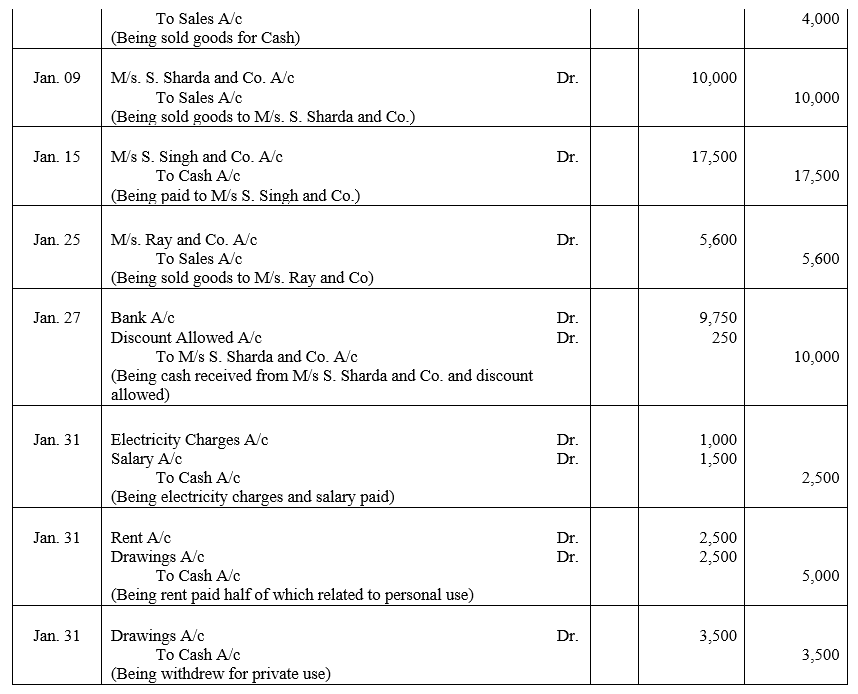
Journalise the following transactions of Mr. Rahul:
TS Grewal Accountancy Class 11 Solutions Chapter 5 Journal - 4
Solution:
TS Grewal Accountancy Class 11 Solutions Chapter 5 Journal - 5
TS Grewal Accountancy Class 11 Solutions Chapter 5 Journal - 6
TS Grewal Accountancy Class 11 Solutions Chapter 5 Journal - 7

TS Grewal Accountancy Class 11 Solutions Chapter 5 Journal

Question 3.
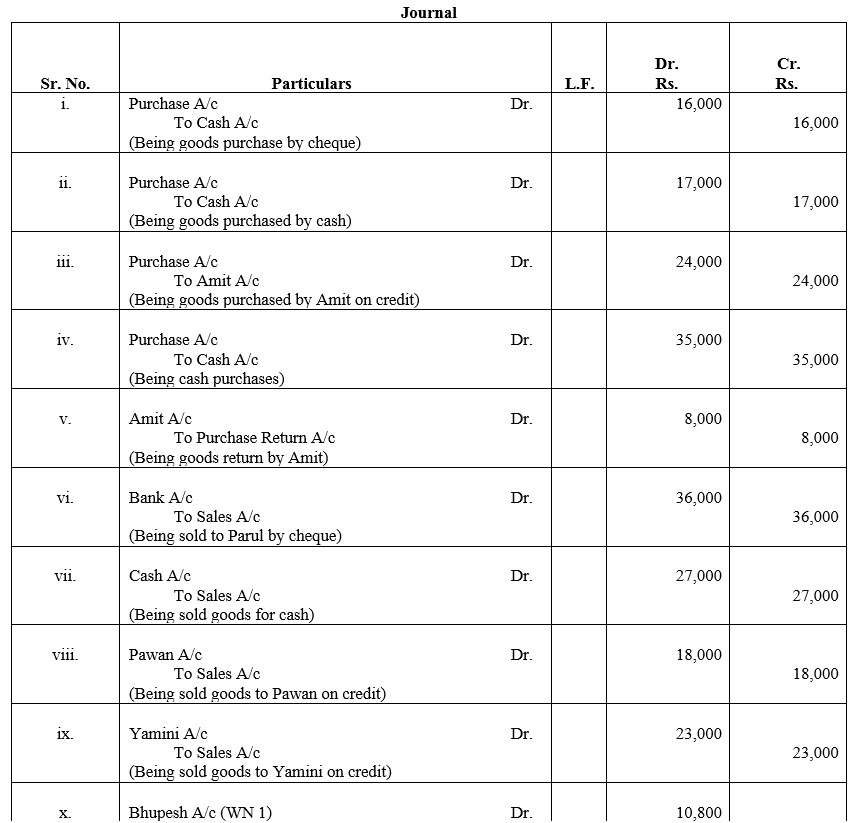
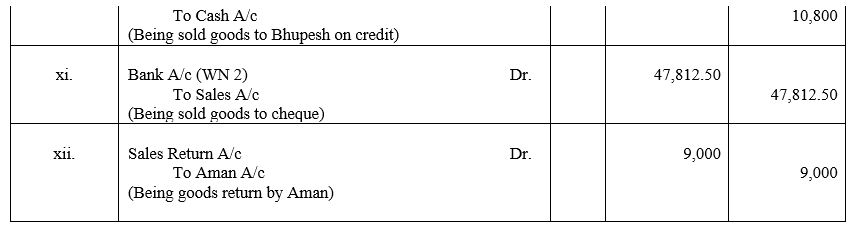
Journalise the following transactions in the books of M/s. R.K. & Co.
(i) Purchased goods at list price of ₹ 20,000 from Vishal at 20% trade discount against cheque payment.
(ii) Purchased goods at list price of ₹ 20,000 from Naman at 15% trade discount against cash.
(iii) Purchased goods at list price of ₹ 30,000 from Amrit at 20% trade discount.
(iv) Purchased goods at list price of ₹ 40,000 for ₹ 35,000 for cash.
(v) Goods returned of list price ₹ 10,000 purchased from Amrit.
(vi) Sold goods to Parul at list price of ₹ 40,000 at 10% trade discount against cheque payment.
(vii) Sold goods to Aman at list price of ₹ 30,000 at 10% trade discount against cash.
(viii) Sold goods to Pawan at list price of ₹ 20,000 at 10% trade discount.
(ix) Sold goods to Yamini at list price of ₹ 25,000 for ₹ 23,000.
(x) Sold goods costing ₹ 10,000 at cost plus 20% less 10% trade discount to Bhupesh.
(xi) Sold goods purchased at list price of ₹ 50,000 less 15% trade discount sold at a profit of 25% & 10% trade discount against cheque.
(xii) Aman returned goods of list price of ₹ 10,000 sold to him at 10% trade discount.
Solution:
TS Grewal Accountancy Class 11 Solutions Chapter 5 Journal - 8
TS Grewal Accountancy Class 11 Solutions Chapter 5 Journal - 9
Working Notes:
1. Calculation of Sales Price
Sales Price = Goods Sold + Cost – trade discount
Sales Price = 10,000 + 20% – 10% = Rs. 10,800
2. Calculation of Purchase and sales Price
Purchase Price = Purchases goods – Trade Discount
Purchase Price = 50,000 – 15% = Rs.42,500
Sales Price = Goods Sold + Profit – trade discount
Sales Price = 42,500 + 25% – 10% = Rs.47,812.50

Question 4.
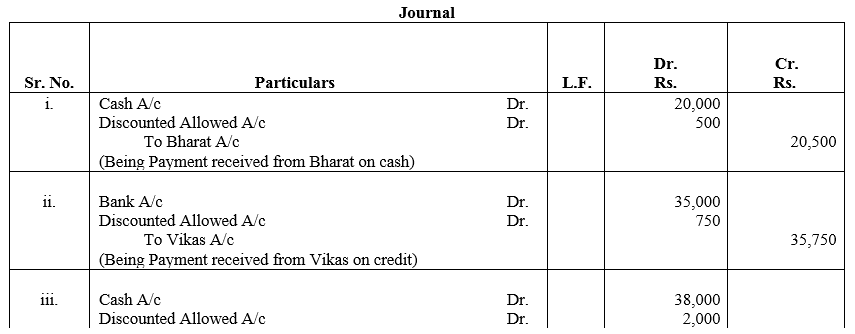
Journalise the following transactions in the books of Bhushan Agencies:
(i) Received from Bharat cash ₹ 20,000, allowed him discount of ₹ 500.
(ii) Received from Vikas ₹ 35,000 by cheque, allowed him discount of ₹ 750.
(iii) Received from Akhil ₹ 38,000 in settlement of his dues of ₹ 40,000 in cash.
(iv) Received from Amrit ₹ 50,000 by cheque on account against dues of ₹ 60,000.
(v) Paid cash ₹ 40,000 to suresh, availed discount of 2%.
(vi) Paid by cheque ₹ 25,000 to Mehar and settled her dues of ₹ 26,000.
(vii) Paid ₹ 25,000 to Yogesh by cheque on account.
(viii) Purchased goods costing ₹ 1,00,000 against cheque and availed discount of 3%.
(ix) Purchased goods costing ₹ 60,000 from Akash & Co., paid 50% immediately availing 3% discount.
(x) Sold goods of ₹ 30,000 against cheque allowing 2% discount.
(xi) Sold goods of ₹ 60,000 to Vimal received 50% of due amount allowing 2% discount.
Solution:
TS Grewal Accountancy Class 11 Solutions Chapter 5 Journal - 10
TS Grewal Accountancy Class 11 Solutions Chapter 5 Journal Q4.1

TS Grewal Accountancy Class 11 Solutions Chapter 5 Journal

Question 5.
Journalise the following transactions:
TS Grewal Accountancy Class 11 Solutions Chapter 5 Journal Q5
Solution:
TS Grewal Accountancy Class 11 Solutions Chapter 5 Journal - 11

Question 6.
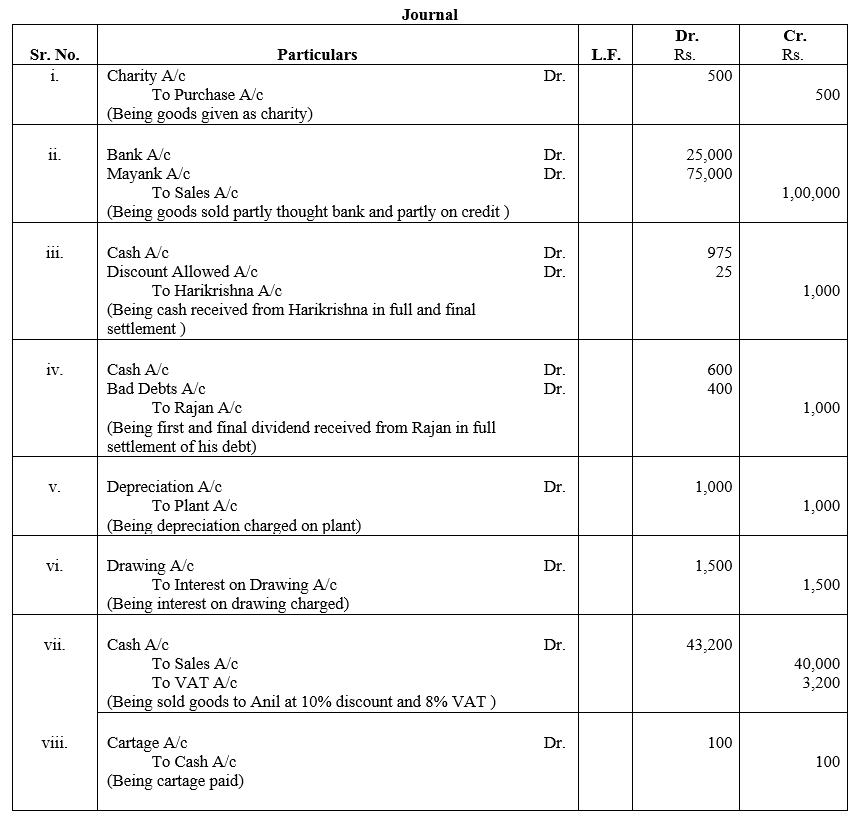
Journalise the following entries:
(i) Goods worth ₹ 500 given as charity.
(ii) Sold goods to Mayank of ₹ 1,00,000, payable 25% by cheque at the time of sale and balance after 30 days of sale.
(iii) Received ₹ 975 from Harikrishna in full settlement of his account for 1,000.
(iv) Received a first and final dividend of 60 paise in a rupee from the Official Receiver of Rajan, who owed us ₹ 1,000.
(v) Charged depreciation on plant ₹ 1,000.
(vi) Charge interest on Drawings ₹ 1,500.
(vii) Sold goods costing ₹ 40,000 to Anil for cash at a profit of 25% on cost less 20% trade discount and charged 8% Value Added Tax and paid cartage ₹ 100, which is not to be charged from customer.
Solution:
TS Grewal Accountancy Class 11 Solutions Chapter 5 Journal - 12

TS Grewal Accountancy Class 11 Solutions Chapter 5 Journal

Question 7.
Journalise the following transaction:
TS Grewal Accountancy Class 11 Solutions Chapter 5 Journal - 13
Solution:
TS Grewal Accountancy Class 11 Solutions Chapter 5 Journal - 14

Question 8.
With Goods and Services Tax (GST)
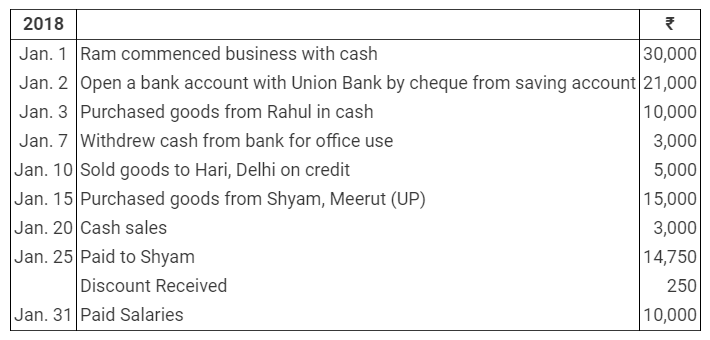
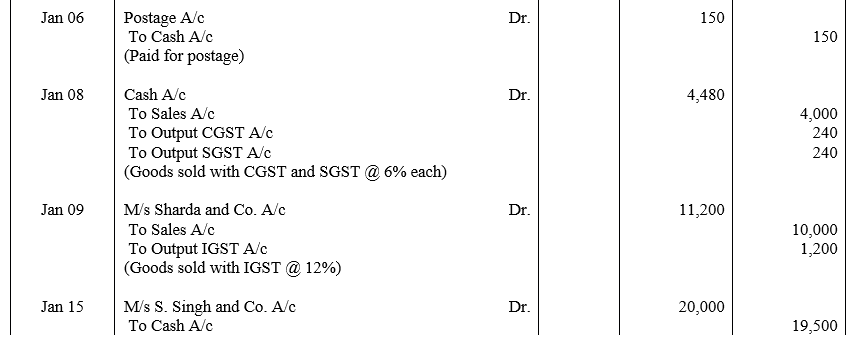
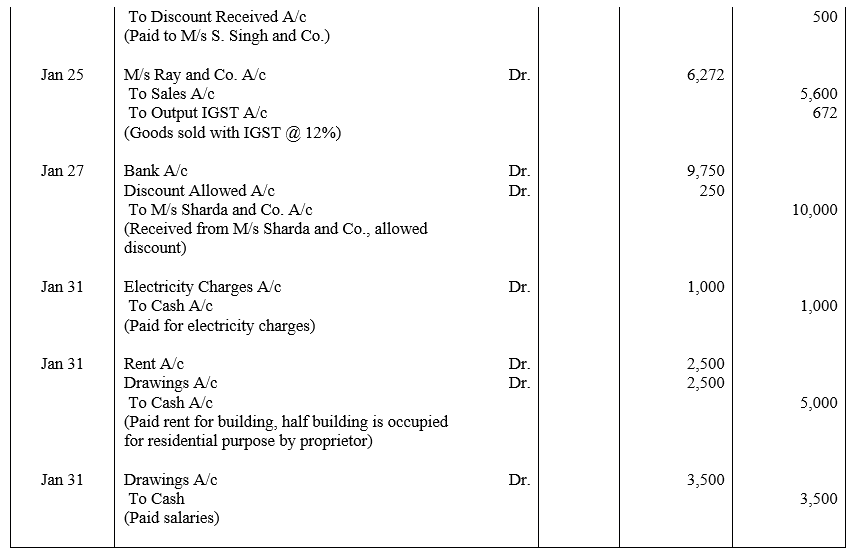
Journalise the following transactions of Singh Enterprises, Delhi:
TS Grewal Accountancy Class 11 Solutions Chapter 5 Journal - 15
CGST and SGST @ 6% each is levied on Intra-state sale and purchase.
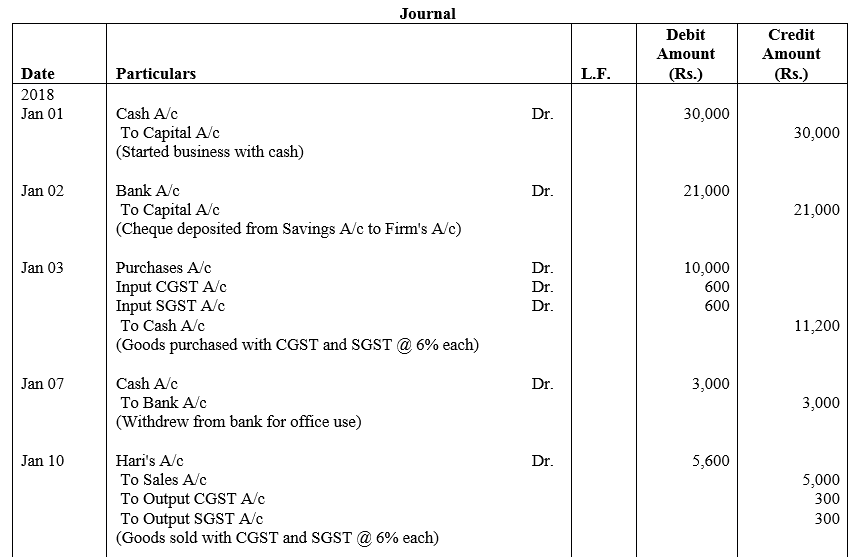
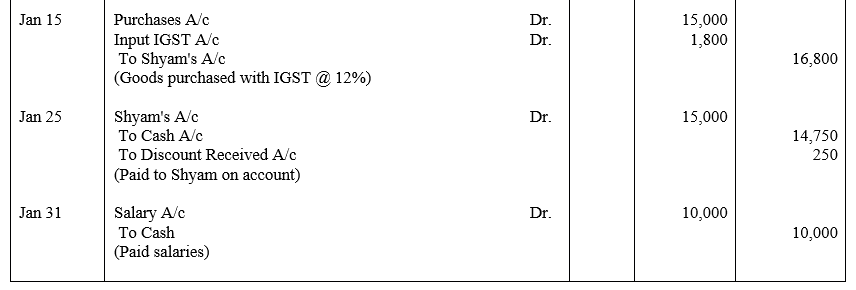
Solution:
TS Grewal Accountancy Class 11 Solutions Chapter 5 Journal - 16
TS Grewal Accountancy Class 11 Solutions Chapter 5 Journal - 17

TS Grewal Accountancy Class 11 Solutions Chapter 5 Journal

Question 9.
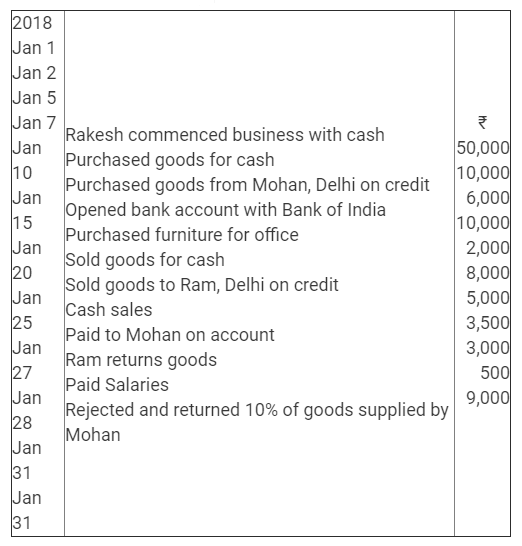
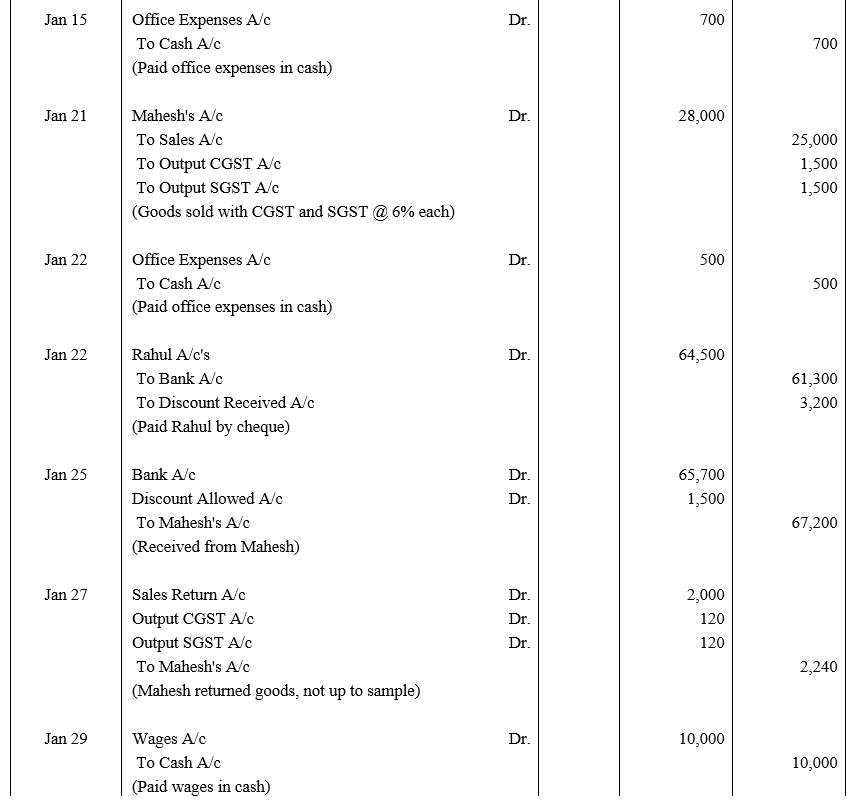
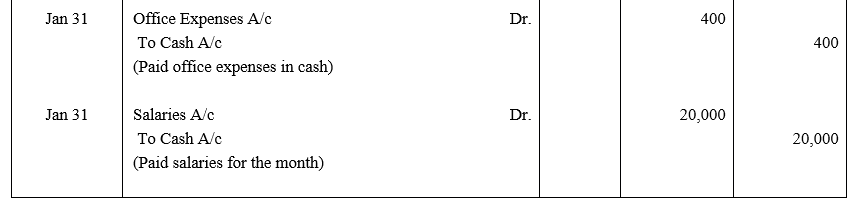
Journalise the following transactions of Rakesh Agencies, Delhi (Proprietor Shri Rakesh):
TS Grewal Accountancy Class 11 Solutions Chapter 5 Journal - 18
CGST and SGST is levied @ 6% each on intra-state sale and purchase. IGST is levied @12% on inter-state sale and purchase.
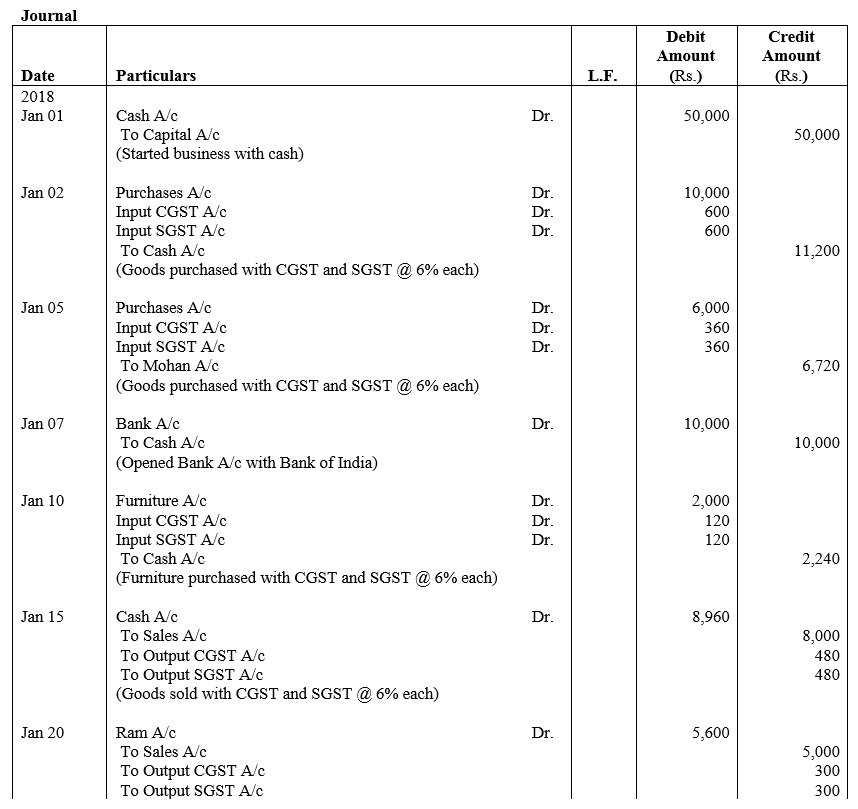
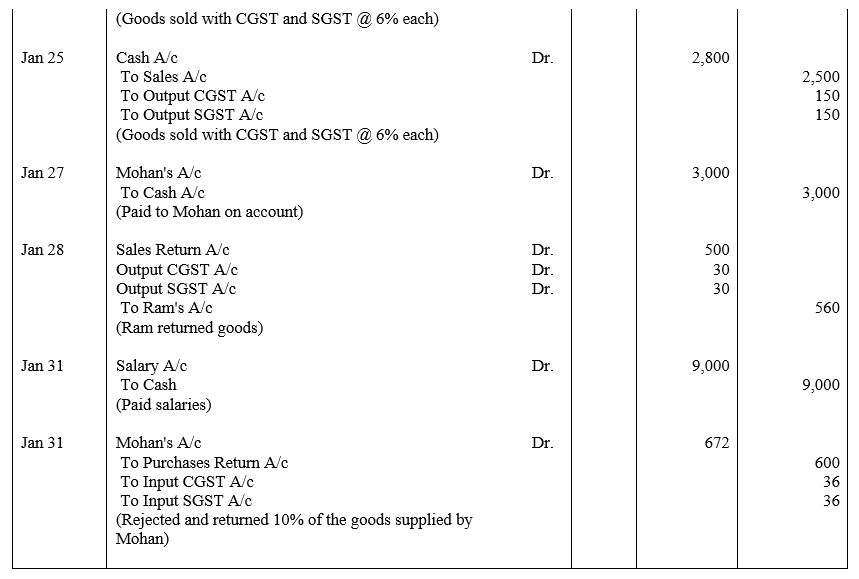
Solution:
TS Grewal Accountancy Class 11 Solutions Chapter 5 Journal - 19
TS Grewal Accountancy Class 11 Solutions Chapter 5 Journal - 20

TS Grewal Accountancy Class 11 Solutions Chapter 5 Journal

Question 10.
Journalise the following transactions of Ram Delhi:
TS Grewal Accountancy Class 11 Solutions Chapter 5 Journal - 21
CGST and SGST is levied @ 6% each on intra-state sale and purchase. IGST is levied @12% on inter-state sale and purchase.
Solution:
TS Grewal Accountancy Class 11 Solutions Chapter 5 Journal - 22
TS Grewal Accountancy Class 11 Solutions Chapter 5 Journal - 23

Question 11.
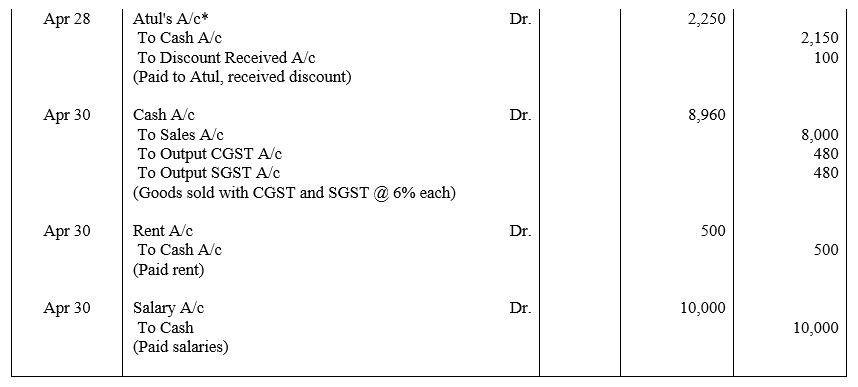
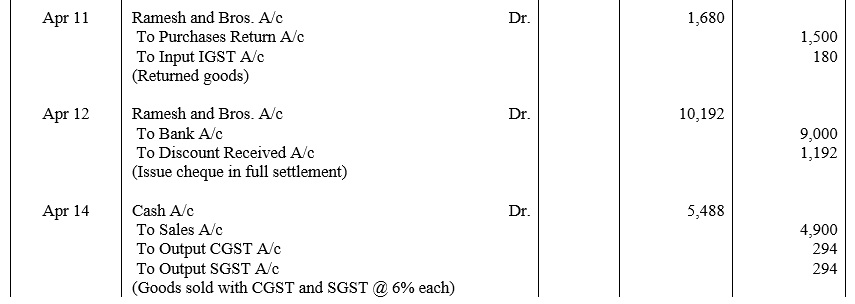
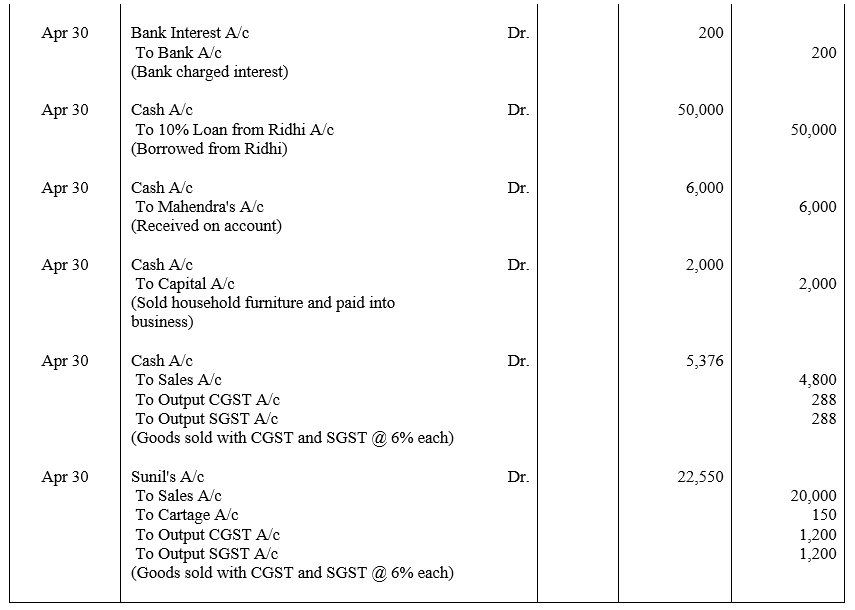
Following transactions of Ramesh Delhi for April, 2018 are given below. Journalise them.
TS Grewal Accountancy Class 11 Solutions Chapter 5 Journal - 24
CGST and SGST is levied @ 6% each on intra-state sale and purchase. IGST is levied @12% on inter-state sale and purchase.
Solution:
TS Grewal Accountancy Class 11 Solutions Chapter 5 Journal - 25
TS Grewal Accountancy Class 11 Solutions Chapter 5 Journal - 26
Note: In transaction dated Apr 28, there is a misprint in the book. The payment of Rs 2,150 is made to Atul and not Shyam.

TS Grewal Accountancy Class 11 Solutions Chapter 5 Journal

Question 12.
Journalise the following transactions of Satish, Noida (UP):
TS Grewal Accountancy Class 11 Solutions Chapter 5 Journal - 27
CGST and SGST is levied @ 6% each on intra-state sale and purchase. IGST is levied @ 12% on inter-state sale and purchase.
Solution:
TS Grewal Accountancy Class 11 Solutions Chapter 5 Journal - 28
TS Grewal Accountancy Class 11 Solutions Chapter 5 Journal - 29
TS Grewal Accountancy Class 11 Solutions Chapter 5 Journal - 30

TS Grewal Accountancy Class 11 Solutions Chapter 5 Journal

Question 13.
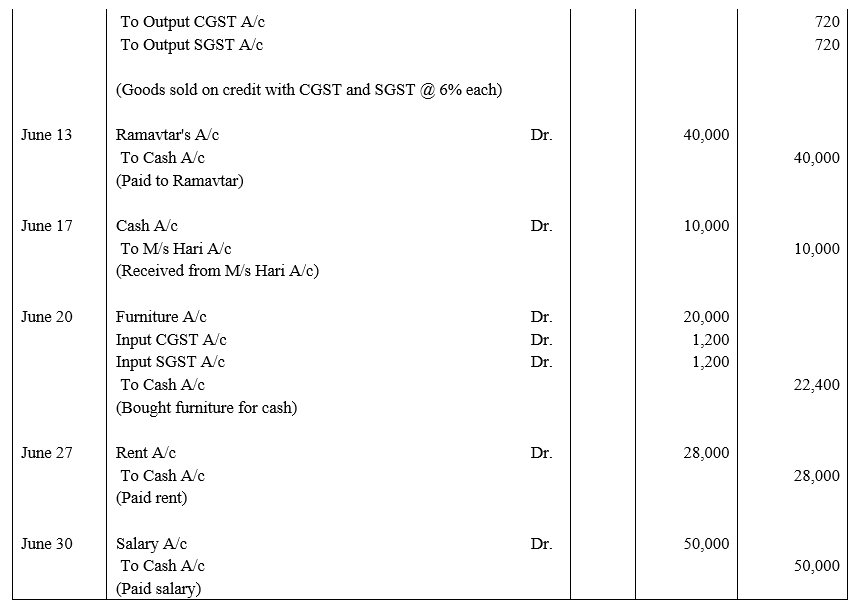
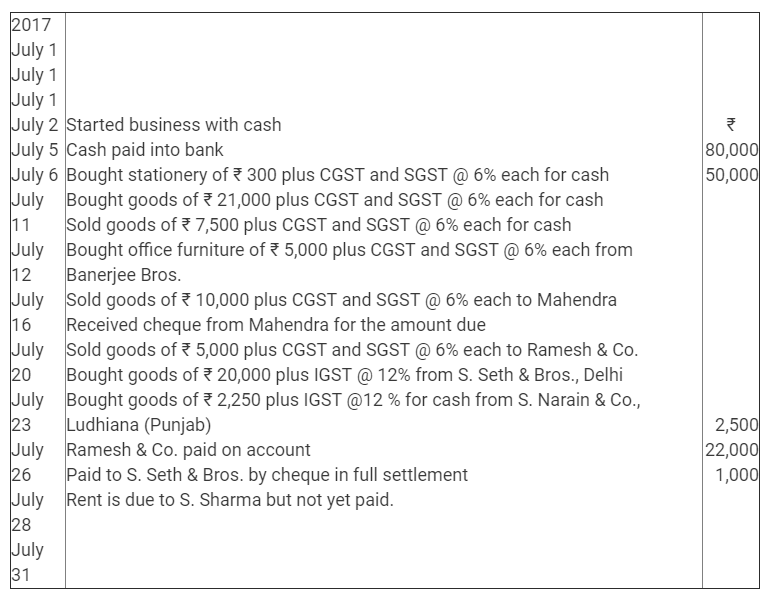
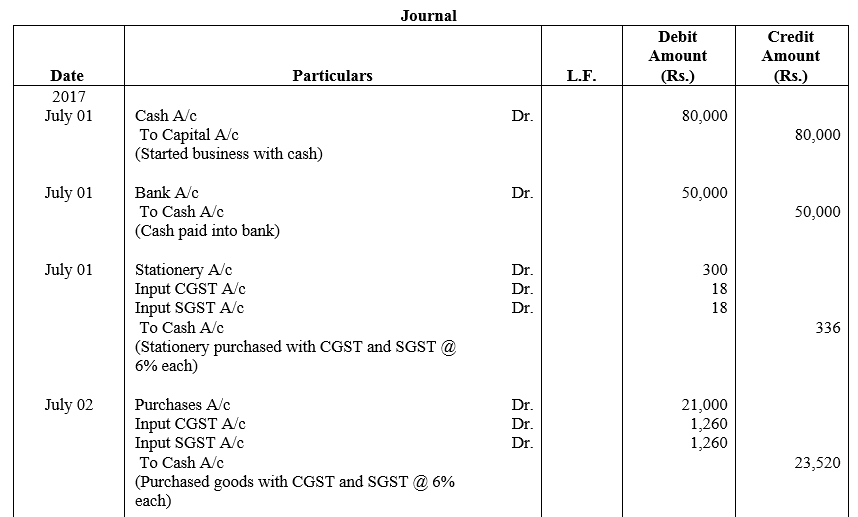
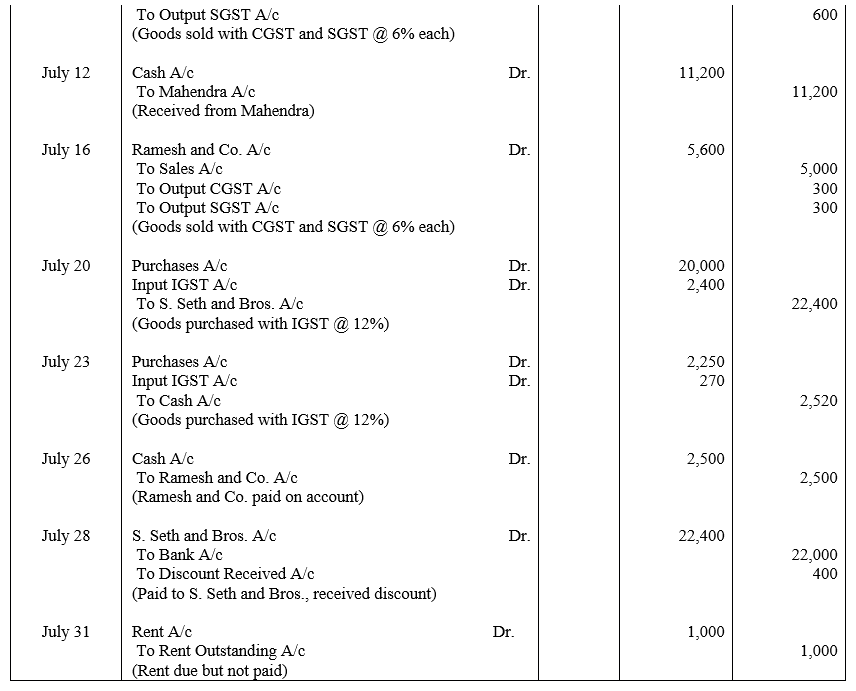
Following are the transactions of R.Singh & Co., Kanpur (UP) for the month of July, 2017. You are required to Journalise them:
TS Grewal Accountancy Class 11 Solutions Chapter 5 Journal - 31
Solution:
TS Grewal Accountancy Class 11 Solutions Chapter 5 Journal - 32
TS Grewal Accountancy Class 11 Solutions Chapter 5 Journal - 33
TS Grewal Accountancy Class 11 Solutions Chapter 5 Journal - 34

TS Grewal Accountancy Class 11 Solutions Chapter 5 Journal

Question 14.
Record the following transactions in the Journal of Ashoka Furniture Traders, Ludhiana (Punjab):
TS Grewal Accountancy Class 11 Solutions Chapter 5 Journal - 35
CGST and SGST is levied @ 6% each on intra-state sale and purchase. IGST is levied @ 12% on inter-state sale and purchase.
Solution:
TS Grewal Accountancy Class 11 Solutions Chapter 5 Journal - 36
TS Grewal Accountancy Class 11 Solutions Chapter 5 Journal - 37
TS Grewal Accountancy Class 11 Solutions Chapter 5 Journal - 38

TS Grewal Accountancy Class 11 Solutions Chapter 5 Journal
*Some Error in Question. Amount specified is more than actual amount due.

Question 15.
Enter the following transactions in the Journal of Suresh who trades in ready-made garments:
TS Grewal Accountancy Class 11 Solutions Chapter 5 Journal - 39
TS Grewal Accountancy Class 11 Solutions Chapter 5 Journal - 40
CGST and SGST is levied @ 6% each on intra-state sale and purchase. IGST is levied @ 12% on inter-state sale and purchase.
Solution:
TS Grewal Accountancy Class 11 Solutions Chapter 5 Journal - 41
TS Grewal Accountancy Class 11 Solutions Chapter 5 Journal - 42
TS Grewal Accountancy Class 11 Solutions Chapter 5 Journal - 43
TS Grewal Accountancy Class 11 Solutions Chapter 5 Journal - 44

Question 16.
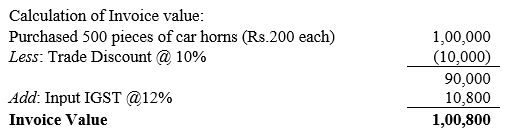
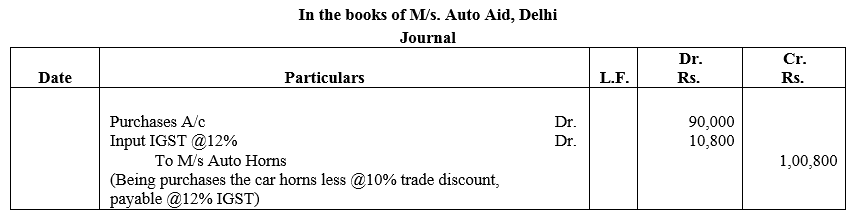
M/s. Auto Aid, Delhi purchased 500 pieces of car horns @ ₹ 200 each less 10% Trade Discount plus IGST @ 12% from M/s Auto Horns, Chandigarh. What is the invoice value?
Solution:
TS Grewal Accountancy Class 11 Solutions Chapter 5 Journal - 45
TS Grewal Accountancy Class 11 Solutions Chapter 5 Journal - 46

TS Grewal Accountancy Class 11 Solutions Chapter 5 Journal

Question 17.
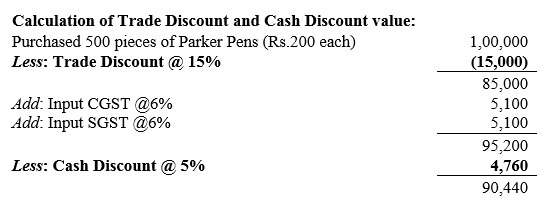
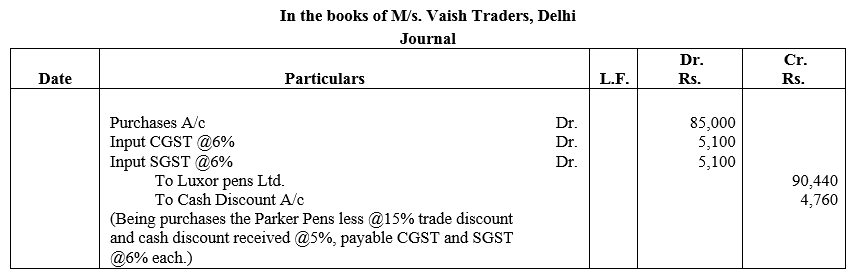
M/s. Vaish Traders, Delhi purchased 500 Parker Pens @ ₹ 200 each less Trade Discount @ 15% from Luxor Pens Ltd., Delhi. CGST and SGST was levied @ 6% each. Further, Cash Discount was allowed @ 5% as the payment was made within specified time. What will be the amount of trade discount and cash discount ?
Solution:
TS Grewal Accountancy Class 11 Solutions Chapter 5 Journal - 47
TS Grewal Accountancy Class 11 Solutions Chapter 5 Journal - 48

Question 18.
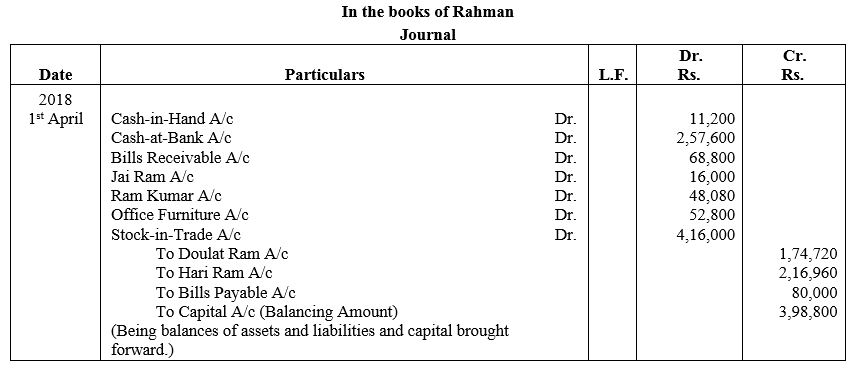
On 1st April, 2018, the position of Rahman was as follows: Cash-in-Hand ₹ 11,200; Cash at Bank ₹ 2,57,600; Bills Receivable ₹ 68,000; Jai Ram (Dr.) ₹ 16,000; Ram Kumar (Dr.) ₹ 48,080; Office Furniture ₹ 52,800; Stock-in-Trade ₹ 4,16,000; Doulat Ram (Cr.) ₹ 1,74,720, Hari Ram (Cr.) ₹ 2,16,960; Bills Payable ₹ 80,000. What was the amount of capital of Rahman on that date? Show the Journal entry to Open his books.
Solution:
TS Grewal Accountancy Class 11 Solutions Chapter 5 Journal - 49

Question 19.
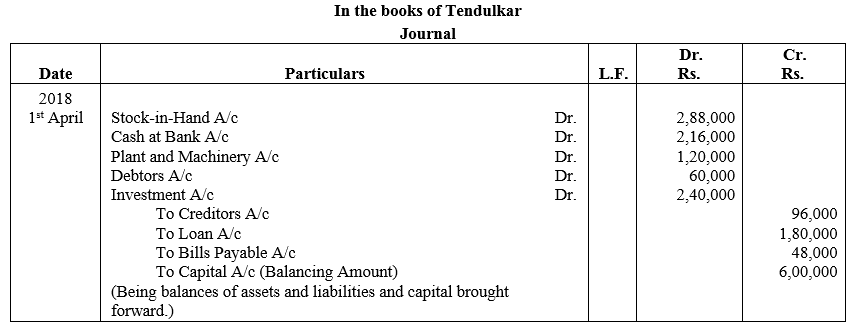
On 1st April, 2018, the position of Tendulkar was as follows: Stock-in-Hand ₹ 2,88,000; Bills Payable ₹ 48,000; Cash at Bank ₹ 2,16,000; Plant and Machinery ₹ 1,20,000; Owing by debtors ₹ 60,000; Owing to creditors ₹ 96,000; Investment ₹ 2,40,000; Loan from S.K. Garg ₹ 1,80,000. What was the amount of Tendulkar’s capital on the date? Show an opening Journal entry.
Solution:
TS Grewal Accountancy Class 11 Solutions Chapter 5 Journal - 50

TS Grewal Accountancy Class 11 Solutions Chapter 5 Journal

Question 20.
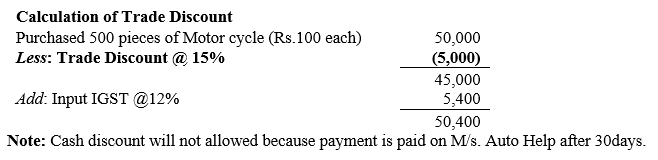
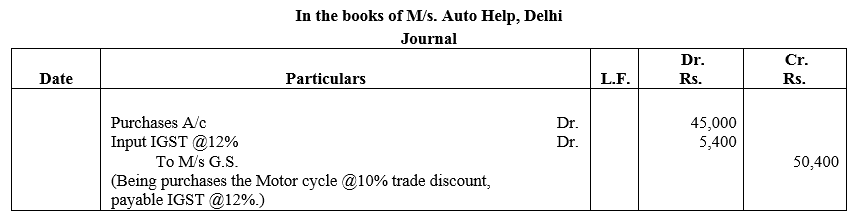
M/s. Auto Help, Delhi purchased 500 pieces of motor cycle horns at ₹ 100 each plus IGST @ 12% from M/s G.S., Auto, Ghaziabad, (UP). Trade terms settled were: Trade Discount will be allowed @ 10% and Cash Discount @ 5% if payment is made within 7 days. M/s. Auto Help made the payment after 30 days. Determine the amount of Trade Discount and Cash Discount.
Solution:
TS Grewal Accountancy Class 11 Solutions Chapter 5 Journal - 51
TS Grewal Accountancy Class 11 Solutions Chapter 5 Journal - 52

Question 21.
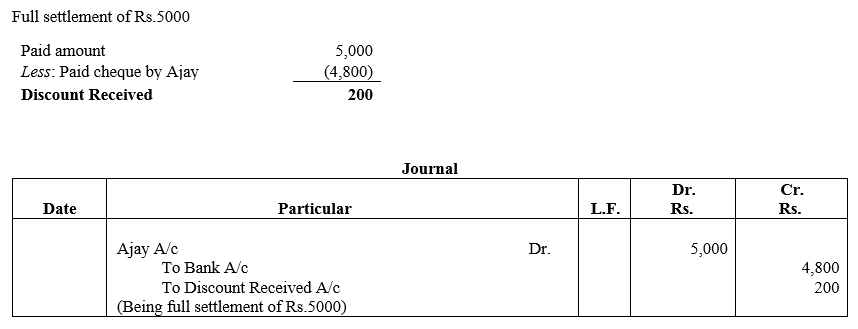
Name the accounts to be credited along with the amount for payment to Ajay of ₹ 4,800 by cheque in full settlement of ₹ 5,000.
Solution:
TS Grewal Accountancy Class 11 Solutions Chapter 5 Journal - 53

Question 22.
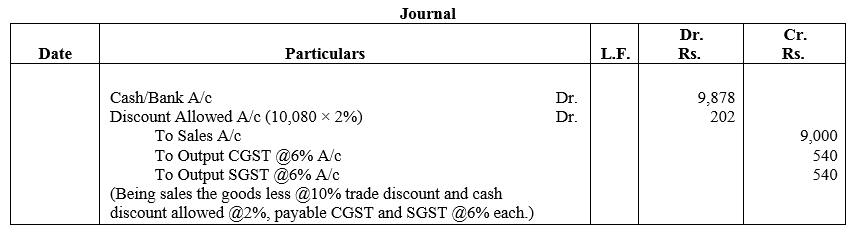
Pass Journal entry for sale of goods by Rahul, Delhi to Anish, Delhi for ₹ 10,000 less 10% Trade Discount and 2% Cash Discount. Assume payment is received at the time of sale. CGST and SGST is levied @ 6% each.
Solution:
TS Grewal Accountancy Class 11 Solutions Chapter 5 Journal - 54

Question 23.
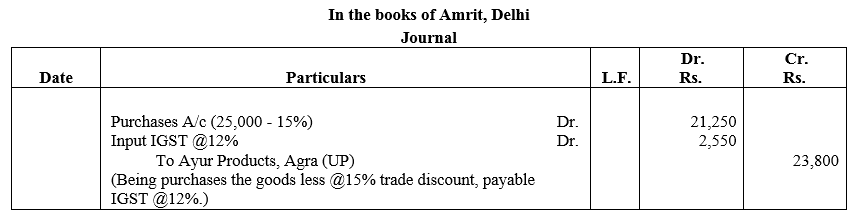
Pass Journal entry for purchase of goods by Amrit, Delhi from Ayur Products, Agra, (UP) for ₹ 25,000 less Trade Discount @ 15% plus IGST @ 12%.
Solution:
TS Grewal Accountancy Class 11 Solutions Chapter 5 Journal - 55

Question 24.
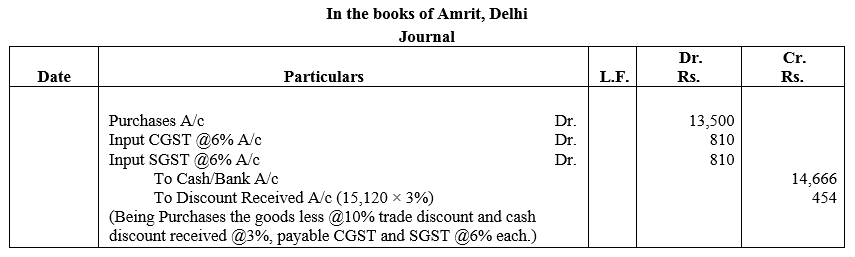
Pass Journal entry for purchase of goods by Amrit, Delhi from Add Gel Pens, Delhi for ₹ 15,000 less Trade Discount 10% and Cash Discount 3% CGST and SGST is levied @ 6% each. Assume payment is made at the time of purchase.
Solution:
TS Grewal Accountancy Class 11 Solutions Chapter 5 Journal - 56

Question 25.
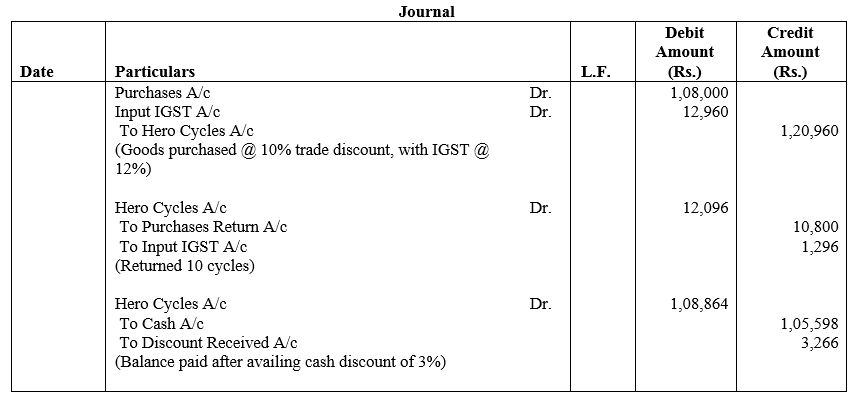
Mittal Cycles purchased 100 cycles from Hero Cycles, Ludhina (Punjab) @ ₹ 1,200 per cycle plus IGST @ 12%. Hero Cycles allowed 10% Trade Discount and 3% Cash Discount if payment is made within 14 days. Mittal Cycles received 10 cycles damaged during transit, which it returned. Mittal Cycles settled the payment in 10 days time.
​Pass Journal entries for the above transactions.
Solution:
TS Grewal Accountancy Class 11 Solutions Chapter 5 Journal - 57

TS Grewal Accountancy Class 11 Solutions Chapter 5 Journal

Question 26.
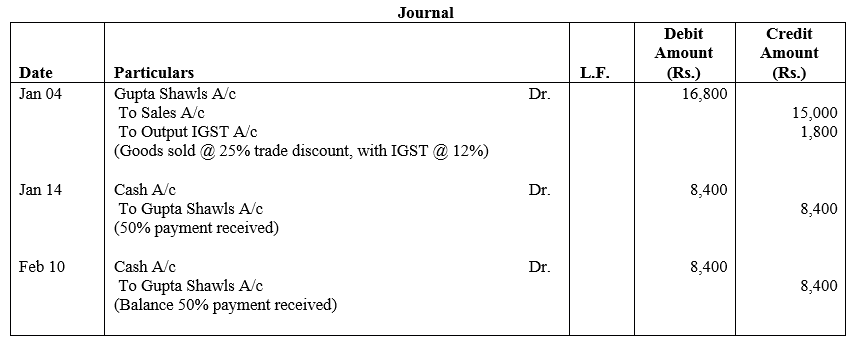
Oswal Woollen Mills, Amritsar (Punjab) sold shawls to Gupta Shawls, Jaipur as per details: Sold 100 shawls @ ₹ 200 per shawl on 4th January, 2018, IGST is levied @ 12%. Trade Discount 25% and Cash Discount 5% if full payment is made within 14 days. Gupta Shawls sent 50% of the payment on 14th January, 2018 and balance payment on 10th February,2018. Pass Journal entries.
Solution:
TS Grewal Accountancy Class 11 Solutions Chapter 5 Journal - 58

Question 27.
Journalise the following transactions in the books of Ashok:
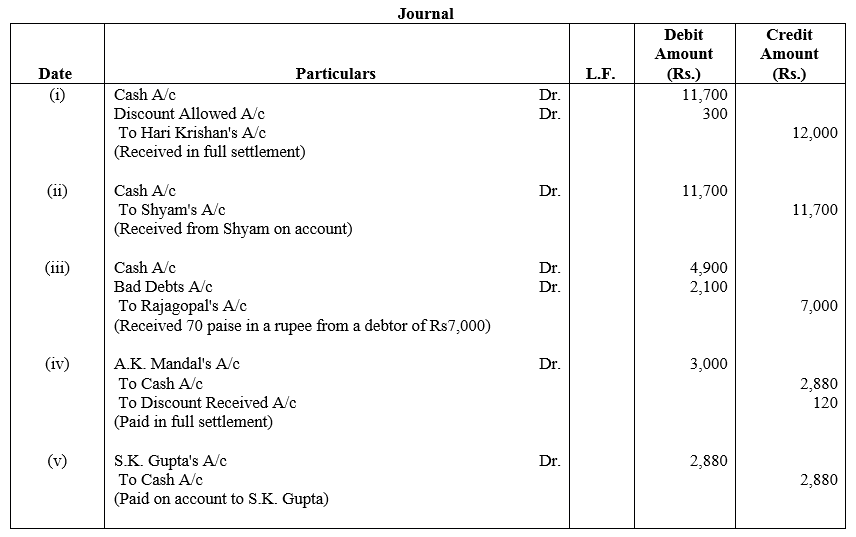
(i) Received ₹ 11,700 from Hari Krishan in full settlement of his account for ₹ 12,000.
(ii) Received ₹ 11,700 from Shyam on his account fro ₹ 12,000.
(iii) Received a first and final divident of 70 paise in the rupee from the official receiver of Rajagopal who owed us ₹ 7,000.
(iv) Paid ₹ 2,880 to A.K. Mandal in full settlement of his account for ₹ 3,000.
(v) Paid ₹ 2,880 to S.K. Gupta on his account for ₹ 3,000.
Solution:
TS Grewal Accountancy Class 11 Solutions Chapter 5 Journal - 59

TS Grewal Accountancy Class 11 Solutions Chapter 5 Journal

Question 28.
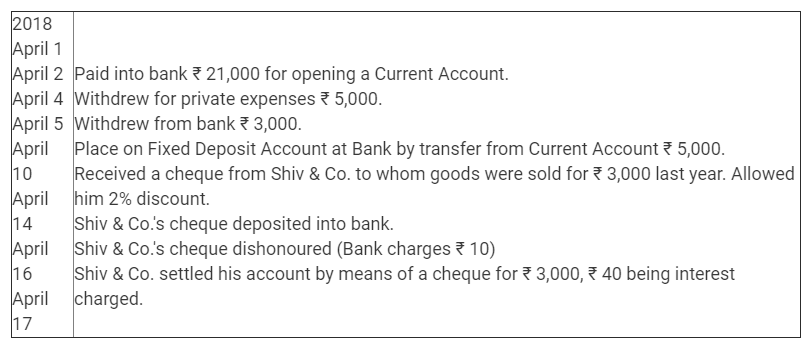
Journalise the following transactions:
TS Grewal Accountancy Class 11 Solutions Chapter 5 Journal - 60
Solution:
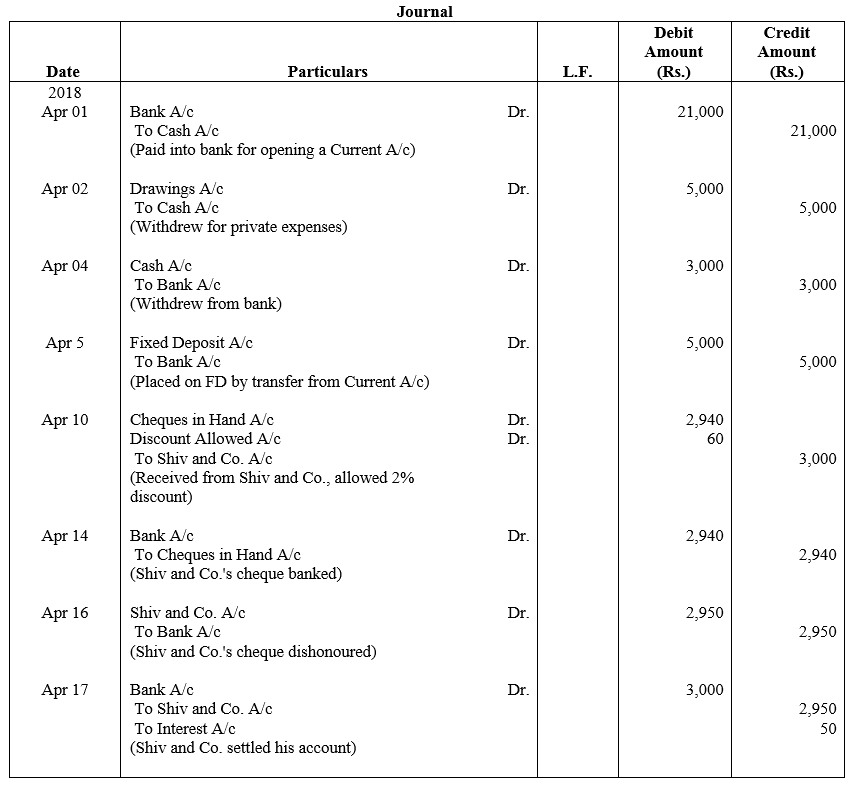
TS Grewal Accountancy Class 11 Solutions Chapter 5 Journal - 61
Note for Apr 17:
Cheque of Rs 2,940 dishonoured. Bank charged Rs 10 (to be recovered from Shiv and Co.). Total due from Shiv and Co. Rs 2,950. New cheque received for Rs 3,000, so interest charged should be Rs 50 (not Rs 40, as given in the book).

Question 29.
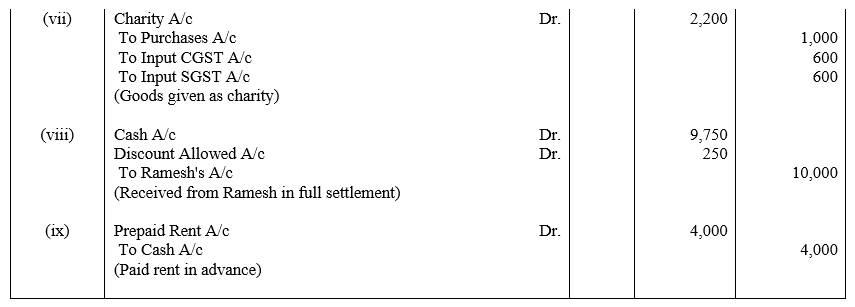
Journalise the following in the books of Amit Saini, Gurugram (Haryana):
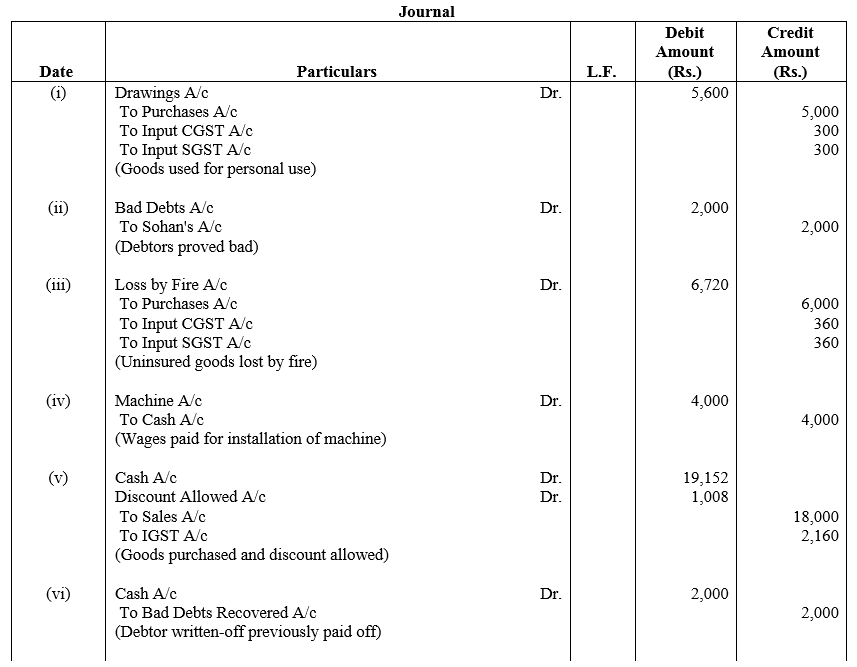
(i) Goods of ₹ 5,000 were used by him for domestic purpose.
(ii) ₹ 2,000 due from Sohan became bad debts.
(iii) Goods of ₹ 6,000 were destroyed by fire and were not insured.
(iv) Paid ₹ 4,000 in cash as wages on installation of machine. GST is not to be levied.
(v) Sold goods to Arjun of Delhi of list price ₹ 20,000. Trade discount @ 10% and cash discount of 5% was allowed.
He paid the amount on the same day and availed the cash discount.
(vi) Received cash for a bad debt written off last year ₹ 2,000.
(vii) Goods of ₹ 1,000 given as charity.
(viii) Received ₹ 9,750 from Ramesh in full settlement of his account of ₹ 10,000.
(ix) Paid rent in advance ₹ 4,000.
​CGST and SGST is to be levied on intra-state sale @ 6% each and IGST @ 12% on inter-state sale.
Solution:
TS Grewal Accountancy Class 11 Solutions Chapter 5 Journal image - 61
TS Grewal Accountancy Class 11 Solutions Chapter 5 Journal image - 62

TS Grewal Accountancy Class 11 Solutions Chapter 5 Journal

Question 30.
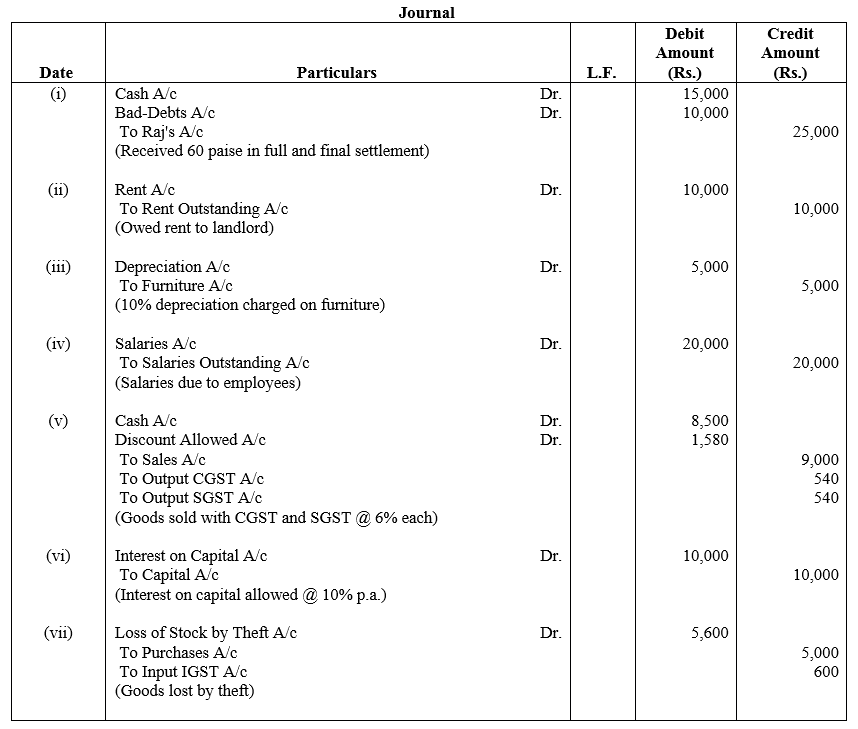
Journalise the following transactions in the books of Mohan Singh, Delhi:
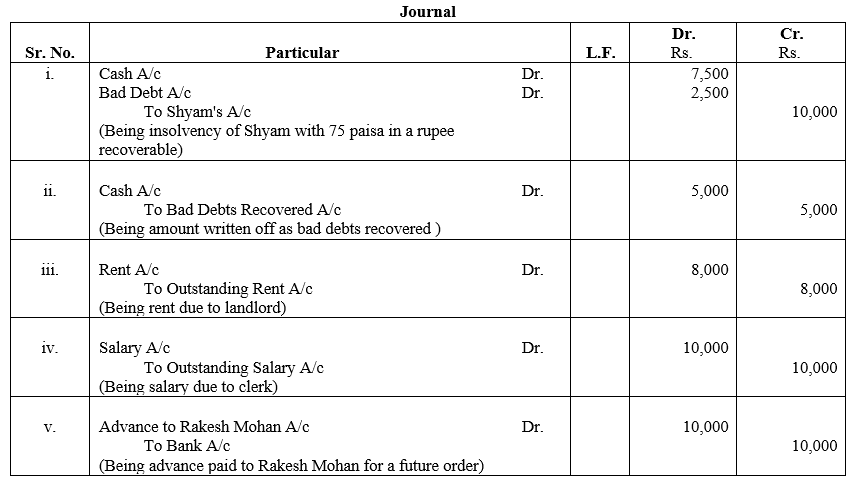
(i) Raj of Alwar, Rajasthan who owed Mohan Singh ₹ 25,000 became insolvent and received 60 paise in a rupee as full and final settlement.
(ii) Mohan Singh owes to his landlord ₹ 10,000 as rent.
(iii) Charge depreciation of 10% on furniture costing ₹ 50,000.
(iv) Salaries due to employees ₹ 20,000.
(v) Sold to Sunil goods in cash of ₹ 10,000 less 10% trade discount plus CGST and SGST @ 6% each and received a net of ₹ 8,500.
(vi) Provided interest on capital of ₹ 1,00,000 @ 10% per annum.
(vii) Goods lost in theft – ₹ 5,000, which were purchased paying IGST @ 12% from Alwar, Rajasthan.
Hint:
(vii) Loss of Stock by Theft A/c – ₹ 5,600
To Purchase A/c – ₹ 5,000
To Input IGST A/c – ₹ 600
Solution:
TS Grewal Accountancy Class 11 Solutions Chapter 5 Journal image - 63

Question 31.
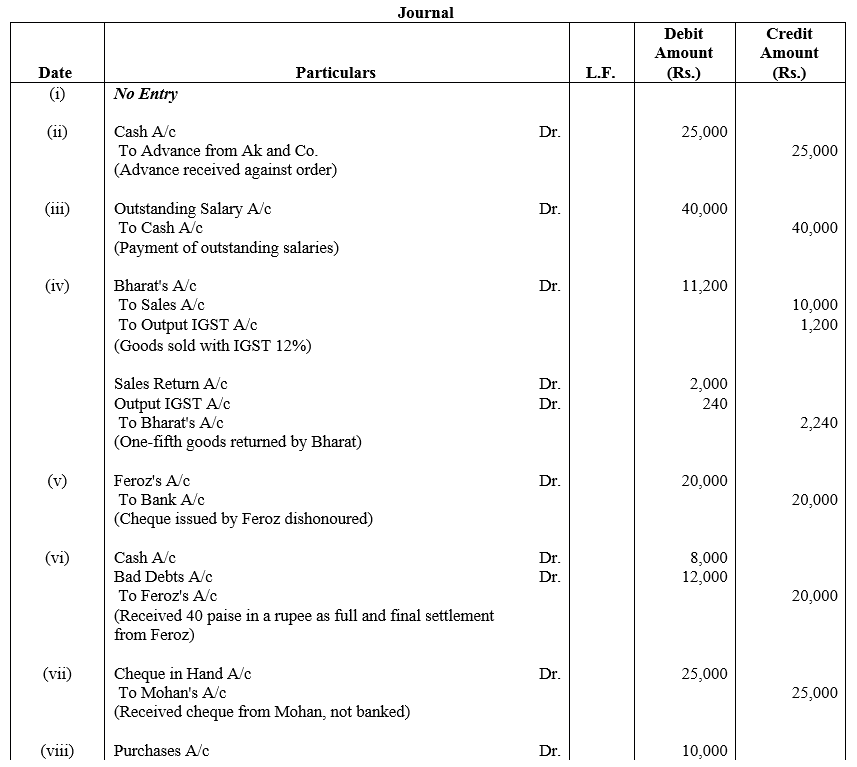
Pass Journal entries in the books of Puneet, Delhi for the following:
(i) Received an order from Karan & Co. for supply of goods of ₹ 50,000.
(ii) Received an order from AK & Co. for goods of ₹ 1,00,000 along with a cheque for ₹ 25,000 as advance.
(iii) Paid to staff ₹ 40,000 against outstanding salary of ₹ 60,000.
(iv) Sold goods to Bharat, Kaithal (Haryana) of ₹ 10,000 plus IGST @ 12% out of which 1/5th were returned being defective.
(v) Cheque of ₹ 20,000 issued by Feroz was dishonoured.
(vi) Received 40 paise in a rupee from Feroz against the above dues.
(vii) Received a cheque of ₹ 25,000 from Mohan after banking hours.
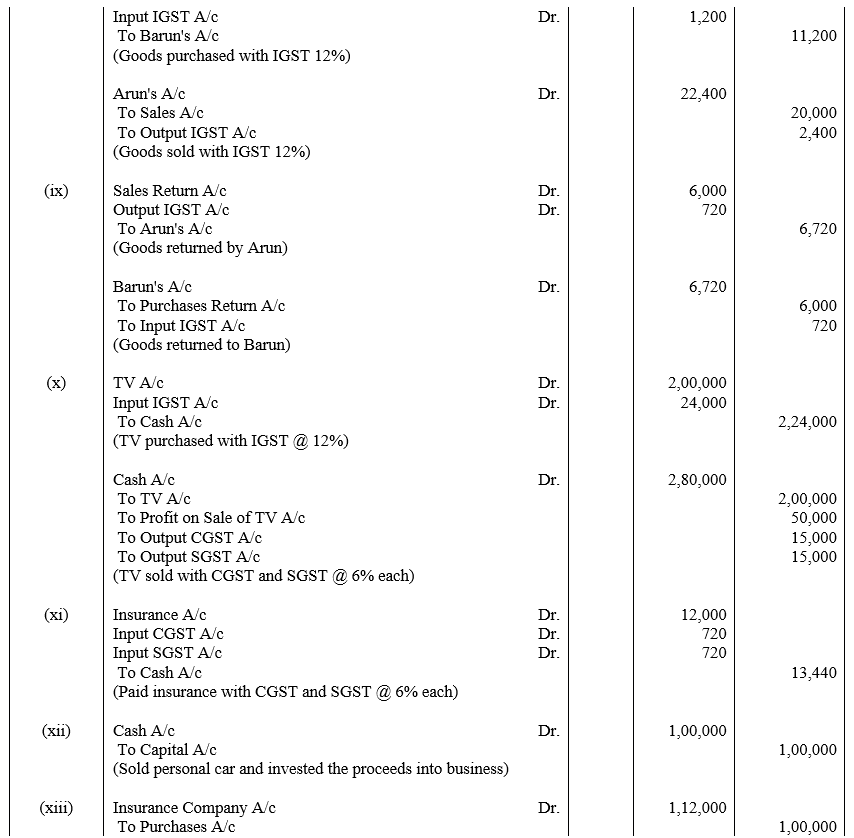
(viii) Purchased goods from Barun of Chandigarh of ₹ 10,000 plus IGST @ 12% and sold them to Arun of Shimla (HP) at ₹ 22,400, including IGST @ 12%.
(ix) Arun returned goods of ₹ 6,720, including IGST which were returned to Barun.
(x) ABC & Co. purchased 10 TV sets @ 20,000 per set and paid IGST @ 12%. It sold all the sets @ 25,000 per set plus CGST and SGST @ 6% each.
(xi) Paid insurance of ₹ 12,000 plus CGST and SGST @ 6% each for a period of one year.
(xii) Sold personal car for ₹ 1,00,000 and invested the amount in the firm.
(xiii) Goods costing ₹ 1,00,000 were destroyed in fire. Insurance company admitted the claim for ₹ 75,000. These goods were purchased within Delhi.
(xiv) Purchased machinery for ₹ 56,000 including IGST of ₹ 6,000 and paid cartage thereon ₹ 5,000 and installation charges ₹10,000.
(xv) Goods costing ₹ 40,000 sold to Mr. X at a profit of 20% on sales less 10% Trade Discount plus CGST and SGST @ 6% each and received a cheque under 2% cash discount.
(xvi) Purchased machinery from New Machinery House for ₹ 50,000 and paid it by means of a bank draft purchased from bank. Paid charges ₹ 500.
Solution:
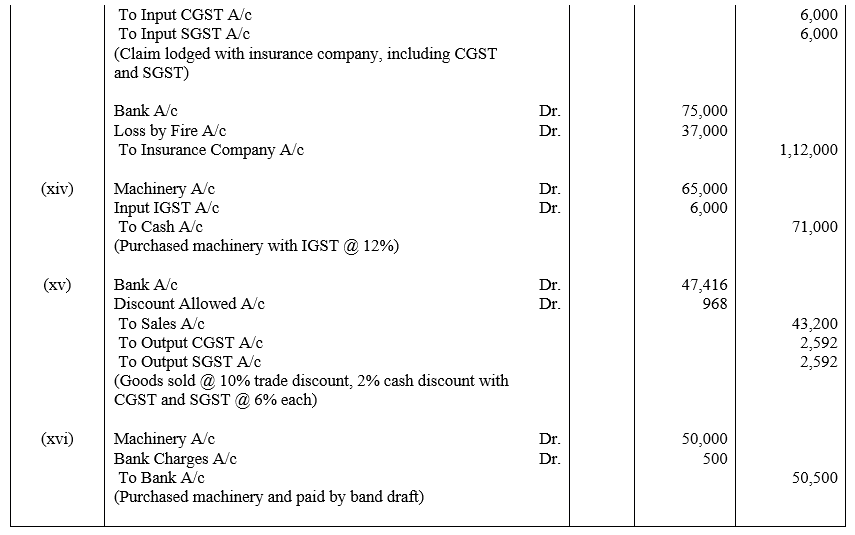
TS Grewal Accountancy Class 11 Solutions Chapter 5 Journal image - 64
TS Grewal Accountancy Class 11 Solutions Chapter 5 Journal image - 65
TS Grewal Accountancy Class 11 Solutions Chapter 5 Journal image - 66

TS Grewal Accountancy Class 11 Solutions Chapter 5 Journal

Question 32.
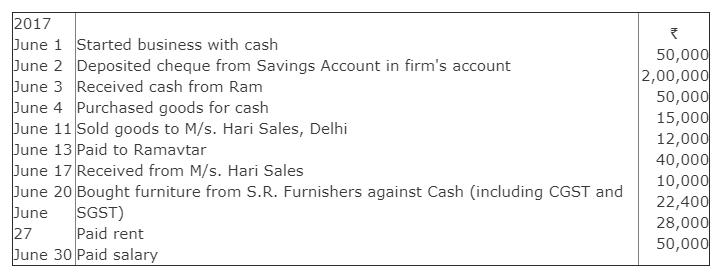
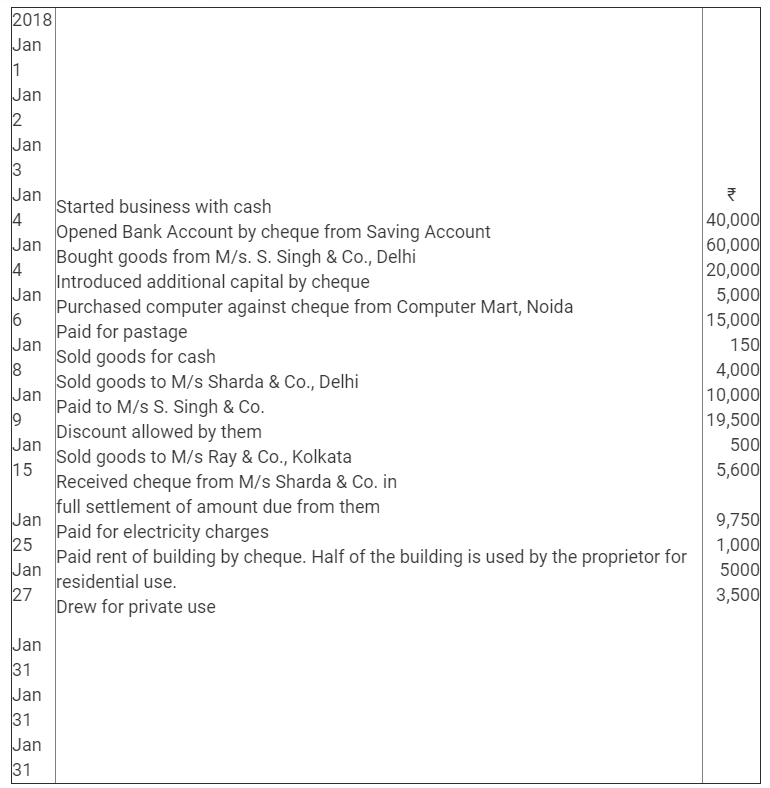
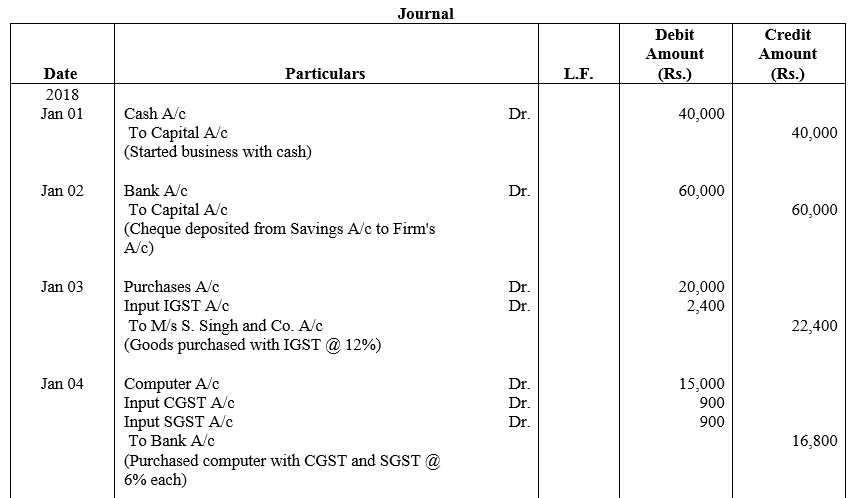
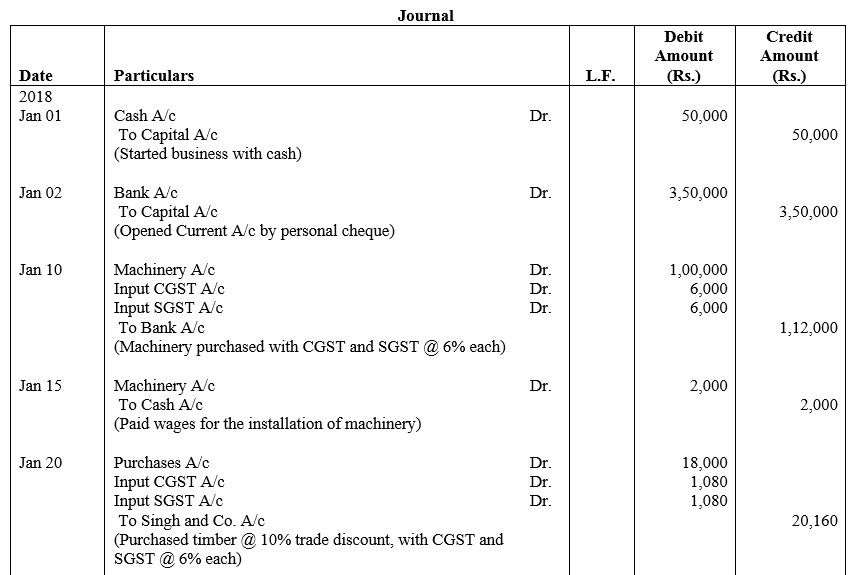
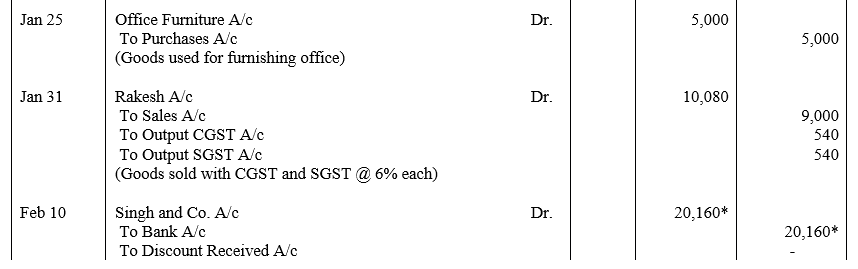
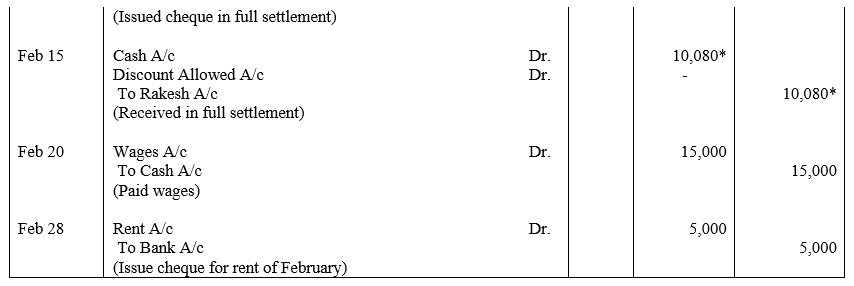
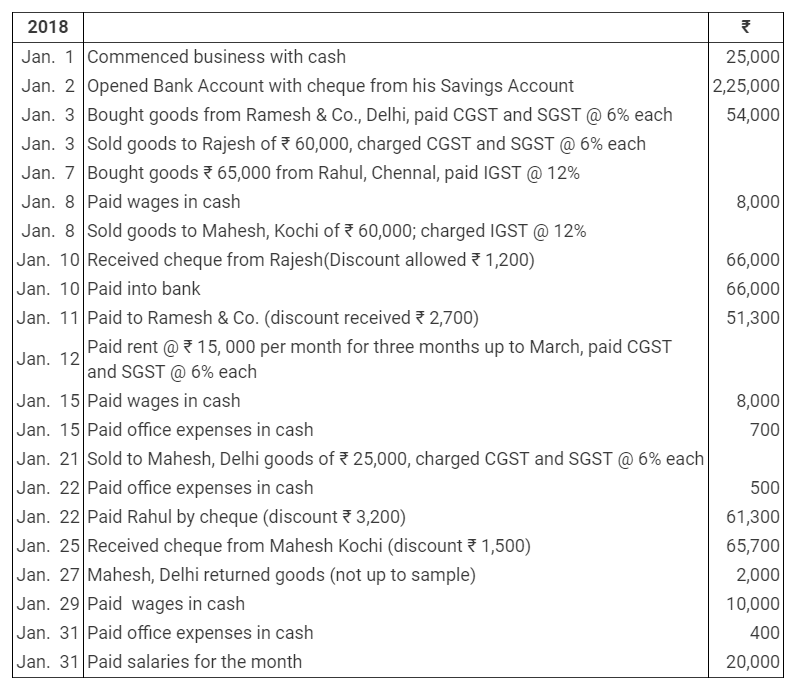
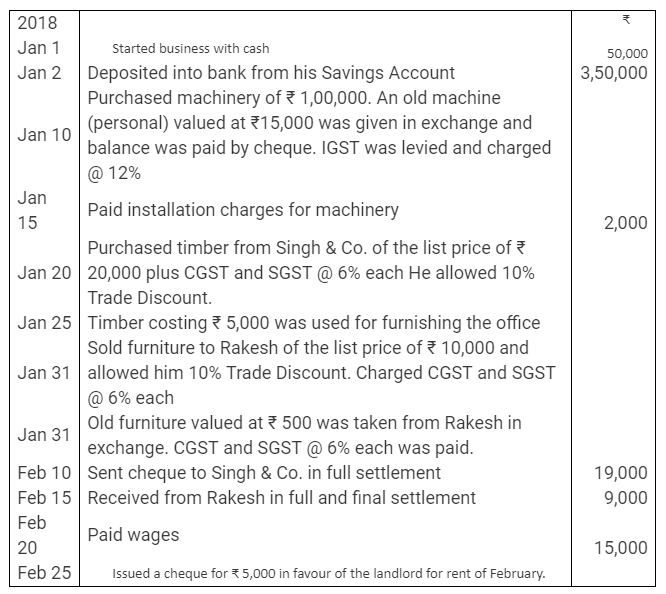
D.Chadha commenced business on 1st January, 2017. His transactions for the month are given below. Journalise them.
TS Grewal Accountancy Class 11 Solutions Chapter 5 Journal image - 67
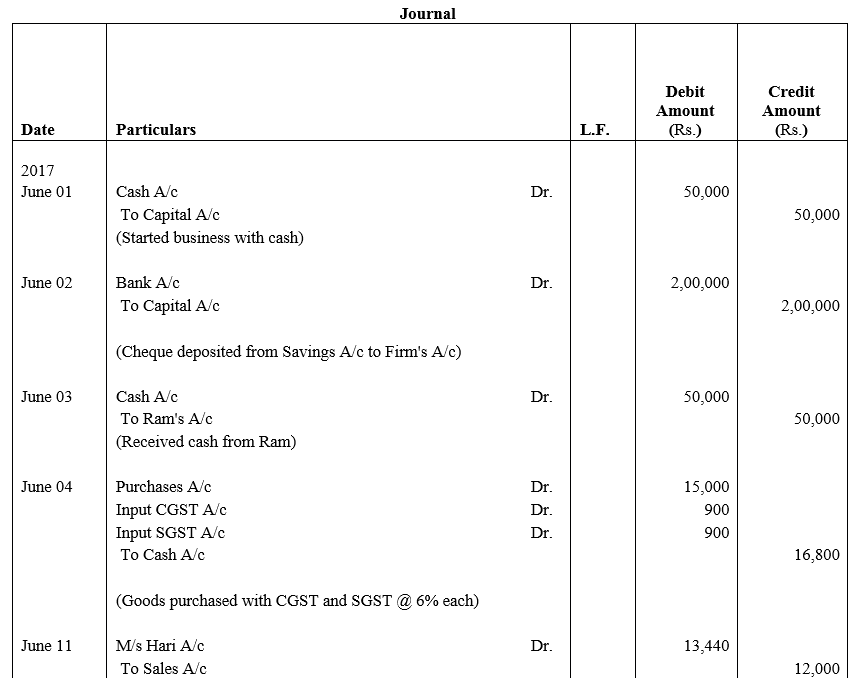
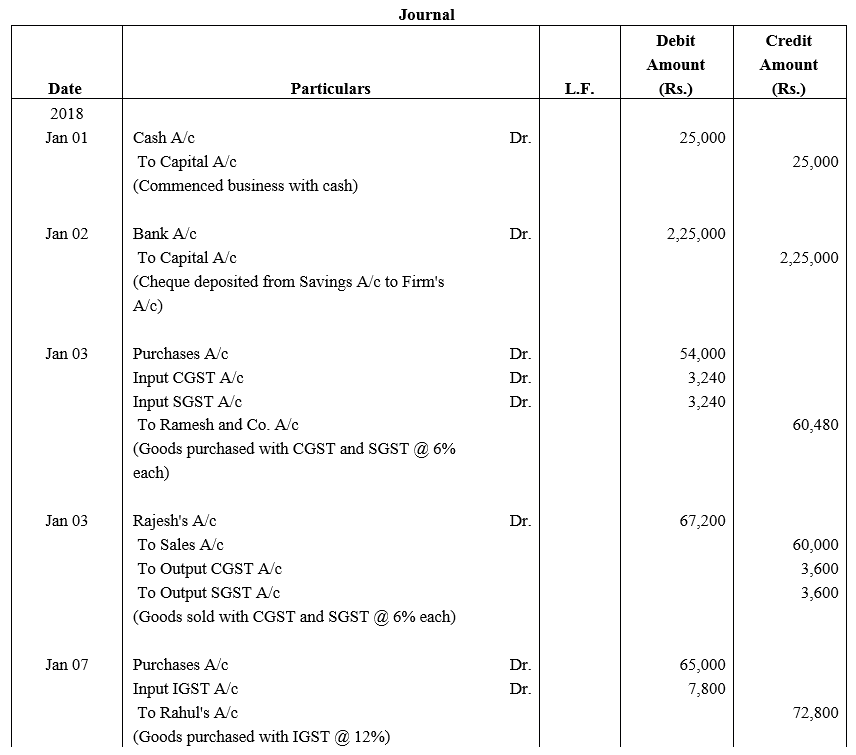
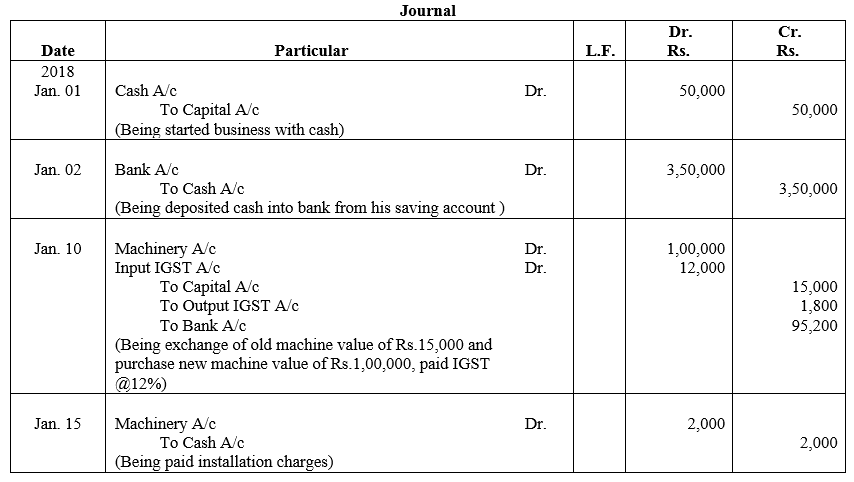
Solution:
TS Grewal Accountancy Class 11 Solutions Chapter 5 Journal image - 68
TS Grewal Accountancy Class 11 Solutions Chapter 5 Journal image - 69
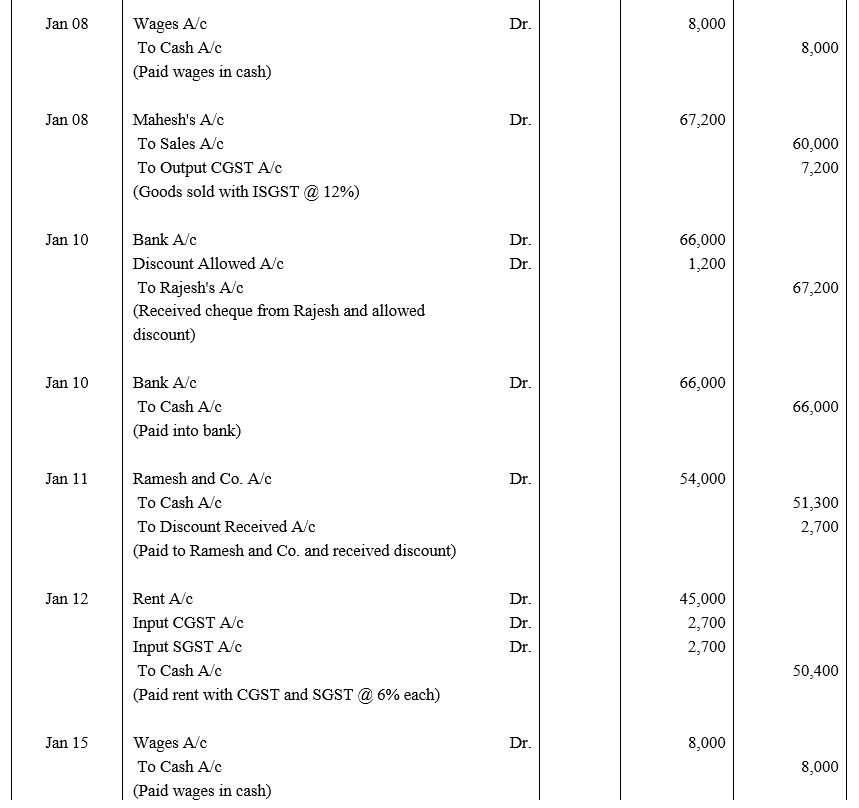
TS Grewal Accountancy Class 11 Solutions Chapter 5 Journal image - 70
TS Grewal Accountancy Class 11 Solutions Chapter 5 Journal image - 71

TS Grewal Accountancy Class 11 Solutions Chapter 5 Journal

Question 33.
Record the following transactions in the Journal of Ashoka Furniture Traders:
TS Grewal Accountancy Class 11 Solutions Chapter 5 Journal image - 72
Solution:
TS Grewal Accountancy Class 11 Solutions Chapter 5 Journal image - 73
TS Grewal Accountancy Class 11 Solutions Chapter 5 Journal image - 74

TS Grewal Accountancy Class 11 Solutions Chapter 5 Journal

Question 34.
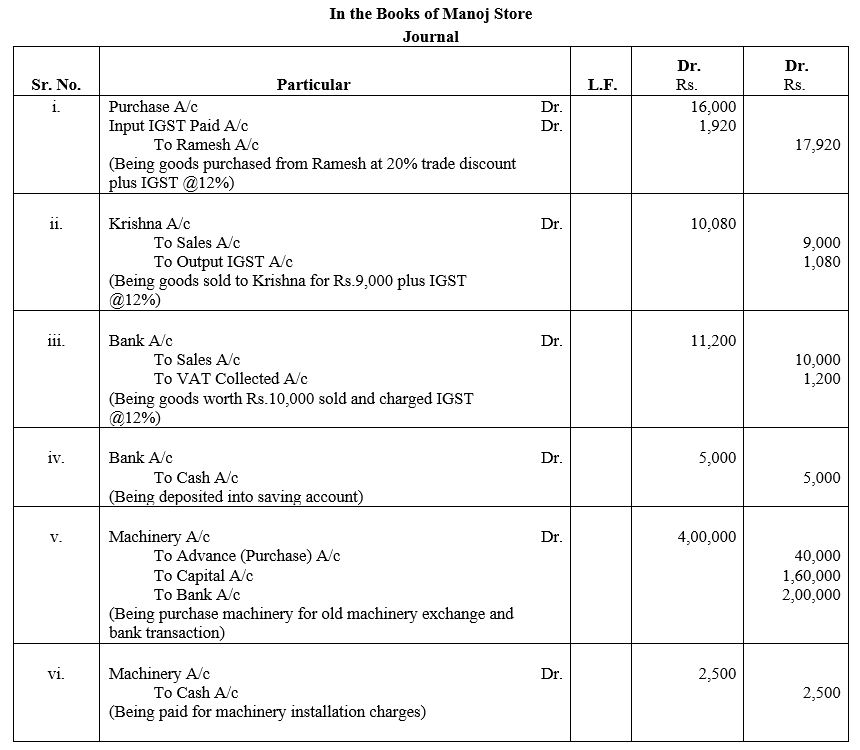
Journalise the following transactions in the books of Manoj Store:
(i) Purchased goods from Ramesh ₹ 20,000 less Trade Discount at 20% plus IGST @ 12%.
(ii) Sold goods costing ₹ 7,000 to Krishna for ₹ 9,000 plus IGST @ 12%.
(iii) Sold goods for ₹ 10,000 and charged IGST @ 12% against cheque.
(iv) ₹ 5,000 were deposited into Saving Account.
(v) Machinery costing ₹ 4,00,000 for which order was placed earlier paying advance of ₹ 40,000. The balance payment was paid as follows:
(a) An old machine (personal) valued at ₹ 30,000 was given in exchange;
(b) Issued a cheque from his savings account for ₹ 1,30,000; and
(c) Balance by issue cheque from firm’s bank account.
(vi) Paid in cash wages ₹ 2,500 for installation of machine.
Solution:
TS Grewal Accountancy Class 11 Solutions Chapter 5 Journal image - 75
Note: An old personal machinery in exchange of Rs.30,000 and bank transaction of Rs.1,30,000 from Saving account will increasing the Capital account of proprietor.

TS Grewal Accountancy Class 11 Solutions Chapter 5 Journal

Question 35.
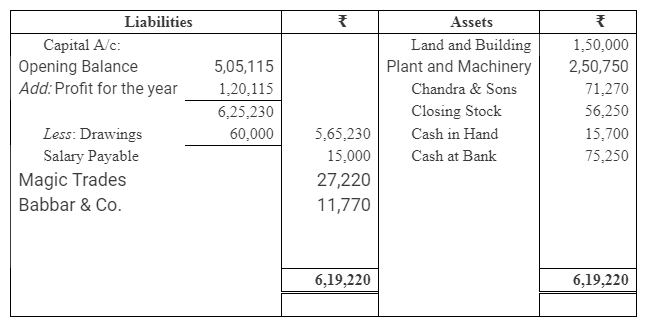
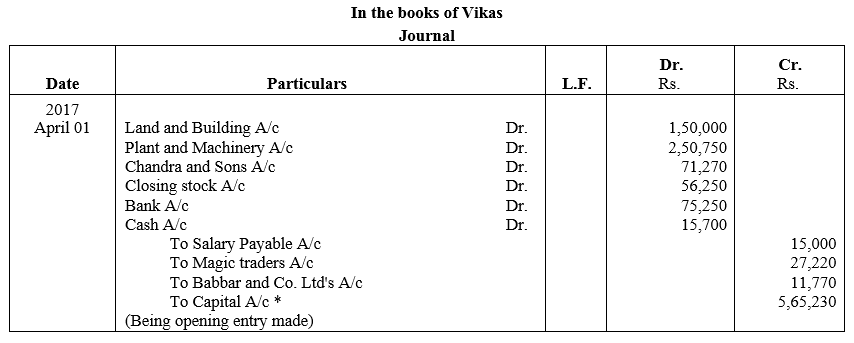
Pass the Opening Entry from the following Balance Sheet as at 31st March, 2018 of Vikas:
TS Grewal Accountancy Class 11 Solutions Chapter 5 Journal image - 76
Solution:
TS Grewal Accountancy Class 11 Solutions Chapter 5 Journal image - 77
* Capital Account is tally amount of Balancing Figure.

We hope the TS Grewal Accountancy Class 11 Solutions Chapter 5 Journal help you. If you have any query regarding TS Grewal Accountancy Class 11 Solutions Chapter 5 Journal, drop a comment below and we will get back to you at the earliest.

Read More:

SUNPHARMA Pivot Point Calculator

NCERT Economics Books for Class 9, 10, 11, 12 PDF Free Download

Here we are providing Free NCERT Economics Books for class 9th to 12th PDF Download. All books are in PDF Format. Say “No to EPUB Format”. Just one click PDF Download.

Download Latest (2023-24) Edition – NCERT Economics Books for class 9, 10, 11, 12 PDF (English)

Class Book Name Download Link
9 Economics PDF Download
10 Understanding Economic Development PDF Download
11 India Economic Development PDF Download
12 Introductory Microeconomics PDF Download
12 Introductory Macroeconomics PDF Download

NCERT Solutions for class 12 Economics PDF

Download Latest (2023-24) Edition – NCERT Economics Books for class 9, 10, 11, 12 PDF (Hindi)

Class  Book Name Download Link
9 Arthashastra PDF Download
10 Arthik Vikas ki Samajh PDF Download
11 Bhartiya Airthyavstha Ka Vikas PDF Download
12 Vyashthi Arthshasrta PDF Download
12 Samashty Arthshastra Ek Parichay PDF Download

NCERT textbooks hold an irreplaceable place when we talk about education in school. National Council of Education Research and Training holds the responsibility for delivering and publishing NCERT books for classes 1 to 12 for all CBSE schools. In fact, all the board exams, as well as prestigious competitive exams, follow NCERT books only. There follows a significant drift when students move to class 9.

Now the pressure gets build up as the board’s classes are approaching i.e. 10 and 12. You need to be extra attentive in class when you study your subjects. You have to mug up all the NCERT textbooks line by line and understand the concepts so as to excel in Board examination.

Coming over to Economics, the NCERT books evenly cover each and every topic of economics in a well-planned manner. Gone are the days when students used to carry those heavy books and read from papers. Now it’s time to move along the technology and opt for an efficient and affordable approach.

There are many websites floating over the internet which facilitate NCERT economics books download in a speedier and effective manner.

Things to consider before making any NCERT book download

EBooks are loved and enjoyed by everyone. We all have laptops and Smartphones, one can easily download the eBooks and can study from their anytime that too for free. There are certain things which you should care about when you plan to download NCERT economics book.

  1. Avoid downloading in EPUB format. These formats are not supported by many mobiles.
  2. Always look for the PDF versions. PDF can be easily downloaded as well as can be viewed online and offline.
  3. Whenever you plan to download, always download the latest version. There are many websites which will offer outdated and old books.
  4. Avoid downloading from suspicious websites. Many users end up in downloading viruses and Trojans instead of books. Download only from trusted websites.
  5. If you feel that, you are getting redirected from the download links, immediately stop the window.
  6. If any website is asking for paid download, leave the website immediately. Opt for a free download option.

With few above-mentioned precautions, you can avail and enjoy the power of the internet.

Importance of Economics NCERT textbooks

Economics is basically a study of resource allocation predominantly a scarce resource to businesses, societies, households, and individuals. Economics uses behavioural models in order to predict responses to changes in market conditions and policy which uses rigorous statistical analysis to investigate these changes.

Not only in school but when you prepared economics for your UPSC preparation, these NCERT books are a must and recommended by professionals.

Where can I download Economics NCERT textbooks for classes 9 to 12?

NCERTbooks.guru is one single website which offers a single click download for all NCERT economics books for classes 9 to 12 in PDF format and that too for free. We offer no redirection and just user-friendly interface. Download your copy NOW!!

If none of the links works, feel free to comment below. We will try to fix that asap.

The studies in NCERT textbooks for classes will help you to understand economics well. Along with that, you will able to get an idea in marketing websites like nifty pivot point calculator.

Must Read:

GODREJCP Pivot Point Calculator

Indigo Class 12 MCQ Questions with Answers English Chapter 5

MCQ Questions for Class 12 English Flamingo Chapter 5 Indigo with Answers

Refer more: INDIGO pivots calculator

Question 1.
Health conditions in Champaran
(a) miserable
(b) tolerable
(c) under control
(d) fairly good

Answer

Answer: (a) miserable


Question 2.
Who volunteered to work in Champaran?
(a) two disciples of Gandhi and their wives
(b) Kasturba and the eldest son of Gandhi
(c) Mahadev Desai and his wife
(d) Narhari Prasad and his wife

Answer

Answer: (a) two disciples of Gandhi and their wives


Question 3.
The representative of the planters offered to refund—– percent to the peasants
(a) 5
(b) 10
(c) 20
(d) 25

Answer

Answer: (d) 25


Question 4.
For how long did Gandhi remain in Champaran?
(a) seven weeks
(b) three months
(c) one and a half year
(d) seven months

Answer

Answer: (d) seven months


Question 5.
What amount of repayment did the big planters think Gandhi would demand?
(a) repayment in full
(b) double the amount
(c) fifty percent of the amount
(d) no payment, just an apology

Answer

Answer: (a) repayment in full


Question 6.
Gandhi was summoned by ___ the Lt. Governor
(a) Sir Edward Gait
(b) Sir Henry Gait
(c) Sir Richard Andrews
(d) Sir Freer Andrews

Answer

Answer: (a) Sir Edward Gait


Question 7.
Who were ready to follow Gandhi into jail?
(a) peasants
(b) lawyers
(c) Shukla
(d) J.B. Kriplani

Answer

Answer: (b) lawyers


Question 8.
The magistrate asked Gandhi to furnish bail for __ minutes
(a) 30
(b) 60
(c) 90
(d) 120

Answer

Answer: (d) 120


Question 9.
How did Gandhi behave with the officials outside the court?
(a) demonstrated his power
(b) was firm and resolute
(c) he said that he would disobey the order
(d) cooperated with them

Answer

Answer: (d) cooperated with them


Question 10.
Why did Gandhi start out on the back of an elephant?
(a) a peasant had been maltreated in a village nearby
(b) he set out to meet the secretary of British Landlords Association
(c) he set out to meet British official commissioner
(d) he was summoned by Sir Edward Gait, the Lt. Governor

Answer

Answer: (a) a peasant had been maltreated in a village nearby


Question 11.
After Tirhut, where did Gandhi go?
(a) Lucknow
(b) Motihari
(c) Cawnpore
(d) Ahmedabad

Answer

Answer: (b) Motihari


Question 12.
What happened when Gandhi visited the secretary of British landlord’s association?
(a) the secretary proceeded to bully him
(b) the secretary advised him forthwith to leave Tirhut
(c) the secretary said that they could not give any information to an outsider
(d) the secretary was very helpful

Answer

Answer: (c) the secretary said that they could not give any information to an outsider


Question 13.
Why was Gandhi not permitted to draw water from Rajendra Prasad’s well?
(a) the servant thought Gandhi was another peasant
(b) as Rajendra Prasad was not at home
(c) Gandhi looked like a vagabond
(d) Gandhi was a Harijan

Answer

Answer: (a) the servant thought Gandhi was another peasant


Question 14.
Where is Champaran district situated?
(a) in the south-west of Orissa
(b) in the foothills of the Himalayas in Bihar
(c) in the northeast of Orissa
(d) in the south of Bihar

Answer

Answer: (b) in the foothills of the Himalayas in Bihar


Question 15.
What did the British landlords and from the peasants after synthetic indigo was developed?
(a) indigo as rent
(b) 15% of produce
(c) money as compensation
(d) a new settlement

Answer

Answer: (c) money as compensation


Question 16.
What were the places visited by Gandhi between his first meeting with Shukla and his arrival at Champaran?
(a) Cawnpore, Ahmedabad, Calcutta, Patna, Muzaffarpur
(b) Calcutta, Patna, Gaya, Muzaffarnagar
(c) Cawnpore, Ahmedabad, Gaya, Calcutta, Patna, Muzaffarpur
(d) Cawnpore, Ahmedabad, Patna and Muzaffarnagar

Answer

Answer: (a) Cawnpore, Ahmedabad, Calcutta, Patna, Muzaffarpur


Question 17.
Who received Gandhi at the Muzaffarpur station?
(a) Shukla
(b) J.B Kriplani
(c) Rajendra Prasad
(d) Nehru

Answer

Answer: (b) J.B Kriplani


Question 18.
Shukla led Gandhi to the house of a lawyer who later became the President of India. He was
(a) J.B Kriplani
(b) Rajendra Prasad
(c) Zakir Hussain
(d) Mahadev Desai

Answer

Answer: (b) Rajendra Prasad


Question 19.
What was the full name of the peasant from Champaran?
(a) J.B Shukla
(b) Rajkumar Shukla
(c) Ramkumar Shukla
(d) Roopkumar Shukla

Answer

Answer: (b) Rajkumar Shukla


Question 20.
When did Gandhiji go to Lucknow?
(a) December 1917
(b) October 1916
(c) February 1917
(d) December 1916

Answer

Answer: (d) December 1916


Question 21.
Where did Gandhiji stay for two days?
(a) At a peasant’s house
(b) At a lawyer’s house
(c) In a guest house
(d) At Prof. Malkani’s house

Answer

Answer: (d) At Prof. Malkani’s house


Question 22.
What was the condition of the peasants in Champaran?
(a) Very happy
(b) Independent
(c) Very rich
(d) Terror stricken and oppressed

Answer

Answer: (d) Terror stricken and oppressed


Question 23.
What was the attitude of the average Indian in smaller localities towards advocates of home rule?
(a) Very welcoming
(b) Very courageous
(c) Pleasing
(d) Very fearful and indifferent

Answer

Answer: (d) Very fearful and indifferent


Question 24.
Why did Gandhi consider the Champaran episode a turning point?
(a) Its voice spread far and wide
(b) It became famous
(c) The British were scared
(d) To protest the courts’ order to postpone the trial

Answer

Answer: (a) Its voice spread far and wide


Question 25.
What was the statement that Gandhiji read pleading himself guilty?
(a) That he was a law breaker
(b) That he wanted to command respect
(c) He was not a law breaker and came to render humanitarian and national service
(d) None

Answer

Answer: (c) He was not a law breaker and came to render humanitarian and national service


Question 26.
Who was Sir Edmund in the lesson Indigo?
(a) A British lawyer
(b) A british Businessman
(c) A British Politician
(d) An Administrator in Indian Civil Services

Answer

Answer: (d) An Administrator in Indian Civil Services


Question 27.
Why did the British want the peasant to pay compensation?
(a) Because they freed them
(b) Because they got orders from the British headquarters
(c) Because they were leaving India
(d) They gave 15% of landholding and entire Indigo harvest

Answer

Answer: (d) They gave 15% of landholding and entire Indigo harvest


Question 28.
Where was Champaran?
(a) In Lucknow
(b) In Delhi
(c) In Uttar Pradesh
(d) A district of Bihar in British India

Answer

Answer: (d) A district of Bihar in British India


Question 29.
Why is Champaran famous?
(a) For fighting
(b) For Indigo
(c) Because Gandhiji visited
(d) For the first Satyagrah movement in 1917

Answer

Answer: (d) For the first Satyagrah movement in 1917


Question 30.
Why did Raj Kumar Shukla come to Lucknow at Annual Congress party session?
(a) To be rich
(b) To be famous
(c) To fight and get money
(d) To complain against injustice of landlord system in Bihar

Answer

Answer: (d) To complain against injustice of landlord system in Bihar


Question 31.
Who was Raj Kumar Shukla?
(a) A lawyer
(b) A government official
(c) A politician
(d) A poor peasant

Answer

Answer: (d) A poor peasant


Question 32.
Why did Gandhiji decide to go to Muzaffarpur?
(a) To have detailed information of the sharecroppers of Champaran
(b) To have information about lawyers
(c) To know different capacities of the people
(d) To have a personal bond with the people

Answer

Answer: (a) To have detailed information of the sharecroppers of Champaran


Question 33.
How did Gandhiji help peasants of Champaran?
(a) By fighting and securing justice for them
(b) By hiring lawyers for them
(c) By educating them
(d) By teaching them cleanliness

Answer

Answer: (a) By fighting and securing justice for them


Question 34.
How much did Indigo planters offer to pay?
(a) 30%
(b) 10%
(c) 25%
(d) 40%

Answer

Answer: (c) 25%


Question 35.
What was Gandhiji’s demand from the British landlords?
(a) 30% refund as repayment
(b) 40% refund as repayment
(c) 50% refund as repayment
(d) 10% refund as repayment

Answer

Answer: (c) 50% refund as repayment


Question 36.
Why was Motihari back with peasants?
(a) Because of people’s rights
(b) Because of the oppression of the British
(c) Because their champion was in trouble
(d) None

Answer

Answer: (c) Because their champion was in trouble


Question 37.
Why did M.K. Gandhi fight in Champaran?
(a) To secure justice for the oppressed
(b) To get popularity
(c) To show power
(d) To boast of his intelligence

Answer

Answer: (a) To secure justice for the oppressed


Question 38.
Indigo is an excerpt from which book of the author?
(a) Men and Politics
(b) Life of Lenin
(c) The Life of Mahatma Gandhi.
(d) None

Answer

Answer: (c) The Life of Mahatma Gandhi.

Question 39.
When did the author serve in the British army?
(a) 1918 – 1920
(b) 1909 – 1910
(c) 1912-1913
(d) 1900-1902

Answer

Answer: (a) 1918 – 1920


Question 40.
Who is the author of Indigo?
(a) Louis Fischer
(b) Leo Tolstoy
(c) Mark Twain
(d) Charles Dickens

Answer

Answer: (a) Louis Fischer


Question 41.
Why was the government baffled?
(a) Because of lawyer’s power
(b) Because of farmers
(c) Because of sharecroppers
(d) Because of the success of Satyagrah movement by peasants

Answer

Answer: (d) Because of the success of Satyagrah movement by peasants


Question 42.
Whom did Gandhiji send a telegram to ?
(a) Sir Edmund
(b) British Government
(c) Peasants
(d) Prof. J.B Kriplani

Answer

Answer: (d) Prof. J.B Kriplani


Question 43.
What was the purpose of the advocates of home rule?
(a) To get money
(b) To be popular
(c) To instigate the people
(d) To encourage people to participate in the freedom movement

Answer

Answer: (d) To encourage people to participate in the freedom movement


Question 44.
How did Kasturba help Gandhiji?
(a) By speaking to the people
(b) By walking with him
(c) By moving here and there
(d) By teaching Ashram rules and cleanliness

Answer

Answer: (d) By teaching Ashram rules and cleanliness


Question 45.
Why did Gandhiji protest at Motihari court house?
(a) To be famous
(b) To show his power
(c) To humiliate the British
(d) To protest the court’s order to postpone the trial

Answer

Answer: (d) To protest the court’s order to postpone the trial


NCERT Solutions for Class 11 English Hornbill Chapter 3 Discovering Tut: The Saga Continues

Class 11 English Chapter 3 NCERT Solutions Discovering Tut: The Saga Continues Free PDF Download

NCERT Solutions for Class 11 English

Question 1.
forensic reconstruction
Answer:
It refers to rebuilding the facts about life and death by putting back together the evidence to examine a crime scientifically. The reconstruction of King Tut’s mummy was done to find solutions to the mysteries surrounding his death.

Question 2.
funerary treasures
Answer:
It refers to the valuables and treasures which were buried along with the pharaoh in the pyramid.

Question 3.
scudded across
Answer:
It refers to moving swiftly from one place to another. It is used in the chapter to describe the movement of the dark-bellied clouds. ‘

Question 4.
casket grey
Answer:
It refers to ash coloured clouds that hid the stars.

Question 5.
resurrection
Answer:
It refers to rebirth or revival after death.

Question 6.
circumvented
Answer:
Outsmarted or outwitted. The thieves would have easily bypassed the guards with artfulness and ripped the mummy apart to remove the gold.

Question 7.
computed tomography
Answer:
It refers to CT scan that provides the X-ray image of a body in cross section. It is used for diagnostic purposes.

Question 8.
eerie detail
Answer:
It refers to detail relating to the supernatural.

Discovering Tut: The Saga Continues Understanding The Text

Question 1.
Give reasons for the following
(i) King Tut’s body has been subjected to repeated scrutiny.
Answer:
King Tut’s body has been subjected to repeated ‘ scrutiny because, right from the time of the
discovery of his tomb in 1922 by Howard Carter, the modern world has been curious to find out what
happened to King Tut. He died unexpectedly. No one knows how the boy king lived and died. His death has been obscured in mystery, with murder being the most extreme possibility.

(ii) Howard Carter’s investigation was resented.
Answer:
Howard Carter’s investigation was resented because he destroyed the original state of the mummy. His men cut off the mummy’s head and severed every major joint of the body to raise King Tut from the coffin.
They then reassembled the remains on a layer of sand in a wooden box and put the body back. Moreover, Howard Carter did not use scientific methods while excavating King Tut’s mummy.
It resulted in great damage to the mummy.

(iii) Howard Carter had to chisel away the solidified resins to raise the King’s remains.
Answer:
Howard Carter had to chisel away the solidified resins to raise the King’s remains because the ritual resins had hardened, cementing King Tut to the bottom of his solid gold coffin permanently.

(iv) King Tut’s body was buried along with gilded treasures.
Answer:
King Tut’s body was buried along with gilded treasures because in that time the king was very wealthy and people thought and hoped that they could take their riches with them in their journey after death.

Hence, King Tut was buried with all the things that he used in his daily life and the things that he would need in the afterlife.

(v) The boy king changed his name from Tutankhaten to Tutankhamun.
Answer:
The boy changed his name from Tutankhaten to Tutankhamun because he wanted the restoration of the old ways. His ancestor, Amenhotep IV, had shocked the country by attacking a major God ‘Amun’. It was a time of unrest. The boy tried to establish the old faith by renaming himself as Tutankhamun which means ‘living image of Amun’.

Question 2.
(i) List the deeds that led Ray Johnson to describe Akhenaten as ‘Wacky’.
Answer:
Ray Johnson described Akhenaten as ‘wacky’ because what he did was nothing less than crazy in those times. He promoted the worship of Aten, the sun disk, changed his own name and moved the religious capital from the old city of Thebes to the new city of Akhetaten, now known as Amama. He further shocked the country by attacking a major God ‘Amun’, by smashing his images and closing his temples.
His reign was a horrible time.

(ii) What were the results of the CT scan?
Answer:
King Tut’s mummy was the first one that was being scanned. The CT machine scanned the mummy from head to toe and created 1700 digital X-ray images in cross-section. King Tut’s head was scanned in 0.62 mm slices to register its complicated structures to probe the secrets of his death. Though there were some hurdles in the scan, it went as expected.

The CT scan showed King Tut’s neck vertebrae as clearly as in an anatomy class. Other images revealed a hand, several views of the rib cage and a transection of the skull that showed there was nothing unnatural in his death.

(iii) List the advances in technology that have improved forensic analysis.
Answer:
Advances in technology have improved forensic analysis significantly. Today, diagnostic imaging can be done by Computed Tomography or CT.

In CT, hundreds of X-rays in cross-section are put together like slices of bread to create a three-dimensional virtual picture of the body. The scanners can scan even an intricate structure by scanning it in thin slices.

(iv) Explain the statement, “King Tut is one of the first mummies to be scanned – in death, as in life…”
Answer:
King Tut was the last ruler of a powerful family that had ruled Egypt for centuries. He came to the throne when he was not even a teenager. At a very young age he contributed tremendously in restoring the past glory and old ways. However, he met a very early death in mysterious circumstances when he was just 18 years old.

Since the discovery of his tomb in 1922, the modem world has speculated a lot about him. His mummy was the first one to undergo a CT scan! Hence, in life as in death, he has been the attention of all.

Discovering Tut: The Saga Continues Talking About The Text

Discuss the following in groups of two pairs, each pair in a group taking opposite points of view.

Question 1.
Scientific intervention is necessary to unearth buried mysteries.
Answer:
For If you think history has any relevance in our life, we must get at the truth. There are so many mysteries which remain unsolved. For example, we know very little about the Indus Valley Civilisation. The seals remain undeciphered. This needs scientific investigation. Without scientific intervention, their meaning will remain unknown.

Against We need to know the past because history is relevant to our lives. But sometimes we take it too far. King Tut’s mummy has been repeatedly investigated, but in spite of spending much money, nothing new has been revealed about why King Tut died so young. We must utilise our resources to help the living rather than just investigating the dead.

Question 2.
Advanced technology gives us conclusive evidence of past events.
Answer:
For Today technology is so advanced that we can reconstruct the past. For example, we know how Pompeii was destroyed. So now we have reconstructed the whole city. We know precisely how the people lived.

Against It is incorrect that advanced technology gives us conclusive evidence of past events. King Tut’s body has been CT-scanned. What can it tell us about how he died? If he was murdered, who murdered him and why? A CT scan might give some idea how he died, but it cannot give conclusive evidence.

Question 3.
Traditions, rituals and funerary practices must be respected.
Answer:
For People who buried their dead with rituals and funerary practices did show reverence for their dead. They wanted them to lie in peace, undisturbed. We must respect their sentiments.

Against Traditions, customs and funerary practices of the past may encourage superstition. They may also hamper the development of society and affect unity. In fact, they could lead to violence and friction between people belonging to different cultures.

Question 4.
Knowledge about the past is useful to complete our knowledge of the world we live in.
Answer:
For The past acts as a mirror to our mistakes and teaches us many lessons. In fact, the present is the outcome of the past. It helps us understand the progress of the events down the ages. It builds a good foundation for our present and future.

Against We must live in the present. The past is infinite and should be left as it is. The past should not affect our present life. It should not be searched again and again; it must be considered as a phase which has passed.

Discovering Tut: The Saga Continues Thinking About Language

Read the following piece of information from the Encyclopaedia of Language by David Crystal.

Egyptian is now extinct:
its history dates from before the third millennium BC, preserved in many hieroglyphic inscriptions and papyrus manuscripts. Around the second century AD, it developed into a language known as Coptic. Coptic may still have been used as late as the early nineteenth century and is still used as a religious language by Monophysite Christians in Egypt.

Question 1.
What do you think are the reasons for the extinction of languages?
Answer:
Some of the reasons for the extinction of languages are
(a) Migration of people to other lands.
(b) Limitation of vocabulary.
(c) Absence of written script along with prevalence of oral tradition.
(d) Globalisation, as it has led to the use of only dominant languages.
(e) Social status of a language.
(f) Introduction of a non-indigeneous language that takes over all social functions.
(g) Constant changes in the society.
(h) Parents do not pass on a language to their children.

Question 2.
Do you think it is important to preserve languages?
Answer:
Yes, it is important to preserve languages as they are responsible for development of the culture of the community. It helps in preservation of one’s heritage and traditions. The loss of any language is a loss for all humanity. Our language defines our identity. One can differentiate even between the people speaking the same language by their dialect or the way they talk. A language represents a whole cultural history. ‘Linguistic diversity’ is a benchmark of cultural diversity. Language is a cultural resource and it should be handed down by parents to their children.

Question 3.
In what ways do you think we could help prevent the extinction of languages and d\a\ec£s?
Answer:
We could help prevent the extinction of languages and dialects by
(a) Transferring the vocabulary and dialects of the language to the next generation.
(b) Documenting the language and preserving information about native literature and linguistics of the language.
(c) Encouraging younger generations to speak the language as they grow.
(d) New technologies such as ‘podcasts’ can be used to . preserve the spoken versions of languages.
(e) Teaching the languages in college and universities and encouraging students to specialise in the same.

Discovering Tut: The Saga Continues Working With Words

Question 1.
Given below are some interesting combinations of words. Explain why they have been used together.
(i) ghostly dust devils
(ii) desert sky
(iii) stunning artefacts
(iv) funerary treasures
(v) scientific detachment
(vi) dark-bellied clouds
(vii) casket grey
(viii) eternal brilliance
(ix) ritual resins
(x) virtual body
Answer:
1. ghostly dust devils It refers to the evil or frightful movements of dusty winds. It reflects the anger of the winds for disturbing the king from his resting place.

2. desert sky It refers to the lifeless and barren sky of the desert. The barren sky spread over the vast desert region portrays a sad picture.

3. stunning artefacts It refers to breathtakingly beautiful objects made by humans. Using the words together explains the external brilliance of the objects found in the tomb.

4. funerary treasures Jewels or precious objects relating to a funeral. It refers to the fact that the king was buried with numerous treasures and items made of pure gold.

5. scientific detachment It refers to the application of reasoning and science without attaching any emotion or feeling into the action taken. The archaeologist Carter did not have any reverence or feeling for King Tut. He was just a scientist without any emotional attachment to King Tut.

6. dark-bellied clouds It refers to the dark, bulging clouds containing rain.

7. casket grey It refers to the grey coloured clouds that hide the stars like placing them in a casket.

8. external brilliance It refers to the endless lustre/ radiance and brightness of the jewels and valuables of the king which is visible externally.

9. ritual resins It refers to resins used as a customary duty in the process of mummifying a body in Egypt at that time.

10. virtual body A figure of the body created through electronic images or CT scan. It resembles a real body and provides a very clear view.

Question 2.
Here are some commonly used medical terms. Find out their meanings.

CT scan MRI tomography
autopsy dialysis ECG
post mortem angiography biopsy

Answer:
CT Scan A CT scan makes use of computer-processed combinations of many X-ray images taken from different angles to produce cross-sectional (tomography) images (virtual ‘slices’) of specific areas of a scanned object, allowing the user to see inside the object without cutting.

MRI Magnetic Resonance Imaging (MRI) is a diagnostic technique that uses magnetic fields and radio waves to produce a detailed image of the body’s soft tissue and bones.

Tomography A method of producing a three – dimensional image of the internal structures of a solid object (like the human body) by the observation and recording of the differences in the effects on the passage of waves of energy hitting those structures.

Autopsy An examination of a body after death to determine the cause of death or the character and extent of changes produced by disease.

Dialysis The purification of blood by separating the waste products from it to replace the normal function of kidneys.

ECG An electrocardiogram (EKG or ECG) is a test that checks for problems with the electrical activity of the heart. It shows the heart’s electrical activity as line tracings on paper.

Post mortem (also called post mortem examination) An examination of a dead body to determine the cause of death.

Angiography A procedure performed to view blood vessels after injecting them with a dye that outlines them on an X-ray. This technique can be used to look at arteries in many areas of the body, including the brain, neck (carotids), heart, chest, pulmonary circuit, kidneys, gastrointestinal area, and limbs.

Biopsy A medical procedure during which a small sample of tissue is removed from a part of the body. The sample of tissue is then examined under the microscope to look for abnormal cells.

Discovering Tut: The Saga Continues Things To Do

Question 1.
The constellation Orion is associated with the legend of Osiris, the god of the afterlife. Find out the astronomical descriptions and legends associated with the following.
(i) Ursa Major (Saptarishi mandala)
(ii) Polaris (Dhruva tara)
(iii) Pegasus (Wingedhorse)
(iv) Sirius (Dogstar)
(v) Gemini (Mithuna)
Answer:
1. Ursa Major (Saptarishi mandala) Ursa Major is a constellation visible throughout the year in the Northern Hemisphere. It consists of seven stars which form the well-known Big-Dipper. Its name means Great Bear in Latin, and is associated with the Legend of Callisto.

According to Sanskrit mythology, this group of seven sages (Saptarishi) also moves around the constant star Dhruva tara known as Polaris.

2. Polaris (Dhruva tara) This star remains constant and always points to the North.

The direction of Ursa Major keeps changing with the passage of the night, but Polaris remains unchanged. It is associated with the legend of Dhruva, the six year old boy who was blessed by Lord Vishnu with a permanent and constant abode in the universe.

3. Pegasus (Winged horse) This is associated with Greek mythology as the winged horse sprung from Medusa’s blood. It carries lightning bolts for Zeus. Pegasus’ constellation may be seen when the stars are clearly visible.

4. Sirius (Dog star) This is associated with the legend of Orion. It is called ‘Dog star’ as it represents Orion’s large hunting dog. The first glimpse of Sirius at dawn announced the rising of the Nile in ancient Egypt.

5. Gemini (Mithuna) A combination of two Nakshatras — Aardhara and Punarvasu and having contradictory qualities.

Question 2.
Some of the leaves and flowers mentions in the passage for adorning the dead are willow, olive, celery, lotus cornflower. Which of these are common in our country?
Answer:
Willow, olive, lotus, and cornflower are common in our country.

Question 3.
Name some leaves and flowers that are used as adornments in our country.
Answer:
Roses, lotus, mehendi, marigolds, champa and chameli flowers and the leaves of mango, peepal, banana, and tulsi are used as adornments in our country.

Discovering Tut: The Saga Continues Short Questions and Answers (2 Marks)

Question 1.
How was the atmosphere when King Tut’s body was scanned?
Answer:
As King Tut’s body was taken from his resting place in the ancient Egyptian cemetery known as the Valley of the Kings, an angry wind stirred up ghostly dust devils. Dark-bellied clouds had moved across the desert sky all day and covered the stars in grey colour. But when the CT scan was over, the wind had stopped and the winter air lay still. The clouds were gone and the Orion constellation of stars was clearly visible.

Question 2.
Why is 5th January 2005 a significant date in Tutankhamun’s saga?
Answer:
5th January 2005 is a significant date in

Tutankhamun’s saga because on this day, the world’s most famous mummy gilded from head to toe was CT scanned in order to probe the remaining mysteries of this little understood young ruler who had died more than 3300 years ago.

Question 3.
Why did the tourists come from around the world? What did they do?
Answer:
The tourists from around the world queued up all afternoon and descended into the narrowed rock-cut tomb. They had come to pay their homage to King Tut.

They watched the murals on the walls of the burial chamber. Some visitors read from guidebooks while others stood silently peering at King Tut’s gilded face.

Question 4.
What superstition had prevailed about Tutankhamun? Did Howard Carter believe this? Why?
Answer:
The superstition of the pharaoh’s curse – death misfortune falling upon those who disturbed him – had prevailed about Tutankhamun. The Egyptians thus never tried to go near King Tut’s tomb and feared it be disasterous. It could invite the pharaoh’s curse.

However, Howard Carter was a Britisher and did not believe this because he thought it was just a superstition to keep thieves away from the tomb and ‘ from the enormous wealth buried with the little pharaoh.

Question 5.
Do you think Howard Carter was absolutely wrong in cutting King Tut’s body into pieces? Why?
Answer:
Carter was absolutely wrong in cutting King Tut’s body into pieces. He damaged the mummy to a great extent and destroyed the natural state of the mummy. Moreover, he did not use scientific methods while excavating King Tut’s mummy, resulting in immense disfiguration of the body. This prevented other scientific investigators from trying to find out the reasons for King Tut’s death at an early age.

Question 6.
Who pointed out that the mummy was in a bad condition? Who was held responsible for it?
Answer:
Zahi Hawass, Secretary General of Egypt’s Supreme Council of Antiquities, bent over the mummy and watched it carefully. He discovered that the mummy was in a very bad condition because Howard Carter cut the body into many pieces, as it was stuck to the bottom of the coffin due to the ritual resins becoming hardened. So, Zahi Hawass held Howard Carter responsible for the bad condition of the mummy.

Question 7.
What was the nature of the wealth with which King Tut’s mummy was buried? What were the things of daily use which were buried with him?
Answer:
The wealth with which King Tut was buried remains the richest royal collection ever found and this has become a part of the pharaoh’s legend. The wealth basically contains different stunning artefacts of gold. Tut was also buried with everyday things such as board games, bronze razor, linen undergarments and cases of food and wine.

Question 8.
What was the fate of the contents of King Tut’s mummy?
Answer:
Even over 80 years after the discovery of King Tut’s tomb in 1922, surprisingly all its contents were complete. They remain the richest royal collection ever found till 2005. They have now become part of the pharaoh’s legend.

Question 9.
What is the significance of the gold in the artefacts found in King Tut’s tomb?
Answer:
Tutankhamun was an extremely wealthy pharaoh. When he died, he was buried with numerous artefacts like pieces of jewellery such as precious collars, inlaid necklaces and bracelets, rings, amulets etc. Even the inner coffin and mask were made of pure gold. It was believed that the eternal glitter and brilliance of the precious gold will ensure the rising again of King Tut.

Question 10.
Why did the artefacts cause a sensation at the time of discovery?
Answer:
The artefacts discovered cause a sensation at the time of discovery because they were all made of pure gold. Their brilliance was eternal and never fading. This eternal brilliance of the artefacts was meant to guarantee the king’s resurrection.

Question 11.
Who found King Tut’s mummy? What problems did he face?
Answer:
Howard Carter, a British archaeologist, was the first person to discover the tomb of King Tut. He found it in 1922 after years of futile searching.

Carter found that the ritual resins had hardened over the years, cementing the mummy of King Tut to the bottom of the solid gold coffin so that it could not be removed for analysis.

So he set the mummy in blazing sunshine to loosen the resins. But nothing happened. Howard Carter then had to chisel away the hardened material, ft damaged the mummy because every major joint of it was broken to get it out.

Question 12.
Howard Carter ran into trouble when he finally reached the mummy. Why?
Answer:
When Howard Carter finally reached the mummy he ran into trouble, because he could not raise the mummy out of the coffin. The ritual resins had hardened, cementing King Tut’s body to the bottom of his solid gold coffin. No amount of force could pull it out.

Question 13.
What evidence was there to prove that the burial of King Tut took place in March or April?
Answer:
After months of carefully recording the pharaoh’s funerary treasures, Howard Carter began investigating the three nested coffins. On opening the first coffin, he found a shroud adorned with garlands of willow and olive leaves, wild celery, lotus petals and cornflowers’.

It was a faded evidence of a burial that took place in March or April because these plants would be available in Egypt during this period of the year.

Question 14.
What efforts did Howard Carter make to separate King Tut’s mummy from its solid gold bottom?
Answer:
When Howard Carter discovered King Tut’s tomb and his mummy in 1922, he found that the ritual resins had hardened and thus cemented the mummy to the bottom of his solid gold coffin. So he put the mummy in the blazing sunshine to loosen the resins.

But nothing melted. There was only one alternative.
The resins had to be chiselled away before removing the King Tut’s remains.

Question 15.
How did Howard Carter detach the mummy?
Answer:
First Howard Carter tried to loosen the resins with the heat of the sun. For several hours, he put the mummy outside in blazing sunshine that heated it to 149 degrees Fahrenheit, but in vain. Then he decided to chisel it out from beneath the limbs and trunk because there was no other way of raising the King Tut’s remains.

Question 16.
What justification did Howard Carter give in his defence? Do you agree with him?
Answer:
The ritual resins had hardened, cementing King Tut’s mummy to the bottom of the solid gold coffin. No amount of force could budge it. Howard Carter feared that thieves would destroy the mummy for the gold. So, he finally decided to chisel out the mummy. But what Howard Carter did cannot be justified. He destroyed the natural state of the mummy. He had no right to do such a thing.

Question 17.
List some adornments on King Tut’s body.
Why had the adornments been buried along with the body?
Answer:
The mummy of King Tut was lavished with glittering ornaments. It was decorated with precious collars, inlaid necklaces, rings, bracelets, amulets and a ceremonial apron.

There were also sandals, sheaths for his fingers and toes and the inner coffin and mask. All of them were of pure gold. The royal family believed that they could take their riches with them to the afterlife and were thus buried with their adornments.

Question 18.
What were the things King Tut was buried with?
Answer:
Howard Carter, a British archaeologist, discovered King Tut’s tomb. He worked for months and carefully recorded Tut’s treasures. He found that many objects were placed along with King Tut’s dead body in his tomb. Wonderful artefacts in gold were placed there. King Tut was also buried with everyday things such as board games, a bronze razor, linen garments and boxes of food and wine.

Question 19.
What startling fact was revealed by a professor of anatomy about King Tut?
Answer:
In 1968, more than 40 years after Howard Carter’s discovery of King Tut’s tomb, a professor of anatomy X-rayed King Tut’s mummy. The professor revealed an astonishing fact that beneath the resin that layered his chest, his breast-bone and front ribs were missing.

Question 20.
Which questions still linger about King Tut?
Answer:
The two biggest questions that still linger about King Tut are how he died and how old he was at the time of his death. He was the last ruler of his dynasty and his funeral was the end of the dynasty. However, the particulars of his passing away and its aftermath are still unclear.

Question 21.
King Tut’s demise was a big event, even by royal standards. Why?
Answer:
King Tut’s demise was a big event, even by royal standards because he was the last ruler in his dynasty. This funeral was the end of a dynasty that ruled Egypt for centuries. Moreover, he died unexpectedly at a very young age.

Question 22.
Who was the last ruler of the powerful dynasty? Describe in brief.
Answer:
King Tut was the last ruler of the powerful dynasty which ruled over Egypt for centuries. He ruled over his kingdom for about 9 years. Young Tutankhaten changed his name to Tutankhamun and restored the old customs. He died unexpectedly about 3300 years ago, which gave rise to many speculations about his cause of death at a young age.

Question 23.
Describe King Tut and his family.
Answer:
King Tut was the last ruler of a powerful family that ruled Egypt for centuries. He was quite young when he sat on the throne. He ruled for about 9 years.

King Tut died unexpectedly in his early youth which gave rise to many doubts and speculations. He was laid to rest laden with his possessions and forgotten.

Amenhotep III, King Tut’s father or grandfather, ruled for almost 40 years. His son Amenhotep IV succeeded him and changed his name to Akhenaten, which meant ‘servant of the Aten’. He shifted his religious capital from the old city of Thebes to Akhetaten. He further shocked the country by attacking Amun, a major God. Then a mysterious ruler Smenkhkare ruled briefly. After him, Tutankhaten took the throne.

Question 24.
What changes did King Tut bring out during his reign?
Answer:
King Tut was named Tutankhaten at the time of his birth. On succeeding his father to the Egyptian throne after Akhenaten, King Tut brought about a restoration of the old customs. First he changed his name to Tutankhamun in reverence of the old god Amun. Then he oversaw the restoration and reopening of old temples, shrines and idols.

Question 25.
Why did King Tut’s mummy have to undergo a CT scan?
Answer:
King Tut’s mummy had earned worldwide fame for the riches it was buried with. Moreover, there arose a great controversy regarding the manner of his death and his age at the time of death. As a result, King Tut’s body was CT. scanned to examine the medical mysteries about his life and death.

Question 26.
How was King Tut’s body carried to the CT scanner?
Answer:
On the night of the scan, workmen carried King Tut’s body from the tomb in his coffin. Like pallbearers they climbed a ramp and a flight of stairs from the burial chamber into the swirling sand outside. Then they rose on a hydraulic lift into the trailer that held the scanner.

Question 27.
“Curse of the pharaoh”, joked a guard nervously. What is the curse and why did the guard say so?
Answer:
The curse of the pharaoh states that death or misfortune would fall upon those who disturbed him. When King Tut’s mummy was carried to be scanned, one of the fans of the CT scan machine stopped working due to sand getting into it. That is why the guard jokingly remarked that it was the curse of the pharaoh.

Question 28.
What snag did the million dollar scanner develop? How was the defect corrected?
Answer:
The scanner had stopped working because sand had got into a cooler fan in it. The fan was replaced with a spare one which had been brought and the work was finished using the substitute fan. Thus the defect was set right and the scanning of King Tut’s mummy was continued.

Question 29.
Why was Zahi Hawass worried? How did he get rid of his worry?
Answer:
Zahi Hawass was Secretary General of Egypt’s Supreme Council of Antiquities in 2005. King Tut’s mummy was already in a bad condition after what Howard Carter did to it. Zahi Hawass was scared of inflicting more damage to it when the first ever CT scan of King Tut’s mummy for an accurate forensic reconstruction was arranged. When everything went as planned, he heaved a sigh of relief.

Discovering Tut: The Saga Continues Long Questions and Answers (6 Marks)

Question 1.
In 1922, King Tut’s tomb was discovered.
Much of the treasure buried in the tomb had already been stolen. Materialistic attitude of man does not allow even the dead to sleep in peace. Will there be any end to this attitude?
Answer:
Man can go to any extent for a handful of gold. In King Tut’s time, the royals were fabulously wealthy and they believed that they could take their riches with them. King Tut’s mummy was thus buried with a lot of gold and other items of daily use in the belief that the dead pharaoh would need those things in the afterlife. It was a matter of faith.

When King Tut’s tomb was discovered, much of the treasure had already been looted. Ethics and morals are not understood by thieves. Their goal in life is to acquire as much wealth as possible by any means. This materialistic attitude will never end will increase day by day.

Question 2.
After reading the chapter you realise that the funerary practice of the Egyptians was somewhat exaggerated as they buried their kings with all kinds of ornaments and items of daily use. Though traditions and rituals must be respected, some superstitious beliefs should be discarded. Discuss.
Answer:
Any society can progress only if it does not let go of its roots. Many of us ridicule certain traditions, make fun of rituals and mock at funerary practices. But all these old practices have certain traditional values attached to them.

There is a belief, not only in India but other countries also, that death is only an end to the physical being. The soul has to travel further.

Human beings are known for their discretionary power. Traditions, rituals and funerary practices should be given due respect, but we should understand that practices which carry no meaning should be discarded. Thus, a dead body should be cremated with honour, but burying it with everyday things has no relevance.

Traditions and rituals make us who we are. They give us identity. But being a better society is an ongoing process. Some very horrible rituals have already been discarded. Hence, we should learn to respect traditions and rituals, not follow them blindly.

Question 3.
What do you understand by the statement, “Archaeology has changed substantially ……….” Discuss with reference to the chapter ‘Discovering Tut: The Saga Continues.’ What do you learn from modern archaeology?
Answer:
During the last few decades, archaeology has undergone a revolutionary change. It is not what it used to be. It has transformed with the times. Earlier it was more about gilded treasures and forgotten fortunes. But now, the focus is not on the treasure. Today, archaeology focuses on the fascinating details of peoples’ lives and the mysteries behind their deaths. Now archaeologists are more interested in other relevant details, like in the case of King Tut’s mummy. Archaeologists are more interested to know about the facts of his life – how he lived and how he died.

Also, archaeology naro uses more sophisticated tools like CT scan machines. It also employs forensic methods and X-ray technology.
Such scientific implements were not available to the archaeologists of earlier years. Hence, they were not able to discover most of the facts about their searches.

Question 4.
We have an abundance of precious monuments in our country. The unfortunate fact is that many are defaced and are falling to pieces due to vandalism and neglect. As a student, what steps would you take to preserve our national wealth?
Answer:
India has an extraordinarily, vast and diverse pool of cultural heritage and ancient monuments which remind us of the golden historic era of over a thousand years. They carry a special and a well deserved respect in the eyes of Indians. However, it is unfortunate that most of these monuments are damaged and are falling to pieces due to thieves and neglect.

As students, we should try to preserve out national wealth. We should prevent others from scribbling on walls. Regular cleanliness drives should be carried out in order to maintain historical monuments. As students, we can also volunteer by being a part of the ‘Adopt a Heritage’ initiative. Moreover, we should help in spreading awareness about these monuments and their importance. In today’s competitive world, we have to preserve the monuments and showcase them to the next generation as the achievements of our ancestors.

Gurajada – The Legend Question and Answers

The Beggar Summary in English

NCERT Solutions for Class 11 English Hornbill Prose

Physical World And Measurement MCQs

NEET  Physics is the scoring paper in the medical entrance examination. Here, you will discover the NEET Physics MCQ Questions for all Concepts as per the latest syllabus. Practice more on a regular basis with these NEET Physics objective questions on air pollution and improve your subject knowledge & problem-solving skills along with time management. NEET Physics Physics Physical World And Measurement Multiple Choice Questions make you feel confident in answering the question in the exam & increases your scores to high.

MCQ on Physical World And Measurement

1. How many numbers of base SI units are there?
(a) 5
(b) 10
(c) 7
(d) 9

Answer

Answer: (c) 7


2. What is the percentage error in the measurement of the kinetic energy of a body, if there is a positive error of 50% in the speed of the body
(a) 125%
(b) 30%
(c) 50%
(d) 100%

Answer

Answer: (d) 100 %


3. What is the dimensional formula of torque and energy
(a) [ML-3T-2] and [MLT-2]
(b) [ML2T-2] and [MLT-2]
(c) [ML2T-2] and [ML2T2]
(d) [MLT2] and [ML2T2]

Answer

Answer: (c) [ML2T-2] and [ML2T2]


4. Find the relative error of y, if y=x2
(a) \(\frac{\triangle x}{x}\)
(b) \(\frac{2 \triangle x}{x}\)
(c) \(\frac{(\wedge x)^{2}}{x}\)
(d) (△x)2

Answer

Answer: (b) \(\frac{2 \triangle x}{x}\)


5. Identify the physical parameters that are having the same dimensions from the below-given list:
(i) Magnetic field
(ii) Energy density
(iii) Refractive index
(iv) Young’s modulus
(v) Dielectric constant
(a) (ii) and (iv)
(b) (i) and (v)
(c) (iii) and (iv)
(d) (iv) and (iii)

Answer

Answer: (a) (ii) and (iv)


6. What is the angle between A and B, if \(\vec{A}+\vec{B}=\vec{C}\) such that \(\vec{C}\) is perpendicular to \(\vec{A}\) and \(|\vec{A}|=|\vec{C}|\)
(a) π
(b) \(\frac{\pi}{2}\)
(c) \(\frac{\pi}{4}\)
(d) \(\frac{3 \pi}{4}\)

Answer

Answer: (d) \(\frac{3 \pi}{4}\)


7. Which the following is a dimensionless quantity
(a) Refractive index
(b) Gravitational constant
(c) Velocity
(d) Planck’s constant

Answer

Answer: (b) Gravitational constant


8. Calculate the value of the dot product of the two vectors whose magnitudes are 3 units and 4 units and their resultant is 1 unit.
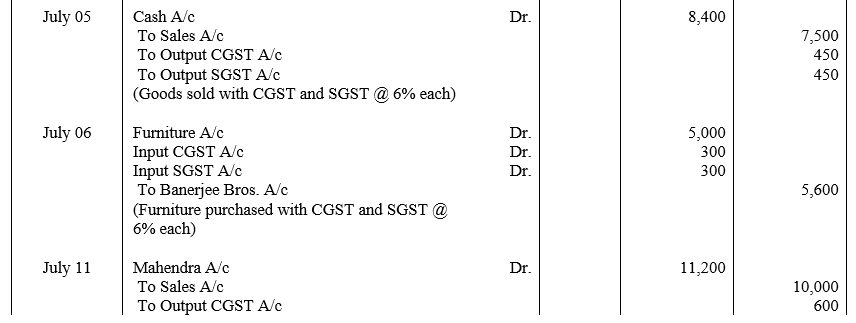
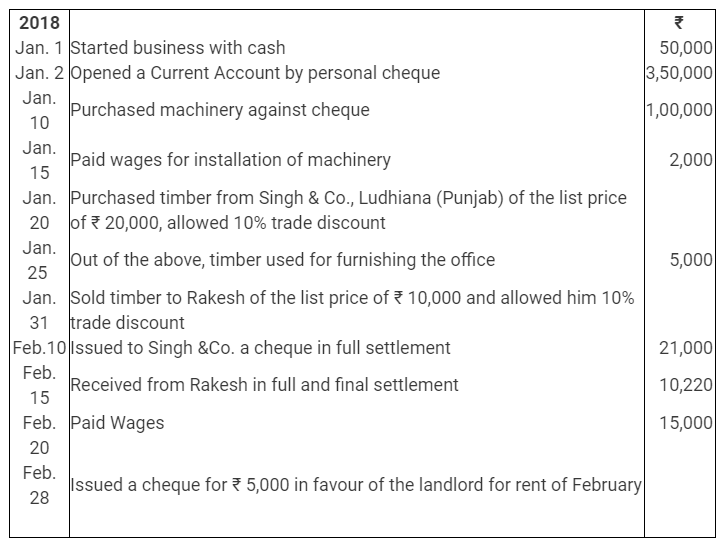
(a) +6 units
(b) 0
(c) -12 units
(d) -1 unit

Answer

Answer: (c) -12 units


9. From the given three fundamental constants, select the combination that gives the dimension of length
(i) Newton’s gravitational constant (G)
(ii) Speed of light in a vacuum (c)
(iii) Planck’s constant (h)
Physical World And Measurement MCQs 1

Answer

Answer: (d) \(\sqrt{\frac{h G}{c^{\frac{3}{2}}}}\)


10. Following are the readings obtained while measuring the diameter of a wire by using the screw gauge0 mm is the main scale reading
52 divisions are the circular scale reading
What is the diameter of the wire if 1 mm on the main scale is equal to the 100 divisions on the circular scale
(a) 0.016 cm
(b) 0.052 cm
(c) 0.15 cm
(d) 0.05 cm

Answer

Answer: (b) 0.052 cm